The Dance of Death: Deciphering the Hidden Gothic Frescoes of Istria’s Rural Churches
Tucked into the limestone hills of the Istrian interior, behind doors that remain locked against the indifferent modern world, some of the most extraordinary Gothic frescoes in all of Europe wait in near-total darkness. Skeleton figures lead popes, emperors, and peasants in a solemn procession across ancient plaster walls; harvest calendars record the rhythm of medieval agricultural life in vivid ochre and cobalt blue. Understanding these painted rooms requires entering a world in which plague, piety, and a radical egalitarianism found their fullest visual expression on the walls of village churches that most travellers never reach.
Key Takeaways
- Istria harbours one of Europe’s most concentrated collections of Gothic fresco cycles, with scholar Branko Fučić’s foundational field survey cataloguing remains at more than 200 sites across the peninsula’s interior villages
- The Dance of Death tradition reached its Adriatic culmination at two masterpiece sites: Beram’s Church of Sv. Marija na Škriljinah (frescoes dated 1474, by Vincent of Kastav) and Hrastovlje’s Church of the Holy Trinity (c. 1490, by Johannes de Castua)
- The Kastav school of painters — centred on the town of Kastav near Rijeka — defined a Venetian-Slavic Gothic synthesis distinct from both Italian and Central European fresco traditions, fusing international iconographic programmes with distinctly local social observation
- Beyond the Dance of Death, Istrian frescoes encode layered iconographic programmes including Calendar of Months cycles, plague saint imagery, Last Judgment panoramas, and Golden Legend hagiographic narratives — each readable through a distinct interpretive lens
- Branko Fučić’s landmark 1963 publication Istarske freske first brought systematic scholarly attention to this heritage, establishing the interpretive framework and site taxonomy still used by researchers today
- Most painted churches are kept locked, requiring advance contact with local key-holders, parish priests, or regional tourist offices — the locked door is itself a defining feature of the Istrian fresco experience
People Also Ask About the Gothic Frescoes of Istria
What is the Dance of Death fresco and what does it depict?
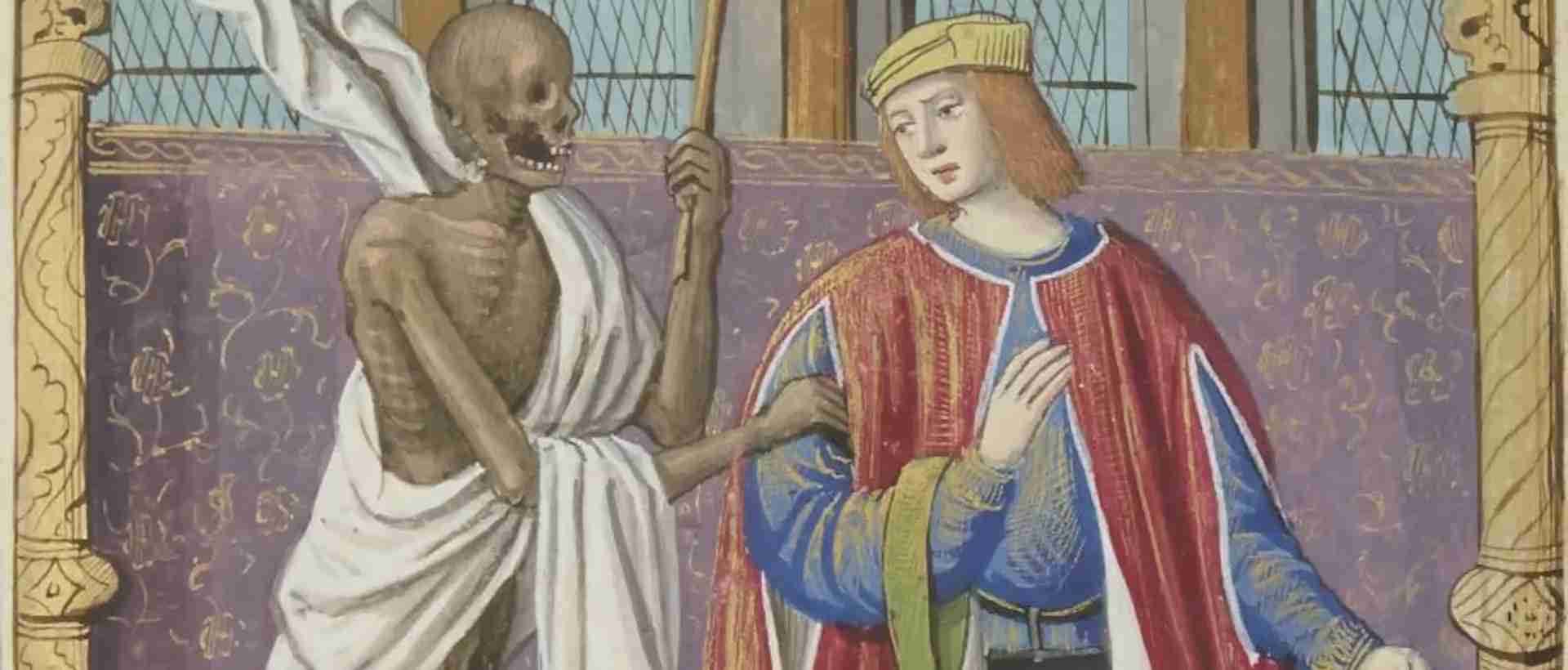
The Dance of Death — Danse Macabre in French, Totentanz in German, Ples mrtvaca in Croatian — is a medieval iconographic tradition representing Death personified as a skeleton or reanimated corpse leading representatives of every social stratum in an irresistible procession toward the grave. The programme asserts the fundamental equality of all human beings before mortality: pope and peasant, emperor and merchant, bishop and knight are summoned in sequence, none able to resist, bargain, or delay their departure. In Istrian examples the procession unfolds along the lower register of the nave wall, skeleton figures alternating with the living in a rhythmic dance. Latin inscriptions identify each mortal figure, and many programmes include speech scrolls recording the protests of the dying. The tradition emerged across Western Europe in the aftermath of the Black Death epidemic of 1347–1351, when the catastrophic death toll of roughly one-third of Europe’s population demanded new ways of representing mortality’s absolute democracy. The Beram Dance of Death (1474) and the Hrastovlje sequence (c. 1490) are among the best-preserved examples in the world and the finest in the Adriatic region — distinguished not only by their state of preservation but by the vivid social realism with which the Kastav painters rendered the living participants.
Where are the most important Gothic fresco churches in Istria?
The two superlative sites are Sv. Marija na Škriljinah at Beram, near Pazin in Croatian Istria, and the Church of the Holy Trinity at Hrastovlje in Slovenian Istria near Koper. Beram preserves a complete fresco cycle by Vincent of Kastav dated 1474, covering nave and chancel with the Dance of Death, a Calendar of Months, scenes from the life of the Virgin, and narrative cycles drawn from the Golden Legend. Hrastovlje offers Johannes de Castua’s c. 1490 programme within a fortified Romanesque church, including a celebrated Dance of Death sequence extending around the entire lower register of the nave and a richly detailed agricultural calendar overhead. Beyond these two masterpieces, significant fresco remains survive at Draguć (the Church of Sv. Rok, with a notable Annunciation cycle), Oprtalj (St. Roch), Paz, Gologorica, Roč, and Sv. Petar u Šumi, as well as at dozens of lesser-known hill chapels scattered through the interior. Each site occupies a different position on the spectrum of preservation, accessibility, and iconographic interest — together they constitute an outdoor museum of Gothic painting that has no real equivalent in the region.
Who were the painters of Istria’s Dance of Death frescoes?
The two painters most closely associated with the Istrian Dance of Death are Vincent of Kastav (Vincentius de Kastua) and Johannes de Castua (Ivan iz Kastva). Both derive their appellations from the hill town of Kastav near Rijeka on the Kvarner Gulf, which appears to have served as the base for a workshop tradition active across the second half of the fifteenth century. Vincent signed and dated the Beram cycle in 1474; Johannes signed the Hrastovlje cycle, which stylistic and documentary evidence places around 1490. The precise relationship between the two painters — whether master and apprentice, older and younger members of the same family, or independent practitioners of a shared regional workshop tradition — remains actively debated in Croatian and Slovenian art historical scholarship. Both operated within a Venetian Gothic stylistic framework that they adapted to local social and theological conditions, producing imagery simultaneously European in convention and distinctly Istrian in social observation. The vivid realism of their peasant figures, the local detail of their agricultural scenes, and the confident handling of large-scale narrative composition mark them as painters of genuine originality working at the edge of the European world they nonetheless fully inhabited.
How can visitors access Istria’s locked painted churches?
Access to most of Istria’s painted churches requires advance planning and local knowledge. The Beram church — Sv. Marija na Škriljinah — is kept permanently locked; the key-holder lives in the village of Beram itself and is reachable during daytime hours, with contact information posted at the church door and available from the Pazin tourist office. The Hrastovlje church in Slovenia operates structured opening hours and is accessible independently or through the local community centre — the more straightforward of the two to visit. For lesser-known sites across the Croatian and Slovenian interiors, the Croatian Conservation Institute, regional heritage offices, and parish priests serve as the best points of contact. Visitors should carry cash for customary voluntary entry donations, dress modestly as these are active places of worship, and build flexibility into their itineraries — contact arrangements sometimes require multiple attempts, and returning the following morning is a routine part of fresco exploration in interior Istria. The effort required is, in every sense, part of the experience: the locked door maintains the atmosphere of discovery that gives these churches much of their power.
Extended multi-day tours – 5+ days
Featured Istria Multi-Day Tour Packages

3 days
Istria 3-Day Discovery Tour
- ✓ Comprehensive Istria experience
- ✓ Expert local guides included
- ✓ All accommodation included
- ✓ Transportation provided

5 days
Istria 5-Day Highlights Experience
- ✓ Comprehensive Istria experience
- ✓ Expert local guides included
- ✓ All accommodation included
- ✓ Transportation provided

7 days
Istria 7-Day Cultural Journey
- ✓ Comprehensive Istria experience
- ✓ Expert local guides included
- ✓ All accommodation included
- ✓ Transportation provided

10 days
Istria 10-Day Complete Adventure
- ✓ Comprehensive Istria experience
- ✓ Expert local guides included
- ✓ All accommodation included
- ✓ Transportation provided
Multi-day tour packages powered by TourRadar. Prices and availability subject to change.
The Painted Interior: Istria as Medieval Europe’s Hidden Gallery
The Istrian Peninsula juts southward into the northern Adriatic from the junction of the Italian, Slovenian, and Croatian worlds, a triangular limestone plateau whose coastal towns were dominated for centuries by Venice while its hilly interior — known historically as Istria grigia, grey Istria — followed a different cultural rhythm altogether. It is the interior that concerns us here: a landscape of modest hilltop villages, Romanesque and Gothic parish churches, and scattered chapels serving agricultural communities whose history stretches from Roman colonisation through Byzantine administration, Carolingian incorporation, Patriarchate of Aquileia ecclesiastical authority, and the complex overlapping jurisdictions of Venice, the Habsburgs, and local nobility that defined the late medieval and early modern centuries.
In this interior, between roughly 1350 and 1550, a remarkable tradition of Gothic fresco painting flourished. Workshop painters — some local, some itinerant from the Friulian and Kvarner workshops to the north and east — covered the walls and vaults of village churches with programmes of extraordinary ambition and variety. Branko Fučić, the Croatian art historian who devoted his scholarly career to cataloguing and interpreting this heritage, identified fresco remains at more than 200 sites across the peninsula in his fieldwork of the 1950s and 1960s. The density of the tradition has no parallel in the region: not in Friuli, not in Carinthia, not in Dalmatia. Interior Istria was, in the Gothic centuries, a remarkable concentration of painted rooms.
The reasons are multiple and interlocking. The Patriarchate of Aquileia, which held ecclesiastical authority over much of Istria until 1751, was both a patron of art in its own right and a conduit through which Italian artistic influence — and Italian iconographic programmes — reached the interior communities. Venice’s coastal dominance meant the sea routes that brought silks and spices north also brought panel paintings, manuscript illuminations, and trained artisans. Local guilds and confraternities, enriched by the agricultural surplus of an intensively cultivated landscape, had both the means and the theological incentives to commission the painting of their parish churches. And above all the catastrophe of the Black Death — which struck Istria as it struck the rest of Europe in 1348 — created a new urgency around the visual representation of mortality, penitence, and divine judgement that the Gothic fresco tradition was perfectly equipped to satisfy.
The frescoes that survive from this efflorescence — despite five centuries of humidity, agricultural smoke, biological growth, and deliberate whitewashing under Counter-Reformation iconoclasm — constitute a body of work that repays scholarly attention at every level of analysis. Iconographically, they preserve programmes that have been lost or severely damaged elsewhere. Socially, they record the faces, costumes, tools, and seasonal labours of a medieval peasant world with a directness that court and ecclesiastical art consistently avoided. Theologically, they articulate positions on death, judgement, hierarchy, and salvation that illuminate the inner life of communities left largely invisible by documentary sources. And technically, they represent the remarkable accomplishment of painters working at significant remove from the metropolitan centres of European Gothic art who nonetheless produced work of the highest quality.
The Gothic Fresco Tradition of Istria: Origins, Patronage, and Cultural Context
The Black Death and the Birth of Dance of Death Imagery
The Dance of Death as an iconographic programme is inseparable from the catastrophe of the mid-fourteenth century. When the plague arrived in Europe in 1347 — carried along the Genoese trade routes from the Black Sea — it killed with a speed and indiscriminateness that dismantled existing frameworks for understanding mortality. The traditional ars moriendi, the medieval art of dying well, had assumed a relatively ordered confrontation between the individual soul and divine judgement at the end of a natural lifespan. The plague killed infants and bishops, merchants and monks, the virtuous and the sinful with equal enthusiasm, in days rather than years. The theological and representational crisis this created demanded a new visual language.
The Dance of Death was that language. Its earliest known painted manifestation appeared in Paris around 1424, in the charnel-house cloister of the Cemetery of the Holy Innocents — a location already saturated with the physical presence of death. The Paris programme, known through later copies before its destruction, showed Death leading a procession of figures from every rank of society across the walls of a space where bones lay literally piled. The message was explicit, even brutal: rank, wealth, learning, and sanctity offered no exemption. The procession of the dead included a pope, an emperor, a cardinal, a king, a patriarch, a constable, an archbishop, a knight, a squire, a physician, an advocate, a priest, a merchant, a monk, a gentleman, a sergeant, a citizen, a monk of Cîteaux, a Carthusian, a sergeant-at-arms, a monk of Cluny, a minstrel, a canon, a lawyer, and a physician — a social panorama of fourteenth-century European life rendered in the service of theological argument.
From Paris the theme spread rapidly across Europe. German and Swiss examples proliferated through the fifteenth century; Italian painters produced parallel meditations under the related theme of the Triumph of Death, from the magnificent lost fresco of the Camposanto in Pisa to the Clusone programme of 1485. The Adriatic rim received the tradition through both the Venetian commercial and artistic networks that connected the northern Adriatic to metropolitan Italian production, and through the Central European Totentanz tradition that came south through the Alpine passes. Istria sat at the intersection of these two currents, and it was in Istria that the tradition achieved one of its most complete and best-preserved expressions.
Venetian Commerce and Cultural Exchange in the Istrian Hinterland
The cultural geography of late medieval Istria was defined by the productive tension between a Venetian-dominated coast and a substantially Croatian and Slavic-speaking interior. Venice held the coastal towns — Poreč, Rovinj, Pula, Koper — and exercised nominal suzerainty over much of the peninsula, but the interior villages were governed by local lords, organized under the ecclesiastical authority of the Patriarchate of Aquileia, and populated by communities whose language, customs, and cultural orientation differed substantially from the Italian-speaking urban coast.
This was not isolation. The interior was thoroughly connected to the broader world through trade routes, ecclesiastical networks, and the movement of itinerant artisans. Olive oil, wine, and grain moved from the interior to coastal markets; Italian merchant cloth, ceramic wares, and manuscript productions moved in the opposite direction. Painters travelling between commissions in Friuli, the Venetian Terraferma, and the Kvarner Gulf regularly passed through the Istrian interior, leaving workshops that absorbed Italian Gothic conventions while producing imagery that reflected the social and agricultural realities of the communities they served. The result was a fresco tradition simultaneously cosmopolitan in iconographic ambition and intensely local in social observation — European in its Death and its saints, Istrian in its peasants and its harvests.
The Workshop System: Itinerant Painters and Ecclesiastical Patrons
Medieval fresco painting in Istria was produced by itinerant workshops operating on commission. Painters did not maintain fixed studios awaiting clients; they moved between commissions, sometimes covering considerable distances, bringing portable equipment — pigments ground and stored in bladders, sketch books of iconographic models, perhaps preparatory drawings on paper or parchment — and applying their craft to the freshly prepared plaster of newly built or newly renovated church interiors. The technical vocabulary of their work, buon fresco (painting into wet lime plaster) supplemented by secco additions (painting onto dry plaster with a binding medium), was standard across the Gothic fresco tradition of northern Italy and the Alpine regions, transmitted through the workshop apprenticeship system.
Patronage came from multiple sources operating simultaneously. Local nobility and the knightly class (the castellani of interior Istrian fortified settlements) funded programmes that included heraldic imagery alongside religious content. Confraternities — the lay religious brotherhoods that organised communal devotional life in medieval parishes — commissioned specific devotional programmes, particularly imagery of plague saints and penitential iconography, as collective acts of piety. Parish communities funded ongoing programmes of decoration over multiple generations, with different hands and different campaigns visible in the archaeological stratigraphy of surviving fresco layers. The result, in the best-preserved churches, is a complex accretion of artistic campaigns that rewards careful reading.
The Dance of Death: Reading a Medieval Wall
European Origins of the Danse Macabre
The iconographic convention of the Dance of Death synthesised several pre-existing medieval traditions about death, social equality, and the memento mori. The legend of the Three Living and Three Dead — in which three noblemen riding to the hunt encounter three decomposing corpses who deliver the message “we were as you are; as we are, you will be” — provided an important precedent, as did the sermon tradition of the ars moriendi, the art of dying, which had generated extensive textual and visual material since the fourteenth century. The innovation of the Dance of Death was its systematic social panorama: rather than confronting a single representative mortal with death, it staged the universal encounter by moving through the entire social hierarchy from the highest ecclesiastical and secular ranks to the lowest, constructing a comprehensive image of society precisely in order to cancel it.
The literary Dance of Death — poems in which Death addresses each figure and each figure responds — developed in parallel with the pictorial tradition, and the two influenced each other continuously through the fifteenth century. German humanist poets, French court writers, and Italian vernacular authors all produced versions; the printed editions of the late fifteenth century, particularly the Basel Dance of Death woodcuts associated (probably incorrectly) with Hans Holbein the Younger but certainly disseminated widely, helped standardise the iconographic programme across European painting traditions.
The Iconographic Convention: Skeletons, Hierarchy, and Inscription
In its developed form, the Dance of Death fresco follows a consistent formal convention. A procession of alternating skeleton and living figures extends along a horizontal register — the lower zone of the nave wall where it is most immediately visible to the standing congregation. Each skeleton figure is paired with a living counterpart; the skeleton advances with evident energy — dancing, playing music, gesturing toward the tomb — while the living figure recoils, gestures in protest, or has already begun to follow. The pairing is the iconographic engine of the programme: death is not passive or distant but active, intimate, and already present beside every living person.
The social hierarchy of the living figures runs from the highest ranks downward: pope, emperor, cardinal, king, queen, bishop, knight, merchant, and concludes at the level of the peasant, the child, and sometimes the infant. The inclusiveness of the programme is theologically deliberate — no rank secures exemption. Latin inscriptions identify each figure by their social role, and speech scrolls or banderoles frequently carry the words of both Death and the mortal: Death invites; the mortal protests; the procession moves on regardless.
Musical iconography is a constant element: skeleton figures frequently carry fiddles, bagpipes, drums, or shawms, and the “dance” of the title is not merely metaphorical but explicitly musical — Death is a musician playing the tune to which the living are compelled to move. This detail carries theological freight: the dance recalls the medieval tradition of chorea as a figure for the loss of rational self-control, and the music of Death inverts the festive music of the living world.
What Makes the Istrian Dance of Death Distinctive
The Istrian examples — primarily Beram and Hrastovlje — share the European convention while departing from it in significant ways that define the Kastav school’s achievement. First, the social realism of the living figures is exceptional by the standards of the period. While French and German examples tend toward schematic, heraldically clear representations of each rank, the Kastav painters rendered their figures with physiognomic individuality and costume detail that reads as portraiture of a social type rather than mere symbol. The merchant at Beram wears specific contemporary dress; the peasant’s tools and posture are those of an observed human being, not a generic placeholder.
Second, the integration of the Dance of Death into a broader iconographic programme that includes the Calendar of Months — an explicit representation of the agricultural year — gives the Istrian frescoes a social coherence that isolated Dance of Death programmes lack. Death is not presented in abstraction but in specific relation to the world of seasonal labour and peasant existence that surrounds it. The skeleton leading the peasant from the harvest field is part of the same world as the peasant threshing grain in the calendar cycle on the adjacent wall: mortality is embedded in the agricultural year rather than inserted from outside it.
Third, the scale and ambition of the complete programmes — at Beram in particular, where the entire church interior is covered with interconnected narrative and thematic cycles — places these frescoes in a different category from isolated Dance of Death representations. They are total programmes, conceived as integrated visual arguments, not collections of individual images.
Beram’s Church of Sv. Marija na Škriljinah: The Masterpiece of 1474
Vincent of Kastav and the Commission
The Church of Sv. Marija na Škriljinah (St Mary on the Slabs, a toponym referring to the limestone plateau on which the church stands) sits on a gentle rise outside the village of Beram, approximately six kilometres from the town of Pazin in central Croatian Istria. The building is a modest Gothic single-nave structure with an apse, entirely unremarkable in its exterior — whitewashed limestone walls, a simple bell tower, locked wooden doors — giving no hint of what lies inside. This is, in the concealing tradition of the Istrian fresco church, precisely the point.
In 1474, a painter who identified himself in an inscription as Vincentius de Kastua — Vincent of Kastav — completed the fresco cycle that covers every surface of the interior. The inscription, which names the painter and the date, is itself an act of professional identity unusual in the context of anonymous village fresco production: Vincent understood his work here as a signature achievement. The commission almost certainly came from the local community — a combination of parish congregation, confraternity patronage, and possibly a contribution from the local nobility associated with the nearby fortified settlement of Beram. The scale of the programme, covering nave walls, chancel arch, apse, and vault, implies substantial resources and a commitment to comprehensive decoration rather than piecemeal addition.
Vincent brought to Beram a vocabulary formed in the Italian Gothic tradition transmitted through the Venetian and Friulian workshops active across the northeastern Adriatic. His handling of architectural space within the painted field — the arched frames that organise narrative cycles, the Gothic canopy structures above individual figures — reflects metropolitan conventions. But his figure types, his landscape backgrounds, and above all his social observation belong to a tradition of vernacular realism that has no close Italian parallel. Vincent was not a provincial craftsman imitating his betters; he was a painter working in a distinct idiom that took Italian Gothic as its formal grammar while developing a vocabulary of his own.
The Dance of Death at Beram: A Section-by-Section Reading
The Dance of Death at Beram occupies the lower register of the north wall of the nave, extending for the full length of the wall in a horizontal frieze of extraordinary vitality. The procession opens with Death playing the bagpipe — a distinctly local instrument choice that grounds the European convention in Istrian musical culture — and proceeds through the social hierarchy in the standard descending sequence.
The papal figure is among the most compelling in the cycle. The pope wears full liturgical vestments, triple tiara, and carries the keys of St Peter; his skeleton counterpart reaches toward him with an intimacy that borders on physical urgency. The pope’s expression — readable even after five centuries — communicates not terror but a kind of resigned acceptance shading toward dignity, as if the papal office itself demands a certain composure even at this ultimate moment. The contrast with the merchant figure, several positions further down the hierarchy, is deliberate: the merchant reaches for his money bags with a gesture that reads simultaneously as a refusal to abandon earthly wealth and a recognition of its futility.
The lower ranks of the procession — craftsmen, peasants, a nursing mother — are where Vincent’s social observation achieves its greatest intensity. The peasant figure carries the specific tools and wears the specific clothing of a fifteenth-century Istrian agricultural worker; the visual connection between this figure and the peasants depicted in the adjacent Calendar of Months cycle is not incidental but programmatic. The Dance of Death at Beram is addressed specifically to the community that worshipped in this church, not to an abstract humanity.
The inscriptions that run below the figures are in Latin — the language of liturgy and scholarship — but their content is designed for the semi-literate or visually literate congregation that read images more fluently than texts. The speech of Death is confident, almost jocular; the speech of the living is a repertoire of human excuses — I was just getting started; my children need me; I have important business; I am not ready — that the congregation would have recognised as their own inner voice.
The Calendar Cycle: Agricultural Life in Gothic Paint
On the north wall above the Dance of Death, and continuing across the nave, Vincent painted a Calendar of Months cycle that represents one of the most detailed and vivid records of medieval Istrian agricultural life in any medium. Each month occupies a roughly equal panel, framed within a painted architectural border, and depicts the dominant agricultural or festive activity of the season rendered with the same social specificity that distinguishes the Dance of Death figures.
January shows a fur-clad figure feasting at a laden table, warming himself at a fire — the interior domestic scene that marks the pause in the agricultural year. February depicts the pruning of the vine, a task specific to the calendar of the Mediterranean agricultural zone and rendered with the precision of a painter who had watched the work being done. March shows plowing with oxen, the preparation of fields for spring sowing, with the specific yoking arrangement and plow type of the Istrian tradition visible in careful detail. June gives haymaking; July the grain harvest; August threshing on the stone floor; September the grape harvest with figures carrying baskets of grapes in postures that recur in Istrian viticultural practice today; November the slaughter of the pig, that essential act of peasant provisioning before winter; December the feast that consumes what has been stored.
The theological significance of the Calendar cycle in combination with the Dance of Death is not decorative but argumentative. Time — the cycle of the agricultural year — is the medium through which mortality operates in the life of the peasant community. Death comes not as an interruption of life but as the completion of a cycle. The Calendar and the Dance of Death together construct a coherent vision of human existence: labour, season, feast, and death as continuous and interconnected realities.
The Narrative Cycles: Golden Legend and Marian Imagery
The remainder of the Beram programme is occupied by narrative cycles drawn primarily from two sources: the life of the Virgin Mary, and the hagiographic narratives of the Legenda Aurea (Golden Legend), the thirteenth-century compendium of saints’ lives by Jacobus de Voragine that served as the primary iconographic sourcebook for medieval Western religious painting. The apse presents a hierarchically arranged programme of sacred figures with Christ in Majesty at its apex; the chancel arch carries scenes of the Annunciation and Nativity; the nave walls, above and adjacent to the calendar and Dance of Death, present narrative cycles including the Three Magi, scenes from the Passion, and episodes from saints’ lives.
St Sebastian, pierced by multiple arrows, appears prominently — the arrows reading as the plague “arrows of God” that had devastated Istrian communities in multiple epidemic waves across the fourteenth and fifteenth centuries. St Roch, the plague pilgrim-saint who is depicted showing his wound and accompanied by the dog who brought him bread during his illness, is another constant presence in Istrian fresco programmes of this period. The frequency of plague saints in the Beram and wider Istrian tradition is not iconographic convention but biographical testimony: these communities had direct, living memory of epidemic mortality when these frescoes were painted.
Reaching Beram and Accessing the Church
Beram is a small village approximately six kilometres northwest of Pazin, reached by secondary road from the main Pazin-Poreč route. The Church of Sv. Marija na Škriljinah stands slightly outside the village on the road toward the settlement; it is signed from the village centre. The church door is locked, and access is obtained through the key-holder who lives in Beram village — a contact whose details are posted on the church door and available from the Pazin tourist information office. The arrangement is informal but reliable during reasonable daytime hours; arriving in mid-morning or mid-afternoon and asking at houses near the church is the standard approach for visitors who have not pre-arranged access.
Photography inside the church is permitted, and the quality of light — particularly from the small south-facing windows — makes midday visits optimal for the Dance of Death register on the north wall. A voluntary donation to the parish is customary and appropriate. The church is a pilgrimage destination as well as a heritage site, and visitors should enter with the awareness that it remains an active place of worship.
Hrastovlje’s Church of the Holy Trinity: Dance of Death in a Fortified Romanesque Shell
Johannes de Castua and the c. 1490 Cycle
The Church of the Holy Trinity at Hrastovlje stands in the Slovenian Karst, in what is now the municipality of Koper in southwestern Slovenia, approximately fifteen kilometres from the sea. Geographically and historically, the site belongs to the Istrian world — it lies within the broader Istrian Peninsula and its fresco tradition connects directly to the Kastav school active across the Kvarner-Istrian region — but politically it is Slovenian territory and has been since the post-war reorganisation of the 1940s and 1950s. This dual identity (Istrian in heritage, Slovenian in administration) is characteristic of the peninsula’s complex political geography and should not detain the visitor from the main point: Hrastovlje is among the most important Gothic fresco sites in the entire Adriatic world.
The church is a three-nave Romanesque structure of early medieval origin, substantially enlarged and vaulted in the Gothic period. Its most distinctive external feature is the high defensive wall that surrounds it on all sides — a fortification added in the fifteenth or early sixteenth century in response to the Ottoman raids that regularly penetrated the Kvarner and Istrian hinterland in this period. The fortified churchyard gives Hrastovlje a distinctive skyline visible for considerable distances across the flat Karst plateau, and the combination of Romanesque architecture, Gothic vault, and defensive perimeter produces an ensemble of unusual architectural character.
The fresco programme was executed by a painter who identified himself in an inscription as Johannes de Castua — Ivan iz Kastva in Croatian — and the cycle is dateable to around 1490. Johannes worked across the entire interior surface: nave walls, pilasters, barrel vaults of the side aisles, and triumphal arch. The programme is encyclopaedic in ambition, covering the Dance of Death, a Calendar of Months, scenes from the Book of Genesis, narrative cycles from the New Testament, and a Last Judgment. The scale of the achievement — a complete theological programme covering every available surface — is without parallel in the immediate region and comparable to the great programme churches of Friuli and Carinthia.
The Dance of Death at Hrastovlje: Reading the Procession
The Dance of Death at Hrastovlje extends around the lower register of the nave walls in a procession that includes representatives of every social rank from the pope to the infant. The sequence is more formally hierarchical than the Beram programme, and the skeleton figures — which are rendered with a graphic skeletal clarity that differs somewhat from Beram’s more painterly approach — engage each mortal in a direct, individual confrontation rather than a general procession movement.
The papal figure at Hrastovlje is depicted at the moment of actual physical seizure: the skeleton grasps the pope’s arm with a directness that emphasises mortality as a tactile, physical event rather than a symbolic transition. The emperor, immediately following, wears contemporary Central European court dress of the late fifteenth century — a detail of historical costume that places the programme in specific time. The merchant and the money-lender figures carry purses and money bags that the skeleton figures reach toward even as their owners clutch them; the irony of wealth at the moment of death is underscored with a directness that tips toward the satirical.
The programme at Hrastovlje includes several figures not always found in shorter Dance of Death sequences: a Jew (identifiable by the distinctive hat required by contemporary sumptuary legislation), a physician, a scholar, and a hermit, among others. This extension of the social panorama beyond the standard hierarchical types reflects the painter’s desire for comprehensive social coverage — a visual claim that death reaches every human community, including those defined by religious difference or vocational withdrawal from ordinary social life.
The Months Cycle and Peasant Existence
The Calendar of Months at Hrastovlje, painted in the barrel vaults of the side aisles, is the most extensively studied element of the cycle from the perspective of social history and agricultural archaeology. Johannes rendered each month with the same combination of formal typological convention and local observational detail that characterises the Beram programme, but the specific details — the tools, the crop varieties, the postures of labour, the architectural settings of domestic scenes — differ sufficiently from Beram to constitute an independent record of contemporary Istrian agricultural practice.
The June haymaking scene at Hrastovlje is particularly celebrated: it shows multiple workers with scythes, a loaded cart, and a figure spreading hay to dry, rendered in a composition that achieves something close to genre painting — an autonomous representation of agricultural work valued for its own sake rather than merely as theological argument. The September grape harvest, similarly, shows the pressing process in detail that reads as documentation as much as decoration. Historians of medieval agriculture have used these cycles as primary sources for the reconstruction of Istrian farming practice, a use that Vincent and Johannes could hardly have anticipated but that their commitment to observational specificity made possible.
The Fortress Setting and Architectural Context
The fortified perimeter that encircles the Hrastovlje church warrants attention in its own right. The defensive wall, with its corner towers and single gate, was built in direct response to the Ottoman threat — a military reality that cast a long shadow over every community in the northern Adriatic hinterland from the mid-fifteenth century onward. The Ottomans raided as far north as the Istrian interior on multiple occasions; the fortified church provided both a physical refuge and, presumably, a spiritual one. The frescoes within the fortified perimeter can be read in this light: a complete theological programme commissioned by a community that lived under the specific anxiety of violent death from an external enemy, and who surrounded their most sacred space with stone walls against that possibility.
The architectural sequence inside the church — Romanesque nave, Gothic vault, frescoed surfaces — reflects multiple building campaigns across several centuries. The Romanesque structure predates the fresco programme by a significant margin; the Gothic vault, which provides the barrel-vaulted side aisles that Johannes used for his Calendar cycles, represents a medieval upgrading of the earlier shell. The interaction between painted programme and architectural surface is more complex at Hrastovlje than at Beram, requiring the painter to adapt his compositions to curved surfaces and awkward angles that a purpose-designed Gothic church interior would not have presented.
Beyond Beram and Hrastovlje: The Wider Istrian Fresco Landscape
Draguć and the Northern Circuit
Draguć, a hilltop village of considerable atmospheric intensity in northern Croatian Istria, preserves two painted churches that together illustrate the breadth of the Istrian fresco tradition beyond the Dance of Death masterpieces. The Church of Sv. Rok (St Roch) contains a fresco cycle attributed to the sixteenth century that shows significant stylistic divergence from the Kastav school, reflecting later Venetian influence in figure type and compositional organisation. An Annunciation and a Nativity cycle, along with the obligatory representation of the titular saint Roch with his dog and wound, constitute a programme modest in scale but high in quality of execution. The second church, Sv. Elizej, contains Romanesque-period remains of considerable age.
The village of Draguć itself — perched on a narrow limestone ridge with the Mirna Valley visible far below — provides one of the most visually compelling settings for a fresco church in the entire region. The combination of medieval architecture, dramatic natural landscape, and near-total absence of contemporary intervention makes a visit to Draguć an experience in temporal displacement that the painted interiors intensify further.
The Churches of Central Istria
The area around Pazin, the administrative centre of central Croatian Istria, is dense with fresco sites. The Church of Sv. Marija Magdalena at Baderna preserves a modest programme with scenes of the Magdalene’s life in a competent but anonymously executed style. The hill town of Pićan (Pedena), historical seat of a bishopric, retains fragments of older fresco cycles in its cathedral interior. Gologorica, a village several kilometres east of Pazin, has a small chapel with Gothic fresco remains that include Calendar cycle fragments showing connections to the broader Kastav workshop tradition. Sv. Petar u Šumi (St Peter in the Forest), a former Pauline monastery, contains an interesting late ensemble of sacred imagery in a setting of considerable woodland beauty.
These secondary sites reward visitors who move beyond the two primary masterpieces. They offer a more nuanced picture of the tradition in its full range — from workshop commissions of high ambition to simpler programmes executed by painters of modest technical formation — and they illuminate the degree to which Gothic fresco production in interior Istria was not an isolated phenomenon of two exceptional churches but a widespread practice embedded in the regular devotional life of the region.
Lesser-Known Chapels and Forgotten Sites
Branko Fučić’s survey documented fresco remains at more than 200 sites — a figure that encompasses everything from complete programmes like Beram and Hrastovlje to a single surviving figure in a whitewashed rural chapel reachable only by unpaved track. The lesser-known tier of this heritage is genuinely extraordinary in its obscurity and, in some cases, in the quality of what it preserves. Roč, a walled village in the northern interior, has a small church with calendar fragments; Oprtalj (Portole), another hilltop settlement near the Mirna valley, preserves fresco remains in multiple church buildings. Paz, Sv. Ivan kod Boruta, and the area around the Mirna valley headwaters all yield painted surfaces to those who seek them out.
The experience of finding a lesser-known site — tracking down the key-holder through a chain of local enquiries, opening a door that opens perhaps once a month, waiting for the eyes to adjust to the interior darkness before the painted surfaces emerge — belongs to a category of travel experience that heritage tourism increasingly struggles to provide: the genuinely unsanitised encounter with the past, in which discovery requires effort and effort is its own reward.
The Kastav School: Defining a Workshop Tradition
Technical Characteristics and Workshop Methods
The technical analysis of Kastav school frescoes reveals a consistent set of workshop practices that help identify the tradition’s productions and distinguish them from other regional schools. The preparation of the plaster support follows standard Italian Gothic practice: a rough base coat (arriccio) was applied first, allowed to dry, and then scored or marked with an incised preparatory drawing (sinopia). The final plaster coat (intonaco) was applied in sections sized for a day’s painting (giornate), visible in the joins at the edges of each day’s work. The quantity of intonaco applied daily was modest by the standards of Italian metropolitan workshops, suggesting a careful, methodical approach rather than the rapid execution of a painter working at industrial scale.
The pigment palette is consistent across Kastav productions. Iron earth pigments — ochres ranging from pale yellow to deep orange-brown, and red iron oxides — provide the warm tonal foundation of the colour scheme. Lead white was used for highlights and light flesh tones. Carbon black mixed with white produced greys. Blue passages — sky zones, certain draperies, the robes of specific sacred figures — were executed with either azurite or a blue prepared from smalt (ground blue glass), depending on the relative availability and cost of materials at the time of execution. The relative scarcity of lapis lazuli, which was prohibitively expensive for rural commission budgets, means that the deep ultramarine blues of metropolitan Italian production are absent from the Kastav palette; the blues are cooler and less saturated, but handled with considerable skill.
Line drawing plays an unusually prominent role in the Kastav pictorial system compared to metropolitan Italian Gothic fresco. Figures are defined primarily through contour rather than modelled through tonal gradation, a choice that connects the tradition to Northern Gothic conventions as much as Italian ones and that gives the frescoes their distinctive graphic energy. The sinuous contour lines — particularly visible in the Dance of Death figures, where the skeletons are rendered in pure line without tonal modelling — are among the most immediately recognisable features of the style.
Vincent and Johannes: Comparing Two Hands
The question of the relationship between Vincent of Kastav and Johannes de Castua is one of the more productive debates in Istrian art history, generating scholarly argument that illuminates the workshop traditions of the region more broadly. The two painters share a locational appellation (both claim Kastav) and a stylistic family resemblance (both work within the same Gothic fresco convention, with similar palette, similar graphic approach to figure definition, and shared iconographic models). But they differ in ways that a close formal comparison makes unmistakable.
Vincent’s figure types at Beram tend toward greater physiognomic individuality and a slightly more plastically modelled treatment of drapery. His compositions are organised with a confidence in spatial recession — the depth implied behind figure groups, the landscape distance in agricultural calendar scenes — that suggests extensive engagement with Italian spatial conventions. Johannes at Hrastovlje produces figures that are somewhat more schematic in physiognomy but compensate with a graphic boldness — particularly in the skeleton figures of the Dance of Death, which are among the most immediately striking images in the entire Istrian tradition — and a monumental sense of scale in his large programme that differs from Vincent’s more episodic narrative approach.
Some scholars have proposed that Johannes was Vincent’s direct pupil, inheriting both the stylistic vocabulary and the iconographic models of the workshop; others argue for two independent practitioners sharing access to common workshop model books without a direct pedagogical relationship. The approximately sixteen-year gap between the dated inscriptions (1474 at Beram; c. 1490 at Hrastovlje) is consistent with either hypothesis. The debate remains unresolved and is unlikely to be settled without documentary evidence that may not survive.
Connections to Friulian and Alpine Fresco Painting
The Kastav school did not develop in isolation. Its pictorial vocabulary reflects sustained engagement with the fresco traditions of the immediately adjacent regions — Friuli to the northwest, Carinthia and Styria to the north, the Venetian Terraferma more broadly — that were producing their own Gothic fresco cycles in the same period. The Friulian tradition, centred on workshops based in Udine, Cividale, and the Tagliamento valley, was particularly close in geographical and commercial terms, and the similarities between certain figure types in Istrian frescoes and those of the Friulian masters point to shared model books, shared training, or direct personal contact.
The Alpine Dance of Death tradition, whose most extensive surviving examples are found in the Carinthian and Styrian church paintings of the fifteenth century, shares with the Kastav school the emphasis on social comprehensiveness and the graphic treatment of the skeleton figure. The precise lines of influence running between these parallel traditions — whether Istrian painters knew Alpine examples directly, absorbed them through intermediary Friulian workshops, or arrived at similar solutions through the shared European convention of the Dance of Death — constitute one of the open questions of regional art historical research. What is clear is that the Kastav school belongs to a northern Adriatic cultural zone that was in active artistic dialogue with both its Italian and its Central European neighbours, absorbing and transforming influences from both directions.
Decoding the Iconographic Programme: Beyond the Dance of Death
Plague Saints Sebastian and Roch: Reading Crisis in Paint
The frequency with which St Sebastian and St Roch appear in Istrian Gothic fresco programmes is a direct index of the epidemic anxiety that pervaded the region throughout the fifteenth century. Sebastian — an Early Christian martyr depicted as a young man tied to a tree or column and pierced by multiple arrows — became the primary intercessor against plague through a theological reading in which the arrows represented the “arrows of God” sent as divine punishment in the form of epidemic disease. Images of Sebastian in this period are not primarily martyrological; they are prophylactic, commissions by communities seeking pictorial insurance against the catastrophe of plague.
Roch is a complementary figure in this devotional system. The saint was a fourteenth-century pilgrim from Montpellier who allegedly contracted and recovered from plague during a journey to Rome, and is depicted in the Istrian tradition consistently in a set of iconographic attributes that identify him to a visually literate congregation: the pilgrim’s cloak and hat, the thigh wound that he exposes to show the buboe of plague, and the dog who brings him bread during his recovery in the forest — an animal that in the iconographic tradition acquired its own quasi-miraculous status. Roch and Sebastian frequently appear together in Istrian frescoes, flanking altars or door openings, functioning as a pair of guardians against the specific threat of epidemic disease.
The Golden Legend in Rural Istria
The Legenda Aurea of Jacobus de Voragine, compiled around 1260, was the most widely disseminated hagiographic compendium of the medieval West and the primary source from which fresco painters drew the narrative content of their saints’ life cycles. In Istrian fresco programmes, the Golden Legend’s influence is pervasive: scenes from the lives of the Virgin, St Anne, St John the Baptist, and the local patron saints of individual churches appear in episodes whose compositional details track the specific narrative formulations of Jacobus’s text as filtered through workshop model books.
The Life of the Virgin programme at Beram, which occupies a substantial portion of the nave walls alongside the Dance of Death and Calendar cycles, draws heavily on Golden Legend narrative for its Apocryphal scenes — the Presentation in the Temple, the Marriage of the Virgin, the Dormition — episodes not found in the canonical Gospels but fully elaborated in Jacobus’s text and deeply familiar to a medieval congregation through liturgical reading and popular devotional practice. The specificity with which Vincent of Kastav rendered these scenes — compositional details, secondary figure types, architectural settings — indicates access to sophisticated iconographic models, whether through workshop model books, panel painting prototypes, or direct acquaintance with metropolitan Italian examples.
Last Judgment Iconography
Last Judgment programmes, occupying the western wall of the nave (the wall facing the congregation as they look toward the altar, but also the wall they face as they depart from the church) are present in several Istrian painted churches, most completely at Hrastovlje. The standard Last Judgment composition, inherited from Byzantine and Romanesque traditions and transformed through Gothic pictorial conventions, shows Christ enthroned in majesty at the apex, flanked by the Virgin and John the Baptist as intercessors; below, the resurrection of the dead from their graves; to Christ’s right, the blessed entering paradise; to his left, the damned being driven toward hell by demons.
The hell mouth — a monstrous gaping jaws into which the damned are herded — is among the most dramatically rendered elements in Istrian Last Judgment imagery, consistent with the tradition’s interest in physical vividness as a vehicle for theological instruction. The specific punishments of the damned, shown in registers descending toward the hell mouth, are distributed according to sin type in ways that reflect the moralistic literature of the period: the avaricious clutch their money bags in the fire; the lascivious are entangled in serpents; the proud are cast down from their heights. The Last Judgment in this context functions as the ultimate extension of the Dance of Death argument: not merely that death is inevitable but that what follows death is determined by the moral quality of the life that preceded it.
Symbolic Calendars and the Agricultural Year
The Calendar of Months, as deployed in the Beram and Hrastovlje programmes, draws on a long tradition in both secular (manuscript illumination, ivory carving) and ecclesiastical (portal sculpture, stained glass) contexts that represents the cycle of the agricultural year as a figure for the passage of time and, by theological extension, for the ordered providence of divine creation. The canonical formulation of the theme — twelve panels, each depicting the characteristic labour of its month — was established in Italian Romanesque portal sculpture and manuscript illumination by the twelfth century and had become a standard element of Gothic monumental decoration by the thirteenth.
What makes the Istrian Calendar cycles distinctive is not their iconographic derivation — which follows the standard programme with predictable fidelity — but the specificity with which the agricultural activities are rendered in terms of local Istrian practice. The vine-pruning of February, the ox-plowing of March, the scything of June, and the grape harvest of September are not generic Mediterranean agricultural scenes but specifically observed renderings of work as it was done in the limestone hills of the Istrian interior in the fifteenth century. Tools, crop varieties, animal breeds, and the physical landscapes of work all carry documentary value that transcends their theological function. The Calendar cycles at Beram and Hrastovlje are, among their many other things, the finest surviving visual records of medieval Istrian agricultural practice.
Conservation: Preserving the Painted Rooms of Istria
Threats to the Fresco Surface
Gothic fresco surfaces are intrinsically vulnerable to the physical conditions of their environment. The lime plaster support responds to moisture with dimensional changes that cause cracking; the salt content of the plaster and the underlying masonry, mobilised by fluctuating humidity, migrates to the painted surface and crystallises as white efflorescence that can lift the pigment layer from its substrate. Biological growth — algae, fungi, and bacteria that colonise the painted surface in the humid interior conditions of many Istrian churches — discolour and chemically degrade the pigment layer over time. And the specific conditions of many Istrian painted churches — unheated rural buildings, seasonal humidity peaks, minimal ventilation — create an environment that accelerates all of these deterioration processes.
The additional threat of deliberate intervention has been historically significant. The Counter-Reformation ecclesiastical policies of the later sixteenth and seventeenth centuries, which discouraged imagery beyond a narrow canonical range in order to combat Protestant criticisms of Catholic image excess, led in many Istrian churches to the whitewashing of fresco programmes that had been painted only a century earlier. The Beram frescoes were protected by their isolation and the continued devotional use of the church; other sites lost substantial or complete programmes under the whitewash. The paradox is that the whitewash, by sealing the painted surface from light and air, sometimes preserved what it concealed: many of the most important fresco discoveries of the twentieth century were made when whitewash was removed from walls assumed to be bare.
Conservation History and Current Approaches
The modern conservation of Istrian frescoes dates from the mid-twentieth century, when the systematic documentation and stabilisation of major sites began under the auspices of Yugoslav cultural heritage institutions. The Hrastovlje fresco programme underwent a major campaign of cleaning, consolidation, and documentation in the 1950s and 1960s, establishing it as the best-documented of the major Kastav school works. Beram was similarly treated, with the consolidation of unstable plaster sections and the documentary photography that now forms the primary record of the programme’s state at that time.
Contemporary conservation approaches applied to Istrian sites combine physical interventions (injection of lime-based grouting behind detached plaster sections, micro-consolidation of pigment layers, controlled removal of biological growth) with environmental management (humidity monitoring, improved ventilation, controlled visitor access) and digital documentation (photogrammetric surveys, multispectral imaging that reveals underdrawing and earlier paint layers invisible to the naked eye). The Croatian Conservation Institute and the Slovenian ZVKDS (Institute for the Protection of Cultural Heritage) are the lead institutions for their respective national territories, with periodic international collaboration on methodology and practice.
Heritage Tourism and the Balance of Access
The tension between heritage access and conservation is particularly acute in the context of Istrian fresco churches. Visitor breath introduces humidity and carbon dioxide; visitor movement disturbs the stable air conditions that the painted surfaces have adapted to over centuries; the presence of artificial lighting, where used, accelerates photochemical degradation of pigments. The locked-door policy maintained at Beram and most other Croatian fresco churches represents a pragmatic resolution of this tension: access controlled through human guardianship is more effective at limiting conservation-threatening visitor behaviour than physical barriers or electronic monitoring systems, and it maintains the social relationship between the frescoes and the communities that own them.
The visitor numbers at the major sites remain modest by the standards of mainstream heritage tourism — Beram does not receive the crowds that would threaten the painted surfaces — but the growth of heritage tourism in Istria more broadly, driven by the peninsula’s increasing popularity as an upmarket rural destination, has increased pressure on the system of informal access that makes the fresco churches accessible at all. The sustainability of that system depends on the continued engagement of local communities as custodians of their own heritage: a social compact that conservation policy in both Croatia and Slovenia has recognised as irreplaceable.
Branko Fučić and the Academic Discovery of Istrian Gothic Art
The 1963 Survey and Its Methodological Legacy
Branko Fučić (1920–1999) was a Croatian art historian, archaeologist, and epigraphist who devoted the central decades of his career to the systematic documentation of medieval art and inscriptions in Istria, Kvarner, and the Dalmatian islands. His 1963 publication Istarske freske (Istrian Frescoes), the result of years of fieldwork in which he personally visited and documented hundreds of churches across the peninsula, established the scholarly foundation on which all subsequent study of the tradition rests. The book combined photographic documentation, technical analysis, iconographic interpretation, and site-by-site cataloguing in a synthesis that was without precedent for the region.
The methodological significance of Fučić’s approach went beyond the specific discoveries it produced. His insistence on first-hand fieldwork — on visiting every church rather than relying on secondary sources or documentary records — led to the identification of fresco remains at sites where no scholarly literature had anticipated them, and to the correction of misattributions and misdatings that had accumulated in the thinner earlier scholarship. His training in epigraphy — the study of inscriptions — gave him the tools to read and interpret the Latin and Glagolitic texts that appear in and around Istrian fresco programmes, a dimension of the evidence that art historians focused exclusively on images had systematically neglected.
Fučić’s later publications, including his comprehensive Glagoljski natpisi (Glagolitic Inscriptions, 1982), extended this interdisciplinary approach to the study of Glagolitic — the medieval Slavic script that was used in Istrian liturgical and epigraphic contexts — producing scholarship that simultaneously illuminated the linguistic history of the region and the cultural context of the fresco tradition he had documented earlier. The two bodies of work together constitute the foundation of modern Croatian medieval art historical scholarship.
Contemporary Scholarship and Ongoing Debates
Scholarship on Istrian Gothic frescoes since Fučić has developed in several directions. Technical art history — the scientific analysis of pigments, plaster, and underdrawing using spectroscopic and multispectral imaging technologies — has added new dimensions to the formal analysis that Fučić’s field documentation made possible, allowing the identification of workshop practices and the sequencing of campaign phases within individual fresco programmes. Croatian and Slovenian scholars, working in both national heritage institutions and university departments, have produced detailed monographic studies of individual sites and specific iconographic problems that deepen the foundational work without replacing it.
The attribution questions surrounding the Kastav school remain the most actively debated area of the field. The precise number and identity of painters associated with the workshop, the question of workshop organisation (family business? guild structure? informal master-pupil chains?), and the geographic extent of the school’s activity continue to generate argument. Connections between the Kastav masters and fresco programmes in the Kvarner islands and on the Croatian mainland south of the Istrian peninsula have been proposed and contested; the possibility of additional signed or datable works attributable to the workshop tradition has not been exhausted.
Social historical and anthropological approaches have increasingly supplemented the art historical, using the frescoes as evidence for the material culture, social organisation, and religious practice of medieval Istrian communities in ways that Fučić’s iconographic approach did not prioritise. The Calendar cycles in particular have attracted attention from historians of medieval agriculture and environmental historians interested in the long-term dynamics of Mediterranean land use. The Istrian fresco tradition, it has become clear, is a resource for multiple disciplines simultaneously.
A Visitor’s Guide to Istria’s Painted Churches
Essential Sites for Dedicated Visitors
Visitors committed to the full scope of the Istrian fresco heritage will find a logical circuit through the peninsula that covers the essential sites in three to five days of dedicated travel, with Pazin as the most convenient base for central and northern Croatian Istria and Koper for the Slovenian sites.
Beram is the indispensable first priority: no other site offers the combination of programme completeness, artistic quality, and primary importance in the tradition that Sv. Marija na Škriljinah provides. Allow at least ninety minutes inside the church — the programme rewards slow reading, and the details of the individual figures repay the attention of a visitor who looks systematically rather than superficially. Hrastovlje is the essential Slovenian counterpart: the fortified setting, the three-nave interior, and the sheer density of the painted programme make it arguably the most visually impressive single experience in the region. Between these two poles, Draguć and the central Istrian circuit (Gologorica, Paz, Baderna area) provide the wider context of the tradition in its full range.
Visitors with more time and a tolerance for the unpredictability of access at lesser-known sites will find rewarding material along the Mirna valley, in the area around Roč and Oprtalj, and in the numerous village churches of the limestone plateau between Poreč and Pazin. The experience of fresco-hunting in interior Istria — tracking down key-holders, opening locked doors, adjusting to darkness — is experientially distinct from visiting the primary masterpieces and constitutes a different but complementary form of heritage encounter.
Access Protocols: Keys, Guardians, and Parish Contacts
The system of access to Istrian painted churches requires an investment of planning that pays dividends in the quality of the visit. For Beram, the starting point is the Pazin tourist information office (located centrally in Pazin), which maintains current contact information for the key-holder and can often facilitate the initial contact. Arriving in the village of Beram itself and making enquiries at nearby houses is a reliable alternative approach; the key-holder is a permanent resident and the arrangement is well-established. For Hrastovlje in Slovenia, current opening hours and contact information are available from the Koper regional tourist board; the church operates more formal access arrangements and is considerably easier to visit independently than most Croatian sites.
For sites beyond the primary two, the most reliable approach is advance contact with the Croatian Conservation Institute’s Pula office and with the parish offices (župni ured) of the relevant administrative parishes, which can identify key-holders and in some cases arrange advance access. The network of contacts maintained by specialist heritage tourism operators in Istria represents another route: several operators working in the region have established relationships with key-holders across the peninsula and can facilitate access to sites that would be genuinely difficult to reach independently.
Regional tourist offices in Pazin, Poreč, Motovun, Buzet, and Rovinj all maintain documentation of nearby fresco sites and can provide starting-point information. The Croatia Tourism Board’s heritage tourism resources include site listings that, while not always current, provide a useful framework for planning a comprehensive circuit.
Practical Preparation: Photography, Timing, and Etiquette
Photography of Istrian fresco programmes is permitted at virtually all sites, subject to the condition — sometimes stated, sometimes implied by the context — that flash photography is not used. Flash causes photochemical degradation of the inorganic pigments that make up Gothic fresco colouring and is universally discouraged by conservation authorities. The quality of available light at most sites is sufficient for handheld photography with a camera capable of reasonable ISO performance; a tripod, if the key-holder permits its use, enables longer exposures that allow genuinely low ISO, high-quality captures of the painted surfaces.
Morning visits are optimal for churches with east-facing windows; midday for north-wall programmes like the Beram Dance of Death, which receives its best light from the south-facing clerestory windows in the middle of the day. Late afternoon light, when it enters west-facing openings, can be dramatically beautiful but creates strong raking shadows that complicate documentary photography while enhancing the atmospheric quality of the visit.
The conventions of behaviour appropriate to a working church apply throughout: conservative dress (shoulders and knees covered), quiet movement, no food or drink inside the building, and respectful treatment of the guardian’s time. Voluntary cash donations to the parish — placed in a dedicated collection box — are the standard mechanism for supporting the maintenance of these buildings, and contributions should be generous relative to the significance of the heritage being accessed. The locked churches of interior Istria remain open to visitors in large part because local communities continue to maintain them; the social compact that makes access possible deserves the visitor’s active support.
Frequently Asked Questions About Istria’s Gothic Frescoes
How many Gothic fresco sites survive in Istria?
Branko Fučić’s systematic fieldwork catalogued fresco remains at more than 200 sites across the Istrian Peninsula. This figure encompasses a wide range of preservation states, from complete programme churches like Beram and Hrastovlje to isolated fragments — a single surviving figure, a remnant of a border pattern — in otherwise whitewashed or ruined buildings. The number of sites with substantial, iconographically readable programmes is significantly smaller: perhaps two dozen churches offer enough surviving material to repay serious study. The number continues to evolve as conservation surveys identify previously unknown sites beneath later plasterwork and as the condition of known sites changes over time.
What distinguishes the Istrian Dance of Death from French and German examples?
The Istrian Dance of Death, as realised by the Kastav school, differs from French and German examples primarily in its integration into comprehensive iconographic programmes (rather than standing as an isolated monument), its combination with the agricultural Calendar of Months cycle (giving mortality an explicitly seasonal context), the social realism with which the living figures are rendered (specific rather than generic, observed rather than schematic), and its adaptation to a Venetian-Slavic cultural context that produces different costume details, different landscape settings, and a different social panorama from the court-centred French tradition or the guild-dominated North German examples. The graphic treatment of the skeleton figures — emphasising line over tonal modelling — connects the Kastav school more closely to Northern Gothic conventions than to Italian ones.
Is Hrastovlje in Croatia or Slovenia?
Hrastovlje is located in the Republic of Slovenia, in the municipality of Koper in the Slovenian Littoral. Geographically and historically it lies within the broader Istrian Peninsula, whose southern portion was administered under Yugoslav federalism as part of Slovenia rather than Croatia, and was definitively assigned to Slovenia with the dissolution of Yugoslavia in 1991. The fresco tradition it preserves belongs to the Kastav school, whose activity centred on the Kvarner-Croatian region; the church’s heritage is fully shared between Croatian and Slovenian scholarship. Practically, this means Hrastovlje falls under the jurisdiction of the Slovenian Institute for the Protection of Cultural Heritage and is accessible through Slovenian tourist infrastructure centred on Koper.
What are the main threats to the survival of Istrian frescoes?
The primary physical threats are moisture-related: rising damp from the ground, condensation from temperature fluctuation, and the salt crystallisation that mobilised moisture carries to the painted surface and deposits as efflorescence that can detach the pigment layer. Biological growth — algae, lichens, and fungal colonies that colonise surfaces in the warm, humid conditions of unheated rural churches — represents a secondary but significant chemical threat. Structural movement in the masonry substrate, particularly in buildings that have received minimal maintenance, causes cracking that disrupts the painted surface. The systemic threat is depopulation of the villages that own these buildings: as communities shrink, the social networks that maintain key-holder access, perform basic building maintenance, and ensure a continuing human presence around the churches become fragile.
What is the Glagolitic connection to Istrian fresco heritage?
Glagolitic, the medieval Slavic script developed by Saints Cyril and Methodius in the ninth century, maintained continuous liturgical use in the Croatian-speaking interior of Istria long after it had been displaced by Latin or Cyrillic in other regions — a distinctive feature of Istrian ecclesiastical culture that persisted into the early modern period. Glagolitic inscriptions appear in and around several painted churches, sometimes carved into the fabric of the building, sometimes painted alongside or within fresco programmes. The Roč area is particularly rich in Glagolitic epigraphic material. Branko Fučić’s expertise in Glagolitic epigraphy — which he applied systematically alongside his fresco documentation — established the connections between the script tradition and the painted tradition as a dimension of Istrian medieval culture requiring integrated analysis.
How do the Istrian Calendar cycles compare to other medieval calendar traditions?
The Calendar of Months cycles at Beram and Hrastovlje belong to a European tradition of monumental calendar representation with deep roots in Romanesque portal sculpture (the facades of Ferrara cathedral and the Baptistery at Parma are paradigmatic Italian examples) and manuscript illumination (the Très Riches Heures du Duc de Berry is the most celebrated northern example). What distinguishes the Istrian examples is their combination of complete programmatic ambition (both present all twelve months in readable condition) with a degree of agricultural and social specificity that exceeds most Italian examples and rivals the detail of the finest northern illuminated manuscripts. Historians of medieval agriculture regard the Beram and Hrastovlje calendars as primary source material for the reconstruction of fifteenth-century Istrian farming practice, a documentary value that complements their considerable artistic significance.
Were there female patrons or subjects in Istrian fresco programmes?
Female figures appear in Istrian fresco programmes both as subjects of devotional imagery and, implicitly, as members of the communities for whom these programmes were created. The Dance of Death sequences include female social types — queen, abbess, countess, and nursing mother among them — acknowledging that the egalitarianism of mortality extended across gender as much as across social rank. Marian programmes, present at Beram and in numerous other churches, placed female spiritual authority at the centre of the iconographic scheme. Documentary evidence for female patronage of specific Istrian fresco commissions is sparse, as it is for most medieval patronage outside elite contexts, but confraternity membership records from the region indicate active female participation in the lay religious organisations that were among the primary commission agents for village church decoration.
What scholarly resources exist for visitors wishing to study Istrian frescoes further?
Branko Fučić’s Istarske freske (1963, Zagreb: Zora) remains the foundational scholarly resource and is available in Croatian and Italian editions. His broader monographic output on Glagolitic epigraphy and medieval Croatian art provides essential context. The journal Peristil, published by the Croatian Society of Art Historians, has carried numerous articles on specific Istrian sites and attribution questions. The publications of the Croatian Conservation Institute (Godišnjak zaštite spomenika kulture Hrvatske) include technical conservation reports on individual sites that serve as primary documentation of their physical state. In English, the scholarship is thinner, but survey treatments of Gothic painting in the northeastern Adriatic region appear in broader studies of Venetian Gothic and Alpine Gothic fresco traditions. The Croatian Cultural Heritage directorate maintains an online inventory of protected heritage sites that includes basic documentation of registered fresco churches.
Can visitors commission guided tours of Istrian fresco churches?
Guided visits to Istrian fresco churches are available through several operators based in the region. Pazin-based heritage tourism organisations offer guided itineraries covering the major sites of central Croatian Istria, including Beram; these tours include the facilitation of access arrangements and iconographic interpretation by specialist guides with art historical training. The advantage of guided access extends beyond convenience: a guide who is known to local key-holders can open sites that resist independent access attempts, and specialist iconographic interpretation substantially enriches the experience of the painted programmes. For the full scope of the tradition — including lesser-known sites beyond the primary two — the guidance of an operator with established regional relationships is effectively indispensable.
How long does a serious visit to the primary fresco sites take?
A visit to both Beram and Hrastovlje, done thoroughly, requires a minimum of one full day if the sites are approached consecutively — and preferably two days with an overnight stop in the interior to allow the morning light at each site rather than arriving at one in afternoon conditions. Adding Draguć and several of the central Istrian secondary sites to the circuit requires a third day. Visitors who commit to the full heritage circuit documented by Fučić — covering a representative selection of the 200-plus recorded sites — require the better part of a week and should expect that some proportion of their planned visits will be frustrated by access difficulties, requiring substitution with alternative sites. This kind of itinerary is the heritage equivalent of a serious walking trail: it rewards fitness, flexibility, and a genuine appetite for the experience over comfort and certainty.