
Tenerife Travel Guide 2027: Canary Islands Planning Resource
Tenerife, the largest of Spain’s Canary Islands, sits in the Atlantic just 300 kilometres off the African coast and delivers warm weather every month of the year. Its landscape ranges from the volcanic caldera of UNESCO-listed Teide National Park to black lava beaches in the north and broad sandy resort strips in the south. This guide covers everything needed to plan a well-timed, well-budgeted 2027 visit: flights, accommodation, entry requirements, transport, top attractions, food, and thorough cost breakdowns for every budget level.
Key Takeaways
- Tenerife has two airports: Tenerife South (TFS) handles the vast majority of charter and low-cost arrivals from Northern Europe; Tenerife North (TFN) is convenient for the capital Santa Cruz de Tenerife and the island’s northern half.
- No visa is required for EU and EEA citizens. UK, US, Canadian, and Australian visitors currently enter without pre-authorisation, but ETIAS — the EU’s new electronic travel authorisation scheme — is expected to become mandatory during 2027; check the official europa.eu/etias site before booking.
- Budget travellers typically spend €60–90 per person per day (two sharing a budget room); mid-range visitors €130–210; luxury travellers €280–485. A week runs approximately €420–630 (budget), €910–1,470 (mid-range), or €1,960–3,400 (luxury).
- The cable car to the summit station of Mount Teide costs around €43 for adults and must be booked well in advance; Teide National Park itself is free to enter and open year-round.
- The south — Playa de las Américas, Costa Adeje, Los Cristianos — offers reliable sunshine and resort infrastructure; the north — Puerto de la Cruz, La Orotava, La Laguna — offers greener landscapes, colonial architecture, and a more authentic Canarian atmosphere.
- TITSA buses cover the entire island; a day travelcard costs €10 and a seven-day pass €50, covering all routes and the Santa Cruz tram line.
People Also Ask About Tenerife 2027
When is the best time to visit Tenerife in 2027?
Tenerife is a genuine year-round destination with coastal temperatures that rarely drop below 18°C in winter or exceed 32°C in summer. For the best combination of warm sun, manageable crowds, and lower prices, the shoulder months of April through June and September through October are ideal. July and August bring the highest visitor numbers and peak hotel rates, particularly in the southern resorts. January and February attract sun-seekers from Northern Europe; the Carnival of Santa Cruz de Tenerife — one of the world’s largest carnival celebrations — transforms the capital for several weeks in February and early March and is a compelling reason to visit in its own right, though accommodation must be booked months in advance. For hikers targeting the high-altitude trails in Teide National Park, May and October offer the best combination of mild summit temperatures, clear skies, and manageable visitor numbers on the paths.
How much does a week in Tenerife cost in 2027?
A week in Tenerife costs approximately €420–630 per person for budget travellers (two sharing a self-catering apartment or budget guesthouse, using buses, eating at local bars, and visiting mainly free sites). Mid-range visitors — two sharing a comfortable hotel, renting a car, and eating at sit-down restaurants — typically spend €910–1,470 per person for seven nights. A luxury holiday at a four- or five-star beachfront resort with private excursions runs €1,960–3,400 per person for the week. These estimates include accommodation at the per-person share, meals, local transport, and a realistic allowance for paid attractions; international flights are separate. Costs in the southern resort zone run somewhat higher than in the quieter north, and all prices rise sharply in August and over Christmas and New Year.
What entry requirements apply to Tenerife visitors in 2027?
Tenerife is part of Spain and the Schengen Area. EU and EEA citizens enter on a national identity card or passport with no restriction on length of stay. UK, US, Canadian, Australian, and other visa-exempt nationals may enter on a valid passport and stay up to 90 days in any 180-day period within the Schengen zone. EES — the EU’s Entry/Exit System, which records biometric data (fingerprints and facial scan) of non-EU short-stay travellers at every border crossing — became fully operational in April 2026 and applies to all land, air, and sea entries. ETIAS, the EU’s pre-travel electronic authorisation for visa-exempt visitors (comparable to the US ESTA), was delayed beyond its planned late-2026 launch date; as of September 2026 its precise implementation timeline had not been confirmed, though a 2027 introduction was widely expected. The fee when launched is set at €7. Verify current ETIAS and EES requirements at europa.eu/etias and through your country’s relevant government travel advisory well before your 2027 trip dates.
What are the top things to do in Tenerife in 2027?
Teide National Park and the cable car ascent to the summit station at 3,555 metres lead most first-time itineraries. Beyond the volcano, the mountain road to Masca village and the Masca Gorge descent to the sea appeal strongly to hikers, and the cliffs of Los Gigantes provide one of the island’s most dramatic coastal panoramas. In the south, Siam Park — Europe’s largest water park — and Loro Parque, a wildlife park and aquarium complex in Puerto de la Cruz, are the main family-oriented draws. La Laguna, a UNESCO-listed colonial city a short tram ride from Santa Cruz de Tenerife, rewards those who venture beyond the resort strips. Anaga Rural Park in the island’s northeast provides some of Europe’s finest surviving laurisilva forest and a network of well-marked hiking trails. Whale and dolphin watching boat trips operate year-round from Los Cristianos and Los Gigantes, and stargazing excursions from the Teide plateau exploit skies rated among the clearest in the northern hemisphere.
Extended multi-day tours – 5+ days
Featured Tenerife Multi-Day Tour Packages
7 days
Sailing the Canary Islands
- ✓ Comprehensive Tenerife tour
- ✓ Expert local guides included
- ✓ All accommodation arranged
- ✓ Transportation provided
7 days
Hike The Canary Islands
- ✓ Comprehensive Tenerife tour
- ✓ Expert local guides included
- ✓ All accommodation arranged
- ✓ Transportation provided

6 days
Tasting the South of Tenerife
- ✓ Booking needs min. 2 travelers
7 days
Tenerife Firsthand – 7 Days Among Volcanoes, Ocean and Adventure
- ✓ Booking needs min. 2 travelers
Multi-day tour packages powered by TourRadar. Prices and availability subject to change.
Introduction to Tenerife
Tenerife occupies roughly 2,034 square kilometres in the eastern Atlantic, positioned at approximately the same latitude as the Saharan coast — a geography that produces its enviable year-round climate. The Canary Current, a cold north-to-south ocean current flowing past the western African coast, moderates temperatures and keeps humidity low, ensuring that even August stays relatively bearable compared to the scorching continental heat at equivalent latitudes. The island is the largest and most populous of the seven main Canary Islands, with close to 900,000 permanent residents, and it receives several million international visitors annually, making it consistently one of the most-visited destinations in Spain.
The island’s most recognisable feature is Mount Teide, a still-active stratovolcano whose summit at 3,718 metres is the highest point on Spanish territory and, measured from the ocean floor, one of the largest volcanic structures on Earth. The vast caldera and lava fields surrounding it were inscribed as a UNESCO World Heritage Site in 2007 for their outstanding geological value and otherworldly beauty; the park landscapes have provided settings for science-fiction film productions and are used in astronaut training programmes. Teide National Park draws over three million visitors per year and is among the most visited national parks in Europe.
Understanding the island’s north–south divide is one of the most practical frameworks for planning any visit. The north — centred on Puerto de la Cruz, La Orotava, and the capital Santa Cruz de Tenerife — is greener, cloudier in winter, and more culturally textured. The colonial-era gardens, baroque churches, and carved wooden balconies of La Orotava; the modernist pools and Canarian architecture of Puerto de la Cruz; and the student-filled streets of La Laguna represent a very different Tenerife from the sun-drenched resort strip. The south — Playa de las Américas, Costa Adeje, Los Cristianos — is drier, more reliably sunny, and purpose-built for beach tourism, with the island’s largest hotels, busiest nightlife, and best-developed family resort infrastructure. Teide National Park sits at the geographic centre of the island, roughly equidistant between the two coasts and accessible from either in about an hour by car.
San Cristóbal de La Laguna — usually called simply La Laguna — was inscribed as a UNESCO World Heritage Site in 1999. Its historic centre, planned in the late fifteenth century on a grid system without defensive walls, was one of the first non-fortified colonial towns in the Spanish Atlantic world and served as an urban planning model for several cities in the Americas. Its streets of painted merchant houses, convents, and churches remain largely intact and give the town one of the most impressive concentrations of pre-modern urban fabric in the Canary Islands.
Tenerife’s economy is built almost entirely on tourism and related services, and its visitor infrastructure is correspondingly mature. English is widely spoken in the southern resort areas and at all major attractions. The currency is the euro. Driving is on the right. The island’s time zone is Western European Time (UTC+0 in winter, UTC+1 in summer) — one hour behind mainland Spain — which surprises some visitors who assume Spanish time applies island-wide.
Getting to Tenerife 2027
Tenerife has two international airports, and choosing between them is one of the first practical decisions for any 2027 visitor.
Tenerife South Airport (TFS), officially Aeropuerto de Tenerife Sur, is located on the southeastern coast near the town of Los Abrigos, 20 to 30 minutes by car or taxi from the main southern resort areas. It handles the overwhelming majority of charter flights and low-cost scheduled services from Northern Europe, the UK, Germany, the Netherlands, and Scandinavia. Most package holidays and first-time visitors arrive here. If your base is in the south — Playa de las Américas, Costa Adeje, Los Cristianos, El Médano, or Golf del Sur — TFS is the natural choice.
Tenerife North Airport (TFN), officially Aeropuerto de Tenerife Norte, sits close to La Laguna at an elevation of around 630 metres, which means it can be affected by low cloud and fog that rarely trouble TFS. It primarily handles domestic flights from mainland Spanish cities — Madrid, Barcelona, Bilbao, and several others — with frequent daily connections. Some European routes also serve TFN. Visitors whose itinerary centres on Puerto de la Cruz, Santa Cruz de Tenerife, or the island’s northern half save a significant transfer distance by flying into TFN.
Flights from the UK: Direct scheduled and charter flights operate year-round from London Gatwick, London Luton, Manchester, Birmingham, Bristol, Edinburgh, Glasgow, Belfast, and Newcastle, among other airports. Journey times are typically four to four and a half hours. Ryanair, easyJet, Jet2, TUI, and Vueling all serve TFS from various UK airports. Return economy fares typically range from £80 to £250 outside peak periods and rise to £200–500 during July, August, Christmas, and school half-term weeks. Booking three to six months in advance for summer travel and two to three months for winter and spring departures generally produces the most competitive fares. Luggage policies vary meaningfully between carriers and should be confirmed at the time of booking, as add-on bag fees can significantly change the total price.
Flights from mainland Europe and beyond: Most major European capitals have direct routes to TFS. Madrid and Barcelona connect to both airports by Iberia and Vueling in approximately two and a half hours. Connections from further afield (North America, the Middle East, South America) typically route through Madrid, Lisbon, or London.
Airport transfers: TITSA buses connect TFS to the southern resort strip and to Santa Cruz de Tenerife via the east coast; the Ten+ travel card covers these journeys. Metered taxis are available at both airports on the official municipal tariff. Private transfer companies offer shared or private fixed-price shuttles bookable in advance, which many late-night arrivals prefer for predictable cost and direct delivery to the hotel door. From TFN, taxis and buses connect efficiently to La Laguna, Santa Cruz, and Puerto de la Cruz.
Inter-island ferries: No passenger ferry service connects Tenerife directly with mainland Europe. However, Fred. Olsen and Naviera Armas operate frequent inter-island ferries linking Tenerife with Gran Canaria, Fuerteventura, Lanzarote, La Palma, La Gomera, and El Hierro. Santa Cruz de Tenerife’s ferry terminal is the main north-island hub; Los Cristianos in the south connects to San Sebastián de La Gomera in approximately 35 minutes on the Fred. Olsen fast service.
When to Visit Tenerife in 2027
Tenerife’s climate is its single most frequently cited attraction, and it genuinely delivers year-round sun — but with meaningful variation between the north and south of the island and dramatic differences with altitude, all of which affect planning.
Southern Tenerife: Playa de las Américas, Costa Adeje, and Los Cristianos average around 320 sunny days per year, with temperatures ranging from 20°C to 24°C in January to 28°C to 32°C in August. Rain is rare in the south at any season, which is why package holidays run year-round rather than following the seasonal pattern of Mediterranean Spain. Beach conditions in the south are comfortable from November through April as well as in the traditional summer months, giving Tenerife one of the longest effective beach seasons of any European destination.
Northern Tenerife: The persistent trade winds that keep the north green and fertile also bring more cloud and occasional rain, particularly from November to February. Puerto de la Cruz and La Laguna can have grey mornings that clear by midday in winter, and short rain showers are normal between November and January. Visitors whose itinerary centres on cultural sightseeing in the north will find spring and late summer considerably more reliably clear than winter.
Teide National Park: The park is accessible year-round but conditions at altitude are always variable. Temperatures at the cable car upper station (3,555 metres) run 10 to 15 degrees lower than at sea level and can drop below freezing even in midsummer. Snow falls on the summit in winter and can temporarily close the cable car, though the caldera road usually remains accessible for driving. Always check current operating status on the official volcanoteide.com site the morning of a planned cable car visit.
Crowd and pricing overview for 2027:
- Quietest and cheapest: November (outside Carnival build-up), early December, and the second and third weeks of January. Hotel rates in the south can drop 30 to 50 percent below August peaks during these periods.
- Moderately busy: February through April (excluding Easter) and September through October. Good weather, manageable crowds, and more competitive pricing make these the most balanced months for most travellers.
- Peak season: July and August; Christmas and New Year; Easter week (Semana Santa); UK and German school half-term periods. Book accommodation three to six months in advance for these dates.
- Special event — Carnival 2027: The Carnival of Santa Cruz de Tenerife typically falls in February or early March depending on the Easter calendar. It is one of the largest carnival celebrations in the world and fills Santa Cruz with processions, concerts, and costume competitions for approximately three weeks. Hotels throughout the island fill quickly and prices rise substantially; travellers who wish to attend should begin accommodation searches six months or more in advance.
Where to Stay in Tenerife 2027
Tenerife has a larger hotel stock than almost any other destination in Spain, spanning every budget level from basic guesthouses to cliff-top five-star resorts. The most fundamental decision is whether to base in the south, the north, or to split a longer stay between both.
Costa Adeje — luxury and upscale mid-range
Costa Adeje is Tenerife’s premium resort zone, with the island’s densest concentration of four- and five-star hotels, fine-dining restaurants, designer boutiques, and a well-maintained coastal promenade connecting several beaches. Playa del Duque and Playa de Fañabé are the flagship resort beaches, both Blue Flag-rated and calm. Hotel room rates for a double in mid-season run approximately €120 to €350 per night; in July, August, Christmas, and New Year, the upper end of the market exceeds €500 per night. True budget accommodation is scarce in Costa Adeje itself; travellers on tighter budgets are better served by the neighbouring resort towns.
Playa de las Américas and Los Cristianos — mid-range and budget
The older resort of Playa de las Américas lies directly south of Costa Adeje and has a wider mix of accommodation options, including apartment complexes and three-star hotels from approximately €40 to €120 per night. Its promenade, beaches, and nightlife are more animated and less polished than Costa Adeje’s. Los Cristianos, the original fishing town at the southern tip of the resort strip, retains some everyday Canarian character behind its tourist promenade and has mid-range hotels and self-catering apartments from around €50 to €150 per night. The ferry terminal for La Gomera is here, which makes Los Cristianos practical for travellers planning an inter-island day trip.
El Médano — watersports and budget-friendly
El Médano, on the southeastern coast near the airport, is the island’s primary windsurf and kiteboard destination. The consistent trade winds that make the beach unsuitable for calm sunbathing make it one of Europe’s best board sports venues; the town has a lively local character and accommodation from around €50 to €120 per night that runs cheaper than the main resort strip.
Puerto de la Cruz — northern mid-range and boutique
Puerto de la Cruz is the historic resort town of the north, established in the nineteenth century as Tenerife’s original visitor destination. The town centre has independent restaurants, traditional Canarian squares, and the remarkable Lago Martínez — a César Manrique-designed complex of lava-rock pools and saltwater lagoons along the seafront. Hotels range from budget guesthouses at €40 to €70 per night to comfortable four-star properties at €100 to €180. The town is 45 minutes to an hour by road from Teide National Park via the TF-21 mountain road and suits visitors who want cultural sightseeing alongside their beach days.
Santa Cruz de Tenerife and La Laguna — urban bases
The capital Santa Cruz offers an urban hotel base with good tram connections to La Laguna and ferry links to the other islands. It suits visitors who are not primarily beach-focused. Business-style hotels dominate at €70 to €160 per night; the city also has a Carnival accommodation premium in February. La Laguna has limited hotel stock but a handful of boutique guesthouses in converted colonial buildings that offer a genuinely immersive historic-city experience.
Booking strategy for 2027: For July and August, begin searches six months in advance. For Carnival week, start earlier. All-inclusive packages at large southern resorts frequently represent good value when food and drink consumption is factored in; compare all-inclusive rates directly against room-only plus daily meal estimates before deciding. Check the hotel’s own booking site alongside platform prices, as direct booking discounts are common.
Getting Around Tenerife 2027
Tenerife’s public transport network is reliable and well-priced on the main routes, but a hire car substantially widens the range of independent exploration — particularly for Teide National Park, the western villages, and the Anaga Peninsula.
TITSA buses
TITSA operates an extensive network of routes covering the entire island, from the main resort centres to small rural villages. Buses are modern, air-conditioned, and punctual on the principal corridors. Inter-urban routes connecting the southern resorts, Santa Cruz, and Puerto de la Cruz run frequently throughout the day; cross-island journeys (south coast to north coast) take approximately one and a half to two hours. The most useful single pricing structure for visitors is the Ten+ travel card system: a day travelcard costs €10 and provides unlimited journeys on all TITSA buses and the Santa Cruz tram for 24 hours from first use. A seven-day travelcard costs €50 and is excellent value for those relying primarily on public transport for a week’s stay. Both cards are available from TITSA bus station ticket desks, vending machines at the airports, and the Ten+ mobile app. Single fares vary by route and distance; long-distance cross-island journeys (such as Puerto de la Cruz to Playa de las Américas) cost approximately €14 as a single ticket — significantly more than the day card makes them if you are making multiple journeys.
Santa Cruz tram
A modern tram line connects Santa Cruz de Tenerife with La Laguna in approximately 30 minutes, making the UNESCO-listed colonial city comfortably day-trippable from the capital and vice versa. The tram is included within the Ten+ travel card. It runs frequently throughout the day and is the most convenient way to combine Santa Cruz and La Laguna in a single visit.
Car hire
A hire car is the most practical option for independent visits to Teide National Park, the Masca mountain road, Los Gigantes, and the Anaga Rural Park. All major international hire companies operate desks at both airports; local companies often offer lower weekly rates. Small-car rentals run approximately €25 to €50 per day, with the widest choice available to those who book well in advance during July and August. EU driving licences are accepted; non-EU visitors with international licences should confirm acceptance with the hire company before booking. The quoted price for online hire typically excludes the collision damage waiver excess; adding full excess insurance can add €8 to €15 per day unless covered by a travel credit card policy or separately purchased excess waiver. Petrol stations are sparse inside Teide National Park; fill the tank before driving the TF-21 mountain road. Some narrow roads in the Teno massif and Anaga require confidence on switchback driving with significant drops.
Taxis
Taxis are metered on the official municipal tariff and available at ranks outside both airports and in all main towns. Night and Sunday supplements apply from 10 PM. For short journeys within a resort area, taxis are a convenient supplement to buses. For airport arrivals with luggage, a shared transfer or taxi split among three or four people can be cost-competitive with the bus.
Top Attractions in Tenerife 2027
Teide National Park and the cable car
Teide National Park is the unambiguous centrepiece of any Tenerife visit. The road through the volcanic caldera passes through a sequence of landscapes — the lava fields of the Llanos de Ucanca, the extraordinary Roques de García (a formation of ancient volcanic rock spires rising from the caldera floor), pumice fields in vivid ochres and greys, and the immense plain of Las Cañadas — that have no equivalent elsewhere in Spain. Entrance to the park by road is free and open year-round; self-driving offers the most flexibility to stop at viewpoints, trailheads, and the El Portillo visitor centre on the park’s northern rim.
The cable car (Teleférico del Teide) connects the lower station at 2,356 metres to the upper platform at La Rambleta (3,555 metres) in approximately eight minutes and provides the most accessible route to high-altitude panoramas spanning all of Tenerife, the neighbouring islands, and — on clear days — across to Gran Canaria and beyond. The adult return fare is approximately €43 (check the current price on volcanoteide.com before visiting, as rates are reviewed annually); the children’s fare is roughly half the adult price. Tickets sell out well in advance between April and September and on weekends throughout the year — advance booking through the official site is essential, and walk-up availability on the day should not be assumed. The cable car can close without notice due to high wind or ice; build flexibility into your Teide day to allow for this possibility.
Accessing the very summit crater (Pico del Teide, 3,718 metres) requires a separate free permit from Spain’s National Parks authority, allocated in limited daily numbers. Applications open up to two months in advance through the Red Nacional de Parques Nacionales website; demand is high from spring through autumn and permits are allocated quickly. Guided summit excursions that include pre-arranged permits are available from tour operators but cost significantly more than the cable car ticket alone, typically €100 to €150 per person.
Loro Parque
Loro Parque in Puerto de la Cruz began as a parrot sanctuary and has grown into one of Spain’s most visited wildlife parks, housing a large diversity of species across extensive tropical gardens. Its most popular draws include dolphin and orca shows, a free-flight aviary, Europe’s largest shark tank, a large indoor penguin habitat, and chimpanzee and gorilla enclosures. The adult entry ticket is approximately €44 (verify the current price on loroparque.com before visiting). Advance booking is recommended in summer; show schedules fill rapidly and arriving at the start of the day is advisable. A free mini-train connects Puerto de la Cruz town centre to the park entrance.
Siam Park
Siam Park, on the south coast near Costa Adeje, is rated among the best water parks in Europe and consistently tops visitor satisfaction rankings for Tenerife attractions. Its Thai-temple architecture, a wave pool generating waves of up to three metres, the Tower of Power near-vertical drop, and an extensive network of slides and rivers cater to a wide age range. The individual adult ticket costs approximately €45 (check siampark.net for current pricing). A twin ticket combining both Siam Park and Loro Parque, valid on separate days, typically starts from around €68 to €78 per person depending on the booking channel and represents better value for visitors planning both. Opening hours are generally 10 AM to 6 PM with seasonal extensions.
La Laguna (San Cristóbal de La Laguna)
The UNESCO World Heritage-listed historic centre of San Cristóbal de La Laguna, inscribed in 1999, is one of the finest surviving examples of early Spanish colonial town planning in the Atlantic world. Laid out without enclosing walls in the late fifteenth century on a clear grid plan, its streets of painted merchant houses, Renaissance convents, and baroque churches served as a planning model for several Latin American cities. The Cathedral, the Church of the Immaculate Conception, the Bishop’s Palace, and the former convent of Santa Catalina de Siena are the most architecturally significant buildings; the university gives the district an everyday vitality that distinguishes it from a purely museum-piece heritage zone. The historic centre streets and most church exteriors are free to explore; some church interiors request a small donation. The tram from Santa Cruz takes approximately 30 minutes.
Masca and the Masca Gorge
Masca village in the Teno Rural Park in the island’s northwest is reached by a mountain road of extraordinary drama — a continuous sequence of hairpin bends with long drops on either side, winding to a village of terraced gardens and stone houses in an isolated ravine. The Masca Gorge hike descends from the village to a small beach at sea level through a spectacular narrow ravine requiring boulder-scrambling and occasional short rope sections. The descent takes three to four hours and requires advance reservation for the boat pickup that collects walkers and returns them to Los Gigantes; the route is classified as demanding and appropriate footwear and water are essential. Access regulations and any permit requirements for the gorge trail are subject to periodic change; confirm current rules through the Tenerife Tourism board or local walking agencies before planning this excursion in 2027.
Los Gigantes
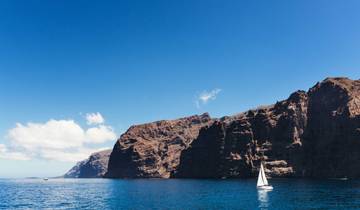
The cliffs of Los Gigantes on Tenerife’s west coast rise between 300 and 600 metres directly from the sea — one of the island’s most dramatic geological spectacles. The small marina town below serves as the departure point for year-round whale and dolphin watching trips (pilot whales are resident in the deep channel between Tenerife and La Gomera), glass-bottomed boat excursions, and boat transfers for the Masca Gorge hike. Whale and dolphin watching trips from Los Gigantes typically last two to three hours and cost approximately €25 to €40 per adult; responsible operators maintain EU-mandated observation distances.
Tenerife Auditorium
The Tenerife Auditorium in Santa Cruz, designed by Santiago Calatrava and opened in 2003, is one of Spain’s most recognisable pieces of contemporary architecture. Its sweeping white concrete shell — likened to a breaking wave and a seashell in various readings — dominates the coastal promenade and is the home of the Tenerife Symphony Orchestra. Guided architectural tours of the building run on selected days; check the Santa Cruz de Tenerife tourism website for the current tour schedule and prices.
Anaga Rural Park
The Anaga massif in Tenerife’s northeast is one of the oldest geological formations on the island and harbours one of the largest surviving areas of laurisilva — the subtropical laurel forest that once covered much of the Macaronesian archipelago before human settlement and climate change reduced its range. The park’s trails pass through dense, misty forest, along dramatic cliff-top ridges, and down to isolated hamlets connected by centuries-old stone paths. The Cruz del Carmen visitor centre, reached by road from La Laguna, is the main trailhead hub with parking, trail maps, and a small café. Entry to the park and all trails is free. A hire car is the most practical way to reach the park’s interior; TITSA rural bus services connect to a limited number of access points.
Tenerife Beaches and Outdoor Activities 2027
Tenerife’s beaches reflect the island’s volcanic character: many of the island’s natural coves have dark grey or black volcanic sand, while the main resort beaches use imported light-coloured sand sustained by regular replenishment programmes.
Southern resort beaches
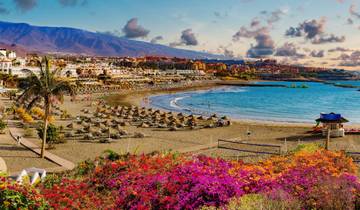
Playa del Duque and Playa de Fañabé in Costa Adeje are the flagship resort beaches — pale sand, Blue Flag-rated water quality, full amenity service, and a sea that is calm and sheltered year-round. Sun lounger and parasol hire costs approximately €10 to €15 per set per day. Playa de las Américas and Los Cristianos each have their own sandy beaches, more animated and backed by the promenades and restaurants of the resort strip. Playa del Médano in the southeast is a conspicuous exception to the resort-beach template: the relentless wind that drives the island’s best board sport activity creates a choppier sea and a more natural, open character.
Northern and western beaches
Puerto de la Cruz lacks a conventional sandy beach, which is why Lago Martínez — César Manrique’s celebrated complex of volcanic lava-rock pools and saltwater lagoons along the town seafront, built in the 1970s — functions as the town’s main bathing destination and is a piece of notable architectural and landscape design in its own right. Entry costs a few euros. Playa de la Arena on the west coast near Puerto de Santiago is an unusual combination of black volcanic sand with typically calm, clear water sheltered from the trade winds; it holds a Blue Flag designation. Benijo beach in the Anaga Peninsula — a remote black-sand cove backed by high cliffs and laurisilva — is one of the island’s most beautiful natural beaches, reached by a path from the road, but the sea can carry a strong current; observe conditions and any posted warnings carefully.
Hiking
Beyond the high-profile routes in Teide National Park and Anaga Rural Park, the island has an extensive network of Caminos Reales — historic stone-paved paths that connected Tenerife’s towns and villages before modern roads were built. The Masca Gorge descent, the Anaga ridgeline from Cruz del Carmen to the coast, and the summit crater trail from the cable car upper station (permit required) are the three walks most frequently cited by long-distance hikers as the island’s finest. Teide’s high-altitude environment demands proper layering, sunscreen, and sufficient water even in summer; the combination of altitude and intense UV at 3,500 metres can catch unprepared walkers off guard.
Watersports
El Médano and La Tejita beach are the island’s principal kitesurfing and windsurfing zones, with schools offering lessons and equipment hire. Puerto Colón marina in Costa Adeje is the main hub for diving operators, with several recognised dive sites on the south coast reef. Surfing breaks exist on the north and west coasts. Glass-bottomed boat trips, jet ski hire, and parasailing operate from the main resort marina areas in the south.
Food and Dining in Tenerife 2027
Canarian cuisine is genuinely distinct from mainland Spanish cooking — shaped by indigenous Guanche food traditions, the transatlantic trading routes that introduced American crops (corn, potatoes, peppers) to the islands, and a centuries-long geographic isolation that allowed local flavours to develop independently of mainland influences.
Papas arrugadas and mojo
The most emblematic Canarian dish is papas arrugadas — small potatoes boiled in heavily salted water until the skin wrinkles and a white salt crust forms on the surface. They are served with mojo sauce, made from garlic, cumin, oil, vinegar, and pepper. Mojo rojo (red pepper, slightly spicy) and mojo verde (green pepper and fresh herbs, milder) are the two standard variants. The combination appears as a starter or side dish at virtually every Canarian restaurant and costs approximately €3 to €5 per portion — the single most cost-effective and genuinely local food choice on the island.
Canarian fish and seafood
Fresh Atlantic fish is central to the island diet. Vieja (parrotfish), cherne (wreckfish), sama (sea bream), and lapas (limpets grilled open with lemon, butter, and garlic) are the most distinctively Canarian seafood choices and are substantially different from the Mediterranean fish menus of mainland Spain. The fishing port of Garachico in the north and the port-side restaurants of Santa Cruz serve excellent freshly-caught fish at prices considerably lower than in tourist-facing resort restaurants. A grilled fish main course at a genuinely local harbour-side restaurant runs approximately €12 to €20; the equivalent dish at a tourist promenade restaurant may cost €20 to €35 for a similar quality of fish.
Gofio
Gofio is a toasted flour made from roasted wheat or corn, a dietary staple whose use on the islands pre-dates Spanish colonisation and can be traced to the indigenous Guanche people. It appears in contemporary Canarian cooking as escaldón (gofio stirred into hot fish or meat broth), as a thickener for soups and stews, and as a base for desserts and ice cream. Its earthy, nutty flavour is unlike anything in mainland Spanish cooking and is worth seeking out in traditional Canarian restaurants (restaurantes de cocina canaria) rather than in the tourist resort dining strips.
Budget dining strategies
The menú del día — a two- or three-course set lunch including bread, a drink, and usually a coffee — is the best-value daily meal structure in Tenerife, typically priced at €10 to €14 at local restaurants Monday to Friday. This is the standard midday meal format across Spain and is served at most non-resort-facing restaurants; quality is generally higher and prices lower at establishments away from the main tourist promenades. Self-catering is a strong option for those in apartments with kitchens; local supermarket chains (Mercadona, HiperDino, and Lidl have widespread island coverage) offer well-priced fresh produce, local cheeses, and Canarian wines. The main covered market in Santa Cruz de Tenerife is the most atmospheric place to buy local produce, cheeses, honey, and mojo sauces to take home.
Canarian wine
Tenerife has been producing wine since the sixteenth century and holds multiple Denominación de Origen classifications, primarily for wines grown on volcanic soils in the Tacoronte-Acentejo appellation in the north and the Valle de La Orotava zone. The island’s indigenous grape varieties — Listán Negro for reds, Listán Blanco for whites — produce wines with a mineral, volcanic character that has gained critical attention disproportionate to their international profile. A glass of local house wine at a Canarian restaurant typically costs €2 to €4; bottles from quality local producers start at approximately €8 to €15 and are widely available in supermarkets and at the Tenerife Wine House in the north of the island.
Restaurants by area
The streets immediately behind the coastal promenade in Costa Adeje and those flanking the Los Cristianos seafront offer the best food-to-price ratio in the south, with mixed Canarian and international menus at mid-range prices (mains €12 to €22). The promenade-front restaurants of Playa del Duque trade on their view and charge accordingly. In the north, the old town of Puerto de la Cruz — particularly around the Plaza del Charco — has a concentration of traditional Canarian restaurants at moderate prices, and the university city of La Laguna’s main street supports student-oriented cafes and newer Canarian bistros that represent some of the island’s best cooking at mid-range prices.
Tenerife Budget and Daily Costs 2027
All cost estimates below are per person per day, with accommodation calculated as the per-person share assuming two people sharing one room. International flights are not included. Prices reflect a typical mid-season week (spring or autumn); July and August and the Christmas period will typically push costs 20 to 40 percent higher across all tiers.
Budget travellers
Budget visitors to Tenerife typically spend €60 to €90 per person per day. This assumes two people sharing a self-catering apartment or budget guesthouse room at approximately €40 to €60 per night for the room (€20 to €30 per person), eating a menú del día for lunch at local restaurants (€10 to €14), buying breakfast and dinner from supermarkets (€10 to €16 combined), and using TITSA buses as the primary transport (a day travelcard at €10 covers most journeys). Attraction spending at this level focuses on free sites — beaches, Anaga Rural Park trails, La Laguna historic centre, the Teide road — with one or two paid days (Loro Parque or Siam Park at approximately €44 to €45 each) spread across the week. A seven-night budget stay costs approximately €420 to €630 per person in total, with the lower end achievable by consistent self-catering and free-attraction days.
Mid-range travellers
Mid-range visitors typically spend €130 to €210 per person per day. A comfortable three-star hotel or apartment-hotel runs €100 to €160 per night per room (€50 to €80 per person), breakfasts at the hotel or a local café add €8 to €15, two restaurant meals add €35 to €55 per day combined, a hire car costs €25 to €40 per day, and paid attractions (cable car, Loro Parque, whale watching, Siam Park spread across the week) average €20 to €35 per day. A week at mid-range level runs approximately €910 to €1,470 per person, with the upper end reflecting peak-season pricing and more frequent paid excursions.
Luxury travellers
Luxury visitors typically spend €280 to €485 per person per day. A four- or five-star coastal resort in Costa Adeje runs €250 to €450 or more per room per night (€125 to €225 per person sharing); fine-dining restaurants and quality resort dining adds €70 to €120 per person for daily meals; a premium hire car or private transfer service adds €50 to €80 per day; and specialist guided tours (private Teide excursions, private whale-watching charters, Masca with a local guide) add €35 to €60 per person per day. A seven-night luxury stay runs approximately €1,960 to €3,400 per person. All-inclusive packages at five-star resorts often bring this figure down compared to room-only rates once food and beverage consumption is factored in.
Key cost reference points for 2027
- Teide cable car adult return: approximately €43 — check current pricing at volcanoteide.com, as rates are reviewed annually
- Loro Parque adult entry: approximately €44 — check loroparque.com
- Siam Park adult entry: approximately €45 — check siampark.net
- Twin ticket (Loro Parque + Siam Park, valid on separate days): from approximately €68–78 per person depending on booking channel
- TITSA bus day travelcard: €10; seven-day travelcard: €50 (both cover all routes and the Santa Cruz tram)
- Whale and dolphin watching boat trip: approximately €25–40 per adult (2–3 hours)
- Menú del día set lunch at a local restaurant: €10–14
- Coffee in a local bar: €1–2
- Glass of local Canarian wine: €2–4
- Supermarket daily basics per person: €8–15
- Sun lounger and parasol hire on resort beach: approximately €10–15 per set per day
Day Trips and Excursions 2027
La Gomera
La Gomera, visible from the southern Tenerife coast on clear days, is the most practical inter-island day trip. The Fred. Olsen fast ferry from Los Cristianos reaches San Sebastián de La Gomera in approximately 35 minutes. La Gomera’s Garajonay National Park, inscribed as a UNESCO World Heritage Site in 1986, covers the island’s mountainous interior with one of the finest surviving areas of laurisilva — ancient laurel forest that once extended across the Macaronesian and southern European coasts. A hire car from San Sebastián allows the park’s highlights — the La Laguna Grande picnic area, the ridgeline mirador at Alto de Garajonay, and the terraced valleys below — to be covered in a day before the return ferry. Advance ferry booking is advisable in July and August.
Mount Teide and Las Cañadas
A full-day Teide excursion is the most universally recommended inland day trip from either coast. Driving independently gives the best control over timing: most tour coaches arrive between 9 AM and 1 PM, and independent drivers who enter the caldera before 9 AM or after 3 PM find considerably emptier viewpoints and parking areas. The Roques de García is the essential stop — the volcanic rock spires rising from the caldera floor are the most photographed scenery on the island — followed by the Visitors’ Centre at El Portillo on the northern rim and the Parador hotel viewpoint near the cable car lower station. Adding the cable car turns a half-day drive into a full day. Organised coach excursions from both coasts include hotel pickup and a guide and are the most convenient option for those without a hire car.
La Orotava
La Orotava, a colonial town on the northern slopes below Teide, preserves some of the finest examples of traditional Canarian domestic architecture on the island. Its upper historic quarter contains seventeenth- and eighteenth-century mansions with the elaborately carved wooden balconies that are the defining feature of Canarian vernacular building, surrounding a grid of stepped alleys leading down to the valley panorama. The Hijuela del Botánico — a botanical annexe of the Royal Botanical Gardens — and the free viewpoint above the town overlooking the valley and sea are two of the highlights. La Orotava is 15 minutes from Puerto de la Cruz by car and most practically visited in combination with a northern circuit.
Garachico
Garachico, on the northwest coast, was Tenerife’s principal commercial port until a volcanic eruption in 1706 buried much of the town under lava. The lava flows that destroyed the harbour created in their cooling the natural rock pools of El Caletón — a series of sheltered tidal pools along the seafront that are now among the island’s most atmospheric bathing spots, entry free. The town’s preserved colonial architecture, handsome main church, and local cafes make it an enjoyable stop; allow two to three hours to walk the centre and swim in the pools, combined naturally with a western coast circuit taking in Los Gigantes and the Masca road.
Anaga Peninsula
The Anaga massif in the northeast is Tenerife’s finest hiking destination for those seeking ancient forest and dramatic ridge trails away from volcanic scenery. The ridge road from La Laguna climbs through the park to a series of viewpoints and trailheads. The walk from Cruz del Carmen visitor centre along the Anaga ridgeline to the isolated hamlet of Chinamada — where some residents continue to use cave dwellings cut into the rock face — is one of the island’s most memorable day hikes, taking approximately three to four hours round trip. The visitor centre has parking, printed trail guides, and a café.
Entry Requirements and Practical Tips for 2027
Entry requirements by nationality
EU and EEA citizens: Enter on a valid national identity card or passport. No pre-travel authorisation required. Length of stay unrestricted within the Schengen framework.
UK citizens: Enter on a valid British passport. The 90-in-180-day Schengen rule applies, meaning no more than 90 days in any rolling 180-day period across all Schengen countries combined. EES biometric border checks — fingerprints and facial photograph recorded at entry and exit — have been operational since April 2026 at all Schengen border crossings. ETIAS (the EU’s pre-travel authorisation) was delayed beyond its planned late-2026 launch; as of September 2026, the precise 2027 implementation timeline was not confirmed. When operational, ETIAS will cost €7 per application, be valid for three years, and require completion before departure. Monitor europa.eu/etias for current status ahead of any 2027 trip.
US, Canadian, Australian, New Zealand, and other visa-exempt nationals: Same 90-in-180-day Schengen limitation. Same EES biometric check requirement from April 2026. Same potential ETIAS requirement during 2027. Verify requirements at the Spanish Ministry of Foreign Affairs website and europa.eu/etias before travel.
Important: Tenerife is subject to exactly the same entry rules as mainland Spain and any other Schengen territory. There is no separate visa or entry requirement for the Canary Islands as distinct from Spain.
Health
No vaccinations are required for Tenerife. EU citizens should carry their European Health Insurance Card (EHIC), which provides access to Spanish public healthcare at the same terms as Spanish residents — it does not cover private treatment, repatriation, or cancellation. UK nationals’ GHIC (UK Global Health Insurance Card) provides similar access to Spanish public healthcare. For all nationalities, comprehensive private travel insurance covering medical emergencies, evacuation, cancellation, and baggage loss is strongly recommended. Emergency services: 112 (pan-European number, answered in English).
Electricity and mobile
Standard EU plugs (Type C and Type F, two round pins at 230V/50Hz) are used throughout the island. UK travellers need an adaptor. Mobile coverage from major European networks is reliable across resort areas and main roads; remote sections of Anaga and the Teno massif have limited signal. EU-based SIMs benefit from standard EU roaming rules. UK travellers should confirm roaming rates with their provider ahead of travel, as post-Brexit roaming terms vary by carrier.
Money
The euro is the currency. ATMs are widespread in resort areas, town centres, and both airports; withdraw on arrival rather than exchanging at the airport currency desk, where rates are consistently poor. Card payment is standard at hotels, larger restaurants, and supermarkets; smaller bars, rural cafes, and market stalls often prefer or require cash. Tipping is not obligatory but rounding up or leaving 5 to 10 percent at restaurants is appreciated; small tips are common at bars for good service.
Local vocabulary
Buses on the Canary Islands are called guaguas (pronounced wah-wahs), not autobuses as in mainland Spain — useful when asking for directions to the bus stop or checking route names. The Canarian accent and some local vocabulary differ from mainland Spanish; restaurant and hotel staff in resort areas almost universally speak English.
Sun and altitude safety
The Canarian UV index is elevated year-round and exceptionally high at altitude; Factor 30 or 50 sunscreen, a hat, and UV-blocking sunglasses are practical necessities rather than optional accessories. At 3,555 metres on the cable car upper platform, the combination of thin air and intense UV can produce headaches and dizziness in unacclimatised visitors; avoid strenuous physical activity immediately after ascending and descend promptly if symptoms appear.
Frequently Asked Questions About Tenerife 2027
Is Tenerife too crowded to visit in 2027?
The southern resort strip — Playa de las Américas, Costa Adeje, Los Cristianos — concentrates large numbers of visitors into a compact coastal zone and can feel busy, particularly in July and August. However, Tenerife as a whole is a large and diverse island, and areas including Anaga Rural Park, the Teno massif, La Laguna’s historic centre, Garachico, and the mountain villages absorb visitors without crowding. Teide National Park sees heavy coach traffic on weekday mornings (typically 9 AM to 1 PM); arriving early or in the mid-afternoon provides a significantly quieter experience of the caldera. Visiting in April, May, October, or November keeps costs lower and queues shorter while maintaining good weather. For independent travellers with a hire car, the sense of crowding in the resort zones is easy to leave behind.
Must I book the Teide cable car in advance for 2027?
Yes, advance booking is essential between April and October and on weekends throughout the year. The cable car has limited capacity per time slot and sells out days to weeks ahead during peak season; walk-up tickets should not be relied upon. Book through the official volcanoteide.com website, which shows real-time availability and allows date changes where slots are available. The cable car closes without warning due to high wind or icing of the cables; closures are more common from November to March. Advance bookings receive refunds or rebooking options in the event of a weather closure. Building a secondary plan into your Teide day — a caldera walk or a drive to the El Portillo visitor centre — ensures the day is not wasted even if the cable car is shut.
What is ETIAS and will it affect my visit to Tenerife in 2027?
ETIAS is the European Travel Information and Authorisation System — the EU’s pre-travel screening scheme for visa-exempt non-EU nationals visiting any of the 30 Schengen countries, comparable to the US ESTA or Australia’s ETA. When active, it requires an online application, a fee of €7, and authorisation valid for three years or until the applicant’s passport expires. It applies to citizens of approximately 60 countries including the UK, USA, Canada, Australia, and New Zealand. The system was originally scheduled for 2022 and has faced multiple delays; the planned late-2026 launch was further postponed, and as of September 2026, a confirmed 2027 date had not been announced. UK, US, and other eligible nationals planning to visit Tenerife in 2027 should check the official europa.eu/etias site in the weeks before booking to confirm whether ETIAS has been activated. Only applications made through the official EU portal are legitimate; multiple third-party sites charge fees for a service that is free to apply through the official channel.
What is the difference between Tenerife South and Tenerife North airports in 2027?
Tenerife South (TFS) is the island’s main international gateway, handling the majority of charter and low-cost scheduled flights from the UK, Germany, the Netherlands, Scandinavia, and Ireland. It is located on the dry southeastern coast, 20 to 30 minutes from the resort towns of Playa de las Américas, Costa Adeje, and Los Cristianos. Most package-holiday visitors arrive here. Tenerife North (TFN) is primarily a domestic hub with frequent connections from Madrid, Barcelona, and other Spanish cities, plus a smaller number of European routes. It lies close to La Laguna and Santa Cruz de Tenerife and is at higher elevation, which means cloud and fog are more frequent. Visitors planning to base in the north — Puerto de la Cruz, La Laguna, or Santa Cruz — will find TFN saves a significant transfer. For southern-based stays, TFS is the clear choice. There is no meaningful price difference between the airports themselves.
Is it safe to swim at Tenerife beaches in 2027?
Sea conditions vary significantly around the island. The main resort beaches of Costa Adeje, Playa de las Américas, and Los Cristianos are sheltered, calm, and patrolled by lifeguards in season; they operate the standard EU flag system (green = safe, yellow = caution, red = no swimming). These are suitable for all swimmers and families with young children year-round. The north coast and exposed natural beaches — particularly on the Anaga Peninsula — can have strong Atlantic swell and currents that make swimming dangerous even when conditions look calm from the beach; observe flag status and posted warnings carefully, and note that some natural coves have no lifeguard presence. The volcanic swimming pools at Garachico (El Caletón) and the Lago Martínez complex in Puerto de la Cruz provide sheltered salt-water alternatives in the north. Rip currents at natural beach entry points are the primary hazard; local information boards and the red flag should always be respected.
What Canarian food should I try during a 2027 visit?
Papas arrugadas con mojo is the single most essential Canarian dish — wrinkled potatoes boiled in salted brine, served with mojo rojo (red pepper sauce) or mojo verde (herb sauce), available at every local restaurant for €3 to €5. Lapas a la plancha — limpets grilled in butter, garlic, and lemon and eaten directly from the shell — are widely available at seafront restaurants in the north and in fishing ports and cost approximately €8 to €12 for a full portion. Fresh vieja (parrotfish) is the most distinctively Canarian fish choice and is usually grilled whole. Escaldón de gofio (toasted flour stirred into fish broth) is the most traditional preparation of the island’s pre-Hispanic staple ingredient and is worth ordering at a restaurant focused on traditional Canarian cooking. For desserts, gofio ice cream and bienmesabe (an almond and honey cream served with ice cream or as a sauce) are the two most characteristic local sweets. Local Canarian wine — particularly reds from the Tacoronte-Acentejo appellation and whites from Valle de La Orotava — is very good value and provides a genuine taste of volcanic-soil viticulture that is largely unknown outside the islands.
How many days does a Tenerife visit require to cover the main highlights in 2027?
A minimum of five to seven nights allows comfortable coverage of the main highlights: Teide National Park and the cable car (one full day), the southern beaches (one or two days), a northern circuit taking in La Laguna, La Orotava, and Puerto de la Cruz (one full day), and a whale-watching boat trip from Los Gigantes or Los Cristianos (one half-day). A seven-to-ten night stay adds La Gomera as a ferry day trip, a full day in Anaga Rural Park, and the western coast villages of Garachico and Masca. Visitors planning a fortnight can cover the entire island at a relaxed pace while still spending unhurried days at beaches. For a first visit focused primarily on beach relaxation with one or two attraction days, five nights in the south is the practical minimum that makes the four-and-a-half-hour flight economically sensible.
What are the hidden costs to budget for in Tenerife 2027?
Sun lounger and parasol hire on resort beaches costs approximately €10 to €15 per set per day and adds meaningfully to a week’s spend if used daily. Resort hotel food and drink at pool bars and in-hotel restaurants is considerably more expensive than equivalent products at nearby independent restaurants and supermarkets; even all-inclusive guests sometimes encounter supplements for premium brands or specialist items. Car hire quoted prices online typically exclude the compulsory collision damage waiver excess, which can add €8 to €15 per day in practice unless covered by a credit card policy or separately purchased excess insurance. Parking in Santa Cruz de Tenerife is metered and competitive; budget €8 to €15 per day if driving into the capital regularly rather than using the tram from La Laguna. ETIAS authorisation, if operational during 2027, will add €7 per traveller. The Teide summit crater permit is free but must be secured weeks in advance; if the self-guided permit system is unavailable, guided summit excursions that include permit access cost approximately €100 to €150 per person, well above the standard cable car ticket price.
Can you visit other Canary Islands on day trips from Tenerife in 2027?
La Gomera is the most practical neighbouring island for a day trip, with Fred. Olsen fast ferries from Los Cristianos reaching San Sebastián de La Gomera in approximately 35 minutes. The day gives enough time to hire a car, visit Garajonay National Park’s laurisilva forest, take in the painted cliffs above the capital, and return on the late afternoon sailing. Gran Canaria is reachable by fast ferry from Santa Cruz de Tenerife in approximately 80 minutes and can be managed as a long day trip, though the distance limits time ashore. La Palma, Fuerteventura, and Lanzarote have crossing times of four hours or more and are better suited to overnight stays than day trips from Tenerife. El Hierro and La Gomera’s deeper interior are similarly best explored with an overnight stay. The ferry timetable and advance booking options are available through Naviera Armas and Fred. Olsen Baleària’s official booking sites.
What should I know about driving in Tenerife in 2027?
Driving is on the right, as in mainland Spain. The autopista (motorway) system connecting both airports, Santa Cruz, and the southern resort strip is fast, well maintained, and free of tolls; it handles the majority of inter-urban traffic efficiently. Mountain roads — the approaches to Masca, the Anaga ridgeline road, sections of the Teno massif — are narrow and winding with switchback bends, limited passing places, and at points no barrier above significant drops; they require confidence and patience, and campervans and large vehicles are not suitable on several of the narrowest routes. Sat-nav is strongly recommended; paper maps alone are insufficient for smaller rural roads. Fill the fuel tank before entering Teide National Park on the TF-21 mountain road, as there are no petrol stations within the park. The caldera road can close due to snow and ice between December and February; check road status at the Cabildo de Tenerife website before driving a mountain crossing in winter. Speed limits: motorways 120 km/h, national roads 90 km/h, built-up areas 30 km/h (or lower on residential streets as signed). Speed cameras are common on the main arteries.