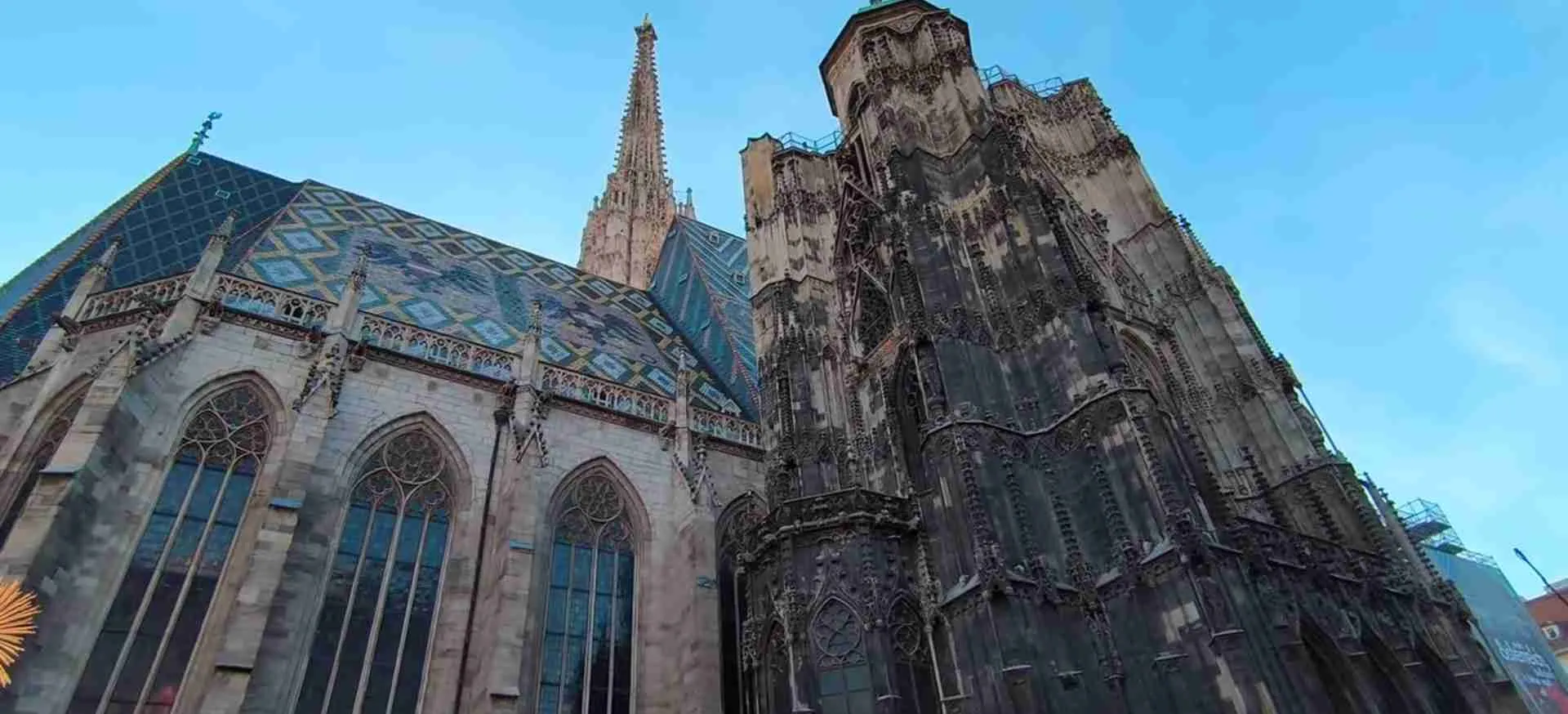
St. Stephen’s Cathedral Vienna Guide: Gothic Masterpiece & Cultural Heart
Key Takeaways
- St. Stephen’s Cathedral represents Vienna’s most significant Gothic monument, featuring a 137-meter South Tower offering panoramic city views after climbing 343 steps
- The cathedral’s construction spanned nearly 400 years (1137-1511), evolving from Romanesque origins through High Gothic transformation into Austria’s national religious symbol
- The intricately patterned roof displays 230,000 glazed tiles forming the Habsburg double-eagle coat of arms, reconstructed after 1945 World War II fire damage
- The Pummerin bell in the North Tower weighs 21,383 kilograms, making it Austria’s largest bell and one of Europe’s most significant church bells
- Guided tours provide exclusive access to the catacombs containing Habsburg internal organs and mass graves from plague outbreaks and Ottoman sieges
- The cathedral remains an active parish church conducting daily masses, weddings, and religious ceremonies while welcoming millions of visitors annually
Introduction: Understanding Vienna’s Spiritual and Architectural Crown
St. Stephen’s Cathedral rises from the heart of Vienna’s historic center as the city’s most recognizable landmark and enduring symbol of Austrian identity. The Gothic masterpiece dominates Stephansplatz with its soaring South Tower piercing the Vienna skyline at 137 meters, visible from nearly every elevated viewpoint within the capital.
The cathedral’s significance extends far beyond architectural magnificence. This building witnessed the baptism of Mozart’s children, the marriages of Habsburg royalty, and the funerals of emperors who shaped Central European history. The cathedral’s survival through Ottoman sieges, Napoleonic bombardments, and World War II bombing makes it a powerful symbol of Vienna’s resilience and continuity across tumultuous centuries.
The building you see today represents nearly 400 years of continuous construction, expansion, and refinement. The original 1137 Romanesque church underwent Gothic transformation beginning in 1304, with successive additions creating the complex we recognize today. The distinctive asymmetrical facade with one completed tower and one incomplete stump reflects both medieval construction economics and later architectural preservation decisions that refused to alter historic proportions.
Understanding St. Stephen’s requires appreciating its dual role as active parish church and major tourist attraction. Daily masses continue in side chapels while thousands of visitors explore the nave, climb the tower, and tour the catacombs. This living religious function distinguishes St. Stephen’s from museum-like cathedral experiences elsewhere in Europe, creating authentic encounters with Viennese spiritual life alongside historical and architectural study.
People Also Ask About St. Stephen’s Cathedral Vienna
Why is St. Stephen’s Cathedral important to Vienna?
St. Stephen’s Cathedral serves as Vienna’s spiritual, historical, and cultural centerpiece, representing Austrian national identity more profoundly than any other single building. The cathedral witnessed crucial moments in Habsburg history including royal weddings, imperial funerals, and the reading of abdication decrees that ended centuries of monarchical rule. The building’s survival through Ottoman sieges in 1529 and 1683, Napoleonic wars, and World War II bombing transforms it into a symbol of Viennese resilience and continuity.
The cathedral’s religious significance remains paramount as seat of the Archbishop of Vienna and Austria’s most important Catholic church. Daily masses, weddings, baptisms, and funerals maintain spiritual traditions dating to medieval foundations while welcoming parishioners and pilgrims from around the world. This continuing religious function preserves the cathedral’s intended purpose beyond mere historical monument status.
What makes St. Stephen’s Cathedral architecturally significant?
St. Stephen’s Cathedral exemplifies Gothic architecture at its most accomplished, featuring pointed arches, ribbed vaulting, flying buttresses, and elaborate stone tracery that define the Gothic style. The asymmetrical facade with the 137-meter South Tower (completed 1433) and unfinished 68-meter North Tower creates distinctive visual drama marking Vienna’s skyline for over 500 years.
The cathedral’s roof represents a unique architectural achievement with 230,000 glazed tiles forming geometric patterns and the Habsburg double-eagle coat of arms. The steep pitch and elaborate decoration transform a functional element into the building’s most photographed feature. Interior accomplishments include the soaring nave reaching 28 meters high, elaborate stone pulpit carved by Anton Pilgram (1514-1515), and the Wiener Neustädter Altar (1447) showcasing late Gothic painted panel artistry.
Who built St. Stephen’s Cathedral and when?
The original Romanesque church was built in 1137 under the patronage of Margrave Leopold IV and Bishop Reginmar of Passau, establishing Vienna’s first significant stone church on the site. A fire destroyed much of this structure in 1258, prompting expansion and Gothic reconstruction.
Duke Rudolf IV initiated the Gothic transformation in 1304, laying foundations for the Gothic choir and beginning the ambitious reconstruction that would span centuries. His successors continued construction with the South Tower (Steffl) completed in 1433 under master builder Hans Puchsbaum, while the North Tower remained unfinished after construction halted in 1511. This generational building process involved dozens of master masons, stone carvers, and craftsmen whose collective efforts created the masterpiece standing today.
What can you see inside St. Stephen’s Cathedral?
The cathedral interior showcases extraordinary Gothic and Baroque artworks spanning centuries of patronage. The stone pulpit created by Anton Pilgram (1514-1515) features intricate carved decoration with the sculptor’s self-portrait peering from beneath the stairs. The Wiener Neustädter Altar (1447) displays elaborate painted panels depicting religious scenes in late Gothic style, while the Pötscher Madonna icon attracts pilgrims seeking intercession.
The catacombs beneath the cathedral hold Habsburg internal organs in copper urns (hearts buried separately in the Augustinian Church, bodies in the Imperial Crypt), mass graves from plague outbreaks, and skeletal remains from dissolved parish cemeteries. The guided catacomb tours provide exclusive access to these underground chambers and their macabre historical contents.
High Altar created by Tobias and Johann Pock (1640-1647) dominates the choir with marble columns, gilded details, and the martyrdom of St. Stephen painted scene. Side chapels contain additional altars, tombs of bishops and nobles, and the Eligius altar for metalworkers displaying guild patronage traditions. The treasury houses liturgical vessels, vestments, and reliquaries accumulated across centuries of church history.
Extended multi-day tours – 5+ days
Featured Vienna Multi-Day Tour Packages
7 days
A Piece of Europe GO
- ✓ Comprehensive Vienna tour
- ✓ Expert local guides included
- ✓ All accommodation arranged
- ✓ Transportation provided
6 days
6 Day Vienna, Salzburg, Budapest, Bratislava, and the Danube Valley
- ✓ Comprehensive Vienna tour
- ✓ Expert local guides included
- ✓ All accommodation arranged
- ✓ Transportation provided
4 days
Budapest & Vienna
- ✓ Comprehensive Vienna tour
- ✓ Expert local guides included
- ✓ All accommodation arranged
- ✓ Transportation provided
7 days
Private Tour: 3 Countries in One Week: Prague – Vienna – Budapest
- ✓ Comprehensive Vienna tour
- ✓ Expert local guides included
- ✓ All accommodation arranged
- ✓ Transportation provided
Multi-day tour packages powered by TourRadar. Prices and availability subject to change.
Historical Development Through the Centuries
Romanesque Origins and Early Medieval Foundation
Vienna’s first stone church arose in 1137 on the site of an earlier structure dating to around 1147, reflecting Vienna’s growing importance as a Babenberg ducal seat. Margrave Leopold IV and Bishop Reginmar of Passau consecrated the Romanesque church featuring characteristic rounded arches, thick walls, and minimal decorative elements typical of 12th-century ecclesiastical architecture.
The 1258 fire destroyed significant portions of the Romanesque building, creating necessity for reconstruction and opportunity for expansion reflecting Vienna’s increasing population and wealth. Archaeological investigations beneath the current cathedral revealed foundation walls, column bases, and architectural fragments from this early period, demonstrating the continuity of sacred space across architectural transformations.
The west facade’s Giant’s Door (Riesentor) and Heathen Towers (Heidentürme) survive as primary Romanesque elements integrated into the later Gothic structure. These components preserve the original church’s proportions and decorative sensibility, with rounded arches and minimal ornamentation contrasting sharply with the Gothic nave’s pointed arches and elaborate stone tracery added later.
Gothic Transformation and Expansion
Duke Rudolf IV, known as “the Founder,” initiated the Gothic reconstruction in 1304 with ambitious plans transforming Vienna’s parish church into a cathedral worthy of Habsburg prestige. Rudolf’s vision included the Gothic choir, South Tower, and nave expansions that would occupy craftsmen for the next two centuries.
The Gothic choir construction (1304-1340) established the building’s High Gothic character with pointed arches, ribbed vaulting, and tall windows flooding interior spaces with light filtered through stained glass. Master builders employed flying buttresses transferring roof weight to exterior supports, allowing thinner walls and larger windows that define Gothic architectural innovation.
The South Tower construction began in 1368 and reached completion in 1433 under master builder Hans Puchsbaum. The 137-meter tower demonstrates Gothic engineering at its most ambitious, with 343 steps spiraling upward through increasingly narrow passages to the watchman’s chamber offering panoramic Vienna views. The tower’s slender proportions, decorative tracery, and crown-like finial create architectural drama visible for kilometers beyond city limits.
The North Tower construction commenced but halted in 1511 at 68 meters height when Habsburg resources shifted to other projects and Renaissance aesthetics diminished enthusiasm for Gothic completion. Subsequent architects proposed various finishing schemes but preservation philosophy ultimately accepted the asymmetrical facade as historically authentic, refusing to impose later architectural styles on medieval foundations.
Baroque Additions and Habsburg Patronage
The 17th century saw Baroque additions transforming interior decoration while preserving Gothic architectural structure. The High Altar installed 1640-1647 by Tobias and Johann Pock introduced marble, gilding, and dramatic sculptural compositions characteristic of Counter-Reformation artistic sensibilities. This Baroque intervention created visual focal points guiding worshippers’ eyes toward the altar’s theatrical presentation of religious narrative.
Side chapel renovations added Baroque altars, paintings, and decorative schemes responding to post-Reformation Catholic revival emphasizing visual splendor in worship spaces. These interventions layered Baroque aesthetics over Gothic bones, creating the stylistic richness visitors encounter today where medieval structure supports baroque decoration and modern liturgical function.
Habsburg patronage intensified St. Stephen’s significance as the dynasty’s preferred venue for royal weddings, baptisms, and funerals. Emperor Maximilian I, Charles VI, Maria Theresa, and Franz Joseph all participated in ceremonies reinforcing the cathedral’s role as Austria’s spiritual stage for imperial ritual and dynastic continuity across centuries of political upheaval.
Modern Restoration and War Damage Recovery
World War II inflicted devastating damage when Soviet artillery bombardment and city fires in April 1945 destroyed the roof, bells, and interior furnishings. The roof’s complete collapse on April 12, 1945 melted the original Pummerin bell into 21,000 kilograms of molten bronze pooling on the cathedral floor, symbolizing Austria’s wartime destruction.
Reconstruction began immediately after war’s end, funded by donations from all Austrian provinces emphasizing the cathedral’s national significance beyond purely Viennese identity. The roof reconstruction replaced 230,000 tiles creating the distinctive chevron pattern and Habsburg double-eagle coat of arms visible today. A new Pummerin bell cast in 1951 from the melted original plus additional bronze weighs 21,383 kilograms and hangs in the North Tower, rung only on special occasions including New Year’s Eve.
Ongoing conservation addresses pollution damage, structural settling, and normal weathering affecting medieval stonework. Recent projects stabilized the South Tower’s foundations, cleaned exterior facades removing industrial pollution deposits, and installed modern climate control protecting artworks and furnishings from humidity and temperature fluctuations while maintaining the building’s active religious and tourist functions.
Architectural Significance and Design Elements
Gothic Structural Innovation
St. Stephen’s Cathedral demonstrates Gothic architecture’s revolutionary structural solutions allowing unprecedented height and light in religious buildings. The pointed arch distributes weight more efficiently than Romanesque rounded arches, enabling thinner walls and larger window openings. This innovation transformed church interiors from dark, fortress-like spaces into soaring light-filled volumes inspiring spiritual contemplation.
Flying buttresses transfer roof and upper wall weight to exterior supports, freeing interior walls from load-bearing requirements. This structural system allowed medieval builders to pierce walls with enormous windows, creating the luminous interiors that define Gothic ecclesiastical architecture. St. Stephen’s flying buttresses arc gracefully from nave walls to exterior piers, their functional purpose transformed into decorative elements showcasing engineering as artistry.
Ribbed vaulting creates the cathedral’s soaring ceiling, with stone ribs forming structural skeletons supporting lighter infill panels. This technique distributed weight along rib lines to supporting columns, allowing greater ceiling heights than earlier barrel vault systems. The nave’s 28-meter ceiling height creates vertical drama emphasizing heaven’s transcendence above earthly existence.
The South Tower represents Gothic engineering’s ultimate expression, rising 137 meters on relatively modest foundations through careful weight distribution and diminishing cross-sections as the tower ascends. The tower’s survival through centuries of weather, earthquakes, and war bombardment validates medieval engineering sophistication often underestimated by modern observers.
The Distinctive Roof and Tile Pattern
St. Stephen’s roof stands as the cathedral’s most photographed feature, with 230,000 glazed tiles forming geometric chevron patterns and the Habsburg double-eagle coat of arms. The steep 80-degree pitch sheds rain and snow efficiently while creating dramatic visual impact from street level. The tiles’ bright colors (yellow, black, turquoise, white) create patterns visible from Vienna’s surrounding hills and the South Tower viewing platform.
The original medieval roof burned completely in the April 1945 fire, collapsing into the cathedral and destroying interior furnishings and the historic Pummerin bell. Reconstruction 1945-1950 replaced the roof using traditional techniques with modern fire-resistant materials, recreating the tile patterns from historical photographs and documentation. This restoration represents one of post-war Austria’s most significant cultural reconstruction efforts.
The roof structure employs massive oak beams supporting tile courses, with the wood framework visible from the attic spaces accessible during specialized tours. The engineering allows the roof to flex slightly during wind stress while maintaining structural integrity across the 111-meter length, demonstrating traditional carpentry’s sophisticated understanding of wood’s structural properties.
Towers, Bells, and Acoustic Significance
The South Tower (Steffl) reaches 137 meters with 343 steps spiraling upward through increasingly narrow passages to the watchman’s chamber. Medieval watchmen lived in the tower maintaining fire lookout duties protecting Vienna from urban conflagrations that threatened densely packed medieval cities. The climb requires moderate fitness with several resting platforms, rewarding effort with panoramic views across Vienna to the Vienna Woods and, on clear days, to Alpine peaks 60 kilometers distant.
The North Tower halted at 68 meters in 1511 when construction funds and architectural enthusiasm shifted to other projects. The Renaissance cupola added in 1579 created a distinctive onion dome contrasting with Gothic verticality, preserving the asymmetrical facade that defines St. Stephen’s visual identity. This tower houses the Pummerin bell accessible via elevator for those unable to climb the South Tower stairs.
The Pummerin bell weighs 21,383 kilograms, making it Austria’s largest bell and Central Europe’s second-largest swinging bell after Cologne Cathedral’s Peter bell. Cast in 1951 from the melted 1711 original plus additional bronze, the bell rings only on special occasions including New Year’s Eve (broadcast nationally) and major religious festivals. The bell’s deep tone resonates across Vienna for several kilometers, marking significant moments in Austrian national life.
Smaller bells in both towers serve daily functions including calling worshippers to mass, marking canonical hours, and tolling for deaths and funerals. The bells’ varied tones create the soundscape of Vienna’s historic center, with Stephansplatz’s acoustic environment shaped by centuries of bell-ringing tradition.
Interior Artistic Masterpieces
Anton Pilgram’s stone pulpit (1514-1515) represents late Gothic sculptural art at its finest. Carved from single limestone blocks, the pulpit features intricate Gothic tracery, representations of the four Latin Church Fathers (Augustine, Ambrose, Gregory, Jerome), and Pilgram’s self-portrait peering from beneath the stairs holding compass and square symbolizing his mason’s craft. The craftsmanship’s precision and the portrait’s psychological realism demonstrate late medieval sculpture’s sophistication.
The Wiener Neustädter Altar (1447) occupies the left choir with painted panels depicting Mary’s life and Christ’s passion in vibrant colors and gold leaf. This late Gothic altarpiece exemplifies the International Gothic style’s elegant figures, rich colors, and detailed backgrounds creating jewel-like devotional images. The altar’s survival through centuries of changing tastes and the 1945 fire makes it an invaluable example of medieval religious art.
The High Altar (1640-1647) by Tobias and Johann Pock introduced Baroque aesthetics with marble columns, gilded details, and the dramatic martyrdom of St. Stephen scene. The altar’s theatrical composition directs attention to the central painted panel through architectural framing, sculptural figures, and strategic lighting from choir windows. This Baroque intervention over the Gothic choir demonstrates architectural layering across stylistic periods.
The Pötscher Madonna icon attracts pilgrims seeking miraculous intercession, with the Byzantine-style painting dating to around 1697. Legend credits the icon with weeping tears in 1697 during Ottoman siege threats, cementing its reputation for miraculous intervention. The icon’s ornate silver frame and votive offerings demonstrate continuing popular devotion despite scholarly skepticism about miraculous claims.
The Catacombs and Underground History
Habsburg Burial Traditions
The catacombs beneath St. Stephen’s Cathedral hold the internal organs of 72 Habsburg family members in copper urns stored in the Ducal Crypt. This macabre tradition divided imperial bodies into three locations: hearts buried in the Augustinian Church’s Heart Crypt, internal organs in St. Stephen’s, and bodies in the Imperial Crypt (Kaisergruft) at the Capuchin Church. This division emphasized religious humility through body decomposition symbolism while accommodating aristocratic preferences for multiple burial sites.
The practice began in 1654 when Emperor Ferdinand III requested this division, with subsequent Habsburgs continuing the tradition through Emperor Franz I (died 1835) and various archdukes, archduchesses, and consorts. The copper urns bear identifying plaques with names, titles, and death dates, creating a genealogical record of Habsburg dynasty members across two centuries.
Guided tours provide exclusive catacomb access, as these areas remain closed to unescorted visitors for preservation and safety reasons. The tours descend through narrow passages to the Ducal Crypt, explaining Habsburg burial customs and Vienna’s complex relationship with death rituals combining Catholic theology with aristocratic privilege and imperial pageantry.
Mass Graves and Plague Burials
The catacombs contain mass graves from plague outbreaks, Ottoman sieges, and parish cemetery closures, with skeletal remains from tens of thousands of Viennese buried in the cathedral’s underground chambers. Medieval and early modern Vienna suffered repeated plague epidemics (notably 1679’s Great Plague killing 76,000), necessitating rapid mass burials when individual graves proved insufficient for mortality rates.
The 1783 closure of parish cemeteries within Vienna’s city walls for public health reasons prompted exhumation and reburial of skeletal remains in St. Stephen’s catacombs and other designated charnel houses. Bones arranged in ossuary style filled underground galleries, creating the macabre chambers visible on catacomb tours with femurs, skulls, and other remains stacked in organized patterns.
These burials represent democratic death equalizing medieval social hierarchies – noble and commoner, wealthy merchant and poverty-stricken laborer united in anonymous mass graves. The catacombs’ atmosphere combines religious meditation on mortality with historical testimony to plague, war, and urban public health evolution across centuries of Vienna’s development.
Architectural Underground Spaces
The catacombs’ architecture features Gothic vaulting, brick passages, and stone chambers created both intentionally as burial space and incidentally as foundation supports for the cathedral’s massive weight. The underground spaces extend beneath Stephansplatz and adjacent buildings, creating extensive networks accessible only during guided tours for preservation and visitor safety.
Temperature and humidity in the catacombs remain relatively constant year-round, preserving skeletal remains and copper burial urns despite surface temperature fluctuations. This stable environment also protects the medieval and early modern masonry from weathering, freeze-thaw cycles, and pollution affecting exposed exterior surfaces.
Recent archaeological investigations in the catacombs uncovered earlier foundation walls, fragments of the Romanesque church, and artifacts spanning centuries of burial practices. These discoveries enhance understanding of the site’s continuity from medieval origins through modern times, with layers of architecture, burial, and reconstruction documenting Vienna’s urban evolution.
St. Stephen’s Cultural and Religious Significance
Active Parish Church and Liturgical Life
St. Stephen’s maintains active parish status with daily masses, sacraments, and pastoral care despite receiving millions of tourists annually. This living religious function distinguishes the cathedral from museum-like attractions, with Sunday masses, weekday services, and special feast day celebrations continuing traditions established in medieval foundations.
The cathedral hosts approximately 300 masses yearly including regular Sunday and weekday services, weddings, baptisms, first communions, confirmations, and funerals for parishioners and visiting Catholics. Famous religious music performances feature the St. Stephen’s Cathedral choir and visiting musicians performing Mozart, Haydn, and other composers who contributed to Vienna’s musical heritage.
Special liturgical celebrations attract large congregations including Christmas midnight mass, Easter services, Corpus Christi processions, and feast of St. Stephen (December 26) commemorating the cathedral’s patron saint. These celebrations combine religious devotion with cultural tradition, drawing both practicing Catholics and cultural observers interested in Vienna’s continuing religious heritage.
Musical Heritage and Mozart Connection
Wolfgang Amadeus Mozart married Constanze Weber in St. Stephen’s Cathedral on August 4, 1782, beginning a marriage producing six children (only two survived infancy) and supporting Mozart’s Vienna period compositions. The cathedral witnessed Mozart children’s baptisms and conducted Mozart’s funeral service on December 6, 1791, three days after his death at age 35.
The modest funeral reflected Mozart’s financial difficulties at death despite his musical genius, with the service held in a side chapel rather than the main cathedral space. The lack of elaborate ceremony and Mozart’s common grave burial in St. Marx Cemetery outside the city walls long puzzled biographers, though recent scholarship attributes this to standard practice for middle-class Viennese rather than neglect of Mozart’s significance.
Joseph Haydn conducted his farewell as cathedral music director in 1790, marking the end of an era in Viennese sacred music before his service with the Esterházy court. Other composers including Anton Bruckner and Franz Schubert participated in cathedral musical life, cementing St. Stephen’s position in Vienna’s unparalleled musical heritage alongside the Vienna State Opera and Musikverein.
National Symbol and Austrian Identity
St. Stephen’s Cathedral symbolizes Austrian national identity more powerfully than any other building, representing resilience through Ottoman sieges, Napoleonic wars, 1848 revolution, World War I empire collapse, and World War II devastation. The cathedral’s survival and repeated reconstruction demonstrate Vienna’s continuity across profound political, social, and cultural transformations.
The post-World War II reconstruction funded by donations from all Austrian provinces emphasized national unity transcending Vienna’s identity as capital city. This collective effort to restore Austria’s most significant monument helped establish post-war Austrian national consciousness distinct from both German identity and Habsburg imperial nostalgia.
New Year’s Eve celebrations center on St. Stephen’s with the Pummerin bell’s midnight ringing broadcast nationally, marking the year’s transition for millions of Austrians. The cathedral’s image appears on Austrian currency, postage stamps, tourist literature, and commercial branding, functioning as instantly recognizable shorthand for Vienna and Austria in global visual culture.
Photography Guide and Visual Documentation
Exterior Photography Strategies
Photographing St. Stephen’s exterior requires strategic positioning given Stephansplatz’s confined space relative to the cathedral’s massive scale. Wide-angle lenses (16-35mm) capture the facade’s full height from the plaza, though distortion affects proportions when shot from directly in front. Stepping back to side streets like Jasomirgottstrasse or Rotenturmstrasse provides better perspective control with reduced distortion.
The South Tower demands vertical composition emphasizing the structure’s soaring height and Gothic detailing. Shooting during golden hour (early morning or late afternoon) creates dramatic side-lighting accentuating the tower’s texture and decorative tracery. Cloud backgrounds add visual drama, with partly cloudy conditions creating more interesting compositions than uniform blue skies.
The roof’s tile pattern photographs best from elevated positions including surrounding building upper floors, though public access proves limited. The South Tower viewing platform offers excellent roof perspectives showing the Habsburg double-eagle coat of arms and geometric tile patterns impossible to appreciate from street level. Use telephoto lenses (70-200mm) compressing perspective and isolating pattern details.
Night photography transforms the cathedral through dramatic floodlighting emphasizing architectural details invisible during daylight. The illuminated South Tower pierces the night sky as Vienna’s most prominent nocturnal landmark. Long exposures (1-4 seconds) on tripod capture both floodlit cathedral and residual dusk sky color, creating more interesting images than pure darkness backgrounds. Stephansplatz’s pedestrian traffic requires timing exposures between crowd surges or embracing motion blur as compositional element.
Interior Photography Techniques
Interior photography challenges include low light levels, high contrast between window areas and shadowed spaces, and crowds obscuring architectural details. Modern cameras’ high ISO performance (ISO 1600-6400) enables handheld shooting at acceptable shutter speeds (1/60-1/125 second) avoiding tripod restrictions in crowded spaces.
The nave’s height and width require ultra-wide lenses (14-24mm) capturing the soaring Gothic architecture’s vertical emphasis. Position yourself in the center aisle shooting toward the altar for classic cathedral compositions emphasizing symmetry and Gothic pointed arch rhythms. Horizontal compositions show the nave’s processional length from entrance to choir.
The stone pulpit deserves close examination with medium telephoto lenses (70-105mm) isolating carved details and Pilgram’s self-portrait. Side-lighting from nave windows creates modeling revealing the sculpture’s three-dimensional complexity. Shoot from multiple angles appreciating different perspectives on the intricate Gothic carving.
Stained glass windows photograph best backlit, requiring exposure compensation to prevent silhouetting and preserve glass color saturation. Bracket exposures (±1-2 stops) ensuring at least one image captures the glass’s translucent colors without blown highlights in the brightest panes. Telephoto lenses (100-200mm) isolate window patterns and figurative details invisible to naked eye from floor level.
Seasonal and Weather Photography Considerations
Summer morning light (6:00-9:00 AM) strikes the south facade creating optimal contrast and color saturation before midday sun flattens contrast. The South Tower’s east-facing details receive warm golden light during these hours, creating the most visually appealing exterior images. Summer also brings longest daylight hours enabling evening photography without waiting until late night for dusk conditions.
Winter snow transforms the cathedral into fairy-tale architecture with snow-covered roofs and plaza creating monochromatic compositions emphasizing Gothic details and tower verticality. Fresh snow during blue hour (pre-dawn or post-sunset) combines winter atmosphere with residual sky color, avoiding the harshness of midday winter light. Snow also empties Stephansplatz of crowds, improving composition possibilities impossible during summer tourist season.
Autumn golden hour provides warm light perfect for the cathedral’s golden limestone facades, with October-November’s lower sun angle creating longer golden hour windows than summer months. Fall foliage in surrounding streets adds color counterpoint to the cathedral’s stone and tile patterns, creating seasonal context in wider compositions.
Stormy weather creates dramatic cloudscapes providing dynamic backgrounds for South Tower compositions. Dark storm clouds with breaks allowing sunlight to strike the cathedral create high-contrast theatrical lighting impossible to achieve during clear weather. Rapid weather changes during spring and autumn create the most photographically productive conditions for capturing varied atmospheric effects.
Conservation Challenges and Preservation Efforts
Stone Weathering and Pollution Damage
The cathedral’s limestone facades suffer ongoing weathering from acid rain, air pollution, freeze-thaw cycles, and Vienna’s urban environment. Industrial pollution deposits create black crusts on exposed surfaces, while acidic moisture dissolves limestone’s calcium carbonate composition, eroding carved details and structural stone. Recent conservation emphasizes pollution reduction, careful cleaning removing harmful deposits without damaging original stone surfaces.
Stone replacement becomes necessary when weathering compromises structural integrity or erodes decorative elements beyond recognition. Conservation teams match replacement stone to original limestone sources when possible, maintaining material consistency across old and new work. Modern stone carving replicates lost details using historical photographs, drawings, and surviving comparable examples, though distinguishing old from new intentionally preserves archaeological honesty.
Protective coatings applied to cleaned stone surfaces reduce future pollution deposits and slow weathering, though these treatments require regular renewal and monitoring for effectiveness. Ongoing research develops improved protective systems balancing preservation needs with stone’s requirement for moisture vapor transmission preventing trapped moisture damage.
Structural Monitoring and Foundation Concerns
The South Tower’s extreme height and relatively modest foundations require continuous structural monitoring preventing dangerous settling or tilting. Modern sensors track minute movements, temperature fluctuations, and stress indicators providing early warning of potential structural issues before visible damage appears. Recent foundation stabilization work strengthened underground supports addressing concerns about Vienna’s groundwater table fluctuations and urban subway construction vibrations.
The roof structure undergoes regular inspection and maintenance replacing damaged tiles, treating wood beams against rot and insect damage, and ensuring drainage systems prevent moisture accumulation. The 1945 reconstruction’s relatively recent age means major structural components remain sound, though normal maintenance addresses localized issues before they escalate into major conservation challenges.
Flying buttress stability receives particular attention as these exterior supports transfer roof weight and require perfect structural performance preventing wall collapse. Crack monitoring, mortar joint maintenance, and drainage management preserve these critical structural elements functioning exactly as medieval engineers designed.
Climate Control and Artwork Preservation
Interior climate control balances preservation requirements for paintings, sculptures, and furnishings against the building’s active religious use and tourist traffic generating heat, humidity, and pollution. Modern HVAC systems moderate temperature and humidity fluctuations preventing the extreme conditions that crack paintings, warp wood, and accelerate deterioration.
Artwork conservation addresses specific objects including the Wiener Neustädter Altar’s painted panels, Anton Pilgram’s pulpit, and the High Altar’s gilded decoration. Recent cleaning removed centuries of candle smoke, incense deposits, and atmospheric pollution revealing original colors and details, while structural consolidation addresses wood panel movement and paint layer separation threatening artwork integrity.
Lighting upgrades balance worship atmosphere, tourist visibility, and conservation concerns limiting light exposure to sensitive materials. Modern LED systems provide better color rendering than previous lighting technologies while generating less heat and offering programmable control adapting illumination to different uses (mass, concert, tourist visits) throughout the day.
Vienna’s Cathedral in Literature and Popular Culture
Literary References and Symbolic Meaning
St. Stephen’s Cathedral appears throughout Viennese literature as symbol of city identity, religious tradition, and historical continuity. Stefan Zweig’s memoirs describe pre-World War I Vienna centered around Stephansplatz and the cathedral’s commanding presence in daily life, while Joseph Roth’s novels employ the cathedral as symbolic anchor for characters navigating Vienna’s social upheavals.
The cathedral functions as meeting place, social marker, and navigation reference point in countless works setting stories in Vienna. Characters rendezvous on Stephansplatz, attend masses, climb the tower, or simply reference the cathedral establishing Vienna’s historic center as story location. This literary tradition continues in contemporary fiction using St. Stephen’s as instantly recognizable Vienna shorthand.
Poetry celebrates the cathedral’s aesthetic power and spiritual significance, with numerous German-language poets employing Gothic architecture as metaphor for transcendence, artistic achievement, and human creativity reaching toward divine perfection. The South Tower’s vertical thrust provides particularly rich symbolic material representing humanity’s spiritual aspirations.
Film and Visual Media Appearances
Countless films feature St. Stephen’s Cathedral establishing Vienna settings or providing dramatic architectural backdrops for chase sequences, romantic encounters, and historical dramas. Carol Reed’s “The Third Man” (1949) uses the cathedral and surrounding streets creating Vienna’s noir atmosphere during post-war occupation, cementing the cathedral’s image in cinematic Vienna portrayals.
The cathedral appears in documentary films about Gothic architecture, Habsburg history, World War II damage and reconstruction, and contemporary Vienna life. These productions explore the building’s architectural significance, historical role, and continuing religious function, introducing international audiences to St. Stephen’s beyond tourist snapshot familiarity.
Photography books, art prints, and tourist literature reproduce the cathedral’s image countless times, establishing iconic views and conventional compositions that guide contemporary photographers while inspiring creative reinterpretations. The building’s photogenic qualities – dramatic verticality, intricate detail, distinctive profile – ensure its continued prominence in visual representations of Vienna.
Symbol of Vienna and Austrian National Identity
St. Stephen’s Cathedral functions as Vienna’s primary symbol in commercial branding, tourism marketing, and national cultural diplomacy. The South Tower’s silhouette appears on everything from coffee packaging to corporate logos, providing instantly recognizable Vienna association without need for explanatory text. This symbolic power transforms architecture into communication, with the cathedral’s image conveying “Vienna” or “Austria” across linguistic and cultural boundaries.
Political symbolism emerges during national moments including World War II reconstruction representing post-war recovery, New Year’s Eve bell-ringing marking temporal transitions, and state funeral services for significant political figures reinforcing the cathedral’s role in national mourning rituals. These associations layer contemporary political meaning onto centuries of religious and architectural significance.
Tourism depends heavily on St. Stephen’s image attracting visitors to Vienna through promotional materials emphasizing the cathedral’s Gothic splendor, historical importance, and central location facilitating exploration of Vienna’s compact historic core. The cathedral delivers on these promotional promises through architectural magnificence, accessible tower climbs providing orientation and views, and catacombs offering unusual underground experiences differentiating St. Stephen’s from conventional cathedral visits.
Frequently Asked Questions About St. Stephen’s Cathedral
Why does St. Stephen’s Cathedral have only one tall tower?
The asymmetrical facade with one 137-meter South Tower and one 68-meter North Tower reflects medieval construction economics and changing architectural priorities rather than structural failure or design incompetence. The South Tower construction spanned 1368-1433 representing enormous financial and labor investment. When North Tower construction began, resources and enthusiasm diminished as Renaissance aesthetics replaced Gothic ideals and Habsburg priorities shifted to other projects. Construction halted in 1511 with the tower incomplete, receiving a Renaissance cupola in 1579 that created the distinctive onion dome visible today. Later generations rejected completion proposals, accepting the asymmetry as historically authentic rather than imposing later architectural styles on medieval foundations.
How many tiles are on St. Stephen’s Cathedral roof?
The cathedral roof contains 230,000 glazed tiles forming geometric chevron patterns and the Habsburg double-eagle coat of arms. These tiles replaced the original roof destroyed in the April 1945 fire during World War II final battles in Vienna. The reconstruction 1945-1950 replicated historical tile patterns using traditional techniques combined with modern fire-resistant materials, creating the distinctive multicolored roof that ranks among Vienna’s most photographed architectural features. The tiles’ bright colors (yellow, black, turquoise, white) remain visible from Vienna’s surrounding hills and the South Tower viewing platform 137 meters above street level.
What architectural style is St. Stephen’s Cathedral?
St. Stephen’s Cathedral represents predominantly Gothic architecture with earlier Romanesque elements surviving in the west facade (Giant’s Door and Heathen Towers) and later Baroque additions in interior decoration. The Gothic transformation beginning in 1304 created the pointed arches, ribbed vaulting, flying buttresses, and soaring verticality that define the cathedral’s architectural character. The South Tower exemplifies High Gothic tower design with elaborate stone tracery and crown-like finial, while the nave’s 28-meter ceiling height demonstrates Gothic structural innovations allowing unprecedented interior space and natural lighting. This architectural layering across styles reflects the building’s construction spanning nearly 400 years.
Can you climb the tower at St. Stephen’s Cathedral?
Visitors can climb the South Tower via 343 steps spiraling upward through increasingly narrow passages to the watchman’s chamber at 137 meters height. The climb requires moderate fitness with several resting platforms providing breaks during the ascent. The viewing platform offers panoramic Vienna views across the city to the Vienna Woods and, on clear days, to Alpine peaks 60 kilometers distant. The North Tower (68 meters) provides elevator access for those unable to manage stairs, reaching the Pummerin bell chamber offering views from lesser height. Both tower experiences require separate tickets beyond basic cathedral admission.
What is the significance of the Pummerin bell?
The Pummerin bell weighing 21,383 kilograms represents Austria’s largest bell and one of Central Europe’s most significant church bells. The current bell was cast in 1951 from the melted 1711 original destroyed in the April 1945 fire plus additional bronze, maintaining material continuity across historical destruction. The bell rings only on special occasions including New Year’s Eve (broadcast nationally across Austria), major religious festivals, and significant national events. The deep tone resonates across Vienna for several kilometers, marking moments of collective importance in Austrian national life. The bell’s limited use preserves both the mechanism from wear and the sound’s special significance through scarcity.
Are there burials inside St. Stephen’s Cathedral?
The cathedral catacombs contain extensive burials including Habsburg internal organs in copper urns stored in the Ducal Crypt, mass graves from plague outbreaks and Ottoman sieges, and skeletal remains from parish cemetery closures. Habsburg tradition divided imperial bodies into three burial locations – hearts in the Augustinian Church, internal organs in St. Stephen’s, bodies in the Imperial Crypt – combining religious humility symbolism with aristocratic burial preferences. The catacombs hold tens of thousands of Viennese buried across centuries, accessible only through guided tours for preservation and visitor safety. No active burials occur currently as the catacombs closed to new interments following public health regulations and heritage preservation priorities.
What is the best time to visit St. Stephen’s Cathedral?
Early morning visits immediately after opening provide quietest viewing conditions before tour groups and general crowds arrive around mid-morning. Weekday mornings (Tuesday-Thursday) experience lower attendance than Mondays (when many European attractions close), Fridays (weekend visitor surge begins), and weekends (peak tourist and local traffic). Mass times see increased activity but offer authentic experiences of the cathedral’s continuing religious function. Late afternoon visits before closing provide another window of reduced crowds. Seasonal timing affects experience with summer bringing maximum visitors but longest daylight hours, while winter offers intimate viewing with significantly reduced crowds despite shorter days.
How long does it take to visit St. Stephen’s Cathedral?
A basic cathedral interior visit examining the nave, side chapels, altars, and pulpit requires 45-60 minutes for meaningful exploration without rushing. Adding the South Tower climb extends visits by 60-90 minutes including queue time, climb, viewing, and descent. Catacomb tours require separate booking and consume 30-45 minutes. A comprehensive visit including interior, tower climb, and catacombs spans 2.5-3.5 hours. Quick visitors focusing only on nave highlights can experience the cathedral’s essential character in 20-30 minutes, though this abbreviated approach sacrifices detailed appreciation of the architecture, artwork, and historical significance that reward extended exploration.
Is photography allowed inside St. Stephen’s Cathedral?
Photography is permitted throughout the cathedral interior for personal, non-commercial use without flash to protect artwork and avoid disturbing worshippers. Tripods are prohibited due to space constraints and visitor safety. Professional photography requiring special equipment or commercial usage requires advance permission and potentially fees. The catacombs prohibit photography entirely out of respect for the dead and preservation of the sensitive environment. Tower photography is unrestricted on viewing platforms. These policies balance visitor documentation and social media sharing against conservation requirements and religious atmosphere maintenance in an active house of worship receiving millions of annual visitors.
What makes St. Stephen’s Cathedral a UNESCO consideration?
While St. Stephen’s Cathedral itself is not individually designated as a UNESCO World Heritage Site, it forms a key component of Vienna’s historic center which received UNESCO World Heritage designation in 2001. The designation recognized Vienna’s historic center as exceptional urban ensemble preserving Baroque urban development, imperial residence architecture, and musical heritage. St. Stephen’s Gothic architecture predates the Baroque period that dominates UNESCO recognition but contributes to the historic center’s architectural diversity and historical continuity. The cathedral’s prominence, architectural significance, and role in Vienna’s historical development made it central to the UNESCO designation rationale even without separate individual listing.