St. Mary’s Basilica Krakow Guide: Gothic Architecture & Veit Stoss Altarpiece
St. Mary’s Basilica rises from Kraków’s Main Market Square as one of Poland’s most magnificent examples of Gothic architecture, its asymmetrical twin towers defining the city’s skyline for over seven centuries. Built in the 14th century on the foundations of an earlier Romanesque church, this brick Gothic masterpiece houses the spectacular Veit Stoss altarpiece, the largest Gothic altarpiece in the world, and serves as both active place of worship and invaluable cultural monument that shaped Polish religious and artistic traditions.
Key Takeaways
- St. Mary’s Basilica was designated a UNESCO World Heritage Site in 1978 as part of the Historic Centre of Kraków, recognized for its outstanding Gothic architecture and cultural significance
- The Veit Stoss altarpiece, carved between 1477 and 1489, stands 13 meters high and 11 meters wide, featuring over 200 sculpted figures and representing the pinnacle of late Gothic wood carving
- The basilica’s two towers of different heights reflect Gothic building practices, with the taller north tower reaching 82 meters and housing the famous Hejnał trumpet call
- The church was rebuilt in Gothic style between 1355 and 1365 under King Casimir III the Great after the earlier Romanesque structure was destroyed during Mongol invasions
- Jan Matejko, Poland’s greatest historical painter, created the magnificent polychrome interior decorations between 1890 and 1891
- The basilica survived Nazi occupation during World War II, though the Veit Stoss altarpiece was dismantled and stolen, later recovered in Nuremberg Castle in 1946
People Also Ask About St. Mary’s Basilica Krakow
What makes the Veit Stoss altarpiece so significant?
The Veit Stoss altarpiece represents the largest Gothic altarpiece in the world and stands as a masterpiece of late Gothic sculpture. Created over twelve years by German sculptor Veit Stoss (known in Polish as Wit Stwosz), the altarpiece measures 13 meters high and 11 meters wide when fully opened, featuring over 200 individually carved figures, some nearly 3 meters in height. The work demonstrates extraordinary technical virtuosity in its billowing drapery, expressive faces, and intricate details, all carved from limewood with oak structure and larch background. The altarpiece’s central scene depicts the Dormition of the Virgin Mary surrounded by the Twelve Apostles, with the upper section showing her Assumption into heaven. The pentaptych design allows the wings to be opened or closed, revealing different scenes for various liturgical seasons. Its artistic quality, monumental scale, and technical achievement make it one of Europe’s most important works of religious art.
Why does St. Mary’s Basilica have two different towers?
The two towers of St. Mary’s Basilica reflect both practical architectural considerations and Gothic building traditions that often resulted in asymmetrical designs. The taller north tower, standing 82 meters high, served as a watchtower and houses the famous trumpet player who performs the Hejnał Mariacki hourly. The shorter south tower, reaching 69 meters, functions as the bell tower housing the church bells. This architectural asymmetry was common in medieval church construction, where towers were often built at different times by different master builders, sometimes over spans of decades. Local legend romanticizes the height difference with a tale of two brothers who were master builders—the younger allegedly killed the older in jealous rage when his tower grew taller, after which the south tower was capped with a cupola rather than reaching its planned height. While historically unverifiable, this legend captures the medieval reality of long construction periods and the competitive pride of master craftsmen.
What is the Hejnał trumpet call and why does it stop mid-melody?
The Hejnał Mariacki is a distinctive trumpet signal played every hour from the taller north tower of St. Mary’s Basilica, a tradition that has continued for centuries and become one of Kraków’s most recognizable symbols. The melody breaks off abruptly mid-stream, commemorating a legendary 13th-century trumpeter who was shot in the throat by a Mongol arrow while sounding the alarm before the Mongol attack on Kraków in 1241. According to tradition, despite his mortal wound, the trumpeter continued playing long enough to warn the city of impending danger, allowing citizens to seek shelter and defenders to prepare. The incomplete melody honors his sacrifice and serves as a constant reminder of Kraków’s tumultuous medieval history. The noon performance is broadcast live throughout Poland and internationally by Polish National Radio 1, making this centuries-old tradition accessible to millions who cannot stand in the Main Market Square to hear it in person.
How did the Veit Stoss altarpiece survive World War II?
The survival of the Veit Stoss altarpiece during World War II represents a dramatic story of cultural rescue, Nazi looting, and eventual recovery. Several weeks before the outbreak of war in September 1939, Polish museum officials partially dismantled the altarpiece and hid the removed elements in Kraków and Sandomierz. However, the Germans quickly learned of their whereabouts and seized the crates. In 1941, under orders from Governor-General Hans Frank, the altarpiece was shipped to the Third Reich, where the Nazis considered it German property since Veit Stoss was German-born. The altarpiece survived heavy Allied bombardment of Nuremberg and was discovered in 1946 hidden in the basement of the heavily bombed Nuremberg Castle by Count Emeryk Hutten-Czapski of the Polish 1st Armoured Division. The recovered altarpiece underwent major restoration in Poland before being reinstalled in St. Mary’s Basilica in 1957, eleven years after its recovery. This epic journey from Kraków to Nazi Germany and back symbolizes Poland’s broader cultural survival through the war years.
Extended multi-day tours – 5+ days
Featured Krakow Multi-Day Tour Packages
3 days
Krakow 3-Day Discovery Tour
- ✓ Comprehensive Krakow experience
- ✓ Expert local guides included
- ✓ All accommodation included
- ✓ Transportation provided
5 days
Krakow 5-Day Highlights Experience
- ✓ Comprehensive Krakow experience
- ✓ Expert local guides included
- ✓ All accommodation included
- ✓ Transportation provided

7 days
Krakow 7-Day Cultural Journey
- ✓ Comprehensive Krakow experience
- ✓ Expert local guides included
- ✓ All accommodation included
- ✓ Transportation provided
10 days
Krakow 10-Day Complete Adventure
- ✓ Comprehensive Krakow experience
- ✓ Expert local guides included
- ✓ All accommodation included
- ✓ Transportation provided
Multi-day tour packages powered by TourRadar. Prices and availability subject to change.
Introduction: Kraków’s Gothic Crown Jewel
Standing at the northeastern corner of Kraków’s Main Market Square, St. Mary’s Basilica dominates the medieval cityscape with its dramatic Gothic architecture and distinctive asymmetrical towers. For over seven centuries, this brick church has served as the spiritual heart of Kraków’s religious life while functioning as an architectural masterpiece that influenced church design across Poland and beyond. The basilica’s position adjacent to the Main Market Square, Europe’s largest medieval square, places it at the geographic and symbolic center of Kraków’s historic core, where it has witnessed the full sweep of Polish history from medieval prosperity through foreign occupation to modern independence.
The basilica’s architectural significance stems from its exemplary demonstration of Polish Gothic brick construction techniques and design principles. Unlike the stone Gothic cathedrals of Western Europe, Polish Gothic churches relied primarily on brick, a material that required different construction approaches and created distinctive aesthetic effects. St. Mary’s Basilica represents the pinnacle of this brick Gothic tradition, with soaring vaults, pointed arches, and intricate brickwork patterns demonstrating the technical mastery of medieval Polish craftsmen. The church’s three-nave basilica plan, with the central nave significantly taller than the side aisles, creates dramatic interior spaces flooded with colored light from stained glass windows.
Beyond its architectural merit, St. Mary’s Basilica houses artistic treasures that rank among Europe’s most important works of religious art. The Veit Stoss altarpiece alone justifies the basilica’s international reputation, but the church also features magnificent polychrome decorations by Jan Matejko, Baroque chapels added over centuries, and numerous works of sculpture and painting that document Polish artistic achievement from the Middle Ages through the modern era. The basilica functions simultaneously as active place of worship, art museum, and living monument to Polish cultural heritage, welcoming both devout Catholics attending Mass and art enthusiasts from around the world who come to experience its treasures.
Historical Foundations: From Romanesque Origins to Gothic Rebuilding
The site of St. Mary’s Basilica has served religious purposes since the early 13th century, when Bishop Iwo Odrowąż of Kraków constructed a Romanesque church in the Main Market Square between 1221 and 1222. This early church reflected the architectural style prevalent across Europe during the Romanesque period, with rounded arches, massive walls, and relatively small windows creating solid, fortress-like religious structures. The Romanesque St. Mary’s Church served Kraków’s growing merchant and artisan population, providing a place of worship conveniently located at the commercial heart of the medieval city.
The Mongol invasions that devastated Poland in the 13th century destroyed the Romanesque church, requiring complete reconstruction. Between 1290 and 1300, builders erected a new early Gothic church on the surviving foundations, incorporating the pointed arches, ribbed vaults, and vertical emphasis characteristic of Gothic architecture. This rebuilt church was consecrated as St. Mary’s Church in 1320, establishing the religious foundation that would continue to serve Kraków for centuries. The early Gothic structure, while more architecturally sophisticated than its Romanesque predecessor, would itself be transformed during the reign of one of Poland’s greatest medieval monarchs.
The most significant architectural transformation occurred between 1355 and 1365 during the reign of King Casimir III the Great, who sponsored the rebuilding of St. Mary’s into the magnificent Gothic edifice that defines its current appearance. This reconstruction elongated the presbytery with financial contribution from wealthy burgher Mikołaj Wierzynek, creating the extended choir space necessary for elaborate liturgical ceremonies. The church was rebuilt into a three-nave basilica with the central nave significantly taller than the side aisles, following the classic basilica plan that created dramatic interior height and allowed for large clerestory windows that flooded the space with light.
The Gothic reconstruction under Casimir III reflected both the king’s broader program of strengthening Polish infrastructure through construction and Kraków’s growing prosperity as a major European trading center. The city’s wealth, derived from its position on important trade routes and its thriving craft industries, allowed for ambitious architectural projects that demonstrated civic pride and religious devotion. The construction of such a magnificent church in the Main Market Square rather than on a cathedral close emphasized the importance of the merchant and artisan classes who funded much of the work and who worshipped in the church. This commercial patronage of religious architecture would continue throughout St. Mary’s history, with wealthy burghers and craft guilds funding chapels, altars, and decorative programs.
Gothic Architecture: Brick, Vaults, and Vertical Aspiration
St. Mary’s Basilica exemplifies the distinctive characteristics of Polish Gothic brick architecture, a regional variation of Gothic style that adapted French and German design principles to local materials and construction traditions. The use of brick rather than stone required different structural approaches and created unique aesthetic effects. Polish Gothic brickwork demonstrates extraordinary technical skill, with intricate patterns, decorative details, and structural elements all executed in molded and carved brick. The basilica’s exterior walls feature this sophisticated brickwork, with different textures and patterns creating visual interest while demonstrating the versatility of brick as a building material.
The basilica’s three-nave plan follows classic Gothic principles, with the central nave soaring significantly higher than the side aisles to create the dramatic vertical emphasis characteristic of Gothic architecture. This height difference allows for clerestory windows in the upper walls of the central nave, flooding the interior with natural light that was often filtered through stained glass to create colored illumination. The pointed Gothic arches that separate the central nave from the side aisles direct the eye upward, reinforcing the vertical thrust that symbolically represents spiritual aspiration toward heaven. The ribbed vaults that crown these spaces demonstrate the structural innovations of Gothic architecture, with stone ribs channeling weight to specific points rather than requiring continuous thick walls.
The presbytery, elongated during the 14th-century reconstruction, provides adequate space for the high altar and allows the clergy to conduct elaborate liturgical ceremonies. The choir stalls, dating from the 17th century, were designated for city councilors, aldermen, and powerful families, reflecting the close relationship between religious and civic authority in medieval Kraków. The presbytery’s architectural treatment emphasizes its sacred importance, with richer decoration, more complex vaulting, and greater height distinguishing it from the nave where the congregation gathered. This spatial hierarchy communicated theological principles through architectural means, making abstract concepts of sacred space tangible and visible.
The basilica’s ring of chapels surrounding the three naves represents centuries of additions and modifications, each chapel reflecting the architectural tastes and religious devotions of different periods. Some chapels maintain Gothic character, while others display Baroque aesthetic sensibilities from later centuries. This accumulation of architectural styles creates historical depth, with each chapel contributing another layer to the building’s evolution. The chapels also demonstrate the social structure of medieval and early modern Kraków, with wealthy families, craft guilds, and religious brotherhoods each funding their own chapel as expressions of piety, status, and civic pride.
The Twin Towers: Asymmetry and Legend
St. Mary’s Basilica’s most distinctive external feature is its pair of asymmetrical towers that flank the main facade, creating an instantly recognizable silhouette on Kraków’s skyline. The taller north tower, standing 82 meters high, dominates the composition with its slender Gothic proportions and decorative crown. This tower, known as the Hejnał tower or watchtower, houses the famous trumpet player who performs the hourly signal and historically served as a lookout post where guards could spot approaching threats and sound alarms. The tower’s height provided excellent views across Kraków and the surrounding countryside, making it valuable for both defensive purposes and civic pride.
The shorter south tower, reaching 69 meters, serves as the bell tower housing the church’s bells that call the faithful to worship and mark important occasions. The architectural treatment of this tower differs from its taller counterpart, with a distinctive cupola crown that creates visual variety while maintaining overall Gothic character. The bells housed in this tower contribute to Kraków’s soundscape, their peals combining with the Hejnał trumpet call to create an auditory identity for the city. The different functions of the two towers—one for watching and signaling, one for bells—reflect the practical needs that shaped medieval church architecture, where religious buildings served civic and defensive purposes alongside their spiritual functions.
The height difference between the towers has inspired romantic legends that attribute the asymmetry to human drama rather than architectural planning. According to the most popular legend, two brothers who were regarded as Kraków’s top construction workers were employed to build the towers. Initial construction progressed at comparable speeds, but it became apparent that the elder brother’s south tower was growing taller than the younger brother’s north tower. In a jealous rage, the younger brother allegedly killed his elder sibling, after which the unfinished south tower was capped with a cupola. While this tale lacks historical verification, it captures the medieval reality of long construction periods, competitive craftsmen, and the dramatic stories that accumulate around major architectural projects.
The architectural explanation for the asymmetry involves the common medieval practice of building towers at different times by different master builders, sometimes with decades separating the construction phases. Gothic builders often began ambitious projects knowing they might not be completed in their lifetimes, and subsequent generations of builders sometimes modified original plans based on changed circumstances, available resources, or evolving architectural preferences. The two towers of St. Mary’s Basilica demonstrate this organic approach to medieval construction, where buildings evolved over time rather than emerging complete according to a single predetermined design. This historical building process created the architectural variety and visual interest that makes medieval churches so compelling.
The Hejnał Mariacki: Kraków’s Musical Signature
The Hejnał Mariacki, the trumpet signal played every hour from St. Mary’s north tower, represents one of Kraków’s most distinctive and beloved traditions. A uniformed trumpeter ascends the tower and plays the brief melody toward each of the four cardinal directions, ensuring that the signal can be heard throughout the Main Market Square and surrounding streets. The plaintive tune consists of just a few bars, but its abrupt halt mid-stream gives it emotional power that resonates with listeners who understand its legendary origins. This hourly performance has continued for centuries, creating a sonic tradition that connects contemporary Kraków with its medieval past.
The legend explaining the incomplete melody dates to the Mongol invasions of the 13th century, specifically the 1241 attack that devastated much of Poland. According to tradition, a watchman stationed in St. Mary’s tower spotted the approaching Mongol army and began playing the alarm signal to warn the city. As he played, a Mongol archer shot an arrow that struck him in the throat, cutting off the melody mid-note. Despite his mortal wound, the legendary trumpeter continued playing long enough to complete the warning, allowing citizens to seek shelter and defenders to prepare for the assault. The abrupt ending of the Hejnał commemorates this sacrifice, transforming the incomplete melody into a memorial that sounds every hour.
The noon performance of the Hejnał holds special significance, as it is broadcast live throughout Poland and internationally by Polish National Radio 1. This broadcast, which has continued since the 1920s, makes the tradition accessible to millions of Poles who cannot physically be present in Kraków’s Main Market Square. The radio broadcast has transformed a local Kraków tradition into a national ritual, with Poles across the country and around the world pausing at noon to hear the familiar trumpet call. This daily connection to Kraków strengthens national identity and maintains cultural continuity, especially for Poles living abroad who use the broadcast to maintain emotional connections with their homeland.
Contemporary trumpeters who perform the Hejnał maintain a tradition of musical excellence while honoring the ceremony’s historical and emotional significance. The position of Hejnał trumpeter is considered an honor, with musicians competing for the opportunity to serve in this historic role. The trumpeters become minor celebrities, recognized by tourists and Kraków residents alike as custodians of an important cultural tradition. The performance requires technical skill—playing a brass instrument at height in all weather conditions demands both musical ability and physical endurance—while also demanding sensitivity to the tradition’s memorial and ceremonial aspects. The daily repetition of this centuries-old ritual creates continuity across time, linking medieval watchmen, modern trumpeters, and future generations who will continue the tradition.
The Veit Stoss Altarpiece: Gothic Masterwork
The Veit Stoss altarpiece dominates the presbytery of St. Mary’s Basilica as the largest Gothic altarpiece in the world and one of Europe’s supreme achievements in wood sculpture. Standing 13 meters high and 11 meters wide when fully opened, the altarpiece features over 200 individually carved figures, some approaching 3 meters in height, all created by German sculptor Veit Stoss (known in Polish as Wit Stwosz) and his workshop between 1477 and 1489. The sheer scale of the work required twelve years of intensive labor by a large workshop that included specialized painters and gilders alongside sculptors, making it one of the most ambitious artistic projects of the late medieval period.
The altarpiece’s structure as a pentaptych—having five separate sections—allows for different visual presentations depending on liturgical season and occasion. The central cabinet features fully three-dimensional sculptures depicting the Dormition of the Virgin Mary, with the Twelve Apostles gathered around her deathbed in poses of grief, wonder, and reverence. Above this scene, the Assumption of the Virgin shows Mary being borne to heaven, while at the very top, outside the main frame, the Coronation of Mary appears flanked by figures of Saint Stanislaus and Saint Adalbert. The progression from death through assumption to coronation narrates the theological understanding of Mary’s special role in salvation history.
The two pairs of wings that frame the central scene feature relief sculptures of varying depth, creating a progression from two-dimensional to three-dimensional representation as the viewer’s eye moves from the outer edges toward the center. The outer wings show bas-relief panels depicting scenes from the life of Mary and Christ, while the inner wings feature high-relief compositions with greater sculptural depth. The six scenes of the Joys of Mary illustrated on the side panels include the Annunciation, Nativity, Adoration of the Magi, Resurrection of Christ, Ascension, and Pentecost. This comprehensive visual program created a complete theological narrative accessible to medieval viewers who might not be able to read theological texts.
The altarpiece’s construction utilized three types of wood, each selected for specific structural and sculptural purposes. The framework is constructed of hard oak that provides strength and stability necessary to support the enormous weight of the sculptures and wings. The background panels are made of lighter but equally strong larch wood that resists warping and provides a stable surface for painted and gilded decoration. The individual figures are carved from soft and flexible limewood (also called linden), which allowed Stoss to achieve the extraordinary detail and expressive qualities visible in faces, hands, and the famous billowing drapery that became his signature style.
Stoss’s sculptural style, sometimes described as “late Gothic Baroque,” emphasizes pathos, dramatic emotion, and virtuoso carving technique. The figures display extraordinary realism in their facial expressions, with individual apostles showing distinct emotional responses to Mary’s death. The drapery treatment demonstrates technical mastery beyond most contemporary sculptors, with fabric appearing to flow and billow around the figures in ways that suggest movement and life. The extensive use of gilding and color enhances the visual impact, with gold leaf applied to highlight important elements while painted details add realism and richness. The combination of sculptural excellence, scale, and technical achievement makes the Veit Stoss altarpiece a work of international significance that transcends its role as church furnishing to become a masterpiece of European art.
Veit Stoss: Artist, Craftsman, Criminal
Veit Stoss (1447-1533) emerged as one of the leading sculptors working in Northern Europe during the transition between late Gothic and early Renaissance periods. Born in Horb am Neckar in southern Germany before 1450, Stoss established himself in Nuremberg as a young man, acquiring the skills and reputation that would lead to the commission that defined his career. In 1477, the townspeople of Kraków offered Stoss the enormous commission to create the altarpiece for St. Mary’s Basilica, the largest Gothic altarpiece ever attempted. Stoss moved to Kraków with his young family, established a workshop, and assumed the more Polish name Wit Stwosz while retaining his German identity and connections.
Stoss’s rise in Kraków was meteoric. Beyond the St. Mary’s altarpiece, he received commissions for other important works including the marble sarcophagus of King Casimir IV in Wawel Cathedral, a sandstone bas-relief Scene in the Garden of Gethsemane, and the stone crucifix still visible in St. Mary’s Basilica. He became a free man of the city, achieved financial success, and integrated into Kraków’s artistic and social elite. The production costs for the altarpiece eventually reached approximately 2,808 florins, roughly equivalent to Kraków’s entire city budget for one year, demonstrating both the ambition of the project and the resources the prosperous city could command during Poland’s Golden Age.
Stoss’s sudden departure from Kraków in 1496, returning to Nuremberg with his wife and eight children, remains somewhat mysterious. He reacquired Nuremberg citizenship for three gulden and initially continued his successful career. However, in 1503, he was arrested for forging the seal and signature of a fraudulent contractor in an investment scheme. The crime carried severe penalties—Stoss could have been blinded or executed. Instead, he was sentenced to be branded with red-hot irons on both cheeks and prohibited from leaving Nuremberg without explicit permission from the city council. This punishment, while brutal by modern standards, was actually lenient for the crime and reflected his status as a respected artist.
Despite the branding and travel restrictions, Stoss managed to continue working, producing notable sculptures in his later years including works for Italian patrons. He created “Tobias and the Angel” in 1516, now in the Germanisches Nationalmuseum in Nuremberg, and a statue of Saint Roch for the Basilica of Santissima Annunziata in Florence. He had influential supporters who helped him overcome the stigma of his criminal conviction, allowing him to maintain his artistic career even while banned from leaving Nuremberg. In his final years, Stoss suffered from failing eyesight, a particular tragedy for a visual artist whose work depended on seeing fine details. Polish painter Jan Matejko movingly depicted this period in his 19th-century painting “Blind Wit Stwosz with His Granddaughter.” Stoss died on September 20, 1533, in his late eighties, and was buried at St. Johannis cemetery in Nuremberg, but his greatest work—the St. Mary’s altarpiece—remains his enduring monument.
Jan Matejko’s Polychrome: 19th-Century Splendor
Jan Matejko (1838-1893), Poland’s greatest historical painter, created the magnificent polychrome interior decorations that transformed St. Mary’s Basilica between 1890 and 1891. Matejko brought to this commission his deep knowledge of Polish history, his technical mastery of painting, and his ability to create decorative programs that educated viewers while creating visually stunning environments. The polychrome scheme covers the vaults, walls, and architectural elements throughout the church, creating a comprehensive decorative program that unifies the diverse architectural elements accumulated over centuries.
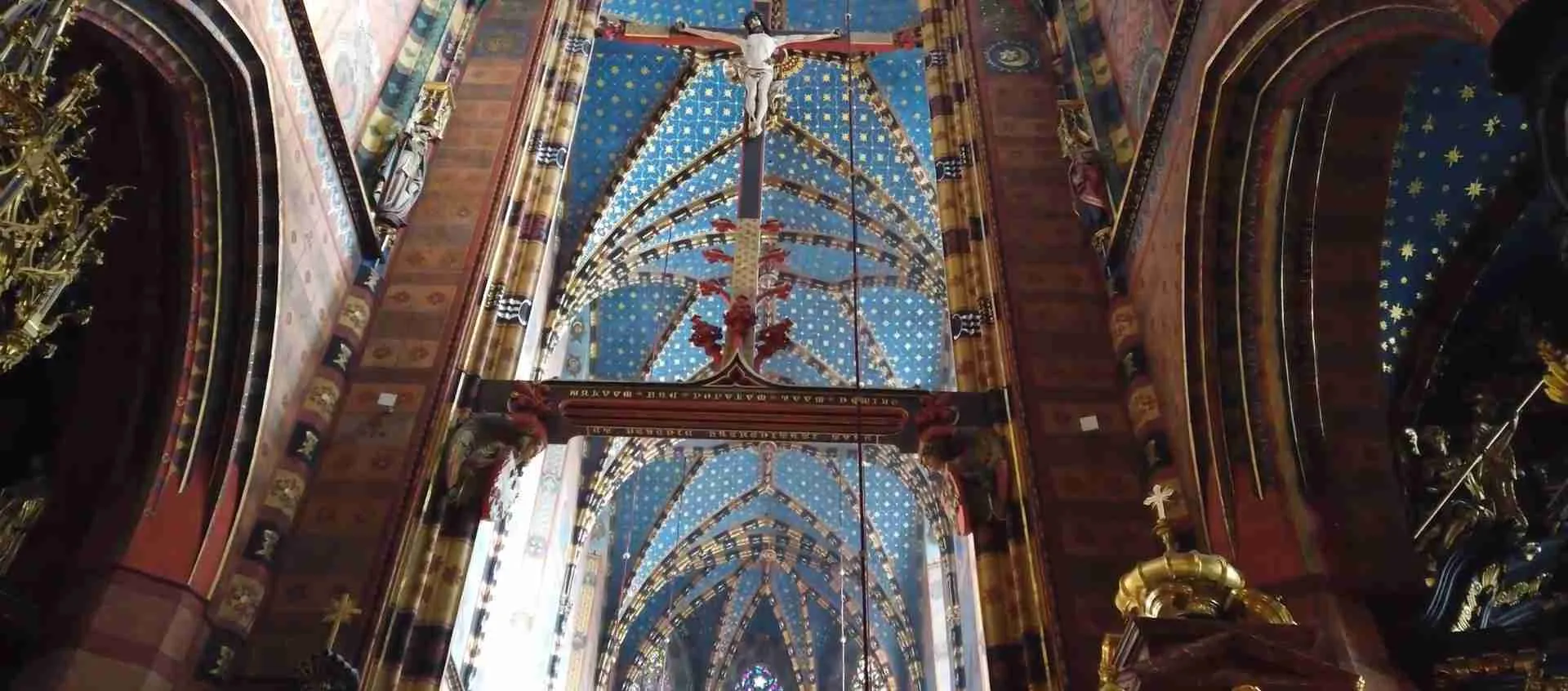
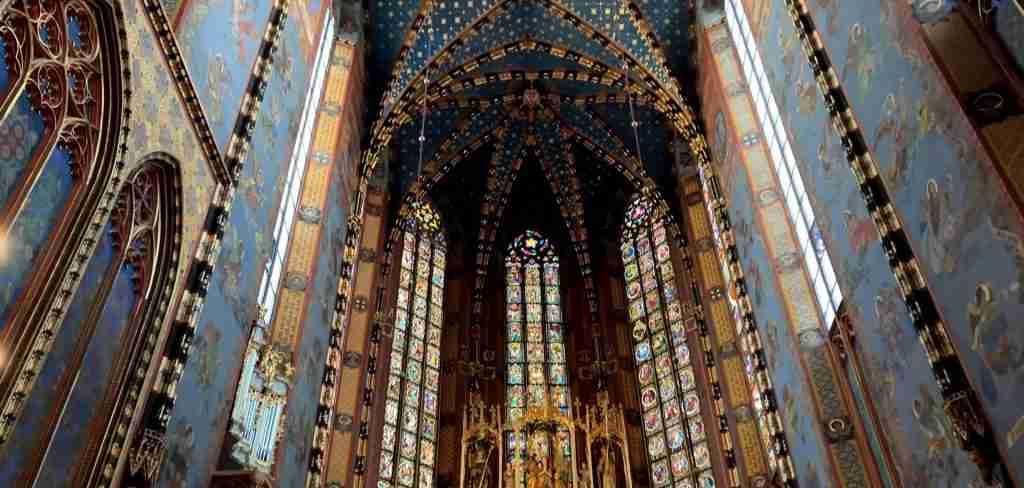
Matejko’s vault decorations create the illusion of a star-filled night sky, with deep blue backgrounds studded with golden stars that suggest the heavens. This celestial imagery reinforces the sacred character of the space while creating visual magnificence that inspires awe and devotion. The paintings throughout the church are primarily ornamental and heraldic in theme, featuring elaborate patterns, coats of arms, and decorative motifs that demonstrate Matejko’s versatility as a designer. While known primarily for his large-scale historical paintings depicting dramatic moments in Polish history, Matejko proved equally skilled at decorative work that enhanced architecture rather than competing with it.
The polychrome program required meticulous planning to integrate new painted decoration with existing architectural elements, sculptures, and artworks without overwhelming or obscuring them. Matejko’s approach respected the Gothic architecture while adding 19th-century richness and color that reflected contemporary aesthetic preferences. The decorative program emphasizes Polish national identity and Catholic faith, themes that were particularly important during the partition era when Poland had lost political independence. The visual assertion of Polish cultural heritage through church decoration served both religious and nationalist purposes, reminding worshippers of their distinct identity even under foreign political control.
Matejko’s work in St. Mary’s Basilica represents one of his final major projects, completed just two years before his death. The commission allowed him to work in the church that had been central to Kraków’s religious life for centuries, creating a permanent legacy that would be experienced daily by thousands of worshippers and visitors. The polychrome decorations complement rather than compete with the Veit Stoss altarpiece, creating an integrated aesthetic environment that spans nearly five centuries from the late Gothic altarpiece to the late 19th-century painted decoration. This layering of artistic periods creates historical depth while maintaining visual coherence, demonstrating how sensitive additions can enhance rather than diminish earlier artistic achievements.
Baroque Additions and Chapels
The 18th century brought Baroque aesthetic sensibilities to St. Mary’s Basilica, with decorative programs supervised by Francesco Placidi introducing the dynamic movement, emotional engagement, and ornamental richness characteristic of Baroque art. Placidi created the Baroque Galilee in the mid-18th century, a porch leading directly to the church that provided both architectural enhancement and symbolic meaning. In medieval and Renaissance theology, the Galilee represented the transitional space between the secular world outside and the sacred space within the church, making it an appropriate location for rich decorative treatment that prepared visitors for entry into the holy space.
The baroque galilee features elaborate sculptural decoration including wooden carved figures of prophets, apostles, and Polish saints created in 1929 by artist Karol Kukan. These figures demonstrate how Baroque aesthetic principles continued to influence church decoration well into the 20th century, with the emotional expressiveness and dynamic poses characteristic of Baroque sculpture serving religious pedagogical purposes. The door itself, known as the Door of Galilee, combines functional architecture with symbolic meaning, marking the threshold between ordinary and sacred space that visitors cross when entering for worship or contemplation.
The ring of chapels surrounding the basilica’s three naves accumulated over centuries, each addition reflecting the devotional preferences and financial resources of different periods and patrons. Some chapels maintain late Gothic character, continuing the architectural vocabulary of the main church structure. Others display Renaissance restraint or Baroque exuberance, creating a diverse architectural environment that documents changing aesthetic tastes across four centuries. Each chapel was typically funded by a specific patron—a wealthy merchant family, a craft guild, or a religious brotherhood—who gained burial rights and the honor of maintaining a dedicated worship space in exchange for their financial support.
The late Baroque altar in the right nave houses a stone crucifix by Veit Stoss, demonstrating how later additions could incorporate and honor earlier artworks. This integration of sculpture from the late 15th century into an 18th-century Baroque architectural frame shows the ongoing respect for Stoss’s artistic achievement and the practical approach to church furnishing that valued beautiful objects regardless of stylistic consistency. The crucifixion scene maintains its devotional power across stylistic boundaries, proving that religious art’s essential purpose transcends particular aesthetic movements or preferences.
St. Mary’s Square: From Cemetery to Public Space
St. Mary’s Square, the open space immediately adjacent to the basilica, has undergone dramatic transformations that reflect changing urban planning principles and social uses of space. During the medieval period, this area functioned as the church cemetery where Kraków residents were buried according to Christian practice that placed the dead within the community rather than segregating them in distant burial grounds. The cemetery’s central location meant that living Kraków residents passed through or near it daily, creating regular visual reminders of mortality and the importance of spiritual preparation. This integration of burial space into daily urban life characterized medieval European cities, where death was visible and present rather than hidden away.
The cemetery was deconstructed in the early 19th century as changing attitudes toward public health and urban planning led cities across Europe to relocate burial grounds away from densely populated centers. The removal of the cemetery and transformation of the space into an open square reflected Enlightenment principles that emphasized rational urban planning, public hygiene, and the creation of open spaces for civic gatherings. The newly created St. Mary’s Square provided an improved setting for viewing the basilica’s architecture, allowing the building to be appreciated from a distance rather than being crowded by cemetery monuments and walls.
The square’s current configuration creates a dignified public space that complements the basilica’s architectural magnificence while serving practical functions. The open area allows for gatherings during religious processions, outdoor ceremonies, and informal congregation before or after services. The square also provides space for the small monument garden and other features that memorialize important events or individuals connected to the basilica’s history. The transformation from cemetery to civic square demonstrates how urban spaces evolve in response to changing social needs and aesthetic preferences while maintaining connection with their historical character and religious purposes.
World War II: Occupation, Theft, and Recovery
The Nazi occupation of Poland in 1939 brought immediate threats to St. Mary’s Basilica and its artistic treasures. Recognizing the danger, Polish museum officials began dismantling the Veit Stoss altarpiece several weeks before the outbreak of war, carefully removing and packing the main statues in crates that were dispersed to different locations in Kraków and Sandomierz. This prescient action demonstrated both the officials’ understanding of the cultural catastrophe that Nazi occupation would bring and their courage in taking preservation actions despite the personal risks involved in defying what would soon become occupation authorities.
Despite these efforts, the Germans quickly learned the locations of the hidden altarpiece components and seized the crates. In 1941, Governor-General Hans Frank ordered the complete altarpiece shipped to the Third Reich. The Nazis’ justification for this theft rested on Veit Stoss’s German birth—since the sculptor met Nazi definitions of “Aryan,” the occupation authorities claimed his altarpiece as German property and denied its fundamental Polish character despite its five centuries in Kraków. The dismantled altarpiece was transported to Germany, where it spent the war years separated from the basilica it had graced since 1489.
The altarpiece survived the war despite heavy Allied bombardment of Nuremberg, where it had been taken. Its discovery in 1946 in the basement of the heavily bombed Nuremberg Castle by Count Emeryk Hutten-Czapski of the Polish 1st Armoured Division represented a triumph of cultural recovery amid the chaos of immediate post-war Europe. The recovery prevented the altarpiece’s permanent loss and allowed for its eventual return to Poland, though the process required years of restoration work before the altarpiece could be reinstalled. The surviving components underwent major restoration between 1946 and 1949 to repair damage sustained during dismantling, transport, wartime storage, and the general deterioration that occurred during its years away from Kraków.
The altarpiece was finally restored to St. Mary’s Basilica in 1957, eleven years after its recovery. The reinstallation became an event of profound national significance, symbolizing Poland’s cultural survival through the catastrophe of World War II and the restoration of treasures that had been stolen. The delay between recovery and reinstallation reflected both the technical challenges of proper restoration and the complex political situation in post-war Poland, where Soviet influence complicated relationships with Western nations that held recovered Polish cultural property. The altarpiece’s return represented not just the restoration of an artwork but the reclamation of national heritage and identity after years of occupation and cultural suppression.
Recent Conservation: 21st-Century Restoration
Between 2015 and 2017, the Veit Stoss altarpiece underwent the most comprehensive conservation treatment in its history, a remarkable project undertaken in situ that allowed the altarpiece to remain in St. Mary’s Basilica rather than being removed to conservation studios. A workshop was established behind the altar where conservators worked for over 1,000 days on the project, which was co-financed by the Civic Committee for the Restoration of Kraków Heritage, the Polish Ministry of Culture and Cultural Heritage, the Municipality of Kraków, and St. Mary’s Parish. This collaboration between civic, governmental, and religious institutions reflected the altarpiece’s importance to multiple stakeholders and Polish society as a whole.
Special scaffolding built in front of the altar allowed visitors to watch the conservators at work, transforming the conservation process into an educational opportunity and public engagement program. Visitors could observe the meticulous techniques conservators employed, ask questions about the work, and develop deeper appreciation for both the original artistic achievement and the modern expertise required to preserve it. This transparency in conservation practice represented a departure from traditional approaches that isolated conservation work in studios away from public view. The visible conservation process demonstrated respect for the public’s interest in cultural heritage while showcasing the sophisticated science and craftsmanship involved in modern conservation.
The conservation team worked on over 200 figures, with the largest weighing 250 kilograms and exceeding 3 meters in height, alongside thousands of individual sculpted elements. The conservation involved the full spectrum of scientific analysis and treatment techniques available to modern conservators. Structural wood was consolidated using compatible materials to prevent further deterioration, cracks were carefully filled while respecting original fillers where they survived, and remnants of later repainting were removed to reveal the original Gothic complexion of the figures. The arrangements of figures and microarchitecture on the corpus and predella were amended based on historical research and physical evidence, correcting alterations made during previous restorations.
The conservation project received a European Heritage Award / Europa Nostra Award in 2023, recognizing it as a unique and exceptional achievement. The awards jury commended the meticulous conservation based on thorough research, carried out by professionals who demonstrated great respect and sensitivity toward the original work. The jury particularly noted that the project brought together people from different countries, reflecting the international importance of the site and the need for cooperation in preserving European heritage. The successful conservation ensured that the Veit Stoss altarpiece will remain accessible to future generations while honoring the original intentions of the Nuremberg master who created it over five centuries ago.
Liturgical Functions: Living Place of Worship
St. Mary’s Basilica continues to function as an active Catholic church, celebrating daily Mass and serving the spiritual needs of Kraków’s Catholic community. This ongoing liturgical use distinguishes it from purely museum spaces, creating a living relationship between historic architecture, artistic treasures, and contemporary religious practice. The daily rhythm of services, from morning Mass through evening prayers, maintains continuity with centuries of worship that have sanctified this space and connected generations of believers. The basilica’s dual role as both religious site and cultural monument creates occasional tensions between preservation needs and liturgical use, but also enriches both functions by maintaining authentic purpose rather than creating a frozen museum display.
The ceremonial opening of the Veit Stoss altarpiece occurs daily at 11:50 AM, a tradition that transforms the altarpiece from static artwork into dynamic liturgical furnishing. The wings are carefully opened to reveal the central scenes, a process that takes several minutes and attracts visitors who time their visits to witness this ceremony. This daily opening honors the altarpiece’s original purpose as a changing visual program designed to reflect liturgical seasons and occasions. During ordinary time, the altarpiece might remain closed, showing the outer painted panels. For major feast days, particularly those related to the Virgin Mary, the full opening reveals the complete sculptural program in all its glory.
Major religious festivals bring St. Mary’s Basilica to life with elaborate ceremonies that fill the space with music, incense, liturgical vestments, and congregational participation. Christmas midnight Mass, Easter celebrations, and Marian feast days draw large crowds who experience the basilica as their ancestors did—as a place of worship where architectural beauty and artistic magnificence enhance rather than distract from religious devotion. These ceremonies demonstrate how Gothic church architecture was designed to support liturgy, with the spatial arrangement, acoustic properties, and visual program all serving religious purposes while creating memorable aesthetic experiences.
The basilica’s eleven chapels continue to serve specific devotional purposes, each dedicated to particular saints or aspects of Catholic theology. Some chapels function as preferred locations for private prayer or small group Masses, while others serve as sites for specific devotional practices or religious brotherhoods. This multiplicity of sacred spaces within the larger church structure reflects Catholic understanding of diverse paths to spiritual engagement, with different chapels appealing to different devotional preferences and allowing for simultaneous religious activities that might disturb each other in a single unified space. The chapels also maintain connections with their historical patrons, preserving memory of the families, guilds, and organizations that funded their construction and decoration.
Architectural Model: Influence on Polish Church Design
St. Mary’s Basilica served as an architectural model for church construction across Poland and in Polish diaspora communities abroad, particularly during the 19th and early 20th centuries when mass Polish emigration created Polish communities in North America and other destinations. The basilica’s distinctive brick Gothic style, its asymmetrical twin towers, and its three-nave basilica plan became templates that Polish communities replicated when building churches in their new homelands. These derivative churches served both religious and cultural functions, providing places of worship while creating architectural connections with the Poland that emigrants had left behind.
Churches built in the “Polish Cathedral style” in American cities with large Polish populations often incorporated design elements directly inspired by St. Mary’s Basilica. St. John Cantius Church in Chicago features a detailed one-third scale copy of the Veit Stoss altarpiece, commissioned in 2003 as tribute to immigrants from Galicia who founded the parish in 1893. This remarkable copy demonstrates both the enduring influence of the original altarpiece and the continuing importance of Polish cultural heritage to diaspora communities maintaining connections with ancestral traditions. Other Polish-American churches similarly referenced St. Mary’s architectural vocabulary, creating built environments that reinforced ethnic identity and cultural continuity across the Atlantic divide.
Within Poland itself, St. Mary’s Basilica influenced church architecture during periods of Gothic Revival interest in the 19th century and during reconstruction after World War II when destroyed churches were often rebuilt in historical styles that honored pre-war architecture. The basilica’s status as exemplary Gothic brick church made it a natural reference point for architects seeking to work in historically appropriate styles. The influence extended beyond direct copying to encompass broader design principles—the emphasis on height and light, the use of brick as primary material, the integration of sculpture and painting with architecture—that characterized Gothic architectural thought and continued to influence church design centuries after the original Gothic period ended.
Cultural Significance: National and Religious Symbol
St. Mary’s Basilica occupies a central position in Polish cultural consciousness, functioning as both religious monument and national symbol. The basilica’s location in Kraków’s Main Market Square, at the heart of what was once Poland’s capital city, gives it prominence that extends beyond its architectural and artistic merit. For centuries, St. Mary’s served the merchant and artisan classes whose economic activities drove Kraków’s prosperity, creating associations with urban life, commercial success, and civic pride that complemented its religious functions. The basilica represents the achievements of medieval Polish civilization during the period when Poland emerged as a major European power.
The hourly Hejnał trumpet call has become one of Poland’s most recognizable audio signatures, instantly identifying Kraków and, by extension, Poland itself. The tradition’s broadcast throughout Poland and internationally by Polish National Radio since the 1920s has transformed a local custom into a national ritual that connects Poles worldwide. The incomplete melody, breaking off mid-stream to commemorate the legendary trumpeter killed during Mongol invasion, serves as a sonic memorial to Polish resistance against foreign aggression—a theme that resonates throughout Polish history with its repeated experiences of invasion and occupation. The daily performance creates continuity across time, linking contemporary Poland with its medieval past.
The basilica appears frequently in Polish literature, film, and popular culture, from medieval chronicles to contemporary novels. The Veit Stoss altarpiece and the Hejnał tradition feature in works by Poland’s greatest writers and artists, while the building itself provides setting for historical narratives and contemporary stories alike. International recognition came through Eric P. Kelly’s 1929 novel “The Trumpeter of Kraków,” which introduced English-speaking readers to the Hejnał legend and the basilica’s significance. More recently, the church has appeared in fantasy literature, including Andrzej Sapkowski’s Witcher series, demonstrating how medieval architecture and legends continue to inspire contemporary creative work.
During periods when Poland lost political independence, St. Mary’s Basilica served as a symbol of cultural survival and national continuity. Religious institutions maintained Polish language, traditions, and identity during partition era when political expression of Polish nationalism was suppressed by occupying powers. The basilica, with its Polish Gothic architecture, artworks by Polish masters like Matejko, and continuous tradition of Polish liturgy and music, represented enduring Polish presence even when the Polish state had been erased from maps. The building’s survival through centuries of foreign occupation, war, and political change makes it a tangible connection to Polish past and a foundation for contemporary Polish identity.
UNESCO World Heritage Status
St. Mary’s Basilica received UNESCO World Heritage designation in 1978 as part of the Historic Centre of Kraków, recognized among the first twelve sites on the World Heritage List. This early recognition reflected Kraków’s outstanding universal value as one of Europe’s best-preserved medieval urban complexes and St. Mary’s particular significance as an architectural and artistic achievement of international importance. The UNESCO inscription acknowledged the basilica’s exceptional testimony to Gothic architectural tradition, its outstanding artistic achievements including the Veit Stoss altarpiece, and its role in the development of European religious art and architecture.
The World Heritage designation brought international attention to preservation needs and helped secure resources for conservation efforts including the major 2015-2017 restoration of the Veit Stoss altarpiece. UNESCO status creates expectations for professional conservation approaches, regular monitoring, and transparent reporting on the site’s condition. This international oversight complements Polish heritage protection laws, creating multiple layers of accountability that help ensure appropriate treatment of the basilica and its artistic treasures. The designation also promotes educational use of the site, encouraging schools, universities, and research institutions to engage with St. Mary’s as a case study in medieval architecture, religious art, and heritage conservation.
International cooperation in St. Mary’s conservation reflects UNESCO’s mission to foster global collaboration in heritage preservation. The 2015-2017 altarpiece conservation brought together experts from multiple countries, incorporating diverse perspectives and specialized expertise into the project. This international engagement enriched the conservation outcomes while building professional networks that facilitate future collaboration. The European Heritage Award / Europa Nostra Award that the project received in 2023 further demonstrates international recognition of conservation excellence and the collaborative approach that brought together civil, governmental, and religious stakeholders.
Tourism and Public Access
St. Mary’s Basilica welcomes hundreds of thousands of visitors annually, creating both opportunities and challenges for this active place of worship that also functions as major cultural monument. The basilica’s central location on Kraków’s Main Market Square makes it readily accessible to tourists exploring the historic center, while its architectural magnificence and the fame of the Veit Stoss altarpiece draw art enthusiasts from around the world. Managing the flow of visitors while maintaining the building’s religious character and protecting its artistic treasures requires careful balance between accessibility and preservation.
Admission policies distinguish between entry to experience the architecture and general atmosphere versus access to the interior for detailed viewing of the altarpiece and other artistic treasures. The basilica charges admission fees for comprehensive visits that include time to examine the altarpiece closely and explore the various chapels and artistic works. These fees support conservation efforts and building maintenance while managing visitor numbers to prevent overcrowding that could damage the building or disturb worshippers. The fees also fund interpretive materials and guided tours that enhance visitor understanding and appreciation.
The daily ceremonial opening of the Veit Stoss altarpiece at 11:50 AM creates a focal point for visitor scheduling, with many timing their visits to witness this ceremony. The opening demonstrates the altarpiece’s function as liturgical furnishing rather than static artwork, showing how the wings move and revealing the complete visual program. Visitors who attend this ceremony gain understanding of medieval religious practices where altarpieces changed appearance according to liturgical seasons and occasions, with different visual programs appropriate for different times in the church year. The ceremony also creates a shared experience among visitors, transforming individual tourism into collective witnessing of a meaningful tradition.
Guided tours provide deeper engagement with the basilica’s architecture, history, and artistic achievements than self-directed visits typically allow. Knowledgeable guides can point out details easily missed by casual observers, explain iconographic programs that require theological knowledge to fully appreciate, and contextualize artworks within their historical and cultural circumstances. The availability of tours in multiple languages reflects Kraków’s international tourist appeal and ensures that visitors from different countries can access interpretive information in languages they understand. Virtual tour options allow those unable to visit in person to experience the basilica’s treasures through high-quality photography and expert narration.
Frequently Asked Questions
How does St. Mary’s Basilica relate to Wawel Cathedral?
St. Mary’s Basilica and Wawel Cathedral served different but complementary roles in Kraków’s religious and civic life. Wawel Cathedral, located on Wawel Hill adjacent to the Royal Castle, functioned as the coronation church of Polish monarchs and the royal necropolis, directly connected to royal power and national governance. St. Mary’s Basilica, positioned in the Main Market Square, served the merchant and artisan classes who drove Kraków’s commercial prosperity. The cathedral represented royal and ecclesiastical authority, while the basilica embodied urban civic pride and commercial success. Both churches contributed to Kraków’s religious landscape, but St. Mary’s maintained closer connections with daily urban life and the commercial classes that funded its construction and decoration. The architectural distinction between the two—Wawel Cathedral integrated into the royal complex on the hill, St. Mary’s Basilica dominating the commercial square—reflected their different social positions and audiences.
What other works by Veit Stoss can be seen in Kraków?
Beyond the famous altarpiece, Veit Stoss created several other significant works during his years in Kraków that remain visible today. The stone crucifix in St. Mary’s Basilica, located in a late Baroque altar in the right nave, demonstrates Stoss’s skill in stone sculpture alongside his better-known wood carving. The enormous crucifix that divides the presbytery from the altar area was created by Stoss’s students, showing his workshop’s capabilities and the master’s influence on the next generation of sculptors. In Wawel Cathedral, Stoss created the marble sarcophagus of King Casimir IV, a masterpiece of funerary sculpture that demonstrates his ability to work in different materials and styles. The original sandstone bas-relief “Scene in the Garden of Gethsemane” resides in the National Museum in Kraków, though a copy can be seen in Plac Mariacki Square near St. Mary’s Basilica. These additional works allow visitors to Kraków to appreciate the full range of Stoss’s artistic abilities across different media and scales.
Can visitors climb the towers of St. Mary’s Basilica?
Tower access at St. Mary’s Basilica is restricted compared to some other historic churches that allow public climbing of their towers. The taller north tower, which houses the hourly trumpeter performing the Hejnał, is not generally open to public climbing due to safety considerations and the need to preserve the working space for the trumpeters. The tower’s narrow medieval stairs, the active use by trumpet performers, and conservation concerns about increased foot traffic all contribute to access restrictions. Some special tours or occasions may provide limited tower access, but these are exceptional rather than routine. Visitors seeking panoramic views of Kraków can access viewing platforms at other locations including Wawel Castle’s Sandomierz Tower and the Town Hall Tower in the Main Market Square, which offer excellent perspectives on the city and opportunities to appreciate St. Mary’s distinctive silhouette from elevated positions.
What is the significance of the blue and gold star ceiling decoration?
The blue vaults decorated with golden stars that crown St. Mary’s Basilica represent Jan Matejko’s vision of creating celestial imagery that transforms the church interior into a symbolic representation of heaven. The deep blue background suggests the night sky, while the golden stars create the illusion of looking up at the heavens from earth. This decorative program served both aesthetic and theological purposes—the beauty inspired awe and devotion, while the celestial imagery reminded worshippers that church space represented a threshold between earthly and heavenly realms. The star-covered vaults create visual continuity across the basilica’s various spaces while allowing for different decorative treatments in specific chapels and areas. The gold stars against blue background also demonstrate Matejko’s skill in creating decorative programs that enhance architecture without overwhelming it, working with the Gothic vaults’ structural lines rather than fighting against them. This approach to sacred decoration influenced other Polish churches and demonstrated how 19th-century artists could add richness to medieval buildings while respecting their original character.
How does brick Gothic architecture differ from stone Gothic?
Brick Gothic architecture represents a regional variation of Gothic style that developed in Northern and Eastern Europe where suitable building stone was scarce but clay for brick production was abundant. The use of brick rather than stone required different construction techniques and created distinctive aesthetic effects. Brick cannot be carved with the fine detail possible in stone, leading brick Gothic builders to create decorative effects through patterns of different colored bricks, corbelling, blind arcades, and projecting courses rather than sculptural decoration. The modular nature of brick construction encouraged certain proportions and rhythms in architectural design, while the material’s properties influenced vault construction and the achievement of the soaring heights characteristic of Gothic style. St. Mary’s Basilica exemplifies brick Gothic achievement, demonstrating how master builders adapted French and German Gothic principles to the constraints and opportunities of brick construction. The result is a distinctively Northern European Gothic style that maintains the vertical emphasis and spiritual aspiration of stone Gothic while developing its own aesthetic vocabulary appropriate to its material.
What happened to St. Mary’s during the Communist period?
During Poland’s Communist period (1945-1989), St. Mary’s Basilica maintained its function as an active Catholic church despite the atheistic ideology of the Communist government. The Catholic Church in Poland, unlike in some other Communist countries, retained significant independence and social influence, partly because of its deep integration with Polish national identity. St. Mary’s continued to celebrate Mass, host religious ceremonies, and serve as a gathering place for Catholics who saw religious practice as both spiritual devotion and resistance to Communist cultural programs. The basilica’s status as a UNESCO World Heritage Site (from 1978) provided additional protection from potential government interference or destruction. The recovery and reinstallation of the Veit Stoss altarpiece in 1957, during the early Communist period, demonstrated that even the Communist government recognized the basilica’s cultural importance and allowed its restoration. The church navigated the difficult balance of maintaining religious mission while operating under a government hostile to religion, using its cultural significance as protection while providing spiritual sustenance to believers who sought refuge from Communist ideology.
Are there any other copies of the Veit Stoss altarpiece besides the one in Chicago?
The copy of the Veit Stoss altarpiece at St. John Cantius Church in Chicago is the largest and most detailed reproduction, created at one-third scale and representing years of meticulous craftsmanship. This copy is unique in its comprehensiveness and accuracy, commissioned specifically to honor the Polish immigrants who founded the parish and to maintain cultural connections with their homeland. While smaller reproductions, photographs, and artistic interpretations of individual figures or scenes from the altarpiece exist, no other full-scale or substantial copy approaches the Chicago version’s ambition and fidelity to the original. The creation of such a detailed copy required extensive documentation of the original, skilled carvers capable of reproducing Stoss’s distinctive style, and substantial financial resources to support the multi-year project. The existence of this copy ensures that the artistic achievement of the Veit Stoss altarpiece remains accessible even to those who cannot travel to Kraków, while also serving as a form of cultural insurance—should anything happen to the original, the Chicago copy preserves detailed information about its appearance and construction.
What is the best time to visit St. Mary’s Basilica?
The optimal visiting time depends on whether visitors prioritize avoiding crowds or experiencing the basilica’s full liturgical life. For quiet contemplation and detailed examination of the altarpiece and other artworks, early morning visits immediately after opening typically encounter fewer crowds, particularly on weekdays rather than weekends. The ceremonial opening of the Veit Stoss altarpiece at 11:50 AM daily attracts many visitors but provides the meaningful experience of seeing the altarpiece’s wings opened and understanding its function as dynamic liturgical furnishing. Major religious festivals including Christmas, Easter, and Marian feast days offer opportunities to experience St. Mary’s as a living place of worship with elaborate ceremonies, beautiful music, and full congregational participation, though these occasions also bring the largest crowds. Visitors interested in photography should consider that interior lighting varies throughout the day, with morning light entering through eastern windows and afternoon light from the west creating different atmospheric effects. The hourly Hejnał trumpet call from the north tower can be heard throughout the Main Market Square at any time, though the noon performance broadcast live by Polish Radio holds special significance.
How has St. Mary’s Basilica survived so many centuries relatively intact?
St. Mary’s survival across seven centuries reflects both fortunate historical circumstances and deliberate preservation efforts. Kraków avoided the complete destruction that befell many Polish cities during World War II because it surrendered without prolonged battle, sparing its historic monuments from the artillery bombardment and urban combat that devastated cities like Warsaw. The basilica’s brick construction provided durability that helped it weather centuries of use, weathering, and occasional disasters. When fires or other damage occurred, the church was repaired and rebuilt rather than abandoned, demonstrating continuous commitment to its preservation. The Veit Stoss altarpiece’s survival required more active intervention—its dismantling before World War II, its recovery from Nazi theft, its careful restoration, and its recent comprehensive conservation all represent deliberate choices to invest resources in preservation. The basilica’s status as active place of worship ensured continuous maintenance and care across centuries, while its designation as cultural monument in modern times brought professional conservation and legal protection. The combination of architectural durability, continuous use creating incentives for maintenance, fortunate avoidance of major disasters, and deliberate preservation efforts when threatened all contributed to St. Mary’s survival as one of Europe’s best-preserved Gothic churches.
What role did craft guilds play in St. Mary’s Basilica?
Craft guilds played crucial roles in both the construction and ongoing maintenance of St. Mary’s Basilica, reflecting the church’s close connection with Kraków’s commercial and artisan classes. During the medieval and early modern periods, wealthy guilds often funded specific chapels, altars, or decorative programs, gaining burial rights and the honor of maintaining their dedicated worship space. Each guild chapel reflected the patron’s identity through choice of patron saints, decorative motifs, and quality of furnishing—wealthier guilds could afford more elaborate chapels, while smaller guilds created more modest but still meaningful spaces. The guilds’ financial support allowed the basilica to accumulate the ring of chapels that surrounds the main nave, creating architectural diversity and demonstrating the social structure of medieval urban society. Guild members attended services in their chapels, celebrated guild feast days with special Masses, and maintained ongoing relationships with the basilica through regular donations and participation in church life. This system of guild patronage spread construction and maintenance costs across multiple wealthy organizations rather than depending on a single patron, creating financial sustainability while binding the church to the commercial community it served.