
Sintra Travel Guide 2026: UNESCO Palaces & Romantic Gardens
Just 40 minutes from Lisbon, Sintra’s UNESCO-listed Cultural Landscape transforms fairy-tale romanticism into stone reality across colorful palaces, mystical estates, and forested peaks. This comprehensive 2026 guide delivers verified practical information for navigating Portugal’s most enchanting day trip destination, where 19th-century royal imagination created one of Europe’s most concentrated collections of Romantic architecture.
Key Takeaways
- Day Trip Budget 2026: Budget travelers spend €35-57 per person visiting 1-2 palaces with train transport and lunch, mid-range visitors invest €85-120 exploring 3-4 sites with guided experiences, while luxury travelers enjoy €165-240 comprehensive visits with private transport and fine dining.
- Overnight Stay Costs 2026: Staying in Sintra costs €70-110 per person daily for budget accommodations (two sharing hostel or budget hotel), €160-250 for mid-range hotel comfort, or €330-525 for luxury palace hotel experiences.
- UNESCO Heritage Status: Sintra’s Cultural Landscape earned World Heritage inscription in 1995 for its extraordinary synthesis of Romantic architecture, designed landscapes, and natural mountain setting that influenced garden design across Europe.
- Major Palace Pricing 2026: Pena Palace €14 (park and palace), National Palace €10, Moorish Castle €8, Quinta da Regaleira €12, Monserrate Palace €12. Combination passes offer savings when visiting multiple sites.
- Best Visit Strategy 2026: Book Pena Palace tickets online days ahead with morning time slots (9:30-11:00 AM) for smallest crowds, arrive in Sintra by 9 AM via train from Lisbon Rossio (€5 round trip), use 434 bus (€14 day pass) for palace access.
- Peak Season Planning: Summer months (June-August) bring intense crowds and highest hotel rates; spring (April-May) and autumn (September-October) deliver better weather-to-crowd ratios with palace gardens at their most beautiful and accommodation costs 30-40% lower.
People Also Ask About Sintra 2026
How Much Does a Day Trip to Sintra Cost in 2026?
A day trip to Sintra from Lisbon costs €35-57 per person for budget travelers, €85-120 for mid-range visitors, or €165-240 for luxury experiences. Budget costs include €5 round-trip train, €10-20 palace entries for 1-2 sites, €10-15 lunch, and €5-9 local bus transport. Mid-range travelers spend €5 train fare, €14 for 434 bus day pass, €35-50 for 3-4 palace entries, €20-35 restaurant lunch, and €10-15 for pastries and drinks. Luxury visitors use €35-50 private transport, visit €60-80 worth of attractions, enjoy €50-80 fine dining, and budget €20-30 for premium experiences. All palace tickets require advance online booking for guaranteed entry, particularly Pena Palace which sells out days ahead during peak season.
Which Palaces Are Must-Visit in Sintra 2026?
Pena Palace (€14) stands as Sintra’s iconic must-see with vibrant Romanticist architecture and panoramic Atlantic views. Quinta da Regaleira (€12) offers mystical gardens with Initiation Wells and underground grottoes. The National Palace (€10) in historic center showcases eight centuries of royal history with distinctive conical chimneys. The Moorish Castle (€8) provides medieval stone walls and spectacular vantage points. First-time visitors should prioritize Pena Palace and Quinta da Regaleira for maximum impact, adding National Palace if time permits. Full-day explorers can include the Moorish Castle for castle-to-palace hiking trails. Monserrate Palace (€12) rewards botanical garden enthusiasts with exotic flora and Anglo-Moorish architecture. Book Pena Palace 3-7 days ahead for peak season dates.
What’s the Best Way to Get to Sintra from Lisbon in 2026?
The train from Lisbon Rossio or Oriente stations to Sintra costs €5 round trip (€2.55 single) and takes 40 minutes with departures every 20-30 minutes throughout the day. Purchase a Viva Viagem card (€0.50) and load credit at station machines to avoid ticket counter queues. Rossio Station serves central Lisbon and sits within walking distance of Baixa and Chiado districts. Oriente Station connects to the airport via three metro stops on the red line. Both lines terminate at Sintra station in the town center. The 434 hop-on-hop-off bus (€14 for 24 hours or €5-9 single journey) departs from Sintra station and services Pena Palace, Moorish Castle, and historic center. Private Uber or Bolt transfers from central Lisbon cost €35-50 one way but skip public transport connections.
How Many Days Do You Need in Sintra 2026?
First-time visitors accomplish Sintra’s highlights in one intensive day trip from Lisbon, visiting 2-3 major palaces between 9 AM and 6 PM. Two days allows thorough exploration of 5-6 palaces and estates at relaxed pace, including hiking trails between Moorish Castle and Pena Palace, Monserrate gardens, and Cabo da Roca coastal viewpoint. Three days permits deep immersion in Sintra-Cascais Natural Park hiking, village restaurants, lesser-known quintas, and full appreciation of each palace’s art collections and gardens. Day-trippers should focus on Pena Palace, Quinta da Regaleira, and National Palace as core triangle. Overnight visitors gain advantage of early morning palace access before crowds arrive and evening atmosphere in historic center after tour buses depart.
Extended multi-day tours – 5+ days
Featured Sintra Multi-Day Tour Packages

3 days
Sintra 3-Day Discovery Tour
- ✓ Comprehensive Sintra experience
- ✓ Expert local guides included
- ✓ All accommodation included
- ✓ Transportation provided

5 days
Sintra 5-Day Highlights Experience
- ✓ Comprehensive Sintra experience
- ✓ Expert local guides included
- ✓ All accommodation included
- ✓ Transportation provided

7 days
Sintra 7-Day Cultural Journey
- ✓ Comprehensive Sintra experience
- ✓ Expert local guides included
- ✓ All accommodation included
- ✓ Transportation provided
10 days
Sintra 10-Day Complete Adventure
- ✓ Comprehensive Sintra experience
- ✓ Expert local guides included
- ✓ All accommodation included
- ✓ Transportation provided
Multi-day tour packages powered by TourRadar. Prices and availability subject to change.
Introduction
Sintra occupies a unique position in European cultural heritage as the finest surviving expression of 19th-century Romantic sensibility translated into architecture and landscape design. When UNESCO designated Sintra’s Cultural Landscape as World Heritage in 1995, the recognition honored not individual monuments but the entire synthesis of palaces, gardens, forests, and peaks that Portuguese royalty and aristocracy transformed into lived fantasy between 1840 and 1910. Lord Byron called these mountains “glorious Eden” in 1809, and successive generations of artists, poets, and wealthy patrons spent fortunes carving that vision into stone and gardens across nine square kilometers of Serra de Sintra’s forested slopes.
For contemporary travelers, Sintra delivers concentrated cultural richness unmatched by any European destination of comparable size. Within 30 minutes of each other by bus, visitors encounter Ferdinand II’s multicolored Pena Palace commanding Atlantic views from 500-meter peaks, medieval Moorish fortifications winding along mountain ridges, mystical Quinta da Regaleira gardens descending nine levels through symbolic initiatic journeys, the National Palace’s eight centuries of royal occupation preserved in its state rooms, and Monserrate’s botanical paradise showcasing species from five continents. This density of significant architecture compressed into compact geography makes Sintra both remarkably efficient for tourism and vulnerable to overcrowding that UNESCO monitoring missions have flagged as threatening the site’s integrity.
Practical navigation requires understanding Sintra’s vertical geography. The historic center sits in valley at 200 meters elevation, surrounding the National Palace whose twin conical chimneys have marked the town center since the 15th century. Most major palaces occupy elevations between 400 and 500 meters, necessitating steep uphill transport via the 434 bus service or private vehicles. The Moorish Castle crowns ridgelines at 450 meters with Pena Palace rising behind it to 500 meters. Quinta da Regaleira spreads across terraced hillside 1 kilometer south of center. This topography creates morning-afternoon crowd flows as tour groups move uphill to Pena Palace then descend to lower attractions, making timing strategies essential for optimal experiences.
The 2026 visitor landscape reflects post-pandemic tourism recovery stabilized at sustained high volumes. Pena Palace welcomes 1.5 million annual visitors, creating severe bottlenecks during July-August peak season when timed entry slots sell out 5-7 days ahead. Parques de Sintra, the public entity managing royal palaces, implemented mandatory online advance booking with specific time slots in 2023, effectively ending same-day walk-up entry for Pena Palace during busy periods. This system reduced wait times inside the palace but transferred frustration to travelers who arrive in Sintra without pre-booked tickets and discover no availability. Current best practice mandates booking Pena Palace minimum 3 days ahead for summer visits, 2 days for spring-autumn, with flexible rescheduling permitted within one year of purchase date.
Weather patterns favor April-May and September-October as optimal visiting windows when temperatures range 15-22°C, rainfall decreases substantially from winter levels, palace gardens display peak bloom periods, and crowd densities remain manageable. July-August heat reaches 28-32°C with intense sun exposure on Pena Palace’s exposed ramparts and negligible cloud cover creating harsh midday photography conditions. Winter months (November-February) bring 50% fewer visitors, lowest accommodation rates, but frequent rain, cloud cover obscuring mountain views, and reduced daylight hours limiting afternoon palace visits. The Atlantic microclimate creates rapid weather changes even within single days, with morning fog burning off to reveal sunny afternoons, necessitating layered clothing regardless of season.
Cultural context enriches physical sightseeing. Ferdinand II, German-born prince consort to Portuguese Queen Maria II, purchased Pena’s ruined monastery in 1838 and spent 16 years creating his Romantic architectural manifesto combining Neo-Gothic, Neo-Manueline, Neo-Islamic, and Neo-Renaissance elements in deliberate stylistic collision. His vision influenced palace construction across Portugal and inspired wealthy families to purchase Sintra estates and create rival fantasy gardens. António Augusto Carvalho Monteiro commissioned Quinta da Regaleira in 1904 as alchemical landscape embedding Masonic, Knights Templar, and Rosicrucian symbols in underground tunnels, grottoes, and initiatic towers. The National Palace represents architectural palimpsest with Moorish foundations, Medieval additions, Manueline renovations under Manuel I, and Baroque embellishments, its evolution mirroring Portuguese history from Reconquista through Age of Discovery.
This guide prioritizes practical execution over romantic description. Where Byron and Southey wrote poetic impressions, contemporary travelers need verified opening hours, exact ticket prices, optimal bus routes, restaurant recommendations supporting local economy, and crowd management strategies. The following sections deliver this information systematically while acknowledging the cultural significance that makes Sintra worth visiting beyond Instagram photography. Understanding that Pena Palace represents Ferdinand II’s philosophical statement about human relationship with natural landscape enhances appreciation beyond exterior color schemes. Recognizing Quinta da Regaleira’s symbolic program transforms garden wandering into interpretive discovery. This balance between practical logistics and cultural depth distinguishes meaningful Sintra experiences from superficial palace-hopping.
Understanding Sintra’s UNESCO World Heritage Status
Sintra’s inscription on the UNESCO World Heritage List in 1995 under the Cultural Landscape category recognized exceptional universal value in three specific criteria. Criterion ii acknowledged Sintra’s profound influence on Romantic landscape architecture across Europe, with gardens and palaces inspiring estate design in Germany, England, and Central Europe throughout the 19th century. Criterion iv recognized the Cultural Landscape as outstanding example of Romantic architectural synthesis integrating palaces, parks, gardens, and agricultural lands into unified designed environment. Criterion v identified Sintra as exceptional testimony to Portuguese land use practices where mountain forests, agricultural terraces, and architectural ensembles achieved harmonious integration vulnerable to irreversible change.
The World Heritage designation encompasses 946 hectares of core zone and 2,627 hectares of buffer zone covering Serra de Sintra’s entire mountain range from Atlantic coast to Tagus River plains. Unlike typical heritage sites focusing on individual monuments, Sintra’s listing protects landscape relationships between built and natural environments. This means preservation concerns extend beyond palace maintenance to forest management, agricultural land use, viewshed protection, and development controls affecting areas visible from heritage properties. UNESCO monitoring missions in 2012 and 2019 expressed concern about development pressures, tourism impacts, and wildfire risks threatening the site’s Outstanding Universal Value.
For visitors, heritage status translates to heightened conservation standards visible in palace restoration quality, garden maintenance, forest trail preservation, and interpretive materials quality. Parques de Sintra’s annual €40 million budget supports continuous restoration work, specialized conservation staff, and research programs studying original plant species, architectural techniques, and historical land use patterns. The organization employs 400 full-time staff including art historians, botanists, architects, and archaeologists maintaining properties to international museum standards. This investment produces visitor experiences substantially exceeding typical historic house museums, with state rooms preserved including original furniture arrangements, wallpapers, and decorative arts collections.
The Cultural Landscape concept distinguishes Sintra from conventional palace tourism. Rather than isolated monuments, visitors experience designed relationships between architecture and setting. Pena Palace gains meaning from its mountain-top position commanding sweeping views across forested parks to the Atlantic. The Moorish Castle’s military purpose transforms into Romantic ruin when viewed from Pena’s ramparts as picturesque scenery. Quinta da Regaleira’s symbolism requires understanding its position within broader esoteric landscape where underground passages, grottos, and hidden trails create initiatic journey through Masonic philosophy. Monserrate’s botanical collections demonstrate 19th-century acclimatization programs introducing exotic species that naturalized within Serra de Sintra’s unique microclimate.
Conservation challenges balance public access against preservation imperatives. The 2 million annual visitors create wear on palace floors, garden paths, and forest trails that continuous maintenance must address. Climate change brings increased wildfire risk to Serra de Sintra’s forests, with severe fires in 2003, 2010, and 2018 destroying historic tree specimens and threatening palace properties. Development pressures from Lisbon’s metropolitan expansion push residential construction into buffer zones, fragmenting natural corridors and altering traditional viewsheds. Tourism impacts concentrate on Pena Palace and Quinta da Regaleira while lesser-known properties like Monserrate and Capuchos Convent receive minimal visitation, creating imbalanced preservation funding and visitor experience quality.
UNESCO’s periodic reporting process requires Portuguese authorities to demonstrate effective management addressing identified threats. Recent measures include mandatory advanced booking reducing uncontrolled visitor surges, forest management programs clearing undergrowth reducing fire fuel loads, buffer zone planning controls limiting inappropriate development, and visitor management strategies distributing crowds across multiple properties through combination ticket incentives. The State Party’s 2020-2025 management plan targets sustainable tourism growth not exceeding 5% annually, expanded interpretation programs deepening visitor understanding beyond photography tourism, and climate adaptation strategies protecting historic gardens and forests against temperature increases and precipitation changes.
Visitors contribute to conservation simply through ticket purchases, with all Parques de Sintra revenue reinvested directly in property maintenance and restoration programs. Choosing less-crowded properties like Monserrate or Capuchos Convent helps balance visitor distribution, reducing overcrowding at Pena Palace while supporting lesser-known but equally significant heritage assets. Respecting pathway restrictions, avoiding touching decorative surfaces, and following photography guidelines protect fragile historic materials. Supporting local businesses in Sintra’s historic center rather than international chain hotels and restaurants strengthens community economic base making heritage conservation socially sustainable beyond tourism revenue.
Palace Ticket Prices and Booking Strategies 2026
Individual palace admission prices in 2026 remain relatively stable with minor adjustments from previous years. Pena Palace charges €14 for combined park and palace access granting entry to palace interiors, park grounds, and Chalet of the Countess of Edla. A park-only ticket costs €8, allowing access to gardens and palace terraces but excluding interior state rooms. The National Palace of Sintra charges €10 for full access including all state rooms, kitchens, and royal quarters. The Moorish Castle costs €8 with access to fortification walls, towers, and archaeological site. Quinta da Regaleira operates independently from Parques de Sintra with €12 admission covering palace, gardens, wells, grottoes, and tunnels. Monserrate Palace charges €12 for palace and botanical gardens entry. These prices apply to adult tickets with reductions available for children aged 6-17, seniors over 65, and students with valid identification.
Combination tickets deliver modest savings when visiting multiple Parques de Sintra properties. The most popular combination bundles Pena Palace with Moorish Castle for €20-22, saving €2-3 versus separate purchases. Other combinations pair National Palace with various properties, though savings rarely exceed 10-15% of individual ticket costs. The Lisboa Card includes free entry to National Palace and Monserrate Palace with discounts on Pena Palace and Moorish Castle, potentially offering value for visitors combining Lisbon and Sintra sightseeing. Third-party tour operators sell bundled experiences including palace entries, transport, and guides at premium pricing targeting convenience over cost savings.
Advance online booking through official Parques de Sintra website or authorized resellers has shifted from recommended to mandatory for Pena Palace between April and October. Time slots assign entry windows in 30-minute intervals starting from 9:30 AM palace opening. Arriving within assigned window is strictly enforced with late arrivals refused entry and tickets non-refundable. This system reduced palace interior crowding from pre-2023 levels when 500-person queues accumulated during peak summer mornings. Current visitor caps limit interior occupancy to sustainable levels, but create booking competition requiring advance planning. Weekend slots during July-August frequently sell out 5-7 days ahead, while weekday availability persists until 2-3 days before visit date.
The booking process requires selecting specific visit date and time slot during purchase, with €14 price charged to credit card or PayPal. Confirmation emails contain QR codes scanned at palace entrances. Time slots indicate palace interior entry time, not park entry time. The walk from park entrance gate to palace entrance requires 20-30 minutes uphill, necessitating arrival at park gates 45-60 minutes before assigned palace time slot. Shuttle buses operate from park entrance to palace door for €3, reducing walk to 5 minutes but adding queue time during busy periods. Missing assigned time slot results in refused entry with no refunds, making punctuality essential planning consideration.
Rescheduling flexibility allows ticket holders to change visit dates through Parques de Sintra website up to one year from purchase date. This policy accommodates weather changes, schedule conflicts, or travel disruptions without ticket forfeit. The process requires logging into booking account, selecting new date and time slot from available options, and receiving updated confirmation email. Peak season rescheduling may encounter limited availability, potentially pushing visits to less desirable time slots or dates. Early booking provides maximum rescheduling flexibility, while last-minute purchases offer minimal alternative options if plans change.
Alternative booking channels through GetYourGuide, Viator, and Tiqets offer convenience but charge 5-15% service fees above official prices. These platforms provide English-language customer service, flexible cancellation policies, and combination packages bundling multiple palaces with Lisbon transport. The premium pays for convenience and support rather than privileged access, as all tickets regardless of purchase source follow identical time slot requirements. Tour company packages including palace entries, guide services, and transport from Lisbon range €60-120 per person, providing value for travelers prioritizing convenience and interpretation over independent exploration.
Ticket purchasing strategy depends on travel style and schedule flexibility. Budget travelers booking official Parques de Sintra tickets 5-7 days ahead secure lowest prices and desired time slots. Mid-range travelers valuing convenience may accept 10% premiums for third-party booking platforms offering superior customer service and flexible cancellation. Luxury travelers join private tours with guaranteed entries and personal guides eliminating logistics entirely at €200-300 per person premium. Spontaneous travelers visiting November-March off-season can often purchase same-day tickets at palace gates, though this gamble risks sold-out situations even during low season weekends and holidays.
Money-saving approaches include prioritizing free attractions like Sintra’s historic center, forest hiking trails, and public viewpoints alongside paid palace entries. The National Palace in town center permits exterior photography and surrounding plaza atmosphere without entry fee. Moorish Castle views from multiple Sintra vantage points provide impressive castle silhouettes without admission cost. Monserrate gardens’ botanical significance and architectural beauty attract fewer crowds than Pena Palace, delivering equivalent cultural value at identical price point without advance booking requirements or time slot restrictions. Quinta da Regaleira’s private management means simpler ticketing, though summer crowds rival Pena Palace during midday hours.
Transportation Guide: Getting to and Around Sintra 2026
Rail service from Lisbon to Sintra operates two routes converging at Sintra station. The Rossio-Sintra line departs from Rossio Station in central Lisbon, serving travelers staying in Baixa, Chiado, Alfama, or Avenida da Liberdade neighborhoods. The Oriente-Sintra line runs from Oriente Station near the airport, stopping at Roma-Areeiro (green metro line), Entrecampos (yellow metro line), and Sete Rios/Jardim Zoológico (blue metro line). Both routes take approximately 40 minutes with trains departing every 20 minutes during peak commuter hours (7-9 AM, 5-7 PM) and every 30 minutes during off-peak periods. Weekend service maintains 30-minute frequency throughout the day.
Ticket purchasing uses the Viva Viagem contactless card system costing €0.50 for initial card purchase then reloadable with credit. Single journey fare of €2.55 charges to card when tapped at station barriers. Return tickets do not exist, requiring two separate single journey charges totaling €5.10 round trip. The card remains valid for one year allowing reuse on future Lisbon trips for metro, buses, and trams. Ticket machines in every station accept cash, credit cards, and offer English language menus. Tourist lines during summer mornings at Rossio can reach 20-30 minutes, making advance card purchase from less-crowded stations advisable before Sintra day trip.
Alternative ticketing options include the 24-hour Lisbon transport pass at €11.40 covering unlimited metro, bus, tram, and suburban train travel including Sintra line. This pass delivers value for travelers combining Sintra day trip with extensive Lisbon transport use on the same day or consecutive days. The Lisboa Card tourist pass includes Sintra train travel alongside free or discounted entry to 50+ Lisbon and Sintra attractions. Prices range €31 for 24 hours, €51 for 48 hours, €62 for 72 hours, providing value for intensive sightseeing schedules visiting multiple paid attractions daily.
Arriving at Sintra station places visitors in practical rather than picturesque setting requiring 10-minute walk downhill to historic center and National Palace. The 434 tourist bus departs directly from station forecourt, offering more efficient palace access than walking. Taxis and Uber vehicles congregate at station exit, providing immediate transport to Pena Palace (€10-15) or Quinta da Regaleira (€5-8). The station neighborhood contains cafés and shops serving local residents rather than tourists, with Cintia café across from station exit offering reasonably-priced breakfast and lunch before or after palace touring.
The 434 hop-on-hop-off bus operates circular route connecting Sintra station, historic center, Quinta da Regaleira, Moorish Castle, and Pena Palace with 15-20 minute frequencies between 9:15 AM and 6 PM. The 24-hour ticket costs €14 (check official Scotturb website for current rates) permitting unlimited boarding throughout day. Single journey tickets at €4.70 and return tickets at €8.85 serve visitors accessing only one palace. The route’s steep gradients and narrow mountain roads create 30-45 minute full circuit times with frequent stops causing unpredictable schedules. Morning buses fill to standing-room capacity during summer, with 20-30 minute waits common at Pena Palace stop. Afternoon service runs lighter loads as tour groups depart Sintra by 4 PM.
Alternative local bus route 435 serves Monserrate Palace and western Sintra estates with similar €14 day pass pricing. This route experiences minimal tourist use despite serving equally significant heritage properties, offering reliable seating and predictable schedules compared to 434’s overcrowding. Combined 434/435 day passes permit full Sintra exploration including lesser-known western palaces and gardens. The 403 bus connects Sintra station to Cabo da Roca clifftop westernmost point of continental Europe, requiring separate standard bus fare rather than tourist pass.
Private transport options include Uber and Bolt rideshare services operating throughout Sintra with typical fares of €5-8 between town center and Pena Palace, €3-5 for shorter distances between nearby attractions. Driver availability varies significantly between morning high demand and afternoon low demand periods. Booking rides from remote palace locations sometimes requires 10-15 minute waits as drivers navigate uphill roads. Tuk-tuk services charging €40-60 for multi-hour palace tours provide touring and transport combination appealing to travelers prioritizing comfort and narration over cost efficiency.
Driving to Sintra from Lisbon covers 25 kilometers in 35-45 minutes under normal traffic conditions via A5 motorway or A16/N9 coastal route. Parking in Sintra’s historic center remains severely limited with public lots filling completely by 10 AM during summer. Pena Palace prohibits private vehicle access between park entrance and palace, requiring visitors to park at base entrance gate and walk or shuttle uphill. Narrow mountain roads unsuitable for large vehicles and unfamiliar drivers create stress offsetting driving convenience. Local authorities actively discourage tourist driving through limited parking supply and preferential treatment for public transport.
Walking routes connect major sites for fit hikers willing to tackle steep elevations and occasionally muddy forest paths. The most scenic route climbs from historic center through Moorish Castle to Pena Palace over 45-60 minutes of steep switchbacks gaining 300 meters elevation. Trail quality ranges from paved sidewalks near town to rough forest paths between palaces, requiring proper footwear regardless of season. Summer heat makes midday hiking uncomfortable, with morning or late afternoon timing providing better conditions. The path between Pena Palace and Chalet of Countess of Edla inside Pena Park covers 1 kilometer through magnificent forest including centuries-old specimens.
Inter-palace distances and time requirements inform efficient day planning. Sintra station to historic center requires 10-15 minutes walking or 5 minutes by 434 bus. Historic center to Quinta da Regaleira spans 1 kilometer uphill, achievable in 15-20 minutes walking or 5 minutes by bus. Quinta da Regaleira to Moorish Castle covers 2 kilometers, practically requiring bus transport. Moorish Castle to Pena Palace sits just 800 meters apart but includes steep uphill gradient making walking challenging. Monserrate Palace lies 3.5 kilometers west of historic center, necessitating bus or car transport. These distances make visiting 3-4 major sites realistic in full day with efficient transport coordination.
Pena Palace: The Crown Jewel of Sintra
Pena Palace dominates Sintra’s skyline from its 500-meter summit, visible across Serra de Sintra and from Lisbon on clear days. Ferdinand II purchased the ruined 16th-century Hieronymite monastery occupying this site in 1838, commissioning Baron Wilhelm Ludwig von Eschwege to transform ruins into Romantic palace expressing architectural fantasy freed from stylistic orthodoxy. Construction continued 1842-1854 with subsequent additions under Ferdinand’s second wife, Countess of Edla, completing the complex by 1885. The architectural program deliberately combines Neo-Gothic, Neo-Manueline, Neo-Islamic, and Neo-Renaissance elements in single composition, rejecting Classical principles of stylistic purity in favor of Romantic eclecticism celebrating historical diversity.
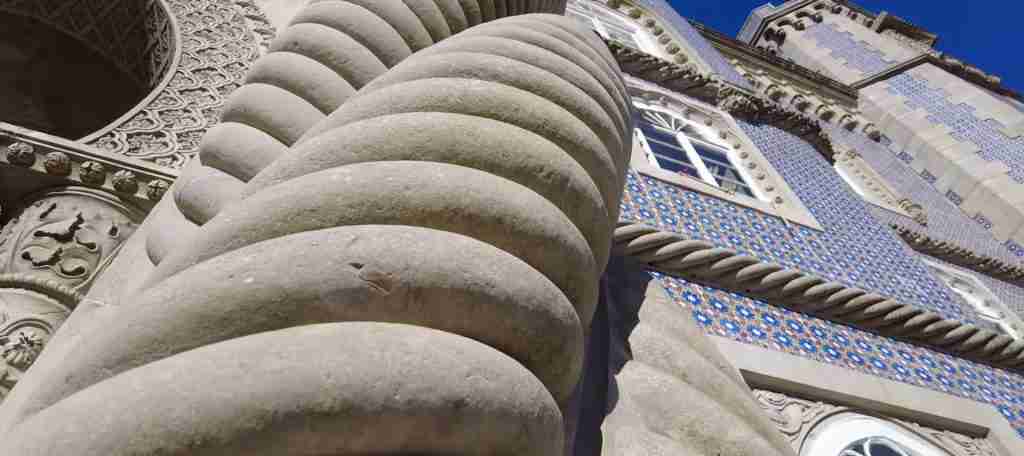
The palace exterior presents most photographed view in Portuguese tourism, with canary yellow and terracotta red facades, Moorish-style minarets, Gothic towers, Manueline stone carving, and medieval battlements creating visual collision impossible to categorize by conventional architectural styles. The Triton Gateway entrance features maritime deity sculpted emerging from marine vegetation, symbolizing Portugal’s Age of Discovery maritime power. The Clock Tower combines Islamic pointed arches with Gothic tracery and Manueline rope molding, embodying Ferdinand’s synthetic approach. The Arab Room’s horseshoe arches and geometric tile patterns reference Iberian Islamic heritage. These stylistic combinations communicated 19th-century Romantic philosophy viewing history as rich palette for artistic appropriation rather than strict archaeological revival.
Interior state rooms preserve 1910 appearance when Portugal’s last royal family departed following republican revolution. The Arab Room’s trompe-l’oeil frescoes create illusion of three-dimensional Islamic tile patterns on flat walls. The Noble Room’s massive chandelier weighs 80 kilograms, suspended above Dresden porcelain and mahogany furniture arranged as royal family left them. The Stag Room’s circular table wraps around central support column, designed for banquet service with rotating sections. Queen Amélia’s Bedroom maintains original silk wallcoverings, four-poster bed, and dressing room appointments frozen in time. These preserved interiors provide rare glimpse of daily royal life rather than museum installations.
The palace chapel retains fragments of original 16th-century monastery including alabaster altarpiece attributed to Nicolau Chanterene, Renaissance sculptor active in Portugal during Manuel I’s reign. Stained glass windows installed under Ferdinand feature heraldic devices and religious imagery in medieval revival style. The chapel’s integration within palace structure demonstrates Ferdinand’s respect for historical fabric while subordinating it to overall Romantic vision. Modern restoration work beginning 2000 required extensive structural reinforcement, roof replacement, and careful cleaning of decorative surfaces accumulated grime without damaging original finishes.
Park grounds extend 85 hectares of designed landscape surrounding palace, containing 500+ tree and plant species from five continents collected during Ferdinand’s 50-year cultivation program. Sequoias from California, cryptomerias from Japan, tree ferns from New Zealand, and magnolias from China naturalized within Serra de Sintra’s mild Atlantic microclimate. Winding paths designed following English Romantic garden principles create deliberately picturesque views framing palace against forest and sky. Artificial ponds, grottos, and hidden pavilions reward exploration beyond main palace routes. The High Cross viewpoint at park’s highest elevation delivers 360-degree panoramas across Sintra, the Atlantic, and Lisbon metropolitan area.
The Chalet of the Countess of Edla, included in palace tickets, occupies park’s southern section as romantic cottage ornée built for Ferdinand’s second wife following Queen Maria II’s death. The half-timbered Alpine chalet design contrasts deliberately with palace’s elaborate architecture, representing different Romantic ideal favoring rustic simplicity over aristocratic grandeur. Cork-clad exterior walls showcase Portuguese traditional building material in refined application. Interior rooms display Arts and Crafts influenced furniture and decoration anticipating later aesthetic movements while remaining rooted in Romantic sensibility. The chalet’s peripheral location means many visitors skip this building, creating peaceful contrast to palace crowds.
Visiting strategy demands early arrival utilizing first available time slots at 9:30 or 10:00 AM when palace floors remain empty and photography proceeds unobstructed. Later morning slots encounter increasing crowds with afternoon entries finding palace already congested from earlier visitors who linger. The mandatory time slot system controls new entries but does not limit duration of stay, allowing early arrivals to occupy spaces throughout day. Interior palace tour requires 45-60 minutes covering all open state rooms at moderate pace with time for photography and exhibit reading. Park exploration demands minimum 90 minutes visiting main paths, viewpoints, and Chalet, with thorough botanical investigation possible across 3-4 hours.
The shuttle bus from park entrance gate to palace door costs €3 each way, eliminating 20-minute uphill walk on paved road. During peak periods, shuttle queue times equal walking duration, making walking preferable for fit visitors. The walking route passes several viewpoints offering palace photography from below, worth brief stops. Downhill walking after palace visit proves easier than uphill approach, with most visitors walking down and shuttling up. The park entrance gate validation begins time slot countdown, making prompt shuttle boarding or walking pace essential for reaching palace door by assigned time.
Photography conditions vary dramatically by weather and time of day. Morning side-lighting enhances palace colors and architectural details, while afternoon rear-lighting from Atlantic sun creates silhouette effects. Summer’s intense midday sun produces harsh shadows and blown highlights challenging for photography. Cloud cover diffuses light creating even illumination favorable for architectural photography but reducing dramatic sky backgrounds. The palace faces east-southeast, making sunrise photography impossible but delivering excellent late morning light. Key viewpoints include the terrace outside Noble Room, the Clock Tower ramparts, the High Cross in park, and various positions along 434 bus route approaching palace.
Quinta da Regaleira: Gardens of Mystery and Symbolism
Quinta da Regaleira represents peak expression of Portuguese esoteric architecture, commissioned by António Augusto Carvalho Monteiro, Brazilian-born coffee baron who returned to Portugal in 1892 with immense fortune and passion for occult philosophy. Monteiro hired Italian architect Luigi Manini, theatrical set designer who brought scenographic expertise to creating three-dimensional symbolic landscape encoding Masonic, Rosicrucian, and Knights Templar iconography throughout estate’s palaces, gardens, grottoes, and underground passages. Construction proceeded 1904-1910, producing five-hectare Romantic garden where every element carries symbolic meaning within elaborate initiatic program.
The palace facade presents neo-Manueline Gothic style referencing Portuguese Age of Discovery nationalism while incorporating alchemical and mystical symbols throughout decorative program. Gargoyles represent guardians of hidden knowledge. Carved stonework includes Templar crosses, Masonic triangles, and esoteric beasts. The chapel adjacent to palace contains inverted symbolism where crosses point downward and altar positioning challenges Catholic orthodoxy, suggesting Monteiro’s heterodox spiritual beliefs. Interior rooms feature carved wood ceilings, painted tile panels, and symbolic decoration demanding interpretive reading beyond surface aesthetics.
The Initiation Well forms estate’s most famous feature, descending 27 meters through nine spiral levels into earth representing Dante’s circles of Hell or Rosicrucian degrees of enlightenment depending on interpretation. Stone steps wind around well’s circumference, creating dizzying descent into darkness punctuated by carved niches and symbolic markers. The well’s bottom opens into underground tunnel network connecting to grottos, artificial lakes, and palace foundations. Walking through these passages rewards adventurous visitors with disorienting navigation through artificial caves where sound and light effects create otherworldly atmosphere.
A second smaller Unfinished Well nearby presents inverted architecture where balconies and windows carved into rock circle open shaft ascending toward sky rather than descending into earth. The symbolic opposition between descending Initiation Well and ascending Unfinished Well represents duality principles central to alchemical philosophy. Underground passages connect both wells and surface at multiple garden locations, creating labyrinthine route requiring experimentation and backtracking to navigate completely. Visitors often become temporarily lost within tunnel system, heightening experience of mystery and discovery.
Water features throughout garden carry symbolic significance beyond decorative function. The Waterfall Lake’s cascade flows over grottos housing symbolic sculptures and hidden passages. The artificial streams follow carefully designed routes connecting themed garden areas. Fountains mark ritual spaces with astrological and alchemical symbolism carved into stone basins. The integration of water systems demonstrates sophisticated 19th-century hydraulic engineering alongside symbolic program, with underground channels controlling water flow throughout estate’s vertical terrain.
Garden areas organize around themed spaces representing different stages of initiatic journey. The Portal of the Guardians provides formal entrance flanked by symbolic beasts. The Terrace of Celestial Bodies displays astronomical symbols and zodiacal references. The Promenade of the Gods houses Classical deity statues reinterpreted through esoteric lens. The abundance of symbolism rewards multiple visits as deeper readings emerge from sustained engagement with Monteiro’s philosophical program. Many visitors experience garden superficially as atmospheric Gothic ruins without grasping elaborate symbolic structure.
Practical visiting recommendations emphasize arriving early at 10 AM opening or late afternoon after 4 PM when tour groups depart. The €12 admission fee includes optional audio guide on smartphone accessed via free WiFi, providing symbolic interpretations and historical context essential for meaningful engagement beyond surface exploration. The audio guide follows numbered route through garden, though free-form wandering allowing personal discovery appeals to some visitors. Complete exploration requires 2-3 hours covering palace interior, gardens, wells, grottoes, and underground passages at thorough pace.
The estate’s independent management means simpler ticketing than Parques de Sintra properties, with online booking available but not mandatory and no specific time slots constraining entry. Tickets purchased at gate work reliably except peak summer weekends when morning sells out by 11 AM. The location just 1 kilometer uphill from Sintra’s historic center allows walking access in 15-20 minutes or brief 434 bus ride. Combining Regaleira with nearby National Palace in single morning or afternoon proves efficient given proximity.
Photography opportunities abound with dramatic architectural elements and natural settings. The Initiation Well’s spiral descent provides iconic image requiring wide-angle lens to capture full depth. Underground tunnel atmospheres reward low-light capability or flash equipment. Garden paths framed by exotic vegetation and Gothic structures create romantic compositions. The palace exterior benefits from morning or afternoon side lighting revealing architectural detail. Overcast conditions suit garden photography by providing even illumination without harsh shadows.
National Palace of Sintra: Eight Centuries of Royal History
The National Palace occupies Sintra’s historic center since at least the 10th century under Moorish occupation, with current structure accumulating through successive royal building campaigns spanning 1400-1750. The distinctive twin conical chimneys rising from kitchen quarters mark Sintra’s historic center from kilometers away, functioning as town symbol since their construction during Manuel I’s reign. Unlike purpose-built Romantic palaces surrounding Sintra, the National Palace evolved organically through centuries of royal occupation, preservation, destruction, and renovation, creating architectural palimpsest where Moorish, Gothic, Manueline, and Baroque elements coexist in single complex.
The palace served Portuguese monarchy as summer retreat escaping Lisbon’s heat and disease outbreaks, with documented royal stays from João I through Manuel II whose departure in 1910 ended 500 years of continuous occupation. Political history permeated these walls where treaties were negotiated, marriages arranged, coups plotted, and artistic patronage exercised. The palace functioned as working royal residence rather than ceremonial showpiece, with domestic architecture revealing daily life patterns of successive monarchs and their courts.
The Swan Room contains ceiling decorated with 27 painted swans, each in different position, commissioned by João I referencing an obscure court scandal. The Magpie Room’s ceiling displays 136 painted magpies holding banners reading “Por Bem” (For Good), again referencing court intrigue and João I’s attempts at damage control. The Stag Room’s hunting scenes painted on ceiling and walls reflect aristocratic leisure pursuits. The Coat of Arms Room presents Portugal’s most important heraldic ceiling, displaying arms of 72 Portuguese noble families surrounding royal coat of arms. These decorative programs reveal medieval and Renaissance court culture through visual documentation.
Manueline architectural elements added during Manuel I’s reign (1495-1521) represent Portuguese Late Gothic style coinciding with Age of Discovery wealth. The twisted rope moldings, maritime motifs, and exotic references appearing in doorways, windows, and decorative carving demonstrate artistic innovation financed by overseas empire profits. The palace chapel contains Manuel I’s tomb and Renaissance religious art including panels attributed to important Portuguese and Flemish painters. The Palatine Chapel’s Mudéjar ceiling combines Islamic geometric patterns with Christian iconography, representing cultural synthesis characteristic of Iberian medieval architecture.
The kitchen quarters beneath the conical chimneys housed massive open hearths for roasting entire oxen during royal banquets, with chimney design creating draft for smoke removal. The ground floor rooms served functional purposes including storage, food preparation, and servant quarters, providing rare glimpse of palace operational infrastructure typically hidden from public view. These utilitarian spaces contrast with ornate state rooms above, illustrating social hierarchies embedded in palace architecture.
Azulejo tile panels throughout palace demonstrate evolution of Portuguese ceramic art from 16th through 18th centuries. Early examples show Islamic-influenced geometric patterns, transitioning to figurative scenes depicting courtly life, hunting expedies, and mythological subjects. The tiles serve both decorative and practical functions, protecting walls from moisture while displaying artistic programs. Several rooms contain rare examples of early Portuguese tilework predating mass production techniques, making palace collection of international significance for ceramics scholars.
The palace location in town center at ground level contrasts with hilltop palaces requiring uphill transport. Visitors reach National Palace by walking 10 minutes downhill from Sintra station or 5 minutes from historic center plaza. The surrounding streets contain restaurants, pastry shops, and souvenir stores targeting tourists, with palace integrated into daily town life unlike isolated hilltop properties. This accessibility makes National Palace logical first or last stop during Sintra day trip, fitting conveniently around bus schedules and meal breaks.
Interior visits require 60-90 minutes covering all open rooms, galleries, and courtyard areas. The €10 admission fee includes audio guide on personal smartphone accessed via palace WiFi, providing room-by-room historical context and artistic interpretation. English-language guided tours operate multiple times daily, lasting approximately 60 minutes with advance booking recommended though not mandatory. The palace opens 9:30 AM with last entry at 6 PM during summer, 5:30 PM during winter months. Visiting Tuesday through Thursday encounters smallest crowds, with weekends bringing peak visitor volumes.
Photography restrictions prohibit flash and tripods inside palace but permit handheld photography throughout most rooms. The decorative ceilings require wide-angle lenses capturing full artistic programs. Low natural light levels in some rooms challenge photography without sensitive camera equipment. The courtyard areas and exterior architecture photograph well in morning or afternoon light, with midday overhead sun creating harsh shadows. The palace’s town center location means surrounding context includes traffic, pedestrians, and commercial buildings that distract from architectural photography unless carefully composed.
Moorish Castle: Medieval Fortifications and Mountain Views
The Moorish Castle crowns Serra de Sintra’s ridgeline at 450 meters elevation, its limestone walls winding across mountain crests visible from Lisbon on clear days. Construction dates to 8th-9th centuries under Moorish occupation of Iberian Peninsula, serving as military fortification controlling strategic mountain passes between coast and interior plains. Christian forces conquered castle during Portugal’s 12th-century Reconquista campaigns, with subsequent Portuguese use as frontier defense until 15th century when military obsolescence led to abandonment. Romantic movement rediscovered ruins in 19th century, with Ferdinand II ordering partial reconstruction maintaining picturesque decay while stabilizing structures for visitor access.
The fortification system extends approximately 450 meters of defensive walls incorporating five towers, two main gates, and associated military structures. The walls follow mountain topography rather than geometric plans, creating organic defensive perimeter exploiting natural elevations for military advantage. The Royal Tower at highest point served as command post and observation station, with sight lines across entire Sintra region to Atlantic coast and Lisbon. The citadel area contained chapel, cistern, and garrison quarters supporting military occupation, with archaeological excavations revealing Medieval occupation layers over original Moorish foundations.
Walking the complete wall circuit requires 45-60 minutes covering uneven stone paths, stairs, and exposed ramparts without safety railings in some sections. The route climbs to Royal Tower via steep stone staircases, with final approach requiring careful footing on worn medieval steps. Physical fitness and appropriate footwear are essential as several sections cross ankle-turning cobblestones and weathered limestone. The €8 admission fee grants access to all walls, towers, and archaeological areas with self-guided exploration following marked routes.
Panoramic views from castle ramparts encompass Pena Palace rising directly behind castle’s position, the Atlantic Ocean 12 kilometers westward, Lisbon metropolitan sprawl across Tagus River valley to east, and Serra de Sintra’s forested ridges extending north and south. These vistas provide exceptional photography opportunities showcasing geographic context of Sintra’s position between mountains and coast. Clear weather delivers visibility extending 30-40 kilometers, while morning fog or afternoon haze limits views to immediate surroundings.
The castle’s accessibility via 434 bus route and proximity to Pena Palace entrance makes combination visits efficient, though steep uphill walking connects both sites for fit hikers preferring forest trail to road approach. The castle opens 9:30 AM with flexible entry times requiring no advance booking or time slots. Visitor numbers remain modest compared to Pena Palace, with uncrowded conditions typical even during peak summer season. This lower visitation intensity preserves atmospheric quality of exploring genuine medieval ruins rather than heavily managed tourist attraction.
Historical interpretation emphasizes military architecture and defensive strategies employed by Moorish and Christian forces, with informational panels explaining fortification features and archaeological discoveries. Recent excavations uncovered Moorish-era artifacts including ceramics, weapons, and architectural fragments displayed in small site museum near entrance gate. The interpretation balances romantic appreciation of picturesque ruins with scholarly archaeological documentation, presenting castle’s complex history spanning twelve centuries.
Weather significantly impacts castle visiting experience, with exposed rampart positions offering minimal shelter from sun, wind, or rain. Summer heat intensifies on treeless stone surfaces, making morning or late afternoon timing preferable. Winter wind exposure creates uncomfortable conditions during storms, with occasional closure during severe weather for safety. The castle’s elevation guarantees cooler temperatures than valley locations, making layered clothing advisable even during summer visits. Fog occasionally obscures views entirely, transforming atmospheric experience but eliminating primary attraction of panoramic vistas.
Photography succeeds throughout day with varying light conditions creating different moods. Morning side-lighting emphasizes stone textures and architectural details, while afternoon rear-lighting produces dramatic silhouettes against sky. Sunset photography delivers exceptional results when castle walls frame lowering sun over Atlantic horizon. The proximity to Pena Palace creates unique compositional opportunities showing colorful palace rising behind medieval fortifications, contrasting Romantic architecture against authentic ruins. Wide-angle lenses capture wall circuits winding across ridges, while telephoto compression brings distant Lisbon closer in frame.
Monserrate Palace and Botanical Gardens
Monserrate Palace occupies western Sintra estates 3.5 kilometers from historic center, representing Anglo-Moorish Romantic architecture commissioned by English merchant Francis Cook who purchased property in 1856. Architect James Knowles designed exotic palace combining Moorish domes, Gothic arches, and Indian architectural elements in eclectic synthesis rivaling Pena Palace’s stylistic mixing. The botanical gardens surrounding palace contain one of Europe’s most important 19th-century plant collections, with 3,000+ species from five continents naturalized within Serra de Sintra’s microclimate supporting exceptional botanical diversity.
The palace exterior presents symmetrical composition organized around central dome flanked by towers and decorated galleries. Moorish horseshoe arches frame entrance porticos, while Gothic tracery windows pierce upper stories. Indian-inspired carved stone decoration covers surfaces with geometric patterns and vegetal motifs. The architecture demonstrates sophisticated understanding of historical styles applied with theatrical freedom characteristic of Victorian Romantic taste. Interior decoration includes elaborate plaster ceilings, tiled floors, carved wood details, and painted surfaces creating sensory richness rivaling more famous Sintra palaces.
The Music Room contains palace’s most striking interior space, crowned by dome perforated with light wells creating dappled illumination effects. Carved stone decoration covers walls with intricate patterns combining Islamic geometry and Gothic naturalism. The room’s exceptional acoustics supported musical performances during Cook family occupation, with contemporary cultural programming continuing this tradition through concerts and events. The intimate scale creates immediacy lacking in grander palace ballrooms.
Botanical gardens developed under Francis Cook’s patronage represent 19th-century acclimatization experiments introducing exotic species to European gardens. Australian tree ferns, Himalayan rhododendrons, Mexican agaves, and New Zealand palms naturalized successfully within gardens’ protected valleys. The landscape design creates distinct botanical zones representing different geographic regions, allowing visitors to experience vegetational transitions from subtropical to temperate environments within compact area. Plant labeling identifies species with botanical and common names plus native geographic origins.
The gardens organize around three main zones. The Mexican Garden contains agaves, yuccas, and succulents thriving in exposed sunny slopes. The fern valley creates humid microclimate supporting tree ferns, mosses, and shade-loving species from southern hemisphere temperate rainforests. The lawn areas display specimen trees including enormous araucarias, sequoias, and cedars introduced during 19th century and now reaching mature dimensions. Meandering paths encourage exploration while protecting sensitive vegetation from visitor impacts.
Waterfall features and artificial streams demonstrate hydraulic engineering supporting garden irrigation and atmospheric effects. The cascades create sound environment enhancing garden experience while serving practical function of moving water throughout estate. Stone bridges, romantic ruins, and hidden grottos dot landscape following English Romantic garden principles prioritizing picturesque composition and discovery over formal geometric layouts.
The palace’s western location and distance from main tourist routes reduces visitor numbers substantially compared to Pena Palace or Quinta da Regaleira, creating peaceful atmosphere more conducive to botanical appreciation and architectural contemplation. The €12 admission fee includes palace interior and complete gardens access with 2-3 hours recommended for thorough exploration. The 435 bus route serves Monserrate from Sintra station, operating less frequently than 434 route but connecting western palaces including Monserrate and Seteais. Uber rides from historic center cost €8-12 each way.
The opening hours 9:30 AM to 7 PM during summer and 10 AM to 6 PM during winter allow flexible timing without mandatory time slots. Last entry occurs one hour before closing. The reduced crowds make afternoon visits comfortable, though morning light favors palace and garden photography. Overcast conditions suit botanical photography by providing even illumination without harsh shadows. The palace faces south, benefiting from optimal lighting throughout day.
Interpretation emphasizes botanical significance and 19th-century gardening history alongside architectural appreciation. Informational panels throughout gardens explain plant origins, cultivation history, and ecological relationships. The visitor center contains exhibits documenting estate history, Cook family patronage, and contemporary conservation efforts maintaining historic plant collections. Guided botanical tours operate during spring and summer months, providing specialist interpretation of significant specimens and garden design principles.
Accommodation Options in Sintra 2026
Staying overnight in Sintra delivers significant advantages over day-tripping from Lisbon, including early morning palace access before crowds arrive, evening atmosphere in historic center after tour buses depart, and flexibility for thorough multi-day exploration. Accommodation options span budget hostels to luxury palace hotels with prices varying substantially by season, location, and property category.
Budget accommodations in €50-80 per night range include hostels with dormitory beds and private rooms, basic guesthouses near station or historic center, and simple hotels offering minimal amenities. Moon Hill Hostel occupies historic building near National Palace with dormitory beds from €25 and private doubles from €60 nightly including breakfast. Sintra 1012 Backpackers provides social hostel atmosphere with dormitories €20-30 and private rooms €50-70 per night. Casa de Hóspedes Dona Maria da Parreirinha offers traditional Portuguese guesthouse experience with simple doubles €60-80 including breakfast, located 800 meters from station. These properties provide clean, safe, functional accommodation prioritizing location and value over luxury amenities.
Mid-range hotels in €100-200 per night range deliver superior comfort, better locations, and enhanced services. NH Sintra Centro occupies modern building adjacent to National Palace with contemporary doubles €120-180 depending on season and view. Villa Sintra Boutique provides character property with decorated rooms €130-200 nightly including breakfast. Hotel Sintra Jardim offers garden setting 10 minutes walking from center with doubles €100-150 per night. These properties feature private bathrooms, air conditioning, WiFi, breakfast service, and professional reception staff providing tourist information and booking assistance.
Luxury accommodations in €250-450+ per night range include historic palace hotels and premium properties offering exceptional locations and services. Lawrence’s Hotel, Portugal’s oldest continuously operating hotel established 1764, occupies 18th-century building in historic center with opulent period-furnished rooms €280-400 nightly. Sintra Marmoris Palace converts 19th-century estate into boutique hotel with decorated suites €300-450 per night including breakfast. Tivoli Palácio de Seteais operates within 18th-century palace 2 kilometers from center with luxury rooms €350-500 nightly, formal gardens, and fine dining restaurant. These properties deliver historic atmosphere, antique furnishings, comprehensive services, and locations within notable architectural landmarks.
The premium luxury category includes Penha Longa Resort, five-star property 8 kilometers from Sintra center with championship golf courses, spa facilities, multiple restaurants, and contemporary rooms €400-800 nightly. This resort caters to different traveler profile emphasizing modern amenities, sports facilities, and conference capabilities over historic atmosphere or Sintra center proximity. The resort operates shuttle service to Sintra attractions and provides comprehensive concierge services booking palace tickets and arranging private tours.
Seasonal pricing variations significantly impact accommodation costs. Summer months June through August command peak rates with midweek prices matching or exceeding weekend rates due to sustained high demand. Spring and autumn shoulder seasons April-May and September-October deliver 25-35% discounts from peak pricing while maintaining pleasant weather. Winter months November through February offer lowest rates with 40-50% discounts from summer peaks, though reduced daylight hours and increased rainfall may impact sightseeing quality. Holiday periods including Christmas, New Year, Easter, and Portuguese national holidays see rate increases regardless of season.
Advance booking proves essential during summer months when properties fill completely weeks ahead, particularly Friday and Saturday nights when Lisbon residents join international tourists. Booking 2-3 months advance for June-August visits secures preferred properties and better rates. Spring and autumn shoulder seasons require 3-4 weeks advance booking for weekend stays, with weekday availability often possible until 1-2 weeks prior. Winter off-season permits spontaneous booking with frequent last-minute availability and potential negotiation for extended stays.
Location considerations balance historic center proximity against hilltop palace access. Properties in historic center within 500 meters of National Palace provide easiest access to restaurants, pastry shops, and evening atmosphere, requiring uphill bus transport or walking to reach Pena Palace and other hilltop attractions. Properties near station sacrifice atmospheric setting for transport convenience, positioned for immediate train access and 434 bus boarding. Western locations near Monserrate offer tranquility and gardens at cost of distance from main attractions requiring vehicle transport. The compact geography means no location exceeds 15 minutes driving from any attraction, making access concerns secondary to property quality and personal preferences.
Booking platforms including Booking.com, Expedia, and Hotels.com provide comprehensive property listings with traveler reviews, photographs, and flexible cancellation policies. Direct booking through property websites sometimes delivers better rates or additional amenities bypassing platform commission costs. Package deals combining accommodation with palace tickets rarely offer significant savings over independent booking, though convenience appeals to travelers prioritizing simplified planning over cost optimization.
Dining and Culinary Experiences in Sintra 2026
Sintra’s dining landscape reflects its dual identity as UNESCO heritage site and major tourist destination, with restaurants spanning traditional Portuguese taverns serving local workers to upscale establishments targeting international visitors. The compact historic center concentrates dining options within 500-meter radius of National Palace, while outlying areas contain neighborhood restaurants favored by residents.
Traditional pastry shops represent Sintra’s most distinctive culinary contribution, with travesseiros and queijadas forming regional specialties produced by local bakeries since Medieval times. Travesseiros are puff pastry pillows filled with almond and egg cream, created by Piriquita pastry shop in 1862 and now sold throughout Sintra. Queijadas are small tarts with cheese, egg, sugar, and cinnamon filling baked in distinctive crimped shapes, with origins tracing to Moorish occupation period. Casa Piriquita operates two locations in historic center serving these specialties alongside coffee for €3-5 per person. Fábrica das Verdadeiras Queijadas da Sapa near National Palace produces traditional queijadas using family recipes spanning generations, with boxes of six queijadas costing €8-12 making portable gifts.
Budget dining options €10-15 per person include café-restaurants serving Portuguese standards like grilled sardines, caldo verde soup, bacalhau preparations, and daily lunch specials. Café Saudade near station offers lunch menus €8-12 including soup, main course, dessert, and drink. Restaurante Regional de Sintra serves traditional Portuguese food in casual setting with mains €10-15. These establishments cater primarily to local workers and residents rather than tourists, delivering authentic regional cooking at accessible prices with minimal English language support.
Mid-range restaurants €20-35 per person provide tourist-oriented dining with English menus, international wine selections, and refined regional cuisine. Incomum serves contemporary Portuguese dishes in atmospheric historic building with mains €18-28. Tascantiga offers traditional petiscos (Portuguese tapas) and regional wines in cozy setting with sharing plates €6-14 allowing varied sampling. Restaurante Romaria da Colares features Colares wine region specialties and seafood with mains €22-32. These restaurants balance quality cooking with reasonable pricing, targeting discerning travelers rather than budget tourists or luxury diners.
Upscale dining €50-80+ per person includes restaurants within luxury hotels and independent fine dining establishments emphasizing seasonal ingredients and refined technique. Restaurante Seteais at Tivoli Palácio de Seteais provides formal dining in palace setting with multi-course menus €70-100 per person. Lawrence’s Restaurant in historic center hotel serves contemporary Portuguese cuisine with tasting menus €60-85. Midori at Penha Longa Resort offers Asian fusion fine dining with sushi and Japanese preparations €50-80 per person. These establishments require advance reservations and appropriate attire, catering to special occasion dining and luxury travelers.
Vegetarian and vegan options exist but require intentional seeking, as traditional Portuguese cuisine emphasizes seafood and meat. Café Saudade offers vegetable soups and salads alongside meat dishes. Several restaurants prepare vegetable cataplanas (traditional copper pot stews) when requested advance. The regional emphasis on seafood, eggs, and dairy in traditional pastries creates challenges for strict vegan diets, though larger restaurants accommodate dietary restrictions when notified during reservations.
Wine represents significant component of dining experience, with local Colares DOC region producing unique wines from ungrafted vines surviving phylloxera epidemic that destroyed most European vineyards in late 19th century. The sandy soil near Atlantic coast prevented phylloxera spread, preserving ancient grape varieties including Ramisco for reds and Malvasia for whites. These wines display distinctive mineral character and aging potential, available in restaurants throughout Sintra at €20-40 per bottle. Port wine selections appear on most wine lists, though Port originates 300 kilometers north in Douro Valley rather than locally.
Meal timing follows Portuguese customs with lunch service 12:30-3:00 PM and dinner beginning 7:30-8:00 PM. Many restaurants close between lunch and dinner service, making mid-afternoon dining difficult. Tourist-oriented establishments maintain continuous service, though kitchen quality often suffers during off-hours. Reservations prove essential for dinner at popular restaurants during summer months, with walk-in seating often unavailable after 8:30 PM. Lunch accommodates walk-ins more readily except weekends when Lisbon day-trippers increase demand.
Service standards vary by establishment category, with budget restaurants providing functional but minimal service, mid-range properties delivering attentive professional service, and upscale venues offering formal European-style table service. Tipping customs add 5-10% for satisfactory service, though service charges occasionally appear in bills making additional tipping optional. Portuguese restaurants include bread, olives, and small appetizers automatically at table with charges appearing on final bill, a practice confusing to visitors unfamiliar with this custom who may consume items assuming they’re complimentary.
Practical dining strategies for day-trippers include early lunch at 12:00-12:30 PM avoiding peak tourist rush at 1:00-2:00 PM, or late lunch at 3:00 PM when most visitors have departed. Morning pastry shop visits coincide naturally with early palace touring schedules, providing quick sustenance without restaurant delays. Overnight visitors benefit from dinner flexibility, arriving after 8:30 PM when initial seating rush subsides or booking advance tables at preferred establishments. Picnic provisions purchased from Sintra’s market or Lisbon supermarkets permit budget-conscious dining in palace gardens and parks where food consumption is permitted in designated areas.
Best Time to Visit Sintra 2026: Seasonal Analysis
Seasonal timing dramatically affects Sintra experiences through weather patterns, crowd densities, palace garden conditions, and accommodation pricing. Optimal timing depends on priorities weighting pleasant weather, smaller crowds, lower costs, and specific atmospheric conditions like autumn colors or spring blooms.
Spring months April and May deliver Sintra’s most balanced visiting conditions. Temperatures range 15-22°C with moderate rainfall decreasing from winter levels but maintaining garden irrigation supporting peak bloom periods. Palace gardens display maximum floral variety with rhododendrons, camellias, azaleas, and exotic flowering species reaching full display. Pena Park’s botanical collections appear at best advantage during May when tree growth flush creates vibrant green canopy. Tourist crowds remain moderate with weekday visits encountering comfortable densities, though weekend volumes increase as Lisbon residents begin seasonal day trips. Accommodation rates sit 20-30% below summer peaks while maintaining good availability except Easter week when Portuguese holiday travel fills properties.
Summer months June through August bring peak tourism intensity with corresponding impacts on experiences. July and August see daily visitor numbers reaching maximum sustainable levels, with Pena Palace timed entries selling out 5-7 days advance and 434 bus experiencing standing-room-only conditions during morning hours. Temperatures climb to 28-32°C with minimal rainfall creating dry gardens requiring intensive irrigation to maintain appearance. The intense sunlight creates harsh midday photography conditions though extending daylight hours until 9:00 PM permit evening palace visits in golden hour light. These months suit visitors prioritizing guaranteed warm weather over crowd avoidance, with children’s summer vacation timing often dictating family travel regardless of optimal conditions. Accommodation costs peak 40-50% above shoulder season rates with advance booking essential 2-3 months prior for preferred properties.
Autumn months September and October extend favorable visiting conditions similar to spring. September maintains summer warmth without peak crowds as school resumption reduces family travel. Temperatures moderate to 18-25°C range with increasing rainfall probability but many sunny days. October brings autumn color to deciduous trees in palace parks, though evergreen-dominated forest creates less dramatic fall foliage than northern European forests. Tourist volumes decline substantially mid-September through October creating comfortable palace touring without advance booking pressures except weekends. Accommodation rates drop 25-35% from summer peaks with good availability. These months represent optimal value proposition balancing weather quality, crowd comfort, and cost efficiency.
Winter months November through February see lowest visitor volumes and accommodation rates dropping 40-50% from summer peaks. Temperatures range 8-15°C with increased rainfall and cloudy conditions potentially obscuring mountain views and limiting photography. Shorter daylight hours restrict afternoon palace visits with last entries advancing to 5:00-5:30 PM. Palace gardens appear dormant with many species reduced to bare branches, though evergreen collections maintain year-round interest. The reduced crowds create intimate palace experiences without time pressures or tour group congestion. Budget travelers and photographers seeking moody atmospheric conditions favor winter visits accepting weather unpredictability for substantial cost savings. Christmas and New Year weeks see temporary demand spikes with rate increases despite off-season timing.
Weather patterns reflect Atlantic maritime influence creating moderate temperatures year-round with relatively high humidity and frequent cloud cover. Sintra’s elevation 200-500 meters above sea level creates microclimate cooler and wetter than Lisbon 25 kilometers east. Morning fog commonly obscures mountain peaks during transitional seasons, burning off by midday to reveal clear afternoons. Afternoon Atlantic breezes moderate summer heat but create windchill during winter. Rainfall concentrates November through March with sporadic storms bringing 20-40mm daily precipitation, while summer months see negligible rainfall except occasional afternoon thunderstorms.
Special events affect seasonal timing considerations. Sintra Music Festival during June and July brings classical music concerts to palace venues including performances in Pena Palace, Queluz Palace, and Seteais Palace gardens. The festival attracts music tourists creating additional accommodation demand and higher cultural programming options. Portuguese public holidays including Republic Day (October 5), All Saints Day (November 1), and Restoration of Independence (December 1) generate domestic tourism surges increasing Sintra crowds despite off-season timing. European school holidays mid-July through August concentrate family tourism from across continent creating peak crowds.
Photography timing considerations favor spring and autumn for optimal light quality, moderate temperatures allowing comfortable multi-hour shooting sessions, and garden conditions displaying seasonal variation. Summer’s extended daylight permits sunrise photography at 6:00 AM and sunset work until 9:00 PM, though midday harsh light creates 10:00 AM to 4:00 PM dead zone for quality architectural photography. Winter’s compressed daylight window 8:00 AM to 6:00 PM limits shooting opportunities but delivers dramatic storm light and moody atmospheric conditions. Fog creates ethereal effects particularly photogenic for Romantic architecture, though eliminates distance views and requires moisture-resistant camera equipment.
Budget considerations strongly favor shoulder seasons April-May and September-October when accommodation costs decrease 25-35% from summer peaks while weather remains favorable and crowds manageable. Winter delivers maximum savings at 40-50% below peak rates but accepts increased weather risk. Summer premium of 40-50% above base rates purchases guaranteed warm weather and maximum daylight hours at cost of intense crowds and highest expenses. Day-trippers avoid accommodation cost variations, with train fares and palace entries maintaining stable year-round pricing except occasional promotional periods during winter months.
Multi-Day Itineraries for Sintra 2026
Comprehensive Sintra exploration benefits from multi-day approaches allowing thorough palace visits, forest hiking, coastal excursions, and village atmosphere immersion beyond single-day tourist circuit pace.
Two-Day Intensive Itinerary
Day One focuses on eastern Sintra’s core attractions starting with 9 AM train arrival from Lisbon. Board 434 bus at station to Pena Palace, utilizing 9:30 AM pre-booked time slot for interior visit. Spend 90 minutes exploring palace state rooms, then dedicate 2 hours to park grounds including Chalet of Countess of Edla and forest paths to High Cross viewpoint. Descend to Moorish Castle via hiking trail or 434 bus, spending 60 minutes walking ramparts and photographing panoramic views. Return to historic center via bus by 2:30 PM for lunch at traditional restaurant. Afternoon explores National Palace interior (60-90 minutes) followed by historic center wandering, pastry shop visits sampling travesseiros and queijadas, and souvenir shopping. Evening train returns to Lisbon by 6:00 PM. Total costs per person: €5 round-trip train, €14 bus pass, €30 palace entries (Pena, Moorish Castle, National Palace), €20 meals and snacks, totaling €70 approximately.
Day Two adds western Sintra estates and coastal areas. Take 9 AM train from Lisbon, board 435 bus to Monserrate Palace spending 2-3 hours exploring palace interior and botanical gardens. Uber or taxi to Cabo da Roca (€12-15), continental Europe’s westernmost point, for dramatic clifftop views and lighthouse photography. Continue to Azenhas do Mar coastal village (€8-10 taxi) for seafood lunch at clifftop restaurant. Afternoon explores Quinta da Regaleira (pre-booked €12 entry) spending 2-3 hours navigating gardens, wells, and underground passages. Return to Lisbon via evening train. Total costs per person: €5 round-trip train, €14 bus pass, €24 palace entries (Monserrate, Regaleira), €25 transport, €30 meals, totaling €98 approximately.
Three-Day Comprehensive Itinerary
Day One matches Two-Day Itinerary Day One visiting Pena Palace, Moorish Castle, and National Palace, but overnight accommodation in Sintra permits relaxed evening exploration of historic center restaurants and evening atmosphere after day-trippers depart. Book mid-range hotel €120-180 per night (€60-90 per person sharing double room) near historic center. Total Day One costs per person: €2.55 one-way train, €14 bus pass, €30 palace entries, €25 meals, €75 hotel share, totaling €146 approximately.
Day Two dedicates morning to Quinta da Regaleira arrival at 10 AM opening for empty garden experience. Spend 3 hours thoroughly exploring symbolic landscape, wells, and underground passages. Lunch in historic center before afternoon visiting Monserrate Palace and gardens (435 bus or Uber). Return to Sintra evening for dinner at upscale restaurant. Total Day Two costs per person: €12 Regaleira entry, €12 Monserrate entry, €14 bus pass, €40 meals including upscale dinner, €75 hotel share, totaling €153 approximately.
Day Three explores Sintra-Cascais Natural Park with morning forest hiking from Sintra center ascending through Moorish Castle to Pena Palace via mountain trails (free). Visit Capuchos Convent, 16th-century Franciscan monastery embedded in boulders demonstrating extreme ascetic architecture (€7 entry, requires private transport). Afternoon visits Colares wine region for vineyard tour and tasting (€15-25 per person) experiencing unique ungrafted vines. Return to Lisbon via evening train. Total Day Three costs per person: €7 Capuchos entry, €20 wine tasting, €20 private transport, €25 meals, €2.55 return train, totaling €74 approximately.
Three-day total approximately €373 per person including €225 accommodation sharing (€150 per person hotel costs), €66 palace entries, €48 meals and dining, €34 transport. This comprehensive approach allows unhurried exploration, evening experiences, forest hiking, and lesser-known sites impossible during single day trip.
One-Day Essential Itinerary for Time-Limited Visitors
Arriving 9 AM train from Lisbon permits visiting three core attractions without overnight stay. Board 434 bus immediately to Pena Palace with 9:30 or 10:00 AM pre-booked time slot. Allocate 90 minutes palace interior plus 60 minutes park walking including High Cross viewpoint. Skip Chalet of Countess of Edla unless time abundant. Descend via 434 bus to Quinta da Regaleira arriving approximately 12:30 PM. Spend 90-120 minutes exploring gardens, Initiation Well, and underground passages. Quick lunch at café near Regaleira or picnic in gardens. Afternoon visits National Palace in historic center (60 minutes interior tour) followed by pastry shop stop sampling regional specialties. Catch 5:00-6:00 PM train returning Lisbon. Total costs per person: €5 round-trip train, €14 bus pass, €36 palace entries (Pena, Regaleira, National Palace), €15 meals and snacks, totaling €70 approximately.
This compressed itinerary sacrifices depth for coverage, limiting palace exploration time and eliminating Moorish Castle, Monserrate, and forest hiking. The pace suits first-time visitors prioritizing maximum landmark collection over thorough engagement. Photographers find timing constraints challenging as cannot wait for optimal light conditions. The schedule’s success requires train punctuality, efficient palace navigation, and skipping queues through pre-booking.
Photography Guide: Capturing Sintra’s Palaces and Gardens
Sintra’s Romantic architecture and mountain setting create exceptional photography opportunities demanding technical knowledge and strategic planning for optimal results. The colorful palaces, dramatic elevations, forest compositions, and variable weather conditions reward skilled photographers while challenging automatic camera settings.
Pena Palace photography benefits from multiple vantage points rather than single standard view. The terrace outside Noble Room delivers classic frontal palace composition with terraces, towers, and domes arranged hierarchically. The approach road viewpoint from 434 bus route approximately 500 meters below palace captures dramatic uphill perspective showing palace crowning mountain peak. The High Cross in Pena Park provides distance view integrating palace within forest landscape. The Moorish Castle ramparts offer telephoto opportunities shooting across intervening valley to palace’s colorful facades. Each position delivers distinct composition requiring different lens choices and lighting considerations.
Optimal lighting for Pena Palace occurs 10:00 AM to 2:00 PM when side-lighting from south reveals architectural details and color saturation. Morning fog frequently obscures palace until 11:00 AM, though creates atmospheric effects valuable for moody interpretations. Afternoon rear-lighting produces silhouette effects suitable for sunset photography but reduces facade detail visibility. Summer’s intense sun creates harsh shadows and blown highlights during midday requiring HDR techniques or graduated neutral density filters for balanced exposures. Overcast conditions provide even illumination eliminating harsh shadows but reducing color vibrancy.
Quinta da Regaleira’s Initiation Well presents technical challenges from extreme contrast between dark well interior and bright sky opening. Wide-angle lenses capture complete spiral descent, though distortion correction required in post-processing. Exposing for well walls underexposes sky creating silhouette rim, while exposing for sky detail obliterates wall texture. HDR bracketing or single exposure with extensive shadow lifting produces optimal results. The well’s circular composition suits centered framing unusual for architectural photography but effective given geometric structure. Morning and afternoon provide similar lighting as well’s depth prevents direct sunlight penetration except briefly at solar noon during summer.
The palace gardens, grottoes, and underground passages reward flash or supplemental lighting revealing architectural details in shadowed spaces. The mystical atmosphere benefits from dramatic lighting emphasizing symbolic elements and mysterious passages. Afternoon side-lighting through forest canopy creates dappled effects on garden paths. The estate’s vertical organization creates multiple elevation perspectives showing palace from above and below.
National Palace photography confronts urban context constraints with surrounding buildings, streets, and tourists complicating clean architectural compositions. The twin conical chimneys photograph effectively from distance positions showing distinctive skyline profile. Morning or late afternoon side-lighting enhances surface textures and dimensional modeling. Interior photography requires high ISO capability managing low ambient light levels, with tripods prohibited requiring steady handheld technique or support against walls and railings. The decorated ceilings need wide-angle lenses capturing complete artistic programs without parallax distortion.
Moorish Castle delivers panoramic landscape opportunities showcasing Sintra’s geographic context. Telephoto lenses compress distant Lisbon closer to foreground ramparts. Wide-angle captures show fortification walls winding across ridges with sky drama. Sunset photography utilizes castle walls as foreground silhouettes framing dramatic skies, requiring graduated neutral density filters or exposure blending maintaining detail throughout tonal range. The exposed elevated position creates wind challenges requiring fast shutter speeds preventing camera shake.
Forest and garden photography throughout Sintra benefits from overcast soft light or early morning/late afternoon golden hour illumination. The mix of exotic and native species creates textural variety rewarding detailed macro work alongside broader landscape views. Pena Park’s mature specimen trees provide study subjects for botanical and artistic photography. Fall colors concentrate in deciduous species between mid-October and November, though evergreen dominance limits autumn color drama compared to northern European forests.
Equipment recommendations include wide-angle zoom covering 16-35mm range capturing palace architecture and interiors, standard zoom 24-70mm for general documentation and palace details, telephoto zoom 70-200mm compressing distance views and isolating architectural elements. Variable aperture consumer zooms prove adequate for daylight exterior work, though fast apertures (f/2.8) benefit interior photography managing low light. Sturdy tripods gain limited utility given prohibition inside palaces and crowds complicating extended exposures outdoors. Lightweight carbon fiber tripods provide stability when permitted without excessive weight burden during uphill palace approaches.
Post-processing considerations emphasize color accuracy preserving Pena Palace’s famous hues without oversaturation. Perspective correction addresses wide-angle distortion particularly significant when photographing towers and vertical architectural elements. Shadow lifting recovers detail in high-contrast scenes without introducing excessive noise. The colorful palaces reward subtle saturation enhancement but punish aggressive processing creating unnatural results. Black and white conversions emphasize architectural form and texture while eliminating color distraction, particularly effective for Moorish Castle and Quinta da Regaleira’s Gothic elements.
Practical photography workflow begins with scouting locations during middle day when light proves less optimal but crowds permit easier movement. Return to identified locations during optimal lighting windows with specific compositions planned. Pre-booking earliest Pena Palace time slots delivers empty palace interiors before crowds accumulate. Quinta da Regaleira opening at 10:00 AM provides brief period of empty gardens valuable for composition work. Patience waiting for tourist-free moments produces clean architectural documentation impossible during peak crowding.
Practical Planning Tips for Sintra 2026
Successful Sintra visits require advance preparation addressing ticketing, transport logistics, physical demands, and timing optimization. The following practical guidance addresses common challenges and prevents typical tourist frustrations.
Advance palace ticket booking represents single most important preparation task, particularly for Pena Palace between April and October. Book 5-7 days ahead for summer weekends, 3-4 days for summer weekdays, 2-3 days for spring-autumn visits. Select earliest available time slots at 9:30 or 10:00 AM for smallest crowds and optimal photography light. Later time slots find palace already crowded from visitors who arrived earlier and remain inside without time limit. The mandatory time slot applies only to palace interior entry, not park entrance, requiring arrival at park gates 45-60 minutes before assigned palace time to allow uphill walking or shuttle queuing.
Physical preparation recognizes Sintra’s vertical geography demanding fitness for uphill walking on steep gradients. The walk from park entrance to Pena Palace covers 1.5 kilometers gaining 100 meters elevation on paved road gradient reaching 10-12%. The Moorish Castle rampart circuit includes uneven stone steps and exposed positions without railings requiring sure footing and reasonable fitness. Quinta da Regaleira’s underground passages involve wet surfaces, low headroom, and steep stone stairs navigated in dim lighting. Proper footwear means closed-toe shoes with non-slip soles rather than sandals or dress shoes. The Atlantic climate creates frequent moisture even during summer, making surfaces slippery.
Packing essentials include layered clothing adapting to temperature variations between valley and mountain elevations, compact rain jacket or umbrella for sudden showers common regardless of season, sun protection including hat and sunscreen during summer, water bottles maintaining hydration during uphill walks, and snacks or picnic lunch avoiding expensive palace café food. Backpack capacity balancing necessary items against weight burden during uphill approaches proves optimal, with daypack 20-25 liters providing adequate volume.
Timing strategies balance multiple competing factors including palace time slots, 434 bus schedules, meal times, and crowd flows. The optimal day-trip schedule arrives Sintra by 9:00 AM, boards 434 bus immediately to Pena Palace, tours palace 9:30-11:00 AM, descends to Quinta da Regaleira for 11:30 AM-1:00 PM visit, lunches 1:00-2:00 PM, visits National Palace 2:00-3:30 PM, explores historic center 3:30-5:00 PM, catches return train 5:30-6:00 PM. This schedule avoids peak crowds, utilizes morning energy for uphill attractions, and allows relaxed afternoon before return journey.
Alternative scheduling prioritizes photography timing over crowd avoidance, visiting Pena Palace early for optimal light then returning afternoon to Quinta da Regaleira and National Palace when lighting better suits those locations. Multiple palace visits across two days permits timing flexibility impossible during single-day compression. Overnight visitors gain freedom exploring early mornings before day-trippers arrive and evenings after their departure.
Budget management controls costs through strategic choices. The €5 round-trip train fare from Lisbon represents fixed cost with no cheaper alternatives. The €14 434 bus pass delivers value when visiting 3+ locations, while €5-9 single tickets suit travelers visiting only 1-2 sites accessible by walking. Palace entry costs total €36 for core three sites (Pena €14, Regaleira €12, National Palace €10), representing unavoidable expense for comprehensive visits. Meal costs vary €10-40 per person depending on restaurant choices, with budget options including picnics, café sandwiches, and pastry shop snacks versus restaurant dining. Total minimum day-trip cost approximates €70 per person covering transport, three palaces, and modest meals.
Money-saving strategies include visiting free attractions like historic center exploration, forest hiking trails, public viewpoints, and exterior palace photography. Prioritizing 2-3 palaces rather than attempting complete collection focuses budget on highest-value experiences. Purchasing lunch provisions in Lisbon before departure avoids Sintra’s tourist-inflated prices. Visiting during shoulder seasons April-May or September-October captures favorable weather at reduced accommodation costs for overnight stays.
Technology preparation downloads Parques de Sintra official app providing offline palace maps, audio guides, and real-time crowd information. The app’s audio guides for National Palace and Pena Palace deliver professional interpretation free with palace entry, accessed via palace WiFi without data charges. Google Maps offline maps ensure navigation without cellular data consumption. Smartphone battery management proves essential as extended GPS use, photography, and audio guide playback drain batteries rapidly, making portable power bank advisable.
Group travel considerations recognize palace time slots apply per individual requiring coordinated booking for traveling companions. Large groups 6+ people benefit from splitting into smaller units avoiding single-file congestion in narrow palace corridors and stairways. The 434 bus accommodates groups but not always on single vehicle during peak periods, accepting separated boarding meeting at destination. Private tours with dedicated transport eliminate coordination challenges at premium cost €200-300 per person.
Traveling with children requires realistic assessment of young people’s stamina for uphill walking, sustained palace touring, and limited rest facilities. The palaces lack dedicated children’s interpretation or interactive elements, relying on visual impact maintaining interest. School-age children generally manage Sintra’s demands successfully, while toddlers and preschoolers may struggle with walking distances and palace interior discipline. Strollers prove impractical on steep gradients, uneven surfaces, and palace stairs, necessitating carriers for non-walking children. The palace parks provide space for children releasing energy between structured interior tours.
Accessibility concerns recognize limited wheelchair access despite preservation requirements. Pena Palace provides accessible route to several state rooms but not complete palace coverage, with elevator service and ramped approaches to ground floor areas. The park’s steep gradients and uneven paths create challenges for mobility limitations. National Palace ground floor rooms prove accessible while upper floors require stair climbing. Quinta da Regaleira’s underground passages, wells, and stair-heavy design severely limits accessible areas. Monserrate provides better accessibility through gardens though palace interior includes stairs. Visitors requiring accessibility accommodations should contact properties advance confirming specific access capabilities matching individual needs.
Day Trips Beyond Sintra: Expanding Your Itinerary 2026
Sintra’s geographic position within Lisbon’s western arc enables combination itineraries incorporating nearby coastal towns, additional palaces, and nature areas enriching multi-day visits beyond Sintra’s core attractions.
Cascais occupies Atlantic coastline 15 kilometers south of Sintra, accessible via 40-minute drive following coastal route through Cabo da Roca or 30 minutes via A5 motorway. This former fishing village transformed into fashionable resort during late 19th century retains charm through preserved historic center, working harbor, and coastal promenade. The town offers beach access, seafood restaurants, boutique shopping, and relaxed atmosphere contrasting with Sintra’s intensive palace touring. Combined Sintra-Cascais days typically visit Sintra palaces morning then drive to Cascais for afternoon beach time and seafood dinner before returning Lisbon evening. Direct trains connect Cascais to Lisbon’s Cais do Sodré station in 35 minutes, though no direct rail service links Sintra and Cascais requiring bus transfer or private transport.
Cabo da Roca marks continental Europe’s westernmost point 18 kilometers west of Sintra, featuring dramatic 140-meter cliffs plunging into Atlantic with historic lighthouse and stone marker commemorating geographic significance. The viewpoint delivers sweeping ocean panoramas and windswept clifftop atmosphere appealing to travelers seeking natural drama beyond palace architecture. The 403 bus connects Sintra station to Cabo da Roca operating limited schedule requiring careful timing. Private transport via Uber or rental car permits flexible timing and combination with Sintra palace visits in single day. The site contains minimal facilities beyond viewpoint platform and lighthouse exterior, with 30-45 minute visits sufficient experiencing location.
Mafra National Palace occupies town 25 kilometers north of Sintra, representing Baroque royal architecture on monumental scale rivaling Spain’s El Escorial. King João V commissioned palace-monastery-basilica complex 1717-1730 housing 330 rooms, 880-meter facade length, and remarkable library containing 36,000 historic volumes. The complex operates as UNESCO World Heritage site (inscribed 2019) under separate management from Sintra properties. Visiting requires dedicated half-day with 2-3 hours touring palace, basilica, and gardens. No direct public transport connects Sintra and Mafra, necessitating rental car or guided tour. The palace’s scale and Baroque grandeur contrast effectively with Sintra’s Romantic intimacy, rewarding travelers interested in Portuguese architectural diversity.
Queluz National Palace sits halfway between Sintra and Lisbon in suburban Queluz, operating as summer royal residence during 18th-19th centuries. The Rococo palace and formal gardens represent Portuguese interpretation of Versailles aesthetics on reduced scale more intimate than Mafra’s monumentality. The palace gardens host summer music festivals and cultural events. Visiting requires 90-120 minutes covering palace interior and gardens. The Sintra railway line stops at Queluz-Belas station 1.5 kilometers from palace, requiring walking or local bus connection. Day-trip itineraries rarely combine Queluz with Sintra given separate palace character and additional time commitment, though dedicated palace enthusiasts may visit both locations across two days.
Sintra-Cascais Natural Park encompasses 145 square kilometers of protected landscape extending from Sintra mountains to Atlantic coast. The park contains hiking trails, coastal cliffs, beaches, and historic military fortifications beyond palace tourism circuit. The Capuchos Convent occupies forested mountainside as 16th-century Franciscan monastery demonstrating extreme architectural asceticism with tiny cells carved between boulders. The site requires private transport located 8 kilometers southwest of Sintra center. Coastal hiking between Cabo da Roca and Guincho Beach covers approximately 10 kilometers along clifftops and beaches with Atlantic views. These natural attractions appeal to outdoor recreation travelers seeking balance against intensive cultural sightseeing.
Ericeira fishing village 25 kilometers northwest of Sintra maintains authentic Portuguese coastal town character without Cascais’s tourist development. The town’s Atlantic beaches attract surfers while historic center preserves traditional architecture and seafood restaurants serving local catches. Ericeira operates as World Surfing Reserve, one of only twelve globally, recognizing wave quality and surf culture significance. Combining Ericeira with Sintra requires rental car as no direct public transport operates between locations. Day-trip itineraries visiting both require early departure and selective palace touring allowing time for beach activities.
Óbidos medieval town occupies position 70 kilometers north of Sintra, featuring complete fortification walls encircling preserved historic center. The town represents Portugal’s best-preserved Medieval settlement with castle, churches, and traditional architecture attracting tourists seeking fairy-tale village atmosphere. The distance from Sintra makes same-day combination challenging, better suited as separate day trip from Lisbon or overnight destination. Tour operators offer Óbidos-Nazaré-Fátima multi-destination tours from Lisbon combining several central Portugal highlights, though these compressed itineraries sacrifice depth for geographic coverage.
Sustainable and Responsible Tourism in Sintra 2026
Sintra’s UNESCO World Heritage status and intensive tourism create sustainability challenges requiring visitor cooperation protecting site integrity for future generations. Mass tourism impacts affect palace preservation, natural environment quality, and local community wellbeing, with individual travelers contributing solutions through conscious choices.
Overcrowding at Pena Palace concentrates visitor impacts on limited palace interior spaces, with 1.5 million annual visitors creating wear on historic floors, decorative surfaces, and climate-controlled environments. The mandatory advance booking and timed entry system implemented by Parques de Sintra represents management response controlling visitor flows to sustainable levels. Travelers support this system through advance planning and punctual arrival respecting assigned time slots. Choosing less-visited properties like Monserrate Palace or Capuchos Convent distributes tourism across multiple sites, reducing single-property pressure while supporting comprehensive heritage funding.
Forest conservation concerns extend beyond palace grounds across Serra de Sintra’s entire mountain range where invasive species, wildfire risk, and recreational pressure threaten ecosystem health. The combination of exotic species introduced during 19th-century botanical collecting and contemporary invasive plants creates management challenges. Australian acacia species naturalize aggressively, outcompeting native vegetation. Visitors respect marked trails avoiding erosion and vegetation damage from off-trail hiking. Smoking prohibitions throughout forested areas reduce wildfire ignition risk particularly severe during summer months. Reporting any observed smoke or flames to emergency services (112) enables rapid fire response protecting historic properties and natural habitat.
Cultural respect encompasses behavior appropriate for heritage sites including speaking quietly in palace interiors, not touching decorative surfaces or furniture, following photography restrictions, and respecting roped-off areas protecting fragile elements. The palaces function as museums preserving irreplaceable historic collections, not theme parks designed for entertainment. Parents supervising children maintaining appropriate behavior protects artifacts while modeling cultural respect. The crowded conditions create shared responsibility as individual inappropriate behavior affects entire visitor experience quality.
Economic sustainability supports local businesses contributing to Sintra’s community economy rather than extracting tourism profits for external benefit. Choosing locally-owned restaurants over international chains, purchasing authentic regional crafts and food products rather than imported souvenirs, and using local tour guides rather than large operators distributes tourism revenue throughout community. The traditional pastry shops producing travesseiros and queijadas represent family businesses spanning multiple generations deserving support over convenience store versions. Accommodation in locally-owned guesthouses and boutique hotels rather than international chain properties retains hospitality revenue within community.
Environmental practices include minimizing single-use plastic bottles through reusable water bottles, properly disposing waste in provided receptacles, using public transport reducing individual vehicle emissions, and choosing tour operators with documented environmental commitments. The train from Lisbon operates electric traction producing minimal direct emissions compared to private vehicle travel. The 434 bus system, despite diesel engines, achieves superior per-passenger efficiency than individual cars. Travelers carrying reusable shopping bags eliminate plastic bag waste from purchases.
Carbon offsetting acknowledges international travel’s climate impact, with various programs allowing voluntary contributions funding renewable energy, reforestation, or energy efficiency projects. Several offset calculation tools estimate flight emissions enabling proportional contribution. While imperfect solution to aviation’s climate impact, offsetting demonstrates engagement with environmental consequences rather than ignoring them completely.
Photography ethics balance documentation desire against other visitors’ experiences and site preservation. Monopolizing prime viewpoints for extended photography sessions while crowds wait represents inconsiderate behavior. Taking turns at popular locations, limiting time at each position, and offering to photograph other travelers creates cooperative atmosphere. Flash photography following property rules protects light-sensitive artwork and textiles from cumulative damage. Drone photography without explicit property permission violates airspace regulations and privacy rights while creating noise pollution disrupting site atmosphere.
Community impact recognition acknowledges tourism’s mixed blessing for Sintra residents balancing economic benefits against quality-of-life impacts from crowds, traffic, and commercial transformation of historic center. The 434 bus contributes traffic congestion on narrow mountain roads affecting residents’ daily access. Vacation rental conversion of traditional housing creates affordability pressures for local workers. Travelers contribute positive impact through courteous behavior, support for local businesses, and engagement extending beyond superficial palace photography toward genuine cultural appreciation.
Education and interpretation investment improves visitor understanding converting passive tourism into meaningful cultural exchange. Reading provided interpretation materials, using audio guides, participating in guided tours, and researching palace history before visits transforms superficial sightseeing into informed appreciation. Understanding Ferdinand II’s Romantic philosophy enriches Pena Palace experience beyond color photography. Recognizing Quinta da Regaleira’s symbolic program reveals intentional design rather than random decorative excess. This deeper engagement justifies heritage preservation efforts and creates advocates for continued conservation funding.
Feedback mechanisms allow visitors sharing observations about preservation concerns, facility conditions, or management improvements with property administrators. Comment cards, online reviews mentioning specific issues, and direct communication with staff during visits provide actionable information improving operations. Constructive feedback focusing on preservation and visitor management rather than personal convenience complaints supports heritage protection goals. The Parques de Sintra organization maintains active presence on social media and review platforms, demonstrating responsiveness to visitor input when appropriately communicated.
Frequently Asked Questions
Can You Visit Sintra Without Booking Tickets in Advance?
Visiting Sintra without advance palace tickets remains possible during off-season months November through March when Pena Palace accepts walk-up purchases at entrance gates. Summer months April through October require mandatory advance online booking with specific time slots for Pena Palace interior access, with walk-up ticket sales discontinued. Quinta da Regaleira, National Palace, Moorish Castle, and Monserrate accept walk-up purchases year-round though online booking recommended avoiding potential sellouts during peak summer weekends. Spontaneous travelers risk finding no Pena Palace availability or undesirable time slots when booking last-minute during April-October. The safest approach books Pena Palace 5-7 days advance for summer visits, 2-3 days for shoulder seasons, maintaining flexibility through Parques de Sintra’s free rescheduling policy within one-year validity period.
Is One Day Enough for Sintra?
One day suffices for visiting Sintra’s three core attractions: Pena Palace, Quinta da Regaleira, and National Palace, representing essential first-time experience. Starting with 9 AM Lisbon train arrival and 9:30-10 AM Pena Palace time slot allows completing three palace interiors plus basic park walking by 5-6 PM return train. This compressed schedule sacrifices Moorish Castle, Monserante Palace, forest hiking, and thorough garden exploration. Two days permit relaxed comprehensive touring including 5-6 properties, coastal viewpoints, and village atmosphere immersion. Three days add forest hiking, Capuchos Convent, wine tasting, and lesser-known estates while maintaining comfortable pace. Day-trippers from Lisbon accomplish highlights successfully while missing subtleties and evening atmosphere available to overnight visitors. The optimal duration depends on interests balancing landmark collection versus deep cultural engagement.
What Should You Wear to Sintra Palaces?
Sintra palaces require modest casual clothing suitable for religious sites and historic properties, avoiding overly revealing attire like tank tops, short shorts, or beachwear that demonstrates respect for cultural heritage settings. Practical footwear means closed-toe shoes with good grip rather than sandals or dress shoes, as palace visiting involves extensive walking including uneven surfaces, stairs, and potentially wet conditions from Atlantic climate moisture. Layered clothing adapts to temperature variations between valley and mountain elevations, with Pena Palace’s 500-meter summit typically 5-7°C cooler than Sintra center. Lightweight rain jacket or umbrella accommodates sudden showers common year-round. Summer visits require sun protection including hat and sunscreen for exposed palace ramparts and garden walking. Winter necessitates warm layers as palaces lack climate control maintaining interior temperatures only marginally warmer than exterior conditions.
Are Sintra Palaces Wheelchair Accessible?
Wheelchair accessibility varies significantly across Sintra properties with no palace offering complete access throughout all areas due to historic architecture predating accessibility standards. Pena Palace provides elevator and ramped access to several ground floor state rooms but not upper floors or towers, with palace park’s steep gradients creating mobility challenges though shuttle bus assists transport between park entrance and palace door. National Palace ground floor rooms prove accessible while upper floors require stair climbing without elevator alternatives. Quinta da Regaleira presents severe accessibility limitations with underground passages, initiatic wells, and extensive stairs throughout property offering minimal accessible routes. Monserrate delivers better accessibility through garden paths and ground floor palace areas though not comprehensive. Moorish Castle’s rampart circuit proves completely inaccessible given medieval fortification architecture requiring stair climbing across uneven stone surfaces. Visitors requiring accessibility accommodations should contact individual properties advance confirming specific capabilities matching individual mobility requirements.
Can You Do Sintra and Cascais in One Day?
Combining Sintra and Cascais in single day proves logistically feasible but creates compressed schedule sacrificing depth at both locations. The optimal approach dedicates morning to Sintra visiting 2-3 core palaces between 9 AM and 2 PM, then drives coastal route through Cabo da Roca to Cascais for afternoon beach time and seafood dinner before returning Lisbon evening. This itinerary works best by rental car or private tour as public transport connections between Sintra and Cascais prove circuitous requiring bus transfer or returning to Lisbon then separate Cascais train. Budget approximately 4-5 hours Sintra, 1 hour Cabo da Roca stop, 3-4 hours Cascais for balanced combination. The compressed timing eliminates thorough palace exploration, forest hiking, and multiple Cascais beach visits possible across two separate dedicated days. Travelers prioritizing comprehensive Sintra experience should dedicate full day there, reserving Cascais as separate day trip. The combination suits travelers with limited time accepting reduced depth for geographic coverage.
What Is the Best Way to Get From Lisbon Airport to Sintra?
The most efficient public transport route from Lisbon Airport to Sintra takes metro red line three stops from airport to Oriente station (€1.90, 10 minutes), then Oriente-Sintra train line direct to Sintra station (€2.55, 40 minutes). Total journey time 60-70 minutes including connection transfer. Purchase Viva Viagem card (€0.50) at airport metro station, load with credit covering metro and train fares. The alternative route takes metro from airport to central Lisbon stations connecting to Rossio-Sintra train line, though requires additional metro connections and longer total journey time. Private transfer via Uber or Bolt costs €35-50 for 35-40 minute drive depending on traffic conditions, delivering door-to-door convenience valuable for travelers with luggage or arriving late evening after public transport service reductions. Pre-booked private transfer services charge €50-70 guaranteeing vehicle availability and fixed pricing. Rental cars from airport provide independence for multi-day Sintra stays with regional exploration plans, though parking challenges in Sintra center and narrow mountain roads discourage rental for visitors planning Lisbon-based stays with single Sintra day trip.
How Much Does It Cost to Visit Sintra for a Day in 2026?
A budget day trip to Sintra from Lisbon costs €35-57 per person including €5 round-trip train from Lisbon, €5-9 local bus transport, €10-20 palace entries for 1-2 sites, €10-15 budget restaurant lunch, and €5-8 snacks and drinks. Mid-range day trips cost €85-120 per person including €5 train fare, €14 for 434 bus day pass, €35-50 palace entries for 3-4 sites, €20-35 restaurant lunch, and €10-15 pastries and beverages. Luxury day trips range €165-240 per person with €35-50 private transport, €60-80 comprehensive palace entries including 5+ sites, €50-80 fine dining lunch, and €20-30 premium experiences like wine tasting. These ranges exclude Lisbon accommodation costs applying only to day-trip transport, admissions, and meals. Overnight stays in Sintra add €70-110 per person daily for budget accommodations (two sharing), €160-250 for mid-range hotels, or €330-525 for luxury properties, all including meals, local transport, and attraction entries beyond accommodation.
Is Sintra Worth Visiting If It Rains?
Sintra remains worth visiting during rain with indoor palace interiors providing comprehensive cultural experiences independent of weather conditions. Pena Palace, National Palace, and Quinta da Regaleira palace buildings offer rain-protected touring lasting several hours covering decorated state rooms, art collections, and historical exhibitions. The outdoor palace parks and gardens lose appeal during heavy rain though light drizzle enhances atmospheric romantic character particularly effective at Quinta da Regaleira’s Gothic features. The Moorish Castle becomes uncomfortable during rain with exposed rampart positions offering no shelter, making this attraction lowest priority during poor weather. Practical considerations include waterproof footwear navigating wet surfaces, rain jacket or umbrella essential equipment, and reduced photography opportunities though overcast lighting suits some architectural subjects. Winter months November-March see highest rainfall probability with 40-60% of days experiencing precipitation, though morning rain frequently clears to afternoon sun allowing split-day scheduling around weather windows. Travelers with flexible schedules can monitor forecasts rescheduling palace tickets through Parques de Sintra’s free date-change policy within one-year validity.
Can You Hike Between Sintra Palaces?
Forest trails connect several Sintra palaces offering hiking alternatives to 434 bus transport for fit travelers comfortable with elevation gains and occasionally challenging terrain. The most popular route climbs from historic center through Moorish Castle to Pena Palace covering approximately 3 kilometers with 300-meter elevation gain requiring 60-90 minutes uphill walking. The trail begins near Vila Sassetti gardens climbing through forest on mixed paved paths and dirt trails with several steep sections and stone stairs. Another route descends from Pena Palace to Chalet of Countess of Edla then continues through forest to Capuchos Convent area, though this requires several kilometers walking on forest roads. The distance between Sintra center and Monserrate Palace (3.5 kilometers) proves walkable though lacks dedicated trail following main road shoulder with vehicle traffic. Quinta da Regaleira sits 1 kilometer uphill from historic center accessible via road walking or informal paths through residential areas. Proper hiking footwear essential as trails can be muddy, rocky, and steep with tree roots creating trip hazards. Summer heat makes afternoon hiking uncomfortable, favoring early morning or late afternoon timing. Forest hiking delivers natural immersion and alternative palace approach perspectives unavailable to bus passengers, rewarding extra time and physical effort.
What Are Sintra’s Best Restaurants for Traditional Portuguese Food?
Traditional Portuguese restaurants in Sintra delivering authentic regional cuisine include Incomum near historic center serving contemporary interpretations of Portuguese classics with mains €18-28 including grilled fish, slow-cooked meats, and seasonal vegetables showcasing local produce. Tascantiga offers traditional petiscos (Portuguese tapas) format allowing sampling multiple regional preparations with sharing plates €6-14 including presunto ham, regional cheeses, seafood preparations, and traditional recipes paired with Portuguese wines. Restaurante Regional de Sintra caters to local workers and residents rather than tourists with lunch specials €8-12 featuring daily rotating menus of Portuguese home cooking including caldo verde soup, grilled sardines, bacalhau preparations, and traditional desserts. Cantinho Gourmet provides upscale Portuguese dining with refined presentations of traditional dishes using quality ingredients with mains €22-35. These restaurants emphasize Portuguese wine selections particularly Colares DOC regional wines produced from ungrafted vines surviving phylloxera epidemic. Reservations recommended for dinner service during summer months, though lunch accommodates walk-ins more readily except weekends when demand increases from Lisbon visitors.