Seville Hidden Gems Guide: Secret Patios & Local Barrios
Seville’s postcard image — the Cathedral, the Alcázar, the tapas bars on every corner — captures only a fraction of what this layered Andalusian city offers. Behind ornate street doors, through lime-washed archways, and across the river in neighborhoods that tourists rarely reach lie patios thick with jasmine, squares where locals spend entire Sunday mornings, and barrios with identities as distinct as separate villages. This guide moves beyond the obvious to reveal the hidden Seville that residents know and return to every day.
Key Takeaways
- Seville’s most rewarding hidden spaces are its privately owned interior patios — glimpsed through open doorways in the Santa Cruz Quarter and La Macarena, and accessible in full in certain palaces and religious houses year-round without advance booking.
- Barrio de Triana, across the Guadalquivir river, combines a centuries-old ceramics tradition with deep flamenco roots and an authentic market life that is entirely separate in character from the tourist center and has never been subsumed by it.
- La Macarena in northern Seville preserves a working-class identity and contains the city’s best-surviving medieval walls, the Thursday flea market on Feria Street, and the most emotionally significant basilica in Seville’s Holy Week calendar.
- The Hercules Promenade (Alameda de Hércules) is the social heart of bohemian Seville — a broad tree-lined boulevard marked by Roman columns at its southern end that functions as a daytime café culture hub and an evening neighborhood gathering point.
- Several of Seville’s richest baroque churches and intact convent interiors sit outside the main tourist circuit and offer extraordinary art collections with none of the visitor queues that attend the Cathedral or Alcázar.
- Hidden Seville rewards early rising: patio gates open for morning airing, market stalls set up before 9 AM, and neighborhood life unfolds fully before tourist groups reach the historic center.
People Also Ask About Seville Hidden Gems
What are the most secret patios in Seville worth visiting?
The most rewarding hidden patios in Seville are not the grand palace courtyards — those are well signposted — but the domestic interiors glimpsed through open doorways in the Santa Cruz Quarter, La Macarena, and Triana. Palacio de las Dueñas on Dueñas Street opens its extraordinary Mudéjar-Gothic courtyards to ticketed visitors and combines historical depth with genuine architectural beauty. Los Venerables hospital complex in the Santa Cruz Quarter has a serene cloister-style patio accessible through the café and exhibition spaces. For serendipitous access, walk any residential street in La Macarena during the morning hours of late April and May, when residents open painted gates for ventilation and in the days surrounding the Cruces de Mayo celebrations occasionally welcome passers-by inside. This tradition is informal and community-led, entirely different in character from Córdoba’s formal patio competition — and all the more charming for it.
Which Seville neighborhoods are the most authentic and least touristy?
Triana across the river is the most complete answer: it is a full-scale working-class barrio with its own identity, market, ceramics workshops, and flamenco heritage that predates modern tourism and has not been consumed by it. La Macarena, occupying the northern stretch of the historic center, runs a close second — its streets around Feria Street and the Hercules Promenade feel genuinely Sevillano rather than curated for visitors. San Bernardo, east of the historic center near the railway station, and Los Remedios, the residential barrio directly across the river from El Arenal, are almost entirely free of tourist infrastructure. The stretch of streets behind Palacio de las Dueñas — the barrios of San Gil, San Julián, and San Marcos — preserves a texture of tile-fronted houses, corner grocery shops, and neighborhood churches that the Santa Cruz Quarter, for all its beauty, lost several decades ago to holiday apartments and restaurant conversion.
When can visitors access private patios in Seville?
Seville has no city-wide patio competition equivalent to Córdoba’s UNESCO-listed festival, but private patios open informally during the Cruces de Mayo period in early May, when residents decorate public spaces and occasionally open gates for neighbors and passersby. Several patios are permanently accessible: Palacio de las Dueñas is open daily to ticket-holders throughout the year; Casa de Pilatos, the privately owned Mudéjar palace near the Barrio de San Marcos, opens its layered courtyards daily; Los Venerables in the Santa Cruz Quarter is accessible through its café and exhibition spaces. The Royal Alcázar’s interior patios, though part of the UNESCO-listed complex, contain some of the finest examples of Mudéjar courtyard design in Europe and are best visited at opening time before midday crowds arrive — the Patio of the Maidens and the gardens behind it reward an hour of quiet attention that midday visits rarely permit.
What is Triana famous for beyond the tourist trail?
Triana’s international reputation rests on ceramics and flamenco, but both are more accessible and more genuine in person than any reputation suggests. The ceramics tradition is not a heritage performance but a working industry: tiles painted in workshops along Pottery Street (Calle Alfarería) and surrounding lanes supply churches, restaurants, and private houses across Andalusia. Triana Market, built above the excavated foundations of the former Castle of San Jorge, is a neighborhood food hall where locals shop daily rather than a curated visitor experience; the bar in the corner fills from 7 AM with workers and retired residents sharing coffee. The riverbank market held on weekend mornings along the Guadalquivir draws antique dealers and bric-a-brac sellers from across the city. Most rewarding of all is simply walking Triana’s residential streets — Betis Street (Calle Betis) along the riverfront, or the quieter lanes of the upper barrio — where the city opens to a more domestic and unhurried register than the tourist center ever allows.
Extended multi-day tours – 5+ days
Featured Seville Multi-Day Tour Packages
3 days
Seville 3-Day Discovery Tour
- ✓ Comprehensive Seville experience
- ✓ Expert local guides included
- ✓ All accommodation included
- ✓ Transportation provided

5 days
Seville 5-Day Highlights Experience
- ✓ Comprehensive Seville experience
- ✓ Expert local guides included
- ✓ All accommodation included
- ✓ Transportation provided

7 days
Seville 7-Day Cultural Journey
- ✓ Comprehensive Seville experience
- ✓ Expert local guides included
- ✓ All accommodation included
- ✓ Transportation provided
10 days
Seville 10-Day Complete Adventure
- ✓ Comprehensive Seville experience
- ✓ Expert local guides included
- ✓ All accommodation included
- ✓ Transportation provided
Multi-day tour packages powered by TourRadar. Prices and availability subject to change.
The Hidden City Behind the Doors
Seville operates on two spatial registers. The first is the city on display: the Cathedral’s Gothic bulk, the orange trees of the Archive of the Indies courtyard, the guided-tour queues at the Alcázar gates, the restaurant menus translated into twelve languages. The second register is hidden, not by design or exclusion, but by the simple logic of the Andalusian house — which turns its living spaces inward, away from the street, organized around a central patio where household life takes place in shade and among flowering plants that do the work of air conditioning. Every unremarkable painted door on a Sevillano residential street potentially conceals a fountain, a lemon tree, and a courtyard that has changed little in form since the city’s Moorish centuries.
This guide moves through Seville’s distinct neighborhoods — barrios with their own social character, their own history of use and occupation, and their own version of the hidden city. A morning in Triana produces a different experience from a morning in La Macarena, and both reveal a Seville that is invisible from the steps of the Cathedral. The city rewards pedestrians and early risers, and it rewards the specific willingness to slow down and look through open doorways rather than past them.
Seville’s long history — Roman Hispalis, Visigothic seat, Moorish capital under the Abbadid dynasty, Castilian conquest in 1248 under Ferdinand III, then gateway city of the Spanish Atlantic trade for two centuries — has left geological layers of urban texture that are still legible in street patterns, wall materials, and the traces of ancient gates and neighborhoods. The hidden city is not romantic fiction but a real historical deposit, accessible to anyone willing to move slowly enough to read it.
A practical orientation before beginning: the historic center of Seville is compact, and the barrios described here are all within walking distance of one another. Triana is fifteen minutes on foot from the Cathedral, across the Triana Bridge. La Macarena is twenty minutes north on foot. The Hercules Promenade is ten minutes north of the Santa Cruz Quarter. The distances that feel significant on a map are negligible on the ground, which means that hidden Seville is accessible without transportation, only requiring the intention to walk in a different direction from the one the tourist signage recommends.
The Patio Culture of Seville
What a Seville Patio Actually Is
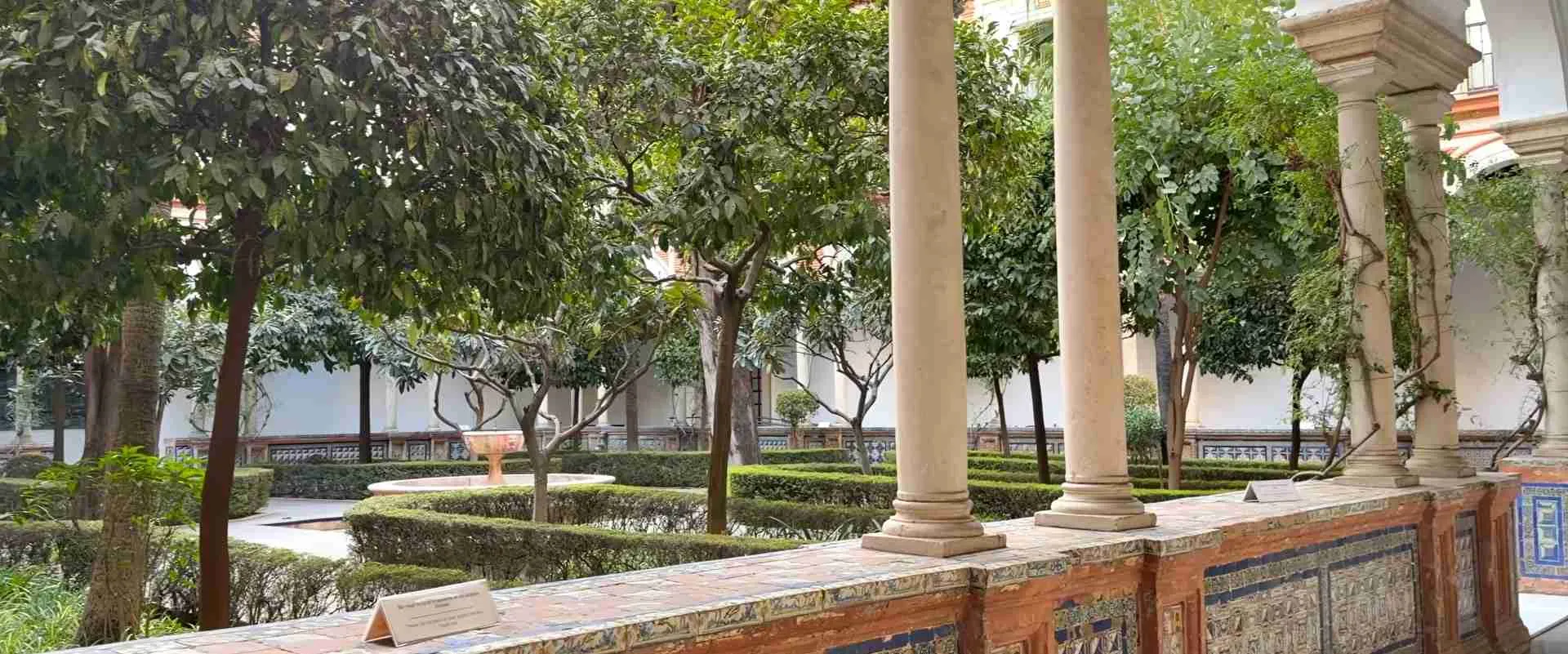
The patio is not a Sevillano invention but a Mediterranean and North African inheritance, transmitted through centuries of Moorish urban culture and adapted to Andalusian conditions over many generations. At its simplest it is an open courtyard at the center of a house, roofed by the sky, surrounded by rooms on two or three storeys. In the Sevillano variant, the patio typically has a central fountain or well, flagstone or tile paving, terracotta pots overflowing with geraniums, bougainvillea, or jasmine, and often a citrus tree whose shade makes the space habitable in high summer. The smell of orange blossom in April, drifting from a patio through an open doorway onto a narrow street, is one of Seville’s most remembered sensory experiences — intense, sudden, and gone again within steps.
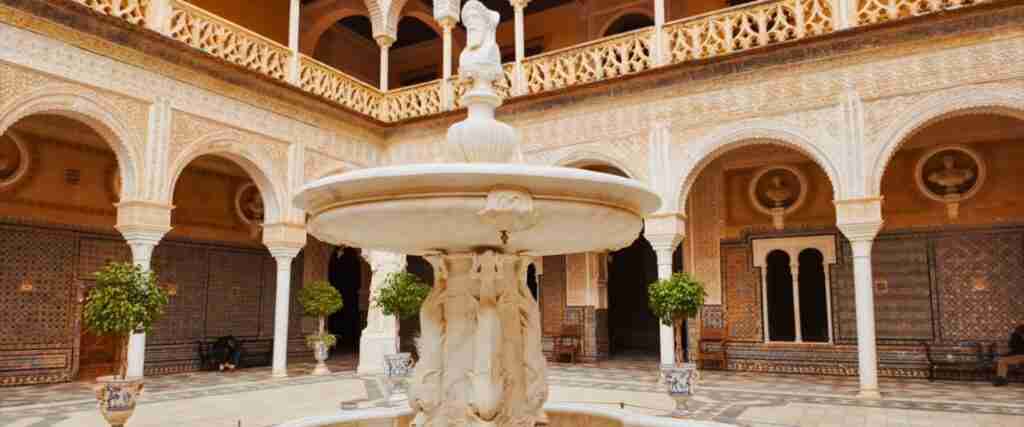
The patio functions differently at different scales. Grand palace patios — the Alcázar’s Patio of the Maidens, the layered courtyards of Casa de Pilatos — are architectural showpieces organized around ceremonial axes, governed by proportion, and decorated with carved stucco, ceramic dados, and marble columns. They represent the highest elaboration of the tradition: spaces designed to impress, to demonstrate wealth and cultivation, to control the movement of visitors through a sequence of visual revelations. Domestic patios in working-class or middling houses are humbler but often more alive: they are the literal center of household life, where children play, laundry dries, and the cool of the stone provides relief from Seville’s fierce summer heat. Between the palace patio and the domestic one lies an entire spectrum of courtyard spaces — the hospital cloister, the convent garden, the civic institution’s formal courtyard — each adapting the same spatial logic to a different set of social purposes.
What unites them all is the inward orientation: Seville builds toward its own center rather than outward to the street, which means the surface of the city — what you see walking its streets — conceals the majority of its inhabited, planted, lived-in space behind closed doors. Learning to look for the patio behind the door is learning to read Seville correctly.
The Corrala Tradition and Communal Patios
A distinct variant of the patio tradition is the corrala or casa de vecinos — a building organized around a shared central courtyard with communal access from each floor via open galleries, functioning as collective urban housing for working-class families. Corralas were common in nineteenth-century Seville, particularly in La Macarena and the Triana barrios, and some survive in residential use. A corrala patio is typically more informal than a domestic garden: it is shared outdoor space, often noisy, sometimes strung with laundry, and genuinely alive in the way that communal spaces become when they are used rather than preserved. Where a grand palace patio arrests attention with its proportions, a functioning corrala pulls you into the texture of neighborhood life as it is actually lived.
Several corralas remain in use in the streets north of the Macarena walls, and their patios, when gates are open in the morning hours, offer a glimpse of a domestic tradition that urban renewal has threatened but not entirely erased. The two-storey gallery arrangement — iron railings, terracotta pots, draped laundry, the voices of neighbors whose household routines are conducted in partial sight and partial sound of one another — is a spatial form with deep roots in Mediterranean and Islamic residential architecture, and its survival in Seville is neither guaranteed nor accidental: it has endured because the buildings have endured and because the residents who live in them have preferred to stay.
How to Access Private Patios Respectfully
The majority of Seville’s patios remain private. The protocol for seeing them requires a willingness to move slowly. Walk residential streets in the historic center, La Macarena, and Triana between 8 AM and noon, when residents open gates for ventilation. Look through the open gate, pause, and look — this is socially normal in Seville and residents are accustomed to it. Do not step inside an open private gate without an invitation. The resident may invite you in; or may not; either response is normal and both deserve courtesy. Photograph through open doorways only if the view is of architecture and plants rather than of people inside their own home.
During May and particularly around the Cruces de Mayo celebrations in early May, gates open more widely, flowers appear on more facades, and the informal displaying of patios becomes a communal activity rather than an accidental one. This is the best window for patio access without the institutional framework of ticketed palace visits. It is also, combined with the approaching heat of summer, the most beautiful time of year for Seville’s streets: jasmine at its peak, orange trees still carrying late fruit, the whitewashed facades reflecting a light that is warm rather than bleaching.
Santa Cruz Quarter: Beyond the Postcard
The Quarter’s History and Street Logic
The Santa Cruz Quarter, Seville’s former Jewish quarter (judería), carries its medieval street plan largely intact. The deliberate maze of dead-end lanes, sudden squares, and right-angle turns — designed to make rapid movement difficult and to create a defensible residential quarter organized around interior security rather than through traffic — predates the Christian city and survives because the cathedral authorities who inherited the neighborhood after the 1248 Reconquista largely retained its fabric. Walking with a map defeats the purpose: the quarter reveals itself through disorientation, through the sudden arrival at a sunlit square after three wrong turns, through the discovery that two streets apparently running parallel share the same arched gate at one end.
The resident population has largely left in recent decades, replaced by holiday apartments and restaurants. But the bones of the neighborhood — the whitewashed walls, the street-level tile panels, the painted doors, and above all the glimpsed patios — preserve the spatial logic of a community that organized itself around interior space rather than street frontage. To walk the Santa Cruz Quarter with an eye for what persists rather than what has been adapted is to encounter a medieval city plan that has survived several centuries of different social occupations without being substantially altered in its geometry.
The most rewarding approach is early morning: the streets empty between dawn and 9 AM, the light is low and raking, gates stand open for airing before residents who remain have closed them for the day, and the quarter reveals a quiet that its midday state — tour groups, restaurant preparation, souvenir logistics — entirely obscures.
Water Lane and the Alcázar Walls
Water Lane (Callejón del Agua) runs along the exterior wall of the Royal Alcázar, a narrow passage between the palace wall on one side and high house walls on the other. The air in the lane is cooler than the surrounding streets; the surfaces change from the whitewash of the residential city to the ancient stone of the palace foundation; flowering plants cascade from upper-storey windows; the name references water channels that historically carried water from the Alcázar gardens to the broader city, traces of which remain below the lane’s paving. Writers and travellers have recorded impressions of the lane since at least the early nineteenth century, and the atmospheric qualities they noted — the closeness of the walls, the sudden shade, the smell of jasmine — remain precisely what they recorded. The romantic associations accumulated over two centuries of literary attention do not diminish the lane itself; they simply confirm that its spatial qualities are durable.
At the northern end of Water Lane, a gate opens into a small square facing the exterior of the Alcázar wall. From here, the scale of the palace fortification is most legible: walls of a height that makes the surrounding residential fabric appear incidental, with the garden vegetation inside the palace visible above the parapet. This viewpoint — the palace as neighbor rather than tourist destination — is one of the Santa Cruz Quarter’s genuinely hidden perspectives, available only to those who have walked Water Lane rather than taken the more direct route to the Alcázar entrance.
Los Venerables and the Velázquez Focus
The Hospital of the Venerable Priests (Los Venerables), founded in the late seventeenth century as a retirement home for elderly clergy, has been repurposed as a cultural and hospitality space without losing its architectural character. Its patio — a double-storey arcade around a central fountain — is accessible through the café and through ticketed access to the Velázquez Focus (Espacio Velázquez) in the basement, a display by the Focus-Abengoa Foundation of works related to Diego Velázquez alongside documentation of his Sevillano formation as a painter. The connection to Velázquez is biographical: Velázquez was born in Seville in 1599 and trained there before his move to Madrid, and the hospital complex, built in the period following the great Sevillano generation of painters, stands in a neighborhood that shaped the visual culture those painters inherited.
The basement space is partly excavated: the patio’s underground water system and earlier archaeological deposits are visible through glass panels set into the floor. This makes Los Venerables one of the rare Seville spaces where architectural layers from multiple centuries are simultaneously present rather than sequentially visited — the baroque patio above, the subterranean water infrastructure below, and Roman-period deposits beneath that, all visible within the footprint of a single courtyard.
Convent Shops and Sweet Traditions
Several enclosed convents in and around the Santa Cruz Quarter sell pastries and confectionery through revolving drums set into their street walls — a centuries-old mechanism by which an enclosed community conducts commerce without breaking its enclosure. The Carmelite convent of San José (known locally as Las Teresas) on Santa Teresa Street, and Santa Inés Convent near the Church of the Savior, are the most accessible. The exchange at the revolving drum — money placed in, pastry returned — takes place in near-silence and without seeing the person on the other side.
The products vary by season and by convent: yemas (egg-yolk sweets), polvorones (crumbling shortbread), torrijas (honey-soaked fried bread associated with Holy Week), and seasonal specialties that each convent produces according to its own tradition and recipe. The hours are set by the convent’s own rhythm, typically mid-morning and sometimes mid-afternoon, and are not announced in advance. Arriving outside those windows means a closed drum and sometimes a handwritten note directing you to return later. This unpredictability is not poor service delivery but the expression of a community organized around a different set of priorities than visitor convenience — which is, precisely, what makes the encounter worth having.
Barrio de Triana: Ceramics, Flamenco, and Working-Class Soul
Crossing the River: Triana as a Separate World
Triana sits across the Guadalquivir from the historic center, connected by the Triana Bridge (Puente de Isabel II), a mid-nineteenth-century iron bridge that was among the earliest of its structural type built in Spain. The crossing takes less than three minutes on foot, but the change of character on the far side is immediate. Triana was historically a separate municipality, incorporated into Seville in 1870, and its residents still speak of the city across the river in terms that make the distinction clear: not Seville versus Triana, but a Triana that has its own coherent identity, its own loyalties, and its own social world that does not depend on the historic center for its definition.
The barrio faces the historic center across the water — the Seville skyline, with the Giralda tower visible from almost every riverside vantage point — but its orientation is inward, toward its own markets, its own bars, its own ceramic-tiled streets and the social worlds those streets contain. This inward coherence is what makes Triana the most complete alternative to the tourist circuit in Seville: it is not an incomplete version of the center but a different thing entirely, with its own historical justification for existing as it is.
The Ceramics Tradition of Triana
Triana’s ceramic tradition is not ornamental heritage but a living industry. Workshops along Pottery Street (Calle Alfarería) and the surrounding lanes have produced hand-painted azulejo tiles for centuries, supplying churches, civic buildings, and private houses across Andalusia and beyond. Triana potteries supplied a significant proportion of the decorative tiling used in the construction of the Plaza de España and the surrounding pavilion buildings for the 1929 Ibero-American Exhibition — one of the largest concentrations of azulejo decoration in Spain — and the workshops that produced those tiles have continued producing in the same neighborhood since.
The distinctive Triana style combines geometric patterns derived from Islamic tile-making traditions with figurative religious and narrative imagery; workshops produce both stock items and bespoke hand-painted commissions. The Triana Ceramics Museum (Centro Cerámica Triana), located in the former Santa Catalina pottery, displays the industrial history of the craft alongside working examples of its techniques. Its most striking feature is the excavated kiln remains preserved in situ beneath the exhibition floor — the physical evidence of the production that has shaped this neighborhood’s identity for centuries. The working demonstration areas show the process of applying oxide pigments to bisque-fired clay before the second kiln firing that fixes the characteristic matte colors of traditional azulejo, and observing it clarifies why hand-painted tiles carry a presence and slight irregularity that machine-printed versions cannot replicate.
Walking Pottery Street itself, a visitor encounters working ceramics shops alongside residential buildings and bars, with the occasional tile-fronted facade demonstrating the product in situ. The tiles are not decorative additions to Triana’s streets; they are structural to its identity, embedded in house numbers, street signs, bar counters, and the dado rails of even the most modest doorway. In Triana, the product and the place that produces it are the same thing — a relationship between craft and neighborhood that urban industrial history rarely preserved and that Triana has maintained against considerable economic pressure to substitute and standardize.
Flamenco Heritage in Triana’s Streets
Triana’s historical connection to Seville’s Romani community made it a significant center of flamenco as a performed and transmitted art form in the nineteenth century. The specific geography of this heritage is now partly commemorated and partly dissolved into the general life of the barrio. Betis Street (Calle Betis), running along the riverbank, contains several peñas flamencas — membership clubs dedicated to flamenco performance and study — that hold regular performances structured for an audience of aficionados rather than for tourists. These clubs are not ticketed shows in the commercial sense; access typically requires either membership or an approach to the club in advance, in Spanish, to enquire about upcoming events that admit non-members. The directness of this enquiry — knocking on a door, asking at a bar, being introduced by someone who knows — is itself characteristic of how flamenco’s community functions. The art is transmitted through networks of people who know each other; entering that world at its edges requires acknowledging the network.
The residential streets behind Betis Street preserve the fabric from which flamenco’s indoor traditions emerged. Individual houses where significant performers were born or lived are marked with ceramic plaques — the Sevillano convention for honoring historical figures — though these plaques require a reading knowledge of Spanish and some familiarity with flamenco genealogy to interpret fully. For a visitor without that background, the plaques function as confirmation that the street carries the history they reference; the history itself requires separate engagement with books, recordings, or conversations with people who know it.
Triana Market: The Neighborhood Food Hall
Triana Market stands on the site of the Castle of San Jorge, the principal seat of the Seville Inquisition, which was demolished in the early nineteenth century. The current market building was substantially reconstructed in the late twentieth century, preserving the medieval castle foundations beneath a glass floor — one of the more unusual combinations of heritage preservation and everyday commercial life in the city. The market serves Triana’s resident population with fish, vegetables, meat, cheese, and prepared food stalls operating from permanent premises, and functions as a social space as much as a commercial one: the bar in the corner is occupied from 7 AM by workers and retired residents sharing coffee before the rest of the market activity begins.
The glass panels set into the market floor above the castle foundations are easily overlooked in the activity of shopping, but pausing over them reveals masonry, drainage channels, and occasional ceramic fragments from the fifteenth and sixteenth centuries. The museum installed in the basement — accessible separately from the market itself — presents the Inquisition’s history and the castle’s archaeology with enough documentation to make the site’s layered meaning tangible rather than merely described. Walking from the cheese counter to the vegetable stalls, it is possible to pass over eight centuries of Seville’s institutional history beneath your feet without being required to acknowledge it, which is, in a practical sense, exactly what the city has always done with its own complexity.
La Macarena: The Barrio Locals Call Home
The Texture of an Authentic Barrio
La Macarena, occupying the northwest section of the historic walled city, is one of the last large Sevillano neighborhoods where the resident population has not been substantially displaced by tourist accommodation and restaurant conversion. Its streets have the character of a barrio that is used daily: corner shops, pharmacies, hardware stores, workshops, school gates, parked motorcycles, and the particular noise of a neighborhood that wakes itself up every morning without regard for visitor schedules. This is not a museum of Sevillano life but the thing itself, ongoing, with all the unpolished details that living neighborhoods contain and preserved neighborhoods cannot.
For a visitor accustomed to the Santa Cruz Quarter’s photogenic uniformity — whitewashed walls, tiled doorways, tourist menus in multiple languages — La Macarena presents a more demanding and more rewarding visual environment: an accumulation of different periods, different degrees of maintenance, different uses of the same architectural tradition, all in proximity to one another without the editing that gentrification performs. The neighborhood church appears at the end of a street occupied by a hardware shop and a bar serving construction workers. A baroque facade rises between apartment buildings of no particular period. The medieval walls appear at the northern end of a residential street as if they had always been there — which, of course, they have.
Feria Street and El Jueves Market
Feria Street (Calle Feria), the barrio’s north-south spine, functions as a commercial main street: hardware and ironmongery shops alongside cafés, patisseries, independent clothing stores, and the occasional antique dealer. The street preserves a variety of trades that commercial homogenization has eliminated from many European city centers, partly through the loyalty of the local population to its own suppliers, and partly through a density of resident custom that makes small-scale specialization viable.
On Thursday mornings, the northern section of Feria Street hosts the El Jueves market — one of Seville’s oldest traditional street markets, the name translating simply as “Thursdays.” The market occupies several blocks from approximately 9 AM to 2 PM, with a mixture of professional second-hand dealers, casual sellers clearing household contents, and specialists in old books, maps, religious imagery, tools, and clothing. The quality of what is on offer varies considerably by week and by table; the experience is consistent: crowds, negotiation, the smell of old paper and slightly damp fabric, and the pleasure of a space that operates according to its own logic without accommodation of the tourist economy. The market has been held on this street for long enough that its origins are disputed rather than precisely documented, which is itself a marker of how deep its roots run in the neighborhood.
The Macarena Walls and Gate
The surviving section of Seville’s medieval city walls in the Macarena neighborhood is the most substantial stretch of ancient fortification visible anywhere in the city. The walls reach approximately twelve meters in height, with regularly spaced rectangular towers, and have their structural origins in the Almohad period of Moorish rule in the twelfth and thirteenth centuries, though they incorporate later medieval modifications and repair work from various periods. The Macarena Gate (Puerta de la Macarena) — a horseshoe-arched opening through the wall — is the best-preserved of the city’s surviving ancient gates. Walking the exterior of the wall along the road that runs alongside its base gives a clear sense of the scale of the fortification and of the effort required to breach it: Ferdinand III’s Castilian forces managed the conquest of Seville in 1248 after a siege of approximately eighteen months, and the wall’s surviving mass makes that duration more comprehensible.
The interior face of the walls, visible from the residential streets running parallel on the city side, reveals the informal relationship between the ancient fortification and the later houses that have grown up against it. In several places, residential buildings are built directly into the wall’s thickness, using its mass as their rear elevation. Windows cut through the wall at odd angles open onto medieval masonry. This vernacular adaptation of monumental infrastructure — the transformation of a defensive wall into a building material — is a practice with a long history in Seville, and its results are one of the most quietly remarkable things about walking the Macarena interior: a city continuously cannibalizing and incorporating its own past without ceremony.
Macarena Basilica and Holy Week Devotion
The Macarena Basilica, a twentieth-century structure built in a historicist baroque style, houses the Virgen de la Esperanza Macarena — a sculpted image of the Virgin that is among the most venerated in Seville’s Holy Week calendar. The image is carried in procession from the basilica in the early hours of Good Friday morning in a procession that draws hundreds of thousands of participants and observers, passing through the streets of La Macarena before dawn. For the other fifty-one weeks of the year, the Virgin is enthroned in her basilica chapel, illuminated, and accessible to visitors throughout the day. The adjacent museum contains the baroque processional platform (paso) and embroidered canopy under which she processes, along with jewelry, embroideries, and documentation of the confraternity’s history.
Understanding the basilica outside the context of Holy Week requires accepting that the devotion to the Macarena is not primarily aesthetic — though the image and its setting are objects of considerable skill — but deeply personal and communal. She is the neighborhood’s Virgin, the object of devotion for residents across generations, and her presence in the barrio is a constant rather than a seasonal event. Residents visit the basilica as a matter of routine, lighting candles, pausing in front of the throne, conducting the ordinary religious practice of a neighborhood that takes its devotional life seriously. Visiting as a tourist in this context requires the same kind of attentiveness that visiting any active place of worship requires: presence without intrusion, attention without disturbance.
El Arenal and the Riverside Quarter
La Maestranza and Its Architectural Identity
El Arenal, the quarter between the historic center and the Guadalquivir riverbank, is defined by two major monuments: La Maestranza bullring and the Gold Tower (Torre del Oro). Both attract visitors in quantity; both have more to offer than their tourist prominence suggests, and both sit in a neighborhood that extends well beyond them into riverside walks, baroque religious architecture, and the particular quiet of a former working port that has reinvented itself for a post-industrial era.
La Maestranza — the Real Maestranza de Caballería de Sevilla, to use its formal title — is one of the oldest bullrings in Spain, built over the course of the eighteenth century. Its distinctive ochre-and-white color combination has made it the visual reference point for bullfighting arenas built since its completion, and its exterior arcade is a piece of baroque civic architecture that rewards attention on its own terms, separate from any engagement with the practice that takes place inside. The interior is accessible on guided tours outside the bullfight season and between fights during it, and reveals the spatial intelligence of a building designed to maximize both spectacle and intimacy: the ring is smaller than modern arenas, the seating closer, the proportions calibrated for an experience of proximity between performer and audience that larger venues have sacrificed. The museum within contains an extensive collection of bullfighting art, costume, and documentation that has genuine cultural-historical value for any visitor, regardless of their position on the practice itself.
The Gold Tower, the Silver Tower, and the Riverside Walk
The Gold Tower (Torre del Oro) stands on the Guadalquivir riverbank as one of the most immediately recognizable monuments in Seville, its twelve-sided form constructed during the Almohad period in the early thirteenth century as a riverside watchtower. It is thoroughly documented, thoroughly visited, and entirely worth seeing — though the visit is brief. Less visited and almost adjacent is the Silver Tower (Torre de la Plata), a smaller rectangular watchtower of similar Almohad construction, partially embedded in later residential building. The Silver Tower is visible from the street that runs past it but requires specifically looking for it: it has no visitor infrastructure, no queue, and no signage that announces its presence to anyone not already looking. It is a medieval tower that has been built around and absorbed into a later urban fabric, surviving because demolishing it would require demolishing the walls attached to it — which is, in Seville, a perfectly ordinary kind of monument survival.
The riverside walk between the Gold Tower and the Triana Bridge is the most agreeable stretch of Seville’s public riverbank, wide enough for separated pedestrian and cycling lanes, shaded by mature trees, and animated by river views in both directions. Across the water, Triana’s Betis Street bar fronts face the walk directly; the effect at dusk, with the Giralda visible above the Seville roofline, is one of the most characteristic views of the city available from public space — and, being a public street rather than a paid attraction, entirely free of queue.
Charity Hospital: Murillo and Valdés Leal in Context
The Charity Hospital (Hospital de la Caridad), founded in the seventeenth century by the nobleman Miguel de Mañara as a charitable institution caring for the sick and burying the executed poor, contains one of the most significant intact collections of seventeenth-century Spanish painting remaining in its original architectural context. Bartolomé Esteban Murillo, who died in Seville in 1682, painted a series of large canvases for the hospital’s church depicting works of mercy — feeding the hungry, clothing the naked, healing the sick — in an approachable style of considerable technical sophistication. Juan de Valdés Leal painted two monumental works for the same church: Finis Gloriae Mundi and In Ictu Oculi, memento mori images of startling directness depicting decaying episcopal corpses and overturned symbols of worldly power, intended to confront viewers with the vanity of earthly achievement.
The hospital still functions as a care home for elderly residents and is accessible to visitors by ticket during set hours. It is among the least-visited significant art sites in central Seville, partly because its subject matter — charity, mortality, and Christian penitence — does not fit comfortably into the architectural tourism circuit, and partly because it requires actively choosing to go there rather than passing it on the way to something else. Both reasons for avoiding it are, in different ways, reasons for going.
Northern Seville: The Forgotten Barrios
San Julián, San Gil, and the Neighborhood Churches
North of the Macarena Basilica, the historic center continues in neighborhoods that see almost no tourist visitors: San Julián, San Gil, San Marcos, and Omnium Sanctorum, named for the parish churches that have historically organized each community. These barrios retain a texture that the Santa Cruz Quarter lost to gentrification years ago — tile-fronted houses with paint worn at the edges, corner bars without tourist menus, the kind of narrow streets where residents double-park motorcycles against the pavement without ceremony. The neighborhood church at the center of each barrio — Gothic, Mudéjar, or baroque depending on its date of construction — is typically open for morning Mass and for a few hours around midday; most contain retablo altarpieces, religious sculpture, and painted ex-voto offerings of considerable quality that see almost no visitors beyond the local congregation.
Walking these streets requires an acceptance of the unremarkable: this is not hidden Seville in the romantic sense of secret viewpoints and concealed gardens, but hidden Seville in the more ordinary sense of a city that has continued to be itself in streets that tourist maps do not mark as destinations. The reward is the specific texture of urban life that only working neighborhoods possess — the greengrocer with the crates of produce on the pavement, the elderly woman checking the street before pulling her door closed, the bar that opens at 7:30 AM and is full by 8:00 with the same people who are there every morning, and whose names the barman knows without needing to be told.
Palacio de las Dueñas: The Palace Open to Visitors
Palacio de las Dueñas, on Dueñas Street between the northern barrios and the more visited sections of the historic center, offers a refined counterpoint to the surrounding streets. The palace — a privately owned compound of fifteenth-to-sixteenth-century construction — contains a sequence of Mudéjar, Gothic, and Renaissance courtyards connected by galleries and gardens, representing several phases of building and elaboration across the late medieval and early modern periods. It has long been associated with the House of Alba and is open to ticketed visitors throughout the year.
The Spanish poet Antonio Machado was born in the palace in 1875, when his family occupied apartments there in connection with his grandfather’s employment as its administrator. A room in the palace museum acknowledges this connection, and the ceramic plaques and documentation in that room represent a genuinely unusual overlap of aristocratic domestic architecture and literary heritage. The palace patios themselves are the primary attraction: the formal garden patio with its orange trees and central pool, the ceramic-tiled arcaded courtyard with its Mudéjar dado work, and the shaded cloister garden beyond are among the most complete examples of Mudéjar domestic architecture accessible to visitors in Seville, more domestic in scale and more layered in feeling than the palace courtyards of the Alcázar.
The Hercules Promenade and Bohemian Seville
The Hercules Promenade (Alameda de Hércules) is simultaneously a Roman monument, a sixteenth-century civic project, and the current social heart of Seville’s bohemian and counterculture communities. The Roman granite columns that mark the promenade’s southern entrance, topped with statues of Hercules and Julius Caesar, are among the oldest free-standing columns still standing in any Spanish city — a survival that reflects the scale of Seville’s Roman predecessor city, Hispalis, rather than any exceptional conservation effort. The promenade itself was created in 1574 by the Count of Barajas, who ordered the flooding of a low-lying marshy area, the driving of piles, and the planting of poplars, making it one of the earliest formal public promenades in Europe — a civic investment in urban amenity that predates most comparable European examples.
In its current form, the Hercules Promenade is flanked by bars, cafés, and cultural venues of deliberately informal character, animated by students, artists, and long-term residents who have organized their social lives around its terraces. On Sunday mornings it hosts a small organic market; at weekends it functions as the default gathering point for Seville’s alternative social scene. On ordinary weekday afternoons it is simply a tree-lined boulevard where parents push prams and retired residents walk dogs, which is to say that it performs the function a promenade was designed to perform, for the population that lives around it. The contrast with the ornate baroque civic formality of the Cathedral and Alcázar district, fifteen minutes’ walk south, could not be more complete.
Sacred Spaces: Baroque Churches and Convent Interiors
Church of San Luis de los Franceses
The Church of San Luis de los Franceses, on San Luis Street in the northern historic center, is a baroque structure of exceptional interior richness that sees a fraction of the visitor attention directed at the Cathedral. Built in the late seventeenth and early eighteenth centuries for the Society of Jesus, the church was closed after the Jesuit expulsion of 1767, subsequently served multiple other functions, and has been restored and reopened for cultural visits. Its interior plan — a circular nave with lateral chapels, frescoed vaults, and a gilded retablo altarpiece — combines in a space that rewards extended attention with its layering of painted and gilded surface across multiple scales. The admission price is modest; reaching it requires walking twenty minutes north of the Santa Cruz Quarter into a neighborhood that casual tourists rarely enter, which means a visit is almost always conducted in near-solitude.
Santa Ana Church in Triana
Santa Ana Church (Iglesia de Santa Ana) in Triana, founded in the late thirteenth century following the Christian conquest of Seville, is one of the oldest surviving parish churches in the city and functions as the spiritual center of the Triana barrio. Its architecture is Gothic in structure, with Mudéjar detailing and later baroque additions accumulated across seven centuries of continuous use, and its interior contains an accumulated devotional heritage — retablos, paintings, sculpture, and a baroque organ — that reflects the barrio’s religious life across those same centuries. The church is in active liturgical use and accessible for visitors in the brief opening period around mid-morning. Its plain street exterior, in a residential lane off Pureza Street, gives no indication of the interior’s size or complexity — a characteristic concealment that Santa Cruz Quarter visitors train themselves to expect but that outside that neighborhood still surprises.
Convent Pastry Culture and the Revolving Drum
Beyond the Santa Cruz Quarter convents, the tradition of monastic confectionery production extends across Seville’s historic neighborhoods. In the city proper, several convents produce and sell through their street-facing revolving drums (tornos): yemas, polvorones, torrijas, and seasonal specialties are among the most common offerings. Each convent has its own recipes, its own seasonal calendar, and its own quietly observed opening hours — typically mid-morning and sometimes mid-afternoon — which are not published in advance and which require return visits when the drum is found closed.
The space of the torno transaction is worth understanding on its own terms. On one side of the wall, the street and the visitor. On the other side, the enclosed community and the drum. The drum rotates through the wall — goods emerge, money disappears inside — without any visual exchange between the two sides. The architecture of the torno is a spatial solution to a spiritual problem: how does a community dedicated to enclosure conduct necessary commerce with the outside world without breaching that enclosure? The answer is this device, still in use in convents founded half a millennium ago, which makes every transaction feel like a small miracle of practical ingenuity.
Hidden Squares and Local Plazas
Alfalfa Square and the Sunday Gathering
Alfalfa Square (Plaza de la Alfalfa), a small irregular square in the heart of the historic center, takes its name from the fodder market that once occupied the space and now functions as a neighborhood gathering point of the unplanned, organic variety. On Sunday mornings, the square hosts an informal market of caged birds, potted plants, and occasionally small animals — a tradition whose survival into the present is a matter of neighborhood habit more than institutional preservation. The cafés around the square fill with residents spending Sunday mornings in the Sevillano manner, which involves coffee, conversation, and no particular intention to move on quickly. The square itself is overlooked by a tile-decorated well housing, a baroque church facade, and a tangle of balconies that make it one of the most photographically interesting unremarkable spaces in the city — a place where nothing remarkable is happening and the ordinariness of what is happening is itself the point.
Salvador Square and the Church of the Savior
Salvador Square (Plaza del Salvador) is known to many visitors as the forecourt of the Church of the Savior (Iglesia del Salvador), Seville’s second-largest church after the Cathedral. The church itself contains a substantial collection of religious sculpture, including the Jesús de la Pasión, documented as a work by the seventeenth-century sculptor Juan Martínez Montañés — an image of sufficient devotional importance to be carried in Holy Week procession by one of the city’s oldest confraternities. The square before it, however, operates independently of its architectural backdrop: used as a morning book market on certain days, as a daytime social space throughout the week, and as a bar-terrace overflow zone on weekend evenings, it has the life of a place that the people around it have collectively decided to use rather than preserve. The church is a backdrop, the square is the stage, and the actors are the same Sevillanos who fill every plaza in the city with the specific noise and leisure of a culture that takes its public outdoor life seriously.
Local Plazas as the Grammar of Sevillano Life
A pattern repeats across Seville’s historic neighborhoods: a small square, irregularly shaped, named for a church or a religious image, surrounded by a mixture of residential buildings and one or two bars, occupied at different times of day by different populations — schoolchildren in the afternoon, elderly residents in the morning, younger adults on weekend evenings. None of these squares is remarkable in isolation; collectively they constitute the grammar of Sevillano urban life, the spatial unit within which the barrio’s social exchange takes place. The Square of Christ of Burgos (Plaza del Cristo de Burgos), near the Hercules Promenade, follows this pattern, as do numerous others that do not appear in tourist itineraries.
Finding these squares requires no map and no insider knowledge — only the decision to turn away from the main tourist arteries and walk any residential street for five minutes. They appear at the end of lanes, at the junction of alleys, wherever the street grid opens up enough to allow a few extra meters of public space. Their furniture is minimal: a bench, a tree, a small fountain that may or may not be working, a plaque on the wall naming a local worthy. Their value is in what happens in them, which is nothing remarkable: people going about their lives in the presence of other people going about their lives, in a city that has organized this particular kind of everyday togetherness with centuries of practice.
Markets, Food Culture, and Everyday Seville
The Logic of the Sevillano Market
Seville’s resident population shops at neighborhood markets in the morning and at specialist shops for particular products. None of the city’s active neighborhood markets is primarily tourist-facing; all reveal something important about the scale and character of local food culture. The Triana Market (already described above) is the most architecturally distinguished and the most embedded in its neighborhood’s identity. The Lonja del Barranco, a nineteenth-century iron market building on the riverbank between the Gold Tower and the Triana Bridge, has been converted to a food market of multiple stalls — more curated and more tourist-oriented than the neighborhood markets, but useful as a survey of the range of Andalusian ingredients and prepared dishes in a single visit.
What distinguishes the neighborhood market from the curated food hall is the social logic it operates within. At Triana Market, the fishmonger knows which regulars prefer their clams cleaned and which don’t; the coffee at the corner bar is made to the preferences of the people who drink it every morning; the vendor at the vegetable stall is the same person who was there last week and will be there next week. This continuity of relationship — between vendor and customer, between product and place — is what generates the specific atmosphere that curated food halls spend enormous effort trying to simulate and never quite achieve.
Tapas as Neighborhood Practice
The tapas culture that Seville exports as a brand is in practice a neighborhood institution, most purely expressed in bars that serve a single rotating tapa with each drink as a matter of habit rather than culinary ambition. In La Macarena, in Triana, and in the northern barrios, this tradition operates as the norm: the free tapa that comes with a glass of beer or a small wine is not a marketing strategy but a social practice, a way of ensuring that no one sits at a bar without eating something. The neighborhood bar at 1 PM on a working day — construction workers, office staff, and retired residents at the same zinc counter, eating fried anchovies or a wedge of potato omelette — is the baseline of Sevillano food culture that all the celebrated restaurants in the Alfalfa area are, in some sense, interpreting.
Finding these bars requires walking away from the main tourist circuits. The practical markers are reliable: a bar with no English on the menu, a zinc counter with cigarette burns, a television showing a football match at volume, and a sufficient density of locals to indicate that the place has a function in the neighborhood independent of passing trade. Ordering requires at most a few words of Spanish and a willingness to point. The result — a cold beer and whatever comes with it — costs less than the equivalent in the tourist center and tastes better, which is the simplest available argument for exploring the hidden city.
Seasonal Food and Seville’s Culinary Calendar
Seville’s food culture is seasonally organized in ways that visitors staying only a few days rarely notice but that extend the potential for discovery considerably. The torrija season runs through Holy Week: a thick slice of bread soaked in egg and honey, fried, and spiced with cinnamon, sold in pastry shops, at convent drums, and in bars throughout the city from the days before Palm Sunday. Strawberries from the nearby Huelva growing areas appear in markets and on bar counters from February onward. Manzanilla sherry from Sanlúcar de Barrameda — bone dry, salt-edged, served cold in a thin copita — is the local accompaniment to fried fish and is available in any bar worth entering in Seville, though it is at its best in Triana, where the proximity to the river seems to intensify whatever oceanic quality the wine carries. Gazpacho in its Sevillano form — thicker than the tourist version, sometimes served almost as a paste rather than a soup — appears at its most intense in bars where it is made from summer tomatoes rather than tinned, and therefore only in high summer and early autumn.
Photography in Hidden Seville
Light, Tiles, and Doorways
Seville’s hidden interior — the glimpsed patios, the painted tiles, the lime-washed walls with their balconied shadows — is a photographer’s subject that rewards patience and a narrow field of view. The conditions that make Seville architecturally extraordinary — bright southern light, whitewashed reflective surfaces, deep shadow at street level — also make midday photography difficult: bleaching light from directly above eliminates the texture of tilework and turns whitewashed walls into overexposed backgrounds. The best light for street and architectural photography falls in the hour after dawn and the hour before dusk, when a low angle produces raking shadows on tilework and gives walls a warmth that the bleaching midday sun removes. Early morning has the additional advantage of near-empty streets in the tourist center, which allows the architecture to be seen as itself rather than as a backdrop to visitor activity.
Patio Photography Through Open Gates
Photographing through open residential gates requires a clear understanding of what is and is not in the public domain. The gate, and the street view through the open gate, are available to the camera; the interior of someone’s home is not. The practical rule: photograph the framed view from the threshold, from street level, without stepping inside the gate. The architectural subject — the fountain, the potted plants, the tiled floor, the light falling across a whitewashed arch — is almost always sufficient for a compelling image. The human subjects inside a private patio are not available for photography without explicit permission, which occasional Sevillano hospitality extends and occasional Sevillano directness declines, both with equal courtesy.
The patio seen through an open doorway has a specific photographic quality that sets it apart from the palace courtyard seen in full: the frame of the gate compresses the view, the contrast between the dark surround of the doorway and the sunlit interior gives the image a luminosity that is difficult to achieve in open-air shooting, and the sense of enclosure — of having glimpsed something not fully disclosed — is preserved by the image in ways that a photograph taken from inside the courtyard cannot reproduce. The best patio photographs are taken from outside.
Ceramics and Tile Details
Seville’s decorative tilework is dispersed across the city in ways that reward systematic attention. House numbers appear on cut-tile panels; street-name plaques use Mudéjar geometric patterns; the dados of bars and grocers carry hand-painted azulejo scenes; the facades of a handful of historic pharmacies and shops display full-height ceramic decoration. In Triana, where the production tradition is strongest, tile details appear in unexpected contexts — the entrance of a workshop tiled with the same geometric precision as a chapel interior, the bar counter surfaced with hand-painted narrative tiles produced within a kilometer of where they sit. Tile photography in close-up, concentrating on the relationship between pattern geometry and the slight irregularities of the hand-painting process, produces images that are simultaneously abstract and deeply material — evidence of the human hand in a mechanical world that is, in Triana, the direct product of the workshops that line the surrounding streets.
Practical Guide to Exploring Hidden Seville
Getting Between Neighborhoods
Seville’s historic neighborhoods are compact enough that walking is the primary mode of movement, and most of the hidden spaces described here are most effectively reached on foot — arriving by taxi or bus and returning immediately obscures the connections between neighborhoods that make the city readable as a whole. From the Cathedral, La Macarena is a twenty-minute walk north; Triana is fifteen minutes west and across the Triana Bridge; the Hercules Promenade is ten minutes north of the Santa Cruz Quarter; Palacio de las Dueñas is fifteen minutes north of the Cathedral.
Seville’s public bicycle system (SEVICI) provides rental points throughout the historic center and adjacent neighborhoods, and the city’s flat terrain and separated cycling lanes make it one of the more cycling-friendly Spanish cities. The distances involved in the circuits described here are all under six kilometers end to end, and the bicycle has the advantage over walking of making the river crossing to Triana feel even shorter. Public buses serve the outer neighborhoods; for the historic center and the barrios described here, they are not necessary. The tram line runs along the main civic axis between the Cathedral and the Hercules Promenade area, which is useful for returning from a long morning walk without the return leg on foot.
When to Visit Each Barrio
La Macarena is at its most alive on Thursday mornings for El Jueves market, and on any ordinary weekday between 9 AM and 1:30 PM when Feria Street’s shops and cafés conduct the serious business of the day. Triana is best on Tuesday through Saturday mornings when the Triana Market is fully active; Betis Street becomes its liveliest from early evening onward. The Hercules Promenade builds through the day from late morning café culture to evening social gathering and is the appropriate destination for a late afternoon or evening exploration of northern Seville. The Santa Cruz Quarter is at its quietest and most accessible before 9 AM, when the tour groups are still at breakfast, and in the early evening when they have dispersed.
Seville’s summer heat — genuine and sustained from June through early September — makes the morning window from approximately 7 AM to 1 PM the practical period for outdoor exploration of any kind, with a necessary interval through the afternoon before late afternoon and evening restore the possibility of comfortable outdoor time. In this context, the hidden Seville itinerary organizes itself naturally: La Macarena market in early morning, Triana at midmorning and market time, the riverside walk in late afternoon, the Hercules Promenade in the evening. May and October offer more flexible timetables and, in May, the additional bonus of peak jasmine and bougainvillea in every patio visible through every open gate.
Language, Navigation, and Approach
Spanish is the working language in all the barrios described here. In La Macarena, Triana, and the northern historic center, English is less reliably available than in the tourist center around the Cathedral; Spanish, or at minimum a willingness to gesture and point, is both necessary and appreciated. Navigation in the historic center’s maze of lanes is most effectively done by landmark orientation rather than GPS, which in streets three meters wide often provides directions for a different lane running parallel. The key spatial anchors — the Giralda tower visible from most elevated vantage points, the river to the west, the Cathedral’s mass always orientating the southern edge of the center — are reliable enough that orientation by sight is almost always recoverable from wherever a wrong turn has led.
Getting lost in the Santa Cruz Quarter, specifically, is not a navigation failure but the appropriate method for encountering the neighborhood, which does not reveal itself through efficient linear movement from point to point. The same is true to a lesser degree of La Macarena’s inner streets and Triana’s lanes behind Betis Street. Slow movement, frequent pausing, and the specific willingness to turn into a street not because it leads anywhere marked on a map but because it looks interesting are the practical skills that hidden Seville rewards above all others.
Frequently Asked Questions
Is Seville’s patio culture the same as Córdoba’s?
No, and the distinction matters to visitors planning around it. Córdoba’s Festival de los Patios Cordobeses is a formally organized, UNESCO-listed intangible cultural heritage event held annually in May, in which private households enter their patios in a judged competition assessed on floral display, tidiness, and traditional character. Seville has no equivalent formal festival or competition. Seville’s patio culture is instead embedded in the architecture and domestic habits of its historic neighborhoods — an informal tradition of private interior courtyards glimpsed through open gates rather than competed over, occasionally opened more widely during the Cruces de Mayo celebrations in early May but never institutionalized as a citywide event. Both traditions are authentic expressions of the Andalusian patio inheritance; they are simply different in structure and scale, and confusing them leads either to disappointed expectations in Seville or an underestimation of the organization and density of what Córdoba’s event involves.
What is the best single neighborhood to explore for a hidden Seville experience?
Triana provides the most complete alternative to the tourist circuit as a self-contained neighborhood with its own identity, market, ceramics tradition, and social life that does not depend on the historic center for its definition. For a visitor who cannot cross the river, the stretch of La Macarena between the Macarena Gate and the Hercules Promenade — particularly along Feria Street and the streets behind Palacio de las Dueñas — concentrates the authentic neighborhood experience into a walkable area that reveals, within an hour, the texture that distinguishes a living barrio from a tourist destination. The Santa Cruz Quarter, despite its visitor density, retains genuine architectural interest in its early morning hours before tour groups arrive, particularly in the lanes around Water Lane and the streets north of the Hospital of the Venerable Priests.
Can visitors enter Palacio de las Dueñas without advance booking?
Palacio de las Dueñas accepts walk-in visitors during its regular opening hours, and advance booking is not required in most periods. During Holy Week and the Seville April Fair, when visitor numbers across the city are at their seasonal peak, early arrival is advisable to avoid any queue at the entrance. The palace charges an admission fee covering access to the patios, gardens, and furnished residential rooms with their associated collections; audio guides are available in several languages. The full circuit takes approximately ninety minutes to two hours; the patios themselves can be seen more quickly, though the garden spaces beyond the main courtyard, which many visitors miss, reward the additional time required to find them.
How do I find an authentic flamenco experience in Seville?
The most authentic flamenco performances in Seville take place in peñas flamencas — membership clubs dedicated to the art form, with the highest concentration in Triana and in the Macarena neighborhood. These clubs hold regular performances, primarily for members and invited guests, but some admit non-members for specific events: enquiring directly at the club, in Spanish, is the correct approach, as telephone or in-person contact is more effective than searching online for booking systems that may not exist. The Cultural Center of Flamenco (La Casa del Flamenco) in the Santa Cruz Quarter offers ticketed performances of genuine quality in an intimate setting aimed at an attentive audience. The tourist tablao format — dinner show with choreographed performance — is not inauthentic in the sense that it employs skilled performers, but it is a theatrical product designed for visitors rather than the living art as its community practices it, and the difference is audible from the first compás.
When is the best time of year to visit hidden Seville?
Late April and May offer the best conditions for the patio and neighborhood culture described here: temperatures are comfortable, jasmine and bougainvillea are in peak flower, and the Cruces de Mayo celebrations in early May open some private patios more widely than at other times. Holy Week, in March or April depending on the year, brings extraordinary beauty to Seville’s streets but also maximum crowds and logistical complexity; quiet patio exploration is difficult except at dawn. October and November offer good temperatures and significantly reduced visitor numbers, with flowering plants past their peak but the light of autumn making the whitewashed streets particularly beautiful. Summer heat from June through August makes midday exploration impractical, but the early morning window — 6 to 10 AM — reveals the city in a different light, with bakers, market suppliers, and cleaning crews occupying streets that are empty of visitors and that feel, temporarily, like the undiscovered city.
Are day trips from Seville that extend the hidden-places theme possible?
Carmona, thirty kilometers east of Seville by bus or car, is a walled hilltop town with a Roman necropolis, a Moorish alcázar, and a historic center that receives modest international visitor numbers despite its proximity to the city. Its streets and squares have the character that Seville’s tourist center has largely lost. Italica, at Santiponce eight kilometers north of Seville, preserves the site of a Roman city that predated Seville and contains a remarkably large and well-preserved Roman amphitheater that sees a fraction of the visitors that Seville’s city center receives. Osuna, ninety kilometers east, and Écija, known locally as the “frying pan of Andalusia” for its summer heat, are both towns of extraordinary baroque architectural richness that function almost entirely for their own resident populations and offer the rare experience of visiting first-rank monuments in what amounts to solitude.
What should I look for on Seville’s street facades to read the city’s historical layers?
Four surface details reveal Seville’s historical layers most clearly to an attentive walker. First, the horseshoe arch: where it appears in a gate or window frame, it indicates either original Moorish construction or a later building explicitly referencing the Mudéjar tradition, a style that continued in Seville long after the Christian conquest. Second, the tile dado: the height, age, and pattern of ceramic dado tiles running along a street-level facade indicate the building’s period and aspiration — geometric Mudéjar patterns suggest medieval or early modern date; painted narrative tiles in blue and white often indicate nineteenth-century Triana production. Third, building inscriptions: Seville’s historic buildings frequently carry carved dates, patron names, or confraternity symbols legible from the pavement without entering the building. Fourth, the ground-floor height relative to street level: a house whose ground floor sits noticeably below the current street surface occupies a site where successive repavings have raised the street by anywhere from a few centimeters to considerably more — a quiet indicator of medieval or earlier construction in a site of continuous occupation since before the Christian city.
Is it appropriate for visitors to attend Mass in Seville’s neighborhood churches?
Yes. Seville’s neighborhood churches are active religious communities that welcome the faithful to Mass, and visitors who attend respectfully are generally welcome. The appropriate behavior is simple: arrive before the service begins, sit quietly toward the rear, stand and sit with the congregation, and leave when the service ends without treating the interior as a tourism space while liturgy is in progress. Visiting for the purposes of seeing the art and architecture is possible during the brief opening periods outside Mass hours, typically mid-morning on weekdays, and a modest donation at the exit is appropriate. Attending liturgy as a visitor — willing to observe the community’s practice on its own terms rather than to consume the building as a visual product — reveals something about the living character of these spaces that no amount of architectural photography can capture.
What is the most practical walking circuit through La Macarena for a first visit?
Enter La Macarena from the historic center via San Luis Street, which runs north from the Salvador Square area and passes the Church of San Luis de los Franceses partway along. Continue north to the junction with Feria Street and turn left (west): this puts you on Feria Street for the full barrio experience — the shops, the cafés, and on Thursdays the El Jueves market extending several blocks to the north. Continue west along Feria Street until you reach the Macarena Gate and the surviving walls on your right. Walk the exterior of the wall to reach the Macarena Basilica, where the Virgin of the Hope (Virgen de la Esperanza Macarena) is enthroned. Return through the interior of the barrio via the residential streets south of the basilica — passing through San Gil and San Julián — which bring you back toward the Hercules Promenade and eventually the historic center. The full circuit covers approximately three kilometers and takes ninety minutes at a relaxed pace, two to three hours if stopping at the market, the walls, the basilica, and the cafés on Feria Street.
How does Triana compare to other working-class barrios that have been gentrified?
Triana’s relative resistance to displacement — it has gentrified less dramatically than comparable inner-city neighborhoods in Madrid or Barcelona, or than Seville’s own northern barrios — is partly structural and partly the result of the ceramics and flamenco identities that have given the neighborhood a cultural coherence that resists simple replacement. The working ceramics workshops on Pottery Street are not museum pieces or boutique heritage enterprises but businesses producing functional and decorative products for a real market, and their presence anchors the neighborhood’s economic identity in a way that service-sector tourism cannot easily substitute. The flamenco community’s concentration of families with deep roots in the barrio has similarly maintained a social density that makes the speculative vacancy cycling that precedes gentrification elsewhere more difficult. This is not to say that Triana is unchanged or immune: property prices have risen, some workshops have closed, and the riverfront on Betis Street has become substantially more restaurant-facing over recent decades. But the interior of the barrio, away from the riverbank, remains functionally Triana in ways that make a walk through it a different experience from walking the comparable streets of a fully gentrified inner-city neighborhood anywhere in Europe.