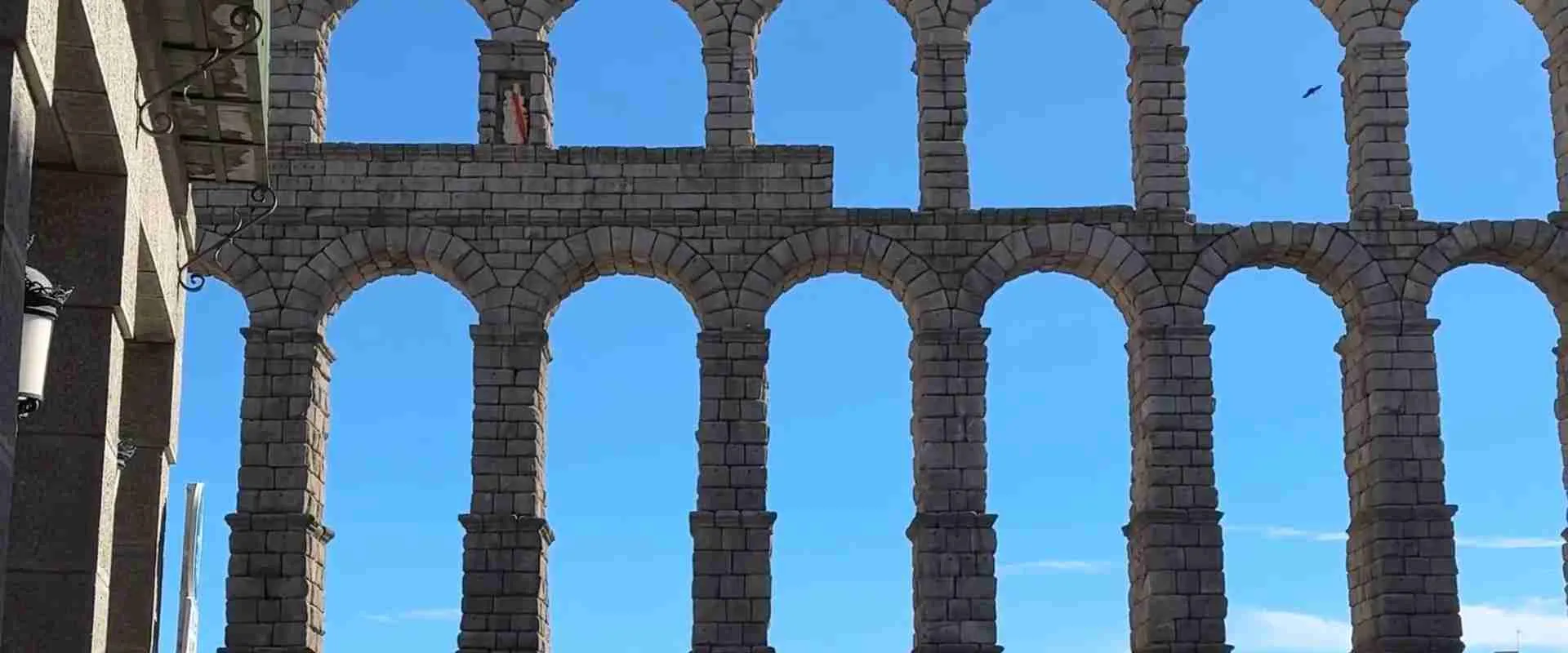
Segovia Day Trip from Madrid 2027: Roman Aqueduct & Alcázar
Segovia sits just 90 kilometres northwest of Madrid yet feels a world away — a compact walled city where a Roman aqueduct still strides across the skyline and a fairy-tale castle crowns a rocky outcrop above the Castilian plain. This guide covers everything you need to plan a seamless Segovia day trip from Madrid in 2027: the fastest and cheapest transport options, verified ticket prices for the Alcázar and Cathedral, itinerary templates for different time budgets, and a full cost breakdown for every traveller type.
Key Takeaways
- The train is fastest: the Renfe Avant reaches Segovia-Guiomar station from Madrid Chamartín in 27 minutes; return tickets bought in advance cost €25–32 per person. The Avanza bus from Madrid Moncloa takes about 75 minutes but drops you closer to the old town and costs just €10–14 return.
- Segovia’s top three sights span a wide range of costs: the Aqueduct of Segovia is entirely free, the Cathedral of Segovia charges €4 for adults, and the Alcázar of Segovia costs approximately €10 for palace admission with an optional €4 extra for the Tower of Juan II.
- A budget day trip comes to roughly €40–50 per person, taking the bus, skipping the Tower, and eating a menú del día; a mid-range day runs €70–85 using the Avant train and enjoying the full Alcázar experience; a guided tour package costs €95–140 and includes transport, a guide, and a traditional cochinillo lunch.
- The Cathedral of Segovia offers free entry on Sunday mornings (9:30–13:30), a useful saving for weekend visitors planning around this slot.
- One day is enough to see the Aqueduct, the Alcázar, and the Cathedral comfortably if you leave Madrid by 9 AM; arriving later squeezes the itinerary, especially in winter when the Alcázar closes at 6 PM.
- Segovia’s Old Town and its Aqueduct have been a UNESCO World Heritage Site since 1985, making the city one of the most historically concentrated day-trip destinations accessible from the Spanish capital.
People Also Ask About Segovia Day Trip from Madrid 2027
How long does it take to travel from Madrid to Segovia in 2027?
The Renfe Avant high-speed train covers the Madrid Chamartín–Segovia Guiomar route in approximately 27 minutes, making it the fastest option. The Avanza bus from Madrid Moncloa bus station takes around 75–80 minutes, depending on traffic, but deposits passengers directly at Segovia’s bus station near the historic centre rather than at the out-of-town rail terminal. If you drive, the A-6 motorway via the AP-61 tunnel covers the roughly 90-kilometre route in about an hour, though toll charges and city parking add cost and complexity.
How much does a Segovia day trip from Madrid cost in 2027?
The cost depends on how you travel and what you visit. Budget travellers using the Avanza bus return, visiting the Cathedral and Alcázar palace (without the tower), and eating a set lunch can expect to spend €40–50 per person. Mid-range travellers taking the Avant train, paying for the full Alcázar with tower, and having a sit-down menú del día spend roughly €70–85 per person. A guided day tour from Madrid that includes transport, an English-speaking guide, main monument entries, and a traditional cochinillo lunch costs €95–140 per person. Note that ticket prices should be confirmed on official sites before travel, as they can be adjusted seasonally.
Is one day enough to see Segovia in 2027?
Yes — Segovia’s three headline monuments are all within easy walking distance of each other in a compact old town, and most visitors cover the Aqueduct, Cathedral, and Alcázar comfortably in six to eight hours. Arriving by 10 AM and returning after 6 PM gives you a full day with time for a proper lunch and some wandering. Visitors who also want to explore the Jewish Quarter, Segovia’s Romanesque churches, or take the optional half-day extension to the Royal Palace of La Granja de San Ildefonso benefit from either an early start or an overnight stay.
Which is better for getting to Segovia in 2027: train or bus?
Both are good choices but suit different priorities. The Renfe Avant train is significantly faster (27 minutes versus 75–80 on the bus) and more comfortable, but it terminates at Segovia-Guiomar station, which is 5 kilometres from the historic centre — so you need Bus Line 11 (€2) or a taxi (€8–10) to reach the Aqueduct. The Avanza bus costs roughly half as much for a return ticket, takes longer, but drops passengers near the old town, saving the station-to-centre connection cost and effort. For families with luggage, or anyone who values door-to-door convenience, the bus wins on practicality; for solo travellers or couples happy to take the local bus from Guiomar, the train is a pleasurable, scenic option.
Why Segovia Is Madrid’s Best Day Trip in 2027
No other city within 100 kilometres of Madrid packs so much historical depth into such a walkable space. Segovia is old in the most literal sense: its most famous structure was already ancient when the Visigoths settled Iberia, and the city accumulated some of the finest medieval religious and civic architecture in Castile over the following centuries before its importance gradually faded as the court moved south to Toledo and eventually Madrid. That quiet retreat from political prominence is precisely what makes Segovia so rewarding to visit today — the city was never large enough to demolish its past in favour of a modern centre.
The UNESCO World Heritage designation, awarded in 1985 to the Old Town of Segovia and its Aqueduct, formally recognises what any visitor can see in minutes: a working Roman engineering marvel, a cluster of Romanesque and Gothic churches, a cathedral considered the last great Gothic building raised in Spain, and an Alcázar whose silhouette alone is worth the journey. What makes Segovia peculiarly satisfying as a day trip is that all of this fits within a 20-minute walk, so time is never wasted on logistics inside the city.
For 2027, the practical picture remains very similar to 2026: train and bus links from Madrid are frequent and affordable, the main monuments are all fully open and taking advance bookings, and the cuisine — anchored by roast suckling pig and roast lamb — gives the city a strong gastronomic identity that turns lunch into part of the experience rather than a pause between sights. This guide gives you everything you need to plan the visit: transport, tickets, timing, budgets, itineraries, and the restaurant information to make a memorable meal part of the day.
Segovia also rewards visitors who take the trouble to look beyond the three headline monuments. The city’s medieval Jewish Quarter, its cluster of extraordinary Romanesque churches, and the nearby Royal Palace of La Granja de San Ildefonso — a Versailles-inspired Baroque garden palace built for Philip V — all add depth for travellers with more time or a return visit in mind. This guide gives those secondary sights their own section so you can decide how far to extend the day.
Getting from Madrid to Segovia in 2027: Train vs Bus
Two public-transport options dominate the Madrid–Segovia journey: the Renfe Avant high-speed train and the Avanza coach service. Both are reliable, both run throughout the day, and the choice between them depends on your priorities around speed, cost, and convenience once you arrive.
Renfe Avant Train from Madrid to Segovia in 2027
The Renfe Avant operates between Madrid Chamartín station and Segovia-Guiomar station in approximately 27 minutes — a genuinely extraordinary journey time for almost 90 kilometres of Castilian terrain. Chamartín is served by Madrid Metro lines 1 and 10 and is straightforward to reach from the city centre.
Avant tickets are priced dynamically, much like airline fares, so buying early and booking in advance through the Renfe website or app consistently produces the lowest fares. For 2027, expect one-way adult tickets to range from around €7–8 for the cheapest advance fares up to approximately €14–16 at the higher flexible price points; a return journey bought at the same time typically comes to €25–32 per person. Check the Renfe website for current pricing as these figures should be confirmed before travel. The regional Alta Velocidad (AVE) and longer-distance services from Madrid Atocha also stop at Guiomar, though the Avant is the service most directly associated with the day-trip route.
Trains depart Chamartín multiple times per hour throughout the day, with the first services running before 7 AM and the last returns from Segovia running well into the evening. The Chamartín–Guiomar journey involves passing through the Guadarrama mountain tunnel, which provides a geological spectacle as well as a fast crossing. Travel time reliability is excellent — high-speed rail in Spain runs to schedule with very few delays.
The key logistical caveat is that Segovia-Guiomar station sits about five kilometres south of the historic centre. A connecting shuttle or local bus is required to complete the journey (see the next section for full details). Factor in the additional 20 minutes and €2 for the Bus Line 11 connection when comparing journey times and costs with the bus option.
Avanza Bus from Madrid to Segovia in 2027
The Avanza coach company operates a frequent, direct service between Madrid Moncloa Intercambiador (the large transport hub in Madrid’s Moncloa district, served by Metro lines 3 and 6) and Segovia’s own bus station, which is located a short walk from the Aqueduct and the start of the old town.
Journey time is approximately 75–80 minutes, with some variation depending on traffic on the A-6 motorway. The motorway route is generally fast, and the service runs regularly throughout the day, typically every 30 minutes during peak times. Return buses from Segovia to Madrid run late into the evening — check the Avanza website for the last departure time on your travel date, as times can shift slightly by season.
For 2027, single adult fares run from approximately €5–8 depending on when and how you book, with return tickets totalling €10–14 per person. Tickets are available at the Moncloa bus station booking windows, from automated machines, and online through the Avanza website. Check the official Avanza site for current 2027 fares before travel.
The bus’s great practical advantage is its terminus: Segovia’s bus station sits on the edge of the historic centre, within easy walking distance of the Aqueduct at Plaza del Azoguejo. There is no connection cost, no bus-hunting in an unfamiliar station, and no extra 20 minutes to budget. For a day trip in which every hour matters, this proximity is a genuine advantage, particularly with young children or heavy luggage.
Driving from Madrid to Segovia in 2027
Driving to Segovia from Madrid is straightforward: take the A-6 motorway northwest from Madrid, then join the AP-61 mountain tunnel at Guadarrama to cross the Sierra de Guadarrama (note the AP-61 is a toll road). The total distance is about 90 kilometres and the drive typically takes around 55–65 minutes. Parking in Segovia’s old town is limited and the centre is partly pedestrianised; the most practical option is the paid car park at the Alcázar or along the Paseo del Salón. Driving makes sense for groups of three or four, where the combined rail or bus cost exceeds the fuel and toll outlay, and for visitors who want to add the La Granja palace or the Pedraza medieval village as a second stop on the same day.
Getting Around Segovia in 2027: From Station to City Centre
If you arrive by train at Segovia-Guiomar station, you will need to cover the five kilometres to the historic centre before your day begins. Three options exist: local bus, taxi, and — for very fit visitors with light bags — a long walk that passes through an undistinguished suburban area and takes about 50–60 minutes on foot.
Bus Line 11 from Guiomar Station in 2027
Bus Line 11 connects Segovia-Guiomar station directly to the city centre, stopping at or near several key points including the area around the Aqueduct at Plaza del Azoguejo. The journey takes approximately 15–20 minutes, and the fare is €2 per ride. The bus runs regularly throughout the day, departing from the stop immediately outside the station’s main exit. The same €2 fare applies for Bus Line 12, which covers a slightly different route but also links the station and the centre. Pay onboard with coins or a contactless card.
Plan for two bus rides in your budget (one in each direction) unless you plan to return on foot from the centre to the station — an option some visitors choose in good weather, since part of the route offers views down into the Eresma river valley.
Taxis from Segovia-Guiomar Station in 2027
Taxis wait outside Segovia-Guiomar station and the rank is easy to find directly in front of the terminal building. A taxi to the city centre costs approximately €8–10 depending on the exact destination. Taxis are a good option for families with pushchairs, travellers with heavy luggage, or anyone whose schedule is tight and who cannot afford to miss a bus. Ride-hailing apps may have limited availability in Segovia compared to Madrid, so the station taxi rank is generally the most reliable option.
Walking from the Bus Station in 2027
Visitors arriving by Avanza bus at Segovia’s bus station face a much shorter walk to the old town — approximately 10–15 minutes on foot to the Aqueduct at Plaza del Azoguejo. The route is mostly flat and well signposted. The station itself is on Paseo Ezequiel González, and the Aqueduct is visible as you approach the historic centre. No connecting transport is needed.
The Roman Aqueduct of Segovia in 2027: Everything You Need to Know
The Aqueduct of Segovia is one of the best-preserved Roman engineering structures in the world and the symbolic centrepiece of the city’s UNESCO World Heritage Site. Walking toward it from the bus station and seeing it suddenly fill the view across the Plaza del Azoguejo is a genuinely arresting moment — the scale, the elegance, and the implausible fact of its survival combine to produce a sight that photographs struggle to fully prepare visitors for.
History and Construction of the Aqueduct of Segovia
The Aqueduct of Segovia was almost certainly built during the Roman Imperial period. Most scholars place construction in the late first or early second century CE, with stylistic comparisons and regional dating evidence pointing to the period between the reigns of Domitian and Trajan, though no dedicatory inscription has survived to confirm the exact date or commissioner. What is clear is that the structure was designed to carry water from the Fuenfría springs in the Sierra de Guadarrama — roughly 15 kilometres away — to the elevated centre of the Roman city.
The aqueduct achieves this by maintaining a gentle, consistent gradient over its entire length, channelling water through a covered stone conduit that rests on a series of arched piers. Its most dramatic section cuts across the modern urban grid at its lowest point near the Plaza del Azoguejo, where the double-tiered arches reach their maximum height of approximately 28.5 metres above street level. The structure extends for roughly 728 metres of visible aboveground stonework, with approximately 167 arches in total — the most frequently cited figure, though some sources differ slightly on the precise count.
What makes the Aqueduct particularly remarkable to engineers and historians is its construction method: the granite blocks are laid without mortar, relying entirely on precise fitting and the distribution of forces through the arches to maintain structural integrity over nearly two millennia. No iron clamps, no bonding agent — just stone shaped and placed with extraordinary precision. Roman hydraulic engineers understood the physics of the arch intuitively, and the result has outlasted virtually every other construction in the region, surviving Visigothic occupation, Moorish conquest, the medieval period, and the modern era with its structure essentially intact.
The Aqueduct suffered some damage during the Moorish occupation of the 11th century, when approximately 36 arches in the central section were reportedly destroyed and later reconstructed; the visible brickwork repair in that section distinguishes it from the original granite. It continued to carry water to Segovia until the mid-20th century and was taken out of active service only in 1973, when the city’s modern water infrastructure made it redundant.
Visiting the Aqueduct of Segovia in 2027: Practical Details
Entry to the Aqueduct is completely free, and it is accessible at all hours of the day and night. The Plaza del Azoguejo is the main viewpoint: standing at street level you look directly up through the double row of arches, and the perspective makes the height and engineering legibility immediately clear. There is a raised walkway along the old town wall above the Plaza del Azoguejo from which you can view the top of the aqueduct from roughly the same elevation as the water channel itself — a very different and equally impressive vantage point. Access to this walkway was historically included in a small guided experience, but check current access arrangements on the Turismo de Segovia website before visiting as conditions may have changed.
The aqueduct is at its most photogenic in early morning light when the eastern sun catches the warm granite and the Plaza del Azoguejo is relatively quiet. By mid-morning, particularly on summer weekends, the plaza fills quickly with visitors and tour groups. Evening visits, when the structure is illuminated, produce dramatic images but require a return to the city after the main monuments have closed.
Best Viewing Points for the Aqueduct in 2027
The most famous view is from street level at the Plaza del Azoguejo, where the full double-tiered height is visible and the sense of scale is most immediate. The raised old-town walkway above the square offers an elevated perspective. A third viewpoint, less well known, sits on the road descending from the old town toward the newer parts of the city (Calle de San Juan / Calle del Doctor Velasco), where a side-on view of the extended arcade shows the full length of the structure cutting across the urban landscape. The Mirador del Alcázar provides a distant panoramic view of the aqueduct in the context of the city’s roofline, most useful for wide-angle photography in the late afternoon.
The Alcázar of Segovia in 2027: Tickets, Hours and Top Tips
The Alcázar of Segovia is the image most people carry away from the city — a narrow-footprint castle at the western tip of the old town’s rocky promontory, its towers and pointed turrets reflected in the Eresma river below. It is a medieval Spanish castle transformed, over successive centuries, into a royal palace, an artillery school, a state prison, and ultimately a national monument and museum. Its current appearance owes as much to 19th-century Romantic rebuilding — following a fire in 1862 that destroyed much of the interior — as to its medieval origins, but the rebuilt interiors are richly decorated and the towers offer some of the most sweeping views in Castile.
Alcázar of Segovia Ticket Prices in 2027
Adult admission to the Alcázar palace and museum costs approximately €10 (check the official Alcázar website for current 2027 rates, as pricing may vary). Children aged 6–14 and senior visitors pay a reduced rate of approximately €7. Children under 6 enter free. The Tower of Juan II, the Alcázar’s tallest tower and the source of its best panoramic views, requires a separate ticket costing an additional €4, bringing the combined total to approximately €14 for an adult who wants the complete experience. The combined ticket is excellent value if you have the energy for the tower’s steep spiral staircase — the 360-degree view from the top across the Sierra de Guadarrama, the old town, and the Castilian plain is the best elevated vantage point in Segovia.
Advance booking is available through the official Alcázar website and is strongly recommended during peak season (July, August, Easter week, and Spanish public holidays), when the castle can sell out or face long queues at the door.
Alcázar of Segovia Opening Hours in 2027
The Alcázar is open daily. From April through October, hours are 10 AM to 8 PM. From November through March, the castle closes earlier at 6 PM. The ticket office closes 30 minutes before the posted closing time. On Christmas Day and New Year’s Day, hours are reduced — check the official website before planning a holiday visit. The last entry slot before closing is the least crowded time to visit, producing excellent late-afternoon light in the royal rooms and fewer queues at the Tower of Juan II.
What to See Inside the Alcázar of Segovia
The Alcázar’s royal rooms are arranged in a chronological circuit through the palace’s principal floors. The Throne Room contains a celebrated coffered ceiling in the Mudéjar style, richly patterned in gold and vivid colour, which is one of the finest surviving examples of this craft tradition in Castile. The Galley Room takes its name from an inverted ship’s-hull ceiling. A long series of rooms displays royal apartments, weapons, and armour from the castle’s period as the Royal Artillery School (the Alcázar served this function from the late 18th century and the General Military Archive still operates from the complex). The Castle Museum occupies the courtyard level and provides historical context for the building’s varied roles. The Tower of Juan II is accessed separately and involves a narrow, steep spiral staircase of around 150 steps — not suitable for visitors with mobility impairments, but rewarding for everyone else.
The Alcázar’s silhouette is often compared to a fairy-tale fortress, and the castle is widely cited in popular culture as an influence on Disney’s fantasy castle aesthetic — though this specific attribution is not confirmed in official Disney documentation and should be treated as a popular association rather than a documented fact. What is certain is that the castle’s architecture inspired 19th-century Romantic painters and illustrators across Europe, and its visual impact remains as strong today as ever.
Booking Alcázar Tickets in Advance for 2027
Buy tickets through the Alcázar’s official website (alcazardesegovia.com) rather than through third-party resellers to avoid additional booking fees. Print your confirmation or load it on your phone. During high season, the difference between having a timed entry slot and joining the walk-in queue can be 30–45 minutes or more. Entry at the booked time is straightforward — show your ticket at the main gatehouse and enter directly. Guided audio devices are available inside for an additional fee if you want structured interpretation of the rooms.
Segovia Cathedral in 2027: Entrance Fees, Hours and Highlights
Standing in the centre of Segovia’s old town, the Cathedral of Segovia is one of the most complete Gothic cathedrals on the Iberian Peninsula. It is frequently described as the last great Gothic cathedral built in Spain — a late flowering of a style that had largely given way to Renaissance and Baroque across Europe by the time construction began. The cathedral’s graceful exterior, with its multiple chapels, flying buttresses, and tower, dominates the Plaza Mayor and the surrounding streets from every direction.
Segovia Cathedral Entrance Fees and Free Entry in 2027
Adult admission to Segovia Cathedral costs €4. Students with valid ID pay €3. Children under 14 enter free at all times. Sunday mornings from 9:30 AM to 1:30 PM, the Cathedral is open for free to all visitors — a useful saving for weekend day-trippers willing to time their visit to this window. For the first mention: check the official Cathedral website or Turismo de Segovia for any pricing updates before travel. The Cathedral is open daily from approximately 9:30 AM to 6:30 PM, with reduced hours in winter — confirming current times on the official site before visiting is recommended.
Architecture and History of Segovia Cathedral
Construction of the current cathedral began in 1525, following the destruction of its predecessor during the Revolt of the Comuneros — the 1520 uprising of Castilian cities against the authority of the Holy Roman Emperor Charles I of Spain. The design is attributed in architectural records to Juan Gil de Hontañón, one of the leading Gothic architects of early 16th-century Castile, and the work was continued after his death by his son Rodrigo Gil de Hontañón, whose hand is particularly evident in the nave and the chapter house. Construction proceeded over more than two centuries, with the central tower completed in 1616 and the building substantially finished by the 18th century.
Inside, the cathedral’s vast nave impresses through scale and proportion rather than decorative exuberance. The stained glass windows, several of which date from the 16th century, bathe the nave in coloured light on clear mornings. The cloister is an unusual feature: it was not built from scratch but was transferred stone by stone from the demolished earlier cathedral, making it older than the building it now adjoins. Among the Cathedral’s treasures is the Sala Capitular (Chapter House), which contains Flemish tapestries and the cathedral’s collection of sacred art including paintings, goldsmithing, and liturgical objects accumulated over centuries of institutional use.
What to See Inside Segovia Cathedral
The main nave and crossing are accessible throughout opening hours and provide the full experience of the Gothic interior. The museum section, housed in the chapter house and side chapels, displays the cathedral’s most valuable portable objects — the tapestries, the processional objects, and several pieces of medieval and Renaissance sculpture. The Gothic cloister, entered from the south side of the nave, is quiet and photogenic in morning light. Visitors who climb the tower (when access is open) gain an elevated view over the Plaza Mayor and across to the Alcázar — check current access at the ticket desk, as tower access has varied in recent years.
Sample Segovia Day Trip Itineraries for 2027
The right itinerary depends on when you arrive, what mode of transport you used, and how much of the city’s secondary attractions you want to cover. The following templates assume a train arrival at Guiomar station, but bus travellers can simply remove the 20-minute bus connection and apply the time saved elsewhere.
Full-Day Segovia Itinerary 2027 (Eight Hours)
Depart Madrid Chamartín on the first convenient Avant train, aiming to arrive at Guiomar by 9:15–9:30 AM. Take Bus Line 11 (€2) to the city centre, arriving at the Aqueduct area around 9:45–10 AM. Spend 30–45 minutes at and around the Aqueduct of Segovia — walk the Plaza del Azoguejo, take the elevated walkway above, and begin the gentle climb up the old town’s central spine via Calle de Cervantes and Calle Juan Bravo.
By 10:30–11 AM, enter Segovia Cathedral when it opens (or join the free-entry window on Sunday mornings). Allow 45–60 minutes for a thorough visit including the cloister and the chapter house. From the Cathedral’s Plaza Mayor, walk the 15-minute route through the old town to the Alcázar, arriving for an 11:30–11:45 AM entry. Allow 90–120 minutes for the Alcázar — the royal rooms, the museum, and the Tower of Juan II if you have booked the full ticket.
Lunch at 1:30–2 PM at one of the traditional restaurants on or near the Plaza Mayor or Calle de Cronista Lecea — an hour is appropriate. After lunch, from 3 PM, use the remaining afternoon to explore the streets of the Jewish Quarter, visit the exterior of the Romanesque Church of San Martín, or walk the old town walls path behind the Alcázar toward the Monastery of Santa María del Parral. Begin the return to Guiomar by 5:30–6 PM, taking Bus Line 11 back to the station for an early-evening train to Madrid.
Half-Day Segovia Itinerary 2027 (Five Hours)
For visitors on a tighter schedule or arriving by midday, a focused five-hour visit is fully viable if you prioritise. Arrive by noon, go directly to the Aqueduct for 20 minutes, then walk the old town spine to the Alcázar and spend 75 minutes there, including the Tower of Juan II. Return along the main street, stopping at the Cathedral for 30–40 minutes. Lunch at 2 PM — either a quick bocadillo from a bar or a set menú del día at a nearby restaurant. Allow one hour for the meal, then spend 30 minutes walking the Plaza Mayor and the approaches to the Cathedral before heading back to the bus or train for a mid-afternoon return to Madrid. This is a satisfying introduction; the Cathedral and Alcázar are the non-negotiables, and the Aqueduct can be seen in a single 20-minute stop at Plaza del Azoguejo.
Segovia Day Trip Budget Breakdown 2027
The following breakdowns are calculated per person based on the verified prices researched for 2027. All totals use Calculation Mode (rounded to the nearest €5). Hotel costs are not included — this is a day trip, so no accommodation applies.
Budget Day Trip to Segovia in 2027: €40–50 Per Person
Budget travellers who want to see the city’s main monuments without spending excessively have a clear path: take the Avanza bus (which drops near the old town, saving the bus connection cost), use the Cathedral’s free Sunday entry window or pay the €4 weekday charge, and visit the Alcázar palace without the tower add-on. A menú del día at a local bar-restaurant — including starter, main course, dessert, bread, and a drink — is widely available in Segovia for €15–18. A coffee and a slice of ponche segoviano, the city’s traditional almond-and-sponge cake, rounds off the afternoon.
Breakdown: Avanza bus return €10–14; Cathedral entry €4; Alcázar palace (no tower) approximately €10; menú del día lunch €15–18; coffee and ponche €3–6. Total: approximately €40–50 per person. Check the Avanza website for current fare options and the official site for current Cathedral and Alcázar rates before travel.
Mid-Range Day Trip to Segovia in 2027: €70–85 Per Person
Mid-range travellers enjoy the speed of the Avant train and the full Alcázar experience with tower access, plus a comfortable sit-down lunch at a proper restaurant. The additional costs are the two Bus Line 11 rides from and to Guiomar station (€2 each), the Cathedral entry, and the tower add-on at the Alcázar.
Breakdown: Avant train return (advance purchase) €25–32; Bus Line 11 ×2 rides €4; Cathedral entry €4; Alcázar with Tower of Juan II approximately €14; menú del día or à la carte lunch €18–22; coffee, dessert, and extras €6–9. Total: approximately €70–85 per person.
Guided Tour Package from Madrid to Segovia in 2027: €95–140 Per Person
Organised day tours departing from central Madrid and including a coach, a professional guide, the main monument entries, and a traditional cochinillo lunch are available through several operators. Group tours from operators including Viator, GetYourGuide, and Civitatis have been running at €65–95 per person for the tour itself (transport plus guide plus selected entries); a traditional cochinillo lunch at one of the established restaurants adds approximately €30–45 per person for a proper sit-down meal. Combined, the guided experience runs €95–140 per person — considerably more than the independent options, but the value lies in the expert narrative, the absence of logistics, the restaurant booking, and the social experience of sharing a traditional Castilian feast.
Confirm current tour prices directly with operators before booking, as tour rates adjust seasonally and availability fills quickly during peak periods.
Hidden Costs to Watch for on a 2027 Segovia Day Trip
Several small costs catch first-time visitors by surprise. The Bus Line 11 transfer from Guiomar station is €2 each way — budget €4 total for the round trip if arriving by train. Luggage storage is available at Segovia’s bus station for a small fee, useful if you plan to carry daypacks and want to stow bags during the main walking route. Audio guides at the Alcázar cost extra beyond the admission fee. Restaurant cover charges (cubierto) are common in traditional Segovian restaurants — a basket of bread may arrive automatically and be charged separately; ask if unsure. Tipping is not mandatory in Spain but rounding up the bill is customary in sit-down restaurants. Parking in the old town costs approximately €1–2 per hour in surface car parks, with daily maximums around €10–15 depending on the facility.
Where to Eat in Segovia in 2027: From Cochinillo to Budget Lunches
Segovia has one of the most distinctive regional food identities of any city within day-trip range of Madrid. The city’s culinary reputation rests above all on cochinillo asado (roast suckling pig) and cordero asado (roast lamb), both cooked in wood-fired clay ovens. The ritual service of cochinillo — the waiter demonstrating the tenderness of the meat by cutting it with the edge of a ceramic plate — is a set piece at the city’s most traditional restaurants. A meal built around this dish is a genuine Segovian experience and justifies the slightly higher price point at the restaurants that do it best.
Traditional Cochinillo Restaurants in Segovia 2027
Mesón de Cándido on the Plaza del Azoguejo, directly beside the Aqueduct, is the most famous cochinillo restaurant in Segovia and possibly in Spain. A family-run establishment with deep roots in the city’s culinary life, it occupies a historic building at the foot of the aqueduct and is closely associated with the tradition of cochinillo service. A full cochinillo meal here runs approximately €35–45 per person for the main course and accompaniments, exclusive of wine. Reservations for lunch, particularly at weekends and in summer, are essential and should be made well in advance — the restaurant fills completely on busy days. The atmosphere is theatrical and tourist-oriented, which some visitors relish and others prefer to avoid in favour of smaller, less well-known alternatives.
Restaurante José María on Calle Cronista Lecea is the other major name in Segovian cochinillo; it is considered by many local food writers to serve the technically finest version in the city. Prices and reservation requirements are similar to Mesón de Cándido. Restaurante El Bernardino, also on Calle Cervantes in the heart of the old town, offers cochinillo and cordero at slightly lower price points and is generally easier to walk into at lunchtime without a reservation, making it a good fallback option. A full ración of cochinillo at most traditional restaurants costs approximately €28–42 per person depending on the establishment and whether you order additional dishes.
Menú del Día and Budget Dining in Segovia 2027
The Spanish menú del día — a fixed-price set lunch available Monday through Saturday in most Spanish restaurants — is the day-tripper’s best friend. Segovia’s bars and mid-range restaurants serve substantial three-course menus, typically including a first course (often a soup or salad), a main of meat or fish, a dessert, bread, and a drink for €15–22 depending on the establishment and the included dishes. This is genuinely good value even if the cochinillo dishes are usually reserved for à la carte ordering.
The streets between the Cathedral and the Aqueduct — particularly Calle de Cervantes, Calle de Juan Bravo, and Calle del Cronista Lecea — concentrate most of the city’s dining options within a very short walk. Local bakeries along the same streets sell ponche segoviano (the city’s traditional cake of marzipan, sponge, and cream, dusted with icing sugar) by the slice for approximately €3–5, making it the ideal post-lunch street snack or take-home treat.
Guided Tour vs Independent Day Trip to Segovia in 2027
Both approaches have real merits, and the right choice depends on your travel priorities and experience level.
Independent travel gives you complete flexibility over your schedule, the ability to spend longer at whichever sights interest you most, and the freedom to choose your own restaurant at your own pace. It costs significantly less — as little as €40–50 per person on the budget tier — and is perfectly straightforward given Segovia’s compact size and easy-to-navigate old town. English-language signage at the main monuments is adequate, and audio guides are available inside the Alcázar for visitors who want detailed interpretation. The logistical complexity is low: buy a bus or train ticket, take the connection to the centre, follow the main street uphill, and the three main sights reveal themselves in natural sequence.
Organised guided tours from Madrid add expert narrative that transforms the experience for history and architecture enthusiasts. A knowledgeable guide contextualises the Aqueduct’s engineering, the Alcázar’s political history, and the Cathedral’s architectural significance in ways that spontaneous self-guided wandering rarely produces. Tours also take care of restaurant bookings — the cochinillo lunch is often the social and culinary highlight of the day — and handle the logistics of the return journey, making the experience appropriate for first-time visitors to Spain, families with young children, and travellers who prefer not to navigate transport in an unfamiliar country. The premium over independent travel is substantial (€95–140 versus €40–85), but for many visitors it is money well spent.
A middle path — arriving independently but booking a 2–3 hour walking tour of the old town with a local guide through platforms like Guruwalk or local operators — offers professional interpretation of the monuments without surrendering control of the full day. Half-day guided walking tours of Segovia’s old town typically cost €15–25 per person for group tours.
Best Time for a Segovia Day Trip from Madrid in 2027
Segovia is a viable day trip in every month of the year, but the experience varies considerably between seasons, and the choice of when to visit depends on what you value most.
Spring and Autumn: The Best Seasons
April, May, September, and October offer the most balanced conditions: mild temperatures, relatively lower visitor numbers than peak summer, long daylight hours (particularly in May and September), and the best light for photography. Spring brings wildflowers to the sierra visible from the Alcázar towers; autumn turns the hillsides above the Eresma valley below the castle into warm gold and amber. These months also coincide with lower train and accommodation prices in Madrid, making the overall trip less expensive.
Summer: Peak Season Realities
July and August bring the largest crowds to Segovia, particularly on weekends when Madrid residents escape the urban heat — Segovia sits at 1,000 metres elevation and is noticeably cooler than the capital. The Alcázar and popular restaurants fill quickly. An early start (arriving by 9–10 AM) is essential to see the main sights without significant queuing. Morning visits to the Aqueduct are strongly recommended before the midday heat builds. The Alcázar’s 8 PM closing time in summer allows a more leisurely afternoon pace. Book all restaurants and attraction tickets in advance during this period.
Winter: Quiet but Cold
November through February offers the smallest crowds and the most atmospheric Segovia, particularly on clear winter days when the snow-capped Sierra de Guadarrama appears above the castle. The cold is real — Segovia’s elevation means temperatures can drop close to freezing on winter mornings — but the light is extraordinary and the city’s Romanesque churches feel most evocative in the low winter sun. Note the Alcázar’s 6 PM winter closing time and plan the afternoon accordingly. The Christmas period brings decorative illumination to the Aqueduct, which looks spectacular at night from the Plaza del Azoguejo.
Weekdays vs Weekends in Segovia
Weekdays are consistently less crowded than weekends throughout the year. Saturday and Sunday in summer are the most congested, with coach tours from Madrid and other Spanish cities adding to the flow of independent visitors. If your schedule allows, a Tuesday or Wednesday visit to Segovia offers noticeably shorter queues, quieter restaurants, and a more authentic sense of the city as a place people actually live in rather than a tourist spectacle. The Sunday Cathedral free-entry window (9:30–13:30) is a genuine saving worth planning around, but it does draw extra visitors to the Cathedral specifically during those hours.
Beyond the Aqueduct and Alcázar: More Sights in Segovia 2027
Visitors who finish the three headline monuments ahead of schedule, or who are making a return trip, will find Segovia’s secondary attractions significant in their own right. The city has more Romanesque churches per square kilometre than almost anywhere in Europe, and its medieval Jewish Quarter and riverside monasteries reward slower exploration.
Segovia’s Romanesque Churches
Segovia contains an exceptional concentration of Romanesque churches, most dating from the 11th to 13th centuries. The most notable include the Church of San Martín on the Calle Juan Bravo — with an elegant external arcade and a carved Romanesque portal — and the Church of San Esteban near the Plaza Mayor, whose tower is considered one of the finest Romanesque bell towers in Castile. The Church of San Millán, located slightly outside the main old-town cluster to the south, is the largest and most complete Romanesque church in the city, with a triple-nave basilica plan and arcaded porticos on two sides. Most of these churches are open to visitors at no charge or for a small voluntary donation, and they see far fewer visitors than the main monuments.
The Jewish Quarter of Segovia
Segovia had a significant Jewish community in the medieval period, and the area to the west of the old town between the Cathedral and the Alcázar preserves the street pattern and some of the historic fabric of the medieval Jewish Quarter. The neighbourhood is now largely residential, but several placards and interpretive markers explain its history, and the narrow streets between the Cathedral and the Alcázar have an atmospheric quality distinct from the main tourist axis. A small Jewish history centre has operated in the area, though visitors should confirm current opening arrangements before including it as a firm stop.
Monastery of Santa María del Parral
The Monastery of Santa María del Parral sits in the Eresma valley below the Alcázar, accessible by a steep path descending from the old town or by a short taxi ride. Founded in the 15th century under the patronage of the Marquis of Villena, the monastery is still active and houses a Hieronymite community. The Gothic church contains the founder’s tomb and is notable for its decorated altarpiece. Visiting hours are limited to specific guided visit windows (check current times locally), but the building’s exterior and the valley setting below the Alcázar make the descent worthwhile even if the interior is closed.
Church of Vera Cruz
Across the valley from the Alcázar, the Church of Vera Cruz is a twelve-sided Romanesque building constructed in the early 13th century and associated with the Knights Templar, though its specific connection to that order is a matter of local tradition rather than fully documented historical record. The unusual polygonal plan, derived from centralised church typologies found in crusader-period buildings across the Mediterranean, makes it architecturally distinctive and it can be viewed from the Alcázar’s Tower of Juan II. Opening hours are limited — confirm locally before making a special trip.
Royal Palace of La Granja de San Ildefonso
For visitors who want to extend the day beyond Segovia, the Royal Palace of La Granja de San Ildefonso is located approximately 12 kilometres southeast of the city in the foothills of the Sierra de Guadarrama. Built in the early 18th century by Philip V — inspired by Versailles and intended as a Spanish counterpart to the French royal garden palace — it contains elaborately designed formal gardens with fountains and a palace interior of Baroque opulence. Adult admission runs approximately €11, with reduced rates for students and free entry for certain groups. Buses connect Segovia city centre to La Granja, and the journey takes around 20–25 minutes. Including La Granja effectively turns the day trip into a full-day itinerary covering two very different periods and styles of Spanish royal architecture.
Practical Tips for Your 2027 Segovia Day Trip
Booking Transport and Tickets in Advance for 2027
Buy Renfe Avant train tickets through the official Renfe website or app as early as possible — the cheapest advance fares sell out on popular dates, and the difference between a €7 advance ticket and a €14 last-minute ticket is significant if you are travelling as a couple or a family. Alcázar tickets are available online through alcazardesegovia.com; online booking avoids the walk-in queue and is strongly recommended from April through September and on all Spanish public holidays. Cathedral entry is typically available at the door without pre-booking, but arrive early in high season to avoid waits. Guided day tours from Madrid should be booked at least a few days in advance during peak periods.
What to Wear for a Segovia Day Trip in 2027
Segovia’s old town is almost entirely on foot over cobblestoned streets and gradients — comfortable, broken-in walking shoes are essential. The city sits at around 1,000 metres of elevation, which means temperatures are noticeably cooler than Madrid at any time of year: bring a light jacket even in summer, when mornings and evenings can be fresh despite midday warmth. In winter, dress for cold — wool layers and a windproof outer shell are appropriate, and the Alcázar’s towers are exposed to the wind at altitude. Sunscreen is advisable even in cooler months given the high elevation and strong Castilian sun. The Cathedral requires covered shoulders and knees to enter, as do most of the active Romanesque churches, so a light scarf or layer is useful.
Language and Communication in Segovia 2027
English is widely spoken at the Alcázar and in the larger tourist-oriented restaurants near the Aqueduct, but Segovia is less cosmopolitan than Madrid and basic Spanish phrases are appreciated by local bar staff and shopkeepers outside the main tourist circuit. The Alcázar provides audio guides in multiple languages including English. Restaurant menus along the main tourist streets are routinely provided in English; neighbourhood bars away from the tourist axis will usually have Spanish-only menus, though pointing and gesturing covers most ordering situations.
Accessibility in Segovia 2027
Segovia’s old town is built on a rocky promontory and much of the terrain involves inclines and cobblestone surfaces, which presents real challenges for wheelchair users and visitors with limited mobility. The Plaza del Azoguejo and the Aqueduct viewpoint are accessible at street level. The Cathedral has a ramp entrance and is generally manageable for wheelchair users. The Alcázar has significant accessibility limitations — the royal rooms involve steps throughout and the Tower of Juan II is inaccessible to wheelchair users due to the spiral staircase. The grounds of the Monastery of Santa María del Parral involve an uneven descent. Confirm current accessibility provisions directly with each monument before visiting if this is a priority consideration.
Luggage and Storage in Segovia 2027
Segovia’s bus station offers left-luggage lockers for small daypacks, which is useful for visitors who arrive by bus with larger bags and want to walk freely. There is no dedicated left-luggage service at Segovia-Guiomar train station (check current provision at the station). Restaurants near the Aqueduct and Alcázar are used to visitors arriving with daypacks and generally accommodate them without issue. Avoid bringing large rolling suitcases on a Segovia day trip — the cobbled streets and steep gradients make them very difficult to manage.
Frequently Asked Questions: Segovia Day Trip from Madrid 2027
How early should I leave Madrid for a Segovia day trip in 2027?
Leaving Madrid between 8 AM and 9 AM gives you the ideal start. A Renfe Avant train departing Chamartín at 8:15–8:30 AM puts you at Guiomar station by 9 AM and, after the Bus Line 11 connection, at the Aqueduct by 9:30–9:45 AM. This gives you approximately 8 hours of daylight in Segovia before you need to head back for a comfortable evening return. An earlier departure is only necessary if you plan to include La Granja de San Ildefonso on the same day. Leaving after 10 AM is workable but compresses the afternoon and makes a unhurried lunch more difficult to fit in without rushing the Alcázar.
Can I see the Aqueduct, Alcázar, and Cathedral all in one day in 2027?
Yes, comfortably. The three monuments are all within a 15–20 minute walk of each other along Segovia’s main old-town spine. A typical sequence — Aqueduct on arrival, Cathedral mid-morning, Alcázar before lunch — covers all three by 1 PM, leaving the full afternoon for lunch, secondary sights, and a relaxed return. The only constraint is the Alcázar’s winter closing time at 6 PM, which requires an earlier start in the months from November through March. Allow 30–45 minutes for the Aqueduct viewpoints, 45–60 minutes for the Cathedral, and 90–120 minutes for the Alcázar with tower.
Is the Renfe Avant train or the Avanza bus better for a Segovia day trip in 2027?
The train is faster (27 minutes versus 75–80 on the bus) and more comfortable for the journey itself, but it arrives at an out-of-town station requiring an additional bus or taxi to reach the historic centre. Return tickets bought in advance cost roughly €25–32. The Avanza bus from Madrid Moncloa takes longer but drops you near the Aqueduct, requiring no further connections. Return tickets cost approximately €10–14. Budget travellers and those with young children or luggage often prefer the bus for its practicality; travellers who value time and comfort choose the train. Both options are reliable and run throughout the day.
Is the Alcázar of Segovia worth visiting in 2027?
Yes — the Alcázar is one of the most visually striking medieval castles in Spain and delivers on the promise of its exterior. The royal rooms contain exceptional decorative ceilings, the museum provides solid historical context, and the Tower of Juan II offers the best panoramic view in the city across the Sierra de Guadarrama and the Castilian plateau. Adult admission to the palace costs approximately €10, with the tower an additional €4. The palace alone is worth the visit; the tower access is essential if you can manage the steep spiral staircase. Book tickets in advance during high season to avoid queues.
How much spending money should I bring for a day in Segovia in 2027?
Budget approximately €40–50 per person for a comfortable day using the bus, visiting the Cathedral and Alcázar palace, and having a set lunch. Add €10–25 if you take the Renfe Avant train return instead. Budget €95–140 if you prefer a guided tour with a traditional cochinillo lunch included. Cash is accepted everywhere but contactless card payment is now widely available in Segovia’s restaurants and attraction ticket offices. An ATM is available near the Plaza Mayor if you need local currency.
Are guided tours from Madrid to Segovia worth it in 2027?
Guided tours are worth it for travellers who want rich historical narrative, the convenience of organised logistics, and a pre-arranged cochinillo lunch at a traditional restaurant — all without managing any of the transport themselves. The cost premium over independent travel is real (€95–140 versus €40–85), but the value lies in the expert interpretation and the restaurant experience. First-time visitors to Spain and families with young children particularly benefit from guided tours. More experienced independent travellers, or those travelling on a budget, will find the self-guided option just as rewarding for a fraction of the cost.
What are the Cathedral of Segovia’s free entry times in 2027?
The Cathedral of Segovia is free for all visitors on Sunday mornings between 9:30 AM and 1:30 PM. This applies to all nationalities. Outside these hours, standard admission is €4 for adults and €3 for students. Children under 14 enter free at all times. If you are visiting on a Sunday, timing your Cathedral visit within the free window is a worthwhile saving, particularly for families or couples. Verify this information on the Cathedral’s official website before travel, as policies can change.
What is the best restaurant for cochinillo in Segovia in 2027?
Mesón de Cándido on the Plaza del Azoguejo is the most famous, occupying a historic building directly adjacent to the Aqueduct and holding a long culinary heritage. Restaurante José María on Calle Cronista Lecea is considered by many food writers to produce the finest version in the city. Both require advance reservations, particularly at weekends and during the summer months, and both offer the classic tableside demonstration of cutting the cochinillo with a ceramic plate. Budget approximately €35–45 per person for a full cochinillo meal at either establishment, not including wine. Restaurante El Bernardino is a slightly more accessible alternative for walk-in visits on quieter days.
Do I need to book Segovia day trip transport in advance in 2027?
Booking Renfe Avant train tickets in advance is strongly recommended — not only are advance fares significantly cheaper (€7–8 versus €14–16 last minute), but the most convenient morning departures from Madrid can fill up on weekends in summer and during public holidays. The Avanza bus can usually be purchased on the day from the ticket machines or windows at Madrid Moncloa, but buying online avoids queues. Alcázar tickets can be purchased at the door outside of peak season, but advance online booking through the official Alcázar website is recommended from April through September. Cathedral entry is nearly always available at the door.
Can I visit Segovia and the Royal Palace of La Granja de San Ildefonso in one day in 2027?
Yes, if you start early and manage your time efficiently. La Granja is approximately 12 kilometres from Segovia city centre, served by a regular bus from the Segovia bus station (the journey takes 20–25 minutes). A realistic combined itinerary means arriving in Segovia by 9 AM, spending 3–4 hours in the old town covering the Aqueduct, Cathedral, and a quick Alcázar visit, having a light lunch, then taking the bus to La Granja for 2–3 hours at the palace and gardens, before returning to Segovia and onward to Madrid by early evening. La Granja’s fountains run on scheduled days — check the current fountain programme on the official Royal Sites of Spain website before visiting, as the full garden display is the highlight of the experience.