San Lorenzo Market & Medici Chapels Guide: Renaissance Art & Florentine Market Life
Florence’s San Lorenzo district unites two essential experiences: the vibrant sensory world of Italy’s oldest continuous market and the solemn grandeur of the Medici family’s final resting place, where Michelangelo’s genius transforms marble into eternal meditation on time and mortality. This convergence of daily Florentine life and Renaissance artistic achievement creates an encounter found nowhere else in the world.
Key Takeaways
- The Medici Chapels house Michelangelo’s New Sacristy with the famous allegorical sculptures Day, Night, Dawn, and Dusk adorning the tombs of Lorenzo and Giuliano de’ Medici
- San Lorenzo Market divides into the outdoor leather and souvenir stalls (Monday-Saturday) and the historic Mercato Centrale food market building designed by Giuseppe Mengoni in 1874
- The Chapel of the Princes displays breathtaking commesso fiorentino (Florentine mosaic) work using semi-precious stones, representing one of the most lavish examples of Baroque decorative art in Italy
- Mercato Centrale’s ground floor operates as a traditional fresh market while the first-floor food hall showcases artisan culinary laboratories from across Italy
- The San Lorenzo complex interconnects the Basilica di San Lorenzo, Medici Chapels, market areas, and Laurentian Library, creating Florence’s densest concentration of Medici heritage
- Combining market exploration with chapel visits requires strategic timing: early morning market shopping followed by midday chapel entry avoids crowds in both locations
People Also Ask About San Lorenzo Market & Medici Chapels
What Makes the Medici Chapels Different from Other Florence Museums?
The Medici Chapels function as both sacred burial ground and artistic masterpiece, blending funerary purpose with Renaissance and Baroque artistic innovation. Unlike museums displaying collected artworks, every element here serves the specific function of honoring the Medici dynasty. Michelangelo designed the New Sacristy as an integrated architectural and sculptural environment where walls, tombs, and statues create a unified meditation on power, death, and the passage of time. The Chapel of the Princes represents centuries of accumulated decorative effort, with artisans continuously adding semi-precious stone inlays until the 18th century. This personal, dynastic character distinguishes the chapels from public art collections.
Can You Visit Both the Market and Medici Chapels in One Morning?
Yes, the proximity and complementary schedules make this combination highly practical. The outdoor market opens at 9 AM, allowing early leather goods browsing before crowds arrive. The Mercato Centrale ground floor operates Monday-Friday until 3 PM, providing fresh market atmosphere during morning hours. The Medici Chapels admit visitors from 8:15 AM, though entering after 10:30 AM avoids tour group congestion. An effective itinerary dedicates 90 minutes to market exploration (outdoor stalls and food market), followed by 90-120 minutes in the chapels, completing the entire circuit by early afternoon. This timing captures the market’s peak vitality while benefiting from lighter chapel crowds after midday.
What Michelangelo Works Are in the Medici Chapels?
Michelangelo created the complete architectural design and principal sculptures for the New Sacristy, representing one of his most cohesive artistic achievements. The four allegorical figures—Day and Night on Giuliano de’ Medici’s tomb, Dawn and Dusk on Lorenzo de’ Medici’s tomb—rank among Michelangelo’s most celebrated sculptures. The Medici Madonna, positioned centrally between the two tombs, shows the Virgin and Child in Michelangelo’s mature style. Beyond these finished works, Michelangelo’s Secret Room contains charcoal drawings attributed to the master, created during his 1530 hiding period. Though Michelangelo designed the entire New Sacristy, he left Florence in 1534 before completion, with Giorgio Vasari and Bartolomeo Ammannati finishing the work according to his plans.
Is the Leather at San Lorenzo Market Genuine Quality?
Quality varies dramatically among the 200+ outdoor stalls, ranging from authentic Italian leather to imported synthetic materials. Genuine leather identification requires physical examination: real leather shows natural grain variations, feels supple rather than plastic-stiff, and produces a distinctive scent. Price signals quality—genuine Italian leather jackets begin around €200-300, while bags start at €80-100. Many stalls display “Made in Italy” labels on products manufactured elsewhere, making vendor selection critical. Established vendors with permanent positions near the Basilica di San Lorenzo entrance generally offer more reliable quality than temporary carts. The market’s value lies in variety and negotiability rather than luxury craftsmanship, positioning it as an accessible introduction to Florentine leather traditions rather than a source for heirloom pieces.
Extended multi-day tours – 5+ days
Featured Florence Multi-Day Tour Packages
3 days
Florence 3-Day Discovery Tour
- ✓ Comprehensive Florence experience
- ✓ Expert local guides included
- ✓ All accommodation included
- ✓ Transportation provided

5 days
Florence 5-Day Highlights Experience
- ✓ Comprehensive Florence experience
- ✓ Expert local guides included
- ✓ All accommodation included
- ✓ Transportation provided
7 days
Florence 7-Day Cultural Journey
- ✓ Comprehensive Florence experience
- ✓ Expert local guides included
- ✓ All accommodation included
- ✓ Transportation provided

10 days
Florence 10-Day Complete Adventure
- ✓ Comprehensive Florence experience
- ✓ Expert local guides included
- ✓ All accommodation included
- ✓ Transportation provided
Multi-day tour packages powered by TourRadar. Prices and availability subject to change.
Introduction
The San Lorenzo district embodies Florence’s dual nature as living city and Renaissance monument. Here, tourists haggling over leather jackets stand meters from Brunelleschi’s architectural genius, while vendors selling fresh porcini mushrooms conduct business in the shadow of Michelangelo’s funerary masterpieces. This compression of sacred and commercial, eternal and ephemeral, creates an authentically Florentine experience that transcends typical museum visits or market shopping.
Understanding the San Lorenzo complex requires recognizing its historical integration. The Medici family deliberately concentrated their architectural patronage in this district, transforming their parish church into a family mausoleum and cultural statement. The market evolved alongside this religious and artistic development, with the 1874 Mercato Centrale building representing Florence’s brief period as Italian capital and its embrace of modern European urban planning. Today’s visitor encounters multiple historical layers: medieval church foundations, Renaissance architectural innovation, Baroque decorative excess, 19th-century market infrastructure, and contemporary commercial vitality.
This guide approaches San Lorenzo comprehensively rather than treating the market and chapels as separate attractions. The physical proximity, shared historical context, and complementary visiting rhythms make isolated treatment artificial. Whether your primary interest centers on Michelangelo’s sculptures, Florentine culinary traditions, leather shopping, or architectural history, the San Lorenzo district rewards integrated exploration that moves fluidly between these elements.
The following sections provide specialized knowledge for both first-time visitors seeking orientation and experienced travelers pursuing deeper understanding. Historical context illuminates artistic and commercial developments, practical information enables efficient visiting, and specialized sections address photography, shopping strategies, and culinary highlights. This structure supports multiple reading approaches: comprehensive pre-visit preparation, selective reference during your Florence stay, or post-visit enrichment of your memories and photographs.
Historical Context: The Medici Legacy in San Lorenzo
The Basilica di San Lorenzo served as the Medici family’s parish church from the 15th century, establishing the district’s role as the dynasty’s religious and cultural center. Cosimo de’ Medici, the family’s first prominent figure, commissioned Filippo Brunelleschi to rebuild the medieval church starting in 1419, creating the first Renaissance-style basilica and establishing architectural patronage as a Medici hallmark. This reconstruction employed classical proportions, geometric clarity, and gray pietra serena stone against white stuccoed walls—architectural vocabulary that would define Florentine Renaissance style.
The Old Sacristy, completed by Brunelleschi in 1428, served as the Medici family’s first chapel and burial site. This pioneering Renaissance interior, with its perfect cubic geometry crowned by a dome, demonstrated the mathematical harmonies that would obsess Renaissance architects. When Lorenzo de’ Medici and his brother Giuliano (assassinated in the 1478 Pazzi Conspiracy) needed tombs, Pope Clement VII (himself a Medici) commissioned Michelangelo to create a New Sacristy that would mirror Brunelleschi’s Old Sacristy while advancing Renaissance artistic language into new territory.
Michelangelo’s work on the New Sacristy spanned 1521 to 1534, interrupted by political upheavals including the 1527 expulsion of the Medici from Florence. During the subsequent siege, Michelangelo served as fortification architect for the republican government, then hid in the secret room below the New Sacristy when the Medici returned to power. His eventual departure for Rome in 1534 to work on the Sistine Chapel and St. Peter’s Basilica left the New Sacristy unfinished, with assistants completing decorative elements according to his designs.
The Chapel of the Princes began construction in 1604 under Grand Duke Ferdinando I de’ Medici, representing the family’s absolute power at its zenith. Unlike the intimate scale of Michelangelo’s New Sacristy, this octagonal mausoleum proclaimed dynastic permanence through sheer size and material opulence. The commesso fiorentino workshop, established specifically for this project, produced intricate semi-precious stone inlays that continued until the 18th century, making the chapel a multi-generational artistic endeavor that outlasted the Medici dynasty itself. The last Medici, Anna Maria Luisa, died in 1743, bequeathing the family’s art collections to Florence on condition they never leave the city—a legacy that established modern Florence’s museum culture.
The market’s history parallels this aristocratic narrative with working-class commercial continuity. San Lorenzo’s central location made it a natural trading center since medieval times, with open-air stalls surrounding the church. The 1874 Mercato Centrale building formalized this tradition during Florence’s tenure as Italian capital (1865-1871), when urban modernization transformed the city center. Giuseppe Mengoni’s iron and glass design consciously evoked Parisian market halls, signaling Florence’s aspiration to match European capitals. This architectural statement combined classical rusticated stonework with modern industrial materials, creating a building that bridged Renaissance heritage and 19th-century progress.
Today’s leather market originated in the post-World War II period, when Florence’s artisan leather tradition expanded to meet tourist demand. The outdoor stalls represent commercial adaptation to mass tourism while maintaining connection to authentic Florentine craft heritage. This layering of medieval commerce, Renaissance patronage, 19th-century modernization, and contemporary tourism creates the complex historical texture that makes San Lorenzo uniquely Florentine.
San Lorenzo Market Operating Hours and Layout
San Lorenzo Market divides into three distinct zones, each with separate schedules and character. The outdoor market operates Monday through Saturday from 9 AM to 7 PM, closing Sundays. Approximately 200 stalls line Via dell’Ariento and surrounding streets, creating a labyrinth of leather goods, clothing, scarves, and souvenirs. Vendors begin setup around 8 AM and typically remain past official closing as they pack merchandise, making early evening visits (6-7:30 PM) possible but less productive as stalls close unpredictably.
The Mercato Centrale ground floor functions as Florence’s traditional fresh market. Operating hours differ from the outdoor market: Monday through Friday 9 AM to 3 PM, Saturday 9 AM to 5 PM, closed Sundays and holidays. These compressed hours reflect the market’s role serving local shoppers and restaurant buyers rather than tourists. Morning visits (9-11 AM) capture peak activity when fishmongers display daily catches, vegetable vendors arrange seasonal produce, and butchers prepare specialty cuts. Afternoon hours (after 1 PM) see reduced selection as vendors sell out of premium items.
The first-floor food hall operates on an extended schedule until midnight, functioning as both lunch venue and evening dining destination. This 2014 renovation transformed underutilized space into a culinary showcase featuring 20+ specialized vendors: Neapolitan pizza ovens, fresh pasta laboratories, butchers grilling bistecca alla fiorentina, seafood counters, gelato makers, wine bars, and craft beer stations. Unlike the ground floor’s wholesale-retail hybrid atmosphere, the food hall explicitly targets tourists and food enthusiasts with English-speaking staff, premium pricing, and Instagram-ready presentation.
Physical navigation requires understanding the building’s orientation. The main Mercato Centrale building occupies the block bounded by Via dell’Ariento (west), Via Panicale (north), Piazza del Mercato Centrale (east), and Via Sant’Antonino (south). The outdoor market extends west and south from this core, wrapping around the Basilica di San Lorenzo. Ground floor entrances open on all four sides, though the Via dell’Ariento entrance provides the grandest entry through iron gates into the market’s historic heart. First-floor food hall access requires stairways or the elevator inside the building—no direct street-level entry exists.
Seasonal variations affect both atmosphere and merchandise. Summer (June-August) brings maximum tourist crowds, extended vendor hours, and aggressive sales approaches. Stall density increases as vendors capitalize on high season, creating more congested aisles. Winter (November-February) operates at reduced intensity with fewer vendors, easier navigation, and more receptive negotiation. The ground floor fresh market maintains consistent character year-round, driven by local shopping patterns rather than tourism cycles, making it a reliable experience regardless of season.
Weekly market patterns show predictable rhythms. Monday mornings start slowly as vendors restock after weekend closure. Tuesday through Thursday represent optimal visiting days combining good selection, moderate crowds, and relaxed vendor attitudes. Friday sees increased activity as locals shop for weekend needs. Saturday reaches maximum chaos with tourists, local shoppers, and reduced vendor patience creating challenging conditions. The Sunday closure provides useful context—vendors treat Monday as a recovery day, making Tuesday the week’s true fresh start.
Mercato Centrale: Florence’s Historic Food Market
Giuseppe Mengoni’s 1874 Mercato Centrale building represents Victorian-era market architecture at its most sophisticated, combining structural innovation with aesthetic ambition. The two-level iron and glass structure spans 9,000 square meters, using cast iron columns and trusses to create column-free interior spaces flooded with natural light. This engineering achievement paralleled Mengoni’s other masterwork, Milan’s Galleria Vittorio Emanuele II, though the Florence market adopts a more utilitarian character befitting its commercial rather than social function.
The exterior blends industrial frankness with Renaissance reference. The rusticated pietra serena base recalls Florentine palazzo architecture, particularly the nearby Palazzo Medici Riccardi, grounding modern construction methods in local architectural tradition. Ten arched bays on each side create rhythmic facades that acknowledge classical proportion while the exposed iron frame announces modern structural principles. This architectural hybridity reflected Florence’s 1860s-70s identity crisis as former Renaissance republic, recently unified Italian capital, and aspiring European metropolis.
Ground floor vendors occupy permanent stalls arranged in regular aisles, creating navigable routes through diverse offerings. The southern section concentrates meat vendors: multiple butcher stalls display regional specialties from Tuscan beef to Umbrian wild boar, while a dedicated horsemeat vendor maintains the traditional Florentine taste for equine meat. The northern section houses fishmongers, their stalls surrounded by ice-filled displays showcasing Mediterranean catches, particularly the day’s selection from Livorno and Viareggio. Central aisles feature produce vendors with seasonal rotation: spring brings artichokes and fava beans, summer showcases tomatoes and zucchini, autumn highlights porcini mushrooms and truffles, winter offers cavolo nero and citrus.
Specialty vendors cluster around the market perimeter, offering products that distinguish Mercato Centrale from generic supermarkets. Cheese mongers stock regional varieties from Parmigiano-Reggiano aged multiple years to fresh pecorino from Pienza. Salumi vendors sell authentic Tuscan prosciutto, finocchiona (fennel-flavored salami), and lardo di Colonnata. Olive oil specialists display single-estate extra virgin oils from Tuscan producers, offering tastings that reveal the sharp, peppery character of quality Tuscan oil. Dried pasta stalls showcase artisan producers using bronze dies and slow drying methods, creating textured pasta that holds sauce better than industrial equivalents.
The first-floor food hall renovation transformed underutilized storage space into a contemporary dining destination while maintaining the building’s historic fabric. Twenty specialized food stations operate as semi-independent businesses: a pizza fritta stall run by Neapolitan masters, a fresh pasta laboratory making tagliatelle and ravioli to order, a dedicated lampredotto stand serving Florence’s signature tripe sandwich, a mozzarella bar forming fresh burrata and buffalo mozzarella, a bistecca grill preparing proper Fiorentina steaks, a seafood counter with daily changing crudo selections, multiple wine bars emphasizing natural and biodynamic producers, craft beer taps, artisan gelato, and coffee roasters.
This modern iteration balances tourist appeal with culinary authenticity. Unlike theme park recreations of Italian food culture, the food hall employs genuine regional specialists: the pizza comes from a Neapolitan pizzaiolo using proper Caputo flour and San Marzano tomatoes, the truffles arrive from Tuscan truffle hunters during season, the Chianti wine selection represents small producers rarely exported beyond Italy. Pricing reflects this quality—expect to pay €15-25 for lunch at most stations—but portions, preparation, and ingredient quality justify the premium over street food alternatives.
Seating arrangements encourage the continental European standing bar culture rather than American-style restaurant dining. High communal tables with stools fill the central space, creating informal gathering zones where strangers share tables and conversations develop spontaneously. Some vendors provide dedicated counter seating, particularly the wine bars and coffee stations, but the general model emphasizes mobility: order from multiple stations, carry plates to communal seating, return dishes to collection points. This system maximizes turnover while creating convivial atmosphere that distinguishes the food hall from conventional restaurants’ isolated table service.
Evening hours (7 PM-midnight) transform the food hall’s character from lunch spot to social destination. Wine consumption increases, aperitivo culture emerges with snacks accompanying drinks, and acoustic music performances occur several evenings weekly. This nocturnal vitality extends market visiting beyond morning shopping hours, making Mercato Centrale relevant to diverse schedules and interests. The building’s iron and glass architecture, dramatically illuminated after dark, creates atmospheric dining that few historic markets achieve.
Outdoor Market: Leather Goods and Florentine Crafts
The San Lorenzo outdoor market stretches across multiple streets surrounding the Basilica and Mercato Centrale, forming one of Florence’s largest tourist-oriented retail concentrations. Approximately 200 vendors occupy fixed positions under retractable canopies, creating a semi-permanent commercial landscape that disappears entirely on Sundays when the district returns to its architectural clarity. This cyclical transformation between market chaos and architectural purity has defined the area for decades.
Leather goods dominate merchandise, reflecting both Florentine artisan heritage and tourist demand. Product categories span jackets (€200-800), bags (€50-300), belts (€20-60), wallets (€30-80), and gloves (€30-70), with enormous quality variation within each range. Understanding this variation requires recognizing the leather supply chain: genuine Italian tanneries produce premium leather sold to established vendors with consistent quality, while imported materials from China and Turkey supply budget-oriented stalls prioritizing price over durability. These categories often intermix within the same stall, making individual item assessment essential.
Quality identification begins with physical examination. Genuine leather displays natural grain patterns with slight irregularities—perfect uniformity signals artificial embossing on synthetic material. Flexibility and recovery matter: quality leather bends smoothly without creasing permanently, while stiff or plastic-feeling material indicates poor tanning or synthetic composition. Smell provides another indicator—genuine leather emits a distinctive organic scent, synthetic materials smell chemical or plastic. Edge finishing reveals construction quality: genuine leather edges show clean cutting and finishing, synthetic edges often appear melted or sealed with adhesive.
Pricing strategies require understanding vendor economics and tourist market dynamics. Marked prices represent opening positions in expected negotiations rather than firm values. Vendors anticipate 20-30% discounts through bargaining, building this expectation into initial pricing. However, bottom prices reflect genuine costs—a quality leather jacket cannot sell profitably for €100, regardless of negotiation skill. Realistic price floors for genuine Italian leather products: jackets €200-250, substantial bags €80-100, wallets €30-40, belts €20-25. Prices significantly below these levels indicate either synthetic materials or imported leather.
Strategic shopping begins with reconnaissance rather than immediate purchasing. Walk the entire market area noting price ranges, style variations, and vendor attitudes before committing to any transaction. This overview prevents overpaying due to incomplete market knowledge and identifies the minority of vendors offering superior quality. Established vendors near the Basilica entrance generally maintain higher standards than peripheral stalls, reflecting their investment in permanent positions and regular customer bases. These premium vendors accept slightly less aggressive negotiation but deliver more reliable quality.
Beyond leather, the market offers Florentine specialty items worth consideration. Marbled paper products continue the Renaissance-era paper marbling tradition, with notebooks, journals, and decorative sheets displaying the swirling patterns created by floating pigments on water. Quality varies—handmade marbling shows irregular patterns and individual character, while mass-produced items display mechanical repetition. Ceramic vendors sell hand-painted Tuscan pottery in traditional yellow, green, and blue glazes, though much merchandise comes from mass production facilities rather than artisan workshops.
Scarf and textile stalls present mixed value. Italian silk scarves range €30-80 for genuine quality, but many vendors stock imported synthetic scarves at €10-15 that resemble but don’t match silk’s properties. Cotton and linen table linens, if genuinely Italian-made, represent good value at €20-50 depending on size, though again imported products dominate lower price points. The “Made in Italy” label requires skepticism—it legally applies to goods undergoing final assembly in Italy regardless of component origins, enabling misleading marketing.
Seasonal merchandise shifts reflect tourist patterns and weather demands. Summer emphasizes light leather jackets, sun hats, lightweight scarves, and sandals. Winter brings heavier leather coats, wool scarves, gloves, and cold-weather accessories. Spring and fall shoulder seasons offer the best selection as vendors stock diverse inventory anticipating variable tourist needs. January sales (following Christmas market intensity) and late August (end of summer peak) sometimes yield genuine discounts as vendors clear seasonal inventory.
Negotiation customs follow Mediterranean market traditions modified by tourist market context. Begin by expressing interest without commitment, examine merchandise carefully suggesting quality awareness, ask prices with mild skepticism, propose counter-offers around 70% of quoted prices, and allow vendors to negotiate upward to mutually acceptable middle ground. This process works best in English or Italian—attempting bargaining in other languages creates communication barriers that frustrate both parties. Purchasing multiple items from one vendor strengthens negotiating position, as bulk sales justify deeper discounts.
Practical considerations affect shopping success. Carry cash—while many vendors accept credit cards, cash purchases enable better negotiation and avoid card fees. Shop weekday mornings (Tuesday-Thursday 9-11 AM) when vendors have full inventory, energy, and patience for proper transactions. Avoid late afternoon Saturday chaos when vendor fatigue, depleted stock, and extreme crowds create poor shopping conditions. Bring a small day pack for purchases, as vendors provide minimal packaging beyond thin plastic bags that tear easily under leather goods’ weight.
Medici Chapels: Architectural Overview and History
The Medici Chapels occupy the eastern section of the San Lorenzo complex, accessed through a separate entrance at Piazza di Madonna degli Aldobrandini rather than through the main basilica. This architectural separation reflects the chapels’ dual function as both sacred space and dynastic monument, requiring distinct circulation and visiting protocols. The museum complex comprises three principal spaces: the Crypt, Chapel of the Princes, and New Sacristy, each representing different periods and artistic approaches to Medici funerary commemoration.
Visitors enter through the Crypt, an octagonal chamber with sturdy cross vaults that serves as the functional burial location for many Medici family members. Tombstones cover the floor, inscribed with names and dates marking the family’s genealogical extent: Cosimo I de’ Medici (1389-1464, not to be confused with later Grand Duke Cosimo I), Grand Duke Cosimo II, Grand Duke Ferdinando I and his wife Christina of Lorraine, Giovanni delle Bande Nere, Prince Lorenzo, and Cardinal Leopoldo. This compressed burial ground demonstrates the family’s numerical extent—over 50 Medici members rest here—while the austere architecture provides functional framework for upward movement to the grander spaces above.
Two staircases ascend from the Crypt to the Chapel of the Princes, creating anticipatory transition from low burial vault to soaring octagonal mausoleum. This vertical progression from compressed to expansive space manipulates visitors’ spatial experience, making the Chapel of the Princes’ height and volume more dramatic through contrast. The architectural sequence demonstrates Renaissance and Baroque spatial understanding, where movement through buildings creates psychological and emotional responses as deliberately as sculptural or painted decoration.
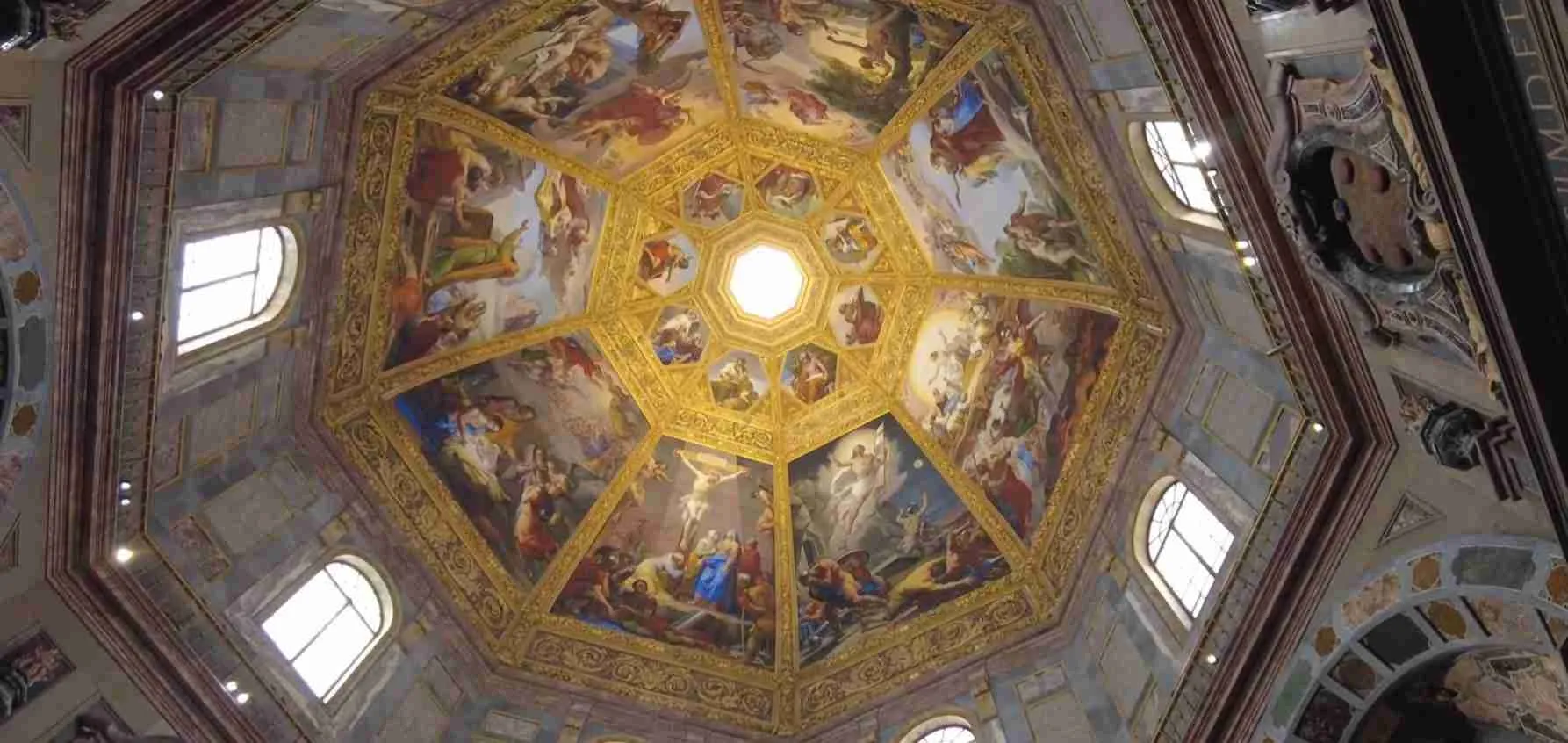
The Chapel of the Princes dominates the complex through sheer scale and material opulence. Begun in 1604 under Grand Duke Ferdinando I to designs by Matteo Nigetti, though often attributed to Bernardo Buontalenti who contributed to planning, the octagonal chamber rises 59 meters to a frescoed dome, creating vertical drama that rivals the Pantheon’s spatial effect. The plan’s octagonal geometry references medieval Florentine baptisteries while the dome construction follows Renaissance structural principles established by Brunelleschi. This architectural syncretism—combining medieval symbolic geometry with Renaissance engineering and Baroque decorative intensity—characterizes the entire Medici Chapel complex.
From the Chapel of the Princes, a corridor leads to Michelangelo’s New Sacristy, creating another spatial transition from Baroque excess to Renaissance clarity. This architectural editing, moving from visual overload to geometric purity, demonstrates the chapels’ chronological and aesthetic range. Where the Chapel of the Princes overwhelms through accumulated decoration, the New Sacristy achieves impact through proportion, restraint, and the concentrated power of Michelangelo’s sculptural genius.
Recent expansions opened previously inaccessible spaces to public view. The Lorraine Crypt, burial place of the Habsburg-Lorraine dynasty that succeeded the Medici as Tuscan rulers, adds 18th and 19th-century funerary architecture to the complex’s historical span. Michelangelo’s Secret Room, discovered in 1975 beneath the New Sacristy, displays charcoal drawings attributed to Michelangelo during his 1530 hiding period after serving the anti-Medici republican government. These additions extend the chapels’ narrative beyond pure Medici commemoration into broader Tuscan dynastic history and Michelangelo biographical documentation.
Conservation challenges continuously affect the chapels’ presentation. The semi-precious stone inlays in the Chapel of the Princes require ongoing maintenance as adhesives deteriorate and stones loosen. Michelangelo’s marble sculptures face environmental threats from humidity, temperature fluctuations, and visitor traffic. Recent interventions installed climate control systems and limited visitor numbers during peak periods, balancing preservation requirements against public access demands. These conservation efforts, invisible to casual visitors, ensure the chapels’ survival for future generations while maintaining their function as active museum spaces.
New Sacristy: Michelangelo’s Architectural Masterpiece
Michelangelo received the New Sacristy commission in 1519 from Cardinal Giulio de’ Medici (later Pope Clement VII), tasked with creating a burial chapel for four Medici family members: Lorenzo de’ Medici (Duke of Urbino, grandson of Lorenzo the Magnificent), Giuliano de’ Medici (Duke of Nemours, son of Lorenzo the Magnificent), Lorenzo the Magnificent himself, and Lorenzo’s brother Giuliano (assassinated in the 1478 Pazzi Conspiracy). The commission specified both architectural design and sculptural decoration, making the project Michelangelo’s first opportunity to synthesize his skills across disciplines into a unified artistic environment.
The architectural concept deliberately mirrors Brunelleschi’s Old Sacristy across the church, creating bilateral symmetry in the basilica’s transept arrangement. However, Michelangelo transformed Brunelleschi’s mathematical serenity into dynamic spatial tension. Where Brunelleschi’s cubic geometry and hemisphere dome create static equilibrium, Michelangelo’s same proportions generate upward movement through attenuated pilasters, recessed windows, and architectural moldings that draw eyes toward the coffered dome. This transformation of identical geometric frameworks into opposite spatial effects demonstrates Michelangelo’s architectural sophistication and his competitive relationship with Renaissance architectural precedents.
The wall treatment introduces Michelangelo’s characteristic architectural language of contrasting gray pietra serena against white stuccoed walls, but pushed toward greater complexity than Brunelleschi’s restraint. Pilasters frame three-dimensional niches and windows in layers of advancing and receding planes, creating architectural sculpture from what could have been flat wall surfaces. The tabernacle windows appear squeezed by the architecture surrounding them, as if the walls exert pressure on these openings—a subtle violence that distinguishes Michelangelo’s spatial sensibility from classical harmony. This architectural compression anticipates the emotional intensity of his sculptural figures.
Michelangelo’s sculptural program centers on two wall tombs flanking the altar, each commemorating one of the younger Medici dukes. The tomb of Lorenzo de’ Medici (Duke of Urbino) occupies the left wall, featuring Lorenzo’s idealized portrait seated in contemplative pose above a sarcophagus supporting the reclining figures of Dusk and Dawn. The tomb of Giuliano de’ Medici (Duke of Nemours) mirrors this arrangement on the right wall, with Giuliano portrayed in active, alert posture above Day and Night. These four allegorical figures—Dawn, Dusk, Day, and Night—constitute the New Sacristy’s sculptural heart and Michelangelo’s most profound meditation on time, mortality, and human existence.
The figures’ anatomical treatment reveals Michelangelo’s mature sculptural approach, where idealized human forms express psychological and philosophical concepts through pose, musculature, and relationship to architectural setting. Dawn twists in awakening movement, her body emerging from sleep’s torpor with muscular definition suggesting effort rather than ease. Dusk collapses into repose, the figure’s weight settling into the sarcophagus as consciousness fades. Day turns aggressively, the powerful male nude’s head wrenched backward in resistance to time’s passage. Night sinks into sleep, her female form accompanied by owl, poppies, and mask symbols of dreams and darkness. The non-finito (deliberately unfinished) quality of some surfaces—particularly evident in Dawn—demonstrates Michelangelo’s evolving aesthetic where partially emerged forms suggested souls struggling against matter’s imprisonment.
The Medici Madonna occupies the wall facing the altar, positioned centrally between the two ducal tombs. This Virgin and Child group shows Mary supporting the Christ child in an unusual crossed-leg pose, with the infant twisting to nurse in a movement that echoes the allegorical figures’ torsion. Unlike Michelangelo’s earlier Pietà’s idealized serenity, the Medici Madonna adopts more immediate, human character in the Virgin’s direct gaze and the child’s natural infant behavior. Art historians interpret this positioning—Mary’s protective stance between Lorenzo and Giuliano’s tombs—as maternal intercession for the deceased dukes, adding theological dimension to the chapel’s commemoration program.
The tomb of Lorenzo the Magnificent and his brother Giuliano, originally planned for elaborate treatment matching the dukes’ monuments, received only simple sarcophagi against the entrance wall, topped by the Madonna and flanked by saints Cosmas and Damian (patron saints of the Medici family, sculpted by assistants). This reduced treatment has generated scholarly debate about whether Michelangelo intentionally subordinated the Magnificent’s tomb to emphasize the younger dukes, or whether his 1534 departure interrupted plans for more elaborate commemoration. The asymmetry adds ambiguity to the chapel’s hierarchical message.
Light manipulation serves architectural and symbolic purposes throughout the New Sacristy. Windows placed high in the dome and walls create downward-flowing illumination that models the sculptures’ forms while suggesting divine light descending into the funerary space. This lighting strategy, standard in Renaissance sacred architecture, acquires particular power in Michelangelo’s hands as light sculpts his marble figures, activating their three-dimensional presence and enhancing their anatomical drama. Morning and afternoon light creates different effects, with sculptural shadows shifting throughout the day, making the chapel a temporally dynamic rather than static environment.
The New Sacristy remained unfinished when Michelangelo departed Florence permanently in 1534. Giorgio Vasari and Bartolomeo Ammannati completed decorative elements according to Michelangelo’s designs, but their work lacks the master’s intensity. This collaboration between Michelangelo’s genius and assistants’ execution creates authenticity questions that complicate attribution—scholars debate which elements represent Michelangelo’s direct work versus skilled interpretation of his intentions. For visitors, this uncertainty matters less than the totality’s achievement: a space where architecture, sculpture, and light combine into one of Western art’s supreme funerary environments.
Chapel of the Princes: Medici Mausoleum
The Chapel of the Princes represents Baroque commemoration at maximum intensity, transforming architectural space into dynastic proclamation through material wealth and decorative accumulation. Construction began in 1604 under Grand Duke Ferdinando I de’ Medici following designs attributed to both Matteo Nigetti and Bernardo Buontalenti, though the octagonal plan’s origins remain debated. Unlike Michelangelo’s New Sacristy, completed within decades, the Chapel of the Princes consumed over 150 years, with decorative work continuing until the 1740s when the Medici line extinguished.
The octagonal plan measures 28 meters in diameter with walls rising 59 meters to the frescoed dome, creating vast interior volume that overwhelms through sheer scale. This geometry references Florence’s baptisteries (particularly the ancient Baptistery of San Giovanni) while the dome’s structure follows Brunelleschi’s Renaissance engineering principles. However, where Renaissance architecture emphasized proportion and harmony, the Chapel of the Princes pursues grandeur through size, making visitors feel diminished before Medici power rather than elevated by spatial beauty. This psychological effect—architectural intimidation serving political messaging—characterizes Baroque court art’s propagandistic ambitions.
Commesso fiorentino (Florentine mosaic) work covers every surface, representing one of the world’s most extensive applications of this semi-precious stone inlay technique. Artisans in the Opificio delle Pietre Dure (Workshop of Semi-Precious Stones), established specifically for this project in 1588, created intricate designs using jasper, agate, lapis lazuli, mother-of-pearl, coral, and dozens of other materials. The technique involves cutting thin stone slices, shaping them to fit precise patterns, and setting them in black Belgian marble backgrounds. The result creates permanent, jewel-like decoration that surpasses painted or mosaic alternatives in color saturation and luminosity.
The decorative program follows strict iconographic hierarchy. The lower walls display coats of arms of Tuscan cities under Medici control, arranged in octagonal panels that encircle the chamber. These heraldic emblems—from Florence, Siena, Pisa, Arezzo, Pistoia, Volterra, and other subject cities—proclaim territorial authority through symbolic representation. Above these civic shields, the walls feature altar niches framed by columns of oriental granite and rare marbles, creating architectural rhythm around the octagon’s perimeter. Six grand ducal sarcophagi occupy spaces between the altars, each bearing bronze statues of the deceased Medici rulers in royal regalia.
The grand dukes’ bronze effigies demonstrate Baroque portraiture’s transformation from Renaissance individualism to dynastic conformity. Rather than capturing personal character as Michelangelo’s Lorenzo and Giuliano portraits attempted, these standardized images present idealized sovereignty through crown, scepter, and rigid frontal poses. Grand Duke Ferdinando I, Grand Duke Cosimo II, Grand Duke Ferdinando II, Grand Duke Cosimo III, and Grand Duke Gian Gastone receive identical formal treatment, their individual personalities submerged in institutional representation. This uniformity served political purposes, emphasizing office over person and suggesting the grand duchy’s perpetual stability regardless of which Medici occupied the throne.
Dome frescoes by Pietro Benvenuti, added in the early 19th century after the Medici extinction, depict biblical scenes in academic neoclassical style that contrasts with the Baroque excess below. This chronological layering—17th-century architecture and commesso fiorentino, 19th-century frescoes—creates stylistic dissonance that some scholars criticize as corrupting the chapel’s Baroque purity, while others interpret as documenting continued Tuscan grand ducal patronage under the successor Habsburg-Lorraine dynasty. For visitors, these frescoes provide visual relief from the overwhelming stone inlay that dominates the lower chapel.
Natural light enters through windows in the dome and high walls, creating illumination that activates the semi-precious stones’ chromatic properties. Lapis lazuli panels glow deep blue, jasper shows warm reds and oranges, mother-of-pearl adds opalescent shimmer, and rare marbles contribute veined patterns. This color saturation exceeds any painting’s capability, as polished stone reflects and refracts light with intensity that pigments cannot match. The effect accumulates—individual panels impress, but the totality of hundreds of square meters covered in semi-precious stone inlay creates visual overload that was precisely the chapel’s intention.
The Medici family’s actual burials occur in the Crypt below rather than in the grand ducal sarcophagi, which function as cenotaphs (empty tombs) rather than genuine burial containers. This separation between display commemoration and actual remains follows royal funerary tradition, allowing the Chapel of the Princes to serve representational purposes while the Crypt provides functional burial. The bronze effigies thus guard empty tombs in architectural theater that prioritizes symbolic presence over physical reality.
Conservation challenges in the Chapel of the Princes center on the commesso fiorentino’s vulnerability to environmental fluctuations. Temperature and humidity variations cause adhesive deterioration, allowing stones to separate from marble backgrounds. Modern restoration campaigns have replaced historic animal-based adhesives with stable synthetic compounds, though this intervention raises preservation philosophy questions about maintaining original materials versus ensuring long-term stability. Visitor management also affects conservation, as body heat and moisture from crowds create microclimate variations that stress the inlays. Recent monitoring systems track these environmental factors, informing conservation strategies that balance public access against preservation requirements.
Michelangelo’s Secret Room: Hidden Artistic Treasures
Beneath the New Sacristy, accessed through a trapdoor and narrow staircase, lies a small room covered with charcoal drawings discovered in 1975 during building maintenance. These sketches, attributed to Michelangelo based on stylistic analysis and historical context, depict anatomical studies, architectural details, and figure compositions that offer insight into his working methods during a specific historical crisis. The room’s existence and decorative covering remained unknown for over 400 years, making this discovery among the 20th century’s most significant Michelangelo scholarship developments.
Historical context explains both the room’s creation and its concealment. In 1527, Florence expelled the Medici and established a republic, with Michelangelo serving as fortification architect defending the city against the combined forces of Pope Clement VII (himself a Medici) and Holy Roman Emperor Charles V. When the republic fell in 1530 and the Medici returned, Michelangelo faced potential execution for his role supporting their enemies. Pope Clement, recognizing Michelangelo’s artistic value, granted amnesty conditional on the artist resuming work on the New Sacristy. During the dangerous period between the republic’s fall and the pope’s protection solidifying, Michelangelo likely hid in this secret room, drawing on the walls to occupy himself during enforced confinement.
The drawings themselves range from quick gestural sketches to detailed anatomical studies, revealing Michelangelo’s creative process in raw form unmediated by finished works. Male nude figures appear in poses suggesting studies for the New Sacristy’s allegorical sculptures, particularly stances related to the reclining Day and Night figures. Architectural sketches show molding profiles and decorative elements that correspond to executed New Sacristy details, demonstrating how Michelangelo worked out design problems through drawing rather than full-scale models. A profile portrait, possibly a self-portrait or depiction of someone visiting him in hiding, adds human dimension to these otherwise abstract anatomical and architectural studies.
Stylistic attribution remains contentious among scholars. Supporters point to the drawings’ anatomical sophistication, characteristic Michelangelesque contour energy, and correspondence with documented New Sacristy designs as evidence of autograph work. Skeptics note the drawings’ sketchiness makes definitive attribution impossible and suggest possible execution by assistants working from Michelangelo’s designs. The room’s confirmed use as Michelangelo’s hiding place provides circumstantial support for the attribution, as does the drawings’ concealment suggesting conscious covering rather than casual decorative practice. Current scholarly consensus tentatively accepts the drawings as Michelangelo’s work while acknowledging attribution uncertainty.
Public access to Michelangelo’s Secret Room requires separate reservation beyond standard Medici Chapels admission, with visits limited to groups of four people for 15 minutes. This restriction reflects the space’s fragility—the narrow 12-step staircase cannot accommodate large crowds, and the small room’s environment requires careful monitoring to prevent humidity and carbon dioxide buildup that threatens the charcoal drawings. The exclusivity and additional effort required paradoxically enhance the experience’s value, creating intimacy with Michelangelo’s artistic process impossible in crowded museum galleries.
The drawings’ preservation presents unique challenges. Charcoal’s friability makes it vulnerable to vibration, air movement, and touch, requiring protective barriers and environmental controls. Unlike oil paintings or frescoes, charcoal drawings lack binding medium securing pigment to surface, meaning any physical disturbance can cause irreversible loss. Conservation efforts have stabilized the most fragile areas while maintaining the drawings’ unrestored appearance, preserving their raw, sketch-like quality rather than transforming them into finished artworks. This conservation philosophy respects the drawings’ nature as working studies never intended for public display.
Planning Your Visit to the Medici Chapels
The Medici Chapels operate Wednesday through Monday from 8:15 AM to 6:50 PM, with last admission 40 minutes before closing. Tuesday closure plus holidays (December 25, January 1) requires schedule awareness when planning Florence itineraries. This Wednesday-Monday pattern aligns with many Italian state museums’ Tuesday closure tradition, concentrating visits across six days and creating predictable rhythm for efficient trip planning.
Standard admission costs €14 for adults, purchased either onsite or through the official b-ticket.com platform with a €3 booking fee. Online booking provides guaranteed entry at reserved timeslots, eliminating queue uncertainty during high season. Combination tickets offer value for multiple museum visits: the 48-hour pass (€26) includes Galleria dell’Accademia and Museo del Bargello, while the 72-hour pass (€38) adds Palazzo Davanzati, Orsanmichele, and Casa Martelli to the Accademia and Bargello access. Both passes require Accademia timeslot reservation when purchasing, with other museums offering skip-the-line entry within the validity period.
Audio guides rent for €6 (single device) or €10 (double device sharing between two people), available onsite in Italian and English. These narrated tours provide context for the chapels’ history, Michelangelo’s sculptures, and the Medici family’s significance, transforming visual experience into informed understanding. The audio guide investment proves valuable for visitors without art history background, as the chapels’ complex iconography and historical references remain opaque without explanation.
Free admission occurs on the first Sunday of each month as part of Italy’s national museum program. This democratic access initiative creates predictable overcrowding, with morning queues extending an hour or more and interior circulation difficult due to visitor density. Free Sunday visits suit budget-constrained travelers willing to accept crowds and potential frustration, but the €14 standard admission on other days purchases dramatically superior experience through manageable visitor numbers and civilized viewing conditions.
Optimal visiting times balance crowd avoidance against personal schedule. The 8:15 AM opening admits early visitors to nearly empty chapels before tour groups arrive around 9:30 AM. This quiet window allows contemplative engagement with Michelangelo’s sculptures and time for photography without tourists obstructing compositions. Late afternoon (after 4:30 PM) also sees reduced crowds as tour groups depart for evening activities, though diminishing natural light affects the chapels’ atmospheric quality. Midday (11 AM-2 PM) represents peak congestion when multiple tour groups converge.
Visit duration typically ranges 90 minutes to 2 hours, depending on engagement level and whether Michelangelo’s Secret Room visit supplements standard chapel access. Rushing through in 45 minutes captures basic highlights but sacrifices the contemplative experience these spaces reward. Spending 2+ hours allows detailed examination of commesso fiorentino inlays, comparative study of Michelangelo’s sculptural variations, and absorption of the architectural environments’ cumulative effect. Audio guide users should add 15-20 minutes to baseline visiting estimates.
Photography policies permit photos without flash, allowing documentation of the chapels’ artistic and architectural achievements. The New Sacristy’s sculptures photograph well with natural window light, though the Chapel of the Princes’ vast scale and high decorative density challenge compositional strategies. Wide-angle lenses capture architectural contexts, while detail shots isolate specific commesso fiorentino panels or sculptural features. Midday overhead light creates harsh shadows that flatten the sculptures’ three-dimensional modeling, making early morning or late afternoon’s angled light preferable for serious photography.
Dress code enforcement reflects the chapels’ sacred character as consecrated religious space. Shoulders and knees must be covered—no sleeveless tops, shorts above knee length, or short skirts. This requirement applies to all visitors regardless of age or gender, with guards refusing admission to inappropriately dressed individuals. Summer visitors should plan layers allowing compliance: lightweight long pants or skirts, scarves covering bare shoulders. The strictness varies by guard temperament, but assuming enforcement prevents entry denial at the door.
Accessibility for visitors with mobility limitations faces challenges from the historic building’s structure. The Medici Chapels provide wheelchair access to the Crypt and Chapel of the Princes through elevators and ramps, but Michelangelo’s Secret Room remains inaccessible due to the narrow staircase. The New Sacristy offers limited wheelchair access, with some viewing angles restricted. Visitors requiring assistance should contact the museum in advance to arrange optimal routing and support, as the medieval building structure cannot be fully modernized without destroying historic fabric.
Combining Market and Chapels: Optimal Itinerary Strategies
The San Lorenzo district’s compact geography enables efficient combination of market exploration and chapel visiting within a half-day itinerary that captures both experiences without exhaustion. Physical proximity—the Medici Chapels entrance sits less than 100 meters from the Mercato Centrale and outdoor market core—eliminates transit time and allows spontaneous movement between attractions based on energy, interest, and crowd conditions.
The recommended sequence begins with early outdoor market exploration (9-10:30 AM), capitalizing on vendors’ fresh morning energy, full inventory selection, and moderate crowd levels before tourist groups arrive. This window allows leather goods comparison, price reconnaissance, and initial purchases without the afternoon’s commercial intensity. Moving from outdoor stalls into the Mercato Centrale ground floor (10:30-11:30 AM) transitions from tourist-oriented retail to authentic food market atmosphere, providing cultural context and potential provisions for later picnic consumption.
The midday transition (11:30 AM-12 PM) involves the brief walk to the Medici Chapels entrance on Piazza di Madonna degli Aldobrandini. Entering the chapels after 11 AM avoids early morning tour group congestion while leaving afternoon free for other Florence attractions. The chapels’ climate-controlled interior provides relief from summer heat, making midday timing comfortable when outdoor activities become oppressive. Allocating 90-120 minutes for chapel exploration (12 PM-1:30 or 2 PM) enables thorough engagement without rushing Michelangelo’s masterpieces.
Post-chapel options depend on energy and appetite. The Mercato Centrale first-floor food hall (2-3 PM) offers diverse lunch options after chapel visiting, with less intense crowds than noon-1 PM peak. Alternatively, continuing to other Florence attractions (Duomo, Uffizi, Accademia) maintains sightseeing momentum, with lunch delayed until later. The market’s continuous operating hours (outdoor until 7 PM, food hall until midnight) accommodate return visits for items identified during morning reconnaissance but not immediately purchased.
Reverse sequencing—chapels before market—works for visitors prioritizing art over commerce or seeking optimal photography light in the New Sacristy. The 8:15 AM chapel opening provides nearly private access to Michelangelo’s sculptures, with angled morning light creating dramatic sculptural modeling. Completing chapel visit by 10 AM allows market entry as vendors fully establish operations, with the entire morning resolved before midday heat. This approach suits early risers and serious art enthusiasts valuing contemplative chapel experience over leisurely market browsing.
Extended itineraries incorporating nearby attractions build upon the San Lorenzo foundation. The Basilica di San Lorenzo, sharing the complex with the Medici Chapels but requiring separate admission, adds Brunelleschi’s Renaissance architecture and the Laurentian Library’s Michelangelo-designed staircase. The Palazzo Medici Riccardi (10-minute walk) shows the family’s Renaissance palace with Benozzo Gozzoli’s Magi Chapel frescoes. These expansions transform a half-day San Lorenzo circuit into comprehensive Medici heritage immersion occupying 5-6 hours including lunch.
Practical logistics support itinerary execution. Store purchases at hotel or baggage storage facilities before chapel visiting—carrying shopping bags through museums proves awkward and risks damage to both merchandise and museum etiquette. Wear comfortable walking shoes for market cobblestones and chapel standing, as the entire circuit involves 2-3 hours of continuous movement without seating. Hydration matters, particularly in summer, with the food hall providing water and refreshment between activities. These mundane considerations prevent minor discomforts from degrading otherwise excellent cultural experiences.
Seasonal adjustments optimize visiting across Florence’s climate variations. Summer (June-August) demands early starts to avoid midday heat, with chapel visiting providing air-conditioned refuge during 1-3 PM peak temperatures. Winter (November-February) compresses outdoor market browsing into midday warmth (11 AM-2 PM), with chapel visiting scheduled before or after to minimize outdoor exposure. Spring and fall shoulder seasons (April-May, September-October) allow flexible timing, though the superior weather increases competition for chapel entry slots requiring advance booking.
Photography Guide: Capturing Market Life and Renaissance Art
Photographing San Lorenzo requires dual technical approaches: dynamic street photography for market spontaneity and controlled architectural photography for chapel documentation. These genres demand different camera settings, compositional strategies, and timing considerations, rewarding photographers who adapt methods to subject matter rather than applying universal approaches.
Market photography thrives on human activity, color saturation, and environmental context. The outdoor stalls’ retractable canopies create dappled shade producing extreme contrast between sunlit and shadowed areas. Modern camera sensors handle this dynamic range better than film ever managed, but optimal results require exposure compensation favoring shadow detail over blown highlights. Shooting in RAW format preserves maximum post-processing flexibility for recovering highlight and shadow information that JPEG compression discards.
Vendor portraiture requires cultural sensitivity and often permission, as many merchants resist photography fearing professional image exploitation without compensation. The approach—visible camera, friendly demeanor, pantomimed request for permission—yields higher success than surreptitious shooting that creates confrontation when detected. Successful portraits capture merchants’ engagement with their craft: leather artisans stretching hides, food vendors arranging produce displays, market workers navigating crowded aisles with loaded handcarts. These environmental portraits document authentic market labor rather than staged tourist-friendly poses.
Merchandise detail shots showcase leather quality, textile patterns, and artisan products that define the market’s commercial character. Macro lenses or close-focus capabilities isolate grain patterns in leather, weave structures in textiles, and surface details in ceramics. These detail photographs serve both artistic and practical purposes, documenting purchase considerations and creating visual records of Florentine craft traditions. The saturated colors of hanging scarves, stacked leather jackets, and arranged ceramics benefit from slight saturation boost in post-processing, though excessive enhancement crosses into garish territory.
The Mercato Centrale’s iron and glass architecture provides strong geometric frameworks for compositions combining structure and human activity. Wide-angle perspectives capture the market hall’s spatial volume, with iron trusses and glass ceiling creating architectural rhythm. Including market activity in these architectural shots—vendors arranging displays, shoppers examining products, butchers preparing meat—adds human scale and narrative dimension. The building’s evening illumination, with warm interior light glowing through glass walls, creates atmospheric images that capture the food hall’s contemporary social function.
Chapel photography transitions from market spontaneity to architectural documentation requiring tripod stability and technical precision. The chapels’ no-flash rule protects artwork while creating low-light challenges demanding high ISO settings, wide apertures, or long exposures. Modern full-frame sensors excel in these conditions, producing clean images at ISO 3200-6400 that would have been impossibly noisy on older cameras. Mirrorless cameras’ electronic viewfinders accurately preview these low-light conditions, unlike optical viewfinders requiring exposure bracketing and review.
Michelangelo’s sculptures reward multiple focal lengths and perspectives. Wide shots establish each tomb’s complete composition, showing how the reclining figures, portrait statues, and architectural framework integrate into unified designs. Medium telephotos (85-135mm) isolate individual allegorical figures, emphasizing their muscular drama and expressive poses. These compressed perspectives flatten the shallow sculptural relief, creating two-dimensional graphic impact from three-dimensional forms. Detail shots targeting specific anatomical passages—Dawn’s emerging torso, Night’s sleeping face, Day’s powerful back muscles—document Michelangelo’s carving virtuosity at chisel-mark resolution.
Chapel architectural photography benefits from corner positions that capture octagonal geometry and vertical extent. The Chapel of the Princes’ vast scale challenges sensor dynamic range, with bright dome frescoes and dark lower walls exceeding single-exposure capture capability. Exposure bracketing with merge to HDR handles this range while risking over-processed appearance if toning isn’t restrained. Alternatively, exposing for midtones and accepting blown highlights in dome windows maintains natural appearance while sacrificing some detail range.
Natural light timing affects sculptural modeling dramatically. Morning light enters New Sacristy windows at angles that graze marble surfaces, creating pronounced shadows that emphasize three-dimensional form. Afternoon light shifts to more direct angles, reducing shadow drama and sometimes flattening sculptural presence. This lighting variation means photographs taken at different times document fundamentally different sculptural experiences. Serious photographers visit multiple times across different days to capture optimal conditions for each specific sculpture.
Composition strategies balance documentation and artistry. Straight documentation captures complete artworks in neutral perspective for reference purposes. Artistic interpretation uses selective framing, emphasized shadows, and compositional dynamics to create images that respond to rather than merely record the artwork. Both approaches validate—documentation serves study and memory, artistic interpretation creates photographs standing as independent visual statements. The choice reflects photographic intentions rather than objective quality standards.
Nearby Attractions: Basilica di San Lorenzo and Laurentian Library
The Basilica di San Lorenzo occupies the western section of the complex sharing walls with the Medici Chapels but requiring separate admission. Brunelleschi’s Renaissance redesign (1419-1470) established architectural vocabulary that influenced Florentine sacred architecture for generations: mathematical proportion, classical column orders, gray pietra serena articulation against white stuccoed walls, geometric clarity replacing Gothic decorative complexity. The unfinished facade’s rough stonework creates jarring contrast with the refined interior, reflecting economic constraints that prevented implementing Michelangelo’s proposed facade design.
The interior’s two-aisled plan follows Latin cross geometry with the Old Sacristy completing the left transept. Brunelleschi’s architectural system employs mathematical modules creating proportional relationships between nave width, column height, arcade rhythm, and ceiling height. These invisible geometric frameworks generate the spatial harmony Renaissance theorists considered essential to sacred architecture. Modern visitors rarely perceive these proportional systems consciously but experience their effect as architectural coherence that distinguishes Brunelleschi’s spaces from arbitrary design.
Artistic highlights include Donatello’s bronze pulpits (his final works, completed by assistants after his death), Filippo Lippi’s frescoes in the Martelli Chapel, and Rosso Fiorentino’s Marriage of the Virgin. The Old Sacristy, Brunelleschi’s earlier masterwork designed as Medici burial chapel, demonstrates the Renaissance architectural principles he would develop further in the main basilica. This small cubic room topped by umbrella dome achieves spatial perfection at intimate scale, proving mathematical proportion works at all architectural sizes.
The Laurentian Library (Biblioteca Medicea Laurenziana), accessed through the basilica cloister but requiring separate admission and advance booking, houses the Medici family’s manuscript collection in architecture designed by Michelangelo. The vestibule staircase represents Michelangelo’s architectural genius at its most theatrical: a sculptural cascade of stone steps filling the compressed vertical space with dynamic movement. This staircase transforms functional circulation into dramatic spatial experience, demonstrating how architecture generates emotional responses through form and proportion rather than merely providing shelter.
The reading room’s elongated proportions and rhythmic pilaster articulation create serene environment for scholarship, contrasting with the vestibule’s compressed energy. Michelangelo designed the distinctive reading benches integrated with the architecture, though post-Renaissance modifications altered some original details. The library’s function as working research facility limits casual tourist access, requiring appointments that reduce spontaneous visits but preserve the scholarly atmosphere Michelangelo’s design intended to support.
Cosimo I’s studiolo in the basilica’s former Medici private apartments displays the duke’s scientific instruments, maps, and curiosities, representing Renaissance intellectual culture beyond art patronage. These rooms contextualize the family’s interests across astronomy, cartography, natural history, and mechanical engineering, showing the Medici as polymathic Renaissance princes rather than solely art collectors. The studiolo visits require special tours offered periodically, making access unpredictable but rewarding when available.
Shopping Strategies: Leather Quality and Negotiation Tips
Successful San Lorenzo leather shopping requires systematic quality assessment, realistic price expectations, and culturally appropriate negotiation. Random purchasing based on superficial appeal yields disappointing results when products reveal poor construction or synthetic materials after returning home. Strategic shopping produces genuine leather goods at fair prices through informed selection and skilled bargaining.
Quality assessment begins with material authentication. Genuine leather shows natural grain variation—no two sections display identical patterns, as animal hides develop unique surface characteristics. Synthetic materials replicate grain through mechanical embossing, creating perfect uniformity that organic materials never achieve. This test works with close examination: genuine leather shows random grain direction changes and natural imperfections, synthetic shows mechanical repetition. The suede test supplements visual inspection: genuine suede roughens when rubbed against the nap, synthetic maintains consistent feel.
Structural examination reveals construction quality independent of material authenticity. Quality leather goods use double or triple stitching in stress areas (bag handles, jacket shoulders, belt attachment points), reinforcing connections that bear weight or friction. Single stitching indicates cost-cutting that compromises durability. Interior lining quality signals overall construction standards—quality goods line interiors with suede, leather, or heavy textile; cheap products use thin synthetic lining or leave interiors unfinished. Hardware inspection matters: solid metal zippers, clasps, and buckles outlast plated plastic components that fail through normal use.
Price calibration prevents both overpaying and pursuing unrealistic bargains. Quality leather jackets cost €200-400, reflecting material expense, artisan labor, and overhead. Offers claiming “real Italian leather” at €80-100 indicate either synthetic materials, imported low-grade leather, or unsustainable business models. Genuine bargains exist—last season’s styles, overstocked inventory, vendor relationships—but never approach the fantasy prices some tourists expect. Setting realistic price targets (jackets €200+, quality bags €80-150, belts €20-40) prevents disappointment while enabling recognition of genuine value when encountered.
Vendor selection influences transaction success more than negotiation skill. Established vendors occupying premium positions near the Basilica entrance maintain higher quality standards than peripheral temporary stalls, as their business models depend on repeat customers and word-of-mouth reputation rather than one-time tourist transactions. These vendors accept less aggressive bargaining but deliver more reliable quality. Conversely, temporary vendors along the market’s outer edges sell primarily to one-time customers, creating incentive structures favoring maximum immediate profit over long-term reputation.
Negotiation mechanics follow Mediterranean market customs adapted to tourist context. The process begins with interest expression and merchandise examination signaling potential purchase without commitment. Asking prices reveals vendor’s opening position—typically 30-40% above their acceptable final price. Counter-offering around 60-70% of asking price establishes your position as informed buyer rather than naive tourist. The vendor responds with reduced offer, you increase slightly, this exchange continues until reaching mutually acceptable middle ground or impasse indicating incompatible price expectations.
Successful negotiation requires cultural awareness. Mediterranean market culture expects bargaining as standard commercial interaction, not personal confrontation. Maintaining friendly, respectful demeanor throughout negotiation prevents transforming commercial transaction into adversarial conflict. Humor and patience improve outcomes—vendors respond better to pleasant customers than aggressive hagglers. Walking away remains your strongest negotiating tool: genuine disinterest often produces final price concessions, though bluffing risks the vendor calling your bluff and ending negotiation.
Multiple-item purchases increase negotiating leverage. Vendors prefer selling several items at reduced margin than single items at maximum profit, as transaction costs (time, effort, payment processing) remain constant regardless of sale size. Bundling jacket, bag, and accessories purchases from one vendor justifies requesting 30-35% total discount versus the 20-25% achievable on single items. This bulk negotiation benefits both parties: vendors move more inventory, buyers achieve better per-item pricing.
Payment method affects final pricing. Cash purchases enable maximum vendor flexibility, as they avoid credit card processing fees and provide immediate liquidity. Credit card transactions typically reduce final discount by 3-5% to cover processing costs. Some vendors refuse cards entirely, particularly for discounted sales, making sufficient euro cash essential for serious shopping. ATMs cluster around Piazza San Lorenzo, though withdrawal fees and exchange rates add transaction costs to consider when converting dollars or other currencies.
Quality guarantees remain rare in open-air markets, as vendors maintain no permanent commercial addresses enabling returns or warranty claims. Purchasing decisions are essentially final—unsatisfactory items cannot be returned for refund. This reality emphasizes upfront quality assessment, as post-purchase remedies don’t exist. Vendors making extravagant quality claims (“100-year guarantee,” “finest Italian leather”) should trigger skepticism rather than confidence, as genuine quality goods prove themselves through examination rather than marketing promises.
Culinary Highlights: Must-Try Foods at Mercato Centrale
The Mercato Centrale ground floor fresh market and first-floor food hall present contrasting culinary experiences: the ground floor supplies ingredients for home cooking while the food hall provides ready-to-eat preparations showcasing Italian regional traditions. Understanding this division guides visiting strategies and sets appropriate expectations for each environment.
Ground floor butchers prepare Tuscan beef specialties, particularly bistecca alla fiorentina—massive T-bone steaks from Chianina cattle weighing 1-1.5 kilograms. These steaks, grilled rare over wood coals in the traditional preparation, represent Tuscan meat culture at its most uncompromising. The butchers sell raw steaks to locals and restaurants, not prepared food to tourists, though observing the selection process, butchering techniques, and price negotiations provides cultural insight into Florentine food values. Premium Chianina beef commands €35-50 per kilogram, reflecting the breed’s protected status and superior flavor.
Fresh pasta vendors display the day’s production: tagliatelle, pappardelle, ravioli, tortellini, and seasonal specialties like pumpkin-filled tortelli during autumn. These artisan pastas use bronze dies creating rough texture that holds sauce better than smooth extruded industrial pasta. The color, thickness, and rough surface distinguish quality fresh pasta from supermarket equivalents. While ground floor vendors sell uncooked pasta requiring home preparation, first-floor stations cook these same products fresh to order.
Cheese counters stock Tuscan and national specialties: aged Parmigiano-Reggiano with crystalline texture and complex umami depth, pecorino Toscano in various aging stages from fresh and mild to aged and sharp, buffalo mozzarella from Campania delivered daily, Gorgonzola dolce and piccante, and burrata—cream-filled mozzarella packets that must be consumed within hours of production. Vendors offer tastes before purchasing, enabling flavor comparison across different producers and aging periods. These tastings function as informal education in Italian cheese diversity rather than mere sales tactics.
Salumi vendors display regional cured meat traditions: prosciutto di Parma and San Daniele (air-dried ham from protected designation regions), finocchiona (Tuscan salami flavored with fennel), lardo di Colonnata (cured pork fat from Carrara marble quarries), and coppa, pancetta, and bresaola. The slicing technique matters—proper salumi cutting requires razor-thin slices that melt on the tongue rather than thick chunks requiring chewing. Watching vendors hand-slice products demonstrates artisan technique distinguishing market offerings from pre-sliced supermarket packages.
First-floor food hall transforms these raw ingredients into prepared dishes across twenty specialized stations. The lampredotto stand serves Florence’s signature street food: cow’s fourth stomach slow-braised in tomato broth, served on semolina rolls with salsa verde. This traditional working-class food might challenge visitors unfamiliar with offal, but the tender texture and rich flavor demonstrate why Florentines maintain the tradition despite modern prosperity enabling alternatives. The vendor’s visible preparation—hauling steaming tripe from broth, slicing it fresh, dressing each sandwich to order—proves authenticity that theme park recreations cannot fake.
Neapolitan pizza stations employ pizzaioli (pizza makers) trained in Naples, using Caputo flour, San Marzano tomatoes, and fresh buffalo mozzarella to create authentic Neapolitan pizza. The dough undergoes slow fermentation developing complex flavor, hand-stretching creates irregular edges with charred bubbles, and quick wood-fired baking in 900°F ovens produces the characteristic leopard-spotted crust. This represents true Neapolitan pizza tradition transplanted to Florence, distinct from the Roman thin-crust style and American derivatives.
Fresh pasta laboratories prepare traditional formats—carbonara, amatriciana, cacio e pepe, ragu—using the ground floor vendors’ fresh pasta. The open kitchen format allows observing preparation: watching cooks toss pasta with sauce in the traditional mantecare technique, adding pasta water to create silky texture, and plating with precise portion control. These demonstrations educate diners about proper Italian pasta cooking beyond the overcomplicated sauce drowning Americans often encounter.
Bistecca stations grill Fiorentina steaks to specification, though the traditional preparation acknowledges only one doneness level: rare, with warm red center and charred exterior. The massive portions (1-1.5 kg) serve 2-3 people, making this premium option (€50-75 per steak) appropriate for sharing rather than solo dining. The ritual matters: selecting the raw steak, watching the grilling process over wood embers, receiving the finished product on warm plates with only salt, pepper, and lemon. This stripped-down presentation emphasizes meat quality rather than concealing it with complex sauces.
Wine bars curate selections emphasizing natural, biodynamic, and small-production wines rarely exported beyond Italy. The sommeliers, often English-speaking, guide selections matching food choices and personal preferences. Tuscan specialties include Super Tuscans blending international grape varieties with traditional Sangiovese, Brunello di Montalcino representing Sangiovese at maximum expression, and Vernaccia di San Gimignano for white wine preferences. The tasting format—wines by the glass in 75-125ml pours—enables sampling multiple expressions without committing to full bottles.
Gelato and pastry stations showcase artisan techniques differentiating quality gelato from industrial ice cream. True gelato displays muted colors (natural pistachio appears greenish-gray, not fluorescent green), dense texture with minimal air incorporation, and flavors using seasonal ingredients. The display presentation matters: quality gelaterias store gelato in covered metal tins maintaining proper temperature, while tourist traps pile brightly colored product in tall pyramids that look attractive but guarantee freezer burn and melted texture. The first-floor gelato stations follow proper technique, making them reliable choices among Florence’s crowded gelato landscape.
Frequently Asked Questions
How much time should I allocate for visiting both the market and chapels?
A comprehensive visit combining both attractions requires approximately 4-5 hours. The outdoor market merits 60-90 minutes for browsing leather goods and surrounding stalls, though serious shoppers comparing quality across vendors may extend this to 2 hours. The Mercato Centrale ground floor requires 30-45 minutes for thorough exploration unless purchasing ingredients for cooking, while the first-floor food hall demands 45-90 minutes for lunch or dining. The Medici Chapels warrant 90-120 minutes for proper engagement with Michelangelo’s sculptures and the Chapel of the Princes, with audio guide users adding 15-20 minutes. Rushing through both experiences in 2-3 hours proves possible but sacrifices the contemplative engagement both deserve. Strategic visitors spread these elements across multiple days, dedicating separate morning sessions to market shopping versus chapel art appreciation rather than cramming everything into single marathon visit.
What’s the best day of the week to visit the San Lorenzo district?
Tuesday through Thursday represent optimal visiting days, balancing vendor selection, crowd levels, and chapel access. The outdoor market closes Sundays while the Medici Chapels close Tuesdays, eliminating both days from consideration for combined visits. Monday mornings see vendors restocking after weekend closure with reduced energy and selection, while Saturday reaches maximum tourist chaos with aggressive crowds and vendor fatigue. Wednesday particularly excels, falling midweek when tourist momentum slows between weekend surges, vendors maintain fresh inventory and patient demeanors, and chapel crowds thin compared to Monday-Tuesday post-weekend tourist influx. Thursday functions similarly well, though Friday begins building toward weekend intensity. First-time visitors should prioritize Wednesday or Thursday, while repeat visitors with specific vendor relationships or chapel photography goals can time visits to less optimal days accepting the trade-offs.
Are credit cards widely accepted at market stalls?
Credit card acceptance varies dramatically across vendor types and transaction sizes, making cash essential for flexible shopping despite cards’ increasing prevalence. The outdoor leather market shows mixed card acceptance: established vendors with permanent stall positions typically accept cards for purchases exceeding €50, while smaller vendors and those selling lower-priced items often refuse cards due to processing fees eating into slim margins. Negotiated purchase prices often exclude card fees, with vendors requesting cash payment or adding 3-5% surcharges for credit card transactions. The Mercato Centrale ground floor vendors predominantly operate cash-only, reflecting their local customer base and small transaction sizes. The first-floor food hall universally accepts cards as modern commercial establishments, though some individual stations impose minimum purchase amounts (typically €10-15) for card payments. Carrying €100-200 cash enables participation in market commerce without card limitation frustrations, with nearby ATMs providing withdrawal options should cash reserves deplete.
Can I bring food from Mercato Centrale into the Medici Chapels?
Museum regulations prohibit food and beverages (except water bottles) inside the Medici Chapels, requiring visitors to consume purchases before entry or store them in lockers if available. This restriction protects artworks from spills, crumbs attracting insects, and aromatic foods affecting enclosed environments. Practical solutions include consuming food hall purchases at the market’s communal seating before walking to the chapels, or scheduling chapel visits before lunch with market dining afterward. Many visitors successfully combine early morning chapel entry (8:15-10 AM) with subsequent late morning/midday market lunch, avoiding the food restriction issue entirely. Picnic-style provisions purchased from ground floor vendors—cheese, salumi, bread—can be carried for later consumption in Florence’s parks (Giardino dei Semplici, Boboli Gardens) rather than immediate eating, making market shopping compatible with afternoon sightseeing schedules that don’t accommodate restaurant dining.
Is photography allowed inside the Medici Chapels, and are tripods permitted?
The Medici Chapels permit photography without flash for personal, non-commercial use, but prohibit tripods and monopods due to visitor circulation concerns and floor protection. This policy enables handheld photography of Michelangelo’s sculptures and architectural details while preventing equipment that obstructs other visitors or risks artwork damage through accidental contact. Modern cameras’ high ISO performance and image stabilization technology mitigate tripod absence, producing acceptable handheld images at shutter speeds that would have demanded tripods with older equipment. Serious photographers achieve sharp results by bracing against walls or columns, using continuous shooting modes to increase sharp frame probability, and accepting the ISO 3200-6400 settings the dim lighting requires. Professional photography requiring artificial lighting, tripods, or commercial image usage demands advance permission from museum administration and typically involves fees, making this option relevant only to professional photographers rather than tourist documentation. Video recording follows similar policies: allowed for personal use without professional equipment, but requiring special permission for commercial projects or stabilization equipment.
What’s the difference between the Basilica di San Lorenzo and the Medici Chapels?
The Basilica di San Lorenzo and Medici Chapels occupy the same architectural complex but function as separate museums with independent ticketing, distinct visiting experiences, and complementary rather than overlapping content. The basilica, designed by Brunelleschi in Renaissance style, serves as active church with Donatello’s bronze pulpits, Filippo Lippi frescoes, and the Old Sacristy as principal attractions. Visitors access the basilica through the main facade (or would, if the facade were completed—currently through side entrances) and experience functioning religious space with Mass celebrated and worship ongoing alongside tourism. The Medici Chapels, accessed through the separate entrance on Piazza di Madonna degli Aldobrandini, function purely as museum space displaying the New Sacristy (Michelangelo’s sculptural masterpiece), Chapel of the Princes (Baroque mausoleum), and associated burial crypts. These spaces share walls with the basilica but maintain architectural and experiential separation, requiring visitors interested in the complete San Lorenzo complex to visit both attractions separately with respective admission fees. The Laurentian Library, accessed through the basilica cloister but requiring separate booking, adds third component to this multi-part complex that rewards comprehensive exploration across several hours.
How does the San Lorenzo Market compare to other Florence leather markets?
San Lorenzo Market represents Florence’s largest and most tourist-oriented leather market, offering maximum selection and competitive pricing at the cost of authentic Florentine artisan atmosphere. The Porcellino Market (Mercato Nuovo) near Palazzo Vecchio sells similar tourist-focused leather goods and souvenirs in more compressed space, with marginally higher quality control but less aggressive pricing due to its tourist-dense location. Sant’Ambrogio Market, in the neighborhood east of Santa Croce, maintains more authentic local character with limited leather offerings but superior food market experience frequented by Florentine residents rather than tourists. The key distinction separates tourist retail (San Lorenzo, Porcellino) from artisan workshops in Oltrarno district’s via Santo Spirito and via Maggio, where genuine leather craftspeople maintain traditional production methods, custom creation, and premium pricing reflecting authentic artisan skill rather than imported mass production. Visitors seeking genuine Florentine leather artistry should explore Oltrarno workshops while budget-conscious shoppers comparing prices across maximum selection benefit from San Lorenzo’s commercial concentration. The market’s value proposition centers on variety, competitive pricing through vendor competition, and convenient central location rather than artisan authenticity or luxury quality.
Are there combined tickets that include both the Medici Chapels and other Florence museums?
The Medici Chapels participate in two official combination ticket programs offering significant savings for multiple museum visits. The 48-hour pass (€26) includes admission to the Galleria dell’Accademia (Michelangelo’s David) and Museo del Bargello (Renaissance sculpture museum), requiring Accademia timeslot reservation at purchase with skip-the-line access to Bargello. The 72-hour cumulative pass (€38) expands coverage to all Bargello Museums: Museo del Bargello, Medici Chapels, Palazzo Davanzati (medieval palace museum), Orsanmichele (church and sculpture museum), and Casa Martelli (Medici family palace), again requiring Accademia reservation with skip-the-line access to other venues. Both passes count hours from Accademia reserved entry time, requiring other museum visits earlier the same day or within 48/72 hours afterward. These combination tickets save money compared to individual admissions (standard Medici Chapels €14, Accademia €16, Bargello €10) while forcing efficient scheduling to maximize value within time limits. Visitors planning comprehensive Florence museum itineraries benefit substantially, while those visiting only 2-3 museums may find individual tickets more flexible despite higher cost. The Firenze Card, previously Florence’s comprehensive museum pass, remains discontinued, making these Bargello Museums combination passes the primary multi-attraction discount option.
What items should I definitely not buy at the San Lorenzo Market?
Several product categories consistently disappoint purchasers through quality issues, authenticity deception, or better value elsewhere. Cheap leather jackets priced under €100 invariably use synthetic materials or low-quality imported leather that cracks, peels, or discolors within months, making their apparent bargain pricing false economy. “Designer” bags claiming brand names (Gucci, Prada, Fendi) represent obvious counterfeits that are illegal to import to many countries and carry legal risks including confiscation and fines—legitimate designer leather never appears at market stall prices. Mass-produced “Made in Italy” scarves, despite labeling, typically undergo final assembly in Italy from imported Asian materials, offering no quality advantage over honestly marketed imports at fraction the price. Fragile ceramics and glassware, while attractive, create packing and transport challenges that result in damage before reaching home, making these better purchased at destination with professional shipping services. Low-priced gold jewelry marked “18k” or “14k” frequently contains base metals with gold plating that wears through quickly, representing neither genuine gold value nor durable costume jewelry—avoid jewelry purchasing entirely without gemological expertise. Instead, focus purchasing on genuine leather goods from quality vendors, regional food products from Mercato Centrale’s ground floor, and artisan paper products where quality assessment through visual inspection proves reliable.
Can children visit the Medici Chapels, and is the content appropriate for young visitors?
The Medici Chapels welcome children without age restrictions, though the content’s funerary nature and artistic sophistication make the experience most rewarding for children aged 10+ with some art history introduction. Younger children (6-9 years) can appreciate Michelangelo’s sculptures’ dramatic poses and the Chapel of the Princes’ colorful stone inlays without understanding the complex iconography or historical context, though the 90-minute visit duration may exceed their attention spans. Families with young children should consider abbreviated visits focusing on New Sacristy highlights (the four allegorical figures, Medici Madonna) before inevitable restlessness emerges. The chapels’ sacred atmosphere and museum decorum expectations—quiet voices, no running, respectful behavior—require parental enforcement that some children manage better than others. Michelangelo’s Secret Room explicitly prohibits children under 10 due to the narrow staircase and fragile drawings’ vulnerability to disturbance. Educational preparation enhances children’s engagement: discussing Renaissance art, Medici family history, and Michelangelo’s achievements before visiting provides context making the sculptures meaningful rather than merely impressive marble figures. The audio guide offers children’s version in some languages, simplifying explanations and shortening content to match younger attention spans, though availability varies by season and should be confirmed when renting. Family-friendly alternatives exist—the Palazzo Vecchio’s family tours and interactive exhibits suit younger children better—making the Medici Chapels optional rather than essential for families prioritizing child-appropriate Florence experiences.