
Ravenna Byzantine Mosaics: Complete UNESCO World Heritage Guide
Ravenna preserves the world’s finest collection of Byzantine mosaics across eight Early Christian monuments inscribed as a UNESCO World Heritage Site in 1996. These 5th and 6th-century masterpieces represent the artistic pinnacle of a city that served as capital of three successive empires, blending Greco-Roman traditions with Christian iconography and both Eastern and Western artistic styles.
Key Takeaways
- UNESCO Recognition: Eight Early Christian monuments collectively form the World Heritage Site, with seven containing Byzantine mosaics dating from the 5th and 6th centuries AD.
- Triple Capital Legacy: Ravenna served as capital of the Western Roman Empire (402-476 AD), the Ostrogothic Kingdom (493-553 AD), and Byzantine Italy (568-751 AD), with each period contributing distinct artistic elements.
- Artistic Supremacy: The mosaics demonstrate the supreme artistry of this medium, recognized by UNESCO for their crucial evidence of artistic and religious relationships during a pivotal period in European cultural history.
- Architectural Diversity: The eight monuments include basilicas, baptisteries, mausoleums, and a private chapel, each representing different architectural traditions and religious purposes.
- Preservation Excellence: Ravenna’s mosaics are among the best-preserved examples of Byzantine art anywhere in the world, with colors and details remaining vivid after fifteen centuries.
- Cultural Synthesis: The monuments showcase a unique blend of Greco-Roman tradition, Christian iconography, and Oriental and Western styles that defined Late Antiquity.
People Also Ask About Ravenna Byzantine Mosaics
Why are Ravenna’s Byzantine mosaics considered the world’s finest?
Ravenna’s Byzantine mosaics are considered the world’s finest because they represent the largest and most important collection of Byzantine mosaic art outside Istanbul, combining exceptional artistic quality with remarkable preservation. The mosaics demonstrate supreme technical mastery in the medium, utilizing millions of tiny glass tesserae (some less than 4 millimeters) to create luminous, detailed compositions with colors that remain vibrant after 1,500 years. The collection spans the crucial transition period from Late Roman to Byzantine artistic traditions, capturing the evolution from naturalistic Roman styles to the more stylized, symbolic Byzantine aesthetic. Unlike many Byzantine mosaics elsewhere that suffered from iconoclasm or later modifications, Ravenna’s examples survived largely intact, providing an unparalleled visual record of 5th and 6th-century religious art. The strategic use of gold backgrounds, the sophisticated understanding of light and reflection, and the ambitious scale of narrative cycles place these works at the pinnacle of mosaic achievement.
What makes the eight monuments a unified UNESCO World Heritage Site?
The eight Early Christian monuments form a unified UNESCO World Heritage Site because they collectively represent the political, religious, and artistic significance of Ravenna during its period as an imperial capital. Built and decorated between the 5th and 6th centuries, these monuments reflect the major historical events that occurred as Ravenna transitioned from Western Roman to Ostrogothic to Byzantine control. Each building contributes essential evidence of how religious architecture and mosaic art evolved during this transformative period in European history. The monuments demonstrate the peaceful coexistence and artistic exchange between Orthodox and Arian Christian communities, the integration of Eastern and Western architectural traditions, and the development of iconographic programs that would influence Christian art for centuries. UNESCO recognized them not as isolated artistic achievements but as an interconnected ensemble that tells the complete story of Ravenna’s unique role in Late Antiquity. Together, they fulfill all four cultural criteria for World Heritage designation, showcasing outstanding artistic skill, crucial evidence of cultural relationships, wonderful blending of traditions, and epitomizing religious art and architecture of the 6th century AD.
How did Ravenna become the center of Byzantine mosaic art?
Ravenna became the center of Byzantine mosaic art through a combination of political circumstances and imperial patronage beginning in 402 AD, when Emperor Honorius relocated the capital of the Western Roman Empire from Milan to Ravenna for strategic security reasons. This elevation from provincial town to imperial capital attracted skilled artisans, architects, and mosaic masters from across the empire. Galla Placidia, sister of Emperor Honorius, settled in Ravenna and became a major patron of Christian art and architecture, commissioning the construction and decoration of numerous religious buildings with elaborate mosaics. When the Ostrogothic King Theodoric conquered Italy in 493 AD, he made Ravenna his capital and continued this tradition of monumental building, employing both local craftsmen and artists from Constantinople. The Byzantine reconquest under Emperor Justinian in 540 AD brought another wave of artistic investment, with master craftsmen arriving from the Eastern capital to create works like the magnificent mosaics in San Vitale. This continuous 150-year period of imperial patronage, combined with Ravenna’s position as a meeting point between Eastern and Western artistic traditions, created ideal conditions for mosaic art to flourish at the highest level.
What artistic techniques make Byzantine mosaics so luminous?
Byzantine mosaics achieve their characteristic luminosity through sophisticated technical innovations in materials, placement, and design. The tesserae (small mosaic pieces) are made from smalti, a glass paste that can be tinted in brilliant colors and contains gold leaf sandwiched between two layers of clear glass for backgrounds, creating surfaces that catch and reflect light at varying angles. Artisans deliberately set the tesserae at slight angles rather than perfectly flat, causing each piece to reflect light differently and creating a shimmering, almost three-dimensional effect that changes as viewers move. The extensive use of gold backgrounds—sometimes covering entire walls and vaults—amplifies ambient light within the buildings, with each gold tessera functioning as a tiny mirror. The strategic placement of windows ensures that natural light illuminates the mosaics from specific angles at different times of day, with designers calculating these effects during construction. Color gradations are achieved not through blending or shading but by juxtaposing tesserae of different hues, allowing the eye to mix the colors optically for richer tones. Dark blue or black backgrounds create maximum contrast with gold and bright colors, intensifying the visual impact. These technical choices transform static images into dynamic, light-responsive artworks that appear to glow from within.
Extended multi-day tours – 5+ days
Featured Emilia Romagna Multi-Day Tour Packages

3 days
Emilia Romagna 3-Day Discovery Tour
- ✓ Comprehensive Emilia Romagna experience
- ✓ Expert local guides included
- ✓ All accommodation included
- ✓ Transportation provided
5 days
Emilia Romagna 5-Day Highlights Experience
- ✓ Comprehensive Emilia Romagna experience
- ✓ Expert local guides included
- ✓ All accommodation included
- ✓ Transportation provided
7 days
Emilia Romagna 7-Day Cultural Journey
- ✓ Comprehensive Emilia Romagna experience
- ✓ Expert local guides included
- ✓ All accommodation included
- ✓ Transportation provided
10 days
Emilia Romagna 10-Day Complete Adventure
- ✓ Comprehensive Emilia Romagna experience
- ✓ Expert local guides included
- ✓ All accommodation included
- ✓ Transportation provided
Multi-day tour packages powered by TourRadar. Prices and availability subject to change.
Introduction: Ravenna’s Unparalleled Mosaic Heritage
The Early Christian Monuments of Ravenna constitute the most significant concentration of Byzantine mosaic art preserved anywhere in the world, offering visitors an unmatched opportunity to experience the artistic splendor of Late Antiquity within the original architectural contexts for which these works were created. Between the early 5th and mid-6th centuries AD, Ravenna transformed from a provincial Roman town into one of Europe’s most important political and cultural centers, serving successively as capital of the Western Roman Empire, the Ostrogothic Kingdom, and Byzantine Italy. This unique historical trajectory attracted the finest artists, architects, and craftsmen of the era, resulting in a concentration of artistic achievement that UNESCO recognized as possessing “outstanding universal value” when inscribing the site on the World Heritage List in 1996.
The eight monuments that comprise the World Heritage Site—Mausoleum of Galla Placidia, Neonian Baptistery, Basilica of Sant’Apollinare Nuovo, Arian Baptistery, Archiepiscopal Chapel, Mausoleum of Theodoric, Basilica of San Vitale, and Basilica of Sant’Apollinare in Classe—span approximately 150 years of continuous artistic development. Each building reflects the religious, political, and cultural priorities of its era while contributing to an ensemble that documents the evolution of Christian art and architecture during one of history’s most significant transition periods. Seven of the eight monuments contain extensive mosaic decoration, with the combined mosaic surfaces representing thousands of square meters of intricate work executed by master craftsmen using millions of individual glass, stone, and gold-leaf tesserae.
What distinguishes Ravenna’s mosaics from other Byzantine artistic monuments is not merely their exceptional quality and state of preservation, but their role in documenting the crucial synthesis of artistic traditions that defined Late Antiquity. The mosaics blend the naturalistic representation and spatial organization inherited from Greco-Roman art with the symbolic, hieratic style of Byzantine spirituality, while incorporating decorative motifs from both Eastern and Western sources. This artistic fusion occurred during a period when Christianity was defining its visual language, making Ravenna’s monuments essential documents for understanding how Christian iconography developed and spread throughout Europe.
The monuments also provide rare insight into the religious complexities of the era, particularly the coexistence of Orthodox and Arian Christianity in Ravenna. Buildings like the Arian Baptistery and Sant’Apollinare Nuovo preserve iconographic programs that reflect Arian theological perspectives, offering tangible evidence of doctrinal debates that shaped early Christianity. Later modifications to some of these buildings following the Byzantine reconquest demonstrate how art served political and religious objectives, with certain mosaics altered or removed to align with Orthodox beliefs.
Beyond their artistic and historical significance, Ravenna’s mosaics possess profound aesthetic power that transcends scholarly analysis. The shimmering gold backgrounds, the luminous colors that seem to glow from within, the expressive faces of saints and emperors, and the intricate patterns of geometric and naturalistic decoration create immersive environments that continue to captivate contemporary visitors. These are not museum artifacts extracted from their original contexts but living monuments that still function as places of worship, maintaining an unbroken connection to the spiritual purposes for which they were created fifteen centuries ago.
This guide provides comprehensive coverage of all eight UNESCO World Heritage monuments in Ravenna, examining their historical contexts, architectural features, mosaic programs, and artistic significance. Each monument receives detailed treatment that illuminates its unique contributions to the ensemble while exploring the interconnections that make the collection greater than the sum of its parts. Whether approached as religious spaces, artistic masterpieces, historical documents, or architectural achievements, Ravenna’s Early Christian monuments offer inexhaustible opportunities for discovery and appreciation.
Historical Context: Ravenna’s Triple Imperial Legacy
Understanding Ravenna’s Byzantine mosaics requires appreciating the extraordinary historical circumstances that elevated this coastal Italian city to imperial status and sustained it as a major cultural center for over three centuries. Ravenna’s transformation from relative obscurity to world-historical importance began abruptly in 402 AD when Emperor Honorius, facing barbarian invasions threatening Rome and Milan, decided to relocate the capital of the Western Roman Empire to this defensible location on the Adriatic coast.
Western Roman Capital (402-476 AD)
The decision to establish Ravenna as the new imperial capital was primarily strategic. The city’s position surrounded by marshes and lagoons provided natural defenses against land-based invasions, while its proximity to the Adriatic Sea maintained vital connections to Constantinople and the Eastern Empire. The port of Classis, five kilometers from the city center, served as one of Rome’s two major naval bases, ensuring military and commercial access to Mediterranean trade routes. Once designated as capital, Ravenna underwent rapid transformation from a modest provincial settlement into an imperial metropolis worthy of its new status.
The most significant patron of this transformation was Galla Placidia, daughter of Emperor Theodosius I and sister of Emperor Honorius. After a tumultuous life that included capture by Visigoths, marriage to their king, and eventual return to Roman authority, Galla Placidia served as regent for her young son Valentinian III and wielded enormous political and cultural influence. Her patronage initiated Ravenna’s artistic flowering, commissioning the construction of churches, baptisteries, and the small cruciform chapel that bears her name. Though she never intended the mausoleum as her final resting place (she was buried in Rome), the building she commissioned around 425 AD contains some of the oldest and most artistically accomplished mosaics in Ravenna.
The Western Roman period established the foundational artistic vocabulary that would characterize Ravenna’s mosaics. These early works maintained strong connections to classical Roman artistic traditions, featuring naturalistic representation, spatial depth, and decorative motifs inherited from pagan antiquity but reinterpreted within Christian contexts. The Neonian Baptistery, completed around 458 AD under Bishop Neon, exemplifies this synthesis with its combination of classical architectural forms and Christian iconographic programs executed in brilliant mosaic.
Ostrogothic Kingdom (493-553 AD)
The deposition of the last Western Roman Emperor in 476 AD ended Roman political authority in Italy, but Ravenna’s importance continued under new management. In 493 AD, Theodoric the Great, king of the Ostrogoths, conquered Italy and established Ravenna as his capital. Despite being of Germanic origin and adhering to Arian Christianity—a doctrine considered heretical by Orthodox Christians—Theodoric proved a sophisticated ruler who understood the value of Roman administrative structures and cultural prestige. His 33-year reign (493-526 AD) represented Ravenna’s golden age of building and artistic patronage.
Theodoric embarked on an ambitious construction program that rivaled any Roman emperor, commissioning churches, baptisteries, palaces, and public works. The Basilica of Sant’Apollinare Nuovo, originally built as his palace chapel, received an elaborate mosaic program that included both religious imagery and, originally, representations of Theodoric’s court. The Arian Baptistery provided his Arian Christian followers with a liturgical space separate from Orthodox baptisteries, decorated with mosaics that reflected Arian theological perspectives. His massive mausoleum, constructed from enormous blocks of Istrian limestone, stands as the only surviving example of a barbarian king’s tomb from this period and the sole monument in the UNESCO ensemble without mosaic decoration.
The Ostrogothic period introduced new artistic influences into Ravenna’s mosaic tradition. While maintaining technical excellence and Christian subject matter, these works incorporated Germanic decorative elements and reflected Arian iconographic preferences. The mosaics demonstrate that Theodoric’s court attracted artisans from diverse backgrounds, including craftsmen trained in both Western Roman and Eastern Byzantine traditions. This cultural synthesis enriched Ravenna’s artistic environment, though many of Theodoric’s most explicitly Arian or personal commemorative mosaics would be altered or destroyed following the Byzantine reconquest.
Byzantine Ravenna (540-751 AD)
Emperor Justinian I’s reconquest of Italy from the Ostrogoths, completed in 540 AD after years of warfare, inaugurated Ravenna’s third and final period of imperial significance. Justinian, ruling from Constantinople, sought to restore the Roman Empire to its former territorial extent and religious unity. Under Byzantine authority, Ravenna became the seat of the Exarchate, the administrative and military headquarters for Byzantine Italy, and witnessed another wave of monumental construction and artistic patronage.
The greatest artistic achievement of Byzantine Ravenna is the Basilica of San Vitale, consecrated in 548 AD. Though construction began under Ostrogothic rule, the building was completed and decorated under Byzantine authority, with Emperor Justinian and Archbishop Maximian providing patronage for one of the most ambitious mosaic programs ever executed. The famous panels depicting Emperor Justinian and Empress Theodora with their courts represent not merely artistic masterpieces but also political statements asserting Byzantine authority in newly reconquered Italy. These mosaics, created by master craftsmen likely brought from Constantinople, demonstrate the full development of Byzantine artistic style with its emphasis on hierarchical arrangement, frontal presentation, spiritual symbolism, and extensive use of gold backgrounds.
The Byzantine period also saw modifications to existing Ostrogothic monuments. In Sant’Apollinare Nuovo, mosaics depicting Theodoric and his court were altered or removed, with Orthodox imagery replacing Arian subjects. These changes demonstrate how art served political and religious purposes, with the new rulers literally rewriting the visual narrative to align with Byzantine ideology. Yet the technical quality of both original and replacement mosaics remained exceptional, with Byzantine artisans matching the skill of their predecessors.
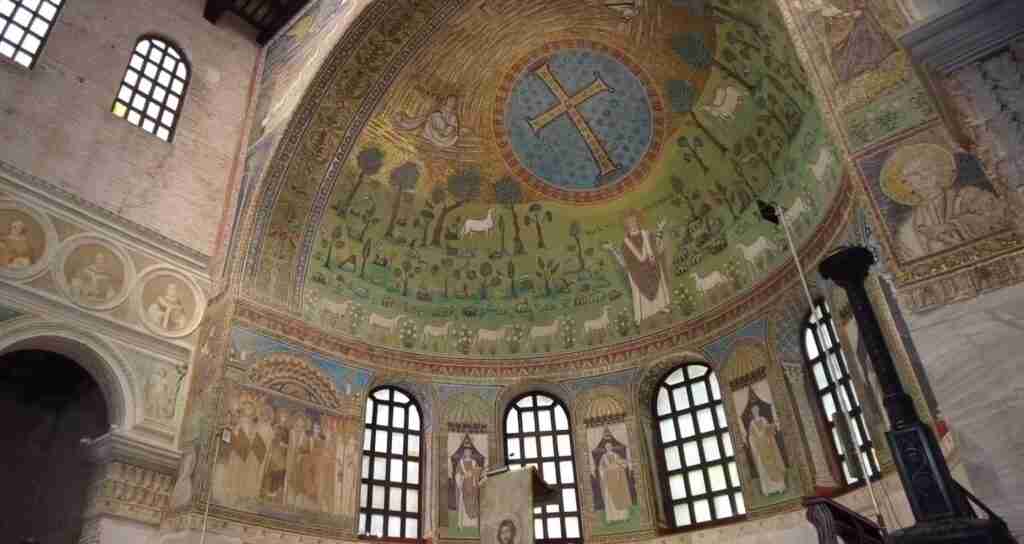
The Basilica of Sant’Apollinare in Classe, consecrated in 549 AD, represents the culmination of Ravenna’s Byzantine artistic achievement. Located near the ancient port, this imposing structure features mosaic programs that combine sophisticated theological symbolism with spectacular visual beauty. The apse mosaics, with their emerald meadows, stylized trees, and gemmed cross, create one of the most spiritually evocative environments in all of Christian art.
Byzantine control of Ravenna continued until 751 AD, when the city fell to the Lombards, ending its role as an imperial capital. However, the artistic legacy created during these three centuries of continuous patronage had already ensured Ravenna’s permanent significance in European cultural history.
Mausoleum of Galla Placidia: The Starry Vault
The Mausoleum of Galla Placidia, constructed around 425 AD, represents the oldest mosaic ensemble in Ravenna and arguably the most artistically refined. This small cruciform building, measuring only 12.75 by 10.25 meters, was commissioned by Galla Placidia either as a chapel dedicated to Saint Lawrence or as a dynastic mausoleum, though historical evidence indicates she was actually buried in Rome rather than Ravenna. Despite or perhaps because of its modest dimensions, the mausoleum contains some of the most exquisite mosaics ever created, with every interior surface except the floor covered in intricate decoration.
Architectural Design and Structure
The building follows a Greek cross plan with barrel-vaulted arms and a central dome, representing a transitional architectural form between Roman and Byzantine traditions. The exterior, constructed of plain brick with blind arcades, gives little indication of the artistic treasures within. Narrow alabaster windows admit limited natural light, creating an atmosphere of mystery and reverence. The thick walls support the vaulted ceiling structure that provides the canvas for the mosaic program.
The Celestial Vault
The most celebrated feature of the Mausoleum of Galla Placidia is its central dome mosaic depicting a deep blue night sky filled with golden stars radiating from a central golden cross. This composition, executed against a background of lapis lazuli blue that has retained its intensity for fifteen centuries, creates an illusion of infinite cosmic space. The approximately 800 eight-pointed stars arranged in concentric circles around the central cross produce a mesmerizing effect, suggesting both the vault of heaven and the cosmic significance of Christ’s sacrifice. The gold tesserae catch and reflect the dim light filtering through alabaster windows, making the stars appear to twinkle as they would in an actual night sky.
This starry vault represents one of the oldest and most beautiful night sky depictions in Western art. The choice of celestial imagery reflects Early Christian symbolism that associated heaven with spiritual perfection and eternal life, appropriate themes for a funerary or commemorative structure. The technical execution demonstrates remarkable sophistication, with each star individually composed of gold tesserae set at varying angles to maximize light reflection.
Lunette Mosaics
The four lunettes above the building’s arms contain narrative mosaic panels of exceptional quality. The most famous depicts Saint Lawrence approaching a flaming grill—the instrument of his martyrdom—while carrying a cross and an open book displaying the text of the Gospels. This scene, rendered with naturalistic detail including spatial depth and modeling, demonstrates the persistence of classical Roman artistic techniques in early Christian art. Lawrence’s white tunic flows naturally, and his face shows individualized features rather than the stylized masks that would characterize later Byzantine work.
The opposite lunette shows a cabinet containing the four Gospels, represented as bound codices with jeweled covers. This image emphasizes the importance of scripture in early Christianity and showcases the mosaicists’ ability to render three-dimensional objects convincingly. The other lunettes depict paired white doves drinking from fountains, symbolizing souls seeking spiritual refreshment, set against rich blue backgrounds with golden acanthus scrolls.
Barrel Vault Decorations
The barrel vaults covering each arm of the cruciform structure display geometric and naturalistic patterns of astonishing intricacy. Acanthus scrolls in gold against deep blue backgrounds create flowing organic designs, while geometric patterns of circles, lozenges, and stylized flowers demonstrate the mosaicists’ mastery of abstract decoration. These ornamental programs draw heavily on Roman decorative traditions but deploy them in service of Christian symbolism, with every motif carrying theological significance.
Apostle Figures
The upper registers of the lunettes feature standing figures of apostles in white robes against golden backgrounds. These figures, though less naturalistic than the Lawrence panel, display careful attention to drapery, gesture, and individual characterization. Each apostle holds a book or scroll, emphasizing their role as witnesses to and transmitters of Christian teaching. The combination of white figures against gold creates luminous effects as light conditions change throughout the day.
Artistic Significance and Influence
The Mausoleum of Galla Placidia occupies a crucial position in the development of Christian mosaic art, demonstrating the transition from classical Roman naturalism toward the more symbolic, non-naturalistic style that would dominate Byzantine art. The coexistence of naturalistic figures (Lawrence, the apostles) with abstract patterns and symbolic imagery (the starry vault, the geometric decorations) shows artists working at the intersection of two traditions, drawing on classical techniques while developing a distinctly Christian visual language.
The building’s influence extended far beyond Ravenna. The starry vault motif appeared in countless later churches and baptisteries across Europe, while the overall approach to integrating mosaics with architectural space became a model for Early Christian and Byzantine designers. The technical excellence and aesthetic refinement achieved in this small structure set standards that subsequent mosaic programs sought to match or exceed.
Visiting the Mausoleum of Galla Placidia remains one of the most profound aesthetic experiences available anywhere. The transition from bright exterior daylight into the dim, blue-and-gold interior creates an immediate sense of entering another realm. As eyes adjust to the low light, the stars begin to emerge from the vaulted darkness, the golden tesserae catching and reflecting the minimal illumination to create an otherworldly atmosphere that has moved visitors for fifteen centuries. The building’s intimate scale enhances this effect, enveloping viewers in the mosaic environment rather than presenting it from a distance.
Neonian Baptistery: Orthodox Christian Architecture
The Neonian Baptistery, also known as the Orthodox Baptistery, represents the finest and most complete surviving example of an Early Christian baptistery anywhere in the world. Constructed in the early 5th century and extensively decorated with mosaics under Bishop Neon around 458 AD, this octagonal structure demonstrates the sophisticated integration of architecture, mosaics, and liturgical function that characterized Ravenna’s religious buildings. Unlike most ancient baptisteries that have been destroyed, heavily modified, or stripped of their decorations, the Neonian Baptistery preserves its original form and much of its decorative program intact.
Architectural Form and Liturgical Function
The baptistery follows an octagonal plan with a diameter of approximately 13.5 meters, a form rich with Christian symbolism. The number eight represented rebirth and resurrection in early Christian numerology, as Christ rose on the eighth day (the day after the seventh day of the week), making the octagon the ideal geometric form for baptisteries where believers underwent spiritual rebirth. Four semicircular apses protrude from alternate sides of the octagon, creating a cross-axial pattern that further emphasizes Christian symbolism.
The central space originally contained a large octagonal baptismal font where adult converts received full immersion baptism—the standard practice in the early Church before infant baptism became common. The floor level has risen approximately two meters since construction due to sediment accumulation, so the original spatial proportions and the relationship between the font and the surrounding architecture have been altered. Despite this change, the building’s essential character as a liturgical space designed for the baptismal rite remains evident.
The Dome Mosaic Program
The baptistery’s dome contains one of the most important iconographic programs in Early Christian art, arranged in three concentric registers that descend from the apex to the base. At the very center of the dome, a medallion depicts the Baptism of Christ in the Jordan River, with John the Baptist shown in the act of baptizing while a personification of the Jordan River, rendered as a semi-nude figure with flowing green drapery, observes from the right. This central scene establishes the baptistery’s liturgical purpose while providing the theological model for all Christian baptism.
The first register surrounding the Baptism medallion features the twelve apostles arranged in a circular procession. These figures, dressed in white robes and set against a gold background, move in a clockwise direction around the dome. Each apostle is individualized through facial features, gesture, and attributes, with Saints Peter and Paul occupying positions of prominence. The apostles carry crowns, symbolizing their role as witnesses to Christ and future recipients of heavenly glory. This apostolic circle visually reinforces the connection between baptism and entry into the community of believers that the apostles represent.
The second register presents eight architectural structures alternating with eight thrones, creating a complex symbolic program. The buildings represent heavenly Jerusalem, the ultimate destination of the baptized soul, while the thrones symbolize divine judgment and authority. Between these structures, elaborate candelabra and altars covered with Gospel books emphasize the liturgical and scriptural foundations of Christian faith. The gold backgrounds and rich colors create a heavenly atmosphere appropriate to the themes of salvation and eternal life.
The lowest register, at the spring of the dome, features elaborate architectural perspectives depicting niches, columns, and hanging curtains in a style derived from Roman wall painting. These elements create an illusion of three-dimensional space and demonstrate the persistence of classical artistic techniques even as Christian iconography was developing its distinct vocabulary.
Lower Wall Decorations
Beneath the dome, the baptistery’s walls display a combination of mosaic decoration, stucco work, and inlaid marble that creates one of the richest ensembles of Early Christian ornament. The stucco reliefs, particularly the figures of prophets standing in niches, show remarkable sculptural quality and classical influence. These three-dimensional elements interact with the flat mosaic surfaces above, creating varied visual textures and depths.
The marble inlay work includes intricate geometric patterns and floral motifs executed with colored marble from across the Mediterranean world. Purple porphyry from Egypt, green serpentine from Greece, and yellow marble from Tunisia demonstrate the resources available to Ravenna’s builders and the city’s connections to the broader Roman world. These precious materials complemented the gold and glass tesserae of the mosaics, creating an environment of extraordinary visual richness.
Artistic and Historical Significance
The Neonian Baptistery represents a crucial moment in the development of Christian architecture and decoration, demonstrating how classical Roman forms and techniques were adapted to serve Christian liturgical and theological purposes. The sophisticated iconographic program articulates complex theological concepts about baptism, salvation, and the Church through visual means accessible to both literate and illiterate believers. The integration of architecture, mosaic, stucco, and marble into a coherent artistic whole established models that influenced baptistery design throughout the medieval period.
The building also provides valuable evidence for the practice of adult baptism in the early Church and the elaborate rituals associated with this sacrament. The architectural arrangements, including the central font and the surrounding space for clergy and candidates, reconstruct the liturgical choreography of baptismal ceremonies that represented one of the most important moments in a Christian’s spiritual life.
Comparison with the later Arian Baptistery, constructed under Theodoric for his Arian followers, reveals both the shared artistic language of Ravenna’s craftsmen and the subtle iconographic differences that distinguished Orthodox and Arian theological perspectives. This comparison makes the Neonian Baptistery essential for understanding the religious divisions and artistic expressions that characterized 5th and 6th-century Christianity.
Basilica of Sant’Apollinare Nuovo: The Procession Mosaics
The Basilica of Sant’Apollinare Nuovo contains the most extensive narrative mosaic cycle in Ravenna, with 26 scenes from the life of Christ arranged along the upper walls of the nave. Originally built around 500 AD by Theodoric the Great as his palace chapel and dedicated to Christ the Redeemer, the basilica underwent significant modifications following the Byzantine reconquest, including changes to its mosaic program that reflect the political and religious transformations of 6th-century Italy.
Architectural Structure
The basilica follows a traditional three-aisled basilica plan with a length of approximately 42 meters, making it one of Ravenna’s larger churches. Twenty-four marble columns with Byzantine basket capitals support the nave arcade, creating a rhythmic progression toward the apse. The cylindrical campanile (bell tower), added in the 9th or 10th century, rises 38 meters and has become one of Ravenna’s most recognizable landmarks. The exterior, though modified over centuries, retains the essential form of a Late Antique basilica with its simple brick walls and high clerestory windows.
The Upper Mosaic Registers: Gospel Cycles
The upper walls of the nave preserve 26 mosaic panels depicting scenes from Christ’s life and passion, divided between the north wall (life and miracles) and the south wall (passion and resurrection). These panels, dating from Theodoric’s original commission around 500 AD, represent some of the most important surviving examples of early Gospel illustration in mosaic form. Each scene is framed as a separate panel set against a gold background, creating a visual narrative that unfolds as worshippers process down the nave toward the altar.
The north wall panels include the Last Supper, Christ and the Samaritan Woman, the Calling of Peter and Andrew, the Healing of the Paralytic, the Raising of Lazarus, and Christ Separating the Sheep from the Goats. These scenes emphasize Christ’s ministry, his miraculous powers, and his teachings about salvation and judgment. The south wall focuses on the Passion, including the Betrayal of Judas, Christ Before Pilate, the Road to Calvary (though the Crucifixion itself is not shown), and the Resurrection appearances. The absence of a Crucifixion scene reflects early Christian reluctance to depict Christ’s suffering, a hesitation that would gradually disappear in later medieval art.
These Gospel scenes demonstrate a transitional artistic style between Roman naturalism and Byzantine abstraction. Architectural backgrounds show attempts at spatial perspective inherited from Roman painting, with buildings arranged to suggest three-dimensional space. However, the figures themselves display increasingly hieratic, frontal presentations characteristic of Byzantine art. The gold backgrounds eliminate naturalistic landscape settings, focusing attention on the sacred figures and events. This stylistic mixture provides valuable evidence for understanding how Christian art evolved during the crucial 5th and 6th centuries.
The Procession Mosaics
The most visually striking feature of Sant’Apollinare Nuovo is the procession mosaics on the lower register of the nave walls, created after the Byzantine reconquest around 560 AD. These mosaics depict two monumental processions moving toward the apse from opposite directions: 22 virgin martyrs advancing from the port of Classis toward an enthroned Virgin Mary and Christ child on the north wall, and 26 male martyrs and saints processing from Theodoric’s palace toward an enthroned Christ on the south wall.
The female martyrs, led by the Three Magi offering gifts to the infant Christ, wear rich garments with jeweled decorations and golden halos, creating a rhythmic pattern of white, gold, and colored robes against the gold background. Each figure is labeled with her name—Agatha, Agnes, Cecilia, Lucy, and others—making this one of the most important visual records of early Christian martyrs. The procession creates a sense of movement and purpose, with the figures’ identical gestures and frontal presentation producing a hypnotic visual rhythm that extends the length of the 36-meter nave.
The male martyrs and saints, led by Saint Martin of Tours (to whom the basilica was rededicated after the Byzantine conquest), display similar visual characteristics. These figures include both martyrs who died for their faith and confessors who witnessed to Christianity through their lives. The procession terminates at a representation of Christ enthroned in majesty, flanked by four angels in blue garments who create a heavenly court.
The Palatial Mosaics and Historical Modifications
The procession mosaics contain fascinating evidence of historical modification. At the western end of both processions, architectural representations depict the port of Classis and Theodoric’s palace in Ravenna. Close examination reveals that figures originally depicted in these architectural settings were removed and replaced with curtains during the Byzantine period. Historical accounts and visual analysis indicate that these deleted figures represented Theodoric himself and members of his Ostrogothic court. The Byzantines literally erased the Ostrogothic rulers from the visual record, replacing them with neutral decorative elements while preserving the overall architectural context.
This deliberate modification demonstrates how art served political purposes in Late Antiquity, with new rulers rewriting visual narratives to establish their own legitimacy while eliminating references to predecessors they considered illegitimate. Yet the technical quality of both the original Ostrogothic mosaics and the Byzantine replacements remained consistently high, showing that artistic excellence transcended political changes.
The Apse and Additional Decorations
The current apse decoration dates from later periods and does not preserve the original 6th-century mosaics, which were destroyed or damaged over centuries. However, other decorative elements throughout the basilica demonstrate the continuing development of mosaic art. The triangular spandrels above the nave arcade contain individual figures of saints and prophets, while ornamental bands feature geometric and vegetal patterns that showcase the decorative versatility of the mosaic medium.
The basilica’s extensive mosaic program, totaling more than 1,000 square meters of decorated surface, represents one of the largest mosaic ensembles in the Christian world. The combination of narrative Gospel scenes, monumental processions, individual saints, and ornamental patterns creates a comprehensive visual catechism that educated believers about Christian doctrine, history, and the communion of saints while creating an environment of transcendent beauty appropriate for divine worship.
Arian Baptistery: Theological Perspectives in Mosaic
The Arian Baptistery, constructed in the late 5th or early 6th century under the patronage of Theodoric the Great, provides unique evidence of Arian Christian art and the religious pluralism that characterized Ostrogothic Ravenna. Built to serve the city’s Arian Christian population—including Theodoric and his Gothic court—this octagonal structure closely resembles the earlier Neonian Baptistery in form and function but displays iconographic differences that reflect distinct theological perspectives.
Historical and Religious Context
Arianism, a Christian doctrine named after the theologian Arius (256-336 AD), taught that Christ was created by God the Father and was therefore subordinate to Him rather than co-equal and co-eternal as Orthodox Christianity maintained. Though condemned as heresy at the Council of Nicaea in 325 AD, Arianism persisted among various Germanic peoples, including the Goths who ruled Italy under Theodoric. The construction of a separate Arian baptistery reflects both Theodoric’s commitment to his religious beliefs and his policy of tolerance that allowed Orthodox and Arian Christians to practice their faiths in separate but parallel institutions.
Architectural Form
Like the Neonian Baptistery, the Arian Baptistery follows an octagonal plan approximately 15 meters in diameter, with the number eight symbolizing rebirth through baptism. The building’s simpler architectural treatment compared to its Orthodox counterpart may reflect the Arian community’s theological emphasis on divine transcendence over elaborate material decoration, though it also could result from more limited resources. The structure underwent significant modifications in the 6th century following the Byzantine reconquest, when it was converted from Arian to Orthodox use and rededicated to the Virgin Mary.
The Dome Mosaic: Baptism of Christ
The baptistery’s sole surviving mosaic program occupies the dome and depicts the Baptism of Christ in the Jordan River, surrounded by the twelve apostles. This central scene closely resembles the Neonian Baptistery’s composition but contains a distinctive iconographic element: Christ is shown completely nude while being baptized, with only the water level providing modest coverage. This unusual representation reflects Arian theological emphasis on Christ’s full humanity—his real physical body and genuine human experience—in contrast to Orthodox tendencies to spiritualize and abstract Christ’s human nature.
The Jordan River is personified as a semi-nude masculine figure carrying a reed and a cloth, a motif derived from classical representations of river gods. This pagan iconographic element, reinterpreted within Christian context, appears in various Ravenna baptisteries and demonstrates the ongoing influence of Greco-Roman artistic traditions on Early Christian art.
John the Baptist stands to Christ’s left, his right hand extended over Christ’s head in the baptismal gesture. A dove representing the Holy Spirit descends from above, completing the trinitarian symbolism of the scene while also illustrating the Gospel accounts of Christ’s baptism. The careful attention to anatomical detail and the naturalistic rendering of the human figures demonstrate the persistence of classical artistic standards even in service of specifically Christian theological messages.
The Apostolic Circle
Surrounding the central Baptism scene, the twelve apostles are arranged in a circular procession similar to the Neonian Baptistery’s program. Each apostle wears a white tunic and carries a crown, symbolizing their witness to Christ and their future heavenly reward. The figures are set against a gold background divided into twelve sections by stylized palm trees, creating a rhythmic visual pattern. The apostles display varying poses and gestures, with some degree of individual characterization in their facial features, though less pronounced than in earlier, more classicizing works.
The iconographic program, while similar in general outline to Orthodox baptistery decorations, emphasizes elements consistent with Arian theology. The clear distinction between Christ (shown as subordinate to the Father through his human baptism) and the divine authority represented by the descending dove reflects Arian insistence on Christ’s created nature and subordinate status within the Trinity.
Comparative Significance
The Arian Baptistery’s greatest historical significance lies in its value for comparative study. By juxtaposing this structure with the Neonian Baptistery—both serving the same liturgical function within the same city but for different Christian communities—scholars can identify the subtle ways that theological differences manifested in visual programs. While the overall iconographic schemes remain remarkably similar, demonstrating a shared Christian artistic language, specific details reflect the distinct emphases of Arian versus Orthodox belief.
The baptistery also provides rare evidence for Arian Christianity’s material culture. Most Arian monuments were destroyed, converted, or heavily modified following the condemnation of Arianism and the religion’s eventual disappearance. Ravenna’s Arian Baptistery is one of the few structures preserving elements of Arian artistic patronage, making it an invaluable document for religious history.
The later conversion of the building to Orthodox use and its rededication to the Virgin Mary demonstrate the practical reuse of sacred spaces following religious and political changes. That the Baptism mosaic survived this conversion suggests either Byzantine appreciation for its artistic quality or the practical difficulty of replacing dome mosaics, though it’s also possible that the iconographic program, despite Arian origins, proved acceptable to Orthodox sensibilities.
Archiepiscopal Chapel: Private Oratory Splendor
The Archiepiscopal Chapel, also known as the Chapel of Sant’Andrea, represents the only surviving example of an early Christian private oratory and the smallest of Ravenna’s UNESCO monuments. Constructed in the early 6th century as a private chapel for Ravenna’s Orthodox archbishops, this intimate space demonstrates how the mosaic art developed for large public churches could be adapted to create equally effective decoration in diminutive settings.
Architectural Character and Location
The chapel occupies the upper floor of the Archbishop’s Palace, accessed via a narrow staircase that emphasizes its exclusive, private nature. The building follows a Greek cross plan with a barrel-vaulted ceiling, measuring approximately 10 by 4 meters in its main chamber. This modest scale creates an intimate atmosphere vastly different from the spacious basilicas elsewhere in Ravenna, offering bishops a personal space for private prayer and contemplation away from public liturgical duties.
The chapel’s location within the palace complex reflects the close integration of religious and administrative functions in Late Antique ecclesiastical government. Bishops wielded significant political as well as spiritual authority, and their private chapels served as sanctuaries where they could seek divine guidance for the complex decisions facing church leaders during this turbulent period.
The Entrance Vestibule
Visitors first encounter a small vestibule whose mosaic program establishes the chapel’s theological themes. The vault displays a medallion of Christ depicted as a warrior-savior, trampling a lion and serpent—symbolic representations of evil—while carrying a cross over his shoulder like a military standard. This unusual martial representation of Christ, known as Christ the Warrior or Christ Triumphant, reflects the militarized Christianity of Late Antiquity when the Church saw itself engaged in cosmic battle against demonic forces.
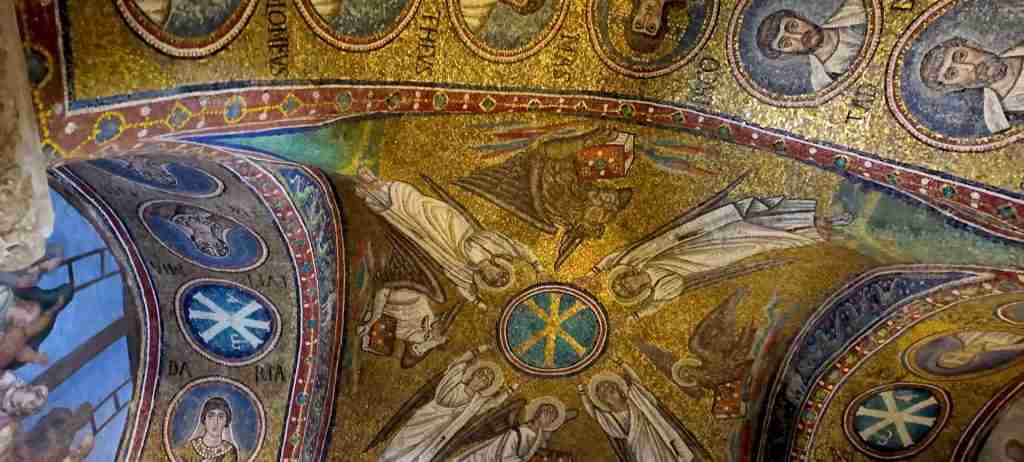
The inscription accompanying this image, taken from Psalm 91:13 (“You will tread on the lion and the cobra; you will trample the great lion and the serpent”), makes explicit the triumph-over-evil theme. The four symbols of the evangelists—the winged man (Matthew), lion (Mark), ox (Luke), and eagle (John)—occupy the corners of the vault, establishing the Gospel foundation for Christian victory over sin and death.
The Main Chapel Mosaics
The main chamber’s mosaic program focuses on the theme of Christian martyrdom and spiritual warfare, appropriate for a private oratory where bishops contemplated the responsibilities and dangers of their office. The barrel vault displays a rich field of golden stars and medallions containing birds against a deep blue background, creating a celestial atmosphere similar to the Mausoleum of Galla Placidia but with more elaborate geometric organization.
The lunette above the altar presents a remarkable image: a youthful, beardless Christ stands frontally, dressed in military armor including a cuirass and purple cloak, holding a cross in his right hand while trampling symbolic beasts with his feet. This militaristic Christ representation, rare in early Christian art, reflects both the martial imagery found in certain biblical texts and the historical context of a Church defining its identity through struggle against paganism, heresy, and political opposition.
The side walls feature standing figures of saints in white robes set within architectural niches. These figures, including martyrs like Saint Lawrence and military saints like Saint Sebastian, provide models of Christian courage and fidelity. The architectural framing creates the illusion of a colonnade opening onto a heavenly court populated by the communion of saints, a visual device that expands the chapel’s actual dimensions through artistic illusion.
Decorative Programs and Symbolic Elements
The chapel’s decorative richness extends to every surface. Acanthus scrolls, geometric patterns, and stylized birds and flowers create intricate borders and frames for the figural scenes. The extensive use of gold tesserae produces a luminous atmosphere enhanced by the limited natural light entering through small windows, making the chapel glow with reflected golden light.
Particular attention was devoted to the decorative treatment of the architectural elements. Column capitals, arch soffits, and wall surfaces received elaborate mosaic covering that transforms structural components into elements of the overall artistic program. This total integration of architecture and decoration creates a unified aesthetic environment where every element contributes to the spiritual atmosphere.
Historical and Artistic Significance
The Archiepiscopal Chapel represents a crucial link in understanding how mosaic art functioned across different scales and contexts. While the great basilicas used mosaics to create public statements visible to entire congregations, this private oratory demonstrates the medium’s effectiveness in intimate settings designed for individual contemplation. The theological themes—Christ’s triumph over evil, the witness of the martyrs, the promise of heavenly reward—remained constant across both public and private contexts, but the artistic execution adapted to the specific spatial and functional requirements of each setting.
The chapel also provides valuable evidence for the personal piety and theological concerns of Ravenna’s bishops during the crucial 6th century. The emphasis on militant Christianity, spiritual warfare, and martyrdom reflects the challenges facing church leaders who navigated complex political situations while defending Orthodox doctrine against Arian alternatives and maintaining ecclesiastical authority in the face of secular power.
As the only private oratory from this period to survive with its mosaic decoration intact, the Archiepiscopal Chapel offers irreplaceable insight into how elite Christians of Late Antiquity created sacred spaces for personal devotion. The sophistication of its artistic program, despite its small scale, demonstrates that the same artistic resources and theological sophistication deployed in public monuments were also available for private commissions, creating jewel-like spaces of extraordinary beauty and spiritual power.
Mausoleum of Theodoric: Architectural Monument Without Mosaics
The Mausoleum of Theodoric stands as the sole UNESCO monument in Ravenna without mosaic decoration, yet its inclusion in the World Heritage ensemble reflects its unique architectural and historical significance. Constructed around 520 AD as the tomb of Theodoric the Great, this massive stone structure represents the only surviving example of a barbarian king’s tomb from the early medieval period and demonstrates architectural principles entirely different from the other Ravenna monuments.
Historical Context and Patronage
Theodoric commissioned his mausoleum toward the end of his reign as king of the Ostrogoths and ruler of Italy. Unlike the other monuments he patronized in Ravenna—basilicas and baptisteries built in Roman and Byzantine styles using brick and decorated with mosaics—Theodoric chose to create his tomb in a style that reflected his Gothic heritage. This decision to build a monument distinctly different from Roman architectural traditions demonstrates Theodoric’s complex cultural identity: a Germanic king who ruled Roman territory, an Arian Christian governing Orthodox subjects, a warrior raised in Constantinople who understood both Roman and Gothic cultural values.
Architectural Design and Construction
The mausoleum consists of two decagonal (ten-sided) levels constructed from massive blocks of Istrian limestone quarried from the region across the Adriatic Sea in modern Croatia. The lower level, approximately 15 meters in diameter, contains a cruciform chamber that may have served liturgical or ceremonial purposes. The upper level houses the burial chamber where Theodoric’s porphyry sarcophagus was placed, accessed via an external staircase (the original access arrangements remain uncertain).
The building’s most remarkable feature is its monolithic stone roof—a single circular capstone carved from a single block of Istrian limestone measuring 11 meters in diameter and over one meter thick, with an estimated weight of 230 tons. How this massive stone was transported from Istria to Ravenna and then lifted into place atop the mausoleum remains one of architecture history’s enduring mysteries. The roof features twelve stone lugs or handles projecting from its edge, each inscribed with a name (possibly of apostles or workers involved in construction), though their practical function remains debated.
The construction technique, using ashlar masonry (carefully cut and fitted stone blocks) rather than the brick and concrete typical of Roman building, represents Germanic or northern European building traditions unfamiliar in Italy. The precision of the stonework demonstrates sophisticated engineering knowledge, with blocks fitted so tightly that mortar proved unnecessary for many joints. This technical mastery suggests Theodoric employed craftsmen familiar with stone construction traditions from regions beyond the Mediterranean.
Architectural Form and Symbolism
The mausoleum’s decagonal plan has generated scholarly debate about its symbolic significance. While eight-sided structures (like baptisteries) carried clear Christian symbolism related to resurrection, the meaning of ten sides remains less certain. Possible interpretations include references to the Ten Commandments, decimal perfection in classical numerology, or simply aesthetic preference. The two-level structure may represent the earthly and heavenly realms, with the lower level belonging to the temporal world and the upper burial chamber existing as a liminal space between earth and heaven.
The building’s exterior originally featured architectural decoration now largely eroded or lost. Blind arcades articulated the walls, and the stone lugs on the roof created a distinctive crown-like silhouette. The structure sat within a larger complex that included a church and other buildings, none of which survive, making the mausoleum’s original architectural context difficult to reconstruct.
Interior Spaces
The lower level’s cruciform chamber features simple but effective architectural design with cross-vaulted ceilings and thick walls pierced by narrow windows. The austerity of this space contrasts dramatically with the mosaic-encrusted interiors of Ravenna’s other monuments, reflecting either different aesthetic preferences, distinct cultural traditions, or the specific funerary function of the building.
The upper burial chamber, accessed via the external staircase, contains a large porphyry sarcophagus that once held Theodoric’s body. The use of porphyry, a purple stone associated with imperial authority in Roman tradition, demonstrates Theodoric’s claims to legitimate rulership and his adoption of Roman imperial symbolism. The chamber’s circular form creates a centralized space appropriate for a royal tomb, with the sarcophagus occupying the position of honor at the center.
Post-Theodoric History
Following Theodoric’s death in 526 AD and the Byzantine reconquest of Ravenna, the mausoleum’s fate reflected the political and religious transformations of the era. Byzantine authorities removed Theodoric’s remains from the sarcophagus—their final disposition remains unknown—and converted the building to Orthodox Christian use, dedicating it to Mary. This conversion involved minimal physical alteration, as the building’s lack of Arian iconography made it easily adaptable to Orthodox purposes.
Over subsequent centuries, the mausoleum’s isolated location outside Ravenna’s city center protected it from urban development that threatened other ancient monuments. However, this isolation also left it vulnerable to neglect and deterioration. The building has undergone several restoration campaigns, most recently in the 20th century, to stabilize its structure and preserve it for future generations.
Architectural and Historical Significance
The Mausoleum of Theodoric represents a unique fusion of cultural traditions: a Germanic king’s tomb built with northern European construction techniques but incorporating Roman imperial symbolism and Christian religious elements. No comparable structure survives from this period, making it an irreplaceable document for understanding the complex cultural exchanges that characterized the transition from antiquity to the medieval period.
The building’s inclusion in Ravenna’s UNESCO ensemble, despite lacking the mosaic decoration that distinguishes the other monuments, recognizes that cultural heritage encompasses diverse forms of artistic and architectural achievement. The mausoleum demonstrates that Ravenna’s significance extends beyond Byzantine mosaic art to include the broader political and cultural transformations that shaped early medieval Europe.
Basilica of San Vitale: Byzantine Artistic Triumph
The Basilica of San Vitale represents the supreme achievement of Byzantine architecture and mosaic art in the West, combining architectural innovation with the most extensive and sophisticated mosaic program in Ravenna. Consecrated in 548 AD after 16 years of construction, San Vitale demonstrates how Byzantine artistic vision could be realized on Italian soil, creating a building that ranks among the finest examples of early Christian architecture anywhere in the world.
Architectural Innovation
San Vitale’s architectural design departs dramatically from the traditional basilica plan used for most Ravenna churches, instead employing a centralized octagonal plan covered by a soaring dome. The building measures approximately 35 meters from the entrance to the apse and reaches 48 meters at the dome’s apex, creating impressive interior volumes. The octagonal core is surrounded by an ambulatory (ring-shaped aisle) and an upper gallery, with eight massive piers supporting the dome via arches and pendentives.
This architectural form derives from Eastern Mediterranean and specifically Constantinopolitan models, particularly the earlier Church of Saints Sergius and Bacchus (built 527-536 AD) in Constantinople. However, San Vitale demonstrates significant variations and innovations, including its spatial organization, the relationship between central space and ambulatory, and the integration of the apse into the overall composition. The building represents not mere copying of Byzantine precedents but rather creative adaptation of Eastern architectural principles to Western contexts and preferences.
The dome construction employs hollow terracotta tubes arranged in concentric rings and embedded in mortar, a technique that reduces weight while maintaining structural integrity. This sophisticated engineering allowed for a lightweight dome that exerts minimal lateral thrust on the supporting piers, eliminating the need for massive buttressing that would compromise the building’s elegant proportions. The dome’s interior surface provides an expansive canvas for mosaic decoration, though the current painted decoration dates from much later periods.
The Apse Mosaic Program: Theological Vision
The apse contains the basilica’s most important mosaic program, arranged in multiple registers that ascend from the altar toward the semi-dome. At the apex of the apse semi-dome, Christ appears as a beardless youth seated on a blue globe representing the cosmos, holding a scroll sealed with seven seals (referencing the Book of Revelation) in his left hand while extending his right hand to offer a martyr’s crown to San Vitale, the church’s patron saint. Two angels flank Christ, while San Vitale approaches from the left and Bishop Ecclesius (who initiated the church’s construction) approaches from the right, carrying a model of the building he founded.
This composition establishes complex theological and political messages. Christ’s cosmic throne demonstrates his universal sovereignty, while the seven-sealed scroll references apocalyptic prophecy and divine revelation. The presentation of the crown to Vitale celebrates martyrdom as the ultimate Christian witness, while Ecclesius’s offering of the church model represents the human response to divine grace through the building of sacred spaces. The youthful, beardless Christ reflects early Christian artistic traditions that emphasized Christ’s eternal nature rather than his historical incarnation.
The lower register of the apse contains mosaic panels depicting the hospitality of Abraham and the sacrifice of Isaac on one side, and the offerings of Abel and Melchizedek on the other. These Old Testament scenes, selected for their prefiguration of Christian sacraments (particularly the Eucharist), demonstrate the typological reading of scripture that characterized early Christian theology. Abraham’s three angelic visitors prefigure the Trinity, while Melchizedek’s offering of bread and wine anticipates the Eucharistic sacrifice. The hand of God emerging from clouds to prevent Abraham’s sacrifice of Isaac shows divine intervention and mercy.
The Imperial Panels: Justinian and Theodora
The basilica’s most famous mosaics occupy the side walls of the apse and depict Emperor Justinian I and Empress Theodora with their respective courts. These panels, created around 547 AD, represent masterpieces of Byzantine political art that combine religious symbolism with imperial propaganda to create some of the most iconic images in all of medieval art.
The Justinian panel shows the emperor at the center of a solemn procession, wearing the purple imperial robes and a jeweled crown while carrying a golden paten (communion plate) as his offering. To his right stand clergy including Archbishop Maximian (identified by inscription), a deacon carrying a jeweled Gospel book, and other ecclesiastics. To Justinian’s left appear court officials and members of the imperial guard, identified by their military insignia and shields marked with the Chi-Rho christogram.
The composition employs strict hierarchical arrangement: Justinian occupies the central position, his head aligned with the central axis and overlapping those of figures behind him to emphasize his supremacy. All figures stand frontally against a gold background, their bodies flattened into abstract patterns of color and line with minimal naturalistic modeling. The rich fabrics, jeweled decorations, and imperial insignia demonstrate the material splendor of Byzantine court ceremony while also serving symbolic functions.
The Theodora panel across the apse presents a similar composition with the empress at the center, wearing elaborate jewelry and an ornate crown while carrying a golden chalice as her offering. Her retinue includes court ladies in sumptuous garments and eunuch officials. The panel includes a remarkable architectural detail: an opening in the wall reveals an interior space with a fountain, suggesting the spatial setting as the palace atrium from which the imperial party departs for the church. The hem of Theodora’s purple robe displays an embroidered scene showing the Three Magi presenting gifts to the infant Christ, creating a visual parallel between the Magi’s offerings and Theodora’s own gift.
These imperial panels serve multiple functions beyond mere portraiture. They assert Justinian and Theodora’s religious authority by depicting them participating directly in liturgical ritual, a privilege reserved for those who claimed both temporal and spiritual legitimacy. The panels were created during or shortly after Justinian’s reconquest of Italy from the Ostrogoths, making them powerful statements of Byzantine authority over Ravenna and Italy. Significantly, neither Justinian nor Theodora ever actually visited Ravenna, making these mosaic representations their only “presence” in the city they ruled from afar.
Additional Mosaic Programs
Beyond the apse, San Vitale contains extensive mosaic decoration throughout its interior spaces. The intrados of the great arches features elaborate patterns of flowers, fruits, animals, and birds rendered in brilliant colors against gold backgrounds. These decorative programs draw on classical ornamental traditions while investing each element with Christian symbolic meaning: grape vines reference the Eucharistic wine, peacocks symbolize immortality, and doves represent the Holy Spirit or faithful souls.
The capitals of the columns and piers display intricate carved decoration combining acanthus leaves with Christian symbols, demonstrating the integration of sculptural and mosaic arts. The marble revetment (wall facing) includes panels of precious colored stones from across the Mediterranean, creating a sumptuous material environment that complements the mosaics.
The lunettes flanking the apse contain mosaic depictions of the Four Evangelists’ symbols and various prophets, while the spandrels of the arches feature angels holding medallions with the cross. This comprehensive decorative program transforms the entire architectural space into a theological statement, with every surface contributing to an overall vision of divine authority, imperial power, and Christian redemption.
Artistic and Historical Significance
San Vitale represents the fullest realization of Byzantine artistic principles in Western architecture. The building demonstrates how Byzantine architects and artists could adapt their traditions to create structures that responded to local conditions while maintaining essential characteristics of Eastern design. The mosaic programs showcase the mature Byzantine style with its emphasis on frontal presentation, hierarchical composition, extensive gold backgrounds, and integration of imperial and religious imagery.
The technical execution of San Vitale’s mosaics demonstrates the highest level of craftsmanship, with millions of tesserae arranged to create subtle color gradations, intricate patterns, and luminous surfaces. The deliberate setting of tesserae at varying angles produces the characteristic shimmering effect of Byzantine mosaics, making images appear to move and change as viewers shift position or as light conditions vary throughout the day.
The building influenced subsequent architecture throughout medieval Europe and beyond. Its centralized plan, dome construction, and decorative integration provided models that architects consulted for centuries. Most famously, Charlemagne ordered his palace chapel at Aachen (built around 800 AD) to be modeled directly on San Vitale, with craftsmen studying the Ravenna building to reproduce its essential features in Francia. This influence extended Byzantine architectural and artistic principles far beyond their original geographic and cultural contexts.
Basilica of Sant’Apollinare in Classe: The Final Masterpiece
The Basilica of Sant’Apollinare in Classe represents the culmination of Ravenna’s artistic achievements and the last of the great Early Christian monuments constructed in the city. Consecrated in 549 AD, this imposing structure combines traditional basilica architecture with mosaic programs that achieve new levels of symbolic sophistication and aesthetic refinement. Located approximately eight kilometers from Ravenna’s city center in what was once the Roman port of Classis, the basilica maintains its original form more completely than any other monument in Ravenna.
Historical Context and Construction
The basilica was commissioned by Archbishop Maximian, the same prelate depicted in San Vitale’s Justinian panel, and funded by the banker Julianus Argentarius who also financed San Vitale. Construction occurred during the final phase of the Gothic Wars when Byzantine forces were consolidating control over Italy, making the basilica both a religious monument and a statement of Byzantine power in the newly reconquered territory. The choice to build this major structure at Classis, the naval port that had served as Rome’s Adriatic fleet base, emphasized the military and strategic dimensions of Byzantine authority.
Classis had declined significantly from its importance during the Roman imperial period, but it retained symbolic value as a connection to Rome’s naval traditions and as Ravenna’s link to Mediterranean maritime networks. The construction of such an ambitious basilica at Classis represented an attempt to revitalize the port and assert its continuing significance within Byzantine Italy.
Architectural Form
Sant’Apollinare in Classe follows the traditional three-aisled basilica plan, measuring approximately 55 meters in length and 30 meters in width, making it the largest church in Ravenna. Twenty-four columns of Greek marble with elaborate Byzantine capitals support the nave arcade, creating a rhythmic progression toward the apse. The exterior, built of plain brick with minimal decoration, follows the austere aesthetic typical of Ravenna’s churches, reserving visual splendor for the interior.
The cylindrical campanile (bell tower), built in the 10th century to replace an earlier structure, rises 37.5 meters and features the characteristic bell openings that increase in number at each level—a design that became standard for Italian campanili. The building’s original flat wooden roof was replaced with the current pitched roof in later medieval periods, altering the exterior silhouette while preserving the essential architectural form.
The Apse Mosaic: Transfiguration and Paradise
The basilica’s artistic glory resides in the apse mosaic, one of the most theologically sophisticated and aesthetically magnificent compositions in Early Christian art. The semi-dome depicts the Transfiguration of Christ, but represented through complex symbolic means rather than literal narrative. At the center of the composition, a large jeweled cross appears against a starred blue circle representing the heavens, with the Greek letters Alpha and Omega suspended from the cross arms and a small medallion containing Christ’s face at the cross’s center. This abstracted representation of Christ and the Transfiguration reflects theological sophistication that moves beyond literal illustration toward pure symbolism.
Three sheep appear in the meadow below the cross, representing the apostles Peter, James, and John who witnessed the Transfiguration according to the Gospel accounts. The hand of God emerges from clouds at the apex of the composition, while the figures of Moses and Elijah—who appeared with Christ during the Transfiguration—are shown as half-length figures emerging from clouds on either side of the cross. This arrangement translates the Gospel narrative into visual form while simultaneously transcending literal representation through symbolic abstraction.
Below the Transfiguration scene, Saint Apollinaris, first bishop of Ravenna and the basilica’s patron saint, stands in a prayer posture (orans position) with arms raised. He wears episcopal vestments decorated with golden bees and stands in a flowering meadow populated by twelve sheep representing the Christian faithful. The sheep emerge from rocky landscape elements on either side, symbolizing the gathering of believers from all parts of the world into the unified flock of the Church.
The meadow itself deserves special attention for its artistic achievement. Rendered in brilliant emerald green with stylized flowers, grasses, and trees, it creates one of the most beautiful landscape settings in Byzantine art. The color green, unusual in Byzantine mosaics which typically favored gold backgrounds, creates a paradisiacal atmosphere suggesting the Garden of Eden or the heavenly kingdom. The stylization of natural elements—trees reduced to symmetrical patterns, flowers to geometric forms—demonstrates the Byzantine aesthetic that valued symbolic clarity over naturalistic representation.
Lower Apse Decoration
The lower register of the apse, below the meadow scene, contains portraits of Ravenna’s first four bishops arranged between windows in a decorative arcade. These figures, depicted as standing saints in liturgical vestments, establish the apostolic succession and institutional continuity of the Ravenna church. The inclusion of these local saints alongside the cosmic Transfiguration scene connects universal Christian theology to the specific history of the Ravenna Christian community.
The spaces between the windows feature elaborate architectural perspectives depicting fantastical buildings—towers, palaces, and churches—that represent the heavenly Jerusalem. These architectural elements, rendered with considerable attention to detail including roof tiles, columns, and decorative elements, create the illusion of glimpsing the celestial city through windows in the apse. The technique draws on Roman wall painting traditions of architectural illusion while adapting them to Christian eschatological themes.
Triumphal Arch Mosaics
The arch framing the apse contains additional mosaic programs that complement the apse’s theological messages. At the apex, a medallion depicts Christ flanked by the symbols of the four evangelists—the winged man, lion, ox, and eagle. This composition, known as Christ in Majesty or the Maiestas Domini, represents Christ as divine judge and cosmic ruler, emphasizing his authority and second coming.
Below the medallion, decorative bands feature various arrangements of vegetation, animals, and geometric patterns. Palm trees heavy with dates appear on both sides of the arch, symbolizing Paradise and the rewards of faithful Christians. Birds of various species perch in the trees and drink from fountains, representing souls seeking spiritual refreshment. The twelve sheep appear again, emerging from the cities of Jerusalem and Bethlehem depicted at the base of the arch, creating visual connections to the apse composition.
Nave Wall Decorations
The nave walls originally contained extensive mosaic programs depicting scenes from the Old and New Testaments, but most of these were destroyed or severely damaged during later periods. What survives includes mosaic portraits of Ravenna’s bishops arranged in medallions between the clerestory windows. These portraits, dating from the 7th to 9th centuries, represent various artistic styles and demonstrate how mosaic art continued in Ravenna even as the city’s political importance declined.
The surviving bishop portraits showcase a range of artistic approaches from the more naturalistic earlier examples to increasingly stylized later works. Each portrait includes an inscription identifying the bishop, providing valuable historical documentation of Ravenna’s ecclesiastical leadership over several centuries. The variation in style, quality, and technique among these portraits demonstrates the evolution of mosaic art as economic conditions, artistic preferences, and technical knowledge changed over time.
Sarcophagi and Additional Elements
The basilica contains a remarkable collection of early Christian sarcophagi lining the side aisles, many decorated with biblical scenes carved in relief. These sarcophagi, dating from the 5th to 8th centuries, provide insight into burial practices and funerary art during Ravenna’s early Christian period. The scenes depicted—including Good Shepherd imagery, biblical narratives, and symbolic representations of salvation—complement the mosaic programs while demonstrating the range of artistic media employed in early Christian contexts.
The floor preserves fragments of the original 6th-century marble pavement, including geometric patterns and inscriptions commemorating donors and important figures. Though much of the original floor has been lost or covered, enough survives to suggest the basilica’s original appearance when mosaic-covered walls rose above elaborately patterned marble floors, creating a total artistic environment of extraordinary richness.
Artistic and Theological Significance
Sant’Apollinare in Classe represents the final flowering of Ravenna’s mosaic tradition and demonstrates the full maturity of Byzantine artistic and theological expression. The apse mosaic’s sophisticated symbolism, combining Transfiguration imagery with paradisiacal landscape and episcopal authority, creates a multi-layered theological statement about Christ’s divine nature, the transformation of creation, and the Church’s role in salvation history.
The choice to represent the Transfiguration symbolically rather than narratively reflects theological developments in Byzantine Christianity that increasingly emphasized mystical and sacramental interpretations of Gospel events. The brilliant green meadow, the jeweled cross, the sheep representing both apostles and faithful, and the architectural glimpses of heavenly Jerusalem combine to create a vision of cosmic transformation and divine glory that transcends literal illustration.
The basilica’s preservation of its original architectural form, combined with the survival of its apse mosaics in remarkably good condition, makes it uniquely valuable for understanding 6th-century Byzantine religious architecture and decoration. While other Ravenna monuments have undergone various modifications, Sant’Apollinare in Classe maintains its essential 6th-century character, providing the most complete example of how a Byzantine basilica appeared during Ravenna’s imperial period.
Mosaic Techniques and Materials
Understanding the technical processes that created Ravenna’s mosaics enhances appreciation of their artistic achievement and helps explain their remarkable durability over fifteen centuries. Byzantine mosaic art represented the culmination of techniques developed over millennia, combining inherited Roman practices with innovations that pushed the medium to new aesthetic heights.
Tesserae Production and Materials
The fundamental building blocks of mosaics are tesserae, small pieces of colored material cut to sizes ranging from tiny 2-3 millimeter cubes for detailed work to larger 10-15 millimeter pieces for backgrounds and broad color fields. Ravenna’s mosaics employ three main types of tesserae: stone, glass, and gold-backed glass, each serving specific purposes and creating distinct visual effects.
Stone tesserae, cut from natural marble and limestone in various colors, provided the most durable material and were particularly favored for floors and lower wall sections subject to wear. The Roman Empire’s extensive marble trade made available stones from across the Mediterranean: white and gray marble from Greece, purple porphyry from Egypt, green serpentine from Sparta, yellow marble from Tunisia, and red marble from Turkey. The natural color variations within stone pieces contributed subtle tonal differences that enriched mosaic surfaces.
Glass tesserae, made from smalti (colored glass paste), offered brilliant colors impossible to achieve with natural stone. Artisans produced smalti by melting silica sand with various metallic oxides: copper compounds created greens and blues, iron produced yellows and browns, manganese yielded purples, while gold and silver produced special effects. The molten glass was poured into flat cakes that cooled and were then cut into tesserae. Byzantine glassmakers achieved extraordinary chromatic ranges, with dozens of distinct shades available for creating subtle color gradations and vibrant contrasts.
Gold tesserae, the most precious and distinctive element of Byzantine mosaics, consisted of gold leaf sandwiched between two layers of glass—a base layer and a thin protective cap of clear glass. This technique, perfected in Late Antiquity, protected the delicate gold leaf while allowing light to penetrate the protective glass layer, reflect off the gold, and emerge through the glass, creating an inner glow distinct from the surface reflection of solid materials. Silver tesserae employed the same sandwich technique but were less commonly used due to silver’s tendency to tarnish.
Preparation and Installation Process
Creating a large mosaic required elaborate preparation and a multi-stage installation process. The process began with preparation of the wall surface, which needed to be absolutely solid and properly treated to support the weight of the mosaic and ensure adhesion of the mortar bed. Brick or stone walls were scored or roughened to improve mortar grip, then covered with multiple layers of progressively finer mortar.
The design was transferred to the prepared surface through various methods. For complex narrative scenes, artists might create full-scale drawings (cartoons) on paper or parchment that were then transferred to the wall surface through techniques like pouncing (pricking holes in the cartoon and dusting through them with colored powder) or direct tracing. For geometric or repeating patterns, templates and measuring tools ensured accuracy and consistency.
Installation occurred in sections, working from top to bottom to avoid disturbing completed work. A final layer of fine mortar was applied to a workable area—usually no more than could be completed in a few hours before the mortar set—and tesserae were pressed into this wet bed. Skilled mosaicists worked quickly but precisely, selecting tesserae of appropriate color and size, placing each piece at the planned angle and depth, and maintaining consistent spacing (joints between tesserae) that contributed to the overall visual effect.
The deliberate setting of tesserae at varying angles rather than perfectly flat represents one of Byzantine mosaic art’s most sophisticated techniques. By angling tesserae differently, artisans ensured that each piece caught light from slightly different directions, creating the shimmering, almost liquid effect characteristic of Byzantine mosaics. This technique required immense skill and experience, as the angles had to be calculated to work with the building’s natural lighting and the viewing positions of worshippers.
Color Theory and Visual Effects
Byzantine mosaicists understood color theory and optical effects with remarkable sophistication, employing techniques that anticipated much later developments in painting and visual arts. Rather than attempting to create smooth color gradations through blending, they juxtaposed tesserae of different hues, relying on optical mixing—the eye’s tendency to blend adjacent colors when viewed from a distance—to achieve subtle tonal transitions and modeling.
This pointillist approach, similar to techniques French Impressionists would develop thirteen centuries later, created richer and more luminous color effects than physical mixing could achieve. A blue robe might incorporate tesserae of dark blue, medium blue, light blue, green-blue, and even touches of purple, with the precise arrangement of these colors creating the illusion of fabric folds, highlights, and shadows while maintaining the vibrancy of each individual color.
The extensive use of gold backgrounds served multiple purposes beyond obvious expressions of wealth and divine glory. Gold reflects light dynamically, making images appear to float in luminous space rather than rest on solid surfaces. The reflective quality meant that mosaics changed appearance with varying light conditions—dim candle light, bright sunshine, or the diffused glow of alabaster windows—creating ever-changing visual experiences that reinforced the sense of encountering divine rather than earthly reality.
Workshop Organization and Artisan Training
Creating the thousands of square meters of mosaics that decorate Ravenna’s monuments required large, well-organized workshops with hierarchical divisions of labor. Master designers (magistri) conceived the overall compositions and created the preparatory drawings, determining iconographic programs in consultation with ecclesiastical or imperial patrons. These masters possessed not only artistic skill but also theological knowledge necessary to create appropriate and meaningful religious imagery.
Skilled mosaicists executed the most important elements—faces, hands, critical narrative moments—while less experienced workers handled backgrounds, borders, and geometric patterns. Apprentices performed preparatory tasks like cutting tesserae, mixing mortar, and organizing materials. This division of labor allowed for efficient production while maintaining quality standards, as the most skilled artisans concentrated on the most challenging and visible elements.
Training in mosaic arts required years of apprenticeship. Young workers began by learning to cut tesserae, mastering the techniques for producing pieces of consistent size and appropriate shape. They progressed to installing simple geometric patterns, then more complex ornamental designs, and finally—if they demonstrated sufficient talent—to figural work. The most accomplished artisans might eventually become masters, capable of designing as well as executing mosaic programs.
Preservation and Restoration Challenges
Ravenna’s mosaics have survived fifteen centuries due to both inherent durability and favorable preservation conditions. Glass and stone tesserae are chemically stable materials largely immune to biological decay, while the lime mortar bed—though potentially vulnerable to water damage—has proven remarkably resilient when properly maintained. The relatively stable climate of the Po River plain, without extreme temperature fluctuations or excessive humidity, has contributed to preservation.
However, various threats have necessitated multiple restoration campaigns over the centuries. Water infiltration through roofs or walls can destabilize the mortar bed, causing tesserae to loosen and fall. Structural movement in buildings can create cracks that compromise mosaic surfaces. Air pollution, particularly sulfur compounds from industrial emissions, can chemically attack glass tesserae and mortar. Even well-intentioned but technically inappropriate restoration efforts have sometimes caused damage.
Modern conservation employs scientific analysis, careful documentation, and minimally invasive techniques to preserve mosaics while respecting their historical integrity. Conservators analyze mortar composition, identify original versus replacement tesserae, monitor environmental conditions, and develop treatment strategies that stabilize mosaics without altering their appearance. Digital documentation creates precise records that aid both conservation planning and scholarly research while providing archival security against potential future damage.
UNESCO World Heritage Designation and Universal Value
The inscription of Ravenna’s Early Christian Monuments on the UNESCO World Heritage List in December 1996 recognized the ensemble’s outstanding universal value and exceptional importance to global cultural heritage. The designation followed rigorous evaluation that examined the monuments’ artistic quality, historical significance, authenticity, integrity, and state of preservation, concluding that they met multiple criteria for World Heritage status with rare distinction.
The Four Cultural Criteria
Ravenna’s monuments fulfill all four cultural criteria that UNESCO employs to evaluate potential World Heritage Sites—a rare achievement that demonstrates their multifaceted significance. Criterion (i) recognizes monuments as masterpieces of human creative genius: the mosaics represent the supreme artistic achievement of the mosaic medium, combining technical excellence with aesthetic refinement to create works of transcendent beauty. The artistic skill displayed in conceiving and executing these vast decorative programs, the sophisticated understanding of color, light, and composition, and the ability to translate complex theological concepts into visual form demonstrate creative genius of the highest order.
Criterion (ii) acknowledges sites that exhibit important interchange of human values over time or within cultural areas: Ravenna’s monuments provide crucial evidence of artistic and religious relationships during a pivotal period when Christianity was developing its visual language and when Eastern and Western artistic traditions were interacting and influencing each other. The monuments document the transmission of Byzantine artistic techniques to the West, the adaptation of classical Roman forms to Christian purposes, and the synthesis of diverse cultural influences that defined Late Antiquity. As meeting points where Greco-Roman, Christian, Oriental, and Germanic traditions converged, the monuments illuminate cultural exchanges that shaped European civilization.
Criterion (iii) recognizes monuments as unique or exceptional testimony to cultural traditions or civilizations: Ravenna’s Early Christian monuments showcase a wonderful blend of Greco-Roman tradition, Christian iconography, and Oriental and Western styles that characterized Late Antique culture. They document the artistic and architectural achievements of three successive political powers—Western Roman, Ostrogothic, and Byzantine—demonstrating how each adapted inherited traditions while contributing distinctive elements. The monuments represent the most complete surviving ensemble from this crucial transition period, providing evidence of cultural continuity and transformation unavailable elsewhere.
Criterion (iv) identifies monuments as outstanding examples of architectural or technological ensembles that illustrate significant stages in human history: the Ravenna monuments constitute an epitome of religious and funerary art and architecture during the 5th and 6th centuries AD. Each building type represented—basilicas, baptisteries, mausoleums, private chapels—demonstrates the highest level of design and execution for its category. Together, they illustrate the range of building types and artistic programs that characterized Early Christian architecture while showcasing the technical innovations and aesthetic achievements that defined the period.
Authenticity and Integrity Assessment
UNESCO’s evaluation emphasized that Ravenna’s monuments maintain high levels of authenticity and integrity despite their great age. Authenticity refers to the monuments’ truthfulness—the degree to which they genuinely represent the historical periods they claim to represent without falsification through inappropriate restoration or reconstruction. The evaluation noted that while the monuments have received various conservation treatments over centuries, these interventions generally respected original materials and designs, avoiding the reconstructive fantasies or stylistic “improvements” that compromised many 19th and early 20th-century restorations elsewhere.
The mosaics themselves retain exceptionally high authenticity, with the vast majority of tesserae being original 5th and 6th-century work. Where losses have occurred and been filled, careful documentation typically identifies restoration areas, allowing viewers and scholars to distinguish original from replacement elements. The architectural structures, though having undergone various maintenance and repair campaigns, preserve their essential forms and spatial characters, continuing to function as originally intended in most cases.
Integrity assessment examines whether monuments retain sufficient original fabric and context to convey their significance effectively. Despite being located in a modern city with all the pressures of urban development, Ravenna’s monuments maintain their essential contexts and relationships. Most occupy their original sites and continue to function for their original purposes—churches remain active places of worship, creating living continuity with their 6th-century origins. The ensemble includes all major monument types from the Early Christian period, providing comprehensive representation of Ravenna’s historical role and artistic achievements.
Comparative Analysis with Other World Heritage Sites
UNESCO’s evaluation included comparative analysis examining how Ravenna’s monuments relate to other Early Christian and Byzantine sites on the World Heritage List. The analysis concluded that while several other sites contain significant Byzantine mosaics—including Hagia Sophia in Istanbul, the Monastery of Daphni in Greece, and the Basilica of Aquileia in Italy—no location matches Ravenna’s combination of quantity, quality, diversity, and preservation.
Istanbul’s Byzantine monuments, though including larger structures and more extensive programs, suffered massive damage during iconoclastic periods and Ottoman conversions, with many original mosaics destroyed or covered. Ravenna’s mosaics, protected by the city’s relative political stability and continuous Christian use of the monuments, survived largely intact. Greek and Balkan Byzantine sites often represent later periods (9th-14th centuries) rather than the crucial 5th-6th centuries when Christian artistic language was developing. Italian sites like Aquileia contain important mosaics but lack the architectural diversity and historical depth of Ravenna’s ensemble.
The evaluation concluded that Ravenna represents “without parallel” the artistic and religious developments of the Early Christian period, justifying its inscription as a unique rather than representative example of its category. This distinction matters because UNESCO prefers to include representative rather than multiple similar examples on the World Heritage List. Ravenna’s designation as the unique outstanding example of Early Christian monumental art effectively recognizes it as irreplaceable within global heritage.
Management and Conservation Framework
World Heritage designation requires effective management and conservation frameworks to ensure monuments’ preservation for future generations. Ravenna’s monuments benefit from multiple levels of protection under Italian heritage legislation, regional Emilia-Romagna cultural protection systems, and municipal preservation ordinances. These legal frameworks prohibit inappropriate alterations, regulate nearby construction, and require expert review of all conservation interventions.
A comprehensive management plan coordinates conservation activities, tourism management, and urban planning to balance preservation imperatives with the legitimate needs of a living city. This plan establishes conservation priorities, allocates resources, develops visitor management strategies, and coordinates among the multiple stakeholders involved in monument preservation—government agencies, religious authorities, conservation professionals, local communities, and tourism operators.
Ongoing monitoring assesses monument conditions, tracking environmental parameters, structural stability, mosaic preservation, and visitor impacts. Advanced technologies including digital documentation, environmental sensors, and structural monitoring systems provide data that informs conservation decisions and early warning of potential problems. International expertise contributes to conservation planning, with UNESCO facilitating knowledge exchange among World Heritage Sites facing similar preservation challenges.
Educational and Cultural Value
Beyond their artistic and historical significance, Ravenna’s monuments serve crucial educational functions, helping contemporary audiences understand the classical world’s transformation into medieval Christian civilization. The monuments provide tangible evidence for historical processes often taught through texts alone, making abstract historical concepts concrete and accessible. Students of art history, religious studies, architectural history, and Mediterranean civilization find invaluable primary sources in these monuments.
The monuments also maintain living cultural significance for Christian communities worldwide. As early examples of Christian religious architecture and decoration, they document the visual traditions that influenced churches for fifteen centuries. Pilgrims visit Ravenna to encounter spaces that maintain direct spiritual continuity with the early Church, while artists and designers draw inspiration from mosaic programs that demonstrate timeless aesthetic principles.
UNESCO designation has enhanced international recognition of Ravenna’s significance, increasing scholarly attention and tourism while also raising preservation standards and ensuring adequate resources for conservation. The designation carries prestige that benefits the entire city economically and culturally while imposing responsibilities for maintaining the monuments to international standards. This balance between exploitation and preservation of cultural heritage represents one of contemporary heritage management’s central challenges, with Ravenna serving as an important case study in achieving sustainable approaches.
Practical Visiting Information
Experiencing Ravenna’s Byzantine mosaics requires practical planning to maximize appreciation while respecting the monuments’ sacred functions and preservation needs. The eight UNESCO sites are distributed across the city with varying access requirements, opening hours, and ticketing arrangements that visitors should understand before arrival.
Geographic Distribution and Access
Six of the eight UNESCO monuments cluster in Ravenna’s historic center within comfortable walking distance of each other: the Mausoleum of Galla Placidia, Basilica of San Vitale, Neonian Baptistery, Archiepiscopal Chapel, Basilica of Sant’Apollinare Nuovo, and Arian Baptistery all lie within a roughly one-kilometer radius. This concentration allows visitors to see these six monuments in a single day, though a more leisurely two-day visit permits deeper engagement without rushing.
The Mausoleum of Theodoric stands approximately 1.5 kilometers northeast of the city center, easily reached on foot in 20-25 minutes or via local bus. Its peripheral location reflects its original function as a funerary monument constructed outside city walls, a Roman practice that continued into Late Antiquity. The site offers a peaceful contrast to the sometimes-crowded central monuments and includes gardens suitable for contemplative breaks.
The Basilica of Sant’Apollinare in Classe lies eight kilometers from central Ravenna in the direction of the Adriatic coast. Regular bus service connects the two locations, with journey times of approximately 20 minutes. Alternatively, cycling the flat route to Classe takes 30-40 minutes along dedicated paths and offers pleasant views of the surrounding countryside. Many visitors find the trip to Classe rewarding not only for the magnificent basilica but also for experiencing the landscape context of the ancient port.
Combined Tickets and Entry Arrangements
A combined ticket provides access to five monuments: Mausoleum of Galla Placidia, Basilica of San Vitale, Basilica of Sant’Apollinare Nuovo, Neonian Baptistery, and Archiepiscopal Chapel (within the Archiepiscopal Museum). This ticket offers significant value compared to purchasing individual entries and remains valid for seven days from first use, allowing flexible scheduling. During peak season (March through June), the Mausoleum of Galla Placidia incurs a supplemental charge beyond the basic combined ticket due to capacity limitations and exceptional demand.
The Mausoleum of Galla Placidia and Neonian Baptistery require advance time-slot reservations even with valid tickets, as visitor numbers are restricted to protect the monuments and ensure quality experiences. Reservations can be made online when purchasing tickets or at the ticket office for same-day entry (subject to availability). This reservation system prevents overcrowding in these small spaces where excessive visitor numbers would compromise both preservation and visitor experience.
The Arian Baptistery typically maintains separate admission arrangements, often with free entry or minimal charges. The Basilica of Sant’Apollinare in Classe operates independently with its own ticketing, as it lies outside the central monument cluster and serves an active parish. The Mausoleum of Theodoric also has separate entry arrangements. Current pricing and ticketing details should be verified on official Ravenna tourism websites, as policies periodically change.
Timing Recommendations
Lighting conditions dramatically affect mosaic viewing experiences, making timing considerations important for photography and optimal appreciation. Morning light (9 AM to 12 PM) generally provides excellent conditions for most monuments, as clerestory windows admit angled sunshine that illuminates mosaics effectively without creating harsh contrasts or glare. Late afternoon light (3 PM to closing) can also produce beautiful effects, particularly in buildings oriented to catch western light, though summer heat may make afternoon visits less comfortable.
Visit duration varies by monument and individual interest levels. The Mausoleum of Galla Placidia, though small, deserves 20-30 minutes for careful examination of its intricate decorations. San Vitale’s architectural complexity and extensive mosaic programs merit at least 45-60 minutes, with serious students of art history benefiting from longer engagement. Sant’Apollinare Nuovo requires 30-45 minutes to properly view its Gospel cycles and procession mosaics. The Neonian and Arian Baptisteries each warrant 15-20 minutes, while the Archiepiscopal Chapel within its museum context deserves 30 minutes including time for associated exhibits. Sant’Apollinare in Classe’s peaceful atmosphere and beautiful apse invite 30-45 minute visits.
Crowd management significantly affects visit quality. High season (April through June and September through October) brings substantial visitor numbers, particularly during weekday mornings when tour groups concentrate their activities. Visiting during early morning hours (within the first hour after opening) or late afternoon (the final two hours before closing) often provides quieter conditions with fewer crowds, allowing more contemplative engagement with the monuments. Winter months (November through February) offer the quietest visiting conditions, though some monuments may have reduced opening hours.
Photography Policies and Practices
Photography without flash is generally permitted in most monuments, allowing visitors to document their experiences while protecting delicate mosaics from damaging light exposure. Flash photography is strictly prohibited as repeated bright light exposure can accelerate color fading in glass tesserae and cause deterioration in ancient materials. Tripods are typically prohibited inside monuments due to space limitations and safety concerns, requiring visitors to rely on camera stabilization features or high-ISO settings for adequate exposure in dim interiors.
Photographing mosaics effectively requires understanding their light-responsive nature. Because tesserae are deliberately set at varying angles, a mosaic’s appearance changes dramatically based on viewing position and light direction. Moving slowly and observing how images transform with changing perspective reveals effects that static photographs cannot capture. Photographers seeking to document mosaics should shoot from multiple angles and under varying light conditions to capture different aspects of these dynamic works.
Accessibility Considerations
Accessibility varies across the monuments due to their historic construction predating modern accessibility standards. San Vitale and Sant’Apollinare Nuovo offer relatively good accessibility with ground-level entries and minimal barriers, though some areas may remain difficult for wheelchairs or mobility-impaired visitors. The Neonian Baptistery involves stairs that limit accessibility, while the Mausoleum of Galla Placidia’s elevated floor level creates entry challenges. The Archiepiscopal Chapel’s upper-floor location within the palace presents accessibility difficulties for mobility-impaired visitors.
Visitors with accessibility needs should contact monument authorities in advance to discuss specific requirements and available accommodations. Some monuments can arrange special access or assistance with advance notice, while others’ architectural configurations simply prevent full accessibility despite best efforts. Information about current accessibility provisions appears on official tourism websites and through tourist information offices.
Visitor Conduct and Preservation Ethics
These monuments function as active religious sites as well as museums and tourist attractions, requiring respectful behavior appropriate to sacred spaces. Modest dress covering shoulders and knees is expected in all churches and chapels, both as respect for religious function and compliance with posted policies. Maintaining quiet demeanor, avoiding disruptive behavior, and showing consideration for others—both worshippers and fellow tourists—ensures positive experiences for all visitors.
Preservation ethics prohibit any contact with mosaics or other decorative surfaces. The oils and acids in human skin can damage ancient materials, while even gentle touching can dislodge fragile tesserae. Eating and drinking inside monuments risks spills that could stain or damage surfaces and attracts insects and rodents that threaten preservation. Following posted rules and staff guidance protects these irreplaceable works for future generations while demonstrating respect for global cultural heritage.
Extended Learning Opportunities
Guided tours led by knowledgeable experts significantly enhance understanding of the monuments’ historical, theological, and artistic significance. Local guides trained in art history and Early Christian studies provide context and interpretation that transforms viewing from casual observation into educational experience. Tours are available in multiple languages and can be arranged through official tourism offices, private tour companies, or directly with qualified guide associations.
The Archiepiscopal Museum houses exhibits that complement the chapel visit, displaying precious objects, manuscripts, and liturgical items from Ravenna’s ecclesiastical history. The National Museum of Ravenna contains extensive collections of Byzantine art, including mosaics removed from demolished or damaged buildings, providing additional context for understanding the UNESCO monuments. Dante’s Tomb and the Dante Museum offer insights into Ravenna’s later medieval significance as the final home of Italy’s greatest poet.
Seasonal Considerations
Ravenna’s climate features hot summers and mild winters, influencing optimal visiting seasons. Spring (April through June) offers pleasant temperatures, blooming vegetation in monastery gardens, and excellent natural light for viewing mosaics. However, this period coincides with peak tourist season, bringing crowds to major monuments. Autumn (September through October) provides similar advantages with somewhat fewer visitors and beautiful seasonal light.
Summer months (July through August) bring heat that can make extended walking uncomfortable, though the dim, cool interiors of the monuments provide welcome refuges from outdoor temperatures. Winter (November through March) offers the quietest visiting conditions and can be quite pleasant during dry periods, though rain is more frequent and natural lighting less optimal. Each season presents trade-offs between weather, crowds, light quality, and practical comfort that visitors should consider when planning trips.
Frequently Asked Questions
How long does it take to see all eight UNESCO monuments in Ravenna?
Seeing all eight UNESCO monuments requires a minimum of one full day for rushed visits or preferably two days for comfortable, thorough exploration. The six central monuments (Galla Placidia, San Vitale, Neonian Baptistery, Archiepiscopal Chapel, Sant’Apollinare Nuovo, and Arian Baptistery) can be visited in a single day as they cluster within walking distance, though this schedule requires discipline and leaves little time for meals or rest. Adding the Mausoleum of Theodoric (1.5 kilometers from center) and Sant’Apollinare in Classe (8 kilometers away) extends the total to a full day plus half a day. A two-day itinerary allows 3-4 hours daily for monument visits plus time for meals, rest, and exploration of Ravenna’s other attractions including its excellent restaurants, historic piazzas, and Dante-related sites. Three days provides optimal pacing for travelers wanting to deeply engage with the mosaics, revisit favorite monuments under different lighting conditions, and experience Ravenna’s broader cultural offerings beyond the UNESCO sites.
What is the difference between Byzantine and Roman mosaic styles?
Byzantine and Roman mosaic styles differ fundamentally in their aesthetic goals, technical approaches, and philosophical foundations, though Byzantine art evolved from Roman precedents. Roman mosaics, particularly floor mosaics, emphasized naturalistic representation with attention to spatial depth, anatomical accuracy, and illusionistic effects derived from painting traditions. Roman artists used shading, foreshortening, and perspective to create convincing three-dimensional images on two-dimensional surfaces, often depicting mythological scenes, daily life, landscapes, and portraits with considerable realism. Colors tended toward earth tones with limited use of gold, and compositions followed classical principles of balance and proportion inherited from Greek art. Byzantine mosaic art, while retaining technical excellence from Roman tradition, pursued different objectives aligned with Christian theological priorities. Byzantine mosaics employed frontal, hieratic presentations of sacred figures set against abstract gold backgrounds that eliminated naturalistic space in favor of spiritual, transcendent realms. Figures became more stylized with elongated proportions, large eyes, and simplified drapery that emphasized symbolic meaning over naturalistic observation. The extensive use of gold backgrounds and the deliberate setting of tesserae at varying angles created shimmering, light-responsive surfaces that suggested divine radiance rather than earthly materiality. Color palettes favored brilliant, jewel-like hues—deep blues, rich purples, emerald greens—that transcended natural observation. Ravenna’s monuments document this transition, with earlier works like the Mausoleum of Galla Placidia showing strong Roman naturalistic influence while later monuments like San Vitale demonstrate fully developed Byzantine aesthetic principles.
Why did Ravenna become so important in the 5th and 6th centuries?
Ravenna’s rise to extraordinary importance resulted from strategic military considerations combined with its advantageous geographic position at the intersection of land and sea routes. When Emperor Honorius relocated the Western Roman Empire’s capital from Milan to Ravenna in 402 AD, he chose the city specifically for its defensibility against barbarian invasions threatening traditional Roman centers. Ravenna’s position surrounded by marshes and lagoons provided natural fortifications against land-based armies, while its location on the Adriatic coast maintained vital maritime connections to Constantinople and the wealthier, more stable Eastern Roman Empire. The port of Classis, one of Rome’s two major naval bases, ensured military and commercial access to Mediterranean trade networks. These strategic advantages proved decisive during the chaotic 5th century when Germanic tribes repeatedly invaded Italy, making more exposed cities vulnerable to attack. Ravenna’s security allowed it to function effectively as an administrative center when traditional capitals could not. When the Ostrogoth Theodoric conquered Italy in 493 AD, he recognized these same advantages and maintained Ravenna as his capital, investing heavily in building programs that enhanced the city’s prestige and functionality. The Byzantine reconquest under Justinian in 540 AD similarly led to Ravenna’s designation as the Exarchate capital, the seat of Byzantine government in Italy. Each successive regime found Ravenna’s combination of security, connectivity, and existing infrastructure ideal for governing Italy during politically unstable times. This three-century period as an imperial capital attracted the finest artists, architects, and craftsmen, resulted in massive construction programs, and generated the wealth necessary for elaborate artistic patronage. Without these political circumstances, Ravenna would likely have remained a provincial city; with them, it became one of Europe’s most important cultural centers, creating the artistic legacy that earned UNESCO World Heritage designation fifteen centuries later.
Are the mosaics original or have they been restored?
The vast majority of tesserae visible in Ravenna’s mosaics are original 5th and 6th-century work, making these among the most authentic Byzantine monuments surviving anywhere. Unlike many ancient sites where extensive reconstruction obscures original from modern work, Ravenna’s mosaics have undergone relatively conservative restoration that prioritizes preservation of original materials over aesthetic completion. Various factors contributed to this exceptional preservation: the monuments’ continuous use as churches ensured ongoing maintenance preventing catastrophic deterioration, Italy’s relatively stable climate avoided the freeze-thaw cycles that damage mosaics in harsher climates, and Ravenna’s decline from political importance after the 8th century meant the monuments avoided destructive renovations that “improved” or modernized buildings elsewhere. Restoration interventions have occurred over centuries, with documentation distinguishing between historical restorations (medieval, Renaissance, Baroque periods) and modern scientific conservation. Some areas suffered losses from water infiltration, structural movement, or deliberate modification (particularly mosaics altered during the Byzantine period to remove Arian imagery), and these damaged sections received replacement tesserae during various restoration campaigns. However, careful examination usually reveals restoration areas through slight color differences, variations in tesserae size, or modern mortar composition distinct from ancient lime mortar. Major 20th and 21st-century conservation projects have employed rigorous documentation, distinguishing original from replacement materials and using reversible techniques that preserve authentic fabric while stabilizing damaged sections. Conservation philosophy emphasizes minimal intervention, accepting areas of loss rather than hypothetical reconstruction, and prioritizing preservation of existing original materials over aesthetic completeness. Visitors viewing Ravenna’s mosaics see predominantly authentic ancient work, with only limited areas of sympathetic restoration necessary to prevent further deterioration. This authenticity distinguishes Ravenna from sites where extensive reconstruction makes it difficult to determine original from modern work.
What do the different colors symbolize in Byzantine mosaics?
Color symbolism in Byzantine mosaics operated on multiple levels, combining theological meaning, liturgical associations, and aesthetic considerations into a sophisticated visual language. Gold, the most distinctive Byzantine color, represented divine light, heavenly glory, and the transcendent realm beyond material existence. Gold backgrounds eliminated naturalistic space and situated sacred figures in timeless, spiritual dimensions rather than earthly locations. The extensive use of gold also demonstrated the patron’s wealth and devotion, as gold tesserae required precious metal leaf embedded in glass. Blue, particularly deep lapis lazuli blue, symbolized heaven, divine truth, and infinity, explaining its frequent use for vaults representing the celestial dome and for the Virgin Mary’s robes emphasizing her heavenly queenship. Purple, the imperial color in Roman and Byzantine tradition, indicated royalty, authority, and high status. Christ, emperors, empresses, and occasionally important saints wore purple garments, visually asserting their supreme positions in celestial and earthly hierarchies. White represented purity, holiness, and spiritual perfection, typically appearing in angels’ robes, martyrs’ garments, and Christ’s transfiguration clothing. The white-robed processions in Sant’Apollinare Nuovo visually communicate the martyrs’ spiritual purity and their transformation through sacrifice. Green symbolized paradise, renewal, and eternal life, evident in the remarkable emerald meadow of Sant’Apollinare in Classe representing the Garden of Eden or heavenly kingdom. Red carried multiple meanings including martyrdom (blood sacrifice), divine love, and the Holy Spirit (fire), with context determining specific interpretation. Black and dark colors indicated mourning, sin, death, or the underworld, though also could represent humility or penitence. However, symbolic meanings weren’t rigidly fixed—context, combination with other colors, and specific iconographic programs could modify standard associations. Byzantine artists also considered aesthetic effects, using colors for visual impact, spatial organization, and creation of luminous environments beyond purely symbolic functions. Understanding these symbolic dimensions enhances appreciation of how Byzantine mosaics communicated complex theological messages through visual means accessible to both literate and illiterate viewers.
Why were some mosaics altered or destroyed after the Byzantine conquest?
The Byzantine reconquest of Ravenna in 540 AD triggered selective modification of existing mosaics for combined religious and political reasons that demonstrate how art served ideological purposes in Late Antiquity. The most significant alterations occurred in monuments commissioned by Theodoric the Great and his Ostrogothic court, particularly the Basilica of Sant’Apollinare Nuovo where the original mosaic program included representations of Theodoric himself, members of his court, and imagery reflecting Arian Christian theology. When Byzantine authorities assumed control, they faced buildings whose decorations celebrated a regime they considered illegitimate and a religious doctrine they deemed heretical. Rather than destroying these monuments entirely—which would have wasted valuable religious buildings and artistic resources—Byzantine officials ordered strategic modifications that eliminated the most objectionable elements while preserving overall decorative schemes. In Sant’Apollinare Nuovo, the figures of Theodoric and his courtiers were literally chipped away and replaced with neutral curtains, removing visual commemoration of Ostrogothic rule while maintaining the architectural settings (the palace and port of Classis) as acceptable decorative elements. Similarly, some mosaics with distinctly Arian iconographic elements were modified or removed to align with Orthodox theology, though surprisingly many Arian-commissioned mosaics survived with minimal alteration, suggesting Byzantine pragmatism about reusing valuable artistic work. These modifications served clear political purposes: they visually erased the previous regime from the historical record, asserting Byzantine authority as the legitimate continuation of Roman imperial tradition while dismissing Ostrogothic rule as an unfortunate interlude. Religious motivations intertwined with political ones, as establishing Orthodox Christianity’s supremacy required eliminating visual evidence of Arian alternatives. The selectivity of these alterations—removing specific figures while preserving broader programs—reveals sophisticated understanding of art’s propaganda value. Complete destruction would have created martyrs and preserved memory; surgical modification created a revised visual narrative presenting Byzantine rule as natural and inevitable. The high quality of Byzantine replacement mosaics, executed by skilled craftsmen matching the technical standards of original work, demonstrates this wasn’t vandalism but rather deliberate rewriting of visual history for ideological purposes.
Can I attend religious services in these monuments?
Most of Ravenna’s UNESCO monuments continue functioning as active churches where regular Catholic liturgical services occur, allowing visitors to experience these spaces in their original religious context rather than solely as museums. The Basilica of San Vitale, Basilica of Sant’Apollinare Nuovo, and Basilica of Sant’Apollinare in Classe maintain regular Mass schedules, typically including daily morning services and multiple Sunday Masses. Attending services provides opportunities to experience the monuments’ acoustic properties, see how candlelight animates mosaics differently than natural daylight, and understand how liturgical ritual interacts with architectural space in ways the buildings were designed to enhance. However, visitors attending services should remember these are genuine acts of worship for local communities, not performances for tourists. Respectful behavior including modest dress, quiet demeanor, and following liturgical protocols (standing, sitting, kneeling at appropriate times even if not participating in communion) shows proper respect for both worshippers and sacred space. Photography during services is generally prohibited or restricted, as are tours and casual wandering that would disrupt worship. The Archiepiscopal Chapel, now part of a museum, and the Mausoleum of Galla Placidia no longer host regular services, functioning exclusively as monuments and museums. The baptisteries (Neonian and Arian) occasionally host special liturgical events like Easter Vigil baptisms but don’t maintain regular service schedules. The Mausoleum of Theodoric, though consecrated as a church during Byzantine times, now operates purely as a historic monument without regular worship. Service schedules vary seasonally and can be confirmed through parish websites, tourist information offices, or by inquiring at the monuments themselves. Visitors interested in experiencing the monuments during worship should plan accordingly, recognizing that tourist access may be restricted during and immediately before/after services to allow congregants privacy and focus. This balance between monuments’ religious and cultural heritage functions represents ongoing negotiation between church authorities, preservation specialists, tourism officials, and local communities—a negotiation that generally succeeds in honoring both sacred and secular values these irreplaceable buildings embody.
What other Byzantine sites exist outside Ravenna worth visiting?
While Ravenna contains the world’s finest concentration of Byzantine mosaics outside Constantinople/Istanbul, several other sites preserve significant Byzantine artistic heritage and provide valuable comparative context. Istanbul’s Hagia Sophia, built by Emperor Justinian (527-537 AD) as Christianity’s greatest church, contains important 9th-14th century mosaics that survived iconoclastic destruction and Ottoman conversion to mosque, including magnificent depictions of Christ, the Virgin Mary, and various emperors. The nearby Kariye Museum (former Church of the Chora) houses what many consider the finest surviving Byzantine frescoes and mosaics, created during the Paleologan Renaissance (early 14th century) and demonstrating Byzantine art’s continued vitality into its final centuries. Greece preserves numerous significant Byzantine monuments, particularly the Monastery of Daphni near Athens (11th century mosaics), Hosios Loukas Monastery in Boeotia (11th century), and Meteora’s monasteries (14th-16th centuries) with extensive fresco programs. Mount Athos, the autonomous monastic republic in northern Greece, contains dozens of active monasteries preserving Byzantine artistic traditions, though access restrictions limit visiting to men with special permits obtained months in advance. Cyprus hosts exceptional Byzantine churches including those in the Troodos Mountains (9th-15th centuries) whose frescoes earned UNESCO World Heritage status. Italy beyond Ravenna offers Byzantine artistic heritage in Venice, particularly San Marco Basilica (11th-13th century mosaics), Torcello Cathedral (7th-12th centuries), and Murano’s Santa Maria e Donato (12th century). Sicily preserves unique Norman-Byzantine synthesis in Palermo’s Palatine Chapel and Monreale Cathedral (12th century), where Norman rulers employed Byzantine craftsmen to create dazzling mosaics combining Eastern techniques with Western iconographic programs. Rome contains important Early Christian mosaics in Santa Maria Maggiore (5th century), Santa Prassede (9th century), and other churches, though these represent Western rather than Byzantine traditions. The Basilica of Aquileia in northeastern Italy preserves extensive 4th-5th century floor mosaics contemporary with Ravenna’s earliest works. Egypt’s Coptic monasteries, particularly St. Catherine’s Monastery in Sinai, contain significant Early Christian and Byzantine art including the famous Christ Pantocrator mosaic (6th century). Serbia, Bulgaria, Macedonia, and other Balkan nations preserve important Byzantine frescoes and mosaics in churches and monasteries representing local artistic traditions influenced by Constantinople. However, despite this rich heritage scattered across former Byzantine territories, no single location matches Ravenna’s combination of quantity, quality, variety, preservation state, and concentration within a compact visitable area, justifying its unique status among World Heritage Byzantine monuments.
How were Byzantine mosaics influenced by Islamic art?
The relationship between Byzantine and Islamic mosaic traditions involved complex mutual influences and artistic exchanges that reflected the intertwined histories of these neighboring civilizations. Byzantine mosaic art predated Islam by several centuries, establishing sophisticated techniques and aesthetic principles before Islam’s 7th-century emergence. When early Islamic rulers conquered Byzantine territories including Syria, Palestine, and Egypt, they encountered Christian churches decorated with elaborate mosaics and recognized the medium’s effectiveness for creating impressive sacred spaces. The Umayyad Caliphate (661-750 AD), ruling from Damascus, employed Byzantine craftsmen to create the magnificent mosaics in the Great Mosque of Damascus (706-715 AD) and the Dome of the Rock in Jerusalem (691 AD). These Islamic commissions used Byzantine techniques—gold backgrounds, glass tesserae, landscape elements—but adapted imagery to Islamic requirements by eliminating human and animal figures in favor of elaborate architectural fantasies, paradise gardens, and geometric patterns consistent with Islamic aniconism. Byzantine artists working for Islamic patrons developed expertise in non-figural decoration that subsequently influenced Byzantine secular art, particularly in palace decoration where geometric patterns and vegetal designs gained prominence. Islamic artistic innovations in geometric pattern, arabesque design, and sophisticated mathematics of symmetry eventually influenced Byzantine decorative arts, particularly in textiles, ceramics, and architectural ornament visible in later Byzantine churches. However, the influence operated primarily in decorative realms rather than in religious iconography, as Byzantine commitment to figural representation of Christ, Mary, and saints remained fundamental to Orthodox Christian identity while Islamic prohibition of such imagery created divergent paths for religious art. Trade connections, diplomatic exchanges, and shared craftsmen working across religious boundaries facilitated artistic cross-pollination throughout the medieval period. Byzantine and Islamic artists both valued gold, precious materials, geometric precision, and creation of transcendent spaces through art, creating parallel aesthetic traditions that occasionally influenced each other while maintaining distinct theological foundations. The extensive use of mosaics in both traditions, the emphasis on light and color, and the goal of creating environments suggesting divine presence represent shared objectives achieved through different iconographic means. Ravenna’s mosaics, created before Islam’s emergence, don’t show Islamic influence, but they established Byzantine artistic principles that would later interact with Islamic traditions throughout the medieval Mediterranean world.
What happened to Ravenna after the Byzantine period ended?
Ravenna’s role as an imperial capital and artistic center ended with the city’s conquest by the Lombards in 751 AD, initiating a long decline from world-historical importance to regional significance. The Lombard occupation severed Ravenna’s political connections to Constantinople and ended the Byzantine Exarchate that had governed Italy for two centuries. Though Lombard rule lasted only three years before the Frankish conquest of 754 AD placed Ravenna under Papal authority, the city never recovered its former status as an independent power center. The relocation of political authority to Rome and later to northern Italian cities during the medieval communal period relegated Ravenna to secondary importance within Italian politics. Economic decline accompanied political marginalization as the port of Classis silted up and ceased functioning effectively, eliminating maritime trade that had sustained Ravenna’s prosperity during the imperial centuries. The marshes and lagoons that once provided defensive advantages became sources of disease, particularly malaria, making the region less attractive for settlement and development. Population declined significantly from the 6th-century peak, with entire quarters of the ancient city abandoned and monumental buildings left to deteriorate. However, this decline paradoxically preserved the Early Christian monuments by removing economic incentives for demolition or radical reconstruction that destroyed ancient buildings in more prosperous cities. Ravenna functioned as a provincial center within the Papal States from the 8th through 18th centuries, with the Catholic Church maintaining the early Christian monuments as functioning churches, ensuring basic upkeep even if elaborate restoration remained beyond available resources. The 19th century brought renewed scholarly and artistic interest in Byzantine art as Romantic movements rediscovered medieval heritage previously dismissed as barbaric. Ravenna’s mosaics attracted artists, historians, and travelers, beginning the city’s transformation into a cultural tourism destination. Major restoration campaigns in the late 19th and 20th centuries stabilized deteriorating monuments using increasingly scientific conservation approaches. UNESCO World Heritage designation in 1996 confirmed Ravenna’s global significance and enhanced preservation resources while boosting tourism revenues. Contemporary Ravenna combines roles as a regional administrative center, industrial port, agricultural market town, and premier destination for Byzantine art appreciation. The city successfully balances preservation of its extraordinary heritage with modern economic functions, maintaining the monuments while providing contemporary services and infrastructure. Ravenna’s distance from Italy’s main tourist circuits (Rome-Florence-Venice) protects it from overwhelming crowds while ensuring visitors who make the effort encounter the mosaics in relatively uncrowded conditions that enhance appreciation. This combination of world-class artistic heritage with modest scale and manageable visitor numbers makes Ravenna an ideal destination for travelers seeking meaningful cultural engagement beyond Italy’s most famous but often overcrowded attractions.