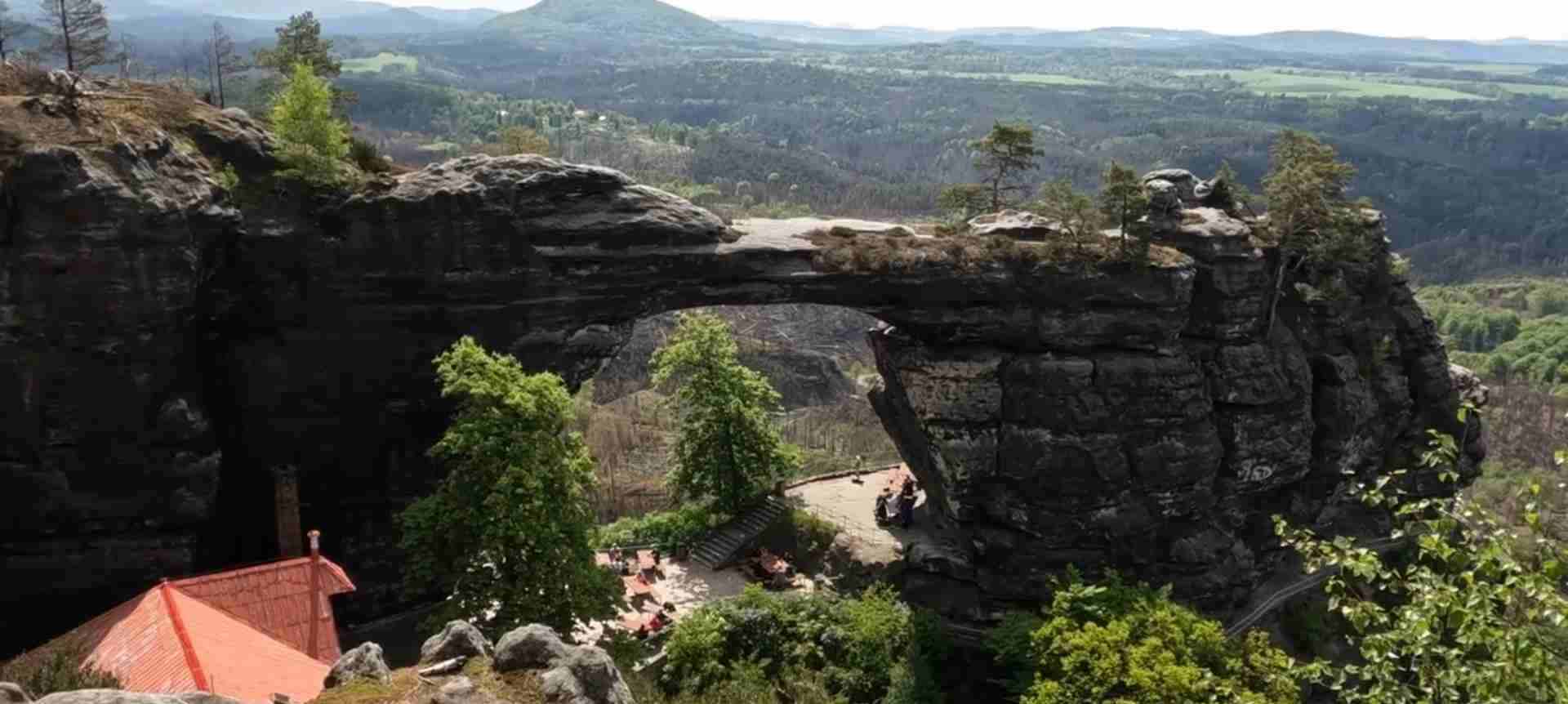
Pravčická Gate Day Trip from Prague 2026: Europe’s Largest Natural Arch
Key Takeaways: Discovering Europe’s Greatest Natural Arch in 2026
- Pravčická Gate stands as Europe’s largest natural sandstone arch at 26.5 meters wide and 16 meters high, formed over 70 million years through erosion of Cretaceous marine sediments in Bohemian Switzerland National Park
- Complete day trips from Prague cost €45-65 per person for independent travel including train tickets, buses, entrance fees, and meals, or €80-120 for guided tours with transportation and guide services included
- May and September 2026 deliver optimal visiting conditions with comfortable temperatures (15-22°C), vibrant spring or autumn colors, and reduced tourist crowds compared to peak summer when 800-1000 daily visitors create congestion at the arch
- The 3.5-kilometer Gabriela’s Trail from Hřensko village provides the standard route requiring 1.5-2 hours uphill hiking with 300-meter elevation gain through mixed forest before reaching the iconic sandstone formation
Introduction: Understanding Europe’s Natural Architectural Marvel
Pravčická brána (Pravčická Gate) represents one of Europe’s most extraordinary geological formations, a freestanding natural arch carved through millions of years from the ancient sandstone bedrock that defines the Bohemian Switzerland landscape. Rising 16 meters from ground level and spanning 26.5 meters at its widest point, this colossal archway dwarfs all comparable European natural arches, creating a landmark that has captivated artists, geologists, and travelers since the 18th century Romantic movement discovered these northern Bohemian borderlands. The arch sits at 414 meters elevation above sea level within the Czech section of the cross-border national park shared with Germany, approximately 130 kilometers north of Prague in a region historically known for its dramatic sandstone formations and deep river gorges.
The formation’s cultural significance extends beyond its geological supremacy. Pravčická Gate appeared in countless 19th-century landscape paintings by Czech and German Romantic artists who traveled here seeking sublime natural beauty. The structure gained modern fame through its appearance in The Chronicles of Narnia film series, where visual effects artists enhanced the natural arch to create the fictional land of Narnia, introducing this Czech landmark to global audiences. Today the site welcomes 200,000-300,000 annual visitors who make the pilgrimage through beech and spruce forests to stand beneath this testament to nature’s architectural capabilities, experiencing a formation that no human construction could replicate in scale, elegance, or enduring presence.
Planning a 2026 day trip to Pravčická Gate from Prague requires understanding transportation logistics, seasonal timing, physical preparation for moderate hiking, and strategies for experiencing this natural monument when crowds reach peak summer levels. The journey combines scenic train travel through Czech countryside, regional bus connections to the mountain village of Hřensko, and forest hiking along well-marked trails that gradually reveal the arch’s full magnificence. Smart planning transforms this excursion from a rushed photo stop into a comprehensive exploration of Bohemian Switzerland’s cultural and natural heritage, with the gate serving as the centerpiece of an adventure encompassing river gorges, historical restaurants, and perspectives on landscapes that shaped Central European Romantic art and literature.
People Also Ask About Pravčická Gate 2026
How do you get to Pravčická Gate from Prague in 2026?
The standard route departs Prague Main Station (Praha hlavní nádraží) via regional train to Děčín (90-110 minutes, departures every hour 6 AM-8 PM), connecting to the regional bus to Hřensko village (30 minutes, departures every 30-60 minutes peak season). From Hřensko’s main bus stop, the marked Gabriela’s Trail leads 3.5 kilometers uphill to Pravčická Gate requiring 1.5-2 hours hiking with 300-meter elevation gain through forest terrain. Total journey time from Prague reaches 4-5 hours including connections, making early morning departure essential for full-day exploration with comfortable return timing. Trains cost €10-14 one-way, buses €2-3, and Pravčická Gate entrance €3 in 2026. Check České dráhy (Czech Railways) for current schedules and online booking options.
Can you climb on or touch Pravčická Gate in 2026?
No, climbing on Pravčická Gate has been strictly prohibited since 1982 to protect the fragile sandstone structure from erosion and potential collapse caused by human activity. Protective barriers prevent direct contact with the arch, while marked viewing areas allow photography and appreciation from safe distances. Historical climbing occurred before the area gained national park protection, but modern regulations impose fines up to €500 for violations including touching the formation, crossing protective barriers, or attempting unauthorized access to the arch structure. Designated viewing platforms provide optimal perspectives for photography while protecting both visitors and this irreplaceable geological monument for future generations.
What is the best time of day to visit Pravčická Gate in 2026?
Early morning arrivals (8-10 AM) provide optimal conditions with soft directional light for photography, minimal tourist crowds, and cooler temperatures for the uphill hike from Hřensko. The arch faces north-northwest, receiving best natural lighting during morning hours when sun angle creates dimensional shadows revealing the formation’s texture and scale. Afternoon visits (2-5 PM) encounter peak crowds from tour groups and day-trippers, creating congestion at viewing platforms and the adjacent Falcon’s Nest restaurant terrace. Late afternoon (4-6 PM summer months) offers compromise timing with thinning crowds and warm golden hour lighting, though return hiking and transportation connections require careful planning to avoid missing last buses and trains to Prague departing around 6-7 PM from Hřensko.
How difficult is the hike to Pravčická Gate from Hřensko?
The standard Gabriela’s Trail rates as moderate difficulty suitable for hikers with average fitness, requiring 1.5-2 hours uphill covering 3.5 kilometers with 300-meter elevation gain. The trail surface varies from paved sections near Hřensko to natural dirt paths and occasional rocky sections, all manageable with standard walking shoes though hiking boots provide better support. Continuous uphill gradient maintains steady effort without technical climbing or scrambling, with red trail markers guiding the entire route. Regular rest benches appear every 400-500 meters allowing recovery breaks, and the forest canopy provides shade during hot weather. Return descent follows the same route completing in 45-60 minutes with reduced physical demand, making the round-trip achievable for most visitors willing to invest 3-4 hours total hiking time.
Extended multi-day tours – 5+ days
Featured Prague Multi-Day Tour Packages
5 days
The Best of Prague in 5 Days
- ✓ Comprehensive Prague tour
- ✓ Expert local guides included
- ✓ All accommodation arranged
- ✓ Transportation provided
7 days
Fantastic week in Prague all inclusive
- ✓ Comprehensive Prague tour
- ✓ Expert local guides included
- ✓ All accommodation arranged
- ✓ Transportation provided
1 days
Exploration of Prague in one day – Private Tour all day
- ✓ Comprehensive Prague tour
- ✓ Expert local guides included
- ✓ All accommodation arranged
- ✓ Transportation provided
7 days
For Lovers So Romantic 7 days in Prague: Private Tour
- ✓ Booking needs min. 2 travelers
Multi-day tour packages powered by TourRadar. Prices and availability subject to change.
Essential Planning Information for 2026 Visits
Geological Formation and Scientific Significance
Pravčická Gate formed through millions of years of erosion acting upon sedimentary rock layers deposited during the Late Cretaceous period (approximately 90-70 million years ago) when this region lay beneath a shallow sea. The sandstone composition consists of compacted marine sands mixed with mineral cements creating varying degrees of hardness throughout the rock mass. Water infiltration, freeze-thaw cycles, wind erosion, and chemical weathering gradually removed softer materials while harder sandstone layers resisted erosion, ultimately carving the freestanding arch we observe today. The process continues at geological timescales, with the formation gradually evolving though changes remain imperceptible within human lifespans.
The arch’s dimensions place it among the world’s most impressive natural rock arches. The span measures 26.5 meters at maximum width, height reaches 16 meters from ground level to the arch crown, and the passage beneath extends 7-8 meters deep creating a true architectural void rather than a shallow overhang. Geological surveys document the arch thickness varies from 3-5 meters at different points, with ongoing monitoring tracking any structural changes that might indicate stability concerns. Comparative analysis shows Pravčická Gate exceeds all documented natural sandstone arches in Europe, with only formations in Utah’s canyon country (Landscape Arch, Rainbow Bridge) and China’s Tianmen Mountain rivaling its scale globally.
Scientific value extends beyond size measurements to include the arch’s role as a reference site for understanding sandstone landscape evolution in Central Europe. The surrounding Bohemian Switzerland region contains hundreds of smaller arches, rock windows, and erosional features at various developmental stages, creating a natural laboratory for studying formation processes. Geologists monitor the arch’s stability using laser scanning technology and seismic sensors, collecting data on weathering rates, structural integrity, and potential hazards that inform conservation strategies protecting this irreplaceable natural monument.
Current Costs and Admission Details for 2026
Pravčická Gate entrance costs €3 per adult in 2026, with reduced rates of €1.50 for students, seniors over 65, and children ages 6-15. Check the Bohemian Switzerland National Park official website for current rates as pricing may vary. Family tickets covering two adults and up to three children cost €7, providing savings for groups. The entrance fee includes access to the immediate gate area, viewing platforms, and the adjacent Falcon’s Nest (Sokolí hnízdo) historic chalet built in 1881, now operating as a restaurant and museum displaying historical photographs, geological exhibits, and cultural artifacts documenting the arch’s discovery and tourism development.
Transportation costs include Prague to Děčín train tickets at €10-14 one-way (€20-28 round-trip), Děčín to Hřensko buses €2-3 each direction, creating total transportation expenses of €24-34 per person. The Labe Arena regional pass offers unlimited bus travel in the Ústí nad Labem region for €8 per day, economical for travelers planning multiple bus connections or side trips to surrounding areas. Czech Railways weekend discounts reduce Saturday-Sunday train fares by 25% when booking online, applicable to Prague-Děčín routes for additional savings on transportation budgets.
Meal and refreshment costs at Falcon’s Nest restaurant range €6-10 for coffee and pastries, €12-18 for lunch mains featuring Czech cuisine, and €4-6 for beverages and snacks. Prices reflect the remote mountain location requiring all supplies be transported uphill, making restaurant costs 30-40% higher than equivalent Prague establishments. Budget-conscious visitors pack lunch from Prague supermarkets (€5-8 for full meal supplies) while still stopping at Falcon’s Nest for drinks and terrace access providing spectacular views across the surrounding landscape.
Transportation Options and Schedules for 2026
Praha hlavní nádraží (Prague Main Station) serves as the primary departure point for Pravčická Gate day trips, with regional trains to Děčín operating hourly from early morning through evening hours. Fast regional services complete the journey in 90-100 minutes, while slower trains make additional stops extending travel time to 110-120 minutes. Morning departures recommended for day trips include the 7:12 AM (arriving Děčín 8:45 AM), 8:12 AM (arriving 9:47 AM), and 9:12 AM (arriving 10:45 AM) services providing adequate daylight hours for hiking and exploration before return connections.
Děčín’s main bus station sits adjacent to the railway station, simplifying connections to regional buses serving Hřensko. Bus line 434 operates the Děčín-Hřensko route every 30-60 minutes during peak tourist season (April-October), with reduced frequency in winter months. The scenic 30-minute journey follows the Elbe River gorge through dramatic landscape before reaching Hřensko’s compact village center. Buses depart approximately 15-30 minutes after major train arrivals, allowing time for station transfers without extended waiting though checking current timetables online before travel confirms precise coordination.
Return journeys from Hřensko to Prague follow the reverse route with final buses departing Hřensko around 6-7 PM connecting to evening trains from Děčín. Missing the last bus forces expensive taxi rides to Děčín (€30-40) or overnight stays in limited Hřensko accommodation, making careful schedule monitoring essential. Download offline bus and train schedules before departure as cellular coverage in the gorge areas proves intermittent, preventing real-time schedule checking during the visit.
Hiking Routes and Trail Options to Pravčická Gate 2026
Gabriela’s Trail: The Standard Route
The red-marked Gabriela’s Trail (Gabrielina stezka) represents the primary access route to Pravčická Gate, departing Hřensko’s main village square near the Kamenice River gorge entrance. The trail immediately begins uphill, following a paved path for the first 500 meters before transitioning to natural dirt surface through dense mixed forest. Beech, oak, and spruce trees provide continuous shade, creating pleasant conditions during hot weather though generating muddy sections after rainfall requiring careful footing.
The route maintains steady uphill gradient averaging 8-10% grade, with occasional steeper sections reaching 12-15% where forest service roads switchback through the landscape. Total elevation gain measures 300 meters over 3.5 kilometers, translating to sustained cardiovascular effort suitable for hikers with average fitness but potentially challenging for sedentary individuals. Rest benches appear every 400-500 meters allowing recovery breaks, with distance markers indicating remaining kilometers to the gate and estimated hiking times based on standard walking pace.
Trail markings follow Czech hiking standards using red painted blazes (horizontal red stripe approximately 10×5 centimeters) on trees, rocks, and posts at 50-100 meter intervals. Direction arrows appear at trail junctions preventing wrong turns, though some intersections can confuse first-time visitors making detailed maps or GPS tracking advisable. The forest environment limits long-distance visibility, creating surprise when the trail suddenly emerges at Pravčická Gate after the final uphill section through a rocky passage.
Alternative Routes and Extended Hikes
The Blue Trail from Mezní Louka border area provides alternative access to Pravčická Gate, offering easier gradient but longer distance (4.5 kilometers, 250-meter elevation gain over gentler slopes). This route suits hikers preferring extended time at moderate exertion rather than concentrated steep climbing. The blue markers follow forest tracks through quieter sections of the park with reduced tourist traffic compared to busy Gabriela’s Trail, creating more wilderness character though requiring transportation to Mezní Louka starting point via different bus routes.
Advanced hikers extend visits by combining the gate with surrounding trails creating 8-12 kilometer loops exploring the broader Bohemian Switzerland landscape. The Ranger’s Path (Pastýřská stěna) connects Pravčická Gate with Kyjovské údolí valley, descending 350 meters through pristine forest with limited facilities requiring self-sufficient preparation. The Green Trail via Kyjovské údolí from Hřensko creates a challenging full-day circuit (10 kilometers, 400+ meters elevation gain) including ladder sections and exposed scrambling unsuitable for acrophobic individuals or children but rewarding experienced hikers with solitude and comprehensive park exposure.
Winter hiking demands proper equipment including microspikes or light crampons as trails become icy, especially on north-facing slopes and shaded forest sections. Snow depth varies from 10-30 centimeters depending on recent weather and elevation, with higher areas accumulating more snow. Winter visitors encounter near-empty trails and snow-covered arch creating dramatic photography opportunities, though short daylight hours (8 AM to 4 PM December-January) limit exploration time and Falcon’s Nest restaurant closes entirely November-March eliminating warm shelter options.
Best Time to Visit Pravčická Gate in 2026
Spring Season: April-May 2026
Spring awakening brings the Bohemian Switzerland forests to vibrant life with wildflower blooms, bird migration activity, and rushing streams fed by snowmelt from higher elevations. April temperatures average 8-15°C, warming to 12-20°C by May, creating comfortable hiking conditions though variable weather requires layered clothing and rain protection. The arch area receives excellent natural lighting during late April and May when sun angle provides dimensional shadows revealing the sandstone’s texture and scale, superior to harsh midday summer lighting.
Tourist crowds remain significantly lower than summer peaks, with April weekdays seeing 100-200 daily visitors compared to 800-1000 during July-August highs. This reduction allows peaceful arch experiences, unobstructed photography, and relaxed viewing platform access without jostling for position. Accommodation in surrounding areas offers more availability and lower rates (30-40% below summer prices), beneficial for travelers planning overnight stays to access sunrise or sunset lighting conditions unavailable to day-trippers.
Spring challenges include unpredictable weather with occasional cold fronts bringing rain or even late snow to higher elevations through mid-April. Trail conditions vary from dry and firm to muddy after rainfall, though the primary Gabriela’s Trail maintains passability year-round. Falcon’s Nest restaurant typically opens for the season in early April (exact dates vary annually), providing warm beverages and shelter though operating with reduced menu and hours compared to peak summer service.
Summer Season: June-August 2026
Summer delivers maximum tourist numbers, longest daylight hours (5 AM to 9:30 PM in June), and guaranteed warm weather creating ideal conditions for families and less experienced hikers. July and August weekends bring severe crowding with tour buses depositing 30-50 person groups simultaneously, creating congestion at viewing platforms and the Falcon’s Nest terrace where seating becomes scarce 11 AM-3 PM. The arch faces north-northwest receiving less direct sunlight during summer when high sun angle creates minimal dimensional lighting, reducing photograph quality compared to spring and autumn lower sun angles.
Peak season advantages include full facility operation with Falcon’s Nest restaurant serving complete menu, extended hours, and outdoor terrace seating overlooking the surrounding forest landscape. All trails receive regular maintenance and ranger presence increases for visitor assistance and safety monitoring. Public transportation operates at maximum frequency with buses every 30 minutes during peak hours, eliminating extended waiting times at Hřensko or Děčín connections.
Summer afternoon thunderstorms develop regularly during July-August, typically forming 2-4 PM when atmospheric instability peaks. These storms bring lightning hazards requiring immediate shelter, heavy rainfall creating slippery trail conditions, and potential flash flooding in lower elevation gorge areas. Monitor weather forecasts before departure and plan gate visits for morning hours when conditions prove most stable and crowds lighter than afternoon periods.
Autumn Season: September-October 2026
Autumn represents the optimal season for photography enthusiasts and visitors seeking combination of comfortable conditions with exceptional natural beauty. September temperatures range 10-18°C, cooling to 5-12°C in October, ideal for sustained hiking effort without overheating. Deciduous forests transform into brilliant displays of orange, red, and yellow foliage peaking late September through mid-October, creating vibrant color contrasts against the grey-beige sandstone formations that dominate throughout the year.
Tourist crowds decrease dramatically after German summer vacation ends in early September, with weekday visits in September-October seeing 150-300 daily visitors compared to summer’s 800-1000, restoring peaceful atmosphere and easy viewing platform access. The lower sun angle during autumn creates superior photographic lighting with long shadows, warm color temperatures, and dimensional relief highlighting the arch’s structural details invisible in harsh midday summer light.
Late October brings shorter daylight hours (sunrise 7 AM, sunset 6 PM by October end) requiring earlier departure from Prague to maximize exploration time before return transportation connections. Some facilities reduce operations in late October, with Falcon’s Nest restaurant closing by November 1st (exact date varies annually). Trail conditions remain excellent through September and early October, though late October rainfall creates muddy sections and fallen leaves obscure trail markings in places requiring careful navigation.
Winter Season: November-March 2026
Winter transforms Pravčická Gate into a wilderness destination for experienced hikers prepared for challenging conditions and solitude. Snow cover typically appears mid-November lasting through March with depths varying 15-40 centimeters depending on elevation and recent snowfall. The arch draped in snow and ice creates dramatic photographic opportunities unavailable in other seasons, with icicles forming along the overhang and surrounding rock faces displaying winter’s artistic effects.
Visitor numbers drop to minimal levels with 20-50 daily visitors during weekdays and 100-150 on fair-weather weekends when hardy Czech hikers escape Prague for mountain air. All commercial facilities close November-March including Falcon’s Nest restaurant, visitor centers, and most Hřensko accommodation, requiring complete self-sufficiency for winter adventurers. Trail maintenance occurs infrequently, with ice accumulation on north-facing slopes creating hazardous footing requiring microspikes, trekking poles, and winter hiking experience.
Extreme cold (temperatures frequently drop below -10°C in January-February) demands full winter gear including insulated layers, waterproof shell, winter boots, gloves, and emergency supplies. Short daylight hours (8 AM to 4:30 PM in December-January) severely limit exploration time, making overnight stays essential for comprehensive winter photography work. However, winter rewards prepared visitors with ethereal beauty, complete solitude, and conditions that test outdoor skills while creating memories impossible during crowded summer seasons.
Sample 2026 Day Trip Itineraries
Independent Traveler Standard Day Trip
Depart Prague Main Station on the 7:12 AM train to Děčín, arriving 8:45 AM with ample time for the 9:15 AM bus to Hřensko (reaching the village at 9:45 AM). Begin the Gabriela’s Trail hike at 10 AM, maintaining steady pace uphill through the forest with short rest breaks at designated benches. Reach Pravčická Gate by 11:30 AM, spending 45-60 minutes exploring the viewing platforms, photographing the arch from multiple angles, and visiting the Falcon’s Nest restaurant for refreshments and terrace viewing.
After comprehensive gate exploration, continue hiking the surrounding trails for an additional 1-2 hours, options including the Falcon’s Nest viewpoint (15-minute walk from the gate offering superior panoramic perspectives), the nature trail explaining local geology and ecology, or exploration of nearby smaller rock formations and forest clearings. Begin descent back to Hřensko by 2 PM via the same Gabriela’s Trail (45-60 minutes downhill), arriving at the village around 3 PM.
Spend remaining afternoon exploring Hřensko’s Kamenice River gorges via boat rides (optional, €10-12 for combined ticket accessing both Edmundova and Divoká gorge sections, 1.5-2 hours total). Alternatively, relax at riverside restaurants enjoying Czech cuisine and local beer before catching the 5:15 PM or 6:15 PM bus to Děčín, connecting to evening trains arriving Prague around 8-9 PM. This relaxed schedule avoids rushing while providing comprehensive Pravčická Gate experience with flexibility for additional activities based on energy levels and personal interests.
Independent day trip costs include Prague-Děčín train €20-28 round-trip, buses €6-8 total, Pravčická Gate entrance €3, Falcon’s Nest refreshments €8-12, packed lunch from Prague €5-8, optional gorge boats €10-12, Hřensko dinner or snacks €12-18. Total day cost: €64-89 per person excluding Prague accommodation. Bring 1.5-2 liters water, energy snacks, camera equipment, rain jacket, and comfortable hiking boots for maximum enjoyment.
Guided Tour Comfortable Experience
Professional guided tours departing Prague at 8-8:30 AM provide stress-free Pravčická Gate access with drivers handling all transportation logistics, parking, and time management. Tours travel via comfortable coaches or minivans, with guides providing commentary on Czech history, regional culture, and geological background during the 2.5-hour journey to Hřensko. Upon arrival around 11 AM, guides lead hiking groups up Gabriela’s Trail at comfortable paces accommodating varying fitness levels, with scheduled breaks and interesting information about flora, fauna, and landscape features encountered en route.
Reaching Pravčická Gate by 12:30-1 PM, guided groups receive 60-90 minute gate area exploration time including professional photography assistance, detailed explanations of the arch’s formation and significance, and access to viewpoints that independent visitors might overlook. Many tours include lunch at Falcon’s Nest restaurant (often pre-arranged as part of tour price) featuring traditional Czech dishes and terrace seating with forest views. Some premium tours extend experiences with gorge boat rides, additional viewpoint hikes, or visits to nearby cultural sites.
Return journeys typically depart Hřensko around 3-3:30 PM, arriving Prague by 6-6:30 PM after a full day without transportation stress, schedule coordination challenges, or language barrier difficulties when purchasing tickets or seeking information. Tour prices range €80-120 per person depending on group size (8-12 person small groups versus 20-30 person buses), inclusions (meals, entrance fees, activities), and operator quality. Check tour company websites for current 2026 rates and seasonal availability, reading recent reviews to assess guide expertise and actual delivery versus marketing promises.
Photography-Focused Extended Visit
Serious photographers benefit from overnight stays in Hřensko or nearby Mezní Louka, enabling access to sunrise and sunset lighting conditions impossible on Prague day trips. Arrive Hřensko afternoon the day before your primary photography session, using remaining daylight to scout viewpoints, test compositions, and plan next morning’s shoot. Overnight accommodation ranges from budget guesthouses (€40-60 per night) to mid-range hotels (€80-120), with advance booking essential during peak summer months.
Depart accommodation before sunrise (summer 4:30-5 AM, autumn 6-6:30 AM) for pre-dawn hike to Pravčická Gate, arriving as first light illuminates the eastern horizon. The empty gate area (before 8-9 AM when day-trip crowds arrive) allows unobstructed photography, tripod setup without space constraints, and quiet contemplation of this natural monument in pristine conditions. Sunrise light creates dramatic effects on the sandstone, with low sun angle casting long shadows and warm color temperatures enhancing the rock’s natural tones.
After morning photography session (typically 2-3 hours capturing various light conditions as sun rises), return to Hřensko for breakfast and rest during midday harsh light hours. Afternoon explores alternative viewpoints, surrounding trails, or gorge areas before returning to the gate for sunset light (summer 7:30-8:30 PM, autumn 5:30-6:30 PM) when warm golden hour creates different atmospheric effects than morning conditions. Second night allows next-morning backup session if weather disappoints, or exploration of additional Bohemian Switzerland locations before returning to Prague.
Two-day photography itinerary costs include accommodation €50-90 per night, meals €40-60 total, transportation €30-40, park fees €3, plus potentially photography permits if shooting commercially (check current regulations with park administration). Total estimated cost: €123-193 per person for comprehensive photography coverage with ideal lighting conditions and flexibility for weather contingencies.
Photography Guide for Pravčická Gate 2026
Optimal Camera Settings and Equipment
The arch’s massive scale and complex textures reward wide-angle lenses capturing the full formation within the frame while including surrounding forest context. Focal lengths from 16-35mm (full-frame equivalent) work ideally for comprehensive shots, while 24-70mm standard zooms provide versatility for both wide scenes and detail isolation. Tripods prove essential for long-exposure work during low-light conditions, HDR bracketing to handle high dynamic range between bright sky and shaded arch, and ensuring maximum sharpness at base ISO.
Exposure challenges include the arch’s north-facing orientation creating shaded conditions even during bright days, while the sky visible through the arch often measures 4-6 stops brighter than shadowed rock surfaces. HDR bracketing (3-5 exposures at 1-2 EV spacing) captures full tonal range for later blending, while graduated neutral density filters help balance sky and foreground. Shoot in RAW format for maximum post-processing flexibility when recovering shadow detail and managing highlight preservation in the bright background.
Recommended apertures range from f/8 to f/11 for landscape shots requiring deep depth of field maintaining sharpness from foreground elements through the arch to distant background. Focus one-third into the scene using hyperfocal distance calculations, or employ focus stacking techniques shooting multiple frames at different focus points for perfect edge-to-edge sharpness. Bring spare batteries as cold temperatures drain power rapidly, plus adequate memory cards for bracketed sequences and 4K video if capturing motion elements.
Composition Strategies and Unique Perspectives
The standard frontal view from the main viewing platform provides the classic Pravčická Gate composition, placing the arch in center frame with forest on both sides creating natural borders. This established perspective appears in countless photographs and paintings, making creative alternatives valuable for unique imagery. Move left or right from the central platform to incorporate asymmetric compositions with the arch off-center, using surrounding trees or rocks as foreground framing elements leading the eye into the scene.
The Falcon’s Nest viewpoint (15-minute walk from the main platform) delivers elevated perspective overlooking the arch from above, creating dramatically different visual impact than ground-level views. This angle reveals the arch’s relationship to surrounding landscape, showing the massive scale and isolated position atop the ridgeline. Sunset light from this viewpoint can create spectacular silhouettes when exposing for bright western sky while allowing the arch to fall into dark shadow defining its distinctive shape.
Detail photography isolates the sandstone’s weathering patterns, mineral staining creating vertical stripes, and vegetation growing in cracks and crevices. Telephoto lenses (100-200mm) compress perspective emphasizing texture and eliminating distracting background elements. Look for human scale references (hikers on trails, people beneath the arch) providing size comparison helping viewers comprehend the formation’s massive dimensions. Morning and evening side-lighting creates texture-revealing shadows impossible during flat midday illumination.
Seasonal Photography Considerations
Spring photography benefits from fresh green foliage, wildflowers in surrounding meadows, and dramatic cloud formations during unsettled weather creating dynamic skies. Morning mist occasionally fills valleys below the gate, creating ethereal scenes with the arch emerging from fog banks. Rain immediately before shooting creates saturated colors in the sandstone and vegetation, with wet rock surfaces reflecting light differently than dry conditions producing unique tonal qualities.
Summer’s long daylight hours allow extended shooting sessions, though harsh midday sun creates poor lighting from approximately 11 AM to 4 PM when direct overhead illumination flattens three-dimensional forms. Focus summer shooting on early morning (5-8 AM) and evening (6-9 PM) when lower sun angles create dimensional lighting. Blue hour after sunset (20-30 minutes post-sunset) creates soft diffused light ideal for balanced exposures without extreme shadows or highlights.
Autumn color peak (late September to mid-October) surrounds the grey-beige arch with vibrant foliage, creating strong color contrasts in landscape compositions. The seasonal palette shifts daily as individual trees change at different rates, with some maples turning brilliant red while adjacent oaks display yellow and green creating complex color relationships. Autumn’s lower sun angle throughout the day improves lighting quality compared to summer’s high sun positions.
Winter snow transforms the scene into monochromatic study of form and light, with white snow emphasizing the arch’s shape and structural elements. Icicles form along the overhang creating decorative natural elements absent in other seasons. Winter’s clear air (when present) provides exceptional visibility extending background views, while occasional fog or low clouds create moody atmospheric conditions. Winter photography demands weather-sealed equipment protecting against moisture from snow and condensation, plus insulated camera bags preventing gear from chilling during transport to frigid outdoor temperatures.
Cultural History and Historical Significance
Discovery and Early Tourism Development
Historical records document Pravčická Gate’s “discovery” by the broader European cultural world in the late 18th century, though local shepherds, hunters, and foresters obviously knew the formation for centuries before Romantic-era travelers began celebrating its dramatic beauty. The first documented visit by a noted cultural figure occurred in 1766 when Swiss-born geologist and theologian Johann Gottlob Lehmann surveyed the region’s geology, describing the arch in scientific publications that introduced it to educated European audiences. However, widespread tourism awareness waited until the early 19th century Romantic movement when artists and writers seeking sublime natural experiences traveled to these borderlands between Bohemia and Saxony.
The arch gained its modern name “Pravčická brána” in the 1850s, though earlier names included “Pravcic Felsen” (German) and various local Czech appellations. The 1824 construction of the first access path from Hřensko village made the site reachable for less adventurous travelers previously deterred by difficult wilderness approaches. This infrastructure investment coincided with Romantic era peak when artists like Caspar David Friedrich painted dramatic Elbe Sandstone landscapes (though not Pravčická Gate specifically), and writers like Ludwig Tieck celebrated the region’s wild character in literature inspiring readers across Europe to visit personally.
Falcon’s Nest Restaurant Heritage
The Falcon’s Nest chalet (Sokolí hnízdo) was constructed in 1881 by the Clary-Aldringen aristocratic family who owned these territories, creating a restaurant and rest facility serving tourists making the challenging hike from lowland villages. The building’s unique architectural style blends Czech mountain chalet traditions with Italian Renaissance elements, creating distinctive structure that complements rather than competes with the natural arch it serves. The original design included ground-floor restaurant space, upper-level lodging rooms for overnight guests (no longer offered), and wraparound terrace providing panoramic views across surrounding forest landscape.
Through the 20th century the building survived both World Wars with minimal damage despite proximity to German border, operating continuously (except brief closures during immediate war years) as tourism facility even under Communist administration when state-owned enterprise managed the property. Post-1989 transitions transferred management to park authorities who maintain the building’s historical character while modernizing kitchen facilities, safety systems, and accessibility features meeting current standards. The restaurant operates April-October serving traditional Czech cuisine with period-appropriate interior design preserving 19th-century atmosphere.
Modern Conservation and Protection Status
Pravčická Gate received formal protection in 1933 as natural monument within the broader landscape conservation area established by Czechoslovak government recognizing the region’s exceptional geological and scenic values. This early protection predated most European national park systems, reflecting Czech cultural appreciation for natural heritage preservation. The 1972 designation as protected landscape area provided enhanced regulations, followed by full national park status in 2000 when Bohemian Switzerland National Park gained creation alongside enhanced cooperation with German Saxon Switzerland National Park across the border.
UNESCO World Heritage tentative list includes the cross-border Bohemian-Saxon Switzerland landscape under potential future designation recognizing outstanding universal value in geological, ecological, and cultural dimensions. The arch serves as the most iconic feature within any potential UNESCO submission, though no formal application timeline exists currently. Conservation programs focus on monitoring structural stability through laser scanning and seismic sensors, managing tourist access to prevent erosion and damage, controlling invasive plant species threatening native biodiversity, and maintaining historical infrastructure including trails and the Falcon’s Nest building.
Money-Saving Strategies for 2026 Visits
Transportation Cost Reduction
Czech Railways weekend discounts provide 25% fare reductions for Saturday-Sunday travel on Prague-Děčín regional trains when purchasing tickets online via their website or mobile app. Groups of 2-5 travelers qualify for additional group discounts of 20-30% when booking together at station counters, though this requires simultaneous ticket purchase rather than individual online transactions. The Labe Arena regional pass costs €8 covering unlimited bus travel throughout the Ústí nad Labem region, economical for travelers making multiple connections or exploring surrounding areas beyond simple Děčín-Hřensko-Děčín routing.
Cycling from Děčín to Hřensko along the Elbe River cycling path eliminates bus costs while adding recreational dimension to the journey. The 20-kilometer route follows dedicated cycling infrastructure requiring 1.5-2 hours for average cyclists, passing through scenic gorge landscape with minimal traffic conflicts. Bike rentals in Děčín cost €12-18 per day from shops near the train station, creating combined transportation cost of €32-40 (train plus rental) comparable to train plus multiple bus connections but offering enhanced experience and exercise benefits. However, this approach adds significant physical exertion before hiking, suitable only for fit travelers comfortable with extended activity days.
Dining and Accommodation Economies
Packing lunch from Prague supermarkets (Lidl, Albert, Tesco) reduces meal costs to €5-8 per person compared to €15-25 restaurant dining at Falcon’s Nest or Hřensko establishments. Bring sandwiches, fruit, trail mix, chocolate bars, and adequate water (1.5-2 liters) providing energy without requiring refrigeration. Stop at Falcon’s Nest for coffee or soft drinks (€2-4) while using their terrace for scenic views without committing to full meal expenditure.
Budget accommodation in Děčín rather than expensive Prague hotels reduces overnight costs by 40-60% while positioning travelers closer to park access points. Hostels cost €20-30 per bed, guesthouses €40-60 per double room, compared to Prague’s €80-150 equivalent quality. This strategy works best for multi-day park visits combining Pravčická Gate with other Bohemian Switzerland attractions, though single-day visitors save more time and money by utilizing existing Prague accommodation avoiding check-in logistics and additional overnight bookings.
Seasonal Timing for Lower Costs
Visiting during shoulder seasons (April-May, September-October) reduces accommodation costs 30-40% compared to peak July-August rates while providing superior visiting conditions with comfortable temperatures and reduced crowds. Mid-week visits (Tuesday-Thursday) cost less than weekends when Czech and German domestic tourists create higher demand, applicable to both accommodation rates and guided tour pricing. Some tour operators offer early booking discounts (15-20% savings) for reservations made 6-8 weeks ahead, though these require confident scheduling and typically involve non-refundable payment terms.
Independent travel always costs less than guided tours, typically totaling €45-65 versus €80-120 per person for equivalent experiences. The savings come from self-arranged transportation using public networks, packed meals, and flexible timing rather than fixed tour schedules. However, independent approaches demand more research, planning effort, comfort with foreign language environments (though English works reasonably well in tourist areas), and willingness to handle logistics personally rather than delegating responsibility to professional tour operators.
Practical Tips and Visitor Information 2026
What to Bring for Day Trips
Essential items include 1.5-2 liters water per person (more during hot weather or extended hiking), energy snacks and lunch, comfortable hiking boots or trail shoes with ankle support, rain jacket regardless of morning weather forecast, sun protection including hat and sunscreen (UV exposure increases at elevation), small first-aid kit, and fully charged mobile phone with offline maps downloaded covering the area. Lightweight backpack (20-30 liters) carries supplies comfortably without creating burden during uphill hiking effort.
Photography equipment beyond basic smartphones should include camera body, wide-angle lens, standard zoom, tripod for long exposures and HDR work, spare batteries (cold drains power rapidly), adequate memory cards, and protective rain cover. Serious photographers add graduated ND filters, polarizer for sky darkening and reflection management, remote shutter release for tripod work, and lens cleaning supplies removing moisture and debris affecting image quality.
Seasonal additions include winter: insulated layers, waterproof boots, gloves, warm hat, microspikes or crampons for icy conditions, and emergency shelter (space blanket). Summer: light breathable clothing, insect repellent for forest sections, swimming gear if planning gorge visits, extra sunscreen. Autumn: colorful foliage peak timing research, warmer layers for cooler temperatures compared to summer, waterproof gear for increased rainfall probability.
Accessibility and Physical Requirements
The standard Gabriela’s Trail requires moderate fitness for 300-meter elevation gain over 1.5-2 hours uphill walking, unsuitable for wheelchairs, limited mobility individuals, or very young children unable to walk extended distances. The trail surface varies from smooth to rocky, with some steep sections and uneven footing creating trip hazards requiring careful attention. No elevator or vehicle access reaches the gate area, making the hike mandatory for all visitors regardless of physical condition.
Alternative viewing options do not exist for those unable to complete the hike, as the gate’s remote location and protected status prevent road construction or mechanical access development. Families with very young children should consider if carrying children in backpack carriers for 3.5 kilometers uphill proves realistic, typically limiting this to children under 3-4 years old before they become too heavy for extended carrying. Children 6-7 and older generally manage the hike with encouragement and frequent breaks, making this achievable family adventure with appropriate preparation and expectation management.
Weather Preparedness and Safety
Weather changes rapidly in mountain environments, with morning sunshine transforming to afternoon thunderstorms during summer months when atmospheric instability peaks. Check detailed forecasts before departure from Prague, monitoring predictions for Hřensko specifically rather than assuming Prague weather matches mountain conditions (temperature typically runs 3-5°C cooler at elevation). Pack rain protection even when forecasts predict sunshine, as microclimate effects create local showers invisible to broader weather models.
Lightning poses serious risk during thunderstorms, with the arch itself acting as potential lightning target due to elevated exposed position. Seek immediate shelter in Falcon’s Nest building or descend rapidly to lower elevation if storms approach, avoiding exposed ridge positions and isolated tall trees that attract strikes. Emergency services respond to mountain rescue calls via 112 universal EU emergency number, though response times vary from 45 minutes to 2-3 hours depending on incident location and resource availability.
Trail hazards include slippery conditions when wet (sandstone becomes extremely slick after rain), loose rocks on steep sections, and occasional wildlife encounters including wild boar in forested areas. Stay on marked trails avoiding cliff edges and unstable formations, respect all safety barriers even when they seem excessive or inconvenient, and avoid trail shortcuts that damage vegetation while increasing personal risk from unexpected hazards.
Frequently Asked Questions
How long should you spend at Pravčická Gate?
Most visitors spend 45-90 minutes at the gate area, allowing time for viewing from multiple platforms, photography from various angles, visiting the Falcon’s Nest restaurant for refreshments, and exploring the immediate surroundings including the Falcon’s Nest viewpoint and nature trail. Photographers may stay 2-3 hours capturing different light conditions, compositions, and details. Combined with 3-4 hours round-trip hiking and potential gorge exploration in Hřensko, full day trips from Prague require 8-10 hours total commitment including transportation.
Can you see Pravčická Gate without hiking?
No vehicle access or mechanical transport (cable cars, elevators, shuttles) reaches Pravčická Gate, making the 3.5-kilometer uphill hike mandatory for all visitors. The trail’s moderate difficulty prevents completion by individuals with significant mobility limitations, wheelchair users, or those unable to walk extended distances on uneven terrain. Alternative viewing does not exist, as the gate’s protected location and terrain prevents road construction or alternative access development. Visitors must accept the hiking requirement or forgo visiting this remote natural monument.
Is Pravčická Gate worth visiting if you have limited time in Prague?
Pravčická Gate ranks among Central Europe’s most spectacular natural formations, offering unique experience unavailable elsewhere in the Czech Republic or surrounding countries. The full day commitment (8-10 hours from Prague) suits travelers with 3+ days in Prague allowing one day for excursion, while those with only 1-2 days should prioritize Prague’s urban cultural attractions. The gate provides dramatic contrast to Prague’s architectural heritage, appealing especially to nature lovers, hikers, photographers, and those seeking outdoor adventure complementing urban sightseeing. However, travelers with extremely limited Prague time or zero interest in hiking should skip this excursion focusing instead on castle, historical, and cultural sites accessible without significant physical effort.
What other attractions can you combine with Pravčická Gate in one day?
The Kamenice River gorges in Hřensko provide natural complement to gate visits, with boat rides navigating narrow passages between towering rock walls (€10-12 for combined ticket, 1.5-2 hours). The Edmundova and Divoká gorges offer contrasting experiences: Edmundova features calm water with smooth rock formations, while Divoká presents dramatic passages with waterfalls and tight canyon sections. Budget 2-3 hours for comprehensive gorge exploration before or after gate hiking, though this creates very full days requiring 10-12 hours total commitment.
Do you need a guide or can you visit Pravčická Gate independently?
Independent visits work perfectly well using public transportation, self-navigation via marked trails, and available maps or GPS apps. The route remains straightforward with clear red trail markings, regular distance indicators, and obvious path following with minimal navigation challenges. Guided tours provide value through transportation convenience (avoiding transfers and schedule coordination), expert commentary on geology and ecology, photography assistance, and group camaraderie. However, independent travelers save €35-70 per person while gaining complete flexibility over timing, pace, and exploration priorities rather than following fixed tour schedules.
Can you climb to the top of Pravčická Gate?
No, climbing on or over Pravčická Gate has been strictly prohibited since 1982 to protect the fragile structure from erosion and potential collapse. Protective barriers prevent access to the arch itself, while marked viewing areas provide safe observation points and photography positions. Historical climbing occurred before park protection status existed, but modern regulations impose substantial fines (up to €500) for violations including touching the formation, crossing barriers, or attempting unauthorized access. The prohibition protects both visitors and this irreplaceable geological monument for future generations.
What is the difference between Pravčická Gate and Bastei Bridge?
Pravčická Gate is a completely natural formation created through millions of years of erosion, while Bastei Bridge is a man-made sandstone bridge constructed in 1851 connecting natural rock pinnacles. Pravčická Gate sits in Czech Bohemian Switzerland National Park requiring moderate hiking to access, while Bastei Bridge exists in German Saxon Switzerland with easier accessibility via paved paths from nearby villages. Both offer spectacular views and represent highlights of the cross-border national park system, though they provide fundamentally different experiences: wild natural monument versus developed tourist infrastructure combining natural and human-built elements.
Is Pravčická Gate suitable for winter visits?
Winter visits work for experienced hikers prepared for challenging conditions including snow, ice, freezing temperatures, and limited facilities. The gate area appears spectacular in winter dress with snow and ice creating dramatic effects, though trails become hazardous requiring microspikes or crampons for safe navigation. All commercial facilities including Falcon’s Nest restaurant close November-March, eliminating warm shelter options and creating self-sufficient requirements. Short winter daylight hours (8 AM to 4:30 PM December-January) limit exploration time, while extreme cold demands full winter gear. Only prepared winter hiking specialists should attempt visits during this season, as conditions can become dangerous for unprepared or inexperienced visitors.
How crowded does Pravčická Gate get during peak season?
Summer weekends and Czech school holiday periods bring 800-1000 daily visitors, creating congestion at viewing platforms where limited space forces waiting for unobstructed photography positions. Tour groups arriving simultaneously (30-50 people at once) can overwhelm the viewing areas for 20-30 minutes until groups disperse. Weekdays see reduced crowds (400-600 visitors), while shoulder seasons (April-May, September-October) drop to 150-300 daily creating comfortable uncrowded experiences. Early morning arrivals (before 10 AM) or late afternoon visits (after 4 PM) avoid peak crowding even during summer season, as most tour groups visit 11 AM-3 PM timeframe.
What wildlife might you encounter hiking to Pravčická Gate?
Common sightings include red deer, roe deer, foxes, and diverse birdlife ranging from woodpeckers to birds of prey including the peregrine falcons that nest on surrounding rock faces. Wild boar populations increase during autumn when acorn crops attract animals to forested areas, requiring hikers to make noise on blind trail corners avoiding surprising these potentially aggressive animals. Fire salamanders inhabit moist areas displaying bright yellow and black warning coloration. Rare species include Ural owls and lynx (reintroduced to Czech forests), though actual sightings remain extremely uncommon. Maintain respectful distance from all wildlife, never feed wild animals, and report aggressive behavior to park rangers immediately.