Prague Walking Tours & Routes 2026: Self-Guided Walks
Key Takeaways
- Prague’s compact historic center features five essential self-guided walking routes covering UNESCO World Heritage sites and major attractions within 2-4 hours each
- The complete walking experience costs €15-25 per day in 2026 including entrance fees, refreshments, and occasional public transport, making it Prague’s most budget-friendly exploration method
- Early morning walks (7-9 AM) provide optimal lighting for photography and minimal crowds at major sites, while evening routes (5-8 PM) capture golden hour magic across the Vltava River
- Navigation apps work reliably throughout Prague’s historic districts with free WiFi available at major squares, cafes, and visitor centers for real-time route adjustments
- The ideal walking tour strategy combines three morning routes with two afternoon/evening walks across a 3-4 day Prague visit for comprehensive heritage coverage
- All major walking routes connect seamlessly through central Prague, allowing flexible itinerary adjustments based on weather, energy levels, and personal interests
Introduction: Discovering Prague on Foot in 2026
Prague reveals its thousand-year story most authentically through walking, where every cobblestone street leads to architectural masterpieces spanning Gothic, Renaissance, Baroque, and Art Nouveau periods. The UNESCO-listed historic center compresses centuries of European history into walkable neighborhoods connected by the iconic Charles Bridge, creating one of the continent’s most pedestrian-friendly capitals. Self-guided walking tours in 2026 combine the freedom to explore at your own pace with comprehensive coverage of Prague’s essential cultural landmarks, hidden courtyards, and riverside promenades.
Walking remains Prague’s most rewarding exploration method because the city’s architectural treasures demand close observation impossible from tour buses or trams. The intricate astronomical clock mechanisms, Gothic portal sculptures, Baroque palace facades, and Art Nouveau building details reveal themselves fully only to pedestrians who can stop, photograph, and absorb the extraordinary craftsmanship at leisure. Prague’s compact scale means major sites cluster within 15-20 minute walks of each other, while the absence of steep hills in the historic center (except the Castle District approach) makes extended walking comfortable for most fitness levels.
The 2026 walking experience benefits from enhanced pedestrian infrastructure, improved wayfinding signage in English, and expanded free WiFi coverage across the historic districts. New walking routes incorporate recently restored buildings and courtyards, while traditional favorites like the Royal Way and riverside promenades continue to showcase Prague’s timeless beauty. Self-guided exploration allows you to bypass crowded group tours, discover personal favorite spots, and adjust timing based on lighting conditions for optimal photography throughout your Prague adventure.
People Also Ask About Prague Walking Tours 2026
How much does a self-guided walking tour cost in Prague in 2026?
A comprehensive self-guided walking day in Prague costs €15-25 per person in 2026, including occasional entrance fees (€3-5 for tower climbs or special exhibitions), refreshment stops (€8-12 for coffee, snacks, and water), and minimal public transport (€1.50 for single tickets when needed). Check official Prague tourism websites for current pricing on optional attractions along walking routes. The core walking experience through streets, squares, and exterior viewpoints costs nothing, making it Prague’s most economical exploration method. Budget travelers completing 3-4 major walking routes across multiple days spend €45-100 total on walking-related expenses, significantly less than organized tour packages.
What is the best walking route in Prague for first-time visitors in 2026?
The Old Town to Castle District route serves as Prague’s essential first-time walking tour, covering 4.5 kilometers across 3-4 hours and connecting all major UNESCO landmarks. Start at Old Town Square with the Astronomical Clock, walk through the medieval streets to Charles Bridge, cross the Vltava River with spectacular castle views, climb through Lesser Town’s Baroque palaces, and ascend to Prague Castle for panoramic city perspectives. This route captures Prague’s complete historical narrative from medieval foundations through Baroque transformation to modern capital status, providing context for all subsequent explorations. The morning timing (8 AM-12 PM) offers optimal lighting and manageable crowds at the castle complex.
Do you need a guide for Prague walking tours in 2026?
Prague’s excellent English signage, comprehensive free maps available at visitor centers, and reliable smartphone navigation make guided tours unnecessary for confident travelers. The historic center’s intuitive layout follows the Vltava River with clear landmarks visible from multiple points, while major attractions feature information panels explaining historical and architectural significance. Self-guided walking provides flexibility to adjust pace, skip crowded sites, extend time at personal favorites, and discover unexpected courtyards or cafes off standard tour routes. However, specialized themed walks (Jewish heritage, Communist architecture, underground tours) benefit from expert guides who access restricted areas and provide historical context unavailable through independent exploration.
How long does it take to walk through Prague’s historic center in 2026?
Walking from Old Town Square to Prague Castle covers approximately 2 kilometers and takes 30-40 minutes at a steady pace without stops. Comprehensive exploration of the historic center including all major squares, Charles Bridge, Castle District, and Jewish Quarter requires 12-15 hours of total walking time across multiple days. Most visitors complete the essential walking routes across 3-4 days with 3-4 hours of walking per day, allowing ample time for attraction visits, meal breaks, and photography stops. The compact scale means you can walk from any historic center point to another within 15-25 minutes, making it easy to return to your accommodation or adjust routes based on energy levels throughout your Prague visit.
Extended multi-day tours – 5+ days
Featured Prague Multi-Day Tour Packages
5 days
The Best of Prague in 5 Days
- ✓ Comprehensive Prague tour
- ✓ Expert local guides included
- ✓ All accommodation arranged
- ✓ Transportation provided
7 days
Fantastic week in Prague all inclusive
- ✓ Comprehensive Prague tour
- ✓ Expert local guides included
- ✓ All accommodation arranged
- ✓ Transportation provided

1 days
Exploration of Prague in one day – Private Tour all day
- ✓ Comprehensive Prague tour
- ✓ Expert local guides included
- ✓ All accommodation arranged
- ✓ Transportation provided
7 days
For Lovers So Romantic 7 days in Prague: Private Tour
- ✓ Booking needs min. 2 travelers
Multi-day tour packages powered by TourRadar. Prices and availability subject to change.
Essential Planning Information 2026
Walking Infrastructure and Accessibility in 2026
Prague’s historic center features predominantly cobblestone streets that require sturdy, comfortable walking shoes with good ankle support and cushioned soles. The Old Town and Jewish Quarter offer relatively flat terrain suitable for all fitness levels, while the Castle District involves significant uphill climbing via staircases and sloped pathways. Pedestrian traffic flows primarily through car-free zones in the most historic areas, though crossing major streets requires attention to tram tracks and cycling lanes. Sidewalks range from generous boulevards along the riverfront to narrow medieval passages barely wide enough for two people, making shoulder bags preferable to wheeled luggage during walking tours.
Accessibility varies considerably across Prague’s walking routes. The flat Old Town Square, Wenceslas Square, and riverside promenades accommodate wheelchairs and strollers, while the Castle District’s steep approaches and Charles Bridge’s uneven stones present significant challenges. Alternative routes using funicular railways, trams, and elevators reach elevated viewpoints without stair climbing, though some historic interiors remain inaccessible. Prague continues improving accessibility with ramps at major sites, though medieval street layouts inherently limit universal access in the most atmospheric historic zones.
Navigation and Technology for 2026 Walking Tours
Smartphone navigation works reliably throughout Prague’s historic center with Google Maps, Maps.me, and Apple Maps providing accurate routing and real-time location tracking. Download offline maps before your visit to ensure navigation capability without data coverage, though free WiFi reaches most major squares, cafes, and visitor centers. The Prague Visitor Center app offers suggested walking routes with audio commentary, while specialized apps like “Prague – Audio Guide & Map” provide neighborhood-specific historical information. Battery-draining GPS usage requires portable chargers or conservative phone use throughout long walking days.
Traditional paper maps remain valuable backups available free at hotels, visitor centers, and major attractions. The compact historic center means orientation stays straightforward with the Vltava River, Prague Castle, and prominent church spires serving as constant visual reference points. Street signs appear in Czech and English at major intersections, while attraction entrances feature clear identification making landmark navigation intuitive even without constant smartphone reference. Many visitors combine digital navigation for initial route planning with traditional observation and landmark recognition once immersed in the walking experience.
Weather Considerations for 2026 Walking Tours
Prague’s weather significantly impacts walking tour comfort across seasons. Summer months (June-August) bring temperatures of 20-28°C ideal for extended walking, though afternoon thunderstorms occur 2-3 times weekly requiring rain jackets or umbrellas. Spring and autumn (April-May, September-October) provide optimal walking conditions at 12-20°C with less precipitation and fewer crowds, making these seasons preferred for serious photography and unhurried exploration. Winter walking (December-February) faces temperatures of -2 to 5°C with occasional snow and ice making cobblestones treacherous, requiring insulated waterproof boots and layered clothing for comfort during shorter 2-3 hour routes.
Morning walks benefit from cooler temperatures and better air quality before afternoon traffic builds, while evening walks capture golden hour lighting but face earlier sunset times in winter (4 PM December vs 9 PM June). Weather checking before each walk allows appropriate clothing choices, though Prague’s weather changes rapidly requiring adaptable layering systems. Indoor attraction visits provide weather breaks during rainy periods, while covered arcades along Wenceslas Square and certain Old Town passages offer shelter during brief showers without completely abandoning outdoor exploration.
Best Walking Routes 2026: Complete Guide
Route Selection Strategy for 2026
Prague’s five essential walking routes divide the historic center into manageable 2-4 hour segments that collectively cover all major UNESCO sites and cultural landmarks. First-time visitors prioritize the Old Town and Castle District routes capturing Prague’s signature attractions, while repeat visitors explore specialized routes through the Jewish Quarter, Lesser Town, and modern districts. The ideal strategy spaces walks across multiple days to prevent exhaustion, combining morning routes for optimal photography with afternoon or evening walks emphasizing atmosphere over architectural documentation. Route flexibility allows adjustments based on weather, with riverside walks preferred during sunny conditions and narrow street routes providing wind protection during inclement periods.
Walking route difficulty varies from flat, easy strolls through Old Town to moderately strenuous Castle District climbs involving 150+ vertical meters of elevation gain. Most visitors comfortably complete 2-3 routes daily when properly paced with meal breaks and attraction visits, while ambitious walkers covering all five routes in 2-3 days risk fatigue that diminishes appreciation for Prague’s details. The compact city center means routes interconnect seamlessly, allowing spontaneous combinations or route extensions when energy and interest warrant additional exploration beyond planned itineraries.
Old Town Walking Tour 2026: Medieval Heart
Route Overview and Timing for 2026
The Old Town walking route covers 3.5 kilometers across 2.5-3 hours, beginning at Powder Tower and circling through the historic core to Charles Bridge. This route showcases Prague’s medieval foundations, Gothic churches, Renaissance facades, and Baroque reconstruction following the 1689 fire. Start early (7-8 AM) to photograph Old Town Square before tour groups arrive, or begin late afternoon (4-5 PM) to catch the Astronomical Clock performance and transition into evening lighting along the riverfront. The completely flat terrain and dense concentration of cafes make this Prague’s easiest and most flexible walking route suitable for all ages and fitness levels.
Detailed Old Town Route for 2026
Begin at Powder Tower (Prašná brána), the Gothic gateway marking the Royal Route’s start where Bohemian kings entered Prague for coronations. Walk along Celetná Street, a perfectly preserved medieval commercial corridor lined with Gothic arcades, Renaissance gables, and Art Nouveau facades housing boutiques and traditional Czech restaurants. The street leads directly to Old Town Square (Staroměstské náměstí), Prague’s ceremonial heart dominated by the Astronomical Clock (Orloj) that performs hourly shows from 9 AM to 11 PM daily. Arrive five minutes before the hour to secure viewing positions as crowds gather quickly at this UNESCO landmark.
Circle Old Town Square clockwise to appreciate its architectural ensemble: the Gothic Týn Church with twin spires rising 80 meters, the Baroque St. Nicholas Church with ornate interior, and the Art Nouveau facades along the square’s edges. The Old Town Hall Tower offers 360-degree views from 69 meters height (entrance €13 in 2026, check prague.eu for current rates) reached by elevator or stairs. Exit the square via Karlova Street, a winding medieval lane that follows the 9th-century trade route to Charles Bridge. This narrow passage showcases typical Prague architecture with vaulted ceilings, wrought iron signs, and hidden courtyards accessible through arched passages.
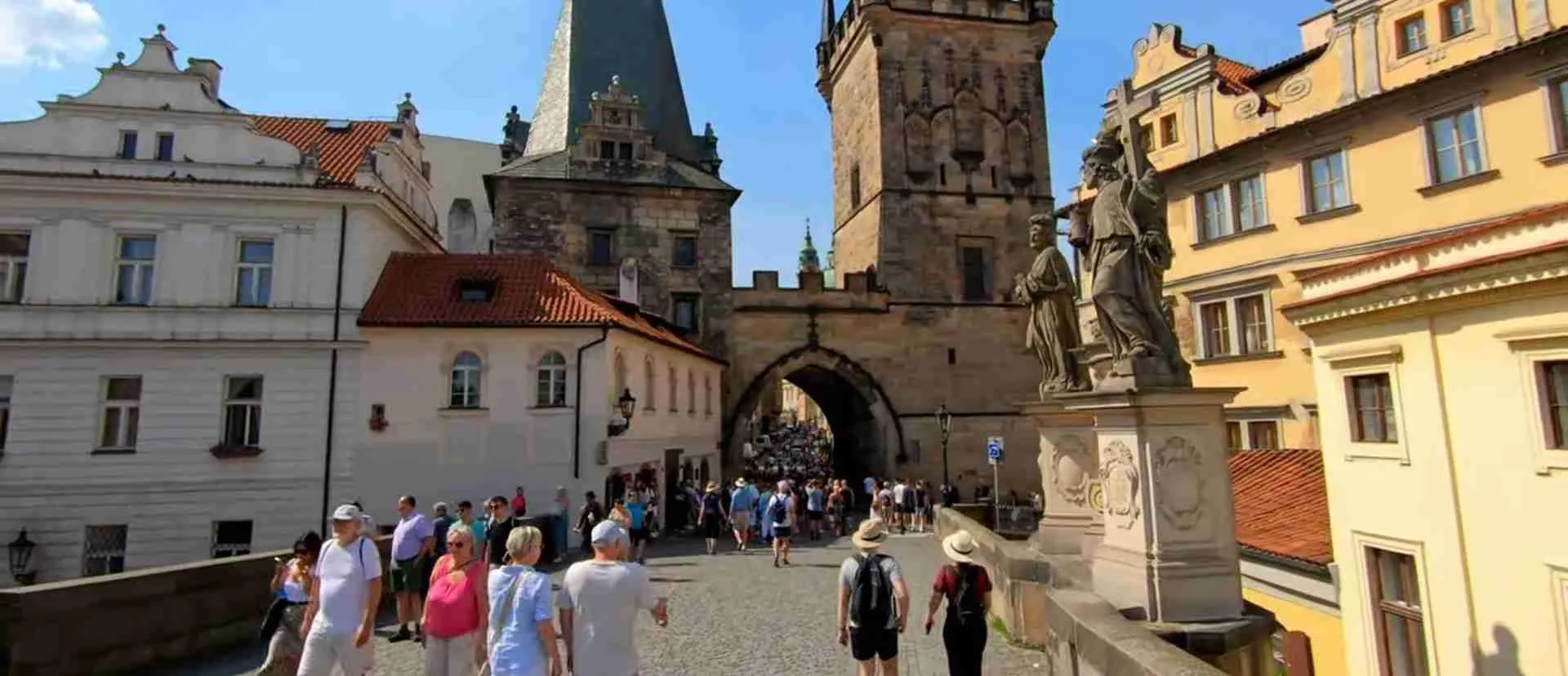
Karlova Street emerges at Charles Bridge (Karlův most), Prague’s iconic 14th-century stone crossing adorned with 30 Baroque statues. Walk the 516-meter span slowly to appreciate each statue’s artistic detail and capture views of Prague Castle, the Vltava River, and riverside architecture. The bridge experience peaks during early morning (6-7 AM) when empty of crowds or late evening (8-9 PM) when illuminated and romantic. Cross to the Lesser Town side, then return via the same route or continue to Malá Strana routes for extended exploration.
Old Town Hidden Gems and Detours for 2026
Several worthwhile detours branch from the main Old Town route without significant time addition. The Estates Theatre (2 blocks south of Old Town Square) hosted Mozart’s Don Giovanni premiere in 1787 and maintains original 18th-century interiors viewable during guided tours. Ungelt courtyard (behind Týn Church) offers a peaceful medieval trading center transformed into galleries and cafes, accessible through narrow passages marked by discreet entrances. The Klementinum complex (near Charles Bridge approach) contains the Baroque Library Hall and Astronomical Tower with extraordinary views, though entry requires advance tickets (€10-15, check klementinum.com for availability).
The Old Town also conceals exceptional examples of cubist architecture along Celetná Street and surrounding blocks, including the House of the Black Madonna museum showcasing this uniquely Czech modernist movement. Small churches like St. James (Kostel sv. Jakuba) provide free entry to stunning Baroque interiors far less crowded than major attractions, while narrow side streets like Jilská or Melantrichova reveal authentic Prague atmosphere away from tourist flows. Budget 30-45 minutes for each significant detour, or simply wander these areas spontaneously when main route crowds become overwhelming.
Castle District Walking Route 2026: Royal Heights
Route Overview and Timing for 2026
The Castle District route spans 4 kilometers with 150 meters elevation gain across 3-4 hours, combining Lesser Town’s Baroque palaces with Prague Castle’s vast complex. This route demands moderate fitness for sustained uphill walking via staircases and ramps, though a funicular alternative (€1.50, included in public transport tickets) eliminates most climbing. Morning timing (8-9 AM) provides optimal castle visit conditions before peak crowds, while afternoon walks (2-3 PM) capture better lighting for riverside photography during descent. The route’s second half through Castle District gardens offers exceptional panoramic views justifying the physical effort required to reach these elevated perspectives.
Detailed Castle District Route for 2026
Begin at Lesser Town Square (Malostranské náměstí) beneath the green dome of St. Nicholas Church, a Baroque masterpiece with extraordinary frescoed interior (entrance €4-6, check stnicholas.cz for current prices). Walk uphill via Nerudova Street, a steep medieval lane preserving original house signs like the Three Fiddles, Golden Horseshoe, and White Swan that identified buildings before numerical addresses. The 15-minute climb passes antique shops, traditional pubs, and narrow side passages revealing hidden gardens and courtyards. Alternative routes via the Old Castle Stairs provide slightly gentler grades but sacrifice Nerudova’s atmospheric architecture.
Enter Prague Castle (Pražský hrad) through the main western gate where the Changing of the Guard ceremony occurs hourly from 7 AM to 8 PM. The castle complex requires 2-3 hours for comprehensive exploration, with entrance circuits costing €10-16 per person in 2026 depending on included areas (check hrad.cz for current ticket options and pricing). Essential stops include St. Vitus Cathedral’s Gothic splendor, the Old Royal Palace’s Vladislav Hall with remarkable ribbed vaulting, and Golden Lane’s tiny medieval houses where castle craftsmen once lived and worked. Photography enthusiasts should budget extra time in the castle gardens offering unobstructed city views across red-tiled rooftops to the Vltava River.
Exit the castle via the eastern gardens, descending through terraced Renaissance and Baroque landscapes to Malá Strana. The descent via the Old Castle Stairs or Thunovská Street provides continuously changing perspectives of the castle’s massive fortifications and surrounding neighborhoods. Complete the route at Kampa Island, a riverside park with galleries, cafes, and the famous John Lennon Wall covered in graffiti tributes. The wall’s constantly changing artwork makes each visit unique, while Kampa’s position below Charles Bridge offers unusual upward perspectives of the iconic crossing.
Castle District Extended Options for 2026
The Strahov Monastery complex (1 kilometer west of the main castle) rewards additional walking with its extraordinary Baroque libraries, brewery, and elevated viewpoints over Prague. The 20-minute extension from the castle follows scenic pathways through wooded areas, though the route involves more uphill climbing suitable for energetic walkers. The monastery’s Theological and Philosophical Libraries rank among Europe’s most beautiful (entrance €10-12, check strahovskyklaster.cz for details), while the brewery serves traditional Czech lunch in a historic setting with castle views.
The Petřín Tower (1.2 kilometers south of the castle) provides an alternative descent route through parks and gardens to Lesser Town. This 60-meter observation tower (entrance €5-7) mimics Paris’s Eiffel Tower design on a smaller scale, offering 360-degree views after climbing 299 steps. The surrounding Petřín Hill contains mirror maze, rose gardens, and peaceful walking paths away from tourist concentrations, making this extension ideal for families or those seeking respite from intense sightseeing. A funicular railway (€1.50, standard public transport ticket) connects Petřín to Lesser Town for those wanting viewpoint access without extensive additional walking.
Jewish Quarter Walking Tour 2026: Heritage Trail
Route Overview and Timing for 2026
The Jewish Quarter (Josefov) route covers 2 kilometers across 2-3 hours, exploring Central Europe’s best-preserved historical Jewish district with six synagogues and the haunting Old Jewish Cemetery. This compact area demands careful timing as synagogue tickets cost €15-20 per person in 2026 with timed entry slots that sell out weeks ahead (reserve at jewishmuseum.cz for guaranteed access). Morning walks (9-10 AM) combine with synagogue opening times, while afternoon timing allows flexible museum visits without schedule pressure. The flat terrain and dense concentration of significant sites make this Prague’s most historically intense walking route requiring emotional preparation for Holocaust memorial spaces.
Detailed Jewish Quarter Route for 2026
Start at the Spanish Synagogue near Old Town Square, a stunning Moorish-revival building with intricate Islamic-inspired decorations covering every interior surface. The synagogue houses exhibitions on Czech Jewish history from emancipation through the Holocaust, providing essential context for understanding the quarter’s significance. Walk north along Pařížská Street, Prague’s luxury boulevard lined with designer boutiques and Art Nouveau architecture, to reach the Old-New Synagogue (Staronová synagoga), Europe’s oldest active synagogue dating to 1270. The Gothic interior maintains medieval prayer arrangements with separate sections, 12th-century Hebrew inscriptions, and legends about the golem created by Rabbi Loew.
The adjacent Old Jewish Cemetery (Starý židovský hřbitov) creates Prague’s most moving memorial space with 12,000 gravestones layered across centuries in just 0.5 hectares. The cemetery operated from 1439-1787 when Jewish burials were restricted to this small area, resulting in multiple burial layers reaching 12 bodies deep in places. Weathered Hebrew inscriptions and symbolic carvings reward close observation, though respectful behavior is mandatory given the sacred nature of this space. The attached Klaus Synagogue houses exhibitions on Jewish burial customs and lifecycle ceremonies providing cultural context.
Complete the route at the Pinkas Synagogue, transformed into a Holocaust memorial with walls inscribed with 77,297 names of Czech Holocaust victims. The synagogue’s upper floor displays drawings by children imprisoned at Terezín concentration camp, creating a profoundly emotional experience that contextualizes the Jewish Quarter’s historical significance. Budget additional time for reflection here as many visitors find this memorial deeply affecting and requiring quiet contemplation before continuing Prague explorations.
Jewish Quarter Cultural Context for 2026
The Jewish Quarter walking route benefits from understanding Prague’s Jewish history spanning 1,000 years from medieval settlement through 20th-century devastation and recent revival. The quarter’s current appearance dates primarily to late 19th-century redevelopment when most medieval buildings were demolished, though the synagogues and cemetery were preserved. This destruction ironically saved the religious structures from Nazi plans to create a “Museum of an Extinct Race,” as Hitler intended to document Jewish culture in Prague while eliminating Jewish people across Europe. The quarter survived the war with most artifacts intact, creating today’s extraordinary museum complex.
Contemporary Jewish life in Prague remains modest with approximately 1,600 Jews currently living in the city, compared to 50,000 before World War II. Several kosher restaurants and Jewish cultural centers have emerged since 1989, though the quarter functions primarily as a memorial and museum space rather than a living neighborhood. Visiting during Jewish holidays or attending Sabbath services at the Old-New Synagogue provides glimpses of continuing religious practice, though tourism dominates the quarter’s current character.
Lesser Town Walking Route 2026: Baroque Beauty
Route Overview and Timing for 2026
The Lesser Town (Malá Strana) route spans 3 kilometers across 2.5-3 hours through Prague’s most cohesive Baroque district, featuring palace gardens, historic churches, and riverfront promenades. This route involves moderate uphill walking in the initial section followed by gentle riverside strolls, suitable for most fitness levels with optional rest stops in numerous gardens and cafes. Afternoon timing (2-4 PM) provides optimal lighting for golden-hour photography along the Vltava, while evening walks (6-8 PM) capture illuminated bridge views and romantic atmosphere around Lesser Town Square. The route’s abundance of hidden gardens offers peaceful respites from Old Town’s intense tourist activity.
Detailed Lesser Town Route for 2026
Begin at Charles Bridge’s Lesser Town (west) end where the bridge towers frame views back toward Old Town. Descend to Kampa Island via stairs beside the towers, exploring this riverside park with John Lennon Wall, historic water mills, and sculpture installations. The island’s southern tip provides exceptional Charles Bridge perspectives unavailable from standard viewpoints, making it a prime photography location during morning or evening golden hours. Several cafes along Kampa’s embankment offer outdoor seating with castle views, creating ideal break points before continuing uphill into Lesser Town proper.
Walk north through Kampa to Lesser Town Square (Malostranské náměstí), pausing to photograph the Baroque St. Nicholas Church dome that dominates Prague’s skyline. The church interior (entrance €4-6) ranks among Prague’s most spectacular Baroque spaces with illusionistic ceiling frescoes, elaborate stucco decorations, and massive organ. Continue up Nerudova Street toward the castle, but detour through side streets like Tržiště or Karmelitská to discover palace courtyards, antique shops, and traditional pubs unchanged since the 19th century. These atmospheric lanes preserve authentic Prague character away from primary tourist routes.
Return to the riverfront via Valdštejnská Street, stopping at Wallenstein Palace and Gardens (Valdštejnský palác a zahrada), a massive early Baroque complex with formal gardens, peacocks, artificial cave, and outdoor concerts during summer. The gardens open free to visitors providing peaceful green space in the heart of Lesser Town. Walk south along the riverside promenade (náplavka) toward the National Theatre, enjoying continuous castle views across the Vltava and passing numerous river cafes and restaurants. This section provides Prague’s most scenic relaxed walking with minimal vehicle traffic and abundant benches for rest stops.
Lesser Town Hidden Courtyards and Gardens 2026
Lesser Town conceals dozens of palace gardens and courtyards accessible through discreet doorways along main streets. The Vrtba Garden (entrance €4-5) offers a terraced Baroque masterpiece with sculptures, fountains, and elevated views across red rooftops to the castle. Vojan Gardens provide free entry to a wilder, less manicured green space with fruit trees, historic chapels, and local residents walking dogs in peaceful afternoon tranquility. Ledeburg Gardens combine with other palace gardens to create a connected network of terraced landscapes climbing toward the castle, though some require separate entrance fees (€5-8) or seasonal opening restrictions.
Discovering these hidden spaces requires curiosity and willingness to push open unmarked doors in palace walls. Many courtyards and gardens connect through interior passages creating unexpected shortcuts between parallel streets. The randomness of these discoveries often produces Prague’s most memorable moments, as you stumble upon secret fountain courtyards, hidden Baroque chapels, or gallery spaces unknown to guidebooks and standard tourist routes. Budget flexible time for these spontaneous explorations that cannot be predicted or perfectly planned in advance.
Modern Prague Walking Tour 2026: 20th Century Architecture
Route Overview and Timing for 2026
The modern Prague route covers 4.5 kilometers across 3 hours, showcasing Art Nouveau masterpieces, Cubist experiments, and functionalist buildings that make Prague a 20th-century architecture capital. This route requires more dispersed walking between sites compared to the concentrated historic center routes, with longer street segments connecting individual buildings. Morning timing works well for photography capturing building details, while afternoon walks benefit from museum openings if including interior visits. The route appeals particularly to architecture enthusiasts and those seeking Prague experiences beyond medieval-Baroque tourist concentration, though it demands more navigation attention across broader city areas.
Detailed Modern Prague Route for 2026
Begin at Wenceslas Square (Václavské náměstí), Prague’s commercial boulevard lined with Art Nouveau and early modern buildings including the Wiehl House with elaborate sgraffito decorations. The square’s modern history includes the 1968 Prague Spring demonstrations and 1989 Velvet Revolution, making it symbolically significant beyond architectural interest. Walk to the Grand Hotel Europa (halfway down the square’s east side), Prague’s most photogenic Art Nouveau building with ornate facade details, original interior, and ground-floor cafe preserving 1905 decorative schemes.
Continue to the Municipal House (Obecní dům) at Republic Square, Prague’s Art Nouveau masterpiece featuring Alfons Mucha interior decorations, magnificent concert hall, and elaborate facade sculptures. The building offers guided tours (€10-15, book at obecnidum.cz) showcasing mayor’s hall, ceremonial rooms, and Mucha’s original artwork. Adjacent to the Municipal House stands the Powder Tower marking the transition between medieval and modern Prague architecture. Walk northeast to explore Prague’s Cubist district around Celetná Street and Dlouhá třída, where the House of the Black Madonna contains a Cubist museum and period cafe reconstructed in angular style.
The route extends to Holešovice district (3 kilometers north, reachable by tram or extended walk) to see the Veletržní Palace housing the National Gallery’s modern art collection in a 1920s functionalist building. This extension adds 1-1.5 hours but rewards architecture enthusiasts with one of Europe’s finest functionalist structures. Return to central Prague via the riverfront for Ginger and Fred building (Dancing House) views, a controversial 1990s deconstructivist design by Frank Gehry and Vlado Milunić that sparked debates about appropriate contemporary architecture in historic Prague.
Art Nouveau Prague Details for 2026
Prague’s Art Nouveau heritage extends beyond major landmarks to include hundreds of apartment buildings, shops, and details throughout the historic center and surrounding districts. The Josefov quarter contains exceptional examples along Pařížská Street where early 20th-century redevelopment created uniform Art Nouveau boulevards. Look upward to catch decorative elements at upper floor levels: floral motifs, female figures, geometric patterns, and elaborate wrought iron balconies that distinguish individual buildings within similar overall styles.
Alfons Mucha’s influence appears throughout Prague beyond the Municipal House, with posters, stained glass windows, and decorative schemes in unexpected locations. The St. Vitus Cathedral contains Mucha’s extraordinary Art Nouveau stained glass window depicting Slavic saints in his characteristic flowing style. Several galleries sell Mucha reproductions and original prints for those wanting tangible connections to Prague’s Art Nouveau movement. The artist’s former studio in the Hradčany district occasionally opens for special exhibitions providing insights into his working methods and philosophy.
Sample 2026 Walking Itineraries: Complete Daily Plans
Day 1: Essential Prague Walking Itinerary 2026
Begin at Powder Tower at 8 AM for an early start avoiding peak crowds. Walk the Old Town route to Charles Bridge (2.5 hours including brief stops), appreciating the Astronomical Clock, Týn Church, and medieval street atmosphere. Coffee break €3-5 at a cafe near Old Town Square provides energy for continued walking. Cross Charles Bridge photographing from both sides, then climb to Prague Castle via Nerudova Street (1 hour uphill walk). Castle exploration requires 2-3 hours with entrance €10-16, depending on selected circuit (check hrad.cz for current official rates as pricing may vary). Lunch inside the castle complex or in Lesser Town costs €12-18 for traditional Czech cuisine.
Afternoon descent through castle gardens to Lesser Town allows relaxed photography of cityscape views. Explore Kampa Island and John Lennon Wall before evening rest at your accommodation. Return to Old Town for dinner €15-25 and evening Charles Bridge photography at sunset (timing varies from 4:30 PM in December to 9 PM in June). Prague beer €3-4, water €2-3, ice cream €3-5. Total day cost: €48-78 per person (excluding accommodation).
Day 2: Deep Dive Walking Itinerary 2026
Start at Lesser Town Square at 9 AM, exploring St. Nicholas Church interior €4-6 and surrounding Baroque streets. Walk through Wallenstein Gardens (free entry) and discover hidden palace courtyards along Tržiště and Nerudova Streets (2 hours). Mid-morning coffee €3-4 in a traditional cafe provides rest before Jewish Quarter exploration. Walk to Josefov via Charles Bridge, arriving at synagogue complex by 11 AM with pre-booked tickets €15-20 (reserve at jewishmuseum.cz). The Jewish Quarter route requires 2-3 hours for comprehensive synagogue visits and Old Jewish Cemetery contemplation.
Lunch in Jewish Quarter or Old Town costs €12-20 for mid-range restaurants. Afternoon free walking through Old Town’s side streets and hidden courtyards exploring areas missed on Day 1’s faster pace. Visit Church of Our Lady Before Týn (free entry) and climb Old Town Hall Tower €13 for panoramic views if weather permits. Dinner in Old Town €20-30 with evening stroll along riverfront promenade. Refreshments €5-8, snacks €4-6. Total day cost: €76-107 per person (excluding accommodation).
Day 3: Extended Walking Itinerary 2026
Morning walking tour of modern Prague beginning at Wenceslas Square at 9 AM. Explore Art Nouveau buildings including Grand Hotel Europa and walk to Municipal House for 10:30 AM guided tour €10-15 (book ahead at obecnidum.cz). The tour lasts 1.5 hours showcasing Alfons Mucha interiors. Coffee break €3-5 in the Municipal House cafe maintains period atmosphere. Afternoon choice: either continue modern architecture route to Holešovice (additional 2-3 hours) or return to favorite historic center areas for relaxed re-exploration and shopping.
Alternative afternoon: Petřín Hill walking tour via funicular €1.50 (included in public transport pass), exploring Petřín Tower €5-7, mirror maze €3-4, and gardens with castle views. Descent through Petřín parks to Lesser Town provides peaceful walking away from tourist crowds. Early dinner €15-25 allows evening free time or concert attendance if desired. Municipal House tour, funicular, Petřín attractions, meals, refreshments. Total day cost: €53-80 per person (excluding accommodation).
Three-Day Walking Summary 2026
The complete three-day walking experience covers all essential Prague routes with flexibility for personal interests and energy levels. Total walking distance spans approximately 18-20 kilometers across the three days at comfortable pace with abundant break opportunities. Combined costs for all three days including entrance fees, meals, refreshments, and minimal transport total €177-265 per person (excluding accommodation), making walking tours Prague’s most economical comprehensive exploration method. The itineraries allow modifications based on weather, with indoor alternatives (synagogues, Municipal House, museums) available during rain and outdoor routes preferred during sunny conditions.
Navigation and Planning Tips 2026
Smartphone Apps and Digital Resources for 2026
Download Google Maps offline for the entire Prague area before your visit ensuring navigation capability without international data charges. The app works reliably throughout the historic center with accurate walking directions and transit integration. Prague Public Transport app (PID Lítačka) provides real-time tram and metro information useful when combining walking with occasional public transport for longer distances. Apple Maps offers similar functionality for iOS users with comparable accuracy in Prague’s urban environment.
Specialized walking tour apps include “Prague – Audio Guide & Map” providing neighborhood-specific historical commentary and suggested routes, though sound quality varies. The official Prague City Tourism app offers maps, event listings, and practical information updated regularly for current conditions. Rick Steves Audio Europe provides free downloadable walking tours following his guidebook routes with enthusiastic commentary, though routes occasionally miss recent changes or hidden gems discovered through independent exploration. Battery management becomes critical when using navigation constantly, requiring portable chargers or conservative screen-on time to ensure full-day capability.
Paper Maps and Traditional Navigation 2026
Free paper maps available at Prague Visitor Center (Old Town Square), hotels, and major attractions serve as excellent backups when phone batteries drain or data becomes unavailable. The compact historic center’s intuitive layout makes paper map navigation straightforward with the Vltava River, Prague Castle, and prominent church spires providing constant orientation references. Offline maps photographed on your phone before leaving WiFi areas offer compromise between paper and digital navigation, accessible without data usage.
Learning basic Czech place name terms aids navigation: “náměstí” (square), “ulice” (street), “most” (bridge), “kostel” (church), “zahrada” (garden). Street signs appear in Czech only in most locations, though tourist area signage increasingly includes English. The historic center’s small scale means getting lost rarely creates serious problems, as wandering inevitably leads back to recognizable landmarks within 10-15 minutes of random walking.
Walking Safety and Comfort 2026
Prague ranks among Europe’s safest cities with minimal violent crime, though pickpocketing concentrates in crowded tourist areas including Charles Bridge, Old Town Square during clock performances, and Metro stations. Wear backpacks on front in dense crowds, keep phones and wallets secured in interior pockets, and maintain awareness of surroundings in crowded spaces. Scams targeting tourists remain rare compared to other European capitals, though some taxi drivers and currency exchange offices near major attractions charge inflated rates easily avoided through standard precautions.
Walking comfort requires appropriate footwear for cobblestone streets that cause ankle fatigue after several hours. Break in new shoes before your Prague visit to prevent blisters during extended walking days. Layered clothing allows adaptation to temperature changes as you move between sunny squares and shaded narrow streets, climb to exposed castle viewpoints, or enter heated interiors during winter. Water bottle refills are available at public fountains and cafes throughout the historic center, though purchasing bottled water (€1.50-2.50) remains convenient for sustained hydration during summer walking.
Money-Saving Strategies for 2026 Walking Tours
Free Walking Experiences in Prague 2026
The majority of Prague’s best walking experiences cost nothing beyond basic refreshments. Walking through Old Town streets, crossing Charles Bridge, photographing exterior architecture, exploring Kampa Island, and discovering hidden courtyards provides exceptional Prague experiences without entrance fees. Free-entry churches include St. James (Kostel sv. Jakuba), Church of Our Lady Before Týn (limited hours), and numerous smaller chapels throughout historic districts. Public gardens like Wallenstein Gardens, Vojan Gardens (small donation requested), and Letná Park offer green spaces and viewpoints accessible without tickets.
The John Lennon Wall, astronomical clock exterior views, Royal Route streets, and riverfront promenades create comprehensive Prague understanding without paid attractions. Photography enthusiasts can document extraordinary architecture entirely from public spaces, while culture seekers absorb Prague’s atmosphere through observation and wandering rather than museum visits. A complete day of quality Prague walking experiences costs only €10-15 for refreshments and possible tram tickets, making this the city’s most budget-friendly exploration approach.
Discount Strategies for Walking Tour Attractions 2026
Prague’s major attractions offer various discount schemes applicable to walking tour planning. Students with valid ISIC cards receive 25-50% discounts at most paid sites including Prague Castle, synagogues, and museum towers. Families benefit from combined tickets at Prague Castle (adult + children discounts) and Jewish Quarter (family packages). Seniors over 65 receive modest discounts at many attractions though requirements vary by site, requiring passport proof of age.
Advance online booking typically costs the same as on-site purchases but guarantees entry during busy periods when tickets sell out. The Prague Card tourist pass combines attraction entries with public transport, though careful calculation shows most walking-focused visitors save money through individual ticket purchases rather than comprehensive passes. Focus spending on genuinely unique experiences (Prague Castle, Jewish Quarter) while skipping optional paid viewpoints that duplicate free perspectives available elsewhere in the compact city center.
Budget Food and Refreshment Strategies 2026
Walking tour food costs can escalate quickly in tourist-focused restaurants around Old Town Square and Charles Bridge where meals cost €15-25 per person. Walk 2-3 blocks away from major landmarks to find local-oriented restaurants charging €8-15 for identical Czech cuisine. Bakeries (pekárna) throughout the historic center sell fresh pastries, sandwiches, and coffee for €3-6 total, creating economical breakfast or snack options during walking routes. Supermarkets near Wenceslas Square or in residential areas beyond the tourist core offer picnic supplies at normal Czech prices (€5-10 for complete lunch) rather than inflated tourist rates.
Water fountains appear throughout Prague’s historic center providing free refills for reusable bottles, eliminating need to purchase €2-3 bottled water multiple times daily. Czech beer costs less than soft drinks in most pubs (€3-4 for 0.5L beer vs €4-5 for Coca-Cola), creating economical beverage strategy for those who drink alcohol. Avoid restaurants with English menus posted outside facing main tourist routes, as these consistently charge 30-50% more than Czech-language establishments one street over serving identical food to local customers and budget-conscious visitors.
2026 Walking Tour Updates and Current Information
Infrastructure Improvements for 2026
Prague continues enhancing pedestrian infrastructure throughout the historic center with expanded car-free zones, improved crosswalk safety, and better tactile paving for accessibility. The Old Town Square area benefits from recent repaving projects creating smoother surfaces while maintaining historical cobblestone character. New wayfinding signage in English appears at major intersections helping international visitors navigate without constant phone reference. Public restroom facilities have expanded near major attractions, though fees remain standard (€1-1.50 per use).
Free WiFi coverage extends across most major squares, parks, and public spaces allowing real-time navigation and information access throughout walking routes. The Prague Public Transport system has enhanced its English-language services making occasional tram or metro rides easier for visitors combining walking with efficient transit connections. Bike lane networks continue expanding, though walking remains the preferred exploration method in the dense historic core where cycling offers marginal advantages over pedestrian mobility.
Seasonal Considerations for 2026 Walking
Summer 2026 (June-August) brings peak tourist crowds making early morning walking essential for comfortable Old Town and Charles Bridge experiences. Temperatures reach 25-30°C creating pleasant conditions for extended walking, though afternoon thunderstorms occur 2-3 times weekly requiring rain jacket preparation. Tourist concentrations mean shoulder season months (April-May, September-October) provide optimal walking conditions with 15-20°C temperatures, fewer crowds, and reliable weather for uninterrupted outdoor exploration.
Winter walking (December-February) faces challenges from freezing temperatures (-2 to 5°C), occasional snow and ice on cobblestones, and early darkness (sunset by 4 PM December). However, winter offers atmospheric lighting, fewer tourists, and special Christmas market routes through Old Town and Wenceslas Square. Spring and autumn shoulder seasons balance comfortable walking conditions with moderate crowds, making these periods ideal for photography-focused visitors and those seeking authentic interactions with local Prague beyond tourist service industry.
Booking and Planning Timeline for 2026
Self-guided walking requires minimal advance planning compared to organized tours, though certain attractions benefit from early preparation. Book Prague Castle tickets 1-2 weeks ahead during peak summer months ensuring guaranteed entry and avoiding long on-site queues. Jewish Quarter synagogue tickets sell out 2-4 weeks ahead in summer requiring advance online purchase for specific time slots. Municipal House guided tours book 1-3 weeks ahead depending on season, while most churches, towers, and viewpoints accommodate walk-up visitors except during rare special events.
Download offline maps, walking apps, and audio guides 1-2 days before your first walking day ensuring content availability without WiFi dependence. Check weather forecasts the evening before each walking day allowing appropriate clothing choices and possible route reordering if rain threatens specific outdoor-focused itineraries. Restaurant reservations remain unnecessary for casual lunches during walking routes, though dinner reservations at popular establishments in Lesser Town or Old Town should be made 1-3 days ahead during peak season to avoid disappointment or long waits.
Frequently Asked Questions About Prague Walking Tours 2026
Is Prague’s historic center walkable in one day?
Prague’s essential highlights can be walked in one intensive day covering Old Town, Charles Bridge, and Castle District across 8-10 hours of continuous movement with brief stops. However, this rushed pace sacrifices the atmospheric appreciation, hidden courtyard discoveries, and photography opportunities that make Prague special. Most visitors prefer spreading walks across 3-4 days allowing 3-4 hours of walking per day with ample time for meals, attraction visits, and spontaneous explorations. The compact scale means you can easily return to areas multiple times for different lighting conditions or to revisit favorite spots discovered during initial walks.
What are the best walking shoes for Prague’s cobblestones?
Sturdy sneakers or walking shoes with cushioned soles and good ankle support work best for Prague’s cobblestone streets. Avoid flat-soled ballet flats, flip-flops, or formal dress shoes that provide inadequate cushioning causing foot fatigue after 2-3 hours on uneven stones. Waterproof hiking shoes or walking boots serve well for winter visits when snow and ice create slippery conditions, though full hiking boots are excessive for flat Old Town routes. Break in any new shoes 2-3 weeks before your Prague visit to prevent blisters during extended walking days. Many visitors bring two comfortable shoe options alternating daily to reduce repetitive pressure points on feet.
Can you walk from Old Town to Prague Castle?
Walking from Old Town Square to Prague Castle covers approximately 2 kilometers taking 30-40 minutes at moderate pace without stops. The route crosses Charles Bridge, traverses Lesser Town, then climbs to the castle via Nerudova Street or alternative staircases. The walk involves approximately 100 vertical meters elevation gain concentrated in the final 15 minutes approaching the castle, requiring moderate fitness though not excessively strenuous for healthy adults. Alternatives include tram 22 from Lesser Town (Malostranská station) directly to castle gates, or the Petřín funicular providing partial elevation assistance.
Is Prague safe for solo walking tourists in 2026?
Prague ranks among Europe’s safest capitals for solo travelers with minimal violent crime and generally respectful local population. Women walking alone face no greater harassment than major Western European cities, though standard precautions (avoiding deserted areas late at night, staying aware of surroundings) apply universally. Pickpocketing concentrates in crowded tourist areas, easily managed through secure bag carrying and pocket awareness. Solo travelers comfortably explore all walking routes described in this guide during daylight hours, while evening walks through well-lit historic center streets remain safe until 10-11 PM. Emergency phone number 112 works throughout Czech Republic for any assistance needs.
Do Prague walking tours operate in rain or winter?
Self-guided walking continues year-round in all weather conditions as you control timing and route flexibility. Rain does not significantly diminish Prague’s beauty, though it makes cobblestones slippery and limits photography quality. Many walkable attractions include covered arcades, churches, and museums providing weather breaks during rainy periods without completely abandoning outdoor exploration. Winter walking offers atmospheric lighting and fewer crowds despite cold temperatures and early darkness. Snow-covered Prague creates postcard scenery, though icy cobblestones require careful footing and waterproof boots. Organized walking tours (free tours, specialized theme tours) operate year-round though winter departure times adjust for earlier sunset.
How much walking is too much in Prague?
Most visitors comfortably manage 8-12 kilometers of walking per day across 3-4 hours of movement spread throughout the day with meal breaks and sitting rests. Exceeding 15 kilometers daily often creates fatigue that diminishes appreciation for architectural details and atmosphere in subsequent days. Listen to your body’s signals, take sitting breaks every 60-90 minutes, and adjust plans if feet or legs become excessively sore. The compact city center means you can easily return to your accommodation for midday rest then resume walking in late afternoon or evening. Trams and metro provide efficient connections for occasionally resting feet while moving between distant areas.
What is the flattest walking route in Prague?
The Old Town and riverfront routes provide Prague’s flattest walking with minimal elevation change. Walking from Powder Tower through Old Town Square to Charles Bridge, then along the riverfront to National Theatre spans 4 kilometers on completely flat terrain suitable for limited mobility visitors, families with strollers, and those avoiding uphill exertion. Wenceslas Square to Old Town Square offers another flat route connecting major areas without climbing. Only the Castle District requires significant uphill walking, easily avoided or minimized through tram access to castle gates then flat exploration of the complex itself.
Are Prague walking tour maps available in English?
Free English-language maps are widely available at Prague Visitor Centers (Old Town Square, Airport, Main Train Station), hotels, and major attractions. These maps mark primary walking routes, major landmarks, and public transport connections with sufficient detail for general navigation. Commercial guidebook maps (Lonely Planet, Rick Steves, DK Eyewitness) provide more detailed street information and suggested walking routes for purchase at bookstores. Digital alternatives include screenshots of Google Maps areas, offline map apps like Maps.me, and specialized Prague tourism apps all offering English interface and content.
How early should you start Prague walking tours?
Starting walks at 7-8 AM provides optimal conditions across all seasons: fewer crowds at major attractions, better photography lighting, cooler summer temperatures, and ability to secure preferred positions at Astronomical Clock performances before tour groups arrive. Old Town, Charles Bridge, and Castle District all reward early access before 9 AM when tour buses discharge crowds. However, Jewish Quarter synagogues don’t open until 9 AM, Municipal House tours start at 10 AM, and some churches delay opening until mid-morning, requiring timing coordination with opening hours. Evening walks starting 5-6 PM capture golden hour lighting and illuminated architecture while avoiding midday tourist peaks.
Can families with children complete Prague walking tours?
Families successfully complete Prague walking routes with age-appropriate modifications. The flat Old Town route suits all ages with frequent café stops and engaging architecture children enjoy photographing. Charles Bridge walking entertains kids with street performers and statue hunting activities. Castle District routes require more planning as uphill walking and lengthy cathedral visits may bore young children, though castle grounds include play areas and gardens providing active breaks. Breaking walks into 60-90 minute segments with playground stops, ice cream breaks, and interactive activities maintains children’s engagement. Stroller-friendly routes exist throughout flat Old Town and riverfront areas, while Baby carrier backpacks work better for Castle District terrain.
FAQ: Prague Walking Tours & Routes 2026
How long does it take to walk around Prague city center?
Walking the complete perimeter of Prague’s historic center covers approximately 8 kilometers requiring 2.5-3 hours at moderate pace without stops. Comprehensive exploration of all major sites across multiple routes requires 12-15 hours total walking time spread across 3-4 days.
Is it better to walk Prague clockwise or counterclockwise?
No optimal direction exists as Prague’s star-shaped layout centers on Old Town Square rather than following circular patterns. Most visitors naturally walk from Old Town toward the castle (west), then return via alternative routes exploring Lesser Town and riverfront areas.
What is the most scenic walking route in Prague?
The Castle District descent through gardens to Kampa Island provides Prague’s most continuously scenic walk with castle fortifications, terraced gardens, Baroque palaces, river views, and Charles Bridge perspectives across 2 kilometers of varied terrain.
Can you see Prague Castle from walking routes?
Prague Castle remains visible from most historic center locations due to its elevated position and massive size. Optimal viewing points include Charles Bridge, Petřín Hill, Letná Park, and Old Town riverfront providing complete castle complex perspectives.
Are guided walking tours worth it in Prague?
Guided tours provide historical context and access to some restricted areas, though Prague’s excellent signage, compact layout, and abundant free information make self-guided walking equally rewarding for independent travelers. Specialized tours (underground spaces, Communist architecture, Jewish heritage) offer expertise unavailable through independent exploration.
How many steps do you walk climbing to Prague Castle?
The primary routes to Prague Castle involve approximately 200-300 steps across various staircases and ramps depending on the chosen path. Alternative routes via tram 22 eliminate most climbing, while the gentlest walking route via Chotkovy sady gardens reduces stair count significantly.
What should you bring on Prague walking tours?
Essential items include comfortable broken-in shoes, reusable water bottle, smartphone with offline maps, portable charger, small backpack, weather-appropriate layers, rain jacket, sunscreen in summer, and Czech crowns for small purchases at cash-only locations.
Is Prague more beautiful at sunrise or sunset for walking?
Both timing options offer exceptional beauty with different characteristics. Sunrise (5:30-6:30 AM summer) provides empty streets and soft eastern light illuminating castle and church facades. Sunset (4:30 PM winter, 9 PM summer) creates golden hour warmth across river views with illuminated architecture emerging as natural light fades.