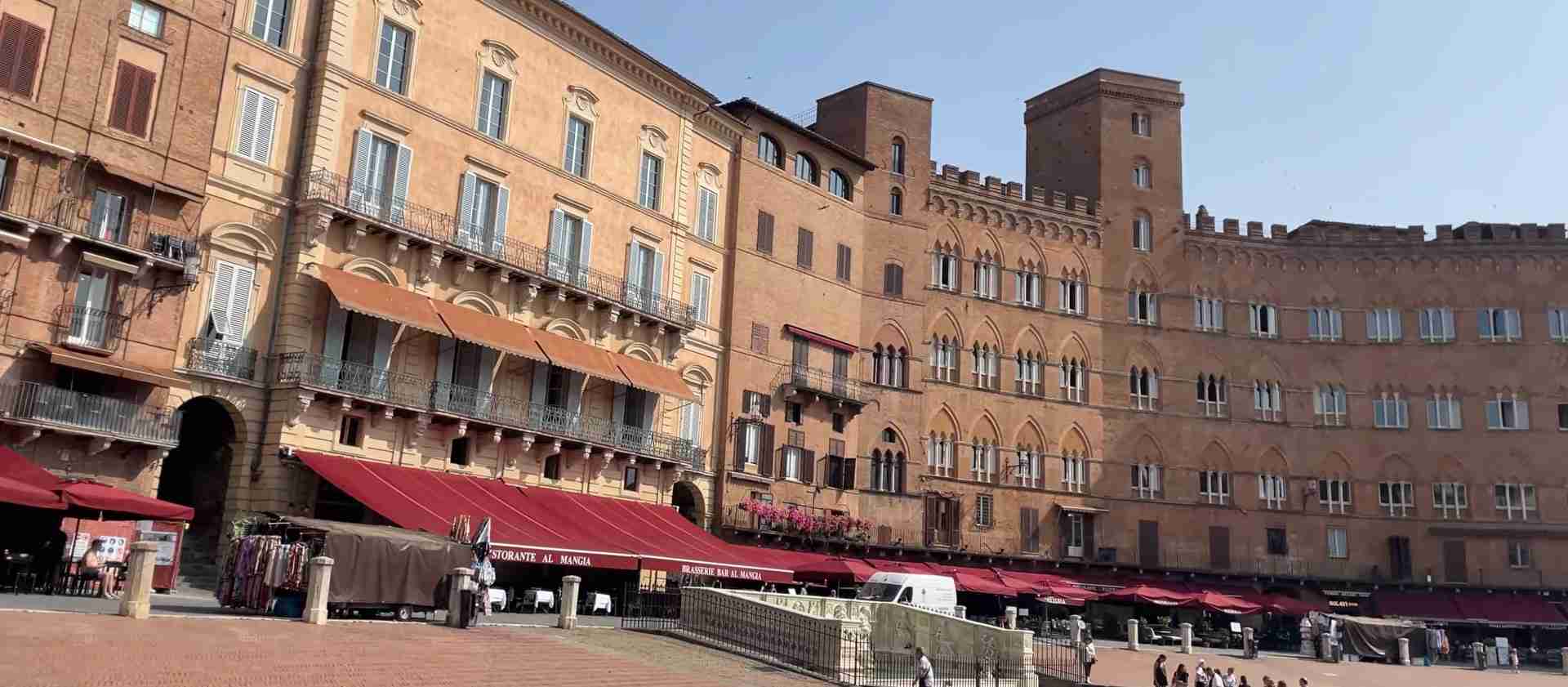
Piazza del Campo & the Palio di Siena Complete Guide 2026: Everything You Need to Know
Piazza del Campo stands as one of Europe’s most magnificent medieval squares, its distinctive shell shape and sloping brick surface creating the arena for the Palio di Siena, Italy’s most legendary horse race. Held twice annually on July 2 and August 16, this centuries-old tradition transforms the UNESCO World Heritage square into a thundering racetrack where bareback riders representing Siena’s 17 contrade (historic neighborhoods) compete for glory, pride, and the hand-painted silk banner that means everything to their communities.
Key Takeaways: Piazza del Campo & Palio 2026
- 2026 Palio Dates: The July Palio (Palio di Provenzano) falls on Wednesday, July 2, 2026, with a 4-day festival from June 29-July 2. The August Palio (Palio dell’Assunta) occurs on Sunday, August 16, 2026, with festivities from August 13-16. Race times are approximately 7:30 PM for July and 7:00 PM for August.
- Free Standing vs. Paid Tickets 2026: Standing in the center of Piazza del Campo is completely free for both the Palio race and trial runs, though entry closes hours before race start and you’ll stand packed shoulder-to-shoulder for 4-6 hours. Paid tickets for grandstand seats, balconies, and windows range €460-1,000 ($485-1,055) depending on location and race date, with July tickets commanding premium prices.
- Booking Requirements 2026: Book Palio tickets 6-12 months in advance for prime locations — popular balcony seats and packages sell out by January for July races, by March for August races. No central box office exists; tickets come from individual property owners, specialized tour operators, or package providers.
- Piazza del Campo Daily Access: The square is free to visit year-round, open 24/7 as a public space. Torre del Mangia (the civic tower) operates 10 AM-7 PM during high season (March-October), 10 AM-4 PM low season, with admission €10-15. Palazzo Pubblico Museo Civico maintains varying hours by season.
- Four-Day Festival Structure: Each Palio is a 4-day event, not just a single race. Day 1 features the horse lottery (tratta) and first trial race. Days 2-3 include additional trial races and contrada dinners. Day 4 brings the historical parade (Corteo Storico) at approximately 5 PM followed by the race 2-3 hours later.
- Beyond the Race 2026: Piazza del Campo serves as Siena’s living room year-round — a free, accessible masterpiece of medieval urban design where locals and visitors gather on the sloping brick surface to picnic, people-watch, and absorb one of Italy’s most atmospheric public spaces regardless of Palio dates.
People Also Ask About Piazza del Campo & the Palio 2026
What Are the Exact Dates for the Palio di Siena in 2026?
The Palio di Siena occurs twice in 2026 on fixed annual dates regardless of day of the week. The July Palio (Palio di Provenzano) honoring the Madonna di Provenzano takes place on Wednesday, July 2, 2026, with the 4-day festival running June 29-July 2. The August Palio (Palio dell’Assunta) celebrating the Assumption of Mary occurs on Sunday, August 16, 2026, with festivities August 13-16. These dates never change year to year — July 2 and August 16 are permanent annual fixtures in Siena’s calendar. Race times are approximately 7:30 PM for the July Palio and 7:00 PM for the August Palio, though exact timing depends on completion of the Corteo Storico historical parade that precedes the race.
How Much Do Palio Tickets Cost in 2026?
Palio tickets for 2026 range from free standing access to premium packages exceeding $15,000. Standing in the center of Piazza del Campo is completely free but requires arriving 6-8 hours before the race and standing packed in crowds for the duration. Paid seating options include: balcony tickets €575-1,000 ($605-1,055) for July Palio, €460-850 ($485-895) for August Palio, depending on viewing location. Grandstand seats range €400-700 ($420-740) with shaded sections commanding higher prices. Private window spaces for 2-4 people cost €800-1,500 ($845-1,580) total. Complete tour packages including hotel accommodation, tickets, contrada dinners, and guided experiences range $298-17,388 per person depending on luxury level and duration. Check official providers for current rates as pricing may vary.
Can You Visit Piazza del Campo When the Palio Isn’t Happening in 2026?
Yes, Piazza del Campo is accessible 365 days a year as a public square with no admission fee. Outside Palio periods, the piazza functions as Siena’s main gathering space where locals and tourists sit on the sloping brick surface, dine at surrounding cafes, and explore the Palazzo Pubblico and Torre del Mangia. The square hosts other events throughout the year including the Mercato nel Campo Christmas market, summer concerts, and various civic celebrations. Visiting outside Palio dates offers the advantage of experiencing the piazza’s architectural beauty and historical significance without overwhelming crowds — you can actually walk freely, photograph from multiple angles, and appreciate details that become impossible during race periods when 40,000+ people pack the space.
How Early Should You Arrive for the Free Standing Area at the Palio 2026?
Plan to arrive at Piazza del Campo by 1-2 PM for the July Palio (7:30 PM race) and 12-1 PM for the August Palio (7:00 PM race) to secure reasonable standing positions in the free center area. The most dedicated spectators arrive as early as 8-10 AM to claim prime central spots with unobstructed views. Access points into the piazza close progressively as capacity fills — typically 2-3 hours before race time when the square reaches maximum safe capacity of approximately 30,000-35,000 standing spectators. Once inside, you cannot leave and re-enter, and no bathroom facilities exist in the center standing area. Bring water, snacks, sun protection, and prepare for 5-7 hours of standing in tightly packed conditions. July races face intense summer heat (often 30-35°C / 86-95°F), while August provides slightly cooler late-afternoon temperatures.
Extended multi-day tours – 5+ days
Featured Siena Multi-Day Tour Packages

3 days
The Essence of Tuscany: Florence & Tuscany in 3 Days
- ✓ Comprehensive Siena tour
- ✓ Expert local guides included
- ✓ All accommodation arranged
- ✓ Transportation provided
3 days
3-Day Tuscany Highlights Tour: Explore Pisa, San Gimignano, Siena, and Florence
- ✓ Booking needs min. 2 travelers
4 days
Siena & Wine
- ✓ Comprehensive Siena tour
- ✓ Expert local guides included
- ✓ All accommodation arranged
- ✓ Transportation provided
6 days
Timeless Tuscany: A Tuscan Villa Experience
- ✓ Comprehensive Siena tour
- ✓ Expert local guides included
- ✓ All accommodation arranged
- ✓ Transportation provided
Multi-day tour packages powered by TourRadar. Prices and availability subject to change.
Understanding Piazza del Campo: Siena’s Shell-Shaped Masterpiece
Piazza del Campo (literally “Field Square,” named for its original use as a green market space) ranks among the most celebrated medieval squares in Europe, its unique fan-shaped design and sloping brick surface creating an urban space unlike any other. The square’s distinctive shell form, divided into nine sections by white travertine stone lines, represents the Council of Nine who governed Siena during its 13th-14th century golden age when the city rivaled Florence as a center of banking, trade, and artistic achievement.
The square’s creation between 1288-1348 was not accidental but the result of strict municipal regulations designed to create architectural harmony. In 1297, the governing Council of Nine enacted building codes requiring all structures facing the piazza to feature only two-light or three-light mullioned windows, with buildings that failed to comply subject to demolition. This forced architectural conformity across decades of construction produced the unified aesthetic that makes Piazza del Campo visually coherent despite the varied ownerships and uses of surrounding buildings.
The square’s geography places it at the meeting point of Siena’s three historic hills (terzi) — the terzo di Città, terzo di San Martino, and terzo di Camollia — with the piazza positioned at the valley where these three ridges converge. This natural depression was deliberately left unpaved in medieval times, functioning as a market field (campo) before the city paved it with brick in a herringbone pattern in 1347-1349. The nine-section division created by white travertine strips radiates from Palazzo Pubblico at the piazza’s low point, with the gently sloping surface creating natural amphitheater seating where thousands can gather with sightlines toward the civic buildings.
Palazzo Pubblico dominates the lower edge of the shell, its Gothic facade and Mangia Tower creating the focal point toward which the entire square flows. Built between 1297-1310 as Siena’s town hall, the palace has housed city government for over 700 years and continues to function as municipal offices while also containing the Museo Civico (Civic Museum) displaying masterworks of Sienese art including Simone Martini’s Maestà and Ambrogio Lorenzetti’s Allegory of Good and Bad Government frescoes.
The Torre del Mangia rises 102 meters (335 feet) adjacent to Palazzo Pubblico, constructed 1338-1348 as a civic counterpoint to the nearby cathedral’s bell tower. The tower’s name derives from its first bell-ringer, Giovanni di Balduccio, nicknamed “Mangiaguadagni” (profit-eater) for his spendthrift habits. The tower’s 505 steps lead to a viewing platform offering panoramic vistas across Siena’s terracotta rooftops and the surrounding Tuscan countryside — one of the most spectacular viewpoints in central Italy.
Fonte Gaia (Joyful Fountain) occupies the piazza’s upper edge, a 19th-century copy of Jacopo della Quercia’s 15th-century original whose weathered fragments are preserved in the Santa Maria della Scala museum. The fountain has supplied water to the piazza since 1346, fed by a 25-kilometer underground aqueduct system that represents one of medieval Europe’s most sophisticated hydraulic engineering achievements.
The piazza’s 333-meter circumference creates a space large enough for major civic gatherings yet intimate enough that the architecture maintains human scale. The gradual 5-degree slope from the fountain edge down to Palazzo Pubblico creates visual drama while serving practical drainage purposes — nine drain channels called gocciolatoi funnel rainwater toward a central underground collection system, preventing flooding despite the square’s basin position.
UNESCO designated Siena’s historic center, including Piazza del Campo, as a World Heritage Site in 1995, recognizing the city’s exceptional preservation of its medieval character and the square’s role as a masterpiece of urban planning that influenced civic architecture across medieval and Renaissance Europe. The inscription specifically noted Piazza del Campo as “an outstanding example of a planned medieval space” where “all the elements come together to form a unified whole which is both beautiful and functional.”
The square’s daily life rhythms vary dramatically by season and time of day. Early mornings see joggers making circuits of the perimeter and cafe workers setting up outdoor seating. Midday brings crowds of tourists photographing the piazza from every angle while locals cut across on their way to offices and errands. Late afternoons transform the space into an outdoor social arena where young people sit in groups on the brick slope, elderly Sienese meet for conversation, and visitors sprawl with gelato or wine purchased from surrounding establishments. Evenings, particularly in summer, see the piazza packed with people enjoying the cooling air and golden light that makes the brick and stone glow warmly.
Twice yearly, this serene civic space transforms into Italy’s most famous racetrack, as the Palio di Siena converts architectural masterpiece into sporting arena and the entire city’s identity crystallizes in a 90-second horse race that encapsulates 700 years of neighborhood pride, religious devotion, strategic manipulation, and pure athletic spectacle.
The Palio di Siena: 700 Years of Tradition
The Palio di Siena represents far more than a horse race — it embodies Siena’s deepest cultural identity, neighborhood allegiances that shape lives from birth, religious devotion to Mary and patron saints, and competitive passions that make the outcome feel like life or death to participants. Understanding the Palio requires grasping that for Sienese, this is not tourism or entertainment but the defining event of their year around which everything else revolves.
The modern Palio format dates to 1656, though horse races in Siena trace back centuries earlier with different courses and rules. The contemporary race format — ten horses running three laps around Piazza del Campo — crystallized in the mid-17th century when Siena’s governing authorities moved the race from the outskirts into the city center, transforming it into its current spectacular urban form.
Siena divides into 17 contrade (singular contrada) — historic neighborhood districts with defined territories, each possessing its own church, museum, social club, colors, emblematic animal, and fierce loyalty from residents born within its boundaries. Contrada membership passes through family lines; being born in a contrada makes you a member for life, even if you later move to different cities or countries. Each contrada maintains year-round activities including dinners, baptisms, marriages, and festivals, with the Palio serving as the culminating moment when neighborhood pride manifests in direct competition.
The 17 contrade are: Aquila (Eagle), Bruco (Caterpillar), Chiocciola (Snail), Civetta (Owl), Drago (Dragon), Giraffa (Giraffe), Istrice (Porcupine), Leocorno (Unicorn), Lupa (She-Wolf), Nicchio (Seashell), Oca (Goose), Onda (Wave), Pantera (Panther), Selva (Forest), Tartuca (Tortoise), Torre (Tower), and Valdimontone (Ram). Each race features only 10 contrade selected through lottery, ensuring rotating participation and preventing the square from becoming dangerously overcrowded with horses.
The prize — the Palio itself — is a hand-painted silk banner (drappellone) commissioned specially for each race, featuring religious imagery honoring either the Madonna di Provenzano (July) or the Assumption of Mary (August). Famous artists create these banners, and winning contrade preserve them in their museums as treasured artifacts representing their triumphs. Possession of the Palio banner, not prize money, represents victory — the winning jockey receives compensation from his contrada, but the silk itself holds the true value as physical manifestation of neighborhood glory.
The race rules are deceptively simple yet create infinite strategic complexity. Ten horses and jockeys (fantini) line up at the mossa (starting rope), with positions determined by lottery. When the starter judges the lineup acceptable (a process that can take minutes or hours through false starts), the rope drops and the race begins. Horses run three clockwise laps of the piazza’s perimeter, navigating the tight curves and treacherous track surface. The first horse to complete three laps wins — with or without its jockey, as riders frequently fall at the dangerous San Martino curve. A riderless horse can and has won Palios, as victory belongs to the horse (and its contrada), not the jockey.
Jockeys, hired professionals rather than contrada members, compete bareback with only a rope halter for control. They carry a nerbo (short whip) used both for encouraging their own horse and, within permitted limits, interfering with rivals. Physical contact between jockeys is allowed and expected — the Palio is deliberately rough, with blocking, pushing, and strategic maneuvers forming core race tactics.
What makes the Palio psychologically complex is that preventing certain contrades from winning matters as much as winning yourself. Each contrada has formal adversaries (nemiches) with whom centuries of rivalry create situations where blocking your enemy’s victory feels almost as satisfying as winning yourself. Strategic alliances form before races, with contrade making deals — “we’ll interfere with your enemy if you interfere with ours” — that add layers of calculated maneuvering beyond simple horse speed.
The four days preceding each race contain as much significance as the race itself. Day 1 features the tratta (horse lottery), where representatives from the ten participating contrade gather in Palazzo Pubblico while ten horses (selected from those presented by owners and deemed suitable by veterinarians) are randomly assigned. This lottery is the first critical moment — a good horse dramatically improves winning chances, while a poor assignment can doom contrada hopes before the race even runs. The first trial race (prova) follows that evening.
Days 2-3 bring additional trial races testing strategies, assessing horse performance, and allowing jockeys (assigned by contrade after receiving horses) to develop race plans. These trials run at the same 7-7:30 PM evening times as the actual Palio, with enthusiastic crowds watching each run. The July 1 / August 15 evening trial, called the Prova Generale (General Rehearsal), serves as the final full-scale practice before race day.
Contrada dinners happen throughout these four days — massive outdoor feasts where hundreds of contrada members gather at long tables set up in streets within their territories, eating traditional Tuscan meals, singing contrada songs, and building collective enthusiasm. These dinners are central to contrada culture and offer tourists willing to purchase tickets (available through tour operators) unique immersion into neighborhood traditions.
Race day begins with the Messa del Fantino (Jockey’s Mass) where competing jockeys attend religious service. Around 3 PM, the blessing of the horse (benedizione del cavallo) occurs in each participating contrada’s church — the horse is literally brought inside the church and blessed by the priest, with the ominous saying “Go and return victorious” (Vai e torna vincitore) echoing the reality that horse safety is secondary to victory.
At approximately 5 PM (July) or 4:30 PM (August), the Corteo Storico begins — a magnificent historical parade of hundreds of participants in medieval costumes representing all 17 contrade (not just the ten racing), along with musicians, flag throwers (sbandieratori), and civic officials. This parade takes 60-90 minutes as it circles the piazza, showcasing each contrada’s colors and symbols while building anticipation for the race to follow.
Around 7:30 PM (July) or 7:00 PM (August), the ten race horses emerge from the Cortile del Podestà (courtyard adjacent to Palazzo Pubblico) and approach the starting line. The mossa (start) is itself a spectacle — horses must line up in assigned positions between two ropes, but they rarely comply peacefully. Jockeys jockey for position, horses rear and break formation, and the starter (mossiere) judges whether the lineup is acceptable. False starts are common, sometimes extending 30-45 minutes before an acceptable start occurs. The tenth horse, the rincorsa, enters from behind once the others are positioned, triggering the rope drop if the mossiere approves the alignment.
The race itself lasts approximately 90 seconds. Ten horses thunder around the piazza three times, navigating the tight curves where falls frequently occur. The San Martino curve, the track’s sharpest turn with the most severe banking, claims victims nearly every race. Jockeys who fall continue the race on foot if they can reach a horse, though success is rare. The atmosphere during those 90 seconds is electric — 40,000+ spectators crammed into every viewing angle scream for their contrade, creating a wall of sound that rivals major sporting events anywhere in the world.
When the first horse crosses the finish line at the mossa, completing three laps, victory is instant and absolute. If that horse carries a contrada’s colors, thousands of that neighborhood’s members pour onto the track in delirious celebration, crying, embracing, and singing contrada anthems. The Palio banner is awarded immediately, and the winning contrada carries it back to their neighborhood for all-night celebrations that continue for days.
Losing contrade members file away in dejection, some genuinely weeping, knowing they must wait months or potentially years for another chance at victory. The emotional extremes are genuine — these are not actors performing for tourists but people whose neighborhood identities and year-long anticipations have either been vindicated or crushed in 90 seconds of frantic racing.
The Palio’s combination of medieval pageantry, genuine athletic competition, strategic complexity, neighborhood passion, and religious devotion creates a cultural experience available nowhere else in the modern world. It operates by its own rules and rhythms, indifferent to outside judgment, a living tradition where 21st-century Siena retains direct connection to its medieval past through unbroken ceremony that has run continuously for over 360 years.
Palio Ticket Options and Pricing 2026
Experiencing the Palio requires choosing between free standing access in the piazza center or purchasing tickets for seated/elevated viewing positions. Each option creates dramatically different experiences with distinct advantages and challenges.
Free Standing in Piazza del Campo Center 2026
The center of Piazza del Campo accommodates approximately 30,000-35,000 standing spectators for free — no ticket, no reservation, first-come first-served access to the middle of the shell-shaped square. This free option sounds ideal but involves significant trade-offs that many first-time visitors underestimate.
Entry to the free center area begins several hours before race time, with access points progressively closing as the square fills to capacity. For the July 2 Palio (7:30 PM race), arrive by 1-2 PM to secure decent positioning, earlier (10 AM-12 PM) for prime spots. For the August 16 Palio (7:00 PM race), arrive by 12-1 PM for reasonable positions, 9 AM-11 AM for best locations.
Once inside the center area, you cannot leave and re-enter — the perimeter becomes sealed as capacity approaches. This means 5-7 hours of continuous standing with no bathroom access, no seating, no shade, and limited ability to move once crowds pack tightly. The July race occurs during peak summer heat (often 30-35°C / 86-95°F), while August typically offers slightly cooler conditions but still intense sun exposure until evening.
Bring essentials you can carry comfortably for hours: water bottles (at least 1-2 liters per person), snacks, sun protection (hats, sunscreen), and patience for standing in tightly packed conditions. Small backpacks or crossbody bags work better than large packs that consume space and frustrate neighbors. Arrive early enough that you can claim a few square meters of space before late arrivals compress everyone shoulder-to-shoulder.
Viewing quality from the center varies dramatically by positioning. The ideal locations are close to the track railings with unobstructed sightlines toward curves or straightaways, but these fill first and require arrival 6-8 hours before race time. Mid-center positions offer partial views of portions of the track but not the full circuit — you’ll see horses thunder past but miss other race sections. Back-center positions near the uphill slope provide the worst views, often seeing nothing except the backs of people in front and occasional glimpses of horses passing openings.
The free center experience creates authentic immersion in the event — you’re surrounded by passionate Sienese wearing contrada colors, singing songs, and creating the electric atmosphere that defines the Palio. The energy is incomparable, the people-watching fascinating, and the sense of being inside rather than observing from outside makes the hours of standing worthwhile for many attendees. However, it’s genuinely challenging physically and requires mental preparation for extended standing in heat with no escape options once committed.
Grandstand Seats 2026
Temporary grandstands erected along portions of the track perimeter offer assigned seating with direct track views. Grandstand tickets range €400-700 ($420-740) depending on location and shading. Prime positions in shaded sections of Casato, Mossa, and Fonte Gaia command highest prices, while full-sun sections or positions with slightly obstructed views cost less.
Grandstands are built directly on the track edge, bringing you within meters of passing horses and creating visceral proximity to the race’s speed and power. The downside is that grandstands obstruct views of other track sections — you see the horses approach, thunder past your section, and disappear around curves rather than watching the full race circuit. For pure proximity and photographic opportunities of horses at full speed, grandstands excel. For comprehensive race viewing, they’re limited.
Grandstand seating provides assigned numbered seats, meaning you don’t need to arrive hours early like free standing. Typical arrival windows are 2-3 hours before race time, allowing more flexibility in how you spend the day. However, grandstands lack bathroom facilities and refreshment access during the race period — surrounding buildings close to the public once the race setup is complete.
Balcony Tickets 2026
Private balconies overlooking Piazza del Campo offer the premier Palio viewing experience for those willing to pay premium prices. Balcony tickets for 2026 range €460-1,000 ($485-1,055) per person depending on location and race date, with July Palio balconies commanding higher prices than August due to greater demand.
The four primary balcony locations are: Mossa (start/finish line) — most expensive at €690-1,000 ($730-1,055) for July, €460-850 ($485-895) for August, offering views of the critical start and finish line drama. Casato — €575-750 ($605-790), positioned at one of the race’s tight curves where lead changes and falls frequently occur. Fonte Gaia — €575-690 ($605-730), providing elevated views from the fountain edge. San Martino — €600-800 ($630-845), overlooking the race’s most dangerous curve where falls are most common.
Balconies typically accommodate 8-20 people depending on building size, with standing or limited seating on small stools (removed shortly before the race starts). The advantage is elevation providing comprehensive track views, protection from the center’s crushing crowds, and typically some refreshment access (water, sodas, light snacks) though alcohol is generally not served. Many balconies lack bathroom access or share facilities with the attached building’s residents, so confirm amenities when booking.
Premium balconies near the start line or the San Martino curve sell out earliest, often by January-February for the July Palio, by March-April for August. Mid-tier balconies along straightaways or in less critical positions remain available later but still require booking 3-6 months ahead for guarantee of specific locations.
Private Window Spaces 2026
Apartments and buildings ringing Piazza del Campo rent windows for small groups (typically 2-4 people per window), offering comfortable indoor viewing with bathroom access, climate control, and the ability to step away from the window when desired. Window spaces cost €800-1,500 ($845-1,580) total for 2-4 people, making them cost-effective for families or small groups when divided per person.
Window viewing provides the most comfortable Palio experience — you sit or stand inside an apartment with full amenities, watching the race through open windows that put you at roughly the same elevation as balconies. The trade-off is reduced atmosphere compared to being outside in the crowd energy, but for visitors prioritizing comfort, sight-line quality, and flexibility (you can retreat from the window during the long wait periods), windows offer excellent value.
Complete Palio Packages 2026
Tour operators offer comprehensive packages bundling accommodation, Palio tickets, contrada dinners, city tours, and support services. Package prices range enormously based on luxury level, duration, and inclusions — from $298 per person for basic 2-night packages with grandstand seating to $17,388 for luxury 5-night experiences including premium balcony seats, five-star hotels, private transfers, wine tastings, and insider access.
Mid-range packages at $1,500-3,500 per person typically include: 3 nights accommodation in 3-4 star hotels, balcony or window Palio tickets, one contrada dinner, guided city tour covering Siena’s historic center and contrada museums, support personnel in Siena for ticket delivery and questions, and sometimes trial race viewing or additional cultural experiences.
Luxury packages at $4,000-17,000+ per person add: 5-star countryside resort stays, premium Mossa balcony positions, multiple contrada dinners, private guided tours with expert historians, wine tastings in Chianti region, spa access, gourmet meals, and private car transfers. Properties like Castel Monastero Resort feature heavily in high-end packages, offering pools, spa facilities, and elegant rooms as counterpoints to the Palio’s intensity.
Package value depends heavily on your priorities. Independent travelers comfortable navigating logistics can book accommodation and purchase tickets separately for less total cost. First-time visitors, those seeking insider experiences like contrada dinners and museums, or travelers preferring turnkey arrangements where all coordination is handled benefit significantly from packages despite premium pricing.
Trial Race Viewing 2026
The six trial races (prove) leading up to each Palio offer viewing opportunities at lower costs and with less crowding than race day. Trial races run the same track with the same horses and jockeys at the same evening times, providing nearly the full Palio experience minus the historical parade and the ultimate tension of the final race.
Trial race tickets cost significantly less than race day tickets — often 40-60% reduction from Palio day pricing. Free center standing operates similarly to race day but with easier access and shorter wait times (arriving 1-2 hours before trial versus 4-8 hours for the actual Palio). Some package operators offer trial race tickets as add-ons or standalone products, allowing budget-conscious visitors to experience the event at reduced cost while avoiding race day’s extreme crowding.
Booking Palio Tickets for 2026
Securing Palio tickets requires understanding that no centralized box office exists — instead, tickets come from individual property owners around the piazza, specialized tour operators who contract with owners, or package providers who bundle tickets with other services.
When to Book Palio Tickets 2026
The critical booking timeline for 2026 Palio tickets follows seasonal patterns: For July 2 Palio tickets, serious booking begins in December 2025-January 2026. Premium balcony positions at the Mossa (start line) sell out by February 2026. Mid-tier balcony and window positions remain available through March-April 2026. Grandstand seats and less desirable positions can sometimes be secured May-June 2026, though selection becomes limited.
For August 16 Palio tickets, the timeline shifts slightly later. Booking opens January-February 2026, with premium positions selling through March-April 2026. Mid-tier options remain available through May-June 2026, and some inventory persists into July 2026.
Book 6-12 months in advance for specific position guarantees. Waiting until 1-2 months before the race means accepting whatever inventory remains, which typically consists of less desirable viewing angles, poor sightlines, or positions far from key race action. Last-minute tickets (within 2-4 weeks of race day) occasionally surface from cancellations but are unreliable for planning purposes.
Reputable Palio Ticket Providers 2026
Several established operators specialize in Palio tickets and packages with years of experience and direct relationships with property owners around Piazza del Campo. Paliotours.com offers comprehensive packages including grandstand seats, balcony tickets, and window positions across all four main piazza locations, with hotel options from 3-star to luxury properties. Their packages include contrada dinner tickets, city tours, and on-site support personnel in Siena.
PaliodeSiena.tickets operates focused ticket sales with pre-registration options for 2026 edition, offering balcony seats, grandstand positions, and window spaces. InTuscany.net (related to Paliotours) provides similar ticket inventory with flexible packaging options.
Tuscan Team specializes in private balcony tickets near the start line, offering standing and seating spots on exclusive balconies with food and drink service. Their July balcony seats cost €1,000 per person, August €850 per person.
Jacopo della Torre operates as an individual ticket specialist with extensive local connections, offering carefully selected viewing positions across balconies, grandstands, and windows with expertise in matching first-time visitors to appropriate ticket types.
RacingBreaks.com provides luxury Palio packages centered on Castel Monastero Resort stays, including private transfers, contrada dinners, wine tastings, and premium viewing positions. These packages target travelers seeking comprehensive luxury experiences rather than tickets-only purchases.
When evaluating ticket sellers, verify: Years in operation (established sellers with multi-year track records are safer than new entrants), ticket pickup arrangements (tickets must be collected in Siena, not mailed internationally, to prevent loss), cancellation policies (Palio tickets are typically non-refundable but may be transferable under specific conditions), and what’s included (seat assignment, refreshments, support services).
Booking Process and Payment 2026
Palio ticket booking typically follows this sequence: Select desired race date (July 2 or August 16), choose ticket type and location (balcony, grandstand, window), reserve tickets through provider’s website or email contact, pay 50% deposit to secure booking, pay remaining balance 30-60 days before race date (specific timing varies by provider), receive confirmation with pickup details.
Tickets are not mailed or emailed in advance — instead, you collect physical tickets in Siena 1-2 days before the race from your provider’s local office or your hotel if staying in a package property. This pickup system prevents postal delays and lost tickets while ensuring providers maintain ticket control until confirmed payment.
Cancellation policies are strict across virtually all Palio ticket sellers. Tickets are non-refundable once purchased, reflecting the reality that if you cancel, the seller has limited time to find replacement buyers for your specific seats. Some sellers offer transfer options where you can assign your tickets to someone else if you cannot attend, and if the seller or you find a replacement buyer, you may receive refunds minus transaction costs and commissions. This transfer provision requires written notification and seller approval.
Weather contingency plans exist — if rain makes the track unsafe, the race is postponed to the following day and your tickets remain valid. If you cannot attend the rescheduled race, tickets are non-refundable as the event has occurred even if delayed.
Visiting Piazza del Campo Year-Round 2026
Piazza del Campo rewards visits throughout the year beyond Palio dates, offering architectural appreciation, historical immersion, and authentic Sienese daily life without the overwhelming crowds that dominate race periods.
Daily Access and Activities 2026
The piazza is freely accessible 24 hours daily as a public square. No admission fee applies to walking the campo, sitting on the brick slope, or exploring the perimeter — this is Siena’s living room where everyone is welcome. Early morning (6-8 AM) sees the square nearly empty except for joggers circling the perimeter and cafe workers setting up. These quiet hours offer photography opportunities capturing the architecture’s details without crowds obstructing views.
Midmorning through afternoon (10 AM-6 PM) brings peak tourist activity with guided groups, independent visitors photographing from multiple angles, and locals crossing the square on daily errands. The sloping brick surface accommodates hundreds of people sitting, picnicking, sketching, and people-watching — a distinctly Mediterranean approach to public space where lounging is encouraged rather than prohibited.
Evening hours (6 PM-midnight) transform the piazza into Siena’s social heart. Young people gather in groups across the slope, elderly residents meet friends for conversation, and the surrounding cafes fill with diners. The lighting after dark creates dramatic shadows emphasizing the palazzo and tower’s architectural details while the brick surface retains daytime warmth radiating back as temperatures cool.
Torre del Mangia Visits 2026
The 102-meter civic tower opens to climbers willing to tackle its 505 steps for panoramic views across Siena and the Tuscan countryside. High season hours (March-October) run 10 AM-7 PM with last entry 6:15 PM. Low season (November-February) operates 10 AM-4 PM with last entry 3:15 PM. Check official schedules for exact dates as seasonal transitions vary.
Admission costs €10-15 (rates vary by package combinations with other sites). Tickets are purchased at the ground-floor ticket office shared with Palazzo Pubblico Museo Civico, often creating queues during peak tourist periods (11 AM-2 PM). Visit early (10-11 AM) or late (5-6 PM) for shortest wait times.
The climb is genuinely strenuous — 505 narrow steps spiraling upward through the tower’s medieval interior with no elevator option. Steps vary in height and width, handrails are present but the passage is often single-file requiring upward and downward traffic to coordinate at passing points. The climb takes 15-25 minutes depending on fitness level and crowd density, with the descent taking slightly less time.
The viewing platform at the top offers 360-degree vistas — Piazza del Campo spreads directly below, Siena’s historic center reveals its complete medieval street pattern, and the surrounding Tuscan hills stretch to horizons. On clear days, visibility extends 30-50 kilometers revealing the distinctive landscape of cypress-lined roads, vineyard patches, and hilltop towns that define the region. Plan 60-90 minutes total for ticket purchase, climb, viewing time, and descent.
Palazzo Pubblico Museo Civico 2026
The Museo Civico inside Palazzo Pubblico displays masterworks of Sienese art in the actual government chambers where Siena’s rulers made decisions for centuries. Opening hours vary seasonally — typically 10 AM-6 PM high season, 10 AM-5 PM low season, with reduced hours on Sundays and holidays. Confirm current schedules on the official comune.siena.it website.
Admission costs €10-18 depending on whether you purchase museum-only access or combination tickets including the Torre del Mangia. The museum’s highlights include Simone Martini’s Maestà (1315), a monumental fresco depicting the Virgin Mary enthroned surrounded by saints and angels, and Ambrogio Lorenzetti’s Allegory of Good and Bad Government (1338-1339), a political fresco cycle showing the effects of just versus corrupt governance on city and countryside life — one of medieval art’s most complex secular works.
The Sala del Mappamondo (Globe Room) contains these major frescoes along with historical maps and civic artifacts. The Sala della Pace (Peace Room) houses additional Lorenzetti works. The Cappella della Signoria (Chapel of the Priors) features frescoes by Taddeo di Bartolo. Allow 45-90 minutes for thorough museum visits depending on art history interest levels.
Best Times to Visit Piazza del Campo (Non-Palio) 2026
Spring months (April-May) offer ideal conditions — pleasant temperatures (15-22°C / 59-72°F), blooming landscapes in surrounding Tuscany, and moderate tourist crowds before summer peaks. The square is beautiful in spring light, comfortable for extended sitting on the brick slope, and accessible without overwhelming congestion.
Early autumn (September-October) provides similarly excellent visiting conditions with warm days (18-25°C / 64-77°F), harvest season atmosphere in Chianti wine regions nearby, and reduced tourist numbers as families return to school schedules. September still sees warm weather suitable for evening piazza lounging, while October brings cooler evenings requiring light jackets but maintaining daytime warmth.
Summer months (June-August) bring peak crowds, especially July when the July 2 Palio creates multi-day visitor surges. Temperatures often exceed 30°C (86°F) making midday piazza sitting in direct sun uncomfortable, though early mornings and evenings remain pleasant. If visiting in summer, plan piazza time for 7-10 AM or 6-9 PM when temperatures moderate and the light flatters the architecture.
Winter months (November-March) see dramatically reduced tourism creating nearly private piazza experiences. Temperatures range 5-15°C (41-59°F) requiring warm clothing, and occasional rain makes the brick surface slippery. However, winter offers authentic glimpses of Sienese daily life without tourist overlay, and the December Mercato nel Campo Christmas market transforms the square into a festive marketplace worth timing visits to experience.
Photography at Piazza del Campo 2026
The square’s distinctive shell shape and surrounding architecture create countless photographic opportunities. Early morning (6-8 AM) provides soft directional light emphasizing the palazzo and tower’s details without harsh shadows or crowds blocking compositions. Golden hour (90 minutes before sunset, roughly 6-8 PM in summer, 4-6 PM in winter) bathes the brick in warm tones and creates dramatic shadows across the sloping surface.
Classic viewpoints include: from the Fonte Gaia fountain edge looking down across the nine sections toward Palazzo Pubblico and the tower — this wide view captures the complete shell shape. From the Palazzo Pubblico base looking upward across the slope toward the fountain — this perspective emphasizes the rise and the surrounding buildings’ facades. From the Torre del Mangia viewing platform looking straight down — aerial perspectives revealing the herringbone brick pattern and the square’s geometry. From the narrow streets entering the piazza capturing framed views of the tower rising above surrounding buildings.
Blue hour (30 minutes after sunset) creates magic when the square’s lighting activates — warm spotlights on Palazzo Pubblico contrast with deepening blue sky, and people scattered across the slope create silhouettes against the illuminated architecture. This timing requires tripods or high-ISO capability but produces the most atmospheric piazza images.
Getting to Siena and Piazza del Campo 2026
Siena’s historic center prohibits most vehicle traffic, making public transportation, walking, or parking on the periphery the standard approaches for reaching Piazza del Campo.
From Florence to Siena 2026
Direct buses operated by Tiemme Spa connect Florence’s main bus station (autostazione SITA) to Siena in 75-90 minutes. Buses depart roughly every 60-90 minutes throughout the day with first departures around 6 AM and last returns around 8 PM. Tickets cost €8-10 each way. Purchase tickets online via tiemmespa.it, at the bus station ticket office, or from tabacchi (tobacco shops) displaying bus ticket symbols. Buses terminate at Siena’s Piazza Gramsci bus terminal, from which Piazza del Campo is a 10-minute downhill walk.
Trains from Florence Santa Maria Novella station to Siena run through Empoli requiring one change, taking 90-120 minutes total. Direct trains are less frequent and slower than buses, making buses the preferred Florence-Siena connection. Train tickets cost €9-11. Siena’s train station sits 2 kilometers from the historic center, requiring local bus connections (line 3, 8, or 10 to city center, €1.20 per ride) or 25-minute uphill walks.
Private car from Florence via SS222 (Chiantigiana wine road) takes 70-90 minutes through scenic Chianti countryside, though parking in or near Siena’s historic center is challenging and expensive. Peripheral parking lots (Parcheggio Il Campo, Parcheggio Santa Caterina) cost €2-3 per hour or €20-25 for full-day parking, requiring 10-20 minute walks into the center.
From Rome to Siena 2026
No direct trains connect Rome to Siena, requiring changes in either Florence or Chiusi. Rome Termini to Florence Santa Maria Novella via high-speed train (90 minutes, €30-50), then Florence to Siena via bus or train (90 minutes, €8-11) creates total journey times of 3-4 hours with €40-65 costs.
Direct buses operate Rome Tiburtina station to Siena (3 hours, €14-20) with less frequent departures than Florence buses but eliminating the need for connections. FlixBus and BusItalia/Baltour operate this route with 2-4 daily departures.
Private car from Rome via A1 autostrada to Valdichiana exit then SS326 to Siena takes 2.5-3 hours (235 kilometers), with tolls approximately €15-20 plus fuel costs.
Within Siena to Piazza del Campo 2026
Siena’s compact historic center makes walking the primary navigation method. From the bus station at Piazza Gramsci, walk south down Via Curtatone or Via della Sapienza for 10 minutes, emerging onto Piazza del Campo’s upper edge near Fonte Gaia. From the train station, take local bus 3, 8, or 10 to Piazza Gramsci or the historic center, then walk. Taxis from the train station to near Piazza del Campo cost €10-15 but cannot enter the restricted traffic zone, dropping passengers at periphery access points.
The historic center’s medieval street layout creates some navigation challenges — streets curve and intersect at odd angles, and signage can be sparse. Smartphone navigation helps, though GPS accuracy occasionally wavers in narrow streets between tall buildings. Following signs toward “Il Campo” generally works, and asking locals “Dov’è il Campo?” (Where is the Campo?) produces helpful pointing.
Where to Stay Near Piazza del Campo 2026
Accommodation near Piazza del Campo ranges from budget hostels to luxury five-star hotels, with location premiums for properties within the historic center versus those on the periphery or in the countryside.
Hotels Within the Historic Center 2026
Grand Hotel Continental Siena occupies a 17th-century palazzo offering Siena’s only five-star accommodation within the historic walls. Rooms cost €300-600 per night depending on season and room category. The rooftop terrace provides Palio views, and the central location puts Piazza del Campo 3 minutes’ walk away. This property features heavily in luxury Palio packages.
Hotel Athena (3-star) provides mid-range comfort 5 minutes’ walk from the campo with rooms €120-200 per night. The hotel’s terrace offers distant views of the Tuscan countryside, and parking is available on-site (rare for historic center properties).
Hotel Chiusarelli (3-star) sits near Piazza San Domenico offering straightforward rooms €90-150 per night with easy walking to Piazza del Campo (8 minutes). This represents solid value for travelers prioritizing location over luxury amenities.
Albergo Tre Donzelle provides budget accommodation €60-100 per night in simple rooms near the Duomo, walking to the campo in 5 minutes. Basic facilities but unbeatable value for location within the historic center.
Countryside Resort Options 2026
Castel Monastero Resort sits 20 kilometers from Siena in Chianti countryside offering five-star luxury with spa, pools, golf, and multiple restaurants. Rooms and suites cost €400-1,200 per night. This property dominates luxury Palio packages, providing retreat-style accommodations as counterpoint to the event’s intensity, with organized transfers to Siena for race days.
Borgo Scopeto Relais (12 kilometers from Siena) offers restored farmhouse luxury in wine country with rooms €250-500 per night. The property includes wine cellar tours, cooking classes, and panoramic Tuscan views.
Relais degli Angeli (20 kilometers from Siena) provides countryside escape with pools, wine tastings, and traditional Tuscan architecture at €180-350 per night.
Palio Period Accommodation 2026
During the four-day Palio periods (June 29-July 2, August 13-16), accommodation prices increase 50-200% depending on property and proximity to the campo. Minimum stay requirements of 3-4 nights are common. Properties within walking distance of Piazza del Campo book out 6-12 months in advance, with only peripheral or countryside options remaining available closer to race dates.
If planning independent Palio attendance without packages, book accommodation simultaneously with tickets — both require long advance planning for the same periods. Consider staying in Florence, San Gimignano, or other nearby towns if Siena accommodation is fully booked, using buses or rental cars to reach Siena for race day (though this adds logistical complexity and requires very early departures to account for Palio-related traffic).
Budget Planning for Palio di Siena 2026
Understanding complete costs for Palio attendance helps set realistic budgets accounting for tickets, accommodation, transportation, meals, and incidentals.
Budget Palio Experience 2026
A budget Palio visit using free center standing, hostel accommodation, and minimal expenses costs approximately €200-300 ($210-315) per person for a 2-night trip. Accommodation €25-40 per night in hostels or budget hotels (€50-80 total for 2 nights). Transportation Florence-Siena return bus €16-20. Meals €30-50 per day (€60-100 total for 2 days: breakfast €5-8, lunch €12-18, dinner €15-25, snacks and drinks €8-12). Free center Palio standing access €0. Incidentals €30-50 (gelato, coffee, water, souvenirs).
This budget approach requires comfort with extended standing in crowds, basic accommodation, and casual dining at pizzerias and cafes rather than restaurants. The Palio itself costs nothing to watch from the center, making this achievable for budget travelers willing to arrive very early on race day and endure the physical demands of 5-7 hours standing in heat and crowds.
Mid-Range Palio Experience 2026
A mid-range Palio experience with grandstand or window tickets, 3-star hotel, and restaurant dining costs approximately €900-1,500 ($950-1,580) per person for a 3-night trip. Accommodation €120-200 per night in 3-star historic center hotels (€360-600 total for 3 nights). Palio tickets €400-800 for grandstand seats or window sharing. Transportation Florence-Siena-Florence return €16-20 plus local Siena transport €10-15. Meals €50-80 per day (€150-240 total for 3 days: nicer restaurant lunches €20-30, dinners €30-50, breakfast at hotel included, drinks and snacks €15-25). Attractions €30-50 (Torre del Mangia, Museo Civico, Duomo complex). Incidentals €50-80.
This mid-range approach provides comfortable viewing conditions, decent accommodation within the historic center or short walking distance, and quality meals while controlling costs below luxury package levels. It requires independent booking and coordination but saves significantly versus pre-packaged tours.
Luxury Palio Experience 2026
A luxury Palio experience with premium balcony tickets, five-star accommodation, contrada dinners, and full package services costs approximately €3,000-8,000 ($3,160-8,440) per person for a 4-night trip. Accommodation €400-800 per night in Grand Hotel Continental or countryside five-star resorts (€1,600-3,200 total for 4 nights). Premium Palio balcony tickets €690-1,000. Contrada dinner €80-150. Private guided tours €150-300. Transportation with private car transfers €200-400. Fine dining meals €100-200 per day (€400-800 total). Wine tastings and additional experiences €200-400.
Luxury packages through RacingBreaks, Wexas Travel, or similar operators bundle these elements with support personnel, insider access to contrada museums and horse blessings, trial race viewings, and concierge services. The premium pays for turnkey experiences where all logistics are handled and authentic cultural immersion (contrada dinners with members, expert guide commentary) enhances understanding beyond what independent travelers typically access.
Money-Saving Strategies 2026
Attend the August 16 Palio instead of July 2 — tickets cost 15-20% less, accommodation is slightly more available, and the race itself is identical in spectacle and tradition. Save €100-300 per person through this simple date choice.
Purchase trial race tickets instead of or in addition to the actual Palio — experience the full race setup and atmosphere at 40-60% cost reduction. Some visitors attend multiple trial races across both Palio periods for less total cost than a single race day premium ticket.
Stay outside Siena in San Gimignano, Monteriggioni, or Chianti countryside towns where accommodation costs 30-50% less than Siena’s historic center during Palio periods. Use rental car or plan very early bus departures to reach Siena by midday on race day.
Dine at bakeries, alimentari (grocery stores), and casual spots rather than tourist-oriented restaurants. A Tuscan lunch from a bakery (sandwich, pastry, drink) costs €8-12 versus €20-35 at a sit-down restaurant. Dinner at a neighborhood trattoria outside the main tourist zones costs €15-25 versus €35-50 in the immediate campo area.
Visit Siena and Piazza del Campo outside Palio periods entirely — experience the architectural beauty, museums, and authentic daily life without the cost premiums, crowds, or booking challenges that define race periods. The piazza is magnificent year-round, and non-Palio visits cost a fraction of race-period trips while offering deeper engagement with the city beyond its most famous event.
Practical Tips for the Palio di Siena 2026
These additional considerations help ensure smooth, safe, and memorable Palio experiences.
What to Bring to the Palio 2026
For free center standing, pack water bottles (1-2 liters per person minimum — you’ll stand in heat for 5-7 hours with no water source access), portable snacks (energy bars, nuts, dried fruit — substantial enough to sustain energy but compact), sun protection (wide-brimmed hat, sunscreen SPF 30+, sunglasses), and small towel or cloth for wiping sweat. Bring minimal bags — small backpack or crossbody bag that doesn’t consume excessive space when packed tightly in crowds. Leave large bags at accommodation as they become burdensome and frustrate neighbors when pressed together.
For grandstand or balcony tickets, you can bring slightly more comfortable provisions as you have assigned space. Water, snacks, sun protection, and light jacket for evening (temperatures drop after sunset even in summer). Some balconies provide refreshments, but verify what’s included when booking rather than assuming availability.
Bring phone/camera with full battery and backup power bank — the 4-6 hour wait provides ample photography opportunities, and you’ll want documentation of the experience. However, during the actual race, phone cameras often capture only blurry motion as horses thunder past at full speed. Video recording works better than still photography for capturing the race itself.
Bathroom Strategies 2026
The free center standing area has absolutely no bathroom facilities, and once inside you cannot leave and re-enter. Use bathrooms at your accommodation, hotel lobbies, or cafes immediately before joining the center queue. Plan your hydration carefully — drink enough to avoid dehydration in heat but not so much that bathroom needs become urgent during the 5-7 hour standing period.
Grandstand seats similarly lack bathroom access during the race period. Surrounding buildings close to the public once race setup completes, meaning no cafe or restaurant bathroom access from mid-afternoon until after the race concludes. Use facilities at your hotel before departing for the piazza.
Balcony and window tickets sometimes include bathroom access in the attached building, but confirm this when booking rather than assuming availability. Some balconies share residential building facilities with limited capacity during the crowded Palio period.
Clothing Recommendations 2026
Wear comfortable shoes with good support and traction — you’ll stand for hours on brick and stone surfaces. Avoid fashion sandals, heels, or smooth-soled shoes that provide poor stability when pressed in crowds or navigating Siena’s steep medieval streets. Sneakers or walking shoes are ideal.
Dress in light, breathable fabrics for July (often 30-35°C / 86-95°F) or slightly warmer layers for August (typically 25-30°C / 77-86°F). Bring a light jacket or sweater even in summer as temperatures drop to 15-20°C (59-68°F) after sunset, and the evening wait after the Corteo Storico can feel cool in short sleeves. White or light-colored clothing reflects heat better than dark colors during the daytime standing periods.
If you have favorite contrada colors or purchased a contrada scarf from gift shops, wearing them adds to the festive atmosphere and shows you’ve engaged with the tradition. However, avoid wearing rival contrada colors in areas dominated by their enemies — this is unlikely to create problems but shows cultural ignorance.
Safety and Security 2026
The Palio is remarkably safe given the massive crowds — violent crime is essentially nonexistent, and the event operates with extensive security presence. However, pickpocketing occurs in tightly packed crowds where bumping and jostling creates opportunities. Wear bags in front positions, keep valuables in interior pockets, and maintain awareness of your belongings when compressed in crowds.
The free center standing experience involves genuine physical crowding that some visitors find overwhelming — if you’re uncomfortable with close physical proximity to strangers or have anxiety in packed spaces, choose paid tickets for elevated positions with more personal space. The center during peak crowding involves shoulder-to-shoulder standing with limited ability to move or create distance.
Stay hydrated in summer heat to avoid heat exhaustion or fainting. If you begin feeling lightheaded, nauseous, or extremely overheated, alert people around you and try to move toward perimeter areas where security personnel can assist. Fainting in packed crowds creates chain reactions of falling people — if you feel faint, sit or crouch immediately rather than trying to remain standing.
Photography During the Race 2026
The 90-second race moves too fast for quality still photography with phone cameras — horses at full gallop combined with crowd motion creates blurry results in most cases. Video recording works better, capturing the motion and sound even if individual frames lack sharpness. Set your phone to video mode before the race starts, then record continuously for the 90-second duration.
The Corteo Storico parade provides better photography opportunities — the slow procession with colorful costumes, flags, and medieval pageantry allows clear shots even with basic phone cameras. The hour-long parade before the race offers more photographic value than the race itself for most casual photographers.
Dedicated cameras with fast shutter speeds (1/500 or faster), telephoto lenses, and good autofocus can capture sharp horse racing imagery, but this requires photographic skill and equipment beyond typical tourist capabilities. If you’re serious about photography, research balcony positions offering unobstructed angles toward curves or straightaways where horses can be framed against clean backgrounds.
Children and Family Considerations 2026
The Palio is suitable for children aged 8-10 and above who can manage extended standing, tolerate crowds, and stay engaged during long wait periods. Younger children find the experience overwhelming — the heat, crowding, noise levels, and inability to leave create challenging conditions for children under 8.
Families with children should strongly consider purchasing balcony or window tickets rather than attempting free center standing. The elevated positions provide bathroom access (often), the ability to step away from viewing windows when children need breaks, and more comfortable conditions during the 4-6 hour wait period. The cost premium becomes worthwhile when children’s comfort affects the entire family’s experience.
The historical parade captivates children effectively — colorful costumes, horses, flags, drums, and pageantry hold attention better than waiting for the race. Frame the experience as a medieval festival rather than purely as a sporting event to maintain children’s interest.
Language Considerations 2026
Siena’s tourist areas including Piazza del Campo operate with decent English availability, though less than Rome or Florence. Restaurant menus in the campo area typically include English translations, and hotel staff speak functional English. However, venturing into neighborhood trattorias or contrada territories outside the main tourist circuits requires Italian language basics or translation apps.
Contrada dinners operate primarily in Italian, with speeches, songs, and traditions conducted in local dialect. Tour operators offering contrada dinner experiences typically provide English-speaking guides who translate key moments and explain significance, but these dinners are fundamentally Italian-language events. This authenticity is part of their appeal for cultural immersion rather than a limitation.
Weather Contingency Planning 2026
Rain delays or cancels the Palio to the following day if track conditions become unsafe. This happens occasionally (every few years) when significant rain makes the brick surface too slippery for horses running at full speed. If the race is postponed, your tickets remain valid for the rescheduled date, and you’ll need flexibility to adjust accommodation and travel plans by one day.
Light rain during trial races is tolerated, but heavy sustained rain forces cancellations. The actual race day receives maximum effort to run if at all possible — organizers will delay slightly to wait for clearing weather, and track crews work to improve drainage. However, horse and jockey safety ultimately determines whether conditions allow racing.
Check weather forecasts in the days before your Palio visit and prepare mental contingency plans if rain threatens. Have flexibility in your schedule to potentially stay an extra night if the race postpones, and verify your ticket provider’s policies about rescheduled races.
Beyond the Palio: Siena’s Other Attractions 2026
Siena rewards multi-day visits exploring the city’s remarkable artistic heritage, UNESCO historic center, and surrounding Tuscan countryside beyond Piazza del Campo and the Palio.
Siena Cathedral Complex 2026
The Duomo di Siena (Siena Cathedral) ranks among Italy’s finest Gothic cathedrals, its striped black-and-white marble exterior and artistic interior featuring works by Pisano, Donatello, Michelangelo, and Pinturicchio. The cathedral opens daily (hours vary seasonally, typically 10:30 AM-5:30 PM winter, 10 AM-7 PM summer, with reduced Sunday hours beginning at 1:30 PM). Admission costs €8-18 depending on the components visited.
The Piccolomini Library inside the cathedral displays vibrant 15th-century frescoes by Pinturicchio depicting the life of Pope Pius II. The cathedral floor, uncovered only August 18-October 16 annually, reveals intricate marble inlay panels representing one of Italy’s most spectacular decorative floors — timed visits during this period add significant value.
The Battistero (Baptistery) behind the cathedral contains a remarkable baptismal font with bronze panels by Donatello, Lorenzo Ghiberti, and Jacopo della Quercia. The Museo dell’Opera del Duomo houses original sculptures from the cathedral including portions of the facade’s original statuary and Duccio’s monumental Maestà altarpiece. The Facciatone (unfinished cathedral expansion) provides a panoramic terrace with views rivaling the Torre del Mangia.
The OPA SI Pass (€15-20) grants access to the complete cathedral complex including the Duomo, library, baptistery, crypt, museum, and Facciatone, valid for three consecutive days. This represents excellent value for thorough cathedral exploration versus purchasing individual site tickets.
Santa Maria della Scala 2026
This former hospital, one of Europe’s oldest continuously operating medical institutions (founded 9th century, functioning as a hospital until the 1990s), now operates as a museum complex displaying archaeological collections, medieval hospital wards, and contemporary art installations. Located directly opposite the cathedral, the complex reveals medieval healthcare systems, pilgrimage infrastructure, and Siena’s civic architecture. Admission €9-12, hours typically 10:30 AM-6:30 PM (varies seasonally).
Pinacoteca Nazionale 2026
Siena’s National Picture Gallery displays the city’s extraordinary artistic production from the 13th-17th centuries, including works by Duccio, Simone Martini, Pietro and Ambrogio Lorenzetti, and other Sienese masters who rivaled Florence’s artists during medieval and Renaissance periods. The collection demonstrates the distinctive Sienese style emphasizing graceful line, jewel-like color, and Byzantine-influenced composition. Admission €4-8, hours 8:30 AM-7 PM Tuesday-Saturday, 8:30 AM-1 PM Sunday and Monday.
Basilica di San Domenico 2026
This massive Gothic church houses the relic of Saint Catherine of Siena’s head (yes, actually her preserved head) in a reliquary chapel featuring frescoes depicting the saint’s life. Catherine of Siena (1347-1380), a mystic, scholar, and influential figure in returning the papacy from Avignon to Rome, is one of Siena’s most revered saints and Italy’s patron saint. The basilica’s stark Gothic interior and the saint’s remarkable story create powerful pilgrimage atmosphere. Free admission, hours typically 7 AM-6:30 PM daily.
Chianti Wine Country Day Trips 2026
Siena serves as an ideal base for exploring the Chianti Classico wine region, with medieval hilltop towns, vineyard-covered hills, and wine estates within 20-40 kilometers. Greve in Chianti, Radda in Chianti, Castellina in Chianti, and Gaiole in Chianti offer wine tastings, cellar tours, and agriturismo lunches. Organized wine tours from Siena cost €70-150 per person including transportation, winery visits, tastings, and lunch. Self-drive tours using rental cars provide more flexibility at similar total costs factoring in vehicle rental, gas, and winery fees.
San Gimignano Day Trip 2026
The “medieval Manhattan” with its famous tower houses sits 40 kilometers northwest of Siena, reachable via bus (€6-8 each way, 60-75 minutes) or car (45 minutes). The remarkably preserved medieval town with 14 surviving towers (from an original 72) creates a fairytale skyline and offers excellent gelato, Vernaccia wine, and pedestrian-friendly streets for exploration. Budget 4-6 hours for a San Gimignano day trip including travel time.
Frequently Asked Questions About Piazza del Campo & the Palio 2026
Is Piazza del Campo Free to Visit in 2026?
Yes, Piazza del Campo is completely free to visit year-round as a public square. No admission fee applies to walking across the campo, sitting on the brick slope, or exploring the perimeter. The square is open 24/7 for public access. However, attractions within surrounding buildings (Torre del Mangia, Palazzo Pubblico Museo Civico) charge separate admission fees of €10-18 depending on sites visited. During the Palio race, the center standing area remains free but paid tickets are required for grandstand seats, balconies, and windows with reserved viewing positions.
How Long Is the Palio di Siena Race in 2026?
The Palio di Siena race lasts approximately 90 seconds — three laps around Piazza del Campo with horses running at full gallop covering roughly 1 kilometer total distance. However, the complete event consumes 4-6 hours including the Corteo Storico historical parade (60-90 minutes), the mossa start lineup (15-45 minutes of positioning and false starts), and the race itself (90 seconds). Spectators in the free center area typically arrive 4-8 hours before the race and wait through the full sequence, making the total experience a half-day or full-day commitment despite the race’s brief duration.
Can You Buy Palio Tickets on Race Day in 2026?
No, you cannot purchase Palio tickets on race day. All grandstand, balcony, and window tickets must be booked weeks or months in advance through tour operators, package providers, or property owners. No ticket sales occur at Piazza del Campo on race day. The only option available on race day is free standing access in the piazza center, which requires no ticket but demands arriving many hours early to enter before capacity closes. Anyone claiming to sell Palio tickets on the street or near the piazza on race day is either scamming tourists or attempting to resell legitimate tickets at inflated prices (which violates most ticket providers’ terms).
What Should I Eat at Piazza del Campo in 2026?
Cafes and restaurants ringing Piazza del Campo offer typical Tuscan dishes including pici (thick hand-rolled pasta with garlic-tomato sauce or wild boar ragu), ribollita (hearty bread and vegetable soup), bistecca alla fiorentina (massive T-bone steak for sharing), panzanella (bread salad with tomatoes and basil), and crostini (toasted bread with chicken liver pate or other toppings). Campo-area restaurants charge premium prices for their location (€15-25 for primi pasta courses, €25-40 for secondi meat courses), with quality varying from excellent to mediocre tourist-focused. For better value and quality, walk 5-10 minutes into side streets away from the piazza where neighborhood trattorias offer superior food at 20-30% lower prices. Don’t miss gelato from Gelateria Costarella (near the campo) or panforte (dense spiced fruitcake that’s Siena’s traditional dessert) from any pasticceria.
Is the Palio Dangerous for Horses in 2026?
Yes, the Palio presents genuine risks to horses, and this aspect generates ongoing controversy. The tight curves, hard brick surface, and high-speed racing create conditions where falls occur frequently, sometimes resulting in horse injuries or fatalities. Animal rights organizations including PETA regularly protest the Palio, arguing the event prioritizes entertainment over animal welfare. Defenders counter that horses receive excellent care (better than most racehorses in conventional racing), that the tradition’s cultural significance justifies the risks, and that modern safety measures including veterinary oversight, track surface preparations, and restricted race conditions reduce dangers. The debate is legitimate, and prospective attendees should understand the Palio includes genuine animal welfare concerns that each visitor must weigh personally when deciding whether to attend and support the tradition.
What Are the 17 Contrade in Siena?
Siena’s 17 contrade (historic neighborhood districts) are: Aquila (Eagle) with blue, yellow, and black colors; Bruco (Caterpillar) in yellow and green; Chiocciola (Snail) in yellow, red, and blue; Civetta (Owl) in red and black; Drago (Dragon) in red and green; Giraffa (Giraffe) in white and red; Istrice (Porcupine) in red, white, and blue; Leocorno (Unicorn) in orange and white; Lupa (She-Wolf) in black and white with orange trim; Nicchio (Seashell) in blue and yellow; Oca (Goose) in white and green; Onda (Wave) in white and blue; Pantera (Panther) in red, blue, and white; Selva (Forest) in green, orange, and white; Tartuca (Tortoise) in yellow and blue; Torre (Tower) in red; and Valdimontone (Ram) in yellow and red. Each contrada occupies defined territory within Siena’s historic center, maintains its own church, museum, and social club, and competes for the Palio banner twice annually.
How Do I Choose Between the July or August Palio in 2026?
The July 2 Palio (Palio di Provenzano) and August 16 Palio (Palio dell’Assunta) are identical in format, rules, and significance to Sienese participants — neither is more important or authentic than the other. For visitors, practical differences guide the choice: July tickets cost 10-20% more and sell out faster due to higher summer tourist demand. July weather is typically hotter (often 32-35°C / 90-95°F) versus slightly cooler August (28-32°C / 82-90°F). The August Palio falls on a fixed Sunday, potentially fitting weekend travel schedules better than July’s Wednesday race which may require midweek vacation time. Some visitors attend both Palios in a single year for the complete experience, though each race is sufficiently compelling that seeing one provides the full cultural and sporting spectacle.
Can I Visit Siena and Skip the Palio in 2026?
Absolutely — Siena is a magnificent UNESCO World Heritage city worth visiting entirely separate from the Palio. Piazza del Campo is beautiful year-round, the Duomo complex ranks among Italy’s finest cathedral ensembles, the medieval street pattern and civic architecture rival any European city, and the Sienese art collections demonstrate extraordinary creativity from the 13th-15th centuries. Non-Palio visits cost dramatically less (accommodation prices are 30-60% lower, no ticket expenses, no crowds creating price inflation), allow relaxed exploration of museums and monuments that become secondary during race periods, and provide authentic glimpses of Sienese daily life without the tourist overlay that dominates Palio weeks. Many travelers specifically avoid Palio dates, preferring to experience Siena’s treasures without the overwhelming crowds and logistical challenges that accompany the race.
What Is a Contrada Dinner and Should I Attend One in 2026?
Contrada dinners (cene della contrada) are massive outdoor feasts hosted by each contrada in the days before the Palio, where hundreds of contrada members gather at long tables set up in streets within their territory to eat traditional Tuscan meals, sing contrada songs, and build collective enthusiasm before the race. These dinners are central to contrada culture and traditionally were members-only events. However, contrade now sell limited tickets to tourists through tour operators to fund their year-round activities. Contrada dinner tickets cost €80-150 per person and offer genuine cultural immersion — you’ll eat alongside contrada members (who may speak limited English), experience the neighborhood passion firsthand, and witness traditions outsiders rarely access. The dinners are authentic rather than tourist performances, making them valuable for travelers seeking deeper engagement with the Palio’s cultural significance beyond watching the race itself.
How Crowded Is Siena During the Palio in 2026?
Extremely crowded — the population of Siena’s historic center swells from approximately 15,000 daily residents to 50,000-60,000 people during the four-day Palio periods, with the peak on race day when 40,000+ pack into Piazza del Campo alone and tens of thousands more fill surrounding streets, bars, and restaurants. The narrow medieval streets become difficult to navigate, restaurants require reservations days in advance or operate at capacity all day, and accommodations within 30 minutes of the centro storico sell out completely. If you’re uncomfortable with dense crowds, noise, and constant motion, the Palio period creates challenging conditions. If you thrive on festival energy and enjoy being swept up in collective celebration, the Palio crowds are part of the experience’s appeal rather than a drawback.