
Pescara Museums, Galleries & Photography Guide 2026
Pescara, the Adriatic capital of Abruzzo, is the birthplace of Gabriele d’Annunzio and Ennio Flaiano, and in 2026 it offers a cultural circuit that spans ethnographic heritage, modern and contemporary art collections, and a thriving independent gallery scene. Four flagship museums hold verified 2026 admission prices ranging from €4 to €12 per visit, complemented by numerous free gallery spaces and an outdoor photography landscape stretching from the 466-metre Sea Bridge to traditional trabocchi fishing platforms on the Adriatic. This guide provides verified hours, admission costs, and practical photography itineraries to help you plan an effective cultural visit in 2026.
Key Takeaways
- Four major museums form the core of Pescara’s 2026 cultural circuit: the Museum of the Peoples of Abruzzo (€8 adults), the Gabriele d’Annunzio Birthplace Museum (€4 adults), the Imago Museum (€12 adults), and the Basilio Cascella Civic Museum — the latter two of the first pair available on a combined €12 ticket.
- The combined ticket covering the Museum of the Peoples of Abruzzo and the Basilio Cascella Civic Museum costs €12 for adults in 2026, making it the best-value option for covering both ethnographic and fine-arts collections in a single day.
- Summer 2026 hours at the Museum of the Peoples of Abruzzo and Basilio Cascella Civic Museum change from 28 June: weekday sessions shift to 10:00–14:00, Saturday evening sessions run 17:30–21:30, and both museums are closed on Sunday — book ahead and verify before travelling.
- Pescara’s outdoor photography landscape is anchored by the 466-metre Sea Bridge — widely regarded at the time of its 2009 construction as Italy’s longest dedicated pedestrian and cycling bridge — with the trabocchi fishing platforms at the port and the Cascella Ship monument on the seafront providing equally distinctive subjects.
- Free gallery access is genuinely viable in Pescara: the La Rocca Foundation, the Molo22 space at the marina (opened November 2025), and PAN (Pescara Art Net) open-day events provide access to significant contemporary work at no admission cost.
- The Gabriele d’Annunzio Birthplace Museum, a state museum managed by the Ministry of Culture, offers free entry on the first Sunday of every month and free entry for all visitors under 18 — check current rates at the official Ministry of Culture site before visiting.
People Also Ask About Pescara Museums, Galleries & Photography 2026
What are the best museums to visit in Pescara in 2026?
The Museum of the Peoples of Abruzzo is the single most comprehensive museum in the city in 2026, covering human presence in the region from the Palaeolithic through to the industrial era across a series of exhibition halls set inside part of Pescara’s former Bourbon-era fortress. For literary and cultural heritage, the Gabriele d’Annunzio Birthplace Museum on Corso Manthonè occupies the house where the poet was born in 1863 and preserves its original nineteenth-century furnishings and personal artefacts. For modern and contemporary art, the Imago Museum on Corso Vittorio Emanuele II holds permanent collections of Scandinavian Impressionists, Italian Pop Art (including a substantial retrospective of Mario Schifano), and figurative works from across the twentieth century, all inside a 1933 rationalist palace. The Basilio Cascella Civic Museum in the Porta Nuova district rounds out the circuit with a collection of roughly 600 paintings, sculptures, ceramics, and graphic works by the Cascella artistic dynasty. Together the four venues represent a full-day cultural programme and can all be visited at no cost for visitors under 18 at the state museum, with discounted rates at the others.
How much do Pescara museums cost in 2026?
Museum admission in Pescara is modest by Italian standards in 2026. The Gabriele d’Annunzio Birthplace Museum, a state institution, charges €4 for a full adult ticket, with a reduced rate of €2 for visitors aged 18 to 25; entry is free for those under 18 and on the first Sunday of each month. The Museum of the Peoples of Abruzzo charges €8 for adults, with a reduced rate of €5 for visitors over 65 or under 18; the combined ticket covering this museum and the Basilio Cascella Civic Museum costs €12 for adults and €8 reduced — a better option if you plan to visit both. The Imago Museum charges €12 for adults, with a reduced rate of €8 for visitors aged 18 to 25 or over 65, and €5 for those aged 6 to 17. A visitor covering all four major museums pays approximately €28 using the combined ticket for the Museum of the Peoples and Cascella (€12) plus the d’Annunzio Birthplace (€4) and the Imago Museum (€12). Verify current rates at each museum’s official website before travelling, as prices may be updated.
What are the best photography locations in Pescara in 2026?
The Sea Bridge is the single most recognisable photographic subject in Pescara in 2026: the 466-metre pedestrian and cycle crossing curves over the mouth of the Pescara river, and its central span provides panoramic views encompassing the Adriatic, the marina, the port, and — on clear winter days — the Gran Sasso massif in the background. For coastal subjects, the trabocchi (traditional wooden fishing platforms on stilts) clustered near the marina offer compelling low-angle compositions, particularly at dawn and in golden-hour light when the structures silhouette against the water. The Cascella Ship monument on the seafront promenade is a striking ferro-concrete landmark that repays photographing at dusk from the beach. In the old city, the narrow streets of Corso Manthonè and the Neo-Romanesque facade of San Cetteo Cathedral provide architectural subjects, while Muzii Square is an active street-art canvas with regularly updated murals. The D’Annunzio Pine Forest, a coastal nature reserve to the north of the city, offers a contrasting environment of dappled pine-canopy light. All of these locations are accessible on foot or by a short bus journey from the city centre.
Are there free art galleries in Pescara in 2026?
Yes, Pescara has a meaningful free gallery offer in 2026. The La Rocca Foundation at Via Paolucci 71 is a non-profit contemporary art space established in 2023 with an active exhibition programme — its 2026 schedule includes the show by architect and artist Ugo La Pietra running from 13 June to 3 October, and a Claire Fontaine solo exhibition from December. Molo22, a new space at the tourist marina on Lungomare Papa Giovanni XXIII that opened in November 2025, operates without admission fees and focuses on emerging and experimental contemporary work. The PAN (Pescara Art Net) network periodically organises Open Day events at which multiple gallery spaces across the city open simultaneously, providing a free, mapped circuit through the contemporary scene. Additional free access points include the outdoor mural installations at Muzii Square and the permanent public installation by Franco Summa (the Enchanted Garden at the OperA residential complex, between Via Antonio Lo Feudo and Via Falcone Borsellino). All free venues operate on their own schedules; check current programming directly before visiting.
Extended multi-day tours – 5+ days
Featured Region Lazio Marche Abruzzo Hiking Trekking Multi-Day Tour Packages
3 days
Region Lazio Marche Abruzzo Hiking Trekking 3-Day Discovery Tour
- ✓ Comprehensive Region Lazio Marche Abruzzo Hiking Trekking experience
- ✓ Expert local guides included
- ✓ All accommodation included
- ✓ Transportation provided

5 days
Region Lazio Marche Abruzzo Hiking Trekking 5-Day Highlights Experience
- ✓ Comprehensive Region Lazio Marche Abruzzo Hiking Trekking experience
- ✓ Expert local guides included
- ✓ All accommodation included
- ✓ Transportation provided

7 days
Region Lazio Marche Abruzzo Hiking Trekking 7-Day Cultural Journey
- ✓ Comprehensive Region Lazio Marche Abruzzo Hiking Trekking experience
- ✓ Expert local guides included
- ✓ All accommodation included
- ✓ Transportation provided
10 days
Region Lazio Marche Abruzzo Hiking Trekking 10-Day Complete Adventure
- ✓ Comprehensive Region Lazio Marche Abruzzo Hiking Trekking experience
- ✓ Expert local guides included
- ✓ All accommodation included
- ✓ Transportation provided
Multi-day tour packages powered by TourRadar. Prices and availability subject to change.
Pescara’s Cultural Landscape in 2026: Context and Background
Pescara is often underestimated by visitors to central Italy, who tend to pass through on the way to the Abruzzo national park or the Trabocchi Coast to the south. That instinct reflects a misunderstanding of the city’s cultural depth. Pescara is the birthplace of Gabriele d’Annunzio, the poet, playwright, and complex cultural figure born here on 12 March 1863, whose influence on twentieth-century Italian literature, aesthetics, and politics extended far beyond his eventual home at the Vittoriale on Lake Garda. Pescara is also the birthplace of Ennio Flaiano, the writer, playwright, and screenwriter born in 1910, who co-wrote a series of landmark Italian films including Federico Fellini’s La Dolce Vita (1960) and 8½ (1963). The simultaneous emergence of two such different yet equally towering figures from the same small Adriatic city is not coincidental: it reflects a cultural vitality that persisted through the twentieth century and persists in 2026.
The contemporary art dimension of that vitality became nationally visible in late 2024, when Pescara was selected as one of five finalists for the inaugural Italian Capital of Contemporary Art 2026 competition run by the Ministry of Culture’s Directorate General for Contemporary Creativity. The title ultimately went to Gibellina in Sicily, but Pescara’s inclusion among the final five — alongside Carrara, Gallarate, and Todi — was a formal acknowledgment of the city’s standing in the national contemporary art landscape. The city’s submission, curated under the title Pescara città contemporanea — Una porta aperta ai sogni (Pescara the Contemporary City — A Door Open to Dreams), drew on the city’s historic density of gallery spaces: by one often-cited figure, a city of approximately 130,000 residents in 1973 already sustained 22 private art galleries, a concentration that analysts describe as among the highest in Italy at the time.
In 2026, the institutional infrastructure is deeper than it has been for decades. The Imago Museum, which opened in September 2021 under the auspices of the PescaraAbruzzo Foundation and was inaugurated by President Sergio Mattarella, has added a substantial modern and contemporary art destination to a city that previously lacked one. Three museums opened in recent years: the 19th Century Museum, the Imago Museum, and the CLAP Museum dedicated to the comic artist and illustrator Andrea Pazienza, who spent his formative years in Pescara. The La Rocca Foundation, established in 2023, has quickly positioned itself as the city’s most active private contemporary art institution. And the Molo22 space at the tourist marina, which opened in November 2025 at one of the Adriatic’s largest boating harbours, has added an experimental, market-free venue focused on emerging talent.
Visitors planning a cultural itinerary in 2026 will find the museums and galleries concentrated in two main zones. The first is the old city (Pescara Vecchia) around Corso Manthonè, where the Museum of the Peoples of Abruzzo and the Gabriele d’Annunzio Birthplace Museum sit within easy walking distance of each other, close to San Cetteo Cathedral. The second is the city centre and Porta Nuova district, where the Imago Museum on Corso Vittorio Emanuele II, the Basilio Cascella Civic Museum on Viale Marconi, and several gallery spaces are accessible on a walkable circuit. The seafront and marina form a third zone of interest for photographers and visitors to Molo22.
Museum of the Peoples of Abruzzo 2026: Visiting Pescara’s Flagship Cultural Museum
The Museum of the Peoples of Abruzzo is Pescara’s most comprehensive and most visited museum, and it is the natural starting point for any 2026 cultural itinerary. It occupies the surviving structures of Pescara’s historic fortress — specifically the former Bourbon-era barracks and the so-called Bourbon Bath (the bagno borbonico, a former penal institution) — at Via delle Caserme 24 in the old city. The museum opened in 1998 after restoration of the barrack spaces, and in 2026 it operates across a series of large exhibition halls devoted to tracing the human story of Abruzzo from its earliest Palaeolithic inhabitants through to the industrial disruption of the mid-twentieth century.
The thematic organisation follows a principle of cultural continuity: the museum’s stated aim is to demonstrate how ancient practices, beliefs, material culture, and social forms persisted across millennia of change in the region. The archaeological sections in the earlier halls cover prehistoric and proto-historic artefacts, among them objects described as dating back approximately 100,000 years from various sites across Abruzzo. These rooms lead into sections on the nine Italic tribal groups of ancient Abruzzo and their role, as the museum’s documentation notes, in giving the name Italia to the peninsula as a whole. Later halls cover the agro-pastoral economy that defined Abruzzo’s cultural identity: the production of wool, cheese, flour, wine, and olive oil is documented through tools and reconstructed working environments, including dioramas and multimedia stations. A dedicated section on the Genti di Mare (the peoples of the sea) addresses the fishing traditions of Pescara’s port community, with scale models of traditional vessels, photographs, and objects from the trabocchi fishing-platform tradition.
The museum also holds a permanent exhibition on the Risorgimento in Abruzzo, accessible free of charge to members of the Avis and Fidas blood-donation associations, and a permanent display of ceramics and sculptures by the Abruzzo artist Giuseppe Di Prinzio. The photographic archive, which includes documentary work by the Swiss ethnographer Paul Scheuermeier from the first half of the twentieth century, is a significant resource for anyone interested in how rural Abruzzo looked before mid-century mechanisation. The library holds approximately 4,000 volumes in ethnography, proto-history, local history, and related fields, available for consultation by appointment.
2026 admission and hours: Adult tickets cost €8; the reduced rate for visitors under 18 or over 65 is €5; children under 3 enter free. The combined ticket covering both this museum and the Basilio Cascella Civic Museum costs €12 for adults (€8 reduced), and is the recommended option if you plan to visit both on the same day. From 22 September 2025 through 27 June 2026 the museum opens Monday to Friday 9:00–13:00 and Saturday to Sunday 16:00–20:00. From 28 June 2026, summer hours apply: Monday to Friday 10:00–14:00; Saturday 17:30–21:30; Sunday closed. The museum is also closed on 1 January, Easter Sunday, 1 November, and 25–26 December. Extraordinary opening for small groups (minimum six persons) can be booked with 48 hours’ notice. Check the official site at gentidabruzzo.com before travelling as hours are subject to change. Telephone: 085 451 0026.
For photographers, the museum building itself offers considerable interest beyond the collections. The partly ruined perimeter of the former fortress and the textured stone and brick surfaces of the barrack complex provide strong architectural and documentary subjects. The courtyard spaces, accessible during visiting hours, have the quality of layered time that characterises sites where military and penal functions were superimposed on older structures — the worn stonework, iron fittings, and contrasting ambient light between interior gallery spaces and open sky make for productive shooting conditions. Photography for personal non-commercial use is generally permitted in Italian state and regional museums, but confirm current policy at the entrance since restrictions may apply around specific artefacts.
Gabriele d’Annunzio Birthplace Museum 2026: National Monument and Literary Archive
The Gabriele d’Annunzio Birthplace Museum at Corso Manthonè 116 occupies the first floor of the house where the poet was born on 12 March 1863 and where he spent his childhood until the age of eleven, when he left for Prato to continue his education. The building was declared a National Monument in 1927 and passed to state ownership in 1958; it is now managed by the Directorate Regional Museum of Abruzzo under the Ministry of Culture. Unlike many literary birthplace museums that reconstruct or approximate the original domestic environment, this building has preserved a substantial portion of its nineteenth-century character: five of the rooms retain their original furnishings, decorative wall paintings, and period objects, providing an unusually direct encounter with the domestic world that appears recurrently in d’Annunzio’s autobiographical writing, most directly in the Notturno, the memoir composed after an aviation accident during the First World War. The museum mounts printed excerpts from the Notturno inside each room, allowing visitors to read d’Annunzio’s own descriptions of the spaces as they stand in them.
The ground floor of the building preserves the well courtyard, once a gathering place for neighbours and a recurring image in d’Annunzio’s recollections of childhood; a small stable for the horse Aquilino is also visible. The rooms beyond the original five-room core have been adapted for documentary exhibitions, holding photographs, books, plaster casts, letters, and personal memorabilia related to d’Annunzio’s literary, theatrical, and political career. For visitors primarily interested in the poetry and prose, the five original rooms are the essential stopping point; for visitors interested in d’Annunzio’s wider cultural significance — his role in the development of Italian aesthetic nationalism, his conduct of the Fiume enterprise in 1919–1920, and his complex relationship with early fascism — the documentary rooms provide contextual material, though a deeper understanding of that context requires reading beyond what the museum presents.
2026 admission and hours: Adult admission costs €4; the reduced rate for visitors aged 18 to 25 is €2. Visitors under 18, teachers, accredited journalists, accredited tourist guides, and students in architecture, fine arts, conservation, and related disciplines enter free. Entry is also free for all visitors on the first Sunday of every month, in line with the national domenica al museo initiative. The museum opens Tuesday to Sunday, 9:00–13:00; it is closed on Mondays. The last admission is at 13:00. Parking is available approximately 100 metres from the museum in the riverside car park accessible from the Unione roundabout. Check current rates and any seasonal extended hours at the Ministry of Culture’s official site (cultura.gov.it) before visiting.
For photographers, the house exterior on Corso Manthonè is a handsome nineteenth-century facade that photographs well against the narrow street in the morning, when the light from the east catches the stonework. The well courtyard, photographed from the upper balcony with a wide-angle lens, compresses the relationship between the domestic and the open sky in a way that echoes the emotional texture of d’Annunzio’s own descriptions. Photography policy for personal use generally applies, but confirm at the entrance.
Imago Museum 2026: Modern and Contemporary Art in the City Centre
The Imago Museum at Corso Vittorio Emanuele II 270 is Pescara’s newest major art institution and the most ambitious addition to the city’s cultural infrastructure in recent memory. It was inaugurated in September 2021 by President Sergio Mattarella and promoted by the PescaraAbruzzo Foundation as part of a broader project of cultural valorisation and urban regeneration. The building that houses it is a 1933 rationalist palazzo originally constructed for the Banco di Napoli’s regional headquarters: its clean geometric volumes, stripped ornament, and emphasis on structural clarity make it among the better examples of Italian rationalist institutional architecture in the region, and the building itself is worth examining as part of the visit.
The museum is organised across four floors. The ground-floor hall is devoted to temporary exhibitions — the programme rotates regularly, so check the museum’s schedule and ticketing platform before visiting. Floor A holds the Scandinavian Impressionists collection, described as the largest display of Danish art held permanently in Italy: it covers a period from 1877 through to approximately the 1940s and represents the community of Nordic painters who worked in the Civita d’Antino colony in Abruzzo, including works associated with the circle of the Danish painter Kristian Zahrtmann. Floor B holds the Arte, Immagine e Realtà (Art, Image and Reality) collection of approximately 130 figurative works from the twentieth century, donated by Alfredo and Teresita Paglione, including works by the American Pop Art figure Larry Rivers and the Spanish social realist painter José Ortega. Floor C is dedicated to a substantial retrospective of Mario Schifano (1934–1998), the Roman-born painter considered a central figure of Italian Pop Art and one of the most significant Italian artists of the postwar period.
The Schifano collection on Floor C is a particular draw for visitors with an interest in twentieth-century Italian art: the display traces Schifano’s trajectory from his early monochrome work in the 1960s through his phase of what critics describe as informale and material experimentation in the 1980s, and ends with his late Matres Matutae cycle of the 1990s, a series of paintings inspired by ancient votive statuary found near Capua. The museum holds works from the PescaraAbruzzo Foundation’s Schifano holdings alongside other loans and acquisitions, making the permanent display one of the more complete Schifano surveys accessible outside Rome or Milan.
2026 admission and hours: Adult admission costs €12; the reduced rate for visitors aged 18 to 25 or over 65 is €8; children aged 6 to 17 pay €5; children under 6 enter free. Visitors with disabilities of 74% or more and one accompanying person enter free. The museum offers free entry on the visitor’s birthday on presentation of a valid identity document. Guided visits for groups of up to 15 people can be booked at €150 for the group. The museum opens Tuesday to Sunday, 10:30–13:30 and 16:00–20:00; it is closed on Mondays. Last morning entry is at 13:00; last afternoon entry at 19:30. Tickets can be purchased at the museum or through the CiaoTickets platform online. Official site: imagomuseum.it.
For photography, the exterior of the Imago Museum building offers a strong rationalist facade that photographs well in midday light when the horizontal geometry of the window bands is fully legible. The building’s position on the principal pedestrian axis of Corso Vittorio Emanuele II means the street scene in front of it is busy and lively in the afternoon; capturing the interaction between passersby and the strict geometric facade can produce effective documentary images. Photography of the collections inside is subject to the museum’s current policy; confirm at the entrance before shooting.
Basilio Cascella Civic Museum 2026: Art Dynasty and Lithographic Heritage
The Basilio Cascella Civic Museum at Viale Marconi 45 is the most architecturally distinctive of Pescara’s four major museums, occupying a two-storey eclectic villa built entirely in terracotta brick with artistic majolica details — the former studio and residence that the painter Basilio Cascella constructed on a plot of land granted by the municipality of Pescara in 1895 for use as a chromo-lithographic workshop. The building served for approximately half a century as both a working studio and a cultural salon at which, according to documentation in the museum and in the standard art-historical literature on the period, figures including Gabriele d’Annunzio, Luigi Pirandello, Giovanni Pascoli, and Filippo Tommaso Marinetti were among the visitors and contributors to the L’Illustrazione Abruzzese, the illustrated periodical that Basilio Cascella launched in 1899. The building was donated to the municipality of Pescara in 1966, and the civic museum dedicated to the Cascella dynasty opened in 1975. Since 2017 it has been managed by the Genti d’Abruzzo Foundation alongside the Museum of the Peoples of Abruzzo, and underwent a general restoration at that time with works reorganised by curator Mariano Cipollini.
The collection now holds approximately 600 works across painting, sculpture, ceramics, and graphic art produced between the late nineteenth and the late twentieth century by members of the Cascella family across four generations. Basilio Cascella himself (1860–1941) is represented by oils, watercolours, pastels, tempera, prints, advertising posters, illustrated labels, and ceramics ranging from his late-nineteenth-century verism through to his symbolist period, the peak of which his contemporaries identified in the large oil on canvas Il bagno della pastora (The Shepherd Girl’s Bath, 1900), which remains the museum’s most recognised single work. His sons Tommaso, Michele (1892–1989), and Gioacchino are each represented with substantial holdings that allow the museum to present the stylistic evolution of the dynasty as a continuous art-historical narrative. The collection was expanded after the 1975 opening to include works by Basilio’s grandchildren — the sculptors Andrea Cascella (1920–1990) and Pietro Cascella (1921–2008) — and an associated outdoor sculpture trail entitled Fuga dal Museo (Flight from the Museum), inaugurated in 2018 in collaboration with the museum and curated by Cordelia von den Steinen, extends the Cascella sculptural presence into public space in the broader Pescara area.
2026 admission and hours: The Basilio Cascella Civic Museum is most economically visited on the combined ticket with the Museum of the Peoples of Abruzzo: €12 for adults, €8 reduced. Hours from 22 September 2025 through 27 June 2026: Monday to Thursday open by advance booking (minimum three days’ notice; call 085 451 0026 or email [email protected]); Friday 9:00–13:00; Saturday to Sunday 16:00–20:00. From 28 June 2026, summer hours apply: Monday to Thursday by advance booking; Friday 10:00–14:00; Saturday 17:30–21:30; Sunday closed. The museum shares the same closure dates as the Museum of the Peoples. Official site: museocascella.it. The courtyard in front of the museum, separated from Viale Marconi by a low wall, displays majolica works by members of the Cascella family and is accessible independently of the museum.
For photographers, the building exterior is immediately striking: the terracotta brick villa with its decorative majolica panels is unlike anything else in Pescara’s built environment, and its contrast with the more neutral early-twentieth-century institutional architecture of the surrounding Porta Nuova district makes it a strong compositional subject. Shoot from the Viale Marconi footpath in the afternoon when the western light catches the brick details and the courtyard majolicas are fully illuminated.
Contemporary Art Galleries and Cultural Spaces in Pescara 2026
Beyond the four flagship museums, Pescara in 2026 maintains an independent gallery sector of notable depth for a city of its size, a legacy of the historically extraordinary concentration of gallery spaces that the city developed from the 1960s onward.
La Rocca Foundation at Via Paolucci 71 is the most ambitious of the new private cultural institutions. Established in 2023 by Ottorino La Rocca as a non-profit dedicated to the production and valorisation of contemporary art, it has in its short existence hosted solo exhibitions by Italian and international artists of national and international standing, and produced a presentation at the Malta Biennale 2024. In 2026, its programme continues under the curatorial direction of Simone Ciglia and includes the exhibition Alla finestra by Ugo La Pietra (born 1938), running from 13 June to 3 October, and the solo show by the feminist conceptual collective Claire Fontaine opening in December. The foundation also runs the FLR Incontra series of interdisciplinary encounters combining visual art with music, literature, and performance. The programme is publicly accessible; check the current exhibition schedule and any admission information at the official site before visiting.
Molo22, located on Lungomare Papa Giovanni XXIII at the tourist marina — one of the largest marinas on the Adriatic — opened in November 2025. Founded by Nadia Di Bernardo, Claudio Di Claudio, and Massimiliano Stella, it operates as a multi-purpose exhibition and performance space explicitly positioned outside conventional gallery market logic, focusing on emerging and experimental work. Its opening show was a photographic exhibition by Joseph De Felici and Ferdinando Gatta. The space is free to enter and holds a programme of exhibitions, concerts, and events. Its marina location makes it a practical stop when photographing the port area and the trabocchi.
PAN (Pescara Art Net) is the umbrella network that maps and connects the contemporary art spaces of Pescara and its immediate surroundings. Its interactive map groups spaces by category — foundations, galleries, museums, and independent spaces — and the periodic Open Day PAN events coordinate simultaneous openings across multiple network members, creating a free, day-long circuit through the city’s contemporary scene. These events are announced through the PAN platform at pescarartnet.it and represent the most efficient way for a visitor to access a cross-section of Pescara’s gallery scene in a single day.
Additional spaces worth noting in 2026 include the Summa Foundation in the Porta Nuova district, a non-profit institution dedicated to the legacy of the Abruzzo artist and architect Franco Summa (1947–2020), whose public art installations punctuate the city’s streets and courtyards. The MicHub (Hub for Creativity and Knowledge), a public-private creativity centre opened in October 2024 with funding from the PescaraAbruzzo Foundation, offers a venue for art, technology, and experimental projects at the intersection of creative disciplines. The GArt Gallery and Arte Pentagono/Arte Focus (two related commercial exhibition spaces in the city centre run by dealer Lorenzo Pincelli) represent the older commercial gallery tradition and hold regular group and solo shows of established contemporary artists.
For photographers visiting these spaces, the gallery environment itself offers visual material: the contrast between the 1895 terracotta Cascella building and the rationalist Imago Museum a few blocks away illustrates the city’s architectural range, and the street art cycle at Muzii Square — where ten artists worked on the exterior walls of the market buildings as part of the Muzii Market Art regeneration project — provides a concentrated street-photography destination in the central commercial district.
Photography Inside Pescara’s Museums and Galleries in 2026
Each of Pescara’s four major museums offers different photographic opportunities from both an ethical and a practical standpoint, and approaching them with some advance planning will produce significantly better results than treating photography as an afterthought to the visit.
As a baseline rule across Italian cultural institutions: personal non-commercial photography without flash is generally permitted in state and municipal museums unless specific signage indicates otherwise, and the same convention broadly applies in foundation-run institutions. In 2026, the most conservative policy is likely at the Imago Museum, which holds works by Mario Schifano and other artists whose estates may impose reproduction restrictions on contemporary canvases; ask at the entrance whether specific rooms or works are subject to photography limitations. The Museum of the Peoples of Abruzzo, as an ethnographic institution, is generally more permissive regarding personal photography of material culture, archaeological objects, and the spatial qualities of the barrack building. The Gabriele d’Annunzio Birthplace Museum, a state institution, typically follows national policy permitting personal photography for non-commercial use. The Basilio Cascella Civic Museum, managed by the same foundation as the Museum of the Peoples, operates with similar convention. In all cases, confirm at the ticket desk before shooting.
In the Museum of the Peoples of Abruzzo, the strongest photographic subjects are structural rather than object-based. The transition zones between the former fortress exterior and the converted gallery interiors — where original stonework meets restored spaces — produce layered compositions with strong tonal contrast. The sections documenting textile production, cheese-making, and agricultural tools present dense arrays of weathered objects that respond well to shallow depth of field and close-up treatment. If the museum is not crowded, shooting from a low angle through the display cases in the diorama sections conveys the three-dimensional reconstruction quality of the exhibits effectively. Bring a camera with good high-ISO performance, as the inner halls can be dim and flash is discouraged.
In the Gabriele d’Annunzio Birthplace Museum, the principal photographic subject is the domestic atmosphere of the nineteenth-century rooms rather than individual objects. Ambient window light produces warm, soft illumination on the period furnishings; avoid direct flash and instead work with the natural interior light, bracketing exposures to retain detail in the bright window areas. The five original rooms are small, so a 24mm or 28mm equivalent lens on a full-frame sensor works better than a longer focal length. The well courtyard, accessible from the ground floor, is the single most characterful space in the building for photography: the relationship between the cobblestones, the brick walls, and the open sky above creates a quiet and contained compositional environment.
In the Imago Museum, the architectural quality of the 1933 rationalist building is itself a photographic subject that many visitors overlook in favour of the collections. The principal staircase, the geometric ceiling treatments, and the way afternoon light enters the west-facing windows on Corso Vittorio Emanuele II all reward architectural photography. For the Schifano collection on Floor C, the large-format canvases with their bold graphic language photograph well in even ambient light; pay attention to avoiding unwanted reflections from protective glass if works are glazed.
In the Basilio Cascella Civic Museum, the eclectic villa architecture offers the most visually varied interior of the four museums, with transitions between the original lithographic studio spaces and the later exhibition rooms adding spatial interest. The ceramics and majolica works — which span the Cascella family’s output across several decades — offer strong colour and surface-texture subjects in moderate ambient light.
Outdoor Photography in Pescara 2026: Seafront, Sea Bridge, and Old City Icons
Pescara’s outdoor photography landscape is among the more varied of any Adriatic city its size, combining modern infrastructure of genuine architectural quality with surviving historic fabric and an exceptional coastal light environment. The following locations represent the most productive photographic subjects in 2026, organised roughly from the seafront inward.
The Sea Bridge (Ponte del Mare). This 466-metre pedestrian and cycling bridge over the mouth of the Pescara river is the most-photographed piece of modern infrastructure in the city. Constructed in 2009 and, at the time of its construction, widely described as the longest dedicated pedestrian and cycling bridge in Italy, the bridge’s curved design incorporates a cable-stay structure above the central span with a visual rhythm that references maritime rigging. Its photographic potential is exceptional from several positions: the south bank approach at sunrise, when the low east light catches the cables against the lightening sky; the midpoint of the bridge looking west toward the city skyline with the Gran Sasso visible on clear winter days; the north bank approach at golden hour looking south with the port and trabocchi in the foreground; and from a boat or the marina approach at dusk, when the structure illuminates against the dark water. The bridge can be reached on foot from the old city in approximately 20 minutes or by bus to the Lungomare stop.
Trabocchi at the marina. The trabocchi are traditional wooden fishing platforms on stilts, constructed along the Abruzzo coast as fixed fishing stations from which nets could be lowered into the water without requiring a boat. Along the Trabocchi Coast to the south of Pescara, these structures are a protected cultural heritage feature and many have been converted into seafood restaurants. Within Pescara itself, a cluster of trabocchi is accessible at the port area near the Sea Bridge — described in several sources as reachable within 30 minutes on foot from the old city following the river. For photography, the trabocchi photograph most effectively at dawn in low coastal mist, from a low angle that captures the wooden structure against the flat water surface. Early morning before the marina becomes busy gives the best conditions. At dusk, the warm orange light on the weathered timber produces a different but equally productive quality.
The Cascella Ship. On the seafront promenade, the Cascella Ship is a large ferro-concrete ship-shaped monument associated with the Cascella artistic dynasty, long established as one of Pescara’s most recognisable landmarks and a popular gathering point. It photographs most effectively from the beach at low angle in the late afternoon, when the form is silhouetted against the western sky over the Adriatic. Note that the sunset in Pescara sets inland (west), not directly over the sea, since the city faces east — the evening light quality comes from the sky behind you as you stand on the beach facing east, producing a warm back-illuminated quality on the trabocchi and other seaside structures to your east and south.
Seafront promenade (lungomare). Pescara’s beach promenade is one of the longest on the Adriatic and extremely active in summer. For documentary and street photography it provides a full range of subjects: the interaction of sunbathers, cyclists, families, and vendors in summer; the emptier, more contemplative landscape in autumn and winter when the light is lower and the colours more muted. Dawn on the beach facing east toward the Adriatic is one of the most reliable landscape photography conditions the city offers: the sun rises over the water and in the right conditions paints the sea in warm tones before the beach establishments open.
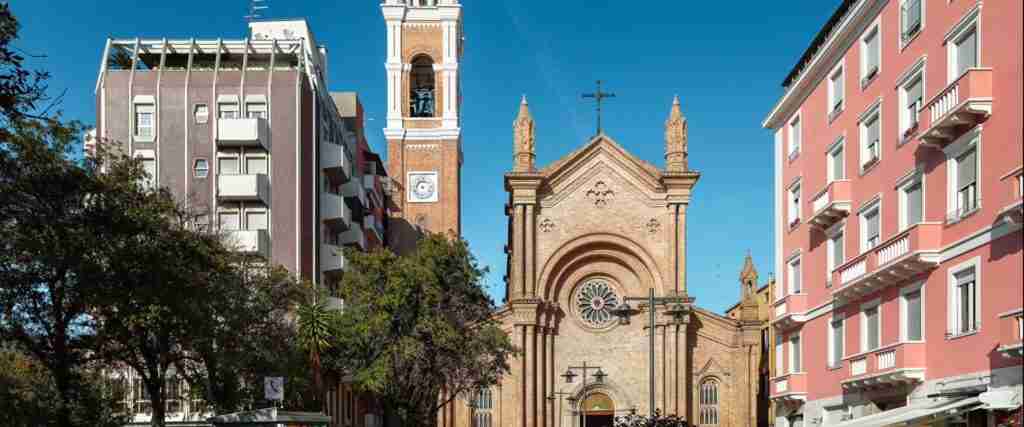
Old Pescara: Corso Manthonè and the San Cetteo Cathedral area. The remaining historic nucleus of Pescara, centred on the stretch of Corso Manthonè between the d’Annunzio Birthplace Museum and the Museum of the Peoples of Abruzzo, provides a compact environment of narrow streets, period building facades, and the dominant Neo-Romanesque front of San Cetteo Cathedral — completed in 1949 and the most architecturally considered religious building in the city. For street photography, the quarter rewards early morning and late afternoon shooting when traffic is lower and the shadows cast by the narrow building alignment produce strong directional light. The cathedral facade, built in warm-toned masonry with a decorative mosaic and rose window, photographs best from the piazza in front with a slight telephoto compression that reduces foreground clutter.
Rebirth Square (Piazza della Rinascita). The main civic square of central Pescara, informally known as the Salotto (the Drawing Room), was redesigned in the early 2000s and hosts an elephant sculpture by Vicentino Michetti — a ferro-concrete work from the early 1970s, restored in 2013 to its original colouring — that functions as a meeting point and a favoured background for portraits. The square photographs well as a city-life subject, particularly in the evening when the surrounding cafés and illuminated facades contribute warm light to a long-exposure shot from street level.
Muzii Square murals. The exterior walls of the Muzii Square market buildings carry a set of ten large-scale murals by different artists, produced during the Muzii Market Art urban regeneration project. The murals photograph well in diffuse morning light, without the harsh shadows that midday sun casts across the surfaces. Shoot from across the open square for compositional clarity.
D’Annunzio Pine Forest. The coastal nature reserve to the north of the city centre offers a contrasting photographic environment to the urban seafront and museum quarter. Beneath the pine canopy, dappled light, pine-needle carpets, and the filtered sound of the nearby sea create a meditative landscape environment suited to long-exposure or soft-focus work. Access is straightforward on foot or by bicycle from the northern seafront promenade.
Budget Planning for Pescara Museums and Cultural Visits in 2026
Pescara is one of the more affordable cultural circuits in central-southern Italy. The following figures are based on verified 2026 admission prices and are stated per person; verify current rates at each venue before visiting, as pricing may be updated.
Admission costs for the full museum circuit are approximately €28 per adult, covering all four major museums: the Gabriele d’Annunzio Birthplace Museum (€4), the combined ticket for the Museum of the Peoples of Abruzzo and the Basilio Cascella Civic Museum (€12), and the Imago Museum (€12). Using the combined ticket for the Museum of the Peoples and the Basilio Cascella Civic Museum saves money compared to purchasing both separately if individual pricing were available. The Gabriele d’Annunzio Birthplace Museum is free for under-18s and free for all visitors on the first Sunday of every month. The Museum of the Peoples is free for children under 3, and both it and the Basilio Cascella Civic Museum offer ICOM member free entry and Touring Club member 50% reduction.
Budget visitor (one or two museums plus free galleries): a visitor choosing to prioritise the Museum of the Peoples of Abruzzo alone (€8) and supplementing the day with free gallery visits at the La Rocca Foundation, Molo22, or a PAN open-day event spends €8 or less on cultural admissions. Adding the combined Cascella ticket brings the total to €12. This is an entirely viable and rewarding cultural day.
Mid-range visitor (three museums): combining the d’Annunzio Birthplace (€4), the Museum of the Peoples (€8), and the Imago Museum (€12) costs €24 per person in cultural admissions. This covers the full range of the city’s heritage, contemporary, and fine arts offer across three distinct buildings.
Full circuit (all four major museums): the combined ticket for the Museum of the Peoples and Cascella (€12) plus the d’Annunzio Birthplace (€4) and the Imago Museum (€12) totals €28 per adult for access to the complete flagship museum circuit. This can comfortably be achieved in one and a half to two full days, allowing adequate time in each museum without rushing.
Food and transport context: museum admissions are only one element of a day’s cost. Lunch at a central Pescara trattoria or pizzeria typically runs €12–20 per person; a coffee at a central café €1.50–3. The city bus network connects the old city, the Porta Nuova district, and the seafront; a single fare costs €1.50. The main museums are within walking distance of each other across the two main cultural zones (old city and Porta Nuova/city centre), and the seafront is a 15–20 minute walk from either. Photography costs nothing beyond equipment, and all major outdoor subjects — the Sea Bridge, the trabocchi, the seafront promenade — are entirely free to access at any hour.
Photography-specific costs to consider: no paid photography tours specific to Pescara have been identified in 2026 at the time of writing; self-guided photography using the walking routes described in this guide is the standard approach. If parking near the seafront or old city, the riverside car park accessible from the Unione roundabout charges approximately €1 for the first hour and €2.50 for a full day — relevant if you plan to return to a vehicle between museum sessions. The tourist marina parking is typically metered.
Practical Planning for Your Pescara Museums and Gallery Visit in 2026
Which day and time to visit. Both the Museum of the Peoples of Abruzzo and the Basilio Cascella Civic Museum close on Sundays, and weekday access to the Cascella museum requires advance booking from Monday to Thursday (minimum three days’ notice). The Gabriele d’Annunzio Birthplace Museum is closed on Mondays. The Imago Museum is closed on Mondays. The most straightforward full-circuit day is therefore Tuesday through Friday (or Saturday, when most venues are open). The first Sunday of the month offers free entry to the d’Annunzio Birthplace and can be a good day to anchor the free-gallery circuit while paying admission only to the Imago Museum.
Summer hours change on 28 June 2026. From late June both the Museum of the Peoples and the Cascella Civic Museum shift to morning weekday sessions (10:00–14:00) and Saturday evening sessions (17:30–21:30), with Sunday closure. If visiting in July or August, plan museum visits for the morning and use the afternoons for beach photography and gallery visits at Molo22 or the La Rocca Foundation.
Booking the Basilio Cascella Civic Museum. Monday to Thursday visits require advance booking by telephone (085 451 0026, extension 1) or email ([email protected] or [email protected]) at least three days before the intended visit. Friday, Saturday, and Sunday visits do not require advance booking. This is the only museum in the main circuit with a booking requirement on weekdays.
Getting around. The old city cluster (Museum of the Peoples of Abruzzo, d’Annunzio Birthplace, San Cetteo Cathedral) is concentrated within a few hundred metres on and around Corso Manthonè. From there, the Porta Nuova district (Basilio Cascella Civic Museum, Viale Marconi) is approximately a 15-minute walk, and the Imago Museum on Corso Vittorio Emanuele II is close to the central railway station. City buses numbered 3, 38, 21, and 10 stop near the Museum of the Peoples. The Pescara Portanuova station connects the city to Rome Tiburtina (approximately 2.5 hours by fast regional service), Bologna, and Naples. The Abruzzo Airport (Aeroporto d’Abruzzo) is a few kilometres from the city centre and connects to a range of European destinations.
Combined with a Trabocchi Coast day trip. Visitors with an interest in both the urban cultural circuit and the trabocchi photography subjects to the south should note that the major trabocchi settlements — San Vito Chietino, Rocca San Giovanni, Fossacesia — are between 30 and 45 minutes south of Pescara by car along the coastal road or the A14 motorway. Many of the trabocchi in those towns have been converted into seafood restaurants where a reservation is required; the structures themselves can be photographed from public coastal access paths at any time of day. Many Pescara-based visitors combine the urban museum circuit on one day with a Trabocchi Coast excursion on the following day.
Photography equipment advice. For the full Pescara cultural and photography circuit, a versatile zoom in the 24–70mm equivalent range handles the majority of subjects — museum interiors, architectural facades, street photography, and the Sea Bridge. For the trabocchi and seafront photography at dawn, a 70–200mm equivalent allows compositional compression across the water. A sturdy tripod is valuable for long-exposure dusk and dawn seafront shots. A mirrorless camera body with good low-light ISO performance is recommended for museum interiors where flash is not appropriate. A polarising filter can significantly improve the rendering of the Adriatic sea surface in midday light. Travel light for the walking circuit between the old city and Porta Nuova districts.
Frequently Asked Questions About Pescara Museums, Galleries & Photography 2026
How much does it cost to visit all of Pescara’s major museums in 2026?
A single adult visiting all four major museums — the Gabriele d’Annunzio Birthplace Museum (€4), the combined Museum of the Peoples of Abruzzo and Basilio Cascella Civic Museum (€12 for the two together), and the Imago Museum (€12) — pays approximately €28 in total admissions. This reflects the most economical combination using the available combined ticket. Visitors under 18 enter the d’Annunzio Birthplace Museum free; children under 3 enter the Museum of the Peoples free; children aged 6–17 pay €5 at the Imago Museum. Free entry to the d’Annunzio Birthplace is also available to all visitors on the first Sunday of each month. Verify current prices at each museum’s official site before visiting, as prices may be updated.
Which Pescara museum is the best single visit in 2026?
The answer depends on visitor interests. The Museum of the Peoples of Abruzzo is the most comprehensive and most distinctively Abruzzese, covering 100,000 years of regional history in an atmospheric former fortress setting — it is the strongest choice for visitors with a general cultural interest or limited time. The Imago Museum is the best choice for modern and contemporary art, with a substantial Mario Schifano retrospective, a major Scandinavian Impressionist collection, and a rotating temporary programme in a quality rationalist building. The Gabriele d’Annunzio Birthplace Museum is essential for visitors with a literary interest in d’Annunzio or in Italian fin-de-siècle and early-twentieth-century culture, and is one of the most atmospheric literary house-museums in the region. The Basilio Cascella Civic Museum is the best choice for Italian decorative arts, ceramics, and the history of artistic patronage and lithographic culture.
Are any Pescara museums free to enter in 2026?
Several admission-free arrangements exist in 2026. The Gabriele d’Annunzio Birthplace Museum, a state institution, offers free entry on the first Sunday of every month in line with the national domenica al museo programme. Visitors under 18 enter this museum free at all times. ICOM card holders enter the Museum of the Peoples of Abruzzo and the Basilio Cascella Civic Museum free of charge; Touring Club members receive a 50% reduction. The Museum of the Peoples admits children under 3 free. Beyond the flagship museums, the La Rocca Foundation, Molo22, and the PAN open-day events provide free access to contemporary art. The outdoor photography circuit — the Sea Bridge, the trabocchi, the seafront promenade — is entirely free to access.
Can visitors photograph inside Pescara’s museums in 2026?
Personal non-commercial photography without flash is generally permitted in Italian museums, including the Museum of the Peoples of Abruzzo, the Gabriele d’Annunzio Birthplace Museum, and the Basilio Cascella Civic Museum. The Imago Museum, which holds contemporary art collections, may impose restrictions on photography of specific works or rooms; confirm the current policy at the entrance before shooting. Flash photography is not appropriate in any of the four museums and will generally be refused. Commercial photography or use of tripods in crowded spaces requires advance permission. When in any doubt, ask staff at the ticket desk before raising your camera.
What are the best photography spots in Pescara in 2026?
The Sea Bridge is the single most photographically productive location in Pescara, offering panoramic views of the Adriatic, the marina, the Pescara river, and on clear days the Gran Sasso massif from its central span. The best times are at sunrise (from the south bank approach looking north) and at dusk (from the north bank looking south toward the port). The trabocchi fishing platforms at the marina are the strongest purely coastal subject and photograph best at dawn in flat light or low mist. The Cascella Ship on the seafront promenade is the city’s most iconic sculptural landmark and photographs well in silhouette against a sunset sky. In the old city, the San Cetteo Cathedral facade in morning light and the cobbled streets of Corso Manthonè offer strong architectural and street photography subjects. The D’Annunzio Pine Forest to the north provides the most peaceful photography environment in or near the city.
How do I get to Pescara’s museums by public transport in 2026?
The Museum of the Peoples of Abruzzo and the Gabriele d’Annunzio Birthplace Museum in the old city are served by city bus routes 3, 38, 21, and 10, which stop near or at the museum cluster. The Imago Museum on Corso Vittorio Emanuele II is within five minutes’ walk of Pescara Centrale railway station and very close to the central bus hub. The Basilio Cascella Civic Museum on Viale Marconi is in the Porta Nuova district, approximately a 15-minute walk from the central station or reachable by taxi. The La Rocca Foundation and the Molo22 marina space are both accessible by bus from the centre, with Molo22 also reachable on foot along the seafront promenade from the Sea Bridge in approximately 15 minutes. Pescara Centrale station connects the city to Rome (approximately 2.5 hours), Bologna, and Naples by national rail services.
Is the Museum of the Peoples of Abruzzo open in summer 2026?
Yes, but with changed hours. From 28 June 2026, the Museum of the Peoples of Abruzzo switches to its summer schedule: Monday to Friday 10:00–14:00; Saturday 17:30–21:30; Sunday closed. It is therefore not open on Sunday afternoons or mornings in the summer period. The Saturday evening session (17:30–21:30) is a particularly pleasant time to visit in high summer when daytime temperatures are high. The Basilio Cascella Civic Museum operates the same summer hours. Both museums close on 1 January, Easter Sunday, 1 November, and 25–26 December regardless of season. Always verify hours directly at gentidabruzzo.com before travelling.
What is the PAN Pescara Art Net and how do I use it in 2026?
PAN (Pescara Art Net) is a network and mapping platform that connects the city’s contemporary art spaces — including foundations, commercial galleries, museums, and independent venues — and publishes a running calendar of exhibitions and events across all member institutions. In practical terms for a 2026 visitor, PAN’s most useful feature is its interactive map at pescarartnet.it, which shows which spaces are currently active and what is showing. The periodic Open Day PAN events are the network’s flagship public initiative: multiple member spaces open simultaneously, often with free entry and extended hours, allowing a visitor to walk a mapped contemporary art circuit across the city in a single day. Check the PAN calendar before your visit to see if an Open Day is scheduled during your stay.
What is the Cascella artistic dynasty in Pescara?
The Cascella family is the most significant artist dynasty in Pescara’s cultural history and one of the more remarkable multi-generational artistic lineages in twentieth-century Italian art. The dynasty began with Basilio Cascella (1860–1941), a painter and graphic artist who established a chromo-lithographic studio in Pescara in 1895 that became both a production facility for printed and illustrated matter and a cultural salon for writers and artists — including, according to the documentation in the museum, Gabriele d’Annunzio, Luigi Pirandello, and Giovanni Pascoli. His three sons — Tommaso (1890–1968), Michele (1892–1989), and Gioacchino (1900–1968) — each developed distinct artistic identities in painting, mosaic, and sculpture. The family’s most internationally recognised figures are Basilio’s grandsons: the sculptor Andrea Cascella (1920–1990), whose abstract works are held in major Italian collections, and the sculptor Pietro Cascella (1921–2008), whose monumental commissions include the International Monument at the Auschwitz-Birkenau concentration camp in Poland, completed in 1967. The Basilio Cascella Civic Museum holds approximately 600 works spanning the family’s output across four generations and was managed by the family until its donation to the city in 1966.
How long should I plan for a full Pescara museums and photography visit in 2026?
Two full days is the comfortable allocation for a thorough cultural visit in 2026. On the first day, cover the old-city cluster: the Gabriele d’Annunzio Birthplace Museum (allow 45–60 minutes), the Museum of the Peoples of Abruzzo (allow 90–120 minutes), and a photography session along Corso Manthonè, San Cetteo Cathedral, and the adjacent streets (60–90 minutes). End the afternoon at the Sea Bridge and trabocchi for golden-hour photography. On the second day, visit the Imago Museum in the morning (allow 90–120 minutes), the Basilio Cascella Civic Museum in the early afternoon (allow 60–90 minutes), and use the remaining afternoon for a gallery circuit taking in the La Rocca Foundation and, if scheduling permits, Molo22 at the marina. This itinerary is relaxed enough to allow for lunch at a local restaurant, coffee stops, and unhurried photography without overloading any single session. Visitors with tighter schedules can prioritise: the Museum of the Peoples plus the Sea Bridge photography is the single most representative half-day cultural experience the city offers.