Pesaro Museums, Galleries & Photography Guide 2026
Pesaro earns its international reputation as Italy’s City of Music, but the Adriatic town that raised Gioachino Rossini also holds one of the peninsula’s most underappreciated concentrations of Renaissance art, majolica ceramics, and classical antiquity — all compressed into a walkable historic centre ten minutes from the beach. This guide covers every major museum, gallery, and photography location in Pesaro for 2026, with verified ticket prices, opening-hour guidance, combined-ticket options, and camera settings for each venue.
Key Takeaways
- The Combined Ticket Pesaro Musei at €12 covers eight venues — including the Civic Museums, Casa Rossini, the Pescheria Visual Arts Center, the Oliveriano Archaeological Museum, and guided Ducal Palace tours — and remains valid for six months; check pesaromusei.it for current official rates.
- The Toschi Mosca Palace Civic Museums house Giovanni Bellini’s Coronation of the Virgin, dated by art historians to approximately the early 1470s and widely considered one of the defining altarpieces of the Italian Renaissance, alongside a nationally significant ceramics collection.
- Budget travelers need approximately €80–120 per person daily (two sharing a budget hotel), mid-range visitors approximately €130–200, and those seeking a premium Pesaro cultural experience approximately €270–410.
- Photography without flash is generally permitted inside Pesaro’s civic museums for personal use; outdoors, People’s Square, the Rocca Costanza exterior, and the Adriatic seafront offer unrestricted shooting in excellent natural light.
- Rocca Costanza — Pesaro’s 15th-century Sforza fortress, closed for over three decades — reopened for guided visits in 2024 and continues in 2026 during ongoing PNRR restoration works; advance booking through pesaromusei.it is required.
- The Oliveriano Archaeological Museum operates Thursday to Sunday afternoons only, and the Pescheria Visual Arts Center concentrates its programming in the summer months — factor these schedules into any multi-museum day.
People Also Ask About Pesaro Museums 2026
What are the best museums to visit in Pesaro in 2026?
Pesaro’s three essential museum experiences in 2026 are the Civic Museums in Toschi Mosca Palace (Giovanni Bellini’s Coronation of the Virgin and five centuries of majolica ceramics), the National Rossini Museum at Montani Antaldi Palace on Via G. Passeri (ten rooms structured like an opera, with original autograph scores, costumes, and Rossini’s Pleyel piano), and Casa Rossini on Via Rossini (the compact birthplace museum with period furnishings and memorabilia). For contemporary art, the Pescheria Visual Arts Center — a spectacular converted 19th-century fish market — hosts rotating exhibitions primarily from June to September. The Oliveriano Archaeological Museum in Almerici Palace rounds out the essential list, covering Iron Age and Roman Pesaro with an innovative installation that reopened in December 2022. The €12 Combined Ticket covers most of the network and is the most practical entry point for a first-time visit.
How much does it cost to visit Pesaro museums in 2026?
The Combined Ticket Pesaro Musei costs €12 per adult at full price (check pesaromusei.it for current rates) and covers eight venues with a six-month validity. The National Rossini Museum charges a separate €8 full-price admission (€6 reduced), as it falls outside the Combined Ticket network. Single-structure tickets across the network are €7 full price and €4 reduced. Children under 18 enter free at all network venues. A full cultural day visiting both the Combined Ticket venues and the National Rossini Museum costs approximately €20 per adult at full price — strong value by Italian museum standards, particularly given the calibre of the Bellini altarpiece and the depth of the Rossini collection.
Where are the best photography locations in Pesaro in 2026?
People’s Square in the historic centre is Pesaro’s most rewarding architectural photography location, with the Ducal Palace facade, the central Baroque fountain, and the surrounding arcaded buildings producing strong compositions at golden hour. The Rocca Costanza exterior — best approached from its northern side — frames the circular fortress against the Adriatic horizon. Along the coast, the seafront promenade between the main beach and the fishing harbour offers dawn light over the water and the Art Nouveau hotel architecture. For elevated panoramas, San Bartolo Regional Natural Park above the city provides clear sight lines over Pesaro’s rooftops to the sea. Inside the Civic Museums, the ceramics gallery and the Bellini Room reward patient photography with a fast prime lens set to ISO 400–800.
Is there a combined museum ticket for Pesaro in 2026?
Yes. The Combined Ticket Pesaro Musei covers eight venues for €12 full price with a six-month validity: the Civic Museums, Casa Rossini, the Via dell’Abbondanza Archaeological Area, the Bicycle Museum, the Pescheria Visual Arts Center, the Colombarone Archaeological Area and Antiquarium, the Oliveriano Archaeological Museum, and guided Ducal Palace tours. A version that adds the Sonosfera® immersive sound experience costs €16. The National Rossini Museum charges separately (€8 full price). A lighter Pesaro Cult Card at €3 covers a secondary group of venues including the Pescheria Visual Arts Center and the Bicycle Museum. Check pesaromusei.it for current pricing and to purchase tickets online.
Extended multi-day tours – 5+ days
Featured Lazio Marche Abruzzo Multi-Day Tour Packages
5 days
5 Day Rome Self Guided: Discover the Eternal City
- ✓ Comprehensive Lazio Marche Abruzzo tour
- ✓ Expert local guides included
- ✓ All accommodation arranged
- ✓ Transportation provided
3 days
Rome City Break – 3 Days/2 Nights
- ✓ Comprehensive Lazio Marche Abruzzo tour
- ✓ Expert local guides included
- ✓ All accommodation arranged
- ✓ Transportation provided
9 days
Paris & Rome: Magical Duo
- ✓ Comprehensive Lazio Marche Abruzzo tour
- ✓ Expert local guides included
- ✓ All accommodation arranged
- ✓ Transportation provided
5 days
The Ultimate Rome Food & Cultural Small-Group Tour Package – 5 Days
- ✓ Comprehensive Lazio Marche Abruzzo tour
- ✓ Expert local guides included
- ✓ All accommodation arranged
- ✓ Transportation provided
Multi-day tour packages powered by TourRadar. Prices and availability subject to change.
Pesaro’s Cultural Identity in 2026
Few Italian coastal cities balance a beach resort reputation with genuine cultural depth the way Pesaro does. The city occupies the northern edge of the Marche region where the Apennine foothills meet the Adriatic, approximately thirty to forty minutes by rail south of Rimini and around 35 kilometres from Urbino — a geographic position that placed it firmly within the orbit of the della Rovere dukes who transformed the whole region during the 15th and 16th centuries. Through that dynastic energy Pesaro acquired its Ducal Palace on People’s Square, its Villa Imperiale in the hills above the city, and the network of civic buildings that still define the historic centre.
Gioachino Rossini was born in Pesaro on 29 February 1792, a biographical fact that has shaped the city’s self-image ever since. The composer’s legacy is now formalized into a dedicated circuit of sites — Casa Rossini, the National Rossini Museum, the Teatro Rossini opera house, and the Rossini Conservatory — while each August the Rossini Opera Festival (ROF), one of Europe’s leading specialist music festivals, draws international audiences to the city. In 2017, UNESCO designated Pesaro a Creative City of Music, a recognition that sits alongside the city’s longer-standing identity as a centre of ceramic production. The majolica tradition stretches back to at least the 14th century: Pesaro potters supplied the tables of Renaissance courts, and the city’s ceramics industry continued largely without interruption into the 20th century, leaving a deep permanent collection at the Civic Museums.
Pesaro served as Italian Capital of Culture in 2024, a year that produced significant expansion of cultural programming, reopened Rocca Costanza to visitors after more than thirty years of closure, and accelerated restoration work across the historic centre. In 2026 the city continues to benefit from the institutional relationships and visitor infrastructure established during that year, with the Pesaro Musei network now operating one of the best-integrated and best-valued museum pass systems in the Marche. For visitors arriving from other Italian art cities, Pesaro reads as a genuinely different proposition: the collections are major — the Bellini altarpiece alone would justify a dedicated visit — but the queues are thin, the city is walkable, and the Adriatic is genuinely there at the end of the main street.
Toschi Mosca Palace and the Pesaro Civic Museums 2026
The Pesaro Civic Museums occupy the first floor of Toschi Mosca Palace, a historic building at the heart of the city, close to People’s Square. The palace serves as the network’s principal venue and houses two foundational collections: the Civic Picture Gallery and the Ceramics Museum. A comprehensive renovation in 2013 reorganized the galleries chronologically and thematically, and a further expansion in summer 2025 — funded through Italy’s National Recovery Plan — added approximately 800 square metres of temporary exhibition space across two levels, significantly increasing the palace’s capacity for major travelling shows.
The Civic Picture Gallery and Giovanni Bellini’s Coronation of the Virgin
The first gallery of the Civic Picture Gallery is organized around Giovanni Bellini’s Coronation of the Virgin — known in Italian scholarship as the Pala dell’Incoronazione della Vergine — which occupies the central wall of the Bellini Room. Art historians date this polyptych altarpiece to approximately the early 1470s; the scholarly consensus places the execution around 1471–74, though the precise dating remains subject to ongoing discussion. The work was originally executed for the church of San Francesco in Pesaro and subsequently transferred to the Civic Museums.
The altarpiece presents the Coronation of the Virgin in the central panel, with saints in the subsidiary panels and a predella of narrative scenes below. What makes the work exceptional is Bellini’s integration of Flemish-influenced light handling — the luminous, oil-glazed surfaces he was developing during this period — with the spatial logic of a Venetian polyptych composition. The figures occupy an open throne structure before a panoramic landscape that art historical discussion has repeatedly connected to the Pesaro and Adriatic countryside; the painting effectively situates the devotional image within a specific, plausible geography. For visitors arriving from Venice or Ferrara, the work provides a landmark point of comparison in Bellini’s career: it predates the great San Giobbe altarpiece by approximately a decade and captures the artist in the process of rethinking the shift from Gothic polyptych conventions toward the unified altarpiece format he perfected in the 1480s.
The Civic Picture Gallery’s remaining rooms extend through 14th- to 19th-century Italian painting, with particular strength in works from Marche, Venetian, Tuscan, and Emilian schools. Names represented in the collection include Tintoretto, Ludovico Carracci, Guido Reni (whose Fall of the Giants forms part of the Hercolani-Rossini collection), Palma il Giovane, and Elisabetta Sirani. A so-called Rossini collection within the picture gallery — donations from the composer’s estate and related holdings — contributes a strong concentration of 17th- and 18th-century works, and the museum’s own communications describe the post-2013 installation as combining chronological and “emotional” criteria, aiming to balance the major works with the breadth of artistic typologies in the collections.
The Ceramics Museum: Majolica and Five Centuries of Pesaro Craft
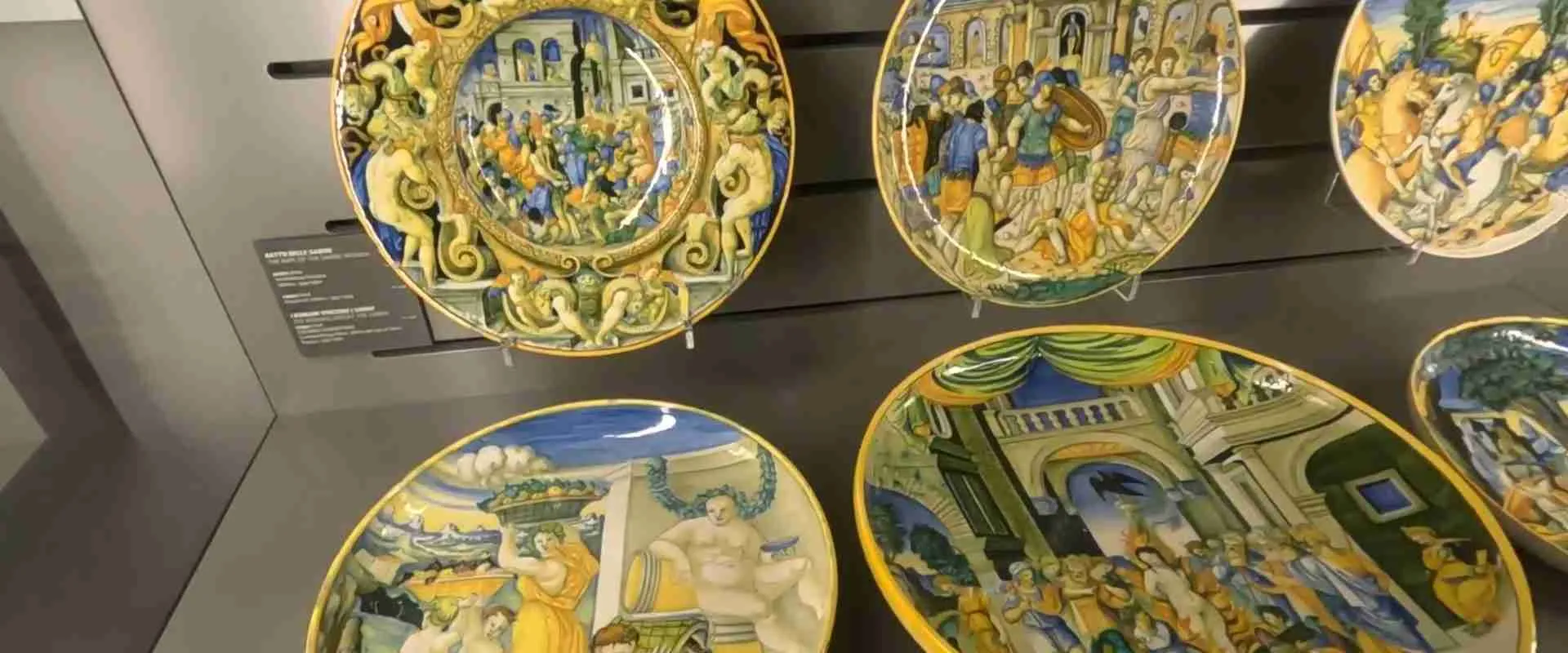
The Ceramics Museum traces what the Civic Museums present as a tradition rooted in Pesaro since at least the 14th century and running, largely without interruption, to the 20th century. The collection’s greatest strength lies in Renaissance-period majolica from the Duchy of Urbino — the elaborate figurative and narrative tin-glazed earthenware known as istoriato (narrative-decorated) majolica that defined Italian ceramic production across the 15th and 16th centuries. Pesaro was one of several ducal-period centres of this production, alongside Faenza and Deruta, and its potters supplied ceremonial and domestic ware to courts across the Italian peninsula.
The display — arranged in a room the museum describes as a Wunderkammer — presents majolica ceramics, decorative arts, furniture, and sculpture together, reflecting a curatorial approach that prioritises social context over strict typological classification. Among the highlights is a Gio’ Ponti porcelain vase titled La passeggiata archeologica (1938), made for the Richard Ginori Manifattura Doccia and acquired through the Vinciguerra donation of 2013; its inclusion within a ceramics collection primarily focused on the Renaissance illustrates the breadth of the story the museum tells. The 18th-century alla rosa (rose-decorated) Pesaro ware — a distinctive local style produced in the 1700s — occupies its own display area and provides a strong visual contrast to the more restrained Renaissance palette.
Floral still-life paintings from the 17th and 18th centuries are integrated alongside the ceramics displays, creating the cross-media reading of decorative traditions the post-2013 installation intended. The result is a museum that rewards slow looking over systematic survey: the ceramics invite very close examination of surface detail, and the natural and artificial lighting in the rooms is generally well-suited to this kind of work.
Practical Information for the Pesaro Civic Museums 2026
The Pesaro Civic Museums are open Tuesday through Sunday including holidays. In January through March 2026, hours are 10:00–13:00 and 15:00–18:00. In April and May 2026, Tuesday through Thursday hours are 10:00–13:00 and 15:00–18:00, while Friday through Sunday and holidays extend the afternoon closing to 19:00. For June through December 2026, check pesaromusei.it directly, as summer and autumn hours are published seasonally. The museum is closed on Mondays except public holidays.
Single-structure admission is €7 for adults (check pesaromusei.it for current rates), €4 reduced for groups of fifteen or more, university students, and visitors with qualifying agreements such as FAI or Touring Club Italiano membership. The Combined Ticket at €12 covers the Civic Museums alongside seven other venues and represents better value for anyone planning to visit more than two sites. Children under 18, ICOM members, journalists with press credentials, visitors with disabilities and one companion, Rossini Conservatory students, and Pesaro Family Card holders enter free. Toschi Mosca Palace is accessible to visitors with limited mobility. Audio guides for visitors with visual impairments are available through NFC technology at the galleries, and tactile reproductions — including a relief copy of the Bellini altarpiece — are provided. Video guides in Italian Sign Language are accessible via NFC and at pesaromusei.it.
National Rossini Museum 2026: A Life in Ten Rooms
The National Rossini Museum opened in June 2019 at Montani Antaldi Palace, Via G. Passeri 72 — a late-18th-century neoclassical building whose frescoed reception rooms provide a fitting setting for the most comprehensive Rossini museum in existence. The museum falls outside the €12 Combined Ticket network and requires a separate admission; it is widely described in official Pesaro communications as the centrepiece of the city’s Rossini circuit, which also encompasses the Teatro Rossini, Casa Rossini, the Rossini Conservatory, and the Rossini Foundation Library on the building’s ground floor.
The Museum’s Operatic Structure and Highlights
The curatorial decision to structure the museum as an opera — with an Overture, two Acts, and an Interlude — is both conceptually appropriate and practically effective as a visitor experience. Ten colour-differentiated rooms are each organized around a distinct biographical and professional phase of Rossini’s life, set within its broader European historical context. The Overture room, designated as the Hall of Mirrors, displays the Pleyel piano that belonged to Rossini, restored for the museum and still playable for institutional events.
Act I covers the composer’s origins in Pesaro, his early training, and the rapid rise to European prominence that characterized the decade following his 1810 debut. Act II follows the maturity, the years in Paris, and the long creative silence that defined the final decades of a life ended in 1868. The Interlude provides the documentary core: original autograph scores, first-edition librettos, operatic costumes, personal effects including Rossini’s own wedding documents, portraits, and busts, combined with multimedia screens projecting recordings of Rossini Opera Festival performances. The building itself is architecturally remarkable: the neoclassical frescoed rooms were redesigned in the 1780s and feature ceiling paintings that draw on the iconographic programme of the Farnese Gallery in Rome, including mythological and allegorical cycles. The palace was acquired by the Pesaro Savings Foundation in 1983, restored by 1991, and has hosted the museum at its principal reception floor level since 2019.
Visiting the National Rossini Museum in 2026
The museum operates seasonally. Published summer hours — for June, July, and September — are Monday, Wednesday, Friday, Saturday, Sunday and holidays from 10:00–13:00 and 15:00–18:00. For other months, check museonazionalerossini.it or pesaromusei.it for the current 2026 schedule. Admission is €8 full price (check the official site for current rates), €6 reduced for Pesaro Musei Card holders, university students, groups of fifteen or more, and qualifying agreement-holders. Free admission applies to children under 19, ICOM members, accredited journalists, visitors with disabilities and one companion, Rossini Conservatory students, and Pesaro Family Card holders. On specific civic dates — including 29 February in leap years, 21 June (Music Day), 2 September (Pesaro Liberation Day), 24 September (feast of San Terenzio, city patron), and 31 October (UNESCO Creative City of Music anniversary) — residents and qualifying guests receive free admission.
The “Pesaro Rossiniana” guided tour, offered each non-holiday Saturday at 9:45am, departs from the Civic Museums and visits the National Rossini Museum, the Rossini Conservatory, Casa Rossini, and the Cathedral of Pesaro over approximately two hours. Advance reservation is required: [email protected] or +39 0721 387541. This is the most contextual way to experience the full Rossini circuit and is strongly recommended for visitors with a focused interest in the composer’s biography and Pesaro’s musical heritage.
Casa Rossini 2026: The Composer’s Birthplace
Casa Rossini is the house on Via Rossini where Gioachino Rossini was born on 29 February 1792. It functions as the biographical anchor of the Rossini circuit — smaller and more intimate than the National Rossini Museum, organized around the physical objects and visual materials directly connected to the composer’s life rather than the broader historical and musical context. Located in the historic centre near People’s Square, it makes a natural first or last stop on a full cultural day.
What to See at Casa Rossini
The museum’s permanent displays are presented through prints, engravings, lithographs, portraits, caricatures, and period furnishings occupying the original rooms. Thematic exhibitions rotate to examine specific aspects of Rossini’s biography and compositional output. Audio and video stations allow visitors to consult materials from the Rossini Foundation’s documentary archives — a resource that includes primary material related to Italian opera of the first half of the 19th century. A dedicated store on the ground floor stocks books, recordings, and merchandise connected to the composer and the Rossini Opera Festival. The overall character of Casa Rossini complements the National Rossini Museum rather than duplicating it: where the larger museum tells the European story of a cosmopolitan artist, Casa Rossini keeps the focus on Pesaro and on the tangible materials of a specific life.
Practical Information for Casa Rossini 2026
Casa Rossini is included in the Combined Ticket at €12 (check pesaromusei.it for current rates). A single-structure ticket is €7 full price, €4 reduced. Children under 18 enter free, along with ICOM members, accredited journalists, visitors with disabilities and one companion, Rossini Conservatory students, and Pesaro Family Card holders. Check pesaromusei.it for current opening hours, which are published seasonally. The “Pesaro Rossiniana” Saturday guided tour stops at Casa Rossini and provides the most contextual way to visit, situating the birthplace within the full Rossini circuit.
Rocca Costanza 2026: Pesaro’s Sforza Fortress
Rocca Costanza is the most visually imposing structure in Pesaro — a late 15th-century fortress at the northern edge of the historic centre, immediately recognizable for its circular plan, four cylindrical towers at the corners, and the deep moat surrounding it. After more than three decades of closure (the fortress served as a prison from 1864 to 1989 and remained inaccessible thereafter), Rocca Costanza reopened for guided public visits during Pesaro’s Italian Capital of Culture year in 2024 and has continued receiving visitors since. Ongoing works — a €650,000 PNRR-funded restoration programme — were confirmed active as of April 2026, with official municipal statements assuring visitors that the construction affects sections not currently on the public visit route and that guided tours continue without interruption.
Architecture and History of Rocca Costanza
Construction of Rocca Costanza began in 1474 and was substantially complete by 1483, according to sources published by the Comune di Pesaro. The fortress was commissioned and conceptually developed by Costanzo Sforza, who was consolidating and extending the defensive system begun by his father Alessandro during the earlier years of Sforza rule in Pesaro. Official Comune di Pesaro documentation describes the initial project as entrusted to the engineer Giorgio Marchesi da Settignano, with the work subsequently passed to others — “perhaps” Luciano Laurana, whose presence in Pesaro is documented by a contract dated 1476 for the supply of stone destined for the fortress. The attribution to Laurana therefore rests on circumstantial documented proximity rather than a direct commission contract and should be treated as possible rather than confirmed.
The fortress presents a geometrically resolved plan: four circular towers linked by curtain walls, the whole encircled by a moat. The internal courtyard, the restored chapel and adjacent rooms, and the east tower are the elements currently open to visitors. From the east tower, the view extends over the city rooftops to the Adriatic — described in official Comune di Pesaro communications as one of the strongest panoramic experiences in the city. The form is characteristic of late 15th-century military architecture in the Marche, which balanced the requirements of artillery defence with the spatial and visual language of the period’s courtly culture.
Visiting Rocca Costanza in 2026
In 2024 and 2025, Rocca Costanza operated through the Pesaro Musei “Tour Capitale” city circuit and, in September 2024, through dedicated “Weekend alla Rocca” sessions with multiple daily time slots. The April 2026 confirmation of ongoing PNRR restoration works stated clearly that visits continue; the exact 2026 schedule — including seasonal hours and whether a Tour Capitale equivalent or a dedicated booking format applies — should be confirmed directly at pesaromusei.it or by calling +39 0721 387541. Entry has been free or included in the Pesaro Musei combined system in recent programming; confirm current admission arrangements when booking. Maximum group sizes apply (typically 25 participants per slot) and advance booking is required. The fortress is located at the northern edge of the historic centre, approximately a ten-minute walk from People’s Square.
For photography purposes, the exterior is freely accessible at any hour. The circular form and the moat are most legible from a moderate distance — approach from the direction of the marina for the best angle with the Adriatic as background in morning light. The fortress is illuminated after dark, making it one of the strongest night photography subjects in the city; long exposures of 20–60 seconds at f/8 will record the illuminated towers reflected in the still moat water.
Pescheria Visual Arts Center 2026: Contemporary Art in a Historic Market
The Pescheria Visual Arts Center occupies a neoclassical building on Corso XI Settembre constructed between 1821 and 1823 by the engineer Pompeo Mancini, originally as the city’s public fish market. Converted to an exhibition space in 1996 and operating since under the Pescheria Foundation (reconstituted in 2017), it is widely described as the most significant contemporary art institution on the Italian Adriatic coast. In 2006 the centre joined AMACI (Association of Italian Contemporary Art Museums), and its programming has included major exhibitions by Enzo Cucchi, Giuseppe Penone, Tony Cragg, Mimmo Paladino, Jannis Kounellis, and Candida Höfer. Following sculptor Giuliano Vangi’s death in 2024, Pesaro received a significant bequest from his estate; works from that collection entered the city’s holdings and were shown at the Pescheria.
Architecture and Programming at the Pescheria Visual Arts Center
The building’s architectural character is imposing: a temple-like neoclassical structure with strong columns facing Corso XI Settembre, a large undivided interior of approximately 370 square metres, and the remains of an adjacent 17th-century dodecagonal church — the former church of the Suffragio — annexed to the exhibition spaces in the early 2000s, adding a distinctive circular plan space to the programme. The fish market’s original stone shell-shaped fountain survives on the interior back wall, and two Istrian marble fountains flank the main entrance. These architectural features are photogenic in their own right and visible to visitors regardless of the current exhibition whenever the centre is open.
Programming at the Pescheria concentrates most heavily in the summer months — the institution’s historical focus has been summer exhibitions of contemporary art, and the UNESCO Creative City of Music designation has added music and sound-related programming alongside the visual arts. Exhibitions typically rotate every six to eight weeks during the summer season. In winter the Pescheria tends to reduce or pause programming; check fondazionepescheria.it and pesaromusei.it for the current 2026 schedule before planning a visit.
Visiting the Pescheria Visual Arts Center in 2026
From the official Comune di Pesaro website, June–September hours were Thursday through Sunday and holidays; confirm exact times and current admission arrangements at pesaromusei.it, as programming schedules can change between seasons. The Pescheria is included in the Combined Ticket Pesaro Musei (€12) and accessible with the Pesaro Cult Card (€3); confirm whether a standalone exhibition admission applies when temporary shows are installed. The building is on Corso XI Settembre, the main commercial street of central Pesaro, approximately five minutes on foot from People’s Square and on the natural route between the Civic Museums and the train station.
Oliveriano Archaeological Museum 2026: A Thousand Years of Pesaro
The Oliveriano Archaeological Museum is the oldest museum in Pesaro’s public network and one of the foundational cultural institutions of the Marche. It takes its name from Annibale degli Abbati Olivieri Giordani (1708–1789), an 18th-century scholar and collector who bequeathed to Pesaro both his archaeological and numismatic collections and a portion of his income to sustain them in perpetuity. The museum is managed by the Fondazione Ente Olivieri and was comprehensively reinstalled and reopened on 13 December 2022 with an entirely new museographic installation, ahead of Pesaro’s Capital of Culture year.
The Collection: From the Iron Age Necropolis to Roman Pisaurum
The collection is organized into four thematic sections presented in sequence through the ground-floor rooms of Almerici Palace, a 17th-century building in the historic centre. The first section introduces the Picene necropolis of Novilara — one of the most extensively excavated pre-Roman burial sites in the Pesaro area, systematically investigated by archaeologist Edoardo Brizio in 1892–93 and subject to further excavation in 2012–13 by the Soprintendenza Archeologia delle Marche. The Novilara necropolises produced grave goods from the 8th and 7th centuries BC and extraordinary figured stelae that represent the museum’s most internationally recognized objects. The first room is anchored by the “naval battle stele,” discovered in 1866 on the hill of San Nicola in Valmanente between Pesaro and Novilara — one of the few surviving Iron Age figural reliefs from central Italy with probable narrative content.
The second section covers the Lucus Pisaurensis, a documented sacred site associated with the early Romanization of the Pesaro area, whose votive deposits include an inscribed cippus gathered by both Olivieri and his colleague Giovan Battista Passeri (1694–1780). The third section is dedicated to Roman Pesaro — known in antiquity as Pisaurum, established as a Latin colony around 184 BC — and draws on excavation finds to reconstruct both public and private life in the Roman municipality. The fourth section returns to the collecting practices of Olivieri and Passeri themselves, displaying a selection from each collection type — bronze divine statuettes, oil lamps, painted vessels — arranged in the spirit of a late-Baroque Wunderkammer.
The installation design was publicly described by the Comune di Pesaro as inspired by the late work of Jannis Kounellis, the Arte Povera artist whose final exhibition was held at the Pescheria Visual Arts Center in Pesaro: stone fragment groups are arranged into large geometric forms that serve as thematic markers, allowing the visual organization of the room itself to encode the curatorial logic independently of whether visitors read the labels. The Oliveriana Library — which holds the Hypnerotomachia Poliphili (Aldus Manutius, Venice, 1499) and other early printed books of international significance — is temporarily relocated to Largo Mamiani 2/4 due to ongoing restoration works at Almerici Palace; library access should be confirmed directly with the Fondazione Ente Olivieri.
Practical Information for the Oliveriano Museum 2026
The Oliveriano Archaeological Museum opens Thursday through Sunday and public holidays only: from June to September, hours are 16:00–19:00; from October to May, hours are 15:30–18:30. These restricted hours are the most significant planning constraint for visitors — a Monday to Wednesday visit to Pesaro will find the Oliveriano closed. A single-structure ticket is €7 full price (check pesaromusei.it for current rates), €4 reduced; the museum is also included in the Combined Ticket (€12) and accessible with the Pesaro Cult Card (€3). Children under 18 enter free. The museum is located in Almerici Palace in the historic centre; contact [email protected] or +39 0721 387541 for current access information and school group reservations.
Outdoor Photography Locations in Pesaro 2026
Pesaro’s geography — a compact historic centre flanked by the Adriatic to the east and the San Bartolo hills to the north and west — creates distinct photography environments within a very small radius. The four strongest outdoor locations each offer a different character, and experienced photographers will find the city productive across multiple revisits at different times of day and season.
People’s Square and the Ducal Palace Facade
People’s Square at the heart of the historic centre is Pesaro’s premier architectural photography location, dominated by the Ducal Palace facade on its north-west side and framed by arcaded buildings along the other elevations. The Ducal Palace, built and modified over the 15th and 16th centuries during the della Rovere and Sforza periods, is now used primarily by the University of Urbino; since the 2024 Capital of Culture year, interior spaces including a hall attributed to Laurana have been opened for cultural events. The central Baroque fountain provides a consistent vertical focal point for wide-angle compositions.
The best natural light for People’s Square arrives in the late afternoon, when the low western sun illuminates the Ducal Palace facade from the left and generates strong relief on the rusticated stone. A 16–35mm equivalent wide-angle lens captures the full spatial context of the piazza; a 50–85mm equivalent isolates architectural detail — cornicing, window surrounds, the arches of the arcade. Early morning before 09:00 minimises vehicular and pedestrian interruption. Overcast days produce even modelling light that suits the masonry texture equally well and eliminates the deep shadows that a high midday sun generates in the narrower side streets.
The Adriatic Seafront and Fishing Harbour
Pesaro’s Adriatic seafront extends in a long arc south of the historic centre, anchored at the north end by the fishing harbour and extending through the main beach to the southern resort strip. The fishing harbour and the adjacent port offer the most photogenic conditions: dawn light on the moored fishing vessels, the lighthouses, the breakwater, and the harbour infrastructure. A 70–200mm telephoto for compression of the boats against the harbour structures, and patience for the first departure of the fleet, reward early rising. The harbour area is working and active; tripods are not prohibited outdoors, but a fast prime lens hand-held also works well in the soft early morning light.
The seafront promenade between the harbour and the main beach preserves a row of Art Nouveau and Liberty-style hotel facades from the early 20th century, a building type specific to the Italian Adriatic resort tradition and increasingly recognized as architectural heritage. The best light for these facades is direct morning sun before 10:00. Sunset from the beach looks west toward the hills rather than over the water — Pesaro faces roughly north-east — so late afternoon positions the sun behind the old town roofline, creating a warm backlighting effect when photographed from the water’s edge facing inland. This is one of Pesaro’s more distinctive photography perspectives and difficult to replicate elsewhere on the Adriatic.
Rocca Costanza Exterior and Night Photography
The exterior of Rocca Costanza is freely accessible at any hour. The fortress is illuminated after dark, making it one of the few strong night-photography subjects in the historic centre. The moat creates a natural reflection surface in calm conditions: a long exposure of 20–60 seconds at f/8 and ISO 200–400 on a tripod will record the illuminated towers in the dark water. The north side, facing toward the marina, is the most open and unobstructed elevation for wide establishing shots; the south side, closer to the historic centre, is hemmed in by surrounding buildings.
For daytime exterior work, morning light from the east illuminates the entrance elevation. The fortress is most impressive when photographed to include the moat in the foreground — a circular polarizing filter eliminates surface glare and deepens the reflection when the sun is at a sufficient angle. A 24–70mm equivalent covers the range from environmental context shots to detail work on the tower cornices and the moat’s stone retaining walls. Drone photography over the historic centre of Pesaro is subject to standard Italian ENAC urban-area restrictions; check current regulations at enac.gov.it before planning aerial work.
San Bartolo Regional Natural Park: Elevated Views
San Bartolo Regional Natural Park begins immediately north of the city and covers the coastal hills that rise steeply from the seafront to approximately 200 metres above sea level. The park is accessible by road — the route toward Fiorenzuola di Focara climbs through olive groves and coastal maquis — and several viewpoints above the city provide unobstructed sight lines south over Pesaro’s rooftops to the Adriatic. The strongest photography time is late afternoon, when the low sun from the west illuminates the city below and the sea catches a warm colour temperature. A 70–200mm telephoto from these heights compresses the urban plane effectively against the sea horizon.
Within the park itself, the limestone cliff vegetation, coastal scrub, and terraced olive groves offer botanical and landscape subjects distinct in character from the urban photography available below. In autumn, the olive harvest provides documentary subjects; in spring and early summer, the coastal maquis produces wildflowers. The park is free to enter and traversed by marked walking trails accessible from the northern edge of the city. Combining a photography session here with the return journey along the coastal road back to the seafront creates an efficient half-day circuit covering Pesaro’s landscape range from elevated rural terrain to beach and harbour.
Museum Photography Tips for Pesaro 2026
Photographing inside Italian museums requires understanding three things simultaneously: the institutional rules governing use of images, the optical physics of a controlled interior environment, and the specific character of the objects you are photographing. Pesaro’s civic museums are, by Italian standards, welcoming to personal photography — but the standard framework applies and understanding it before you arrive saves wasted time at the entrance.
Photography Policies in Pesaro’s Museums
Photography for personal, non-commercial use without flash is generally permitted in Pesaro’s civic museum spaces. This baseline applies at the Civic Museums in Toschi Mosca Palace; verify the current policy at the National Rossini Museum and Casa Rossini directly at the entrance, as institutional policies differ and are subject to revision. In Italian public museums, flash is universally prohibited — it damages light-sensitive pigments over repeated exposure even at low intensities — and tripods and monopods typically require written permission unavailable to casual visitors. Commercial photography (advertising, editorial, or commercial distribution) requires a separate agreement with the relevant institution. Social media publication of personal photographs is generally accepted under the personal use category, though this is an evolving area of Italian intellectual property law; photograph for your own documentation and seek institutional permission before large-scale or commercial publication.
At the Pescheria Visual Arts Center, photography policies vary by exhibition and by the terms of the lending institutions for specific works. Check at the entrance for current rules when temporary exhibitions are installed. The building’s permanent architectural character is freely photographable from the exterior at all times.
Camera Settings for Gallery Interiors
Pesaro’s civic museums use a combination of artificial ceiling lighting — LED or fluorescent — and natural light from windows and skylights, creating a mixed-colour-temperature environment where automatic white balance can produce unpredictable results. Shooting in RAW format is the practical solution: it preserves full colour information and allows white balance correction in post-processing without quality loss. Set a custom white balance where your camera supports it, using a grey or white neutral surface in the room.
For handheld work without flash, a fast prime lens — 35mm, 50mm, or 85mm equivalent at f/1.4 to f/2.8 — provides the aperture needed to maintain a shutter speed high enough to prevent motion blur (1/60s minimum for stationary subjects, 1/125s if you cannot brace against a wall). Set ISO between 400 and 1600 depending on ambient light; modern mirrorless and DSLR sensors handle ISO 800 with acceptable noise for personal output. The ceramics displays in the Civic Museums’ Ceramics Room are comparatively well-lit and manageable at ISO 400–800. The Bellini Room is darker and the altarpiece large and vertical; a moderate telephoto in the 50–85mm range allows detail work from a respectful distance without raising ISO excessively.
Photographing the Bellini Altarpiece
Giovanni Bellini’s Coronation of the Virgin presents specific photographic challenges. The altarpiece is large and vertical, and its full extent is difficult to frame without backing to the far wall of the Bellini Room. A 24mm or 28mm equivalent wide-angle from the room entrance captures the full altarpiece in context; 50mm or longer allows isolation of individual panels. The gold leaf in the background and the halos is highly reflective: avoid shooting with overhead lights directly behind you, as these reflect into your image even without flash. Shooting at a very slight angle off the direct perpendicular axis can reduce specular reflections from the gold ground without noticeably distorting the geometry of the panels.
The spatial context of the room itself — the dark walls, the other paintings, the architectural framing of the gallery — is a strong compositional element. Environmental shots that show the altarpiece within its gallery setting represent the viewing experience more honestly than tight crops of individual panels. For detail work on the faces, the landscape background, and the predella narratives, an 85–105mm equivalent at maximum aperture allows shallow-focus extraction of specific passages without moving uncomfortably close to a work behind a floor barrier.
Budget Planning for Pesaro Museums 2026
The following cost ranges are calculated per person per day, with two travelers sharing accommodation. Hotel room rates are divided by two before addition to individual costs. Figures reflect 2026 conditions; all ranges use verified ticket prices from pesaromusei.it as the admission benchmark.
Budget Cultural Day in Pesaro 2026
Budget travelers visiting Pesaro can cover the most significant cultural sites for approximately €80–120 per person daily, two sharing a budget hotel or bed and breakfast. Budget accommodation in Pesaro typically runs €60–90 per room per night, which is €30–45 per person when split. A café breakfast with coffee and pastry costs €5–8; lunch at a simple trattoria or tavola calda runs €12–18; a straightforward dinner at a neighbourhood restaurant €18–28. Local bus services and walking — the historic centre is entirely on foot — add €5–9. Museum admissions focused on the Combined Ticket come to €9–12 (reduced or full-price depending on eligibility). Components total: low end (€30 hotel + €5 breakfast + €12 lunch + €18 dinner + €5 transport + €9 admissions) = €79, rounded to €80; high end (€45 + €8 + €18 + €28 + €9 + €12) = €120. Budget travelers need approximately €80–120 per person daily (two sharing a budget hotel).
Mid-Range Cultural Day in Pesaro 2026
Mid-range visitors covering both the Combined Ticket venues and the National Rossini Museum, dining at sit-down restaurants, and staying in a three-star hotel in or near the historic centre should plan for approximately €130–200 per person daily. Mid-range hotels in Pesaro run roughly €100–150 per room per night, which is €50–75 per person when shared. A more comfortable breakfast (hotel café or good café) costs €10–15; a sit-down lunch at a good restaurant €20–30; dinner at a mid-range restaurant with a carafe of house wine €30–45. Transport within the city adds €5–10. Museum admissions covering the Combined Ticket plus the National Rossini Museum come to €15–25 (from €15 reduced-rate combined admission to €20 at full price, with possible audio guides at the top end). Components: low (€50 + €10 + €20 + €30 + €5 + €15) = €130; high (€75 + €15 + €30 + €45 + €10 + €25) = €200. Mid-range travelers spend approximately €130–200 per person daily (two sharing).
Luxury Cultural Day in Pesaro 2026
Luxury visitors seeking four-star accommodation, fine dining, and premium cultural experiences should budget approximately €270–410 per person daily. Luxury hotels and boutique properties in and around Pesaro — including properties on the San Bartolo hills and along the seafront — run roughly €200–300 per room per night, which is €100–150 per person when shared. Breakfast at a hotel or upscale café runs €20–30; lunch at a fine seafood or regional restaurant €40–60; an evening dinner with local wines €70–100. Private transfers and taxi use add €15–25. Museum admissions including all venues and optional private guided supplements come to €25–45. Components: low (€100 + €20 + €40 + €70 + €15 + €25) = €270; high (€150 + €30 + €60 + €100 + €25 + €45) = €410. Luxury visitors invest approximately €270–410 per person daily (two sharing a premium property).
Combined Tickets and Passes in Pesaro 2026
The Pesaro Musei ticketing system is organized into four entry types, and choosing the right one before arriving at the first venue saves both money and queue time.
The Combined Ticket Pesaro Musei (€12 full price at the time of writing — check pesaromusei.it for current rates) covers eight venues: the Civic Museums in Toschi Mosca Palace, Casa Rossini, the Via dell’Abbondanza Archaeological Area, the Bicycle Museum, the Pescheria Visual Arts Center, the Colombarone Archaeological Area and Antiquarium, the Oliveriano Archaeological Museum, and guided Ducal Palace tours. Validity is six months from first use — an unusual provision among Italian museum passes that makes it genuinely useful for visitors who split a Pesaro cultural itinerary across multiple trips. Reduced rates apply: €9 for groups of fifteen or more, university students, and agreement-holders; €6 for Pesaro Cult Card owners and tour groups with licensed guides from the province of Pesaro-Urbino.
A Combined Ticket that also includes the Sonosfera® — Pesaro’s fixed-installation immersive spatial sound experience — is available for €16 full price, €12 reduced A, and €10 reduced B. If the Sonosfera® is of interest (it draws consistently positive visitor responses for its audio engineering), this version represents significantly better value than purchasing the sound experience separately.
The single-structure ticket at €7 (€4 reduced) covers any one eligible venue with one-year validity. This is appropriate for a visitor planning to see only the Civic Museums or only Casa Rossini; for anyone visiting two or more venues the Combined Ticket at €12 is almost certainly better value.
The Pesaro Cult Card at €3 (annual validity) covers a secondary group of venues: the Colombarone Archaeological Area and Antiquarium, the Giovanni Gentiletti House-Museum, the Officine Benelli Museum, the Pescheria Visual Arts Center, and the Bicycle Museum. It also enables the reduced-price admission tier at Combined Ticket venues. For a visitor whose primary interest is contemporary art at the Pescheria, the €3 Cult Card is the most targeted option. The National Rossini Museum charges separately at €8 full price and is not covered by any of the above passes.
Free admission across all network venues applies permanently to children under 18, ICOM members, accredited journalists, visitors with disabilities and one companion, Rossini Conservatory students, and Pesaro Family Card holders. The “Stradomenica” initiative offers free admission for Pesaro Cult Card holders on the third Sunday of the month from October to May. Advance ticket purchase is available through liveticket.it (linked from pesaromusei.it).
Getting to and Between Pesaro’s Museums 2026
Pesaro’s historic centre is compact enough that all primary cultural venues lie within a fifteen-minute walk of each other. People’s Square serves as the natural orientation point: the Civic Museums are approximately three minutes on foot; Casa Rossini is on Via Rossini, which branches directly off the historic centre; the National Rossini Museum is on Via G. Passeri heading toward the train station; the Pescheria Visual Arts Center is on Corso XI Settembre; the Oliveriano Archaeological Museum is in Almerici Palace in the centre; and Rocca Costanza is approximately ten minutes’ walk north toward the marina.
Pesaro is served by the Italian national rail network with frequent services to Bologna, Rimini, Ancona, and beyond. The main station (Stazione di Pesaro) is approximately fifteen minutes on foot from People’s Square, or five minutes by taxi. Arriving by train is the most practical option for day visitors from Rimini (approximately 30–40 minutes depending on service type) or from Fano and Ancona to the south. Within the city, the historic centre is largely pedestrianized or subject to ZTL restricted-traffic zones; visitors staying outside the centre typically reach the cultural venues on foot or by local bus. Cycling paths run along the seafront and into the centre; bicycles are rentable seasonally. The summer shuttle service from Gabicce along the San Bartolo hills, which operated during the 2024 Capital of Culture year, made Rocca Costanza accessible from the northern beach areas without a car — check with the city’s tourist information at pesaroonline.it for whether equivalent services run in 2026.
Best Times to Visit Pesaro’s Museums 2026
The optimal months for a Pesaro museum visit are May, June, September, and October. In these months the weather is pleasant and predictable, the city is active without the overload of peak summer resort traffic, all museums are operating at full or near-full schedules, and natural light for outdoor photography is at its best. The sun angle in May and September produces the directional illumination that brings stone facades to life without the harsh midday flattening of July and August. Hotel prices in these shoulder months are lower than in peak summer — a meaningful saving at a destination where August accommodation is in high demand.
July and August bring the Rossini Opera Festival, held each year in August. This event transforms Pesaro’s cultural metabolism: hotel rates rise, availability tightens, and the city fills with opera specialists and music professionals from across Europe. For visitors whose primary purpose is the festival itself, August is obviously the right time, and the combination of festival performances at the Teatro Rossini and other venues with the permanent museum collections creates a concentrated week of music-and-art programming. For those focused exclusively on the visual arts and photography, August crowds and elevated prices make this a less efficient visit unless the festival is an added attraction.
Winter (January to March) is the quietest period. The Civic Museums maintain reliable opening (Tuesday–Sunday 10:00–13:00 / 15:00–18:00 in January–March 2026), though the National Rossini Museum operates a limited winter schedule — confirm current hours at museonazionalerossini.it. The Pescheria Visual Arts Center reduces or pauses programming outside summer, and the Oliveriano Archaeological Museum maintains its Thursday–Sunday afternoon schedule year-round. Budget accommodation in winter is significantly less expensive than in summer; some mid-range hotels in Pesaro are available in January at prices comparable to budget summer rates, and the city is genuinely quiet. Photography conditions in winter are notable: the Adriatic light in December and January is exceptional in clarity, the absence of summer foliage opens unobstructed views of architectural detail in People’s Square, and the fishing harbour is most active in cooler months — making winter mornings at the port particularly productive for documentary photography.
Sample Cultural Itineraries for Pesaro 2026
The following itineraries are calibrated to verified opening hours and the geographic clustering of the historic centre.
Half-Day Museum Focus
A focused three-hour half-day begins at the Civic Museums in Toschi Mosca Palace at opening (10:00). Spend the first ninety minutes in the Bellini Room and the Ceramics Museum, giving the altarpiece approximately forty-five minutes and the ceramics displays the remaining time. Exit to People’s Square for a twenty-minute photography circuit of the Ducal Palace facade, the central fountain, and the surrounding arcades. Walk to Corso XI Settembre and visit the Pescheria Visual Arts Center if a current exhibition is running (open Thursday–Sunday; confirm in advance). If the Pescheria is closed, substitute a walk along Via Rossini past Casa Rossini and back through the main commercial street to the square. Combined Ticket admission: €12 per adult.
Full Day in Pesaro’s Museums and Galleries
A full cultural day opens at the Civic Museums (10:00–12:30), covering both the Civic Picture Gallery and the Ceramics Museum before the midday closure. Lunch near People’s Square (13:00–14:30) — the streets immediately south of the square offer multiple mid-range and budget options. After lunch, visit the National Rossini Museum (15:00–17:00), allowing the full time for both Acts and the Interlude. From there, walk to the Oliveriano Archaeological Museum for its afternoon opening (16:00–19:00 in summer, 15:30–18:30 in other months) and spend forty-five to sixty minutes on the four archaeological sections. End the day with a photography circuit of Rocca Costanza — exterior photography and, if a guided slot is pre-booked, the internal courtyard and east tower. Sunset and blue-hour photographs of the illuminated fortress exterior follow naturally as a close to the day. Combined Ticket admission: €12; National Rossini Museum: €8. Total admissions: approximately €20 per adult at full price.
Two-Day Cultural Deep Dive
Day One follows the full-day itinerary above. Day Two extends the programme to include an early-morning photography session at the Adriatic fishing harbour (arrive by 06:30–07:00 for dawn light on the boats), breakfast at a seafront café, then the Saturday “Pesaro Rossiniana” guided tour if visiting on a Saturday (09:45 departure from the Civic Museums, covering the National Rossini Museum, Rossini Conservatory, Casa Rossini, and the Cathedral over two hours — advance reservation required). After the tour, drive or take a local bus to San Bartolo Regional Natural Park for early-afternoon landscape and panoramic photography above the city. Return to the historic centre by late afternoon; visit the Pescheria Visual Arts Center if Day One was not a Thursday–Sunday. Close the second day with a return to People’s Square at golden hour for the best architectural photography conditions. On a two-day visit, adding a half-day trip to Urbino — approximately 35 kilometres from Pesaro, accessible by bus or car — provides a direct comparison between the Pesaro collections and the National Gallery of the Marche at the Ducal Palace of Urbino: one of Italy’s great Renaissance galleries, in a UNESCO World Heritage hilltop city that shares much of Pesaro’s dynastic history.
Frequently Asked Questions About Pesaro Museums 2026
Is the Pesaro Combined Ticket worth buying in 2026?
The €12 Combined Ticket covers eight venues with a six-month validity, making it excellent value for any visitor planning to see more than one or two sites. The Civic Museums alone — with the Bellini altarpiece and the ceramics collection — justify the admission; adding Casa Rossini, the Oliveriano Archaeological Museum, and the Pescheria Visual Arts Center to the same ticket at no extra cost makes the combined option clearly superior to purchasing individual single-structure tickets at €7 each. Visitors who also want the National Rossini Museum (€8 separate) spend approximately €20 in total admissions for a comprehensive cultural day — strong value against the depth of the collections. Check pesaromusei.it for current rates before purchasing.
Can I visit the National Rossini Museum and the Civic Museums on the same day in 2026?
Yes — a combined visit is both practical and strongly recommended, though the National Rossini Museum requires a separate ticket (€8 full price). The two museums complement each other precisely: the Civic Museums hold the Bellini altarpiece and the major ceramics collection with Rossini-related 18th-century paintings, while the National Rossini Museum provides the full biographical and musical context at Montani Antaldi Palace on Via G. Passeri. Allow approximately two hours for the Civic Museums and ninety minutes to two hours for the National Rossini Museum. Both together make a full and rewarding cultural day, particularly if the Saturday “Pesaro Rossiniana” guided tour is included to weave in Casa Rossini and the Rossini Conservatory.
Do Pesaro museums allow photography inside in 2026?
Photography for personal use without flash is generally permitted at the Pesaro Civic Museums. Flash is universally prohibited to protect light-sensitive artworks. Tripods and monopods require written institutional permission, which is not typically available to casual visitors. For the National Rossini Museum, Casa Rossini, and temporary exhibitions at the Pescheria Visual Arts Center, confirm the current policy at the entrance on arrival. Commercial photography — for advertising, editorial, or commercial media — always requires a separate agreement with the institution. A fast prime lens (35–85mm equivalent) at f/2 or wider is the practical solution for handheld museum photography in Pesaro’s low-to-moderate-light gallery interiors. Shoot in RAW format and adjust white balance in post to manage the mixed lighting.
What makes Giovanni Bellini’s altarpiece in Pesaro significant?
Giovanni Bellini’s Coronation of the Virgin — dated by art historians to approximately the early 1470s — is one of the most important altarpieces in Italian Renaissance painting outside the major national collections of Venice, Florence, and Rome. Originally commissioned for the church of San Francesco in Pesaro, it represents a key document in Bellini’s development of a new spatial and luminous language, integrating Flemish-influenced oil-glazed surfaces with Venetian polyptych structure and an open landscape setting that places the devotional scene within a credible geography. Displayed in a dedicated room in the Civic Picture Gallery, it allows a level of close-range access that comparable works in larger institutions — with their crowd barriers and controlled sight lines — rarely permit.
Is Rocca Costanza accessible to visitors in 2026?
Rocca Costanza is accessible for guided visits in 2026. Ongoing PNRR restoration works (€650,000 budget) are underway on sections not currently on the public visit route, and a Comune di Pesaro statement from April 2026 confirmed that the restoration does not affect access to the internal courtyard, the restored chapel, and the east tower, and that guided visits continue. Advance booking is required through pesaromusei.it or by calling +39 0721 387541; group sizes are capped (typically 25 participants per slot). The fortress exterior — including the moat and outer walls — is freely visible at all hours without booking. Confirm the current visit schedule and admission arrangements when booking, as the format may evolve from year to year.
What are the best photography highlights of the Pescheria Visual Arts Center in 2026?
The Pescheria Visual Arts Center’s architectural character is itself a photography subject independent of any current exhibition. The neoclassical exterior with its strong columned loggia on Corso XI Settembre, the original stone shell-shaped fountain on the interior back wall, and the two Istrian marble entrance fountains are freely photographable from the exterior and visible inside whenever the centre is open. The annexed former church of the Suffragio adds a distinctive dodecagonal space to the complex, with ceiling height and natural light that wide-angle interior photography exploits particularly well. Check exhibitions in advance via fondazionepescheria.it; summer programming (June–September) is the most active period and the most likely time to find a significant exhibition open.
What is the best time for photography at People’s Square in 2026?
The golden hour in late afternoon — from approximately 17:00 to 18:30 depending on the season — provides the most favourable conditions for People’s Square. The low western sun illuminates the Ducal Palace facade in warm raking light that emphasises the stonework’s texture and relief. For morning photographers, sunrise approaches from the east (from the direction of the Adriatic), which backlights the Ducal Palace but illuminates the opposite side of the square effectively. Overcast days eliminate the harsh midday shadows in the piazza and produce even modelling light well-suited to the stone architecture. Early morning before 08:00 keeps vehicle and pedestrian traffic minimal. The square does not pedestrianize completely throughout the day, so early morning or late evening visits are the most practical for unobstructed wide-angle compositions.
Does Pesaro offer free museum entry days in 2026?
Several free-entry opportunities operate across the Pesaro Musei network. The “Stradomenica” initiative offers free admission for Pesaro Cult Card holders (€3 annual) on the third Sunday of each month from October to May. Permanent free admission applies at all network venues to children under 18, ICOM members, accredited journalists, people with disabilities and one companion, Rossini Conservatory students, and Pesaro Family Card holders. The National Rossini Museum additionally offers free admission for residents on 29 February in leap years, 21 June (Music Day), 2 September (Pesaro Liberation Day), 24 September (feast of San Terenzio), and 31 October. The Civic Museums at Palazzo Ciacchi and the Synagogue are free to all visitors at all times. Check pesaromusei.it and museonazionalerossini.it for the current free-entry calendar.
How does the Oliveriano Archaeological Museum compare to other Marche archaeology collections?
The Oliveriano Archaeological Museum is not a large encyclopaedic collection in the mode of Ancona’s National Archaeological Museum of the Marche; it is a focused regional museum particularly strong in the Picene material culture of the Iron Age necropolis of Novilara and in the Roman-period development of ancient Pisaurum. The famous naval battle stele from 1866 — one of the few Iron Age figured reliefs from central Italy with possible narrative content — would draw specialist attention anywhere in Italy. The 2022 installation, inspired in its design logic by Arte Povera, is sophisticated by civic museum standards. The restricted Thursday–Sunday afternoon schedule is the main practical constraint; within those hours, the museum is efficiently sized for a 45–60-minute visit and well suited to combination with the Civic Museums and the Pescheria on the same day.
Is Pesaro worth visiting alongside Urbino in 2026?
Pesaro and Urbino form a natural paired itinerary for anyone interested in the Renaissance culture of the Marche. Urbino — approximately 35 kilometres from Pesaro, accessible by bus or car — holds the National Gallery of the Marche at the Ducal Palace of Urbino, one of Italy’s great Renaissance collections, alongside Raphael’s birthplace and the intact urban fabric of a UNESCO World Heritage hilltop city. The two cities share their della Rovere dynastic heritage: the same ruling family connected both cities to the artistic production of the 15th and 16th centuries, and a combined two-day visit — one day in Pesaro for the Bellini altarpiece, the Rossini museums, and the photography locations; one day in Urbino for the National Gallery of the Marche — covers the central art-historical argument of the Marche in a manageable itinerary. Bus services run between Pesaro and Urbino; journey time is approximately 50–60 minutes.