Panama City Walking Tours & Routes 2026: Self-Guided Walks
Key Takeaways:
- Casco Viejo’s UNESCO World Heritage district delivers the premier walking experience with colonial architecture, museums, galleries, and waterfront promenades concentrated in 10 compact blocks
- Cinta Costera’s 8-kilometer waterfront path connects modern financial district to Casco Viejo through scenic bay-front promenades ideal for morning or sunset walks
- Amador Causeway extends 6 kilometers across four islands linking Pacific Ocean entrance to Panama Canal with dedicated pedestrian lanes and bicycle infrastructure
- Early morning walks (6:30-9:00 AM) or late afternoon sessions (4:30-7:00 PM) avoid midday heat and humidity reaching 90°F with 80% humidity
- Free self-guided walking eliminates tour costs while allowing personalized pacing, photographic flexibility, and spontaneous cafe/restaurant discoveries
- Mobile apps including Maps.me offline navigation and translation tools enable independent exploration without guide dependence or data connectivity requirements
Planning Your Panama City Walking Tours in 2026
Panama City’s diverse urban landscapes reward pedestrian exploration across colonial quarters, modern waterfront developments, and tropical urban parks. Walking tours provide intimate neighborhood perspectives impossible from vehicles, revealing architectural details, street art installations, local commerce patterns, and cultural atmospheres defining each district’s character. The strategic approach combines structured morning heritage walks with flexible afternoon neighborhood wandering and evening waterfront promenades.
Temperature and humidity significantly impact walking comfort in Panama City’s tropical climate. Plan outdoor walking during early morning cool periods (6:30-9:00 AM when temperatures range 75-80°F) or late afternoon/evening sessions (4:30-7:00 PM after peak heat subsides). Midday walking (11:00 AM-3:00 PM) becomes extremely uncomfortable with temperatures exceeding 90°F and humidity approaching 80-85%, creating heat exhaustion risks for unacclimatized visitors.
The optimal walking strategy alternates outdoor exploration with air-conditioned museum, gallery, and restaurant breaks every 60-90 minutes. This rhythm prevents heat fatigue while maintaining energy for full-day urban discovery. Casco Viejo’s concentrated architecture supports this pattern with museums, churches, and cafes located at 5-10 minute walking intervals along primary routes.
People Also Ask About Panama City Walking Tours 2026
Is Panama City walkable for tourists in 2026?
Panama City offers excellent walkability within specific districts in 2026. Casco Viejo delivers completely pedestrian-friendly exploration across its 10-block UNESCO World Heritage zone with level sidewalks, abundant shade from colonial buildings, and attractions within 200-500 meters of each other. The Cinta Costera waterfront promenade provides 8 kilometers of dedicated pedestrian paths separated from traffic. Amador Causeway features 6 kilometers of car-free walking and cycling lanes. However, the modern financial district requires vehicle or metro transportation between widely spaced attractions due to 2-4 kilometer distances, heavy traffic, and limited sidewalk connectivity. Overall, 70% of major tourist sites cluster in three walkable zones (Casco Viejo, Cinta Costera, Amador Causeway) accessible through short taxi or Uber connections between districts.
How long does it take to walk Casco Viejo in 2026?
A complete Casco Viejo self-guided walking tour covering all major sites requires 3-5 hours in 2026. The basic architectural loop (Plaza de la Independencia, Metropolitan Cathedral, Plaza de Francia, churches, and viewpoints) spans 2 kilometers requiring 30-45 minutes of pure walking time. However, meaningful exploration includes museum visits (Panama Canal Museum 45-60 minutes, Contemporary Art Museum 30-45 minutes), church interiors (15-20 minutes each for three major churches), photo stops at murals and viewpoints (5-10 minutes each), and cafe breaks for refreshment and rest. Early morning starts at 8:00 AM allow comprehensive coverage before midday heat, while afternoon walks beginning 4:00 PM benefit from golden hour photography light enhancing colonial facades and bay views.
Are walking tours in Panama City safe in 2026?
Walking tours in Panama City’s main tourist districts maintain excellent safety records in 2026. Casco Viejo features visible police presence, security cameras, and tourist police patrols specifically assigned to heritage district protection. The area underwent extensive gentrification during the 2000s-2010s transforming previously deteriorated sections into safe, well-maintained neighborhoods. Cinta Costera and Amador Causeway remain heavily trafficked by joggers, cyclists, and families throughout daylight hours, creating natural security through population density. Standard urban precautions apply: avoid displaying expensive jewelry or electronics, maintain awareness of surroundings, use hotel safes for passports and excess cash, and remain in well-lit areas after dark. Evening walks in Casco Viejo (before 10:00 PM) concentrate on restaurant and bar districts along Avenida Central and Plaza Bolívar where crowds provide security.
What is the best time for walking tours in Panama City in 2026?
Early morning (6:30-9:00 AM) represents optimal walking conditions in Panama City during 2026. Temperatures remain comfortable at 75-82°F before midday heat intensifies, streets are less crowded allowing unobstructed photography, and wildlife in Metropolitan Natural Park displays peak activity during cool hours. Sunrise walks along Cinta Costera (sunrise occurs 6:00-6:30 AM year-round) provide soft lighting ideal for skyline photographs. Late afternoon through early evening (4:30-7:00 PM) offers secondary optimal windows with temperatures cooling from daily peaks, golden hour photography light enhancing colonial architecture in Casco Viejo, and sunset viewing opportunities along waterfront promenades. Avoid midday walking (11:00 AM-3:00 PM) when heat and humidity create uncomfortable conditions and harsh overhead sunlight produces unflattering photographs.
Extended multi-day tours – 5+ days
Featured Panama Multi-Day Tour Packages
9 days
9 Days Across Panama: Culture, Mountains & Caribbean Paradise
- ✓ Comprehensive Panama tour
- ✓ Expert local guides included
- ✓ All accommodation arranged
- ✓ Transportation provided

8 days
Highlights of Panama
- ✓ Comprehensive Panama tour
- ✓ Expert local guides included
- ✓ All accommodation arranged
- ✓ Transportation provided
5 days
Panama & San Blas Islands (Guna Yala) – 5 days
- ✓ Comprehensive Panama tour
- ✓ Expert local guides included
- ✓ All accommodation arranged
- ✓ Transportation provided
8 days
Explore Panama and Enjoy Paradise at Playa Bonita
- ✓ Comprehensive Panama tour
- ✓ Expert local guides included
- ✓ All accommodation arranged
- ✓ Transportation provided
Multi-day tour packages powered by TourRadar. Prices and availability subject to change.
Essential Walking Information for 2026
Footwear and Clothing Recommendations for 2026
Comfortable walking shoes with cushioned soles and good arch support prove essential for Panama City’s mixed surfaces in 2026. Casco Viejo’s cobblestone streets dating to the 1670s create uneven walking requiring ankle support and thick soles preventing foot fatigue. Modern waterfront promenades feature smooth concrete ideal for athletic shoes, sandals, or casual footwear. Avoid high heels, flip-flops, or minimalist shoes lacking cushioning for extended walks exceeding 3 kilometers.
Lightweight, breathable clothing manages humidity better than cotton fabrics retaining moisture. Quick-dry synthetic shirts, shorts, and pants allow sweat evaporation maintaining comfort during 3-5 hour walking sessions. Long sleeves and pants provide sun protection while remaining breathable in tropical conditions. Wide-brimmed hats shield faces from intense equatorial sun, while sunglasses reduce glare from bay reflections along waterfront routes.
Layered approach accommodates transitions between outdoor heat and air-conditioned interior spaces. Light sweaters or long-sleeve shirts prevent over-cooling in museums, restaurants, and churches maintaining 68-72°F temperatures contrasting with outdoor 85-90°F conditions. Rain jackets or compact umbrellas address afternoon showers common during May-November rainy season, though most showers last 30-90 minutes allowing shelter in nearby cafes or covered walkways.
Hydration and Rest Strategy for 2026
Tropical heat and humidity create significant dehydration risks during extended walking tours in 2026 Panama City. Carry reusable water bottles (1-liter minimum capacity) refilling at restaurants, hotels, or public fountains along routes. Panama City’s tap water meets international safety standards making refills safe throughout tourist districts. Budget $5-8 daily for bottled water purchases if preferring commercial brands or lacking refill opportunities.
Schedule deliberate rest breaks every 60-90 minutes preventing heat exhaustion and maintaining energy throughout full-day explorations. Casco Viejo’s numerous cafes provide ideal rest stops: Café Unido offers excellent Panamanian coffee ($2-4), bakeries sell pastries and cold drinks ($3-6), and juice stands prepare fresh tropical fruit smoothies ($3-5). Air-conditioned museums, churches, and galleries serve dual purposes as cultural attractions and climate-controlled rest environments.
Navigation Tools and Resources for 2026
Offline map applications eliminate mobile data requirements while providing turn-by-turn navigation throughout Panama City in 2026. Maps.me and Google Maps both support offline map downloads covering entire Panama City metropolitan area including Casco Viejo street-level detail, waterfront promenade routing, and major landmark identification. Download maps via WiFi at hotels before departing for daily walks, ensuring navigation capability without international data plans or roaming charges.
Translation apps including Google Translate offline mode facilitate Spanish-English communication when asking directions, reading menus, or interpreting historical plaques. Download Spanish language packs via hotel WiFi enabling camera-based text translation for signs, museum displays, and restaurant menus without data connectivity. Basic Spanish phrases (¿Dónde está…? meaning “Where is…?”, gracias meaning “thank you”, perdón meaning “excuse me”) enhance local interactions.
Photography apps with GPS tagging automatically record photo locations enabling route reconstruction and favorite spot identification for return visits. Sunrise/sunset timing apps (The Photographer’s Ephemeris, Sun Surveyor) predict optimal lighting conditions for architectural photography throughout Casco Viejo and waterfront locations. These tools work offline after initial download.
Casco Viejo Heritage Walking Route 2026
Complete Casco Viejo Circuit: 2.5 Kilometers, 3-5 Hours
Begin at Plaza de la Independencia (also called Plaza Mayor or Cathedral Plaza) where Panama declared independence from Colombia on November 3, 1903. The plaza centers on Metropolitan Cathedral (Catedral Metropolitana), construction spanning 1688-1796 representing 108 years of architectural evolution. The contrasting gray ashlar-stone facade flanked by white neoclassical bell towers inlaid with mother-of-pearl creates Casco Viejo’s most photographed landmark. Interior visits reveal impressive marble altars, colonial-era religious art, and vaulted ceilings demonstrating Spanish baroque influences.
Walk east along Avenida Central to the Panama Canal Museum (Museo del Canal Interoceánico) occupying a neoclassical 1875 building serving as French Canal headquarters (1881) and later U.S. commission offices. Entry costs $8-10 providing access to four floors chronicling French construction attempts, American completion success, operational evolution, and 2016 expansion project. Exhibits include engineering models, worker photographs, geopolitical documents, and interactive displays explaining lock mechanics. English audio guides ($5 rental) enhance understanding for non-Spanish speakers.
Continue north to Plaza Bolívar honoring Venezuelan general Simón Bolívar who led independence movements across South America. The 1883 plaza features a monument with decorative friezes depicting Bolívar’s life, surrounded by mango and palm trees providing shade for park benches. Iglesia de San Francisco de Asís (Church of Saint Francis of Assisi) borders the plaza’s north side, featuring eight hardwood baroque altars and religious art collection dating to the 1670s.
Waterfront and French Plaza Section
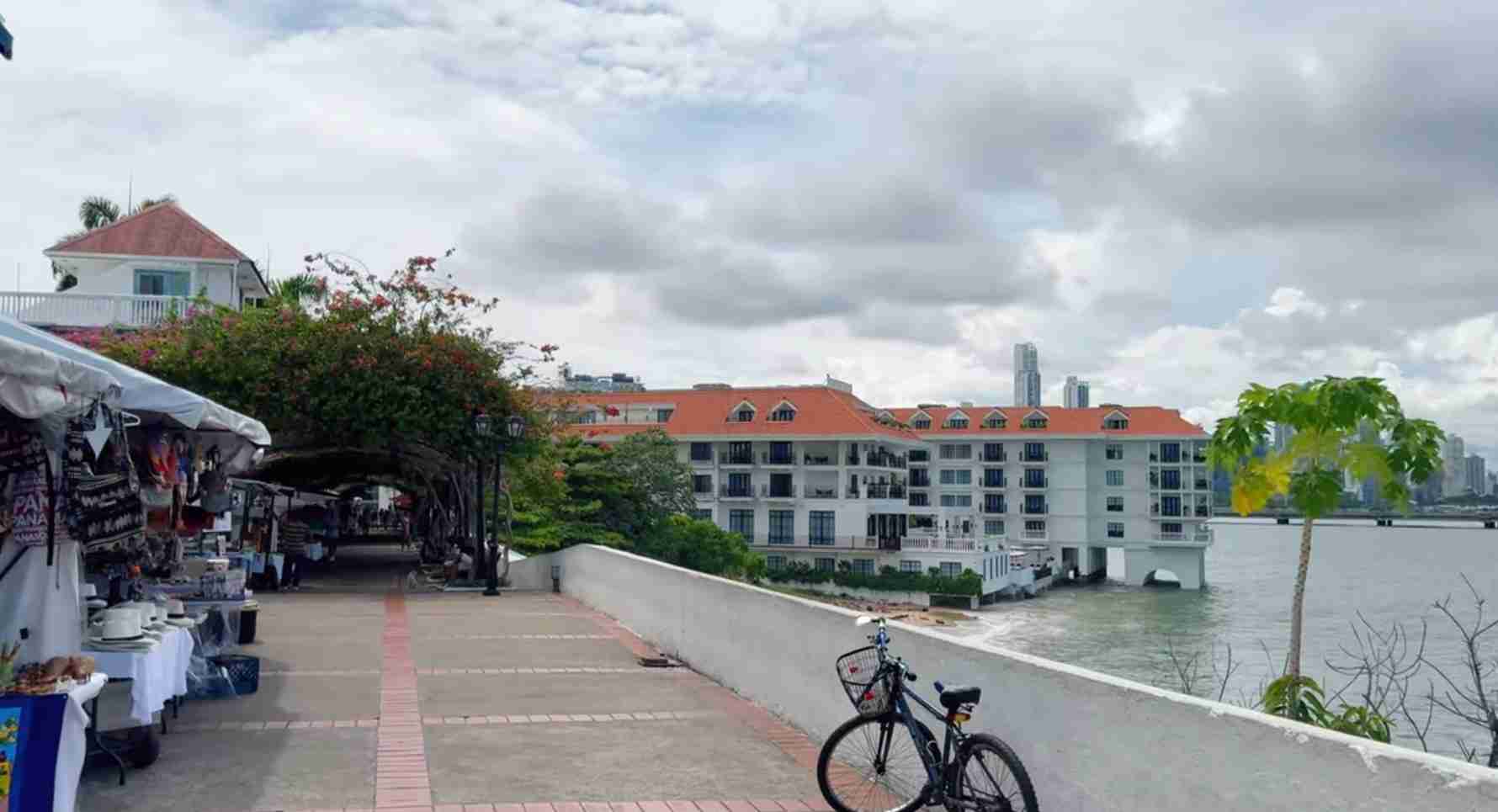
Walk south on Avenida A toward Plaza de Francia occupying Casco Viejo’s southern tip. The plaza honors 22,000 French construction workers who died during 1880s Panama Canal attempts from yellow fever, malaria, and accidents. Stone tablets detail French contributions, while a towering obelisk and rooster statue (France’s national symbol) dominate the plaza center. The elevated walkway atop Las Bóvedas (former Spanish dungeons converted to jail, storehouse, and offices) provides spectacular bay views, modern skyline photographs, and Bridge of the Americas sightings.
The walkway accommodates street vendors selling local artwork, Guna mola textiles, and handcrafted jewelry at reasonable prices ($15-80). This represents excellent opportunity for authentic Panamanian art purchases supporting local artists. The viewpoint captures sunset colors reflecting off glass towers across the bay, making late afternoon visits (5:00-6:30 PM) particularly photogenic.
Walk west along the waterfront to Iglesia de San José featuring the famous Golden Altar (Altar de Oro). Legend claims priests painted the baroque altar black to hide its value when privateer Henry Morgan sacked Panama Viejo in 1671, deceiving raiders who passed it believing the altar worthless. The gilded wood carving survived transfer to Casco Viejo when the city relocated in 1673, becoming Casco’s most valuable religious artifact. Church entry is free, though donations ($1-2) support maintenance and restoration efforts.
Churches and Colonial Architecture
Head north to Iglesia de la Compañía de Jesús ruins representing the 1641 Jesuit monastery destroyed by multiple fires and earthquakes. Impressive stone walls remain standing despite abandonment, creating dramatic photographic subjects especially during golden hour when evening light illuminates weathered stonework. Adjacent sits the Museo de Arte Religioso Colonial displaying religious artifacts, paintings, sculptures, and liturgical objects from the 16th-18th centuries.
Continue to the Arco Chato (Flat Arch), unusual supporting brick arch from a 17th-century church surviving the 1781 fire destroying the main structure. The gravity-defying arch spanning 49 feet with minimal curvature allegedly influenced U.S. senators debating canal location—its survival demonstrated low seismic activity favoring Panama over Nicaragua. The original arch collapsed in 2003 but reconstruction following original design allows visitors to appreciate the architectural achievement.
Walk to Casa Góngora on Avenida Central and Calle 4, the best-preserved Spanish colonial residence in Casco Viejo. Built in 1756 by pearl merchant Captain Pablo Góngora, the structure maintains original woodwork including ceiling beams, doors, and architectural details. The building houses cultural center hosting art exhibitions, live jazz performances (Wednesdays 8:00 PM), and fashion shows. Entry is free during normal hours (9:00 AM-5:00 PM Tuesday-Saturday).
Street Art and Contemporary Additions
Explore Avenida B and surrounding blocks showcasing Casco Viejo’s vibrant street art scene. Local and international artists created large-scale murals depicting Panamanian biodiversity, cultural heritage, and social themes on building facades throughout the district. Notable installations include the colorful butterflies along Calle 9, indigenous-themed murals near Plaza Herrera, and abstract geometric designs on Avenida A warehouses.
Visit La Calle de los Sombreros (Hat Street) featuring hundreds of colorful Panama hats suspended between buildings creating a canopy effect. This Instagram-favorite installation represents collaboration between local artisans and tourism promotion efforts. The shaded street provides relief from sun while offering unique photographic perspectives. Adjacent shops sell authentic Panama hats ($25-150 depending on quality and weave tightness) supporting traditional hat-making cooperatives.
Cinta Costera Waterfront Promenade 2026
Complete Waterfront Route: 8 Kilometers, 2-3 Hours
The Cinta Costera (Coastal Belt) extends 8 kilometers from Casco Viejo’s eastern edge through the financial district to Punta Pacifica, creating Panama City’s premier waterfront recreational space. The multi-phase development (constructed 2008-2014) reclaimed bay areas for parks, pedestrian paths, cycling lanes, exercise equipment, playgrounds, and public art installations. The completely paved, dedicated pathway separates pedestrians and cyclists from vehicle traffic ensuring safety throughout the route.
Begin at the Casco Viejo connection point near the fish market (Mercado de Mariscos) walking east along the bay. The first 2 kilometers (Cinta Costera 1) features wide promenades with bay views on one side and the modern financial district skyline on the other. Early morning walks (6:30-8:00 AM) encounter joggers, tai chi practitioners, and families enjoying cooler temperatures. Sunrise photography captures golden light illuminating glass towers across the bay creating impressive cityscape compositions.
At kilometer 2, the path reaches Balboa Avenue section (Cinta Costera 2) adding landscaped parks, monuments, and cultural spaces. The Panama Canal Memorial honors construction workers with plaques naming nationalities contributing to the project (over 90 countries represented). Public art installations appear at 300-500 meter intervals including sculptures celebrating Panamanian culture, abstract metal works, and interactive pieces inviting visitor participation.
Activity Zones and Amenities
Kilometer 3-5 features the most developed recreational infrastructure. Exercise equipment stations provide free outdoor gym facilities every 400-500 meters along the route. Playgrounds accommodate children aged 2-12 with climbing structures, swings, and slides. Basketball courts, soccer fields, and skateboard parks attract local youth throughout afternoon and evening hours. Public restrooms operate at three locations along the route (kilometer markers 2, 4, and 6), though quality varies and bringing toilet paper is advisable.
Food vendors and small cafes concentrate near kilometer 4 at the Cinta Costera 3 section. Mobile carts sell fresh coconut water ($2-3), fruit smoothies ($3-5), ice cream ($2-4), and traditional snacks like empanadas ($1-2 each). Sit-down restaurants along parallel Balboa Avenue offer seafood, international cuisine, and Panamanian traditional dishes at $12-25 per meal. Sunday morning markets (8:00 AM-1:00 PM) feature food trucks, artisan vendors, and live music creating festival atmospheres.
Sunset and Evening Experiences
The Cinta Costera transforms during late afternoon and evening hours (5:00-9:00 PM) as families, couples, and exercise enthusiasts populate the pathways. Sunset occurs 6:00-6:30 PM year-round (minimal variation due to equatorial location), creating optimal viewing from kilometer 2-4 sections facing west across the bay. The skyline illumination beginning at dusk provides dramatic nighttime photography opportunities with building lights reflecting on bay waters.
Evening security remains strong throughout the route with police patrols, lighting every 30-50 meters, and population density preventing isolated sections. However, exercise caution after 9:00 PM when crowds thin and darker areas between light posts create visibility limitations. Stick to well-populated sections and main pathway avoiding park interior paths after dark.
Amador Causeway Island Walk 2026
Causeway Overview and Route Description: 6 Kilometers Round-Trip
The Amador Causeway (Calzada de Amador) extends 3 kilometers from mainland Panama City across four small islands (Naos, Perico, Culebra, and Flamenco) to the Pacific Ocean entrance of the Panama Canal. Constructed using rocks excavated during canal building (1904-1914), the causeway creates both a breakwater protecting harbor facilities and a recreational corridor offering spectacular views of the Bridge of the Americas, Panama City skyline, and ships waiting for canal transit.
The dedicated pedestrian and cycling path runs the causeway’s entire length separated from vehicle roadway by barriers and landscaping. The completely flat route requires no elevation changes making it accessible for all fitness levels. Shade remains limited with only occasional palm trees and built structures providing sun protection—early morning (6:30-8:30 AM) or late afternoon (4:30-6:30 PM) timing prevents midday heat exposure.
Walking outbound from the mainland toward Flamenco Island provides immediate bay and skyline views. The first kilometer passes Punta Culebra Nature Center (Smithsonian Tropical Research Institute facility) featuring marine exhibits, sloth viewing areas, and touch tanks with entrance fees at $4-6. The center opens 10:00 AM-5:00 PM Tuesday-Sunday making it ideal for return-leg stops rather than early morning outbound walks.
Islands and Attractions Along the Route
Naos Island (kilometer 1) features the Biomuseo, Frank Gehry’s only Latin American architectural project showcasing Panama’s biodiversity through interactive exhibits. The building’s vibrant multicolored panels create striking photographs against blue sky backgrounds. Admission costs approximately $22 adults with visits requiring 90-120 minutes for complete exhibition exploration. The museum opens 10:00 AM-4:00 PM Tuesday-Friday and 10:00 AM-5:00 PM weekends.
Perico and Culebra Islands (kilometers 1.5-2.5) host marinas, restaurants, and recreational facilities. Yacht clubs display impressive vessels, while waterfront restaurants serve fresh seafood with bay views. Seafood prices range $20-45 for entrées at mid-range establishments, while budget options near marina parking areas charge $12-18 for fish plates with rice and plantains. Sunday brunches feature live music and buffet options at several venues ($25-35 per person).
Flamenco Island (kilometer 3, causeway terminus) concentrates the highest density of restaurants, bars, and shops. The island accommodates cruise ship tenders when large vessels anchor in Panama Bay, creating occasional crowding during afternoon hours. The Flamenco marina provides boat charter services for Panama Bay cruises, fishing expeditions, and Pearl Islands transfers. Return walking allows different perspective angles on the skyline and bridge, particularly attractive during golden hour (5:00-6:00 PM) when western sun illuminates city buildings.
Bicycle Alternative and Rentals
Bicycle riding dramatically reduces causeway crossing time from 90-minute walks to 30-40 minute rides. Burke Bikes near Flamenco marina rents standard bicycles ($8-12 hourly), family quad bikes ($25 hourly accommodating 4 people), and electric bikes ($15-20 hourly for easier pedaling). Children’s bikes with training wheels and rear-mounted child seats provide family cycling options. Rental agreements require ID deposits or credit card holds released upon equipment return.
The dedicated cycling lane runs parallel to the walking path separated by painted lines. Traffic remains light even during peak hours (weekends 10:00 AM-5:00 PM) allowing safe family cycling including children aged 6+ with basic riding proficiency. Helmets are provided with rentals though not legally required. The flat terrain enables riders of all fitness levels to complete round-trip journeys without significant exertion.
Metropolitan Natural Park Urban Rainforest 2026
Park Overview and Trail Network
Metropolitan Natural Park (Parque Natural Metropolitano) represents the only protected rainforest within capital city limits in all of Latin America. The 575-acre preserve located 15 minutes from downtown maintains tropical moist forest harboring 227 bird species, 45 mammal species, and 284 tree varieties. Entry costs just $4 per person making it exceptional value for wildlife viewing and rainforest hiking within urban environment.
Five marked trails totaling 8 kilometers accommodate varying difficulty levels and time commitments. The Mono Tití Trail (1.2 kilometers, 30-40 minutes, easy) provides flat loop through forest edge ideal for bird photography and monkey observations. The Cedro Trail (1.8 kilometers, 45-60 minutes, moderate) ascends gradually toward viewpoint areas. The Los Momótides Trail (2.1 kilometers, 60-75 minutes, moderate-difficult) climbs to Cerro Cedro summit (150 meters elevation) offering panoramic views of Panama City, the canal, and surrounding forest canopy.
Early morning visits (6:30-9:00 AM) maximize wildlife encounters as animals feed actively before midday heat. Howler monkeys vocalize at dawn creating jungle soundscapes audible throughout the park. Three-toed sloths inhabit cecropia trees near trail edges, their slow movements making them easier to spot than faster-moving mammals. Toucans, trogons, and motmots concentrate around fruiting trees, while antbird flocks follow army ant swarms through forest understory.
Wildlife Viewing Strategy
Successful wildlife observation requires patience, quiet movement, and trained observation. Walk slowly (2 kilometers per hour maximum) scanning tree branches, trunk surfaces, and ground vegetation for movement or unusual shapes. Binoculars (8×42 or 10×42 magnification optimal) enable distant animal identification without disturbing wildlife. Field guides help species identification—birds of Panama apps like eBird provide photo references, range maps, and call recordings for the 227 species recorded in the park.
Listen actively for animal vocalizations indicating presence before visual confirmation. Howler monkey roars carry 5 kilometers through forest canopy. Woodpecker drumming creates distinctive rhythmic patterns. Motmots produce low “hoot-hoot” calls from shaded perches. Following these auditory cues leads to sightings impossible through visual scanning alone.
Photography challenges include low light conditions under forest canopy requiring camera settings of ISO 1600-3200, wide aperture lenses (f/2.8 or larger), and stabilization for slow shutter speeds. Telephoto lenses (300mm-600mm) enable detailed animal portraits from respectful distances avoiding disturbance. Flash photography disturbs wildlife and produces unnatural lighting—rely on natural light and high ISO capabilities for forest photography.
Practical Hiking Information
Wear closed-toe shoes with good traction for muddy trail sections, particularly during rainy season (May-November). Long pants and long sleeves provide protection from biting insects despite heat. Apply DEET-based insect repellent to exposed skin, focusing on ankles, wrists, and neck areas where insects target warm blood flow. Reapply every 2-3 hours for continuous protection.
Carry 1-2 liters of water for trails exceeding 1 hour, as no facilities exist beyond the visitor center. Restrooms at the entrance building provide last opportunities before trail access. Trail markers appear every 200-300 meters preventing navigation errors, though trail intersections feature signage indicating distances and difficulty ratings. Park rangers patrol trails daily addressing medical emergencies or lost visitors.
Panama Viejo Archaeological Walk 2026
Ruins Site Layout and Route
Panama Viejo (Old Panama) spreads across 57 acres of archaeological ruins representing the original 1519 Spanish settlement destroyed by privateer Henry Morgan in 1671. The preserved remains include cathedral walls, plaza layouts, monastery foundations, and defensive fortifications providing insight into early Spanish colonial urban planning. Entry costs $15 per person including museum access and cathedral tower climb.
Begin at the visitor center and museum reviewing historical context before ruins exploration. The museum chronicles the city’s founding by Pedrarias Dávila, function as Peru expedition launching point, role in gold/silver transit from New World to Spain, pirate attacks, and ultimate destruction. Interactive displays explain 16th-17th century daily life, trade patterns, and religious practices. Allocate 30-45 minutes for museum before outdoor walking.
The self-guided ruins walk follows a 2-kilometer loop accessing major structures via gravel paths and grass areas. Interpretive signs in Spanish and English explain each building’s function and architectural significance. The cathedral tower represents the walk’s focal point, requiring 115-step climb to three observation levels providing panoramic views of archaeological site and modern Panama City juxtaposition. Tower access is included in admission but requires moderate fitness for stair climbing.
Major Ruins and Historical Context
Plaza Mayor served as the social, cultural, economic, religious, and political center of the original city. The open space accommodated markets, public gatherings, and official ceremonies. Surrounding the plaza are Casa Terrín and Casa Oeste foundations representing wealthy merchant residences, and the town hall remains demonstrating civic architecture.
The cathedral stone walls stand as the fourth structure on this site—three previous wooden cathedrals burned before the current masonry building (constructed 1619-1626). The tower served dual purposes as belfry and watchtower providing early warning of approaching ships (whether friendly traders or hostile pirates). The climb provides historical perspective on defensive concerns dominating early colonial life.
The Convento de la Concepción represents one of the largest ruins covering an entire city block. The female religious congregation headquartered here played significant roles in colonial social services including education, healthcare, and charity distribution. Stone walls outline dormitories, chapels, gardens, and administrative spaces within the complex.
Practical Visiting Information
The exposed archaeological site offers minimal shade protection necessitating early morning (7:00-9:00 AM) or late afternoon (4:00-6:00 PM) visits avoiding midday sun exposure. Wide-brimmed hats, sunscreen (SPF 30+ recommended), and sunglasses prove essential for comfortable exploration. The grassy areas between structures provide pleasant walking surfaces though uneven ground requires sturdy footwear. Avoid sandals or flip-flops favoring closed-toe shoes with ankle support.
Photography benefits from side-angle sunlight during golden hours (first hour after sunrise, last hour before sunset) illuminating stone textures and creating three-dimensional depth in shadows. Midday overhead sun produces flat lighting unsuitable for architectural photography. Wide-angle lenses (16-35mm) capture full structure contexts within ruins settings, while 50mm-85mm focal lengths create detailed architectural element portraits.
Money-Saving Free Walking Strategies 2026
Completely Free Walking Experiences
Casco Viejo street walking, plaza sitting, and exterior architectural appreciation cost nothing beyond personal hydration and snack expenses. Church exteriors, colonial facades, street art installations, and waterfront viewpoints provide hours of photography and cultural observation without admission fees. Most churches allow free entry for prayer and quiet observation (modest clothing and respectful behavior expected), though specific religious artifact access may require museum tickets.
Cinta Costera and Amador Causeway walking remains completely free throughout their 14 combined kilometers. These waterfront experiences deliver world-class skyline views, bay recreation, and public art exposure at zero cost. Sunday morning events including street vendors, food trucks, and cultural performances provide entertainment without admission requirements, though food and craft purchases support local entrepreneurs.
Metropolitan Natural Park charges modest $4 admission but delivers extraordinary value through 8 kilometers of trails, rainforest immersion, and wildlife viewing impossible to replicate elsewhere in Panama City. The cost equals 1-2 coffee drinks but provides 2-5 hours of nature experiences within urban environment.
Self-Guided versus Organized Tour Trade-Offs
Free walking tours through GuruWalk platform operate in Casco Viejo on tip-based models. Guides work for gratuities only (suggested $10-20 per person) providing historical context, architectural interpretation, and neighborhood orientation during 2-3 hour walks. Tours depart 10:00 AM and 3:00 PM daily from Plaza de la Independencia. Meeting points accommodate walk-up participation without advance reservations.
Paid organized walking tours ($35-65 per person through operators like Viator or local companies) include museum admissions, guide expertise, and small group experiences (8-12 participants maximum). These tours deliver deeper historical knowledge and access to guides’ specialized training in Panamanian history and architecture. However, self-guided exploration allows unlimited photography time, spontaneous cafe stops, and personalized pacing impossible in scheduled group tours.
Frequently Asked Questions: Panama City Walking Tours 2026
Do I need a guide for Panama City walking tours in 2026?
Guides significantly enhance historical and cultural understanding but aren’t necessary for safe, enjoyable walking in Panama City’s main tourist districts in 2026. Casco Viejo’s compact layout, English signage at major sites, and straightforward navigation enable successful self-guided exploration. However, guides provide historical context, architectural details, and cultural insights impossible to discover independently. Free walking tours through GuruWalk ($10-20 suggested tips) offer affordable middle ground between completely independent exploration and premium private guide services ($80-150 for 3-4 hours). First-time visitors benefit from guide interpretation, while repeat visitors save money through self-guided approaches.
Can I walk between Casco Viejo and the modern financial district in 2026?
Direct walking between Casco Viejo and financial district via Cinta Costera spans 3-4 kilometers requiring 45-60 minutes along waterfront pathways. The route is safe, scenic, and completely pedestrian-friendly with bay views throughout. However, midday heat (11:00 AM-3:00 PM) makes this walk uncomfortable—schedule for early morning or late afternoon timing. Alternative transportation includes Uber ($3-5, 10-minute ride), Metro Line 1 to Cinco de Mayo station ($0.35, 15 minutes total including walking to/from stations), or Metrobus routes along Avenida Balboa ($0.25-0.50, 20-25 minutes with stops). Most visitors find the waterfront walk pleasant during cool hours but use vehicles for midday transitions.
What should I bring on Panama City walking tours in 2026?
Essential items include reusable water bottle (1-liter minimum for 3+ hour walks), comfortable walking shoes with cushioning, wide-brimmed hat for sun protection, reef-safe sunscreen (SPF 30+), sunglasses, small backpack for purchases and layers, camera with extra batteries/memory cards, cash ($20-40 for purchases, tips, and small vendor transactions), and compact rain jacket or umbrella during May-November rainy season. Optional but recommended: portable phone charger, offline map downloads, basic first-aid kit (bandages, pain relievers, antihistamines), insect repellent for Metropolitan Natural Park walks, and translation app for Spanish-English communication. Avoid carrying excessive valuables, expensive jewelry, or large amounts of cash beyond immediate needs.
Are there public restrooms along Panama City walking routes in 2026?
Public restroom availability varies significantly by location in 2026. Casco Viejo lacks dedicated public facilities but museums (Panama Canal Museum, Contemporary Art Museum), churches (after respectful request), and restaurants/cafes provide access to paying customers. Purchase coffee or snack ($3-6) enabling restroom use without awkwardness. Cinta Costera features three public restroom buildings at kilometer markers 2, 4, and 6, though cleanliness varies and bringing tissue is advisable. Amador Causeway restaurants and Biomuseo provide facilities for visitors. Metropolitan Natural Park maintains restrooms at the entrance visitor center but none along interior trails. Plan restroom stops before extended walks and patronize cafes/restaurants along routes for facilities access.
Can I walk Panama City with a stroller or wheelchair in 2026?
Accessibility varies dramatically by district and route in 2026. Cinta Costera and Amador Causeway feature completely paved, level surfaces ideal for strollers and wheelchairs throughout their entire lengths. These routes provide excellent accessibility for mobility-limited visitors. However, Casco Viejo’s cobblestone streets from the 1670s create challenging navigation for wheelchairs and strollers—substantial jolting and uneven surfaces require all-terrain wheels and significant pushing effort. Curbs lack consistent ramps limiting sidewalk-to-street transitions. Museums and major churches in Casco Viejo offer wheelchair access through modified entrances, though colonial buildings lack elevators limiting upper floor access. Metropolitan Natural Park trails remain unsuitable for wheels due to natural surfaces, roots, and elevation changes. Families with young children find umbrella strollers difficult in Casco Viejo—baby carriers provide better mobility across uneven terrain.
What is the best walking tour for photography in Panama City in 2026?
Casco Viejo during golden hour (first hour after sunrise 6:30-7:30 AM or last hour before sunset 5:30-6:30 PM) delivers optimal photography conditions in 2026. Morning light illuminates colonial facades from the east creating warm tones on weathered stones, wrought iron balconies, and colorful building exteriors. Evening golden hour highlights western-facing structures along the waterfront with bay reflections providing foreground interest. The Las Bóvedas walkway offers skyline photography across the bay with modern towers creating dramatic contrasts against colonial foreground elements. Cinta Costera sunrise walks capture the financial district awakening with golden light on glass facades and bay reflections, while sunset sessions show illuminated buildings transitioning to nighttime skyline photography. Bring wide-angle lens (16-35mm) for architectural contexts and 50-85mm for detailed element portraits.
Are there guided walking tours in languages other than English in 2026?
Spanish-language tours operate daily through multiple operators given Panama’s primary language. Free GuruWalk tours in Casco Viejo offer both Spanish and English departures. French, German, and Portuguese tours are available through specialty operators on advance-request basis requiring 3-7 day booking windows. Italian, Mandarin, and Japanese tours operate less frequently—inquire directly with premium tour companies (Ancon Expeditions, Panama Day Trips) for multilingual guide availability. Self-guided walking eliminates language dependencies though museum displays and historical plaques primarily appear in Spanish and English. Translation apps bridge language gaps for independent walkers seeking information from signs, plaques, and local interactions.
How do I avoid getting lost during self-guided walking tours in 2026?
Download offline maps through Maps.me or Google Maps before walking expeditions ensuring navigation without mobile data requirements. Mark hotel location as “favorite” or “saved place” enabling easy return routing. Casco Viejo’s compact 10-block area makes getting seriously lost nearly impossible—waterfront orientation on east side, Avenida A on north boundary, and distinctive landmarks (cathedral, Plaza Bolívar) provide constant reference points. Cinta Costera and Amador Causeway represent linear routes impossible to lose way on—simply reverse direction for return journeys. Metropolitan Natural Park trails feature clear signage and color-coded marking preventing navigation errors. Carry hotel business cards with addresses in Spanish enabling taxi/Uber directions if disoriented. Learn key Spanish phrases: “¿Dónde está [hotel name]?” means “Where is [hotel name]?”
What neighborhoods should I avoid walking in Panama City in 2026?
Stick to established tourist districts (Casco Viejo, Cinta Costera, Amador Causeway, financial district, and Punta Pacifica) for safe walking experiences in 2026. Avoid walking in El Chorrillo, Curundu, Tocumen (except airport area), and Santa Ana periphery where higher crime rates and less tourist infrastructure create unnecessary risks. These neighborhoods lack attractions justifying visitor presence and present elevated theft/assault risks particularly after dark. Tourist police concentrate in Casco Viejo and waterfront areas specifically protecting visitor zones—straying beyond these districts reduces security presence and increases vulnerability. If uncertain about neighborhood safety, consult hotel concierge, use Uber/taxis rather than walking, or join organized tours providing transportation and security through guide presence.
Can I walk at night in Panama City in 2026?
Evening walking (until 10:00-11:00 PM) remains safe in Casco Viejo’s restaurant and bar districts along Avenida Central and around Plaza Bolívar where crowds and lighting provide security through population density. Cinta Costera accommodates evening walkers and joggers until 9:00 PM with good lighting and police patrols, though population thins after this hour creating isolated sections. Amador Causeway operates lighting throughout but concentrates activity near Flamenco marina restaurants—outer causeway sections become isolated after 8:00 PM. Avoid Casco Viejo periphery areas and empty plazas after 10:00 PM when restaurants close and streets empty. Financial district presents limited nighttime walking interest due to lack of evening attractions and activity—stick to Casco Viejo for evening experiences. Groups provide better security than solo walkers after dark. Uber ($3-5) offers inexpensive alternative to nighttime walking in any district.