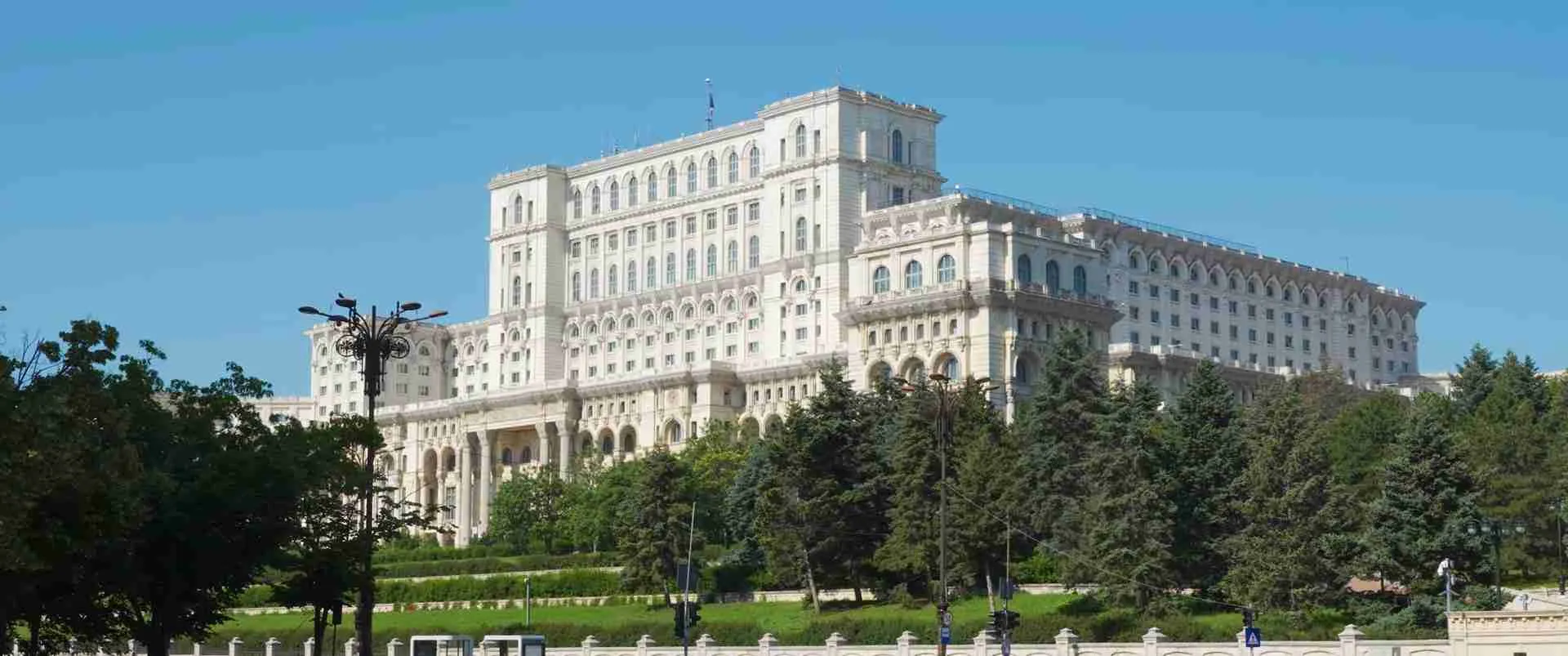
Palace of the Parliament Bucharest: World’s Heaviest Building Complete Tour Guide
Bucharest’s Palace of the Parliament stands as the world’s heaviest building at 4.1 million tonnes and the second-largest administrative structure globally, offering visitors an extraordinary journey through Romania’s complex 20th-century history. This colossal monument to communist-era megalomania combines staggering architectural ambition with opulent interiors featuring marble halls, crystal chandeliers, and hand-woven carpets, all accessible through guided tours that reveal both the building’s imposing grandeur and its controversial origins.
Key Takeaways: Palace of the Parliament Essentials
- Architectural Supremacy: The Palace holds three Guinness World Records as the world’s heaviest building (4.1 million tonnes), the most expensive administrative building (€4 billion valuation), and the second-largest administrative building after the Pentagon, with a floor area of 365,000 square meters containing over 1,100 rooms across 12 above-ground floors and 8 underground levels.
- Tour Requirements and Access: Entry requires advance booking and passport presentation, with guided tours starting at €14 for adults. Tours cover the Honor Hallway, Nicolae Bălcescu Hall, Human Rights Hall, and Europe’s largest ballroom, revealing interiors constructed from 1 million cubic meters of marble, 3,500 tonnes of crystal, and 700,000 tonnes of steel and bronze.
- Construction Legacy: Built between 1984 and 1997 under dictator Nicolae Ceaușescu’s orders, the palace required demolishing an entire Bucharest neighborhood, displacing 40,000 people, and employing over 100,000 workers in 24-hour shifts, making it both an architectural marvel and a symbol of totalitarian excess.
- Physical Phenomena: The building’s immense weight causes it to sink 6 millimeters annually as sediment layers beneath compress under the mass, creating a unique engineering challenge that continues decades after construction completion.
- Current Function: Since 1994, the palace houses Romania’s Chamber of Deputies and Senate, with the National Museum of Contemporary Art occupying the west wing, though approximately 70% of the building’s 330,000 square meters remains empty and unused.
- Visitor Experience: Standard tours last 45 minutes covering main ceremonial rooms, with extended options including basement access (additional 15 minutes) and terrace visits offering panoramic city views, all providing insight into the palace’s role as both political headquarters and historical monument.
People Also Ask About Palace of the Parliament Bucharest
Why is the Palace of the Parliament the heaviest building in the world?
The Palace of the Parliament achieves its status as the world’s heaviest building through the sheer volume of construction materials concentrated within its 2.55 million cubic meter volume. The structure contains 700,000 tonnes of steel and bronze for the structural framework, 1 million cubic meters of solid marble from Romanian quarries forming floors and walls throughout the building, 3,500 tonnes of crystal in the form of massive chandeliers and decorative elements, 900,000 cubic meters of hardwood for intricate parquet floors and wall panels, and 200,000 square meters of hand-woven woolen carpets weighing several tonnes each. This combination of dense materials, multiplied across 12 above-ground floors and 8 underground levels, creates a total mass of 4.1 million tonnes. The building’s immense weight exceeds the Great Pyramid of Giza by volume and causes the structure to sink 6 millimeters each year as the sediment beneath compresses under sustained pressure. Unlike modern skyscrapers that use lighter steel and glass construction, Ceaușescu insisted on solid Romanian materials that emphasized permanence and grandeur, resulting in a building whose mass remains unmatched globally.
How many rooms does the Palace of the Parliament have?
The Palace of the Parliament contains more than 1,100 rooms spread across its 365,000 square meter floor area, though some sources cite over 3,000 rooms when counting all spaces including service areas, storage rooms, and technical chambers. The main ceremonial spaces accessible on tours include the Honor Hallway, Nicolae Bălcescu Hall with imported African hardwood doors, the Human Rights Hall, the Music Hall, the Pink Room, and Europe’s largest ballroom measuring thousands of square meters with over 500 crystal chandeliers. The building houses 440 government offices, over 30 halls and salons of various sizes, galleries, corridors adorned with artwork, and conference rooms used by Romania’s Chamber of Deputies and Senate. The eight underground levels contain additional chambers including a nuclear bunker at the lowest depth of 92 meters, connected to other Bucharest institutions through 20 kilometers of tunnels wide enough for vehicles. Despite this vast number of spaces, approximately 70% of the palace remains empty and unused, a stark testament to Ceaușescu’s megalomaniacal vision exceeding any practical governmental need.
Can you visit the Palace of the Parliament on your own?
Independent exploration of the Palace of the Parliament is not permitted — all visitors must join organized guided tours with advance reservations required at least 24 hours before arrival. This mandatory guided tour policy exists for multiple reasons: the building functions as Romania’s active parliamentary headquarters where sensitive governmental work occurs, security protocols require controlled access and visitor monitoring, the palace’s sheer size and labyrinthine layout of over 1,100 rooms across multiple floors would make self-guided navigation impractical and potentially dangerous, and the complex history and architectural details benefit from expert interpretation that guides provide. Tours operate daily from March through October between 9 AM and 5 PM, and from November through February between 10 AM and 4 PM. Visitors must bring passports for security clearance at the entrance on B-dul Naţiunile Unite (the northern side of the building). Several tour options exist: standard tours covering main ceremonial rooms in 45 minutes, extended tours adding basement access for an additional 15 minutes, terrace tours providing city panoramas, and specialized tours focusing on specific architectural or historical aspects when available. All tours include professional guides speaking multiple languages including English, Romanian, and Italian, ensuring comprehensive understanding of both the palace’s grandiose design and its controversial communist-era origins.
What makes the Palace of the Parliament architecturally unique?
The Palace of the Parliament’s architectural uniqueness stems from its unprecedented combination of scale, materials, and design philosophy representing an extreme expression of communist-era monumentalism. Architect Anca Petrescu, appointed chief architect at age 28, led a team of 700 architects in creating a structure that blends neoclassical architectural forms with socialist realism principles, resulting in a building whose heaviness and monumentality manifest both physically and aesthetically. The structure’s distinctive features include a wide, heavy base that tapers slightly upward across 12 floors reaching 84 meters in height, creating a pyramid-like silhouette visible from across Bucharest. The building uses exclusively Romanian materials — a nationalist requirement imposed by Ceaușescu — showcasing domestic marble varieties, indigenous hardwoods, Romanian crystal craftsmanship, and textiles produced by local artisans. Interior spaces feature disproportionate scale with ceiling heights reaching 15-20 meters in ceremonial halls, doorways designed for monumental impact rather than human proportion, and corridors wide enough to accommodate large groups. The palace incorporates 2,800 chandeliers (many weighing multiple tonnes), floor-to-ceiling mirrors creating illusions of infinite space, hand-carved wood paneling covering entire walls, and marble staircases with balustrades featuring intricate sculptural details. Underground, the structure extends 92 meters deep with reinforced bunkers designed to withstand nuclear attack, connected through 20 kilometers of tunnels to other government buildings. This combination of autocratic vision, lavish materials, monumental proportions, and defensive engineering creates an architectural specimen without parallel in modern construction.
Extended multi-day tours – 5+ days
Featured Bucharest Multi-Day Tour Packages
3 days
Bucharest 3-Day Discovery Tour
- ✓ Comprehensive Bucharest experience
- ✓ Expert local guides included
- ✓ All accommodation included
- ✓ Transportation provided
5 days
Bucharest 5-Day Highlights Experience
- ✓ Comprehensive Bucharest experience
- ✓ Expert local guides included
- ✓ All accommodation included
- ✓ Transportation provided
7 days
Bucharest 7-Day Cultural Journey
- ✓ Comprehensive Bucharest experience
- ✓ Expert local guides included
- ✓ All accommodation included
- ✓ Transportation provided
10 days
Bucharest 10-Day Complete Adventure
- ✓ Comprehensive Bucharest experience
- ✓ Expert local guides included
- ✓ All accommodation included
- ✓ Transportation provided
Multi-day tour packages powered by TourRadar. Prices and availability subject to change.
Introduction: Understanding Bucharest’s Monumental Palace
The Palace of the Parliament towers over Bucharest’s Dealul Spirii (Arsenal Hill) as a physical manifestation of Nicolae Ceaușescu’s authoritarian vision, representing both Romania’s darkest political chapter and one of the 20th century’s most ambitious architectural undertakings. This colossal structure embodies contradictions at every level: built as the “People’s House” while 40,000 people lost their homes to make space for its construction, designed to showcase Romanian national pride while bankrupting the economy, and intended as a symbol of communist permanence yet now serving as democratic Romania’s parliamentary seat. The building’s superlatives tell part of its story — heaviest building on Earth, second-largest administrative structure globally, most expensive building ever constructed, third-largest building by volume — but numbers alone cannot capture the palace’s complex legacy as both architectural achievement and monument to totalitarian excess.
Understanding the Palace of the Parliament requires grasping the historical context that produced it. The devastating 1977 Vrancea earthquake, measuring 7.5 on the Richter scale, provided Ceaușescu with justification to demolish significant portions of historic Bucharest under the guise of modernization and earthquake-proofing. What followed became Project Bucharest, an intensive reconstruction program inspired by Ceaușescu’s visit to North Korean leader Kim Il Sung and his palace in Pyongyang. The Romanian dictator envisioned transforming Bucharest into a showcase capital rivaling Paris, centered on a monumental palace that would house all governmental functions in a single structure symbolizing state power and unity. This vision manifested in a building project that consumed enormous national resources during a period when ordinary Romanians faced severe austerity, food rationing, and energy shortages — a bitter irony that defines the palace’s historical significance.
Today’s visitors encounter a building transformed from totalitarian showpiece to working democratic institution, creating unique tensions between the structure’s original purpose and current function. The palace houses Romania’s Chamber of Deputies (since 1994) and Senate (since 2004), alongside the National Museum of Contemporary Art in the west wing, international conference facilities, and exhibition spaces. Yet approximately 70% of the building remains empty — vast halls, unused offices, and corridors that stand as silent testimony to Ceaușescu’s megalomaniacal overreach. Tour guides navigate this complexity by presenting both the palace’s impressive architectural and engineering achievements alongside honest acknowledgment of the human and economic costs that created it, offering visitors a nuanced understanding of Romania’s 20th-century history through the lens of its most controversial monument.
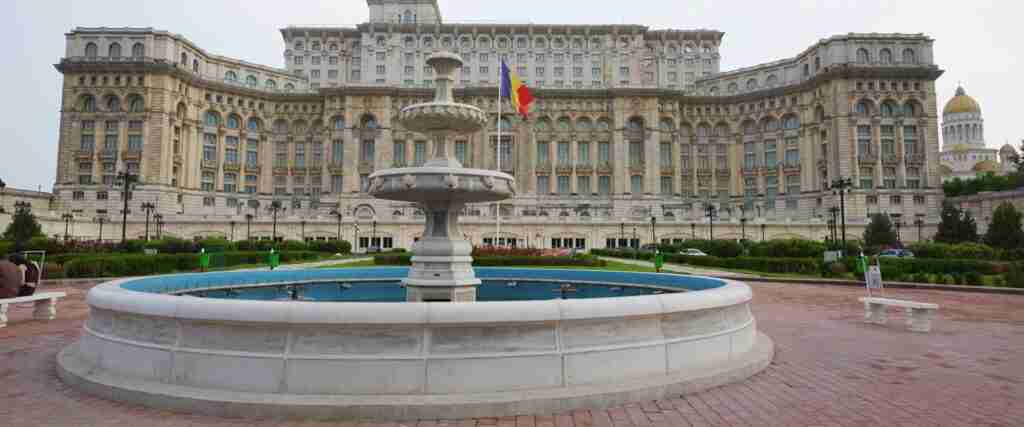
The palace’s physical impact on Bucharest extends beyond the building itself through the 3.5-kilometer Bulevardul Unirii (Union Boulevard), constructed simultaneously to provide a grand approach rivaling Paris’s Champs-Élysées. This urban restructuring reshaped central Bucharest’s character, destroying medieval street patterns, historic neighborhoods, Orthodox churches, synagogues, and hospitals to impose a rigid geometric order reflecting totalitarian planning principles. The neighborhood that once occupied Dealul Spirii contained diverse architectural heritage spanning centuries, all erased to make room for Ceaușescu’s vision. Today, Union Boulevard’s fountain displays and apartment buildings built to uniform designs create a distinctive urban landscape that some find impressive while others view as a permanent scar on Bucharest’s historic fabric — perspectives that vary among Romanians themselves based on generational experience and political outlook.
Visiting the Palace of the Parliament offers travelers an extraordinary opportunity to experience architecture at a scale rarely encountered, while simultaneously confronting questions about power, national identity, historical memory, and the human cost of authoritarian ambition. The tour experience balances aesthetic appreciation of undeniable craftsmanship — the intricate wood carvings, massive crystal chandeliers, hand-woven carpets, and marble work representing Romanian artisanal excellence — with critical understanding of the conditions under which these were created. Workers labored in 24-hour shifts, often in dangerous conditions that resulted in numerous deaths, creating interiors of opulent luxury while their own families faced deprivation. This juxtaposition between material splendor and moral complexity makes the palace more than a tourist attraction; it becomes a profound meditation on power, sacrifice, and the ways societies remember and reconcile with difficult pasts.
Historical Background: From Ceaușescu’s Vision to Democratic Parliament
The Palace of the Parliament’s origins trace to Nicolae Ceaușescu’s 1971 visit to North Korea, where he observed Kim Il Sung’s monumental architecture and the juche ideology emphasizing state independence, unified ideology, and national self-reliance. Ceaușescu returned to Romania determined to create a comparable architectural statement symbolizing Romania’s socialist achievement and his personal authority. The 1977 Vrancea earthquake, despite causing significant damage to Bucharest’s older structures, provided the political pretext for wholesale urban transformation under Project Bucharest, initiated in 1978. This program combined earthquake-proofing justifications with ideological goals, allowing Ceaușescu to demolish neighborhoods deemed insufficiently modern or representative of the socialist vision he championed.
The architectural competition held in 1983 selected Anca Petrescu, a 28-year-old architect, as chief designer — a choice that sparked controversy both for her youth and for concerns about political favoritism in the selection process. Petrescu led a coordinating team of 10 assisting architects overseeing approximately 700 total architects who developed detailed plans for every aspect of the building. The design specified that all construction materials must originate within Romania, reflecting Ceaușescu’s nationalist economic policies and desire to showcase domestic production capabilities. This requirement created massive demand for Romanian marble, crystal, steel, bronze, hardwoods, textiles, and other materials, effectively nationalizing production and requiring industries to prioritize palace construction over other economic needs. The scale of material requirements strained Romania’s economy significantly: quarries operated beyond sustainable capacity, forests were logged extensively, and skilled artisans were redirected from other projects to serve palace construction exclusively.
Construction commenced in 1984 with the demolition of existing neighborhoods occupying Dealul Spirii and surrounding areas. Approximately 40,000 people received forced relocation notices, typically with minimal compensation and short notice periods. The demolition erased an entire district containing 19 Orthodox churches, 6 synagogues (including the historic Văcărești Monastery), 3 Protestant churches, 30 factories, numerous hospitals and schools, and thousands of residential buildings representing various architectural periods from medieval structures through 19th-century townhouses. Historic preservation concerns were dismissed as incompatible with socialist modernization goals. The cleared area extended beyond the palace footprint to accommodate the planned 3.5-kilometer Union Boulevard and flanking uniform apartment buildings, reshaping central Bucharest’s urban fabric according to rigid geometric principles.
The construction workforce eventually exceeded 100,000 people, with approximately 20,000 workers on-site simultaneously during peak construction periods, organized into three shifts enabling 24-hour construction operations seven days per week. The workforce included construction workers, marble cutters, woodworkers, crystal craftsmen, weavers, metalworkers, electricians, and specialists in every trade. Military conscripts supplemented civilian workers; between 1984 and 1990, approximately 12,000 soldiers participated in construction as part of their service obligations. Working conditions were harsh: long shifts in all weather conditions, minimal safety equipment, high accident rates, and pressure to meet unrealistic deadlines imposed by Ceaușescu’s demands. Numerous workers died in construction accidents — official numbers remain unclear due to communist-era record suppression, but estimates suggest dozens of fatalities from falls, equipment failures, and exposure incidents. Survivors report intense pressure, inadequate rest, and fear of punishment for delays or quality issues.
The palace consumed enormous national resources during a period of severe economic hardship for ordinary Romanians. Throughout the 1980s, Ceaușescu implemented brutal austerity measures to repay Romania’s foreign debt, rationing food, fuel, and electricity for the population while diverting resources to palace construction. This created a bitter paradox: citizens endured cold winters without heating, stood in bread lines, and faced food shortages while workers installed crystal chandeliers weighing multiple tonnes and laid kilometers of hand-woven carpets in the palace. The contrast between the building’s opulence and widespread poverty fueled resentment that contributed to the revolutionary atmosphere culminating in December 1989’s violent overthrow of the Ceaușescu regime.
Construction continued after Ceaușescu’s execution on December 25, 1989, though the pace slowed significantly and funding became uncertain. The new democratic government faced decisions about the palace’s fate: proposals included demolition, conversion to alternative uses, or completion for governmental purposes. Demolition was rejected as economically wasteful — the building represented billions in sunk costs, and demolition itself would require significant resources. Alternative use proposals included converting the palace into a casino, hotel complex, or commercial center, but these were deemed inappropriate given the building’s symbolic significance and structural characteristics. Ultimately, authorities decided to complete essential portions and adapt the palace for parliamentary use, housing the Chamber of Deputies beginning in 1994 and the Senate from 2004 onward.
The palace reached substantial completion in 1997, though significant portions remain unfinished or undeveloped to this day. Approximately 70% of the building’s total area stands empty, containing bare concrete rooms, unfinished corridors, and spaces lacking fixtures or finishes. This incompleteness reflects both the project’s excessive scale and post-1989 budget constraints — democratic Romania lacked funds and political will to complete all portions of a building that exceeded any practical governmental need. The empty spaces serve as powerful metaphors for Ceaușescu’s megalomaniacal vision, a monument to ambition that outstripped both necessity and capacity.
Since 2004, the palace’s west wing has housed the National Museum of Contemporary Art, created through adding a glass annex alongside external elevators to provide independent museum access without requiring entrance through parliamentary security. This adaptive reuse demonstrates efforts to activate unused palace spaces for cultural purposes, transforming portions of the totalitarian monument into public cultural infrastructure. The museum’s presence creates interesting juxtapositions between contemporary art and the building’s communist-era interiors, encouraging visitors to consider relationships between political power, artistic expression, and historical memory.
The Palace of the Parliament’s transformation from Ceaușescu’s personal monument to democratic institution remains incomplete in both physical and symbolic terms. While parliament functions effectively within completed portions, the vast empty areas, the building’s continued association with dictatorship, and ongoing debates about appropriate uses for such a controversial structure ensure the palace retains complex, contested meanings in Romanian national consciousness. For visitors, understanding this historical trajectory from totalitarian vision through violent revolution to democratic adaptation enriches the tour experience, framing the palace not as a static monument but as a living site where Romania continues negotiating relationships with its communist past.
Architectural Specifications and World Records
The Palace of the Parliament’s architectural statistics establish it as one of humanity’s most ambitious building projects, combining unprecedented scale with extraordinary material density. The structure occupies a footprint measuring 270 meters in length and 245 meters in width, with a total floor area of 365,000 square meters spread across 12 above-ground floors and 8 underground levels. The building reaches 84 meters in height above ground while extending 92 meters below the surface, creating a total vertical dimension of 176 meters from the deepest underground chamber to the highest rooftop point. This combination of horizontal spread and vertical depth produces a total volume of 2.55 million cubic meters, exceeding the Great Pyramid of Giza’s volume by 2% — a comparison that earned the palace the descriptor “pharaonic” in architectural commentary.
The building’s status as the world’s heaviest structure derives from the extraordinary quantities of dense construction materials concentrated within this volume. The palace contains 700,000 tonnes of steel and bronze forming the structural skeleton and decorative elements, 1 million cubic meters of solid marble extracted from Romanian quarries and used throughout for floors, walls, columns, and decorative features, 3,500 tonnes of crystal manufactured into chandeliers, light fixtures, and decorative panels, 900,000 cubic meters of hardwood — primarily oak, cherry, and walnut — crafted into parquet floors, wall panels, furniture, and architectural details, 200,000 square meters of hand-woven woolen carpets and rugs weighing several tonnes each, 550,000 tonnes of cement in foundations and structural elements, and 2 million tonnes of sand mixed into concrete throughout the structure. These materials combine to produce a total building mass of 4.1 million tonnes (9.04 billion pounds), earning Guinness World Record certification as the heaviest building globally.
This immense weight creates measurable geophysical effects on the palace’s foundation and surrounding terrain. The building sinks approximately 6 millimeters per year as sediment layers beneath the structure compress under sustained pressure. Romanian geotechnical specialists who have studied this phenomenon explain that the palace sits atop alluvial deposits and softer sedimentary layers that compact gradually under the sustained load, creating differential settlement patterns across the foundation. While this sinking rate does not threaten structural integrity — the building was designed with deep foundations extending to bedrock and incorporating settlement allowances — it represents a unique engineering challenge requiring ongoing monitoring to ensure symmetrical settlement and prevent structural stresses from uneven subsidence.
The palace holds additional world records beyond heaviest building. Guinness World Records recognizes it as the most expensive administrative building ever constructed, with current valuations estimating €4 billion in construction costs adjusted to present-day currency values. This figure encompasses direct construction expenses, material procurement costs, land clearance and demolition expenses, and the economic opportunity costs of diverting national resources from other uses during the 1980s construction period. Operating costs remain substantial: annual heating, cooling, and electricity expenses exceed $6 million, creating ongoing fiscal burdens for the Romanian government. These high operating costs reflect the building’s poor energy efficiency — communist-era construction prioritized monumental aesthetics over thermal performance, resulting in massive heat losses through single-pane windows, uninsulated marble walls, and enormous interior volumes requiring climate control.
The palace ranks as the second-largest administrative building globally by floor area, exceeded only by the Pentagon in Arlington, Virginia (which measures 610,000 square meters including courtyards). Among civilian administrative buildings specifically, the palace holds first place, as the Pentagon functions as military headquarters. The palace exceeds other notable large structures including China’s Long’ao building in Jinan, Thailand’s Parliament Complex in Bangkok, and India’s Rashtrapati Bhavan presidential palace in Delhi. This ranking considers only administrative buildings housing governmental functions; if industrial or commercial structures were included, the palace would rank lower, but within its category of governmental administrative headquarters, only the Pentagon surpasses it dimensionally.
The building’s room count varies depending on how spaces are categorized and counted. Conservative estimates cite over 1,100 rooms when counting distinct chambers with specific functions, including 440 governmental offices, over 30 ceremonial halls and salons of various sizes, conference rooms, reception areas, galleries, and specialized chambers. More comprehensive counts including all defined spaces reach over 3,000 rooms by adding storage areas, service corridors, mechanical rooms, security stations, restrooms, and technical chambers. The building contains 40 elevators serving vertical circulation across its 20-story total vertical span (12 above ground plus 8 below), along with monumental staircases connecting major levels.
Specific notable interior spaces include Europe’s largest ballroom, measuring several thousand square meters with capacity for thousands of people, adorned with over 500 crystal chandeliers, 1,400 mirrors creating visual infinity effects, and ornate ceiling decorations combining baroque-influenced plasterwork with socialist realist iconography. The Honor Hallway extends hundreds of meters in length with ceiling heights reaching 15 meters, lined with Romanian marble columns and featuring floor-to-ceiling windows overlooking Union Boulevard. Nicolae Bălcescu Hall features monumental doors constructed from African hardwood — a gift from Zairean dictator Mobutu Sese Seko to Ceaușescu — representing one of the few non-Romanian materials incorporated into the palace’s construction. The Human Rights Hall, ironically named given Ceaușescu’s human rights record, serves as a major parliamentary chamber with seating for hundreds of legislators and gallery spaces for observers. The Music Hall incorporates acoustic design principles enabling classical performances, though its primary use remains governmental receptions and ceremonial events.
Underground levels house increasingly specialized and secured spaces as depth increases. The upper underground floors contain additional governmental offices, archives, storage facilities, and service areas supporting above-ground functions. Mid-level underground floors house mechanical systems including heating, cooling, electrical distribution, and water management infrastructure required to operate such a massive structure. The lowest underground level, at 92 meters depth, contains a nuclear bunker designed to shelter governmental leadership during atomic attack, equipped with independent air filtration, food and water storage, emergency power generation, and communications systems. This bunker connects through a 20-kilometer network of tunnels to other significant Bucharest government buildings, enabling leadership movement between facilities without surface exposure during emergency scenarios. The tunnels are wide enough to accommodate vehicle traffic, allowing secure underground transportation.
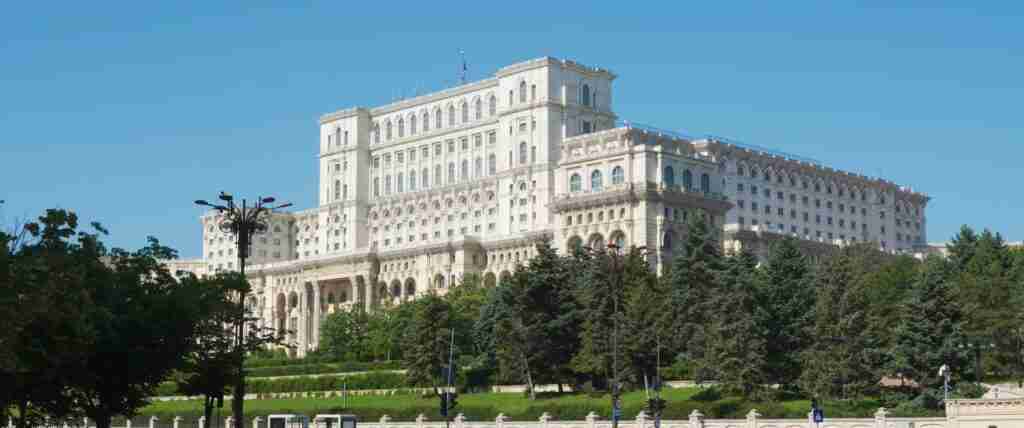
The palace’s exterior architecture combines neoclassical design elements with modernist monumentalism and socialist realist principles. The facade features repetitive window patterns creating rhythmic horizontal bands across the building’s face, contrasting with vertical emphasis created by massive columns and pilasters dividing the exterior into sections. The building employs a stepped pyramid silhouette, wider at the base and tapering slightly toward the roofline, creating visual weight and stability associations. External materials include marble cladding on primary facades, bronze decorative elements including door surrounds and sculptural details, and glass in thousands of windows — many original windows used single-pane glass common in 1980s construction, though some sections have received energy-efficient retrofits in recent decades. The main entrance features a grand staircase approaching the building from Union Boulevard, designed for ceremonial arrivals and state functions.
The palace’s position atop Dealul Spirii provides commanding views across Bucharest, reinforcing its symbolic dominance of the city. This elevation also served practical defensive purposes in Ceaușescu’s conception, offering clear sight lines in all directions and creating psychological associations with historical fortifications occupying high ground. The cleared approach along Union Boulevard eliminated close urban fabric that might have obscured the palace, ensuring visibility from great distances — the building is reportedly visible from space, though this claim is somewhat exaggerated, as many large structures appear in high-resolution satellite imagery.
Tour Types and Visitor Experiences
All visitors to the Palace of the Parliament must participate in organized guided tours — independent exploration is not permitted due to security requirements, the building’s active function as parliamentary headquarters, and the complexity of navigating over 1,100 rooms across multiple levels. Tours require advance reservations made at least 24 hours prior to arrival, either through official channels by calling +40 733 558 102 or +40 733 558 103, through the palace’s official ticketing system, or through licensed tour operators offering palace visits as part of broader Bucharest tour packages. Advance booking is essential during peak tourist seasons from April through October, when tour slots fill days in advance; spontaneous same-day visits are rarely accommodated.
The Standard Tour represents the most popular option, lasting approximately 45 minutes and covering the palace’s primary ceremonial spaces. This tour route includes the Honor Hallway, a vast corridor extending hundreds of meters with towering marble columns and elaborate ceiling decorations; Nicolae Bălcescu Hall featuring the famous African hardwood doors; the Human Rights Hall where parliamentary sessions occur; the Music Hall with its acoustic design and crystal chandeliers; and the immense ballroom showcasing over 500 chandeliers and walls lined with mirrors. Guides provide historical context about Ceaușescu’s motivations, construction details including worker conditions and material sourcing, architectural explanations of design choices, and information about the palace’s current parliamentary functions. The standard tour costs €14 for adults, €5 for children ages 7-18, and €7 for students presenting valid student identification; Romanian citizens receive free admission. Children under age 7 enter free when accompanied by adults. These prices cover admission and guide services; photography is permitted in most areas.
The Basement Tour extends the standard experience by adding access to underground levels, including views of the nuclear bunker at 92 meters depth and segments of the 20-kilometer tunnel network connecting to other government buildings. This extension adds approximately 15 minutes to tour duration and costs an additional €10 per person beyond the standard tour price. The basement portion reveals engineering aspects not visible in ceremonial spaces above: massive concrete foundations, mechanical systems managing climate control and power distribution, and the defensive architecture reflecting Cold War-era strategic planning. The basement tour particularly interests architecture and engineering enthusiasts, military history buffs, and visitors curious about communist-era infrastructure. Basement access is not always available, as parliamentary security requirements or governmental activities may restrict access on certain dates; visitors specifically interested in this option should confirm availability when booking.
The Terrace and City View Tour provides access to upper-level terraces offering panoramic views across Bucharest, including perspectives along the entire length of Union Boulevard and views toward the city center’s historic districts. This tour segment costs an additional €15 per person and adds roughly 10-15 minutes to the visit duration. The terrace experience appeals to photographers seeking elevated city perspectives and visitors wanting to understand the palace’s relationship to Bucharest’s urban geography. The terrace that Ceaușescu famously used for public addresses — where he delivered his final speech before fleeing during the December 1989 revolution — is visible from certain vantage points, though access to that specific balcony varies depending on security protocols. The terrace tour operates primarily during favorable weather conditions from April through October; winter terrace access is limited due to safety concerns with ice and snow.
Combined tour options bundle standard access with basement and/or terrace extensions. The Standard + City View combination costs €35 per person, the Standard + Basement combination costs €15 per person, and the comprehensive Standard + City View + Basement package costs €23 per person. These bundled options offer modest savings compared to purchasing each segment separately and provide the most thorough palace experience, recommended for visitors with particular interest in architecture, history, or photography. The full combined tour requires approximately 90 minutes to two hours including security procedures and transitions between levels.
Specialized tours occasionally operate focusing on specific themes such as art collections, architectural details, textile craftsmanship, or political history. The Art Collection Tour examines the over 4,000 artworks now housed in the palace, which has grown from an initial 76 pieces when parliamentary use commenced in 1993. These works include Romanian paintings, sculptures, tapestries, and decorative arts displayed throughout ceremonial spaces and corridors. The Textile and Craftsmanship Tour emphasizes the hand-woven carpets, custom fabrics, wood carvings, and artisanal details created by Romanian craftspeople during construction. These specialized tours operate irregularly based on guide availability and minimum group size requirements; interested visitors should inquire about availability when making reservations.
Group tours accommodate between 10 and 30 participants depending on the specific route and security considerations. Larger tour groups sometimes divide into smaller sub-groups for portions of the tour to avoid overcrowding individual rooms. Private tours for smaller parties can be arranged at premium rates through official channels or licensed tour operators, offering more personalized experiences with opportunities to ask detailed questions and spend additional time in areas of particular interest. Private tours prove especially valuable for photography enthusiasts, architecture students, historians, and visitors with specific research interests.
Tour languages include Romanian, English, Italian, and Spanish as primary options available on most tours. Guides speaking French, German, and other languages may be available with advance notice and depend on staff availability. If a requested language guide is unavailable, tours default to English, which most international visitors understand adequately. The quality of English-speaking guides is generally high, with most having university education in history, architecture, or related fields and several years’ experience conducting palace tours. Visitor reviews consistently praise guide knowledge, storytelling abilities, and willingness to answer questions, noting that guides balance official historical narratives with honest acknowledgment of the palace’s controversial aspects.
The tour experience includes airport-style security screening at the entrance, requiring all visitors to present passports or government-issued photo identification for verification against reservation lists. Security procedures include metal detectors, bag screening, and prohibition of large backpacks, weapons, or items deemed security threats. Photography is generally permitted using personal cameras or smartphones, but filming equipment, drones, tripods, and professional lighting apparatus require special permits obtained in advance. Flash photography is discouraged in certain rooms to protect textiles and artworks. Visitors should dress modestly and comfortably for walking; while no strict dress code applies, extremely casual attire like beach wear is considered inappropriate for a functioning governmental building.
Accessibility for visitors with mobility limitations presents challenges due to the palace’s design. While the building has elevators, many ceremonial spaces require climbing significant staircases — the standard tour involves approximately 200 steps across multiple flights, not all in sequence. Visitors with limited mobility should notify tour operators when booking to discuss possible accommodations, though some portions of the tour may remain inaccessible. Wheelchair accessibility is limited to certain routes; the palace’s construction predates modern accessibility standards, and retrofitting such a massive historic structure faces preservation and engineering constraints.
Tour departures operate at scheduled times throughout the day depending on season and demand. During high season (March through October), tours may depart every 30-45 minutes from 9 AM through final departures at 4:15 PM, allowing time to complete tours before the 5 PM closing time. Low season (November through February) operates reduced schedules with tours departing every 60-90 minutes from 10 AM through 3:30 PM, concluding before the 4 PM closing time. Peak summer months may add additional departure times to accommodate high visitor volumes; winter months may cancel tours during severe weather or when visitor numbers fall below minimum group sizes. Specific departure schedules vary weekly based on parliamentary activities, governmental events, and maintenance requirements; checking current schedules when making reservations prevents disappointment.
Interior Highlights and Decorative Elements
The Palace of the Parliament’s interiors showcase Romanian craftsmanship at extraordinary scales, with each major space demonstrating particular aspects of the decorative program Ceaușescu and architect Anca Petrescu envisioned. The cumulative effect overwhelms most visitors through sheer repetition of opulent details: seemingly endless corridors lined with marble, room after room featuring massive chandeliers, and decorative motifs repeated hundreds of times across vast surfaces. This intentional excess served ideological purposes, demonstrating the socialist state’s capacity to marshal resources and labor toward creating beauty and grandeur — though this beauty came at enormous human and economic cost.
The Honor Hallway establishes the palace’s monumental character immediately upon entry, extending hundreds of meters with ceiling heights approaching 15 meters. Romanian marble columns line both sides at regular intervals, each carved from single stone pieces weighing several tonnes and polished to mirror finishes. The floor consists of geometric marble patterns combining cream, rose, and gray Romanian marble varieties in designs requiring precise cutting and fitting. Ceiling decorations incorporate elaborate plasterwork featuring socialist realist motifs including agricultural and industrial symbols interspersed with classical architectural elements like acanthus leaves and Greek key patterns. Natural light enters through tall windows along one side, supplemented by crystal chandeliers positioned at intervals down the hallway’s length. The corridor’s scale makes human figures appear diminished, an intentional design choice emphasizing state power over individual presence.
Nicolae Bălcescu Hall draws attention through its unique doors constructed from African hardwood — specifically, wenge and ebony from Zaire (now Democratic Republic of Congo). These doors represent a gift from dictator Mobutu Sese Seko to Ceaușescu, symbolizing solidarity between African and European socialist-aligned regimes during the 1980s. The doors’ dark wood contrasts dramatically with surrounding light marble, and their massive scale — each door panel stands over 4 meters tall and weighs approximately 400 kilograms — required custom hinges engineered to support such weight while enabling smooth operation. The doors open onto a hall featuring Romanian marble floors in intricate geometric patterns, walls clad in polished marble panels alternating between cream and rose tones, and ceiling decorations combining sculptural plasterwork with gold leaf accents. The hall functions as a reception space for diplomatic events and state visits.
The Human Rights Hall serves as one of the palace’s primary parliamentary chambers where the Chamber of Deputies conducts legislative sessions. The room features semicircular seating arrangements for several hundred legislators, elevated speaker platforms, and gallery spaces for observers and press. Lighting comes from multiple crystal chandeliers and modern lighting systems installed during parliamentary adaptation. The chamber’s acoustics incorporate design considerations enabling speakers to project without electronic amplification, though modern sound systems supplement natural acoustics during actual sessions. The hall’s name represents post-1989 rebranding; under Ceaușescu, the space bore different designations reflecting communist ideology. Current parliamentary use creates interesting juxtapositions between the hall’s origins as totalitarian monument and its present function housing democratic legislative processes — a tension guides acknowledge during tours.
The Music Hall demonstrates acoustic design principles incorporated into select palace spaces. The room features wooden wall panels and ceiling elements that absorb and reflect sound to create favorable listening conditions for classical music performances. Crystal chandeliers provide illumination while their positioning avoids acoustic interference. The floor uses parquet patterns combining oak, cherry, and walnut in designs requiring master craftsmen to cut, fit, and finish thousands of individual wood pieces. The hall hosts occasional concerts, receptions, and cultural events, though its primary use remains governmental functions. The space accommodates several hundred guests for seated performances or larger numbers for standing receptions.
Europe’s largest ballroom represents the palace’s most spectacular interior space, measuring several thousand square meters with capacity for thousands of attendees during major events. The room features over 500 crystal chandeliers arranged in geometric patterns across the ceiling, creating dazzling light effects when fully illuminated. Walls incorporate approximately 1,400 mirrors in gilded frames, positioned to create visual infinity effects where reflections multiply chandelier light and make the space appear even larger than its actual dimensions. The floor consists of intricately patterned parquet combining multiple hardwood varieties in repeating geometric designs. Ceiling decorations combine elaborate plasterwork with gold leaf details, creating baroque-influenced aesthetics that contrast with the building’s exterior modernist severity. The ballroom hosts state banquets, diplomatic receptions, international conferences, and occasional cultural events including fashion shows and concerts. Some famous visitors have performed in this space, including Michael Jackson, who concluded a 1990s press conference here with a moonwalk before appearing on an exterior balcony where he famously shouted “I love you, Budapest!” to surprised fans — mistaking Bucharest for Hungary’s capital in a gaffe that became part of palace lore.
The Pink Room, named for its rose-toned marble cladding, exemplifies the color-themed rooms found throughout the palace. Different ceremonial spaces emphasize particular marble varieties or color schemes: the White Hall features cream and white marbles exclusively, the Blue Hall incorporates blue-gray marble tones, and so forth. This color coding served both decorative purposes and practical wayfinding functions within the vast building — though the sheer number of rooms means that even this system provides limited orientation assistance to first-time visitors. The Pink Room functions as a reception space and meeting room for smaller diplomatic gatherings or governmental working sessions.
Hand-woven carpets and rugs appear throughout the palace, with approximately 200,000 square meters of textile floor coverings in total. Many carpets measure exceptionally large — some individual pieces extend 30 meters or longer, requiring custom looms constructed specifically for palace production. Traditional Romanian carpet-weaving workshops received commissions to produce these textiles using patterns incorporating Romanian folk motifs, socialist symbols, and decorative designs harmonizing with each room’s overall aesthetic. The carpets’ wool content and substantial thickness contribute significantly to the building’s total weight; large carpets can weigh several tonnes each. Many remain in excellent condition decades after installation due to limited foot traffic in ceremonial spaces; working governmental offices received more durable carpets designed for daily use.
Crystal chandeliers represent perhaps the palace’s most iconic decorative elements, with approximately 2,800 chandeliers throughout the building ranging from relatively modest fixtures in corridors to massive installations weighing multiple tonnes in major ceremonial halls. Romanian crystal manufacturers produced these pieces using traditional hand-cutting and assembly techniques. Each major chandelier consists of thousands of individual crystal components — prisms, beads, and decorative elements — attached to metal frameworks designed to support substantial weight while allowing light to refract through the crystal. Maintenance of these chandeliers requires specialized crews who periodically clean and inspect each piece; in the ballroom alone, cleaning all 500+ chandeliers requires weeks of labor using scaffolding systems to access ceiling heights. Electrical systems powering the chandeliers consume enormous energy; illuminating all lighting throughout the palace simultaneously would draw several megawatts, contributing to the building’s substantial operating costs.
Decorative plasterwork appears extensively in ceiling designs, moldings, cornices, and wall decorations throughout ceremonial spaces. Romanian plaster artisans created these elements using traditional techniques involving hand modeling, casting, and finishing. Designs incorporate classical architectural motifs including acanthus leaves, geometric patterns, egg-and-dart moldings, and Greek key borders alongside socialist realist iconography such as wheat sheaves representing agriculture, gear wheels symbolizing industry, and stylized hammers representing labor. Some ceiling panels feature high-relief sculptural elements depicting allegorical figures or historical scenes. Gold leaf applications accent selected plasterwork, adding visual richness and reflecting chandelier light. The plasterwork’s scale and repetition create cumulative impact as visitors move through successive spaces, each reinforcing the decorative program’s overwhelming character.
The palace contains extensive art collections that have grown significantly since parliamentary use commenced. The initial collection of 76 pieces in 1993 has expanded to over 4,000 artworks including Romanian paintings, sculptures, tapestries, and decorative arts displayed throughout corridors, offices, and ceremonial chambers. These works represent Romanian artistic production across periods, with particular emphasis on 19th and 20th-century pieces. Some artworks date to the communist era and reflect socialist realist aesthetics, while others represent classical or modern Romanian artistic traditions. The collection serves both decorative purposes and symbolic functions, asserting Romanian cultural achievement within the palace’s walls. Specific noteworthy pieces appear in tour highlights, though the collection’s dispersal across hundreds of rooms means visitors see only small selections during standard tours.
Modern additions since 1989 include updated telecommunications, computer networking, and security systems required for 21st-century parliamentary functions. These technological layers coexist with original 1980s infrastructure, creating interesting juxtapositions between communist-era design and contemporary requirements. Conference rooms feature modern audiovisual equipment, digital voting systems for legislators, simultaneous translation facilities for international meetings, and broadcast capabilities enabling live transmission of parliamentary sessions. These upgrades required careful integration to avoid damaging historic decorative elements while meeting functional needs of working government headquarters.
Construction Materials and Romanian Craftsmanship
Nicolae Ceaușescu’s insistence that all palace construction materials originate within Romania transformed the project into a showcase of domestic resources and craftsmanship while creating unprecedented demand that strained the nation’s industries and artisan communities. This nationalist requirement served ideological purposes — demonstrating socialist Romania’s self-sufficiency and economic independence — but imposed practical constraints that complicated construction and exhausted domestic supply chains. The resulting material inventory remains extraordinary: 1 million cubic meters of marble, 700,000 tonnes of steel and bronze, 3,500 tonnes of crystal, 900,000 cubic meters of hardwood, 200,000 square meters of textiles, 550,000 tonnes of cement, and 2 million tonnes of sand, all sourced within Romania’s borders.
Romanian marble appears throughout the palace in dozens of varieties extracted from quarries nationwide. The primary marble types include cream and white marbles from Vâlcea County quarries, rose-toned marbles from Poiana Ruscă Mountains, gray marbles from Banat region, and multicolored marbles from various Carpathian deposits. Each marble variety features distinct geological characteristics — vein patterns, color variations, hardness levels, and polishing qualities — requiring specialized knowledge to select appropriate applications. Harder marbles suited floor use where wear resistance mattered, while softer varieties with superior carving characteristics served decorative wall panels and sculptural elements. Quarrying 1 million cubic meters of marble required operating numerous quarries at maximum capacity throughout the 1980s, exhausting some deposits and creating environmental impacts through landscape disruption and waste material generation. Transportation from quarries to Bucharest consumed significant fuel and logistics capacity, and cutting, polishing, and installing marble pieces employed thousands of specialized stonemasons and installers working throughout the construction period.
Steel and bronze structural elements totaling 700,000 tonnes came from Romanian metallurgical facilities including the massive Hunedoara steelworks and other industrial complexes. The palace’s structural skeleton consists of reinforced concrete with extensive steel reinforcement providing earthquake resistance and supporting loads from massive marble cladding, heavy decorative elements, and dense building materials throughout. Bronze appears primarily in decorative applications including door hardware, railings, light fixtures, sculptural details, and ornamental panels. Producing these quantities required diverting metallurgical capacity from other economic priorities, including exports that earned foreign currency and domestic construction projects serving civilian needs. The metallurgical sector operated at maximum output during the 1980s, contributing to equipment wear, deferred maintenance, and eventual production declines following the communist period.
Crystal production for 2,800 chandeliers comprising 3,500 tonnes of cut crystal represented an unprecedented undertaking for Romanian glass manufacturers. Traditional crystal production involves melting high-quality sand with lead oxide to create lead crystal with superior refractive properties, then hand-cutting each component to create faceted surfaces that maximize light refraction. Romanian crystal workshops at locations including Dorohoi and Iași received commissions for palace chandeliers, requiring them to expand capacity, train additional craftsmen, and develop specialized cutting patterns. Each major chandelier contains thousands of individual crystal components requiring precise cutting to match design specifications, drilling for attachment hardware, and hand assembly onto metal frameworks. The cumulative labor of producing all palace chandeliers occupied hundreds of skilled crystal cutters for years. Quality control ensured consistent standards, as even small variations in cut angles or dimensions would create visual discontinuities when chandeliers were illuminated. This crystal production legacy contributed to Romanian expertise in this craft, though market demand declined after communism’s fall.
Hardwood procurement of 900,000 cubic meters drew from Romania’s extensive forests, primarily selecting oak, cherry, walnut, and other domestic species suitable for architectural woodwork. This quantity represents thousands of mature trees felled and processed specifically for palace use. Logging operations intensified in multiple forest regions, sometimes controversially harvesting protected or old-growth stands when accessible sources proved insufficient. The wood required extensive processing: sawing logs into boards and planks, kiln-drying to reduce moisture content and prevent warping, selecting pieces with appropriate grain patterns and color tones, cutting to precise dimensions, and crafting into finished products including parquet flooring, wall panels, door frames, furniture, and architectural details. Specialist woodworkers created intricate parquet patterns requiring master-level skills in geometric layout, precision cutting, and installation. Some individual parquet designs incorporate thousands of pieces per room, each cut and fitted individually to create seamless geometric patterns. Wood finishing involved multiple sanding stages followed by oil, varnish, or wax applications creating protective surfaces and enhancing natural grain. Decades later, much of this woodwork remains in excellent condition, testament to both material quality and craftsmanship standards, though some areas show wear from governmental office use.
Textile production of 200,000 square meters of hand-woven carpets and rugs represented extraordinary output from Romania’s carpet-weaving industry. Traditional Romanian carpet-weaving centers in regions including Oltenia and Moldova received palace commissions requiring them to establish custom production facilities with oversized looms capable of weaving extremely large pieces. Some individual carpets measure 30 meters or longer, requiring looms constructed specifically for palace production and teams of weavers working collaboratively on single pieces. Weaving such massive carpets consumed years of labor; large ceremonial hall carpets could require 18-24 months from start to completion, with multiple weavers working simultaneously. Designs incorporated traditional Romanian folk patterns, socialist iconography including wheat sheaves and industrial symbols, and decorative motifs harmonizing with each room’s color scheme and architectural details. Wool came from Romanian sheep flocks, sheared, cleaned, dyed using both natural and synthetic dyes, and spun into yarns suitable for weaving. The carpets’ substantial thickness and density contribute significantly to the palace’s total weight and provide acoustic benefits by absorbing sound in ceremonial spaces. Many carpets remain in near-pristine condition due to limited use; ceremonial spaces see little foot traffic, and protective measures prevent soil accumulation and wear.
Cement and concrete production of 550,000 tonnes cement and associated sand and aggregate consumed significant Romanian cement industry capacity. The palace’s foundations required massive concrete pours to support the building’s weight and ensure stability on Bucharest’s alluvial soils. Reinforced concrete structural elements throughout the building provide earthquake resistance — an important consideration given the 1977 earthquake’s destructive impacts. Concrete appears extensively in underground levels, structural cores, floor slabs, and load-bearing walls throughout the structure. Producing these quantities meant operating cement kilns continuously, consuming fuel resources, and coordinating logistics to deliver concrete to the construction site in workable condition before setting occurred. The building’s deep foundations extending to bedrock required specialized concrete formulations and pouring techniques ensuring structural integrity at depth.
The palace’s construction workforce included not only manual laborers but also specialized artisans, craftsmen, and artists whose skills created the decorative elements distinguishing the palace from ordinary construction. Master stonemasons selected marble pieces, planned cutting patterns to maximize visual appeal through vein alignment, and oversaw installation ensuring proper support and alignment. Woodworkers ranging from rough carpenters to master cabinetmakers created everything from structural framing to intricate marquetry and carved decorative panels. Metalworkers fabricated structural steel, decorative bronze elements, custom hardware, and chandelier frameworks. Glass workers and crystal cutters produced chandeliers and decorative glass elements. Textile weavers created massive carpets using traditional techniques. Plaster artisans modeled, cast, and installed decorative plasterwork throughout ceremonial spaces. Electricians installed complex lighting systems powering thousands of fixtures. These specialized trades represented Romanian craftsmanship at the highest skill levels, though many artisans worked under difficult conditions with limited recognition and meager compensation despite creating works of substantial beauty and technical accomplishment.
The psychological and economic impacts of diverting such massive material quantities and artisan labor to palace construction while ordinary Romanians endured austerity created deep resentments. Citizens saw marble extracted from national quarries installed in palace floors while they lacked adequate housing. They observed skilled craftsmen creating opulent palace interiors while consumer goods shortages meant difficulty obtaining basic household items. They experienced food and fuel rationing while construction consumed energy resources. This contrast between the palace’s extravagance and widespread deprivation contributed to the revolutionary climate culminating in December 1989’s uprising. Today, guides addressing these contradictions help visitors understand how the palace’s material magnificence coexists with moral complexity regarding its origins.
Visiting Practicalities: Planning Your Tour
Planning a successful Palace of the Parliament visit requires understanding booking procedures, entry requirements, operating schedules, and logistical considerations that differ from typical tourist attractions due to the building’s active governmental function and security protocols. Advance preparation ensures smooth experiences and maximizes the visit’s value.
Booking reservations at least 24 hours prior to intended visit dates is mandatory, though booking further in advance is advisable during peak tourist seasons from April through October. Reservation channels include calling official palace tour numbers (+40 733 558 102 or +40 733 558 103) during business hours, booking through the palace’s official website or authorized ticketing platforms, or arranging visits through licensed tour operators offering palace tours as part of broader Bucharest city tour packages. When booking independently, specify preferred tour language (English, Romanian, Italian, or Spanish are primary options), desired tour type (standard, basement, terrace, or combined options), date and approximate time, and number of participants. Group bookings for 10 or more people may receive modest per-person discounts and can request specific departure times if arranged sufficiently in advance. Private tours for smaller parties at premium rates offer more flexible scheduling and personalized experiences.
Bringing valid government-issued photo identification is essential for all visitors — passports for international tourists or national ID cards for Romanian and EU citizens. Security personnel verify identification against reservation lists before allowing entry; visitors without proper identification will be denied access regardless of paid reservations. This strict policy reflects the building’s active governmental function and security requirements protecting parliamentary operations and officials. Photocopies or digital images of identification documents are not acceptable substitutes; original physical documents are required.
Operating hours vary seasonally to account for daylight availability and visitor demand patterns. From March through October, the palace operates daily from 9 AM to 5 PM, with final standard tour departures at approximately 4:15 PM to ensure tours complete before closing time. From November through February, operating hours shift to 10 AM to 4 PM daily, with final tour departures around 3:15 PM. These winter hours reflect reduced daylight and lower tourist volumes during cold months. Tours operate every day including weekends and most holidays, though exceptional closures may occur during major parliamentary events, state visits, or governmental functions requiring exclusive building access. Checking operating status when making reservations or on intended visit dates prevents wasted trips during unexpected closures.
Security screening procedures resemble airport security and require allowing extra time before scheduled tour departure. Visitors undergo metal detector screening, bag X-ray examination, and physical bag searches if security personnel deem necessary. Prohibited items include weapons, large backpacks or luggage, sharp objects, flammable materials, and anything deemed security threats. Small purses, camera bags, and modest backpacks containing personal items are generally permitted after screening. Professional filming equipment, tripods, drones, commercial lighting apparatus, and similar specialized gear require advance permits obtained through official channels; attempting to bring such equipment without authorization results in denial of entry or requirement to leave items at security. Flash photography is discouraged in certain areas to protect textiles and artworks, though personal cameras and smartphones are welcome throughout most tour routes. Visitors should avoid bringing unnecessary items to minimize security screening delays and reduce carrying burden during walking-intensive tours.
Appropriate attire for palace visits combines comfort for extensive walking with respect for the building’s governmental function. While no formal dress code is enforced, extremely casual attire including beachwear, athletic clothing, or revealing garments is inappropriate for a working parliamentary headquarters. Comfortable walking shoes are essential; tours involve extensive walking and approximately 200 steps across multiple staircase flights (not all in sequence, but cumulative). The palace’s marble and parquet floors can be slippery, making shoes with good traction advisable. Weather-appropriate clothing matters, as portions of tours near exterior windows or in less climate-controlled areas may feel warm in summer or cool in winter. The palace’s climate control systems, while substantial, struggle to maintain uniform temperatures throughout such vast volumes; some spaces may feel drafty or temperature-variable.
Accessibility considerations affect visitors with mobility limitations or disabilities. The palace predates modern accessibility standards, and its design includes numerous staircases connecting levels and accessing ceremonial spaces. While elevators exist, many key tour areas require stair climbing; the standard tour involves approximately 200 steps total. Visitors with mobility limitations should discuss access concerns when booking, as some modified routes may be possible using elevators where available, though portions of the standard tour may remain inaccessible. Wheelchair accessibility is severely limited; the building’s historic status and structural characteristics make comprehensive accessibility retrofits impractical. Visitors using wheelchairs should contact tour organizers in advance to explore whether any accommodation is possible or whether alternative viewing options exist. Visitors with other disabilities should similarly inquire about available accommodations when booking.
Photography policies permit personal photography using cameras and smartphones throughout most tour areas, allowing visitors to document their experiences and capture impressive interior views. Commercial photography, videography for broadcast or professional use, and photography using specialized equipment require advance permits with associated fees and must be coordinated through official channels. Guides may indicate specific areas where photography is restricted due to security concerns, parliamentary activities, or conservation needs protecting light-sensitive artworks and textiles. Respecting these restrictions is mandatory. Flash photography is generally discouraged as repeated flash exposure damages textiles and artworks; modern cameras and smartphones perform adequately in available light throughout most palace spaces given their abundant chandelier and window illumination.
Reaching the Palace of the Parliament is straightforward using Bucharest’s public transportation network. Metro access via the M1 and M3 lines to Izvor station places visitors within a 5-minute walk of the palace entrance. Bus routes 136 and 385 serve stops near the palace. Taxis and rideshare services (Uber, Bolt) operate throughout Bucharest and can drop passengers at the palace’s designated visitor entrance on B-dul Naţiunile Unite (United Nations Avenue) on the building’s northern side. Visitors approaching from the iconic Union Boulevard view the palace’s main facade, but the tour entrance is not the front-facing ceremonial entrance; instead, visitors must walk around the building’s northern side to reach the tour entry point. Signage in Romanian and English directs foot traffic to the correct entrance. Arriving 15-20 minutes before scheduled tour times allows adequate security screening time without feeling rushed.
Tour duration considerations help visitors schedule appropriately within broader Bucharest itineraries. Standard tours last approximately 45 minutes, though total time including security screening, waiting for tour departure, and post-tour exit procedures typically extends to 60-75 minutes. Basement extensions add 15 minutes, terrace access adds 10-15 minutes, and comprehensive combined tours can extend to 90 minutes or longer including all segments. Visitors should avoid scheduling other commitments immediately after palace tours to accommodate potential delays or extended experiences.
Combining palace visits with nearby Bucharest attractions creates efficient sightseeing days. Union Boulevard itself offers photogenic fountains and views back toward the palace worth exploring after tours conclude. The Old Town (Lipscani) district lies approximately 2 kilometers northeast and contains historic buildings, churches, restaurants, and nightlife. Revolution Square, site of December 1989’s pivotal events during Ceaușescu’s overthrow, sits about 2.5 kilometers north and features memorial plaques, the former Communist Party headquarters building, and the Romanian Athenaeum concert hall. Cișmigiu Gardens, Bucharest’s oldest public park, provides pleasant green spaces for relaxation approximately 1.5 kilometers north. The Village Museum (Muzeul Satului), an open-air ethnographic museum displaying traditional Romanian architecture, lies about 5 kilometers north. Visitors can create full-day itineraries combining the palace morning visit with afternoon explorations of these complementary sites.
Photography Opportunities and Perspectives
The Palace of the Parliament presents extraordinary photography opportunities combining architectural grandeur, decorative opulence, and unique urban perspectives. Photographers ranging from casual smartphone users to serious enthusiasts find compelling subjects throughout the palace and its surroundings, though understanding optimal timing, equipment considerations, and compositional approaches enhances photographic results.
Exterior photography benefits from considering the palace’s massive scale and relationship to surrounding urban context. The classic frontal view from Union Boulevard captures the palace’s imposing symmetrical facade with the boulevard’s fountains providing foreground interest and leading lines drawing eyes toward the building. This perspective works best during morning hours when eastern light illuminates the facade, or during golden hour before sunset when warm light enhances the marble cladding’s color tones. The boulevard’s width allows sufficient distance to frame the entire building even with standard lenses; wide-angle lenses (24-35mm equivalent on full-frame sensors) capture both building and boulevard context, while telephoto lenses (85mm and longer) isolate architectural details including column capitals, window arrangements, and decorative elements.
Side perspectives from Izvor Street or Calea 13 Septembrie reveal the building’s depth and the stepped pyramid profile that tapers from wide base to narrower upper floors. These angles work particularly well in afternoon when western light rakes across the facade creating shadows that emphasize architectural relief and three-dimensional form. Shooting from elevated positions in nearby buildings or parking structures (where accessible) provides aerial perspectives showing the palace’s relationship to Bucharest’s urban fabric and revealing the rooftop details invisible from ground level.
Nighttime exterior photography transforms the palace through dramatic illumination. Floodlighting emphasizes the facade’s architectural features while creating striking contrasts between illuminated marble and dark sky. Long exposure techniques (several seconds using tripods) blur fountain water into ethereal veils while maintaining sharp building details. Blue hour photography immediately after sunset provides deep blue sky backgrounds that contrast beautifully with warm artificial lighting. Union Boulevard’s fountains offer foreground elements and light reflections adding visual interest. Avoid using flash for distant architectural subjects; it provides no effective illumination at such distances while potentially annoying others.
Interior photography during tours captures the palace’s opulent decorative elements and spatial qualities, though working within tour constraints requires adaptability. The abundant natural light from tall windows plus bright chandelier illumination provides sufficient illumination for handheld photography using modern cameras and smartphones without requiring flash. Wide-angle lenses (24mm or wider) prove essential for capturing spacious halls within confined shooting positions; most interior spaces cannot be fully backed away from due to tour group movement constraints. For rooms like the massive ballroom, ultra-wide lenses (16-20mm) capture expansive compositions showing ceiling chandeliers, mirrored walls, and floor patterns in single frames.
Detail photography isolates individual decorative elements: crystal chandelier components with light refracting through faceted surfaces, intricate wood parquet patterns, marble vein patterns and color variations, sculptural plasterwork decorating ceilings and cornices, and textile weave details in carpets and wall hangings. Telephoto lenses (70-200mm range) isolate details from distance when tours don’t allow close approach. Looking for compositional opportunities where chandelier light interacts with marble surfaces creates dynamic images showing how materials and lighting combine for visual impact.
Symmetry appears throughout the palace’s design, from corridors with repeating column rhythms to ballroom chandelier arrangements and parquet geometric patterns. Centering compositions to emphasize symmetry creates formally powerful images reflecting the building’s authoritarian design intentions. Shooting along hallway lengths with centered perspectives generates one-point perspective compositions where architectural lines converge toward distant vanishing points, creating depth and drawing viewers into the frame.
Human scale provides useful context for conveying the palace’s immense proportions. Including tour group members in compositions demonstrates how the architecture dwarfs human figures — a fundamental aspect of the building’s psychological impact. Seek opportunities to position people at strategic points: beneath towering doorways, ascending monumental staircases, or silhouetted against tall windows. These human elements transform pure architectural documentation into more narrative images conveying experiential qualities.
Reflection photography utilizes the palace’s 1,400+ mirrors in the ballroom and polished marble surfaces throughout. Chandelier reflections in mirror walls create layered visual complexity and apparent infinity effects. Marble floor reflections of columns, chandeliers, or windows introduce symmetry and visual richness. These reflective opportunities reward experimentation with camera positions and angles to optimize reflected elements’ contributions to compositions.
Window light photography capitalizes on the dramatic illumination created when sunlight streams through tall windows into interior spaces, creating volumetric light beams visible through atmospheric haze or dust particles. Shooting toward windows (contre-jour technique) silhouettes architectural elements against bright backgrounds, emphasizing forms and reducing distracting detail. Exposing for highlight detail in windows often underexposes interiors, creating dramatic high-contrast images; alternatively, exposing for shadow detail blows out window areas but reveals interior details — choosing between these approaches depends on desired aesthetic effect.
Black and white photography suits the palace’s formal architectural character, emphasizing form, texture, and tonal contrasts while removing color as a consideration. Strong directional lighting creating shadows and highlights translates effectively to monochrome. Marble’s varied textures and reflective properties create tonal richness in black and white. Architectural details including plasterwork, wood grain, and crystal facets reveal themselves through tonal variation rather than color differentiation.
Terrace photography (if terrace tours are booked) provides panoramic perspectives across Bucharest showing the palace’s relationship to the city. Wide-angle lenses capture broad city vistas, while telephoto lenses isolate distant landmarks including the Romanian Athenaeum, Revolution Square monuments, and historic church domes. Shooting along Union Boulevard from elevated positions shows the boulevard’s axial organization leading from the palace toward the city center. These aerial perspectives help visitors understand the massive urban transformation Ceaușescu imposed through Project Bucharest.
Equipment recommendations balance photographic capability with travel practicality and tour constraints. For serious photographers, a versatile zoom lens covering 24-70mm provides wide-angle capabilities for interior spaces plus moderate telephoto reach for details and portraits. Adding a telephoto zoom (70-200mm) enables isolating distant details and compressing perspective. Ultra-wide lenses (16-20mm) dramatically expand interior coverage but introduce perspective distortion requiring careful composition to avoid unflattering effects. For smartphone photographers, utilizing ultra-wide capabilities captures more scene within confined spaces, while digital zoom should be avoided as it degrades quality; instead, photographers should move closer when possible or accept wider compositions and crop later if needed. Tripods are generally not permitted during tours due to security concerns and interference with group movement, making handheld technique important; using image stabilization features (optical or sensor-based) or higher ISO settings maintains sharp images without tripods.
Post-processing considerations allow enhancing palace photographs while respecting authentic representation. Adjusting exposure to recover shadow detail in high-contrast scenes reveals interior features that appear dark in unprocessed images. Straightening horizon lines and architectural verticals corrects perspective distortion inevitable when shooting upward at tall ceilings or when using wide-angle lenses. Selective color enhancement emphasizes Romanian marble’s color variations and crystal chandeliers’ sparkle. HDR techniques (high dynamic range) combining multiple exposures at different brightness levels capture both bright window areas and darker interior shadows in single images showing full tonal range — useful for the palace’s challenging lighting conditions mixing bright natural light with darker interior areas.
The Palace in Romanian Cultural Memory and Contemporary Context
The Palace of the Parliament occupies a complex, contested position in Romanian national consciousness, embodying tensions between acknowledging architectural achievement and condemning the authoritarian regime and human suffering that created it. This duality manifests in ongoing debates about how to interpret, present, and utilize the building in post-communist Romania — discussions reflecting broader challenges of reckoning with difficult pasts and transforming totalitarian heritage into resources for democratic societies.
For Romanians who lived through the 1980s construction period, the palace evokes powerful personal memories often tinged with pain and anger. Many recall the forced relocations that displaced 40,000 people from the demolished neighborhood, destroying communities and erasing personal histories attached to homes where families had lived for generations. Others remember the austerity period’s deprivations — food rationing, electricity cuts, heating shortages — made more bitter by knowledge that resources were being diverted to palace construction while ordinary citizens suffered. Some worked on the construction itself or knew someone who did, carrying memories of harsh working conditions, long shifts, minimal compensation, and the accidents and deaths that occurred during the rushed construction timeline. These direct experiences create visceral emotional responses to the palace that transcend abstract architectural appreciation; for many in this generation, the building remains fundamentally tainted by its origins regardless of its current democratic functions.
Younger Romanians born after 1989 often relate to the palace differently, lacking direct communist-era memories and encountering the building primarily as an architectural landmark and parliamentary headquarters. Some view it pragmatically as a historical fact — a building that exists, serves governmental purposes, and attracts tourist revenue regardless of its problematic origins. Others embrace its superlative qualities (heaviest building, second-largest administrative structure, most expensive building) as sources of national pride distinct from the regime that built it, reclaiming the palace as evidence of Romanian engineering capacity and craftsmanship. Still others maintain critical stances informed by family histories and education about communist repression, viewing the palace as a permanent reminder of the costs of authoritarianism that should be preserved precisely to ensure such excess never recurs. These generational differences occasionally surface in debates about palace use, renovation priorities, and interpretive approaches for tourism.
The decision to house Romania’s democratic parliament within Ceaușescu’s palace created both practical solutions and symbolic complications. Practically, the building’s governmental design, central location, and vast available space suited parliamentary needs after the former Chamber of Deputies building was donated to the Romanian Orthodox Church. Completing sufficient portions to enable occupancy proved more economically rational than constructing new parliamentary headquarters while the palace stood partially finished. Symbolically, however, placing democratic institutions within a totalitarian monument generates ironic juxtapositions between the building’s authoritarian origins and current democratic functions — ironies that shape both Romanian self-perception and international visitors’ interpretations. Some Romanians view this transformation as poetic justice, reclaiming the dictator’s palace for democratic purposes and symbolically subordinating his legacy to popular sovereignty. Others find the arrangement unsettling, arguing that conducting democratic processes within spaces designed to exalt autocracy normalizes totalitarian aesthetics and fails to create sufficient symbolic distance from the communist past.
International perceptions of the palace vary considerably based on visitors’ national backgrounds, political perspectives, and architectural interests. Western European and North American tourists often approach the palace primarily as an architectural curiosity — a “must-see” Bucharest attraction notable for its extreme scale and opulent interiors. Many express fascination with the building’s superlative qualities and the regime’s audacity in creating such a structure. Some find the palace’s megalomaniacal character darkly impressive, a “so bad it’s good” quality where the excess itself becomes the attraction. Others respond with moral discomfort, troubled by touring spaces created through human suffering and viewing the palace as a monument to oppression rather than achievement. Tourists from former communist countries sometimes bring comparative perspectives, noting similarities to or differences from monumental architecture in their own countries and reflecting on shared experiences of totalitarianism.
The palace’s transformation into a tourist attraction raises ethical questions about commodifying sites associated with repression and suffering. Tourism generates significant revenue supporting the building’s enormous operating costs and contributing to Bucharest’s tourism economy, creating financial incentives to present the palace attractively. However, overly sanitized or triumphal narratives that emphasize architectural magnificence while minimizing human costs risk trivializing historical suffering. Conversely, presentations focused exclusively on condemnation might fail to acknowledge the complexity of historical memory or the building’s undeniable architectural and engineering significance. Finding appropriate balance — honestly addressing the palace’s problematic origins while allowing space for aesthetic appreciation and avoiding didacticism — challenges guides and tour operators navigating these tensions daily.
The palace’s relationship to Bucharest’s urban identity remains ambiguous. On one hand, the building dominates the city’s skyline, appears prominently in tourism marketing, and provides an iconic landmark facilitating wayfinding and spatial orientation. Its visibility from many points across Bucharest makes it inescapable in residents’ daily experience of their city. On the other hand, the palace represents violent disruption of Bucharest’s historic fabric — the neighborhood it replaced contained architectural heritage spanning centuries, and the rigid geometric order it imposed contrasts with the irregular, organic patterns characterizing older Bucharest districts. Some architecture critics view the palace and Union Boulevard as permanent scars disfiguring the city, while others acknowledge that decades have integrated these elements into Bucharest’s identity regardless of their origins. Urban planning debates occasionally resurface about whether and how to modify the palace’s surroundings — whether to maintain the cleared plaza approach, introduce landscaping to soften the harsh geometries, or allow new construction that would alter sight lines and urban relationships.
Contemporary cultural responses to the palace include artistic and literary engagements that explore its meanings and contested legacy. Romanian writers, filmmakers, and visual artists have created works interrogating the building’s symbolism and its role in national memory. Some artists appropriate palace imagery ironically, subverting its original authoritarian messages through recontextualization. Others create works documenting the demolished neighborhood, preserving memories of what was lost. Still others explore psychological dimensions of living in a city dominated by such a structure, examining how monumental architecture shapes consciousness and spatial experience. These cultural productions contribute to ongoing negotiations about how contemporary Romania relates to its communist past and what role sites like the palace should play in collective memory.
The palace occasionally hosts events beyond governmental functions, including international conferences, cultural exhibitions, concerts, and even fashion shows. These alternative uses attempt to activate the vast empty spaces while generating revenue supporting operating costs. Some events consciously engage with the building’s character — contemporary art exhibitions creating dialogues between modern works and communist-era spaces, for instance, or performances addressing themes of power and architecture. Other events treat the palace more neutrally as prestigious venue space valued for grandeur regardless of historical associations. These varied uses reflect ongoing experimentation with how to inhabit and utilize such a complicated structure in ways that acknowledge history while enabling productive contemporary functions.
Maintenance and preservation challenges persist given the building’s immense scale and aging systems. Original 1980s infrastructure including electrical, plumbing, heating, and cooling systems requires ongoing updates and repairs. Energy efficiency remains poor by modern standards, contributing to annual operating costs exceeding $6 million. Some preservation questions lack clear answers: Should original decorative elements be maintained exactly as constructed, preserving authentic communist-era aesthetics even as they decay? Or should renovation introduce contemporary materials and techniques improving functionality while altering historical character? Should empty sections be left unfinished as testimony to the project’s excessive ambition, or completed to enable productive use? These decisions involve competing values — historical authenticity versus practical functionality, preservation versus adaptation — requiring ongoing negotiation among governmental authorities, preservation specialists, and various stakeholders.
Comparing the Palace to Other Monumental Architecture
Situating the Palace of the Parliament within broader contexts of monumental architecture worldwide illuminates both its unique characteristics and its participation in longstanding traditions of using built form to express power, ideology, and national identity. Comparisons reveal patterns in how authoritarian regimes across ideologies and eras have employed architecture as political tool while highlighting specific features distinguishing the Bucharest palace from other monumental projects.
The most obvious architectural parallel is the Pentagon in Arlington, Virginia, which surpasses the Palace of the Parliament as the world’s largest administrative building with 610,000 square meters of floor area compared to the palace’s 365,000 square meters. However, the Pentagon’s distributed five-sided plan creates a fundamentally different spatial character than the palace’s centralized pyramid form. The Pentagon emphasizes functional efficiency — its design enables walking between any two points in the building within seven minutes, optimizing circulation for military administration. The Palace of the Parliament prioritizes symbolic impact through monumental ceremonial spaces and decorative opulence over functional efficiency; circulation routes are often indirect and inefficient due to the emphasis on grand processional sequences. The Pentagon also differs in cultural reception: while Americans may critique military spending or specific policies, the building itself lacks the deeply contested moral status the palace carries in Romania due to the dramatically different political contexts of their construction — American democracy versus Romanian dictatorship.
Stalin-era architecture in the Soviet Union and Eastern Bloc provides natural comparison points given direct influences on Romanian communist aesthetics. The Seven Sisters skyscrapers in Moscow, particularly the Main Building of Moscow State University, share the palace’s wedding-cake silhouette, neoclassical decorative vocabulary, and use of architecture to project socialist state power. Warsaw’s Palace of Culture and Science, built as a “gift” from Stalin to Poland, similarly combines massive scale with ornate interiors and contested symbolic meanings in post-communist society. However, these Soviet-era structures generally emphasize vertical monumentality through tower forms, while the Palace of the Parliament spreads horizontally across a vast footprint with more moderate height. The palace also distinguishes itself through material density contributing to its status as world’s heaviest building — Soviet structures used more conventional construction methods rather than the extreme material concentrations Ceaușescu demanded.
Fascist architecture from Mussolini’s Italy and Hitler’s Germany pursued similar symbolic goals through monumental scale and classical references. Mussolini’s EUR district in Rome, particularly the Palazzo della Civiltà Italiana with its repetitive arched facade, demonstrates comparable use of stripped classicism and geometric repetition. Nazi Germany’s planned transformations of Berlin under Albert Speer’s direction, while largely unrealized, envisioned buildings of even greater scale than the Palace of the Parliament, including the proposed Volkshalle (People’s Hall) that would have dwarfed all existing structures. These fascist precedents share the palace’s authoritarian origins and use of architecture to intimidate through scale while glorifying the state. However, fascist architecture typically employed starker, more austere aesthetics than the palace’s ornate interiors, reflecting different ideological emphases — fascism’s militarism and discipline versus communist claims to providing abundance and cultural achievement.
North Korean architecture directly influenced the Palace of the Parliament, as Ceaușescu modeled his vision on Kim Il Sung’s Kumsusan Palace and Pyongyang’s monumental planning. North Korea’s Ryugyong Hotel (unfinished pyramid-shaped hotel begun in 1987) shares the palace’s excessive ambition and completion challenges. North Korean monuments like the Arch of Triumph in Pyongyang demonstrate similar uses of monumental scale to project regime power. The key difference lies in context: North Korea maintains the totalitarian system that created its monuments, while Romania has transformed into a democracy, creating different frameworks for interpreting these structures. The Palace of the Parliament thus offers a case study in how monumental totalitarian architecture functions in post-totalitarian democratic societies — a question North Korea’s monuments don’t yet pose.
Historical precedents for monumental state architecture extend back millennia. Ancient Egyptian pharaonic building projects including pyramids and temples, Roman imperial architecture like the Colosseum and Baths of Caracalla, and Versailles under Louis XIV all demonstrate rulers using monumental construction to project power and legitimize authority. These historical parallels highlight continuities in architectural symbolism across vastly different societies and eras. The palace participates in this longstanding tradition while employing 20th-century technologies and modernist/neoclassical aesthetics. Comparisons to ancient monuments also inform debates about the palace’s status: some argue that sufficient historical distance eventually allows appreciation of architectural achievement independent of problematic origins, as occurs with ancient structures built using slave labor. Others counter that this argument inappropriately applies timescales of centuries or millennia to recent history where living memory and contemporary political implications remain active.
Religious monumental architecture provides another comparison frame. St. Peter’s Basilica in Vatican City, various European cathedrals, Islamic mosque complexes like the Shah Mosque in Isfahan, and Hindu temple complexes like Angkor Wat all demonstrate how spiritual motivations can drive monumental construction similar in ambition to state projects. These religious monuments share the palace’s use of lavish materials, skilled craftsmanship, and overwhelming scale to inspire awe, though directed toward divine rather than political authority. The palace’s secular character distinguishes it from religious monuments, yet some analysis suggests communist ideology functioned quasi-religiously for true believers, making the palace a kind of secular temple to socialist achievement — an interpretation reinforced by the building’s hierarchical spatial progression and decorative program combining ideological symbols with aesthetic effects designed to inspire submission to the state.
Contemporary architecture rarely attempts the Palace of the Parliament’s particular combination of massive scale, material density, and monumental symbolism. Modern democratic societies generally favor more distributed governmental architectures and avoid the authoritarian associations of excessive monumentality. When contemporary buildings achieve remarkable scale — like Burj Khalifa’s height or the Vehicle Assembly Building’s volume — they typically serve commercial or technical functions rather than governmental symbolism. This makes the Palace of the Parliament something of a historical anachronism, the last great monument to 20th-century totalitarian architectural ambition and an increasingly unique specimen as time passes.
Beyond the Palace: Related Sites in Bucharest
Understanding the Palace of the Parliament’s fuller context benefits from visiting related Bucharest sites that illuminate different aspects of Romanian communist history, Ceaușescu’s regime, and the broader urban transformations Project Bucharest imposed. These sites create a more complete picture of the period and the palace’s role within it.
The Ceaușescu Mansion (Casa Ceaușescu or Spring Palace) located in northern Bucharest’s Primăverii neighborhood provides intimate counterpoint to the palace’s public monumentality. This residence served as Nicolae and Elena Ceaușescu’s private home from 1965 until their 1989 overthrow, revealing the couple’s personal tastes and lifestyle behind closed doors. Tours display preserved interiors including bedrooms, dining rooms, entertainment spaces, indoor swimming pool, private cinema, and extensive wine cellars. The décor combines opulence with surprisingly conservative middle-class aesthetics — velvet upholstery, heavy draperies, gilded furniture, and extensive crystal and porcelain collections. The mansion’s relatively modest scale compared to the Palace of the Parliament highlights the contrast between public megalomaniacal display and private domesticity. Visitors find the juxtaposition between the austerity imposed on ordinary Romanians and the Ceaușescus’ comfortable lifestyle particularly striking. Combined tours visiting both the Palace of the Parliament and the Ceaușescu Mansion provide complementary perspectives on the regime’s public face and private reality.
Revolution Square (Piața Revoluției) in central Bucharest marks the geographic and symbolic heart of December 1989’s revolutionary events that ended Ceaușescu’s regime. The square contains several significant buildings and memorials: the former Central Committee of the Romanian Communist Party headquarters (now housing governmental offices) from whose balcony Ceaușescu delivered his final speech on December 21, 1989, when unexpected crowd hostility forced him to flee via helicopter; memorial plaques and the Rebirth Memorial (Memorialul Renașterii) commemorating those killed during the revolution; the Romanian Athenaeum concert hall, a 19th-century architectural jewel representing pre-communist cultural heritage; and the former Royal Palace, now National Art Museum. Standing in Revolution Square while understanding its role in toppling the regime that built the Palace of the Parliament adds crucial historical dimension to palace visits, demonstrating how the communist project ultimately failed despite architectural efforts to project permanence and invincibility.
Union Boulevard (Bulevardul Unirii) itself warrants exploration as a major Project Bucharest component built simultaneously with the palace. Extending 3.5 kilometers from the palace toward Bucharest’s center, the boulevard was designed to rival Paris’s Champs-Élysées and provide a grand approach to the palace. The boulevard features synchronized fountains creating impressive water displays during warmer months, uniform apartment buildings flanking both sides demonstrating socialist planning principles and standardized architecture, and wide sidewalks and green spaces theoretically creating pleasant pedestrian environments (though the boulevard’s width makes it feel inhospitable and car-dominated). Walking the boulevard from palace to city center provides perspective on the massive urban transformation Ceaușescu imposed, the scale of demolition required to create this axis, and the contrast between rigid geometric planning and the organic street patterns of older Bucharest neighborhoods visible in adjacent areas. The boulevard functions less successfully than intended — traffic is often sparse, pedestrian activity limited outside peak commuter hours, and the uniform buildings criticized as monotonous. Nevertheless, experiencing this urban space helps visitors understand the palace as part of broader urban restructuring rather than an isolated building project.
The Museum of Romanian History (Muzeul Național de Istorie a României) located in central Bucharest provides comprehensive historical context spanning Romanian history from prehistoric times through the modern period. Exhibitions covering the communist era and the 1989 revolution help visitors understand the Palace of the Parliament within Romania’s broader 20th-century trajectory. Displays of communist-era propaganda materials, household objects demonstrating daily life conditions, and documentation of repression and resistance provide counterpoints to the palace’s official narrative of socialist achievement. The museum’s presentation helps visitors critically assess the palace as historical artifact rather than accepting it uncritically as mere architectural spectacle.
The Village Museum (Muzeul Satului) in northern Bucharest offers complete contrast to the Palace of the Parliament’s modernist monumentalism through its preservation of traditional Romanian rural architecture and folkways. This open-air museum displays authentic peasant houses, churches, mills, and workshops relocated from villages nationwide and reassembled in a park setting. Experiencing these humble traditional structures highlights the enormous gap between Romanian vernacular traditions and Ceaușescu’s megalomaniacal modernization programs, demonstrating what was culturally devalued or destroyed in the name of socialist progress. The Village Museum reminds visitors that the Romania represented in the palace’s monumental spaces coexisted with — and largely suppressed — older cultural patterns rooted in rural traditions and regional diversity.
The Văcărești Monastery site, demolished during Project Bucharest to make space for the palace and Union Boulevard, remains visible only through archival photographs and memorial markers. This 18th-century Orthodox monastery complex represented significant religious and architectural heritage erased by Ceaușescu’s vision. While the physical monastery no longer exists, awareness of its destruction and what was lost adds poignant dimension to palace visits, personalizing the abstract concept of “demolishing a neighborhood” through the specific example of an important religious and cultural institution sacrificed to totalitarian ambition. Some Bucharest tours specifically address demolished heritage, using archival photographs and historical maps to show visitors what occupied the palace site before clearance.
The Cotroceni Palace, Romania’s current presidential residence, provides comparison with the Palace of the Parliament through its historical evolution and architectural character. Originally built as a monastery in the 17th century, then transformed into a royal palace in the 19th century, Cotroceni demonstrates Romanian architectural traditions that preceded communist modernism. The palace houses a museum displaying royal collections and documenting Romanian history through the royal period. Visiting Cotroceni and the Palace of the Parliament together contrasts traditional dynastic architecture emphasizing continuity and cultural preservation with revolutionary architecture rejecting the past in favor of totalitarian futurism.
The Bucharest Systematization Museum (planned but not yet open) will eventually provide dedicated space for documenting Project Bucharest and the urban transformations implemented under Ceaușescu. This future museum aims to preserve architectural plans, photographs of demolished neighborhoods, oral histories from displaced residents and construction workers, and analysis of the project’s impacts on Bucharest’s urban character. When operational, this museum will provide essential contextual resources for understanding the palace as one component of much broader urban restructuring that reshaped Romania’s capital city according to totalitarian planning principles.
Frequently Asked Questions About Palace of the Parliament Tours
How much do Palace of the Parliament tickets cost?
Standard tour tickets cost €14 for adults, €5 for children ages 7 through 18, and €7 for students presenting valid student identification, with free admission for Romanian citizens and children under age 7 accompanied by adults. Tour extensions add costs: basement access costs an additional €10, terrace and city view access costs an additional €15, and combined packages offer modest savings compared to purchasing segments separately. The Standard + City View combination costs €35, Standard + Basement costs €15, and the comprehensive Standard + City View + Basement package costs €23. These prices include guided tour services but do not cover transportation to the palace, food, or additional personal expenses. Prices occasionally adjust, so checking current rates when making reservations confirms accurate budgeting. Photography using personal cameras and smartphones is included in admission prices; professional photography or filming requires separate permits with associated fees.
Do you need to book Palace of the Parliament tours in advance?
Advance reservations at least 24 hours prior to intended visit dates are mandatory for all Palace of the Parliament tours due to security requirements, tour group size management, and coordination with parliamentary activities that may restrict access on short notice. Booking further ahead than 24 hours is strongly advisable during peak tourist seasons from April through October, when tours often fill days in advance and same-day availability is rare. Booking channels include calling official palace tour numbers during business hours, using the palace’s official website or authorized online ticketing platforms, or arranging visits through licensed tour operators offering palace tours as part of broader Bucharest packages. Walk-up visitors without reservations are typically denied entry regardless of willingness to pay, as tour capacities are strictly controlled and last-minute additions compromise security protocols and tour quality. Planning ahead and booking as early as travel dates are confirmed prevents disappointment and ensures preferred tour times and types.
What language are Palace of the Parliament tours conducted in?
Palace of the Parliament tours operate primarily in Romanian, English, Italian, and Spanish, with guides fluent in these languages available on most tours throughout the year. French and German-language tours may be available with advance notice depending on guide availability, and other languages can sometimes be accommodated for private tours arranged well in advance. When booking, specify preferred language to ensure appropriate guide assignment. If a requested language guide is unavailable on desired dates, tours default to English, which most international visitors understand adequately. The quality of English-speaking guides is consistently praised in visitor reviews, with guides typically possessing university education in history, architecture, or related fields and several years’ experience conducting palace tours. Guides provide not only factual information about architecture and history but also contextual narratives about Ceaușescu’s regime, construction conditions, and the palace’s transformation from totalitarian monument to democratic institution, requiring language skills sufficient to communicate nuanced historical interpretations effectively.
How long does a Palace of the Parliament tour take?
Standard tours covering main ceremonial rooms last approximately 45 minutes of active touring time, though total duration from arrival to departure typically extends to 60-75 minutes including security screening procedures, waiting for tour departure, and post-tour exit. Basement extensions add roughly 15 minutes to tour duration, terrace access adds 10-15 minutes, and comprehensive combined tours including all segments require approximately 90 minutes to two hours total. Visitors should allocate generous time buffers and avoid scheduling commitments immediately after palace visits to accommodate potential delays from extended security procedures during high-traffic periods, larger tour groups that move more slowly, or guides who provide particularly detailed presentations. The tours maintain steady pacing moving through successive rooms without extended stationary periods; visitors with mobility limitations or stamina concerns should consider this when evaluating whether tour duration and physical demands match their capabilities.
Can you take photos inside the Palace of the Parliament?
Photography using personal cameras and smartphones is permitted throughout most Palace of the Parliament tour areas, allowing visitors to document their experiences and capture the impressive interiors. Flash photography is discouraged in many areas to protect light-sensitive textiles and artworks from cumulative damage caused by repeated flash exposure, though the palace’s abundant natural light from tall windows plus bright chandelier illumination provides sufficient lighting for quality photography without flash in most spaces. Guides may indicate specific restricted areas where photography is prohibited due to security concerns, active parliamentary sessions, or conservation needs; respecting these restrictions is mandatory. Commercial photography, videography for broadcast or professional use, and photography using specialized equipment including tripods, professional lighting, or drones requires advance permits obtained through official channels with associated fees and must be coordinated separately from standard tourism. Visitors planning professional photography should contact palace authorities weeks in advance to discuss requirements, restrictions, and permit procedures rather than arriving with equipment and hoping for permission.
Is the Palace of the Parliament wheelchair accessible?
Wheelchair accessibility at the Palace of the Parliament is severely limited due to the building’s design predating modern accessibility standards and incorporating numerous staircases connecting levels and accessing ceremonial spaces. While elevators exist for vertical circulation, many key tour areas require stair climbing; the standard tour involves approximately 200 steps total across multiple flights distributed throughout the route. Some modified tour routes may be possible using elevators where available, potentially providing partial palace access for wheelchair users, but significant portions of the standard tour will remain inaccessible. Visitors using wheelchairs should contact tour organizers well in advance when making reservations to discuss whether any accommodation is possible and what limitations exist, allowing informed decisions about whether attempting a visit is worthwhile given inevitable access restrictions. The palace’s status as historic government building creates practical constraints on comprehensive accessibility retrofits, and the massive scale plus architectural features make full wheelchair accessibility unlikely to achieve without fundamentally altering the building’s character. Visitors with other mobility limitations who can manage some stairs but have stamina concerns should similarly inquire about tour routes and physical demands when booking.
What should you wear to visit the Palace of the Parliament?
Comfortable walking shoes with good traction represent the single most important clothing consideration for Palace of the Parliament visits, as tours involve extensive walking and approximately 200 steps across marble and parquet floors that can be slippery. While no formal dress code is enforced, visitors should dress modestly and avoid extremely casual attire including beachwear, athletic clothing, or revealing garments out of respect for the building’s function as working parliamentary headquarters where governmental business occurs daily. Business casual or smart casual attire proves appropriate — slacks or jeans with collared shirts or blouses, dresses or skirts of modest length, and closed-toe shoes constitute typical visitor clothing. Weather-appropriate outer layers matter, as portions of tours near exterior windows or in less climate-controlled areas may feel warm during summer or cool during winter; the palace’s vast volumes challenge climate control systems, creating temperature variations between spaces. Carrying a light jacket or sweater allows adjusting to temperature fluctuations. Comfortable clothing enabling easy movement proves practical given the walking requirements and stair climbing, while avoiding overly tight or restrictive garments. Visitors should avoid bringing large bags or backpacks if possible, as these require security screening and create carrying burdens during tours; small purses or camera bags containing essentials prove more practical.
Why was the Palace of the Parliament built?
Nicolae Ceaușescu ordered construction of the Palace of the Parliament to serve multiple interconnected purposes reflecting his authoritarian ideology and megalomaniacal vision for Romania. Practically, he intended the palace to house all Romanian governmental functions in a single centralized structure, consolidating previously dispersed ministries, offices, and administrative bodies under one roof to symbolize state unity and facilitate centralized control. Symbolically, the palace would demonstrate socialist Romania’s achievements and economic strength, providing monumental architecture rivaling or surpassing Western capitalist nations and showcasing Romania’s independence from Soviet domination during a period when Ceaușescu cultivated nationalist credentials. Personally, the palace reflected Ceaușescu’s grandiose self-conception and desire for legacy, creating a monument that would immortalize his rule and transform Bucharest into a showcase capital comparable to Pyongyang under Kim Il Sung — whose North Korean architecture directly inspired Ceaușescu following a state visit. The 1977 Vrancea earthquake provided political pretext for wholesale urban transformation under the guise of earthquake-proofing and modernization, enabling Ceaușescu to demolish significant portions of historic Bucharest and impose rigid geometric planning reflecting totalitarian spatial control. The palace thus combined practical administrative goals, ideological symbolism, nationalist assertions, personal vanity, and urban control in a project whose excessive ambition and enormous costs ultimately contributed to the resentments that fueled the 1989 revolution ending Ceaușescu’s regime.
What happened to Nicolae Ceaușescu?
Nicolae Ceaușescu’s rule ended abruptly during Romania’s December 1989 revolution, part of the broader wave of Eastern European communist regime collapses that year. On December 21, 1989, Ceaușescu attempted to address a large crowd in Bucharest’s Revolution Square in a rally organized to demonstrate popular support, but unexpected crowd hostility and chants against the regime disrupted his speech — a unprecedented public rejection that was broadcast live on state television. As protests intensified, Ceaușescu and his wife Elena fled the Central Committee building via helicopter, beginning several days of chaotic flight attempting to escape capture. Military and security forces divided between regime loyalists and those joining the revolution, creating violent street battles in Bucharest and other cities resulting in over 1,000 deaths. Ceaușescu was captured on December 22 near Târgoviște, north of Bucharest, and held by military authorities. A hastily convened military tribunal conducted a trial on December 25, 1989, charging the Ceaușescus with genocide, damage to the national economy, and other crimes. Following guilty verdicts, Nicolae and Elena Ceaușescu were executed by firing squad on December 25, 1989, in Târgoviște. The execution’s brutal swiftness remains controversial; some view it as necessary to end the violence and prevent regime loyalists from attempting rescue, while others criticize it as summary justice denying proper legal proceedings. The Ceaușescus’ fall and execution left the Palace of the Parliament incomplete and raised immediate questions about the building’s fate in post-communist Romania.
Is the Palace of the Parliament worth visiting?
The Palace of the Parliament merits visiting for most travelers interested in architecture, history, or understanding 20th-century totalitarianism, offering experiences and perspectives unavailable elsewhere. The building’s status as world’s heaviest structure, second-largest administrative building globally, and repository of extraordinary craftsmanship in marble, wood, crystal, and textiles creates genuinely unique architectural encounters — few buildings worldwide match this scale or decorative opulence. Historically, the palace provides tangible connection to Romania’s communist period and the Ceaușescu regime’s excesses, making abstract historical narratives concrete through direct physical experience of the spaces created under that system. The moral complexity of touring a building constructed through human suffering while admiring undeniable craftsmanship raises important questions about how societies remember difficult pasts and what responsibilities visitors bear when engaging with controversial heritage. Guides generally provide nuanced presentations acknowledging both architectural achievement and human costs, supporting thoughtful engagement rather than uncritical celebration. The palace visit offers value for architecture enthusiasts appreciating monumental design and decorative details, history buffs studying communism and totalitarian regimes, photography enthusiasts capturing dramatic interiors, and thoughtful travelers interested in sites that prompt reflection on power, memory, and historical justice. Visitors should approach with realistic expectations: the palace is impressive rather than beautiful, thought-provoking rather than uplifting, and historically significant rather than emotionally comfortable. Those seeking purely aesthetic pleasure or entertainment may find the experience heavy or unsettling, while those prepared for complex engagement with difficult history generally find the visit rewarding and memorable.