Padua Museums & Galleries 2026: Ultimate Cultural Guide
Padua concentrates more UNESCO-inscribed art, medieval civic monuments, and world-first scientific institutions into its walkable historic centre than almost any Italian city of comparable size. The 2021 inscription of the city’s fourteenth-century fresco cycles — collectively known as Padova Urbs Picta — confirmed what art historians had argued for a century: the revolution that gave birth to Western painting originated here, in the workshop of Giotto, and its legacy spans eight extraordinary sites spread across the old town. This guide covers every major museum and gallery open in 2026, with verified admission prices, opening hours, booking requirements, and strategic advice for structuring your visit around the most essential stops.
Key Takeaways for Padua Museums 2026
- The Scrovegni Chapel requires advance booking. Only 25 visitors are admitted per 15-minute slot. Standard adult tickets cost €15 plus a €1 online booking fee (Tuesday–Sunday), covering the Chapel, Eremitani Museum, and Palazzo Zuckermann. Evening slots (€10, Chapel only) are bookable on the day of the visit. Check the official booking portal at cappelladegliscrovegni.it for current availability before finalising your dates.
- The Urbs Picta Card (€28 / 48 h; €35 / 72 h) covers all eight UNESCO fresco sites plus unlimited public transport — the most efficient option if you plan to visit more than three sites on the Urbs Picta circuit in a single stay.
- The Padova Città della Scienza integrated ticket (€25) links the Botanical Garden, Museum of Nature and Humankind, and Palazzo del Bo into a single pass valid for six months — ideal if your interests run toward the city’s remarkable scientific heritage rather than its medieval art.
- MUSME (€12) and Palazzo della Ragione (€8) are chronically underestimated. Both rank among the most distinctive museum experiences in northern Italy yet receive a fraction of the attention directed at the Scrovegni Chapel.
- Most civic museums are closed on non-holiday Mondays; the Scrovegni Chapel and Eremitani stay open seven days a week. Plan any Monday visit around these two plus the Botanical Garden and the Botanical Museum, which also open Tuesday–Sunday.
- Children under 6 enter all civic museums free; students and visitors aged 6–17 qualify for heavily reduced rates (as low as €3–€6) at every major site in the city.
People Also Ask About Padua Museums & Galleries 2026
How much does it cost to visit the Scrovegni Chapel in 2026?
The standard adult ticket for the Scrovegni Chapel runs €15 (plus a €1 online booking fee), and this price covers the Chapel itself together with the adjacent Eremitani Museum and Palazzo Zuckermann for visits on Tuesday through Sunday. On Mondays, when Palazzo Zuckermann is closed, a reduced combined ticket covering the Chapel and Eremitani Museum is available at €12 (plus €1 booking fee). Evening visits — the “Giotto sotto le stelle” slot running 19:00–22:00 — cost €10 for Chapel access only and can be booked on the same day of the visit, making them the most flexible option for spontaneous visitors. Reduced tickets for groups of ten or more, EU citizens over 65, and association members cost €11 (Chapel + Museums). Youth and student tickets (ages 6–17 and university students) are €6 (Chapel + Museums) plus the booking fee. Children under 6 enter free. Booking at least one day in advance is mandatory for standard daytime slots.
What is the best museum pass for Padua in 2026?
For visitors planning to see the full Urbs Picta circuit of UNESCO-inscribed fresco sites, the Urbs Picta Card at €28 (48 hours) or €35 (72 hours) delivers the best overall value: it covers all eight fresco sites including the Scrovegni Chapel, the Baptistery, Palazzo della Ragione, Oratory of San Giorgio, and Oratorio di San Michele, and includes unlimited use of Padua’s public transport network throughout its validity window. For visitors whose priorities lie with the university’s scientific heritage — Botanical Garden, Museum of Nature and Humankind, and Palazzo del Bo — the Padova Città della Scienza integrated ticket at €25 is the smarter choice. Both passes can be purchased at the ticket offices of their respective anchor institutions. Families should note the Family Card (€30), valid for 15 days and covering two adults with up to two children under 17 for one visit per civic museum site.
Which Padua museums are UNESCO World Heritage Sites in 2026?
Padua holds two separate UNESCO World Heritage inscriptions. The first, designated in 2021, is “Padua’s fourteenth-century fresco cycles” (Padova Urbs Picta), a serial site encompassing eight building complexes: the Scrovegni Chapel, Church of the Eremitani, Palazzo della Ragione, Chapel of the Reggia Carrarese, Cathedral Baptistery, Basilica and Convent of Sant’Antonio, Oratory of San Giorgio, and Oratorio di San Michele. The second, inscribed in 1997, is the Orto Botanico di Padova — the world’s oldest continuously operating academic botanical garden, founded in 1545 and still occupying its original Renaissance footprint. No other Italian city of Padua’s scale holds two entirely separate UNESCO inscriptions within the same historic centre, making the city uniquely dense in internationally recognised cultural and scientific heritage.
How many days do you need to visit all Padua museums in 2026?
Two full days comfortably cover the essential museum circuit. Day one works best for the Scrovegni Chapel (book the morning slot), followed by the Eremitani Civic Museums and Palazzo della Ragione in the afternoon. Day two handles the Botanical Garden, Palazzo del Bo, and the Museum of Nature and Humankind, with MUSME fitting into either day depending on energy levels. A third day allows for the Baptistery, Oratory of San Giorgio, Palazzo Zuckermann, Caffè Pedrocchi, and the smaller university collections. Padua is easily reachable as a day trip from Venice (30 minutes by fast train) and from Verona (50 minutes), which gives single-day visitors enough time for the Scrovegni Chapel plus one or two additional sites if they arrive early and book ahead.
Extended multi-day tours – 5+ days
Featured Padua Multi-Day Tour Packages
5 days
5 Days in Venice: Hidden Paths, Verona & Padua
- ✓ Comprehensive Padua tour
- ✓ Expert local guides included
- ✓ All accommodation arranged
- ✓ Transportation provided
6 days
Italy's Northern Pearls: Padua, Verona & Venice
- ✓ Booking needs min. 2 travelers
7 days
Italian Holidays
- ✓ Comprehensive Padua tour
- ✓ Expert local guides included
- ✓ All accommodation arranged
- ✓ Transportation provided
7 days
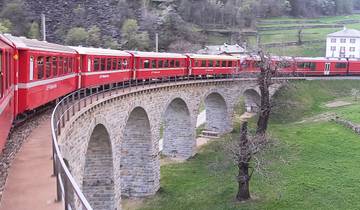
Lakes, Lagoon & Mountains: Lakes Como, Garda, Bernina train & Venice. Private Tour
- ✓ Comprehensive Padua tour
- ✓ Expert local guides included
- ✓ All accommodation arranged
- ✓ Transportation provided
Multi-day tour packages powered by TourRadar. Prices and availability subject to change.
Introduction to Padua’s Cultural Landscape in 2026
Padua occupies an unusual position in Italian cultural geography. It is not one of Italy’s headline tourist destinations — Venice is 30 kilometres to the east, Verona 80 kilometres to the west — yet it harbours a density of art-historical significance that rivals Florence and Rome for specific, concentrated periods. The city’s special claim to world art history centres on the decade following 1300, when Giotto di Bondone spent two years inside the Scrovegni Chapel applying a fresco cycle that effectively invented Western painting’s treatment of space, emotion, and narrative. Everything that followed — Masaccio, Leonardo, Raphael, Michelangelo — built on the technical and conceptual revolution Giotto staged on that small chapel’s walls.
The UNESCO committee that inscribed Padova Urbs Picta in 2021 recognised that Giotto’s achievement did not occur in isolation. The same city, over the same fourteenth century, produced an entire school of artists — Guariento di Arpo, Giusto de’ Menabuoi, Altichiero da Zevio, Jacopo Avanzi, Jacopo da Verona — who took Giotto’s innovations and extended them across the walls of eight further building complexes. These frescoes cover a combined 3,694 square metres, making Padua the single most densely frescoed urban environment in Europe from the pre-Renaissance period.
Beyond this medieval and late-medieval core, Padua constructed an equally extraordinary scientific heritage. The University of Padua, founded in 1222, was for two centuries the most intellectually free institution in Europe, attracting Galileo Galilei (who taught here from 1592 to 1610), Nicolaus Copernicus, William Harvey (who formulated his theory of blood circulation based on observations made in Padua), and Andreas Vesalius (who published his foundational anatomy text while working at the university). The 1595 Anatomical Theatre inside Palazzo del Bo is the world’s oldest surviving permanent anatomical theatre. The 1545 Botanical Garden, still growing in its original circular footprint between Prato della Valle and the Basilica of Sant’Antonio, is the world’s oldest academic botanical garden to have operated continuously in its founding location.
Visitors in 2026 encounter a museum ecosystem that has matured rapidly over the preceding decade. The Museum of Nature and Humankind, which unified the university’s four great natural history collections under one roof opposite the Scrovegni Chapel, continues to draw strong visitor numbers. MUSME, the interactive Museum of the History of Medicine housed in the fifteenth-century Hospital of San Francesco, remains one of northern Italy’s most technically innovative museum experiences. The civic museums complex — Chapel, Eremitani, Palazzo Zuckermann — functions as the institutional anchor of the cultural circuit, while the Cathedral Baptistery and the two oratories near the Basilica of Sant’Antonio complete the Urbs Picta trail for those committed to tracing the full arc of Giotto’s influence.
Padua’s UNESCO Heritage and the Urbs Picta Fresco Network
“Padua’s fourteenth-century fresco cycles” became Italy’s fifty-seventh UNESCO World Heritage Site on 24 July 2021, inscribed under criteria (i) and (ii) for the outstanding universal value of its contribution to the development of Western painting. The inscription recognises not a single building but a serial site — four component parts, eight building complexes — spread across the historic walled city. The Outstanding Universal Value statement identifies the Padua fresco cycles as the direct source of the stylistic revolution that would, a century later, produce the High Renaissance.
The eight sites divide naturally into zones. Part 1 (Scrovegni and Eremitani) clusters the Chapel and the adjacent church in the Giardini dell’Arena park in the north of the historic centre. Part 2 groups Palazzo della Ragione, the Chapel of the Reggia Carrarese (Loggia Carrarese, now the Galileiana Academy), and the Cathedral Baptistery around the central piazzas. Part 3 encompasses the Basilica and Convent of Sant’Antonio complex, including the Oratory of San Giorgio, at the southern end of the historic centre near Prato della Valle. Part 4 is the Oratorio di San Michele, a short walk from the Basilica.
The six principal artists documented across these sites form an extraordinary generational relay. Giotto (1266/7–1337) painted the Scrovegni cycle between 1303 and 1305 and the lost original fresco cycle in Palazzo della Ragione. Guariento di Arpo completed the Chapel of the Reggia Carrarese in the 1350s. Giusto de’ Menabuoi covered every centimetre of the Cathedral Baptistery’s interior in a dense biblical programme between 1375 and 1378. Altichiero da Zevio and Jacopo Avanzi painted the Oratory of San Giorgio from 1379 to 1384. Jacopo da Verona completed the Oratorio di San Michele at the close of the century.
For practical visitors, the significance of the UNESCO inscription is twofold. First, it validates the investment of time required to see beyond the Scrovegni Chapel to the city’s other, less-visited fresco sites — particularly the Baptistery, which many critics consider technically comparable to the Chapel itself. Second, it created the institutional infrastructure of the Urbs Picta Card, which bundles access to all eight sites and Padua’s public transport into a single pass, removing the logistical friction of buying tickets at each individual location.
The Orto Botanico holds its own UNESCO designation, inscribed in 1997, predating the Urbs Picta inscription by 24 years. The two inscriptions cover entirely different aspects of Padua’s heritage — the visual arts revolution of the 1300s on one hand, and the scientific revolution of the 1500s on the other — and together they make a compelling argument that Padua, not any of the better-known tourist cities of the Veneto, produced the most structurally important intellectual contributions to European civilisation between the medieval and early modern periods.
The Scrovegni Chapel 2026: Booking Giotto’s Masterpiece
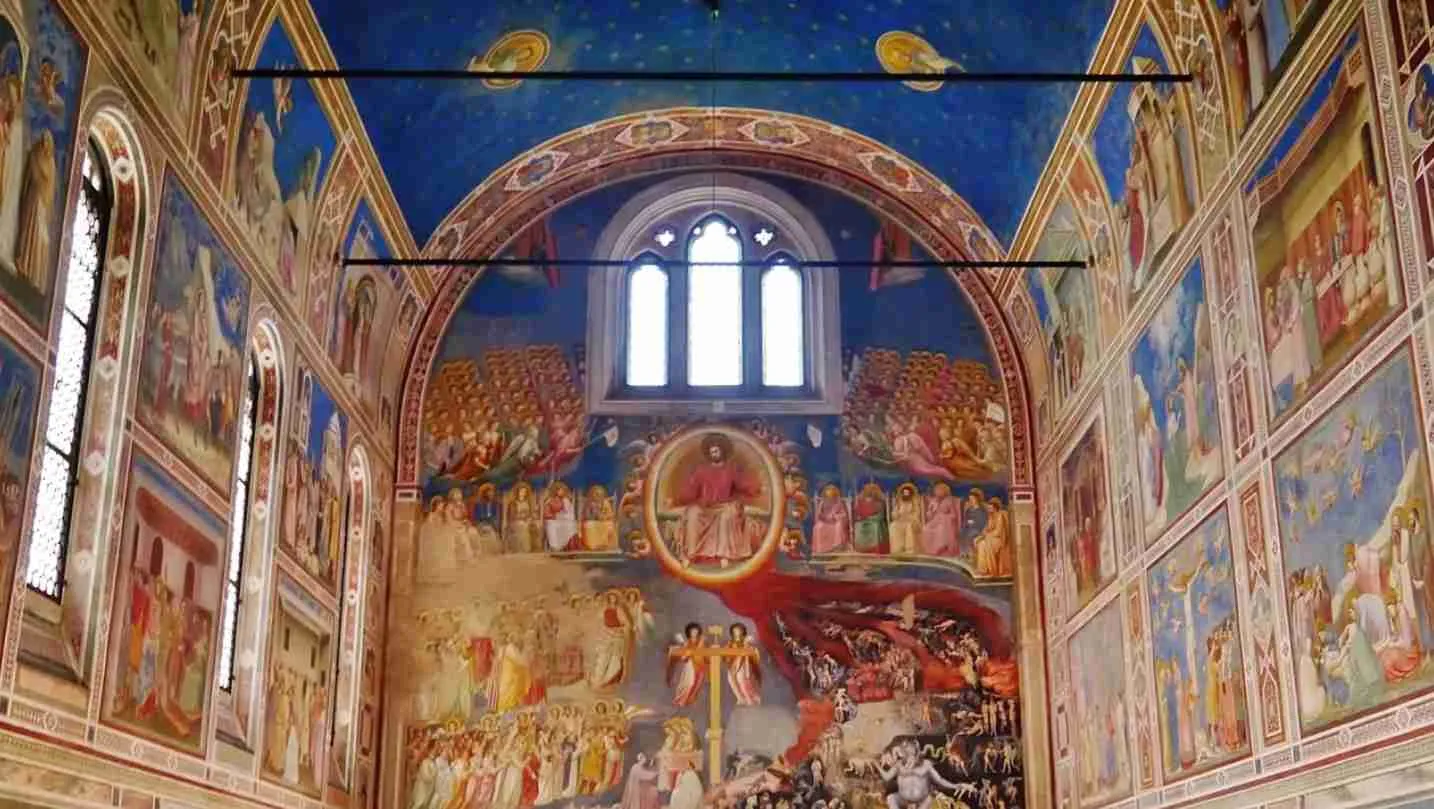
The Cappella degli Scrovegni is the non-negotiable centrepiece of any visit to Padua. Enrico Scrovegni commissioned Giotto to paint the small single-nave chapel in 1303, possibly to atone for the usurious wealth accumulated by his father — Reginaldo Scrovegni is the money-lender Dante placed in the seventh circle of the Inferno. Over two years, Giotto covered all four walls and the barrel vault in a 39-scene cycle depicting the lives of Joachim and Anna, the Virgin Mary, and Christ, anchored on the entrance wall by a monumental Last Judgement. The result is not simply a beautiful painting: it is the founding document of Western pictorial illusionism, the first sustained treatment of interior space, psychological individuality, and sequential narrative drama in European art.
Each of the 39 narrative scenes operates as a self-contained compositional unit while maintaining visual continuity across the entire programme. The blues — the deep lapis lazuli of the painted sky, still breathtaking after 720 years — anchor a palette of ochres, pinks, and earthy reds that responds to the chapel’s particular quality of light. The Vices and Virtues painted in grisaille along the lower register demonstrate Giotto’s mastery of sculptural illusion, each figure appearing to project from a stone niche despite existing only as brushwork on flat plaster. The entire enterprise represents a technical and intellectual achievement that the Renaissance would spend a century attempting to surpass.
Booking in 2026: Tickets are available exclusively online through Vivaticket (linked from cappelladegliscrovegni.it) and must be reserved at least one day in advance for all daytime standard slots. Bookings for visits up to 10 June 2026 opened at noon on 11 December 2025; the rolling booking window continues at the same two-month rolling interval. Groups of 25 receive a single 15-minute slot in the chapel; the pre-visit period in the acclimatisation antechamber, where an introductory video screens, runs 15 minutes prior to chapel entry. Arrive at the ticket office (Piazza Eremitani 8, approximately 100 metres from the Chapel entrance) at least 30 minutes before your slot. Late arrivals are not admitted and must rebook for an available future slot.
Tickets (check cappelladegliscrovegni.it for current rates):
- Full price, Tuesday–Sunday (Chapel + Eremitani Museum + Palazzo Zuckermann): €15 + €1 booking fee
- Full price, Monday (Chapel + Eremitani Museum only, Zuckermann closed): €12 + €1 booking fee
- Reduced (groups 10+, EU citizens over 65, association members): €11 + €1 booking fee (Tue–Sun)
- Youth and students (ages 6–17, university students): €6 + €1 booking fee
- Evening visit “Giotto sotto le stelle” (Chapel only, 19:00–22:00): €10 — bookable on the day
- Children under 6: free
Opening hours: Monday–Sunday 9:00–19:00. Closed 25–26 December and 1 January; the Chapel remains open on 1 May (a public holiday) including evening slots, while the Eremitani Museum and Palazzo Zuckermann close on that day.
The ticket price covers not just the Chapel itself but the entire Eremitani Museum complex on the same site — a detail many visitors overlook when budgeting. The Eremitani Museum alone justifies the price: it houses the city’s core archaeological collections and an extensive pinacoteca (picture gallery) including several works of the first rank. Visitors who book the Tuesday–Sunday ticket but spend only 15 minutes in the Chapel and leave without entering the adjacent museum are missing roughly half of the cultural content their ticket covers.
Photography and Conservation Inside the Scrovegni Chapel
Photography without flash is permitted inside the chapel. The 15-minute time limit is strictly enforced as a conservation measure: the chapel’s microclimate — humidity and carbon dioxide levels — must recover between visitor groups to prevent long-term damage to the plaster and pigment. The acclimatisation antechamber that all visitors pass through before entry serves the dual purpose of providing visual context and stabilising visitors’ body temperature. Do not bring large bags or backpacks into the chapel; lockers are available at the Eremitani Museum entrance. The chapel interior is not accessible for visitors with significant mobility limitations due to its narrow entrance configuration.
Eremitani Civic Museums and Pinacoteca 2026
The Museo Eremitani, housed in the former Augustinian monastery adjacent to the Scrovegni Chapel, is the oldest museum complex in the Veneto and one of the oldest continuously operating museum institutions in Italy, tracing its origins to 1825. It functions as the city’s primary repository for archaeological and art-historical collections, and a visit of genuine substance requires two to three hours — time most visitors, fixated on the adjacent chapel, fail to allocate.
The Archaeological Collections span the ground floor and document Padua’s pre-Roman and Roman heritage in systematic depth. The Paleo-Veneto section illustrates the distinctive civilisation that preceded Roman conquest, with votive objects, metalwork, and decorated horse-riding gear that demonstrate the refinement of Iron Age culture in the Po plain. The Roman Via Annia section reconstructs life along the road that connected Padua to Aquileia, the great northeastern port city, with milestone markers, funerary monuments, and everyday objects retrieved from excavations along the route. The Egyptian section owes its existence to Giovanni Battista Belzoni (1778–1823), the Paduan-born strongman, engineer, and archaeologist who opened the tomb of Seti I in the Valley of the Kings and became one of the most consequential (and controversial) figures in early Egyptology. His personal collection forms the nucleus of an Egyptian gallery that includes genuine material of significant historical weight.
The Pinacoteca occupies the upper floors and presents Paduan and Venetian painting from the thirteenth to the eighteenth century in roughly chronological sequence. The room dedicated to Trecento art holds two objects of exceptional significance: a painted Crucifix by Giotto, documented as the work originally suspended above the Scrovegni Chapel’s altar before being transferred to the museum in the nineteenth century, and a group of panel paintings by Guariento di Arpo — including the Angels from the Carrarese Chapel — that illustrate the direction Paduan painting took in the generation immediately following Giotto. Francesco Squarcione’s Lazara Altarpiece represents the mid-fifteenth century, a period when Squarcione’s workshop served as the training ground for Andrea Mantegna, whose mature altarpiece for the church of Sant’Agostino in Verona had not yet been completed when he was already absorbing the Paduan tradition of fusing classical archaeology with naturalistic painting. The sixteenth-century rooms include Titian’s pair of oil panels Birth of Adonis and The Legend of Polydoros, notable Tintoretto canvases, a Madonna and Child by Boccaccio Boccacini, and a selection of works by Veronese. The eighteenth-century galleries conclude with paintings by Giambattista Tiepolo, whose St. Joseph with the Young Christ demonstrates the luminous chromatic range that would later transform ceiling painting throughout the Catholic world.
Seven multimedia stations on the lower level of the museum provide orientation to the Scrovegni Chapel frescoes and their art-historical context — particularly useful for visitors who plan to visit the museum before their chapel slot.
Opening hours: Monday–Sunday 9:00–19:00 (ticket office closes at 18:00). Closed 1 May, 25–26 December, 1 January.
Tickets: Included with Scrovegni Chapel ticket (see above). Museum only (no Chapel, Tuesday–Sunday): €11 full, €9 reduced, €5 youth and students. Monday rate (Museum only, no Zuckermann): €9 full.
The Church of the Eremitani
Adjacent to the museum, the fourteenth-century church of Santi Filippo e Giacomo agli Eremitani is one of the eight Urbs Picta UNESCO sites and is free to enter. The church was heavily damaged in an Allied bombing raid on 11 March 1944 — targeting a nearby railway junction — which destroyed Mantegna’s Ovetari Chapel frescoes, at that time considered the finest example of early Renaissance painting in the Veneto. Some fragments were salvaged and painstakingly reassembled; they are now displayed in the church. Guariento’s fresco programme in the main chapel survives intact. The devastation of the Mantegna frescoes, and the subsequent decades-long effort to reconstruct them digitally from pre-war photographic archives, has become a touchstone case in the ethics and technology of cultural heritage restoration.
Palazzo della Ragione 2026: Europe’s Largest Medieval Frescoed Hall
The Palazzo della Ragione stands between the twin market piazzas — Piazza delle Erbe and Piazza dei Frutti — at the geographic and commercial heart of medieval Padua. Construction began in 1218 under the direction of master builder Benvenuta da Bologna, and the building served as the city’s law court, council chamber, and administrative centre for six centuries. Between 1306 and 1308, the Augustinian friar and engineer Fra’ Giovanni degli Eremitani replaced the building’s original three internal rooms with a single vast hall — the Salone — covered by a roof shaped like an inverted ship’s keel, a structural and aesthetic achievement that made the building famous across northern Italy.
The original frescoes were commissioned from Giotto himself, working from an iconographic programme devised by Pietro d’Abano, the city’s pre-eminent physician and natural philosopher, who fused astrological allegory with medieval calendar cycles. These frescoes were destroyed in a catastrophic fire in 1420. The Paduan painters Nicolò Miretto and Stefano da Ferrara repainted the entire programme between 1425 and 1440, following d’Abano’s original scheme as closely as available records permitted. The result covers approximately 2,500 square metres of wall surface — the widest single frescoed hall in the Urbs Picta circuit — with 333 painted panels depicting the influence of celestial bodies on human activities, agricultural labour, and seasonal ceremonies, interspersed with saints, evangelists, and the symbols of the judicial function the space once served.
The Salone is also one of the finest spaces in Italy for understanding the scale and ambition of medieval civic culture. At 81.5 metres long, 27 metres wide, and 27 metres high — its roof-vault still unsupported by internal columns — it gives visitors a visceral sense of the institutional confidence that drove Italian commune-era architecture. A wooden replica of the cavallo (horse) made by Donatello for the equestrian statue of Gattamelata stands in the space; the original is located outside the Basilica of Sant’Antonio and represents one of the foundational works of Renaissance sculpture. Temporary exhibitions, cultural events, and evening programmes take place in the Salone throughout 2026.
Opening hours: Tuesday–Sunday 9:00–19:00 (last entry 18:00). Closed non-holiday Mondays, 1 May, 25–26 December, 1 January.
Tickets (check turismopadova.it for current rates): Full price €8; reduced (groups 10+, EU over 65, association members, Padua residents) €6; youth and students (ages 6–17, university students) €3; children under 5 free. Optional €1 reservation fee for prebooking.
Orto Botanico di Padova 2026: The World’s Oldest Continuous Academic Botanical Garden
The Orto Botanico was founded by decree of the Venetian Senate on 29 June 1545, on the initiative of Professor Francesco Bonafede, to cultivate medicinal plants for identification and study by the University of Padua’s Faculty of Medicine. The idea that physicians and pharmacists needed direct, empirical knowledge of the plants they prescribed — rather than reliance on classical texts — was itself revolutionary, reflecting the same empirical epistemology that would produce Vesalius’s anatomy, Galileo’s telescope, and Harvey’s circulatory theory. The garden is the direct institutional ancestor of every academic botanical garden in the world.
The physical design has barely changed since 1545. A circle 86 metres in diameter, inscribed by a stone wall with elaborate gate structures, contains a square divided by two perpendicular avenues into four quadrants, themselves subdivided into decorative geometric patterns of planted beds — the standard Renaissance hortus conclusus made monumental. Within this Renaissance structure, the University of Padua introduced a second component in 2014: the Biodiversity Garden, a modern extension featuring five climatically controlled greenhouses simulating tropical, subtropical, Mediterranean, arid, and temperate biomes, housing over 1,300 species from five continents. The two gardens — one a perfectly preserved Renaissance ideal, the other a state-of-the-art conservation and research facility — coexist without aesthetic friction, making the site unusually satisfying as both heritage monument and living scientific institution.
Among the garden’s notable individual specimens, the oldest is the Mediterranean palm (Chamaerops humilis) planted in 1585 and known as the Palma di Goethe after Johann Wolfgang von Goethe, who visited in 1786 and wrote about the palm in his Italian Journey as a stimulus for the botanical theory he published three years later. The plant is still growing in its original position, now enclosed in a specially designed greenhouse.
The adjacent Botanical Museum, inaugurated as part of the renovated complex, presents the garden’s historical collections — herbarium sheets, illustrated manuscripts, seed exchange records, botanical instruments — in an exhibition space that connects the garden’s medical origins with modern conservation science.
Opening hours: April–September, Tuesday–Sunday 10:00–19:00; October, Tuesday–Sunday 10:00–18:00; November–March, Tuesday–Sunday 10:00–17:00. Closed Mondays.
Tickets (check ortobotanico1545.it for current rates): Adults €10; reduced (over 65, teachers) €8; youth ages 13–25 €6; children 6–12 with paying adult free; children under 6 free. Audio guide (including an AudioPen Kids version) included in the ticket price. Integrated “Padova Città della Scienza” tickets covering the Botanical Garden plus Museum of Nature and Humankind plus Palazzo del Bo are available at €25 (3 sites) and €18 (any 2 sites).
Palazzo del Bo 2026: Galileo’s Lecture Hall and the World’s First Permanent Anatomical Theatre
The Palazzo del Bo — named after the Hospitium Bovis, the medieval inn “at the sign of the ox” that previously occupied this site — has served as the seat of the University of Padua since 1539. The building presents itself as a living campus rather than a museum: students cross the Old Courtyard on their way to lectures, the Rector still administers from offices within the complex, and the 3,000 coats of arms that line the courtyard walls belong to real graduates and benefactors across eight centuries. Visiting Palazzo del Bo is an exercise in understanding what a continuous institutional culture looks like — not preserved behind glass but still in use.
The primary destination for cultural visitors is the Anatomical Theatre (Teatro Anatomico), built in 1595 at the initiative of Girolamo Fabrici d’Acquapendente and universally recognised as the world’s oldest surviving permanent structure built for the systematic public dissection of cadavers. The theatre is a marvel of spatial ingenuity: an oval, tiered funnel of carved and polished wood, with spectators standing at successive levels above the central dissecting table, each tier slightly cantilevered outward to improve sightlines. At the peak periods of the seventeenth century, audiences of 300 gathered here to watch dissections performed by the same professors who, outside these walls, were rewriting the textbooks of anatomy, physiology, and embryology.
The Sala dei Quaranta preserves the original wooden reading desk from which Galileo Galilei lectured between 1592 and 1610 — the period he described as “the happiest eighteen years of my life.” Galileo taught mathematics and physics at Padua while simultaneously conducting the experimental work that would eventually lead to the Dialogo and his confrontation with the Inquisition. The desk is not a reconstruction; it is the object from which he worked, and its presence in the room where students once crowded to hear him gives the building a physical intimacy with the history of science that no museum reproduction can replicate.
The building also contains exceptional twentieth-century interiors: architect Gio Ponti’s 1940s renovation produced the “Staircase of Knowledge” with its luminous frescoes by Massimo Campigli, and the rector’s apartments include furniture and decorative programme that rank among the finest examples of Italian rationalist interior design.
Access: Weekday visits operate via guided tours bookable through the University of Padua ([email protected], +39 049 827 3939). On Saturdays, Sundays, and public holidays, Palazzo del Bo can be visited independently with a multilingual QR-code audio guide as part of the Padova Città della Scienza integrated ticket (€25 for 3 sites including Botanical Garden and Museum of Nature and Humankind; €18 for any 2 sites). Integrated tickets are valid for six months from the date of purchase. University of Padua students and staff enter free.
Museum of Nature and Humankind 2026: Padua’s Science Flagship
The Museum of Nature and Humankind (Museo della Natura e dell’Uomo), inaugurated to mark the 800th anniversary of the University of Padua’s founding, occupies Palazzo Cavalli at Corso Garibaldi 39 — a prominent position directly opposite the Scrovegni Chapel that makes it geographically impossible to overlook, even if many first-time visitors nonetheless walk past it. The museum consolidates four separate university collections that had previously been scattered across different sites: Mineralogy, Geology and Palaeontology, Zoology, and Anthropology. The combined holdings total 200,000 objects accumulated across four centuries of university-sponsored scientific collection.
The exhibition takes “Earth as an evolving system” as its organising principle, presenting the four collections as sequential chapters of a single planetary narrative: the deep time of geological formation, the emergence and diversification of life, the evolution of human societies, and the relationship between Homo sapiens and the natural world. The narrative is delivered through a combination of traditional specimen cases — genuinely exceptional material, including one of the finest mineralogical collections in Italy — and high-quality multimedia installations that contextualise the objects within current scientific understanding.
The Anthropology section is particularly strong, drawing on fieldwork collected by University of Padua researchers across Africa, South America, and the Pacific over more than two centuries. The Zoology halls display mounted specimens, skeletal preparations, and taxidermied animals at a level of quality comparable to the major natural history museums of Rome and Florence. The Palaeontology section includes several significant local finds from the Veneto region, which has proved unusually productive for fossil discovery.
Opening hours: Tuesday–Friday 9:00–18:00 (last entry 17:00); Saturday, Sunday, and public holidays 10:00–19:00 (last entry 18:00). Closed non-holiday Mondays.
Tickets (check visitmnu.it for current rates): Full price (ages 26–64) €12; reduced (over 65, teachers) €10; youth (ages 13–25) €7; family (2 adults + up to 3 under 18) €30; children under 6 free. Integrated 3-site “Padova Città della Scienza” ticket: €25.
MUSME 2026: Interactive Museum of the History of Medicine
MUSME occupies the Gothic shell of the fifteenth-century Hospital of San Francesco, the first hospital established in Padua (1414) and in continuous medical use for nearly four centuries. The conversion of this space into an interactive science museum, completed in 2015, represents one of the more successful recent attempts in Italian museum design to make the history of medicine genuinely accessible to general audiences while maintaining sufficient scholarly rigour to satisfy specialist visitors.
The exhibition is organised around four thematic “rooms” — Anatomy, Physiology, Pathology, Therapy — each interrogating its subject through a combination of historical artefacts, wax anatomical models, multimedia installations, and hands-on interactive elements. The signature experience is the simulation of an anatomical dissection using virtual reality technology, allowing visitors to experience the procedure from the perspective of the spectating students who once packed into the 1595 Anatomical Theatre at Palazzo del Bo. Seven monumental virtual “doors,” each presenting a different historical scientist including Galileo, open onto contextual narratives that situate Padua’s medical achievements within their broader European history.
The climactic space of the visit is the Vesaliano Anatomical Theatre within MUSME itself — an eight-metre model of the human body that visitors can enter and explore at scale, its transparent surfaces revealing the organs, vascular systems, and skeletal structure within. This is not a simplified educational model but a detailed anatomical installation that draws on the same tradition of wax model-making that Clemente Susini and his collaborators developed in Florence and Bologna in the eighteenth century.
MUSME works exceptionally well for families: the interactive design is calibrated to engage children from around age 7 upward, while the depth of historical and scientific content rewards adult visitors with specialist interests. It is consistently rated among the top three attractions in the city on review platforms, yet remains significantly less crowded than the Scrovegni Chapel or the Botanical Garden, making it one of the city’s most accessible major sites even during peak season.
Opening hours: Tuesday–Friday 14:30–19:00 (last entry 18:00); Saturday, Sunday, and holidays 9:30–17:00. Closed non-holiday Mondays, 25 December, 1 January.
Tickets (check musme.it for current rates): Adults €12; over 65 and groups €8; youth and students ages 4–17 and university students up to age 26 €6; children under 4 free.
The Baptistery and Urbs Picta Oratory Sites 2026
Three of the eight Urbs Picta UNESCO sites lie within or adjacent to the Cathedral and Basilica complexes at the southern end of the historic centre and are visited by a fraction of the tourists who crowd the Scrovegni Chapel, despite housing fresco programmes of comparable quality.
Cathedral Baptistery
The Cathedral Baptistery (Battistero della Cattedrale) at Piazza Duomo 12 contains what many fresco scholars consider the most complete and technically accomplished of all the Urbs Picta programmes: the full interior decoration executed by Giusto de’ Menabuoi between 1375 and 1378, on commission from Fina de’ Buzzacarini, wife of the Paduan lord Francesco I da Carrara. Every surface of the small octagonal building — walls, pendentives, drum, dome — is covered in a densely interlocking programme of biblical narrative. The central dome presents Christ Pantocrator surrounded by concentric rings of angels, Virgin, evangelists, prophets, and saints in a composition of extraordinary spatial and chromatic ambition. Art historians who rank Giusto above Giotto as a technician point to the Baptistery as the evidence: the mastery of perspective, foreshortening, and architectural illusionism displayed here goes beyond what the Scrovegni Chapel achieves, even if it lacks the emotional directness and compositional clarity that make Giotto’s cycle the more immediately affecting experience.
Tickets (check museodiocesanopadova.it for current rates): Baptistery and Museum combined €12 adults, €9 students ages 7–25; Museum only €6 adults; children under 6 free. Open Monday 14:00–18:00; Tuesday–Sunday 10:00–18:00.
Oratory of San Giorgio
The Oratorio di San Giorgio, next to the Cathedral of Sant’Antonio, was built as a private funerary chapel by the nobleman Raimondo Lupi da Soragna and decorated by Altichiero da Zevio and Jacopo da Verona between 1379 and 1384. Altichiero’s frescoes — depicting the Life of Christ, St. George, St. Catherine, and St. Lucy across all four walls — show a painter in total command of the spatial innovations introduced by Giotto, extending them toward the narrative complexity and crowd-scene choreography that characterise the mature Gothic international style. The chapel is small enough that the frescoes can be studied at unusually close range. Entry is included in the Urbs Picta Card. Closed Mondays (except public holidays).
Oratorio di San Michele
The Oratorio di San Michele, a short walk from the Basilica, was painted by Jacopo da Verona circa 1397, making it the chronological endpoint of the Urbs Picta programme. The frescoes document the final phase of the fourteenth-century Paduan school and are included in the Urbs Picta Card. Entry to the church of the Eremitani (part of the same UNESCO complex) is free and requires no ticket.
Loggia Carrarese
The Loggia Carrarese — the surviving wing of the Reggia Carrarese, the palace of Padua’s ruling Carrara dynasty — houses Guariento di Arpo’s biblical fresco cycle painted for the private chapel of the princes in the 1350s. Now the seat of the Galileiana Academy of Arts and Science, the Loggia operates under different access arrangements from the other Urbs Picta sites; check the Urbs Picta Card terms for current inclusion status.
Palazzo Zuckermann and the Bottacin Museum 2026
Palazzo Zuckermann, a neoclassical building on Corso Garibaldi directly across from the Eremitani complex, houses two collections that form part of the civic museums system and are included in the standard Scrovegni Chapel + Museums ticket.
The Museum of Applied and Decorative Arts (upper floors) presents ceramics, textiles, metalwork, glass, furniture, and jewellery from the medieval period through the early twentieth century, with particular strength in Venetian glassware, Renaissance bronzes, and Art Nouveau decorative objects. The collection reads as a material history of taste and domestic life in the Veneto over six centuries — less glamorous than the Pinacoteca but invaluable for visitors interested in design history and the craftwork traditions that underpinned the Renaissance luxury economy.
The Museo Bottacin (same building) was assembled by the nineteenth-century collector Nicola Bottacin and donated to the city in 1865. Its primary significance lies in its numismatic holdings — one of the largest and most systematically organised coin collections in Italy, spanning ancient Greek and Roman coinage through Venetian medieval minting to Italian Risorgimento-era medals. For specialists in monetary history and heraldry, the collection is a primary research resource. General visitors will find the medal series documenting the great figures of Renaissance Italian culture (Donatello, Mantegna, Petrarch) among the most immediately engaging material.
Opening hours: Tuesday–Sunday 10:00–19:00 (last entry 18:00, 45 minutes before closing). Closed non-holiday Mondays, 1 May, 25–26 December, 1 January.
Tickets: Included in the standard Scrovegni Chapel + Museums ticket (€15 + €1 booking fee for Tue–Sun). Museums-only access (without Chapel): €11 full, €9 reduced, €5 youth/students.
Caffè Pedrocchi 2026: Historic Café and Risorgimento Museum
The Caffè Pedrocchi, designed by Giuseppe Jappelli and completed in 1831, occupies a position in the history of Italian intellectual culture that no straightforward summary does justice to. Antonio Pedrocchi’s café became the gathering place of Padua’s academic, artistic, and political life through the critical decades of the Risorgimento, hosting the writer George Sand, serving as a meeting point for Carbonari conspirators, and witnessing the student uprising of 8 February 1848 that preceded the wider revolutionary upheavals of that year across Europe. The café’s nickname — “the café without doors” — derived from its original policy of never closing, a commitment to continuous public access that made it a symbol of the liberal values of the Enlightenment urban bourgeoisie.
The ground-floor café rooms are free to enter and remain in operation as a working café, serving coffee, wine, and food from a menu that has not moved dramatically from its nineteenth-century origins. The signature Caffè Pedrocchi drink — a cold espresso with mint cream, served in a small glass — merits attention as a local speciality rather than a tourist affectation: it has been on the menu since the 1840s. Breakfasting here before a morning museum visit is one of the more civilised ways to begin a day in Padua.
The Noble Floor (piano nobile) above the café houses the Museum of the Risorgimento and Contemporary Age, which documents the political and cultural history of Padua from the fall of the Venetian Republic (1797) to the promulgation of the Italian Republic’s Constitution (1948). Exhibition rooms in different historical styles — Egyptian, Etruscan, Gothic, Renaissance, Greek — contain artefacts, documents, portraits, and weapons relating to the Napoleonic occupation, the Austrian restoration, the 1848 uprising, the Risorgimento, and the two World Wars. The museum’s scale is intimate and the material specific enough to reward visitors with a particular interest in Italian nineteenth-century history.
Opening hours: Museum, Tuesday–Sunday 9:30–12:30 and 15:30–18:00. Closed Christmas, New Year’s Day, and 1 May.
Tickets: €4, including access to the Noble Floor. The museum is included in the civic museums Urbs Picta Card and Family Card.
Museum Passes and Ticket Strategies for Padua 2026
Padua’s museum landscape divides into three institutional orbits — the civic museums (Scrovegni and associated sites), the Urbs Picta UNESCO circuit, and the university science cluster — each with its own ticket structure. Understanding which orbit matches your priorities before buying any ticket avoids overpaying and ensures you don’t accidentally omit sites covered by a pass you already hold.
Urbs Picta Card: Best for the Fresco Circuit
The Urbs Picta Card — €28 for 48 hours, €35 for 72 hours — covers the Scrovegni Chapel, Eremitani Museum, Palazzo Zuckermann, Palazzo della Ragione, Baptistery, Oratory of San Giorgio, Oratorio di San Michele, Loggia Carrarese, Caffè Pedrocchi Noble Floor, Oratorio di San Rocco, Loggia e Odeo Cornaro, and Petrarch’s House in Arquà Petrarca, plus unlimited use of Padua’s public transport network. The Scrovegni Chapel visit within the Card still requires the €1 per-person booking fee. The card begins its validity window from the moment you first use it at any site, not from the point of purchase. Check cappelladegliscrovegni.it for the complete current list of included sites, as the programme is periodically updated.
An Urbs Picta Card without the Scrovegni Chapel (NC version) is also available at €18 for 48 hours and €23 for 72 hours — practical for visitors who have already seen the Chapel or who have no interest in paying the pre-booking requirement, and who want efficient access to the remaining fresco sites and transport.
Padova Città della Scienza: Best for the University Circuit
The integrated “Padua City of Science” ticket covers the Botanical Garden, Museum of Nature and Humankind, and Palazzo del Bo in any combination: €25 for all three sites, €18 for any two, with family versions at €55 (three sites) and €40 (two sites), valid for six months from purchase date. This is substantially cheaper than buying each of the three individually and has the added advantage that the six-month validity allows visitors arriving on a day when one site is closed to use their remaining access on a return trip. On Sundays, Padova Città della Scienza ticket holders also receive free access to several university specialist collections — Museum of Geography, Giovanni Poleni Museum, Enrico Bernardi Machine Museum — that are otherwise accessible only through individual arrangements.
Individual Tickets: When They Make Sense
Individual tickets are the right choice for visitors seeing only one or two sites in each institutional orbit. If your itinerary includes only the Scrovegni Chapel and one other site, the individual Chapel + Museums ticket (€16) is straightforward. If you plan to visit MUSME (which is not included in either pass), the individual adult ticket at €12 is the only option. The Family Card (€30, valid 15 days) is excellent value for families visiting multiple civic museum sites.
Free Admission Opportunities 2026
Several significant sites in Padua are free at all times: the Basilica of Sant’Antonio (free entry; the attached Oratorio di San Giorgio requires a ticket or Urbs Picta Card), the Church of the Eremitani, the Prato della Valle, the University’s Old Courtyard at Palazzo del Bo (with ID), and the city’s market piazzas. Most civic museums offer free admission on specific calendar occasions in 2026, including International Women’s Day (8 March), Father’s Day (19 March), the Feast of Sant’Antonio (10–13 June), and the entire month of August 2026 for Padua residents and university students to mark the fifth anniversary of the Urbs Picta UNESCO inscription.
Sample Itineraries for Padua Museums 2026
One-Day Essential Visit
For visitors arriving from Venice or Verona for the day, the structure that maximises impact without overloading is: book a 9:00 or 9:30 Scrovegni Chapel slot online at least two days in advance; collect tickets at the Eremitani ticket office by 8:30; spend the 15-minute pre-visit period in the antechamber reviewing the introductory film; take the full 15 minutes in the Chapel itself. Then allocate 90 minutes to the Eremitani Museum — at minimum, the Trecento gallery with Giotto’s Crucifix, the Venetian masters rooms, and the Egyptian section. Break for lunch in Piazza delle Erbe or Piazza dei Frutti, where the ground floor of Palazzo della Ragione houses some of the best food stalls in the city. Spend 60–75 minutes in the upper Salone of Palazzo della Ragione in the afternoon. If time and energy allow, add a 45-minute visit to the Botanical Garden or a coffee and browse of the Caffè Pedrocchi Noble Floor before catching the train back.
Two-Day Museum Visit
Day 1: Scrovegni Chapel (morning slot), Eremitani Museum (morning), lunch near the market piazzas, Palazzo della Ragione (early afternoon), Caffè Pedrocchi Noble Floor and Risorgimento Museum (late afternoon). Evening Scrovegni slot is available if you want a second, quieter experience of the Chapel without the morning crowds.
Day 2: Orto Botanico (open from 10:00, allow 90 minutes), Palazzo del Bo guided tour or weekend audio-guide visit (allow 90 minutes), Museum of Nature and Humankind (allow 2 hours), MUSME if visiting on Saturday, Sunday, or a weekday afternoon (open from 14:30 on weekdays, from 9:30 on weekends).
Three-Day Comprehensive Circuit
Day 1: As above for the Scrovegni, Eremitani, and Palazzo della Ragione.
Day 2: Cathedral Baptistery (morning — plan 60 minutes for this exceptional space), Oratory of San Giorgio (adjacent, 30–45 minutes), Basilica of Sant’Antonio (free, allow 60 minutes for the interior and chapels), Prato della Valle walk. Afternoon: Botanical Garden.
Day 3: Palazzo del Bo, Museum of Nature and Humankind, MUSME. If museum fatigue has set in, substitute the afternoon with Palazzo Zuckermann (included in the Chapel ticket already purchased) and the Oratorio di San Michele to complete the Urbs Picta circuit.
Practical Tips for Visiting Padua Museums in 2026
Getting to Padua
Padua’s train station sits at the northwestern edge of the historic centre, approximately 20–25 minutes on foot from the Scrovegni Chapel. Trenitalia and Italo both serve Padua on the Venice–Milan high-speed line; fast trains from Venice Santa Lucia take 25–30 minutes, from Verona Porta Nuova 45–55 minutes, from Milan Centrale 2 hours 10 minutes. The tram line (Tramvia) connects the station to Prato della Valle and stops near the Botanical Garden; a single tram ticket costs €1.30, or use the public transport included in the Urbs Picta Card.
When to Visit
October through March brings the lightest tourist pressure outside of Christmas and New Year. The months of June through September see the highest visitor volume at the Scrovegni Chapel specifically, with Scrovegni slots booking out further in advance. Spring (April–May) and autumn (September–October) offer the best combination of mild weather, manageable crowds, and garden conditions — the Botanical Garden’s main seasonal display runs through spring. All of August 2026 offers free civic museum entry for Padua residents and university students as part of the fifth-anniversary Urbs Picta celebrations, which may increase summer visitor volume at some sites.
Booking and Logistics
The Scrovegni Chapel is the only site requiring mandatory advance booking. MUSME, the Botanical Garden, and the Museum of Nature and Humankind welcome walk-in visitors on most days outside peak holiday periods, though online booking is available and speeds entry. The Eremitani Museum, Palazzo della Ragione, and Palazzo Zuckermann do not require advance reservation for individual visitors. Palazzo del Bo weekday guided tours require prior booking via the University of Padua contact centre (+39 049 827 3939, open daily 9:00–17:00, or [email protected]).
Accessibility
The Eremitani Museum, Museum of Nature and Humankind, Botanical Garden (paved paths throughout), and MUSME are all accessible for visitors with mobility limitations. The Scrovegni Chapel has a narrow entrance configuration that may present difficulties for some wheelchair users; contact the museum in advance to discuss specific requirements. Palazzo del Bo’s Anatomical Theatre, reached via a narrow spiral stair, is not accessible to visitors with limited mobility; however, the main courtyard and several ground-floor rooms are accessible.
Dining Near the Museums
Piazza delle Erbe and Piazza dei Frutti operate daily markets (Monday–Saturday) with food stalls, cheese vendors, and prepared food counters that serve inexpensive lunches. The ground floor of Palazzo della Ragione itself houses a number of deli-style food shops. For a more extended meal, the streets immediately north of the Scrovegni Chapel and east of Prato della Valle offer a representative range of Paduan trattorie where the local cuisine — pasta e fagioli, risotto al radicchio, bigoli with duck ragù, horse tartare — is served without tourist premiums.
Frequently Asked Questions About Padua Museums 2026
Is the Scrovegni Chapel worth the advance planning required?
The Scrovegni Chapel is worth considerably more advance planning than most visitors apply. It contains the single most important artwork in the history of Western painting — the argument is supportable, not hyperbolic — and the 15-minute limit inside the chapel, far from being a frustrating restriction, concentrates the mind in a way that prolonged exposure never can. Come with the key scenes memorised; the introductory video in the antechamber provides useful orientation. The experience of standing inside that painted space, even briefly, is genuinely transformative in a way that photographic reproductions never convey.
Can I visit Padua’s museums as a day trip from Venice?
Yes — Padua is the most rewarding day trip from Venice precisely because it is so different from it. The journey takes 25–30 minutes on a fast train from Venice Santa Lucia. A well-organised day can cover the Scrovegni Chapel (pre-booked morning slot), the Eremitani Museum, and Palazzo della Ragione with time to spare. Book the earliest available morning Chapel slot, collect the ticket at the museum by 8:30, and the day is efficiently structured from the start. The Urbs Picta Card is worthwhile for Venice-based visitors who can plan two separate day trips within its 48-hour or 72-hour validity window.
What is the Padova Urbs Picta and why does it matter for visitors in 2026?
Padova Urbs Picta is the name for the UNESCO World Heritage serial site “Padua’s fourteenth-century fresco cycles,” inscribed in 2021. It encompasses eight building complexes within the historic city where fresco cycles painted between 1302 and 1397 document the most important stylistic revolution in European visual art. For practical visitors in 2026, Urbs Picta is relevant primarily as the brand name for the city’s unified tourist infrastructure: the Urbs Picta Card (€28/48h, €35/72h) bundles access to all eight sites and public transport; the official Urbs Picta mobile app provides navigation, audio guides, and contextual information across the full circuit.
How does the Botanical Garden relate to the wider museum circuit?
The Botanical Garden is a UNESCO World Heritage Site independent of the Urbs Picta fresco inscription, designated in 1997 for its foundational role in developing modern botanical science, ecology, and pharmacy. It is not administratively connected to the civic museums but fits naturally into a two-day museum circuit as the opening or closing visit on the science-focused day — after Palazzo del Bo and before or after the Museum of Nature and Humankind. The Padova Città della Scienza integrated ticket (€25) links all three University of Padua science sites and represents a significant saving over individual entry fees.
Are Padua’s museums suitable for children?
MUSME is outstanding for children from around age 7 upward, with hands-on interactive elements throughout and the dramatic eight-metre body model as a centrepiece. The Museum of Nature and Humankind holds strong appeal for children interested in natural history, with animal specimens, fossils, and minerals presented with well-designed interpretive labels. The Botanical Garden includes an AudioPen Kids audio guide designed specifically for younger visitors. The Scrovegni Chapel is accessible for children but the 15-minute slot and conservation rules (strict quiet, no running, no touching) require parental preparation. Children under 6 enter all civic museums free.
What do I see at Palazzo del Bo apart from the Anatomical Theatre?
Palazzo del Bo contains: the Sala dei Quaranta with Galileo’s original wooden lecture desk; the Aula Magna (Great Hall), still used for graduation ceremonies and academic events, decorated with twentieth-century frescoes; the Old Courtyard with its double loggia and approximately 3,000 coats of arms; the modern New Courtyard with sculpture by Gio Pomodoro and Jannis Kounellis; a memorial to Elena Lucrezia Cornaro Piscopia, the world’s first woman to receive a PhD (University of Padua, 1678); and the Gio Ponti 1940s interiors, which represent one of the most significant surviving examples of Italian rationalist interior design. A guided tour runs 90–120 minutes and includes all major spaces.
Is the Cathedral Baptistery as impressive as the Scrovegni Chapel?
Technically, many fresco scholars argue Giusto de’ Menabuoi’s programme in the Baptistery surpasses the Scrovegni Chapel in spatial ambition and compositional complexity. The Baptistery receives perhaps 5% of the Scrovegni’s visitor numbers despite UNESCO inscription and comparable scholarly status — making it one of the most underappreciated major cultural sites in Europe. The emotional register is different: where Giotto achieves an almost theatrical drama of individual facial expression and gestural clarity, Giusto builds an overwhelming cosmic programme of extraordinary density. Both sites deserve a serious visit; the Baptistery combined with the Cathedral Museum costs €12 for adults.
What are the hidden-cost considerations for a Padua museum day?
The main hidden cost across Padua’s museum circuit is the €1 booking fee for each Scrovegni Chapel ticket — it applies per person including reduced and youth tickets, and it applies whether you book online or pay by credit card at the ticket office (walk-in cash payment on the day is not available for daytime slots). Transport between sites is modest since the historic centre is compact and almost all major museums are within 15 minutes’ walk of each other; the tram supplements walking for the Botanical Garden and southern sites. Audio guides, where not included in the ticket price (the Botanical Garden includes one), typically cost an additional €3–€5.
Can I photograph inside Padua’s museums?
Photography without flash is permitted at the Scrovegni Chapel, the Eremitani Museum, the Botanical Garden, the Museum of Nature and Humankind, MUSME, and Palazzo della Ragione. Professional photography and video filming require advance permission from each museum’s administration. Inside the Anatomical Theatre at Palazzo del Bo, photography rules are set by the guided tour schedule and may vary by tour group — confirm with the guide at the start of the visit. The Cathedral Baptistery permits non-flash photography for personal use.
How do I reach the Oratory of San Giorgio and the Baptistery from the Scrovegni Chapel on foot?
From the Scrovegni Chapel (Piazza Eremitani), the most direct route to the Cathedral Baptistery runs south through the university district along Via Dante and Via 8 Febbraio — approximately 15 minutes’ walking. The Oratory of San Giorgio is adjacent to the Basilica of Sant’Antonio at Piazza del Santo, a further 5 minutes south of the Baptistery or 20 minutes from the Scrovegni. The Botanical Garden is 5 minutes east of the Basilica, between Prato della Valle and Via Orto Botanico. The entire circuit from Scrovegni to Orto Botanico — hitting all four Urbs Picta component zones on foot — covers approximately 3.5 kilometres and takes 35–40 minutes of walking time exclusive of museum visits.