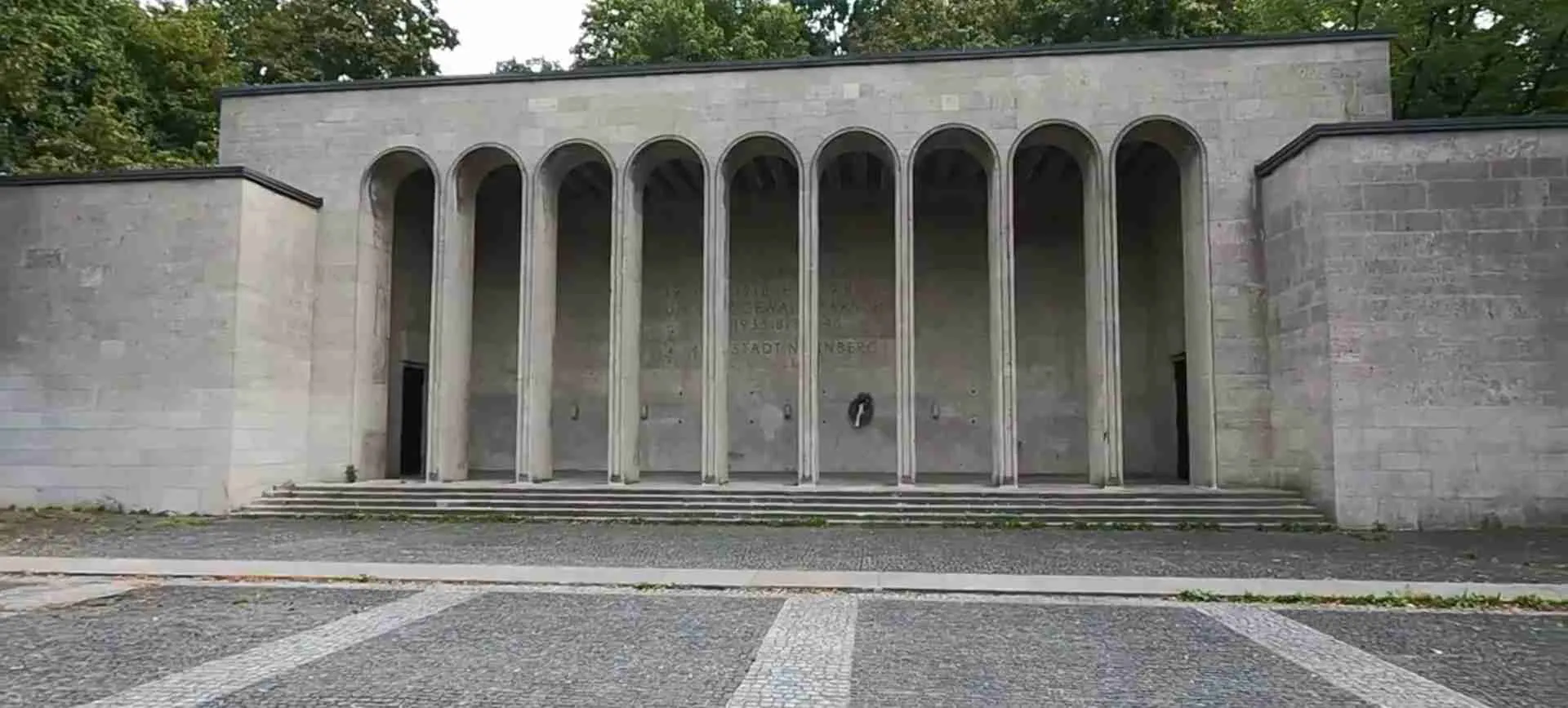
Nuremberg Nazi Rally Grounds: History Guide
Key Takeaways:
- The Nazi Party Rally Grounds span 11 square kilometers in southeastern Nuremberg, designed to accommodate up to 500,000 participants in mass propaganda spectacles demonstrating totalitarian power and racial ideology
- Albert Speer’s monumental architecture employed classical references and overwhelming scale to project Nazi permanence claims, though most structures remained incomplete when war interrupted construction
- Annual rallies from 1933-1938 orchestrated elaborate choreography combining torchlight processions, military displays, and Hitler speeches creating emotional mass experiences superseding rational political discourse
- The partially completed Congress Hall and Zeppelin Field grandstand represent Europe’s largest surviving Nazi architectural remnants, raising ongoing debates about preservation versus demolition
- The Documentation Center occupies the Congress Hall’s north wing, examining Nazi propaganda techniques and rally grounds’ role in constructing popular consent for dictatorship and genocide
Understanding Nuremberg’s Role in Nazi Ideology
Nuremberg held profound symbolic significance for Nazi ideology as the medieval imperial city embodying idealized German cultural heritage and ethnic nationalism. The party selected Nuremberg as permanent rally location in 1933, transforming the city into propaganda showcase and “City of the Reich Party Rallies.” This designation connected Nazi movement to romanticized medieval German Empire, claiming historical continuity between medieval imperial glory and Hitler’s proclaimed “Third Reich.” The city’s well-preserved medieval architecture provided photogenic backdrops for propaganda films portraying Nazis as restorers of authentic German greatness threatened by modernity, democracy, and racial “contamination.”
The rally grounds construction represented the Nazi regime’s largest architectural project, envisioning permanent monuments to movement ideology and anticipated thousand-year Reich. Albert Speer, Hitler’s chief architect, designed massive structures intended to rival ancient Rome’s imperial architecture and exceed contemporary democratic nations’ building projects. These monumental constructions served propaganda functions demonstrating Nazi power, economic recovery under Hitler’s leadership, and regime permanence to domestic and international audiences. The scale deliberately overwhelmed individual visitors, reducing persons to insignificant components within vast collective masses expressing unity with Führer and movement.
Annual rallies transformed Nuremberg into temporary Nazi capital for week-long spectacles combining political speeches, military parades, youth gatherings, and elaborate nighttime ceremonies. These events attracted hundreds of thousands of participants including party officials, Hitler Youth, SS units, Wehrmacht forces, and civilian spectators. The rallies served multiple functions: reinforcing party hierarchy, rewarding loyal members with emotional peak experiences, demonstrating military strength, and creating propaganda materials distributed through newsreels and publications worldwide. Leni Riefenstahl’s film “Triumph of the Will” documenting the 1934 rally became the most influential propaganda film ever produced, establishing visual vocabulary for totalitarian spectacle copied by authoritarian regimes globally.
The grounds’ design reflected core Nazi ideological commitments to racial hierarchy, militarism, and Führer worship. Spatial organization placed Hitler at focal points dominating visual perspectives and gathering attention. Massive assembly areas reduced individuals to uniform masses arrayed in geometric formations visible from elevated platforms where Nazi leadership observed crowds. This spatial hierarchy materialized ideology’s anti-democratic essence, creating physical environments where individual agency disappeared into collective subordination to leadership authority. The architecture communicated that Nazi power was permanent, overwhelming, and destined to shape German destiny for millennia.
People Also Ask About Nuremberg Rally Grounds
Why did the Nazis choose Nuremberg for their rallies?
Nuremberg offered strategic advantages including central German location, extensive medieval architecture supporting nationalist narratives, and strong local Nazi party organization facilitating rally logistics. The city’s medieval heritage enabled propaganda connecting Nazi movement to idealized German imperial past, claiming continuity between Holy Roman Empire and Hitler’s “Third Reich.” Nuremberg’s role hosting imperial diets (assemblies) during medieval period provided historical precedent for gathering German political authority in the city. Additionally, Nuremberg’s distance from Berlin enabled rally spectacles distinct from everyday governmental functions, creating special ceremonial events separated from routine administration.
Practical considerations included adequate land availability for massive construction projects, transportation infrastructure supporting hundreds of thousands of visitors, and accommodation capacity housing participants. The city’s position in Franconia, traditionally conservative and nationalist region, provided politically sympathetic population supporting rally organization. Local officials and businesses eagerly cooperated with Nazi plans, anticipating economic benefits from massive construction projects and annual visitor influxes. This willing collaboration enabled smooth rally implementation without local resistance that might have complicated events in less politically aligned cities.
What structures still exist at the rally grounds?
The partially completed Congress Hall represents the most substantial surviving structure, a massive horseshoe-shaped building designed to accommodate 50,000 people for party congresses. Construction halted in 1939 when war redirected resources, leaving the exterior shell completed but interior spaces unfinished. The Zeppelin Field grandstand survived bombing and post-war demolition debates, though deterioration necessitated ongoing stabilization efforts. The Great Road, a 2-kilometer granite-paved processional avenue, remains intact though vehicle traffic and weathering have damaged the original surface.
Smaller surviving elements include portions of the Luitpold Arena foundations, sections of the German Stadium excavations (never completed beyond foundation trenches), and various support buildings converted to post-war uses. The Zeppelin Field’s stone towers flanking the main grandstand remain standing, though debate continues about their preservation or removal. Most structures envisioned in Speer’s master plan were never built or were demolished in post-war years, leaving fragmentary archaeological landscape rather than complete architectural complex originally envisioned.
How large were the Nuremberg rallies?
Rally attendance peaked in the late 1930s with approximately 500,000 participants converging on Nuremberg during week-long September events. The 1938 rally, the last held before war interrupted annual gatherings, attracted over 550,000 attendees including party officials, military units, Hitler Youth members, and civilian spectators. Daily events distributed crowds across multiple venues, with the Zeppelin Field accommodating up to 200,000 people during mass ceremonies, the Luitpold Arena holding 150,000 for political speeches, and the Great Road providing space for military parades involving tens of thousands of troops.
Participant composition included approximately 100,000 Hitler Youth and League of German Girls members demonstrating Nazi success indoctrinating youth, 70,000-80,000 Wehrmacht and SS forces displaying military might, and 40,000-50,000 party officials representing Nazi movement’s organizational reach. Civilian spectators numbered in the hundreds of thousands, drawn by propaganda promising transformative experiences and opportunities to see Hitler personally. The massive scale created logistical challenges requiring extensive temporary housing in tent cities, supplemental transportation, and food distribution systems supporting populations larger than most German cities.
What happened at the rallies?
Rallies followed elaborate week-long schedules combining political speeches, military parades, youth demonstrations, cultural performances, and religious-style ceremonies venerating Hitler and Nazi ideology. Days began with reveille awakening participants in military-style discipline, followed by formal assemblies, Führer addresses, and evening torch-lit processions creating dramatic visual spectacles. Each day focused on specific themes: Wehrmacht day highlighting military power, Hitler Youth day emphasizing generational indoctrination, and Party Congress day celebrating movement ideology.
Emotional manipulation employed theatrical techniques including nighttime ceremonies, cathedral of light effects created by searchlights, massed choirs and orchestras, and choreographed crowd responses to leadership speeches. Hitler’s addresses built to crescendos provoking ecstatic crowd reactions, with participants describing quasi-religious conversion experiences and overwhelming emotional identification with Führer and movement. These carefully orchestrated spectacles aimed to bypass rational political judgment, creating emotional commitments transcending intellectual agreement with specific policies or ideologies. The rallies functioned as annual renewal rituals reinforcing participants’ Nazi identity and subordination to collective movement authority.
Who designed the rally grounds architecture?
Albert Speer served as chief architect for the rally grounds, appointed by Hitler in 1934 at age 29 after impressing the Führer with Berlin event designs. Speer’s architectural vision combined neoclassical elements, monumental scale, and modern construction techniques creating structures intended to communicate Nazi power and permanence. His designs referenced ancient Roman architecture, particularly Colosseum and imperial forum precedents, claiming continuity between Nazi movement and classical civilization’s alleged racial purity and martial excellence.
Speer worked closely with Hitler, who personally reviewed plans and insisted on modifications increasing scale and grandeur. The Führer’s amateur architectural interests shaped design decisions, with Hitler demanding ever-larger dimensions and more imposing visual effects. This collaboration produced structures exceeding practical functional requirements—the Congress Hall’s 50,000-person capacity far exceeded actual party congress needs—prioritizing propaganda impacts over utility. Speer’s later writings acknowledged architecture’s propaganda purposes while minimizing his complicity in regime’s broader crimes, though his position as Armaments Minister made him central to war effort employing slave labor killing thousands.
Extended multi-day tours – 5+ days
Featured Bavaria Multi-Day Tour Packages
3 days
Bavaria 3-Day Discovery Tour
- ✓ Comprehensive Bavaria experience
- ✓ Expert local guides included
- ✓ All accommodation included
- ✓ Transportation provided

5 days
Bavaria 5-Day Highlights Experience
- ✓ Comprehensive Bavaria experience
- ✓ Expert local guides included
- ✓ All accommodation included
- ✓ Transportation provided

7 days
Bavaria 7-Day Cultural Journey
- ✓ Comprehensive Bavaria experience
- ✓ Expert local guides included
- ✓ All accommodation included
- ✓ Transportation provided

10 days
Bavaria 10-Day Complete Adventure
- ✓ Comprehensive Bavaria experience
- ✓ Expert local guides included
- ✓ All accommodation included
- ✓ Transportation provided
Multi-day tour packages powered by TourRadar. Prices and availability subject to change.
Why weren’t the rally grounds demolished after the war?
Post-war demolition debates weighed destroying Nazi architecture to prevent neo-Nazi pilgrimage sites against preserving structures as historical evidence and educational resources. American occupation authorities initially planned complete demolition, viewing massive Nazi monuments as threats to democratic reconstruction. However, demolition costs proved prohibitive given post-war resource scarcity, with the Congress Hall alone requiring extensive explosive operations expensive and potentially dangerous for surrounding neighborhoods. Practical considerations delayed demolition while political debates evolved toward preservation for educational purposes.
The 1970s-1980s witnessed shifting attitudes recognizing rally grounds’ historical significance as largest surviving Nazi architectural complex, providing tangible evidence of totalitarian ideology’s material manifestations. Preservation advocates argued that maintaining structures enabled critical historical education impossible if physical evidence disappeared. The 1985 Congress Hall conversion into Documentation Center resolved debates by transforming Nazi monument into anti-fascist educational institution, demonstrating that preservation need not honor Nazi legacy but could actively combat extremism through historical confrontation.
Historical Development and Construction
Early Rally Locations and Nuremberg Selection
The Nazi Party held annual rallies at various locations during the 1920s before establishing Nuremberg as permanent site. Early gatherings in Munich, Weimar, and other cities served party organizing functions, bringing dispersed members together for speeches, planning sessions, and collective identity reinforcement. These modest events attracted thousands rather than hundreds of thousands, with limited choreography and minimal architectural infrastructure. Hitler recognized mass gatherings’ propaganda potential early, understanding that emotional spectacles could build movement loyalty more effectively than rational political argument.
The 1927 Nuremberg rally, though not yet permanent annual location, demonstrated the city’s suitability for large-scale events. Nuremberg offered medieval architectural backdrops, adequate open spaces, and enthusiastic local Nazi organization. The 1929 rally, attracting over 150,000 participants, confirmed Nuremberg’s capacity for massive events and reinforced Hitler’s preference for the city. Following Nazi seizure of power in 1933, Nuremberg received official designation as permanent rally site, with planning immediately beginning for purpose-built grounds accommodating anticipated participant growth and propaganda ambitions.
Initial rally grounds utilized existing Luitpold Arena, constructed in 1906 for Bavarian centennial celebrations and available for Nazi appropriation. This existing facility accommodated early rallies while plans developed for permanent grounds. The 1933 rally, first after Hitler’s appointment as Chancellor, attracted 500,000 participants despite limited specialized infrastructure, demonstrating demand for expanded facilities and validating ambitious construction plans. The success of improvised 1933 event convinced Hitler and Speer that purpose-built grounds could multiply propaganda impacts through architectural grandeur and rational spatial organization.
Albert Speer’s Master Plan
Speer’s master plan envisioned transforming 11 square kilometers into monumental complex including Congress Hall, Zeppelin Field with grandstand, Great Road processional avenue, German Stadium, Märzfeld military parade ground, and numerous support structures. The plan reflected Hitler’s obsession with architectural legacy and Nazi ideology’s claims to thousand-year Reich permanence. Speer employed classical architectural references combined with modern engineering enabling unprecedented scale, creating hybrid aesthetic mixing ancient precedents with contemporary construction capabilities.
The Congress Hall design referenced Rome’s Colosseum, creating horseshoe-shaped structure 250 meters in diameter and 70 meters high. The planned interior featured column-ringed assembly space with explicit Roman imperial references claiming Nazi movement as classical civilization’s rightful inheritor. Construction employed massive granite blocks, reinforced concrete, and modern steel framework supporting the enormous roof structure. Work progressed rapidly from 1935-1939, completing exterior shell before war halted construction leaving interior spaces permanently unfinished.
The Zeppelin Field received priority completion for immediate rally use, featuring 360-meter-long grandstand topped by monumental colonnaded central section and flanking towers. The main tribune elevated Hitler and Nazi leadership 20 meters above assembled masses, creating spatial hierarchy materializing ideological subordination. The field accommodated 200,000 people in precisely organized formations, with designated zones for different participant categories. Speer’s cathedral of light—152 searchlights creating vertical columns visible from 100 kilometers—became rally grounds’ most famous architectural effect, though this temporary installation existed only during actual events rather than permanent structure.
Construction Methods and Labor
Construction employed tens of thousands of workers including skilled craftsmen, engineers, and unskilled laborers recruited from across Germany. The regime promoted rally grounds construction as economic recovery program providing employment during Depression-era unemployment. Workers received standardized wages and propaganda emphasized voluntary patriotic labor contributing to national greatness. However, this public narrative obscured coerced labor including concentration camp prisoners and forced workers conscripted through compulsory service programs.
Building materials included granite quarried from Bavarian sources, particularly Flossenbürg where a concentration camp specifically established to provide stone for rally grounds and other Nazi projects. Prisoners quarried, shaped, and transported granite blocks under brutal conditions killing thousands through exhaustion, accidents, and deliberate violence. The Great Road’s granite paving required approximately 60,000 square meters of precisely cut stone, representing enormous quarrying effort concentrated in camps where prisoner lives counted for nothing against architectural ambitions.
Engineering challenges included creating massive concrete structures requiring innovative forming techniques and reinforcement methods. The Congress Hall’s roof demanded structural calculations pushing contemporary engineering capabilities, with Speer consulting leading engineers to achieve the enormous unsupported span. Zeppelin Field construction required extensive earth moving creating elevated grandstand platforms and leveling parade grounds for precise formations. These technical achievements demonstrated German engineering excellence exploited for propaganda purposes, with construction methods’ brutality hidden beneath public narratives celebrating architectural accomplishment.
Wartime Suspension and Incomplete Structures
War outbreak in September 1939 immediately halted rally grounds construction as resources shifted to military priorities. The 1939 rally, scheduled for September 2-11, was cancelled days before opening as Wehrmacht invaded Poland. Construction sites transformed into industrial facilities, storage areas, and eventually housed foreign forced laborers and prisoners of war supporting Nuremberg’s war industries. The Congress Hall’s unfinished interior spaces served utilitarian purposes entirely contrary to intended ceremonial grandeur.
Planned structures remaining unrealized included the German Stadium, designed to accommodate 405,000 spectators and become world’s largest stadium. Foundation excavations began in 1937, revealing archaeological remains of Roman settlements that work destroyed in prioritizing Nazi construction over historical preservation. The stadium site remained a massive excavation crater when war suspended work permanently. The Märzfeld, planned 955-meter military parade ground, never progressed beyond preliminary site clearance and planning documents.
Allied bombing damaged some completed structures while sparing others through targeting priorities focusing on industrial and transportation infrastructure rather than propaganda monuments. The Zeppelin grandstand survived relatively intact, while Congress Hall’s massive construction resisted bomb damage that destroyed less substantial buildings. Post-war occupation forces found abandoned construction sites, incomplete buildings, and deteriorating completed structures requiring decisions about preservation, demolition, or adaptive reuse for peacetime purposes entirely divorced from Nazi propaganda functions.
Architectural Analysis and Design Principles
Monumental Scale and Classical References
Rally grounds architecture employed overwhelming scale creating psychological impacts reducing individual significance against massive stone structures and vast assembly spaces. The Congress Hall’s 250-meter diameter exceeded Rome’s Colosseum (189 meters) by deliberate design asserting Nazi superiority over classical civilization. Speer’s theory of “ruin value” demanded construction methods ensuring that even when buildings eventually decayed, their remains would produce aesthetically impressive ruins comparable to Roman monuments. This theory reflected Nazi temporal delusions imagining their structures standing for millennia as testaments to movement’s historical importance.
Classical architectural references particularly Roman imperial precedents claimed Nazi movement as authentic Western civilization inheritor against democratic “decadence” and communist “barbarism.” Column orders, symmetrical compositions, and triumphal arch motifs explicitly referenced ancient architecture while modern materials and engineering enabled unprecedented scale. This architectural strategy communicated that Nazis represented both tradition’s faithful guardians and modernity’s masters, synthesizing past greatness with contemporary power in service of racial ideology and authoritarian politics.
Material choices emphasized permanence through granite, limestone, and reinforced concrete rather than temporary or economical materials. The massive stone blocks communicated solidity, endurance, and resistance to change or destruction. Surface treatments employed smooth polished stone contrasting with rough rusticated bases, creating visual hierarchy and tactile variety within monumental compositions. These material decisions reflected ideological commitments to permanence, purity, and hierarchical order materialized through architectural fabric.
Spatial Organization and Choreography
Rally grounds spatial organization created hierarchical relationships between leadership and masses through elevation differences, sightline control, and circulation patterns. Hitler and Nazi elite occupied elevated platforms commanding visual attention and demonstrating authority through spatial dominance. The Zeppelin Field grandstand’s 20-meter elevation placed leadership literally above assembled masses, requiring participants to look upward in postures suggesting reverence or submission. This vertical hierarchy materialized ideological commitments to Führer principle and authoritarian subordination.
Sightlines focused attention toward leadership positions, with architectural compositions creating framed views directing observation toward Hitler’s speaking position. The masses arrayed in geometric formations became visual elements in compositions designed for leadership perspective, reducing individuals to components in larger patterns visible only from elevated platforms. This design strategy inverted democratic assumptions about political space, creating environments where masses existed to be observed by leaders rather than citizens observing and judging their representatives.
Circulation systems controlled participant movement through designated entry sequences, assembly areas, and processional routes. The Great Road served as primary axis organizing spatial relationships and facilitating military parades and ceremonial processions. Participants followed prescribed paths ensuring proper positioning within rally choreography, with spatial organization enforcing behavioral conformity and collective coordination. This environmental control complemented propaganda’s ideological conditioning, using architectural constraints to reinforce movement discipline and individual subordination to collective will.
Lighting and Atmospheric Effects
Speer’s cathedral of light created the rally grounds’ most dramatic architectural effect despite being temporary installation rather than permanent structure. The 152 anti-aircraft searchlights positioned around the Zeppelin Field projected vertical beams creating light columns extending to atmospheric limits. This effect transformed night sky into architectural element, creating cathedral-like enclosure suggesting sacred or transcendent significance. Participants described overwhelming emotional impacts from the light cathedral, with architectural space extending beyond physical structures into atmospheric phenomena.
Torchlight processions employed fire’s primal psychological associations, creating moving rivers of flame through darkened streets and rally grounds. Tens of thousands of torch-bearers created visually spectacular displays while generating heat, smoke, and flickering light producing sensory immersion intensifying emotional responses. The torches’ medieval associations connected Nazi spectacles to idealized German past, while fire’s destructive power symbolized movement’s revolutionary transformation burning away Weimar democracy and racial “impurity.”
Daytime lighting strategies employed precise orientation and shadow patterns enhancing architectural drama. The Zeppelin grandstand’s east-west axis ensured morning sun illuminated the tribune’s central section during early rallies, creating visual focus on leadership positions. Afternoon shadows provided relief from summer heat while creating dramatic contrasts emphasizing architectural mass and sculptural qualities. These calculated lighting effects demonstrated sophisticated understanding of environmental conditions’ roles in shaping architectural experience and emotional response.
Acoustic Design and Sound Amplification
Rally grounds incorporated sophisticated acoustic engineering enabling Hitler’s speeches to reach hundreds of thousands without electronic amplification. The Zeppelin grandstand’s curved wall behind speaking platform reflected sound waves toward assembled masses, functioning as passive amplification system. Stone surfaces created hard reflective acoustics projecting voice across the field while risking echo effects that careful geometric design minimized. These acoustic calculations ensured Hitler’s oratory, central to Nazi propaganda, reached maximum audience with minimal technological mediation.
Electronic amplification systems supplemented architectural acoustics, with extensive loudspeaker networks distributed throughout grounds. Technicians operated complex sound systems ensuring speech clarity and musical performances reached all participants regardless of position. The technology’s visibility reinforced modernity narratives portraying Nazis as technological progressives rather than backward reactionaries. Public address systems created unified acoustic experience, with Hitler’s voice simultaneously reaching dispersed crowds creating illusion of personal communication despite addressing hundreds of thousands.
Musical performances employed massed choirs, military bands, and orchestras creating overwhelming sonic environments. Wagner’s music featured prominently, with compositions’ emotional intensity and mythological themes supporting Nazi ideology’s pseudo-religious dimensions. The sonic landscape combined military precision in band performances, religious solemnity in choral works, and ecstatic crowd responses to speeches creating multilayered acoustic experiences reinforcing emotional manipulation and rational thought suppression.
Rally Choreography and Propaganda Techniques
Annual Rally Structure and Themes
Rallies followed week-long schedules beginning with opening ceremonies and progressing through themed days highlighting different movement components. The typical structure included Congress day featuring party officials delivering ideological addresses, Wehrmacht day demonstrating military power through parades and exercises, Hitler Youth day showcasing generational indoctrination success, and Labor Service day emphasizing worker mobilization. Each day combined morning assemblies, afternoon events, and evening ceremonies creating intensive multi-day immersion in Nazi ideology and collective experience.
Opening ceremonies established rallies’ quasi-religious tone through flag dedications, memorial services for movement “martyrs,” and Hitler’s arrival producing ecstatic crowd reactions. The Führer’s appearance transformed ordinary political gathering into transcendent event, with participants describing emotional peaks and sense of personal connection despite addressing masses of hundreds of thousands. Hitler cultivated this charismatic authority through careful choreography maximizing dramatic impact and emotional manipulation.
Closing ceremonies featured Hitler’s final address summarizing rally themes and issuing directives for coming year. These speeches built to crescendos provoking overwhelming crowd responses, with participants shouting approval, weeping, and displaying ecstatic behaviors suggesting religious conversion rather than political agreement. The rallies concluded with evening torch processions and firework displays creating memorable final impressions sustaining emotional impacts after participants’ return to normal life. These carefully designed closing ceremonies ensured rallies’ psychological effects persisted beyond immediate events.
Visual Spectacle and Mass Choreography
Rally choreography transformed hundreds of thousands of individuals into precisely organized visual patterns observable from leadership platforms and aerial perspectives. Participants arranged in geometric formations—squares, rectangles, and lines—created abstract compositions where individual identity disappeared into collective mass. This visual strategy materialized Nazi ideology’s subordination of individual to collective, demonstrating movement’s capacity to organize and discipline German society into unified instrument serving leadership will.
Uniform requirements ensured visual consistency, with different participant categories wearing distinctive costumes enabling color-coded identification. Hitler Youth in brown shirts, SS in black, Wehrmacht in grey, and party officials in various uniforms created patchwork patterns when massed in formations. Flag displays added red, white, and black color schemes dominating visual field and creating immersive Nazi aesthetic environment. These color coordinations appeared in Riefenstahl’s propaganda films as carefully composed artistic elements rather than documentary recording.
Nighttime spectacles employed fire and light creating dramatic visual effects impossible during daylight. Torchlight processions created rivers of flame winding through streets and rally grounds, producing moving visual patterns combining medieval associations with modern mass organization. The cathedral of light created architectural space from atmospheric phenomena, generating overwhelming sensory experiences participants described as transcendent or sacred. These nighttime effects provided rally signatures, becoming iconic images representing Nazi propaganda’s theatrical sophistication and emotional manipulation.
Hitler’s Oratorical Performances
Hitler’s speeches constituted rallies’ emotional and ideological centers, with the Führer’s oratorical performances carefully crafted for maximum psychological impact. Speeches typically lasted 60-90 minutes, beginning quietly with historical narratives establishing context before building intensity through increasingly aggressive rhetoric, dramatic pauses, and crescendoing delivery. Hitler employed repetition, rhetorical questions, and emotional appeals bypassing rational analysis in favor of visceral response and collective enthusiasm.
The content combined historical mythmaking portraying Germans as victimized race requiring lebensraum and racial purity protection, scapegoating blaming Jews, communists, and democratic “weakness” for Germany’s problems, and utopian promises about Thousand Year Reich and national greatness restoration. These themes mixed resentment, fear, pride, and hope creating emotional cocktails overriding critical thinking and moral restraint. Hitler’s delivery transformed written text into performance art, with physicality, vocal modulation, and gestural vocabulary creating multisensory experiences transcending words’ semantic content.
Crowd responses followed predictable patterns with participants interrupting speeches with coordinated chanting, applause, and approval shouting. These responses appeared spontaneous but reflected careful conditioning and social pressure ensuring conformity. Individuals describing resistance to emotional manipulation reported feeling isolated and threatened by surrounding enthusiasm, with collective fervor creating psychological pressure toward conformity and public enthusiasm regardless of private doubts. This dynamic demonstrated totalitarian spectacle’s power creating behavioral compliance even among skeptical participants.
Film and Photographic Documentation
Leni Riefenstahl’s “Triumph of the Will” documenting the 1934 rally became propaganda cinema’s masterwork, establishing visual vocabulary for totalitarian spectacle copied worldwide. Riefenstahl employed innovative cinematography including aerial shots, tracking shots through crowds, and dramatic low angles making Hitler appear monumental. The film editing created narrative rhythm building emotional intensity, with Wagner’s music, crowd responses, and Hitler’s speeches orchestrated into seamless propaganda experience. The film functioned as rally substitute for Germans unable to attend personally while providing international audiences with carefully crafted Nazi Germany image.
Photographic documentation employed leading photographers creating iconic images circulated through newspapers, magazines, and propaganda publications. These images emphasized scale, order, and collective enthusiasm while concealing coercion, staging, and dissenting responses. Photography transformed rallies from temporary events into permanent visual records shaping historical memory and contemporary perception. The staged and manipulated nature of much documentation demonstrates that rally “reality” existed as much in representation as actual events, with photographs and films creating propaganda experiences distinct from participants’ direct observations.
Newsreel distribution brought rally highlights to cinema audiences globally, with carefully edited segments showing military might, enthusiastic crowds, and Hitler’s speeches creating impressions of German strength and unity. These newsreels influenced international opinion, contributing to appeasement policies based partly on overestimated German military strength and underestimated internal opposition. The propaganda’s international impacts demonstrated visual spectacle’s power transcending language barriers and creating political effects through emotional manipulation rather than rational argument.
Post-War History and Transformation
Allied Occupation and Initial Uses
American forces occupying Nuremberg in April 1945 immediately recognized rally grounds’ symbolic significance, using the Zeppelin Field for victory celebrations and troop assemblies. Photographs showing American soldiers and liberated concentration camp survivors gathering at sites of Nazi triumph created powerful symbolic reversals, with victims and victors literally occupying spaces designed to project Nazi permanence and superiority. These images circulated globally as visual evidence of totalitarianism’s defeat and democracy’s triumph.
The 1945 demolition of the swastika crowning the Zeppelin grandstand provided particularly potent symbolic destruction captured in photographs and newsreels distributed worldwide. American engineers employed explosives toppling the massive stone swastika, with the monument’s fragmentation symbolizing Nazi ideology’s destruction. This controlled demolition satisfied Allied desires for symbolic victory while preserving the underlying grandstand structure’s potential utility for occupation forces requiring large assembly facilities.
Occupation authorities contemplated complete rally grounds demolition, viewing Nazi monuments as potential pilgrimage sites for neo-Nazi movements and obstacles to democratic reconstruction. However, immediate post-war priorities including housing shortage, displaced persons accommodation, and occupation administration demanded practical building use rather than expensive demolition operations. The Congress Hall housed military storage, administrative offices, and temporarily displaced persons, with utilitarian functions replacing intended ceremonial purposes in ironic transformation.
Nuremberg Trials and Historical Justice
The International Military Tribunal conducted in Nuremberg’s Palace of Justice from November 1945 to October 1946 created powerful symbolic connection between rally grounds’ propaganda spectacles and legal accountability for Nazi crimes. The trial location selection reflected Nuremberg’s Nazi associations, with prosecutors deliberately choosing the rallies’ host city for confronting defendants with justice in spaces celebrating their earlier triumphs. Though trials occurred in palace rather than rally grounds, the broader Nuremberg context created symbolic framework of historical reckoning.
The trials established legal precedents for prosecuting crimes against humanity, aggressive war, and genocide, creating international law foundations persisting into contemporary war crimes tribunals. Documentary evidence presented during trials included rally footage and photographs demonstrating Nazi ideology’s public celebration, linking propaganda spectacles to genocide implementation. These materials showed how rallies normalized violence, cultivated authoritarian loyalty, and prepared populations for accepting extraordinary crimes as necessary for racial ideology’s realization.
Subsequent trials prosecuted lower-level officials, doctors, industrialists, and military commanders, expanding accountability beyond top leadership. The twelve Nuremberg Trials addressed different perpetrator categories and crime types, establishing comprehensive documentation of Nazi crimes. This judicial process transformed Nuremberg from Nazi celebration city into justice symbol, though this symbolic rehabilitation couldn’t erase complicity of local officials and citizens who enthusiastically supported rally organization and benefited economically from annual events.
Cold War Era and Gradual Decay
Post-occupation rally grounds entered extended neglect period as Nuremberg prioritized reconstruction over monument preservation or demolition. The site served various informal purposes including training areas for military sports clubs, informal gathering spaces, and gradually deteriorating architectural ruins attracting limited public interest. The Congress Hall’s unfinished interior spaces housed temporary uses including vehicle storage and community events bearing no relationship to Nazi-era intended functions.
The Zeppelin Field hosted American military events including Fourth of July celebrations and sporting competitions, with occupation forces’ continued use preventing complete abandonment while avoiding historical confrontation with site’s Nazi associations. This utilitarian approach reflected broader German society’s reluctance during the 1950s-1960s to confront Nazi past, with “economic miracle” priorities and Cold War pressures encouraging forward focus rather than historical reckoning. Rally grounds existed as awkward remnants neither properly preserved as historical monuments nor completely demolished to erase shameful past.
Youth culture appropriated spaces for informal gatherings, concerts, and counterculture activities, with 1960s-1970s teenagers using sites as hangouts without necessarily understanding historical significance. This unconscious reuse demonstrated how sites lose original meanings through generational change and contextual transformation. Parents and grandparents who attended rallies as enthusiastic participants rarely discussed these experiences with children, creating knowledge gaps where architectural spaces persisted but historical understanding atrophied through silence and shame.
Memorial Development and Educational Use
The 1970s-1980s witnessed shifting attitudes toward rally grounds preservation as historical consciousness evolved through generational change and student movements demanding Nazi past confrontation. Historians, educators, and civic activists argued that preserving rally grounds enabled critical historical education impossible if physical evidence disappeared. These preservation advocates emphasized that maintaining Nazi architecture need not honor the regime but could facilitate understanding totalitarian ideology’s material manifestations and propaganda techniques.
The Documentation Center’s 1985 opening in Congress Hall’s north wing transformed Nazi monument into anti-fascist educational institution, demonstrating that preservation could serve democratic education rather than neo-Nazi commemoration. The center’s exhibitions examined rally grounds’ construction, propaganda functions, and relationships to broader Nazi policies including war and genocide. This adaptive reuse model provided international precedent for addressing difficult heritage sites, showing how problematic monuments could be repurposed for critical education rather than simple demolition or neglectful abandonment.
Subsequent decades brought extensive historical research, archaeological investigations, and conservation efforts stabilizing deteriorating structures. The Zeppelin grandstand required emergency interventions preventing collapse, with ongoing debates about investment levels for preserving contested heritage. Educational programming expanded including guided tours, school curricula integrating rally grounds visits, and international exchange programs bringing visitors worldwide to confront Nazi propaganda architecture. These efforts positioned rally grounds as valuable educational resources rather than shameful ruins requiring concealment or destruction.
Documentation Center Exhibitions and Interpretation
Exhibition Content and Themes
Documentation Center exhibitions examine Nazi Party Rally organization, propaganda techniques, architectural symbolism, and connections between Nuremberg spectacles and regime crimes including war and genocide. Displays employ historical photographs, propaganda materials, architectural models, film footage, and survivor testimonies creating comprehensive analysis of how rallies functioned within broader Nazi system. The exhibitions emphasize rallies’ roles in normalizing violence, cultivating Führer worship, and preparing populations for extraordinary crimes justified through racial ideology.
Architectural analysis sections explain Speer’s design principles, construction methods, and symbolic intentions, helping visitors understand how built environment shaped participant experiences and communicated ideological messages. Models showing completed versus actually built structures reveal construction’s fragmentary nature and thousand-year Reich delusions. These architectural exhibits demonstrate how physical space serves propaganda purposes, using rally grounds as case study in totalitarian environmental manipulation.
Biographical sections profile rally participants from multiple perspectives including enthusiastic supporters, coerced attendees, foreign observers, and victims excluded from or persecuted by Nazi movement. These diverse perspectives complicate simplistic narratives portraying all Germans as enthusiastic Nazis or passive victims, instead revealing complex realities of consent, coercion, enthusiasm, and resistance. Personal testimonies humanize historical abstraction, connecting individual experiences to broader historical processes.
Educational Programs and Visitor Services
Educational programs serve school groups, adult learners, and international visitors through guided tours, workshops, lectures, and specialized seminars. Professional educators employ primary source analysis, critical thinking exercises, and contemporary connections addressing far-right extremism, propaganda recognition, and democratic resilience. These programs position rally grounds as resources for civic education rather than simple historical curiosities, connecting past analysis to present political vigilance.
Guided tours traverse rally grounds connecting architectural sites with historical narratives, helping visitors understand spatial relationships and design intentions. Guides explain how specific locations hosted particular rally events, enabling imaginative reconstruction of massive spectacles now existing only through photographic and film documentation. Walking the Great Road, standing on Zeppelin Field, or entering Congress Hall’s monumental spaces provides experiential learning impossible through classroom instruction alone.
Digital resources including website materials, virtual tours, and mobile applications extend educational access beyond physical visits. These resources enable international audiences to engage rally grounds history without traveling to Nuremberg, democratizing access while raising questions about experiential learning’s irreplaceable value. Virtual reality experiments attempt creating immersive rally experiences, though controversy surrounds whether technological reconstruction risks normalizing or trivializing historical atrocities through entertainment-style presentation.
Interpretive Challenges and Debates
Interpretation faces challenges balancing historical accuracy, accessibility for diverse audiences, and avoiding inadvertent Nazi glorification. Exhibition designers must explain propaganda’s effectiveness without replicating manipulative techniques, describe architectural grandeur without aesthetic admiration, and analyze Hitler’s charisma without personality cult reinforcement. These interpretive complexities require sophisticated pedagogical approaches acknowledging propaganda’s power while maintaining critical distance and ethical judgment.
Language choices prove particularly sensitive, with debates surrounding terminology describing rally participants. Should exhibitions call them “victims” of propaganda, “perpetrators” of regime support, or acknowledge complex realities where individuals experienced elements of both categories? These linguistic decisions shape historical understanding and contemporary political implications, as different terms suggest varying levels of individual responsibility and collective guilt.
Contemporary relevance debates address whether exhibitions should explicitly connect Nazi propaganda to current far-right movements, conspiracy theories, and authoritarianism threats. Some argue that historical analysis becomes meaningful only through contemporary application, while others contend that forced analogies risk trivializing unique Nazi crimes or making partisan political arguments inappropriate for publicly funded institutions. Documentation Center programming navigates these tensions by encouraging visitor reflection on contemporary parallels without prescribing specific political conclusions.
Conservation and Preservation Debates
Structural Deterioration and Stabilization
Rally grounds structures face ongoing deterioration through weather exposure, material decay, and deferred maintenance during decades of neglect. The Zeppelin grandstand’s stone and concrete construction shows weathering damage, water infiltration, and structural cracking requiring costly stabilization interventions. Conservation decisions weigh preserving maximum original material against replacing deteriorated elements for safety and long-term stability. These technical decisions carry symbolic weight, as excessive restoration risks appearing to honor Nazi architecture while complete neglect allows natural decay potentially eliminating problematic monuments through passive demolition.
The Congress Hall’s unfinished interior presents unique challenges, as original construction never completed spaces now requiring protection from elements despite lacking roofs or weatherproofing. Conservation approaches include minimal intervention stabilizing existing fabric, protective structures preventing further decay, or controversial completion enabling full building use. Each approach reflects different preservation philosophies and political positions regarding appropriate engagement with Nazi architectural heritage.
Environmental factors including acid rain, freeze-thaw cycles, and vegetation growth accelerate structural degradation. Moss and plant growth in masonry joints undermines structural integrity while contributing to ruins’ romantic aesthetic. Conservation treatments must balance arresting decay against maintaining historical authenticity, as too-perfect restoration erases time’s passage and historical distance from Nazi era. These decisions require negotiating competing values of material preservation, historical authenticity, and contemporary meaning.
Preservation Ethics and Political Dimensions
Preservation debates engage fundamental questions about appropriate treatment of totalitarian regime monuments. Should democratic societies preserve buildings designed to celebrate dictatorship and genocide? If preserved, how should interpretation prevent sites from becoming neo-Nazi pilgrimage destinations or inadvertently honoring Nazi ideology? These questions lack simple answers, with preservation advocates and demolition supporters offering competing ethical and practical arguments.
International precedents from other countries addressing difficult heritage inform Nuremberg debates. Romanian demolition of Ceaușescu’s monuments, Soviet-era statue removals across Eastern Europe, and South African apartheid memorial controversies provide comparative examples. However, Nazi crimes’ unique scale and horror arguably demand approaches potentially differing from other authoritarian regime remnants. The Holocaust’s singular historical position complicates applying standard heritage preservation principles developed for monuments celebrating less comprehensively criminal regimes.
Economic considerations influence preservation decisions, as maintaining massive stone structures requires substantial ongoing funding. Taxpayers question whether public resources should support Nazi monument preservation, arguing that money would be better spent on contemporary needs or victimized communities’ memorialization. Preservation advocates counter that historical education justifies costs, and that demolition would itself prove expensive while eliminating irreplaceable educational resources. These economic debates intersect with ethical and political arguments creating complex decision-making environments.
Future Vision and Long-term Planning
Long-term planning addresses rally grounds’ futures over coming decades and centuries as structures continue aging and societal relationships to Nazi past evolve through generational change. Current approaches emphasize stabilization maintaining present conditions rather than restoration to original or completion to intended designs. This conservative approach preserves options for future generations while avoiding irreversible interventions reflecting contemporary values potentially not shared by future societies.
Alternative use proposals suggest additional cultural programming, memorial installations by contemporary artists, or expanded museum facilities utilizing existing structures. These interventions could enhance educational value while potentially diluting historical focus through overlaying contemporary layers on Nazi-era fabric. Debates continue about appropriate balance between preservation of historical authenticity and active contemporary engagement transforming spaces through new uses and meanings.
Climate change presents emerging challenges through increased extreme weather events, rising temperatures affecting material stability, and vegetation changes altering site ecology. Conservation planning must anticipate these evolving conditions, implementing adaptive strategies protecting structures from future climate scenarios. These technical challenges intersect with philosophical questions about how much society should invest preserving monuments to regime whose crimes included environmental exploitation and resource wars presaging contemporary climate crisis.
Photography Guide and Visitor Experience
Significant Viewpoints and Compositions
The Congress Hall’s monumental facade provides powerful compositions emphasizing architectural scale and classical references. Frontal perspectives highlight the horseshoe shape and colonnade rhythm, while oblique angles reveal the building’s massive depth and incomplete interior spaces visible through window openings. Dawn and dusk lighting creates dramatic shadows accentuating architectural relief and the structure’s overwhelming mass. These compositions enable visual documentation while raising ethical questions about aestheticizing Nazi architecture.
The Zeppelin grandstand viewed from the field level recreates participant perspectives, showing how architecture dominated visual experience and created hierarchical spatial relationships. Photographs from this viewpoint convey the tribune’s elevation and central colonnade’s monumentality. Conversely, perspectives from the grandstand looking across the empty field enable imagining hundreds of thousands assembled in geometric formations. These contrasting viewpoints help reconstruct rally spatial dynamics and participant experiences.
The Great Road’s 2-kilometer length provides processional perspectives showing architectural axis organization and monumental scale. Photographs emphasizing the road’s vanishing point convey designed grandeur while the granite paving’s weathering reveals time’s passage since Nazi era. Detail photographs of damaged paving stones where vehicles have cracked original surfaces document how practical post-war uses have literally eroded Nazi construction, creating visual metaphors for regime’s failure and eventual destruction.
Technical Photography Considerations
Architectural photography of rally grounds benefits from wide-angle lenses capturing entire structures’ scale within single frames. However, extreme wide-angles risk distorting proportions and creating inadvertent dramatic effects potentially aestheticizing Nazi architecture problematically. Standard and moderate wide-angle focal lengths (24-50mm equivalent) provide documentary accuracy without excessive manipulation. Architectural correction through tilt-shift lenses maintains vertical lines preventing convergence that can make structures appear unstable or overly dynamic.
Lighting conditions significantly impact architectural documentation, with overcast days providing even illumination revealing structural details without harsh shadows. However, dramatic lighting during golden hour or storm conditions creates emotionally powerful images raising questions about appropriate emotional tone for documenting sites associated with genocide. Photographers must consider whether creating beautiful images of Nazi architecture serves educational purposes or risks aesthetic appreciation inappropriate for monuments designed to celebrate totalitarian ideology.
Black-and-white photography references historical documentation and propaganda images, creating visual continuity with archival materials. This aesthetic choice can enhance historical understanding by removing contemporary color distractions and emphasizing formal architectural qualities. However, monochromatic treatment also risks romanticizing ruins or creating nostalgic atmospheres inappropriate for sites of this historical character. Color photography maintains contemporary perspective and temporal distance from Nazi era, though may feel less historically resonant.
Ethical Photography Considerations
Photography at rally grounds requires ethical sensitivity regarding appropriate representation of sites designed for totalitarian propaganda. Photographers should avoid compositions glorifying Nazi architecture or inadvertently replicating propaganda aesthetics celebrating regime achievements. This means rejecting heroic low angles, dramatic backlighting creating silhouettes, or other visual techniques associated with Riefenstahl’s propaganda films. Documentary photography should maintain critical distance rather than aesthetic admiration.
Selfies and casual tourist photography present particular ethical challenges, as treating sites as backdrops for personal photography risks trivializing historical gravity. Visitors taking selfies at rally grounds face criticism similar to concentration camp selfie controversies, with such photographs suggesting inappropriate lightheartedness at sites associated with genocide preparation and ideological indoctrination enabling mass murder. Photography should serve educational documentation rather than social media entertainment or personal brand building.
Publishing and sharing photographs requires contextual framing explaining historical significance and contemporary educational purposes. Images circulated without explanation risk misappropriation by neo-Nazi movements seeking architectural imagery celebrating Nazi aesthetic. Photographers should accompany images with educational captions, historical context, and interpretive frameworks preventing misuse while promoting informed historical understanding. This responsibility extends beyond individual photography to institutional and media representation of rally grounds.
Seasonal and Temporal Considerations
Different seasons provide varying atmospheric conditions affecting photographic interpretation and visitor experience. Winter’s bare trees and grey skies create somber mood appropriate to sites’ historical character, while summer vegetation partially conceals structures creating contrast between natural growth and architectural permanence. Snow covering rally grounds transforms spaces, emphasizing ruins’ abandonment and natural processes reclaiming human construction. These seasonal variations enable different interpretive perspectives and emotional responses.
Annual September timing coinciding with historical rally schedule creates temporal resonance for contemporary visitors experiencing sites during the same seasonal period when rallies occurred. This temporal alignment enables imagining historical events within similar environmental conditions—late summer heat, particular quality of light—connecting contemporary experience with historical reality. However, this timing also attracts neo-Nazi groups on rally anniversaries, requiring enhanced security and potentially limiting public access during sensitive dates.
Long-term photographic documentation tracking structural decay over years or decades provides valuable conservation records while creating visual narratives about time’s passage and historical distance from Nazi era. Comparison photographs showing same viewpoints across multiple years reveal weathering progression, vegetation growth, and intervention impacts. These temporal sequences document how sites transform through natural processes and human decisions about preservation, use, and interpretation.
Contemporary Significance and Ongoing Debates
Educational Value and Democratic Lessons
Rally grounds provide tangible evidence for studying totalitarian propaganda, architectural ideology expression, and mass psychology under dictatorship. These physical remnants enable educational experiences impossible through textbooks or classroom instruction alone, allowing students and visitors to experience environmental scale and spatial organization that shaped participants’ responses. Walking through spaces designed for mass manipulation creates visceral understanding of propaganda’s power and authoritarian spectacle’s seductive capabilities.
Contemporary relevance derives from connections between Nazi propaganda techniques and current misinformation, conspiracy theories, and far-right extremism. Rally grounds educate about emotional manipulation, scapegoating, and how authoritarian movements build popular support through spectacle rather than rational political argument. These historical lessons apply to contemporary challenges including social media radicalization, populist demagogy, and democratic erosion, making rally grounds valuable resources for civic education beyond historical interest alone.
However, instrumentalizing Nazi history for contemporary political purposes risks trivializing unique Holocaust crimes or making partisan arguments inappropriate for publicly funded historical institutions. Educators must balance drawing relevant connections with maintaining historical specificity and avoiding simplistic analogies equating contemporary political challenges with Nazi-era catastrophe. This pedagogical challenge requires sophisticated approaches acknowledging both historical particularity and contemporary relevance without conflating different contexts or minimizing Nazi crimes’ unprecedented scale.
Neo-Nazi Appropriation Concerns
Rally grounds face ongoing challenges from neo-Nazi movements seeking symbolic connection to Nazi past through architectural remnants. Far-right groups occasionally gather at sites on historically significant dates, performing ideological pilgrimages honoring Nazi legacy despite official prohibition and security measures. These incidents demonstrate that preserving Nazi architecture creates risks of sites becoming focal points for contemporary extremism, validating some preservation opponents’ concerns about maintaining monuments to totalitarianism.
Security measures include surveillance cameras, police presence during sensitive anniversary dates, and rapid response protocols for unauthorized gatherings. However, extensive fortification or access restrictions undermine educational missions requiring public engagement with historical sites. This tension between preventing neo-Nazi appropriation and maintaining educational accessibility lacks easy resolution, requiring ongoing negotiation between competing security and pedagogical priorities.
Educational interventions attempt countering neo-Nazi misappropriation through comprehensive historical interpretation, critical analysis programs, and active engagement with far-right ideology’s contemporary manifestations. Documentation Center programming specifically addresses how Nazi symbolism functions in current extremist movements, teaching visitors to recognize and resist propaganda techniques persisting in modern forms. These educational strategies position rally grounds as resources for actively combating extremism rather than passively memorializing past crimes.
International Tourism and Memory Politics
Rally grounds attract international visitors including students, history enthusiasts, and general tourists, creating complex dynamics between serious historical education and casual tourism. Some visitors approach sites with appropriate gravity and educational interest, while others treat locations as tourist attractions comparable to less historically fraught monuments. This diversity creates challenges for interpretation and site management, as programming must serve multiple constituencies with varying knowledge, motivations, and emotional relationships to Nazi history.
Dark tourism debates question whether visiting sites associated with atrocity constitutes legitimate educational activity or voyeuristic consumption of others’ suffering. Rally grounds occupy ambiguous position as perpetrator monuments rather than victim memorials, creating different ethical dynamics than concentration camp visits. Visiting spaces celebrating Nazi power raises questions about appropriate emotional response and whether architectural experience risks inadvertent appreciation for design qualities divorced from political context.
International memory politics influence how different national groups interpret rally grounds based on varying historical relationships to Nazi Germany. German visitors process complex national history and inherited responsibility questions, while international visitors from former occupied countries or Allied nations bring different historical perspectives and emotional responses. Jewish visitors and genocide survivors’ descendants experience sites through victim-centered frameworks potentially conflicting with architectural or propaganda-focused interpretation. These diverse perspectives require inclusive educational approaches acknowledging multiple legitimate memory frameworks.
FAQ: Nuremberg Rally Grounds
How much time is needed to visit the rally grounds?
Comprehensive visits including Documentation Center exhibition and walking major outdoor sites require 3-4 hours. The exhibition alone takes 90-120 minutes for thorough engagement with historical materials. Walking the Great Road, viewing Zeppelin Field, and exploring Congress Hall exterior adds approximately 90-120 minutes depending on pace and interest level. Abbreviated visits focusing on Documentation Center or selected outdoor sites can be completed in 2 hours.
Are guided tours available?
The Documentation Center offers guided tours in German and English conducted by trained educators providing comprehensive historical context and answering visitor questions. Tours typically last 90-120 minutes covering both indoor exhibitions and outdoor architectural sites. Private tours can be arranged for groups, while audio guides provide self-guided alternatives in multiple languages. School groups receive specialized educational programming tailored to age-appropriate learning objectives.
What is the Documentation Center?
The Documentation Center occupies the Congress Hall’s north wing, examining Nazi Party Rally history, propaganda techniques, architectural symbolism, and connections to broader Nazi policies. Permanent exhibitions employ photographs, documents, models, film footage, and artifacts creating comprehensive educational experience. The center functions as research institution, museum, and educational facility serving students, scholars, and general visitors seeking historical understanding.
Can you enter the Congress Hall?
The Congress Hall’s interior remains largely inaccessible due to incomplete construction and safety concerns. The Documentation Center occupies finished northern wing sections, while vast unfinished interior spaces remain closed to public access. Occasional special tours or events provide limited access to normally restricted areas, though general visitors experience the building primarily through exterior observation and Documentation Center exhibitions describing intended functions and symbolic significance.
What happened to the rally grounds after World War II?
American occupation forces initially used sites for military purposes while debating complete demolition. The Zeppelin grandstand’s swastika was demolished in 1945 as symbolic victory gesture. Subsequent decades brought gradual neglect, informal reuse, and eventual recognition as historically significant sites warranting preservation for educational purposes. The 1985 Documentation Center opening transformed Nazi monument into anti-fascist educational institution, establishing model for critical engagement with problematic architectural heritage.
Why were the rally grounds built in Nuremberg?
Nuremberg offered symbolic significance as medieval imperial city supporting Nazi historical narratives, central German location facilitating participant travel, and existing infrastructure supporting massive events. The city’s strong local Nazi organization provided logistical support, while medieval architecture created photogenic propaganda backdrops connecting Nazi movement to idealized German past. Hitler personally selected Nuremberg as permanent rally site in 1933, cementing the city’s identification with Nazi ideology.
How large are the rally grounds?
The rally grounds span approximately 11 square kilometers in southeastern Nuremberg, including Congress Hall, Zeppelin Field, Great Road, and sites of planned but incomplete structures. The Zeppelin Field alone accommodated 200,000 people, while total rally attendance reached 500,000 participants distributed across multiple venues. The Great Road extends 2 kilometers as monumental processional avenue. This massive scale reflects Nazi ambitions for permanent monuments to thousand-year Reich ideology.
Is it appropriate to photograph the rally grounds?
Photography is permitted and can serve educational documentation purposes when approached respectfully. However, visitors should avoid selfies, casual tourist snapshots, or compositions aestheticizing Nazi architecture inappropriately. Photography should document historical evidence and architectural analysis rather than create entertainment content or personal social media materials. Ethical photography maintains critical perspective rather than inadvertent glorification of totalitarian monuments.
What architectural style do the rally grounds represent?
The rally grounds exemplify Nazi architectural ideology combining neoclassical references, monumental scale, and modern engineering. Speer’s designs referenced Roman imperial architecture while employing contemporary construction techniques enabling unprecedented scale. This architectural approach claimed Nazi movement as classical civilization’s inheritor while demonstrating modern technological mastery. The style reflects totalitarian aesthetics emphasizing permanence, hierarchy, and overwhelming scale reducing individual significance.
Are the rally grounds a UNESCO World Heritage Site?
The rally grounds are not UNESCO World Heritage Sites, though debates occasionally emerge about potential designation recognizing historical significance. UNESCO designation raises complex ethical questions about whether honoring sites as world heritage risks legitimizing or glorifying Nazi architecture. Current consensus emphasizes educational and research value without UNESCO designation’s potentially problematic symbolic endorsement. The sites remain locally and nationally protected historical monuments without international heritage designation.