Milford Sound Cruise Guide 2026: What to Expect
Key Takeaways
- Cruise Duration Options: Standard 2-hour cruises cover full fiord length to Tasman Sea entrance, 1-hour express options available, and extended 2.5-hour nature cruises provide additional wildlife time
- Pricing Investment 2026: Standard cruises cost NZ$99-139 per adult, extended nature cruises NZ$129-169, and premium small vessel experiences NZ$189-249 (check operator websites for current official rates)
- Vessel Selection: Large ships (200-400 passengers) offer stability and indoor heated spaces, mid-size boats (80-150 passengers) balance comfort with viewing access, small vessels (50-80 passengers) provide intimate experiences
- Route Highlights: Close approaches to Stirling Falls and Bowen Falls, seal colonies at fiord entrance, dramatic granite cliffs rising 1,200 meters vertically, and Tasman Sea exposure
- Weather Considerations: Rain enhances the experience with temporary waterfalls, waterproof clothing essential, sea spray common near falls, temperature range 8-18°C on deck
- Best Viewing Strategy: Outdoor deck access provides optimal photography despite cold and spray, starboard side (right when heading toward sea) offers superior Mitre Peak perspectives
Understanding Milford Sound Cruises in 2026
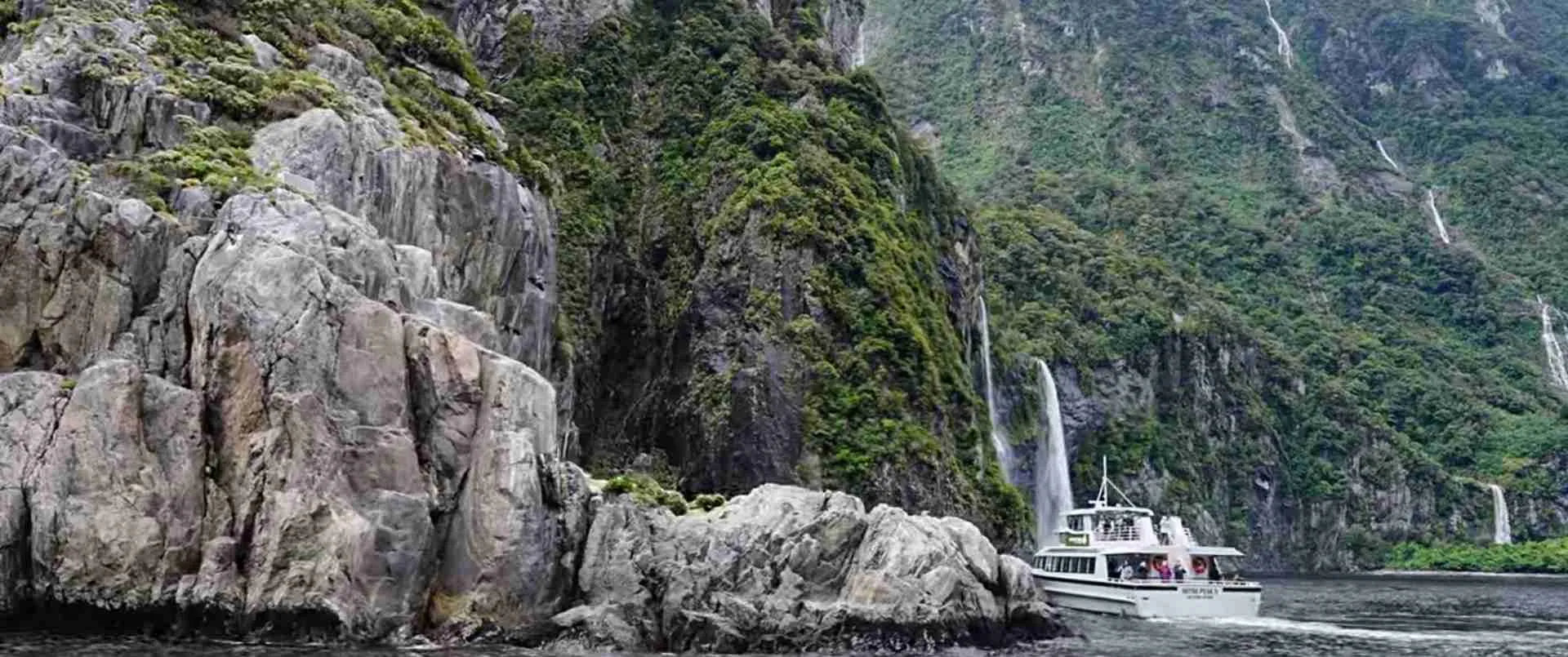
Cruising through Milford Sound provides the essential perspective for appreciating this UNESCO World Heritage fiord’s geological drama and ecological richness. The water-based approach reveals vertical granite cliffs rising directly from sea level to 1,200-meter summits, numerous waterfalls cascading down these precipitous faces, and the dramatic transition between freshwater surface layers and deeper marine environments supporting diverse wildlife populations. No land-based viewpoint captures the fiord’s scale and character as effectively as the cruise experience traversing its 16-kilometer length from terminal to open ocean.
The fiord formed through repeated glacial advances over 2 million years, with massive ice flows carving the characteristic U-shaped valley now flooded by seawater to depths exceeding 400 meters. This glacial history created the sheer rock walls that define Milford Sound’s appearance, polished smooth by ice movement and subsequently colonized by temperate rainforest vegetation clinging to vertical surfaces wherever soil accumulates in cracks and ledges. Understanding this geological context enhances appreciation for the landscapes viewed during cruise journeys.
Multiple cruise operators offer varying vessel types, route emphases, and duration options, each providing legitimate access to the fiord’s highlights while differing in passenger capacity, onboard amenities, and commentary approaches. The standard 2-hour cruise format established decades ago remains optimal for balancing comprehensive fiord coverage with practical timing considerations for travelers making day trips from Queenstown or Te Anau. Shorter and longer options serve specific traveler needs but the 2-hour duration captures essential experiences without excessive time commitment or compromising key highlights.
Weather conditions significantly influence cruise experiences, with rain paradoxically enhancing rather than diminishing the spectacle through creation of hundreds of temporary waterfalls that transform cliff faces into cascading sheets of water. The fiord receives 6,000-8,000mm annual precipitation, making clear weather unusual and rainy conditions the atmospheric norm that shapes both ecosystem and visitor experience. Successful cruise participants embrace weather variability rather than hoping for constant sunshine inappropriate to this temperate rainforest environment.
People Also Ask About Milford Sound Cruises 2026
How much does a Milford Sound cruise cost in 2026?
Standard 2-hour cruises cost NZ$99-139 per adult depending on operator and season, with children (5-14 years) typically NZ$49-69 and family packages available. Extended 2.5-hour nature cruises range NZ$129-169 per adult, while premium small vessel experiences cost NZ$189-249. Check operator websites including RealNZ, Cruise Milford, and Go Orange for current official rates as pricing varies seasonally. Cruise tickets purchased independently (for self-drive travelers) cost less than bundled day tour packages from Queenstown, though transportation and logistics become personal responsibility.
What is the best time of day for Milford Sound cruises in 2026?
Morning cruises (9:00-11:00 AM departures) benefit from typically calmer conditions before afternoon winds develop and better lighting angles for photography of waterfalls and cliff faces. Midday cruises (11:30 AM-1:30 PM) experience more crowded conditions during peak season but maintain good visibility and wildlife activity. Early afternoon cruises (2:00-4:00 PM) often encounter increasing wind and choppier water but see fewer vessels on the fiord creating more intimate atmosphere. Seasonal variations affect optimal timing, with summer’s extended daylight allowing quality experiences throughout the day while winter’s shorter daylight constrains options to midday departures.
Do Milford Sound cruises operate in rain in 2026?
Cruises operate in rain unless extreme wind conditions create unsafe vessel handling or visibility drops below minimum safety thresholds—occurrences happening fewer than 10 days annually. Rain enhances the Milford Sound experience by activating hundreds of temporary waterfalls that transform every cliff face into cascading water displays. The fiord averages 220+ rainy days per year, making rain the normal condition rather than exception. Operators provide covered areas on all vessels, though outdoor deck access despite rain yields superior photography and experience quality compared to remaining exclusively in heated indoor spaces.
Can you see dolphins and seals on Milford Sound cruises in 2026?
New Zealand fur seals appear regularly at the fiord entrance hauled out on rocks, with sightings on 70-80% of cruises during breeding season (November-January) and 40-60% of cruises during other months. Bottlenose dolphins visit the outer fiord area less predictably, appearing on approximately 15-25% of cruises with higher frequency during summer months when fish populations concentrate near the entrance. Fiordland crested penguins fish near shore during breeding season (August-November) with sighting probability around 30-40% during these months. Wildlife encounters aren’t guaranteed but occur frequently enough that most cruises include at least seal observations and seabird viewing opportunities.
Extended multi-day tours – 5+ days
Featured Milford Sound Multi-Day Tour Packages

3 days
Milford Sound 3-Day Discovery Tour
- ✓ Comprehensive Milford Sound experience
- ✓ Expert local guides included
- ✓ All accommodation included
- ✓ Transportation provided

5 days
Milford Sound 5-Day Highlights Experience
- ✓ Comprehensive Milford Sound experience
- ✓ Expert local guides included
- ✓ All accommodation included
- ✓ Transportation provided

7 days
Milford Sound 7-Day Cultural Journey
- ✓ Comprehensive Milford Sound experience
- ✓ Expert local guides included
- ✓ All accommodation included
- ✓ Transportation provided

10 days
Milford Sound 10-Day Complete Adventure
- ✓ Comprehensive Milford Sound experience
- ✓ Expert local guides included
- ✓ All accommodation included
- ✓ Transportation provided
Multi-day tour packages powered by TourRadar. Prices and availability subject to change.
Vessel Types and Selection Strategy 2026
Large Cruise Ships: Stability and Amenities
The largest vessels operating in Milford Sound accommodate 200-400 passengers across multiple deck levels, providing maximum stability in rough conditions and comprehensive onboard amenities including heated indoor cabins, cafés serving hot food and beverages, large outdoor decks, and multiple viewing areas accommodating crowds during popular highlights. These ships handle choppy water conditions better than smaller vessels, making them preferable for travelers prone to seasickness or those prioritizing comfort over intimate viewing experiences.
RealNZ operates the primary large vessel fleet including Milford Mariner and Milford Wanderer, both purpose-built for the fiord with ice-strengthened hulls, powerful engines for handling strong currents at the entrance, and stabilization systems reducing roll in rough water. Indoor spaces provide refuge during rain or cold weather while maintaining good visibility through large windows, though glass creates photography challenges with reflections and limitations on lens angle adjustments. These vessels cost NZ$99-119 for standard 2-hour cruises in 2026 (check realnz.com for current official rates).
The large ship experience emphasizes accessibility and reliability over exclusivity, with boarding processes handling hundreds of passengers efficiently through organized queuing systems and designated seating areas. Commentary reaches all passengers through PA systems broadcasting from the wheelhouse, covering geological formation, historical exploration, wildlife identification, and Māori cultural connections to the area. The scale of these operations ensures consistent departure times and predictable experiences, valuable for travelers on tight schedules coordinating with day tour operators from Queenstown.
Disadvantages of large vessels include crowded conditions at key viewing points when 300+ passengers attempt to photograph Stirling Falls simultaneously, reduced flexibility in route timing if wildlife appears unexpectedly, and less intimate atmosphere compared to smaller boat experiences. Passengers comfortable with cruise ship style operations appreciate the amenities and stability, while those seeking more personal connections to guides or exclusive viewing positions may find the crowding detracts from natural environment immersion.
Mid-Size Vessels: Balanced Approach
Mid-size vessels accommodating 80-150 passengers offer compromise between large ship stability and small boat intimacy, operating modern catamarans or purpose-built touring vessels with multiple deck levels, indoor heated spaces, and outdoor viewing areas proportioned for smaller passenger numbers. These boats provide sufficient stability for most conditions while maintaining maneuverability for optimal positioning near waterfalls and wildlife viewing areas. Operators including Cruise Milford and Southern Discoveries focus on this vessel category, emphasizing comfort without sacrificing viewing quality.
Catamaran designs common in this size category deliver superior stability through twin hull configuration, reducing roll motion that triggers seasickness while maintaining shallow draft allowing closer approaches to shoreline features. The dual-hull design creates spacious deck areas relative to vessel length, providing ample room for passengers to move around viewing points without excessive crowding. Indoor cabins maintain comfortable temperatures while large windows preserve visual connection to landscapes, creating weather-protected viewing options valued during cold or wet conditions.
These vessels cost NZ$109-129 for standard 2-hour cruises, reflecting enhanced comfort and reduced passenger density compared to large ship options. Some operators include complimentary hot beverages or light refreshments in this price point, adding value for travelers seeking small upgrades without premium pricing. The mid-size category often delivers the optimal balance for most travelers—sufficient amenities and stability without sacrificing personalized service or viewing access that deteriorates on the largest vessels.
Commentary on mid-size vessels tends toward more interactive formats with guides available for questions beyond scripted narration, creating opportunities for travelers interested in specific geological, ecological, or cultural topics to engage more deeply with guide expertise. The reduced passenger count allows guides to notice individual interests and tailor certain commentary elements accordingly, though the fundamental route and timing remain standardized to meet operational and safety requirements.
Small Vessel Experiences: Intimacy and Flexibility
Small vessels carrying 50-80 passengers deliver the most intimate cruise experiences with closer guide interaction, reduced crowding at viewing points, and greater flexibility for captain and crew to adjust routing when wildlife appears or optimal conditions develop at specific locations. Operators specializing in small boat experiences include Go Orange and various private charter companies catering to photography groups or travelers prioritizing exclusive access over budget considerations.
The smaller passenger count creates community atmosphere where fellow travelers and crew connect more personally throughout the journey, sharing excitement about wildlife sightings or dramatic weather conditions rather than experiencing the cruise as isolated individuals among hundreds. Guides on small vessels often share detailed knowledge about specific rock formations, plant species, or historical events beyond standard commentary, engaging with passenger interests and questions that emerge during the cruise rather than following strictly scripted presentations.
These premium experiences cost NZ$139-169 for standard duration cruises, with extended nature cruises and photography-focused departures ranging NZ$189-249. The pricing reflects reduced passenger revenue per trip while maintaining operational costs similar to larger vessels, though travelers consistently rate small boat experiences highly for personalization and access quality. Photographers particularly value small vessels for reduced deck crowding allowing tripod use and optimal positioning for key shots without competing with dozens of others for the same viewing angles.
Motion characteristics on small vessels differ noticeably from larger ships, with more pronounced movement in choppy conditions but also greater responsiveness allowing captains to position optimally relative to waterfalls, wildlife, or lighting conditions. Travelers comfortable with boat motion and prioritizing photography or naturalist experiences over maximum comfort consistently prefer small vessel options despite higher costs and potential for rougher ride quality in adverse weather conditions.
Standard Cruise Route and Highlights 2026
Terminal to Mid-Fiord: Initial Perspectives
Vessels depart from Milford Sound terminal situated in Harrison Cove, a small bay on the southern shore of the fiord providing protected mooring and passenger facilities. The departure process begins with boarding via covered walkways connecting terminal buildings to vessel moorings, with crew directing passengers to seating areas or encouraging deck access for immediate photography opportunities. As vessels pull away from the terminal, the fiord’s scale becomes apparent with 1,200-meter peaks rising vertically on both sides and the distinctive pyramid shape of Mitre Peak dominating the southern shore perspective.
Bowen Falls cascades 155 meters down the northern cliff face visible immediately upon departing the terminal area, providing the first major waterfall encounter. The permanent waterfall maintains consistent flow year-round fed by Dale Creek draining the mountains behind, contrasting with temporary waterfalls that appear only during and immediately after rainfall. Vessels pass close enough to Bowen Falls to feel spray and hear the thunderous water impact, creating dramatic first impression of the fiord’s power and scale.
The outbound journey progresses north-westward through the main channel, passing beneath towering cliff faces where temperate rainforest vegetation clings to any horizontal surface while vertical granite faces remain bare polished rock revealing geological structure and glacial erosion patterns. Commentary during this section explains the fiord formation through repeated glacial advances, the ecosystem adaptation to extreme precipitation levels, and early Māori presence in the area including legendary stories about the fiord’s creation by the god Tūterakiwhanoa using his adze to carve valleys from solid rock.
The perspective constantly shifts as vessel progress reveals new viewing angles on Mitre Peak, additional waterfalls appearing in side valleys, and changing relationships between the narrow fiord channel and surrounding mountain masses. The u-shaped valley profile characteristic of glacial carving becomes obvious from water level, where steep walls rise directly from depths exceeding 400 meters to summits 1,000+ meters above, creating the dramatic verticality that defines Milford Sound’s appearance and geological significance.
Stirling Falls: The Main Event
Stirling Falls drops 155 meters down the southern cliff face approximately 8 kilometers from the terminal, representing the dramatic highlight of most cruise itineraries where vessels approach close enough for passengers to experience substantial spray and feel the waterfall’s power through air movement and sound. This permanent waterfall maintains strong flow year-round fed by Sinbad Creek, though volume increases dramatically during rainfall when the entire cliff face transforms into cascading water surrounding the main channel.
Cruise vessels approach Stirling Falls from the northeast, slowing significantly as they close distance to allow passengers photography time and sensory experience of the massive water volume plunging into the fiord. Captains position vessels approximately 20-30 meters from the fall base where spray reaches deck areas and passengers feel temperature drops from the misting water. The close approach reveals the scale impossible to grasp from distant viewing—the 155-meter drop creates such velocity that water shatters into mist before reaching the fiord surface, and the sound overwhelms conversation even aboard large vessels with engine noise.
Photography at Stirling Falls requires protecting cameras from spray while capturing both the overall scale and dramatic details of water motion. Wide-angle lenses (16-35mm equivalent) capture the full height of the falls within the cliff context, while telephoto lenses (70-200mm equivalent) isolate water details and reveal the texture of surrounding rock faces. Fast shutter speeds (1/500 second or faster) freeze water droplets creating sharp detail, while slower speeds (1/30-1/60 second) blur water into smooth motion showing flow rather than frozen moments.
The duration vessels spend at Stirling Falls varies by operator, cruise schedule, and water conditions, typically ranging 5-10 minutes allowing passengers to move around decks for different viewing angles and photography opportunities. During peak season when multiple vessels operate simultaneously, captains coordinate approaches to prevent overcrowding at the falls and ensure each vessel receives adequate viewing time without excessive delays affecting departure schedules and coordination with shore-based tour operators.
Fiord Entrance and Open Ocean
Continuing beyond Stirling Falls, vessels proceed toward the fiord entrance where the protected channel opens to the Tasman Sea. This transition zone features the roughest water conditions as ocean swells enter the fiord mouth and collide with freshwater outflow from the fiord itself, creating turbulence noticeable aboard all vessel types. The changing water conditions demonstrate the dynamic interface between freshwater and marine environments, with visible color differences between dark tannin-stained freshwater floating atop clearer marine water due to density differentials.
New Zealand fur seals frequent rocks at the fiord entrance, hauling out to rest, socialize, and regulate body temperature between fishing expeditions into rich feeding areas where fiord meets ocean. Breeding season (November-January) concentrates larger numbers with territorial males defending rocks near females and young pups visible during late summer months. Vessels slow significantly when seals appear, approaching close enough for clear viewing and photography while maintaining distances preventing disturbance to resting animals or disruption of breeding behaviors.
The entrance area also attracts seabirds including gulls, shags, and occasionally albatross utilizing the nutrient-rich mixing zone where freshwater runoff carrying forest nutrients meets marine systems supporting fish populations. Fiordland crested penguins appear regularly during breeding season (August-November) diving in the entrance area and occasionally hauling out on rocks, though their presence remains more unpredictable than seal encounters. Bottlenose dolphins visit occasionally, attracted by fish concentrations and apparently also by curiosity about vessels, sometimes bow-riding or feeding near boats.
The furthest point of standard cruises reaches just beyond the formal fiord entrance where ocean swells become pronounced and views open toward the Tasman Sea horizon. This perspective demonstrates Milford Sound’s exposure to Southern Ocean weather systems and provides context for the extreme rainfall characteristic of the area—weather patterns approaching from Antarctica encounter mountain ranges and dump moisture as they rise over peaks, creating the 6,000-8,000mm annual precipitation that feeds hundreds of waterfalls and sustains temperate rainforest ecosystems. Vessels hold position briefly at this exposed location before turning back toward the terminal, completing the outbound journey phase of the cruise experience.
Return Journey: Different Perspectives
The return journey reverses the outbound route, but changing light angles and different viewing perspectives from the opposite direction create substantially different visual experiences. Features passed on the starboard (right) side outbound appear on port (left) returning, and the reversed lighting reveals textures and colors invisible during initial passage. Captains often approach different waterfalls or wildlife viewing areas on the return leg, balancing time constraints with desires to show passengers varied experiences rather than simple route repetition.
Additional temporary waterfalls become visible during return transit if rainfall occurred during the cruise, as drainage patterns direct runoff into the fiord from numerous small catchments invisible until water begins flowing. These ephemeral falls last hours to days depending on rainfall volume and drainage basin size, creating constantly changing waterfall displays that ensure no two cruises appear identical even when following standardized routes. Passengers frequently comment that the return journey reveals features missed during outbound passage, partly due to attention being directed elsewhere during initial transit and partly due to genuinely different perspectives from reversed viewing angles.
Commentary during return portions often focuses on topics not covered outbound, including more detailed ecological discussions about rainforest adaptations to high rainfall, conservation challenges in maintaining wilderness character while accommodating tourism, and comparisons between Milford Sound and other fiords in the Fiordland system. Guides use return time to answer passenger questions accumulated during the cruise and expand on topics that generated interest during outbound commentary, creating more interactive dialogue compared to initial structured presentations.
Final approaches to the terminal slow significantly as vessels navigate the narrow entrance to Harrison Cove and maneuver into mooring positions coordinated with other vessels arriving or departing. The final minutes aboard provide opportunities for last photographs of Mitre Peak from close-in perspectives impossible from offshore positions, and passengers gather belongings while reflecting on experiences before disembarking back to terminal facilities for onward travel arrangements.
Wildlife Viewing Strategies 2026
New Zealand Fur Seals: Most Reliable Encounter
New Zealand fur seals (Arctocephalus forsteri) represent the most consistently observed marine mammals during Milford Sound cruises, with populations utilizing rocks at the fiord entrance for hauling out between foraging expeditions into rich coastal waters. These seals reach 2.5 meters length and 180 kilograms for adult males, with smaller females typically 1.5 meters and 70 kilograms. Their presence at specific rocks near the entrance has become predictable over decades of observation, with certain locations reliably hosting resting seals on 70-80% of cruises during peak breeding months (November-January).
Viewing occurs from vessels positioned 20-40 meters offshore from haul-out rocks, providing clear sight lines while maintaining distances preventing disturbance. Binoculars enhance observations allowing detail of individual seals’ movements and behaviors, while telephoto lenses (200-400mm equivalent on full-frame cameras, or equivalent reach on crop sensors) enable tight portraits isolating animals against rock backgrounds. Morning cruises often encounter more active behaviors as seals return from overnight fishing expeditions, while afternoon cruises show more resting behaviors as animals digest meals and conserve energy.
Breeding season concentrations November through January create the most dramatic viewing when territorial males defend prime rocks near groups of females with newborn pups. The males produce loud vocalizations audible from cruise vessels and engage in aggressive displays toward competing males, though actual fighting remains relatively rare as most disputes resolve through threat displays rather than physical contact. Young pups visible from late December through February demonstrate limited swimming ability initially, practicing in shallow water near rocks while females alternate between nursing and foraging trips.
Outside breeding season, seal numbers at haul-out sites decrease as animals disperse more broadly for feeding, though some individuals maintain presence year-round utilizing favored rocks for resting between fishing expeditions. The seals feed primarily on fish, octopus, and squid in coastal waters, diving to depths of 200+ meters and remaining submerged 10-15 minutes during deep foraging dives. Their presence indicates healthy marine ecosystem supporting sufficient prey populations, and their adaptability to human presence around popular tourist sites demonstrates successful coexistence when appropriate viewing distances and behaviors are maintained.
Fiordland Crested Penguins: Seasonal Specialty
Fiordland crested penguins (Eudyptes pachyrhynchus) represent New Zealand endemic seabirds breeding in coastal forests around Milford Sound and other Fiordland locations, with approximately 2,500-3,000 breeding pairs remaining making them among the rarest penguin species globally. These penguins reach 55-60 centimeters height with distinctive yellow crests extending from forehead to beyond eyes, and adults weigh 3-4 kilograms. Their presence during Milford Sound cruises occurs primarily August through November during breeding season when adults make daily fishing trips from nest sites in coastal temperate rainforest to feeding areas in the fiord and adjacent coastal waters.
Viewing opportunities remain less predictable than seal encounters, with penguins appearing on approximately 30-40% of cruises during peak breeding months and much less frequently outside this window. The penguins fish alone or in small groups (2-4 individuals) rather than large rafts, diving repeatedly in productive areas where small fish concentrate near the surface or mid-water. Sightings typically occur near the fiord entrance or along cliff bases where upwelling creates favorable feeding conditions attracting prey species.
Photography challenges include the penguins’ small size relative to distances, their diving behavior making surface presence unpredictable, and dark plumage creating exposure challenges against bright water reflections. When penguins surface near vessels (typically remaining 50+ meters away), fast autofocus and tracking capabilities help maintain focus on moving subjects, while image stabilization assists with sharp results from moving vessel platforms. The distinctive yellow crest allows positive identification even at considerable distances, differentiating these rare penguins from other seabird species sharing the environment.
Conservation concerns for Fiordland crested penguins include predation by introduced stoats at nest sites, declining prey availability due to ocean warming affecting fish distributions, and limited breeding habitat as coastal development reduces suitable nesting areas. Viewing these endangered birds during Milford Sound cruises provides opportunities to appreciate their unique adaptations to temperate rainforest coastal environments and understand conservation challenges facing endemic New Zealand seabirds.
Bottlenose Dolphins and Other Marine Visitors
Bottlenose dolphins (Tursiops truncatus) visit Milford Sound less predictably than seals or penguins, appearing on approximately 15-25% of cruises with higher frequency during summer months when prey fish congregate near the fiord entrance. A resident population of approximately 60 individuals utilizes the Fiordland coast including occasional ventures into Milford Sound proper, particularly when calm conditions and abundant prey create favorable feeding opportunities. These dolphins reach 3-4 meters length and demonstrate characteristic curious behavior around vessels, sometimes approaching closely for bow-riding or simply observing boat movements.
Dolphin encounters generate exceptional excitement aboard cruise vessels as these intelligent marine mammals often perform acrobatic behaviors including leaping, tail-slapping, and synchronized swimming displays. The dolphins appear to show genuine curiosity about boats and passengers, maintaining proximity voluntarily rather than due to food association or feeding behaviors. International regulations prohibit deliberate approaches to dolphins, but when animals choose to approach vessels, captains maintain steady course and speed allowing the dolphins to interact on their own terms without disruption.
Photography of dolphins requires fast shutter speeds (1/1000 second or faster) to freeze motion of leaping animals, continuous autofocus tracking their movements as they surface and dive, and anticipation of behavior patterns allowing pre-focused preparation for breaches and jumps. The unpredictability of dolphin movements makes photography challenging but rewarding when successful, with images capturing the power and grace of these marine mammals in dramatic Milford Sound settings creating memorable photographs.
Other occasional marine visitors include humpback whales during migration seasons (June-July southbound, October-November northbound) passing the fiord entrance en route between tropical breeding areas and Antarctic feeding grounds. Whale sightings occur on fewer than 5% of cruises and typically involve distant observations from the fiord entrance as whales generally remain offshore in deeper water. Orcas appear very rarely, with perhaps one encounter per several hundred cruises as these apex predators patrol broader coastal areas rather than concentrating in fiords.
Booking Strategies and Timing 2026
Independent vs Package Booking Options
Independent cruise bookings allow self-drive travelers or those arranging custom itineraries to select specific operators, vessel types, and departure times matching personal schedules and preferences. Booking directly through operator websites or Milford Sound terminal provides access to full range of cruise options including specialty nature cruises, sunset departures (summer only), and small vessel experiences sometimes unavailable through bundled packages. Independent bookings cost NZ$99-169 for standard cruises depending on operator and vessel type (check operator websites for current official rates as pricing varies seasonally).
Package bookings bundling transport from Queenstown or Te Anau with cruise tickets simplify logistics through single reservation covering all components. Tour operators negotiate contracted cruise space with specific departure times, coordinating coach arrival timing with boarding schedules to eliminate waiting periods and streamline passenger flow. Package pricing typically ranges NZ$199-449 for complete day experiences including transport, cruise, and guided commentary throughout the journey, representing good value for travelers prioritizing convenience over operator/vessel selection flexibility.
The independent booking approach suits confident travelers comfortable with self-drive mountain roads, those wanting flexible departure timing outside standard tour schedules, and visitors staying in Milford Sound area allowing multiple day exploration rather than rushed day-trip experiences. Self-drive visitors must coordinate cruise timing with travel schedules, arrive 30 minutes before departure, and secure parking at the limited-capacity terminal lot (filling by 10:00 AM during peak season requiring early morning departures from accommodation).
Package bookings eliminate navigation stress, parking concerns, and timing coordination challenges, with tour operators handling all logistics and adjusting for delays or changing conditions. This approach works well for travelers uncomfortable with long-distance mountain driving, those wanting guided commentary throughout the full journey, and visitors without personal vehicles in New Zealand. The trade-off involves reduced control over cruise operator selection and fixed departure/return schedules that may not align perfectly with personal preferences regarding timing or route stops.
Seasonal Booking Windows and Availability
Peak summer months (December-February) see highest cruise demand with frequent departures (every 30-60 minutes) throughout daylight hours accommodating the volume of day-trippers from Queenstown. Booking 2-4 weeks ahead for summer travel ensures preferred departure times and vessel choices, though last-minute availability exists most days due to high-capacity operators running multiple vessels. Premium small-boat experiences and nature-focused cruises require longer advance booking (4-6 weeks) as limited daily departures fill quickly with travelers researching options carefully.
Shoulder seasons (March-May, September-November) reduce cruise frequency slightly with departures every 1-2 hours during core midday period, though extended daylight hours in March and November allow broader scheduling than winter months. Advance booking 1-3 weeks typically secures desired departures, with last-minute options available except during school holiday periods when domestic travelers concentrate around specific dates. Shoulder season pricing remains stable at standard rates without significant seasonal discounts despite reduced demand volumes.
Winter months (June-August) contract cruise schedules substantially with departures concentrated around midday hours (10:00 AM-2:00 PM) aligning with limited daylight and typical day-tour arrival times from Queenstown. Booking 1-2 weeks ahead suffices for most dates, though flexibility regarding exact times proves valuable as cruise schedules adjust based on actual demand and weather affecting passenger numbers. Some operators offer winter discounts (10-15% off peak rates) recognizing reduced demand and challenging weather conditions that may diminish experience quality for travelers expecting constant sunshine impossible in this environment.
Weather Backup Plans and Flexible Booking
Cruise cancellations occur rarely (fewer than 10 days annually) when extreme wind conditions create unsafe vessel handling or when visibility drops below minimum safety thresholds. More commonly, cruises operate in rain, cold temperatures, and moderate wind that passengers may perceive as poor conditions but which remain within operational safety parameters. Understanding that Milford Sound experiences rain on 220+ days annually helps set realistic expectations about weather probability rather than assuming clear conditions as normal.
Flexible booking policies vary by operator, with most allowing date changes without penalty if requested more than 24 hours before scheduled departure. Cancellations within 24 hours typically incur partial fees (30-50% of booking value), while no-shows forfeit full payment. These policies reflect the contracted nature of tourism operations where last-minute cancellations leave empty vessel capacity impossible to fill with replacement bookings on short notice. Travelers concerned about weather should book operators with flexible policies or consider travel insurance covering weather-related cancellation scenarios.
The reality of Milford Sound weather means accepting rain probability and preparing accordingly rather than hoping for perfect conditions unlikely to materialize in this temperate rainforest environment. Rain enhances waterfall displays dramatically, creating the hundreds of temporary cascades that define the fiord’s appearance during and after precipitation. Many experienced travelers deliberately prefer rainy conditions for their dramatic atmosphere and enhanced photography opportunities, though this perspective requires appropriate waterproof clothing and acceptance of discomfort as worthwhile trade-off for spectacular scenery.
Onboard Experience and Amenities 2026
Deck Access and Viewing Positions
Outdoor deck access provides essential perspective for fully experiencing Milford Sound’s scale, atmosphere, and photographic opportunities despite cold temperatures and potential rain or sea spray. Modern cruise vessels include extensive outdoor deck space wrapping around upper levels with railings providing safety while maintaining unobstructed sight lines to cliff faces, waterfalls, and wildlife. Strategic positioning on decks becomes important during crowded cruises when 200+ passengers compete for optimal viewing angles at key highlights like Stirling Falls or seal viewing areas.
Starboard side (right when facing forward toward the sea) offers superior perspectives during outbound passages for Mitre Peak photography and waterfall viewing, as most major features appear on this side of the vessel during initial transit. Returning journeys reverse these advantages, with port side (left facing forward) providing better positions for features now appearing on that side. Experienced photographers often move between sides throughout cruises following the light and specific features rather than remaining in single positions, accepting the movement and repositioning as necessary for capturing best images.
Forward and aft deck areas provide different perspective options with bow positions offering sweeping forward views as landscape approaches and stern positions allowing context shots showing the vessel’s wake and passed terrain. Corner positions where side decks meet forward or aft sections often prove less crowded than mid-ship railings while maintaining good viewing angles, making these areas valuable for travelers wanting less competitive photography positions. Wind affects different deck areas variably, with forward positions experiencing strongest wind but aft areas sometimes affected by engine exhaust depending on wind direction.
Indoor viewing from cabin spaces preserves comfort during cold or wet weather but sacrifices photography quality through glass reflections, limited angle adjustments, and reduced connection to atmosphere and sound of the environment. Most vessels provide heated indoor spaces with large windows creating weather-protected viewing suitable for travelers prioritizing comfort, families with young children, or those affected by cold temperatures making extended outdoor time uncomfortable. The trade-off balances physical comfort against experience intensity and photographic opportunity—both legitimate choices based on personal priorities and weather conditions during specific cruises.
Commentary and Educational Content
Live commentary from captains or dedicated guides provides context about geological formation, ecosystem characteristics, wildlife identification, Māori cultural connections, and European exploration history throughout cruise durations. Commentary quality varies significantly between operators and individual guides, ranging from basic scripted narration covering essential facts to extensive natural history discussions incorporating recent research findings and detailed responses to passenger questions. Travelers prioritizing educational content should research operator reputations and consider small-vessel options where guide-passenger ratios allow more interactive learning experiences.
The geological focus explains fiord formation through glacial processes occurring over 2 million years, with repeated ice advances carving the characteristic U-shaped valley profile and polishing vertical rock faces smooth. Commentary typically includes discussion of current ecological processes including temperate rainforest adaptation to 6,000-8,000mm annual rainfall, freshwater/marine ecosystem interfaces creating rich feeding areas for wildlife, and ongoing erosion processes visible in active rockfall areas and sediment transport patterns. Understanding these geological and ecological contexts transforms cruise experiences from simple sightseeing into educational engagement with landscape processes and ecosystem functioning.
Cultural commentary covers Māori traditional knowledge about Fiordland including stories of the god Tūterakiwhanoa carving fiords using his adze, seasonal presence of Māori in the area for pounamu (greenstone) gathering, and traditional navigation routes through forest and along coastlines. European exploration history typically includes Captain Cook’s 1770 passage along the coast when he missed the fiord entrance due to its narrow opening, subsequent sealing industry impacts on fur seal populations, and early tourism development in the late 1800s when access required arduous overland journeys before road construction made mass visitation possible.
Audio guide systems on some larger vessels allow passengers to control commentary content and language options through headsets tuned to different channels broadcasting in multiple languages and offering varied detail levels. This technology accommodates international tourists while providing enhanced accessibility for passengers with hearing difficulties, though it reduces the communal experience of shared live commentary that encourages passenger interaction and spontaneous guide responses to emerging conditions or wildlife appearances during cruises.
Food and Beverage Services
Onboard café services on larger vessels sell hot beverages (coffee, tea, hot chocolate NZ$5-7), light meals (sandwiches NZ$12-16, hot food NZ$15-20), and snacks (baked goods NZ$5-8, chips and candy NZ$4-6) throughout cruise durations. The convenience of purchasing warm drinks or food aboard proves valuable during cold or long cruises, though prices reflect captive market dynamics and limited competition. Smaller vessels typically lack full café services but may provide complimentary tea/coffee or include light refreshments in premium cruise packages.
Bringing personal food and beverages remains acceptable and common practice, particularly for travelers on budget-conscious itineraries or those with dietary restrictions not easily accommodated through limited onboard menus. Thermoses of hot drinks maintain temperature throughout cruises, providing warmth during outdoor deck viewing sessions without requiring multiple café purchases. Packaged snacks and sandwiches prepared before departure or purchased at terminal facilities supply energy during 2-hour cruises without relying on onboard services that may experience long queues during busy periods when hundreds of passengers compete for limited counter space.
Alcohol sales aboard vessels remain limited or nonexistent depending on operator policies and vessel licensing, with most focusing on non-alcoholic beverage options suitable for diverse passenger demographics including families with children. The cold temperatures and potential motion of vessels reduce alcohol appeal for many passengers, while the relatively short cruise duration makes extensive food or beverage service less critical than during longer journey experiences requiring meal provisions.
Photography Tips for 2026 Cruises
Camera Settings and Technical Approach
Milford Sound’s dramatic vertical topography and frequent rain create challenging exposure scenarios requiring technical knowledge and adaptive camera settings. The extreme tonal range between bright sky and shadowed cliff faces often exceeds camera dynamic range capabilities in single exposures, making exposure bracketing valuable for serious landscape photography. Modern cameras with excellent dynamic range sensors (14+ stops) allow single RAW exposures to be processed recovering both highlight and shadow detail, though extreme scenes still benefit from bracketed sequences merged in post-processing.
Fast shutter speeds (1/500 second or faster) become essential when photographing from moving vessel platforms, freezing both camera motion and subject movement to maintain sharp results. Image stabilization in lenses or camera bodies helps but cannot compensate for large movements, making fast shutter speeds the primary defense against blur. This requires increasing ISO sensitivity to 400-1600 depending on available light, with modern cameras producing excellent quality at these sensitivities when proper exposure and processing techniques are employed.
Aperture selection balances depth of field needs against shutter speed requirements, with f/5.6-f/8 providing sufficient depth for most scenic compositions while allowing faster shutter speeds than f/11-f/16 alternatives. Foreground elements requiring extensive depth of field remain rare during cruises as most compositions feature distant subjects (cliffs, waterfalls, peaks) where depth of field becomes less critical. Occasional wildlife photography may require wider apertures (f/4-f/5.6) for isolating subjects against busy backgrounds while maintaining fast shutter speeds for sharp results of moving animals.
RAW format capture provides essential flexibility for processing high-contrast scenes, allowing recovery of blown highlights or blocked shadows impossible with JPEG’s limited bit depth. The color temperature variations between direct sun, heavy cloud, and rain require white balance adjustments that RAW processing handles easily while JPEG files bake in white balance choices made in-camera. Storage card capacity becomes important as RAW files accumulate quickly during active shooting sessions throughout 2-hour cruises—bringing multiple high-capacity cards prevents storage limitations forcing reduced shooting or switching to lower-quality JPEG formats.
Compositional Strategies and Timing
The constantly changing relationship between vessel position and shoreline features requires anticipating compositions rather than reacting after features appear, as vessels move continuously and optimal angles pass quickly. Studying maps or satellite imagery before cruises helps identify major features and anticipate their positions relative to vessel routes, allowing preparation of appropriate lenses and visualization of desired compositions before moments arrive. Guides often announce upcoming highlights allowing preparation time, though photographers benefit from independent awareness of approaching features based on route progression and visible landmarks.
Including foreground elements adds depth to otherwise flat scenic compositions dominated by distant cliffs and waterfalls. Vessel elements (railings, rigging, other passengers silhouetted) provide human scale references showing the environment’s grandeur, while sea spray or water droplets captured sharply in foreground layers add dynamism and sense of presence within the scene rather than distant observation. These compositional elements require wider apertures (f/4-f/5.6) for controlling depth of field or focus stacking techniques combining multiple exposures focused at different distances.
Vertical compositions suit many Milford Sound subjects better than horizontal orientations, as the extreme verticality of cliff faces and waterfalls translates poorly into horizontal frames that include excessive empty water or sky. Portrait orientation captures the full drama of 1,200-meter cliff faces rising from sea level or towering waterfalls in single frames without requiring extreme wide-angle lenses that distort perspective. Wildlife photography particularly benefits from vertical orientations when subjects like seals occupy vertical positions on rocks or penguins swim in vertical water columns.
Light quality varies dramatically with weather conditions, from harsh direct sun creating extreme contrast to soft overcast light allowing even exposures across entire scenes. Rainy conditions often produce the most atmospheric images through mist, dramatic cloud formations, and enhanced waterfall volume, though they require protecting camera equipment from moisture. The most memorable images frequently emerge from challenging conditions that less-prepared photographers avoid, rewarding those willing to endure discomfort for compelling photographs that capture Milford Sound’s raw character rather than sanitized tourist perspectives.
Protecting Equipment in Harsh Conditions
Moisture represents the primary equipment threat during Milford Sound cruises, coming from rain, sea spray, and high humidity even during nominally dry conditions. Weather-sealed camera bodies and lenses provide essential protection for serious photography, maintaining functionality when exposed to mist and spray that would damage non-sealed equipment. UV filters protecting front lens elements prevent salt spray and water droplets from contacting expensive lens coatings that may be damaged by minerals in seawater or acid rain characteristic of high-rainfall environments.
Microfiber cleaning cloths serve essential roles maintaining clear lens surfaces as spray and moisture accumulate during outdoor shooting sessions. Multiple cloths allow cycling through clean ones as others become saturated, maintaining ability to clean lenses throughout 2-hour cruise durations. Lens pens with retractable brushes help remove water droplets without smearing them across glass surfaces, while rocket blowers clear loose water without physical contact that might introduce dirt particles scratching delicate coatings.
Camera bags with waterproof covers or waterproof camera backpacks protect equipment during rain while allowing quick access for changing lenses or retrieving spare batteries and memory cards. Storing equipment in sealed plastic bags when not actively shooting provides additional moisture protection, particularly for backup cameras or lenses not immediately needed. Silica gel packets in camera bags absorb ambient moisture preventing condensation formation inside lenses or camera bodies when moving between cold outdoor environments and warm indoor spaces.
Battery performance degrades in cold temperatures, with capacity dropping 20-40% compared to room temperature operation. Carrying spare batteries in warm pockets maintains their temperature and performance, swapping in fresh batteries when installed ones show decreased capacity. Memory card problems increase in extreme cold as contact pins contract and connections become less reliable—using quality cards from reputable manufacturers reduces failure risk, while bringing multiple smaller-capacity cards distributes images across several cards minimizing data loss if individual cards fail.
Frequently Asked Questions About Milford Sound Cruises 2026
How long should I spend on a Milford Sound cruise?
The standard 2-hour cruise duration proves optimal for most travelers, covering the complete 16-kilometer fiord length from terminal to Tasman Sea entrance with adequate time at major waterfalls and wildlife viewing areas. Shorter 1-hour express cruises sacrifice outer fiord highlights and rush through the experience without sufficient time for photography or wildlife observation. Extended 2.5-hour nature cruises provide additional time near wildlife areas and allow more detailed naturalist commentary, suiting travelers with particular interest in ecology or wildlife photography. The 2-hour format balances comprehensive coverage with reasonable time commitment fitting efficiently within day-trip schedules from Queenstown.
Which cruise operator is best for Milford Sound?
RealNZ operates the largest fleet with most frequent departures, competitive pricing (NZ$99-119), and reliable service using purpose-built vessels with good amenities. Go Orange specializes in small-group experiences (50-80 passengers) with enhanced commentary and flexibility (NZ$139-169). Cruise Milford operates modern catamarans providing superior stability and comfortable mid-size experiences (NZ$109-129). The best choice depends on priorities: budget-conscious travelers prefer RealNZ, those wanting personalized service choose Go Orange, and travelers seeking balanced comfort-experience value select Cruise Milford. All operators successfully showcase the fiord’s highlights—differences emerge in vessel crowding, commentary depth, and pricing levels.
Should I book cruise tickets in advance for 2026?
Advance booking 2-4 weeks before travel ensures preferred departure times and vessel choices during peak summer months (December-February), though same-day availability usually exists due to multiple operators and frequent departures. Self-drive travelers arriving without reservations risk encountering fully booked departures during specific time slots, particularly mid-morning periods (10:00 AM-12:00 PM) coinciding with day-tour arrivals from Queenstown. Advance booking eliminates this uncertainty and often provides small discounts (5-10% off) for online reservations compared to terminal walk-up purchases. Travelers on package tours need not worry as operators pre-arrange cruise tickets coordinated with transport schedules.
What wildlife will I definitely see on a Milford Sound cruise?
New Zealand fur seals appear on 70-80% of cruises during breeding season (November-January) and 40-60% of cruises other months, making them the most reliable wildlife encounter. Seabirds including gulls, shags, and occasionally albatross appear on virtually all cruises utilizing the fiord for feeding. Fiordland crested penguins appear less predictably on 30-40% of cruises during breeding season (August-November) and rarely outside these months. Bottlenose dolphins occur on approximately 15-25% of cruises with higher summer frequency. No wildlife guarantees exist as animals roam freely, but seal observations occur frequently enough that most cruises include at least this encounter.
Can I take a Milford Sound cruise if I get seasick?
Larger vessels (200-400 passengers) provide most stable platforms reducing motion effects, with catamaran designs offering superior stability through twin-hull configurations. The fiord remains relatively protected from ocean swells except near the entrance where rougher water occurs briefly. Preventative medication taken 30-60 minutes before boarding proves most effective, while ginger tablets offer natural alternatives. Choosing forward-facing seats near vessel middle reduces motion perception compared to rear seats. Severe seasickness sufferers might struggle during rough conditions, but moderate sensitivity typically manages successfully aboard stable larger vessels with preventative measures and outdoor deck access for fresh air.
Is Milford Sound cruise worth it in winter?
Winter cruises (June-August) deliver dramatic atmospheric conditions with snow-capped peaks, moody cloud formations, and spectacular ice formations along waterfalls, though cold temperatures (8-12°C) and frequent rain challenge unprepared visitors. Smaller crowds allow more relaxed photography and viewing experiences without competing with hundreds of other passengers. Winter pricing typically runs 15-20% below peak summer rates, offering good value for travelers embracing cold-weather challenges. Road closures occur more frequently due to avalanche risk or snow, requiring flexible travel plans. Photographers and travelers valuing atmosphere over comfort often prefer winter conditions, while those prioritizing sunny weather should visit December-February.
What is the best side of the boat for viewing?
Starboard side (right facing forward) offers superior perspectives during outbound transit for Mitre Peak and major waterfalls, while port side (left facing forward) becomes preferable during return journey as these same features now appear on that side. Serious photographers and active viewers move between sides throughout cruises following light and specific features rather than remaining in fixed positions. Corner positions where side decks meet forward or aft sections often prove less crowded while maintaining good viewing angles. Both sides provide valuable perspectives at different points—flexibility and willingness to move creates better experiences than staying in single positions throughout 2-hour cruises.
How much should I tip the crew on Milford Sound cruises?
Tipping remains uncommon and unexpected in New Zealand tourism operations including Milford Sound cruises, as staff receive fair wages without relying on tips as income supplements. Passengers impressed by exceptional service or commentary may offer tips (NZ$5-20 per passenger depending on group size and service quality), but crew members don’t expect these and travelers shouldn’t feel obligated. International visitors from tipping cultures sometimes offer gratuities, which staff accept graciously, but the practice remains voluntary rather than normative in New Zealand service contexts. Quality experiences emerge from professional operations and fair employment practices rather than tip-dependent service models.
Can I bring food and drinks on Milford Sound cruises?
Personal food and non-alcoholic beverages are permitted and commonly brought aboard by budget-conscious travelers or those with dietary restrictions. Thermoses of hot drinks, packed sandwiches, and snacks supplement or replace onboard café purchases without violating operator policies. Alcohol generally requires purchasing from onboard services where available (many vessels don’t sell alcohol), with outside alcohol consumption prohibited or restricted by operators maintaining family-friendly environments. Disposing of trash properly using provided receptacles maintains vessel cleanliness and environmental responsibility. Bringing personal provisions proves particularly valuable for travelers making long day trips from Queenstown who require sustenance throughout 12-14 hour travel days.
What happens if my cruise is cancelled due to weather?
Cruise cancellations occur rarely (fewer than 10 days annually) when extreme wind conditions or very low visibility create unsafe operations. Operators provide full refunds for cancelled departures and attempt to reschedule passengers onto later departures same day if conditions improve, though this depends on available capacity. Travelers on package tours from Queenstown receive refunds for cruise portions while operators decide whether to continue with scenic drive experiences or return passengers to Queenstown for partial refunds. Travel insurance covering weather-related cancellations provides financial protection for travelers concerned about lost bookings, though standard trip insurance policies often exclude weather as covered cancellation reason requiring specific weather-inclusive policies.
Planning Your Perfect Cruise Experience 2026
Successful Milford Sound cruise experiences emerge from realistic expectations about weather variability, appropriate clothing for cold and wet conditions, and embrace of the fiord’s natural character rather than hoping for sanitized tourist experiences. The 220+ annual rain days mean accepting precipitation as the normal condition that creates the hundreds of waterfalls and lush temperate rainforest defining Milford Sound’s appearance. Travelers prepared for rain both practically (waterproof clothing, camera protection) and psychologically (viewing rain as enhancing rather than diminishing experience) consistently report higher satisfaction than those expecting constant sunshine inappropriate to this environment.
Choosing vessel types and operators matching personal priorities optimizes experiences, whether prioritizing budget efficiency (large ships, standard cruises), seeking enhanced interpretation (small vessels with expert guides), or desiring comfort focus (mid-size vessels with good amenities). Research into operator reputations, vessel characteristics, and service levels helps travelers make informed choices aligning with preferences regarding crowding tolerance, educational content priorities, and budget considerations. No single “best” option exists—rather, multiple legitimate approaches serve different traveler types and priorities effectively.
Photography preparation including weather-sealed equipment, protective measures for cameras, and technical knowledge about exposure settings for high-contrast scenes distinguishes compelling images from routine snapshots. The willingness to endure outdoor conditions despite cold and spray yields dramatically better photographs than remaining exclusively in heated indoor spaces, as connection to environment and immediate response to changing conditions prove essential for capturing the fiord’s dynamic character. Balancing comfort needs with photographic aspirations creates personal frameworks for maximizing cruise experiences while maintaining reasonable physical comfort and equipment protection.
Understanding cruise routes, highlight timing, and wildlife patterns allows anticipating rather than merely reacting to notable moments. Mapping feature locations, studying optimal photography positions for specific subjects, and knowing seasonal wildlife patterns transforms passive sightseeing into active engagement with landscape and ecosystem. This preparation effort pays dividends through captured moments, comprehensive understanding, and deeper appreciation for the geological processes and ecological adaptations that create Milford Sound’s unique character within global World Heritage context.