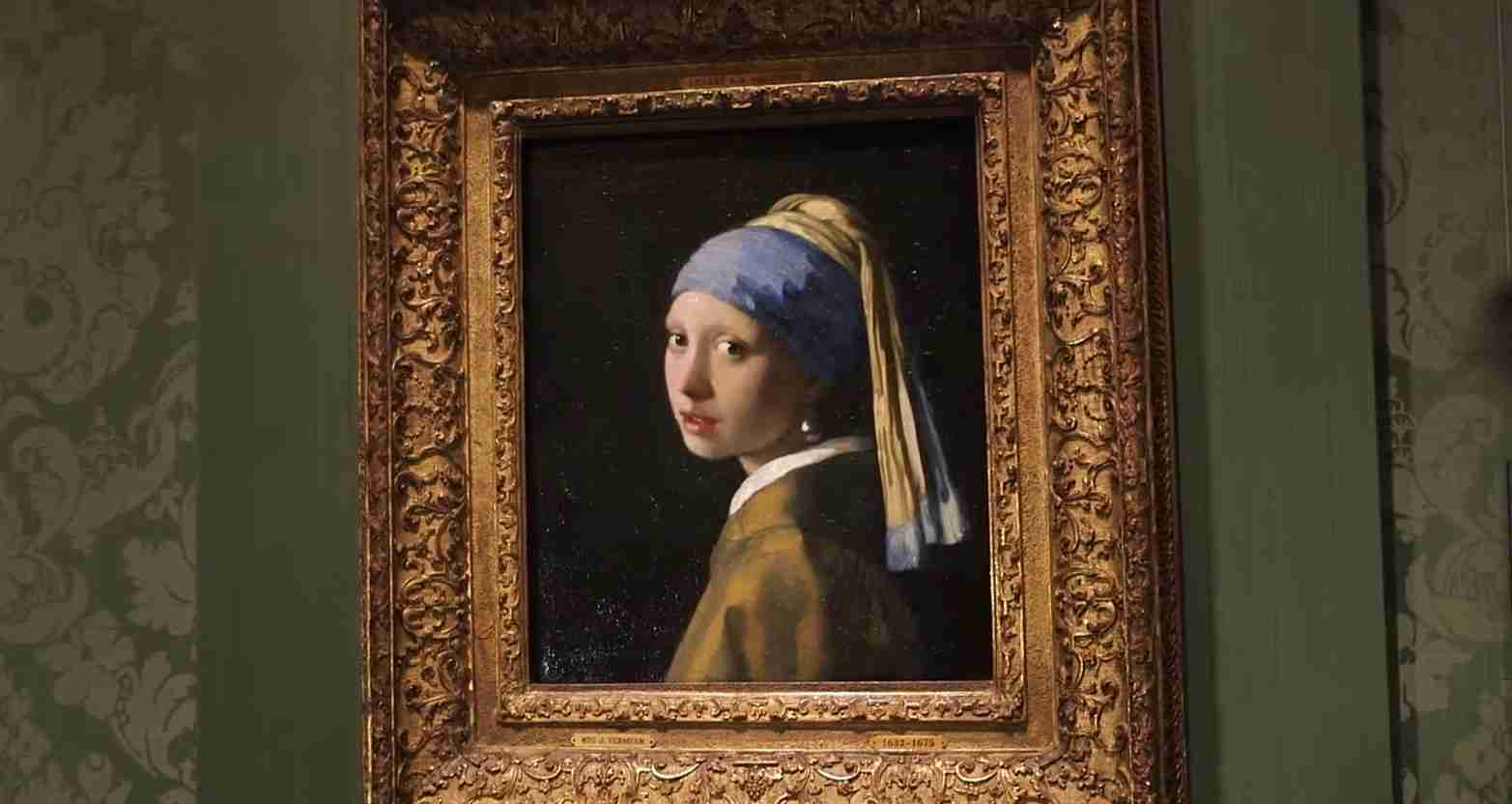
Mauritshuis Museum The Hague: Vermeer’s Girl with Pearl Earring
The Mauritshuis houses one of the world’s finest collections of Dutch Golden Age painting in an intimate 17th-century mansion, including Johannes Vermeer’s iconic “Girl with a Pearl Earring” alongside masterpieces by Rembrandt, Frans Hals, and Jan Steen. This architectural jewel in The Hague’s political heart offers viewers direct encounters with approximately 200 carefully curated paintings displayed in elegant period rooms that preserve the atmosphere of a patrician residence while providing world-class museum experiences.
Key Takeaways
- Iconic Vermeer Masterpiece: “Girl with a Pearl Earring” represents Vermeer’s mastery of light and intimacy, painted around 1665 as a tronie rather than a commissioned portrait
- Compact Excellence: The museum displays approximately 200 masterpieces from Dutch and Flemish masters, emphasizing quality over quantity in an intimate setting
- Rembrandt Collection: Eleven paintings currently attributed to Rembrandt include “The Anatomy Lesson of Dr. Nicolaes Tulp” and his late self-portrait from the year of his death
- Architectural Significance: The building served as the residence of Count Johan Maurits of Nassau-Siegen from 1641, exemplifying Dutch classical architecture by Jacob van Campen and Pieter Post
- Three Vermeer Works: Beyond the Pearl Earring, the museum holds “View of Delft” and “Diana and her Nymphs,” providing comprehensive Vermeer representation
- Accessible Masterpieces: The intimate scale allows close viewing of paintings without the overwhelming crowds and vast spaces of larger museums
People Also Ask About Mauritshuis Museum
Why is the Girl with a Pearl Earring so famous?
“Girl with a Pearl Earring” achieved worldwide fame through its enigmatic subject, masterful execution, and modern cultural prominence. The painting captivates viewers through the girl’s direct gaze over her shoulder, parted lips suggesting imminent speech, and the luminous pearl rendered with just two brushstrokes. Vermeer’s handling of light creates extraordinary intimacy and three-dimensionality despite the small canvas size of 44.5 × 39 cm. The work remained relatively unknown until 1881 and gained massive popular recognition following Tracy Chevalier’s 1999 novel and the 2003 film adaptation starring Scarlett Johansson, transforming it into an icon comparable to Leonardo’s Mona Lisa.
Is Girl with a Pearl Earring a portrait or a tronie?
“Girl with a Pearl Earring” functions as a tronie rather than a portrait, representing a distinctly Dutch painting category depicting idealized character types rather than specific individuals. Tronies explore facial expressions, exotic costumes, and lighting effects without the formal requirements of commissioned portraiture. The girl’s identity remains unknown despite centuries of speculation suggesting possibilities from Vermeer’s daughter Maria to household servants. The exotic turban, improbably large pearl earring, and theatrical presentation all indicate the painting’s purpose as artistic exploration of beauty and expression rather than documentation of a particular person’s likeness.
How many paintings does the Mauritshuis have?
The Mauritshuis collection comprises approximately 800 paintings, with around 200 masterpieces displayed in the permanent galleries at any given time. This selective presentation emphasizes exceptional quality over comprehensive quantity, creating an intimate viewing experience impossible in larger museums. The collection focuses intensively on Dutch and Flemish Golden Age works from the 16th and 17th centuries, including paintings by Vermeer, Rembrandt, Frans Hals, Jan Steen, Paulus Potter, Carel Fabritius, and Peter Paul Rubens. The concentrated excellence earned the museum its reputation as possessing the highest number of impressive paintings per square meter in the Netherlands.
What other famous paintings are at the Mauritshuis?
Beyond “Girl with a Pearl Earring,” the Mauritshuis houses Rembrandt’s “The Anatomy Lesson of Dr. Nicolaes Tulp,” one of the artist’s most celebrated group portraits, and his profound late self-portrait from 1669. Vermeer’s monumental “View of Delft” displays his mastery of landscape and atmospheric effects. Carel Fabritius’s tiny “The Goldfinch” influenced Donna Tartt’s Pulitzer Prize-winning novel. The collection includes Jan Steen’s moralizing genre scenes, Frans Hals’s vivid portraits, Paulus Potter’s life-sized “The Bull,” and numerous exceptional still lifes, landscapes, and religious works demonstrating the full range of Dutch Golden Age achievement.
Extended multi-day tours – 5+ days
Featured Netherlands Multi-Day Tour Packages

3 days
Netherlands 3-Day Discovery Tour
- ✓ Comprehensive Netherlands experience
- ✓ Expert local guides included
- ✓ All accommodation included
- ✓ Transportation provided

5 days
Netherlands 5-Day Highlights Experience
- ✓ Comprehensive Netherlands experience
- ✓ Expert local guides included
- ✓ All accommodation included
- ✓ Transportation provided

7 days
Netherlands 7-Day Cultural Journey
- ✓ Comprehensive Netherlands experience
- ✓ Expert local guides included
- ✓ All accommodation included
- ✓ Transportation provided

10 days
Netherlands 10-Day Complete Adventure
- ✓ Comprehensive Netherlands experience
- ✓ Expert local guides included
- ✓ All accommodation included
- ✓ Transportation provided
Multi-day tour packages powered by TourRadar. Prices and availability subject to change.
Introduction to the Mauritshuis
The Mauritshuis occupies a unique position among world art museums through its combination of architectural distinction, collection excellence, and human scale. Built between 1636 and 1641 as a private mansion for Count Johan Maurits of Nassau-Siegen, the building exemplifies Dutch classical architecture while its collection represents the pinnacle of Dutch Golden Age painting. The museum’s name translates literally as “Maurice’s House,” preserving the connection to its original aristocratic owner.
Unlike vast encyclopedic museums requiring days to explore comprehensively, the Mauritshuis rewards visitors with an intensive encounter with masterpieces viewable in 90 minutes to two hours. The galleries occupy elegant period rooms that maintain residential atmosphere rather than adopting institutional museum design. This intimacy allows viewers to experience paintings as their original owners might have, surrounded by fine furnishings and architectural details that complement rather than overwhelm the artworks.
The museum achieved international recognition primarily through “Girl with a Pearl Earring,” but the broader collection merits equal attention. Eleven Rembrandts span the artist’s career from youthful work through his final self-portrait. Three Vermeers provide rare opportunity to study the artist’s evolution and technical mastery. Genre scenes, portraits, still lifes, and landscapes by lesser-known but equally skilled contemporaries create comprehensive understanding of Dutch Golden Age visual culture and artistic achievement.
Vermeer’s Girl with a Pearl Earring: Complete Analysis
Technical Specifications and Composition
Johannes Vermeer painted “Girl with a Pearl Earring” around 1665 on canvas measuring 44.5 × 39 cm (17.5 × 15.35 inches). The modest dimensions concentrate attention on the subject’s face and upper body, eliminating distracting details and environmental context. Vermeer signed the work “IVMeer” but included no date, though stylistic analysis and the pearl motif appearing in multiple works from this period confirm the mid-1660s timeframe.
The composition demonstrates brilliant simplicity through its dark background, three-quarter view, and dramatic lighting. The girl turns her head over her shoulder toward the viewer, caught in a moment between looking away and engaging directly. Her head tilts slightly, creating dynamic asymmetry that prevents static formality. The dark background, originally a deep enamel-like green created with transparent glaze over black underpaint, has darkened over centuries as the organic pigments indigo and weld faded. Modern viewers see nearly pure black where 17th-century observers perceived subtle green atmospheric depth.
Vermeer’s lighting falls from upper left, illuminating the girl’s face, the highlights on her moist lips, and most dramatically the pearl earring. The turban combines brilliant ultramarine blue (ground from precious lapis lazuli imported from Afghanistan) with golden yellow ochre, creating color contrasts that frame the face. The white collar peeks above a golden jacket, providing structural base for the composition while reflecting light upward onto the pearl and face.
The Famous Pearl Earring
The titular pearl achieves its luminous three-dimensionality through astonishingly economical means: just two brushstrokes. Vermeer applied one gray comma-shaped stroke at the bottom to capture reflection from the white collar, then added a thick white impasto dab at the top suggesting light from an unseen window. No hook or wire suspends the pearl, creating the illusion it floats against the girl’s neck. The pearl’s size exceeds any documented natural pearl, leading experts to conclude it represents either glass varnished to resemble pearl or pure artistic imagination.
Pearls appear frequently in Vermeer’s oeuvre, including prominent placement in “Woman with a Pearl Necklace” and decorative use in several other works. The fashion for both real and imitation pearls peaked during 1650-1680, making the accessory both contemporary and exotic. Dutch astrophysicist Vincent Icke argued in 2014 that the earring’s specular reflection, pear shape, and large size suggest polished tin rather than pearl, though most scholars maintain the traditional identification while acknowledging the likely artificial nature of the jewel.
The Tronie Tradition
“Girl with a Pearl Earring” belongs to the Dutch tronie tradition, paintings depicting character types rather than specific individuals. Tronies allowed artists to explore facial expressions, exotic costumes, unusual lighting, and technical challenges without the constraints of commissioned portraiture requiring accurate likeness and formal composition. The exotic turban, theatrical pearl, and direct emotional engagement all signal the work’s status as artistic exploration rather than documentation.
The distinction between portrait and tronie matters for understanding viewer expectations and artistic intention. Portraits serve commemorative and social functions, recording specific individuals for posterity and displaying family status. Tronies operate as art objects valued for aesthetic and technical qualities, collected for visual appeal rather than personal connections. Vermeer’s contemporaries would immediately recognize “Girl with a Pearl Earring” as a tronie through the exotic costume and expressive engagement, appreciating it as demonstration of artistic skill rather than questioning the subject’s identity.
Identity Speculation
Despite the tronie designation indicating no specific individual, speculation about the girl’s identity persists. Theories propose Vermeer’s eldest daughter Maria, approximately 12-13 years old in 1665, based on age appropriateness and the possibility she served as convenient model in the artist’s household. Some scholars suggest Magdalena van Ruijven, 12-year-old daughter of Vermeer’s chief patron Pieter Claesz van Ruijven, though no documentary evidence supports this identification. The servant theory gained popular traction through Tracy Chevalier’s novel, which imagined a fictional maid named Griet posing for Vermeer.
Attempts to identify the model through facial comparison with other Vermeer works prove inconclusive. Similar features appear in several paintings, but different poses, lighting, and painting techniques prevent definitive matching. The probability remains high that a live model posed for Vermeer, as the individualized features and convincing anatomy suggest direct observation rather than invention. However, the model’s identity likely held no significance for Vermeer or his contemporaries, who valued the painting as artistic achievement rather than biographical document.
Painting Technique and Vermeer’s Mastery
Vermeer’s technical mastery reveals itself in the painting’s extraordinary handling of light and soft-focus effects. He applied green ochre underpainting that made subsequent colors more vibrant, a technique visible in infrared reflectography. White-based undercoat in areas including the face and collar intensified reflective surfaces, creating the luminous glow in the pearl, eyes, and moist lips. The careful buildup of translucent glazes over opaque underlayers achieves remarkable depth and atmospheric quality despite the small canvas size.
Conservation treatment in 1994 revealed hidden subtleties obscured by dirt, discolored varnish, and previous restoration efforts. Conservators discovered a subtle highlight on the girl’s lower lip that earlier restorers had overpainted. One of three highlights on the pearl proved to be loosened paint flake; its removal restored Vermeer’s original intention. The treatment also confirmed the original green background color, now lost to pigment deterioration but documented through technical analysis.
Vermeer’s characteristic soft-focus effect, making the painting resemble slightly out-of-focus photography, continues generating debate about possible use of camera obscura. This optical device projects inverted images through a lens, and Delft hosted considerable lens-grinding industry in Vermeer’s era. The blur in “Girl with a Pearl Earring” and other works suggests either camera obscura influence or deliberate technique mimicking optical effects Vermeer observed in nature or through lenses. The question remains unresolved, though the technical precision and optical sophistication support some form of optical aid or deep understanding of optical phenomena.
The Mauritshuis Building and History
Architectural Heritage
Architects Jacob van Campen and Pieter Post designed the Mauritshuis between 1636 and 1641 in Dutch classical style, synthesizing Italian Renaissance influences with Northern European traditions. The compact two-story structure sits on a raised basement, with symmetrical façade featuring pilasters, pediments, and carefully proportioned windows. The building exemplifies restrained elegance characteristic of Dutch classicism, avoiding excessive ornamentation while achieving dignity through proportion, materials, and architectural details.
Count Johan Maurits of Nassau-Siegen commissioned the mansion during his tenure as governor of Dutch Brazil, though he occupied it only briefly upon returning to the Netherlands. The building’s name “Mauritshuis” preserves his legacy even as its function transformed from private residence to royal property to public museum. The structure survived The Hague’s urban development pressures and avoided destruction during various conflicts, maintaining remarkable architectural integrity across nearly four centuries.
The building’s location beside the Hofvijver pond and adjacent to the Binnenhof parliamentary complex places it at The Hague’s political and cultural heart. The setting provides quintessential Dutch scenes with historic buildings reflected in calm water, Gothic architecture contrasting with classical proportions, and the concentration of power, culture, and heritage within compact urban space.
Transformation into Museum
The Mauritshuis served various functions after Count Johan Maurits’s death before becoming the Royal Picture Gallery Mauritshuis in 1822. The transformation to museum status responded to Dutch royal family’s desire to create public cultural institutions, with the building’s scale and architectural quality suiting the intimate painting collection assembled from royal holdings and subsequent acquisitions.
The museum maintained government ownership and operation until 1995 privatization created an independent foundation managing both building and collection through long-term loan arrangement. This structure allows greater operational flexibility while preserving public access and scholarly mission. The foundation balances conservation responsibilities, exhibition programming, educational initiatives, and financial sustainability without compromising the collection’s integrity or public service mandate.
A major renovation and expansion project completed in 2014 doubled the museum’s usable space through underground development connecting the Mauritshuis with adjacent buildings. Architect Hans van Heeswijk designed the expansion to preserve the historic building’s character while creating modern amenities including improved entrance facilities, temporary exhibition galleries, educational spaces, café, and museum shop. The project restored the building’s original stately entrance while adding infrastructure necessary for 21st-century museum operations.
The Rembrandt Collection
The Anatomy Lesson of Dr. Nicolaes Tulp
Rembrandt’s “The Anatomy Lesson of Dr. Nicolaes Tulp” (1632) represents one of his most celebrated early works and remains among the Mauritshuis’s most important paintings. The large group portrait depicts Amsterdam surgeon Nicolaes Tulp demonstrating arm muscle anatomy to seven guild members during a public dissection, a prestigious annual event in Amsterdam’s medical community. Rembrandt revolutionized the group portrait genre by creating dramatic composition, individualized characterization, and intellectual engagement rather than static formal arrangement.
The painting demonstrates Rembrandt’s mastery of light, anatomy, and psychological portrayal at age 26. The dramatic illumination focuses attention on the cadaver’s exposed forearm and Tulp’s demonstrating hand, while the seven observers display varied reactions from intense concentration to casual interest. The pyramid composition and baroque dynamism contrast sharply with earlier Dutch group portraits’ static linear arrangements. The work established Rembrandt’s reputation in Amsterdam and generated numerous important portrait commissions.
Other Rembrandt Masterpieces
The Mauritshuis currently attributes eleven paintings to Rembrandt himself, following recent research that deattributed three works to studio copies. The collection includes Rembrandt’s late self-portrait from 1669, painted the year of his death, showing the aging artist with unflinching honesty and profound psychological depth. “Saul and David” depicts the biblical king listening to David’s harp, demonstrating Rembrandt’s ability to convey complex emotion through gesture and expression. “Simeon’s Song of Praise” captures the aged prophet recognizing the infant Jesus, rendered with tender intimacy.
Additional Rembrandts span his career from youthful work through mature masterpieces. “Homer” portrays the blind ancient poet with dignity and pathos. “Susanna” depicts the biblical scene of virtuous woman surprised by lecherous elders. “Two African Men” demonstrates Rembrandt’s sympathetic portrayal of subjects rarely depicted in 17th-century Dutch art. Each work reveals different aspects of Rembrandt’s range from biblical narrative to portraiture to character studies.
Attribution Research and Scholarship
The Mauritshuis maintains rigorous scholarly standards regarding attribution, conducting ongoing research using the latest conservation science and art historical analysis. Recent examination of three paintings long attributed to Rembrandt concluded they represent studio copies rather than works by the master himself. “Portrait of Rembrandt with a Gorget,” “Study of an Old Man,” and “‘Tronie’ of an Old Man” now carry studio attributions following technical analysis revealing execution quality inconsistent with Rembrandt’s autograph works.
This attribution research demonstrates how understanding of Rembrandt’s oeuvre continues evolving. The museum now maintains eighteen paintings acquired as Rembrandts, with eleven attributed to the master himself and seven written off or questioned. The “Rembrandt?” presentation in 2019-2025 documented this research process, showing visitors how technical analysis, conservation treatment, and scholarly debate contribute to authentication. Such transparency builds public understanding of art historical methodology while maintaining the museum’s reputation for scholarly integrity.
Other Collection Highlights
Vermeer’s View of Delft
“View of Delft” (c. 1660-1661) represents Vermeer’s largest canvas and one of only two surviving cityscapes among his approximately 36 known works. The painting depicts Delft from across the Schie canal, capturing the city’s fortifications, gates, towers, and buildings under dramatic cloudy sky with brilliant light breaking through. Vermeer’s handling of atmospheric effects, water reflections, and architectural detail creates monumentality despite the topographical accuracy and observed naturalism.
Marcel Proust famously described the painting through his character Bergotte in “In Search of Lost Time,” praising “the little patch of yellow wall” and having Bergotte die while contemplating the work. This literary immortalization enhanced the painting’s mystique and focused attention on Vermeer’s technical mastery. The work demonstrates his ability to transform urban landscape into sublime artistic achievement through patient observation, masterful technique, and profound understanding of light’s transformative power.
Carel Fabritius and The Goldfinch
Carel Fabritius’s “The Goldfinch” (1654) measures only 33.5 × 22.8 cm yet achieves remarkable presence through brilliant execution and trompe-l’oeil effects. The tiny painting depicts a pet goldfinch chained to its feeding box against plain wall, rendered with such immediacy and naturalism that viewers perceive the bird could fly away if freed. Fabritius died in the Delft gunpowder explosion of 1654 shortly after completing the work, making it among his final paintings and enhancing its poignancy.
The painting gained renewed attention through Donna Tartt’s 2013 Pulitzer Prize-winning novel “The Goldfinch,” which centers on the protagonist’s theft of and obsession with the painting. The novel’s success brought unprecedented visitor numbers to the Mauritshuis, demonstrating how contemporary literature and popular culture continue influencing museum attendance and public engagement with historical art. Fabritius’s technical brilliance and the work’s intimate scale make it a perfect example of the Mauritshuis’s concentrated excellence.
Genre Painting and Daily Life
Jan Steen’s genre scenes represent Dutch Golden Age painting’s lighter side, depicting taverns, households, and festive celebrations with moralizing undertones disguised as entertainment. “‘As the Old Sing, So Pipe the Young'” warns against bad parental example through a chaotic household scene. “Girl Eating Oysters” combines sensuality with symbolic meaning, as oysters carried erotic connotations. Steen’s vibrant colors, energetic compositions, and psychological insight make his works enduringly popular despite their didactic origins.
Gerard ter Borch’s “Mother Combing Her Child’s Hair, known as ‘Hunting for Lice'” elevates mundane domestic activity to artistic dignity through exquisite technique and intimate observation. Frans Hals’s portraits capture Dutch merchant class vitality through bold brushwork and psychological penetration. Pieter de Hooch’s courtyard scenes demonstrate mastery of perspective and light filtering through architectural spaces. These genre paintings and portraits collectively document 17th-century Dutch life while achieving timeless artistic quality.
Still Life Traditions
The Mauritshuis still life collection demonstrates the Dutch mastery of this genre from simple compositions to elaborate arrangements. Ambrosius Bosschaert the Elder’s “Vase of Flowers in a Window” combines botanical accuracy with decorative splendor, depicting flowers that bloom in different seasons united in impossible arrangement. Jan Davidsz de Heem’s “Vase of Flowers” displays technical virtuosity through varied textures, transparent glass, water droplets, and insects.
Clara Peeters’s “Still Life with Cheeses, Almonds and Pretzels” showcases female artist achievement in male-dominated art world while demonstrating keen observation of surfaces and materials. Adriaen Coorte’s “Still Life with Wild Strawberries” achieves haunting simplicity through minimal composition and precise rendering. These works served multiple purposes from demonstrating artistic skill to symbolizing transience and mortality to simply providing beautiful decoration for Dutch homes.
Visiting the Mauritshuis
Practical Information
The Mauritshuis opens Tuesday through Sunday from 10 AM to 6 PM, with extended hours until 8 PM on Thursdays. The museum closes on Mondays and certain national holidays. Admission costs €20 for adults, with free entry for visitors under 18 years old (check mauritshuis.nl for current official rates as pricing may vary). Tickets include access to the Prince William V Gallery, The Hague’s first public art gallery located nearby.
Advance timed-entry ticket purchase through the museum website guarantees admission and reduces wait times, particularly important during summer months and special exhibitions when crowds peak. The museum shop offers reproductions, art books, and Vermeer-themed merchandise from pearl earrings to sophisticated design objects. The on-site café provides refreshments and light meals with views of the surrounding area.
Planning Your Visit
Allow 90 minutes to two hours for a comprehensive visit covering collection highlights without excessive rushing. Arrive when the museum opens at 10 AM to experience the galleries with minimal crowds, particularly important for viewing “Girl with a Pearl Earring” without obstruction. Alternatively, visiting after 4 PM provides quieter conditions though with less remaining time before closing.
Free audio guides in multiple languages enhance the viewing experience with detailed information about major works, artistic techniques, and historical context. Guided tours operate at scheduled times, providing expert interpretation and insights unavailable through self-directed viewing. The compact galleries prevent getting lost and allow visitors to return easily to favorite works for additional contemplation.
Photography proves prohibited inside the museum galleries to protect paintings from light damage and create contemplative atmosphere. The museum provides professional photography in the entrance area with reproductions for visitors wanting souvenir images. The restriction encourages direct engagement with original works rather than mediated experience through camera screens.
Special Exhibitions and Programs
The Mauritshuis organizes three major exhibitions annually, exploring themes related to the permanent collection or broader art historical topics. Past exhibitions examined subjects from 17th-century sensory experiences to the turbulent life of Count Johan Maurits to attribution questions surrounding Rembrandt works. These temporary exhibitions complement the permanent collection while providing fresh perspectives and drawing repeat visitors.
Educational programs serve diverse audiences from children to scholars. Family activities during school holidays introduce young visitors to art through interactive experiences. Lectures, workshops, and symposia engage serious students and researchers. The museum maintains robust online presence including gigapixel digitization of the collection allowing extreme close-up viewing impossible with original works, virtual reality experiences, and scholarly publications.
Cultural Impact and Legacy
Popular Culture Phenomenon
“Girl with a Pearl Earring” achieved unprecedented popular recognition through Tracy Chevalier’s 1999 historical novel imagining the painting’s creation. The book’s commercial success introduced millions of readers to Vermeer and the Mauritshuis, transforming the work from art historical treasure into cultural icon. The 2003 film adaptation starring Scarlett Johansson as fictional servant Griet brought visual realization to Chevalier’s imagination, further cementing the painting’s place in global consciousness.
This modern fame creates both opportunities and challenges for the Mauritshuis. Visitor numbers increased dramatically following the novel and film, bringing unprecedented public attention and revenue while creating crowd management issues and focusing attention disproportionately on one work within a rich collection. The museum balances accessibility to the famous painting with efforts to direct attention toward other masterpieces deserving recognition.
The “Mona Lisa of the North”
Comparisons between “Girl with a Pearl Earring” and Leonardo’s “Mona Lisa” emphasize both paintings’ enigmatic quality, direct viewer engagement, and iconic status. Both works feature subjects whose identities remain uncertain, expressions suggesting psychological complexity, and technical mastery elevating portrait tradition to transcendent achievement. The parallel proves somewhat misleading given the fundamental distinction between Leonardo’s commissioned portrait and Vermeer’s tronie, yet captures the works’ shared ability to fascinate viewers across centuries.
The comparison also highlights different paths to fame. The Mona Lisa achieved recognition relatively early through Leonardo’s reputation and French royal collections’ prestige. “Girl with a Pearl Earring” remained obscure until the late 19th century and achieved mass recognition only in the late 20th century through literature and film. This modern trajectory demonstrates how contemporary media continues shaping relationships with historical art, creating new contexts for appreciation while potentially oversimplifying complex artistic achievements.
The Prince William V Gallery
Mauritshuis admission includes entry to the Prince William V Gallery, located a short walk away at Buitenhof 35. This gallery represents the Netherlands’ first publicly accessible art collection, established in 1774 when Prince William V of Orange-Nassau opened his private collection for public viewing twice weekly. The installation preserves 18th-century display practices with paintings hung floor-to-ceiling in dense arrangements that modern museums abandoned in favor of sparse hanging emphasizing individual works.
The gallery’s historical presentation provides valuable context for understanding how earlier generations experienced art. The crowded walls, diverse subjects juxtaposed without thematic organization, and mixture of quality levels reflect collecting practices and aesthetic preferences different from contemporary approaches. Works in the Prince William V Gallery complement the Mauritshuis collection while demonstrating the evolution of museum practice and art appreciation over two and a half centuries.
Conservation and Research
The Mauritshuis maintains active conservation studio conducting treatment, technical analysis, and research on collection works. Public viewing windows allow visitors to observe conservators at work, demystifying conservation processes and building understanding of the skilled labor required to preserve cultural heritage. Recent high-profile projects included the comprehensive examination of “Girl with a Pearl Earring” using 10 billion pixel 3D digital scanning, revealing unprecedented detail about Vermeer’s materials and techniques.
Research collaborations with institutions including TU Delft, AkzoNobel, and international museums advance understanding of Dutch Golden Age painting through scientific analysis. Pigment identification, underdrawing discovery, authentication questions, and technical art history all benefit from the combination of traditional connoisseurship and modern analytical techniques. The museum publishes research findings through scholarly journals, exhibition catalogues, and public presentations, contributing to global art historical knowledge.
Frequently Asked Questions
How long does it take to visit the Mauritshuis?
A comprehensive visit to the Mauritshuis takes 90 minutes to two hours for viewers wanting to see collection highlights and spend quality time with major works including “Girl with a Pearl Earring,” Rembrandt’s “Anatomy Lesson,” and Vermeer’s “View of Delft.” The compact galleries and focused collection prevent the exhaustion common in larger museums, while the concentrated excellence rewards careful viewing. Visitors focusing exclusively on most famous works can tour in 45-60 minutes, though this rushing overlooks numerous exceptional paintings deserving attention. Art enthusiasts and students may spend three or more hours examining works in detail, using audio guides, and revisiting favorite paintings.
Can you take photos inside the Mauritshuis?
Photography inside the Mauritshuis galleries is prohibited to protect paintings from cumulative light damage and create contemplative viewing atmosphere. The museum provides a photography area in the entrance with high-quality reproductions for visitors wanting souvenir images with the artworks. This policy proves common in museums housing light-sensitive works and encourages direct engagement with original paintings rather than mediated experience through camera screens. Visitors can photograph the building’s exterior, entrance areas, and café without restriction.
Is the real Girl with a Pearl Earring always on display?
The authentic “Girl with a Pearl Earring” by Johannes Vermeer remains permanently displayed at the Mauritshuis except during rare conservation treatment or special loan exhibitions. The museum’s commitment to keeping this iconic work accessible reflects its status as the collection’s most famous painting and primary visitor draw. Temporary removal for conservation or loans receives extensive advance notice and publicity. The painting occasionally travels for major international exhibitions, though such loans occur infrequently given the work’s fragility and the museum’s responsibility to ensure its preservation for future generations.
Who was the girl in Vermeer’s painting?
The girl’s identity remains unknown and likely unknowable, as the painting functions as a tronie depicting an idealized type rather than a specific individual. Theories propose various candidates including Vermeer’s daughter Maria, patron’s daughter Magdalena van Ruijven, or unnamed household servant, but no documentary evidence supports any identification. The question of identity, while endlessly fascinating to modern viewers, would have seemed irrelevant to 17th-century audiences who understood tronies as artistic explorations rather than biographical documents. The painting’s power derives from its psychological and aesthetic qualities rather than the subject’s identity, making the mystery ultimately unimportant to artistic appreciation.
What other Vermeer paintings does the Mauritshuis have?
Beyond “Girl with a Pearl Earring,” the Mauritshuis owns two other Johannes Vermeer paintings: “View of Delft” (c. 1660-1661) and “Diana and her Nymphs” (c. 1653-1654). “View of Delft” represents one of only two cityscape paintings in Vermeer’s oeuvre, depicting his hometown across the Schie canal with masterful atmospheric effects and architectural detail. “Diana and her Nymphs” shows the mythological goddess bathing with her attendants, demonstrating Vermeer’s early work before he developed his characteristic interior scenes. These three paintings provide comprehensive representation of Vermeer’s range from portraiture to landscape to mythological narrative, making the Mauritshuis essential for understanding his artistic development.
How big is the actual Girl with a Pearl Earring painting?
The original “Girl with a Pearl Earring” measures 44.5 × 39 cm (17.5 × 15.35 inches), surprisingly small compared to the painting’s monumental cultural presence. The modest dimensions typify Vermeer’s working scale and contribute to the painting’s intimacy and immediacy. The small canvas concentrates attention on the girl’s face and eliminates distracting environmental details, creating psychological intensity impossible in larger formats. Visitors encountering the original often express surprise at its compact size, having internalized enlarged reproduction scale through books, posters, and digital images. The intimate dimensions allow close viewing revealing Vermeer’s extraordinary technical mastery visible in brushwork details.
Is the Mauritshuis suitable for children?
The Mauritshuis welcomes families and provides programming designed for young visitors, though the museum’s quiet contemplative atmosphere suits older children better than very young ones. Children under 18 enter free, making family visits economically accessible. The museum offers family activities during school holidays including workshops, guided tours, and interactive materials helping children engage with art. The compact size prevents the exhaustion common in larger museums, and the 90-minute visit duration matches children’s attention spans better than all-day museum marathons. However, the formal gallery setting and fragile artworks require appropriate behavior, making the experience better suited for children capable of museum decorum.
What is a tronie in Dutch art?
A tronie represents a distinctly Dutch painting category depicting idealized character types, facial expressions, or exotic costumes rather than specific individuals. The term derives from the Dutch word “tronie” meaning face or facial expression. Tronies allowed artists to explore artistic challenges including unusual lighting, expressive poses, exotic dress, and technical effects without the constraints of commissioned portraiture requiring accurate likeness and formal composition. Collectors valued tronies for aesthetic qualities and artistic virtuosity rather than commemorative or social functions. “Girl with a Pearl Earring” exemplifies the tronie tradition through its exotic turban, theatrical pearl earring, and expressive engagement, serving as demonstration of Vermeer’s skill rather than documentation of a specific person.
How do I get to the Mauritshuis from Amsterdam?
Direct trains from Amsterdam Centraal to Den Haag Centraal operate every few minutes throughout the day, with journey times of 48-56 minutes. From Den Haag Centraal station, the Mauritshuis sits approximately 20 minutes’ walk through The Hague’s center, or visitors can take tram lines 1, 9, or 16 for the 5-8 minute journey. The museum’s location at Plein 29 places it beside the Hofvijver pond and Binnenhof complex in The Hague’s historic heart. Clear signage and the museum’s distinctive architecture make it easy to locate. Many visitors combine Mauritshuis visits with other Hague attractions including the Binnenhof, Escher in The Palace, and Scheveningen beach, making The Hague an excellent day trip destination from Amsterdam.
Are there guided tours at the Mauritshuis?
The Mauritshuis offers guided tours in multiple languages at scheduled times throughout the week, providing expert interpretation of collection highlights and artistic context unavailable through self-directed viewing. Tours typically last 60-90 minutes and cover major works including “Girl with a Pearl Earring,” Rembrandt’s masterpieces, and other collection treasures. Free audio guides in numerous languages provide alternative interpretation for visitors preferring independent pacing. Private guided tours can be arranged for groups wanting customized experiences. The museum also provides highlight tours focusing specifically on most famous works for time-limited visitors. Tour schedules and booking information appear on the museum website and at the information desk.