
Lucerne Photography Guide: Mastering Iconic & Hidden Perspectives
Lucerne presents photographers with a rare combination of medieval architecture, alpine panoramas, and pristine lake reflections, all concentrated within a compact area that rewards both planned compositions and spontaneous captures. The city’s strategic position between Lake Lucerne and the surrounding peaks creates ever-changing light conditions that transform familiar landmarks throughout the day, while lesser-known vantage points reveal perspectives that extend far beyond the postcard standards.
Key Takeaways: Essential Lucerne Photography Insights
- Seasonal Light Transformations: Spring brings flower-adorned bridges and soft morning mists, summer delivers crystalline mountain visibility, autumn paints the landscape in golds and reds with exceptional clarity, and winter offers snow-dusted scenes with fewer crowds and sharper atmospheric conditions.
- Blue Hour Supremacy: The period immediately after sunset produces Lucerne’s most dramatic images, when illuminated bridges cast vibrant reflections across the Reuss River while mountains retain definition against deepening skies, creating a balance between artificial and natural light that disappears within thirty minutes.
- Elevation Advantages: The Musegg Wall towers provide panoramic perspectives that contextualize Lucerne’s relationship to Lake Lucerne and Mount Pilatus, with the Zytturm and Männliturm offering particularly strong compositions during golden hour when low-angle sunlight illuminates rooftops while mountains remain in shadow.
- Reflection Mastery: Early morning stillness on Lake Lucerne and the Reuss River creates mirror-perfect reflections between sunrise and mid-morning, before wind disrupts water surfaces, making dawn departures essential for capturing Chapel Bridge symmetry and mountain doubles.
- Architectural Layering: Lucerne’s visual richness stems from overlapping historical periods—Gothic towers, Renaissance facades, Baroque churches, and contemporary structures coexist within single frames, rewarding photographers who compose with foreground, middle ground, and background elements that guide the viewer’s eye through centuries.
- Hidden Angle Discoveries: The southern riverbank between Chapel Bridge and Spreuer Bridge, the riverside path immediately below Chapel Bridge, and the Inseli Park peninsula offer perspectives that most visitors overlook, providing fresh interpretations of familiar landmarks without the crowds that congregate at conventional viewpoints.
People Also Ask About Lucerne Photography
What is the best time of day for photographing Chapel Bridge?
Chapel Bridge achieves optimal photographic conditions during two distinct windows. The first hour after sunrise produces soft, directional light with minimal crowds and calm water reflections, particularly effective when photographing from the southern riverbank toward the Water Tower with Mount Pilatus in the background. The blue hour immediately after sunset offers the second premium window, when the bridge’s illumination creates golden reflections across the Reuss River while the sky retains color gradation from horizon to zenith. Night photography after full darkness produces high-contrast scenes with deep blacks and bright highlights, though the dynamic range often exceeds camera sensors without exposure bracketing. Midday shooting during summer brings harsh overhead light and dense tourist crowds that complicate clean compositions, making early and late sessions distinctly superior for both light quality and practical shooting conditions.
Which Musegg Wall tower provides the best photography viewpoint?
The Zytturm delivers the strongest combination of accessibility, panoramic scope, and compositional variety among the publicly accessible Musegg Wall towers. Positioned at 871 meters elevation, the Zytturm viewing platform frames Lake Lucerne, the Old Town rooftops, and Mount Pilatus within a single panorama that works equally well for ultra-wide establishing shots and telephoto compression of distant peaks. The Männliturm, located slightly west, offers a marginally higher vantage point at 33 meters tower height and captures dramatic diagonal perspectives along the wall itself, particularly effective during golden hour when tower shadows stretch across medieval fortifications. The Wachtturm provides eastern views toward the lake’s southern arms, while the Schirmerturm frames the transition between Old Town and modern Lucerne. Late afternoon light between May and September illuminates these viewpoints optimally, casting warm tones across rooftops while mountains remain defined against clear skies, creating depth through tonal separation that enhances three-dimensional perception in two-dimensional images.
How do seasonal changes affect Lucerne photography opportunities?
Seasonal transformations fundamentally alter Lucerne’s photographic character beyond simple weather variations. Spring introduces flower-lined bridge railings from April through June, adding vibrant foreground color to Chapel Bridge compositions while morning mists frequently shroud Lake Lucerne, creating atmospheric separation between waterfront and mountain layers. Summer delivers maximum visibility with clear alpine air that reveals distant peaks across 100 kilometers, though tourist density peaks between July and August, complicating architectural photography that requires empty frames. Autumn transforms the landscape between September and October, when hillside deciduous forests shift to gold and red while lower-angled sunlight produces longer golden hours and more dramatic shadow play across medieval facades. Winter conditions from December through February bring snow-covered mountains and Old Town rooftops with minimal crowds, sharper atmospheric transparency without summer haze, and unique blue-hour opportunities when Christmas market lights combine with natural twilight. Each season also affects accessibility—the Musegg Wall towers close November through March, while Mount Pilatus cogwheel railway operates only May through October, requiring photographers to plan mountain perspectives around operational calendars that shift annually based on snowfall and maintenance schedules.
What camera settings work best for Lucerne’s mixed light conditions?
Lucerne’s combination of bright alpine reflections and deep architectural shadows creates exposure challenges that require deliberate approach rather than automatic settings. For blue hour river reflections, manual mode with ISO 400-800, aperture f/8-f/11 for depth of field, and shutter speeds between 1-4 seconds on a tripod captures illuminated bridges with sky detail and reflection clarity, though speeds beyond 2 seconds risk losing texture in moving water. Golden hour mountain panoramas from Musegg Wall towers benefit from ISO 100-200, aperture f/8-f/16 depending on desired depth of field, and shutter speeds between 1/125-1/500 second handheld or faster for distant detail sharpness. Midday Old Town alley photography requires exposure compensation of +0.7 to +1.3 stops to prevent underexposure in shaded passages, while spot metering on sunlit building facades prevents blown highlights in high-contrast scenes. Winter snow photography demands exposure compensation of +1 to +2 stops to maintain white snow appearance rather than gray rendition that automatic metering produces. Bracketing three exposures at 1-stop intervals provides raw material for HDR processing when dynamic range exceeds sensor capability, particularly effective for chapel interiors with bright windows or riverside scenes where illuminated bridges float above dark water. Most contemporary cameras handle these variations with reasonable automation, though understanding the underlying principles allows photographers to override when conditions exceed programmed assumptions that favor average rather than optimal results.
Extended multi-day tours – 5+ days
Featured Lucerne Multi-Day Tour Packages
3 days
Lucerne 3-Day Discovery Tour
- ✓ Comprehensive Lucerne experience
- ✓ Expert local guides included
- ✓ All accommodation included
- ✓ Transportation provided

5 days
Lucerne 5-Day Highlights Experience
- ✓ Comprehensive Lucerne experience
- ✓ Expert local guides included
- ✓ All accommodation included
- ✓ Transportation provided

7 days
Lucerne 7-Day Cultural Journey
- ✓ Comprehensive Lucerne experience
- ✓ Expert local guides included
- ✓ All accommodation included
- ✓ Transportation provided

10 days
Lucerne 10-Day Complete Adventure
- ✓ Comprehensive Lucerne experience
- ✓ Expert local guides included
- ✓ All accommodation included
- ✓ Transportation provided
Multi-day tour packages powered by TourRadar. Prices and availability subject to change.
Introduction: Photographing Lucerne’s Layered Perspectives
Lucerne occupies a geographical convergence where the Reuss River exits Lake Lucerne at the base of Mount Pilatus, creating a compressed landscape where medieval bridges, Gothic towers, Baroque churches, and alpine panoramas coexist within walking distance. This spatial density rewards photographers who understand how to layer these elements through intentional composition rather than simply documenting individual landmarks in isolation. The city’s photographic appeal extends beyond its postcard fame—while Chapel Bridge deservedly attracts international attention, the riverside paths, elevated fortification walls, and seasonal transformations offer perspectives that require local knowledge and timing rather than simply arriving at famous coordinates.
Light behavior in Lucerne follows predictable alpine patterns that photographers can exploit with planning. Morning conditions frequently produce temperature inversions that trap fog at lake level while mountains emerge clear above, creating atmospheric separation that adds depth to multilayered compositions. Late afternoon sun angles during spring and autumn strike medieval facades at oblique angles that enhance texture and architectural detail, while summer’s extended daylight allows photographers to work golden hour scenes that begin three hours before sunset and continue past official twilight into prolonged blue hour conditions. Winter’s lower sun arc produces all-day sidelight that carves definition across building faces and tower surfaces, though shorter daylight windows compress shooting schedules into concentrated periods that demand prioritized location sequencing.
Understanding Lucerne’s photographic geography requires mental mapping beyond tourist concentrations. Chapel Bridge forms the city’s visual anchor, but the southern riverbank between Seebrücke and Spreuer Bridge provides superior perspectives for capturing the bridge with Water Tower and mountain backdrop in aligned composition. The Musegg Wall towers deliver panoramic overview shots that establish geographic context, while narrow Old Town alleys offer intimate street photography opportunities that contrast with expansive lake and mountain vistas. Lake Lucerne’s promenade transitions from urban waterfront near the train station to park-like settings at Inseli and beyond, allowing photographers to vary environmental context within short walking distances that maintain consistent mountain backgrounds across diverse foreground treatments.
Seasonal timing profoundly influences both available shots and practical shooting conditions. Spring’s flower-adorned bridges appear from mid-April through June, when geraniums and petunias line Chapel Bridge railings in coordinated color schemes that change annually but consistently provide foreground interest. Summer brings maximum tourist density that complicates architectural photography requiring empty frames, though early morning sessions before 8 AM and blue hour periods after 9 PM offer relative solitude even during peak August crowds. Autumn delivers Lucerne’s most dramatic color transformations as hillside deciduous forests shift from green to gold and red between mid-September and late October, while wine-harvest festivals add cultural elements to street photography opportunities. Winter conditions reveal the city’s bones when snow simplifies visual complexity and Christmas markets introduce festive lighting that extends blue hour shooting opportunities with warm artificial illumination mixing against cool twilight skies.
Technical considerations for Lucerne photography center on managing extreme dynamic range between bright alpine reflections and deep architectural shadows. The city’s north-south river orientation creates challenging lighting during midday when buildings cast harsh shadows across narrow streets, making early morning and late afternoon shooting windows distinctly superior for architectural detail. Water photography requires understanding Lake Lucerne’s wind patterns—calm morning conditions typically persist until mid-morning before thermal heating generates afternoon breezes that ripple reflections into texture rather than mirrors. Night photography along the river demands sturdy tripods and exposure bracketing to capture illuminated bridge details against dark water without blowing highlights or losing shadow detail, while city light pollution from modern districts creates orange color casts that require white balance correction toward cooler temperatures during post-processing.
Chapel Bridge Photography: Mastering Lucerne’s Signature Icon
Chapel Bridge presents both Lucerne’s most photographed subject and its most challenging compositional puzzle—how to create fresh interpretations of an image that exists in millions of variations across social media and stock photography libraries. The bridge itself spans the Reuss River at a diagonal angle that connects the Old Town with the modern city, with the octagonal Water Tower positioned approximately one-third along its length, creating a natural composition following rule-of-thirds principles. The covered wooden structure features flower boxes along both railings that bloom from spring through autumn, adding color accents that vary seasonally while maintaining consistent red geraniums as the dominant hue coordinated with the bridge’s terracotta roof tiles.
The most effective Chapel Bridge perspectives emerge from the southern riverbank rather than from within the bridge itself or from the northern approach where most tourists congregate. Walking east from the Seebrücke toward Spreuer Bridge, photographers encounter multiple viewing positions that align the bridge, Water Tower, and Mount Pilatus in layered compositions that create depth through overlapping elements. The optimal viewpoint appears approximately 50 meters east of the bridge’s southern terminus, where a riverside path at water level allows low-angle compositions that emphasize the bridge’s architectural details while including mountain backgrounds. This position also captures river reflections when morning stillness produces mirror surfaces, doubling the visual impact through symmetry that connects water and sky through the bridge as a central element.
Blue hour timing transforms Chapel Bridge photography from pleasant to exceptional. The period between 20-40 minutes after sunset, when civil twilight transitions toward nautical twilight, creates balanced exposures where the bridge’s illumination matches sky brightness without overwhelming either element. The bridge features warm tungsten lighting along its length and focused uplighting on the Water Tower, generating golden reflections across the Reuss River that contrast with the cooling blue tones of the post-sunset sky. This color temperature opposition—warm artificial light against cool natural light—produces images with inherent visual tension that draws viewer attention more effectively than single-temperature scenes. Photographers should arrive at chosen positions 30 minutes before optimal timing to establish composition and test exposures as light levels drop, as the window of balanced lighting passes quickly and repositioning during peak conditions wastes precious minutes.
Night photography after full darkness produces high-contrast images that emphasize the bridge’s illuminated structure floating above black water, though this approach sacrifices the contextual mountain backdrop that disappears into darkness. Long exposures between 2-8 seconds blur any moving water into silk while capturing star trails if skies remain clear, creating surreal interpretations that depart from literal representation. The bridge’s interior presents additional photographic opportunities—the triangular paintings suspended from rafters depict historical scenes and religious imagery that photograph well with available light if visitors avoid blocking frames, while the bent section near the Water Tower creates natural framing that allows photographers to include both architectural details and external views through the opposite railing.
Seasonal variations dramatically alter Chapel Bridge’s photographic character. Spring brings fresh flower installations and occasional morning fog that shrouds the bridge in atmospheric mystery, creating moody interpretations that contrast with summer’s bright clarity. Autumn morning light strikes the bridge at angles that illuminate the eastern face while leaving the western side in relative shadow, creating diagonal light patterns across the wooden structure that enhance three-dimensional perception. Winter conditions offer snow-dusted railings and less saturated colors that produce minimalist compositions, while Christmas season adds decorated evergreen branches and seasonal lighting that supplements the bridge’s standard illumination. Photographers working multiple seasons can build portfolios that demonstrate Lucerne’s temporal transformations using Chapel Bridge as the consistent element that anchors comparative visual studies.
Avoiding cliché requires deliberate compositional choices beyond simply documenting the bridge’s existence. Telephoto compression from distant viewpoints along the lake promenade creates stacked perspectives that flatten spatial relationships between bridge, tower, and mountains into graphic compositions emphasizing form over depth. Ultra-wide angles from beneath the bridge’s northern terminus looking up toward the tower produce dramatic perspectives that distort architectural lines into converging diagonals, though these shots risk resembling thousands of similar attempts by photographers discovering the same obvious position. More successful approaches incorporate foreground elements—moored boats, riverside flowers, or passing swans—that create depth through near-mid-far layering, preventing the bridge from dominating as a centered subject and instead becoming one element within a more complex visual narrative about Lucerne’s relationship between built environment and natural setting.
Musegg Wall Towers: Elevated Panoramic Perspectives
The Musegg Wall fortifications climb the hillside north of Lucerne’s Old Town in a 870-meter line punctuated by nine medieval towers, four of which remain publicly accessible from April through October. These elevated positions deliver the city’s premier panoramic viewpoints, offering photographers the opportunity to capture Lucerne’s geographic context—the relationship between compact medieval core, sprawling lake, and surrounding alpine amphitheater—in single frames that establish spatial understanding impossible from ground level. The towers range in height from 28 to 52 meters, positioned at various elevations along the ascending ridge, creating multiple vantage points that vary viewing angles and background mountain alignments for compositional diversity.
The Zytturm serves as the most accessible and photographically productive tower, positioned midway along the wall at a point where the Old Town rooftops, Lake Lucerne, and Mount Pilatus align in balanced composition. The tower’s viewing platform sits approximately 30 meters above street level, elevated sufficiently to clear intervening buildings while maintaining enough proximity to preserve architectural detail in Old Town structures. Wide-angle lenses between 16-35mm capture the full sweep from lake to mountains, though photographers should avoid placing the horizon line in the frame’s center, instead positioning it in the lower or upper third to emphasize either sky or foreground based on which element offers stronger visual interest on particular shooting days. The tower’s western windows frame Mount Pilatus prominently, while eastern openings look toward the lake’s southern arms where water channels disappear between mountain ridges in layered atmospheric perspective.
The Männliturm, positioned west of the Zytturm, rises 33 meters from ground to pinnacle and features an iron figure of a medieval knight crowning its peak—a distinctive silhouette that identifies the tower in distance shots from other vantage points. This tower’s primary photographic value lies in perspectives along the wall itself, capturing the fortification’s serpentine path as it climbs the hillside with intervening towers punctuating the skyline. Late afternoon light during spring and autumn strikes the wall at acute angles that carve deep shadows between stone blocks, enhancing texture that flattens under overhead noon light. These diagonal compositions benefit from telephoto compression that stacks wall sections into graphic patterns, creating abstract interpretations of defensive architecture that transcend specific location documentation.
The Wachtturm occupies the eastern section of the wall, offering perspectives toward Lake Lucerne’s southern reaches where the water body fragments into multiple arms that penetrate between mountain ranges. This viewpoint works particularly well during morning hours when low sun angles illuminate the lake’s surface while mountains remain partially shadowed, creating tonal separation that defines depth through progressive lightening from foreground to background. The tower’s positioning also captures the transition between medieval Old Town and modern Lucerne developments, allowing photographers to document urban evolution through contrasting architectural styles that bracket the fortification wall as a temporal dividing line between historical and contemporary city districts.
Golden hour timing from Musegg towers requires understanding seasonal sun paths that shift dramatically between summer and winter. During June and July, the sun sets northwest over Mount Pilatus, creating direct backlighting that silhouettes the mountain’s distinctive profile while illuminating Old Town rooftops with warm sidelight. September and October shift sunset positions southward, producing more acute angles that strike building facades directly rather than glancingly, intensifying color saturation in terracotta roof tiles and painted plaster walls. Winter’s southern sunset arc produces all-day sidelight across the city, though shorter daylight windows compress golden hour into concentrated periods between 4-5 PM that pass quickly, demanding efficient shooting workflows that prioritize key compositions before optimal light fades.
Compositional strategies for tower panoramas should incorporate foreground elements from the fortification walls themselves—battlements, stone texture, or other towers—rather than simply documenting distant views from elevated positions. Including these architectural elements in the lower frame establishes scale and context while creating visual depth through near-mid-far layering that guides viewer attention from immediate foreground through middle-ground city detail into background mountain expanses. Vertical panoramas that tilt upward to include sky while maintaining foreground detail work particularly well during dramatic cloud conditions when overhead formations add compositional interest to what might otherwise become empty negative space above mountain horizons.
Lake Lucerne Reflections: Mastering Water Photography
Lake Lucerne’s calm morning surfaces create mirror-perfect reflections that double visual impact through symmetry, transforming single subjects into balanced compositions where mountain peaks, waterfront buildings, and passing boats appear both above and below the waterline dividing frame center. These reflection opportunities peak during the first two hours after sunrise, when overnight cooling produces temperature stability that prevents wind generation and before thermal heating creates afternoon breezes that ripple water surfaces into texture rather than mirrors. Photographers pursuing reflection shots must prioritize early morning sessions regardless of inconvenience, as midday attempts consistently fail to capture the glasslike stillness essential for clean symmetrical compositions.
The lake promenade between the train station and Inseli Park offers multiple reflection shooting positions that vary foreground treatment while maintaining consistent mountain backgrounds. The section immediately adjacent to the Kurplatz provides urban waterfront perspectives with the KKL Culture and Congress Center’s modern architecture reflecting alongside historic buildings, creating compositional contrasts between contemporary and traditional structures unified through shared reflection on common water surfaces. Moving east toward Schweizerhofquai, the promenade transitions to park-like settings where manicured lawns, flowerbeds, and mature trees provide foreground interest that prevents compositions from becoming simple sky-water dividing lines lacking visual anchors in lower frame sections.
Inseli Park occupies a small peninsula that extends into Lake Lucerne between the main waterfront and the Lido swimming area, creating a quiet location that most tourists overlook in favor of Chapel Bridge concentrations. This position offers unobstructed lake views toward Mount Pilatus with minimal foreground complications from moored boats or waterfront buildings, allowing photographers to compose clean horizon-line scenes where water occupies the lower half and mountain skyline dominates the upper portion. The park’s elevated lawn areas permit slight elevation advantages that compress water surfaces through shallow viewing angles, enhancing reflection intensity by reducing the visible distance between viewer and mirror surface that dilutes reflection clarity when photographing from water level directly.
Mount Pilatus reflections appear most dramatic during early morning hours when the mountain’s eastern face catches first sunlight while the lake remains in relative shadow, creating luminosity contrasts between the illuminated peak and darker water surface that make the reflection appear brighter and more defined than middle-of-day conditions when uniform lighting flattens tonal distinctions. This effect intensifies during autumn and winter when lower sun angles produce extended periods of directional sidelight rather than overhead illumination. Photographers should position themselves with the sun behind them or to the side, avoiding direct backlighting that creates lens flare and reduces contrast through atmospheric haze illumination that washes out subtle tonal gradations essential for reflection definition.
Technical considerations for reflection photography include polarizing filter use, which requires careful management to enhance rather than eliminate reflections. Rotating a polarizing filter through its range demonstrates how it affects water reflections—at certain angles, the filter reduces glare from water surfaces while maintaining sky color saturation, but excessive polarization can eliminate reflections entirely, defeating the composition’s purpose. The optimal polarizer position typically occurs at 90 degrees to the sun, where maximum effect appears without destroying desired reflections. Photographers should test polarizer rotation while observing through the viewfinder, noting the angle that enhances rather than erases water mirror effects.
Wind management remains the primary variable determining reflection photography success or failure. Local wind patterns on Lake Lucerne typically follow diurnal cycles—calm overnight conditions persist through early morning until thermal heating generates afternoon breezes that peak during mid-afternoon before calming again toward evening. Photographers should check weather forecasts for wind predictions, though local topography creates microclimates that deviate from regional forecasts. The lake’s orientation and surrounding mountains channel winds along specific paths, with the northern end near Lucerne generally experiencing less wind than exposed southern sections where mountain gaps funnel alpine air across open water. Even light breezes of 5-10 kilometers per hour disrupt mirror reflections sufficiently to prevent clean symmetry, making absolute calm essential rather than merely preferable for successful reflection compositions.
Long exposure techniques transform slightly rippled water surfaces into smooth silk through motion blur that averages wave patterns into continuous tones, though this approach produces different aesthetic results than true mirror reflections captured at fast shutter speeds. Exposures between 1-4 seconds with neutral density filters during bright morning light create these silken effects, requiring sturdy tripods and remote releases to prevent camera shake that would blur the entire image beyond just water surfaces. This technique works particularly well when boats or swans move through the frame, as their motion creates ghostly trails across otherwise solid water surfaces, adding dynamic elements to static landscape compositions.
Hidden Photography Spots: Beyond the Obvious Locations
Lucerne’s lesser-known viewpoints reward photographers who venture beyond Chapel Bridge and Musegg Wall congregations to discover perspectives that provide fresh interpretations without the crowds that complicate popular location shooting. These hidden spots don’t require difficult access or insider connections—they simply sit slightly off the main tourist circuit where most visitors never explore, creating opportunities for original compositions that avoid replicating the thousands of nearly identical images produced daily at famous landmarks. Understanding where these positions exist and what photographic advantages they offer transforms casual wandering into productive scouting that yields distinctive portfolio additions.
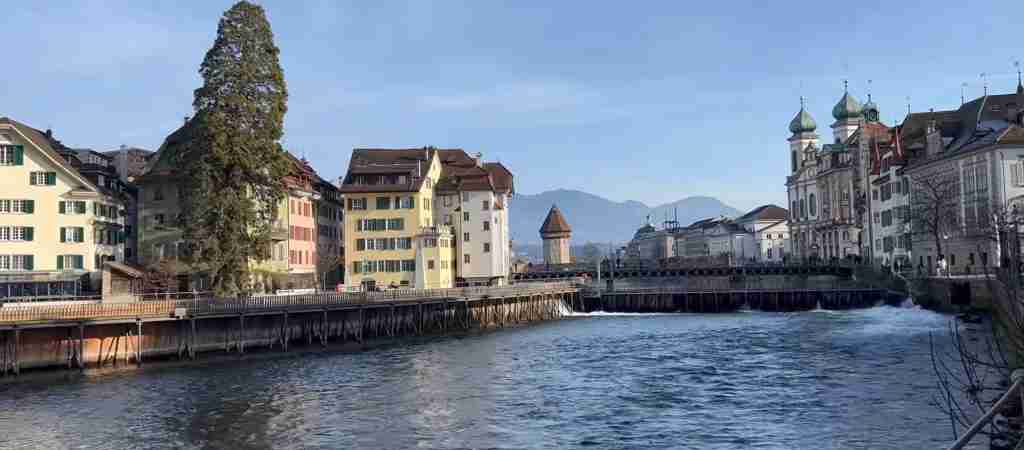
The southern riverbank path between Chapel Bridge and Spreuer Bridge provides the city’s most underutilized perspective, offering head-on views toward Chapel Bridge with the Jesuit Church’s distinctive Baroque towers framing the composition’s left side while the Water Tower anchors the right portion. Most photographers shoot Chapel Bridge from the north, where tourism infrastructure concentrates viewing areas and restaurants, missing this southern angle entirely despite its superior lighting during morning hours when east-facing facades receive direct sunlight rather than remaining in shadow as occurs from northern positions. The path runs at water level, creating low-angle viewpoints that emphasize architectural verticality while including river reflections that double visual impact through symmetry impossible from elevated northern embankments.
The Spreuer Bridge itself attracts minimal photographic attention compared to its more famous Chapel Bridge sibling, despite offering equally compelling architectural details and substantially fewer competing tourists within the frame. This covered wooden bridge spans the Reuss River west of Chapel Bridge, featuring 67 triangular paintings depicting the Dance of Death—a medieval artistic theme showing Death leading representatives of all social classes in a macabre procession. The bridge’s wooden interior with painted panels creates Gothic atmosphere that photographs well using available light from the openings along both sides, while external views from the adjacent Nadelwehr weir capture the bridge with rushing water adding dynamic foreground interest that contrasts with the structure’s static architectural presence.
The Nadelwehr weir immediately adjacent to Spreuer Bridge forms a historic water control system with adjustable wooden needles that regulate flow through the Reuss River, creating a distinctive sawtooth pattern across the water surface that photographs dramatically during high-flow conditions when water surges between the vertical barriers. This location works particularly well for long-exposure water motion blur shots that transform churning rapids into misty veils while maintaining sharp detail in the stationary bridge and weir structures. Early morning and late afternoon provide the best lighting angles that strike the scene obliquely rather than directly overhead, creating shadows between the wooden needles that define their three-dimensional form rather than flattening them into silhouettes against bright water surfaces.
The riverside walking path immediately below Chapel Bridge’s northern terminus offers an unconventional upward perspective that emphasizes the bridge’s wooden construction details—massive timber beams, intricate roof framework, and triangular painting arrangement—from angles impossible to capture while walking through the bridge at pedestrian level. This position requires descending stone steps from the main embankment to reach water level, where photographers can shoot upward through the bridge’s openings with sky backgrounds that silhouette structural elements into graphic patterns. Wide-angle lenses exaggerate perspective distortion, making vertical supports appear to converge dramatically while horizontal beams create leading lines that draw attention through the frame toward vanishing points beyond the bridge’s far end.
Dreilinden Park occupies a hillside position east of the Old Town, providing elevated views across Lake Lucerne toward Mount Pilatus and Mount Rigi that lack foreground urban complications present in waterfront perspectives. The park features a prominent bench marking what local photographers call “probably the most beautiful view” in Lucerne—a claim that may exaggerate slightly but accurately describes the location’s panoramic scope that encompasses multiple mountain peaks, extensive lake surface, and distant shoreline communities in single compositions. This position works best during late afternoon and evening hours when western sunlight illuminates eastern mountain faces while the photographer shoots toward lit subjects rather than into backlight, though morning sessions offer alternative orientations if western mountains remain the primary subject rather than eastern panoramas.
The Château Gütsch castle-hotel perches on a hillside southwest of the Old Town at approximately 550 meters elevation, accessible via a short funicular railway from Gütschbahn station. The castle’s turrets and viewing terraces provide southern perspectives toward the city center with Lake Lucerne and mountains beyond, creating multilayered compositions that stack urban, water, and alpine elements through telephoto compression. Access requires either dining at the hotel restaurant or taking the funicular for viewpoint access without patronizing hotel facilities, though the latter approach may encounter restrictions during private events. Golden hour timing produces exceptional results when low sun angles strike the castle’s white walls while illuminating the valley below, creating tonal contrasts between bright architectural foreground and shadowed landscape middle ground that enhance depth perception through value separation.
The Swiss Museum of Transport’s outdoor areas, located a short bus ride or pleasant walk east of the city center, offer unexpected industrial photography opportunities alongside transportation exhibits that include historic aircraft, locomotives, and vehicles photographed against backdrop settings that contextualize Switzerland’s engineering achievements. The massive tunnel boring machine used for the Gotthard Base Tunnel construction creates a powerful sculptural presence that photographs dramatically in strong sidelight, while vintage transportation equipment provides period details that work particularly well in black-and-white interpretations emphasizing form, texture, and tonal relationships over color documentation. This location serves photographers interested in diversifying Lucerne portfolios beyond natural landscapes and medieval architecture into technical/industrial themes that represent the city’s contemporary identity as a regional transportation hub.
Seasonal Photography: Spring Through Winter Transformations
Spring conditions between March and June introduce Lucerne’s most dramatic color transformations as winter dormancy gives way to explosive floral displays that line Chapel Bridge railings, fill Old Town window boxes, and carpet hillsides with wildflower meadows. The flower installations on both bridges begin appearing in mid-April when frost danger passes, creating coordinated color schemes that vary annually but consistently emphasize red geraniums as the dominant hue complementing the bridges’ terracotta roof tiles. These floral additions transform architectural photography from purely structural documentation into living compositions where organic elements soften hard-edged buildings and bridges, adding texture and color variation that prevents purely geometric interpretations.
Spring morning mists frequently shroud Lake Lucerne until mid-morning, creating atmospheric conditions that separate visual layers through progressive clarity from foreground sharpness through middle-ground softness into background disappearance. This atmospheric perspective enhances depth perception by creating tonal gradation that guides viewer attention from immediate clarity into mysterious distance, particularly effective when photographing from elevated positions like Musegg Wall towers where the fog layer appears as a distinct horizontal band dividing lower city from upper mountains. These conditions prove unpredictable and short-lived, requiring flexible shooting schedules that allow photographers to respond quickly when favorable atmospheric conditions emerge rather than adhering to predetermined shooting plans that miss transient opportunities.
Summer photography between June and September offers Lucerne’s longest daylight windows and most reliable weather patterns, though tourist density peaks during July and August, complicating architectural photography that requires empty frames. The extended daylight hours shift golden hour timing to late evening—sunset occurs after 9 PM during June and July, with civil twilight extending past 10 PM, creating blue hour opportunities at times when most tourists have returned to hotels or restaurants. Photographers willing to work these late sessions encounter substantially reduced crowds along Chapel Bridge and riverfront promenades, allowing clean architectural shots impossible during midday congestion when continuous tourist flow prevents clear views of buildings, bridges, and streets.
Summer’s clear alpine air produces maximum visibility across Lake Lucerne toward distant peaks that remain hidden during other seasons when atmospheric moisture reduces clarity beyond 50-80 kilometers. This extended visibility allows telephoto compositions that compress multiple mountain ranges into stacked layers appearing progressively lighter through atmospheric perspective, creating depth through tonal gradation from dark foreground peaks through middle-toned mid-distance ridges to pale background summits fading into sky. These compression shots require telephoto lenses beyond 200mm focal length to achieve meaningful spatial flattening, with 400-600mm ranges producing the most dramatic stacking effects that transform three-dimensional landscape into graphic two-dimensional pattern emphasizing form over realistic depth representation.
Autumn photography between September and November delivers Lucerne’s most dramatic color palettes as hillside deciduous forests shift from summer green through autumn gold, orange, and red before winter dormancy. The color transformation progresses gradually over six to eight weeks, beginning in mid-September at higher elevations and descending toward lake level through October, creating a moving target that requires timing flexibility to capture peak color intensity. The best autumn photography often occurs during the narrow window between peak foliage color and the first significant storms that strip leaves from trees, typically a span of only 5-7 days that varies annually based on weather patterns and requires monitoring local conditions through webcams and regional photography forums.
Autumn’s lower sun angles produce longer golden hours than summer’s overhead light, with September and October offering extended periods of warm directional illumination that begins 2-3 hours before sunset and continues through blue hour into early evening. This extended premium lighting window allows photographers to work multiple locations during single sessions rather than choosing between positions based on which receives optimal light during brief golden hour periods. The lower angles also create longer shadows across buildings and streets, carving architectural detail through shadow contrast that flattens under summer’s high overhead sun positions, enhancing texture in medieval stone walls and wooden bridge construction that benefits from raking sidelight rather than flat frontal illumination.
Winter conditions from December through February transform Lucerne into a minimalist landscape where snow simplifies visual complexity by covering surface detail with uniform white that reduces scenes to essential forms—building outlines, tree structures, and mountain profiles—stripped of texture and color variation that compete for attention during warmer seasons. This reduction to basics appeals to photographers pursuing formal compositions emphasizing shape, line, and tonal relationships over detailed documentation, creating images that transcend specific location recognition to become abstract studies in form and light. Snow also brightens scenes considerably, reflecting light upward that fills shadows and reduces overall contrast, though photographers must compensate exposure positively by +1 to +2 stops to prevent snow rendering as gray rather than white as camera meters attempt to average scene brightness to middle gray.
Winter’s shorter daylight windows compress shooting schedules into concentrated periods that demand prioritized location sequencing. December and January provide only 8-9 hours of daylight between 8 AM and 5 PM, with golden hour occurring in mid-afternoon rather than evening, forcing photographers to complete multiple location visits during limited premium lighting periods rather than spreading sessions across extended summer days. The earlier golden hour timing proves advantageous for capturing Chapel Bridge reflections during blue hour at reasonable evening hours rather than waiting until 10 PM as summer schedules require, making winter photography more accessible for photographers unwilling to work late-night sessions that summer’s extended twilight demands.
Blue Hour and Night Photography: Capturing Lucerne After Dark
Blue hour photography captures the brief period immediately after sunset when civil twilight produces sky luminosity that balances artificial light intensities without overwhelming either natural or human-made illumination. This balanced lighting window spans only 20-40 minutes depending on season and latitude, beginning when the sun descends 4-6 degrees below the horizon and ending when darkness eliminates sky detail entirely. For Lucerne photography, blue hour provides the single most important lighting condition for capturing illuminated bridges and waterfront buildings with retained mountain backdrop definition and dramatic sky gradation from horizon blues through zenith deeper tones, creating images with inherent visual interest that daytime and full-night shots rarely achieve.
Chapel Bridge during blue hour becomes Lucerne’s most photogenic subject, with warm tungsten bridge lighting generating golden reflections across the Reuss River that contrast against cooling blue sky tones in perfect color temperature opposition. The bridge features continuous lighting along its full length plus focused uplighting on the Water Tower that emphasizes its octagonal form, creating a luminous structure floating between darkening water below and deepening sky above. Photographers should position themselves on the southern riverbank approximately 50 meters east of the bridge’s southern terminus, where low-angle viewpoints capture both bridge structure and water reflections while including Mount Pilatus in the background before it disappears completely into darkness during later night hours.
Technical settings for blue hour photography require manual exposure mode to maintain consistent exposure as light levels drop rapidly, preventing automatic exposure systems from progressively lengthening shutter speeds that create unwanted motion blur or necessitate continuous ISO increases that degrade image quality through noise accumulation. Recommended starting parameters include ISO 400-800, aperture f/8-f/11 for adequate depth of field across foreground through background elements, and shutter speeds between 1-4 seconds on a tripod. These settings balance exposure between illuminated bridge highlights and darker surrounding elements while maintaining detail in both bright and shadow areas that automatic metering typically fails to preserve, either blowing highlights to retain shadow detail or crushing shadows to prevent highlight clipping.
The timing window for optimal blue hour photography shifts throughout the year following sunset variations. During June and July, sunset occurs after 9 PM with blue hour extending past 9:30 PM, creating challenges for photographers working with children or adhering to rigid schedules but offering late-session opportunities when tourist crowds diminish substantially. December and January compress sunset to before 5 PM with blue hour concluding by 5:30 PM, providing more convenient timing but shorter windows that allow less experimental shooting and location repositioning. Photographers should arrive at chosen positions 30 minutes before optimal blue hour timing to establish composition and test initial exposures as light levels drop, rather than arriving during peak conditions and wasting precious minutes sorting technical details while optimal lighting passes.
Post-blue hour night photography after full darkness produces high-contrast images emphasizing illuminated structures floating above black water and sky, creating dramatic but context-limited scenes that sacrifice mountain backdrops and spatial relationships visible during blue hour’s balanced lighting. Night exposures ranging from 4-15 seconds blur moving water into smooth silk while capturing static architectural details sharply, though longer exposures risk star trailing if clear skies include visible stars that move perceptibly during multi-second exposures. These longer exposures also accumulate noise in shadow areas that require post-processing noise reduction, though contemporary cameras handle high ISO performance sufficiently well that noise rarely becomes objectionable in images displayed at reasonable sizes rather than examined at 100% magnification on computer monitors.
The Old Town’s narrow streets and covered arcades create night photography opportunities distinct from waterfront bridge scenes, with medieval building facades illuminated by street lamps, shop windows, and restaurant exterior lighting that creates warm ambiance against cold stone architecture. These alley shots benefit from slight underexposure that preserves highlight detail in bright windows and lamps while accepting some shadow blocking in unlit building faces, creating high-contrast interpretations that emphasize light sources and illuminated surfaces rather than attempting to render every architectural detail visible. Wide-angle lenses between 16-24mm capture the spatial compression of narrow streets that tower vertically on either side, though photographers should avoid extreme distortion that makes buildings appear to lean dramatically toward frame edges through uncorrected perspective correction.
The Musegg Wall towers illuminate at night through exterior uplighting that creates dramatic silhouettes against evening skies, visible from numerous positions throughout the Old Town where the fortification line marks the transition between medieval core and hillside forest. These distant night views work particularly well during blue hour when towers remain defined against lighter sky backgrounds, while post-twilight conditions create silhouette profiles that emphasize form over detail. Long exposures from 8-20 seconds during full darkness allow photographers to capture star trails arcing behind tower outlines, creating images that combine medieval architecture with celestial motion for compositions that transcend simple building documentation into conceptual interpretations linking human construction with cosmic scales.
Winter night photography introduces Christmas market opportunities that peak during December when seasonal lighting installations decorate Chapel Bridge, Old Town streets, and waterfront promenades with festive illumination that supplements permanent lighting with temporary elements changing annually. The market’s combination of warm tungsten lights, colored decorative lighting, and moving crowds creates dynamic scenes that benefit from shutter speeds long enough to blur pedestrian motion into ghostly trails while maintaining sharp architectural detail, typically achieved through exposures between 1-4 seconds that allow sufficient movement to register as blur without becoming completely invisible through over-dilution. These market scenes capture Lucerne’s seasonal character that other months cannot replicate, adding portfolio diversity that demonstrates the city’s temporal transformations beyond geographic perspective variations.
Mountain Photography: Mount Pilatus and Mount Rigi Perspectives
Mount Pilatus rises directly south of Lucerne to 2128 meters elevation, creating the dominant visual backdrop for most city photography while offering its own exceptional viewpoint opportunities when accessed via cogwheel railway or aerial cable car. The mountain’s distinctive profile with multiple peaks—Esel, Oberhaupt, and Tomlishorn—creates an instantly recognizable silhouette that identifies Lucerne-area photography, though photographing from the summit rather than toward it produces dramatically different perspectives that reverse the visual relationship between city below and mountains beyond. Accessing Pilatus summit requires planning around seasonal operations, as the cogwheel railway operates only May through October while cable car access continues year-round, limiting winter summit photography to cable car approach that presents different visual routes than the cogwheel’s southern flank trajectory.
Summit photography from Pilatus Kulm captures panoramic views encompassing Lake Lucerne’s full extent, the city of Lucerne appearing as a compact cluster of buildings at the lake’s northern tip, and distant alpine ranges extending toward the Bernese Oberland and beyond. Clear-weather visibility from the summit regularly exceeds 100 kilometers, revealing dozens of identifiable peaks across multiple mountain ranges that create layered horizons through atmospheric perspective gradually lightening from dark foreground through middle-toned mid-distance into pale background fading toward sky. These expansive views work best photographed during early morning or late afternoon when directional sidelight creates shadow relief that defines individual peaks through tonal separation, while midday overhead light flattens mountains into uniform brightness that reduces three-dimensional perception into two-dimensional silhouettes lacking depth cues.
The Dragon Path walking trail immediately below the summit viewing terraces provides alternative perspectives through carved stone “peepholes” that frame specific views toward Lake Lucerne and surrounding landscapes, creating natural vignettes that focus attention on particular compositional elements rather than presenting undifferentiated 360-degree panoramas. These framed views work particularly well for photographers pursuing creative interpretations beyond simple documentation, as the stone apertures add foreground context that establishes scale and creates visual depth through near-mid-far layering. The path requires only 5-10 minutes to walk, offering quick perspective changes without significant time investment that allows photographers to efficiently sample multiple viewpoints during limited summit visits constrained by cable car schedules or weather window closures.
The Esel peak, accessible via a 10-15 minute climb from the main summit area, provides an elevated perspective above the hotel and restaurant complex that removes human infrastructure from foreground compositions, creating cleaner mountain-to-mountain views that emphasize natural rather than built environments. The climb follows stone steps with periodic steeper sections requiring reasonable fitness but presenting no technical challenges beyond uneven footing and exposure to steep drop-offs that demand caution near unprotected edges. The summit rewards the effort with 360-degree views that include perspectives back toward the main Pilatus Kulm buildings, allowing photographers to capture the architectural complex set against broader mountain contexts that demonstrate the human structures’ relative insignificance amid surrounding alpine vastness.
Mount Rigi rises northeast of Lucerne across Lake Lucerne, reaching 1798 meters at Rigi Kulm summit and offering alternative perspectives that reverse the Pilatus viewpoint by looking southwest toward Lucerne with Pilatus appearing in the background. This reversed orientation creates compositional opportunities unavailable from Pilatus itself, particularly for photographers interested in capturing the relationship between Lucerne, Lake Lucerne, and the mountains beyond in single frames that demonstrate geographic context through spatial relationships impossible to convey from ground-level city positions. Rigi access requires either cogwheel railway from Vitznau or Arth-Goldau, or cable car from Weggis, with all routes operating year-round unlike Pilatus’s seasonal railway limitations.
Sunrise photography from Rigi Kulm provides classic Swiss Alpine conditions when overnight temperature inversions trap fog at valley level while summits remain clear above, creating a sea of clouds that covers Lake Lucerne completely while surrounding peaks emerge as islands floating in white vapor. These conditions occur most reliably during autumn and winter when stable high-pressure systems persist for multiple days, though predicting specific occurrences requires monitoring webcams and weather patterns that indicate overnight cloud formation without morning dissipation. Photographers pursuing these dramatic conditions should plan overnight stays at the summit hotel to guarantee positioning during prime lighting regardless of first ascent cable car schedules that typically begin too late to capture optimal sunrise conditions.
Technical considerations for mountain summit photography center on atmospheric haze management that reduces contrast and color saturation through water vapor and particle scattering. UV filters minimize some haze effects, though their impact proves marginal compared to inherent atmospheric conditions beyond photographic control. Post-processing contrast and clarity adjustments partially compensate for atmospheric softening, restoring definition to distant features that appear washed out in straight-from-camera files. Photographers should shoot in RAW format rather than JPEG to retain maximum tonal information for post-processing flexibility, as atmospheric conditions frequently require substantial adjustments that degrade JPEG files but handle acceptably in RAW files containing greater bit depth and dynamic range information.
Street Photography and Old Town Details: Capturing Urban Character
Lucerne’s Old Town presents concentrated street photography opportunities within a compact area spanning roughly 400 by 300 meters between the river and hillside fortifications, where medieval building facades, narrow cobblestone alleys, painted frescoes, ornate fountains, and daily life activities create diverse visual subjects within easy walking distances. The district’s protected historic status prevents modern alterations that would dilute architectural coherence, maintaining visual consistency that allows photographers to work without contemporary intrusions disrupting period character. Understanding which streets offer particular photographic advantages and when lighting conditions favor specific locations transforms random wandering into productive shooting that maximizes limited time and optimal light availability.
The Weinmarkt square anchors the Old Town’s western section, featuring the distinctive Weinmarkt fountain crowned with a banner-bearing figure and surrounded by painted building facades displaying traditional Swiss decorative schemes of trompe l’oeil architectural elements and heraldic designs. The square’s relative openness allows overhead sky light to reach ground level even during midday when surrounding narrow streets remain shadowed, creating consistent illumination that permits photography across extended time windows rather than brief optimal lighting periods. The fountain serves as a natural focal point for compositional organization, providing a central subject around which to arrange supporting elements—passing pedestrians, cafe diners, building details—into balanced frames that lead viewer attention from edges toward center following classical compositional principles.
The Hirschenplatz square occupies the Old Town’s eastern section near Chapel Bridge, presenting similar fountain-centered composition opportunities with slightly different building arrangements and pedestrian traffic patterns that vary hour by hour as tourist flows shift between major landmarks. Early morning sessions capture empty squares with dramatic sidelight striking building facades at acute angles that carve texture through shadow relief, while midday brings dense crowds that transform architectural photography into street scene documentation where human activity becomes primary rather than supporting subject matter. The choice between empty and populated frames depends on photographic intent—pure architectural documentation benefits from empty scenes that present buildings without visual clutter, while environmental portraits require human presence that contextualizes architecture through scale comparison and activity demonstration.
The narrow residential streets climbing the hillside between the river and Musegg Wall create canyon-like spaces where opposing buildings nearly touch overhead, creating dramatic perspective compression that exaggerates vertical scale through upward-tilting viewpoints. These alleys photograph best during late morning or early afternoon when sun angles permit light penetration into otherwise perpetually shadowed passages, though the narrow windows of direct illumination last only 30-60 minutes before sun progression removes light from street level. Wide-angle lenses between 16-24mm enhance vertical exaggeration through perspective distortion that makes buildings appear to lean dramatically inward, creating dynamic compositions that emphasize spatial compression over literal architectural representation.
Architectural detail photography throughout the Old Town captures the decorative elements that distinguish Lucerne’s medieval buildings—painted frescoes depicting historical scenes, wrought-iron signs indicating shop trades through pictorial rather than textual communication, carved wooden shutters and decorative brackets, and ornamental fountains featuring elaborate sculptural programs. These details reward photographers working with telephoto lenses that isolate individual elements from surrounding contexts, creating graphic compositions emphasizing pattern, texture, and form extracted from three-dimensional architectural wholes. Overcast lighting conditions actually benefit detail photography by providing even illumination without harsh shadows that complicate exposure management when bright highlights and deep shadows exceed camera sensor dynamic range capabilities.
Street portrait opportunities arise naturally throughout the Old Town as cafes spill onto sidewalks, street musicians perform at strategic corners, and tourists pause to examine building details or consult maps. Candid street photography requires discretion and respect for subject privacy—photographing people engaged in public activities in public spaces remains legal in Switzerland, though courtesy suggests avoiding obviously intrusive shooting that makes subjects uncomfortable. Environmental portraits that include substantial architectural context alongside human subjects generally prove less invasive than tightly cropped facial portraits that isolate individuals from surroundings, allowing photographers to capture daily life activities without reducing subjects to mere objects stripped of contextual dignity.
Lake Promenade and Waterfront Perspectives: Beyond Chapel Bridge
The lake promenade extends eastward from Lucerne’s train station for approximately two kilometers along Lake Lucerne’s northern shore, transitioning from urban waterfront near the KKL Culture and Congress Center through park-like middle sections to residential neighborhoods beyond Inseli Park. This extended waterfront offers varied perspectives on the lake-mountain relationship that changes progressively with distance from the city center, allowing photographers to compose images emphasizing different foreground treatments while maintaining consistent alpine backgrounds across multiple shooting locations. Walking the full promenade requires 30-40 minutes at casual pace, or longer when stopping frequently for photography, making bicycle rental a practical option for efficiently sampling multiple positions during limited time windows.
The KKL Lucerne Culture and Congress Center anchors the promenade’s western terminus with Jean Nouvel’s distinctive modern architecture featuring a massive cantilevered roof that extends over both building and adjacent plaza, creating a covered public space that functions as both architectural statement and practical gathering area. The building’s contemporary design contrasts dramatically with Lucerne’s medieval architecture, providing compositional opportunities that juxtapose historical and modern elements within single frames demonstrating urban evolution across centuries. The building photographs particularly well during blue hour when interior lighting illuminates through floor-to-ceiling windows while exterior surfaces reflect fading sky colors, creating luminous facades that appear to glow against darkening surroundings.
The Kurplatz section immediately east of the train station features manicured gardens, seasonal flower beds, and historic hotels whose grand facades line the waterfront in continuous rhythm, creating Belle Époque atmosphere recalling late 19th-century tourism’s golden age when Lucerne emerged as a premier European resort destination. These buildings photograph effectively when included as middle-ground elements positioned between waterfront walkway foreground and lake-mountain background, creating depth through spatial layering that guides viewer attention from immediate surroundings through architectural transition zones into distant natural landscapes. Late afternoon light strikes these eastern facades directly rather than glancingly, intensifying color saturation in painted plaster walls and emphasizing ornamental details that flatten under frontal lighting lacking directional shadow relief.
The Schweizerhofquai continues the promenade eastward past the Kurplatz with increasingly park-like character as formal gardens give way to informal lawn areas, mature trees, and recreational facilities including playgrounds and swimming areas. This transition from urban to suburban waterfront provides changing compositional contexts while maintaining lake and mountain views, allowing photographers to vary environmental treatments within short walking distances. The lawn areas permit slightly elevated positions above water level that improve sight lines across the lake toward distant mountains, creating clearer horizons than water-level perspectives where intervening boats, buoys, and shoreline structures complicate foreground management.
Inseli Park occupies a small peninsula extending into Lake Lucerne between the main promenade and the Lido swimming complex, creating a quiet location offering unobstructed lake views toward Mount Pilatus without foreground complications from waterfront buildings or boat traffic. The park’s relative isolation from main tourist circuits means substantially reduced visitor density compared to Chapel Bridge or train station areas, allowing photographers to work without crowds entering frames or occupying optimal shooting positions. Early morning sessions capture sunrise conditions when eastern light illuminates Mount Pilatus’s western face while the foreground remains relatively shadowed, creating luminosity contrasts that draw attention to the illuminated peak against darker surroundings.
The historic paddle steamer fleet operating on Lake Lucerne provides moving subjects that add dynamic elements to otherwise static landscape compositions, with five vintage vessels dating from 1901-1928 continuing regular passenger service during summer months May through October. These steamers feature distinctive profiles with tall smokestacks, paddlewheels, and ornate Victorian-era detailing that photograph dramatically when captured in motion with mountain backdrops, creating images that combine historical transportation heritage with alpine natural beauty. Photographers positioned along the promenade can anticipate steamer passages by checking published schedules that indicate departure and arrival times at Lucerne’s pier, allowing positioning at favorable locations 10-15 minutes before boats pass for optimal composition preparation.
Telephoto perspective compression works particularly well along the lake promenade, where distance from subjects allows long focal lengths to stack multiple spatial layers—foreground boats, middle-ground shoreline features, background mountains—into flattened compositions emphasizing two-dimensional pattern over three-dimensional depth. Lenses in the 200-400mm range produce moderate compression suitable for isolating specific mountain peaks framed between foreground elements, while extreme telephotos beyond 500mm create dramatic stacking effects that transform realistic landscape into graphic abstraction resembling telephoto paintings more than literal documentation. These compression techniques require clear atmospheric conditions to maintain sharpness across distances that atmospheric haze can soften substantially, making autumn and winter shooting more reliable for extreme telephoto work than humid summer conditions.
Equipment Recommendations and Technical Considerations
Lucerne photography spans diverse subjects requiring different equipment approaches depending on whether architectural documentation, landscape panoramas, street candids, or night exposures constitute primary shooting objectives. No single lens or camera setup handles all situations optimally, forcing photographers to prioritize based on personal interests and accept compromises for secondary shooting opportunities encountered during sessions planned around different priorities. Understanding which gear choices serve particular photographic goals allows informed decision-making about what to carry versus what to leave behind, balancing capability against weight considerations that matter significantly during extended walking sessions through hilly Old Town streets and steep Musegg Wall climbs.
Wide-angle lenses between 16-35mm handle architectural interiors, narrow Old Town alleys, and expansive lake-mountain panoramas that require broad fields of view to capture spatial context impossible with normal or telephoto focal lengths. Full-frame equivalent 16mm proves particularly useful for Chapel Bridge interior shots showing triangular paintings, Musegg Wall tower perspectives including both architectural details and distant views, and Old Town street scenes where surrounding buildings tower overhead creating canyon-like passages. These extreme wide angles introduce substantial perspective distortion that requires careful composition to avoid unnatural appearance, particularly when vertical lines converge dramatically toward upper frame edges unless corrected through either tilt-shift optics or post-processing perspective adjustment tools.
Standard zoom lenses covering 24-70mm or 24-105mm ranges serve as versatile primary optics handling the majority of Lucerne photography situations with reasonable compromise between wide-angle capability and moderate telephoto reach. These lenses capture Chapel Bridge from southern riverbank positions, Musegg Wall tower views including both immediate city detail and distant mountain context, and street photography requiring sufficient focal length to maintain respectful distance from subjects while filling frames adequately. The 24-70mm f/2.8 constant aperture variant provides low-light advantages for blue hour and interior photography, though the larger size and doubled weight compared to variable aperture alternatives may discourage casual carrying during extended walking sessions where weight accumulation from multiple lenses, camera bodies, and accessories becomes fatiguing across full-day outings.
Telephoto lenses from 70-200mm through 100-400mm serve landscape compression, distant architectural detail isolation, and Mount Pilatus/Mount Rigi summit photography where distance from subjects prevents wide-angle effectiveness. The 70-200mm f/2.8 represents the classic professional choice providing both reach and speed, though the substantial size and weight may prove excessive for photographers prioritizing mobility over maximum optical performance. Variable aperture alternatives like 70-200mm f/4 or 100-400mm f/5.6 reduce both weight and cost while maintaining reasonable image quality, accepting modest light-gathering compromise that matters primarily during dim interior work or evening sessions when every half-stop of aperture affects ISO requirements and shutter speed flexibility.
Tripod selection balances stability requirements for long exposure night photography against portability concerns during daylight walking sessions when tripods remain packed but still accumulate weight and bulk. Carbon fiber construction reduces weight substantially compared to aluminum alternatives, though higher costs may prove prohibitive for casual users unwilling to invest premium amounts in support equipment. Compact travel tripods folding to 40-50 centimeters transport easily in backpacks or attach to camera bags externally, though reduced stability compared to full-sized tripods may limit effectiveness during windy conditions or with heavy telephoto lenses generating substantial leverage forces that demand robust support. Ball heads provide faster positioning than pan-tilt heads for landscape photography requiring frequent recomposition, though panoramic shooting benefits from pan-tilt heads offering precise horizontal rotation without disturbing vertical alignment between sequential frames.
Polarizing filters manage water reflections, reduce sky glare, and enhance color saturation through selective light wave filtration, proving particularly valuable for daytime Lake Lucerne photography where reflection control determines composition success or failure. Circular polarizers accommodate autofocus and auto-exposure systems unlike older linear designs, with rotating outer rings allowing photographers to adjust polarization strength while observing effects through viewfinders. Neutral density filters enable long exposures during bright daylight conditions by reducing incoming light intensity, allowing shutter speeds of several seconds or longer that blur water motion into silk and clouds into streaks across otherwise static landscape scenes. Variable ND filters offer adjustment flexibility through rotating design that changes density across 3-8 stop ranges, though optical quality generally trails fixed-density alternatives that maintain sharper results without color casts sometimes introduced by variable designs.
Remote releases prevent camera shake during tripod-mounted exposures by eliminating the physical contact vibration introduced through manual shutter button pressing, particularly important during exposures between 1/30 second and 2 seconds where vibration effects prove most visible. Wireless releases using radio frequency or Bluetooth connectivity eliminate cable management complications, though battery drain and occasional connectivity failures represent potential disadvantages compared to simple wired releases offering mechanical reliability without power requirements. Most contemporary cameras include built-in interval timer functionality that delays shutter actuation several seconds after mirror lockup on DSLRs or electronic shutter engagement on mirrorless systems, providing hands-free shooting that achieves vibration reduction objectives without requiring separate remote release accessories.
Composition Techniques and Artistic Approaches
Effective Lucerne photography transcends simple documentation of existing scenes to create interpretive images that communicate personal vision through deliberate compositional choices governing how subjects appear within frames and which elements receive emphasis over competing visual information. Understanding traditional composition principles—rule of thirds, leading lines, framing, symmetry, and perspective—provides foundational tools for organizing visual elements, though creative success ultimately requires knowing when to apply these guidelines and when to violate them purposefully for specific expressive effects that conventional approaches cannot achieve. Developing personal photographic vision means making conscious decisions about what to include, exclude, emphasize, and subordinate rather than simply recording whatever appears before the camera without editorial judgment.
The rule of thirds organizes frames through imaginary grid lines dividing horizontal and vertical dimensions into thirds, with major compositional elements positioned at grid line intersections rather than dead center creating dynamic arrangements that guide viewer attention through deliberate imbalance. Chapel Bridge compositions benefit from positioning the Water Tower at right-third vertical line rather than centered, leaving left-two-thirds for bridge structure and background mountains that create balanced asymmetry more visually engaging than centered symmetry. However, deliberate central placement works effectively when symmetry itself becomes the compositional concept—mirror reflections on still water demand centered horizon lines that equalize reflected and direct views into balanced compositions where asymmetric rule-of-thirds placement would destroy the symmetry that justifies the image’s existence.
Leading lines guide viewer attention through frames along visual pathways created by architectural edges, river banks, pathways, or shadow boundaries that connect foreground entry points to middle-ground subjects and background destinations. The Reuss River serves as natural leading line flowing through Lucerne from mountains toward lake, with Chapel Bridge spanning perpendicular to create visual intersection between horizontal water flow and vertical tower element. Old Town alleys provide perspective-driven leading lines where building walls converge toward vanishing points at alley ends, creating depth through dimensional compression that transforms three-dimensional space into two-dimensional representation maintaining spatial understanding through progressive size reduction. Effective leading line usage requires positioning camera and composing frame so lines originate from frame corners or edges rather than starting randomly within the frame interior, creating entry points that invite viewer participation through implied movement along the indicated path.
Framing within frames creates layered compositions where foreground elements surround subjects positioned in middle ground, directing attention through natural apertures that function like viewfinder boundaries within the larger image frame. Musegg Wall tower windows naturally frame city and lake views, creating compositional structures that add depth through spatial layering while providing context about viewing position relationship to distant subjects. Chapel Bridge’s covered structure frames external views seen through bridge openings, with wooden support columns functioning as vertical framing elements bracketing horizontal water and mountain views beyond. These frame-within-frame compositions work best when foreground frames remain darker than illuminated subjects beyond, creating tonal separation that prevents foreground elements from competing visually with intended subjects rather than supporting them through contextual framing relationships.
Symmetry compositions organize subjects along central vertical axes creating balanced arrangements where left and right sides mirror each other through identical or similar elements positioned equidistant from frame center. Water reflections naturally produce symmetrical compositions when calm surfaces create perfect mirrors doubling above-water subjects below the waterline, with the water surface itself forming the horizontal axis dividing mirrored halves. These reflections work most effectively when horizon placement occurs exactly at frame vertical center rather than offset toward upper or lower thirds, as asymmetric horizon positioning destroys the perfect balance that justifies symmetry as compositional organizing principle. Architectural symmetry appears in formal building facades designed with central entrances flanked by balanced window arrangements, fountain sculptures positioned on central pedestals, or bridge structures spanning rivers with identical arches on either side of central piers.
Perspective control manages how three-dimensional subjects appear in two-dimensional photographs, with normal lenses near 50mm producing perspective approximating human vision while wide angles exaggerate depth and telephotos compress space. Wide-angle upward tilts toward tall buildings create converging vertical lines that make structures appear to lean backward, an effect either embraced for dramatic interpretation or corrected through tilt-shift optics or post-processing for architectural accuracy. Telephoto compression flattens spatial relationships between foreground and background elements separated by substantial distances, making Mount Pilatus appear larger relative to foreground Lucerne buildings than human perception suggests when viewing the scene directly, creating dramatic interpretations that sacrifice literal accuracy for compositional impact emphasizing specific relationships between separated elements.
Post-Processing Workflow for Lucerne Images
Post-processing transforms raw camera captures into finished photographs through selective adjustments addressing exposure, color, contrast, sharpness, and creative interpretation decisions that extend beyond simple correction of technical deficiencies to active image creation following photographic vision. The distinction between excessive manipulation that falsifies reality and legitimate interpretation enhancing visual communication remains subjective and context-dependent—landscape photography traditionally accepts substantial creative latitude that documentary photojournalism prohibits, while artistic photography acknowledges interpretation as inherent to the medium regardless of specific techniques employed. Understanding which adjustments address which image qualities and when particular interventions prove most effective allows informed decision-making about processing strategies serving photographic intent rather than arbitrary application of popular effects regardless of appropriateness.
Exposure adjustment corrects underexposure or overexposure resulting from incorrect camera settings or challenging lighting conditions exceeding sensor dynamic range, though significant exposure correction degrades image quality through increased shadow noise or reduced highlight detail depending on adjustment direction. RAW format shooting provides substantially greater exposure latitude than JPEG capture, allowing recovery of 1-2 stops underexposure or 0.5-1 stop overexposure without obvious quality degradation, while JPEG’s reduced bit depth and applied compression limit adjustment flexibility to minor corrections before posterization and artifacts become visible. Chapel Bridge blue hour exposures frequently require shadow lifting to reveal architectural detail in darker building faces while preventing blown highlights in illuminated bridge sections, a balancing act simplified by shooting bracketed exposures merged through HDR processing rather than attempting single-exposure capture of scenes exceeding sensor capabilities.
White balance correction adjusts color temperature to remove unwanted color casts resulting from mismatched camera settings and ambient light temperatures, particularly relevant for night photography where mixed lighting sources—warm tungsten street lamps, neutral moonlight, cool blue twilight sky—create competing color temperatures within single frames. Auto white balance frequently produces acceptable results for daylight photography under consistent illumination, though specific situations benefit from manual color temperature selection preventing camera misinterpretation—overcast conditions may require 6500-7000K warming to prevent excessive blue coolness, while shade requires even warmer settings approaching 8000K counteracting strong blue cast from overhead sky illumination excluding direct sunlight. Creative white balance manipulation intentionally shifts color palettes toward specific moods—cooling winter scenes emphasizes cold through blue bias, while warming autumn foliage intensifies golden tones suggesting warmth and abundance.
Contrast adjustment controls tonal range compression or expansion affecting how highlights, midtones, and shadows separate or merge across value scales from pure white through middle gray to absolute black. Lucerne’s atmospheric haze frequently reduces contrast through light scattering that flattens distant mountains into low-contrast silhouettes lacking definition, requiring contrast increases restoring tonal separation that enhances depth perception through progressive darkening from background through middle ground into foreground. However, excessive contrast crushes shadow detail into blocked blacks and blows highlights into empty whites eliminating recoverable information, requiring judicious application that enhances rather than destroys subtle tonal gradations carrying visual information about subject form and texture. Luminosity masks in advanced editing software allow selective contrast adjustment affecting specific tonal ranges independently—increasing shadow contrast without affecting highlights, or vice versa—providing fine control impossible through global contrast sliders affecting all tones uniformly.
Color saturation adjustment intensifies or reduces color purity affecting how vivid or muted hues appear, with increased saturation making colors more vibrant while decreased saturation moves images toward monochrome. Lucerne photography frequently benefits from selective saturation increases emphasizing specific color ranges—boosting blue saturation intensifies lake and sky while leaving other colors unchanged, enhancing specific elements without creating overall artificial appearance from uniformly oversaturated palettes. Vibrance adjustment provides alternative saturation control affecting understated colors more than already-saturated hues, preventing skin tones or bright elements from becoming cartoonish while lifting muted tones toward greater prominence, though distinguishing vibrance from saturation effects requires side-by-side comparison as differences prove subtle in many images.
Sharpness adjustment enhances edge contrast creating appearance of increased detail through accentuating boundaries between different tones or colors, compensating for slight focus softness or diffraction effects from small apertures that slightly reduce optimal sharpness. However, sharpening cannot create detail absent from original captures—attempting to sharpen significantly soft images creates harsh halos around edges without recovering genuine detail, producing worse results than accepting slight softness honestly. Selective sharpening targeting specific image areas proves more effective than global application across entire frames—sharpening mountain peaks while leaving foreground vegetation softer directs attention toward intended subjects through sharpness contrast drawing eyes toward sharp areas away from soft regions serving supporting roles.
Frequently Asked Questions About Lucerne Photography
Do I need special permits to photograph in Lucerne?
Photographing in Lucerne’s public spaces including streets, bridges, parks, and lake promenade requires no permits or permissions for personal, educational, or editorial use. Commercial photography for advertising campaigns or location scouting may require permits from Lucerne tourism authorities, though enforcement appears sporadic and primarily targets large productions with extensive equipment rather than individual photographers working professionally. Private property including hotel interiors, restaurant dining areas, and museum exhibits may restrict photography through posted signs or staff instructions, with violation risking expulsion but rarely legal consequences. The Musegg Wall towers permit photography without restriction during public access hours April through October, while Chapel Bridge allows photography from within the structure and from surrounding public viewpoints without limitation. Drone photography requires specific authorizations from Swiss aviation authorities and cannot operate within Lucerne’s urban core without explicit permissions rarely granted for recreational purposes, restricting aerial photography to manned aircraft operations or legally compliant drone use in peripheral areas outside regulated airspace.
What’s the best season for first-time photographers visiting Lucerne?
Autumn between mid-September and late October provides the optimal combination of favorable weather probability, dramatic color palettes, extended golden hour lighting, and moderate tourist density for photographers experiencing Lucerne initially. The autumn color transformation as hillside forests shift from green through gold and red creates vibrant natural palettes unavailable during other seasons, while lower sun angles produce longer periods of warm directional light ideal for architectural and landscape photography requiring texture-revealing sidelight rather than flat overhead illumination. September and early October typically offer more stable weather than spring’s unpredictable conditions or summer’s occasional thunderstorm patterns, with autumn high-pressure systems frequently persisting multiple days producing consecutive shooting opportunities without weather-related session cancellations. Tourist crowds diminish substantially after August peaks, allowing easier access to popular viewpoints and reducing unwanted pedestrians in architectural frames, though visitor numbers remain sufficient to support full restaurant and hotel services unlike winter’s reduced operations when some facilities close seasonally. First-time photographers benefit from autumn’s compressed excellence window delivering multiple photographic advantages simultaneously rather than requiring seasonal return visits to capture specific conditions available only during particular months.
Can I capture good Lucerne photographs with just a smartphone?
Contemporary smartphone cameras produce excellent results for well-lit daylight photography across most Lucerne subjects including Chapel Bridge exteriors, Old Town architecture, lake promenades, and general street scenes, with computational photography features like HDR processing and portrait mode background blur creating images approaching dedicated camera quality under favorable conditions. However, smartphones struggle with specific situations where dedicated cameras excel—low-light blue hour and night photography produces excessive noise and limited dynamic range compared to larger sensors in mirrorless or DSLR systems, while extreme telephoto perspectives compressing mountain landscapes or wildlife details remain impossible without optical zoom capabilities exceeding smartphone limitations. Smartphone wide-angle lenses handle Musegg Wall tower panoramas and Old Town alley perspectives effectively, though perspective distortion correction and precise manual exposure control prove more difficult than with dedicated camera interfaces designed explicitly for photographic control rather than general smartphone functionality. Successful smartphone photography in Lucerne requires understanding device capabilities and limitations, shooting during optimal lighting conditions that favor computational processing strengths, and accepting that certain specialized applications demand dedicated camera equipment that smartphones cannot replace regardless of improving technology bridging quality gaps across typical tourist photography scenarios.
How do I photograph Chapel Bridge without crowds ruining compositions?
Eliminating crowds from Chapel Bridge photographs requires timing strategies exploiting daily and seasonal patterns when visitor density reaches minimum levels, combined with compositional approaches that either exclude pedestrian traffic through careful framing or incorporate human presence as intentional compositional elements rather than unwanted distractions. Early morning sessions beginning at sunrise and extending through approximately 8 AM encounter minimal tourist activity as most visitors remain at breakfast or sleeping, providing 90-minute windows for capturing empty bridge frames impossible during midday congestion lasting roughly 10 AM through 6 PM when continuous pedestrian flow prevents clean architectural shots. Late evening blue hour sessions after 9 PM during summer months offer alternative timing when most tourists have dispersed to restaurants or hotels, creating second daily opportunity for unobstructed photography though requiring late working hours unsuitable for photographers preferring conventional schedules. Winter months December through February reduce overall visitor numbers substantially compared to summer peaks, with weekday sessions particularly favorable as weekend tourists from neighboring countries create temporary crowd surges even during otherwise quieter seasons. Long exposure techniques using 10-30 second shutter speeds with neutral density filters blur moving pedestrians into ghostly transparencies or eliminate them entirely through motion averaging, though this approach requires tripod stability and works only for subjects crossing frame rather than stopping within composition for durations exceeding exposure length.
What focal length lens should I prioritize if carrying only one?
A standard zoom covering approximately 24-70mm on full-frame cameras or equivalent 15-50mm on crop sensors provides the most versatile single-lens solution handling the majority of Lucerne photography situations with reasonable compromise between wide-angle capability for architectural interiors and narrow streets, normal perspective for general documentation, and moderate telephoto reach for isolating distant details or compressing spatial relationships. The 24mm wide end captures Chapel Bridge from southern riverbank positions including Water Tower and mountain backdrop in single frames, photographs Musegg Wall tower interiors showing both architectural details and exterior views through windows, and handles Old Town alley perspectives where surrounding buildings tower overhead creating vertical compression. The 70mm long end provides sufficient reach for isolating architectural details like painted facades or fountain sculptures, capturing tighter lake views toward Mount Pilatus that exclude excessive foreground water, and shooting street portraits maintaining respectful distance from subjects while filling frames adequately without requiring extremely close approach. Variable aperture versions like 24-70mm f/3.5-5.6 reduce weight and cost compared to constant aperture f/2.8 alternatives while maintaining reasonable image quality, accepting modest light-gathering compromise that matters primarily during dim interior work or evening sessions when every half-stop of aperture affects shutter speed flexibility and ISO requirements determining noise levels in shadow regions.
How do I manage Lucerne’s extreme light contrasts during photography?
Lucerne’s combination of bright alpine reflections and deep architectural shadows creates dynamic range challenges exceeding single-exposure sensor capabilities, requiring either exposure bracketing merged through HDR processing, graduated neutral density filters balancing sky and foreground brightness, or compositional choices that avoid including extreme highlights and shadows within single frames. Bracketing captures three to five exposures at one-stop intervals—one properly exposed for midtones, additional frames overexposed to capture shadow detail, and underexposed frames preserving highlight information—which post-processing software merges into single images containing detail across the full tonal range from darkest shadows through brightest highlights. This technique proves particularly effective for blue hour Chapel Bridge photography where illuminated bridge sections appear several stops brighter than surrounding darker water and buildings, or Old Town alley scenes where sunlit building tops contrast with shaded street-level passages. Graduated ND filters darken upper frame portions while leaving lower sections unaffected, balancing bright skies with darker foreground landscapes during sunset or mountain photography where sky brightness overwhelms foreground detail in single exposures. However, these filters work only for scenes with distinct horizontal brightness divisions between sky and land, proving ineffective for irregular boundaries like Musegg Wall towers protruding into sky regions or Chapel Bridge creating complex brightness transitions between illuminated structure and surrounding shadows. Compositional management simply avoids including extreme contrasts within single frames through careful positioning that either silhouettes subjects against bright backgrounds accepting lost detail, or exposes for highlights allowing shadow blocking, both approaches requiring acceptance of lost information in sacrifice zones rather than attempting impossible perfect exposure across impossible dynamic ranges.
What time should I arrive at locations for optimal morning light?
Optimal morning photography timing requires arriving at chosen locations 30-45 minutes before sunrise to establish position, test compositions, and prepare equipment before premium lighting begins, as the period from 30 minutes before sunrise through 90 minutes afterward provides the most dramatic and versatile light quality for landscape and architectural photography. Pre-sunrise civil twilight creates soft directional illumination without harsh shadows, ideal for capturing Chapel Bridge reflections when water remains calm before wind disrupts mirror surfaces, or photographing Old Town facades with even lighting revealing architectural detail without extreme contrast complications. Sunrise itself produces the day’s most dramatic light as low sun angles generate warm color temperatures and long shadows carving texture across building surfaces, though exact sunrise timing shifts throughout the year from approximately 5:30 AM during June to 8:00 AM in December requiring seasonal adjustment to maintain consistent relative timing rather than fixed clock times. Post-sunrise golden hour continues 60-90 minutes after sunrise depending on season and weather conditions, maintaining warm directional light that gradually transitions toward harsher overhead illumination as sun elevation increases and color temperature cools from sunrise warmth toward neutral daylight values. Photographers should consult sunrise calculators providing exact times for specific dates and locations, adding 30 minutes before official sunrise for arrival and setup, ensuring positioning during entire premium lighting window rather than rushing to locations after optimal conditions have already commenced.
Should I shoot in RAW or JPEG format for Lucerne photography?
RAW format provides substantially greater post-processing flexibility than JPEG for Lucerne photography involving challenging lighting conditions, extreme dynamic range, or creative interpretation requiring significant adjustments during editing workflow. RAW files contain unprocessed sensor data with 12-14 bits per color channel compared to JPEG’s 8 bits, allowing exposure adjustment of approximately 2 stops underexposure or 1 stop overexposure without obvious quality degradation, while JPEG’s reduced bit depth and applied compression limit adjustment to minor corrections before posterization and artifacts become visible. Blue hour photography typically requires shadow lifting to reveal architectural detail while preventing blown highlights, white balance adjustment to manage mixed color temperatures from artificial lighting and natural twilight, and contrast enhancement to compensate for atmospheric haze flattening distant mountains—all adjustments handled more successfully with RAW’s greater tonal information than JPEG’s compressed data. However, RAW files consume approximately three times the storage space as equivalent JPEGs and require post-processing through dedicated software before sharing or printing, creating workflow overhead that casual photographers may find excessive for straightforward daylight snapshots requiring minimal editing. Hybrid approaches shooting RAW+JPEG simultaneously provide both options, with JPEG serving immediate sharing needs while RAW preserves maximum data for images deserving careful post-processing attention, though doubled file storage and increased write times from recording both formats simultaneously create practical limitations for rapid-sequence shooting or extended sessions filling memory cards quickly.
How do I photograph Mount Pilatus from Lucerne most effectively?
Mount Pilatus photographs most dramatically from elevated Lucerne positions providing clear sight lines across intervening city and lake, particularly Musegg Wall towers where 30-50 meter elevation advantages raise viewpoints above foreground obstructions while maintaining sufficient proximity to preserve mountain detail across approximately 15 kilometers distance. The Zytturm viewing platform frames Pilatus prominently in western windows with Old Town rooftops providing middle-ground context between elevated viewpoint and distant mountain backdrop, creating layered compositions that establish spatial relationships through progressive size reduction from large foreground elements through smaller middle-ground buildings to distant mountain scaled appropriately within three-dimensional perspective. Late afternoon light between May and September strikes Pilatus’s eastern face directly rather than glancingly, illuminating mountain detail while surrounding landscape remains relatively shadowed, creating tonal separation that draws attention to the lit mountain through contrast with darker foreground and sky. Telephoto compression from lake promenade positions using 200-400mm focal lengths stacks Chapel Bridge, Water Tower, and Pilatus into flattened graphic compositions emphasizing two-dimensional pattern over realistic depth representation, creating dramatic interpretations that sacrifice literal accuracy for compositional impact emphasizing relationships between separated architectural and natural elements. Clear atmospheric conditions prove essential for successful Pilatus photography as humidity and haze reduce contrast and color saturation across the 15-kilometer viewing distance, with autumn and winter offering more reliable clarity than humid summer conditions when atmospheric moisture softens distant features regardless of technically perfect weather forecasts promising sunshine.
What are the best backup locations if weather prevents planned photography?
Overcast or rainy conditions that prevent exterior photography redirect efforts toward covered locations including Chapel Bridge and Spreuer Bridge interiors showing triangular paintings and wooden construction details, Old Town covered arcades and shopping passages offering architectural photography protected from precipitation, and museum facilities like the Swiss Museum of Transport providing indoor subjects when outdoor landscapes remain inaccessible. Chapel Bridge’s covered structure permits interior photography during any weather, with soft overcast light actually benefiting the triangular painting documentation by providing even illumination without harsh shadows or bright window reflections complicating exposure management. The Spreuer Bridge interior offers similar covered shooting opportunities with Dance of Death painting series providing historical subject matter photographable regardless of exterior conditions preventing landscape work. Old Town’s extensive covered arcade systems lining major shopping streets create sheltered passages where architectural details, shop windows, and street life activities continue despite rain or snow, maintaining photographic opportunities when open squares and uncovered streets become unpleasant for extended shooting sessions. The Swiss Museum of Transport provides full-day indoor photography potential with vintage locomotives, aircraft, automobiles, and interactive exhibits offering diverse subjects appealing to photographers interested in transportation history and industrial design beyond purely landscape or architectural specializations. Backup location planning before departure prevents wasted days when weather fails to cooperate with exterior photography plans, ensuring productive shooting regardless of conditions by maintaining alternative subject lists accessible when primary objectives become temporarily impossible.