
Lorelei Rock Travel Guide: Rhine Valley Legend
Key Takeaways:
- The Lorelei Rock rises 120 meters above the Rhine River at its narrowest and deepest point, creating the most dangerous navigational passage along the entire commercial waterway
- Heinrich Heine’s immortal poem “Die Lore-Ley” transformed a relatively obscure folk tale into Germany’s most famous legend, inspiring countless musical settings and artistic interpretations
- The rock’s summit viewpoint offers dramatic perspectives of the Rhine Gorge, with castle-studded cliffs and barge traffic passing through the treacherous narrows below
- Modern visitors experience the legend through multiple approaches: river cruises passing beneath the cliff, hiking trails ascending to the summit, and the visitor center explaining the site’s cultural significance
- The Lorelei occupies the heart of the UNESCO World Heritage Upper Middle Rhine Valley, representing the geological and cultural forces that shaped this iconic landscape
- Beyond the legend, the site offers practical exploration opportunities including hiking paths, wine village visits, and access to the concentrated castle landscape defining this Rhine section
Where Legend Meets Landscape
The Lorelei Rock commands the most dramatic passage along the entire Rhine River, a place where geological forces created navigational hazards and human imagination transformed geography into mythology. This massive slate outcrop rises 120 meters above the waterline at a point where the Rhine narrows to barely 113 meters wide, less than a quarter of its width elsewhere. The deep channel beneath the rock, reaching 25 meters in depth, creates powerful currents that have challenged river pilots for millennia and sent countless vessels to destruction on hidden rocks and treacherous shoals.
The physical setting explains why legend attached itself so persistently to this particular location. The rock’s sheer face reflects and amplifies sounds, creating acoustic phenomena that early travelers attributed to supernatural sources. The dangerous currents demanded absolute concentration from helmsmen navigating the passage, any distraction potentially fatal. When mist rising from the river shrouded the cliffs in shifting veils, imagination easily populated the heights with spirits, sirens, and supernatural beings responsible for the many wrecks accumulating beneath the waters.
Today’s visitors encounter a landscape transformed by engineering, tourism infrastructure, and literary fame, yet the rock’s essential character remains undiminished. Modern navigation aids and channel improvements have tamed the passage’s worst dangers, though professional pilots still treat the Lorelei stretch with respect. The literary associations have made this location Germany’s most recognizable riverine landmark, drawing visitors who arrive by boat, train, and automobile to experience the reality underlying the romance. Understanding both dimensions, the physical geography and the cultural mythology, enriches any Lorelei visit beyond superficial tourism.
People Also Ask About the Lorelei
Who was the Lorelei maiden?
The Lorelei maiden exists as a literary creation rather than a historical figure, though her story draws on genuine folk beliefs about water spirits that pervaded Germanic culture for centuries. The modern legend took shape during the early 19th century Romantic movement, when German writers actively sought native mythology to rival classical traditions. Clemens Brentano first introduced the Lorelei character in his 1801 ballad “Zu Bacharach am Rheine,” presenting her as a beautiful young woman driven to throw herself from the rock after being condemned for bewitching men with her beauty.
Heinrich Heine’s 1824 poem “Die Lore-Ley” crystallized the legend into its iconic form. His version depicts a golden-haired maiden sitting atop the rock at twilight, combing her hair and singing a melody so beautiful that passing sailors become entranced. Distracted from navigating the dangerous passage, their boats crash upon the rocks below, drowning crew and cargo alike. The poem’s musical setting by Friedrich Silcher in 1837 spread the legend throughout German-speaking lands and beyond, establishing the image that persists in popular imagination today.
Why is the Lorelei stretch so dangerous?
The Lorelei passage concentrates multiple hazards within a confined space, creating conditions that challenged river navigation for centuries. The Rhine narrows dramatically at this point, compressing the massive water volume into a channel barely 113 meters wide. This constriction accelerates current velocity while creating turbulent eddies that can destabilize vessels. The deep channel, reaching 25 meters, generates unpredictable underwater currents that affect boats differently depending on their draft and loading.
Submerged rocks extending from the cliff base created the most immediate danger in pre-modern times. Before systematic channel improvements began in the 19th century, these hidden obstacles claimed vessels regularly, their locations unmarked and difficult to avoid even for experienced pilots. The passage’s acoustic properties compounded navigation difficulties, as echoing sounds disoriented helmsmen attempting to maintain course through the narrows. Modern engineering has removed the most dangerous rocks and installed navigation aids, yet commercial vessels still employ specialized Rhine pilots with specific Lorelei passage certifications.
What is the best way to experience the Lorelei?
The Lorelei rewards multiple approaches, each revealing different dimensions of the site’s character. River cruises passing beneath the rock provide the experience closest to historical travelers, with the cliffs looming overhead and the narrow passage creating a sense of dramatic transition. Most Rhine cruise itineraries highlight the Lorelei passage, with commentary explaining the legend as the ship navigates the narrows. This perspective emphasizes the rock’s scale and the channel’s constriction impossible to appreciate from above.
Ascending to the summit viewpoint provides the alternative perspective, looking down upon the river traffic threading through the passage below. The visitor center at the summit offers exhibits explaining both natural and cultural history, while viewing platforms position visitors directly above the legendary cliff edge. Hiking trails connecting St. Goarshausen with the summit allow immersive landscape engagement, passing through forest and vineyard zones that characterize the surrounding terrain. Combining river and summit experiences in a single visit provides the most complete Lorelei understanding.
Can visitors climb the Lorelei Rock itself?
Direct climbing on the Lorelei cliff face is prohibited for safety reasons, as the steep slate surfaces present genuine hazards and the site’s protected status restricts damaging activities. However, multiple marked hiking trails reach the summit plateau where visitors can safely approach the cliff edge at designated viewpoints. The trails begin from St. Goarshausen, the town directly below the rock on the Rhine’s eastern bank, ascending through forested slopes to the plateau above.
The summit area has been developed with visitor facilities while maintaining the natural character essential to the site’s appeal. Walking paths connect viewpoints, the visitor center, and a summer theater venue where open-air performances celebrate the Lorelei legend. The trails connecting the summit with surrounding areas extend into longer hiking routes traversing the Rhine Gorge, enabling visitors to incorporate the Lorelei into more extensive explorations of the UNESCO World Heritage landscape.
Extended multi-day tours – 5+ days
Featured Rhine Valley Multi-Day Tour Packages
3 days
Rhine Valley 3-Day Discovery Tour
- ✓ Comprehensive Rhine Valley experience
- ✓ Expert local guides included
- ✓ All accommodation included
- ✓ Transportation provided
5 days
Rhine Valley 5-Day Highlights Experience
- ✓ Comprehensive Rhine Valley experience
- ✓ Expert local guides included
- ✓ All accommodation included
- ✓ Transportation provided

7 days
Rhine Valley 7-Day Cultural Journey
- ✓ Comprehensive Rhine Valley experience
- ✓ Expert local guides included
- ✓ All accommodation included
- ✓ Transportation provided

10 days
Rhine Valley 10-Day Complete Adventure
- ✓ Comprehensive Rhine Valley experience
- ✓ Expert local guides included
- ✓ All accommodation included
- ✓ Transportation provided
Multi-day tour packages powered by TourRadar. Prices and availability subject to change.
The Legend’s Literary Origins
The Lorelei legend demonstrates how Romantic era writers deliberately created mythology to satisfy cultural needs previously met by classical traditions. German intellectuals in the late 18th and early 19th centuries sought native legends, folk tales, and mythological figures that could anchor German cultural identity as classical Greece and Rome anchored other European nations. The Rhine Valley, with its dramatic landscapes and medieval ruins, provided ideal raw material for this project.
Clemens Brentano initiated the Lorelei legend in 1801 with his ballad “Zu Bacharach am Rheine,” published in his novel “Godwi.” His version presents Lore Lay as a beautiful maiden from Bacharach whose devastating effect on male admirers leads to her condemnation by a bishop. Rather than face confinement in a convent, she requests permission to climb the rock for a final view of her former lover’s castle, then throws herself into the Rhine below. The story combines Christian morality with Romantic tragedy, typical of the era’s literary preoccupations.
Heinrich Heine transformed Brentano’s narrative into the version that achieved permanent cultural status. His 1824 poem “Die Lore-Ley” appeared in the collection “Buch der Lieder,” establishing imagery that subsequent generations adopted without alteration. The golden-haired maiden combing her hair while singing with fatal beauty became the standard Lorelei representation, reproduced in countless paintings, sculptures, and popular illustrations. Heine’s ironic framing, with the narrator questioning why the tale so moves him, added psychological depth absent from Brentano’s more straightforward tragedy.
Friedrich Silcher’s 1837 musical setting carried Heine’s poem into German folk culture, where it remains embedded today. The simple, singable melody encouraged popular transmission, with the song learned in schools and performed at family gatherings throughout German-speaking regions. The Nazi regime’s troubled relationship with Heine, a Jewish-born poet whose work could not be excised from German culture, led to absurd attributions of the poem to “anonymous” or “folk tradition” during the Third Reich, a historical footnote illuminating both the song’s cultural penetration and the era’s ideological contradictions.
Geological Formation and River Dynamics
The Lorelei Rock exists because of geological forces operating over hundreds of millions of years, though the specific formation visible today emerged relatively recently in geological terms. The underlying slate dates from the Devonian period, approximately 400 million years ago, when the region lay beneath a shallow sea where fine sediments accumulated and eventually compressed into the hard, fissile rock characterizing the Rhine Gorge. Subsequent tectonic forces uplifted these formations, creating the highlands through which the Rhine carved its valley.
The Rhine’s erosive power shaped the gorge during the past several million years, with the river cutting downward through the rising landmass at roughly the same rate the land rose. This balance between uplift and erosion created the deeply incised valley visible today, with the river maintaining its course while the surrounding terrain elevated around it. The Lorelei represents a point where particularly hard slate resisted erosion more successfully than surrounding rock, leaving a prominent outcrop that the river was forced to curve around rather than cut through.
The narrow channel at the Lorelei creates hydraulic conditions distinguishing this passage from all others along the navigable Rhine. The constriction accelerates water velocity while the deep channel generates complex current patterns. During high water periods, the increased volume moving through the restricted passage amplifies these effects, creating conditions that still demand respect from commercial traffic. Conversely, low water periods expose navigation hazards normally submerged, requiring different piloting techniques.
The rock’s acoustic properties attracted early scientific attention and contributed to the location’s mysterious reputation. The curved cliff face acts as a reflector, bouncing sounds back toward the river with amplification effects. Early travelers reported hearing voices, songs, and echoes that seemed to originate from the rock itself, phenomena easily attributed to supernatural causes before acoustics provided natural explanations. The famous “Lorelei echo” remains demonstrable, though modern traffic noise often obscures the effect that so impressed earlier visitors.
The Rhine Gorge Landscape Context
The Lorelei occupies the geographical and symbolic center of the UNESCO World Heritage Upper Middle Rhine Valley, a 65-kilometer stretch between Koblenz and Rüdesheim recognized for its exceptional combination of natural beauty, cultural landscape, and historical significance. The inscription criteria emphasized the gorge’s outstanding scenic qualities, the concentration of medieval fortifications, the terraced vineyards transforming steep hillsides, and the accumulated cultural associations that influenced European Romanticism.
The landscape surrounding the Lorelei concentrates these characteristics with particular intensity. Castle ruins crown virtually every defensible promontory, their shattered walls and towers creating the silhouettes that define Rhine Romanticism imagery. The fortifications originated during the medieval period when competing feudal lords established toll stations controlling river traffic, their positions reflecting strategic geographical advantages that also produced the valley’s most dramatic scenery.
Vineyard terraces climb hillsides throughout the gorge, including slopes visible from the Lorelei summit. These agricultural landscapes represent centuries of human labor transforming steep, unproductive terrain into wine-producing assets. The terracing systems require constant maintenance, as the underlying slate tends toward erosion without the stabilizing walls and careful drainage that viticulture provides. The wines produced from these demanding slopes, primarily Riesling, command premium prices reflecting both quality characteristics and production difficulties.
The valley’s transportation significance predates medieval castles and Roman fortifications. The Rhine provides the only navigable passage through the highlands separating southern and northern Europe, a geographical fact that concentrated trade, military movements, and cultural exchange along its banks for millennia. The Lorelei’s danger reflected the importance of the route it threatened; lesser waterways would not have generated the shipping volume that made the passage’s hazards consequential.
Ascending to the Summit
Reaching the Lorelei summit requires ascending approximately 120 meters from the river level at St. Goarshausen, achievable through several routes offering different experiences and difficulty levels. The most direct approach follows a well-maintained hiking trail from the town center, climbing through forest cover to emerge on the plateau above. This route takes approximately 45 minutes to an hour for visitors of average fitness, with some steep sections requiring careful footing.
The trail passes through landscape zones characteristic of the Rhine Gorge. The lower slopes support mixed deciduous forest that provides welcome shade during summer ascents. Higher sections emerge into more open terrain where glimpses of the river below punctuate the climb. The final approach crosses the plateau to reach the visitor facilities positioned near the famous cliff edge.
Vehicle access reaches the summit via a road from the plateau’s inland side, providing an option for visitors unable or unwilling to make the hiking ascent. Parking facilities accommodate cars and tour buses, with the visitor center positioned conveniently near the parking area. This approach sacrifices the physical engagement of the hiking route but enables summit access for all visitors regardless of mobility limitations.
The summit facilities include a modern visitor center with exhibits exploring the Lorelei’s natural history, the legend’s development, and the site’s position within the Rhine tourism phenomenon. Interactive displays and multimedia presentations engage visitors of varying ages and interest levels. The center provides useful orientation before exploring the outdoor viewpoints where the landscape itself provides the primary attraction.
Viewing Platforms and Perspectives
Multiple viewing platforms position visitors at different points along the cliff edge, each providing distinct perspectives on the river, the passage, and the surrounding landscape. The main terrace near the visitor center offers the most comprehensive panorama, sweeping from upstream reaches through the narrow passage to the broader channel downstream. Interpretive panels identify visible landmarks including castles, towns, and landscape features.
The famous cliff edge viewpoint positions visitors directly above the legendary rock face, looking down toward the river traffic threading through the narrow channel below. This perspective emphasizes the dramatic height and steepness that characterize the site, with the water surface appearing directly below the viewing position. Safety railings protect visitors while allowing photographs capturing the vertiginous relationship between viewer, cliff, and river.
The upstream viewpoint reveals the river’s approach to the narrows, showing how the channel constricts as the rock forces the waterway against the opposite bank. Commercial barges and cruise ships appear as toys from this elevation, their actual scale only becoming apparent when they pass directly beneath the viewing position. The contrast between the vessels’ apparent vulnerability and their actual tonnage illustrates why the Lorelei passage demanded such navigational respect.
The downstream perspective shows the channel opening after passing the rock, though the gorge character continues for several kilometers before the valley broadens significantly. Castle ruins punctuate the visible ridges, their positions demonstrating how medieval lords positioned fortifications to control the confined passage. The relationships between castles, river, and terrain become comprehensible from this elevated viewpoint in ways impossible to appreciate from river level.
The Lorelei Statue and Memorial
A bronze statue of the Lorelei maiden occupies a position near the waterline on a breakwater extending from the river’s edge below the cliff. This sculpture, created by Natascha Alexandrowna Princesse Jusupoff and installed in 1983, depicts the legendary figure seated on rocks combing her hair, precisely matching the imagery established by Heine’s poem. The statue provides a photographic subject for passengers on passing vessels, many of whom capture images without leaving their ships.
The statue’s positioning reflects practical rather than legendary considerations. The breakwater where she sits was constructed for navigational purposes, providing a stable platform that happened to offer an appropriate location for commemorating the legend. The figure’s modest scale, approximately life-sized, contrasts with the massive cliff above, emphasizing the human dimension of a story ultimately about human vulnerability and fatal attraction.
Reaching the statue requires descending from St. Goarshausen along the river promenade, following a path that continues past the town’s limits toward the breakwater. This approach allows close examination of the sculpture and photographs from multiple angles, though the most iconic views actually come from the river where the statue appears against the looming cliff background. The combination of summit visit and waterside statue exploration provides comprehensive Lorelei coverage.
The statue has become an obligatory pilgrimage point for Lorelei visitors, generating the photography queues and selfie poses common at famous landmarks worldwide. The figure’s thoughtful expression and traditional pose reference the Romantic imagery that established the legend, though contemporary visitors often approach with ironic distance that would have puzzled the earnest Romantics who created the mythology. The statue nonetheless anchors the legend in physical form, providing tangible connection to the otherwise intangible story.
River Passage: Experiencing the Narrows
Passing through the Lorelei narrows by boat provides the experience closest to that of historical travelers, though modern vessels face none of the hazards that generated the site’s fearsome reputation. Rhine cruise itineraries invariably highlight the Lorelei passage, with shipboard commentary explaining the legend as the cliff approaches and the channel narrows. The dramatic height of the rock, visible in ways impossible from any other perspective, impresses even passengers familiar with the site from previous visits.
The approach from upstream reveals how the river constricts as the rock forces the channel against the opposite bank. The current accelerates noticeably, carrying vessels through the passage with increased velocity. On larger cruise ships, this acceleration is barely perceptible, though smaller craft may feel the river’s grip more distinctly. The cliff face looms overhead as vessels pass the rock’s closest point, its sheer surface rising from the waterline to the summit far above.
Downstream approaches offer different drama, with vessels moving against the current and the rock revealing itself gradually around the upstream bend. Pilots must account for the narrowing channel and accelerating current, though modern navigation aids and well-charted conditions remove genuine uncertainty. The passage still demands attention, as commercial traffic in both directions must coordinate movement through the restricted space.
Many cruise vessels play recordings of Heine’s poem or Silcher’s musical setting as ships transit the passage, reinforcing the legendary associations that draw many passengers to Rhine cruises specifically. The theatrical presentation, sometimes dismissed as touristy, actually approximates historical practice: 19th-century steamship companies cultivated Romantic imagery precisely to attract the tourist traffic that made Rhine cruises profitable.
St. Goarshausen: The Town Beneath the Rock
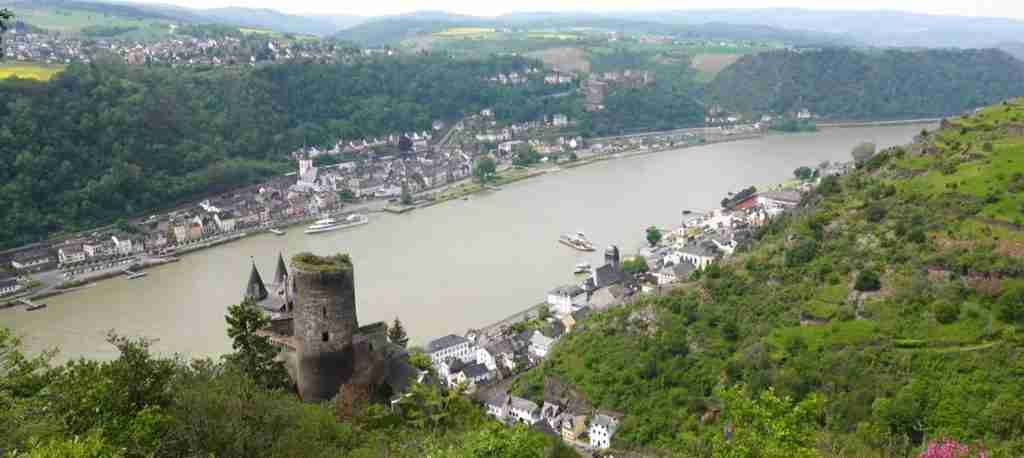
St. Goarshausen occupies the Rhine’s eastern bank directly below the Lorelei, serving as the primary base for visitors exploring the famous rock. This small town of approximately 1,500 residents sustains an economy heavily dependent on Lorelei-related tourism, with hotels, restaurants, and shops oriented toward visitor needs. The town’s position at the foot of the legendary cliff creates a compressed relationship between settlement and landmark unique along the Rhine.
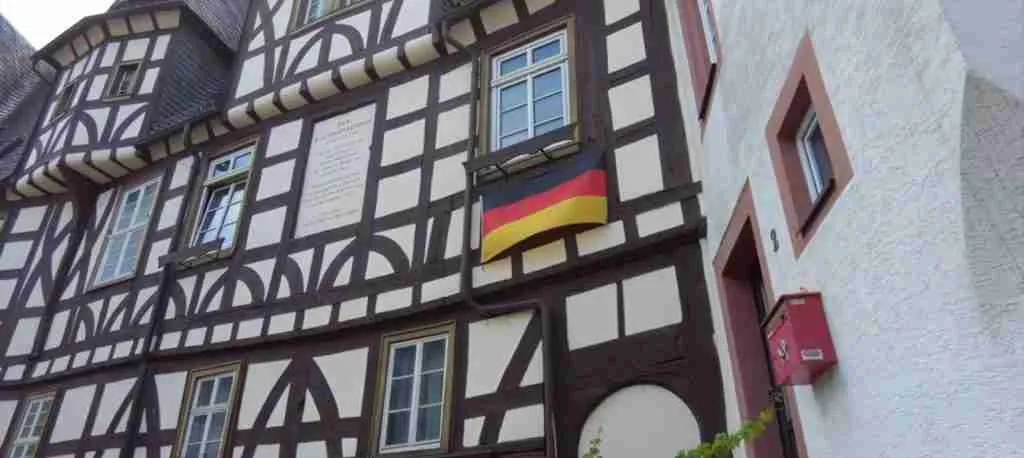
The town center preserves traditional Rhine Valley architecture, with half-timbered buildings lining narrow streets that predate automobile traffic. The waterfront promenade provides pleasant walking with views across the river toward St. Goar on the opposite bank, where twin towers of the ruined Rheinfels Castle dominate the skyline. Ferry services connect the two towns, enabling visitors to explore both banks without requiring lengthy detours to the nearest bridges.
Burg Katz, a castle ruin perched on the hillside above St. Goarshausen, provides an additional attraction beyond the Lorelei itself. The castle’s position allowed medieval lords to control river traffic in coordination with Rheinfels Castle across the water, creating a toll barrier that extracted payments from passing merchants. The castle remains in private ownership and is not open to general visitors, though its silhouette contributes significantly to the townscape and photography opportunities.
Accommodations in St. Goarshausen range from traditional guesthouses to larger hotels capable of receiving tour groups. Staying overnight allows experiencing the Lorelei at different times of day, including dawn and dusk when lighting conditions transform the cliff’s appearance and reduce visitor congestion at the summit. The town’s restaurants serve regional specialties alongside international options, with Rhine wines featured prominently on most menus.
The Rhine Romantics: Artists and Writers
The Lorelei’s cultural significance extends far beyond Heine’s famous poem to encompass a broad artistic movement that transformed the Rhine Valley into symbolic landscape resonating throughout Western culture. The Rhine Romantics, active primarily during the early 19th century, invested the river and its gorge with meanings that influenced literature, music, visual arts, and popular consciousness for generations.
English artists and writers contributed significantly to establishing the Rhine’s Romantic reputation. J.M.W. Turner painted multiple Rhine scenes during visits in 1817 and 1840, his atmospheric canvases capturing the valley’s dramatic qualities in ways that circulated through exhibitions and reproductions. Lord Byron set portions of “Childe Harold’s Pilgrimage” along the Rhine, introducing British readers to landscapes they might experience through emerging steamship tourism.
German composers found operatic and symphonic inspiration in Rhine landscapes and legends. Richard Wagner drew extensively on Rhine mythology for his “Ring” cycle, with the Rhinemaidens who guard the cursed gold representing water spirits analogous to the Lorelei. Robert Schumann composed his “Rhenish Symphony” after relocating to Düsseldorf, incorporating the river’s character into musical structure. The Lorelei legend itself inspired dozens of musical settings beyond Silcher’s famous version.
Visual artists produced countless images of the Lorelei and surrounding gorge, establishing iconographic conventions that persist in contemporary representations. The standard composition positions the viewer on the river looking upstream toward the cliff, with a small boat and sometimes the legendary maiden visible. This framing, repeated through paintings, prints, postcards, and eventually photographs, created visual expectations that actual visitors measure against experienced reality.
Photography at the Lorelei
The Lorelei presents photographic challenges and opportunities that reward thoughtful planning and flexible approaches. The site’s fame generates expectations shaped by centuries of artistic representation, while actual conditions often diverge from idealized imagery. Understanding light, weather, and positioning options helps photographers capture compelling images rather than disappointing snapshots.
Summit viewpoints offer the most comprehensive perspectives but present technical challenges including extreme contrast between sky and shadowed gorge, distant subjects that test lens capabilities, and atmospheric haze that varies unpredictably with weather conditions. Morning light from the east illuminates the river valley while leaving the western slopes in shadow; afternoon and evening light reverses this pattern. Overcast conditions reduce contrast problems while muting the dramatic lighting that can produce the most striking images.
The cliff edge viewpoint directly above the famous rock face enables dramatic compositions emphasizing height and verticality. Wide-angle lenses exaggerate the vertiginous perspective, while telephoto options can isolate passing vessels against the water surface far below. Timing shots to capture vessels in the narrow passage requires patience, as traffic intervals vary unpredictably and optimal positioning may require waiting through several unsuitable subjects.
River-level photography captures the Lorelei statue with the cliff rising behind, an iconic composition that challenges execution. The statue faces the river, meaning photographs from the shore capture her back or profile rather than the frontal view familiar from publicity images. Boat-based photography provides the traditional perspective but introduces motion, vibration, and limited positioning flexibility. Passengers on commercial vessels have only seconds as ships pass the optimal position.
The surrounding gorge landscape provides endless alternative subjects, including castle ruins, vineyard patterns, river traffic, and traditional architecture in St. Goarshausen and other valley towns. These elements can supplement or substitute for Lorelei-specific imagery, particularly when weather, crowds, or timing compromise primary targets. The UNESCO designation reflects landscape qualities extending far beyond the famous rock.
Hiking the Rheinsteig
The Rheinsteig long-distance hiking trail passes directly through the Lorelei area, offering opportunities to incorporate the famous site into more extensive walking explorations of the Rhine Gorge. This 320-kilometer trail connects Wiesbaden in the south with Bonn in the north, traversing the eastern bank of the Rhine through the most dramatic gorge scenery. The Lorelei section ranks among the trail’s highlights, combining natural beauty with cultural significance.
The trail reaches the Lorelei summit from both north and south, enabling hikers to choose approaches based on starting points and itinerary preferences. The southern approach from Kaub follows ridge lines with intermittent viewpoints before descending toward the famous cliff. The northern approach from St. Goarshausen climbs directly to the summit before continuing along the plateau edge toward Kestert.
Day hiking options allow Lorelei visits without committing to the entire Rheinsteig. The circuit from St. Goarshausen to the summit and back takes approximately two to three hours depending on time spent at viewpoints and visitor facilities. Extended loops can incorporate Burg Katz, additional viewpoints, and connections to the parallel Rheinburgenweg trail along the ridge crest.
Trail conditions vary seasonally, with some sections becoming muddy or slippery during wet periods. Summer hikers should carry water, as facilities along the trail are limited between major stopping points. The steep ascents and descents characterizing Rhine Gorge trails demand reasonable fitness, though the well-maintained paths present no technical difficulties for experienced walkers.
Wine Villages and Cultural Exploration
The Lorelei area sits within the Mittelrhein wine region, one of Germany’s smaller and lesser-known wine areas producing distinctive wines from challenging terrain. The steep hillsides visible from the Lorelei summit support vineyard cultivation similar to the more famous Rheingau downstream, though production volumes and international recognition lag behind that prestigious neighbor.
Bacharach, located approximately 10 kilometers upstream from St. Goarshausen, represents the best-preserved medieval town in the Rhine Gorge and provides an essential complement to Lorelei visits. The town’s half-timbered architecture, defensive walls, and ruined chapel overlooking the Rhine create atmospheric settings for exploring regional history and sampling local wines. Wine estates in Bacharach welcome visitors for tastings, often in historic cellar settings.
Oberwesel, positioned between Bacharach and the Lorelei, preserves substantial sections of its medieval town walls and boasts an imposing Gothic church whose tower serves as a landmark throughout the surrounding valley. The town’s compact center allows easy exploration on foot, with wine taverns and restaurants concentrated near the riverside and church.
St. Goar, the twin town facing St. Goarshausen across the Rhine, merits inclusion in any thorough Lorelei-area exploration. The ruined Rheinfels Castle above the town ranks among the gorge’s largest fortification complexes, with extensive underground passages and panoramic viewpoints. Ferry services connect the two towns, making St. Goar easily accessible for visitors based in St. Goarshausen.
Seasonal Considerations and Events
The Lorelei experience varies significantly across seasons, with each period offering distinct advantages and limitations that visitors should consider when planning. Summer brings the largest visitor numbers, longest daylight hours, and best conditions for hiking and outdoor activities. The summit facilities operate extended hours during peak season, and all transportation options function at full capacity.
Spring and autumn provide excellent conditions for visitors prioritizing landscape photography, hiking comfort, and reduced crowds. The gorge’s steep orientation creates dramatic lighting effects during these seasons when the sun’s lower angle generates strong shadows and golden tones. Vineyard colors transform in autumn, adding visual interest beyond the famous rock itself. Some facilities may operate on reduced schedules during shoulder seasons.
Winter visits reveal the gorge’s stark beauty stripped of foliage, with castle ruins and rock formations appearing more prominently against bare hillsides. Snow occasionally blankets the area, creating atmospheric conditions photographers prize despite the physical discomfort. The visitor center and summit facilities may close during winter months, and hiking trails can become treacherous when icy.
The annual “Rhine in Flames” festival illuminates the gorge with fireworks displays during summer evenings, with one major event centered on the Lorelei area. Boats carrying spectators crowd the river while synchronized pyrotechnics transform the cliff faces into cascading light displays. Accommodations book far in advance for festival dates, and the concentrated crowds may deter visitors preferring quieter experiences.
Practical Navigation and Transportation
Reaching the Lorelei involves choices between rail, road, and river transportation, each with distinct characteristics affecting the overall experience. The left bank railway line, following the river through the gorge, provides frequent services connecting St. Goar with major cities including Koblenz and Mainz. St. Goarshausen, on the opposite bank, is reached via ferry from St. Goar or by circuitous road routes.
River cruise passengers experience the Lorelei without transportation concerns, as ships pass directly beneath the cliff while narration explains the legendary associations. This approach provides the classic river perspective but limits time for summit exploration unless the itinerary includes a shore excursion. Day cruises from various Rhine ports include the Lorelei passage as a highlight.
Road approaches reach the area via the B9 highway following the left bank or the B42 on the right bank, both scenic routes passing through gorge towns and offering frequent viewpoints. Parking in St. Goarshausen and at the summit allows flexibility for visitors with vehicles. The road to the summit plateau approaches from inland rather than following the cliff edge.
Combining transportation modes often produces the most satisfying visits. Arriving by rail or road allows summit exploration before descending to catch a river cruise through the narrows, experiencing both perspectives in a single visit. Ferry connections between St. Goar and St. Goarshausen enable exploration of both river banks without requiring vehicle repositioning.
Conservation and UNESCO Heritage Status
The UNESCO World Heritage inscription protecting the Upper Middle Rhine Valley imposes preservation obligations affecting the Lorelei and surrounding communities. The designation, awarded in 2002, recognizes the valley’s outstanding universal value based on scenic qualities, historical significance, and cultural associations that developed over two millennia. Protection measures seek to maintain the landscape character that justified inscription while accommodating ongoing human activity.
The vineyard landscape faces particular conservation challenges as traditional viticulture struggles against economic pressures favoring larger, mechanizable operations. The steep Mittelrhein slopes require entirely manual cultivation, generating labor costs that local wine prices often cannot recover. Abandoned vineyard sections revert to scrub vegetation, altering the landscape character that UNESCO recognition aims to preserve. Support programs and marketing initiatives attempt to maintain economically viable viticulture.
Tourism management balances economic dependence against impacts on the landscape and communities the heritage designation protects. The Lorelei attracts visitor numbers potentially threatening the site’s character through overdevelopment, congestion, and commercialization. Planning regulations restrict construction and alterations within the heritage zone, though pressures for tourist-oriented development persist.
Climate change presents both immediate and longer-term concerns for the heritage landscape. Extreme weather events, including the devastating 2021 floods that struck communities throughout the Rhine watershed, demonstrate the river’s continued capacity for destructive power. Longer-term climate shifts may alter the viticultural conditions that shaped the traditional landscape, potentially requiring adaptation measures that transform rather than preserve historical character.
FAQ: Essential Questions About the Lorelei
Is the Lorelei legend based on actual events?
The Lorelei legend originated as a literary creation during the early 19th century Romantic movement, with no historical foundation in actual events or persons. Clemens Brentano invented the character for his 1801 ballad, and Heinrich Heine established the iconic version in 1824. The legend drew on genuine folk beliefs about water spirits and reflected the dangerous navigational conditions at the narrows, but the specific story of the singing maiden was entirely fictional.
How dangerous is the Lorelei passage for modern vessels?
Modern navigation aids, channel improvements, and professional piloting have eliminated most historical hazards at the Lorelei narrows. Commercial vessels still employ specialized Rhine pilots with specific certifications for this section, and the passage demands attention due to the narrow channel and strong currents. However, the wrecks that earned the site its fearsome reputation occurred before 19th-century engineering improvements removed the most dangerous submerged rocks.
How much time should visitors allow for the Lorelei?
A focused visit covering the summit viewpoints and visitor center requires two to three hours, including the hiking ascent from St. Goarshausen or a shorter visit arriving by vehicle. Combining summit exploration with the waterside statue and potentially a river cruise passage expands the visit to a half-day or longer. Visitors incorporating Lorelei into broader Rhine Gorge exploration should plan full-day or multi-day itineraries.
What is the relationship between the Lorelei and nearby castles?
The castles visible from the Lorelei summit represent medieval toll fortifications positioned to control river traffic through the gorge. The dangerous conditions at the Lorelei narrows made this stretch particularly valuable for toll collection, as vessels were forced into predictable paths through the constricted channel. Burg Katz above St. Goarshausen and Rheinfels Castle across the river in St. Goar formed a coordinated toll barrier at the famous passage.
Can visitors hear the famous Lorelei echo?
The acoustic properties that contributed to the Lorelei’s mysterious reputation remain demonstrable, though modern traffic noise often obscures the effect. The curved cliff face reflects and amplifies sounds, creating echoes that early travelers attributed to supernatural sources. Visitors at the waterside during quiet periods may experience the phenomenon, though expectations formed by legendary descriptions often exceed actual acoustic experiences.
What facilities are available at the summit?
The summit area includes a modern visitor center with exhibits on natural and cultural history, viewing platforms at multiple locations along the cliff edge, a summer theater venue for open-air performances, restaurants and cafes, and souvenir facilities. Parking accommodates visitors arriving by vehicle, and restroom facilities serve the touring public. Operating hours and available services vary seasonally.
Is the Lorelei accessible for visitors with mobility limitations?
Vehicle access reaches the summit plateau via an inland road, enabling visitors unable to make the hiking ascent to reach the main viewpoints and facilities. The visitor center and primary terrace viewing area accommodate wheelchair users and those with limited mobility. The more dramatic cliff edge viewpoints involve terrain that may challenge some visitors, though the accessible areas provide satisfying experiences for most purposes.
What other attractions should visitors combine with the Lorelei?
The UNESCO World Heritage Rhine Gorge extends 65 kilometers and contains numerous worthy attractions beyond the Lorelei. Bacharach provides exceptional medieval architecture and wine-tasting opportunities. Rheinfels Castle in St. Goar ranks among the gorge’s largest fortification complexes. The Marksburg Castle near Koblenz is the only Rhine fortress never destroyed. Rüdesheim offers concentrated tourism facilities at the gorge’s southern end.
What are the best conditions for photography at the Lorelei?
Photography conditions vary with weather, time of day, and seasonal factors. Morning light from the east illuminates the river valley while afternoon light favors different perspectives. Overcast conditions reduce harsh contrast between bright sky and shadowed gorge. Autumn provides colorful vineyard foliage, while winter reveals stark rock formations typically obscured by vegetation. River-level photography from boats captures classic perspectives unavailable from shore.
How does the Lorelei connect to other Rhine Valley UNESCO sites?
The Lorelei occupies the center of the UNESCO World Heritage Upper Middle Rhine Valley, a single designation covering the 65-kilometer gorge between Koblenz and Rüdesheim. This heritage area connects to other Rhine-related UNESCO sites including the Roman monuments of nearby Trier and the cathedral cities along the lower Rhine. The river itself serves as a cultural corridor linking these heritage concentrations.