Livorno Best Tours & Walking Routes 2026: Secret Spots & Lesser-Known Treasures
Livorno sits at the heart of the Tuscan coast, yet most visitors who dock here board a coach straight to Pisa or Florence and never set foot in the city itself. That is a significant missed opportunity. Beneath the working port, a network of Medici canals, multicultural streets, free fortresses turned public gardens, and one of Italy’s most distinct local cultures waits for the traveler willing to stay. This guide covers every major tour type, three detailed self-guided walking routes, and the lesser-known spots that first-time visitors consistently overlook in 2026.
Key Takeaways
- Canal boat tours navigate the Fossi Medicei — the historic Medici canal network — for €15 per adult aboard the Battello Marco Polo; the Venezia Nuova gondola tour runs the same price for a shorter, more intimate 35-minute experience on a Venetian-style sandalo.
- Guided city walking tours start from approximately €45–50 per person for a two-hour exploration of the historic center, and are available through platforms such as GetYourGuide and Viator (check current EUR rates before booking, as prices are listed in local currency or USD depending on your region). Check official sites for current rates as pricing may vary.
- The Fortezza Nuova (New Fortress), attributed to Bernardo Buontalenti and Don Giovanni de’ Medici in the late sixteenth century, is entirely free to enter as a public park and garden, making it Livorno’s best no-cost hidden gem.
- The Montenero funicular connects the city to the hilltop Sanctuary of Montenero for a single standard urban bus ticket of €1.50, valid 70 minutes — one of Italy’s best-value heritage rides.
- Summer 2026 brings the Effetto Venezia festival (late July to early August) to the Venezia Nuova quarter and Fortezza Nuova, along with an open-air cinema program running from late June through summer at €3.50–€6 per screening.
- Via della Madonna — known locally as the street of the three churches — concentrates Armenian, Greek Orthodox, and Catholic places of worship on a single historic street, a direct legacy of the Leggi Livornine (1593) that established Livorno as one of Europe’s most religiously tolerant cities.
People Also Ask About Livorno Tours and Walking Routes 2026
What are the best guided tours available in Livorno in 2026?
The most popular guided experiences in Livorno in 2026 fall into three categories. Canal boat tours on the Medici canals offer a one-hour narrated journey for €15 per adult, departing from the Porto Mediceo entrance (in front of the Quattro Mori monument) or from Scali del Monte Pio in the Venezia quarter; audioguides in English, Spanish, French, and German are available for an additional €2. Street food walking tours run approximately three hours and cost around €60–70 per person, covering the Mercato delle Vettovaglie and the city’s best cecina, 5e5, and cacciucco. For cruise passengers with limited time, a two-hour licensed walking tour of the historic center — starting at Piazza della Repubblica, moving through the Fortezza Vecchia precinct, and ending in Venezia Nuova — provides an efficient introduction; these begin from roughly €45–50 per person through GetYourGuide or Viator. Private and custom tours are available through platforms such as ToursByLocals, where local guides tailor itineraries by interest and pace.
How much does a canal boat tour in Livorno cost in 2026?
The Battello Marco Polo operated by LivornoinBattello charges €15 per adult for a guided canal tour of approximately one hour, covering the full Medici canal network. Youth passengers (up to 150 cm in height) pay €7, and children up to 100 cm travel free. An audioguide in English, Spanish, French, or German is available for a supplementary €2 per person. A shorter alternative — the sandalo veneziano (Venetian gondola-style) tour run by LivornoTour — also costs €15 per person for roughly 35 minutes on a smaller, more intimate craft limited to eight passengers, with a minimum booking of four people. Both operators depart from the Venezia Nuova quarter and require advance booking in peak season; the LivornoinBattello timetable is published at livornoinbattello.it with online ticket purchase. Always verify current prices on the official sites before arrival, as rates can be adjusted seasonally.
What hidden spots should first-time visitors explore in Livorno in 2026?
Three spots consistently surprise first-time visitors who venture beyond the cruise bus routes. The Fortezza Nuova — a late-sixteenth-century Medici fortress attributed to Bernardo Buontalenti and Don Giovanni de’ Medici — is now a free public park of 44,000 square metres, with panoramic walls, summer concerts, open-air cinema, and a café-bistrot nestled inside its ancient arched rooms; most tourists who pass Livorno never walk through its gates. The second is Via della Madonna, the stretch of road also called the street of the three churches: within a few hundred metres, an Armenian church, a Greek Orthodox church, and a Catholic church stand in sequence, a living record of the religious tolerance encoded in the Leggi Livornine of 1593. Third is the city’s underground: the barrel-vaulted fishing cellars (cantine) built directly onto the canal banks of Venezia Nuova can be glimpsed from the water on a boat tour and explored in some cases at street level — these hidden rooms are where the fish merchants of the great trading families stored their catch for centuries.
How do cruise passengers get from Livorno port to the city’s main walking routes in 2026?
Cruise ships dock at the Porto di Livorno terminal, which lies outside the walkable city center. The most direct option is the PortoLivorno2000 cruise shuttle bus, which runs between the terminal and the city center (typically Via Cogorano, near Piazza della Repubblica); check ticket pricing when boarding, as shuttle costs can apply depending on your ship and berth assignment. From the city center drop-off, the main walking routes begin immediately: the Fortezza Vecchia, the Quattro Mori monument at Piazza Micheli, the entrance to the Venezia Nuova canal quarter, and the Mercato delle Vettovaglie are all within a ten-minute walk of each other. Taxis and rideshare services are also available at the terminal. Walking tour operators and canal boat tours use meeting points in or near Piazza della Repubblica and Piazza Micheli, so confirm your exact meeting point when booking; most tour listings specify whether port pickup is included in the price or whether you must reach the meeting point independently.
Extended multi-day tours – 5+ days
Featured Tuscany Multi-Day Tour Packages

4 days
The Best of Tuscany: Florence, Chianti & Cinque Terre Escape | 4 Days
- ✓ Comprehensive Tuscany tour
- ✓ Expert local guides included
- ✓ All accommodation arranged
- ✓ Transportation provided
3 days
Taste of Tuscany: A San Gimignano Wine Escape | 3 Days
- ✓ Booking needs min. 2 travelers

7 days
Tuscany to Cinque Terre: Wines, Villages & Unforgettable Walks
- ✓ Comprehensive Tuscany tour
- ✓ Expert local guides included
- ✓ All accommodation arranged
- ✓ Transportation provided

5 days
5 Day Tuscan Food & Wine Tour Package
- ✓ Comprehensive Tuscany tour
- ✓ Expert local guides included
- ✓ All accommodation arranged
- ✓ Transportation provided
Multi-day tour packages powered by TourRadar. Prices and availability subject to change.
Introduction: Why Livorno Rewards the Traveler Who Stays
Livorno is often described as the city that Tuscany tourists pass through. On any given cruise stop, the coaches queue up outside the terminal and the passengers file efficiently toward Pisa’s Leaning Tower or Florence’s Duomo, leaving the port city itself largely unexamined. That pattern is understandable — Tuscany’s canonical destinations are magnificent — but it comes at a real cost. The traveler who stays in Livorno, even for an afternoon, finds a city that is unlike anywhere else in the region.
The key to understanding Livorno is a document issued in 1593. The Leggi Livornine — the “Livorno Laws” — were a set of edicts issued by Grand Duke Ferdinando I de’ Medici that established the city as a free port open to merchants, practitioners, and communities of all faiths. Jews, Muslims, Greeks, Armenians, English Protestant merchants, Dutch traders, and numerous other groups settled here under guarantees of religious freedom and legal protection that were almost unparalleled in late-Renaissance Europe. The multicultural legacy of those laws is still physically legible in the city today: on Via della Madonna, known locally as the street of the three churches, an Armenian apostolic church, a Greek Orthodox church, and a Catholic church stand within a few hundred metres of each other. The Jewish quarter nearby contains a monumental neo-Moorish synagogue, reconstructed after wartime damage, that testifies to a community with centuries of continuous presence. The Dutch church — now known as the Tempio della Graziana or “Dutch church” — adds yet another layer to the religious geography of a city that was, for much of the seventeenth and eighteenth centuries, one of the most cosmopolitan ports in the Mediterranean.
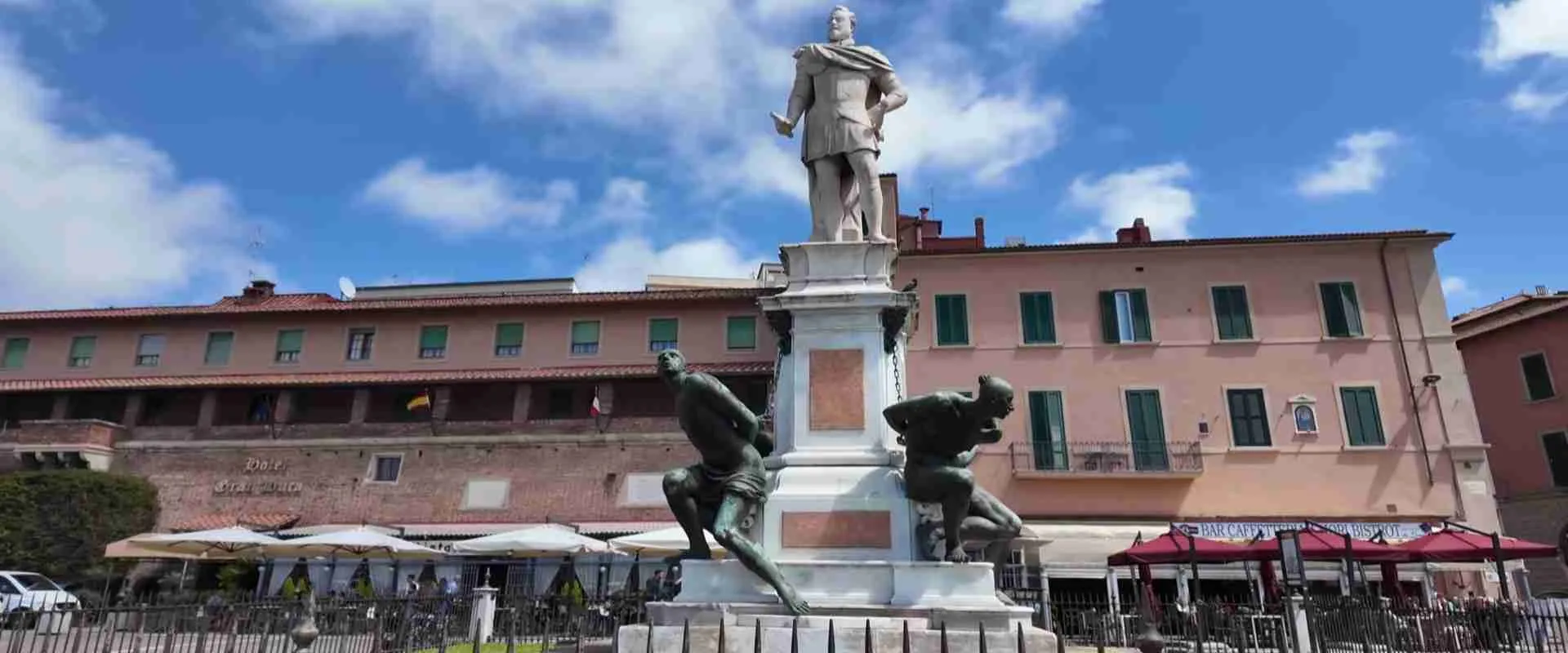
None of this history is visible from the window of a coach heading north to Pisa. To read it, you have to walk — through the canal quarter, down the street of the three churches, out to the harbor entrance where the Quattro Mori monument stands at the threshold between the city and the sea. The four chained bronze figures at the base of that monument — sculpted by Pietro Tacca between 1623 and 1626 — are perhaps the finest pieces of public sculpture in Tuscany outside Florence, and yet many visitors to the region have never heard of them.
What this guide offers is a practical toolkit for spending meaningful time in Livorno in 2026: the full range of guided tours available, three detailed self-guided walking routes with distances and timings, the secret spots that trip-planning guides routinely overlook, and the practical information needed to book everything from a canal boat ride to a shore excursion to Florence. Whether you are a cruise passenger with three hours to spare, an independent traveler spending a day or two, or someone who has been to Livorno before and wants to go deeper, the following sections cover everything you need.
Understanding What Makes Livorno Different
Livorno is a labronica city — a word derived from the ancient name Labron or Labrone that inhabitants use to describe everything particular about this place and its culture. There is a dry, self-aware wit in Livornese humor, a deliberate pride in being working-class and port-facing rather than artistic and Renaissance-facing. Livorno was built quickly, as a planned city, from the late sixteenth century onward, rather than accumulating its character over the medieval centuries as most Tuscan cities did. There is no medieval center in the sense of a winding old-town core; the plan is Renaissance and Baroque, gridded around a canal network modeled loosely on Venice’s.
That canal network — the Fossi Medicei — is the single most distinctive physical feature of the city. The canals connect the Medici harbor to the interior of the urban fabric, passing under bridges and palazzo facades and beneath the extraordinary Piazza della Repubblica, a bridge-piazza that one of the longest of its kind in Europe; sources give different measurements for its width, with figures ranging from 220 to 242 metres cited by different local operators, though the underlying claim — that it is an unusually wide covered crossing — is evident to anyone who walks beneath it. The canal system served commercial purposes for centuries, allowing goods from incoming ships to be distributed directly to the merchants’ warehouses (cantine) that opened onto the water in the Venezia Nuova quarter. Today the cantine are still there, mostly repurposed, but visible from the water and from the canal-side paths.
The food culture is equally distinctive. Livorno is the birthplace of cacciucco, the robust saffron-and-tomato fish stew that is arguably the most important dish in the Tuscan coastal repertoire, and the city is also responsible for cecina (a thick chickpea flatbread baked in a wood-fired oven) and 5 e 5 — the beloved street snack in which cecina is stuffed into a roll. The ponce alla livornese, a coffee spiked with rum and served with a lemon rind, is the city’s signature drink, available at virtually every bar. These are not secondary tourist offerings; they are the real daily food of Livorno, and encountering them in the Mercato delle Vettovaglie — the massive covered market near the canal — or on a street food walking tour is a more authentically Tuscan experience than most of what a visitor can find in better-known destinations.
Best Guided Tours in Livorno 2026
Livorno in 2026 offers a well-developed range of guided experiences, from brief city walks to half-day food-and-culture immersions. The tour landscape has grown significantly as the city attracts increasing attention from independent travelers who choose to explore rather than transit. Below is a category-by-category overview of the main options.
City Walking Tours in Livorno 2026
The standard licensed walking tour of Livorno runs approximately two hours and covers the city’s most important historic sites in a logical sequence. A typical route begins at Piazza della Repubblica, moves along the canal toward the Fortezza Vecchia (Old Fortress) and Piazza Micheli, passes the Quattro Mori monument and the Porto Mediceo entrance, then winds through the Venezia Nuova canal quarter before ending at the Mercato delle Vettovaglie or the entrance to Fortezza Nuova. These tours are operated by licensed local guides and typically accommodate groups of up to fifteen people. Prices start from approximately €45–50 per person for a shared group tour; private walking tours cost more but allow complete flexibility of pace and route. Both GetYourGuide and Viator list multiple operators; verify current EUR prices on each platform before booking, as prices on international platforms may initially be displayed in USD. Most operators offer 24-hour free cancellation, which is worth using as rain can affect the experience considerably.
Several walking tour operators specifically focus on the hidden and lesser-known aspects of the city. One operator listed on GetYourGuide markets itself as “Secret Livorno: A Walking Journey Through History, Canals, and Legends” and prices from approximately €45–50 per person for a two-to-three-hour walk. The Venezia Nuova district is typically included, along with the canal-side facades, the underground cantine, and the story of the city’s mercantile families. Guides who are licensed by the Italian Ministry of Tourism are clearly identifiable; check listings for this credential, particularly for shore excursion tours where regulatory compliance is important.
A cultural association based in Livorno also offers a free-donation walking experience for small groups of two to six people. This is not a licensed guiding service and focuses on personal connection and local knowledge rather than formal historical commentary. The group operates by prior contact and welcomes visitors who want to understand the city through the eyes of someone who lives there. Reviews describe the experience as genuinely warm and informative, particularly for travelers spending more than a day in the city.
Medici Canal Boat Tours in Livorno 2026
Canal boat tours are Livorno’s most distinctive guided experience and the one that consistently receives the highest traveler satisfaction ratings. Two main operators run regular departures.
LivornoinBattello (also operating as LivornobyBoat) runs the Battello Marco Polo service on the full network of the Medici canals. Adult tickets cost €15 for a tour of approximately one hour; youth passengers up to 150 cm in height pay €7, and children up to 100 cm travel free. An audioguide in English, Spanish, French, or German is available for an additional €2 per person — worth taking if you are not joining a tour with a live Italian-language guide. Departures operate from two embarkation points: Imbarco A, at the entrance to the Porto Mediceo facing the Quattro Mori monument, and Imbarco V, at the Scali del Monte Pio in the Venezia quarter. The full schedule and online ticket purchase are available at livornoinbattello.it. Book ahead in high summer (July and August) as departures fill quickly, particularly on weekends. The service operates all year but with reduced frequency in December, January, and February. Check the current rates before arrival as pricing may be adjusted seasonally.
The route covers the entire canal network: passing through the barrel-vaulted arch beneath Piazza della Repubblica, skirting the walls of the Fortezza Nuova and the Fortezza Vecchia, gliding past the merchants’ palaces of the Venezia Nuova quarter, and arriving at the Porto Mediceo opposite the Quattro Mori. The canal perspective reveals building foundations, canal-level doorways, and architectural details that are completely invisible from the street.
LivornoTour offers an alternative experience using a sandalo veneziano — a Venetian-style rowing boat carrying a maximum of eight passengers. At €15 per person for approximately 35 minutes, this is a shorter and more intimate option, best suited to small groups. The minimum booking is four people. Departures are typically in the late afternoon and operate from the Venezia Nuova quarter. Contact the operator directly for availability and scheduling, as the sandalo schedule varies by season and availability.
Street Food and Market Tours in Livorno 2026
Livorno’s street food scene is one of the most authentically regional in Tuscany, and several operators have built tour programs specifically around it. The standard street food walking tour runs approximately three hours and typically starts near the Mercato delle Vettovaglie (the Central Market) or Via Cogorano. Tastings typically include cecina from the wood-fired oven, a 5e5 roll assembled fresh at a market stall, fresh seafood, aged cheeses, and a glass of local wine or a ponce alla livornese at a historic bar. Prices run approximately €60–70 per person, inclusive of all food and drink tastings; verify current EUR rates on GetYourGuide or Viator before booking. Reviews consistently highlight the guides as knowledgeable storytellers who connect food to the city’s multicultural history.
The Mercato delle Vettovaglie itself is worth visiting independently even outside a tour. The market occupies a substantial nineteenth-century iron-and-glass structure near the canal and is commonly described by local sources as one of the largest covered markets in the region. The morning hours (roughly 7:00–13:00 on weekdays, check seasonal hours before visiting) are the most lively and the most representative of daily labronica life. You will find vendors selling the full range of Livornese specialties alongside conventional market produce, and the atmosphere is unhurried and genuinely local.
Cooking Classes and Hands-On Experiences in Livorno 2026
Hands-on food experiences in Livorno tend to take place in private homes or small teaching kitchens in the Venezia Nuova district. A pasta-making class running approximately 105 minutes — during which participants prepare fresh pappardelle by hand with guidance from a local expert — is listed on GetYourGuide from approximately €70–75 per person, inclusive of the meal and a glass of prosecco and wine. A more comprehensive private cooking class at a local home (approximately three hours, ending with a shared meal paired with regional wine) is available from around €150–165 per person; this format is best suited to small groups or couples. Both formats require advance booking; availability at short notice is limited. Cooking classes specifically focused on cacciucco — the signature fish stew — are also occasionally available; search current GetYourGuide and Viator listings for the latest offerings, as specific experiences are added and updated seasonally.
Private and Small-Group Tours in Livorno 2026
Private tours in Livorno are available through platforms such as ToursByLocals, which connects travelers with local guides for fully customized experiences. A private guide can tailor an itinerary to your specific interests — maritime history, multicultural heritage, street art, food culture, or architectural details — and can adjust timing based on your schedule. Private tours are particularly useful for cruise passengers who need a guaranteed return time, for travelers with mobility considerations requiring a slower pace, and for anyone who finds the standard group walking tour format too rushed to absorb the city’s layered history properly. Guides on ToursByLocals will typically meet at the cruise port or city center on request. Prices for private tours vary significantly by guide, duration, and group size; budget approximately €150–300 for a half-day private experience for two people, though ranges differ.
Shore Excursions and Day Trips by Coach from Livorno 2026
The majority of tour activity marketed from Livorno is actually shore excursion transport to other Tuscan destinations. A day trip by air-conditioned coach to Florence and Pisa — Livorno’s dominant shore excursion product — starts from approximately €38–50 per person for a combined eight-hour day including transfers and free time in both cities; upgrades for a licensed walking tour guide or Accademia Gallery tickets add to this price. Pisa-only excursions run approximately four hours and start from around €19–35 per person depending on whether a guided tour of the Piazza dei Miracoli and optional Leaning Tower tickets are included.
Lucca and Pisa combined tours start from approximately €40–50 per person for full-day access to both walled cities. Cinque Terre excursions (Manarola or the full five-village ferry circuit) are available from around €70–82 per person for a full day including Pisa as a first stop. All shore excursion prices should be confirmed against current EUR listings on GetYourGuide or Viator, as pricing is dynamic and early-booking discounts of 10–15% are frequently available for tours booked more than two weeks ahead.
Top Self-Guided Walking Routes in Livorno 2026
Livorno’s compact historic center makes it an excellent city for independent exploration on foot. The three routes below each take between 60 and 90 minutes at a relaxed pace and can be extended or combined. All starting points are reachable on foot from the cruise shuttle bus drop-off at Via Cogorano near Piazza della Repubblica, or from the city’s main train station (Livorno Centrale, approximately 10–15 minutes’ walk from the city center).
Route 1: The Fortresses and Port Circuit (90 minutes)
This route links the two Medici fortresses with the harbor entrance and the Venezia Nuova canal quarter, covering the widest range of Livorno’s heritage in a single walk. Begin at Piazza della Repubblica, the massive bridge-piazza that stretches above the canal network. Walk south toward the water to reach Piazza Micheli, where the Quattro Mori monument stands at the entrance to the Porto Mediceo. Take time to examine the monument closely: the upper marble statue of Grand Duke Ferdinando I de’ Medici is the work of sculptor Giovanni Bandini (completed around 1599, installed here in 1617), while the four chained bronze figures at the base are by Pietro Tacca, student of Giambologna, and were cast and installed in two phases between 1623 and 1626. The realism and psychological intensity of the Moors — four enslaved men depicted in four different postures of dignified suffering — represent some of the finest bronze work in early Baroque Italian sculpture. There is a local legend that from one specific spot in the piazza, you can see the nose of all four Moors simultaneously; finding that point is traditionally said to bring good luck.
From Piazza Micheli, follow the water’s edge to reach the entrance of the Fortezza Vecchia (Old Fortress), the older of the two Medici fortifications, which guards the harbor and today hosts summer concerts and cultural events managed by the Port Authority. The fortress is not always accessible for interior tours but is impressive from outside, particularly from the canal-side path. Continue along the canal — where you may see the LivornoinBattello boat emerging from or entering the tunnel beneath Piazza della Repubblica — through the Venezia Nuova quarter. Here the canal-side palazzi built for European merchant families in the seventeenth and eighteenth centuries line both banks; the architecture at water level is quite different from street level, full of blocked doorways, iron rings, and loading platforms. The route ends at the entrance to Fortezza Nuova (see the Secret Spots section for full details), where you can enter the free public park and walk the rampart walls for panoramic views over the canal network and toward the sea.
Route 2: The Multicultural Heritage Walk (60–75 minutes)
This shorter route focuses specifically on the religious and cultural plurality of Livorno that derives from the Leggi Livornine of 1593. Begin at Piazza Grande (also known as Piazza del Duomo), where the Cattedrale di San Francesco — Livorno’s cathedral — occupies the central position in the city’s main civic square. The cathedral was heavily damaged during the Second World War and rebuilt; its present form reflects post-war reconstruction rather than original design, but the surrounding piazza retains its seventeenth-century proportions.
From Piazza Grande, follow Via dei Cairoli south and then turn onto Via della Madonna, known locally as the street of the three churches. Walking along this street, you will encounter three places of worship representing three distinct religious communities, each established here as a direct consequence of the Leggi Livornine: the Armenian Apostolic Church of the Annunciation, the Greek Orthodox Church of the Immaculate Conception, and a Catholic church. The Armenian and Greek communities established themselves in Livorno as early as the seventeenth century, making this one of the longest-lived Armenian and Greek diasporic presences in Western Europe. Take time to look at the facades and, where opening hours permit, the interiors.
Continue from Via della Madonna toward the area of the former Jewish quarter, where the Jewish community — given refuge and full civil guarantees under the Leggi Livornine — established an important commercial and cultural life from the late sixteenth century onward. The present-day Synagogue of Livorno on Piazza Benamozegh is a substantial neo-Moorish building that replaced the original seventeenth-century synagogue destroyed in the war. Consult opening hours locally, as they vary. The surrounding streets preserve street names and building fragments that reference the community’s long presence. The walk ends near the Mercato delle Vettovaglie, where the morning market provides an excellent practical conclusion to the cultural itinerary.
Route 3: The Coastal Promenade Route (60 minutes)
Livorno’s seafront offers a completely different register from the canal-and-fortress interior. This route follows the shoreline southward from the city center and is best taken in the late afternoon, when the light off the Tyrrhenian Sea is at its most spectacular. Begin at Terrazza Mascagni, the spectacular checkerboard seafront terrace built in black and white marble paving, named after the Livorno-born composer Pietro Mascagni. The terrace extends along the seafront and forms one of the city’s most distinctive public spaces; it is free and accessible at all hours. From here, the view opens across the Tyrrhenian toward the Tuscan Archipelago, with Gorgona, Capraia, and Elba visible on clear days, and on exceptional days the distant silhouettes of Corsica and even Sardinia appear on the horizon.
The Livorno Aquarium, housed in a historic building adjacent to Terrazza Mascagni, makes a natural stop within this route, particularly for families. Entrance tickets cost approximately €18 per adult (check current rates at the official site or on GetYourGuide, where skip-the-line purchase is available; prices may vary). The aquarium presents Mediterranean marine life across 33 display tanks on two floors, with an observation tunnel, a tactile pool, and exhibits on insects, amphibians, and reptiles on the upper level.
From Terrazza Mascagni, continue south along the seafront to the area of the Villa Fabbricotti, a nineteenth-century villa set within public gardens that also host the Arena Fabbricotti open-air cinema in summer, one of the alternatives to the Fortezza Nuova program. The gardens are free and offer a quiet retreat from the seafront promenade. The route can be retraced on foot or, in summer months, a city bus connection back toward the center is available.
Secret Spots and Hidden Gems to Discover in Livorno 2026
Livorno has a very particular relationship with tourism: the city is frequently listed as a gateway to Florence and Pisa but rarely as a destination in its own right. The result is that several of its most remarkable spaces remain genuinely undervisited, even in the busiest months of the cruise season. The following places consistently appear in reviews from travelers who have looked beyond the surface.
Fortezza Nuova: The Free Medici Garden in Livorno 2026
The Fortezza Nuova is Livorno’s most underrated space and one of the best free cultural destinations in Tuscany. Designed in the late sixteenth century — the official site of the Fortezza Nuova attributes it to Bernardo Buontalenti and Don Giovanni de’ Medici — the fortress was conceived as the inner defensive anchor of the city, distinct from the Fortezza Vecchia that guards the harbor. It sits in the heart of the Venezia Nuova quarter, its red-brick walls rising directly from the surrounding canals, making it visually striking from every approach.
Inside the walls, 44,000 square metres of parkland have been converted into a public garden open to all, free of charge. The Sala degli Archi (Vaulted Rooms Hall) inside the fortress walls is used for book presentations, cultural events, and has a bookshop dedicated to the history of Livorno and the fortress itself. A café-bistrot (Loups Bistrot) operates within the grounds. In summer 2026, the Fortezza Nuova’s program runs from June 5 to September 6 and includes live music concerts, art exhibitions, artisan markets (Fortezza Market Days on selected weekends), and for the first time this year, an open-air cinema program running from late June through summer on Monday to Thursday and Sunday evenings, with screenings at 21:15. Tickets for the cinema cost €3.50 for Italian and European films, and €6 for international titles (reduced to €5). The Effetto Venezia festival, the city’s most beloved summer event, takes place in the last days of July and the first days of August and uses the Fortezza Nuova as one of its main stages.
An immersive historical tour using virtual reality headsets — Back in Time in Fortezza Nuova — is also available by reservation through the Visit Livorno platform (visit-livorno.it). This experience reconstructs the fortress as it appeared in the Medici period, using VR technology combined with a live multilingual guide; it includes access to the rampart walkways and a food and wine tasting at the conclusion. Consult the Visit Livorno platform directly for current pricing and booking, as the experience is bookable as an add-on to various tour packages.
Via della Madonna: The Street of Three Faiths in 2026
Via della Madonna is one of the most unusual streets in all of Tuscany, and it is almost entirely absent from mainstream tourist itineraries. Along a few hundred metres of this quiet street in the center of Livorno stand an Armenian Apostolic church, a Greek Orthodox church, and a Catholic church — three places of worship from three distinct religious traditions, existing in proximity because of the Leggi Livornine that established Livorno as a sanctuary for persecuted and displaced religious communities in 1593. The Armenian community’s church dates from the seventeenth century; the Greek Orthodox community has been present in Livorno for a comparable period, maintaining religious life continuously.
The street is quiet, rarely featured on tourist maps, and almost never crowded. Walking it requires no ticket and no guide, though the context makes considerably more sense if approached after visiting or reading about the Medici port history. The interiors of the churches, when open, are modest but historically significant; the Armenian church in particular contains devotional art reflecting the long cultural continuity of the Armenian diaspora in Italy. The broader Livorno tradition of hosting the Dutch reformed community (the Tempio della Graziana, known as the Dutch church) and a substantial Jewish community further enriches the neighborhood context.
The Cantine of Venezia Nuova in 2026
The cantine are the hidden rooms of Livorno’s canal quarter. Built directly onto the canal banks of the Venezia Nuova, these low, barrel-vaulted spaces opened at water level into the canals, functioning as the storage and loading facilities for the merchant families whose palaces rose above them. The fish merchants, grain traders, and general importers who dominated Livorno’s commerce in the seventeenth and eighteenth centuries conducted much of their actual trade through these spaces, receiving goods directly from boats at the canal-level doors. Most cantine have been repurposed or closed in the intervening centuries, but their presence remains visible: from a canal boat tour, the water-level openings are clearly visible beneath palazzo facades. At street level, some of the old entrances and vaulted interiors survive in adapted form as cellars, stores, or event spaces. The Effetto Venezia festival uses some of these spaces for performances and installations during its annual program in late July and early August.
The Mercato delle Vettovaglie in 2026
The Mercato delle Vettovaglie — Livorno’s Central Market — occupies a large nineteenth-century iron-and-glass structure near the canal network and is commonly cited by local sources as among the most significant covered markets in the region. What makes it distinctive from a visitor’s perspective is not size but authenticity: this is genuinely where local Livornesi shop for daily provisions, and the vendors selling cecina, fresh fish, local pecorino, seasonal produce, and prepared street food are operating for residents rather than tourists. The market is most active on weekday mornings, roughly 7:00–13:00, with reduced activity on Sunday; verify current hours locally before visiting, as the seasonal schedule can vary. Food walking tour operators typically include it as a core tasting stop, but independent visitors can explore equally well: the cecina stalls at the market are excellent, and the 5e5 roll — chickpea flatbread stuffed fresh into a white roll — makes an ideal mid-morning stop for approximately €2–3.
The Four Noses at the Quattro Mori in 2026
The Quattro Mori monument in Piazza Micheli is Livorno’s primary landmark and almost impossible to miss, yet one of its most appealing features is consistently overlooked: local tradition holds that there exists a single specific spot within Piazza Micheli from which the noses of all four bronze Moorish figures are simultaneously visible. Finding this precise point, which requires aligning your position carefully relative to the four figures arranged at the corners of the base, is said to bring good fortune. The spot is not marked; locating it is part of the pleasure. The legend is purely local and well-known to residents, but almost never mentioned in mainstream English-language travel guides. Even visitors who have been to Livorno before and seen the monument often do not know about it. It is the kind of small discovery that converts a monument inspection into a genuine encounter with a living city culture.
Day Trips and Excursions from Livorno 2026
Livorno’s position on the Tuscan coast makes it an effective hub for day trips to several significant destinations, with Pisa and the Montenero Sanctuary being the two that require the least time investment. Florence, Lucca, and Cinque Terre require a longer day but are fully feasible as excursions.
Montenero Sanctuary by Funicular in 2026
The Montenero Sanctuary is the easiest and most accessible half-day excursion from Livorno’s city center, and it costs almost nothing. The Sanctuary of the Madonna delle Grazie sits on the hilltop above Livorno’s southern coastline, reachable either by road or by the historic Montenero funicular — one of the oldest funicular railways in Italy, inaugurated in 1908 and distinguished by being the first in Italy to adopt fully automated operation. The funicular runs from Montenero Basso to Montenero Alto in approximately five minutes. The fare is a standard Livorno urban bus ticket, costing €1.50 (valid 70 minutes from validation). No separate funicular ticket exists; simply purchase a standard urban bus ticket at any tobacconist, at the Autolinee Toscane app, or at ticket machines before boarding and validate it on entry. The funicular operates daily from approximately 07:15 to 20:03; verify the schedule at at-bus.it or autolineetoscane.it before setting out, as individual routes may have service interruptions.
The sanctuary itself rewards a visit for both its architecture and its panoramic situation. The view from the hilltop across Livorno, the Tyrrhenian Sea, and the Tuscan Archipelago is among the finest in the province. On clear days, Gorgona, Capraia, and Elba are distinctly visible; Corsica appears on the clearest days. The sanctuary’s ex-voto gallery — an extraordinary collection of votive offerings accumulated over centuries — is covered in depth in the dedicated evergreen article in this cluster. Entry to the sanctuary is free; modest dress is required inside. Plan approximately one to two hours for the full hilltop visit including the funicular ride each way.
Pisa: The Closest Day Trip from Livorno in 2026
Pisa lies approximately 20–25 kilometres from Livorno and is the obvious first choice for travelers who want to see one of Italy’s major monuments. By train from Livorno Centrale to Pisa Centrale the journey takes roughly 15–20 minutes; regional trains run frequently throughout the day. By coach from the cruise terminal, organized shore excursions run approximately four hours, giving roughly two hours of free time in the Piazza dei Miracoli (Campo dei Miracoli). Organized Pisa excursions from the port start from approximately €19–34 per person depending on whether a licensed guide and Leaning Tower tickets are included; the tower requires a timed-entry reservation, so pre-booking through piazza-dei-miracoli.it or a bundled tour package is advisable in peak season. Independent visitors arriving by train can reach the Piazza dei Miracoli in roughly 15 minutes on foot from Pisa Centrale, or by a city bus. The square is a UNESCO World Heritage Site and contains the Leaning Tower, the Cathedral, the Baptistery, and the Camposanto Monumentale — plan at least two to three hours for a meaningful visit.
Florence and Chianti Wine Country from Livorno in 2026
Florence is approximately 90 kilometres from Livorno by road (roughly 70 minutes by direct coach) and makes an ambitious but very popular full-day excursion. By train, the journey from Livorno Centrale to Firenze Santa Maria Novella takes approximately 1 hour 20 minutes on regional trains, or approximately 1 hour 50 minutes on slower services; Trenitalia schedules can be checked at trenitalia.com. Organized full-day shore excursions combining Florence and Pisa start from approximately €38–50 per person for a coach transfer with free time in both cities; options including a licensed walking tour guide or Accademia Gallery tickets cost more and must be booked in advance, as the Accademia (home of Michelangelo’s David) requires timed-entry reservations that sell out days ahead in summer. Florence itself is an all-day commitment rather than a quick stop; if visiting from Livorno, allocate at least four to five hours in the city to justify the transit time.
Chianti wine country lies between Florence and Siena and is reachable as a half-day or full-day excursion from Livorno with a private guide or minivan tour. Winery visits in the Chianti Classico zone typically include a guided cellar tour and tasting of two to three wines; prices for a combined day excursion from Livorno start from approximately €56 per person for a 1.5-hour winery visit to approximately €180 per person for a small-group full-day tour including Lucca and Pisa. Check GetYourGuide or ToursByLocals for current availability.
Lucca and the Cinque Terre from Livorno in 2026
Lucca is 25 kilometres north of Livorno and reachable by train from Livorno Centrale (approximately 30–40 minutes with a change at Pisa). The walled Renaissance city is covered in depth in the Lucca cluster of this content series and is an excellent half-day destination for travelers spending more than one day in the Livorno area. Organized combined Lucca-and-Pisa excursions from the port cost from approximately €40–50 per person. Cinque Terre — the series of five cliffside fishing villages on the Ligurian coast — is a longer excursion, typically running eight to nine hours from Livorno and including Pisa as a transit stop. Combined Pisa and Manarola (one of the five villages) excursions cost from approximately €70–82 per person; full five-village ferry circuits require additional time and budget. Timed-entry requirements now apply to parts of the Cinque Terre trail network; check with the tour operator or the official Cinque Terre National Park website for current access rules.
How to Book Tours in Livorno 2026
Livorno’s tour ecosystem in 2026 spans several platforms and booking channels, each with different strengths depending on what kind of experience you are seeking. The following guidance covers the most important practical considerations.
Canal Boat Tours: Direct Booking in Livorno 2026
The most reliable and cost-efficient way to book a canal boat tour is through the direct operator websites. LivornoinBattello (livornoinbattello.it) offers online ticket purchase with a live scheduling calendar showing departure times and embarkation point assignments for specific dates. Given that summer departures fill up, particularly on weekends, booking at least three to seven days in advance is advisable from June through September. The website is available in Italian with some English navigation; payment is by credit card or PayPal. If you are unable to book online or prefer to pay in person, arrive at Imbarco A (Porto Mediceo entrance, opposite the Quattro Mori) or Imbarco V (Scali del Monte Pio) at least 15 minutes before the scheduled departure to purchase a ticket at the counter if space remains. Tickets are non-refundable once purchased.
Walking Tours and Private Guides in Livorno 2026
For walking tours and private guides, GetYourGuide (getyourguide.com) and Viator (viator.com) offer the widest selection of verified operators with traveler reviews. Both platforms offer free cancellation on most tours up to 24 hours before the start time, which significantly reduces the risk associated with weather-dependent outdoor walks. When comparing options, look for guides who are listed as licensed by the Italian Ministry of Tourism (autorizzato ai sensi del D.Lgs. 79/2011 or equivalent); this credential matters for the quality of historical commentary and for compliance with local regulations that apply to tours operating near ports and heritage sites. ToursByLocals (toursbylocals.com) is the strongest platform specifically for private custom tours; the profile pages for individual Livorno-based guides include sample itineraries and reviews that help in matching a guide’s focus areas to your interests.
For food tours specifically, the best results consistently come from operators who have a local base in Livorno rather than Florence-based agencies running excursions to Livorno as a secondary market. Look for operators whose meeting point is the Mercato delle Vettovaglie or the central historic area rather than the port shuttle drop-off.
Booking Tips for Cruise Passengers in Livorno 2026
Cruise passengers face specific constraints that require planning. The most important is the guaranteed return time: missing the ship’s departure is a significant problem, and no tour should leave the return-to-port timing to chance. When booking any tour from Livorno as a cruise passenger, confirm the following: that the operator includes port drop-off at the end of the tour (many walking and canal tours do not include this automatically), that the schedule allows at least 45 minutes of buffer before your ship’s scheduled departure, and that the operator has a contact number you can reach in case of delay. Shore excursion operators selling combined Florence-Pisa tours typically offer explicit on-time-back guarantees for this reason.
For those who prefer to explore Livorno itself rather than leaving for other destinations, the combination of an early-morning street food walk through the Mercato delle Vettovaglie, a one-hour canal boat tour, and independent exploration of the Fortezza Nuova fills a full morning comfortably. The Quattro Mori and Fortezza Vecchia can be added to this circuit without significantly extending the time requirement. Total cost for this combination: approximately €15 (canal boat) plus food at the market (budget €10–15) plus the funicular if extending to Montenero (€1.50). The Fortezza Nuova park and the Piazza della Repubblica walk are free.
Seasonal Guide to Touring Livorno in 2026
Livorno’s tour season follows the Mediterranean rhythm, with peak activity in June through September, a quieter shoulder period in April, May, and October, and a reduced but not inactive winter. Understanding the seasonal pattern helps in choosing the right experiences for the right time of year.
Spring and Autumn: Peak Season for Self-Guided Walking in 2026
April, May, September, and October offer the best conditions for walking and outdoor exploration in Livorno. Temperatures are comfortable for extended walks (typically 16–24 °C in spring, 18–25 °C in autumn), the light on the Tyrrhenian is excellent for photography, and the city operates at a calmer pace than during the summer peak. Canal boat departures operate on a standard schedule, walking tour operators are fully active, and the Mercato delle Vettovaglie runs its full weekly program. Spring also brings the annual Tuscany Medieval Festival to Fortezza Nuova (in recent years held in May), an event that fills the fortress with historical reenactors, artisan markets, and live music. Accommodation prices in spring and autumn are generally lower than summer, and the cruise ship calendar is active but not at maximum density — meaning the city is busy but not overwhelmed.
May is particularly recommended for anyone combining Livorno with Pisa and Lucca: all three cities are at their best before the summer heat settles and before July’s crowds arrive. The Montenero funicular operates its full daily schedule, the coastal promenade walk along Terrazza Mascagni is pleasant in the morning and evening hours, and the outdoor dining season is fully underway without the summer queues.
Summer 2026: Effetto Venezia and the Festival Season
Summer in Livorno is festival season, and the city uses the season well. The Fortezza Nuova operates its most ambitious summer program from June 5 to September 6, 2026, with concerts, art exhibitions, artisan market days, the Tuscany Medieval Festival, and the new open-air cinema program at Loups Bistrot running most evenings from late June. The Effetto Venezia festival — Livorno’s signature annual event, centered on the Venezia Nuova quarter — is scheduled for late July to early August 2026 (typically covering approximately five or six days in that window); it brings open-air performances, food stalls, artisan markets, and live music to the canal-side streets and the Fortezza Nuova, making it the single best occasion for visitors who want to experience the city at its most alive. Specific dates for Effetto Venezia 2026 should be confirmed at the official city portal or at livornotoday.it as they approach, since the precise dates may shift.
The Fortezza Vecchia also operates a full summer concert calendar in 2026, with performances listed at fortezzavecchia.it. Summer canal boat tours increase in frequency on weekends, with evening departure slots added in July and August. The trade-off for all of this activity is heat — July and August can see temperatures above 32 °C — and larger crowds at the city’s key sites. Book canal boat tours at least a week ahead in peak summer, and morning departures are cooler and more pleasant than afternoon ones.
Winter: The Quiet Walking Season in Livorno
December through February is Livorno’s quietest period for tourism. Canal boat operations are reduced (LivornoinBattello notes limited availability in these months) and some smaller tour operators suspend operations entirely. However, the city remains fully functional and the permanent sites — the Quattro Mori, the fortresses, Via della Madonna, the Mercato delle Vettovaglie, the Terrazza Mascagni — are all accessible and entirely crowd-free. The Jewish Hanukkah and Christian Christmas periods bring modest seasonal decoration to the city center. The Montenero funicular runs its standard daily schedule all year. For a traveler who finds summer Tuscany overwhelming and prefers a contemplative city walk, Livorno in January or February offers a completely different and genuinely rewarding experience.
Frequently Asked Questions About Livorno Tours and Walking Routes 2026
Is Livorno worth visiting on its own, or should I use it only as a base for day trips?
Livorno is entirely worth visiting as a destination in its own right. The city’s multicultural heritage, canal network, two Medici fortresses, and the Quattro Mori monument — featuring Pietro Tacca’s extraordinary bronze figures installed between 1623 and 1626 — offer a historical and artistic experience of genuine depth. The food culture (cacciucco, cecina, 5e5, ponce alla livornese) is one of the most distinctly regional in Tuscany. A full day in Livorno gives sufficient time to complete the Fortresses and Port walking circuit, take a canal boat tour, and explore the Mercato delle Vettovaglie; a day and a half allows the multicultural heritage walk and a funicular trip to Montenero as well. Using Livorno purely as a gateway to Pisa and Florence, while understandable given those cities’ fame, means missing one of Tuscany’s most authentic urban experiences.
How long does the LivornoinBattello canal boat tour take, and where does it depart?
The LivornoinBattello Battello Marco Polo service runs for approximately one hour and covers the full Medici canal network. Tickets cost €15 for adults, €7 for youth (up to 150 cm in height), and are free for children up to 100 cm. Departure points are Imbarco A (at the entrance to the Porto Mediceo, facing the Quattro Mori monument in Piazza Micheli) and Imbarco V (at the Scali del Monte Pio in the Venezia quarter). An audioguide in English, Spanish, French, or German costs an additional €2 per person. Tickets can be purchased online at livornoinbattello.it with real-time scheduling; arrive at the embarkation point at least 15 minutes before departure. Check the official site for current prices and timetable before your visit, as seasonal adjustments apply. The service operates all year, with reduced frequency in December, January, and February.
What does it cost to enter the Fortezza Nuova, and what is inside?
The Fortezza Nuova is free to enter as a public park and garden. The fortress, attributed to Bernardo Buontalenti and Don Giovanni de’ Medici in the late sixteenth century, encloses approximately 44,000 square metres of parkland with rampart walkways offering panoramic views over the canal network and toward the sea. Inside, the Sala degli Archi (a vaulted brick hall) hosts cultural events, a bookshop dedicated to the history of Livorno and the fortress, and art exhibitions. The Loups Bistrot café operates within the grounds. In summer 2026, the fortress hosts a packed program of concerts, artisan market days, and open-air cinema at €3.50–€6 per screening. An immersive VR historical tour (Back in Time in Fortezza Nuova) is available by advance reservation through visit-livorno.it; consult that platform for current pricing.
What is the cheapest way to reach the Montenero Sanctuary from Livorno in 2026?
The Montenero funicular is by far the cheapest and most enjoyable way to reach the sanctuary. The fare is a standard Livorno urban bus ticket costing €1.50, valid for 70 minutes from validation. There is no separate funicular ticket; purchase a standard urban bus ticket from any tobacconist, the Autolinee Toscane app, or ticket machines before boarding, and validate it at the funicular entrance. The journey from Montenero Basso to Montenero Alto takes approximately five minutes. The funicular runs daily from approximately 07:15 to 20:03; confirm the current schedule at at-bus.it before visiting, as service interruptions occasionally occur. The sanctuary itself is free to enter. The hilltop view across the Tyrrhenian and the archipelago, and the sanctuary’s ex-voto collection, make this one of the best-value heritage experiences in the province.
Are there food tours specifically focused on Livorno’s cuisine in 2026?
Yes. Street food walking tours of approximately three hours are available from Livorno-based operators on GetYourGuide and Viator, with prices starting from approximately €60–70 per person including all tastings. A standard food tour covers the Mercato delle Vettovaglie, where cecina, fresh fish, and seasonal produce are sampled, as well as street stops for 5e5 and the ponce alla livornese. Guides typically connect the tastings to the history of the Medici free port and the multicultural trading city that Livorno was in the seventeenth and eighteenth centuries. More extensive private food and cooking experiences — including hands-on cacciucco preparation or pasta-making in a local home — are available from approximately €70–165 per person depending on format and duration; search current GetYourGuide or ToursByLocals listings for the latest offerings, as operators update their programs seasonally. Verify all EUR prices directly on the booking platform before committing, as international sites may display pricing in USD.
What is the Quattro Mori monument, and who made it?
The Quattro Mori (Four Moors) monument in Piazza Micheli is Livorno’s principal landmark and one of the most significant pieces of public sculpture in Tuscany. It consists of two elements produced by two different artists working in two different periods. The upper marble statue depicting Grand Duke Ferdinando I de’ Medici in the uniform of the Order of the Knights of St. Stephen was commissioned from sculptor Giovanni Bandini in 1595, completed around 1599, and installed on its pedestal in 1617 in the presence of Cosimo II de’ Medici. The four bronze figures of enslaved Moorish men at the base of the pedestal were then commissioned from Pietro Tacca, student of Giambologna, who cast and installed them in two phases: the first two figures in 1623, the remaining two in 1626. Tacca is recorded to have visited the prisons of Livorno to study prisoners as models for the figures, resulting in four anatomically distinct and psychologically intense bronze works that are widely considered among the finest in early Baroque Italian sculpture. The monument commemorates the victories of the Knights of St. Stephen against Barbary pirate fleets in the late sixteenth and early seventeenth centuries.
How do I get from the Livorno cruise terminal to the city center in 2026?
The Livorno cruise terminal is located outside the city center and requires a transit connection. The PortoLivorno2000 shuttle bus runs between the terminal and the city center (typically to Via Cogorano near Piazza della Repubblica); a shuttle fare may apply depending on your ship and berth, so verify costs when boarding. Taxis and rideshare services are available at the terminal gates. From the city center drop-off, the Quattro Mori and Fortezza Vecchia at Piazza Micheli are approximately a 5–10-minute walk; the Fortezza Nuova and Venezia Nuova canal quarter are approximately 10–15 minutes. Canal boat tours and walking tour operators typically use meeting points in or near Piazza della Repubblica and Piazza Micheli, so confirm the precise meeting point when booking your tour. The funicular to Montenero is reached from Montenero Basso, which requires a local bus connection from the city center; allow 20–30 minutes for this transit in your planning.
What is the Effetto Venezia festival, and when does it take place in 2026?
Effetto Venezia is Livorno’s most popular annual summer festival, described by residents as the city’s most beloved event of the year. It takes place in the Venezia Nuova canal quarter and at the Fortezza Nuova, filling the streets, canal banks, and fortress grounds with open-air performances, music, artisan markets, food stalls, art exhibitions, and evening events that run late into the night. The festival typically occupies approximately five to six consecutive days in late July to early August; the 2026 official calendar placed it in the final days of July and early days of August, with the Fortezza Nuova specifically included in the program from July 29 to August 3, 2026. Specific dates and program details are announced progressively at livornotoday.it and the official Fortezza Nuova social channels. No advance booking is required for the outdoor public events, though specific concerts or performances within the program may require tickets.
Is Via della Madonna / the street of the three churches accessible to visitors?
Via della Madonna is a public street in the historic center of Livorno and accessible to all visitors at no cost. The three places of worship along the street — the Armenian Apostolic church, the Greek Orthodox church, and a Catholic church — are generally accessible for individual visits during opening hours, though these vary by church and are not standardized. The best approach is to visit in the morning (10:00–12:00 range), which tends to coincide with more reliable opening times for heritage religious buildings of this type. Respectful dress is expected inside all three. Licensed walking tour guides covering the multicultural heritage of Livorno routinely include Via della Madonna in their itineraries and can provide historical context that significantly enriches the visit; booking a guided route (see the Best Guided Tours section above) is recommended for anyone who wants to understand the full significance of what they are seeing rather than simply observing three church facades.
What practical items should I carry for a self-guided walk in Livorno in 2026?
For a full day of self-guided walking in Livorno, bring comfortable closed shoes suitable for uneven canal-side paving and occasional cobblestones. Sunscreen, a hat, and water are essential from May through September; the seafront and open piazzas offer little shade. A portable public transit ticket (Autolinee Toscane app or a pre-purchased urban bus ticket) covers both the city buses and the Montenero funicular at €1.50 per journey, which is useful if your walk extends to the hilltop or if you need to cross the city quickly. Cash is useful at the Mercato delle Vettovaglie and at smaller street food vendors, though cards are increasingly accepted. The Fortezza Nuova, the Quattro Mori, and the city’s street life are all accessible at no charge; the only significant costs for a self-guided day are the canal boat tour (€15 adult) and any food and drink you choose along the route. The Livorno Aquarium requires a ticket (approximately €18 adult; check current rates on the official aquarium site or GetYourGuide) and is best pre-booked in summer to avoid queuing.