Last Supper Tickets & How to Book 2026: Complete Reservation Guide
Leonardo da Vinci’s Last Supper stands as one of the world’s most sought-after cultural experiences, drawing visitors to Milan’s Santa Maria delle Grazie refectory to witness the 15th-century masterpiece up close. Securing tickets requires understanding the quarterly release system, navigating sold-out dates, and planning months ahead for this UNESCO World Heritage Site that admits only 40 visitors every 15 minutes.
Key Takeaways
- Official Last Supper tickets cost €15 in 2026 for standard admission, with all visits limited to strict 15-minute viewing windows and 40-person group maximums
- Tickets release quarterly three months in advance (December for February-April, March for May-July, June for August-October, September for November-January) selling out within hours for peak dates
- The official booking platform lastsupper.shop via Vivaticket provides base €15 pricing, while third-party tours (€45-120) offer guaranteed access when standard tickets sell out
- Official guided tours cost €25 (€15 admission + €10 guide fee) and maintain separate inventory often available after standard tickets disappear
- Wednesday noon releases add small batches of tickets for the following week, providing last-minute opportunities for flexible travelers
- Free entry first Sunday monthly requires booking preceding Wednesday at noon with tickets vanishing within 15-20 minutes
People Also Ask About Last Supper Tickets 2026
How much do Last Supper tickets cost in 2026?
Standard Last Supper tickets cost €15 per person in 2026 including the booking fee, providing 15 minutes of viewing time inside the Santa Maria delle Grazie refectory. Official guided tours cost €25 (€15 admission plus €10 mandatory guide fee) and offer expert commentary during the viewing window. EU citizens aged 18-25 qualify for reduced €2 tickets requiring valid ID verification, while all visitors under 18 enter free though every person including infants must hold reserved tickets with specific time slots. Third-party tour operators charge €45-120 for packages combining Last Supper access with Milan walking tours, Duomo visits, or other attractions, with premiums reflecting guaranteed admission when official tickets sell out.
When do Last Supper tickets go on sale for 2026?
Last Supper tickets release in quarterly blocks exactly three months before each period at 12:00 PM Italian time on specific Wednesdays. The February-April 2026 quarter opened December 17, 2025, at noon. May-July 2026 tickets will release mid-March 2026, August-October 2026 in mid-June 2026, and November 2026-January 2027 in mid-September 2026. Tickets for peak summer months (June-August) sell out within hours of release, while shoulder season dates (November-March) may remain available for days or weeks. The museum adds small batches every Wednesday at noon for the following week, creating last-minute booking opportunities for dates otherwise showing sold-out status.
Can I buy Last Supper tickets at the door in 2026?
Walk-up ticket purchases at Santa Maria delle Grazie do not exist in 2026—the museum operates exclusively on advance reservations with zero same-day sales capacity. The on-site ticket office validates existing bookings and distributes pre-purchased tickets but never sells new admissions regardless of cancellations or no-shows. Travelers arriving without confirmed reservations face complete entry denial with no exceptions. Extremely rare returned tickets occasionally appear for later the same day, but this remains unpredictable and unreliable. The strict 15-minute viewing windows and 40-person group limits make advance booking absolutely mandatory, distinguishing the Last Supper from other Italian attractions like the Colosseum or Uffizi Gallery where walk-up purchases remain possible.
What should I do if Last Supper tickets are sold out for 2026?
When the official website shows sold-out dates, switch to the “Guided Tours” filter on lastsupper.shop to access separate inventory maintained for official museum tours at €25 per person. These guided slots often remain available after standard €15 tickets disappear completely. Third-party operators including GetYourGuide, Viator, and Tiqets maintain their own allocations bookable months in advance at premium prices (€45-120) guaranteeing admission when official sources show no availability. Check the Pinacoteca Ambrosiana website for combined tickets pairing Last Supper access with the Ambrosiana art collection. Monitor the booking calendar every Wednesday at noon when the museum releases small batches for the following week—persistence checking this weekly window secures tickets for otherwise sold-out dates.
Extended multi-day tours – 5+ days
Featured Milan Multi-Day Tour Packages

3 days
Milan 3-Day Discovery Tour
- ✓ Comprehensive Milan experience
- ✓ Expert local guides included
- ✓ All accommodation included
- ✓ Transportation provided

5 days
Milan 5-Day Highlights Experience
- ✓ Comprehensive Milan experience
- ✓ Expert local guides included
- ✓ All accommodation included
- ✓ Transportation provided

7 days
Milan 7-Day Cultural Journey
- ✓ Comprehensive Milan experience
- ✓ Expert local guides included
- ✓ All accommodation included
- ✓ Transportation provided

10 days
Milan 10-Day Complete Adventure
- ✓ Comprehensive Milan experience
- ✓ Expert local guides included
- ✓ All accommodation included
- ✓ Transportation provided
Multi-day tour packages powered by TourRadar. Prices and availability subject to change.
Introduction: Understanding Last Supper Ticket Challenges in 2026
Leonardo da Vinci’s Last Supper presents unique booking challenges unmatched by other Italian cultural attractions due to extraordinary preservation requirements protecting this fragile 15th-century masterpiece. Da Vinci painted the mural using experimental dry tempera and oil techniques rather than traditional fresco methods, creating a work of exceptional beauty but extreme vulnerability to humidity, dust, and environmental deterioration. These preservation concerns limit daily visitors to approximately 1,100 people compared to the Colosseum’s 20,000 or Uffizi Gallery’s 12,000, making Last Supper tickets among Europe’s most difficult reservations to secure.
The museum admits visitors in strict 15-minute windows with 40-person group maximums, operating climate-controlled airlock systems that stabilize temperature and humidity before groups enter the refectory. This preservation protocol means only 30-35 viewing slots occur daily Tuesday through Sunday, with Monday closures further restricting weekly capacity. The result: overwhelming demand confronting severely limited supply creates booking conditions requiring advance planning measured in months rather than weeks.
The ticketing system’s quarterly release schedule compounds booking difficulty. Tickets release three months before each period in single bursts rather than gradual availability, forcing travelers to align Milan visits with distant booking windows opening long before finalizing broader Italy itineraries. Peak summer dates (June-August) sell out within hours of release, while even off-season months show heavy demand from year-round tourism to Milan’s business and fashion capital.
Understanding the booking mechanics, quarterly release calendar, alternative access methods, and what-to-do-when-sold-out strategies transforms Last Supper ticket procurement from overwhelming frustration into manageable planning. This guide provides comprehensive 2026 booking procedures, price breakdowns, sold-out solutions, and visit preparation ensuring successful access to Leonardo’s Renaissance masterpiece.
Last Supper Ticket Prices and Categories 2026
Last Supper admission in 2026 follows straightforward pricing with limited categories, though understanding which tickets provide actual access versus useless purchases requires attention to booking platform details.
Standard Admission Tickets (€15 for Adults)
Standard Last Supper tickets cost €15 per person in 2026, covering admission fees and mandatory advance booking charges in the single combined price. This €15 rate provides 15 minutes inside the refectory viewing Leonardo’s mural along with Donato da Montorfano’s Crucifixion on the opposite wall, occasional glimpses of figures possibly by Leonardo’s hand. The ticket includes no audio guide, printed materials, or expert commentary—visitors enter, view independently, and exit when the 15-minute window expires.
All standard tickets operate on timed-entry reservations specifying exact visit dates and times (example: Tuesday, June 10, 2026, 10:30 AM). Visitors must collect physical tickets at the on-site office 15-30 minutes before scheduled slots, presenting booking confirmations and matching photo identification. The €15 price represents the absolute minimum cost for Last Supper access through official channels, with no discounts for advance purchase or group bookings beyond the reduced-price categories detailed below.
Reduced Price Tickets (€2 for EU Youth 18-25)
European Union and European Economic Area citizens aged 18-25 qualify for reduced €2 tickets requiring valid passport or national ID card verification showing both age and EU/EEA citizenship. These reduced tickets follow identical booking procedures, 15-minute viewing windows, and timed-entry requirements as standard €15 admissions. The €13 savings applies only at ticket collection when presenting proper documentation—booking without acceptable ID results in paying the €15 standard rate on-site or entry denial.
Non-EU youth and visitors aged 26+ pay full €15 rates regardless of student status, making this reduced category narrower than many European museums offering broader student discounts. The age calculation uses the visit date, not booking date—travelers turning 26 between booking and visiting pay full price despite qualifying for reduced rates when originally purchasing.
Free Admission for Children Under 18
All visitors under age 18 enter free regardless of nationality, but free tickets still require advance reservations through the standard booking system. Parents cannot simply bring children without tickets—every person entering the refectory including infants held in arms must hold confirmed timed reservations showing names and visit slots. When booking online, children’s tickets typically appear as €0 admission though some platforms add €2 booking fees despite zero entry cost.
Families booking children’s tickets must enter exact names matching ID documents (passports, national ID cards, or school identification). Staff verify ages at entry, requesting documentation for children appearing near the 18-year threshold. The free admission extends to groups and tour bookings—children joining €25 official tours or third-party packages pay zero admission while parents cover full rates.
Official Guided Tours (€25 for Museum-Led Experiences)
The Last Supper Museum operates official guided tours in Italian and English costing €25 per person (€15 standard admission plus €10 mandatory guide supplement). These museum-led experiences provide expert commentary during the 15-minute viewing window from licensed guides explaining Leonardo’s techniques, the disciples’ identities, symbolic elements, and conservation history. The official tours maintain completely separate ticket inventory from standard admission, often showing availability after €15 tickets sell out entirely.
Official guided tours operate specific time slots distinct from standard admission windows, appearing on separate booking calendar tabs labeled “Guided Tours” rather than general admission. Booking these tours requires selecting language preference (Italian or English) and committing to guided experience—the museum prohibits switching from guided to independent viewing after booking. The €10 guide premium over standard tickets delivers substantial value through expert interpretation transforming brief viewings into meaningful cultural experiences rather than rushed glimpses of famous artwork.
Free First Sunday Monthly Tickets
The Last Supper offers free admission the first Sunday of every month as part of Italy’s national free museum day initiative, but securing these zero-cost tickets requires intense competition and precise timing. Free Sunday tickets release online only the preceding Wednesday at exactly 12:00 PM Italian time, vanishing within 15-20 minutes as thousands of users compete for limited slots. The museum provides no phone bookings for free Sundays—only online reservations through the official platform succeed.
Free Sunday tickets follow identical 15-minute viewing windows and 40-person group limits as paid admissions, providing the same experience without financial cost. However, underground chambers and guided commentary remain unavailable on free Sundays, limiting visitors to refectory access only. The booking intensity and rapid sellout often make free Sundays more stressful than worthwhile for travelers with flexible budgets preferring the simpler process of purchasing €15 standard tickets on regular operating days.
How the Quarterly Ticket Release System Works in 2026
The Last Supper’s quarterly booking calendar represents the primary challenge in securing tickets, requiring understanding specific release dates and planning Milan visits around distant booking windows.
The museum releases tickets in three-month blocks following this 2026 schedule: November 2025-January 2026 tickets opened mid-September 2025, February-April 2026 opened December 17, 2025, May-July 2026 will open mid-March 2026, and August-October 2026 will open mid-June 2026. Each quarterly release occurs at exactly 12:00 PM (noon) Italian time on specified Wednesdays announced on the official website several weeks ahead. No tickets become available outside these quarterly windows—attempting to book May 2026 dates in December 2025 shows nothing because that quarter hasn’t opened for reservations.
This system requires backwards planning from Milan visit dates. Travelers planning August 2026 trips must wait until mid-June 2026 when tickets release, creating chicken-and-egg scenarios where flights and hotels require booking months before Last Supper tickets even become available for purchase. The solution involves either accepting booking risk by reserving Milan accommodations before securing Last Supper tickets, or choosing tour packages bookable months ahead guaranteeing admission regardless of official ticket availability.
Peak summer months (June-August) see entire quarterly allocations disappear within hours of noon releases as individual travelers, tour operators, and resellers compete for limited inventory. Shoulder seasons (April-May, September-October) provide 1-3 days before selling out, while true off-season (November-February excluding Christmas holidays) may show availability lasting weeks. However, “lasting weeks” remains relative—even January dates often sell out 30-45 days after release despite lower overall demand.
The Wednesday noon releases happen Italy time (CET/CEST depending on daylight saving), requiring time zone conversions for international bookers. Noon Rome equals 6:00 AM New York, 3:00 AM Los Angeles, 11:00 AM London, and 9:00 PM Sydney. Setting multiple alarms and clearing calendars for these critical booking windows provides the best shot at securing preferred dates through official channels.
Beyond quarterly releases, the museum adds small batches of tickets every Wednesday at 12:00 PM for the following week. These weekly Wednesday drops include returned tickets, tour group cancellations, and periodically released held inventory. Monitoring these weekly additions offers last-minute booking opportunities for dates otherwise showing completely sold out. Persistence checking Wednesday releases throughout the weeks before Milan visits occasionally rewards flexible travelers unable to book during initial quarterly openings.
Step-by-Step Official Booking Process 2026
Booking Last Supper tickets through official channels requires navigating the Vivaticket platform powering the museum’s reservation system at lastsupper.shop.
Begin by navigating to lastsupper.shop (or cenacolovinciano.org which redirects to the booking platform) and switching the language selector in the upper right corner from Italian to English for interface clarity. The homepage displays the current quarterly booking calendar showing green (available), yellow (limited), or grey (sold out) dates. Click your preferred visit date to reveal available time slots in 15-minute increments from 8:15 AM through 6:45 PM (last entry).
Time slot selection shows exact visit times (example: 3:00 PM, 3:15 PM, 3:30 PM) with remaining availability indicated by green highlighting or “sold out” grey blocks. Choose your preferred slot carefully as changes and refunds remain impossible after purchase confirmation. The system permits booking maximum 5 tickets per transaction online, requiring multiple separate purchases for larger groups or email requests to [email protected] for 10+ person groups.
After selecting date and time, enter ticket quantities for each category: adults (€15), EU youth 18-25 (€2), and children under 18 (€0). Provide complete names for every ticket holder exactly as they appear on government-issued photo ID—passports, national ID cards, or driver’s licenses all work for verification. The booking system issues tickets in individual names preventing transfers or changes after purchase, meaning traveler “John Smith” cannot use tickets booked for “Jack Smithson” even with explanations or ID showing both names refer to the same person.
Complete payment using credit cards, debit cards, or PayPal, receiving email confirmation within minutes containing booking reference codes but not actual tickets. Actual tickets require collection at the Santa Maria delle Grazie ticket office minimum 15-30 minutes before scheduled viewing times. The confirmation email provides all necessary information for on-site ticket retrieval—printing confirmations remains optional as smartphone displays work equally well for presenting booking references.
Alternative booking methods include calling +39 02 92800360 for phone reservations (maximum 9 tickets per call) or emailing [email protected] for groups of 10-30 people. Phone bookings sometimes access inventory unavailable on the website, making calls worthwhile when online calendars show sold-out dates. However, phone lines experience heavy volume during and immediately after quarterly releases, requiring patience navigating Italian-language automated menus before reaching English-speaking operators.
What to Do When Official Tickets Are Sold Out 2026
Discovering sold-out dates on the official booking platform doesn’t mean missing Leonardo’s masterpiece—multiple proven strategies secure Last Supper access when standard tickets disappear.
Switch to Official Guided Tours
The museum maintains completely separate ticket inventory for official guided tours bookable on the same lastsupper.shop platform under different calendar tabs. When the standard admission calendar shows grey sold-out dates, click “Guided Tours” filters to reveal €25 official museum-led experiences often displaying green availability for identical dates. These guided slots cost €10 more than independent viewing but include expert commentary and frequently remain bookable after €15 tickets vanish entirely.
Official guided tours operate their own time schedules separate from standard admission windows, explaining why availability differs dramatically between booking categories. The tours provide English or Italian commentary from licensed museum guides explaining Leonardo’s revolutionary techniques, the disciples’ emotional expressions, symbolic elements hidden throughout the composition, and the mural’s remarkable survival through centuries of deterioration, warfare, and restoration attempts. The €10 premium over standard tickets transforms rushed 15-minute viewings into meaningful cultural experiences making guided tours worthwhile beyond simply solving sold-out frustrations.
Third-Party Tour Operators
GetYourGuide, Viator, Tiqets, and specialized tour companies maintain Last Supper ticket allocations bookable months in advance through their platforms at premium prices ranging €45-120 per person. These third-party tours combine Last Supper access with Milan walking tours visiting the Duomo, La Scala opera house, Sforza Castle, or Galleria Vittorio Emanuele II, creating half-day or full-day packages justifying higher costs through comprehensive city exploration.
Third-party operators secure guaranteed admission regardless of official website sold-out status by purchasing bulk allocations during quarterly releases or maintaining partnerships with the museum. Their pricing reflects markup fees (€30-105 above base €15 admission) covering guaranteed access, guide services, and operational costs. However, these platforms offer superior customer service, flexible cancellation policies, and availability extending months beyond quarterly booking windows, making premiums worthwhile for travelers unable to navigate official booking complexities or planning trips before quarterly releases open.
GetYourGuide provides the most user-friendly booking experience with 24-hour cancellation policies and typically the lowest third-party premiums (€45-75 for basic tours). Viator offers widest variety including early-morning small-group options (6 participants maximum) and combination packages. Walks of Italy specializes in intimate small-group experiences with maximum 15 participants and expert local guides. Comparing multiple platforms before booking reveals significant price variations for essentially identical Last Supper access—always check 3-4 operators before purchasing.
Pinacoteca Ambrosiana Combined Tickets
The Pinacoteca Ambrosiana art gallery maintains a small Last Supper ticket allocation sold as combination packages pairing refectory access with Ambrosiana museum admission. These combined tickets cost more than standard €15 Last Supper entry but less than most third-party tours while guaranteeing access when official sources show sold out. Check the Ambrosiana website directly rather than relying solely on lastsupper.shop availability.
Wednesday Noon Monitoring Strategy
The museum releases small batches of tickets every Wednesday at 12:00 PM Italian time for the following week, adding returned reservations, tour cancellations, and occasionally held inventory to the booking calendar. Travelers with flexible Milan schedules can monitor these weekly Wednesday releases checking dates otherwise showing sold out during quarterly openings. Success requires persistent checking—missing one Wednesday means waiting until the next week’s release.
This strategy works best for visitors already in Milan or northern Italy with ability to adjust plans around sudden ticket availability. Booking Wednesday releases requires rapid action as released slots disappear within minutes once appearing on calendars. Set phone alarms for 11:55 AM Italian time every Wednesday, refresh booking pages exactly at noon, and complete purchases immediately when green availability appears for target dates.
Last Supper Opening Hours and Visit Schedule 2026
The Last Supper Museum operates Tuesday through Sunday with Monday closures plus annual holidays creating specific visit scheduling parameters.
Standard operating hours run 8:15 AM to 7:00 PM Tuesday-Sunday with last admission at 6:45 PM. The museum admits visitors in 15-minute increments starting 8:15 AM and continuing through 6:45 PM, creating approximately 30 time slots daily depending on maintenance requirements and special events. Each slot accommodates maximum 40 visitors forming single groups entering together through climate-controlled airlocks before dispersing inside the refectory for independent viewing.
Monday closures remain consistent throughout 2026 with zero exceptions, eliminating one-seventh of weekly capacity and concentrating demand into six operating days. Annual holiday closures include January 1 (New Year’s Day), May 1 (Labor Day), and December 25 (Christmas Day). These closures appear as unavailable dates on booking calendars, preventing accidental purchases for non-operating days.
The 15-minute viewing window operates strictly enforced by museum staff monitoring entry and exit times. Groups enter refectories at precise scheduled times (10:30 AM group enters 10:30:00-10:30:59) with doors closing exactly 15 minutes later regardless of individual arrival times within groups. Late arrivals miss portions of their allotted windows with no extensions or compensation. Early departures don’t extend subsequent groups’ times—the schedule operates like clockwork maintaining environmental controls essential for mural preservation.
First Sunday monthly free admission operates identical hours (8:15 AM-7:00 PM) with the same 15-minute viewing windows and 40-person group limits as paid days. Free Sundays simply eliminate admission charges rather than extending hours or relaxing capacity restrictions.
On-Site Visit Procedures and Requirements 2026
Understanding what happens at Santa Maria delle Grazie ensures smooth experiences and prevents entry denials from procedural mistakes.
Ticket Collection Process
Arrive at the Last Supper Museum ticket office minimum 15-30 minutes before scheduled viewing times to collect physical tickets required for refectory entry. The ticket office occupies a small building adjacent to Santa Maria delle Grazie church on Piazza Santa Maria delle Grazie, clearly marked with museum signage. Present booking confirmation emails (printed or smartphone display) plus government-issued photo ID matching ticket names to attendants who verify reservations and print physical entry tickets.
The ticket office queue length varies by time of day with morning slots (8:15-10:00 AM) seeing smallest crowds and midday periods (11:00 AM-2:00 PM) creating longest waits. Budget 10-15 minutes for ticket collection during calm periods, extending to 20-25 minutes during peak hours. Staff call viewing groups by time slots, prioritizing imminent departure times over early arrivals—reaching the office 45 minutes early provides no advantage over 20-minute advance arrivals.
Mandatory Photo ID Verification
Every visitor must present government-issued photo identification matching the exact name printed on their ticket. Acceptable ID includes passports, national ID cards, and driver’s licenses showing photos and full legal names. The museum strictly enforces this anti-scalping measure, turning away visitors whose IDs fail to match ticket names regardless of explanations or circumstances.
For children’s free tickets, parents must bring documentation proving ages—passports work best, though school ID cards or health cards showing birthdates may satisfy requirements. Staff scrutinize ID verification carefully, particularly for reduced €2 tickets requiring proof of EU citizenship and 18-25 age range. Attempting entry without proper ID results in denied admission without refunds or rescheduling options.
Bag Storage and Prohibited Items
Small bags and purses pass through security screening without issue, but large backpacks, wheeled luggage, and suitcases require mandatory locker storage in facilities adjacent to the ticket office. The museum provides free lockers accepting bags too large for refectory entry, with visitors depositing government ID cards as security collateral retrieving them when reclaiming stored items after viewing.
Photography remains permitted inside the refectory without flash or tripods. Smartphones and cameras work freely for capturing Leonardo’s mural and Montorfano’s Crucifixion on the opposite wall. Professional equipment including detachable lenses, external lighting, and video cameras require special permits obtained weeks ahead through museum administration—casual tourists using standard cameras face no restrictions.
Climate-Controlled Entry Airlocks
Groups proceed from the ticket office to refectory entrances where climate-controlled airlock systems stabilize temperature and humidity before allowing final entry. Visitors wait in the first airlock chamber while environmental sensors equilibrate conditions, then advance to a second chamber before doors open revealing Leonardo’s masterpiece. This two-stage process takes 2-3 minutes protecting the fragile mural from sudden environmental shifts that would accelerate deterioration.
Once inside the refectory, visitors move freely within the viewing space approaching the wall closely or stepping back for full composition perspective. The 15-minute window begins when the final visitor enters, not when the first arrives—groups stagger naturally during the airlock process creating effective viewing times of 13-14 minutes once everyone reaches the refectory proper.
What to See During Your 15 Minutes
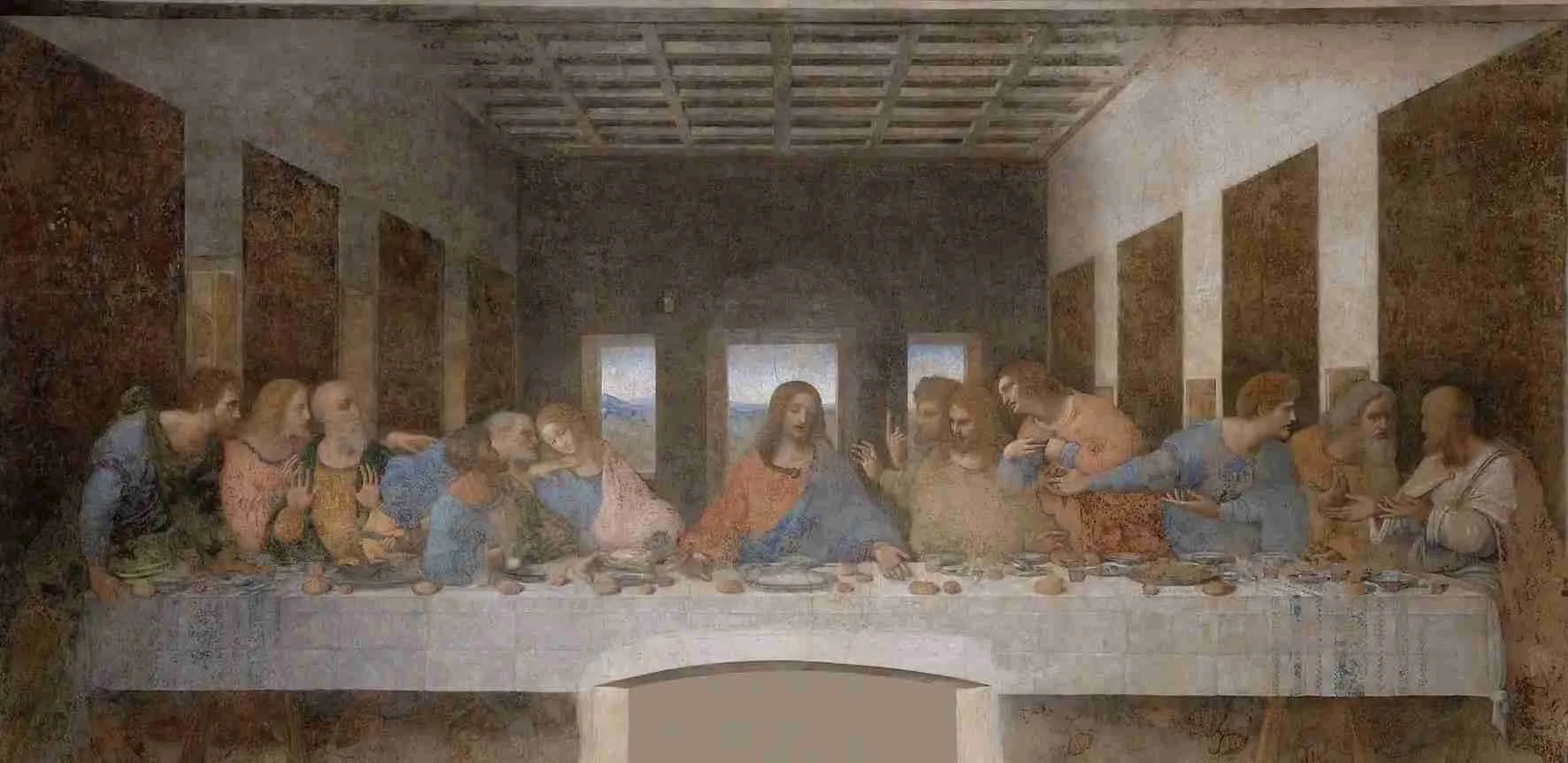
The Last Supper occupies the refectory’s north wall measuring 460 × 880 centimeters (15 × 29 feet), depicting Jesus announcing his impending betrayal while the twelve apostles react with shock, confusion, and denial. Leonardo organized the disciples into four groups of three, creating dynamic compositions around Christ’s isolated central figure. The painting’s perspective lines converge on Christ’s head, drawing viewers’ eyes to the composition’s emotional and spiritual center.
Examine the apostles’ expressions and gestures revealing individual psychological responses—Peter grips a knife foreshadowing his later violence, Judas recoils clutching his silver bag, Thomas raises his finger questioning Christ’s statement. The table arrangement breaks from traditional Last Supper iconography placing Judas among the disciples rather than isolated on the opposite side, challenging viewers to identify the betrayer among the confused reactions.
Turn to the opposite wall viewing Donato da Montorfano’s Crucifixion fresco painted 1495, contemporary with Leonardo’s work. Close examination of figures in Montorfano’s lower corners reveals painting possibly by Leonardo’s hand according to some scholars, though attribution remains disputed. The Crucifixion survives in better condition than the Last Supper due to traditional fresco techniques proving more durable than Leonardo’s experimental tempera and oil approach.
Photography and Viewing Tips 2026
Maximizing the brief 15-minute window requires strategic planning and knowing what to prioritize during limited viewing time.
Arrive with mental preparation of what to examine most closely—watching Last Supper documentaries or reading Leonardo analysis before visiting helps identify specific details to seek during the rushed experience. The 15 minutes pass quickly when wandering aimlessly versus systematically examining prepared priority elements.
Photography works best immediately upon entering before crowds cluster near optimal viewing positions. The refectory’s relatively small size means 40 people create meaningful congestion despite the space feeling open compared to museum galleries. Snap wide-angle shots capturing the complete mural first, then zoom in on specific apostle groups and Christ’s figure before crowds block sight lines.
The mural’s faded condition shocks many first-time viewers expecting vibrant colors matching reproduction prints. Centuries of deterioration, misguided restoration attempts, and Leonardo’s experimental technique created a ghost of the original painting, though enough survives to convey the revolutionary composition and psychological depth. Understanding this faded reality prevents disappointment while enabling appreciation for what remains visible.
Step back to the refectory’s far wall (opposite the Last Supper) to appreciate Leonardo’s perspective construction and the painting’s integration with the room’s architecture. The mural’s painted windows align with the refectory’s actual windows creating illusion of extended space beyond the wall. This full-room perspective gets lost when standing too close focusing on individual apostle details.
Use the final 2-3 minutes examining Montorfano’s Crucifixion and the refectory’s architecture rather than lingering solely on Leonardo’s work. The complete space provides context for how the Last Supper functioned in the convent’s daily life, transforming from artwork to spiritual environment where Dominican monks dined beneath Christ’s final meal with his disciples.
Transportation to Santa Maria delle Grazie 2026
The Last Supper Museum occupies Santa Maria delle Grazie church complex in central Milan’s Corso Magenta district, easily accessible via public transport or walking from the Duomo area.
Metro Access
Metro Line 1 (red line) stops at Conciliazione station 400 meters (5-minute walk) from Santa Maria delle Grazie. Exit following signs toward Corso Magenta, turning right onto Corso Magenta and continuing 300 meters to Piazza Santa Maria delle Grazie where the church and museum entrance appear on the left. Line 1 trains run every 3-5 minutes during peak hours (7:00-9:00 AM, 5:00-7:00 PM) and every 7-10 minutes off-peak.
Metro Line 2 (green line) offers alternative access via Sant’Ambrogio station 600 meters (8-minute walk) from the museum. Exit onto Via Edmondo de Amicis, turn left onto Corso Magenta, and continue 400 meters to Piazza Santa Maria delle Grazie. This slightly longer route provides backup when Line 1 experiences delays or maintenance.
Single metro tickets cost €2.20 valid for 90 minutes including unlimited transfers between metro lines, buses, and trams within the validation window. Daily passes (€7.60) or multi-day options (€18 for 3 days) make sense for travelers using public transport multiple times daily across Milan sightseeing.
Tram Service
Tram Line 16 stops directly at Santa Maria delle Grazie providing door-to-door service from the Duomo area in 10-12 minutes. Board at Duomo heading west toward San Siro, exiting at the Santa Maria delle Grazie stop immediately adjacent to the church complex. Trams run every 8-12 minutes throughout the day using the same €2.20 metro tickets.
Tram Line 10 offers additional service from Stazione Centrale (Milan’s main train station) reaching Santa Maria delle Grazie in 25-30 minutes. This route works for travelers arriving by train from other Italian cities or Milan airports making direct connections to the Last Supper without hotel check-ins.
Walking from Duomo
The Last Supper sits 1.5 kilometers (20-minute walk) west of Milan Duomo cathedral along Corso Magenta, one of the city’s main historic thoroughfares. Walk west from Piazza del Duomo via Via Torino, continuing onto Via Carducci which becomes Corso Magenta. The route passes San Maurizio al Monastero Maggiore church (Milan’s “Sistine Chapel” with remarkable Renaissance frescoes worth brief visits) and follows clear signage to Santa Maria delle Grazie.
This walking route remains entirely flat, navigating wide pedestrian-friendly streets through upscale shopping districts and historic architecture. Budget 25-30 minutes including stopping for photographs and navigating crowds rather than Google Maps’ optimistic 20-minute estimates assuming unobstructed movement.
Combining Last Supper with Other Milan Attractions 2026
Strategic scheduling maximizes Milan cultural experiences around the Last Supper’s fixed viewing time, though the brief 15-minute window and specific timed entry prevent all-day blocking.
Santa Maria delle Grazie church opens free to the public outside Last Supper viewing hours (typically 7:00 AM-12:00 PM and 3:00 PM-7:00 PM), providing access to the Renaissance architecture and interior decoration beyond the ticketed refectory. The church closes during midday hours when Last Supper groups operate, requiring morning or late afternoon visits for church exploration paired with earlier or later refectory reservations.
San Maurizio al Monastero Maggiore sits 400 meters east of Santa Maria delle Grazie on Corso Magenta, offering free admission to spectacular 16th-century frescoes often compared to the Sistine Chapel for artistic richness despite minimal tourist awareness. Visiting San Maurizio before or after the Last Supper creates a concentrated Renaissance art experience within single 45-60 minute walking radius.
The Duomo and central Milan attractions require 20-minute walks or 10-minute tram rides from Santa Maria delle Grazie, making morning Last Supper viewings ideal for pairing with afternoon Duomo climbing, Galleria Vittorio Emanuele II shopping, and La Scala opera house touring. Afternoon Last Supper slots work well following morning Duomo visits, creating efficient full-day Milan itineraries without backtracking across the city.
Leonardo da Vinci National Museum of Science and Technology occupies former monastery buildings 800 meters south of Santa Maria delle Grazie, housing extensive Leonardo exhibits including models of his inventions and engineering designs. The museum requires 2-3 hours for thorough exploration, making it difficult to combine with other activities the same morning or afternoon as the Last Supper unless starting very early or finishing very late.
Money-Saving Strategies for Last Supper Access 2026
Minimizing Last Supper costs while ensuring successful access requires understanding when premium payments deliver value versus when patience and persistence secure base pricing.
Book Official Tickets at Quarterly Release
Setting calendar reminders for quarterly release dates (mid-March, mid-June, mid-September, mid-December at 12:00 PM Italian time) and booking immediately when windows open guarantees €15 base pricing without third-party markups. The quarterly releases require advance planning and flexible travel dates but save €30-105 per person compared to sold-out alternatives. For families of four, official €15 tickets cost €60 total versus €180-480 for third-party tours—savings justifying backwards itinerary planning around booking windows.
Official Guided Tours Over Private Operators
When standard €15 tickets sell out, choosing official museum-led €25 guided tours saves €20-95 per person versus private tour operators charging €45-120. The €10 premium over standard admission buys expert commentary from licensed museum guides, making official tours worthwhile experiences beyond simply sold-out solutions. Check the “Guided Tours” calendar section before purchasing expensive third-party packages—official guided slots often remain available when standard tickets disappear.
Free First Sunday Strategy
Free admission first Sunday monthly eliminates the €15 ticket cost but requires intense competition booking preceding Wednesday at noon with success rates under 20% during peak months. The savings (€15 per person, €60 for families of four) must be weighed against booking stress, low success probability, and potential trip planning around uncertain free Sunday availability. Free Sundays work best for Milan residents or travelers with months-long flexible scheduling able to attempt multiple Wednesday bookings until succeeding.
Wednesday Noon Persistence
Monitoring weekly Wednesday noon releases for last-minute availability provides occasional opportunities securing €15 official tickets for dates otherwise requiring €45-120 third-party purchases. This strategy demands flexibility visiting Milan without confirmed Last Supper access, able to adjust plans around sudden availability appearing on booking calendars. Risk-tolerant travelers save substantially when Wednesday monitoring succeeds, though guaranteed-access tour packages remain safer for inflexible schedules.
Common Booking Mistakes to Avoid in 2026
Understanding frequent errors prevents wasted money, missed reservations, and Last Supper access failures.
Booking Wrong Quarter
The booking platform only displays the current open quarter, making it impossible to book May 2026 dates when viewing the February-April 2026 calendar. Travelers attempting to reserve June visits in December discover blank calendars not because dates are sold out but because that quarter hasn’t opened for bookings. Always verify which quarterly period includes your travel dates and when that quarter opens for reservations before concluding tickets are unavailable.
Name Mismatch Errors
Entering ticket names that don’t match government-issued ID creates entry denial situations fixable only through forfeited tickets and repurchasing. Use full legal names exactly as they appear on passports or national ID cards—”Elizabeth” ticket won’t work for “Betty” on driver’s license despite being the same person. Verify spelling accuracy before confirming purchases as name changes remain impossible after booking.
Arriving at Wrong Time
Tickets specify exact viewing times (3:15 PM, not “afternoon” or “around 3:00”) with entry permitted only during designated 15-minute windows. Arriving 30 minutes early or 20 minutes late both result in missed viewings without refunds or rescheduling. Calendar entries and phone alarms should note ticket office arrival times 30 minutes before viewing slots, not the viewing times themselves.
Expecting Walk-Up Availability
Unlike the Colosseum, Uffizi, or other Italian attractions allowing same-day purchases, the Last Supper operates exclusively on advance reservations with zero walk-up capacity. Travelers assuming they can queue for tickets upon Milan arrival face complete disappointment—the on-site office only validates existing bookings, never sells new admissions. This critical difference between Last Supper procedures and typical museum practices catches unprepared visitors repeatedly.
Booking Fake Websites
Multiple scam websites masquerade as official Last Supper booking platforms, charging inflated prices for non-existent tickets or valid reservations at 3-5× markup. The only official booking platform is lastsupper.shop operated by Vivaticket, with the museum website cenacolovinciano.org redirecting to this authorized reseller. Any other domain selling Last Supper tickets operates either as legitimate third-party tour operators (GetYourGuide, Viator) or fraudulent scams. Verify URLs carefully before entering payment information.
Frequently Asked Questions About Last Supper Tickets 2026
Can I change my Last Supper ticket date or time after booking?
Last Supper tickets cannot be changed, modified, refunded, or transferred under any circumstances after purchase confirmation. The museum maintains absolute no-changes policies eliminating flexibility for travel plan adjustments, illness, flight cancellations, or any other situation. Tickets are issued in specific names for exact dates and times with zero exception processes. Travelers needing different dates must forfeit original tickets without refunds and purchase new reservations if availability exists. This inflexibility makes booking only after finalizing complete Milan itineraries essential, despite quarterly release systems pressuring early purchases. Third-party operators including GetYourGuide and Viator offer more flexible cancellation policies (typically 24-48 hours before visit dates) justifying premium prices for travelers unable to commit firmly to specific times months ahead.
How long should I plan to spend at the Last Supper Museum?
The actual Last Supper viewing lasts exactly 15 minutes from entering the refectory to mandatory exit, but total museum visit time extends 45-75 minutes including ticket collection, security screening, airlock climate stabilization, and optional church exploration. Arrive at the ticket office 15-30 minutes before scheduled viewing times to collect physical tickets and complete ID verification. The climate-controlled airlock process requires 2-3 minutes before groups enter the refectory. After the 15-minute viewing concludes, visitors may explore Santa Maria delle Grazie church if open (schedule varies) adding 15-20 minutes, though church access remains separate from ticketed refectory admission. Budget minimum one hour from ticket office arrival to departing the complex, extending to 90 minutes when combining with church visits or nearby San Maurizio al Monastero Maggiore.
Is photography allowed inside the Last Supper refectory?
Photography is permitted inside the refectory without flash or tripods, allowing smartphone and camera use for capturing Leonardo’s mural and Montorfano’s Crucifixion. Standard tourist cameras and phones work freely for personal use, though professional equipment including detachable lenses, external lighting, video cameras, and stabilization equipment require special permits obtained weeks ahead through museum administration. Flash photography remains strictly prohibited due to light damage accelerating the mural’s deterioration, with guards monitoring visitors and requesting flash deactivation when detected. Tripods create obstruction issues in the relatively small refectory shared by 40 simultaneous visitors, explaining their prohibition regardless of photography experience. Most visitors successfully capture quality images using smartphone HDR modes or camera high ISO settings compensating for the refectory’s moderate interior lighting without flash assistance.
What should I wear to visit the Last Supper?
Santa Maria delle Grazie enforces modest dress code requirements for refectory access, mandating covered shoulders and knees for all visitors regardless of age or gender. Tank tops, sleeveless shirts, shorts above the knee, and short skirts risk entry denial even with valid tickets. The dress code applies year-round including summer months when Milan temperatures exceed 30°C (86°F) creating temptation for lighter clothing. Bringing lightweight cardigans or shawls to cover shoulders and wearing knee-length shorts or skirts satisfies requirements while maintaining comfort in warm weather. The church section enforces identical modest dress standards, though refectory access tickets don’t automatically include church entry which operates separate free admission policies outside Last Supper viewing hours. Guards strictly enforce these requirements at entrance points, turning away improperly dressed visitors without exceptions or temporary covering provisions.
Can I visit the Last Supper with a baby or small children?
Babies and small children may visit the Last Supper but require their own free tickets with confirmed reservations identical to adult bookings. Every person entering the refectory including infants held in arms must hold individual timed reservations—parents cannot simply bring children without tickets. When booking, include children in ticket quantities selecting the “under 18” free category and entering each child’s full name. Strollers and baby carriers pass through security screening though refectory space limitations make baby-wearing more practical than pushing strollers among 40 visitors in the relatively compact viewing area. The 15-minute window and requirement for quiet respectful viewing may challenge very young children unable to maintain silence, though the brief timeframe prevents most misbehavior escalating to disruptive levels. Museums provide no children’s activities or educational materials—the experience remains adult-oriented art viewing scaled down to 15-minute child-appropriate duration primarily through time brevity rather than content adaptation.
What happens if I’m late for my Last Supper time slot?
Late arrivals miss portions of their 15-minute viewing windows with no extensions, compensation, or rescheduling regardless of lateness reasons. The museum operates precise time-slot schedules admitting groups at exact designated times and exiting them 15 minutes later without flexibility for individual circumstances. Arriving 5 minutes late means receiving 10 minutes viewing time, arriving 10 minutes late provides 5 minutes, and arriving 16+ minutes late results in complete missed viewing without refunds. This inflexibility stems from environmental control requirements and subsequent groups’ schedules—extending one group’s time delays all following slots creating cascade disruptions affecting dozens of visitors. Traffic jams, public transport delays, getting lost navigating Milan, and underestimating ticket collection time all create late arrival risks. Budgeting conservative travel time to Santa Maria delle Grazie, arriving at ticket office 30 minutes before viewing slots rather than 15 minutes, and allowing cushions for unexpected delays prevents late arrival disasters forfeiting non-refundable tickets.
Are there lockers for luggage at the Last Supper Museum?
Free luggage lockers adjacent to the ticket office accept large backpacks, suitcases, and bags too big for refectory entry. Visitors deposit government-issued ID cards (passports, national ID cards, driver’s licenses) as security collateral when using lockers, retrieving ID when reclaiming stored items after viewing. The locker system accommodates travelers visiting the Last Supper during Milan layovers, day trips from other Italian cities, or immediately before/after hotel check-outs unable to store luggage elsewhere. Small purses and bags pass through security screening without locker requirements—only oversized items exceeding typical backpack dimensions require storage. The museum provides zero luggage storage reservations—locker availability operates first-come-first-served with enough capacity for normal daily demand but potential shortages during peak summer months when multiple visitors arrive with luggage simultaneously. Travelers with extremely valuable belongings or luggage exceeding standard locker sizes should arrange hotel storage or dedicated luggage services before museum visits rather than assuming on-site accommodation.
Is the Last Supper Museum wheelchair accessible?
The refectory provides wheelchair accessibility through ramped entrances, wide doorways, and barrier-free viewing spaces accommodating mobility devices without limitations. Wheelchair users book tickets through standard procedures selecting mobility assistance requirements during reservation to ensure appropriate access arrangements. The climate-controlled airlock system and refectory viewing area present no wheelchair obstacles—the space functions as single-level open room rather than multi-floor museum requiring elevators or specialized routes. However, Santa Maria delle Grazie church portions beyond the ticketed refectory include stairs and elevated areas presenting accessibility challenges for comprehensive church exploration, though refectory access itself remains fully wheelchair-compatible. Visitors requiring accessibility accommodations should arrive at ticket office with extra time beyond the recommended 15-30 minute window, allowing staff to coordinate appropriate entrance procedures and ensure smooth climate-controlled airlock navigation with mobility devices.
Can I book Last Supper tickets as a gift for someone else?
Booking Last Supper tickets as gifts requires entering the recipient’s exact name as it appears on their government-issued ID since the museum issues tickets in individual names verified at entry. Gift purchasers cannot book tickets in their own names intending recipients to use them—the person named on the ticket must present matching photo identification or face entry denial. When gifting, obtain recipients’ full legal names spelled exactly as appearing on passports or ID cards before booking. Gift certificates or vouchers don’t exist—the booking system only issues specific dated, timed, named tickets without transfer capabilities. Consider alternative gifts like tour package vouchers from GetYourGuide or Viator allowing recipients to select their own dates and complete final booking with their names, though these cost more than direct official tickets. The inflexible name-matching requirement makes Last Supper tickets challenging gifts unless purchasers possess recipients’ exact ID information and can coordinate specific visit dates eliminating scheduling surprises.
What’s the best time of day to visit the Last Supper?
Morning time slots (8:15-10:00 AM) offer smallest ticket office crowds, shortest collection waits, and quietest refectory viewing experiences as afternoon visitors haven’t yet arrived and previous days’ tourists have departed Milan. Early viewing also provides schedule flexibility for combining Last Supper access with full-day Milan itineraries visiting the Duomo, Sforza Castle, Brera Gallery, and other attractions afterward. However, the climate-controlled refectory maintains consistent temperature and lighting throughout operating hours, eliminating traditional museum considerations like natural light quality or summer heat avoidance. The strictly enforced 15-minute viewing windows and controlled environment mean time-of-day selection should prioritize overall Milan itinerary flow rather than perceived viewing quality differences—all time slots provide identical experiences once inside the refectory. Afternoon slots (2:00-4:00 PM) work well following morning Duomo climbs or Brera Gallery visits, while evening slots (5:00-6:45 PM) accommodate travelers arriving Milan on afternoon trains from other Italian cities.