Lascaux Caves Guide: Prehistoric Art UNESCO
Key Takeaways
- Lascaux contains over 600 prehistoric paintings and 1,500 engravings created approximately 17,000 years ago during the Upper Paleolithic period
- The Great Hall of Bulls features the largest prehistoric animal representations ever discovered, with some aurochs measuring over 5 meters in length
- Four teenage boys discovered the caves in 1940, leading to one of archaeology’s most significant prehistoric art finds
- The original cave closed to public access in 1963 to prevent irreversible damage, with exact replicas now providing visitor experiences
- Lascaux demonstrates sophisticated artistic techniques including perspective, movement, and multi-pigment composition that revolutionized understanding of Paleolithic human cognition
- UNESCO designated Lascaux as a World Heritage site in 1979 as part of the Vézère Valley prehistoric sites complex
Introduction: Humanity’s Earliest Artistic Masterpieces
The Lascaux caves in southwestern France preserve humanity’s most spectacular prehistoric art gallery, created by Cro-Magnon artists approximately 17,000 years ago. Located in the Vézère Valley near Montignac in the Dordogne region, these limestone caverns contain over 600 painted and drawn animals alongside nearly 1,500 engravings, representing the pinnacle of Upper Paleolithic artistic achievement. The sophistication, scale, and preservation quality of Lascaux art transformed archaeological understanding of early human cognitive capabilities and cultural complexity.
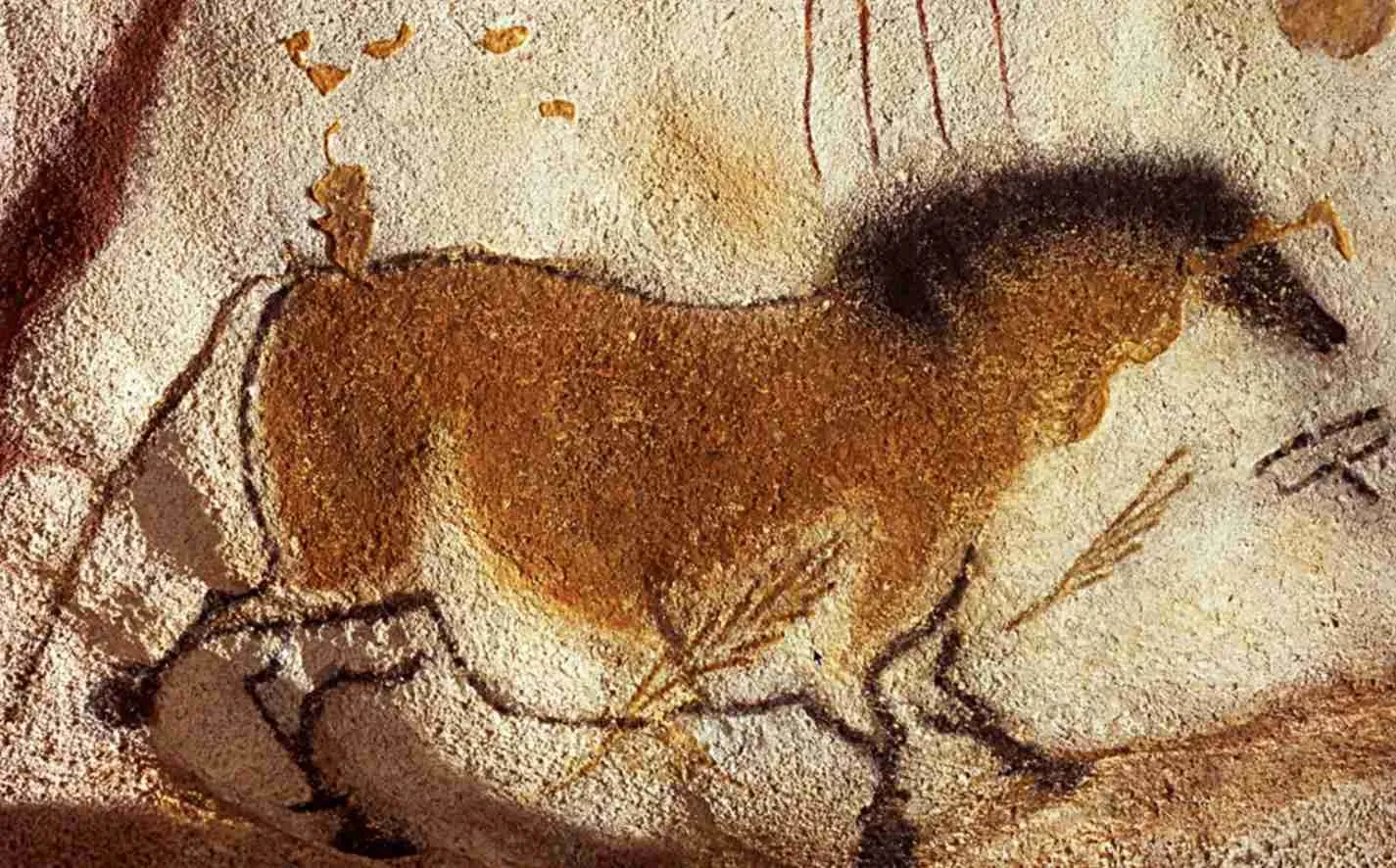
The cave system extends approximately 250 meters underground, featuring multiple chambers connected by narrow passages. Artists worked in complete darkness, using stone lamps filled with animal fat to illuminate their canvases of limestone walls and ceilings. The paintings demonstrate remarkable technical skill, employing natural mineral pigments, sophisticated composition techniques, and an understanding of perspective that wouldn’t reappear in Western art for thousands of years. The artists created dynamic scenes of running horses, charging bulls, leaping deer, and mysterious symbolic figures that continue to captivate viewers and challenge interpretations.
Lascaux’s importance extends beyond artistic merit to fundamental questions about human evolution, symbolic thinking, and cultural transmission. The cave art provides direct evidence of abstract thought, ritual behavior, and complex social organization among Paleolithic communities. The choice of subjects, positioning within cave architecture, and symbolic associations suggest sophisticated belief systems and possibly shamanic practices. Modern scientific analysis using techniques from spectroscopy to 3D modeling continues revealing new insights about ancient artistic methods, chronology, and cultural contexts.
The cave’s discovery in 1940 initiated decades of archaeological research, public fascination, and eventually conservation challenges that led to revolutionary preservation strategies. After opening to tourists in 1948, the influx of visitors caused rapid degradation through carbon dioxide, humidity, and microbial growth. The difficult decision to close the original cave in 1963 sparked the development of exact replicas using cutting-edge technology, creating a model for heritage site preservation worldwide. Today, Lascaux serves both as a protected archaeological treasure and an accessible educational resource through its masterfully recreated facsimiles.
People Also Ask About Lascaux Caves Art
What makes Lascaux cave art unique among prehistoric sites?
Lascaux stands apart from other prehistoric caves through the exceptional quality, quantity, and preservation of its artworks. The site contains over 600 painted figures and 1,500 engravings, making it one of the most densely decorated Paleolithic caves ever discovered. The artistic sophistication surpasses most contemporary sites, with painters demonstrating advanced techniques including shading to create three-dimensional effects, overlapping figures to suggest depth, and twisted perspective showing animals from multiple angles simultaneously. The Great Hall of Bulls alone contains the largest prehistoric animal representations known to archaeology, with some aurochs measuring over 5 meters from horn to tail.
The technical execution reveals extraordinary skill in pigment preparation and application. Artists ground mineral ochres, manganese dioxide, and charcoal into fine powders, mixing them with binding agents like animal fat or plant resins. They applied these paints through multiple methods including finger-painting, brush application using animal hair or plant fibers, and spray-painting by blowing pigment through hollow bones. Some figures show evidence of preliminary sketching with charcoal or manganese before final painting, indicating careful planning and composition. The mastery of line work, particularly in the engraved figures, demonstrates precise control and artistic confidence.
The cave’s exceptional preservation state allowed colors to retain remarkable vibrancy over 17,000 years. The sealed limestone environment maintained stable temperature and humidity, preventing the oxidation and fading that degraded many other prehistoric sites. When discoverers first entered in 1940, they found paintings appearing almost fresh, with reds, yellows, browns, and blacks displaying intensity suggesting recent creation. This preservation quality enabled detailed study of layering techniques, pigment composition, and artistic processes impossible at more deteriorated sites.
How old are the Lascaux cave paintings and how was this determined?
Scientific dating places Lascaux’s main painting phase around 17,000 years ago during the Magdalenian period of the Upper Paleolithic. Initial radiocarbon dating of charcoal from the cave floor and organic materials in paint pigments established this timeframe, later refined through multiple analytical techniques. Researchers collected charcoal samples from stone lamps and hearths found within the cave, while also analyzing organic binding agents mixed with mineral pigments. The consistency across multiple samples from different cave sections confirmed a primary artistic phase rather than centuries of gradual accumulation.
More recent dating methods have added precision and complexity to Lascaux’s chronology. Uranium-thorium dating of calcite formations overlying some paintings provides minimum age constraints, confirming that artworks existed before these mineral deposits formed. Analysis of tool marks and engraving techniques reveals multiple artistic episodes, with some sections possibly predating the main painting phase by several thousand years. Stylistic analysis comparing Lascaux motifs to dated artifacts from regional archaeological layers supports the radiocarbon chronology while identifying possible earlier and later interventions.
The dating places Lascaux creation during a specific climatic and cultural period when southwestern France experienced cold but relatively stable conditions during the last glacial maximum. The Magdalenian people who created these artworks lived as skilled hunters in a landscape dominated by reindeer, horses, bison, and other large herbivores. Understanding this temporal context helps interpret the cave’s function and meaning within Paleolithic society, suggesting possible connections to seasonal hunting rituals, initiation ceremonies, or shamanic practices tied to specific astronomical or seasonal cycles.
Who discovered Lascaux caves and what were the circumstances?
Four teenage boys discovered Lascaux on September 12, 1940, following their dog Robot into a hole created by a fallen tree on the hillside above Montignac. Marcel Ravidat, aged 18, led the initial exploration accompanied by Jacques Marsal, Georges Agnel, and Simon Coencas, all local youths from the Dordogne region. The boys enlarged the opening and descended approximately 15 meters into the darkness using improvised lamps. Upon reaching the cave floor and illuminating the walls, they encountered the spectacular painted animals that would become world-famous within months.
The teenagers recognized the significance of their discovery and immediately contacted their former schoolteacher, Léon Laval, who notified local authorities and archaeology expert Henri Breuil. Breuil, already renowned for prehistoric art research at Altamira and Font-de-Gaume, visited Lascaux on September 21, 1940, just nine days after discovery. His authentication and enthusiastic description as “the Sistine Chapel of prehistory” brought immediate scientific and public attention. The timing during World War II initially limited international awareness, but by war’s end Lascaux had become archaeology’s most celebrated new discovery.
The young discoverers received recognition through official acknowledgment and later served as the first official cave guides when Lascaux opened to tourists in 1948. Marcel Ravidat and Jacques Marsal dedicated much of their lives to Lascaux, working as guides and participating in conservation efforts for decades. Their discovery transformed the sleepy market town of Montignac into an international tourist destination and sparked intensive archaeological research throughout the Vézère Valley that revealed numerous additional prehistoric sites. The accidental nature of the discovery emphasizes how much prehistoric heritage may remain hidden, accessible only through fortunate circumstances or systematic survey.
What animals are depicted in Lascaux and what do they represent?
Lascaux artists portrayed a specific repertoire of animals dominated by large herbivores that inhabited southwestern France during the Upper Paleolithic. Horses comprise the most numerous representations with nearly 365 individual animals, appearing in almost every cave section. Aurochs, the extinct wild cattle that stood 1.8 meters at the shoulder, appear in 90 depictions including the magnificent bulls of the Great Hall. Bison, depicted 23 times, show dynamic poses suggesting movement and behavior. Red deer (stags) appear in approximately 20 images, while ibex and reindeer receive less frequent but notable representation.
More unusual and symbolically significant animals include the enigmatic “unicorn” or composite creature in the Hall of Bulls, featuring two straight parallel lines projecting from its head like horns or antennae. This figure has sparked intense debate about whether it represents a mythological creature, a shamanic vision, or an attempt to depict a real animal from an unusual perspective. Seven feline representations, probably cave lions, appear in various sections, rendered with characteristic muscular bodies and hunting postures. A single bear figure, several rhinoceroses, and possible wolf or fox images expand the bestiary beyond the dominant herbivores.
Notably absent from Lascaux are reindeer, despite this species providing the primary food source for Magdalenian people in the region. This selective representation suggests the cave art served purposes beyond simple documentation of available game animals. The emphasis on horses and aurochs, neither of which dominated archaeological food refuse at contemporary habitation sites, indicates symbolic or ritual significance rather than dietary importance. The choice of species, their sizes, postures, and locations within cave architecture all suggest careful selection according to cultural or spiritual criteria that remain partially mysterious but clearly involved more than simple hunting magic.
Extended multi-day tours – 5+ days
Featured Bordeaux Multi-Day Tour Packages
11 days
Beautiful Bordeaux 2026
- ✓ Comprehensive Bordeaux tour
- ✓ Expert local guides included
- ✓ All accommodation arranged
- ✓ Transportation provided
7 days
From Bordeaux to Toulouse or Toulouse to Bordeaux by Bike Self-Guided
- ✓ Comprehensive Bordeaux tour
- ✓ Expert local guides included
- ✓ All accommodation arranged
- ✓ Transportation provided

6 days
Cycling The Grand Crus of Bordeaux
- ✓ Comprehensive Bordeaux tour
- ✓ Expert local guides included
- ✓ All accommodation arranged
- ✓ Transportation provided
11 days
Bordeaux Affair with Madrid
- ✓ Comprehensive Bordeaux tour
- ✓ Expert local guides included
- ✓ All accommodation arranged
- ✓ Transportation provided
Multi-day tour packages powered by TourRadar. Prices and availability subject to change.
Discovery and Historical Context
The Lascaux discovery occurred during extraordinary historical circumstances that shaped both its immediate reception and long-term significance. France in September 1940 existed under German occupation following the June armistice, with the Dordogne region lying in the theoretically independent Vichy zone. This context meant early research proceeded under constrained conditions, with international communication limited and resources scarce. Nevertheless, the site’s importance transcended wartime disruptions, with Henri Breuil and other scholars conducting preliminary studies even as conflict raged across Europe.
The Vézère Valley where Lascaux sits had already yielded significant prehistoric discoveries before 1940. Les Eyzies, just 25 kilometers southwest, had produced Cro-Magnon skeletal remains in 1868, establishing the valley as crucial for understanding human evolution. Font-de-Gaume, Combarelles, and other decorated caves discovered in the early 1900s demonstrated prehistoric artistic capabilities, preparing the archaeological community to appreciate Lascaux’s significance. This existing research framework meant Lascaux could be immediately recognized as exceptional rather than dismissed as impossible, a fate that had befallen the Altamira cave art discovery in Spain decades earlier.
Local landowner ownership complicated the site’s future. The boys had discovered Lascaux on property belonging to the Comte de La Rochefoucauld, who initially granted Henri Breuil exclusive research access. Post-war negotiations eventually transferred ownership to the French state, allowing systematic archaeological investigation and public access. The property transfer reflected growing recognition of prehistoric sites as national heritage requiring protection and professional management rather than private curiosities. This transition from private to public ownership established precedents for heritage site management that influenced policies throughout France and internationally.
The rapid decision to open Lascaux to tourism in 1948 reflected post-war reconstruction priorities and the site’s immediate cultural impact. Within fifteen years of discovery, over one million visitors had walked through the original cave, bringing crucial revenue to the recovering Dordogne economy but also initiating destructive processes. The cave’s transformation from unknown natural cavity to global tourist attraction in less than a decade created an unrepeatable historical moment when prehistoric art became accessible to mass audiences before conservation concerns became paramount. This brief window of direct public access to the original paintings shaped popular understanding of prehistoric art and created lasting memories for fortunate early visitors.
Prehistoric Artistic Techniques
Lascaux artists employed sophisticated painting techniques that demonstrate remarkable technical knowledge and artistic planning. Pigment preparation began with careful selection and processing of natural minerals. Red and yellow ochres came from iron oxide deposits, browns from manganese dioxide, and blacks from charcoal or manganese. Artists ground these materials into fine powder using stone mortars and pestles, achieving particle sizes that enabled smooth application and color blending. The consistency of pigment quality across different cave sections suggests specialized artisans prepared materials centrally rather than each painter grinding their own colors.
Multiple application methods appear throughout Lascaux, indicating deliberate technical choices based on desired effects. Large surfaces received pigment blown through hollow bones or reeds, creating soft-edged forms and subtle color gradations. This spray-painting technique covered areas quickly while avoiding direct hand contact with walls, important in sections where artists worked in awkward positions. Finger-painting created detailed features and fine lines, with prints still visible in some pigment deposits. Brushes made from animal hair, plant fibers, or chewed stick ends enabled precise line work and detailed rendering of anatomical features like eyes, nostrils, and hooves.
The discovery of stone lamps filled with animal fat within the cave reveals how artists illuminated their workspace in absolute darkness. These lamps, carved from limestone with shallow depressions holding the fuel, produced steady flames when equipped with moss or juniper wicks. Experimental archaeology has recreated these lighting conditions, demonstrating how flickering lamplight created animated effects on painted animals, making them appear to move and breathe. Artists strategically positioned figures to maximize these kinetic effects, suggesting they understood and deliberately exploited the visual impact of shifting shadows and highlights.
Preparation of wall surfaces shows careful planning before actual painting began. In some sections, artists smoothed limestone surfaces by scraping away irregular protrusions or filling depressions with calcite paste. The choice of particular wall sections often exploited natural rock formations, using curves and bulges to suggest animal anatomy. Some figures incorporated pre-existing cracks or mineral stains into compositions, demonstrating opportunistic creativity. The technical sophistication extends to the use of scaffolding or platforms suggested by ancient holes drilled into cave walls, indicating artists erected temporary structures to reach high ceiling sections where some of the most spectacular paintings appear.
The Great Hall of Bulls
The Great Hall of Bulls, also known as the Rotunda, constitutes Lascaux’s most spectacular artistic achievement and serves as the first major chamber visitors encounter after descending from the entrance. This roughly circular room measures approximately 17 meters in length and 6 meters in width, with ceiling heights reaching 7 meters. The walls and ceiling form a continuous canvas bearing some of the largest and most dynamic prehistoric animal representations ever created. The chamber’s natural acoustics produce resonant sound effects, suggesting possible use in ritual ceremonies involving chanting, singing, or musical instruments.
Four enormous black aurochs bulls dominate the composition, their massive bodies stretching up to 5.5 meters in length. These extinct wild cattle appear in profile, rendered with powerful muscular forms and sweeping horn curves that create dramatic visual impact. The artists positioned these bulls to exploit the chamber’s curved walls, making the animals appear to move around the space as viewers shift position. The largest bull, positioned prominently on the left wall, displays all characteristic features of auroch anatomy while achieving heroic proportions that elevate it beyond mere naturalistic representation to symbolic or totemic significance.
Surrounding the dominant bulls, smaller horses, deer, and the enigmatic “unicorn” create complex layered compositions. The paintings overlap in some areas, suggesting either multiple artistic phases or deliberate compositional choices to suggest depth and movement. The famous “unicorn,” positioned near the entrance, features a bulky body covered with circular marks, two straight parallel lines projecting from its head, and a swollen belly suggesting pregnancy. Interpretations range from composite mythological creature to realistic depiction of a two-horned rhinoceros shown from an unusual angle. The unresolved identity adds mystery to the Hall’s already powerful visual impact.
The artistic techniques in the Great Hall demonstrate the Magdalenian painters’ full technical repertoire. The black bulls utilize charcoal and manganese pigments applied in smooth, confident lines that define muscular contours and anatomical details. Some figures show color variations suggesting three-dimensional modeling, with darker tones indicating shadowed areas and lighter shades representing highlighted surfaces. The proportional relationships between animals reflect careful planning, creating visual hierarchy that guides viewer attention from the dominating bulls to subsidiary figures. The overall compositional balance, despite the apparent randomness of animal placement, suggests sophisticated aesthetic sensibilities and possibly narrative or symbolic relationships between depicted creatures.
Symbolic Meanings and Interpretations
Interpreting Lascaux’s symbolic meanings challenges archaeologists because Paleolithic peoples left no written explanations and the cultural gap spanning 17,000 years makes definitive understanding impossible. Nevertheless, consistent patterns in animal selection, positioning, and association provide clues about possible symbolic systems. The overwhelming dominance of horses and aurochs, neither primary food sources in Magdalenian diet as revealed by habitation site analysis, suggests these animals carried special cultural significance beyond practical hunting importance. The selective nature of representations, with reindeer virtually absent despite providing primary sustenance, indicates symbolic choice rather than simple documentation of surrounding fauna.
The sexual associations present throughout Lascaux have led to interpretations involving fertility magic or gender symbolism. Many aurochs bulls display exaggerated masculine features, while some horse figures appear pregnant or are positioned near abstract signs possibly representing female symbols. The juxtaposition of male and female forms, sometimes in apparent copulation or courtship postures, suggests concerns with reproduction, seasonal cycles, or cosmological duality. Some researchers interpret these pairings as representing complementary cosmic forces similar to concepts found in later mythological systems, though such interpretations remain necessarily speculative.
The geometric signs and abstract symbols scattered throughout Lascaux have attracted intense analytical attention. These include dots, lines, grids, and more complex forms that appear repeatedly across different cave sections. Some patterns cluster around specific animal figures while others stand independently. Researchers have proposed interpretations ranging from lunar calendars and astronomical observations to tribal markers, shamanic symbols, or notation systems recording important information. The famous “shaft scene” deep in the cave, showing a bird-headed human figure, a wounded bison, and a bird on a pole, has generated countless interpretations involving shamanic trance, hunting accidents, or mythological narratives.
Contemporary anthropological studies of hunter-gatherer societies provide possible frameworks for understanding Lascaux’s function. Many recent hunting cultures use sacred caves as initiation sites where adolescents undergo transformation rituals. The difficult access to some Lascaux sections, requiring crawling through narrow passages, parallels initiation ordeals in various cultures. The cave’s complete darkness, broken only by flickering lamplight, would create psychologically intense environments suitable for transformative experiences. The paintings might have served as visual aids in oral narratives, teaching tools conveying cultural knowledge, or focal points for trance induction in shamanic practices. While specific meanings remain elusive, the sophistication and care invested in Lascaux’s creation clearly indicates profound cultural importance transcending simple aesthetic enjoyment.
Conservation Challenges and Solutions
The decision to open Lascaux to public tourism in 1948 initiated degradation processes that threatened the cave’s very survival. Over 1,200 visitors daily during peak seasons created a hostile microclimate within the sealed cave environment. Human respiration added massive quantities of carbon dioxide, raising cave atmosphere CO2 levels from natural 0.03% to over 2.5%. This carbon dioxide dissolved in condensation moisture, forming weak carbonic acid that attacked limestone surfaces and pigment layers. Visitor body heat raised ambient temperature by several degrees, while respiration added humidity that condensed on cool cave walls, creating water films over painted surfaces.
The most visible damage appeared as “green disease,” an algal bloom that emerged in the late 1950s. Artificial lighting installed for tourist convenience, combined with increased humidity, created perfect conditions for photosynthetic organisms. Green algae spread across previously pristine white calcite surfaces, threatening to overgrow painted areas. Simultaneously, calcite deposits began forming over paintings as the altered humidity patterns disrupted the cave’s natural equilibrium. White patches of newly precipitated calcite appeared on previously clear painted surfaces, obscuring details that had remained visible for millennia until human intervention disrupted the balanced cave environment.
The scientific community recognized by the early 1960s that continued public access would destroy Lascaux within decades. After intense debate balancing cultural access against preservation responsibility, French Minister of Culture André Malraux ordered the cave’s closure to tourists in April 1963. This unprecedented decision prioritized long-term conservation over immediate public access and economic benefit. The closure affected Montignac’s tourism economy significantly but established the principle that certain heritage sites require complete protection from visitation, with alternative access methods developed to satisfy public interest while preserving irreplaceable originals.
Post-closure conservation efforts have battled ongoing challenges requiring continuous monitoring and intervention. Various bacterial and fungal infections have appeared despite visitor exclusion, possibly introduced during the open period or through air exchange with the external environment. The appearance of “white disease” in 2001, caused by Fusarium solani fungus, required emergency treatments including biocide applications and manual cleaning. Climate control systems maintain stable temperature and humidity while limiting air exchange to prevent external contamination. A dedicated team monitors the cave constantly using sensors and regular visual inspections, ready to intervene if new threats emerge. The conservation challenges demonstrate that even protected sites require active management rather than simple isolation.
Photography and Documentation
Photographing and documenting Lascaux has evolved from early black-and-white images to sophisticated digital capture systems that record microscopic details and create three-dimensional models. The first systematic photographic documentation occurred immediately after discovery, with primitive equipment and challenging lighting conditions. Photographers used magnesium flash powder for illumination, creating dramatic but inconsistent lighting that sometimes obscured details while emphasizing others. These early photographs, despite technical limitations, provide crucial baseline documentation showing the cave’s condition before tourist-related degradation began.
The development of Lascaux II, the major replica opened in 1983, required revolutionary documentation techniques to achieve accurate reproduction. Teams spent years photographing every surface from multiple angles, measuring exact dimensions, and analyzing pigment composition. They created detailed topographic maps of cave walls using photogrammetry, capturing the three-dimensional contours essential for realistic replica construction. Colorimetry studies analyzed exact pigment hues under controlled lighting, enabling precise color matching in replica paintings. This documentation process itself advanced archaeological recording technology, establishing methodologies adopted worldwide for heritage site analysis.
Modern digital documentation employs laser scanning and photogrammetry to create millimeter-accurate three-dimensional models of the entire cave system. These models serve multiple purposes beyond simple archival preservation. Researchers use them to analyze painting techniques, identifying tool marks and application patterns invisible to naked eye inspection. The 3D models enable virtual visits for researchers unable to access the protected original cave, democratizing access to primary materials for study. Educational institutions worldwide use these digital resources to bring Lascaux into classrooms, allowing students to explore the cave virtually with resolution and lighting control impossible for original tourist visits.
Specialized imaging techniques reveal hidden aspects of Lascaux art invisible under normal viewing conditions. Ultraviolet fluorescence photography shows organic materials in pigments and identifies modern contamination invisible to normal vision. Infrared imaging penetrates surface deposits to reveal underlying paintings or preparatory sketches. X-ray fluorescence spectroscopy analyzes pigment chemical composition non-destructively, identifying specific minerals used and detecting evidence of degradation. Reflectance transformation imaging captures surfaces under multiple lighting angles, revealing subtle engravings and surface textures. These advanced techniques continue discovering new details about artistic methods and cave history, demonstrating how technology enables ever-deeper understanding of prehistoric achievements.
UNESCO World Heritage Significance
UNESCO inscribed the Prehistoric Sites and Decorated Caves of the Vézère Valley, including Lascaux, on the World Heritage List in 1979 under criteria (i) and (iii). Criterion (i) recognizes sites representing masterpieces of human creative genius, perfectly describing Lascaux’s artistic achievement. The paintings demonstrate extraordinary technical skill, aesthetic sensibility, and creative imagination that transcend their prehistoric origins to achieve timeless artistic significance. The sophistication challenges assumptions about cognitive capabilities of Upper Paleolithic humans, proving that artistic excellence and complex symbolic thinking existed at least 17,000 years ago.
Criterion (iii) acknowledges sites bearing exceptional testimony to cultural traditions or civilizations. Lascaux provides irreplaceable evidence of Magdalenian culture in southwestern France during the last Ice Age. The cave preserves direct material testimony to belief systems, artistic practices, and symbolic thought impossible to reconstruct from utilitarian artifacts alone. The decision to create these elaborate artworks deep underground, accessible only through difficult passages, reveals spiritual or ceremonial dimensions of Paleolithic life. The investment of time, skill, and resources required demonstrates sophisticated social organization capable of supporting specialized artists and dedicating labor to non-subsistence activities.
The Vézère Valley designation encompasses multiple prehistoric sites beyond Lascaux, creating a cultural landscape that documents continuous human occupation spanning 400,000 years. The valley contains over 150 known prehistoric sites including habitation areas, tool-making workshops, and decorated caves. Font-de-Gaume preserves polychrome paintings of bison, mammoths, and horses. Les Combarelles features hundreds of engraved animal figures. La Mouthe, discovered in 1895, provided early proof of Paleolithic artistic capabilities when skepticism still dismissed such claims. Together, these sites create comprehensive evidence of human cultural evolution in a geographically concentrated area accessible for comparative study.
The UNESCO designation brought international attention and support for conservation efforts while establishing preservation standards applicable globally. The decision to close Lascaux to tourist access, though economically painful for the local region, received validation and support through World Heritage status. The development of high-quality replicas as alternatives to original site visitation became a model copied worldwide, balancing preservation responsibilities with legitimate public interest in accessing cultural heritage. UNESCO monitoring and expertise helped navigate conservation challenges, providing international scientific cooperation and resources. The designation transformed Lascaux from a French national treasure into recognized human heritage belonging to all peoples, transcending national borders to represent shared human achievement.
Cultural Impact and Legacy
Lascaux’s discovery transformed public perception of prehistoric humans from primitive brutes to sophisticated artists and thinkers. Before the mid-twentieth century, popular imagination often portrayed Ice Age peoples as barely human, lacking culture, art, or complex thought. The extraordinary beauty and technical sophistication of Lascaux paintings demolished these misconceptions, forcing recognition that cognitive capabilities comparable to modern humans existed tens of thousands of years ago. This paradigm shift influenced fields beyond archaeology, affecting anthropology, psychology, philosophy, and debates about human nature and cultural evolution.
The phrase “the Sistine Chapel of prehistory,” coined by Henri Breuil, captured public imagination and established Lascaux as prehistoric art’s defining masterpiece. This comparison, while slightly misleading given the 15,000-year gap and entirely different cultural contexts, effectively communicated Lascaux’s artistic significance to broad audiences. The analogy elevated prehistoric art from archaeological curiosity to recognized component of human artistic achievement, deserving placement alongside acknowledged masterpieces of later civilizations. Museums worldwide incorporated prehistoric art into their chronological narratives, with Lascaux frequently featured as the starting point of human artistic expression.
The cave’s influence on modern art has been profound if often indirect. Artists from Picasso to contemporary creators have drawn inspiration from prehistoric painting’s directness, economy of line, and powerful simplification of form. The discovery that sophisticated art existed in such remote antiquity liberated some artists from classical traditions, suggesting that authentic artistic expression transcends formal training or academic conventions. The modernist valorization of “primitive” art found prehistoric caves providing ultimate validation that powerful art emerges from direct engagement with fundamental human experiences rather than refined cultural elaboration.
Educational impact extends from specialist archaeological training to elementary school curricula worldwide. Lascaux appears in textbooks as evidence of early human creativity, serving as accessible entry point for teaching prehistory. The cave’s romantic discovery story engages student imagination while the artworks themselves provide tangible connection to remote ancestors. Virtual visits and replica experiences enable millions to encounter prehistoric art directly, creating personal relationships with deep human heritage. The ongoing scientific study of Lascaux, employing cutting-edge analytical techniques, demonstrates how ancient sites remain active research frontiers yielding new insights as investigative technologies advance. This combination of accessibility and mystery ensures Lascaux’s continued cultural relevance and educational value for future generations.
Frequently Asked Questions
Can you visit the original Lascaux cave?
The original Lascaux cave remains closed to all visitors except authorized researchers and conservation specialists. The cave closed to tourist access in 1963 after fifteen years of public visitation caused severe degradation through increased carbon dioxide, humidity, and microbial contamination. Only a handful of scientists enter the original cave annually for essential monitoring and conservation work, following strict protocols to minimize environmental impact. All visits require ministerial authorization and occur under carefully controlled conditions with limited time inside and mandatory decontamination procedures.
What are the available Lascaux replica experiences?
Lascaux II, opened in 1983 adjacent to the original cave, replicates the Great Hall of Bulls and Painted Gallery in exact detail using the same techniques and pigments as Paleolithic artists. This replica sits just 200 meters from the original cave entrance. Lascaux III, a mobile exhibition that tours internationally, reproduces five key cave sections using high-resolution digital printing on flexible supports. Lascaux IV, the International Centre for Cave Art, opened in 2016 in Montignac, presenting a complete replica of the entire cave system using advanced digital scanning and traditional craftsmanship. This newest facility includes interactive exhibitions, virtual reality experiences, and educational programming that contextualizes the cave within broader Paleolithic culture.
How were the Lascaux paintings created in complete darkness?
Artists worked by lamplight using stone lamps filled with animal fat, several of which archaeologists discovered within the cave. These shallow limestone vessels held melted fat with moss or juniper wicks that burned steadily for hours, producing sufficient light for detailed work. Experimental archaeology has recreated these conditions, demonstrating that skilled artists working with such lighting could execute precise paintings while the flickering flames created animated effects on finished artworks. Artists probably worked in small teams, with some holding lamps to illuminate surfaces while others painted. The positioning of some figures in high, difficult-to-access locations suggests the use of wooden scaffolding or platforms, with multiple lamps providing adequate illumination.
Why are there no human figures in Lascaux paintings?
Human figures appear extremely rarely in Paleolithic cave art generally, not just at Lascaux. The most notable human representation at Lascaux occurs in the Shaft scene, showing a bird-headed stick figure near a wounded bison, but even this figure displays highly schematic rendering unlike the naturalistic animal depictions. Anthropologists propose various explanations including cultural taboos against realistic human representation, focus on animals as spiritually significant entities, or shamanic traditions where transformed humans took animal forms during ritual experiences. The absence may also reflect practical considerations, as animal subjects allowed demonstrating artistic skill through complex anatomical rendering while human figures risked appearing inadequate or violating cultural prohibitions.
What pigments did Lascaux artists use and how were they prepared?
Artists used four primary pigments derived from natural minerals found locally. Iron oxide provided red and yellow ochres in various shades depending on iron content and heating. Manganese dioxide created blacks and dark browns. Charcoal from burned wood or bones produced intense blacks. Artists collected these materials, ground them into fine powder using stone mortars and pestles, and mixed them with binding agents such as animal fat, blood, egg white, or plant resins. Chemical analysis reveals sophisticated pigment recipes with consistent quality, suggesting specialized preparation by knowledgeable individuals. Some paintings show evidence of preliminary sketching with charcoal before final pigment application, indicating careful planning and compositional preparation.
How long did it take to create all the Lascaux paintings?
The exact timeframe remains uncertain, but most archaeologists believe the major painting phase occurred within a relatively short period, possibly decades rather than centuries. Stylistic consistency across most paintings suggests a unified artistic tradition and possibly collaboration among artists who shared techniques and aesthetic principles. However, radiocarbon dating of different sections shows some temporal variation, indicating possible return visits or successive generations adding to earlier work. The total labor investment, including pigment preparation, lamp fuel collection, and actual painting time, represents hundreds or possibly thousands of person-hours. Whether this work occurred in concentrated campaigns or intermittent sessions over extended periods remains debated.
What happened to cause the cave paintings to deteriorate after opening to tourists?
Human visitation fundamentally altered the cave’s stable microclimate that had preserved paintings for 17,000 years. Visitors exhaled massive quantities of carbon dioxide that dissolved in condensation moisture, forming carbonic acid that attacked limestone surfaces and pigments. Body heat raised cave temperature, disrupting the thermal equilibrium and causing moisture condensation on walls. Artificial lighting installed for tourism promoted algal growth that spread across painted surfaces. The introduction of skin bacteria, clothing fibers, and other organic materials from over one million visitors created nutrients supporting microbial colonies. These combined factors initiated degradation processes that became irreversible without closure and intensive conservation intervention.
How accurate are the Lascaux replicas compared to the original?
The replicas achieve extraordinary accuracy through meticulous documentation and traditional reconstruction techniques. Lascaux II artists used the same natural pigments and application methods as prehistoric painters, applying colors to artificial rock surfaces molded from the original cave walls using latex and polyester resin casts. Every crack, bulge, and surface texture appears in correct position. Colorimetric analysis ensured precise pigment matching under various lighting conditions. Lascaux IV, the newest replica, employs laser scanning accurate to one millimeter, combined with high-resolution photography and traditional painting to achieve even greater fidelity. While replicas cannot duplicate the psychological impact of encountering 17,000-year-old original surfaces, they accurately convey artistic techniques, compositions, and aesthetic impact that made Lascaux extraordinary.
What was the Lascaux cave’s original function in Paleolithic society?
The cave’s function remains subject to interpretation and debate, though clearly involved purposes beyond simple habitation. The absence of living debris, tools, or food remains suggests people did not live in the decorated sections. The difficult access to some painted areas, requiring crawling through narrow passages, indicates special rather than casual use. Theories include shamanic ritual sites where altered consciousness experiences occurred, initiation locations where adolescents underwent transformation ceremonies, seasonal gathering places for dispersed groups to reinforce social bonds and cultural identity, or astronomical observation sites aligned with celestial phenomena. The sophisticated artwork’s creation required significant labor investment justified only by profound cultural importance, suggesting spiritual, educational, or ceremonial functions central to Magdalenian society.
Are new cave paintings still being discovered in the region?
New prehistoric caves continue emerging occasionally through systematic survey and accidental discovery, though none approaching Lascaux’s scale or preservation. The Vézère Valley’s limestone geology creates extensive cave systems, many unexplored or inadequately documented. Archaeologists conduct systematic surveys using ground-penetrating radar, cavity detection techniques, and analysis of topographical features suggesting cave presence. The 1994 discovery of Chauvet Cave in southern France, containing even older paintings dated to 32,000 years ago, demonstrated that major finds remain possible. Modern excavation and development projects require archaeological assessment, sometimes revealing previously unknown sites. While Lascaux-scale discoveries occur rarely, ongoing research continuously expands understanding of Paleolithic artistic distribution and diversity.