
Larissa Budget Guide 2026: Travel Cost Breakdown
Larissa sits at the geographic heart of mainland Greece, equidistant between Athens and Thessaloniki, yet it remains largely off the international tourist circuit — and that is precisely why it costs so much less. Greece’s fourth-largest city rewards budget-conscious travelers with genuine taverna meals priced for university students, walkable ancient ruins with no entrance queues, and a sprawling riverside park that rivals anything in the country, all without the price premiums that coastal and island destinations routinely charge. This guide delivers verified 2026 costs across every spending category — accommodation, food, transport, and attractions — so you can arrive in Larissa with complete financial clarity.
Key Takeaways: Larissa Costs in 2026
- Budget travelers spend €45–70 per person daily (two sharing a budget hotel), covering accommodation, three meals, city transport, and occasional entrance fees.
- Mid-range travelers spend €100–145 per person daily (two sharing a 3-star hotel), with sit-down restaurant meals and guided cultural visits included.
- Luxury visitors invest €195–280 per person daily (two sharing a 4- or 5-star hotel), with upscale dining and private transport factored in.
- Top attraction: the Diachronic Museum of Larissa charges €6 per adult from April through October and €3 from November through March; the city’s ancient theatres and Alkazar riverside park are free.
- City transport costs €1 per city bus journey; taxis anywhere within the city run under €4; Athens is reachable by KTEL bus for approximately €30 and by Hellenic Train for €17–24.
- Meteora, one of Greece’s most spectacular UNESCO World Heritage Sites, is 85 km from Larissa and reachable by bus via Trikala for €8–13 each way, making an affordable day trip from the city entirely feasible.
People Also Ask About Larissa Budget 2026
How much does Larissa cost per day in 2026?
Budget travelers spend €45–70 per person daily when two people share a budget hotel. Mid-range travelers spend €100–145 per person daily sharing a 3-star hotel. Luxury visitors invest €195–280 per person daily sharing a 4- or 5-star property. All figures include accommodation (shared), three meals, local transport, and admission to paid attractions. Larissa undercuts Athens prices by 20–30% across every category, making it one of the most cost-effective mainland Greek cities for 2026 visitors.
What is the cheapest time to visit Larissa in 2026?
November through March is Larissa’s low season for tourism. Hotel rates drop 20–30% below summer peaks, and the Diachronic Museum cuts its entry fee from €6 to €3. The city also offers free museum admission on the first Sunday of each month from November to March, on 18 April (International Day of Monuments), 18 May (International Day of Museums), and on the last weekend of September during European Heritage Days. Spring shoulder season — April to June — combines moderate prices with comfortable weather and is the best overall value window for 2026 visitors.
How much should I budget for a week in Larissa in 2026?
A budget week costs approximately €315–490 per person (two sharing budget accommodation, seven nights). A mid-range week runs €700–1,015 per person (two sharing a 3-star hotel). A luxury week reaches €1,365–1,960 per person (two sharing a 4-star or Grecotel property). All figures include accommodation, all meals, local transport, and entrance fees. International flights, travel insurance, and pre-departure costs are not included in any tier.
Is Larissa cheaper than Athens in 2026?
Larissa is 20–30% cheaper than Athens across most visitor spending categories. A 3-star hotel in Larissa averages €75–100 per night compared to €130–180 in central Athens for comparable quality. Restaurant meals run €2–5 cheaper per person at equivalent quality levels. City transport costs €1 per bus journey versus €1.40 for the Athens Metro. Larissa’s limited international tourism profile means restaurants and hotels price for Greek residents and business travelers rather than tourists, keeping every spending category below Athens benchmarks.
Extended multi-day tours – 5+ days
Featured Northern Greece Multi-Day Tour Packages

3 days
Northern Greece 3-Day Discovery Tour
- ✓ Comprehensive Northern Greece experience
- ✓ Expert local guides included
- ✓ All accommodation included
- ✓ Transportation provided

5 days
Northern Greece 5-Day Highlights Experience
- ✓ Comprehensive Northern Greece experience
- ✓ Expert local guides included
- ✓ All accommodation included
- ✓ Transportation provided
7 days
Northern Greece 7-Day Cultural Journey
- ✓ Comprehensive Northern Greece experience
- ✓ Expert local guides included
- ✓ All accommodation included
- ✓ Transportation provided

10 days
Northern Greece 10-Day Complete Adventure
- ✓ Comprehensive Northern Greece experience
- ✓ Expert local guides included
- ✓ All accommodation included
- ✓ Transportation provided
Multi-day tour packages powered by TourRadar. Prices and availability subject to change.
Understanding Larissa Travel Costs in 2026
Larissa (Greek: Λάρισα) is Greece’s fourth-largest city, the administrative capital of Thessaly, and a functioning urban centre with a population approaching 165,000 rather than a curated tourist product. A major university town, a regional agricultural hub, and a key node on the Athens–Thessaloniki transport corridor, it maintains the economic rhythms of authentic Greek urban life. For traveling visitors, this has a direct and highly beneficial financial consequence: restaurants serve students and office workers, hotels accommodate business travelers and Greeks visiting family, and cafés charge market rates calibrated to resident purchasing power, not tourist tolerance.
The city sits on a broad agricultural plain in central Thessaly, 355 km north of Athens and 150 km south of Thessaloniki. Historically one of Greece’s oldest continuously occupied settlements — with Neolithic artifacts dating to 6000 BC — it was the capital of the Thessalian League in antiquity and an important Roman provincial city. Today its core is walkable, its main sights cluster within a compact central area, and its proximity to some of Greece’s most remarkable landscapes and heritage sites makes it a natural base for exploring central mainland Greece.
Within 100 km of Larissa lie Meteora’s UNESCO-listed monasteries perched on soaring rock pillars (85 km west), the Tempi Valley gorge carved by the Pinios River through the cliffs between Mount Olympus and Mount Ossa (38 km north), Mount Olympus National Park (100 km north), and the Pelion Peninsula beaches (45 km east via Volos). This geographic centrality, combined with the city’s domestic-market pricing, makes Larissa a genuine value proposition in 2026: a real Greek city at real Greek prices, surrounded by world-class attractions that remain largely undiscovered by international tourism.
The cost profile of Larissa in 2026 benefits from three structural advantages. First, the city’s 25,000-strong university student population creates fierce competition in the food and café sector, keeping meal prices at some of the lowest levels found in any Greek city. Second, its primary hotel market is domestic business travel rather than international tourism, which limits the seasonal price volatility that inflates island and coastal-resort rates. Third, its main cultural institutions charge minimal admission — the flagship Diachronic Museum tops out at €6 in summer — meaning a full day of cultural exploration costs a fraction of comparable admission fees elsewhere in Greece.
Accommodation Costs in Larissa 2026
Larissa’s hotel market offers 30–40 properties across all categories, with the clear majority located in or immediately adjacent to the city centre. Budget rooms start from €40 per night, 3-star hotels average €75–100, 4-star properties run €100–130, and the city’s flagship luxury resort charges €130–180 per night. Seasonal variation exists but stays moderate compared to coastal Greece: summer surcharges of 20–30% apply at popular mid-range hotels, but Larissa never approaches the extreme island-season pricing that doubles or triples room rates in July and August.
Budget Accommodation in Larissa 2026 (€40–55 per room per night)
Budget accommodation concentrates in the city centre, within easy walking distance of all major attractions. Hotel Acropol (Papanastasiou Street, near the Ancient Theatre) is one of the most centrally located budget options, a few minutes’ walk from the main squares, though rooms are basic and in need of refurbishment. The Grand Hotel and Dionysos Hotel offer similar budget positioning with central locations. Budget hotels in Larissa run €40–55 per room per night, translating to €20–28 per person when two travelers share. Rooms at this tier are clean but simple — air conditioning, basic bathroom, no frills. Breakfast is not included at budget properties; the nearest bakery or café serves a solid Greek breakfast for €3–5.
Mid-Range Hotels in Larissa 2026 (€75–100 per room per night)
The mid-range tier in Larissa delivers strong value, with well-reviewed hotels at prices significantly below Athens equivalents. Hotel Park (Tsakalof Street, directly across from the city’s Archaeological Museum) earns the highest consistent ratings on booking platforms, holds a Green Key environmental certification, and charges €75–95 per night for a double room. A renowned breakfast buffet is included in most rate packages. Hotel Metropol, also in the city centre, carries strong reviews and prices similarly at €80–100. Divani Palace Larissa and Comfort Suites & Rooms represent newer additions to the mid-range inventory. At this tier, expect en-suite rooms with Wi-Fi, air conditioning, and a proper breakfast; parking is available at most properties but fills quickly in the city centre. Two travelers sharing a mid-range room pay €38–50 per person per night.
Boutique and 4-Star Hotels in Larissa 2026 (€100–130 per room per night)
The upper mid-range and boutique tier in Larissa is small but growing. Minnō Boutique Hotel & Spa represents the design-focused end of this category, with spa facilities, stylish rooms, and city-centre positioning at €100–120 per room per night. Divani Palace Larissa, at 4-star classification, provides a full-service hotel experience at €110–130 per night. At this tier, breakfast buffets, fitness facilities, and business amenities are standard. Two travelers sharing pay €50–65 per person per night.
Luxury Accommodation in Larissa 2026 (€130–180 per room per night)
Grecotel Larissa Imperial stands as the city’s flagship luxury property, a large resort hotel set 4–5 km from the city centre with indoor and outdoor pools, a full spa, extensive gardens, and a renowned breakfast buffet that reviews describe as exceptional. It operates at the 4- to 5-star level and prices at €130–180 per room per night depending on season and room category. The distance from the centre makes a car or regular taxi use practical. Two travelers sharing pay €65–90 per person per night. For visitors seeking resort-style comfort alongside city access, it is the clear choice in the Larissa region.
Seasonal Accommodation Pricing Note 2026
Winter rates (November–March) at Larissa’s mid-range and luxury hotels run 20–30% below summer peaks. Budget properties show less seasonal variation since they cater primarily to business and domestic travelers year-round. Booking 4–6 weeks ahead secures the best mid-range rates. Same-day and last-minute bookings are viable at budget properties given the limited international tourism demand.
Food and Dining Costs in Larissa 2026
Larissa’s food scene delivers excellent value across all tiers. An inexpensive restaurant meal averages €11, a three-course meal for two at a mid-range taverna runs €55–60 (€27–30 per person), and coffee at a city-centre café costs €3.50–4. The city’s large student population drives a competitive street food and fast-casual market where souvlaki, the quintessential Greek snack, costs €3.50–4.50 per portion. Grocery shopping at Larissa’s two weekly farmers’ markets — Saturday in the Neapoli district, Wednesday along Kalitheas Street near the Pinios River — brings fresh produce at significantly lower prices than supermarkets.
Budget Eating in Larissa 2026 (€19–30 per person per day)
Budget travelers eat very well in Larissa. A Greek breakfast at a bakery or street kiosk — coffee, a cheese pie (tiropita), or a koulouri sesame bread ring — costs €3–5. Lunch at a souvlatzidiko (souvlaki shop) runs €4–7 for a full pita wrap with meat, tomato, onion, and tzatziki. Dinner at an inexpensive taverna or psistaria (grill house), where meat is ordered by weight at 330 g portions, comes to €10–15 per person including a small carafe of house wine. Kimatothrafstis (Kentavron 2) serves small plates from €3.50 and soup for €3, making it one of the city’s most affordable dining options. Self-catering travelers using Larissa’s farmers’ markets and supermarkets can reduce food costs further: a full day’s groceries for two costs €12–18.
Mid-Range Dining in Larissa 2026 (€45–65 per person per day)
The mid-range dining experience in Larissa centres on traditional Greek tavernas and restaurants along Filellinon Street (the main restaurant concentration in the city’s northern central district), around Frourio Square (lively in summer evenings), and around Neapoli Square (dominated by pubs and restaurants). A sit-down lunch at a mid-range restaurant costs €12–18 per person. Dinner at a proper taverna or restaurant — three courses without wine — runs €25–35 per person. Nikodimos (Karaiskaki 2, a well-regarded old taverna with a pleasant courtyard) and Syndrivani (south side of Platia Ethnarhou Makariou, known for lamb and moussaka, open all day) are among the city’s reliable mid-range choices. A morning cappuccino at any of the city’s central café-bars costs €3.50–4. Adding drinks at dinner brings a mid-range evening meal to €30–40 per person.
Upscale Dining in Larissa 2026 (€90–125 per person per day)
Larissa’s top restaurants deliver a full Greek fine-dining experience at prices that remain below Athens equivalents. A premium dinner with wine and multiple courses runs €50–70 per person. The city’s restaurant culture follows Greek evening rhythms: locals eat late, with dinner rarely starting before 9 PM and restaurants buzzing until midnight. Thessalian cuisine features excellent lamb, dairy products (local feta and aged cheese), and tsipouro — the local firewater distilled from grape pomace and Thessaly’s most celebrated regional drink. Tsipouro from nearby Tyrnavos (15 km north, famous for its production) accompanies a mezze spread at most traditional establishments for €3–5 per glass.
Thessalian Food Specialties and What They Cost in Larissa 2026
Larissa’s food identity centres on the agricultural abundance of the Thessalian plain — one of Greece’s most productive farming regions, producing lamb, beef, dairy, grain, and vegetables in quantities that keep local restaurant menus seasonal and ingredient-focused. Lamb is the regional centrepiece: grilled, slow-roasted in a wood oven (kleftiko style), or braised with orzo pasta (giouvetsi) at €12–18 per portion in a sit-down taverna. Moussaka (layered minced meat and aubergine with béchamel) and pastitsio (baked pasta with meat sauce) appear on virtually every menu at €9–14. Fresh dairy from local producers makes the Greek salad (horiatiki) at €6–9 noticeably better than in tourist-area restaurants, where cheaper sourcing is visible in quality. Tsipouro, the regional firewater produced from grape pomace and particularly celebrated from nearby Tyrnavos, is served as a digestif or aperitif with small mezze plates — the full tsipouro-and-mezze ritual at a traditional kafeneion (coffee house) runs €8–15 per person. Halva and local honey from the region’s bee-keeping villages appear as desserts and on breakfast tables; a jar of Thessalian thyme honey from the farmers’ market makes a high-value, low-cost souvenir at €4–8.
Coffee and Café Culture Costs in Larissa 2026
Greek café culture is central to daily life in Larissa, and the city centre is saturated with cafés and café-bars where locals spend hours over a single frappé or Greek coffee. A cappuccino costs €3.50–4, a Greek coffee (ellinikos) or frappé (iced instant coffee, the quintessential Greek summer drink) costs €3–3.50, and a soft drink at a bar costs €2–3. The café-bar scene is concentrated around the central squares and Frourio Square; during summer evenings, outdoor seating at these establishments fills by 9 PM.
Transportation Costs in Larissa 2026
Getting to and around Larissa is straightforward and inexpensive. The city has bus connections to Athens for approximately €30 and to Thessaloniki for approximately €13.50. Hellenic Train operates two daily intercity trains connecting Athens and Thessaloniki through Larissa, with fares of €17–24 for Athens–Larissa. Within the city, a flat-fare bus network covers the entire urban area for €1 per journey, and a taxi to anywhere in the city costs under €4.
Getting to Larissa 2026: Transport Options and Costs
KTEL Larisas operates approximately 15 daily coach departures from Athens Liossion terminal to Larissa, a journey of roughly 3.5–4 hours, at approximately €30 per ticket. Coaches include free Wi-Fi and are the most frequent and flexible option. From Thessaloniki, KTEL connects with Larissa around 10 times daily, a journey of about 1.5–2 hours, at approximately €13.50. Hellenic Train runs two daily intercity trains on the Athens–Larissa–Thessaloniki mainline; from Athens, tickets cost €17–24 in second class and the journey takes approximately 3 hours 40 minutes. Advance booking is recommended as both daily services sell out during weekends and holidays — check hellenictrain.gr for schedules and booking. Larissa railway station sits 1 km south of the city centre, an easy walk or short taxi ride away. The nearest year-round international airport is Thessaloniki Makedonia (SKG), 150 km north; Nea Anchialos Airport near Volos (75 km south) serves seasonal charter flights in summer only.
Getting Around Larissa 2026: City Transport Costs
The city centre is walkable: all major sights, most hotels, the main restaurant streets, and the two central squares lie within a 15-minute walk of each other. For longer crossings of the city, the Astiko KTEL urban bus network covers all districts at a flat fare of approximately €1 per journey. Tickets are available via the official mobile app or purchased onboard. Taxis (identifiable by their silver colour in Larissa, unlike the yellow cabs of Athens) operate on metered fares with rate 1 applying from 5 AM to midnight and rate 2 (double) from midnight to 5 AM. Any journey within the city runs under €4; add €1–2 for pickups at the bus or train station, and a small surcharge applies for taxi-hailing service by phone. Ride-share apps (Beat, Uber in limited availability) supplement traditional taxis. Larissa is flat and bicycle-friendly: Papanastasiou Street and parts of Kyprou Street have dedicated cycle lanes, and the Pinios River paths provide 1.5 km of smooth riverside cycling on each bank.
Car Rental for Day Trips from Larissa 2026
Renting a car unlocks the full scope of central Greece from Larissa, including direct access to Meteora, the Tempi Valley, and Mount Olympus National Park. Compact car rental in Larissa runs €35–55 per day from local agencies and major chains, including insurance and unlimited mileage. Parking in the city centre presents the main challenge — on-street parking is scarce, but the Pantheon Plaza mall and several peripheral parking lots offer paid parking at €1–2 per hour. For day trips to Meteora (85 km, 1 hour 10 minutes driving), a rental car cuts the travel time dramatically compared to the 3-hour bus journey via Trikala.
Airport and Long-Distance Transfer Costs 2026
A taxi from Larissa to Thessaloniki Airport (150 km) runs €80–100 from private transfer companies. The most economical approach for travelers arriving at Thessaloniki Airport is the airport bus to Thessaloniki’s KTEL Macedonia terminal, then a KTEL coach directly to Larissa at approximately €13.50. Total cost with this combination: approximately €15–18, compared to €80–100 for a private airport transfer. For travelers flying through Athens, the Athens–Larissa KTEL bus at €30 from Liossion terminal is the most economical connection.
Attraction and Activity Costs in Larissa 2026
Larissa’s attraction profile is strong on history and archaeology, with most of the city’s best experiences either free or priced under €6. The flagship Diachronic Museum charges €6 in summer (April–October) or €3 in winter (November–March). The Folklore Museum charges €3. The Municipal Art Gallery (Katsigras Museum), the two ancient theatres, and Alkazar Park are free. Visitors with EU citizenship under 18, and EU students with a valid student card, enter the Diachronic Museum free of charge.
Diachronic Museum of Larissa: Costs and Opening Hours 2026
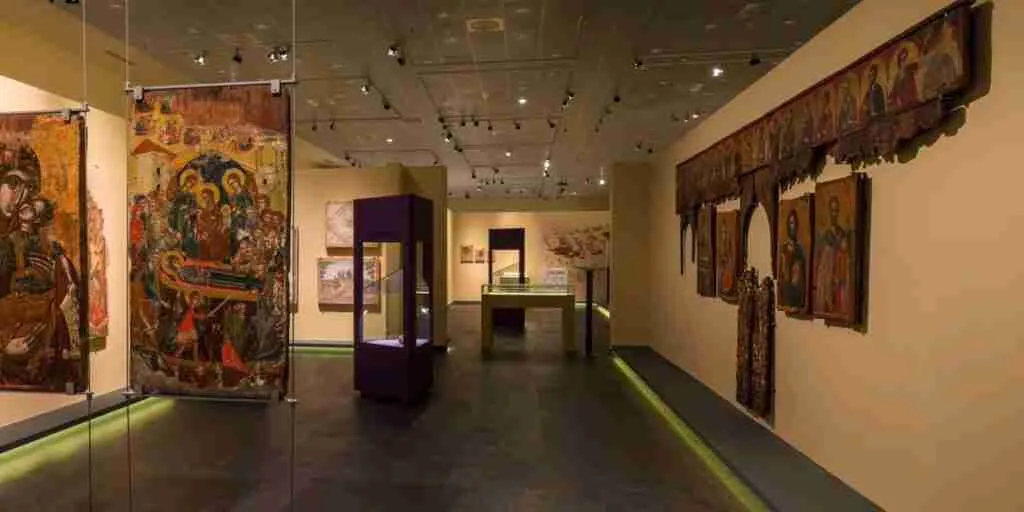
The Diachronic Museum of Larissa is one of the ten largest museums in Greece, inaugurated in 2015 and located 4 km southwest of the city centre in the Mezourlo district. It presents 10,000 years of regional history across eleven exhibition sections, from Paleolithic finds through Neolithic effigies, classical Greek and Roman artifacts, Byzantine mosaics, Ottoman tombstones, coins, and 19th-century material culture. The permanent collection includes a celebrated Neolithic sculpture collection and an early Christian mosaic floor. Admission costs €6 per adult from 1 April to 31 October and €3 from 1 November to 31 March (check the official site at dml.culture.gr for current rates). Free admission days include the first Sunday of each month from November to March, 18 April (International Day of Monuments), 18 May (International Day of Museums), the last weekend of September (European Heritage Days), and 28 October (National Holiday). Opening hours run daily 8 AM–8 PM in summer and Wednesday–Monday 8:30 AM–3:30 PM in winter. The museum is closed on Tuesdays in the winter season. Bus or taxi from the city centre takes 10–15 minutes.
Free and Low-Cost Attractions in Larissa 2026
The city’s two ancient theatres represent exceptional free heritage. The First Ancient Theatre, built by Macedonian King Philip V in the 3rd century BC at the foot of the ancient acropolis hill, is not open for interior access but is fully visible and impressive from along Eleftheriou Venizelou Street. The Second Ancient Theatre, dating from the Roman period, has two surviving rows of seats and a partial stage visible from the nearby street intersection. Neither requires admission or pre-booking.
The Municipal Art Gallery — officially the G. I. Katsigras Museum (Franklinou Roosevelt 59) — holds the third-largest collection of modern Greek art in the country, covering the 19th and 20th centuries. Admission is free. The Folklore Museum of Larissa charges €3 and covers the traditional life, crafts, and folk traditions of the Thessaly region. Alkazar Park, across the Pinios River from the city centre, is a free riverside green space with a large fountain, walking and cycling paths, and a statue of Hippocrates (ancient tradition holds he was buried in Larissa). The medieval Frourio (fortress) hill in the city centre is freely walkable; the views over the city and plains of Thessaly from the hilltop are among the best in Larissa.
Admission Summary: Larissa Attractions 2026
- Diachronic Museum: €6 (April–October), €3 (November–March); EU students and under-18s free
- Folklore Museum: €3
- Municipal Art Gallery (Katsigras): free
- Ancient Theatre (First): free — viewable from street
- Ancient Theatre (Second): free — viewable from street
- Alkazar Park: free
- Frourio hilltop walk: free
- Pinios River paths: free
Seasonal Price Variations in Larissa 2026
Larissa’s seasonal pricing pattern differs from the extreme swings common to Greek island and coastal destinations. Because the city caters primarily to domestic business travelers, university students, and transit visitors rather than international beach tourists, hotel rates and restaurant prices remain relatively stable year-round with modest peaks and troughs.
Summer 2026 in Larissa (June–August): Costs and Considerations
July and August bring the highest hotel rates, with mid-range properties running €90–110 per room and the Grecotel approaching its seasonal ceiling. The Diachronic Museum charges its summer rate of €6 and extends its hours to 8 PM daily. Temperatures on the Thessalian plain in July and August reach 35–40°C, making Larissa one of the hottest cities in Greece during this period. Tourists who choose Larissa in summer benefit from quieter museums (most Greek island visitors bypass the city) but face heat that makes afternoon sightseeing uncomfortable. The city’s café-bar scene thrives in summer evenings, with outdoor terraces full from 9 PM onward.
Shoulder Season 2026 (April–June and September–October): Best Value Window
Spring (April–June) and early autumn (September–October) offer the best balance of comfortable temperatures, moderate hotel pricing, and full attraction access. Hotel rates in this period run €75–95 for 3-star rooms, roughly 15–20% below peak summer. Temperatures are mild — 18–28°C — and the surrounding region is at its most visually striking: the Thessalian plain is green in spring and gold in early autumn. The Diachronic Museum opens its summer hours and summer pricing from April, but visitor numbers are modest, making for uncrowded gallery time. This shoulder season is the recommended window for first-time Larissa visitors in 2026.
Winter 2026 in Larissa (November–March): Lowest Prices
November through March brings Larissa’s most competitive accommodation pricing, with budget rooms from €40, 3-star hotels at €65–80, and reduced winter rates at upper-category properties. The Diachronic Museum drops its fee to €3, the city’s thermal baths and indoor venues gain appeal, and the Thessalian countryside takes on a striking winter aspect. The city does not shut down in winter: Greek urban café culture continues regardless of temperature, and the tsipouro bars and traditional tavernas fill with locals. Visitors prepared for cold, occasionally wet winters find Larissa at its most authentically Thessalian character and at its cheapest prices. The major Greek holidays — Christmas, New Year, and Easter — bring some domestic visitors and slightly higher hotel rates during the specific holiday weekends.
Complete Daily Budget Breakdowns for Larissa 2026
The following daily breakdowns reflect verified 2026 prices for travelers spending a full day in Larissa with a typical mix of cultural activity, dining, and local transport. All figures are per person, assuming two travelers sharing accommodation. Hotel rates are divided by two before inclusion in the per-person total.
Budget Daily Budget Breakdown for Larissa 2026
Budget travelers in Larissa in 2026 spend €45–70 per person daily (two sharing a budget hotel). The breakdown: budget hotel share €20–28, breakfast at a bakery €3–5, lunch at a souvlatzidiko €6–10, dinner at an inexpensive taverna €10–15, coffee and drinks €3–4, city bus or walking transport €2–4, attraction admission €0–3 (many days free). The range’s lower end applies to winter travel with free museum days; the upper end to summer evenings with drinks at a café terrace. Solo travelers at this tier pay €55–85 daily (no room sharing discount).
Mid-Range Daily Budget Breakdown for Larissa 2026
Mid-range travelers in Larissa in 2026 spend €100–145 per person daily (two sharing a 3-star hotel). The breakdown: 3-star hotel share €38–50, breakfast at the hotel or a café €8–12, lunch at a sit-down taverna €12–18, dinner with a carafe of wine €25–35, coffee and café stops €5–8, mixed bus and occasional taxi transport €5–10, museum or cultural admissions €6–10. This tier supports full museum visits, leisurely meals, and the occasional taxi without financial stress.
Luxury Daily Budget Breakdown for Larissa 2026
Luxury visitors in Larissa in 2026 invest €195–280 per person daily (two sharing a 4- or 5-star hotel). The breakdown: upscale hotel share €65–90, hotel breakfast buffet €15–20, lunch at a top city restaurant €25–35, dinner at a fine restaurant with wine €50–70, coffee and drinks €10–15, taxi and private transport €15–25, premium experiences and entrance fees €15–25. The Grecotel Larissa Imperial’s spa and pool facilities and its acclaimed breakfast buffet are included in the upper end of this range.
Sample Multi-Day Itineraries with 2026 Cost Breakdowns
The following itineraries are designed as practical planning tools. Line-item costs reflect individual pricing for specific activities; totals use “approximately” to acknowledge variability across choices within each day.
Budget 3-Day Larissa Itinerary 2026
This itinerary covers Larissa’s essential sights on a tight budget, with two nights at a budget hotel and all meals at the city’s inexpensive options. Total cost: approximately €115–180 per person (two sharing).
Day 1 — Arrival and City Centre: Check in to budget hotel (€40–55/room, share €20–28), walk the ancient acropolis hill and Frourio free, explore the central pedestrian streets, dinner at an inexpensive taverna with tsipouro (€12–15 per person), evening coffee at Frourio Square (€3.50).
Day 2 — Museums and Riverside: Breakfast at a bakery (€4), city bus to Diachronic Museum (€1 each way + entry €3–6), Folklore Museum (€3) and Municipal Art Gallery (free), lunch at a souvlatzidiko near the centre (€6–8), afternoon walk along Alkazar Park and Pinios River (free), dinner at Kimatothrafstis for mezze plates (€10–14 per person).
Day 3 — Market and Departure: If Saturday, visit the Neapoli farmers’ market for local cheese, honey, and produce (browsing free; €5–10 if buying), breakfast and coffee at a central café (€5–6), explore the shopping streets before departure.
Mid-Range 5-Day Larissa Itinerary 2026
This itinerary combines Larissa’s city sights with a day trip to Meteora and a visit to the Tempi Valley, using 3-star accommodation and proper sit-down dining throughout. Total cost: approximately €465–665 per person (two sharing).
Day 1 — Arrival: Check in to Hotel Park or Metropol (€75–100/room, share €38–50), walk the city centre, dinner at Syndrivani (moussaka and lamb, approximately €20–28 per person).
Day 2 — Larissa Culture: Hotel breakfast included (€0), Diachronic Museum (€6), Municipal Art Gallery (free), Folklore Museum (€3), lunch on Filellinon Street (€14–18), afternoon at Alkazar Park, evening drinks at Neapoli Square (€12–18).
Day 3 — Meteora Day Trip: KTEL bus from Larissa to Trikala then Kalambaka (€8–13 each way), three Meteora monastery visits at €5 each (€15 total per person), lunch in Kalambaka (€12–16), return bus to Larissa. This is the day trip highlight of any Larissa visit in 2026.
Day 4 — Tempi Valley and Surrounding Region: Car rental or guided excursion to the Vale of Tempi (38 km north), the Platamon Castle on the coast, and the slopes of Mount Olympus foothills (car rental approximately €35–45 for the day; fuel €10–15; entrance to castle €3), dinner on return in Larissa (€22–32).
Day 5 — Departure: Final hotel breakfast, shopping for local tsipouro and Thessalian products as souvenirs (€10–25), departure by train or KTEL.
Luxury 3-Day Larissa Itinerary 2026
This itinerary uses Grecotel Larissa Imperial as its base, with private transfers, guided cultural experiences, and Larissa’s best dining. Total cost: approximately €520–750 per person (two sharing).
Day 1 — Arrival at the Imperial: Check in to Grecotel Larissa Imperial (€130–180/room, share €65–90), spa use, dinner at the hotel restaurant or a top city restaurant (€50–70 per person).
Day 2 — Private Cultural Exploration: Private taxi to the Diachronic Museum with a morning slot before crowds (€6 entry plus €10–15 taxi), private guided walking tour of the ancient theatres and acropolis (local guides €40–60 for 2 hours), lunch at a top taverna (€30–40 per person), afternoon at leisure or Alkazar Park, evening at Frourio Square for tsipouro culture (€15–25).
Day 3 — Meteora Private Day Trip: Private driver to Meteora (€80–120 for a private car for the day), four monastery visits at €5 each (€20 total), lunch in Kalambaka at a restaurant overlooking the rocks (€25–35 per person), return to Larissa. Private transport eliminates the 3-hour bus connection and allows flexibility in monastery timing.
Day Trips from Larissa 2026: Budget and Transport Costs
Larissa’s central position in mainland Greece makes it an ideal base for day trips to several world-class destinations. The cost profile for each excursion varies significantly depending on whether you travel by public bus, car rental, or private transfer. All destinations listed below are reachable as genuine day trips — departing Larissa in the morning and returning before or shortly after dinner — from a city-centre hotel base. Allocate an additional €5–15 per person per day trip for meals in the destination town beyond what you would spend dining in Larissa itself.
Meteora Day Trip from Larissa 2026: Costs and Transport
Meteora, the UNESCO World Heritage Site featuring six active Orthodox monasteries built atop soaring sandstone pillars, is the single most compelling day trip from Larissa. The route by public bus involves KTEL services from Larissa to Trikala (approximately 1 hour, €6–8 one way) and then Trikala to Kalambaka (approximately 45 minutes, €2–5), for a total of €8–13 each way. No direct Larissa–Kalambaka service exists; the transfer in Trikala is required. Travel time from door to Kalambaka is approximately 2.5–3 hours by this route. Each Meteora monastery charges €5 per adult entry, payable only in cash. Visiting three monasteries costs €15 per person; visiting all six active monasteries costs €30 per person. Admission is free for children under 12. Dress requirements apply at every monastery: covered shoulders and knees for all visitors. Cash in small denominations is essential as card readers are unreliable at monastery entrances. Driving from Larissa takes approximately 1 hour 10 minutes (85 km via Trikala); a rental car at €35–45 per day makes the logistics significantly easier and allows early morning arrival before tour groups. A private transfer runs €80–120 for the round trip.
Volos and the Pelion Peninsula from Larissa 2026: Costs
Volos, the port city at the foot of the Pelion Peninsula, is 45 km southeast of Larissa — a 35-minute drive or an approximately 45-minute KTEL bus journey costing €8–10 each way. Volos itself is a lively Greek port city with an excellent waterfront dining scene; a lunch of fresh seafood meze on the port costs €20–35 per person. Day trips extend further to the Pelion Peninsula villages (15–30 minutes from Volos by car), where traditional stone architecture, chestnut forests, and accessible beaches await. A full Volos–Pelion day excursion by rental car runs €35–55 for car hire plus €10–15 fuel and €20–35 for a seafood lunch.
Thessaloniki Day Trip from Larissa 2026: Costs
Greece’s second city lies 150 km north of Larissa, reachable by KTEL bus for €13.50 and approximately 1.5–2 hours. Hellenic Train covers the route in under 1.5 hours. Thessaloniki’s Byzantine churches and museums (Rotunda, Hagia Sophia, Archaeological Museum) charge €4–8 entry each. A day in Thessaloniki for a Larissa-based traveler costs €13.50–24 in round-trip transport plus €20–50 for meals and admissions in the city, for a total day-trip cost of approximately €35–75 per person.
Tempi Valley and Platamonas Castle from Larissa 2026
The Vale of Tempi, where the Pinios River forces its way between the sheer cliffs of Mount Olympus and Mount Ossa, lies 38 km north of Larissa. The gorge holds the Chapel of Agia Paraskevi tucked into the rock face and offers short trails along the river. By car (30 minutes from Larissa), the drive is straightforward; Platamonas Castle on the coast, a medieval fortification in excellent condition perched above the beach, lies a further 30 km north. Castle entry costs €3. A Tempi–Platamonas day trip by rental car costs approximately €35–45 for the car, €8–12 for fuel, and €3 for castle entry.
Hidden Costs and Fees in Larissa 2026
Several spending categories catch first-time visitors to Greece off-guard. Understanding these in advance prevents budget surprises and allows more accurate trip planning.
Greek Accommodation Tax (Klimatikos Foros) 2026
Greece applies a government-mandated overnight stay tax charged per room per night. The rates by hotel classification are: 5-star properties €4 per room per night, 4-star €3, 3-star €1.50, 1- and 2-star hotels €0.50, and furnished apartments or Airbnb-style rentals €0.25–1.50 depending on the number of bedrooms. This tax is charged in addition to quoted room rates and is not included in most booking platform pre-tax totals. For a couple spending 4 nights in a 3-star Larissa hotel, the additional tax amounts to €6 total for the room over the stay. Verify current rates with your accommodation before arrival.
Tipping Culture in Greece 2026
Tipping in Greece is appreciated but not mandatory. At restaurants, rounding up the bill to the nearest €5 or leaving 5–10% for good service is the local standard. Fast food and souvlaki counters do not expect tips. Taxi drivers are tipped by rounding up the metered fare. Hotel housekeeping tips of €1–2 per night per room are appreciated but not required. Tsipouro bars and café counters: no tip expected. Guided tour operators: €5–10 per person for a half-day tour is a standard gesture.
ATM Fees and Currency in Larissa 2026
Larissa is fully within the Eurozone. Euro banknotes are the only currency accepted; no exchange is needed for travelers arriving from other Eurozone countries. Non-EU visitors should change currency at the airport or use bank ATMs in the city centre — Alpha Bank, Eurobank, and Piraeus Bank all have central branches and ATMs. Local bank ATMs charge no surcharge on standard withdrawals; third-party ATMs in tourist areas add €3–5 in fees. Carry cash in small denominations (€5 and €10 notes) specifically for Meteora monastery entry, farmers’ market purchases, and taxis.
Parking Costs in Larissa 2026
Drivers staying in the city centre face limited on-street parking. Municipal paid parking zones throughout the centre charge approximately €1–2 per hour. Pantheon Plaza shopping mall (large city centre mall) offers free parking with validation. The Grecotel Larissa Imperial includes free parking as standard. Budget and mid-range city centre hotels offer parking either on-site at €5–10 per day or by arrangement with nearby public lots. Clarify parking arrangements when booking if arriving by car.
Supermarket and Self-Catering Costs 2026
Larissa has multiple large supermarkets (AB Vassilopoulos, Lidl, Sklavenitis, and local chains) within easy reach of the city centre. A day’s self-catered groceries for two — bread, cheese, cold cuts, fruit, yogurt, and drinks — costs €12–18 at a supermarket versus €8–12 at the weekly farmers’ market. Self-catering breakfast from supermarket supplies (yogurt, honey, fresh bread, fruit) costs approximately €2–3 per person per day, delivering the biggest per-euro savings at the budget tier.
Money-Saving Strategies for Larissa 2026
Larissa’s domestic-market pricing already delivers strong value compared to most Greek destinations. These strategies reduce costs further without sacrificing the quality of the experience.
Visit the Diachronic Museum in winter or on free days. Traveling between November and March cuts the museum fee from €6 to €3 per adult. Free entry on the first Sunday of each month from November to March eliminates the fee entirely. EU citizens under 25 with a passport or ID card enter free regardless of season — the single biggest admission saving available at any Larissa attraction.
Eat where the students eat. Larissa’s university district and the streets around the central squares are saturated with affordable tavernas, souvlatzidika, and psistaries that price for student budgets. A full souvlaki pita with meat, vegetables, and tzatziki costs €3.50–4.50 and constitutes a complete lunch. Dinner before 9 PM at these establishments tends to be quieter, meaning faster service and sometimes better table choices.
Use the farmers’ markets. The Saturday market in Neapoli and the Wednesday market along Kalitheas Street sell direct-from-farm produce, dairy, honey, and olive oil at prices well below supermarket rates. For self-catering accommodation or travelers wanting to buy local products as souvenirs, these markets represent far better value than tourist shops.
Travel by KTEL bus rather than taxi for intercity journeys. The KTEL coach network connecting Larissa to Athens (€30), Thessaloniki (€13.50), Trikala (€6–8), and Volos (€8–10) is reliable, frequent, and dramatically cheaper than private transfers. Within the city, €1 bus journeys cover every district.
Book Meteora independently rather than through a tour package. A Larissa-based independent Meteora day trip via KTEL bus costs €16–26 in return transport plus €5 per monastery in admission. An organised group tour departing from Athens and stopping in Kalambaka costs €59–80 per person. Independent travel from Larissa is 50–60% cheaper, with comparable monastery access.
Stay in shoulder season. April to June and September to October bring hotel rates 15–20% below July and August peaks, while temperatures are comfortable for walking and sightseeing. Shoulder season is consistently the best combination of value and experience for Larissa in 2026.
Take advantage of free city sights. Larissa’s ancient theatres, Alkazar Park, Pinios River walks, the Municipal Art Gallery, and the Frourio hilltop are all free. A full day of city sightseeing can cost as little as €3–6 per person (Folklore Museum entry), making Larissa one of the most affordable full cultural days available anywhere on the Greek mainland.
Budget Planning for Families, Solo Travelers, and Groups in Larissa 2026
Different traveler profiles face different cost dynamics in Larissa. Understanding these variations allows more accurate personal budget planning.
Family Travel Costs in Larissa 2026
Families with children benefit from several structural advantages in Larissa. EU citizens under 18 and all children under 12 enter the Diachronic Museum free of charge, eliminating one of the only significant admission fees in the city. The Alkazar riverside park, the Pinios walking paths, and the central squares are free family-friendly spaces that occupy children without cost. Greek restaurants are universally welcoming to families with children, and kitchen flexibility for simple pasta or grilled chicken dishes is standard. A family of two adults and two children (EU under-18s) spending a week in a mid-range hotel room needs to factor a second room or family room supplement (€30–50 more per night than a standard double) into accommodation costs. Summer families should note that July and August heat on the Thessalian plain reaches 40°C; air conditioning in the hotel is non-negotiable and is standard across all Larissa accommodation categories.
Solo Traveler Costs in Larissa 2026
Solo travelers face the standard Greek accommodation challenge: room rates are designed for double occupancy, and single supplements of 20–40% are common at mid-range and above. A solo traveler renting a budget room pays the full €40–55 per night without a sharing partner; at mid-range, the full €75–100 per room applies. Solo daily costs in Larissa therefore run: budget €55–85 per person, mid-range €120–175 per person, luxury €230–330 per person. Hostels with dormitory beds are not prominently represented in Larissa’s accommodation inventory — it is primarily a hotel city rather than a hostel city — but private room rental through apartment platforms can bridge the gap, with city centre private rooms available from €35–50 per night for solo occupancy. The city’s café culture, active nightlife around Neapoli Square and Frourio Square, and student population make Larissa an unusually sociable destination for solo travelers compared to quieter Greek heritage towns.
Group and Business Travel Costs in Larissa 2026
Groups of four or more traveling together benefit from the Greek practice of splitting the cost of shared taverna meals (mezze-style ordering reduces per-person costs at mid-range restaurants) and from negotiated group rates at smaller hotels. The Diachronic Museum offers group ticket pricing through travel agent arrangements. Private taxi use for groups of three or four is economically competitive with public bus for intercity journeys of under 50 km, given the low €4 base fare for city taxis and fixed rates for regional transfers. Business travelers find Larissa’s hotel infrastructure — particularly Hotel Park, Metropol, and Divani Palace — well-equipped for business needs, with meeting rooms, reliable Wi-Fi, and central locations.
Neighbourhood Guide: Where to Stay in Larissa 2026
Larissa is compact enough that the choice of neighbourhood matters less than in a sprawling metropolis, but the areas below represent distinct stay experiences for different visitor priorities.
City Centre (Kentro): The default and recommended choice for visitors. All major sights, restaurants, cafés, and bars are within a 10–15 minute walk. Hotel options range from budget (Acropol, Grand) through mid-range (Park, Metropol, Divani Palace) to boutique (Minnō Spa). The central squares — Tachydromeon Square and the pedestrianised shopping centre — anchor daily life. Nightlife at Frourio Square and Neapoli Square is a short walk. Price premium over suburban stays: essentially none for comparable category hotels. Noise from late-night café activity is present near Frourio Square in summer; confirm room position if noise sensitivity is a concern.
Near Larissa Station (South of the Ring Road): Hotels in this area include a few budget options and offer easy access for early train departures. The station is a 15-minute walk from the city centre along a direct street. No special disadvantage for short stays; less convenient for accessing the main restaurant and nightlife areas after dinner.
Mezourlo Area (Southwest, 4 km): The Diachronic Museum’s neighbourhood is primarily residential. No significant hotel presence here; the museum is best visited by bus (€1) or taxi (€3–4) from a city centre base.
Suburban and Peripheral (4–6 km from Centre): The Grecotel Larissa Imperial occupies this zone, along with some motel-style accommodation along approach roads. The resort experience and the distance trade off against each other; city sights require taxi or car use. Budget €10–20 per day for transport between the resort and the city centre.
Frequently Asked Questions About Larissa Budget 2026
How much cash should I bring to Larissa in 2026?
Carry €50–100 in cash for a typical stay. Most city-centre restaurants, hotels, and shops accept cards. Cash is essential for: Meteora monastery entry (cash only at the gate, €5 per monastery), city bus tickets if not using the mobile app, farmers’ market purchases, and small cafés and street souvlaki counters. ATMs from Greek banks (Alpha Bank, Piraeus, Eurobank) in the city centre are plentiful and charge no local surcharge on standard withdrawals.
Are there any free museum days in Larissa in 2026?
The Diachronic Museum of Larissa offers free admission on the first Sunday of each month from November through March, on 18 April (International Day of Monuments), 18 May (International Day of Museums), the last weekend of September (European Heritage Days), and 28 October (National Holiday). EU citizens under 25 with a valid ID or passport enter free year-round. EU students with a student card and visitors over 65 with EU citizenship receive discounted entry (€3) regardless of season. Check the official site at dml.culture.gr to confirm free days before your visit.
Is Larissa good value compared to other Greek cities in 2026?
Larissa delivers consistently better value than Athens, Thessaloniki, and significantly better value than any island or coastal resort destination. Hotel, restaurant, and transport prices run 20–30% below Athens levels for equivalent quality. The city’s sights charge minimal or no entry fees. The absence of a tourist-inflated economy — Larissa prices for residents, not visitors — is the key structural advantage. For travelers wanting an authentic Greek urban experience without the premium charged by island-destination branding, Larissa is the best-value mid-sized city in central Greece in 2026.
What is the best way to get from Athens to Larissa cheaply in 2026?
The KTEL Larisas coach from Athens Liossion terminal (around €30) runs approximately 15 times daily and is the most flexible and frequently departed option. Hellenic Train runs two daily intercity departures from Athens Larissa Station at €17–24 in second class — cheaper than the bus but limited to twice-daily departures. Book train tickets in advance at hellenictrain.gr, especially for weekend travel. The journey by either mode takes approximately 3.5–4 hours. Driving by private car takes about 3.5 hours on the E75 motorway with toll costs of approximately €10–14 each way.
Does Larissa have hostels in 2026?
Larissa does not have a prominent hostel scene with dormitory-style accommodation like you find in Athens or Thessaloniki. The city is primarily a business and domestic travel hotel market. Budget travelers find the cheapest options in Larissa’s 1- and 2-star hotels (€40–55 per room), which at shared occupancy deliver per-person rates (€20–28) comparable to hostel dorm pricing in other Greek cities. Private room rentals through Airbnb and booking platforms offer a hostel-like price point for solo travelers, with private rooms from €35–50 per night.
Can I visit Meteora as a day trip from Larissa in 2026?
A Meteora day trip from Larissa is practical, though the bus route via Trikala takes approximately 2.5–3 hours each way. Depart Larissa by the first morning KTEL connection, arrive in Kalambaka by late morning, visit three monasteries by midday (€5 entry each, cash), have lunch in Kalambaka, and return to Larissa by early evening. The full-day round-trip costs approximately €16–26 for bus transport and €15 for three monastery entries — approximately €30–40 total per person, making it one of the most affordable routes to a UNESCO World Heritage Site in Greece. Driving from Larissa takes 1 hour 10 minutes and gives full flexibility over monastery timing.
What does a week in Larissa cost in 2026?
A budget week costs approximately €315–490 per person (two sharing budget accommodation for seven nights, including meals, transport, and admissions). A mid-range week runs €700–1,015 per person (two sharing a 3-star hotel). A luxury week reaches €1,365–1,960 per person (two sharing the Grecotel Larissa Imperial or equivalent 4-star property). These figures do not include international flights, travel insurance, or intercity transport from your departure city to Larissa.
Are restaurants expensive in Larissa in 2026?
Restaurant prices in Larissa are among the most affordable in any Greek city of comparable size. An inexpensive restaurant meal averages €11, with budget options from €8. A three-course dinner for two at a mid-range taverna runs €55–60 total. The souvlaki and street food culture is strong — a full souvlaki pita costs €3.50–4.50. The university student population drives competitive pricing throughout the food sector. Compared to Athens, budget and mid-range meals in Larissa run €2–5 cheaper per person for equivalent quality; compared to Greek island restaurants, the savings are even larger.
What hidden costs should I watch for in Larissa in 2026?
The government-mandated Greek accommodation tax (klimatikos foros) adds €0.50–3 per room per night depending on hotel category, charged at checkout. This is not always visible in pre-booking quoted prices. Cash-only payment is required at Meteora monastery entrances, at the weekly farmers’ markets, and at many small cafés and street food stands. City-centre parking fills quickly in Larissa, and municipal parking zones cost €1–2 per hour; confirm parking arrangements before arriving by car. Third-party ATMs in the city charge €3–5 per withdrawal; use Greek bank ATMs to avoid fees.
Is Larissa a safe city for travelers in 2026?
Larissa is a safe, low-crime Greek city. The central areas are well-lit, pedestrianized, and active until late at night throughout the year. Standard travel precautions — awareness of belongings in busy café and market areas, using official metered taxis — are sufficient. The tourist police emergency number is 171; general emergency services respond to 112. Taxi fraud is uncommon but possible; always confirm that the meter is running and request a receipt if in any doubt about the fare charged. The city’s nightlife around Frourio Square and Neapoli Square is lively in summer evenings but remains safe and primarily local in character.
What should I eat in Larissa on a budget in 2026?
Souvlaki is the single best value food in Larissa: a full pita wrap with grilled pork or chicken, tomato, onion, and tzatziki costs €3.50–4.50 and constitutes a filling meal at any hour. Tiropita (cheese pie) and spanakopita (spinach and feta pie) from a city-centre bakery cost €1.50–2.50 each and make an excellent breakfast or snack. At sit-down tavernas, ordering moussaka or a grilled meat main at €9–14 with a shared Greek salad (€6–9) and house wine by the carafe (€6–10) delivers a complete dinner for €12–18 per person. The farmers’ market on Saturday in Neapoli and Wednesday along Kalitheas Street sells local feta, fresh vegetables, olives, and honey directly from Thessalian producers at prices well below supermarket levels, making them the best stop for self-catering provisions and edible souvenirs.