Killarney Photography Guide: Best Spots in Kerry’s Landscapes
Killarney’s dramatic mountain backdrops, mirror-still lakes, and ancient oak forests create Ireland’s most photogenic landscape, where golden-hour light transforms Gothic ruins into fairytale scenes and morning mist turns familiar viewpoints into ethereal dreamscapes. This comprehensive guide reveals the iconic perspectives that define Kerry photography alongside secret vantage points known only to locals, with detailed technical guidance for capturing everything from sweeping panoramas across MacGillycuddy’s Reeks to intimate woodland compositions in the native yew forests of Muckross.
Key Takeaways: Essential Photography Insights for Killarney
- Golden Hour Dominance: Killarney’s west-facing mountain ranges create exceptional sunset conditions, with the Gap of Dunloe and Ladies View offering unobstructed western exposures that capture alpenglow on distant peaks while foreground lakes reflect the color show.
- Weather Windows: Kerry’s maritime climate produces rapidly changing conditions that transform scenes within minutes—persistent rain creates dramatic waterfall flow and saturated woodland colors, while post-storm clearings deliver crystalline atmosphere and rainbow opportunities across the valley.
- Seasonal Color Shifts: Autumn delivers peak photographic conditions with rust-colored bracken covering mountainsides, golden oak leaves carpeting forest floors, and low-angle light creating long shadows across the lakes, while spring brings vibrant rhododendron blooms that frame lakeside compositions in purples and pinks.
- Lake Reflection Mastery: Killarney’s three lakes (Lough Leane, Muckross Lake, Upper Lake) offer mirror-perfect reflections during calm mornings, with the sheltered bays near Ross Castle and Muckross House providing the most reliable still-water conditions for symmetrical compositions.
- Woodland Photography Excellence: The ancient oak woodlands contain Ireland’s finest temperate rainforest environments, where diffused light filters through moss-draped branches creating naturally soft illumination perfect for intimate forest floor compositions featuring ferns, fungi, and gnarled tree roots.
- Mountain Photography Access: MacGillycuddy’s Reeks—Ireland’s highest mountain range—provides dramatic backdrops visible from multiple lake viewpoints, with Torc Mountain offering the most accessible elevated perspective requiring only a moderate 90-minute ascent to reach panoramic summit views.
People Also Ask About Killarney Photography
What is the most photographed location in Killarney?
Ladies View represents Killarney’s most iconic photographic perspective, capturing all three lakes with the MacGillycuddy’s Reeks mountain range rising dramatically in the background—a composition that has defined Kerry landscape photography since Queen Victoria’s ladies-in-waiting declared it Ireland’s finest view during their 1861 visit. The roadside viewpoint on the N71 Ring of Kerry road provides immediate access to this sweeping panorama, though photographers seeking fresh interpretations descend the informal trails to lakeside positions that incorporate foreground rocks and native vegetation into wider compositions. Early morning visits before tour bus arrivals deliver solitude and the possibility of mist-filled valleys that add atmospheric depth, while late afternoon brings directional side-lighting that reveals texture in the mountain ridges and creates color saturation in the foreground heather.
What camera settings work best for Killarney’s changeable light conditions?
Killarney’s maritime climate demands flexible exposure strategies, with aperture priority mode (f/8 to f/11 for landscape depth of field) paired with auto-ISO (100-800 range) providing the responsiveness needed for rapidly shifting cloud cover and sudden sunbreaks through rain showers. Morning woodland photography benefits from wider apertures (f/2.8 to f/5.6) that isolate fern details against soft-focused backgrounds, while waterfall compositions require narrow apertures (f/16 to f/22) combined with neutral density filters to achieve the 1-4 second shutter speeds that render flowing water as silky motion blur. Kerry’s frequent overcast conditions create naturally diffused light that eliminates harsh shadows but requires exposure compensation (+0.3 to +1.0 EV) to prevent the camera’s meter from underexposing scenes dominated by bright skies—bracketing exposures becomes essential when mixing bright lake surfaces with dark mountain silhouettes in the same frame.
When does Killarney offer the best photographic light throughout the year?
Autumn delivers Killarney’s peak photographic conditions from late September through November, when low-angle sunlight (rising southeast, setting southwest) creates extended golden hours that bathe mountainsides in warm directional light for three hours after dawn and before dusk. The seasonal transformation brings rust-colored bracken to the uplands, golden oak foliage to the woodlands, and stormy atmospheric conditions that produce dramatic cloud formations and frequent rainbows across the valley—all while tourist numbers decline after the summer peak, returning tranquility to popular viewpoints like Ross Castle and Muckross House. Spring’s secondary peak (April through early June) offers longer daylight hours for extended shooting sessions, vibrant rhododendron blooms that add foreground color to lakeside compositions, and active wildlife including red deer stags with developing antlers and newborn fawns in the valley meadows.
What photography equipment proves essential for Killarney’s diverse landscapes?
A versatile wide-angle zoom (16-35mm full-frame equivalent) serves as the primary lens for capturing Killarney’s expansive lake-and-mountain panoramas from viewpoints like Ladies View and Aghadoe Heights, while a standard zoom (24-70mm) handles mid-range compositions at locations like Ross Castle where architectural elements combine with landscape backdrops. Killarney’s frequent rain demands weather-sealed camera bodies and lens protection—a simple rain cover or even a shower cap prevents moisture damage during unexpected downpours that create the most dramatic atmospheric conditions. Circular polarizing filters prove invaluable for managing reflections on lake surfaces (rotating to either enhance or eliminate water reflections depending on compositional intent), deepening blue skies on partly cloudy days, and cutting through atmospheric haze that often obscures distant mountain details in Kerry’s moisture-laden air.
Extended multi-day tours – 5+ days
Featured Killarney Multi-Day Tour Packages

3 days
Killarney 3-Day Discovery Tour
- ✓ Comprehensive Killarney experience
- ✓ Expert local guides included
- ✓ All accommodation included
- ✓ Transportation provided
5 days
Killarney 5-Day Highlights Experience
- ✓ Comprehensive Killarney experience
- ✓ Expert local guides included
- ✓ All accommodation included
- ✓ Transportation provided
7 days
Killarney 7-Day Cultural Journey
- ✓ Comprehensive Killarney experience
- ✓ Expert local guides included
- ✓ All accommodation included
- ✓ Transportation provided

10 days
Killarney 10-Day Complete Adventure
- ✓ Comprehensive Killarney experience
- ✓ Expert local guides included
- ✓ All accommodation included
- ✓ Transportation provided
Multi-day tour packages powered by TourRadar. Prices and availability subject to change.
Introduction: Photography in Ireland’s Premier Landscape
Killarney National Park spans 25,000 acres of Ireland’s most diverse photographic terrain, where glacier-carved valleys contain three interconnected lakes surrounded by native oak woodlands, with Ireland’s highest mountain range rising beyond to create layered compositions that shift from intimate forest details to sweeping alpine panoramas within minutes of walking. The landscape represents a photographic microcosm of Irish scenic variety—Gothic Revival castles reflect in mirror-calm lake bays, medieval abbey ruins emerge from ancient woodlands, Victorian estates showcase formal gardens against wild mountain backdrops, and cascading waterfalls tumble through moss-covered rock gorges. This geographic concentration eliminates the location-hopping required in other Irish regions, allowing photographers to work a compact area intensively rather than driving hours between dispersed attractions.
Kerry’s position on Ireland’s southwestern coast creates distinctive photographic conditions shaped by Atlantic weather systems that deliver constant atmospheric variation. Morning mist rising from the lakes transforms familiar viewpoints into ethereal scenes where mountain silhouettes fade into layers of progressively lighter tones, creating natural depth through atmospheric perspective. Rain showers sweep across the valley in visible curtains that can be tracked and photographed as they approach, while the breaks between fronts deliver crystalline air quality that renders distant details with exceptional clarity. This weather dynamism means returning to the same location across different days—or even different hours within a single day—produces entirely distinct photographic opportunities as changing light, mist, and cloud cover continuously reconfigure the scene.
The region’s cultural landscape enhances its natural beauty through centuries of human interaction with the environment. Ross Castle’s 15th-century tower house provides a perfectly scaled architectural element for lakeside compositions, its stone walls and corner turrets creating visual anchors that ground sweeping water-and-mountain views in human narrative. Muckross House’s Victorian elegance and formal gardens offer manicured foregrounds for wild mountain backdrops, demonstrating the Irish estate tradition of framing designed landscapes within natural grandeur. The abandoned copper mines in the Gap of Dunloe and ruined cottages throughout the valley tell stories of past habitation that add historical depth to pure landscape photography—each weathered stone wall and moss-covered foundation represents a compositional opportunity to blend human history with natural beauty.
Killarney’s accessibility removes the physical barriers that often separate photographers from exceptional Irish landscapes. Paved roads reach viewpoints like Ladies View and Moll’s Gap, boardwalks traverse the Muckross wetlands to bring cameras within meters of pristine bog environments, and well-maintained trails ascend to elevated perspectives on Torc Mountain without requiring technical mountaineering skills. This infrastructure allows photographers to focus energy on creative decisions rather than navigation challenges, while still offering wilderness experiences for those willing to venture beyond the developed areas. The combination of convenient access to classic views and available solitude in the backcountry accommodates both efficient location-collecting and contemplative long-exposure work in peaceful settings.
Iconic Photography Locations in Killarney National Park
Ladies View: The Classic Killarney Panorama
Ladies View delivers the definitive Killarney landscape composition from its elevated roadside position on the N71, where the view encompasses all three lakes descending through the valley with the MacGillycuddy’s Reeks mountain range rising beyond—a layered perspective that demonstrates classic landscape photography principles of foreground, middle ground, and background elements working together in a unified frame. The immediate foreground contains heather-covered slopes that provide color and texture in close focus, the middle ground presents the serpentine lakes winding through the valley bottom, and the distant background features Ireland’s highest peaks creating a dramatic skyline that anchors the entire composition. This natural arrangement of elements in receding planes creates depth through both linear perspective (converging lines of the valley) and atmospheric perspective (progressive lightening of tones toward the horizon).
The viewpoint’s west-northwest orientation makes it exceptional for afternoon and sunset photography, when side-lighting rakes across the mountain faces to reveal every ridge and gully while warm light saturates the foreground vegetation. Summer sunsets occur around 21:30, providing extended golden hour light from 19:30 onward as the sun tracks along the horizon, illuminating the scene from progressively lower angles that create longer shadows and richer colors. Autumn brings earlier sunsets (17:30 to 18:30) with more dramatic weather patterns—clearing storms often leave broken clouds that catch sunset color while gaps in the cover send shafts of light spotlighting specific mountains or lake sections, creating natural drama that static clear skies cannot match.
The standard roadside perspective captures the established view, but photographers seeking fresh interpretations descend the informal trails that drop toward the lakeshore below. These lower positions incorporate foreground elements that the elevated viewpoint lacks—weathered fence posts, gnarled oak branches, glacial erratic boulders, and native ferns all serve as anchoring elements in the near field. A 10-15 minute descent brings cameras to lakeside positions where calm mornings produce mirror reflections that double the visual impact, with the mountains appearing both in direct view and inverted in the water below. Wide-angle lenses (16-24mm) work at the roadside viewpoint to capture the full panorama, while moderate wide angles (24-35mm) suit the lakeside positions where closer proximity to foreground elements requires slightly longer focal lengths to maintain proper perspective.
Ross Castle: Lakeside Architecture and Reflections
Ross Castle’s 15th-century tower house stands on a limestone outcrop extending into Lough Leane, creating the quintessential Irish castle-on-water composition that combines medieval architecture with natural landscape in a single frame. The castle’s position at the eastern end of the lake provides numerous photographic approaches—shooting from the adjacent peninsula captures the structure against the western mountain backdrop with the lake providing foreground interest, while positions along the opposite shore frame the castle as a distant element within a broader landscape context. Early morning offers the most reliable calm water conditions for reflection photography, with the sheltered bay protecting the water surface from wind disturbance that ripples would create on the more exposed main lake.
The castle’s compact footprint and vertical emphasis make it well-suited to portrait-orientation compositions that emphasize the tower’s height while including both the structure and its reflection in a balanced frame. A 50-85mm focal length provides appropriate perspective from the main photographic positions across the small bay, filling the frame with the castle while including sufficient surrounding landscape to establish context. Wider angles (24-35mm) work for compositions that emphasize the relationship between castle, lake, and distant mountains, creating environmental portraits that show the structure in its full geographic setting rather than isolating it as an architectural subject.
Seasonal variations transform the castle’s photographic character throughout the year. Autumn delivers warm color in the surrounding woodlands that frames the gray stone structure in golden and rust tones, while winter’s bare trees reveal the castle’s full silhouette without summer’s concealing foliage—the stark branches create natural framing elements that draw the eye toward the tower. Spring brings active bird life to the lakeshore, with swans and ducks adding animated elements to otherwise static architectural compositions. The castle remains accessible throughout daylight hours via a short walk from the car park, with the eastern approach offering the most dramatic perspectives as the walking path follows the shoreline to positions directly across the small bay from the tower.
Muckross House and Gardens: Victorian Elegance in Wild Landscape
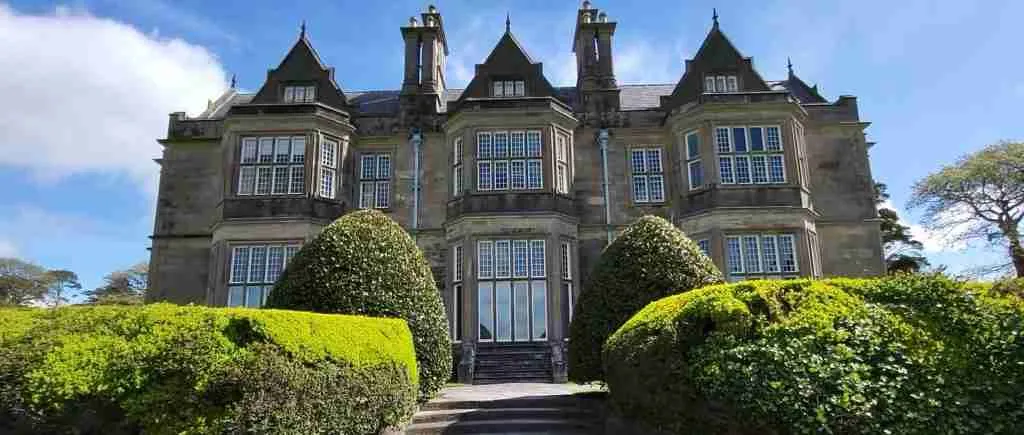
Muckross House presents a rare Irish example of formal Victorian estate photography, where manicured lawns, specimen trees, and geometric garden beds provide foreground structure for compositions that balance human design against the wild mountain backdrop of Torc and Mangerton rising beyond. The house’s Tudor Revival architecture features asymmetrical gables, elaborate chimneys, and limestone facades that photograph well in the soft overcast light typical of Kerry—harsh direct sunlight creates problematic shadows under the deep eaves, while diffused cloud cover wraps the building in even illumination that reveals architectural detail without contrast issues.
The sunken garden demonstrates Victorian garden design at its peak, with symmetrical beds arranged around a central fountain and framed by yew hedges that create dark green walls contrasting with seasonal flower colors. Spring brings rhododendron blooms in purples and pinks that mass along the garden boundaries, summer fills the beds with herbaceous perennials, and autumn delivers rich foliage colors in the specimen maples and copper beeches planted throughout the grounds. The garden’s formal geometry provides compositional structure that landscape photographers can either emphasize (using symmetrical framing and central fountain as a focal point) or deliberately work against (shooting from oblique angles that emphasize the garden’s integration with the surrounding informal woodland).
The estate’s extensive grounds contain woodland trails that transition from manicured parkland to natural oak forest within minutes, offering photographers a range of environments from designed landscape to wilderness. The Rock Garden presents naturalistic planting of alpines and ferns among limestone outcrops, creating intimate compositions where carefully selected plants appear to grow wild among the rocks. The Muckross Traditional Farms section provides cultural landscape photography opportunities, with reconstructed thatched cottages, stone walls, and agricultural implements creating scenes of historical rural life against the mountain backdrop—these cultural elements work particularly well in overcast conditions when the soft light prevents harsh shadows from obscuring the architectural and agricultural details.
Torc Waterfall: Kerry’s Premier Cascade
Torc Waterfall drops 20 meters over moss-covered rock steps in a woodland amphitheater where ancient oaks frame the cascade and filtered light creates naturally soft illumination throughout the day. The waterfall’s multi-tiered structure provides compositional flexibility—tight framings isolate individual cascade sections showing water texture and rock detail, while wider perspectives include the surrounding temperate rainforest environment that makes this location distinctively Irish. A short paved path from the N71 car park reaches the main viewing platform within 200 meters, though photographers achieve more interesting perspectives by continuing up the rough trail along the waterfall’s eastern side to elevated positions that look down on the upper cascades.
The waterfall requires long exposure techniques to render the flowing water as smooth motion blur, typically demanding shutter speeds between 0.5 and 4 seconds depending on aesthetic preference—shorter exposures maintain some texture and energy in the water flow, while longer exposures create the silky appearance that has become a waterfall photography standard. Kerry’s frequent overcast conditions often provide naturally subdued light that allows these longer exposures without filters, but sunny conditions require neutral density filters to prevent overexposure when using the narrow apertures (f/16 to f/22) needed for maximum depth of field. A circular polarizing filter proves valuable for managing reflections on wet rocks and cutting through water surface glare that can create bright highlights competing with the cascade itself.
Seasonal water volume dramatically affects the waterfall’s photographic character. Winter and spring rains swell the Owengarriff River to create powerful, wide cascades that fill the entire rock face with curtains of white water, while summer and autumn typically reduce flow to more delicate ribbons that allow the underlying rock structure to become a significant compositional element. High water produces dramatic power and movement but can lack the detail and texture that lower flows reveal—many photographers prefer the shoulder seasons when moderate flow strikes a balance between impressive volume and visible rock detail. The surrounding woodland also varies seasonally, with autumn delivering golden oak foliage that adds warm color to the predominantly green scene, while spring brings fresh fern growth and rhododendron blooms in the understory.
Gap of Dunloe: Mountain Valley Drama
The Gap of Dunloe cuts a dramatic pass between MacGillycuddy’s Reeks and the Purple Mountain range, creating a glacially-carved valley where a narrow road winds through landscape transitions from farmland to alpine terrain within 11 kilometers. The southern entrance near Kate Kearney’s Cottage provides the classic compositional approach—the winding road leads the eye up the valley between progressively higher mountain walls, creating powerful linear perspective reinforced by stone walls that parallel the road and converge toward the distant pass. Wide-angle lenses (16-24mm) emphasize this perspective compression, making the valley appear deeper and the mountains more imposing than moderate focal lengths would render them.
Morning light works best in the Gap of Dunloe, as the east-facing orientation receives early sun that illuminates the valley while the western mountains remain in shadow, creating clear tonal separation between the sunlit foreground and darker mountain backdrop. Mist commonly fills the valley bottom in early morning, particularly after clear nights when cold air drains downslope to settle in the low ground—this mist adds atmospheric depth and can be photographed both as a compositional element (shooting into the mist to create layers of progressively lighter tones) and as a phenomenon in process (capturing the moment when rising sun causes the mist to lift and dissipate).
The five small lakes spaced along the valley floor provide foreground interest and reflection opportunities throughout the ascent. Each lake occupies a natural depression in the glacial valley bottom, with surrounding boulders and native vegetation offering compositional elements for lake-and-mountain combinations. The uppermost lake sits just below the highest point of the pass, where the road crests between the mountain ranges to reveal views northward over the Black Valley—this transitional moment from enclosed valley to open vista creates dramatic before-and-after perspectives that demonstrate landscape scale through the contrast between intimate valley photography and expansive mountain panoramas from the summit.
Hidden Photography Locations: Beyond the Classic Views
Derrycunnihy Church Ruins: Gothic Architecture in Woodland Setting
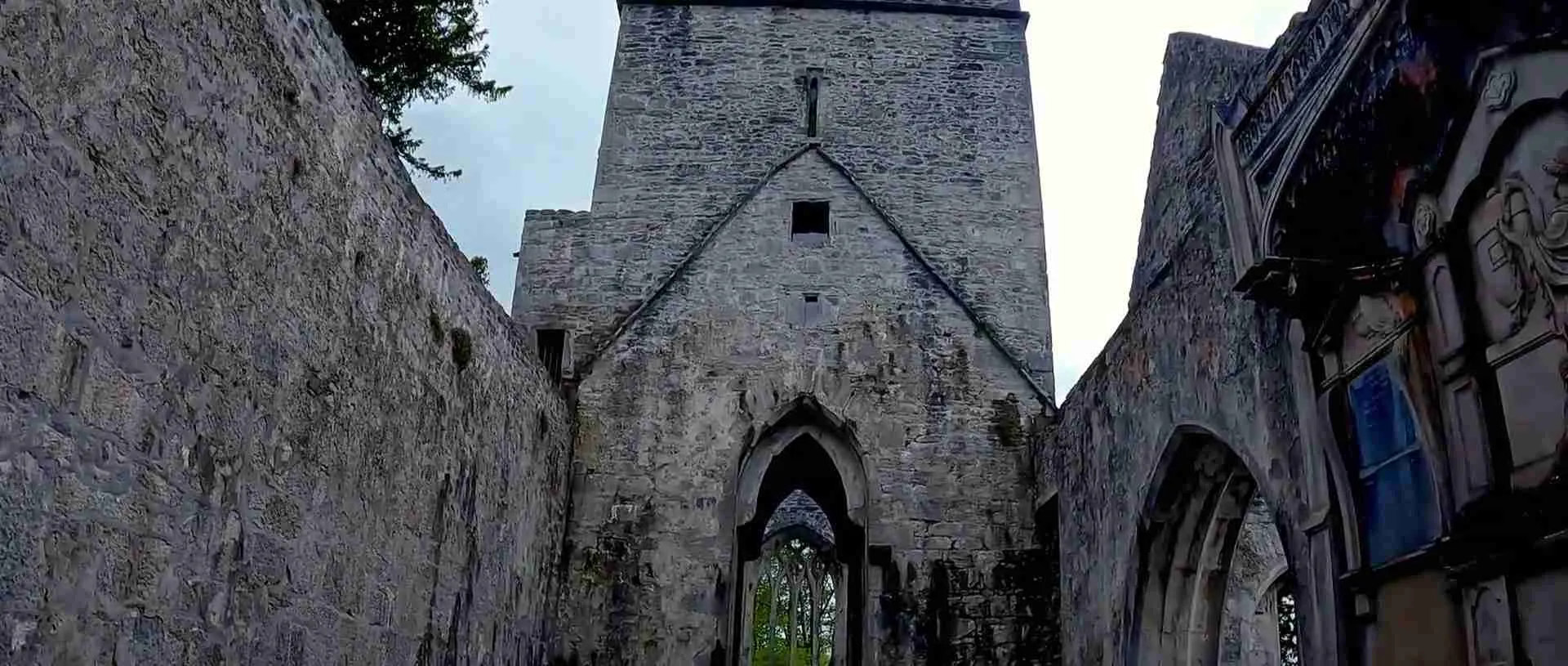
The ruined church at Derrycunnihy sits in ancient oak woodland on the northern shore of Muckross Lake, accessible only by foot or bicycle along the scenic trail that circles the lake. The 19th-century Gothic Revival structure features pointed-arch windows that frame views through to the forest beyond, creating natural compositional devices that guide the viewer’s eye while the weathered stone walls and collapsed roof demonstrate romantic decay. Ivy covers portions of the walls, ferns grow from cracks in the masonry, and moss carpets the floor—all creating the classic Irish ruin aesthetic that blends human construction back into the natural landscape.
The woodland setting provides year-round photographic interest through seasonal changes in the surrounding forest. Autumn delivers the most dramatic transformation, when golden oak leaves contrast against the gray stone and carpet the church floor in natural color that needs no enhancement—the fallen leaves create ready-made foregrounds for wide-angle interior shots looking out through the window arches. Spring brings fresh green to the woodland and activates the bird population, with robins and wrens often perching on the windowsills where they can be included in architectural compositions as living elements that add scale and narrative to the static stone structure.
The location’s remoteness eliminates the crowd management issues that plague accessible sites like Ross Castle, allowing contemplative photography without time pressure or compositional compromise. Midday visits work well here despite the conventional landscape photographer’s preference for golden hour light—the woodland canopy diffuses direct sunlight to create even, soft illumination that prevents harsh shadows while the dense forest blocks distant views that would otherwise compete for attention, focusing the frame entirely on the interplay between Gothic architecture and temperate rainforest. A moderate wide-angle lens (24-35mm) handles most compositions in the confined interior spaces, while a standard zoom allows detail shots of architectural elements like carved window tracery and dressed stone quoins.
Old Weir Bridge: Stone Architecture Over Mountain Stream
The Old Weir Bridge arches across the channel connecting Muckross Lake to Lough Leane, its weathered limestone construction demonstrating traditional Irish bridge building at a perfect human scale for photographic composition. The bridge’s single-arch design creates a symmetrical element that anchors compositions, while the flowing water beneath provides movement and texture that prevent the static architectural subject from becoming rigid. Upstream perspectives show the bridge framed by overhanging oak branches with the mountain backdrop beyond, while downstream views incorporate the Meeting of the Waters (where three channels converge) into broader landscape compositions.
The location excels for long-exposure water photography, where 1-4 second exposures render the flowing current as misty motion blur that contrasts with the sharp-focused stone architecture. Neutral density filters enable these longer exposures even in bright conditions, though Kerry’s frequent cloud cover often provides sufficiently subdued light that filters become unnecessary—photographers can simply stop down to f/16 or f/22 and achieve the desired shutter speed through narrow aperture alone. Circular polarizing filters manage reflections on the water surface, either eliminating them to show clear views of the rocky streambed or enhancing them when interesting sky patterns reflect in calm pools above the bridge.
Access requires either the lake circuit trail (bike-friendly) or a boat excursion from Ross Castle, making this a destination for photographers committed to working beyond roadside viewpoints. The investment in access time delivers substantial rewards through solitude and pristine conditions—morning visits often find the location completely empty despite its proximity to heavily trafficked areas like Muckross House. The surrounding oak woodland creates dappled light patterns that change throughout the day as the sun tracks across the sky, with early morning and late afternoon providing directional side-light that reveals texture in the stone arch while backlighting filters through the forest canopy to create rim-lighting on leaves and dramatic atmospheric effects in any lingering morning mist.
Dinis Cottage Promontory: Lakeside Forest Photography
Dinis Cottage occupies a wooded promontory extending into Muckross Lake, where the convergence of water, forest, and mountain creates intimate landscape compositions that emphasize Killarney’s temperate rainforest character over its more frequently photographed alpine aspects. Ancient oaks draped with moss and lichen lean over the shoreline, their gnarled roots gripping the rocky ground as they reach toward the water—these individual trees make excellent close-range subjects demonstrating the woodland’s age and character. The cottage itself (a 19th-century fishing lodge) provides an architectural element at human scale, though the primary photographic interest lies in the relationship between forest and lake rather than the building.
The promontory’s jutting position creates 180-degree water views that shift from mountain backdrops (looking south toward Torc and Mangerton) to island-dotted lake surfaces (looking north across the main body of Muckross Lake). This variety allows photographers to work multiple compositions from a single base position by simply changing orientation, maximizing productivity during limited light windows like the golden hour. Calm mornings deliver mirror reflections where the mountains appear both in direct view above the tree line and inverted in the lake below, creating symmetrical compositions that double the visual impact while the forested promontory provides the dark anchor that grounds the entire frame.
The understorey vegetation includes native Irish ferns, mosses, and lichens that thrive in the high-humidity environment created by lake proximity and forest canopy—these smaller elements reward macro and close-focus work that contrasts with the sweeping landscape possibilities. Morning mist commonly forms over the lake surface, creating ethereal conditions where the water appears to generate its own atmosphere while the forest emerges from the vapor as a dark silhouette. The location remains accessible year-round via the Muckross Lake circuit trail, with autumn delivering peak conditions when fallen oak leaves carpet the forest floor in gold and the low-angle sunlight penetrates deeper into the woodland than summer’s high sun can manage.
Aghadoe Heights Viewpoint: Elevated Town and Lake Panorama
Aghadoe Heights looks down over Killarney town and Lough Leane from an elevated hillside position that provides the area’s premier sunrise perspective—the eastern orientation captures the sun rising directly over the lake with the town occupying the middle ground and the MacGillycuddy’s Reeks forming the distant horizon. The elevated vantage point (approximately 200 meters above the lake) creates a bird’s-eye perspective that shows landscape patterns invisible from ground level, particularly the relationship between human settlement (Killarney town’s street grid and building clusters) and the natural environment (lake, woodland, mountains) that contains it.
Sunrise timing varies dramatically across seasons, from 5:00 in midsummer to 8:30 in midwinter, requiring advance planning to arrive during the critical blue hour that precedes dawn. The pre-dawn period delivers rich blue tones in the sky while artificial lights still illuminate Killarney town below, creating a color contrast between warm electric light and cool natural twilight—this brief window before the sun rises over the lake offers the most dramatic light of the entire day. As the sun appears over the eastern hills, it first illuminates the distant mountains while the town and lake remain in shadow, creating layered tonal relationships that demonstrate atmospheric perspective through progressively lighter values in the distance.
The viewpoint includes the ruins of Aghadoe Cathedral and Round Tower, both 12th-century structures that provide foreground interest and cultural context for what would otherwise be pure landscape photography. Photographing through the cathedral’s arched windows frames the distant view in Gothic stonework, adding historical narrative to the composition while the architectural elements create natural leading lines that guide the viewer’s eye toward the landscape beyond. A moderate wide-angle lens (24-35mm) captures both the architectural foreground and landscape background with appropriate depth of field at f/11, while longer focal lengths (70-200mm) isolate specific sections of the panorama—Killarney town with cathedral spires, Ross Island woodlands, or the distant mountain profile.
Woodland Photography Techniques for Killarney’s Ancient Forests
Understanding Temperate Rainforest Light
Killarney’s oak woodlands function as temperate rainforest—high rainfall, mild temperatures, and persistent humidity create conditions where mosses, ferns, and lichens thrive in the understorey and even colonize tree branches and trunks. This vegetation density creates unique photographic lighting conditions that differ fundamentally from typical deciduous woodland. The canopy thickness prevents most direct sunlight from reaching the forest floor even in midsummer, creating naturally diffused illumination that remains relatively consistent throughout the day. This means woodland photography in Killarney works well during midday hours that landscape photographers typically avoid—the forest canopy performs the same light-softening function that cloudy skies provide for open landscapes.
Overcast days actually enhance woodland photography rather than diminishing it, as the cloud cover eliminates the occasional sunbeams that penetrate canopy gaps to create bright hotspots and extreme contrast that exceed camera dynamic range. Continuous diffused light wraps around tree trunks and forest floor elements from all directions, creating subtle modeling and minimal shadows that allow detail to register across the entire frame without the blocked shadows or blown highlights that direct sunlight would produce. This even illumination particularly benefits color photography, where the saturated greens of moss-covered trees and fern-carpeted ground photograph with rich color that harsh sunlight would wash out through excessive brightness.
The forest’s vertical structure creates layers at different distances from the camera—foreground ferns occupy the first 2-3 meters, middle-ground tree trunks stand 5-20 meters away, and background trees recede into progressively softer focus. Managing depth of field across these layers requires careful aperture selection—f/8 maintains sharpness from immediate foreground through middle distance while allowing background elements to soften naturally, creating depth through selective focus rather than trying to render everything sharp with small apertures that would require impossibly slow shutter speeds in the forest’s subdued light. This approach accepts bokeh in the distant background as a compositional element rather than fighting to eliminate it through stopping down to f/16 or f/22.
Photographing Individual Trees and Forest Details
The ancient oaks demonstrate extraordinary character through twisted trunks, gnarled branches, and moss-covered bark that create portrait-worthy subjects when isolated from the broader forest context. Individual tree photography requires different approaches than general woodland scenes—moving close to the trunk (1-3 meters) with a moderate wide-angle lens (24-35mm) emphasizes the tree’s mass and texture while a low camera position looking upward along the trunk creates a perspective that showcases the tree’s height and the canopy structure above. Vertical composition emphasizes the tree’s reaching quality as branches extend toward light, while horizontal framing can incorporate the surrounding forest to show the featured tree in relationship to its community.
Bark texture photography rewards close examination—Killarney’s oaks develop deeply furrowed bark patterns that photograph well in the forest’s naturally diffused light, while the moss and lichen colonies that cover many trunks create color contrasts between gray-brown bark and bright green vegetation. Macro lenses or close-focus capabilities reveal intricate detail in lichen structures and bark patterns that appear merely textured to the naked eye but resolve into complex landscapes at close range. Rain-dampened bark shows deeper color saturation and more pronounced texture than dry wood—shooting immediately after showers or during light drizzle enhances these qualities while also activating the vibrant greens in moss colonies that appear dull when dry.
Forest floor compositions emphasize the horizontal plane rather than the vertical tree trunks, with wide-angle lenses (16-24mm) used from low positions to create foreground-dominated frames where ferns, fallen logs, fungi, and leaf litter occupy the majority of the frame while tree trunks provide background context. Autumn creates ideal forest floor conditions when golden oak leaves carpet the ground in natural color while green ferns persist underneath, creating a color palette that requires no saturation adjustment in post-processing. Fungi emerge throughout autumn and winter, with species ranging from small woodland mushrooms to impressive bracket fungi growing shelf-like from tree trunks—these organisms add seasonal interest and provide focused subjects within the general woodland environment.
Seasonal Woodland Transformations
Spring woodland photography centers on new growth emerging from the forest floor and canopy—bright green fern fronds unfurl in characteristic spiral patterns that create elegant line compositions, while the oak canopy develops fresh leaves that glow yellow-green when backlit by morning or evening sun penetrating the forest gaps. Bluebells carpet sections of the woodland floor in May, creating carpets of color that photograph best in soft overcast light that prevents the delicate blue flowers from appearing washed out. The spring canopy remains relatively open before the leaves reach full size, allowing more light penetration than the dense summer forest will permit—this creates opportunities for rim-lighting and sun-star effects as direct beams filter through branches.
Summer woodland presents the forest at its most densely vegetated state, with a closed canopy creating the deep shade and even illumination that defines temperate rainforest photography. The consistent green palette shifts the photographic focus from color variation to texture and form—the shapes created by overlapping fern fronds, the patterns in moss-covered boulders, and the sculptural quality of ancient tree trunks become primary compositional elements when color variation cannot provide structure. This is the season for black and white woodland photography, where the subtle tonal gradations between different greens translate into grayscale values that emphasize form and light quality over the color relationships that dominate other seasons.
Autumn transforms the woodland through color rather than light, as the oak canopy turns golden-brown and sheds leaves that accumulate on the forest floor in thick carpets. This seasonal color works best photographed in soft overcast light that prevents harsh shadows under the canopy while allowing the warm tones to saturate fully—bright sun creates excessive contrast between sunlit leaves and shaded trunks that either clips highlights in the bright areas or blocks shadow detail. The falling leaves themselves create motion opportunities when wind stirs the canopy, with fast shutter speeds (1/500 second or faster) freezing individual leaves in mid-air while slower speeds (1/15 to 1/60 second) render them as blurred motion that conveys movement without completely dissolving into abstraction.
Mountain Photography in MacGillycuddy’s Reeks
Photographing Ireland’s Highest Peaks from Valley Viewpoints
MacGillycuddy’s Reeks rise dramatically from sea level to Carrauntoohil’s 1,038-meter summit within just a few horizontal kilometers, creating exceptionally steep mountain profiles that photograph with impressive verticality from valley-floor viewpoints. The range’s proximity to Killarney’s lakes means water can be incorporated into foreground compositions that include the mountains—Ladies View, Moll’s Gap, and various positions along the Black Valley Road all frame the peaks beyond lake surfaces or valley floors. These valley perspectives show the mountains’ full height and create the most dramatic sense of scale, particularly when human elements (boats on the lake, houses in the valley) provide size reference that emphasizes the peaks’ elevation.
Side-lighting reveals maximum mountain detail by casting shadows that define every ridge, gully, and cliff face—early morning light from the east illuminates the range’s eastern flanks while leaving western faces in shadow, creating strong three-dimensional modeling through the interplay of light and dark. Late afternoon reverses this relationship as westerly sun catches the western aspects, though the orientation of specific peaks within the range means some faces receive better light in morning while others favor afternoon. Monitoring weather forecasts becomes essential for mountain photography in Kerry, as the Atlantic climate produces rapid changes between clear conditions and complete cloud cover—the most dramatic mountain photography often occurs during transitional weather when broken clouds create spotlighting effects as sunbeams break through gaps to illuminate specific peaks while surrounding summits remain in shadow.
Telephoto focal lengths (70-200mm) compress the apparent distance between foreground and background elements, making the mountains appear larger and more imposing in the frame—this compression effect works particularly well when photographing across water, where the intervening lake becomes a layer that separates foreground from mountain backdrop without introducing visual clutter. Wide-angle perspectives (16-35mm) de-emphasize the mountains by showing them in broader landscape context, an approach that works when the composition prioritizes the relationship between multiple landscape elements (lake, woodland, valley, mountains) rather than isolating the peaks as the primary subject. Both approaches have merit depending on compositional intent, with many photographers working scenes with multiple focal lengths to create variety in their mountain photography.
Elevated Perspectives: Torc Mountain Summit
Torc Mountain’s summit reaches 535 meters elevation through a well-maintained trail that ascends from the N71 car park near Torc Waterfall, requiring approximately 90 minutes of steady climbing to reach the cairn-marked top. The summit provides a 360-degree panorama that fundamentally differs from valley perspectives by looking across at the MacGillycuddy’s Reeks rather than up at them—this eye-level view shows the relationship between individual peaks and reveals the complexity of the range’s topography in ways that valley viewpoints cannot. Looking northwest, the view extends over Killarney’s three lakes with the full sweep of the Reeks beyond, while turning east shows the Mangerton range and south reveals the Kenmare valley and Atlantic coast.
The elevated perspective creates opportunities for layered compositions where foreground, middle ground, and background occupy distinct horizontal bands—the immediate foreground contains Torc’s heather-covered summit slopes, the middle ground shows the lakes occupying the valley bottom, and the background features the Reeks rising to the western horizon. This layering works particularly well in morning light when mist fills the valleys to separate the layers further, with the summit standing above the cloud in clear air while the lakes disappear into white vapor and distant peaks emerge from the mist as islands. These temperature inversion conditions occur most reliably on clear autumn and winter mornings when overnight cooling creates stable air masses that trap moisture at lower elevations.
Weather changes rapidly at the summit elevation, where exposure to wind and passing showers creates challenging conditions for camera handling and lens cleaning. A weather-sealed camera body and lens protection (even a simple plastic bag) prove essential when clouds engulf the summit and deposit moisture on exposed equipment—these cloudy periods can be photographed as atmospheric events rather than obstacles, with the swirling mist creating abstract minimal compositions where familiar landmarks disappear and reappear as cloud density varies. The summit requires substantial physical effort to reach, limiting visitor numbers even during summer peak season—early morning starts (beginning the ascent at sunrise) combine physical exertion with the day’s best light and deliver summit arrival during the golden hour when low-angle light creates maximum drama across the landscape below.
Black Valley and Gap of Dunloe Mountain Compositions
The Black Valley occupies a glacially-carved depression between the MacGillycuddy’s Reeks and the Purple Mountain range, creating an enclosed valley environment where photographers work within the mountains rather than looking at them from external viewpoints. The valley floor sits at approximately 100 meters elevation with peaks rising 900+ meters on both sides, creating a dramatic sense of containment and scale that differs from the open vistas available from roadside viewpoints. The narrow valley naturally channels compositions along its northeast-southwest axis, with the mountains providing inevitable background elements that frame and contain every view.
Morning light enters the valley from the northeast, illuminating the valley floor and northern faces of the Reeks while the Purple Mountain range remains in shadow—this creates natural tonal separation between the two mountain walls that emphasizes the valley’s enclosed character. The narrow opening at the head of the Gap of Dunloe becomes a compositional focal point where the eye can escape the enclosed valley toward distant views, creating a sense of journey and discovery that purely enclosed compositions cannot achieve. Mist behaves predictably in the valley, settling into the low ground overnight and clearing from the floor upward as morning sun warms the air—photographing this clearance process shows the mountains emerging progressively from cloud, revealing their height and mass through the vertical extent of the mist layer they penetrate.
Stone walls and abandoned cottages throughout the valley provide human elements that establish scale and add narrative to mountain landscapes that might otherwise appear abstract in their grandeur. These cultural landscape features work particularly well as foreground elements in wide-angle compositions that show the full valley context—a ruined cottage in the near field with the Reeks rising beyond creates a composition that speaks to both natural majesty and human history, demonstrating how generations lived within and worked this dramatic environment. Winter delivers the most graphic conditions when snow covers the peaks above 500 meters while the valley floor remains clear, creating stark tonal contrasts between white summits, dark mountain faces, and green valley bottom that emphasize the landscape’s vertical relief.
Lake Photography: Reflections and Water Compositions
Creating Mirror Reflections on Killarney’s Lakes
Perfect mirror reflections require absolutely calm water conditions that occur most reliably during early morning hours before thermal heating generates wind, typically within the first two hours after sunrise during summer or the first hour during cooler seasons. Sheltered bays and narrow channels provide protection from prevailing winds that disturb the main lake surfaces—Ross Castle’s small bay, the narrows between Muckross and Lough Leane, and the protected inlets along Dinis Island all offer reliable reflection opportunities even when the open lakes show ripples. Scout potential reflection locations in advance to identify protected positions, then arrive during calm conditions to work compositions that incorporate both the direct subject and its inverted mirror image.
Symmetrical compositions emphasize the reflection by placing the horizon line precisely at the center of the frame, creating perfect bilateral symmetry where the upper and lower halves mirror each other exactly—this approach works particularly well for architectural subjects like Ross Castle where the geometric structure appears equally strong in both orientations. Asymmetrical compositions favor either the direct view or the reflection by placing the horizon above or below center, using the less-emphasized element as supporting visual information rather than equal partner. Both approaches have merit, with symmetrical framing creating graphic impact through pattern and asymmetrical compositions allowing more creative flexibility in emphasizing specific elements.
Circular polarizing filters manage reflections actively rather than passively accepting whatever the water surface provides—rotating the filter adjusts reflection intensity from complete elimination (showing straight through the water surface to the lakebed below) to maximum enhancement (intensifying the mirror effect). For classic reflection photography, rotate the filter to intensify rather than eliminate the reflection, which darkens the sky above while enriching the color in the reflected sky below. Understanding polarizer orientation proves essential—the filter has maximum effect when the camera points perpendicular to the sun’s position, meaning early morning and late afternoon provide stronger polarizing effect than midday when the sun sits directly overhead. Test the filter’s effect by rotating it slowly while watching the viewfinder to see how the reflection changes, then lock it at the position that delivers the desired result.
Sunrise and Sunset Lake Photography
Sunset photography on Killarney’s lakes benefits from the western mountain backdrop that provides solid silhouette forms against evening sky color—the mountains create a dark baseline that grounds colorful skies while their profiles add geographic specificity that pure sky-and-water compositions lack. Ladies View and positions along the southern shore of Lough Leane both face generally west toward the Reeks, allowing sunset compositions that capture the mountains’ silhouette against golden or red skies. The sun sets behind the mountains rather than into the water, which prevents the direct solar disk from appearing in frame—this indirect sunset light produces softer, more graduated color than shooting directly into the sun would create, allowing better exposure balance between bright sky and darker foreground.
Sunrise offers different opportunities through its eastern orientation, with the sun rising over the lower hills and immediately illuminating the western mountains in warm early light while the lakes remain in shadow. Aghadoe Heights provides the premier sunrise perspective looking east over Lough Leane, while positions along the western shore of the lake face the rising sun with Ross Castle and the eastern mountains silhouetted in the pre-dawn blue hour. The transitional period before the sun actually appears delivers the richest color, when the sky glows with blue, purple, and orange tones while the landscape remains in shadow—this blue hour window lasts approximately 20-30 minutes and rewards photographers who arrive early rather than timing their arrival for the actual sunrise moment.
Lake surfaces add reflected color to sunrise and sunset compositions, effectively doubling the color impact by showing vivid sky tones both directly and in the water reflection. This works best when light wind creates subtle texture on the lake surface that breaks the reflection into impressionistic color rather than perfect mirror—the broken reflection adds painted quality to the water while maintaining recognizable connection to the sky above. Graduated neutral density filters balance exposure between bright skies and darker landscapes by selectively darkening the sky portion of the frame, preventing the camera’s meter from either overexposing the sky to properly expose the foreground or underexposing the landscape to maintain sky detail. A 2-stop (0.6) or 3-stop (0.9) graduated ND filter typically provides appropriate balance for Killarney’s moderate landscape relief where the transition from land to sky occurs gradually rather than at a harsh horizon line.
Island and Peninsula Photography
Innisfallen Island occupies the center of Lough Leane, its wooded slopes and monastic ruins creating a focal point for lake compositions that would otherwise lack middle-ground interest between the immediate shore and distant mountains. The island photographs best from elevated positions like Aghadoe Heights or Ross Castle’s battlements, where the camera looks down on the island to show its full extent and relationship to the surrounding water. From ground-level positions around the lakeshore, the island appears as a low tree-covered mound that merges visually with the background, losing its island character—the elevated perspective separates it clearly from the background through both height and tonal contrast.
Multiple islands and peninsulas throughout the three-lake system provide compositional variety through their different sizes, shapes, and positions. Dinis Peninsula creates bold foreground when photographed from opposite shores, its dark wooded mass contrasting with bright water to establish depth through tonal layering. The smaller islands scattered across Muckross Lake serve as stepping stones that guide the eye across the water surface toward distant mountains, creating a compositional path that connects foreground to background through a series of intermediate elements. Photographing these island relationships requires careful position selection—some vantage points show islands separated clearly by water gaps, while others create visual overlap where islands appear to merge into single masses despite being separated by substantial channels.
Peninsula compositions work particularly well when side-lighting rakes across the wooded slopes to reveal three-dimensional form through the interplay of illuminated treetops and shadowed valleys between them—this modeling transforms what would otherwise appear as flat dark masses into textured three-dimensional landforms. The relationship between land and water creates natural leading lines where shorelines curve into the distance, providing compositional structure that guides the viewer’s eye through the frame. Wide-angle lenses emphasize these shoreline curves through perspective distortion that exaggerates the foreground peninsula while compressing the distant islands and mountains into a layered background, creating dramatic depth through both linear and atmospheric perspective.
Seasonal Photography Strategies Throughout the Year
Spring Photography: New Growth and Extended Light
Spring transforms Killarney’s woodlands through the emergence of new growth, with fresh fern fronds unfurling in characteristic spiral patterns and the oak canopy developing bright yellow-green foliage that glows when backlit. The rhododendron bloom peaks in May and early June, when these invasive but photogenic plants mass along lakeshore and woodland edges in displays of purple and pink flowers that create natural foreground color for landscape compositions. The blooms work particularly well photographed in soft overcast light that prevents the delicate flowers from appearing washed out, while the dense flower clusters provide sufficient color mass to register as significant compositional elements even in wide-angle landscape frames that include substantial non-floral area.
Extended daylight hours in May and June provide 16+ hours between sunrise and sunset, allowing photographers to work multiple locations during single days without the compressed shooting windows that winter imposes. The sun’s high arc creates vertical midday light that penetrates deeper into the woodland than winter’s low sun can manage, illuminating forest floor details and creating dappled light patterns as beams filter through the developing canopy. This midday woodland light works better than midday landscape light, where the overhead sun creates flat illumination on open terrain—the forest canopy diffuses and directs the light in ways that maintain interest even during hours that landscape photographers typically avoid.
Wildlife becomes more visible and active during spring, with red deer frequently observed in valley meadows as females give birth to fawns and males begin developing new antlers. Bird activity peaks during nesting season, with residents like robins and wrens singing from prominent perches while summer migrants arrive to breed in the woodland and wetland habitats. These wildlife subjects add animated elements to otherwise static landscape compositions, though photographing them requires longer focal lengths (300-500mm) than landscape work typically demands—carrying a lightweight telephoto alongside landscape gear allows opportunistic wildlife photography when encounters occur during location-to-location travel.
Summer Photography: Midnight Light and Dense Vegetation
Summer solstice brings Killarney’s longest days with sunset occurring around 21:30 and twilight extending until nearly 23:00, creating exceptional extended light conditions where the golden hour lasts for hours rather than the 30-60 minutes typical of equinox periods. The sun tracks along the northern horizon during evening, maintaining low-angle directional light that reveals landscape texture and creates warm color long after it would have set behind mountains during winter’s steeper solar arc. This extended evening light allows unhurried work at multiple locations during single sessions, with time to explore compositional variations and experiment with different perspectives while the light quality remains favorable.
The woodland reaches maximum density during summer when the oak canopy closes completely and the understory vegetation achieves full growth, creating the darkest conditions in the forest’s annual cycle. This deep shade challenges camera sensors and requires either high ISO settings (1600-3200) to maintain reasonable shutter speeds or acceptance of very slow speeds that demand tripod support even during midday hours. The consistent green color palette shifts photographic focus from color variation to form and texture, with the shapes created by fern fronds, the patterns in moss-covered trunks, and the sculptural quality of ancient trees becoming the primary compositional elements when seasonal color changes cannot provide structure.
Tourist numbers peak during summer school holidays (July-August), requiring early morning photography sessions at popular locations like Ross Castle and Ladies View to avoid crowd management issues. Sunrise arrivals deliver both optimal light and maximum solitude, while midday and afternoon hours see heavy visitation that makes clean compositions difficult without unwanted human elements in frame. The crowds create opportunities for cultural landscape photography showing Killarney’s tourism industry in action, though photographers seeking pristine natural landscapes should concentrate shooting efforts during early morning and evening hours when visitor numbers decline substantially.
Autumn Photography: Peak Color and Dramatic Weather
Autumn represents Killarney’s premier photographic season, when the combination of rich seasonal color, dramatic weather patterns, and declining tourist numbers creates ideal conditions for landscape photography. The oak canopy transitions from green to golden-brown through October and early November, with the color change occurring gradually from the highest elevations downward as cold air triggers the autumn transformation. This progression allows photographers to track the color peak as it descends from the mountain slopes through the woodland to the lakeshore, providing an extended window of autumn color rather than a single brief peak that can be missed due to travel constraints.
Bracken covering the mountainsides turns rust-orange and red-brown, creating broad sweeps of warm color across the upland slopes that contrast dramatically with the green valley floors still in summer vegetation. This color division emphasizes the landscape’s vertical relief while providing natural color variation that requires no saturation enhancement in post-processing—the scene delivers rich color straight from the camera when properly exposed. Morning side-lighting rakes across these colored slopes to reveal every contour and fold in the terrain, creating three-dimensional modeling through the interplay of illuminated faces and shadowed hollows.
Atlantic storm systems become more frequent and intense during autumn, producing the dramatic weather conditions that create exceptional landscape photography opportunities. Rain showers sweep across the valley in visible curtains that can be tracked and photographed as they approach, while the breaks between fronts deliver crystalline air quality and occasional rainbows spanning the valley. These transitional weather windows reward photographers who monitor forecasts and respond quickly to favorable conditions—the most dramatic light often occurs during brief clearings when low-angle sun breaks through storm clouds to spotlight specific landscape elements while surrounding areas remain in shadow, creating natural drama that static weather conditions cannot match.
Winter Photography: Snow, Storms, and Low-Angle Light
Winter delivers Killarney’s most dramatic mountain photography when snow covers the peaks above 500 meters while the valley floor remains clear, creating stark tonal contrasts that emphasize the landscape’s vertical relief through the visual separation between white summits and dark lower slopes. These snow conditions occur unpredictably rather than reliably, with some winters producing multiple snow events and others remaining largely snow-free—monitoring weather forecasts becomes essential for capturing the brief windows when mountain snow and clear valley weather coincide. The snow typically persists for 2-5 days on the high peaks before melting or new storms obscure visibility, creating limited opportunities that reward flexible photographers who can respond quickly to favorable conditions.
The sun’s low arc creates extended golden hour light that lasts from mid-afternoon through sunset, with the low angle producing dramatic side-lighting that reveals landscape texture and creates long shadows across the terrain. Winter solstice brings the year’s lowest sun angle, when even midday light arrives from a 15-degree elevation that would qualify as golden hour light during summer months. This consistent low-angle illumination allows productive photography throughout the short winter day (approximately 8 hours of daylight in December) rather than concentrating all shooting into brief sunrise and sunset windows.
Bare deciduous trees reveal landscape structure that summer foliage conceals, with the oak woodland’s branching patterns creating graphic elements in winter compositions that would disappear under leafy canopies during growing season. The simplified palette of browns, grays, and greens focuses attention on form and light rather than color, creating conditions well-suited to black and white photography where tonal relationships and textural detail become the primary compositional elements. Persistent rain saturates the landscape with water, creating enhanced waterfall flow and vibrant green moss color while also generating the atmospheric conditions that produce dramatic cloud formations and frequent rainbows—accepting rather than avoiding wet weather delivers some of winter’s most compelling photographic opportunities.
Equipment Recommendations for Killarney Photography
Essential Camera Gear and Lenses
A versatile wide-angle zoom (16-35mm full-frame equivalent) serves as the primary lens for Killarney landscape photography, covering the focal length range needed for sweeping lake-and-mountain panoramas from viewpoints like Ladies View while remaining wide enough for woodland interiors where limited working distance prevents using longer lenses. The 16mm wide end captures the full breadth of valley views, while the 35mm long end provides a more natural perspective for compositions that emphasize specific landscape elements rather than maximizing scope. Image stabilization proves valuable for handheld photography during Killarney’s frequent overcast conditions when subdued light might otherwise demand slower shutter speeds than handheld technique can safely manage.
A standard zoom (24-70mm or 24-105mm) provides the mid-range focal lengths needed for castle and architectural photography where wide-angles would distort vertical lines while telephotos would require impractical working distances. The 70mm or 105mm long end reaches into moderate telephoto territory useful for isolating specific landscape elements—individual trees, waterfall details, distant mountain peaks—without requiring the bulk and weight of a dedicated telephoto lens. This versatile range handles the majority of Killarney photography outside of true wide-angle landscape work, making it the logical second lens to complement the wide-angle zoom.
Weather sealing in both camera body and lenses proves essential rather than optional in Kerry’s wet climate, where encountering rain during outdoor photography sessions approaches inevitability rather than possibility. Weather-sealed equipment continues functioning during rain showers and heavy mist that would threaten unsealed gear, allowing photography to continue during the dramatic atmospheric conditions that storms create rather than forcing retreat to shelter when conditions become most interesting. A simple rain cover or even a shower cap provides additional protection during heavy rain, while lens hoods prevent water droplets from reaching the front element where they would create soft spots and flare in the image.
Filters for Managing Killarney’s Light and Water
Circular polarizing filters prove indispensable for Killarney photography through their multiple effects on landscape scenes—they manage reflections on water surfaces (rotating to either enhance or eliminate based on compositional intent), deepen blue sky on partly cloudy days, and cut through atmospheric haze that obscures distant mountain details in Kerry’s moisture-laden air. The filter screws onto the front of the lens and rotates freely, allowing continuous adjustment of polarization strength while watching the effect in the viewfinder or on the camera’s rear screen. Maximum polarization occurs when the camera points perpendicular to the sun’s position, meaning early morning and late afternoon photography receives stronger effect than midday when the overhead sun produces minimal polarization regardless of filter rotation.
Neutral density filters enable long exposures during daylight hours, allowing the multi-second shutter speeds needed to render flowing water as silky motion blur in waterfall photography or to smooth rippled lake surfaces into glassy calm. A 3-stop (0.8 ND) or 6-stop (1.8 ND) filter provides appropriate density for typical waterfall work, reducing light sufficiently to achieve 1-4 second exposures at f/16 even in moderately bright conditions. Variable ND filters offer convenience through continuously adjustable density from 2-8 stops achieved by rotating the filter ring, though they introduce potential image quality compromises including color casts and sharpness reduction that fixed-density filters avoid—for critical work, high-quality fixed ND filters deliver better optical performance than variables.
Graduated neutral density filters balance exposure between bright skies and darker landscapes by selectively darkening the upper portion of the frame, preventing the camera’s meter from either overexposing the sky to properly expose the land or underexposing the foreground to maintain sky detail. Soft-edge graduates work best for Killarney’s mountain landscapes where the land-to-sky transition occurs gradually along an irregular mountain profile rather than at a hard horizon line—the soft transition zone blends naturally without creating obvious banding. A 2-stop (0.6 GND) or 3-stop (0.9 GND) filter handles typical Killarney scenes where moderate landscape relief creates brightness differences between sky and ground without the extreme range that would require stronger filtration.
Support and Protection Gear
A sturdy tripod proves essential for Killarney photography despite adding weight and bulk to the field kit—waterfall long exposures, sunrise/sunset lake reflections, woodland photography in subdued light, and any serious landscape work benefits from the stability that handheld technique cannot provide. Carbon fiber construction reduces weight compared to aluminum while maintaining rigidity, though quality aluminum tripods perform equally well at lower cost for photographers willing to carry additional weight. The tripod should extend to eye level without raising the center column, allowing comfortable composition through the viewfinder while maintaining maximum stability—extending the center column trades stability for height, creating a less stable platform that defeats the tripod’s purpose.
A ball head provides smooth, intuitive camera positioning with a single locking control that allows quick framing adjustments during changing light conditions—loosening the ball allows free camera movement in any direction, while tightening locks the position instantly. Pan-tilt heads offer more precise control through separate adjustments for horizontal and vertical movement, though the multiple controls slow operation compared to ball heads’ single-motion design. Either head style works effectively; choice depends on personal preference and shooting style rather than objective superiority of one design over the other.
Weather protection for camera gear ranges from simple to sophisticated depending on budget and tolerance for complexity. At minimum, carrying several gallon-size ziplock bags allows quick protection when unexpected rain arrives—slip the camera inside the bag, cut a hole for the lens to poke through, and continue shooting with makeshift rain cover. Purpose-designed rain covers provide better functionality through transparent panels for viewing the camera controls and fitted openings for lens and viewfinder, while remaining compact enough to carry permanently in the camera bag. Waterproof camera bags protect gear during transport between locations, though access time makes them impractical as working bags—a weather-resistant camera bag with rain cover serves better for walk-around photography where quick access matters more than absolute waterproofing.
Technical Considerations for Killarney’s Challenging Conditions
Managing Dynamic Range in High-Contrast Scenes
Killarney’s frequent high-contrast scenes—dark foreground forests against bright skies, shadowed valley floors below sunlit mountain peaks, lake reflections mixing dark vegetation with bright sky—challenge camera sensors’ ability to capture detail across the full brightness range present in the scene. Modern cameras typically handle 12-14 stops of dynamic range from pure black to pure white, but scenes containing bright skies and dark shadows often exceed this range, forcing choices about which tones to preserve and which to sacrifice. Exposing for the highlights maintains sky detail but renders foreground shadows as featureless black, while exposing for shadows preserves foreground detail but blows out highlights to pure white with no recoverable information.
Graduated neutral density filters provide an optical solution by selectively darkening the sky portion of the frame to bring the scene’s brightness range within the sensor’s capability—the filter balances exposure at capture time rather than relying on post-processing recovery. This in-camera approach delivers better quality than pushing shadows or pulling highlights in processing, where aggressive adjustments introduce noise in shadows and posterization in highlights. The filter technique requires relatively straight horizon lines to work effectively—scenes with complex skylines where mountains, trees, or buildings project irregularly into the sky create situations where the filter’s straight transition darkens portions of the landscape along with the sky, though soft-edge graduates minimize this issue through gradual transitions that blend more naturally than hard-edge filters.
Bracketing exposures creates multiple captures of the same scene at different exposures—typically a normally exposed base image plus underexposed and overexposed variants that preserve detail in highlights and shadows respectively. These brackets can be manually blended in post-processing or automatically combined using HDR software that merges the exposures into a single image containing the full tonal range present across the bracket series. Natural-looking HDR results require restraint in processing—the goal is extending dynamic range to match what the eye sees rather than creating the hyperreal appearance that excessive HDR processing produces. Subtle HDR that viewers don’t consciously recognize as processed imagery delivers the most successful results for landscape photography.
Focusing Strategies for Landscape Depth
Achieving front-to-back sharpness in landscape compositions requires understanding hyperfocal distance—the focusing point where depth of field extends from half that distance through to infinity, creating maximum depth coverage with a given aperture. For a 24mm lens at f/11, hyperfocal distance sits approximately 6 feet from the camera; focusing at this point renders everything from 3 feet through infinity acceptably sharp. This focusing strategy works for scenes containing both near foreground and distant background elements where both must appear sharp—focus roughly one-third of the way into the scene rather than on the furthest element, allowing depth of field to extend both forward and backward from the focused point.
Focus stacking provides an alternative approach for scenes where even stopped-down apertures cannot achieve adequate depth of field, particularly in close-focus work where macro distances create extremely shallow depth regardless of aperture setting. The technique involves capturing multiple images focused at different distances throughout the scene, then blending them in post-processing software that combines the sharp portions of each frame into a single composite showing sharpness from immediate foreground through distant background. Manual focus works better than autofocus for focus stacking because it allows precise control over focus position changes between frames—autofocus systems may not select the exact focus points needed for proper coverage of the scene’s depth.
Live view focusing provides precision that viewfinder focusing cannot match, particularly when working at wide apertures where shallow depth of field demands exact focus placement. Engaging live view displays the scene on the camera’s rear screen with the ability to magnify the image 5x or 10x for critical focus verification—this magnified view shows focus accuracy that the optical viewfinder’s smaller, lower-resolution display cannot reveal. The technique proves especially valuable for tripod-mounted landscape work where the camera remains stationary rather than being handheld for spontaneous capture, allowing time for the methodical process of entering live view, magnifying the image, achieving precise focus, and capturing the frame.
Post-Processing Approaches for Killarney Imagery
Killarney’s naturally saturated landscape colors—green forests, blue lakes, rust-colored bracken, golden autumn foliage—require minimal saturation enhancement in post-processing and often benefit from subtle reduction to prevent oversaturated results that appear unrealistic. The vibrant greens that make Kerry distinctive can easily cross into garish territory when saturation sliders push too far, creating unnatural color that defeats the purpose of capturing the landscape’s authentic appearance. A light touch with saturation adjustment or preferring luminance adjustments that brighten/darken specific color ranges without intensifying their saturation delivers more natural results that maintain credibility.
Contrast adjustments prove more valuable than saturation for enhancing Killarney imagery, as Kerry’s soft overcast light creates naturally low-contrast scenes that benefit from modest contrast increases to add visual punch without fundamentally altering the captured color. Global contrast affects the entire image uniformly, while local contrast (clarity) affects fine detail and edge definition without impacting broader tonal relationships—combining both approaches at moderate strength creates presence and dimensionality in the image without the harsh appearance that excessive contrast produces. The diffused light that makes Kerry challenging for in-camera contrast actually creates ideal conditions for post-processing contrast enhancement, as there are no blocked shadows or blown highlights that would prevent aggressive adjustment.
Color temperature corrections compensate for the blue cast that overcast conditions create or the warm tones that golden hour light produces, though both cases reward restraint rather than aggressive neutralization. Overcast light’s blue bias contributes to the cool, moody atmosphere characteristic of Irish landscape photography—warming it to neutral daylight color temperature can eliminate the atmospheric quality that makes the scene distinctive. Similarly, golden hour’s warm tones define that lighting condition and should be enhanced rather than neutralized, though extreme warmth that pushes toward orange or red typically requires modest cooling to maintain natural appearance. The goal is refined enhancement of the light as captured rather than transformation into fundamentally different color.
Planning Your Killarney Photography Journey
Creating Location-Based Shooting Schedules
Efficient Killarney photography requires matching locations to optimal light conditions rather than trying to photograph everything under whatever light happens to exist when visiting each location. Sunrise photography demands eastern-facing locations like Aghadoe Heights or positions along the western shore of Lough Leane, while sunset work requires western orientations at Ladies View, Moll’s Gap, or the eastern lakeshore facing the Reeks. Midday hours suit woodland photography where the canopy diffuses harsh overhead sun, and waterfall photography where long exposures smooth water flow regardless of the flat lighting conditions that landscape photographers typically avoid during midday.
A multi-day visit allows systematic coverage of diverse locations under appropriate conditions—Day 1 might concentrate on sunrise at Aghadoe followed by morning woodland work in Muckross and afternoon mountain photography when side-light reveals maximum detail, while Day 2 could focus on the Gap of Dunloe during morning light before moving to waterfall photography during midday’s diffused conditions and ending at Ladies View for sunset. This location-and-timing strategy delivers better results than geographic efficiency that visits locations in whatever order minimizes driving, as the slight additional travel time repays through dramatically improved light quality at each destination.
Weather forecasting becomes essential for planning these location-based schedules, as Kerry’s changeable conditions mean that clear sunrise predictions justify early starts at Aghadoe while overcast forecasts suggest spending that time on woodland photography that benefits from soft light. Apps and websites providing hour-by-hour weather predictions allow photographers to construct flexible daily plans that adapt to predicted conditions—saving mountain photography for clear spells, pursuing waterfall work during rain that enhances flow and saturates colors, and using transition periods when storms clear for dramatic broken-cloud photography that static conditions cannot provide.
Accommodating Kerry’s Rapid Weather Changes
Kerry’s Atlantic position creates weather patterns that change substantially within hours rather than maintaining stable conditions for entire days—morning rain gives way to afternoon sunshine, clear dawns deteriorate into midday storms, and persistent overcast suddenly breaks to reveal blue sky and dramatic clouds. This variability demands flexible photography plans that can shift locations and approaches in response to developing conditions rather than rigidly following predetermined schedules regardless of actual weather. Monitoring sky conditions in real-time and adjusting plans accordingly delivers better results than ignoring the weather and hoping conditions improve at planned locations.
Rain should be embraced as a photographic opportunity rather than avoided as an obstacle, as wet conditions create some of Kerry’s most compelling landscape photography. Rain saturates colors to levels impossible during dry weather—greens become richer, stone appears darker and more textured, and autumn foliage glows with intensity that dry conditions cannot match. Waterfalls achieve maximum flow during and immediately after rain events, creating powerful cascades that dwarf the trickles present during dry spells. Post-storm clearings deliver the most dramatic light of any weather condition, when low-angle sun breaks through thinning clouds to create spotlighting effects, rainbows, and crystalline atmosphere that reveals distant details with exceptional clarity.
Carrying weather-appropriate clothing and camera protection allows continued photography during conditions that would force retreat if inadequately prepared—waterproof jacket and pants, waterproof boots, and camera rain cover constitute minimum requirements for Kerry photography. This gear allows working through rain showers to capture the atmospheric conditions they create rather than waiting in the car until weather improves, often missing the transitional moments when the most interesting light occurs. The investment in weather protection pays immediate returns through expanded photographic opportunities and more comfortable field work during the inevitable wet conditions that characterize Ireland’s climate.
Balancing Popular Locations with Hidden Discoveries
Killarney’s popularity creates crowding at iconic locations during peak visitor hours (10:00-17:00 daily, intensifying during summer months), requiring either acceptance of human elements in compositions or strategic timing to avoid the crowds. Sunrise and sunset sessions at popular viewpoints like Ladies View and Ross Castle deliver near-solitude when most visitors remain in accommodation, while midday hours see heavy traffic that makes clean landscape compositions difficult without including tourists in frame. This pattern suggests concentrating effort at iconic locations during edge hours while using midday for less-visited locations where crowds never become problematic.
Hidden locations reward the effort required to reach them through both solitude and fresh perspectives unavailable from roadside viewpoints. Derrycunnihy Church ruins, Old Weir Bridge, and Dinis Cottage all require hiking or cycling to access, creating barriers that filter out casual visitors and deliver these locations to photographers willing to invest time reaching them. The physical effort becomes part of the photographic process rather than an inconvenience—arriving at a remote location after a significant walk creates investment in making successful images that quick roadside stops cannot generate, often resulting in more contemplative work and greater satisfaction with results.
Balancing iconic and hidden locations across a photography trip creates portfolio diversity while ensuring coverage of Killarney’s essential perspectives. A successful visit might capture the classic Ladies View panorama alongside lesser-known woodland scenes from Derrycunnihy, mainstream Ross Castle architecture combined with the intimate scale of Old Weir Bridge, and standard Torc Waterfall perspectives complemented by creative compositions from less-photographed tributaries. This approach delivers both the expected images that demonstrate familiarity with Killarney’s signature landscapes and the unexpected perspectives that show creative vision beyond simply recreating the postcard views that everyone captures.
Frequently Asked Questions About Killarney Photography
What time of year offers the best conditions for photography in Killarney?
Autumn from late September through November delivers Killarney’s peak photographic conditions through the combination of rich seasonal color, dramatic weather patterns, extended golden hour light from low sun angles, and reduced tourist numbers compared to summer peaks. The oak woodlands transition to golden-brown foliage while bracken covering the mountainsides turns rust-orange, creating warm color palettes that photograph beautifully in the directional side-lighting that autumn’s low sun angle produces. Atlantic storm systems bring frequent weather changes that create rainbow opportunities and dramatic cloud formations, while the breaks between fronts deliver crystalline air quality that reveals distant mountain details with exceptional clarity. Tourist crowds decline substantially after the summer school holidays end in September, returning tranquility to popular viewpoints and allowing unhurried photography without crowd management issues. Spring from April through early June represents the secondary peak season, offering vibrant rhododendron blooms, extended daylight hours for long shooting days, and active wildlife including newborn red deer fawns in valley meadows.
Do I need special permits or permissions to photograph in Killarney National Park?
Killarney National Park permits photography throughout its public access areas without requiring special permissions for personal non-commercial work, though commercial photography intended for publication, advertising, or sale may require formal permission from the National Parks and Wildlife Service depending on the specific use and location. The distinction between personal and commercial photography matters—visitors photographing for their own portfolios, social media, or personal collections work freely without permits, while professional photographers working on assignment for magazines, tourism boards, or commercial clients should contact the park office to clarify permission requirements before shooting. Drone photography requires compliance with Irish Aviation Authority regulations including remote pilot competency certificates and adherence to airspace restrictions, with additional park-specific approvals needed for any drone operations within the national park boundaries where drone use is generally restricted to protect wildlife and visitor experience.
What are the biggest technical challenges when photographing Killarney’s landscapes?
Managing extreme dynamic range represents Killarney’s primary technical challenge, as scenes frequently combine dark foreground forests or shadowed valleys with bright skies that exceed camera sensors’ ability to capture detail in both areas simultaneously—exposing for highlights renders foregrounds as featureless black while exposing for shadows blows highlights to pure white. Graduated neutral density filters provide an optical solution by selectively darkening skies to balance exposure, while exposure bracketing and HDR processing create digital solutions through blending multiple captures. Kerry’s frequent rain and high humidity create moisture management issues that threaten unsealed camera equipment, requiring weather-sealed bodies and lenses plus protective covers during heavy rain—moisture entering the camera can cause electrical failures or fog lens elements from inside where external cleaning cannot reach. Rapidly changing weather conditions demand flexible planning and quick response to shifting light, as morning rain may give way to afternoon sun or vice versa, requiring photographers to adapt locations and approaches in real-time rather than following rigid predetermined schedules that assume stable conditions.
How important is using a tripod for Killarney landscape photography?
A tripod proves essential rather than optional for serious Killarney landscape photography, as the most compelling images typically occur during low-light conditions—sunrise and sunset golden hours, woodland interiors with naturally subdued illumination, waterfall long exposures requiring multi-second shutter speeds—where handheld technique cannot provide the stability needed for sharp results at optimal apertures. The tripod enables precise composition through its static support that allows careful refinement of framing elements, while camera movement during exposure causes blur that renders technical camera quality irrelevant—a sharp image from a modest camera on a tripod exceeds a blurred image from an expensive camera shot handheld in marginal light. Waterfall photography specifically requires tripod support to achieve the 1-4 second exposures that render flowing water as silky motion blur, as no handheld technique can maintain camera stability during these extended exposures. The tripod’s primary disadvantage involves additional weight and bulk during hiking approaches to remote locations, though this burden pays immediate returns through expanded photographic capabilities and improved image quality compared to handheld alternatives.
Can I capture quality images with smartphone cameras or do I need professional equipment?
Modern smartphones produce excellent Killarney landscape photography under favorable conditions—bright daylight, moderate contrast scenes without extreme shadows or highlights, and subjects within the phone’s fixed wide-angle focal length sweet spot—while struggling with challenging conditions where dedicated cameras excel through larger sensors, interchangeable lenses, and manual control. Smartphones handle straightforward landscape compositions at popular viewpoints like Ladies View during good weather, delivering images suitable for social media and personal collections without the weight and complexity of dedicated cameras. However, smartphones face substantial limitations in low light (sunrise/sunset/woodland photography), high-contrast scenes requiring graduated filters or exposure bracketing, waterfall long exposures demanding shutter speeds beyond the phone’s capabilities, and telephoto photography where the phone’s digital zoom produces inferior results compared to optical telephoto lenses. The decision between smartphone and dedicated camera depends primarily on intended use—casual documentation and social media sharing work well with phones, while serious portfolio development, large print production, or publication require the technical capabilities that dedicated cameras provide through larger sensors, RAW capture, manual exposure control, and professional lenses.
What focal length lens should I prioritize if I can only bring one to Killarney?
A versatile wide-angle zoom covering 16-35mm (full-frame equivalent) handles the majority of Killarney’s signature photographic opportunities including sweeping lake-and-mountain panoramas from viewpoints like Ladies View and Aghadoe Heights, woodland interiors where limited working distance demands wide angles to capture the forest environment, waterfall compositions that include both the cascade and surrounding landscape context, and architectural photography at locations like Ross Castle where moderate wide angles prevent excessive perspective distortion while including sufficient context. The 16mm wide end captures the full breadth of Killarney’s expansive valley views, while the 35mm long end provides more natural perspective for compositions emphasizing specific landscape elements rather than maximum scope. This focal length range aligns perfectly with Killarney’s geographic scale where moderate-size mountains, medium-distance lake views, and accessible viewpoints create scenes that wide-angle perspectives render most effectively. A standard zoom (24-70mm) serves as a strong second choice for photographers prioritizing architectural detail and mid-range landscape work over maximum wide-angle capability, though it sacrifices the ultra-wide perspectives that define classic Killarney panoramas.
How do I handle photography during Killarney’s frequent rain showers?
Embracing rain as a creative opportunity rather than avoiding it as an obstacle unlocks some of Killarney’s most compelling photographic conditions—saturated colors that dry weather cannot match, enhanced waterfall flow creating powerful cascades, dramatic atmospheric effects including mist and fog, and the potential for rainbows during breaks between showers when sun illuminates rainfall against dark clouds. Weather-sealed camera bodies and lenses allow continued operation during rain without threatening equipment damage, while simple rain covers or even shower caps provide additional protection during heavy downpours. Keeping the front lens element dry requires vigilance and frequent wiping with a microfiber cloth, as water droplets create soft spots and flare that degrade image quality—a lens hood provides some protection but cannot completely prevent moisture in horizontal rain driven by wind. Composition strategies adapt to wet conditions by emphasizing the very elements that rain enhances—close-focus work on rain-saturated foliage showing water droplets, waterfall photography capturing maximum flow, woodland scenes where wet bark shows richer color and texture than dry wood, and atmospheric shots incorporating mist and fog as compositional elements rather than obstacles to distant visibility.
What’s the best approach for photographing Ross Castle to create fresh perspectives?
Moving beyond the standard frontal view from the adjacent peninsula requires exploring alternative positions around the castle’s perimeter and varying the time of day to work different light conditions—sunrise photography from positions northeast of the castle captures morning light illuminating the tower’s eastern face while the structure reflects in calm water, sunset approaches from the southwest show the castle silhouetted against evening sky color, and midday overcast conditions suit architectural detail work where diffused light prevents harsh shadows. Lower positions at water level emphasize the castle’s relationship with Lough Leane and create opportunities for reflection photography during calm conditions, while elevated perspectives from the wooded slopes behind the castle look down on the structure to show its strategic position commanding the lake. Incorporating foreground elements transforms the composition from simple architectural documentation to layered landscape photography—branches framing the castle, rocks along the shoreline providing near-field interest, or boats moored in the bay adding human scale and activity to otherwise static architecture. Seasonal variations create distinct photographic opportunities as autumn foliage frames the gray stone in golden color, winter’s bare trees reveal the tower’s full silhouette, and spring flowers add foreground color to lakeside compositions.
How accessible are Killarney’s photography locations for those with limited mobility?
Killarney provides excellent photography access for visitors with mobility limitations through paved viewpoints at locations including Ladies View (roadside parking with immediate panoramic access), Moll’s Gap (wheelchair-accessible viewing platform), and Torc Waterfall (paved path from car park to main viewing platform within 200 meters), though the most dramatic perspectives often require hiking beyond these developed areas. Ross Castle features relatively flat approaches from the adjacent car park with firm surfaces suitable for wheelchairs and walking assistance devices, while Muckross House and Gardens include paved paths throughout the formal gardens and ground floor house access via ramps. Jaunting car tours (traditional horse-drawn carriages) provide mobility-assisted access to locations including the Gap of Dunloe and Muckross Estate routes, allowing photography from the carriage or during stops at viewpoints where the jaunting car driver can position the vehicle for optimal views. Boat tours on the lakes deliver unique perspectives inaccessible by foot while requiring minimal physical exertion beyond boarding and disembarking the vessels, though photography from moving boats demands faster shutter speeds to prevent motion blur compared to static tripod positions on land.
Should I focus on one or two locations per day or try to cover multiple sites?
Concentrating intensive effort on fewer locations during optimal light conditions produces stronger results than superficially covering numerous sites under whatever light exists when visiting each location—depth of exploration at individual sites allows discovering multiple compositional approaches, waiting for optimal light or atmospheric conditions, and creating varied images from a single location rather than collecting single rushed shots from many places. A productive day might work Aghadoe Heights during sunrise (two hours), transition to Muckross woodlands for morning forest photography (three hours), break during harsh midday light, and finish at Ladies View for sunset (two hours)—this schedule concentrates shooting during prime light while allowing midday rest that landscape photography’s slow pace and physical demands require. The approach delivers comprehensive coverage of each featured location under appropriate conditions rather than scattered images from many sites captured under compromised light. However, reconnaissance visits to survey potential locations and identify specific compositions merit broader geographic coverage even during suboptimal light, as understanding where to return under better conditions creates the knowledge base for efficient future shooting. Balancing intensive work at select locations with broader exploration depending on trip duration and specific goals allows both depth and breadth appropriate to individual photographic priorities.