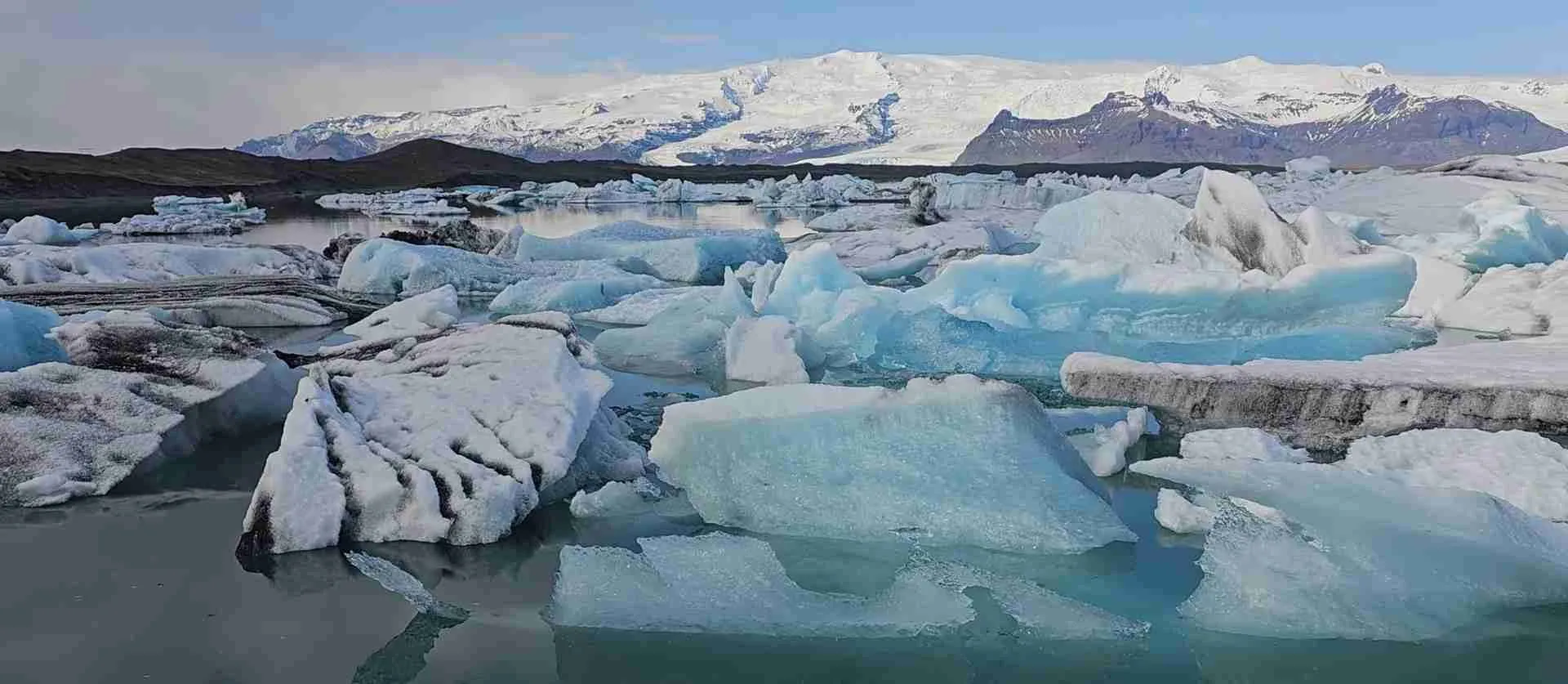
Jökulsárlón Glacier Lagoon & Diamond Beach: Complete Guide
Jökulsárlón Glacier Lagoon and Diamond Beach represent two complementary faces of Iceland’s glacial drama, where massive icebergs calving from Europe’s largest glacier drift through serene waters before washing ashore on jet-black volcanic sand to create one of nature’s most surreal landscapes. Located on Iceland’s Southeast Coast within Vatnajökull National Park, these adjacent attractions showcase the dynamic process of glacial retreat through thousand-year-old ice formations floating in ethereal blue waters and glittering like gems against dark sand, offering visitors the rare opportunity to witness geological processes occurring on human timescales through boat tours among the icebergs, wildlife encounters with seals and seabirds, and photography opportunities that have made this location Iceland’s most iconic glacier destination.
Key Takeaways
- Glacial Dynamics: Jökulsárlón formed starting in the 1930s as Breiðamerkurjökull glacier retreated from the Atlantic Ocean, creating Iceland’s deepest natural lake at 248 meters where icebergs calve daily from the glacier tongue and drift toward the sea, while Diamond Beach receives these same icebergs after they pass through the lagoon and wash ashore on black volcanic sand.
- Location and Access: Both sites sit directly off Route 1 approximately 380 kilometers southeast of Reykjavík requiring 5-5.5 hours driving time, positioned between Skaftafell (60 kilometers west) and Höfn (80 kilometers east), with parking costing ISK 1,000 at either location covering access to both attractions for the day.
- Boat Tour Options: Three distinct waterborne experiences operate May through October weather permitting—amphibian boat tours (ISK 7,100 adults, 30-40 minutes, family-friendly), Zodiac boat tours (approximately $108, 1 hour, closer iceberg access), and kayaking ($97.80+, 2-3 hours, most intimate experience)—with advance booking essential during summer peak season.
- Wildlife Presence: Harbor seals maintain year-round residence in the lagoon, frequently seen lounging on icebergs or swimming near boats, while Arctic terns, skuas, and great skuas nest around the lagoon during summer breeding season, with occasional orca sightings from Diamond Beach during winter months.
- UNESCO World Heritage Status: Jökulsárlón and Diamond Beach sit within Vatnajökull National Park, designated as a UNESCO World Heritage Site in 2019 for its outstanding volcanic and glacial processes, making this one of Iceland’s two World Heritage properties alongside Þingvellir.
- Dynamic Nature: The lagoon’s iceberg composition changes daily as new ice calves from the glacier while existing bergs melt or drift seaward, and Diamond Beach’s ice distribution varies with tides and ocean conditions, meaning no two visits present identical landscapes and seasonal timing dramatically affects the experience from summer’s boat tours and midnight sun to winter’s ice caves and Northern Lights.
People Also Ask About Jökulsárlón and Diamond Beach
What is Jökulsárlón Glacier Lagoon?
Jökulsárlón Glacier Lagoon is Iceland’s most famous glacial lake, formed when the Breiðamerkurjökull outlet glacier of Vatnajökull—Europe’s largest glacier—began retreating from the Atlantic Ocean in the 1930s, leaving behind a deep basin that filled with meltwater and became Iceland’s deepest natural lake at 248 meters. The lagoon sits at the southern edge of Vatnajökull glacier where massive icebergs continuously calve from the glacier tongue into the serene blue waters, creating a constantly evolving seascape of floating ice formations ranging from car-sized chunks to multi-story towers. These icebergs drift across the 18-square-kilometer lagoon surface driven by wind and tides before eventually passing through a narrow outlet channel into the Atlantic Ocean, with many subsequently washing ashore on adjacent Diamond Beach. The lagoon’s formation represents one of the most dramatic visible examples of climate-driven glacial retreat, having expanded from a small lake to its current massive size within living memory, with the glacier terminus retreating approximately 3 kilometers from the ocean since the 1930s and continuing to recede at measurable rates each year.
How did Diamond Beach get its name?
Diamond Beach derives its evocative name from the visual appearance of glacier ice chunks strewn across the black volcanic sand, where transparent and blue-tinted ice fragments sparkle like scattered gemstones when struck by sunlight, creating the impression of diamonds displayed on dark velvet. The official Icelandic name is Breiðamerkursandur (the broad-sand outwash plain) or Fellsfjara (fell beach), but the popular English designation “Diamond Beach” captures the striking aesthetic that made this location internationally famous through photography and social media. The ice formations originate as icebergs in Jökulsárlón Glacier Lagoon that drift through the outlet channel connecting the lagoon to the Atlantic Ocean, where wave action and salt water polish them into smooth, gem-like shapes before tides deposit them on the black sand beach. The ice pieces range from fist-sized fragments to blocks exceeding human height, with colors varying from crystal-clear transparency through brilliant blue tints to ice containing trapped volcanic ash creating darker striations. The “diamonds” constantly refresh as new ice arrives with each tide while existing pieces melt or wash back to sea, ensuring the beach presents different distributions and arrangements during every visit.
Can you swim in Jökulsárlón or Diamond Beach?
Swimming is absolutely prohibited in both Jökulsárlón Glacier Lagoon and at Diamond Beach due to multiple deadly hazards including water temperatures of 0-4°C that cause rapid hypothermia within minutes of immersion, glacial currents that can pull swimmers into deep water or under icebergs, shifting ice formations that can roll or collapse without warning crushing anything nearby, and at Diamond Beach specifically the powerful Atlantic surf and sneaker waves that arrive without warning to sweep people into the ocean where rescue becomes nearly impossible. The glacial meltwater in the lagoon maintains temperatures just above freezing year-round, cold enough that even brief exposure causes muscle cramping and loss of coordination that make swimming impossible regardless of physical fitness or swimming ability. Additionally, the icebergs floating in the lagoon can shift positions, roll over, or break apart suddenly due to changing weight distribution as melt occurs, creating dangerous conditions even for boats and making any water contact extremely hazardous. At Diamond Beach, the same sneaker wave hazard that makes Reynisfjara dangerous applies with equal severity—powerful waves surge far up the beach without warning, and the ice-cold Atlantic water combined with strong currents mean anyone swept into the surf faces extremely low survival probability even if rescue teams respond immediately. Visitors must maintain safe distances from the waterline at both locations, never wade or touch the water, stay well back from the surf zone at Diamond Beach, and never climb onto floating icebergs or ice pieces at either site.
When is the best time to visit Jökulsárlón and Diamond Beach?
The best time to visit Jökulsárlón and Diamond Beach depends on priorities between boat tour availability, ice conditions, weather, daylight hours, and seasonal phenomena, with each season offering distinct advantages. Summer (May-September) provides the only opportunity for boat tours on the lagoon which operate exclusively during warmer months, offers mild temperatures of 8-15°C comfortable for extended outdoor time, features 16-20+ hours of daylight enabling visits at any hour including midnight sun photography in June-July, and presents the highest probability of seal sightings as pups are born and raised during this period, though summer also brings maximum crowds and requires booking tours well in advance. Winter (November-March) offers access to nearby glacial ice caves beneath Vatnajökull which exist only during cold months, provides opportunities for Northern Lights photography above the lagoon and icebergs creating extraordinary atmospheric compositions, typically presents larger ice volumes in both the lagoon and on Diamond Beach as winter storms and tides deposit more ice, and encounters minimal crowds compared to summer, though temperatures of -5°C to +5°C combined with limited daylight (4-5 hours in December-January) and potential road closures during severe weather create challenging conditions requiring appropriate preparation. Shoulder seasons (April, October) balance moderate weather and transitional ice conditions with fewer crowds than peak summer, though boat tour availability becomes weather-dependent rather than guaranteed. For photography specifically, winter’s dramatic lighting, ice volume, and Northern Lights potential outweigh summer’s comfortable conditions, while first-time visitors prioritizing boat tours and seal interactions should target June-August despite the crowds.
Extended multi-day tours – 5+ days
Featured Iceland Multi-Day Tour Packages

3 days
Iceland 3-Day Discovery Tour
- ✓ Comprehensive Iceland experience
- ✓ Expert local guides included
- ✓ All accommodation included
- ✓ Transportation provided

5 days
Iceland 5-Day Highlights Experience
- ✓ Comprehensive Iceland experience
- ✓ Expert local guides included
- ✓ All accommodation included
- ✓ Transportation provided

7 days
Iceland 7-Day Cultural Journey
- ✓ Comprehensive Iceland experience
- ✓ Expert local guides included
- ✓ All accommodation included
- ✓ Transportation provided
10 days
Iceland 10-Day Complete Adventure
- ✓ Comprehensive Iceland experience
- ✓ Expert local guides included
- ✓ All accommodation included
- ✓ Transportation provided
Multi-day tour packages powered by TourRadar. Prices and availability subject to change.
Introduction
Jökulsárlón Glacier Lagoon and Diamond Beach occupy a unique position in Iceland’s landscape where active geological processes occur at speeds visible to human observation rather than unfolding across geological timescales invisible to individual lifetimes. The lagoon’s very existence demonstrates climate-driven glacial retreat happening within decades, having formed entirely since the 1930s as Breiðamerkurjökull glacier withdrew from the ocean and continues expanding as the ice margin recedes farther inland each year. Standing at the lagoon’s shore, visitors witness thousand-year-old ice that fell as snow atop Vatnajökull centuries ago finally reaching the endpoint of its glacial journey, calving from the glacier terminus to begin drifting across open water before dissolving back into the ocean from which precipitation originally formed it.
The relationship between Jökulsárlón and Diamond Beach illustrates how glacial systems function as dynamic processes rather than static features. Ice that calves into the lagoon embarks on a journey driven by wind, tides, and the lagoon’s connection to the Atlantic through a narrow outlet channel beneath Route 1’s bridge. Larger icebergs may remain grounded in the lagoon’s deeper sections for months or years, gradually melting and breaking into smaller fragments, while smaller pieces drift more readily toward the outlet where they pass into the ocean. Once in marine waters, wave action and salt water accelerate melting while polishing the ice into smooth shapes, and tidal currents eventually deposit these polished fragments on the black volcanic sand of Diamond Beach where they rest until they melt completely or wash back to sea on subsequent tides.
The lagoon sits within Vatnajökull National Park, which encompasses all of Vatnajökull glacier and its outlet glaciers along with surrounding volcanic and glacial landscapes. The park received UNESCO World Heritage Site designation in 2019, recognizing its outstanding examples of volcanic and glacial processes and the dynamic interactions between volcanism and glaciation that create Iceland’s distinctive landscapes. This designation makes Jökulsárlón one of Iceland’s two World Heritage properties, alongside Þingvellir National Park, elevating these glacial features to the highest level of international conservation recognition.
The lagoon and beach gained international fame through their appearance in multiple major film productions seeking dramatic, otherworldly backdrops. James Bond films including “A View to a Kill” and “Die Another Day” used Jökulsárlón for action sequences requiring frozen wasteland settings, “Tomb Raider” filmed scenes at the lagoon, “Batman Begins” incorporated the location, and numerous other productions capitalized on the alien appearance of massive blue icebergs floating on dark water. These cinematic appearances amplified the location’s tourist profile beyond nature photography and geology communities to general international awareness, contributing to visitation numbers that now exceed hundreds of thousands annually.
Yet beneath the tourist infrastructure and cinematic recognition, Jökulsárlón and Diamond Beach remain fundamentally wild landscapes governed by glacial and marine processes indifferent to human presence. The icebergs calve according to glacial dynamics, not tour schedules. The ice distribution on Diamond Beach responds to tidal cycles and storm systems, not visitor preferences. Seals hunt fish among the icebergs following their ecological needs, not photographer wishes. This wildness adds authenticity to the experience—these are not manufactured attractions but natural phenomena operating according to physical laws, creating landscapes that shift and transform continuously beyond human control or prediction.
Understanding Glacial Formation and Dynamics
Jökulsárlón Glacier Lagoon represents the visible manifestation of complex glacial processes occurring over vastly different timescales, from the centuries-long journey of ice through the glacier system to the daily calving events that add new icebergs to the lagoon. Understanding these processes enriches appreciation of the landscape beyond simple visual spectacle, revealing the lagoon as a window into climate dynamics, glacial physics, and the ongoing transformation of Iceland’s landscape.
The ice floating in Jökulsárlón originated as snow falling on the Vatnajökull ice cap hundreds to thousands of years ago, accumulating in the high-elevation accumulation zone where annual snowfall exceeds annual melting. Over decades and centuries, the weight of overlying snow compressed deeper layers into solid ice while pressure from the growing ice mass caused the glacier to flow downhill under its own weight, moving ice from the accumulation zone toward lower-elevation ablation zones where melting and calving remove ice mass. The Breiðamerkurjökull outlet glacier represents one of approximately 30 glacier tongues flowing from the main Vatnajökull ice cap, each following its individual valley system toward different sections of Iceland’s coast.
The thousand-year timescale for ice formation creates ice with unique properties distinct from regular frozen water. Glacial ice appears blue because of its extreme density—centuries of compression have squeezed out air bubbles that would scatter light and create white appearance in regular ice or snow. When light penetrates dense glacial ice, the ice absorbs longer wavelengths (reds and yellows) while shorter wavelengths (blues) scatter and emerge, creating the characteristic brilliant blue color most intense in the thickest, oldest ice sections. Some icebergs also display black or gray striations where volcanic ash from historical Icelandic eruptions became incorporated into the glacier during accumulation, providing visible markers of specific eruption events frozen into the ice record.
The lagoon itself formed starting around 1935 when Breiðamerkurjökull glacier began retreating from the Atlantic Ocean, a withdrawal driven by rising temperatures that shifted the balance between ice accumulation in the mountains and ablation at lower elevations. As the glacier terminus retreated inland, it left behind a depression scoured by ice movement over previous millennia. This depression filled with glacial meltwater, creating an initial small lake that has since expanded to its current 18-square-kilometer area as the glacier continues retreating. The lagoon’s maximum depth of 248 meters makes it Iceland’s deepest natural lake, with this extreme depth resulting from the glacier having scoured deeply into bedrock during previous advances when the ice mass was larger and more powerful.
Calving—the process where ice breaks from the glacier terminus—occurs through several mechanisms operating simultaneously. Thermal melting at the ice-water interface undermines the glacier front, creating overhanging sections that eventually collapse under their own weight. Fractures propagate through the ice due to stress from the glacier’s flow and from temperature variations causing expansion and contraction. Water entering surface crevasses can refreeze and expand, wedging fractures open until sections detach. The frequency and size of calving events vary with temperature, time of year, and the glacier’s specific geometry at any given moment, making calving somewhat unpredictable in timing though inevitable as a process. Visitors sometimes witness major calving events producing house-sized icebergs accompanied by thunderous cracking sounds and wave surges, though such dramatic events occur sporadically rather than on schedules convenient for tourism.
Once icebergs enter the lagoon, their movement depends on wind direction, tidal forces transmitted through the outlet channel, and the complex currents within the lagoon itself. Larger icebergs may ground in shallower sections while smaller pieces drift more freely. All icebergs gradually melt due to relatively warm water temperatures (0-4°C, far warmer than the ice itself), with melting rates accelerating during summer and slowing during winter. As icebergs melt, their weight distribution changes, sometimes causing them to roll over and present previously underwater surfaces to the air. These rollovers can occur suddenly and create dangerous wave surges, making it absolutely prohibited to approach closely or touch icebergs from shore.
Location and Geography Within Vatnajökull National Park
Jökulsárlón Glacier Lagoon and Diamond Beach occupy a dramatic position on Iceland’s Southeast Coast where the Breiðamerkurjökull glacier reaches toward the Atlantic Ocean, located approximately 380 kilometers southeast of Reykjavík via Route 1, 60 kilometers east of Skaftafell Nature Reserve, and 80 kilometers west of Höfn, Iceland’s primary fishing town in the southeast. The lagoon sits at the southern margin of Vatnajökull National Park, which encompasses Europe’s largest glacier by volume covering approximately 8% of Iceland’s total land area and contains Iceland’s highest peak, Hvannadalshnjúkur at 2,110 meters.
Route 1 (the Ring Road) passes directly adjacent to the lagoon, with a modern bridge crossing the narrow outlet channel that connects the lagoon to the ocean. Parking areas sit on both sides of the bridge—the north side providing access to the lagoon itself with the boat tour departure points, café, and restroom facilities, while the south side parking areas (east and west of the outlet) provide access to Diamond Beach. The proximity to Route 1 makes both locations extremely accessible compared to many Icelandic natural attractions requiring extended drives on unpaved roads, contributing to their status as must-see stops on South Coast and Ring Road itineraries.
The broader landscape surrounding the lagoon demonstrates the interaction between glacial and volcanic processes that characterize Vatnajökull National Park. The black sand on Diamond Beach originates from volcanic material rather than glacial sediment—when Icelandic volcanoes erupt, their lava contains high percentages of basalt which shatters into dark mineral grains when cooled rapidly. Glacial rivers transport this volcanic material from inland source areas to the coast, depositing it across broad outwash plains (sandur in Icelandic) that extend between the glaciers and the ocean. The Breiðamerkursandur outwash plain upon which Diamond Beach sits represents one of many such glacial-volcanic landscapes characteristic of Iceland’s South Coast.
Vatnajökull National Park’s UNESCO World Heritage designation in 2019 recognized this area as an outstanding example of volcanic and glacial processes and their interactions. The designation cited the park’s exceptional demonstrations of volcanism beneath ice caps, glacier advance and retreat patterns, glacial lake formation, jökulhlaup (glacial outburst flood) phenomena, and the continuing geological processes visible at human timescales. Jökulsárlón specifically exemplifies glacier retreat and glacial lake formation, while the broader Vatnajökull system demonstrates how Iceland’s position on the Mid-Atlantic Ridge creates volcanic activity that interacts with glacial ice to produce unique geological features and hazards.
The park contains several other significant glacial lakes besides Jökulsárlón, including Fjallsárlón approximately 10 kilometers west—a smaller, quieter lagoon also fed by Vatnajökull ice and offering less-crowded alternatives for visitors seeking similar glacial lake experiences. Multiple outlet glaciers descend from the main ice cap, each creating its own characteristic landscape features from moraines to glacial rivers to outwash plains. The park encompasses hiking trails, ice cave access points (winter only), glacier hiking departure points, and viewpoints overlooking various sections of the ice cap and its tongues.
Getting to Jökulsárlón and Diamond Beach from Reykjavík
The journey from Reykjavík to Jökulsárlón covers approximately 380 kilometers via Route 1 (the Ring Road), requiring 5 to 5.5 hours driving time under good conditions without extended stops. This drive ranks among Iceland’s most scenic routes, passing multiple major attractions that transform the journey into a comprehensive South Coast tour rather than simple transit to a single destination.
Self-Drive Route and Highlights
Departing Reykjavík eastbound on Route 1, the journey initially crosses agricultural lowlands before the landscape transitions to increasingly dramatic terrain approaching Iceland’s South Coast. The route passes within view of Eyjafjallajökull volcano and glacier approximately 120 kilometers from Reykjavík—the volcano whose 2010 eruption disrupted European air traffic for weeks, creating the ash cloud that grounded flights across the continent. Seljalandsfoss waterfall (120 kilometers from Reykjavík, parking ISK 800) offers the unique experience of walking behind a 60-meter cascade, while Skógafoss waterfall (150 kilometers, parking ISK 1,000) creates a thunderous 60-meter drop with impressive volume.
Beyond Skógafoss, the route passes the Sólheimasandur plain where the famous DC-3 plane wreck sits approximately 4 kilometers from the road, accessible only by walking or bicycle following removal of vehicle access. The village of Vík (180 kilometers from Reykjavík) marks the approximate halfway point, with Reynisfjara black sand beach and the Reynisdrangar sea stacks located just west of the village. Continuing east from Vík, Route 1 traverses extensive glacial outwash plains (sandur) with views of Vatnajökull glacier becoming increasingly prominent to the north.
Fjaðrárgljúfur canyon (approximately 230 kilometers from Reykjavík) offers a 2-kilometer detour on Route 206 to view the 100-meter-deep river gorge (parking ISK 1,000). Skaftafell Nature Reserve and Visitor Centre (320 kilometers from Reykjavík) provides hiking trail access including the popular route to Svartifoss waterfall, famous for the basalt column formations framing its cascade. From Skaftafell, Jökulsárlón lies approximately 60 kilometers farther east, making the total one-way journey from Reykjavík approximately 380 kilometers.
The drive remains accessible year-round to standard passenger vehicles under normal conditions, though winter driving (November-March) requires significant caution. Iceland’s South Coast receives substantial precipitation, and winter storms can create ice, snow, reduced visibility, and occasionally road closures. Winter travelers should monitor road.is for current road conditions and vedur.is for weather forecasts, ensure their rental vehicle has winter tires (mandatory November-March), and be prepared for the possibility of delayed travel or overnight stops if conditions deteriorate. Summer driving presents fewer challenges though weather remains variable and sudden changes from sunshine to rain occur frequently.
Guided Tours from Reykjavík
Multiple tour operators offer South Coast tours from Reykjavík incorporating Jökulsárlón and Diamond Beach, ranging from single-day marathons to multi-day itineraries allowing more comfortable pacing and overnight stops. Day tours typically operate 14-16 hours including driving time and stops, departing Reykjavík around 7-8 AM and returning around 10-11 PM. These tours include Jökulsárlón and Diamond Beach along with selections from Seljalandsfoss, Skógafoss, Reynisfjara, Vík, and Skaftafell depending on specific itinerary, with some tours including boat rides on the lagoon as part of the package while others offer boat tours as optional add-ons.
Multi-day tours (typically 2-3 days) provide substantially more comfortable experiences, breaking the journey with overnight accommodation in Vík, near Skaftafell, or other South Coast locations. These extended itineraries allow visiting Jökulsárlón during optimal lighting conditions rather than being constrained by the timing dictated by a Reykjavík-based day tour, provide opportunities for sunrise or sunset photography at the lagoon and Diamond Beach, and often include winter ice cave visits (November-March) beneath Vatnajökull that single-day tours cannot accommodate due to timing constraints.
Tours provide particular value during winter when self-driving becomes most challenging, offering the advantage of experienced drivers familiar with Icelandic winter road conditions, vehicles equipped for snow and ice, flexibility to adjust routes if specific sections face closures, and the ability to focus on scenery and photography rather than navigation and driving stress. Summer tours similarly eliminate driving concerns while providing guided interpretation at stops, though the summer road conditions make self-driving feasible for those comfortable with long-distance driving and preferring independent schedules.
Parking, Fees, and Access Details
Jökulsárlón Glacier Lagoon provides a large paved parking area on the north side of Route 1’s bridge, directly adjacent to the lagoon with short walking distances to the shore, boat tour departure points, café, and restroom facilities. Parking costs ISK 1,000 ($7-7.50 USD) for standard passenger vehicles, paid through the Parka mobile app which can be downloaded before arrival and allows payment up to 24 hours after leaving. The parking area accommodates cars, campervans, and tour buses, though it reaches capacity during peak summer midday hours (10 AM-4 PM June-August) when arriving earlier or later improves parking availability. Overnight parking is prohibited at all Icelandic natural attractions including Jökulsárlón.
Diamond Beach parking consists of two separate areas on the south side of Route 1—Eystri-Fellsfjara (east parking) and Vestari-Fellsfjara (west parking)—both accessed via short side roads from the Ring Road and positioned on opposite sides of the outlet channel that drains Jökulsárlón to the ocean. Both Diamond Beach parking areas also charge ISK 1,000, paid through the Parka app. Critically, payment at either Jökulsárlón or Diamond Beach covers parking at both locations for the entire day—visitors should not pay twice if moving between the two sites. The parking lots feature cameras monitoring vehicle license plates to verify payment, with penalties up to ISK 5,000 applied for non-payment.
Walking between Jökulsárlón and Diamond Beach via the bridge and connecting paths takes approximately 5-10 minutes, making it entirely feasible to park at one location and walk to the other if parking space availability becomes an issue. During peak summer season when Jökulsárlón parking fills, using Diamond Beach parking and walking to the lagoon provides a practical alternative. The parking areas operate 24 hours daily year-round, allowing visits at any hour though services including the café and boat tours maintain limited operating hours.
Restroom facilities exist at the Jökulsárlón parking area adjacent to the café building, providing essential services at this remote location. Diamond Beach parking areas have minimal or no facilities beyond the parking surface itself, though the short distance to Jökulsárlón makes the café restrooms accessible. The Jökulsárlón café serves warming food and beverages including traditional Icelandic dishes, coffee, and lighter options, providing refuge during cold or wet weather and eliminating the need to drive elsewhere for basic food service.
The walking distance from parking to the lagoon shore at Jökulsárlón measures less than 100 meters over paved and gravel surfaces, while boat tour boarding requires walking to the shoreline dock areas approximately 100-200 meters from parking. Diamond Beach involves walking from either parking area across a low sandy berm to reach the beach itself, typically 50-200 meters depending on which parking area is used and where along the beach visitors wish to explore. These short distances and relatively level terrain make both locations accessible for most visitors without significant mobility limitations, though the sandy beach surface at Diamond Beach presents challenges for wheelchairs and walkers.
Boat Tour Options on Jökulsárlón
Three distinct waterborne tour options operate on Jökulsárlón Glacier Lagoon from approximately May through October, weather permitting, with each offering different experiences, pricing, and levels of adventure. All boat tours depart from the Jökulsárlón north shore near the main parking area and café, with advance booking strongly recommended especially during June-August peak season when tours frequently sell out days or weeks ahead.
Amphibian Boat Tours
Amphibian boat tours utilize large, stable vessels that drive directly from the parking area into the lagoon water, accommodating approximately 30-40 passengers per departure and operating continuously throughout the day with boats leaving approximately every 15-20 minutes during busy periods. Tours last 30-40 minutes, navigating among the icebergs while guides provide English-language commentary about the lagoon’s geology, the glacier calving process, iceberg characteristics, and wildlife including seal identification. The boats approach moderately close to icebergs, allowing passengers to appreciate their size and examine ice colors and formations, though maintaining safe distances to avoid hazards from potentially unstable ice.
Pricing for amphibian tours runs ISK 7,100 ($46-50 USD) for adults aged 13 and above, ISK 3,500 for children aged 6-12, and free for children under 6. Tours operate from early May through late October depending on ice conditions and weather, with most frequent departures during June-August. The tours are family-friendly with no minimum age beyond the free-admission cutoff, making them suitable for visitors seeking a relatively gentle introduction to the lagoon environment. Guides typically retrieve a small piece of glacial ice during tours, allowing passengers to touch thousand-year-old ice and often taste the extremely pure meltwater.
Amphibian boats provide the most accessible lagoon experience, requiring no special equipment or physical capability beyond ability to board the vessel via a few steps. The large passenger capacity means these tours accommodate walk-up visitors better than smaller Zodiac tours during less-busy periods, though advance booking remains advisable to guarantee space during preferred time windows. The tours depart from a ticket office and boarding area at the lagoon’s north shore, with tickets exchangeable on arrival after advance online booking or sometimes available for same-day purchase if space remains.
Zodiac Boat Tours
Zodiac boat tours employ smaller rigid inflatable boats carrying approximately 10-12 passengers, enabling closer approaches to icebergs and access to narrower channels between ice formations that larger amphibian boats cannot navigate. Tours last approximately one hour—substantially longer than amphibian tours—and provide more adventurous experiences with greater possibility of spray and movement as the boats maneuver among the ice. Passengers receive flotation suits (full-body waterproof outerwear with built-in buoyancy) before boarding, both for safety and to protect against spray and cold.
Pricing for Zodiac tours averages around $108 USD per person, reflecting the longer duration, smaller group size, and more specialized equipment compared to amphibian tours. Tours operate May through September with more limited schedules than amphibian tours due to weather sensitivity—high winds or rough water can force cancellations of Zodiac tours even when amphibian tours continue operating. Advance booking is essential as the smaller passenger capacity and higher demand from adventure-seeking visitors means Zodiac tours sell out earlier and more completely than amphibian alternatives.
The Zodiac experience appeals to visitors prioritizing close ice encounters and more dynamic boat operations over the gentler amphibian tour approach. The boats can approach icebergs more closely and navigate into confined spaces, providing photography opportunities and ice perspectives impossible from larger vessels. However, the tours involve more physical engagement—boarding rigid inflatables requires greater mobility than amphibian boats, the flotation suits can feel cumbersome, and the potential for spray and boat movement may challenge visitors prone to seasickness or those preferring calmer experiences.
Kayaking on Jökulsárlón
Kayaking tours offer the most intimate and active way to experience Jökulsárlón, paddling stable double kayaks among the icebergs for 2-3 hours total including safety briefing, equipment distribution, and on-water time. Tours operate June through September in small groups (typically 6-10 participants), providing highly personalized experiences impossible with motorized boat tours. Kayaking allows silent movement through the lagoon, approaching wildlife without engine noise, accessing very shallow areas and ice-packed channels, and experiencing the environment at human-powered pace rather than scheduled tour rhythm.
Pricing starts around $97.80 per person with some operators charging higher rates depending on group size and specific offerings. Tours require no previous kayaking experience—guides provide instruction for beginners and the kayaks are designed for stability rather than speed. However, participants must have reasonable physical fitness and ability to paddle for extended periods, sit in the kayak’s confined space, and potentially self-rescue with guide assistance if capsizing occurs (rare in the calm lagoon conditions but possible). Minimum age requirements typically start at 12-14 years depending on operator.
Kayaking tours include all necessary equipment: kayaks, paddles, spray skirts, flotation suits, and safety equipment. The suits provide both waterproofing and thermal protection essential in the cold environment. Tours begin with land-based instruction covering paddle technique, kayak entry and exit, safety protocols, and what to expect on the water. The actual paddling portion allows time for ice exploration, photography, seal observation, and simply experiencing the unique sensation of floating among thousand-year-old glacial ice in silent, self-propelled craft.
Weather sensitivity makes kayaking the most cancellation-prone activity on Jökulsárlón—wind conditions safe for motorized boats can prove challenging or dangerous for kayaks, and tours may be called off with relatively short notice if conditions deteriorate. Advance booking is essential as group sizes are very limited, but participants should maintain flexible schedules understanding that weather-driven cancellations can occur even with confirmed reservations.
Exploring Diamond Beach
Diamond Beach occupies the black volcanic sand shoreline where Jökulsárlón’s outlet channel meets the Atlantic Ocean, stretching approximately 1-2 kilometers along the coast with ice formations scattered across the dark sand creating the dramatic contrast that earned the location its evocative name. Unlike Jökulsárlón where boat tours provide structured activities, Diamond Beach exists as an unguided natural space for walking, photography, wildlife observation, and simple appreciation of the surreal landscape where glacier ice rests on volcanic sand against the backdrop of Atlantic waves.
The ice distribution on Diamond Beach varies dramatically based on tidal cycles, ocean conditions, and the volume of ice currently passing through Jökulsárlón’s outlet channel. High tides and onshore winds bring more ice onto the beach, while low tides and offshore winds can leave relatively little ice on the sand with more floating just offshore. The size of ice pieces ranges from fist-sized fragments to blocks exceeding human height, with colors varying from crystal-clear transparency through brilliant blue tints characteristic of compressed glacial ice to darker ice containing volcanic ash. Some pieces display smooth, polished surfaces created by wave action, while others show rough, recently fractured faces where sections have broken from larger bergs.
Walking the beach involves traversing uneven black sand that can be wet and soft near the waterline, with scattered ice pieces requiring navigation around obstacles rather than following defined paths. The beach extends on both sides of the outlet channel, with the western section (Vestari-Fellsfjara) typically receiving slightly more visitor traffic due to proximity to the Jökulsárlón parking area, while the eastern section (Eystri-Fellsfjara) offers similar ice and sand but often fewer people. Visitors commonly spend 30 minutes to 2 hours exploring the beach, photographing ice formations, observing the interplay between waves and ice, and walking the shoreline to discover varied ice distributions along the coast.
The best light conditions for photography occur during golden hour—the period shortly after sunrise and before sunset—when low-angle sunlight illuminates the ice with warm tones and creates long shadows emphasizing the three-dimensional form of ice sculptures against the sand. Summer’s extended daylight hours and high sun angle can create harsh midday light less flattering for ice photography, while winter’s limited daylight concentrates the optimal shooting hours into a brief window but rewards photographers with dramatic low-angle light throughout the short day. Overcast conditions, frequent along Iceland’s South Coast, provide soft, even light that reduces extreme contrast between bright ice and dark sand, often yielding excellent results despite lacking the colorful drama of golden hour sunshine.
Safety at Diamond Beach requires the same precautions as any Icelandic black sand beach—maintaining substantial distance from the waterline as sneaker waves can surge far up the beach without warning, never turning your back to the ocean which prevents seeing approaching dangerous waves, and never climbing onto ice pieces which can shift, roll over, or break creating serious injury risk. The ice appears stable but can be hollow, have sharp edges, or conceal cracks that fail under body weight. Additionally, ice pieces floating in shallow water near shore should never be approached or touched—these can shift position with waves, roll over unexpectedly, or be pulled seaward by currents taking unwary visitors with them.
Wildlife at Diamond Beach includes harbor seals that sometimes haul out on the sand or swim in the outlet channel and near-shore ocean, Arctic terns and other seabirds nesting on cliffs and foraging along the beach, and occasional orca sightings from shore during winter months when these marine mammals patrol Iceland’s coastal waters. Seals are the most reliably present wildlife, though sightings are never guaranteed and depend on seal behavior rather than visitor schedules. Orcas represent rare but spectacular sightings, with the whales occasionally visible from shore as they hunt along the coast particularly during winter when herring populations concentrate near Iceland.
Wildlife Watching: Seals and Seabirds
Harbor seals (Phoca vitulina) maintain year-round residence in Jökulsárlón Glacier Lagoon, with population estimates typically ranging 50-100 individuals though numbers fluctuate seasonally as some seals move between the lagoon and coastal waters. The lagoon’s permanent connection to the Atlantic Ocean allows seals to move freely between freshwater and marine environments, and the abundant fish population (salmon, Arctic char, herring entering from the ocean) provides rich feeding grounds that support the seal colony. Seals frequently rest on icebergs, using the floating ice as haul-out platforms where they sun themselves and digest food between foraging dives.
Boat tours provide the most reliable seal observation opportunities, as the boats cover more lagoon area and guides know locations where seals commonly haul out. Seals often show curiosity toward boats, swimming close to observe the vessels and their passengers, sometimes surfacing within meters of the boat to examine the tourists who have come to see them. This close approach happens on seal initiative rather than from boats pursuing seals—responsible tour operators maintain appropriate distances and let seals choose whether to approach, creating encounters that feel like mutual observation rather than wildlife harassment.
Seal pups are born during June-July, with nursing females and young pups occasionally visible on icebergs during summer boat tours. The pups remain with mothers for several weeks while learning to swim and hunt, sometimes resting on ice while mothers forage nearby. This breeding season timing makes summer tours (June-August) optimal for visitors specifically interested in seal watching, though seals remain present year-round and winter visitors may encounter seals without the summer competition for iceberg space from tourists.
Seabirds nesting around Jökulsárlón include Arctic terns, great skuas (bonxies), Arctic skuas, and various gull species. Arctic terns—the long-distance migration champions that travel between Arctic and Antarctic breeding grounds annually—nest on the outwash plains and shoreline areas around the lagoon from May through August, aggressively defending nesting territories through dive-bombing attacks on perceived threats including humans who approach too closely. Visitors walking near nesting areas should watch for terns flying directly toward them in attack approaches and retreat from specific areas where this behavior occurs, as the attacks indicate nests or chicks nearby requiring protection.
Great skuas, powerful predatory seabirds, nest on the plains near the lagoon and hunt both fish and other birds including stealing food from smaller seabirds through aggressive pursuit. These large, brown birds have impressive flight capabilities and represent one of the apex avian predators in the Icelandic environment. Arctic skuas, smaller cousins of great skuas, employ similar kleptoparasitic hunting strategies stealing food from other birds. Both skua species defend nests vigorously during breeding season, though they typically focus defensive behavior on avian intruders rather than ground-based humans.
Various gull species including glaucous gulls, Iceland gulls, and great black-backed gulls forage around the lagoon and beach, scavenging, hunting fish, and competing for food resources. The diversity of seabirds reflects the lagoon’s position at the intersection of freshwater and marine environments, glacial and coastal ecosystems, creating habitat niches supporting multiple species with different ecological roles and requirements.
Winter Ice Caves and Year-Round Seasonal Differences
Winter transforms the Jökulsárlón region beyond simple temperature and daylight changes, opening access to extraordinary ice caves beneath Vatnajökull glacier that exist only during cold months when frigid temperatures stabilize the caves and make them safe for human entry. These ice caves form when glacial meltwater carves tunnels and chambers through the glacier ice during summer, with the resulting voids persisting through winter when subfreezing temperatures prevent continued melting and collapse. The caves feature surreal blue and white ice formations, frozen waterfalls, ice sculptures created by centuries of glacial movement, and light transmission through ice walls creating ethereal atmospheric effects.
Ice cave tours operate November through March, departing from meeting points near Jökulsárlón for drives in modified super jeeps capable of traversing glacial terrain to reach cave entrances. Tours last 2.5-4 hours total including driving time to the glacier, equipment distribution (helmets, crampons, headlamps), guided exploration of the cave interior, and return transport. The caves change annually as new formations develop and previous year’s caves collapse or become inaccessible, meaning each winter season features different specific cave locations though the general area remains consistent near the Breiðamerkurjökull glacier margin.
Access to ice caves requires joining guided tours rather than independent exploration—the caves present serious hazards including unstable ice that can collapse without warning, hidden crevasses, slippery surfaces, and navigation challenges in the featureless ice environment. Professional guides assess cave stability, choose safe routes through the formations, monitor conditions during visits, and ensure groups don’t exceed safe occupancy levels for specific chambers. The tours provide all necessary safety equipment and instruction but require reasonable physical fitness, ability to walk on uneven ice surfaces, comfort in confined spaces, and tolerance for cold conditions inside the glacier.
The dramatic visual experience inside ice caves—brilliant blue ice illuminated by natural light and headlamps, frozen formations creating otherworldly architecture, the knowledge of being inside a living glacier—creates photography opportunities and experiential memories distinct from summer glacier activities. However, the tours operate in challenging winter conditions with weather-dependent reliability similar to summer boat tours, and the subfreezing temperatures, limited daylight, and potential road closures mean winter visitors must accept greater uncertainty and flexibility in scheduling compared to summer travel.
Beyond ice caves, winter at Jökulsárlón and Diamond Beach features substantially different conditions from summer visits. The lagoon often contains more and larger icebergs as winter storms and glacier surges contribute ice volume, while subfreezing temperatures slow melting compared to summer’s warmer conditions. Diamond Beach similarly displays greater ice accumulation during winter, with winter storms and high tides depositing ice farther up the beach and in greater volumes. Snow accumulation on the surrounding landscape creates starkly beautiful monochromatic compositions contrasting white glaciers and snow against black volcanic sand and deep blue ice.
Northern Lights (aurora borealis) visibility from September through March adds extraordinary photographic and experiential dimension to winter visits, with Jökulsárlón’s dark-sky location and dramatic foreground elements (icebergs on the lagoon, ice on Diamond Beach) creating exceptional opportunities for aurora photography. The aurora requires dark skies (limiting visibility to late evening through early morning during shoulder seasons when some twilight persists), solar activity generating displays, and clear or partially clear weather allowing sky visibility. The vedur.is weather service provides aurora forecasts indicating probability and cloud coverage, while the relatively treeless flat terrain around Jökulsárlón offers excellent aurora visibility when conditions align.
Summer conditions (May-September) present opposite characteristics: warmer temperatures of 8-15°C comfortable for extended outdoor time without heavy winter clothing, 16-24 hours of daylight in June-July enabling visits at any hour including midnight sun photography, boat tour availability impossible during winter freeze, and generally easier travel conditions with roads reliably open and weather less severe than winter storms. However, summer brings maximum crowds requiring advance tour booking, midday parking challenges at peak hours, and higher sun angles creating less dramatic landscape lighting compared to winter’s extended golden hours.
Photography Guide: Capturing Glacial Landscapes
Jökulsárlón Glacier Lagoon and Diamond Beach rank among the world’s most photographed glacial landscapes, offering extraordinary opportunities across lighting conditions, seasons, and compositional approaches. The locations’ dramatic elements—blue icebergs floating on dark water, ice fragments on black sand, the glacier tongue as distant backdrop, wildlife including seals and seabirds—provide ready subjects, though transforming these elements into compelling photographs requires understanding light, composition, and the specific technical challenges these environments present.
Essential Equipment and Settings
Wide-angle lenses (14-35mm full-frame equivalent) prove essential for capturing the expansive lagoon views, beach compositions including both ice and background elements, and establishing shots showing the relationship between foreground ice and distant glacier. However, telephoto lenses (70-200mm and longer) become equally important for isolating individual icebergs, compressing lagoon depth to create layered compositions of multiple ice formations, photographing seals from appropriate distances, and capturing abstracted ice details emphasizing color and form. A versatile two-lens kit might include a 16-35mm and 70-200mm covering most compositional needs.
Circular polarizing filters prove useful for reducing glare on water and ice surfaces, enhancing cloud definition, and occasionally deepening sky color, though their effect on ice itself is complex—while polarizers reduce reflections they can also diminish the brilliant blue color in glacial ice that comes from internal light scattering rather than surface reflection. Neutral density filters (6-10 stops) enable long exposures during daylight hours, smoothing water movement around icebergs and creating ethereal fog-like effects from moving clouds. Variable ND filters provide flexibility for different exposure lengths from several seconds to multiple minutes.
Recommended camera settings begin with ISO 100-400 for optimal dynamic range and minimal noise, particularly important when capturing the extreme tonal range from bright ice highlights through deep shadows in the black sand. Aperture selection balances depth of field needs: f/8-f/11 provides front-to-back sharpness for landscape compositions including foreground ice and background glacier, while f/16-f/22 maximizes depth for macro work on ice details though diffraction begins limiting sharpness at these smallest apertures. Shutter speed varies based on creative intent: 1/250-1/1000 second freezes wave motion on Diamond Beach showing spray detail, 1/4-1 second shows directional water flow while maintaining texture, and 5-30 seconds creates smooth ethereal water and removes all wave detail creating minimalist compositions.
Tripod use proves essential for long exposures, low-light shooting during blue hour and night, and maintaining consistent framing when creating exposure sequences for HDR or focus stacking. However, the black sand at Diamond Beach creates tripod stability challenges—the sand is soft, wet, and subject to wave wash that can undermine tripod legs. Setting tripods with legs spread wide distributes weight more effectively, and monitoring leg position throughout shooting prevents the slow sinking that can ruin critical shots. Some photographers carry small squares of thin plywood or plastic to place under tripod feet providing larger bearing surfaces on soft sand.
Optimal Light Conditions and Timing
Golden hour—the period shortly after sunrise and before sunset when sunlight strikes the landscape at low angles with warm color temperature—transforms both Jökulsárlón and Diamond Beach through dramatic side-lighting that emphasizes ice texture and three-dimensional form, warm color casts that complement the cool blue of glacial ice, and long shadows creating depth and visual interest. Summer golden hour extends for hours due to the sun’s shallow trajectory near the summer solstice, while winter’s brief daylight concentrates golden hour into compact windows requiring precise timing. Sunrise timing varies from approximately 3-4 AM in June to 10-11 AM in December, making apps like The Photographer’s Ephemeris or PhotoPills essential for planning.
Blue hour, occurring before sunrise and after sunset when ambient light takes on deep blue tones without direct sunlight, creates moody atmospheric conditions particularly effective for long-exposure work where the subdued light allows multi-minute exposures without overexposure. Icebergs silhouetted against blue-hour skies create minimalist compositions emphasizing form, while any remaining sky color provides natural gradients contrasting the darker ice and land elements. Winter blue hour lasts longer than summer’s brief transition, while summer’s high latitude means blue hour may barely occur or be replaced by extended twilight during the June-July midnight sun period.
Overcast conditions, extremely frequent along Iceland’s South Coast, eliminate harsh contrast between bright ice and dark water or sand, provide soft even light that flatters ice surfaces and eliminates challenging exposure decisions, and create moody atmospheric character emphasizing the locations’ dramatic rather than colorful qualities. Overcast light works particularly well for compositions emphasizing pattern, texture, and form over color, and enables comfortable exposure of both highlights in ice and shadows in sand or water simultaneously. Many of the most celebrated photographs from these locations were made under overcast skies rather than sunshine, demonstrating that “good weather” and “good light” represent different concepts in landscape photography.
Stormy conditions produce the most dramatic atmospheric effects with rapidly changing light, powerful wave action on Diamond Beach creating dynamic foregrounds, and brooding skies adding emotional weight to compositions. However, storms create obvious challenges: rain and spray on lenses requiring constant wiping and potentially damaging equipment, difficulty maintaining stability in high winds, rapidly changing conditions making exposure challenging, and increased safety concerns at Diamond Beach where storm waves can surge particularly far inland. Photographers working in storms need weather-sealed equipment, protective covers or rain sleeves, and heightened awareness of environmental hazards.
Composition Strategies
At Jökulsárlón Glacier Lagoon, effective compositions often use icebergs as the primary subject positioned in middle-ground or background with foreground elements providing context and depth. The lagoon shore offers various foreground options: smaller ice pieces grounded in shallow water, patterns in the black sand shoreline, reflections in calm water creating mirror images of icebergs, and the shoreline itself as a leading line drawing viewers into the frame toward the main iceberg subjects. The distant Breiðamerkurjökull glacier provides dramatic backdrop when visible, though fog and low clouds frequently obscure the glacier creating atmospheric but glacier-less compositions.
Iceberg selection and positioning within the frame determines compositional success. Individual dramatic bergs with interesting shapes, blue color, or unusual characteristics make strong isolated subjects. Multiple icebergs at varying distances create depth through layering and size progression. Timing matters as icebergs drift slowly across the lagoon driven by wind and current—patience allows waiting for compositionally optimal positions as bergs move relative to each other and to the photographer’s position. Boat tours provide mobile platforms for changing perspective, though the continuous motion and inability to use tripods creates different challenges from shore-based photography.
At Diamond Beach, the ice pieces on black sand create ready-made subjects though successful compositions require selection and framing that emphasizes specific elements rather than simply recording “ice on sand.” Individual dramatic ice pieces with interesting translucency, color, or form make strong minimalist subjects, particularly when isolated against simple sand backgrounds. Collections of multiple ice fragments create pattern and repetition, while juxtaposing ice sizes creates scale drama. The wet sand at the wave boundary provides reflective surfaces doubling ice formations, and the foaming wave edges create motion and energy contrasting the static ice.
Wave motion photography at Diamond Beach requires careful timing and awareness. Long exposures beginning as waves recede create smooth directional flow with the foam appearing as mist-like trails, while exposures capturing incoming waves show more chaotic motion less aesthetically pleasing for most compositions. Photographers often time exposures to coincide with the largest wave sets, when surf reaches highest up the beach and creates maximum foam and motion. However, timing exposures to large waves requires maintaining safe distance—no photograph justifies approaching the dangerous waterline where sneaker waves can arrive without warning.
Seasonal Photography Considerations
Summer photography benefits from boat tour availability enabling waterborne perspectives impossible from shore, the possibility of seal encounters adding wildlife elements to ice landscapes, midnight sun compositions during late June-early July when the sun barely dips below the horizon providing extraordinary extended golden hour light, and comfortable working conditions allowing extended sessions without severe cold limiting functionality. However, summer’s higher sun angle during midday creates harsh contrast and less interesting light compared to other seasons, and maximum crowds can complicate working at optimal shore positions particularly at Diamond Beach where fewer people enable cleaner compositions.
Winter photography provides opportunities for Northern Lights compositions above the lagoon and icebergs creating extraordinary atmospheric scenes, generally larger ice volumes in both the lagoon and on Diamond Beach from winter storm activity and reduced melting, snow-dusted landscapes creating monochromatic beauty, and dramatic low-angle light throughout the brief day rather than concentrated in limited golden hour windows. However, subfreezing temperatures challenge camera batteries requiring spares kept warm, reduce LCD screen responsiveness requiring chimping caution, and can affect lens autofocus and mechanicals requiring manual backup techniques. The limited daylight window (4-5 hours December-January) compresses optimal shooting time while extended darkness enables night photography including aurora work.
Weather volatility across all seasons means bringing protective equipment for cameras including rain covers, lens cloths for removing water droplets, and plastic bags for emergency protection during sudden precipitation. Cold conditions even during summer near the glacier and ocean require gloves that allow camera operation, and photographers often use fingerless gloves or specialized photography gloves with fold-back fingertips enabling delicate control for settings adjustment while maintaining hand warmth between shots.
Nearby Attractions and Extended Itinerary Options
Jökulsárlón and Diamond Beach’s position along Route 1 and within Vatnajökull National Park places them within reach of multiple significant attractions enabling visitors to construct comprehensive itineraries combining the glacier lagoon with additional natural features, cultural sites, and alternative glacial landscapes accessible from the same journey.
Fjallsárlón Glacier Lagoon
Fjallsárlón, a smaller glacial lagoon approximately 10 kilometers west of Jökulsárlón, offers a quieter alternative to its famous neighbor with substantially fewer visitors, free parking, and equally dramatic icebergs floating against the backdrop of the glacier tongue. The lagoon formed similarly to Jökulsárlón as the Fjallsjökull glacier retreated from the Atlantic, leaving a depression that filled with meltwater. Boat tours operate on Fjallsárlón during summer months (June-September) providing closer approaches to the glacier terminus than Jökulsárlón tours can achieve due to the smaller lagoon’s different configuration.
Fjallsárlón sees a fraction of Jökulsárlón’s visitor numbers despite sitting directly along Route 1 with easy access. This reduced crowding creates opportunities for contemplative experiences of the glacial environment without tour bus groups, allows better wildlife observation as seals show less habituation to human presence, and enables photography compositions without other tourists appearing in frames. However, the smaller size means fewer and generally smaller icebergs compared to Jökulsárlón, and the reduced tourism infrastructure means minimal facilities beyond parking and a small information display.
Skaftafell Nature Reserve and Vatnajökull National Park
Skaftafell, located approximately 60 kilometers west of Jökulsárlón, serves as a major access point for Vatnajökull National Park with extensive hiking trail networks, a comprehensive visitor center, and departure points for glacier hiking tours. The most popular hiking destination, Svartifoss (Black Falls), features a 60-meter waterfall framed by hexagonal basalt columns similar to those at Reynisfjara but in a different geological context, reached via a 1.5-kilometer trail with moderate elevation gain.
Longer and more challenging hikes from Skaftafell include routes to glacier viewpoints, mountain summits overlooking the ice cap, and multi-day backpacking trails through the park’s wilderness areas. Glacier hiking tours departing from Skaftafell take participants onto the Falljökull or Svínafellsjökull glacier tongues for guided walks across the ice wearing crampons and using ice axes, providing firsthand experience of glacial landscapes beyond the distant views from Jökulsárlón. These glacier hikes operate year-round though with different characteristics—summer hikes feature blue ice and crevasse navigation, while winter adds ice caves and different snow conditions.
Höfn and Vestrahorn
Höfn, a fishing town of approximately 2,000 residents located 80 kilometers east of Jökulsárlón, provides the nearest substantial services including accommodations, restaurants, grocery stores, and gas stations. The town is famous for langoustine (Norway lobster) harvested from surrounding waters, with multiple restaurants serving fresh langoustine dishes making Höfn a culinary destination for seafood enthusiasts. The town also serves as a practical overnight stop for travelers exploring the southeast coast or continuing around the Ring Road toward the East Fjords.
Vestrahorn mountain, located approximately 90 kilometers east of Jökulsárlón past Höfn, creates one of Iceland’s most photographed mountain profiles with its dramatic pointed peaks rising directly from coastal plains. Access to optimal photography positions requires entering private land (Stokksnes peninsula) with an entrance fee of approximately ISK 1,000 paid at the Viking Café, a quirky establishment featuring a Viking movie set alongside the café serving meals and providing restroom facilities. The mountain provides stunning compositions particularly during dawn and dusk, with black sand beaches and tidal pools in the foreground creating layered landscape photographs.
Western Route Toward Vík
Traveling west from Jökulsárlón toward Vík and eventually Reykjavík, the route passes Kirkjubæjarklaustur, a small settlement serving as a service center for the region, and Fjaðrárgljúfur canyon approximately 50 kilometers west of Jökulsárlón. The canyon offers dramatic viewpoints along a 100-meter-deep gorge carved by the Fjaðrá river, with a well-maintained trail system providing access to multiple overlook positions. Parking costs ISK 1,000.
Continuing west, the route reaches Vík and Reynisfjara black sand beach approximately 180 kilometers from Jökulsárlón, with the journey passing extensive glacial outwash plains, views of Vatnajökull and Mýrdalsjökull glaciers, and agricultural areas in the lowlands. This western direction represents the return journey for visitors completing South Coast tours from Reykjavík, though those circling the Ring Road continue east instead toward the East Fjords and eventually Akureyri in the north.
Accommodation Options Near Jökulsárlón
The remote location of Jökulsárlón and Diamond Beach means accommodation options concentrate in a few specific areas rather than being distributed evenly along the coast. Advance booking is essential particularly during June-August peak season, with reservations 3-6 months ahead recommended for preferred properties and dates. The nearest accommodations to the lagoon itself sit 10-20 kilometers away, while additional options exist in Höfn (80 kilometers east) and near Skaftafell (60 kilometers west).
Premium Options
Fosshotel Glacier Lagoon, located approximately 20 kilometers west of Jökulsárlón, offers modern rooms with panoramic glacier and ocean views, an on-site restaurant serving Icelandic fusion cuisine, and upscale amenities making it the premier accommodation in the immediate area. The hotel’s architectural design maximizes natural light and views, with large windows in guest rooms and common areas framing the surrounding landscape. Pricing reflects the premium positioning and limited competition in this remote location.
Fosshotel Vatnajökull, positioned near Skaftafell approximately 60 kilometers west of Jökulsárlón, provides another upscale option with excellent access to both Jökulsárlón and Skaftafell hiking trails. The hotel features a restaurant, bar, and comfortable rooms with modern amenities, serving as a base for multi-day exploration of the Vatnajökull National Park region.
Mid-Range Options
Hali Country Hotel, located approximately 15-20 kilometers east of Jökulsárlón, offers comfortable rooms with glacier or sea views, an on-site cultural heritage museum dedicated to Icelandic writer Þórbergur Þórðarson, and a restaurant known for fresh Arctic char from the hotel’s own fish farm. The property combines accommodation with cultural interpretation, providing context for the regional settlement history and literary heritage.
Hotel Skaftafell, positioned near Skaftafell Nature Reserve approximately 60 kilometers west, provides 63 rooms with private bathrooms, televisions, and WiFi, along with views across the glacial outwash plains toward Vatnajökull. The family-run hotel offers good value for visitors prioritizing hiking access at Skaftafell while maintaining reasonable driving distance to Jökulsárlón.
Guesthouse and farmstay options scattered along Route 1 between Skaftafell and Höfn provide more intimate experiences often in renovated farm buildings, with breakfast included and opportunities to interact with hosts familiar with the region. These properties typically offer fewer amenities than hotels but compensate with personal service and lower pricing.
Budget Options
Vagnsstaðir HI Hostel, approximately 26 kilometers north of Diamond Beach, provides budget-friendly dormitory beds and private rooms with shared facilities making it practical for backpackers and budget-conscious Ring Road travelers. The hostel offers basic but functional accommodation with kitchen facilities enabling self-catering, common areas for socializing, and easy road access to Jökulsárlón and surrounding attractions.
Camping represents the most economical accommodation option, with campgrounds at Skaftafell offering extensive facilities including hot showers, cooking shelters, and electricity hookups for RVs. The Skaftafell campground positions visitors within walking distance of hiking trails while maintaining 60-kilometer driving distance to Jökulsárlón. Wild camping (camping outside designated campgrounds) is prohibited in Iceland, with violations subject to fines, making official campgrounds the only legal budget camping option.
Safety Protocols and Visitor Guidelines
Both Jökulsárlón Glacier Lagoon and Diamond Beach present specific hazards requiring visitor awareness and adherence to safety protocols. Understanding these hazards and following established guidelines ensures safe experiences while protecting the fragile glacial environment.
Water Safety at Jökulsárlón
Swimming, wading, or any water contact in Jökulsárlón remains absolutely prohibited due to water temperatures of 0-4°C that cause rapid hypothermia, deep water exceeding 200 meters in many areas making drowning risk extreme, glacial currents that can pull swimmers into deep sections or under icebergs, and shifting ice formations that can roll, break apart, or collapse creating crushing hazards. Visitors must stay on designated shore areas and never approach the water’s edge except at official boat tour boarding points under supervision of tour operators.
Icebergs floating in the lagoon can appear stable but may roll over without warning as melting changes their weight distribution, creating wave surges dangerous to anything nearby. Never attempt to touch, climb onto, or approach closely any floating ice whether from shore or from boats during tours. Tour operators maintain appropriate distances based on ice size and behavior assessment, but shore visitors lack this expertise and must simply stay clear of all floating ice.
Diamond Beach Hazards
Sneaker waves represent the primary hazard at Diamond Beach—powerful surges arriving without warning between normal wave sets that can sweep people off their feet and into the freezing Atlantic where survival time measures in minutes and rescue becomes nearly impossible. The same sneaker wave phenomena affecting Reynisfjara occurs at Diamond Beach with equal severity, requiring visitors to maintain substantial distance from the waterline, never turn their back to the ocean, watch for wave patterns, and immediately retreat if waves begin reaching closer than initially observed.
Ice on the beach should never be climbed upon despite appearing solid and stable. Ice pieces can have sharp edges causing cuts, can be hollow with thin walls that collapse under body weight, can shift position as waves undercut their sand foundation, and can harbor cracks or fractures invisible from outside. Additionally, ice in shallow water or the wet sand zone near the surf can be swept seaward by waves taking anyone standing on it with the ice, or can flip over suddenly when undermined by wave action.
The beach remains open 24 hours daily with no enforced closure periods, placing responsibility on individual visitors to assess conditions and maintain safe behavior. Unlike some attractions with rangers or staff monitoring visitor activity, Diamond Beach operates as an essentially unsupervised natural space where visitors must exercise personal judgment and caution. This freedom comes with responsibility—there are no safety barriers preventing unsafe approaches to water or ice, no warning systems beyond static signs, and no staff intervening when visitors make dangerous choices.
Cold Weather Considerations
Even during summer, temperatures near Jökulsárlón and Diamond Beach remain cool (8-15°C) with glacier-driven winds creating significant wind chill. Hypothermia risk exists year-round when wet clothing combines with wind and relatively cool temperatures, making waterproof outer layers essential even during apparently mild conditions. Winter temperatures of -5°C to +5°C combined with wind chill can create dangerous exposure for inadequately clothed visitors, particularly those spending extended periods outdoors for photography or wildlife watching.
Appropriate clothing layers include moisture-wicking base layers providing warmth even when damp, insulating mid-layers (fleece or down depending on conditions), and waterproof breathable outer shells protecting from rain and wind. Sturdy waterproof boots prevent wet feet when walking on damp sand or near water, while hats and gloves address heat loss from extremities particularly during shoulder season and winter. Summer visitors often underestimate the cold near glaciers and ocean, arriving with insufficient clothing and suffering uncomfortable experiences that could be avoided with proper preparation.
Environmental Protection
The glacial environment at Jökulsárlón and the beaches surrounding it are fragile ecosystems vulnerable to visitor impacts. Established paths should be followed rather than creating social trails across vegetated areas or fragile terrain. Nothing should be removed from the environment including ice pieces, black sand, rocks, or any natural materials—what appears as a small personal souvenir becomes significant environmental impact when practiced by hundreds of thousands of visitors annually. Conversely, nothing should be added including carved names on ice, trash left on beaches, or cigarette butts discarded in sand.
Disturbing wildlife including approaching seals closely, attempting to touch seals on ice, chasing birds, or disrupting nesting areas violates both ethical wildlife watching principles and Icelandic regulations protecting fauna. Boat tour operators maintain appropriate distances from seals allowing the animals to approach on their own initiative, a model shore-based wildlife watchers should emulate. Arctic terns defending nesting territories through dive-bombing represent a different situation—these attacks indicate humans have approached too close to nests and should retreat rather than continuing through defended areas.
Frequently Asked Questions
How much time should I spend at Jökulsárlón and Diamond Beach?
Most visitors allocate 2-4 hours total for both Jökulsárlón Glacier Lagoon and Diamond Beach combined, though this duration varies substantially based on activities and interests. A basic visit walking the Jökulsárlón shore, viewing icebergs from land, and exploring Diamond Beach requires approximately 1-2 hours. Adding an amphibian boat tour (30-40 minutes) or Zodiac tour (1 hour) extends the visit by the tour duration plus waiting time before departure. Photography enthusiasts often spend 3-4+ hours working both locations during optimal light, particularly if shooting sunrise or sunset sequences. The locations sit directly across Route 1 from each other connected by a short walk, allowing flexible time division between them. Visitors on tight schedules can experience both locations meaningfully in 1-1.5 hours, while those with flexible itineraries often linger half a day or return for multiple visits during optimal conditions.
Can you visit Jökulsárlón and Diamond Beach in winter?
Both Jökulsárlón Glacier Lagoon and Diamond Beach remain accessible throughout winter (November-March) as Route 1 receives priority snow clearing and remains open year-round under normal conditions, though winter visits require appropriate preparation for challenging conditions and differ substantially from summer experiences. Boat tours do not operate during winter as the lagoon’s connection to the Atlantic can partially freeze and cold temperatures make waterborne tours unsafe and uncomfortable, eliminating this primary summer activity. However, winter offers access to glacial ice caves beneath Vatnajökull which exist only during cold months when frigid temperatures stabilize the caves, Northern Lights photography opportunities above the lagoon and icebergs, generally larger ice volumes in both locations due to winter storms and reduced melting, and minimal crowds compared to summer’s peak visitation. Winter driving requires vehicles with winter tires (mandatory November-March), experience with snow and ice driving, careful monitoring of weather forecasts and road conditions via road.is and vedur.is, and acceptance that severe weather may force delays or route changes. Temperatures of -5°C to +5°C combined with wind chill and only 4-5 hours of daylight in December-January create challenging but rewarding conditions for properly prepared visitors.
Is Jökulsárlón a UNESCO World Heritage Site?
Jökulsárlón Glacier Lagoon and Diamond Beach sit within Vatnajökull National Park, which received UNESCO World Heritage Site designation in 2019, making these locations part of a World Heritage property though the designation applies to the broader park rather than the lagoon specifically. The UNESCO listing recognizes Vatnajökull National Park for its outstanding examples of volcanic and glacial processes including active volcanism beneath ice caps, glacier advance and retreat patterns, glacial lake formation, jökulhlaup (glacial outburst flood) phenomena, and continuing geological processes visible at human timescales. Jökulsárlón exemplifies the glacial lake formation and glacier retreat processes that contributed to the park’s World Heritage recognition. Iceland has two UNESCO World Heritage Sites: Vatnajökull National Park (natural, inscribed 2019) and Þingvellir National Park (cultural, inscribed 2004), making Jökulsárlón one of Iceland’s World Heritage locations though not an independently designated site.
Are there restaurants or facilities at Jökulsárlón?
Jökulsárlón Glacier Lagoon provides a café building adjacent to the main parking area on the lagoon’s north shore, serving traditional Icelandic dishes including lamb soup and fish soup, sandwiches, coffee, and lighter options. The café operates during standard daytime hours roughly 9 AM-6 PM though hours vary seasonally with extended summer operation and reduced winter hours, and can close temporarily during severe weather or when visitor numbers don’t justify remaining open. Restroom facilities in the café building remain accessible even when the café dining area is closed, providing essential services at this remote location. Diamond Beach has no facilities beyond parking areas—visitors requiring restrooms or food service must walk to the Jökulsárlón café approximately 5-10 minutes away via the bridge and connecting paths. The nearest comprehensive services including grocery stores, gas stations, and multiple restaurant options are in Höfn approximately 80 kilometers east or near Skaftafell approximately 60 kilometers west, making it advisable to bring water and snacks rather than depending on limited on-site facilities particularly during shoulder season and winter when the café may operate reduced hours or close entirely during slow periods.
Do I need to book boat tours in advance?
Advance booking for Jökulsárlón boat tours is strongly recommended particularly during June-August peak season when tours frequently sell out days or weeks ahead, with Zodiac tours selling out earlier and more completely than amphibian tours due to their smaller passenger capacity and higher demand from adventure-seeking visitors. During May, September, and October shoulder season, advance booking remains advisable though same-day availability exists more frequently than peak summer. Tour tickets are typically not time-specific—advance bookings secure a spot on any departure during the operating day rather than a specific departure time, with boats leaving approximately every 15-20 minutes during busy periods allowing flexibility in timing actual departure. However, arriving early in the operating day provides more departure time options particularly for Zodiac tours which run less frequently than amphibian tours. Booking in advance guarantees space during preferred dates when visiting as part of larger Iceland itineraries where flexibility to return different days doesn’t exist, eliminates disappointment of arriving at Jökulsárlón only to find tours sold out, and often provides small price advantages compared to walk-up rates. Kayaking tours with their very limited group sizes require advance booking as they sell out earliest, often weeks or months ahead during summer.
What is the best season to see seals?
Harbor seals inhabit Jökulsárlón Glacier Lagoon year-round making seal sightings possible during any season, though summer (June-August) provides the highest seal activity and best viewing opportunities as this period coincides with pupping season when females give birth and nurse young pups on the lagoon’s icebergs. Seal pups are born during June-July, remaining with mothers for several weeks while learning to swim and hunt, creating opportunities to observe mothers with pups hauled out on ice or swimming together in the lagoon. Summer boat tours maximize seal encounter probability as tours cover more lagoon area than shore-based observation and guides know locations where seals commonly haul out or forage. Seals often show curiosity toward boats, swimming close to observe vessels and passengers, creating close-encounter opportunities where seals approach within meters allowing excellent photography and observation. Winter seal presence continues though with potentially reduced activity as some individuals may spend more time in coastal waters rather than the lagoon, and the absence of boat tours limits observation to shore-based viewing which provides less coverage and fewer close encounters. Seals hauled out on icebergs remain visible from shore during all seasons though distance makes detailed observation challenging without binoculars or telephoto lenses, while seals swimming in the lagoon are difficult to spot from shore due to their low profile and dark coloring against dark water.
Can I touch or take the ice from Diamond Beach?
Visitors may touch ice pieces resting on the sand at Diamond Beach—the ice is not hazardous to touch and poses no danger from brief contact—though climbing onto ice remains prohibited due to sharp edges, potential hollow sections that could collapse, and ice instability as waves undermine sand foundations or shift ice positions. Touching ice allows appreciating its density, cold temperature, and smooth wave-polished surfaces, and many visitors briefly touch ice while photographing it or examining translucency and color. However, removing ice or any other natural materials from Diamond Beach or Jökulsárlón is prohibited under Icelandic environmental regulations protecting natural areas, with enforcement including fines for violations regardless of whether visitors intended to keep ice as souvenirs or claim they were taking small quantities. The prohibition reflects the principle that individual actions appearing harmless become significant environmental impacts when practiced by hundreds of thousands of visitors annually—if each visitor removed a single ice piece, the cumulative removal would be substantial. The ice at Diamond Beach exists as part of natural glacial processes and should be allowed to melt naturally and return to the ocean rather than being removed as souvenirs. This restriction applies equally to black sand, rocks, or any other natural materials from the beach or lagoon area.
How far is Jökulsárlón from Reykjavík?
Jökulsárlón Glacier Lagoon sits approximately 380 kilometers (236 miles) southeast of Reykjavík via Route 1 (the Ring Road), requiring 5 to 5.5 hours driving time under good conditions without extended stops at attractions along the route. This distance makes Jökulsárlón feasible as a long day trip from Reykjavík though the journey requires 10-11+ hours round-trip driving plus time at the lagoon itself, creating an exhausting schedule that many visitors find uncomfortable. Most travelers either join organized tours that handle the driving and timing, or self-drive but include overnight accommodation near Jökulsárlón, Vík, or Skaftafell to break the journey into more comfortable segments. The route passes major South Coast attractions including Seljalandsfoss and Skógafoss waterfalls (120-150 kilometers from Reykjavík), Vík and Reynisfjara black sand beach (180 kilometers), and Skaftafell (320 kilometers), with most visitors incorporating multiple stops rather than driving directly to Jökulsárlón. Summer driving conditions allow completing the journey in standard passenger vehicles, while winter driving requires winter tires and careful attention to weather and road conditions which can extend travel time substantially if snow or ice create hazardous sections requiring reduced speeds or temporary closures.
What films have been shot at Jökulsárlón?
Jökulsárlón Glacier Lagoon has appeared in multiple major film productions attracted by its dramatic otherworldly appearance and distinctive blue icebergs floating on dark water. James Bond films “A View to a Kill” (1985) and “Die Another Day” (2002) filmed action sequences at the lagoon, with “Die Another Day” featuring the lagoon prominently during ice-driving chase sequences shot on the frozen lagoon during winter. “Lara Croft: Tomb Raider” (2001) used Jökulsárlón for scenes requiring dramatic icy landscapes, while “Batman Begins” (2005) incorporated the location for frozen wasteland sequences. “Beowulf and Grendel” (2005) filmed extensively in the region, and numerous television productions including documentaries about climate change and glacial processes have featured the lagoon. More recently, the location appeared in the opening sequence of the James Bond film “No Time to Die” (2021). These cinematic appearances amplified Jökulsárlón’s international recognition beyond nature photography communities, contributing to the location’s transformation from a relatively unknown glacial lake in the 1980s to one of Iceland’s most visited and photographed attractions with hundreds of thousands of visitors annually drawn by combination of natural beauty and cinematic fame.
Is parking free at Diamond Beach?
Parking at Diamond Beach costs ISK 1,000 (approximately $7-7.50 USD) for standard passenger vehicles, paid through the Parka mobile app which can be downloaded before arrival and allows payment up to 24 hours after leaving. However, parking payment at either Jökulsárlón Glacier Lagoon or Diamond Beach covers both locations for the entire day—visitors should not pay twice when moving between the two sites as a single ISK 1,000 payment provides access to parking at both the lagoon’s north shore lot and both Diamond Beach parking areas (east and west sides of the outlet channel). The parking areas feature cameras monitoring vehicle license plates to verify payment through the app system, with penalties up to ISK 5,000 applied for non-payment discovered through the automated monitoring. Both locations operate parking 24 hours daily year-round with overnight parking prohibited, and the payment requirement applies regardless of arrival time including early morning or late evening visits outside standard business hours when no staff are present to collect fees in person.