Istanbul Blue Mosque Complete Guide: Ottoman Masterpiece of Six Minarets and Iznik Tiles
The Blue Mosque stands as Istanbul’s most iconic religious monument, rising with ethereal grace across from Hagia Sophia in the heart of Sultanahmet Square. This comprehensive guide explores the architectural masterpiece officially known as Sultan Ahmed Mosque, revealing the story behind its controversial six minarets, the artistry of over 20,000 handcrafted Iznik tiles that bathe the interior in celestial blue light, and practical visiting information for experiencing this living monument where Ottoman imperial grandeur meets daily Islamic worship.
Key Takeaways
- The Blue Mosque, officially named Sultan Ahmed Mosque, was constructed between 1609-1616 by Sultan Ahmed I, completed just one year before his death at age 27
- Over 20,000 handcrafted blue Iznik tiles cover the interior walls with intricate floral and geometric patterns, creating the luminous azure atmosphere that inspired the mosque’s popular name
- The mosque’s six minarets sparked controversy when built, as only Mecca’s Grand Mosque possessed six minarets at the time—Sultan Ahmed I resolved the dispute by financing a seventh minaret for Mecca
- Entry remains free as the mosque functions as an active place of worship, with visitor access restricted during five daily prayer times and Friday afternoon prayers until 14:30
- Architect Sedefkâr Mehmed Ağa, trained by legendary master Mimar Sinan, designed the mosque drawing inspiration from both the nearby Hagia Sophia and the classical Ottoman Şehzade Mosque
- The central dome reaches 43 meters high and 23.5 meters in diameter, supported by four massive “elephant foot” pillars and surrounded by cascading semi-domes creating the mosque’s distinctive silhouette
People Also Ask About Blue Mosque
Why is the Blue Mosque blue inside?
The Blue Mosque derives its iconic blue interior from over 20,000 handcrafted ceramic tiles produced in İznik (ancient Nicaea), the Ottoman Empire’s premier tile-making center located southeast of Istanbul. These tiles, manufactured specifically for Sultan Ahmed I’s mosque between 1610-1616, feature intricate floral patterns including tulips, roses, carnations, and cypress trees rendered in brilliant blues, greens, and turquoise hues against white backgrounds. The tiles cover the lower walls throughout the mosque’s interior, particularly concentrated around the galleries and mihrab (prayer niche). When sunlight streams through the mosque’s 260+ windows, the light reflects off the glazed tile surfaces, creating a luminous blue glow that suffuses the entire prayer hall. The upper walls above the tile panels display painted decorations in geometric patterns and organic medallions, though much of this painted work dates from 19th-century restoration rather than the original 17th-century construction. The concentration of blue tones in both the tiles and later painted decorations creates the overwhelming impression of a blue interior space that earned the mosque its popular Western name, though locals continue calling it Sultanahmet Camii (Sultan Ahmed Mosque) after its patron.
How many minarets does the Blue Mosque have and why was this controversial?
The Blue Mosque features six minarets, making it unique among Ottoman imperial mosques and sparking significant controversy during its construction. Four minarets rise from the corners of the main prayer hall, each featuring three balconies (şerefe), while two additional minarets with two balconies each stand at the outer corners of the courtyard. This architectural choice proved controversial because at the time of construction, only the Prophet’s Mosque in Mecca possessed six minarets, making the number a distinctive honor reserved for Islam’s holiest site. When Sultan Ahmed I commissioned six minarets for his Istanbul mosque, religious scholars and the public criticized this perceived presumption—how could a sultan build a mosque rivaling Mecca’s sacred shrine? According to historical accounts, Sultan Ahmed I resolved the controversy diplomatically by financing the construction of a seventh minaret for the Prophet’s Mosque in Mecca, thereby restoring Mecca’s supremacy while allowing his own mosque to retain its six minarets. A popular legend claims the six minarets resulted from a misunderstanding—Sultan Ahmed I supposedly requested minarets of “gold” (altın in Turkish), but the architect misheard this as “six” (altı), and the sultan accepted the mistake rather than admitting the error. While this story remains unverified folklore, the six minarets became the Blue Mosque’s most distinctive external feature, creating the dramatic skyline silhouette recognizable across Istanbul today.
Who built the Blue Mosque and how long did construction take?
Sultan Ahmed I commissioned the Blue Mosque in 1609 when he was just 19 years old, appointing Sedefkâr Mehmed Ağa as the chief architect to realize his vision of an imperial mosque rivaling the grandeur of Hagia Sophia. Sedefkâr Mehmed Ağa had trained under Mimar Sinan, the legendary Ottoman architect who defined classical Ottoman mosque design through masterpieces including the Süleymaniye Mosque and Selimiye Mosque. Construction proceeded remarkably quickly, completed in just seven years by 1616—an impressive achievement for a structure of such monumental scale and decorative complexity. The accelerated timeline required mobilizing thousands of workers, craftsmen, and artisans, including the entire output of İznik’s tile workshops which produced tiles exclusively for this project during the construction period. Tragically, Sultan Ahmed I died in 1617, just one year after his mosque’s completion, at the young age of 27 from typhus. He enjoyed his architectural legacy for barely a year before being interred in the tomb (türbe) built adjacent to the mosque’s northern wall, where visitors today can pay respects to the young sultan whose ambitious vision created one of the world’s most beautiful mosques despite his short reign plagued by military defeats and economic challenges.
Can you visit the Blue Mosque for free or do you need tickets?
Entry to the Blue Mosque remains completely free for all visitors as it continues functioning as an active place of worship rather than a museum. No tickets, reservations, or advance bookings are required for individual visitors who simply wish to enter the mosque and appreciate its architectural and artistic splendor. However, visitors must pass through mandatory security screening, which can create queues lasting 30-60 minutes during peak tourist seasons (June-August) and cruise ship arrival times, particularly between 10:00-15:00. Free admission applies to the main mosque interior only—the adjacent complex buildings including Sultan Ahmed I’s tomb, the mosque’s former madrasa (Islamic school), and other auxiliary structures can be viewed from the exterior but some may charge small fees or have restricted access. While entry is free, donations are welcome and collection boxes appear near the entrance, with contributions supporting ongoing mosque maintenance and conservation. Guided tours offered by private tour companies charge fees (typically $15-30 per person for group tours, $50-100 for private tours), but these tours provide historical context, architectural insights, and strategic timing to avoid crowds that independent visitors may miss. Audio guide apps downloadable to smartphones offer similar educational content at lower cost ($5-10). The free admission policy makes the Blue Mosque exceptionally accessible compared to nearby monuments like Hagia Sophia (€25) and Topkapi Palace (approximately €80), allowing budget-conscious travelers to experience one of Istanbul’s greatest architectural treasures without financial barriers.
Extended multi-day tours – 5+ days
Featured Istanbul Multi-Day Tour Packages
3 days
Istanbul 3-Day Discovery Tour
- ✓ Comprehensive Istanbul experience
- ✓ Expert local guides included
- ✓ All accommodation included
- ✓ Transportation provided
5 days
Istanbul 5-Day Highlights Experience
- ✓ Comprehensive Istanbul experience
- ✓ Expert local guides included
- ✓ All accommodation included
- ✓ Transportation provided
7 days
Istanbul 7-Day Cultural Journey
- ✓ Comprehensive Istanbul experience
- ✓ Expert local guides included
- ✓ All accommodation included
- ✓ Transportation provided
10 days
Istanbul 10-Day Complete Adventure
- ✓ Comprehensive Istanbul experience
- ✓ Expert local guides included
- ✓ All accommodation included
- ✓ Transportation provided
Multi-day tour packages powered by TourRadar. Prices and availability subject to change.
Historical Origins: Sultan Ahmed I’s Architectural Ambition
The Blue Mosque emerged from the vision of Sultan Ahmed I, who ascended the Ottoman throne in 1603 at merely 14 years old following the tumultuous reign and deposition of his father Mehmed III. Unlike his illustrious predecessors who expanded Ottoman territories through military conquest, Ahmed I inherited an empire facing significant challenges—ongoing wars with Persia drained imperial coffers, the 1606 Peace of Zsitvatorok with Austria acknowledged the Habsburg emperor as an equal rather than a subordinate (a humiliating diplomatic setback for Ottoman prestige), and internal political instability threatened the dynasty’s authority.
Lacking the military triumphs that traditionally legitimized Ottoman sultans, Ahmed I sought to establish his legacy through architectural patronage, following the Ottoman tradition where great rulers commissioned great mosques. The timing proved significant—Ahmed I became the first sultan since Selim II (who built the magnificent Selimiye Mosque in Edirne, completed 1575) to commission an imperial mosque in Istanbul, as both Murad III and Mehmed III before him had focused resources on military campaigns rather than monumental architecture. By 1609, Ahmed I determined to build a mosque that would reassert Ottoman imperial grandeur and demonstrate his devotion to Islam, selecting a site of tremendous symbolic importance directly across from Hagia Sophia in the historic heart of Constantinople.
The Symbolic Site Selection
The mosque’s location demonstrates remarkable political and religious symbolism. Ahmed I chose to build on Istanbul’s first hill, the only one of the city’s seven hills not already crowned by a major mosque. This site occupied the southeastern corner of the ancient Byzantine Hippodrome, where Constantinople’s citizens had gathered for chariot races and imperial ceremonies for centuries. The location’s Byzantine imperial associations reinforced the Ottoman claim as rightful heirs to Constantinople’s legacy, while positioning the new mosque directly facing Hagia Sophia—Christianity’s greatest cathedral, converted to a mosque in 1453—created a visual dialogue between the Ottoman and Byzantine architectural traditions.
Unlike earlier Ottoman imperial mosques which were deliberately placed in outlying districts to encourage urban development and take advantage of hilltop topography, the Sultan Ahmed Mosque occupied the densely built historic center. Making space for the enormous complex required extensive property acquisition—the Ottoman government purchased and demolished numerous houses, shops, Byzantine-era structures, and portions of the ancient Hippodrome’s seating to clear the necessary area. This expropriation, combined with the mosque’s enormous construction costs during economically challenging times, generated public criticism that Ahmed I prioritized architectural vanity over practical state needs.
Architect Sedefkâr Mehmed Ağa’s Challenge
Sultan Ahmed I appointed Sedefkâr Mehmed Ağa as the mosque’s architect, entrusting him with creating a structure worthy of an imperial patron while respecting the site’s constraints and the intimidating proximity of Hagia Sophia’s dome, which had dominated Istanbul’s skyline for over a millennium. Sedefkâr Mehmed Ağa (his name derives from “sedefkâr,” meaning mother-of-pearl inlay artisan, indicating his initial craft before becoming an architect) had trained in the architectural workshop of Mimar Sinan, the legendary 16th-century master whose mosques defined classical Ottoman architecture.
Though Sinan himself did not design the Blue Mosque (he died in 1588, two decades before construction began), his influence permeates the design. Mehmed Ağa drew particular inspiration from Sinan’s Şehzade Mosque (completed 1548), adopting its harmonious cascading dome arrangement while scaling up the proportions and adding innovations. The challenge lay in creating a mosque that could visually hold its own alongside Hagia Sophia without simply copying Byzantine architecture, while simultaneously honoring the classical Ottoman tradition established by Sinan. Mehmed Ağa’s solution combined the best elements of both traditions—Byzantine spatial grandeur married to Ottoman decorative refinement.
Architectural Design and Structure
The Blue Mosque represents the culmination of classical Ottoman architectural development, synthesizing Byzantine spatial concepts with Ottoman decorative traditions into a design of remarkable harmony and balance. The mosque follows the traditional Ottoman imperial mosque plan: a large prayer hall dominated by a central dome, preceded by a monumental courtyard of nearly equal size to the covered prayer space, with the entire complex surrounded by auxiliary buildings forming a külliye (religious complex) including a madrasa (Islamic school), hospital, primary school, public kitchen, and market shops whose rents supported the mosque’s maintenance.
The Cascading Dome System
The prayer hall’s architectural masterpiece centers on a massive central dome rising 43 meters above the floor and spanning 23.5 meters in diameter—slightly smaller than Hagia Sophia’s dome but nonetheless creating an impressively vast interior volume. This dome rests on four enormous cylindrical pillars nicknamed “elephant feet” due to their 5-meter diameter supporting immense weight. Unlike Hagia Sophia’s dome which sits on pendentives connected to the building’s walls, the Blue Mosque’s dome transfers its load to these four freestanding pillars, allowing the walls to open with numerous windows flooding the interior with light.
Surrounding the central dome, four semi-domes extend the interior space outward in the four cardinal directions, creating a roughly square prayer hall. These semi-domes themselves are flanked by smaller secondary domes, creating the characteristic cascading effect when viewing the mosque from outside—a rhythmic progression from the towering central dome down through progressively smaller supporting domes, all covered in traditional Ottoman lead sheeting that weathers to a silvery-gray color. This cascading arrangement, perfected by Mimar Sinan in the 16th century, solves both structural and aesthetic challenges: structurally, the semi-domes help support the central dome’s lateral thrust; aesthetically, they create a pyramidal composition that appears to lift the massive dome skyward with effortless grace.
The Monumental Courtyard
The Blue Mosque features the largest courtyard of any Ottoman imperial mosque, measuring nearly equal in size to the covered prayer hall itself—an unusual proportion that emphasizes openness and accessibility. The courtyard is surrounded by porticoed galleries supported by 26 marble and granite columns with elaborately carved capitals, creating a covered walkway (revak) on all four sides. A hexagonal fountain (şadırvan) occupies the courtyard’s center, originally serving the practical function of providing ablution water for worshippers performing ritual washing before prayers, though now primarily decorative as modern ablution facilities occupy a separate structure.
Three monumental gates provide access to the courtyard: the main imperial gate on the western side (facing the Hippodrome), featuring ornate stone carving and calligraphic inscriptions, served as the sultan’s ceremonial entrance. Two additional gates on the north and south sides accommodate general public access. The courtyard floor is paved with marble creating a gleaming white surface that reflects sunlight, while the surrounding portico domes, smaller than those covering the prayer hall, feature painted decorations in blue and gold creating a preview of the interior’s splendor.
The Controversial Six Minarets
The mosque’s most distinctive external feature remains its six slender minarets rising at the corners of the complex. In traditional Ottoman practice, imperial mosques typically featured four minarets (as seen at Süleymaniye Mosque and Selimiye Mosque), while smaller mosques had two or even one. Only the Prophet’s Mosque in Mecca possessed six minarets, making this number a sacred distinction reserved for Islam’s holiest site. Sultan Ahmed I’s decision to commission six minarets for his Istanbul mosque therefore represented either remarkable boldness or presumptuous sacrilege depending on one’s perspective.
The four minarets at the prayer hall corners each rise approximately 64 meters and feature three balconies (şerefe) from which the muezzin traditionally called the faithful to prayer. The two courtyard minarets stand slightly shorter with two balconies each. Each balcony is supported by decorative muqarnas (honeycomb) corbeling, creating shadows and depth on the otherwise smooth minaret shafts. The minarets follow the classic Ottoman “pencil” style—extremely slender compared to their height, tapering slightly as they rise, and terminating in conical lead-covered caps topped with gilt crescent finials.
Historically, muezzins climbed the narrow spiral staircases inside each minaret five times daily to deliver the call to prayer (ezan) from the balconies, though modern practice uses loudspeakers. During the 21st-century restoration (completed 2023), three minarets were completely dismantled, each stone numbered and catalogued, structurally repaired, and reassembled in original position—a massive conservation undertaking that revealed the minarets’ sophisticated construction using interlocking stones without interior metal reinforcement.
Interior Splendor: The Blue Iznik Tiles
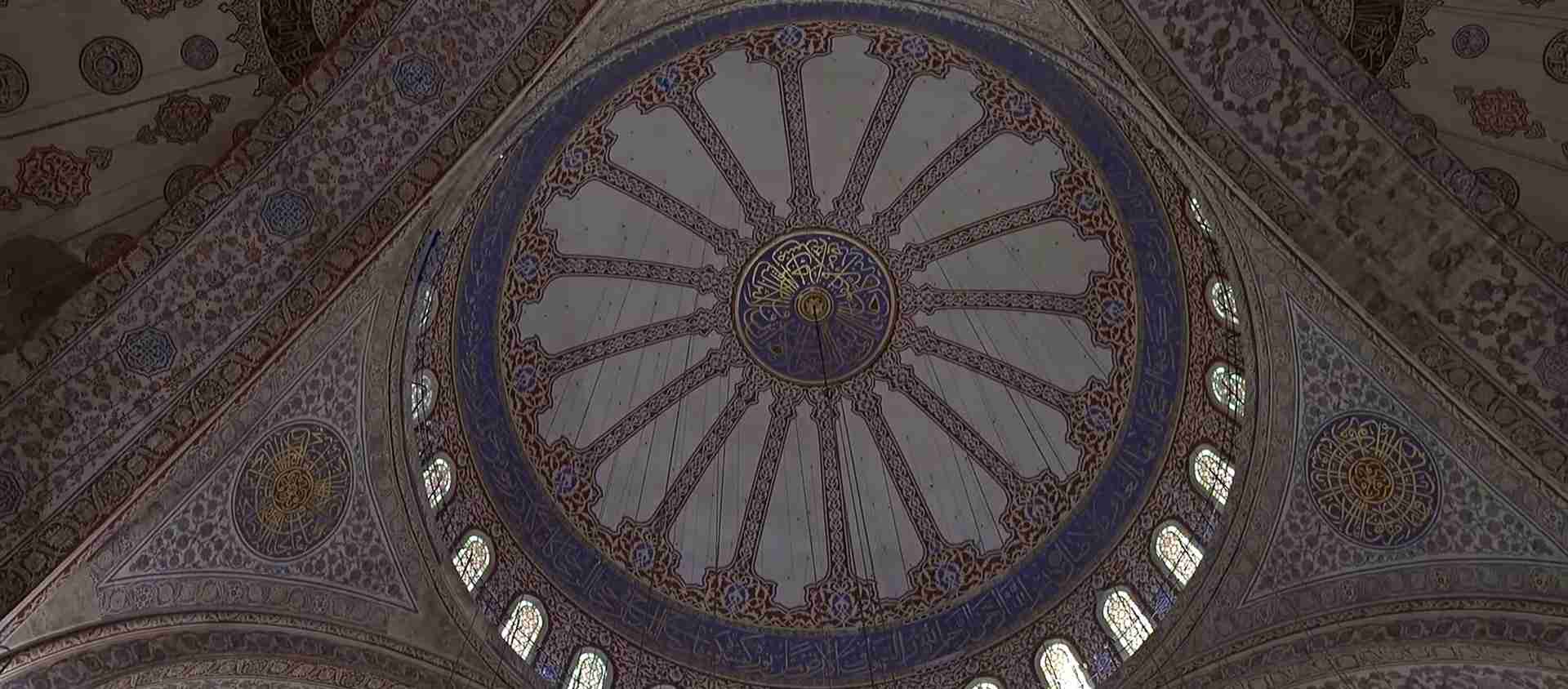
Stepping inside the Blue Mosque reveals the origin of its popular name—an overwhelming impression of celestial blue light created by over 20,000 handcrafted ceramic tiles covering the walls in breathtaking floral and geometric patterns. These tiles represent the pinnacle of Ottoman ceramic artistry, produced during the early 17th century when İznik workshops reached their technical and artistic zenith before the craft declined in subsequent decades.
The Iznik Tile Tradition
İznik, a town in northwestern Anatolia approximately 140 kilometers southeast of Istanbul, emerged as the Ottoman Empire’s premier ceramics center during the 15th-16th centuries, producing tiles and pottery of extraordinary quality and beauty. İznik artisans developed distinctive techniques including underglaze painting (decorations applied before the clear glaze covering, allowing brilliant colors while protecting the design), the famous “İznik red” (a vibrant coral-red pigment achieved through Armenian bole clay), and complex designs combining floral naturalism with geometric abstraction reflecting both Persian and Ottoman aesthetic traditions.
Sultan Ahmed I demonstrated such dedication to decorating his mosque with the finest tiles that he essentially monopolized İznik’s entire ceramic industry for the seven-year construction period, commissioning tiles exclusively for this project and preventing other customers from accessing İznik workshops. This concentrated patronage allowed İznik masters to experiment with new designs and achieve unprecedented consistency in quality, though it also contributed to the workshops’ later decline as other markets dried up during this exclusive focus.
Tile Patterns and Symbolism
The Blue Mosque’s tiles display over 50 different tulip designs alone, reflecting the Ottoman Empire’s famous tulip cultivation and the flower’s symbolic associations with paradise and divine beauty. Beyond tulips, the tiles depict roses, carnations, hyacinths, cypress trees, fruit trees, and fantastical flowers combining realistic and stylized elements. Geometric patterns including arabesques, cloud bands, and interlacing stars fill spaces between floral elements, creating an overall effect of organic abundance constrained by mathematical order—a visual representation of Islamic cosmology where divine order structures natural profusion.
The tiles concentrate most densely around the mihrab (prayer niche indicating Mecca’s direction), the galleries, and the lower walls throughout the prayer hall. Blue dominates the color palette, ranging from deep cobalt to pale turquoise, complemented by greens (emerald to olive), coral reds, and white backgrounds. The original tiles used natural mineral pigments producing colors that remain vibrant after 400 years, though some panels underwent restoration replacing damaged tiles with modern reproductions that attempt matching original patterns while lacking the same depth and luminosity achieved by 17th-century İznik masters.
Beyond the tiled areas, the upper walls and dome interiors feature painted decorations applied during 19th-century restoration that replaced original 17th-century paintwork. These painted areas display geometric patterns and organic medallions in blues, golds, and reds, though the quality doesn’t match the tile work below. The central dome features painted Quranic verses and geometric patterns, while the semi-domes and smaller domes continue the decorative program, creating an entirely decorated interior where virtually no surface remains bare stone.
Windows and Light
Over 260 windows pierce the mosque’s domes and walls at multiple levels, creating the flood of natural light essential to activating the tile decorations. The windows originally contained Venetian stained glass featuring colored patterns (destroyed over centuries and replaced), allowing colored light to play across the tiles while maintaining the interior’s bright illumination. The window arrangement demonstrates sophisticated understanding of light effects—windows in the central dome’s drum illuminate the uppermost reaches, half-dome windows light the intermediate zones, and wall windows at floor level ensure even illumination throughout the prayer hall.
The interplay between natural light and tile surfaces creates the mosque’s magical atmosphere, particularly during morning and late afternoon when angled sunlight creates dramatic shadows and highlights on the three-dimensional tile patterns. The tiles’ glazed surfaces reflect light, amplifying the overall brightness while the blue and green colors absorb warm light wavelengths and reflect cool tones, creating the overall blue luminosity that inspired the mosque’s nickname. During the recent restoration, lighting designers added LED fixtures designed to complement natural light without overpowering the daylight-dominated lighting scheme that the mosque’s architect intended.
Prayer Hall Details and Furnishings
The Mihrab and Minbar
The mihrab, a decorative niche in the qibla wall indicating Mecca’s direction for prayer, occupies the prayer hall’s focal point. Carved from single pieces of white marble with intricate floral and geometric relief patterns, the mihrab exemplifies Ottoman stone carving at its finest. Flanking the mihrab, columns of green marble (quarried from Marmara Island) frame the niche, while the surrounding wall receives the densest concentration of İznik tiles creating a visual emphasis on this spiritually significant location.
Adjacent to the mihrab stands the minbar (pulpit), a tall marble structure with a slender staircase leading to an elevated platform from which the imam delivers Friday sermons. The minbar features delicate carved screens, geometric patterns, and a distinctive conical turret cap resembling minaret architecture in miniature. The minbar’s careful positioning ensures acoustic projection—the imam’s voice carries clearly throughout the vast prayer hall without electronic amplification, demonstrating the architect’s understanding of sound propagation and the prayer hall’s acoustic properties designed to distribute sound evenly.
The Imperial Loge
On the prayer hall’s left side (facing the mihrab), an elevated platform accessible via an external ramp structure served as the imperial loge where the sultan attended prayers separated from common worshippers. This imperial pavilion represents an architectural innovation appearing for the first time in Ottoman mosque design—previous imperial mosques lacked dedicated sultan’s sections. The structure includes a covered ramp, retiring rooms where the sultan could rest before or after prayers, and an enclosed balcony overlooking both the prayer hall interior and the Sea of Marmara beyond.
The imperial loge’s awkward integration into the overall design reveals it was incorporated late in the design process, creating spatial complexities that slightly compromise the prayer hall’s otherwise harmonious proportions. After Sultan Ahmed I’s death, subsequent sultans used the facility only occasionally, and it gained new purpose in 1826 when it served as headquarters for Grand Vizier Hüsrev Pasha during the suppression of the rebellious Janissary Corps. A fire in 1912 damaged the structure, requiring restoration that rebuilt portions while maintaining the original architectural character.
Calligraphy and Inscriptions
The prayer hall’s decoration includes magnificent Islamic calligraphy executed by Seyyid Kasım Gubari, one of the Ottoman Empire’s most celebrated calligraphers. Quranic verses, hadith (sayings of the Prophet Muhammad), and religious formulas appear in large-scale calligraphy panels throughout the prayer hall, particularly around the mihrab and on the central dome’s interior. The calligraphy employs various traditional Islamic scripts including thuluth (characterized by elongated vertical strokes) and naskh (more compact and horizontal), demonstrating Gubari’s mastery of calligraphic styles.
The inscriptions serve both decorative and didactic functions—beautifying the mosque while reminding worshippers of core Islamic teachings. Major panels include verses from the Quran’s “Light Verse” (Surah an-Nur 24:35) describing God as the light of the heavens and earth, particularly appropriate for a building designed to manifest divine light through its luminous blue tile work and abundant windows. Other inscriptions record the mosque’s foundation, Sultan Ahmed I’s patronage, and the architect’s name, preserving the historical record while praising those who created this sacred space.
The Mosque Complex: Beyond the Prayer Hall
The Blue Mosque functioned as the centerpiece of a larger külliye (religious and social complex) serving diverse community needs beyond providing space for prayer. Unlike earlier Ottoman mosque complexes where auxiliary buildings were arranged in symmetrical patterns around the mosque, the Blue Mosque’s challenging site next to the ancient Hippodrome prevented organized planning—the complex’s additional structures scatter around the mosque and Hippodrome in available spaces rather than following geometric order.
Sultan Ahmed I’s Tomb
Directly adjacent to the mosque’s northern wall stands the octagonal tomb (türbe) housing Sultan Ahmed I, who died in 1617 at age 27 from typhus, barely one year after his mosque’s completion. The tomb also contains the remains of Ahmed I’s wife Kösem Sultan and three of his sons who also served as sultans (Osman II, Murad IV, and Prince Bayezid). The tomb’s interior features İznik tile panels and painted decorations continuing the mosque’s artistic program on an intimate scale appropriate for a funerary structure.
Visitors can enter the tomb outside prayer times, finding a quieter contemplative space compared to the bustling mosque interior. The tomb serves as a poignant reminder of the young sultan whose ambition created one of the world’s great mosques despite his troubled reign and early death, his architectural legacy far outlasting his brief life and ultimately defining how the world remembers him.
The Madrasa and Other Buildings
The complex originally included a madrasa (Islamic theological school) where students studied Quranic interpretation, Islamic law, Arabic language, and traditional sciences. The madrasa occupied a building along the mosque’s northern side, though it no longer functions as a school. Additional structures in various states of preservation include a primary school (mektep), hospital (darüşşifa), public kitchen (imaret) feeding the poor and students, caravanserai providing lodging for travelers, shops whose rental income supported the complex’s maintenance, and the sultan’s private entrance pavilion.
Many auxiliary buildings suffered damage from fires, earthquakes, and urban development over the centuries. A major fire in 1912 destroyed or damaged several structures, which were subsequently restored. The complex never achieved the architectural unity and integrated planning of earlier Ottoman mosque complexes like the Süleymaniye, reflecting the challenging site constraints and possibly hasty planning during the abbreviated seven-year construction period. Nevertheless, the mosque itself achieves such magnificent success that these peripheral buildings’ limitations fade to insignificance.
Visiting the Blue Mosque: Practical Information
Opening Hours and Prayer Time Closures
The Blue Mosque opens daily from approximately 08:30 until one hour before sunset (varying seasonally, typically 17:30-18:30), with tourist access restricted during five daily prayer times when the mosque closes to non-worshippers for approximately 30-45 minutes. Prayer times vary throughout the year following the Islamic lunar calendar and solar day cycle, but typically occur around sunrise (fajr), early afternoon (dhuhr around 13:00-14:00), mid-afternoon (asr around 16:00-17:00), sunset (maghrib), and evening (isha approximately 90 minutes after sunset).
Friday presents special restrictions—the mosque closes to tourists from before noon until approximately 14:30 for Friday congregational prayers (Jumu’ah), which attract large numbers of local worshippers and feature extended sermons. Visitors planning Friday sightseeing should schedule the Blue Mosque for early morning (08:30-11:30) or late afternoon (after 15:00) to avoid the Friday closure. Islamic holidays including Ramadan (month-long dawn-to-dusk fasting) and the major festivals of Eid al-Fitr and Eid al-Adha may affect visiting hours and crowd levels.
Security screening creates queues particularly during peak tourist season (June-August) and when cruise ships disgorge passengers into Sultanahmet. Lines typically reach maximum length 10:00-15:00 on summer days, sometimes requiring 30-60 minutes waiting before clearing security and entering the mosque. Arriving at opening time (08:30) or late afternoon provides the best chance of minimal queuing. Prayer time closures actually benefit patient visitors—positioning yourself near the entrance shortly before prayer times end allows entering immediately after the mosque reopens when the interior is least crowded.
Dress Code Requirements
As an active place of worship, the Blue Mosque enforces modest dress standards strictly. All visitors regardless of gender must cover shoulders and knees—no tank tops, sleeveless shirts, shorts, or short skirts permitted. Women must additionally cover their hair with headscarves, provided free at the entrance if you arrive without one (though bringing your own scarf ensures better fit and cleanliness). The provided scarves are basic rectangular cloths that can be tied in simple styles, with mosque attendants available to help visitors unfamiliar with headscarf wrapping.
All visitors must remove shoes before entering the prayer hall, placing them in provided plastic bags to carry inside or storing them in designated shoe racks near the entrance (though valuable shoes might disappear from racks—carrying them in the bag ensures their safety). Socks or bare feet are acceptable on the interior carpets. Conservative Muslim visitors often bring prayer rugs or covering cloths, but tourists walk directly on the mosque’s extensive carpeting.
Dress code enforcement occurs at the security checkpoint before entering the mosque grounds—visitors dressed inappropriately receive warnings to cover up using provided wraps or return when properly dressed. Tour groups sometimes carry spare long skirts and head coverings for unprepared group members. Respecting these requirements demonstrates cultural sensitivity and ensures smooth entry—attempting to negotiate or ignore dress codes wastes time and shows disrespect for the mosque’s religious function.
Photography and Behavior Guidelines
Photography remains permitted inside the Blue Mosque without flash, allowing visitors to document the extraordinary tile work and architectural details. However, respect for worshippers takes precedence—avoid photographing people praying, maintain quiet voices, don’t walk directly in front of praying individuals, and refrain from eating, drinking, or inappropriate behavior inside the prayer hall. The mosque functions first as a place of worship, with tourist access graciously permitted rather than being its primary purpose.
The tourist viewing area typically occupies the sides and rear of the prayer hall, with the central prayer space and area near the mihrab reserved for worshippers. Ropes or temporary barriers may define tourist zones during busy prayer times. Visitors should remain in designated areas, avoid sitting on prayer carpets in the central section, and generally behave with the same decorum expected in any sacred space regardless of personal religious beliefs.
The mosque’s exterior courtyard, fountain, and surrounding gardens offer excellent photography opportunities without religious restrictions, making them ideal for those wanting photos without navigating the interior’s rules. The view of the mosque from Sultanahmet Square and from the courtyard fountain looking toward the prayer hall create iconic compositions, particularly during the golden hours of early morning and late afternoon when angled sunlight illuminates the cascading domes and slender minarets.
Guided Tours and Audio Guides
While entry to the mosque is free, guided tours provide valuable historical context, architectural insights, and strategic timing that enhance the experience. Private tour companies offer small group tours (typically $15-30 per person) combining the Blue Mosque with other Sultanahmet monuments like Hagia Sophia, Topkapi Palace, and the Basilica Cistern in half-day or full-day packages. These tours benefit from guides who understand prayer time schedules and can time visits to minimize crowds.
Audio guide smartphone applications offer self-paced alternatives at lower cost, providing historical narration, architectural explanations, and details about the tile patterns and calligraphy viewable while walking through the mosque. Many apps include photos and diagrams highlighting specific features, though using phones inside the mosque requires discretion to avoid appearing disrespectful. Downloading audio guides before arrival ensures they work offline without requiring data connectivity inside the mosque.
Free informal guides sometimes approach tourists outside the mosque offering their services, though quality varies dramatically—some are knowledgeable history enthusiasts genuinely wanting to share their city’s heritage, while others provide superficial commentary mainly interested in steering visitors toward carpet shops or restaurants paying commissions. Licensed professional guides display official identification and typically work through established tour companies rather than approaching random tourists in the square.
Best Times to Visit
Early morning immediately after opening (08:30-10:00) offers the optimal visiting experience—minimal crowds allowing unhurried appreciation of the tile work, excellent morning light entering through the eastern windows illuminating the mihrab wall, and generally smooth entry without excessive security queuing. Late afternoon (16:00-17:30) provides a second favorable window with fewer tour groups and beautiful angled sunlight, though visitors must monitor prayer times to avoid sudden closures.
Weekday mornings (Tuesday-Thursday) see lighter tourist traffic than weekends and Mondays, while Friday mornings before the noon closure allow viewing before the weekly congregational prayer draws large crowds. Summer months (June-August) bring peak crowds coinciding with Europe’s school holidays and cruise ship season—visiting during shoulder seasons (April-May, September-October) encounters fewer tourists while maintaining pleasant weather. Winter (November-March) offers the quietest visiting conditions but shorter daylight hours and potential rain affecting outdoor queuing comfort.
Ramadan, the Islamic holy month of fasting observed by Muslims worldwide, creates unique visiting conditions—the mosque maintains normal tourist hours but worshippers fasting from dawn to sunset may appear more fatigued during daytime visits, while evening prayers after breaking the fast (iftar) draw enormous crowds filling the mosque beyond capacity. Visiting during Ramadan requires extra cultural sensitivity and patience with prayer time closures.
The Blue Mosque in Cultural Context
Relationship with Hagia Sophia
The Blue Mosque’s position directly across Sultanahmet Square from Hagia Sophia creates one of the world’s most dramatic architectural dialogues—the supreme Byzantine cathedral facing the classical Ottoman mosque, separated by merely 150 meters of open square. Sultan Ahmed I deliberately positioned his mosque to engage visually with Hagia Sophia, creating a structure that could hold its own against the cathedral that had dominated Istanbul’s skyline and inspired Islamic architecture for over a millennium following the Ottoman conquest of Constantinople in 1453.
Rather than attempting to match Hagia Sophia’s revolutionary dome engineering (which remains unsurpassed in Byzantine architecture), the Blue Mosque adopted Ottoman classical traditions but executed them with supreme refinement—the cascading dome arrangement, slender minarets, and elaborate tile decoration represent Ottoman architecture’s distinctive achievements rather than Byzantine imitation. The result creates complementarity rather than competition—Hagia Sophia’s massive masonry presence and ancient gravitas balanced by the Blue Mosque’s vertical grace and colorful decoration, the two monuments representing their respective civilizations’ architectural pinnacles standing in eternal conversation across the square.
Impact on Ottoman Architecture
The Blue Mosque represents both culmination and conclusion of the classical Ottoman mosque tradition established by Mimar Sinan in the 16th century. Its completion in 1616 coincided with the Ottoman Empire’s transition from expansion to defense, from cultural confidence to increasing European military and economic pressure. No subsequent sultan commissioned an imperial mosque in Istanbul matching the Blue Mosque’s scale or ambition—it stands as the last of the great Ottoman imperial mosques, its perfected classical forms soon giving way to Baroque and Rococo influences arriving from Europe in the 18th century.
The mosque’s influence appears in numerous 17th-century Ottoman mosques that adopted design elements including the cascading dome arrangement, extensive İznik tile decoration, and multiple minarets. However, none achieved the Blue Mosque’s harmonious integration of these elements, and the decline of İznik ceramic workshops following the Blue Mosque’s completion meant later mosques could never replicate its tile splendor. In this sense, the Blue Mosque represents Ottoman architectural and decorative arts at their zenith, a moment of supreme achievement before inevitable decline.
Modern Conservation Challenges
Maintaining the Blue Mosque presents ongoing conservation challenges balancing preservation of priceless historical fabric against the building’s continuing function as an active mosque serving daily prayers and accommodating millions of annual visitors. Environmental factors including air pollution, humidity from the Sea of Marmara, earthquakes threatening structural stability, and simple age-related deterioration all require constant monitoring and intervention.
A major restoration lasting from 2018-2023 addressed critical structural and decorative issues—three of the six minarets were completely dismantled and rebuilt, the central dome’s structural connections were reinforced against earthquake damage, İznik tiles were cleaned and consolidated, damaged tile panels received conservation, the lead roof covering was renewed, the courtyard pavement was releveled, and the interior lighting was upgraded to LED systems. The restoration work proceeded in phases allowing the mosque to remain partially open to worshippers and visitors, though complete access resumed only after the project’s completion.
Future conservation faces the challenge of replacing damaged İznik tiles—modern Turkish ceramic workshops have attempted recreating historical İznik techniques, but contemporary tiles lack the same brilliant colors and depth achieved by 17th-century masters whose exact methods remain partially mysterious. Balancing tourist access with preservation needs creates ongoing tension, as the wear from millions of visitors walking on historic carpets, touching marble columns, and generating interior humidity affects long-term preservation even as tourism revenues support conservation work.
Frequently Asked Questions About the Blue Mosque
What is the difference between the Blue Mosque and Hagia Sophia?
The Blue Mosque (Sultan Ahmed Mosque) and Hagia Sophia represent two different civilizations’ architectural achievements separated by over a millennium. Hagia Sophia was built 532-537 CE as a Byzantine Christian cathedral during Emperor Justinian’s reign, featuring revolutionary dome engineering that remained unsurpassed in Byzantine architecture and serving as Christianity’s greatest church for nearly 1,000 years. The Ottomans converted Hagia Sophia to a mosque in 1453 following Constantinople’s conquest, adding minarets and Islamic decoration while preserving Byzantine mosaics. In 1935 it became a museum, then reverted to mosque status in 2020, currently functioning as both an active mosque and tourist attraction with €25 entrance fee for upper gallery access. The Blue Mosque was built 1609-1616 as an Ottoman imperial mosque specifically designed to rival Hagia Sophia’s grandeur while asserting distinct Ottoman architectural identity. It features six minarets versus Hagia Sophia’s four (added during Ottoman period), extensive İznik tile decoration creating blue interior atmosphere, and classical Ottoman cascading dome arrangement. Entry remains free as it functions primarily as a place of worship. Architecturally, Hagia Sophia represents Byzantine engineering genius with its massive dome seemingly floating on pendentives and hidden buttresses, while the Blue Mosque demonstrates Ottoman classical refinement with transparent structural logic and emphasis on decorative beauty through tiles and calligraphy. Visitors typically tour both monuments to appreciate the architectural dialogue between these civilizations’ supreme achievements.
Why do some sources say the Blue Mosque has different numbers of tiles?
Historical sources cite various numbers for the Blue Mosque’s İznik tiles ranging from 20,000 to over 21,000, creating confusion about the exact quantity. This variation stems from counting methodology differences and the reality that the precise number has likely changed over the mosque’s 400-year history. The most commonly cited figure of “over 20,000 tiles” provides a general magnitude while acknowledging counting uncertainty. A detailed analysis published by Turkish conservation authorities cites 21,043 individual tiles covering the mosque’s interior walls, but this number may include both original 17th-century İznik tiles and modern replacement tiles installed during various restoration campaigns. The tiles vary significantly in size—some are small individual squares or rectangles, while others are large panels composed of multiple fired pieces—making the counting unit ambiguous depending on whether “tiles” refers to individual fired pieces or installed panels. Additionally, many “tiles” are actually composite panels made from multiple smaller pieces fitted together, further complicating counting. The important point remains that the mosque contains tens of thousands of handcrafted ceramic pieces creating the spectacular blue interior decoration, whether the exact count totals 20,000, 21,000, or some intermediate figure. Conservation work continues discovering hidden or covered tile panels, potentially revealing additional tiles not included in historical counts, while damaged tiles removed during restoration reduce the number of original period tiles even as modern reproductions maintain the overall decorative scheme.
Can women visit the Blue Mosque during their menstrual period?
Yes, women can visit the Blue Mosque as tourists during menstruation without religious restriction. While traditional Islamic law prohibits menstruating women from performing formal prayers and touching the Quran, these restrictions apply to worship participation rather than simply entering mosque buildings. The Blue Mosque welcomes all tourists regardless of gender or personal circumstances, with the understanding that non-Muslim visitors and Muslim tourists not entering for prayer purposes occupy a different category than worshippers coming for religious observance. The primary entry requirements for all visitors—modest dress covering shoulders and knees, headscarf for women, shoes removed before entering—apply equally to all female visitors without inquiry into personal circumstances. This policy reflects the mosque’s dual function as both active place of worship and tourist attraction, accommodating visitors who come to appreciate architectural and artistic beauty rather than participate in religious services. Menstruating Muslim women who wish to pray would traditionally refrain from the ritual prayer itself, but visiting the mosque as a tourist to view its beauty and reflect spiritually remains perfectly acceptable in standard Islamic practice. The mosque staff and security personnel never inquire about such personal matters when admitting tourists. Visitors should simply follow the standard dress code, behave respectfully in the sacred space, and maintain appropriate decorum during their visit regardless of personal circumstances.
How long should I spend visiting the Blue Mosque?
Most visitors spend 30-45 minutes inside the Blue Mosque appreciating the interior architecture, tile work, and atmosphere, with total visit time including exterior queue, security screening, and courtyard exploration typically ranging 60-90 minutes. The actual prayer hall visit proceeds relatively quickly for those simply walking through and photographing the tiles and dome—20-30 minutes suffices for a complete circuit through the tourist areas, viewing from multiple vantage points, and taking photographs. Visitors with particular interest in Islamic art, Ottoman architecture, or tile design may spend 45-60 minutes closely examining the İznik tile patterns, reading calligraphic inscriptions, and appreciating architectural details. Adding security queue time (15-60 minutes depending on season and time of day), shoe removal and dress code compliance (5-10 minutes), courtyard exploration (10-15 minutes), and potentially visiting Sultan Ahmed I’s tomb (10 minutes) brings the total Blue Mosque visit to approximately 90 minutes for thorough appreciation. Visitors can efficiently combine the Blue Mosque with other Sultanahmet monuments in a single day—a typical half-day Sultanahmet itinerary might allocate 90 minutes for the Blue Mosque, 60-90 minutes for Hagia Sophia (directly across the square), 45 minutes for the Basilica Cistern, and 30 minutes for the Hippodrome, with breaks for rest and refreshment bringing the total to 4-5 hours of sightseeing. Those joining guided tours typically spend 45-60 minutes at the Blue Mosque including both the guide’s exterior explanation and interior visit, with tour pacing designed to maximize information delivery while maintaining group cohesion.
Are there any restrictions on what tourists can do inside the Blue Mosque?
Tourists visiting the Blue Mosque must follow several behavioral restrictions respecting its primary function as an active place of worship. Photography without flash is permitted throughout the prayer hall and courtyard, but visitors should avoid photographing worshippers, particularly during prayer when photography becomes especially intrusive. Quiet voices are required inside the prayer hall—conversations permitted but loud talking, laughing, or calling out disrupts the contemplative atmosphere and disturbs those praying. Visitors must stay in designated tourist areas, typically the sides and rear of the prayer hall, avoiding the central prayer space particularly when worshippers are present. Sitting on prayer carpets in the central area reserved for worship is prohibited unless one is actually praying. Eating, drinking, smoking, and chewing gum inside the mosque are forbidden, though water bottles may be carried in bags and consumed outside in the courtyard. Physical affection between couples including kissing, embracing, or hand-holding should be minimized inside the prayer hall out of respect for conservative sensibilities. Children must be supervised to prevent running, shouting, or disruptive behavior that disturbs worshippers or other visitors. The mosque provides separate prayer areas for men and women, with women’s prayer section accessed via side entrances—tourists generally enter through the main tourist entrance regardless of gender. During prayer times when the mosque closes to tourists, attempting to remain inside or sneaking past barriers violates the temporary restriction and shows disrespect for worship. Donation boxes near the entrance welcome contributions but carry no obligation—visitors should never feel pressured to donate, though small contributions support mosque maintenance and conservation work. Overall, the principle guiding tourist behavior should be respect for the mosque as a living sacred space where faith is actively practiced rather than merely a museum or historical monument.
What makes the Blue Mosque different from other Ottoman mosques?
Several features distinguish the Blue Mosque from other Ottoman imperial mosques, making it unique even within the classical Ottoman architectural tradition. The six minarets represent the most obvious distinction—no other Ottoman mosque in Istanbul possesses six minarets, with imperial mosques typically featuring four (Süleymaniye, Selimiye) and smaller mosques having two or one. This unprecedented number created controversy when built and remains the mosque’s most distinctive external characteristic. The extensive use of İznik tile decoration represents another distinguishing feature—while other Ottoman mosques incorporate İznik tiles in mihrab areas and selected panels, the Blue Mosque’s employment of over 20,000 tiles covering vast interior wall surfaces represents the most lavish tile program in imperial Ottoman mosque architecture. The combination of scale and decoration intensity has no parallel in other Ottoman mosques. The mosque’s location in the historic Sultanahmet peninsula directly facing Hagia Sophia, rather than on one of Istanbul’s outer hills where imperial mosques typically stood, creates unique urban symbolism. The massive courtyard nearly equal in size to the covered prayer hall exceeds other Ottoman mosque courtyards in scale, emphasizing openness and accessibility. The imperial loge’s L-shaped structure with covered ramp, retiring rooms, and enclosed balcony represents an architectural innovation appearing for the first time in the Blue Mosque and not repeated in subsequent mosques. The combination of all these features—six minarets, unprecedented tile decoration, symbolic location, vast courtyard, and architectural innovations—together create the Blue Mosque’s distinctive character that makes it immediately recognizable and different from even its closest Ottoman predecessors. Additionally, the Blue Mosque’s status as the last great imperial mosque built in Istanbul before Ottoman architectural traditions gave way to European Baroque influences adds historical significance, representing the culmination and conclusion of the classical Ottoman mosque tradition rather than a point along an ongoing evolutionary arc.
What happened to the Blue Mosque during World War I and the founding of modern Turkey?
The Blue Mosque continued functioning as an active mosque throughout World War I, the Ottoman Empire’s collapse, the Turkish War of Independence, and the founding of the Turkish Republic in 1923, though the complex’s auxiliary buildings suffered damage requiring restoration. Unlike Hagia Sophia which underwent dramatic status changes—converted from mosque to museum in 1935 by Atatürk’s secular government, then reverted to mosque status in 2020—the Blue Mosque maintained consistent religious use throughout the 20th century without interruption. The Ottoman Empire’s defeat in World War I and subsequent occupation of Istanbul by Allied forces (1918-1923) brought no direct military damage to the mosque, though the complex’s auxiliary buildings including parts of the madrasa and imperial pavilion suffered from the 1912 fire that predated the war and from general neglect during the chaotic war and immediate post-war years. The Turkish Republic’s founding in 1923 and Atatürk’s secularization reforms dramatically changed Turkey’s religious landscape—the caliphate was abolished in 1924, Sufi orders were banned, religious schools closed, and Islamic law replaced with Swiss-based civil code. However, the Blue Mosque as a functioning neighborhood mosque serving daily prayers escaped the most radical reforms affecting institutions like Hagia Sophia. The mosque underwent restoration in the 1930s addressing war-era neglect and earthquake damage, with subsequent 20th-century maintenance ensuring the building’s structural stability and decorative preservation. The dramatic contrast between Hagia Sophia’s conversion to museum status and the Blue Mosque’s continuous religious function actually benefited both monuments—tourists could appreciate Hagia Sophia’s Byzantine mosaics and architecture in museum context while experiencing the Blue Mosque as a living worship space, providing different but complementary visiting experiences. The mosque’s neighborhood around Sultanahmet developed into Istanbul’s primary tourist zone during the mid-20th century, bringing both tourism revenue supporting conservation and challenges from mass tourism impact on this historic sacred space.
Is it disrespectful for non-Muslims to visit the Blue Mosque?
No, non-Muslim visitors are welcomed at the Blue Mosque and visiting as a respectful tourist demonstrates cultural curiosity and appreciation for Islamic architecture and Ottoman history rather than disrespect. Islamic tradition generally encourages sharing mosques’ beauty with all humanity, viewing architectural splendor as manifestations of divine creativity worthy of universal appreciation regardless of personal faith. The mosque’s management explicitly accommodates tourist visits by establishing designated visiting hours outside prayer times, providing free headscarves for women who arrive unprepared, creating tourist pathways that avoid disrupting worship, and posting clear multilingual signage explaining visiting rules and Islamic customs. This infrastructure demonstrates institutional welcome for non-Muslim visitors who respect the mosque’s religious function and behavioral expectations. The key distinction lies between respectful appreciation and disrespectful behavior—tourists who dress modestly, maintain quiet voices, avoid disrupting prayers, follow photography guidelines, and generally comport themselves appropriately show respect regardless of personal religious beliefs or lack thereof. Conversely, inappropriate dress, loud conversations, intrusive photography of worshippers, or cavalier attitudes toward sacred space would demonstrate disrespect whether from Muslims or non-Muslims. Many mosque visitors report profound experiences appreciating the spiritual atmosphere, architectural beauty, and serene environment even without sharing Islamic faith—the mosque’s aesthetic and contemplative qualities transcend religious boundaries, offering beauty and peace to all receptive visitors. Some Muslims particularly welcome non-Muslim visitors as opportunities for cultural exchange and countering negative stereotypes about Islam, viewing tourist interest in mosques as chances to demonstrate Islamic hospitality and artistic achievement. Visitors uncertain about appropriate behavior should observe other tourists or ask mosque attendants who regularly help visitors navigate unfamiliar customs. The simple test remains treating the mosque as one would any sacred space in any faith tradition—with respect, quiet, and mindfulness of those for whom this represents a holy place of active worship regardless of whether one shares those beliefs.