India Hidden Gems Guide: Secret Spots & Lesser-Known Treasures
Beyond India’s iconic monuments lie extraordinary hidden treasures scattered across the subcontinent, from forgotten cave temples carved into volcanic cliffs to medieval fortresses lost in desert sands. These lesser-known UNESCO World Heritage Sites and secret destinations offer profound cultural encounters without the overwhelming crowds that define popular attractions, revealing authentic dimensions of India’s 5,000-year heritage that most travelers never discover.
Key Takeaways
- India contains 42 UNESCO World Heritage Sites, with more than half receiving fewer than 100,000 annual visitors compared to the Taj Mahal’s 7-8 million, offering comparable historical significance without crowds
- The Champaner-Pavagadh Archaeological Park preserves eight centuries of unbroken Islamic and Hindu architecture spanning 1297-1573, yet welcomes only 50,000 visitors annually despite being among Asia’s most complete medieval city complexes
- Remote Himalayan sites like the Great Himalayan National Park and Nanda Devi Biosphere Reserve protect ecosystems containing snow leopards, blue sheep, and Western Tragopan pheasants found nowhere else on Earth, accessible only through multi-day treks
- Lesser-known rock-cut cave complexes at Elephanta, Ajanta, and Ellora rival Egypt’s Valley of the Kings in scale and artistic achievement, with Ellora’s Kailasa Temple representing the world’s largest monolithic structure carved from a single rock
- India’s Victorian Gothic and Art Deco architectural ensembles in Mumbai constitute the world’s second-largest collection after Miami, showcasing fusion styles unique to colonial-era India that transformed urban planning across South Asia
- Sacred groves and cultural landscapes like Khangchendzonga National Park integrate Buddhist pilgrimage traditions with pristine alpine wilderness, offering spiritual experiences distinct from temple-focused tourism
People Also Ask About India Hidden Gems
What are the most underrated UNESCO World Heritage Sites in India?
The most underrated UNESCO sites in India include Champaner-Pavagadh Archaeological Park in Gujarat, which preserves eight centuries of continuous Islamic and Hindu architecture from 1297-1573 with fewer than 50,000 annual visitors despite being one of Asia’s most complete medieval fortified city complexes. The Rani ki Vav stepwell in Patan demonstrates 11th-century Maru-Gurjara architectural mastery through seven levels descending 27 meters with over 500 principal sculptures, yet remains largely unknown outside India. The Victorian Gothic and Art Deco Ensembles of Mumbai represent the world’s second-largest collection of these architectural styles after Miami, showcasing unique Indo-Saracenic fusion designs from 1860-1940 that transformed colonial urban planning. The Mountain Railways of India, including the Darjeeling Himalayan Railway, Nilgiri Mountain Railway, and Kalka-Shimla Railway, demonstrate extraordinary 19th-century engineering solutions for Himalayan terrain through innovative loop systems and gradient-conquering designs, operating authentic steam engines on routes unchanged since the 1880s.
Which Indian destinations offer authentic cultural experiences without tourist crowds?
Authentic crowd-free cultural experiences exist across India’s lesser-visited regions. Chettinad in Tamil Nadu preserves 10,000+ mansions built by 19th-century merchant banking families, featuring Burma teak pillars, Italian marble floors, and Belgian chandeliers in architectural styles found nowhere else globally, with the region welcoming fewer than 20,000 international visitors annually. The Majuli River Island in Assam, Earth’s largest inhabited river island at 880 square kilometers, maintains 22 active Vaishnavite monasteries (sattras) preserving 500-year-old dance, music, and mask-making traditions practiced daily by monk communities, accessible only by ferry across the Brahmaputra River. Orchha in Madhya Pradesh contains 16th-17th century Bundela Rajput palaces and cenotaphs rivaling Rajasthan’s famous forts in architectural sophistication but hosting 90% fewer tourists, with evening aarti ceremonies at Ram Raja Temple maintaining authentic devotional practices unchanged for 400 years. The Spiti Valley in Himachal Pradesh protects 1,000-year-old Buddhist monasteries like Tabo and Key, designated as the “Ajanta of the Himalayas” for their ancient murals and manuscripts, reachable only during the 4-month summer season when high-altitude passes open.
How do I access remote heritage sites in India?
Remote Indian heritage sites require advance planning and specific access strategies. Himalayan destinations like the Great Himalayan National Park, Nanda Devi Biosphere Reserve, and Pin Valley require trekking permits obtained 2-4 weeks in advance through the Indian Mountaineering Foundation or state forest departments, with mandatory local guide requirements for zones above 3,500 meters and restricted area permits for regions within 50 kilometers of international borders. River island destinations like Majuli require ferry crossings with scheduled departures from Jorhat or Neemati ghats, taking 1-2 hours depending on Brahmaputra water levels, with limited accommodation requiring advance booking during festival seasons October-March. Desert heritage sites like Champaner-Pavagadh involve combination transport using trains to Vadodara followed by 45-kilometer bus or taxi transfers, with the summit Kalika Temple requiring cable car access or a 600-step climb. Monsoon accessibility limitations affect Western Ghats sites June-September when roads wash out and cave complexes close, requiring seasonal timing October-May for reliable access to Ajanta, Ellora, and Elephanta caves.
What makes India’s hidden gems different from famous monuments?
India’s hidden gems offer distinct advantages over famous monuments through superior crowd management, authentic cultural context, and often greater architectural innovation. Lesser-known sites like the Hoysala Temples at Belur, Halebidu, and Somnathapura display stone carving techniques surpassing the Taj Mahal in intricacy, with every surface covered in narrative friezes depicting 10,000+ individual figures carved from chloritic schist that permits detail impossible in Taj Mahal marble, all viewable without the 70,000 daily visitors that overwhelm Agra. The Group of Monuments at Pattadakal demonstrates experimental architectural synthesis across 7th-8th centuries, where Chalukya architects tested both Dravidian and Nagara temple design systems side by side, creating a laboratory of innovation that influenced temple architecture across South India for six centuries afterward. Remote locations preserve authentic usage contexts absent from heavily touristed sites—monasteries in Spiti Valley maintain daily prayer schedules with resident monk communities using sacred spaces for their intended purposes rather than as museum exhibits, offering genuine cultural immersion impossible at monetized attractions. The absence of protective barriers, crowd control systems, and commercial infrastructure at sites like Rani ki Vav and Champaner-Pavagadh allows intimate interaction with heritage structures, though requiring greater visitor responsibility for conservation.
Extended multi-day tours – 5+ days
Featured India Multi-Day Tour Packages
3 days
India 3-Day Discovery Tour
- ✓ Comprehensive India experience
- ✓ Expert local guides included
- ✓ All accommodation included
- ✓ Transportation provided

5 days
India 5-Day Highlights Experience
- ✓ Comprehensive India experience
- ✓ Expert local guides included
- ✓ All accommodation included
- ✓ Transportation provided

7 days
India 7-Day Cultural Journey
- ✓ Comprehensive India experience
- ✓ Expert local guides included
- ✓ All accommodation included
- ✓ Transportation provided
10 days
India 10-Day Complete Adventure
- ✓ Comprehensive India experience
- ✓ Expert local guides included
- ✓ All accommodation included
- ✓ Transportation provided
Multi-day tour packages powered by TourRadar. Prices and availability subject to change.
Introduction
India’s hidden gems constitute a parallel heritage universe existing beyond the well-trodden circuits connecting Delhi, Agra, and Jaipur. While 45 million domestic and international tourists annually crowd the Taj Mahal, Amber Fort, and Red Fort, extraordinary monuments of equal or superior historical significance languish in relative obscurity across India’s 3.28 million square kilometers. These lesser-known destinations include 22 UNESCO World Heritage Sites receiving fewer than 100,000 visitors each year, medieval city complexes rivaling European counterparts in preservation quality, Himalayan monasteries maintaining 1,000-year-old Buddhist traditions, and rock-cut cave temples whose sculptural achievements exceed Egypt’s pyramids in artistic sophistication.
The cultural value proposition of India’s hidden gems transcends simple crowd avoidance. These sites often preserve more authentic contexts than heavily commercialized famous monuments—villages around Champaner-Pavagadh maintain craft traditions unchanged since the 14th century, Spiti Valley monasteries conduct ancient ritual cycles with resident monk communities rather than for tourist performance, and Victorian-era Mumbai neighborhoods function as living architectural museums where heritage buildings house working offices and residences rather than serving as sterile exhibition spaces. The architectural innovation displayed at lesser-known sites frequently surpasses famous counterparts: Hoysala temples achieve stone carving detail impossible in the Taj Mahal’s marble, Rani ki Vav’s stepwell engineering represents more sophisticated hydraulic understanding than most famous monuments, and the Mountain Railways demonstrate Victorian engineering problem-solving that transformed global narrow-gauge railway design.
Geographic distribution patterns reveal hidden gems concentrated in regions neglected by mainstream tourism. Gujarat contains five UNESCO sites including Champaner-Pavagadh and Rani ki Vav but receives only 3% of India’s international tourists, with 97% of foreign visitors bypassing the state entirely. The northeastern states of Assam, Meghalaya, and Arunachal Pradesh protect sacred groves, living root bridges, and cultural landscapes receiving virtually no international tourism despite containing biodiversity levels exceeding better-known wildlife reserves. The Deccan plateau’s medieval monuments at Hampi, Pattadakal, and Aihole rival Angkor Wat in scale and preservation but attract fewer than 500,000 combined annual visitors compared to Cambodia’s 2.6 million to Angkor.
Accessibility challenges contributing to hidden gem status range from geographic remoteness to infrastructure limitations and regulatory restrictions. Himalayan heritage sites like the Great Himalayan National Park, Nanda Devi Biosphere Reserve, and high-altitude monasteries remain accessible only 4-5 months annually when mountain passes open May-October, requiring multi-day treks with mandatory guide and porter support. River island destinations like Majuli depend on ferry schedules affected by monsoon-season flooding that isolates the island June-August. Desert and semi-arid locations in Rajasthan and Gujarat face extreme summer temperatures exceeding 45°C April-June that close monuments during peak heat hours. Restricted area permits, forest department permissions, and archaeological survey approvals add bureaucratic complexity to visiting certain protected heritage zones.
This guide reveals India’s most significant hidden treasures organized by geographic region and heritage type, providing practical access information, cultural context, and architectural analysis for monuments that deserve recognition alongside India’s famous icons. Each featured destination represents authentic heritage experiences available to travelers willing to venture beyond standard tourist circuits into the remarkable diversity of India’s lesser-known cultural landscapes.
Western India Hidden Gems: Gujarat and Maharashtra Treasures
Western India contains the highest concentration of lesser-known UNESCO World Heritage Sites in the country, with Gujarat and Maharashtra protecting medieval Islamic cities, ancient rock-cut cave complexes, colonial architectural ensembles, and Victorian-era engineering marvels that collectively receive fewer visitors than the Taj Mahal alone despite representing 1,500 years of continuous cultural achievement.
Champaner-Pavagadh Archaeological Park: Medieval Fortified City Complex
Champaner-Pavagadh Archaeological Park in Gujarat preserves the most complete pre-Mughal Islamic fortified city in Asia, containing 114 monuments across 1,329 hectares that document eight centuries of continuous occupation from 1297-1573. The site encompasses the entirely preserved medieval city of Champaner at the hill base and the sacred Hindu fortress of Pavagadh crowning the 800-meter volcanic outcrop above, connected by fortification walls ascending through multiple defensive gates demonstrating sophisticated 14th-16th century military architecture. The park receives approximately 50,000 visitors annually, a fraction of the 7-8 million visiting the Taj Mahal, despite UNESCO recognizing it as among the most important medieval urban complexes in South Asia.
The architectural significance of Champaner centers on its role as the transitional bridge between pre-Mughal Sultanate architecture and later Mughal styles. Built by Mahmud Begada between 1484-1535 as the Gujarat Sultanate capital, the city demonstrates experimental fusion of Islamic architectural principles with indigenous Hindu-Jain traditions, creating unique forms that influenced Mughal architecture after Emperor Humayun conquered Gujarat in 1535. The Jama Masjid, constructed 1513-1523, ranks among India’s finest early mosques, featuring a 75 x 50 meter courtyard surrounded by pillared prayer halls with 172 ornately carved columns, each displaying different capital designs synthesizing Islamic geometric patterns with Hindu foliate motifs. The mosque’s central mihrab contains carved inscriptions in Naskh script alongside Sanskrit-influenced decorative elements, embodying the cultural synthesis characterizing Champaner’s architecture.
The fortification system ascending Pavagadh Hill demonstrates medieval military engineering adapted to volcanic terrain. Seven defensive gates punctuate the 5-kilometer ascent from Champaner to the summit Kalika Temple, each positioned at strategic turns where defenders commanded elevated positions over attackers. The Machi Gate at 300 meters elevation, carved through solid basalt, narrows to 1.5 meters width to prevent elephant-mounted assaults, while the Budhiya Gate at 450 meters incorporates a 90-degree turn forcing attackers to expose their right flanks (unprotected by shields). The summit fortifications crown the volcanic plug at 762 meters, where Kalika Mata Temple occupies a platform carved from living rock, accessed via 600 stone steps or modern cable car completing the 750-meter vertical ascent in 5 minutes.
The city’s water management infrastructure reveals sophisticated hydraulic engineering. Champaner contains 42 stepwells, tanks, and channels supplying water to different city quarters, with the Kevada Masjid incorporating an integrated ablution tank fed by underground channels from uphill springs. The Sahar ki Masjid features a 15-meter-deep stepwell within the mosque complex, demonstrating integration of Islamic ablution requirements with Hindu-Jain stepwell architecture traditions. These water systems remained functional until the 1960s, when modern piping replaced traditional channels, though archaeological conservation efforts since 2004 have restored several historical water features to working condition.
The broader archaeological park protects Hindu-Jain heritage predating Islamic construction. The Lakulisa Temple at the base of Pavagadh dates to 10th-11th centuries, displaying early Solanki dynasty architecture that influenced later Champaner mosque designs, particularly the pillared mandapa halls reinterpreted in Islamic prayer halls. The summit plateau contains Jain temples from 12th-13th centuries alongside Hindu shrines to Kalika Mata, creating a multi-faith sacred landscape where Islamic, Hindu, and Jain traditions coexist across the same hilltop. This religious continuity distinguishes Champaner-Pavagadh from other medieval Islamic cities where Hindu structures were demolished rather than integrated.
Access to Champaner-Pavagadh requires traveling to Vadodara, 45 kilometers southwest, with regular bus services (₹40-60) and taxis (₹800-1,200 round trip) connecting the city to the archaeological park. The site opens 8:30 AM – 5:30 PM daily, with no entry fee for the general park though the cable car to Pavagadh summit costs ₹165 round trip (₹100 one-way). Guided tours led by Archaeological Survey of India guides cost ₹500 for 2-3 hours covering primary monuments, though most structures remain freely accessible for self-guided exploration. Accommodation options exist in Halol town 5 kilometers away, with budget guesthouses at ₹600-1,000 and the upscale Champaner Heritage Resort at ₹3,500-5,000 per night.
Rani ki Vav Stepwell: Subterranean Architectural Masterpiece
Rani ki Vav in Patan, Gujarat, represents the pinnacle of Indian stepwell architecture, descending 27 meters through seven levels containing over 500 principal sculptures and 1,000 minor carvings created between 1063-1083 during the Solanki dynasty reign. The stepwell demonstrates the evolution of utilitarian water structures into elaborate architectural compositions integrating hydraulic engineering with temple-quality sculptural programs, earning UNESCO recognition in 2014 for its exceptional artistic achievement and innovative structural design. The monument receives 150,000-200,000 visitors annually, modest compared to major tourist sites despite representing one of the world’s most sophisticated examples of inverted temple architecture.
The architectural conception transforms the stepwell into an inverted temple descending toward the sacred element of water. Seven levels of pillared galleries create a subterranean palace, each level accessed by ornate staircases flanked by sculptural panels depicting the Dashavatara (ten incarnations of Vishnu), apsaras (celestial nymphs), planetary deities, mythological narratives, and geometric patterns. The sculptural quality matches or exceeds temple exteriors of the same period, with individual figures achieving the refined detail and graceful proportions characteristic of peak Solanki artistry. The western wall contains the most elaborate sculpture sequence, where 212 principal figures arranged across four stories create a vertical narrative beginning with earthly devotees at the top descending through celestial beings to divine forms at the water level, metaphorically representing the soul’s descent toward spiritual purification.
The hydraulic engineering demonstrates sophisticated understanding of groundwater dynamics and structural mathematics. The stepwell penetrates 27 meters to reach the water table, with the shaft dimensions precisely calculated to prevent structural collapse while maximizing usable space—the 10-meter-wide base expands to 65 meters length at the uppermost level, creating a reverse stepped pyramid descending underground. The original design incorporated 500+ stone steps allowing water access regardless of seasonal water table fluctuation from 5 meters depth during monsoon to 23 meters in summer, though the current Archaeological Survey of India presentation blocks access below the third level for preservation. The structural system employs corbelled arches and beams distributing weight across a matrix of load-bearing columns, allowing the seven-level underground structure to remain stable for nearly 1,000 years despite multiple floods that buried the stepwell under 7 meters of silt between the 13th-19th centuries.
The rediscovery narrative adds remarkable context to the monument’s preservation. The stepwell disappeared entirely under flood-deposited sediment by 1304 following the Saraswati River’s course change, remaining buried and forgotten for nearly 700 years until Archaeological Survey of India excavations in 1986-1987 uncovered the uppermost levels. Full excavation required until 1999 to expose all seven levels, with the monument’s preservation benefiting paradoxically from its burial—the silt layer protected sculptures from weathering and vandalism that destroyed exposed monuments across Gujarat. The pristine condition of carvings 900+ years old, with details sharp enough to distinguish individual ornaments and facial expressions, reflects this accidental preservation through submersion.
The broader architectural context positions Rani ki Vav within Gujarat’s stepwell tradition. The Solanki dynasty constructed hundreds of stepwells across Gujarat from 950-1300, with Rani ki Vav representing the tradition’s apogee before Islamic conquest disrupted Hindu architectural patronage. Nearby Patan contains several other significant stepwells including Trikam Baoli and Bahadur Singh ni Vav, though none match Rani ki Vav’s scale or sculptural richness. The stepwell tradition influenced later Islamic architecture in Gujarat, with the integration of subterranean water tanks in mosques at Champaner and Ahmedabad demonstrating cross-cultural architectural exchange.
Access to Rani ki Vav requires reaching Patan, 130 kilometers northwest of Ahmedabad, via bus (₹150-200, 3 hours) or taxi (₹2,500-3,500 day trip). The stepwell opens 8:00 AM – 6:00 PM daily, with ₹40 entry for Indian nationals and ₹600 for foreign visitors. Archaeological Survey of India maintains a small interpretive center explaining construction techniques and sculptural iconography, though signage remains minimal within the monument itself. Audio guides available for ₹100 provide 45-minute commentary covering architectural features and mythological narratives. Patan offers limited accommodation with budget hotels at ₹800-1,500 and heritage properties like Patang Hotel at ₹3,000-4,500 per night, though most visitors base in Ahmedabad for day trips combining Rani ki Vav with nearby Modhera Sun Temple and Sahastralinga Talav stepwell.
Victorian Gothic and Art Deco Ensembles of Mumbai: Colonial Architectural Fusion
Mumbai’s Victorian Gothic and Art Deco Ensembles, inscribed as UNESCO World Heritage in 2018, represent the world’s second-largest collection of these architectural styles after Miami, documenting the transformation of colonial Bombay from trading outpost to modern metropolis through 19th-20th century architectural innovation. The ensemble comprises 94 buildings across two distinct areas: the Victorian Gothic precinct around Oval Maidan built 1860-1920, and the Art Deco precinct along Marine Drive constructed 1930-1950. These structures demonstrate unique Indo-Saracenic fusion styles where British architects incorporated Indian decorative motifs into European structural systems, creating architectural forms found nowhere else globally.
The Victorian Gothic precinct centers on monumental civic and educational institutions employing pointed arches, ribbed vaults, and vertical emphasis characteristic of Gothic Revival architecture while integrating Hindu-Islamic decorative vocabulary. The Chhatrapati Shivaji Maharaj Terminus (formerly Victoria Terminus), designed by Frederick William Stevens and completed 1887-1888, exemplifies this synthesis through a railway station incorporating Gothic turrets and flying buttresses alongside Mughal domes, Hindu temple-style carved brackets, and peacock motifs drawn from Indian palace architecture. The building’s scale—spanning 2.85 hectares with a 330-foot-long facade and 135-foot-high central dome—made it the British Empire’s largest railway station at completion, serving today as the busiest in India with 3 million daily commuters passing through the heritage structure.
The University of Mumbai and adjacent High Court buildings demonstrate the application of Gothic principles to tropical conditions. Both structures, designed by Gilbert Scott and completed in 1874-1878, incorporate deep verandahs, high ceilings, and cross-ventilation systems adapted from Indian vernacular architecture to provide passive cooling within Gothic Revival forms. The University’s Rajabai Clock Tower, inspired by London’s Big Ben but incorporating Venetian and Indian elements, rises 85 meters with external stone filigree and 280-step internal staircase, functioning as both civic landmark and climatic adaptation through its open structure promoting air circulation. The integration of water features, internal courtyards, and arcaded walkways demonstrates the evolution of British architectural practice through exposure to India’s environmental and cultural contexts.
The Art Deco precinct along Marine Drive represents India’s fullest expression of 1930s-1940s Modernism, with continuous building facades extending 3 kilometers creating what UNESCO terms the world’s finest and most intact seafront Art Deco ensemble. The buildings employ characteristic Art Deco features—stepped facades, curved balconies, geometric ornament, and pastel color schemes—while incorporating tropical modifications including deep sun-shading devices, corner balconies capturing sea breezes, and ground-floor arcades protecting pedestrians from monsoon rains. The architectural density exceeds Miami’s Art Deco district, with 64 buildings along a single continuous waterfront compared to Miami’s dispersed pattern across multiple blocks.
The Indo-Art Deco synthesis reaches fullest expression in cinema buildings like the Regal and Eros theatres. These structures combine International Style massing and materials (reinforced concrete, chrome fixtures, geometric forms) with Indian decorative programs including lotus-flower motifs in plasterwork, mythological figures in lobby murals, and traditional jali screens in ventilation systems. The New India Assurance Building (1936) by Master Sathe integrates Hindu and Jain temple organization principles into Art Deco structure, with a central tower (shikhara) surrounded by subsidiary masses (mandapas) reinterpreted through 1930s architectural vocabulary.
The living heritage character distinguishes Mumbai’s ensembles from museum-ified heritage districts elsewhere. The Victorian Gothic buildings continue serving their original civic and educational functions—the High Court operates daily with hundreds of lawyers and litigants, the University enrolls 500,000+ students across affiliated colleges, and Chhatrapati Shivaji Terminus handles 3 million commuters daily through infrastructure designed for 19th-century railway operations. The Art Deco buildings similarly function as working residences, offices, and commercial spaces rather than preserved exhibits, creating authentic heritage contexts where historical architecture supports contemporary urban life.
Access to both heritage precincts requires no special permits, with all buildings on public streets accessible for exterior viewing, though interior access varies. The Chhatrapati Shivaji Terminus allows public access to platforms and main hall areas during railway operating hours (free entry), while the Heritage Walk conducted by the Municipal Corporation offers guided tours (₹100, weekends 9:00 AM) covering exterior and selected interior spaces. The Marine Drive Art Deco buildings remain primarily residential and commercial, with exteriors viewable during self-guided walks and occasional interior access through Mumbai Art Deco Trust walking tours (₹1,500, weekends). The Mumbai Heritage Conservation Committee website maps all 94 UNESCO-listed buildings with historical information accessible via smartphone app.
Elephanta Caves: Island Rock-Cut Temple Complex
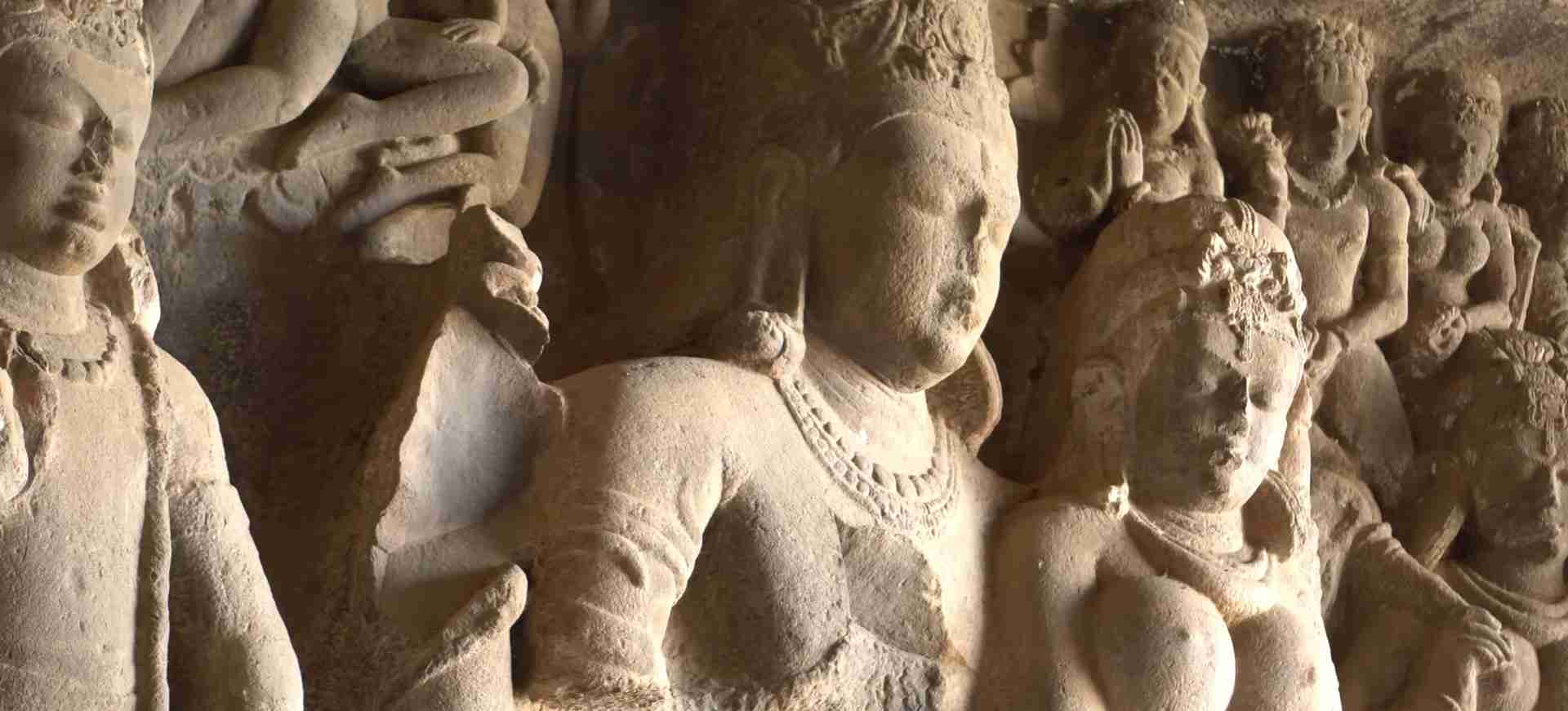
The Elephanta Caves on Elephanta Island in Mumbai Harbor contain 5th-6th century rock-cut Shiva temples representing the pinnacle of early Hindu cave architecture, with the main cave housing the monumental Trimurti Sadashiva sculpture ranking among the greatest achievements of Indian art. The caves received UNESCO designation in 1987, acknowledging their significance as prototypes influencing later Hindu temple design across India while demonstrating advanced structural understanding of load-bearing rock-cut architecture. Despite proximity to Mumbai (10 kilometers offshore), the caves receive approximately 300,000 annual visitors, far fewer than mainland monuments, with the island’s remoteness and ferry-dependent access preserving a sense of pilgrimage site authenticity absent from more accessible heritage destinations.
The main cave (Cave 1) spans 39 meters north-south by 40 meters east-west, carved entirely from basaltic rock forming the island’s core. The architectural conception follows early Hindu temple principles with a central shrine (garbhagriha) surrounded by a pillared mandapa hall, though the rock-cut execution creates spatial effects impossible in structural architecture—the 26 columns supporting the cave ceiling taper from massive 2-meter-square bases to delicate capitals, creating illusions of lightness that defy the millions of tons of solid rock above. The columns’ positioning creates diagonal sightlines toward shrine panels carved into the cave walls, with devotees circumambulating the mandapa encountering different Shiva manifestations as they move through space—the Tandava dance, the Ardhanarishvara androgynous form, the marriage with Parvati, the demons’ destruction.
The Trimurti Sadashiva sculpture dominates the southern wall, rising 6 meters high and spanning 5.5 meters width across three colossal faces representing Shiva’s three aspects: creator, preserver, destroyer. The central face displays serene meditation, the left face shows feminine grace (Shiva as creator), and the right face expresses fierce intensity (Shiva as destroyer), creating a theological statement about divinity’s transcendence of human binary categories. The sculpture’s scale and execution required removing approximately 200 cubic meters of solid basalt while preserving structural integrity of the cave ceiling above, demonstrating sophisticated understanding of rock stress patterns and carving sequences. The surface detail preserves original tooling marks showing the progression of work from rough blocking to final polishing, revealing 5th-century sculptural techniques still clearly visible 1,500 years later.
The cave’s smaller shrine panels demonstrate narrative sculptural programs equaling free-standing temple exteriors in quality and iconographic complexity. The Gangadhara panel shows Shiva receiving the Ganges River’s descent to Earth in his hair, with 20+ figures depicting celestial beings, demons, and mortal witnesses arranged in complex compositional groupings across 4 meters of carved relief. The Kalyanasundara marriage panel contains 40+ individual figures showing Shiva’s wedding to Parvati, with detailed depictions of musicians, attendants, and divine witnesses participating in the cosmic marriage ceremony. These narrative panels function as visual theology texts, communicating complex philosophical concepts through figural compositions accessible to illiterate devotees while offering sophisticated symbolic readings for learned viewers.
The archaeological context places Elephanta within the broader tradition of Deccan rock-cut architecture. The caves likely date to 450-550 CE during the Kalachuri dynasty’s rule, though scholarly debate continues about precise chronology. The carving techniques demonstrate evolution beyond earlier Buddhist caves at Ajanta and Karla, with larger open spaces, higher ceilings, and more sophisticated lighting strategies using cave orientation and entrance positioning to illuminate interior sculptures through reflected sunlight. This technical advancement influenced later Hindu cave temples at Ellora and Badami, where architects expanded upon Elephanta’s structural solutions while developing more complex multi-story cave systems.
Access to Elephanta requires ferry transport from Mumbai’s Gateway of India, with boats departing 9:00 AM – 2:00 PM daily (₹200 round trip, 1-hour journey each way). The island requires climbing 120 stone steps from the ferry pier to the cave plateau, with palanquin service available for elderly visitors (₹1,500-2,000). Cave entry costs ₹40 for Indian nationals and ₹600 for foreign visitors, with Archaeological Survey of India guides offering tours (₹500 for 1-2 hours) though the caves remain unguided and freely explorable. The island contains no accommodation, with all visitors making day trips from Mumbai. Optimal visiting occurs October-March for comfortable temperatures and clear lighting conditions, avoiding monsoon season June-September when ferry services suspend due to rough seas.
Southern India Hidden Gems: Hoysala Temples and Deccan Monuments
Southern India’s lesser-known heritage sites concentrate in Karnataka and Andhra Pradesh, where medieval Hindu dynasties created temple architecture and urban complexes rivaling Northern monuments in sophistication but receiving minimal international tourism despite UNESCO recognition. These destinations preserve exceptional stone carving traditions, experimental architectural synthesis, and medieval urban planning that influenced South Indian architecture for centuries afterward.
Sacred Ensembles of the Hoysalas: Belur, Halebidu, and Somnathapura Temples
The Sacred Ensembles of the Hoysalas in Karnataka, designated UNESCO World Heritage in 2023, represent the culmination of South Indian temple architecture through three 12th-13th century masterpieces at Belur, Halebidu, and Somnathapura demonstrating stone carving techniques surpassing all contemporary monuments in intricacy and narrative complexity. The Hoysala temples employ chloritic schist (soapstone), a metamorphic rock softer than the granites used in other South Indian temples, allowing sculptors to achieve detail impossible in harder materials—individual figures display jewelry ornaments carved to millimeter precision, fabric folds suggesting movement and texture, and facial expressions conveying specific emotional states. These temples receive 200,000-300,000 combined annual visitors, minimal compared to Northern India’s major monuments despite representing the pinnacle of Indian stone carving achievement.
The Chennakesava Temple at Belur, constructed 1116-1133, established the Hoysala architectural vocabulary that subsequent temples refined. The temple rises on a star-shaped platform (jagati) elevating the structure 1 meter above ground level, with the star plan creating 32 projecting and receding angles that multiply surface area for sculptural decoration. Every surface—exterior walls, pillared mandapa interior, basement friezes, ceiling panels—contains carved decoration, with estimates suggesting 10,000+ individual sculpted figures across the temple complex. The exterior wall sculptures depict Puranic narratives, royal processions, hunting scenes, battle sequences, and temple rituals in continuous friezes running the temple’s 60-meter perimeter, functioning as visual encyclopedias of 12th-century South Indian court culture.
The Hoysaleswara Temple at Halebidu, built 1121-1160, demonstrates Hoysala architecture at maximum elaboration. The temple contains two shrines dedicated to Shiva, each preceded by Nandi pavilions and connected by a common platform creating a symmetrical double-temple complex unprecedented in Indian architecture. The temple’s most remarkable feature appears in its horizontal sculptural friezes wrapping the exterior walls at multiple registers: the basement level shows elephant processions (650+ individual elephants in sequence), the middle register depicts lions, horses, and mythical creatures, the upper registers present Ramayana and Mahabharata episodes, Puranic narratives, and Shiva mythology. The sculptural density exceeds any contemporary structure globally, with every square centimeter of wall surface carved with figures, ornament, or architectural detail.
The individual sculptural quality reaches technical perfection in the bracket figures (salabhanjika) supporting the mandapa roof. These life-size female figures, 42 in total across both shrines, each displays unique poses, jewelry patterns, and emotional expressions carved with extraordinary naturalism. The famous Darpana Sundari (Lady with Mirror) bracket shows a woman examining her reflection with jewelry details including individual chain links, textile patterns suggesting silk saris, and facial features preserving the sculptor’s name—Manibalaki—inscribed in tiny characters on the figure’s base. This practice of sculptor signatures appears throughout Hoysala temples, with dozens of individual artists identified, demonstrating the high social status and artistic recognition accorded to temple sculptors.
The Keshava Temple at Somnathapura, completed 1268, represents Hoysala architecture’s final evolution. The temple employs a perfect trikuta (three-shrine) plan with shrines positioned at 120-degree angles around a central pillared hall, creating a symmetrical composition unmatched in earlier temples. The star-shaped platform creates 48 angles multiplying wall surface area, with the exterior surface carved into 5 horizontal registers containing 1,500+ individual sculptural panels. The temple demonstrates final refinement of Hoysala proportional systems, with the height-to-width ratio, shrine-to-mandapa proportions, and sculptural panel dimensions following precise mathematical relationships based on ancient vastu shastra (architectural science) principles.
The architectural context positions Hoysala temples as culmination of South Indian temple evolution. The star-platform design, multiply-angled wall surfaces, and horizontal frieze organization influenced later Vijayanagara temple architecture at Hampi and Lepakshi, while the integration of sculpture with architecture created temple-as-artwork concepts that transformed temple construction across South India. The use of chloritic schist became signature Hoysala practice, with later dynasties continuing this material choice for small temples and mandapas even after Hoysala political decline in the 13th century.
Access to the three temples requires basing in Hassan or Mysore, with Belur located 38 kilometers from Hassan (1-hour bus ride, ₹40), Halebidu 32 kilometers from Hassan (45-minute bus, ₹35), and Somnathapura 35 kilometers from Mysore (1-hour bus, ₹40). Each temple opens 6:00 AM – 6:00 PM daily, with Archaeological Survey of India entry fees of ₹25 for Indians and ₹300 for foreign visitors per temple. Official guides charge ₹300-500 for 1-hour tours explaining sculptural narratives and architectural features. Hassan offers budget hotels at ₹800-1,500 and mid-range properties at ₹2,500-4,000, serving as the optimal base for visiting all three temples across 2 days. Optimal lighting occurs 8:00-11:00 AM and 3:00-5:00 PM when low-angle sun highlights sculptural relief, with midday overhead light flattening details.
Group of Monuments at Pattadakal: Architectural Laboratory of Temple Design
The Group of Monuments at Pattadakal in Karnataka represents a unique architectural experiment where 7th-8th century Chalukya architects constructed temples in both Dravidian (Southern) and Nagara (Northern) architectural styles side-by-side, creating a laboratory for testing design systems that influenced temple architecture across India for subsequent centuries. The site contains nine temples within a 200-meter radius, four employing Northern shikhara towers, four using Southern vimana pyramids, and one (Papanatha) synthesizing both traditions. UNESCO designated Pattadakal in 1987, recognizing it as exceptional documentation of architectural evolution and cross-cultural exchange. The site receives approximately 100,000 annual visitors, minimal compared to other Karnataka heritage destinations despite representing a critical moment in Indian architectural history.
The Virupaksha Temple, constructed 740 CE and Pattadakal’s largest monument, established Dravidian style as the dominant form in Deccan temple architecture. The temple employs the classic Dravidian pyramid tower (vimana) rising in diminishing tiers to 60 meters height, with each tier containing sculptural panels depicting Ramayana episodes, Mahabharata battles, and Puranic narratives. The temple’s innovation appears in its pillared mandapa halls, where 36 massive columns create a spacious interior hall preceding the shrine, a feature that became standard in later South Indian temples. The columns demonstrate experimental capital designs testing various bracket configurations and shaft proportions that influenced Hoysala and Vijayanagara temple columns centuries later.
The four Northern-style temples—Galaganatha, Kashi Vishwanatha, Jambulinga, and Kadasiddeshwara—employ shikhara towers with curvilinear profiles rising in vertical emphasis rather than Dravidian horizontal tiers. These temples demonstrate Chalukya architects’ mastery of Northern architectural vocabulary acquired through interaction with Rajput kingdoms, with the shikhara forms matching contemporary temples in Rajasthan and Madhya Pradesh while incorporating Deccan sculptural traditions. The coexistence of Northern and Southern styles within a single sacred complex unique to Pattadakal demonstrates intentional architectural experimentation rather than stylistic confusion, with royal patrons commissioning diverse temple types to test which forms worked best in the Deccan context.
The Papanatha Temple represents the synthesis experiment, combining a Dravidian vimana tower over the shrine with Northern-style shikhara elements in subsidiary structures and a pillared mandapa following neither system precisely. The temple’s exterior sculptures demonstrate similar experimental fusion, with Ramayana narrative panels employing Southern compositional principles while Northern-influenced bracket figures and doorframe designs appear in mandapa sections. This architectural hybridity influenced subsequent developments including Indo-Islamic architecture at Bijapur and the Vijayanagara synthesis visible at Hampi, where architects freely combined architectural elements from multiple traditions.
The site’s ritual significance extends beyond architectural experimentation. Pattadakal served as the Chalukya dynasty’s coronation site, with temples constructed as royal donations celebrating military victories and political achievements. The Virupaksha Temple commemorates King Vikramaditya II’s victory over the Pallavas in 740 CE, with inscriptions recording the temple’s construction by Queen Lokamahadevi as a victory monument. This practice of linking temple construction to political events created architectural documentation of Chalukya history, with each temple’s sculptural program incorporating references to contemporary military campaigns and dynastic succession.
The broader archaeological landscape includes the nearby sites of Aihole and Badami within 20-40 kilometers, creating a triangle of Chalukya architectural heritage. Aihole contains 125+ temples from 5th-8th centuries showing early experimental phases that culminated at Pattadakal, while Badami’s rock-cut cave temples demonstrate parallel development in subterranean architecture. Visiting all three sites provides comprehensive understanding of Chalukya architectural evolution across 300 years.
Access to Pattadakal requires reaching Badami town, 22 kilometers south, via train or bus from Hubli (100 kilometers, ₹150-200, 3 hours). Local buses connect Badami to Pattadakal every 30 minutes (₹20, 30 minutes), with shared auto-rickshaws available (₹150-200 for 2-3 people). The monuments open 6:00 AM – 6:00 PM daily, with entry fees of ₹40 for Indians and ₹600 for foreign visitors covering all nine temples. Archaeological Survey of India guides charge ₹400-600 for 2-hour tours explaining architectural features and historical context. Badami offers budget hotels at ₹600-1,200 and mid-range properties at ₹2,000-3,500, serving as the base for visiting Pattadakal, Aihole, and Badami caves across 2-3 days.
Rock-Cut Cave Architecture: Ajanta and Ellora Complexes
India’s rock-cut cave complexes at Ajanta and Ellora represent the world’s most extensive examples of subterranean religious architecture, with 64 caves containing Buddhist monasteries, Hindu temples, and Jain shrines carved from basaltic cliffs between the 2nd century BCE and 10th century CE. These sites demonstrate progressive evolution of rock-cutting technology and architectural ambition across eight centuries, culminating in the Kailasa Temple at Ellora—the largest monolithic structure globally, carved from a single outcrop. Despite UNESCO recognition since 1983, the caves receive approximately 500,000-600,000 combined annual visitors, a fraction of Taj Mahal crowds despite representing greater architectural achievement and longer construction periods.
Ajanta Caves: Buddhist Monastery Complex and Mural Masterpieces
The Ajanta Caves contain 30 Buddhist cave temples and monasteries carved into a horseshoe-shaped cliff in Maharashtra’s Sahyadri hills, created in two distinct phases: early caves (2nd-1st century BCE) in the Hinayana tradition and later caves (5th-6th century CE) representing Mahayana Buddhism’s artistic flowering. The caves’ significance extends beyond architecture to their mural paintings, which constitute the most complete surviving examples of ancient Indian painting and demonstrate sophisticated artistic traditions that influenced Buddhist art across Asia. The remote location—isolated in a river gorge 100 kilometers from major cities—contributed to the caves’ preservation through 1,300 years of abandonment until British colonial officer John Smith rediscovered them in 1819 during a tiger hunting expedition.
The architectural evolution appears clearly across the cave sequence. Early Hinayana caves (Caves 9, 10, 12, 13) follow simple chaitya hall and vihara monastery plans, with rectangular halls containing rows of pillars leading to stupas carved from the cliff face’s living rock. Cave 10, the oldest, demonstrates primitive cutting techniques where rough surfaces and irregular column spacing reflect limited rock-cutting experience, with the horseshoe-shaped chaitya window admitting sunlight to illuminate the stupa. Later Mahayana caves (Caves 1, 2, 16, 17, 19, 26) display sophisticated architectural planning, with precisely proportioned pillared halls, elaborate facade sculptures, and integrated Buddha shrines demonstrating 400 years of technical advancement.
The mural paintings distinguishing Ajanta survive in Caves 1, 2, 16, and 17, with Cave 17 preserving the most extensive and best-preserved examples. These murals employ the fresco secco technique, painting on dry plaster rather than wet fresco, applied over multi-layer plaster preparations mixing mud, lime, and organic materials. The paintings depict Jataka tales (Buddha’s previous lives), Buddhist cosmology, court scenes, and everyday life in 5th-century India, providing rare visual documentation of ancient Indian culture including costume, architecture, warfare, and social customs. The artistic sophistication rivals contemporary Roman wall paintings, with complex compositions containing 100+ figures, perspective systems suggesting spatial depth, and color palettes using mineral pigments imported from across Asia.
The Cave 1 murals include the famous Padmapani and Vajrapani bodhisattva figures flanking the shrine entrance, rising 2 meters high with graceful poses and serene expressions that became archetypes for Buddhist iconography across Asia. The Padmapani figure holds a lotus and displays the tribhanga (triple-bend) pose demonstrating Indian sculptural ideals translated to painting, with delicate shading suggesting three-dimensional form and ornate jewelry details rendered in individual brushstrokes. The surrounding walls contain narrative panels showing Buddhist legends, celestial beings, and donors, with inscriptions identifying some commissioned panels by individual patrons from the Vakataka court.
The technical achievement of carving entire caves from solid basalt required sophisticated project management and engineering understanding. The excavation process began from the top, progressively cutting downward to maintain structural stability while removing thousands of tons of rock. The pillars, ceilings, and sculptural details all remain physically connected to the cliff face—no blocks were added or assembled, with entire caves including decorative elements carved from the single basaltic outcrop. This monolithic technique demanded precise planning since errors were irreversible, with the final forms designed before cutting began and maintained through years-long excavation processes.
The abandonment and rediscovery narrative contributes to Ajanta’s mystique. The caves ceased receiving Buddhist patronage by the 7th-8th centuries as Buddhism declined in India, with the remote location allowing complete abandonment without the site’s conversion to other uses. Vegetation overgrew the cliff face, and local knowledge of the caves faded, preserving the murals from vandalism or religious iconoclasm that destroyed Buddhist art elsewhere. The 1819 rediscovery led to archaeological documentation and conservation, though 19th-century preservation efforts proved destructive, with early attempts to clean murals using oil and varnish causing irreversible damage to pigments. Modern conservation employs minimally invasive techniques developed by Archaeological Survey of India and international partners.
Access to Ajanta requires reaching Aurangabad, 100 kilometers south, with regular bus services (₹150-200, 2.5 hours) and organized tours (₹1,500-2,500 including guide and transport). The caves open 9:00 AM – 5:30 PM Tuesday-Sunday, closed Mondays, with entry fees of ₹40 for Indians and ₹600 for foreign visitors. Visitor restrictions limit time inside decorated caves to 15-20 minutes due to conservation concerns about humidity from visitor breathing affecting murals. Photography prohibited inside painted caves. Aurangabad serves as the accommodation base with budget hotels at ₹800-1,500, mid-range properties at ₹2,500-4,500, and upscale options at ₹6,000-12,000 per night.
Ellora Caves: Multi-Faith Architectural Synthesis and Kailasa Temple
The Ellora Caves complex contains 34 rock-cut monuments representing Buddhism, Hinduism, and Jainism carved sequentially between 600-1000 CE, demonstrating religious tolerance and architectural evolution across four centuries in a single cliff face. The complex includes 12 Buddhist caves (600-700 CE), 17 Hindu caves (700-900 CE), and 5 Jain caves (800-1000 CE), with the Hindu Cave 16—the Kailasa Temple—representing the world’s largest monolithic structure and India’s most ambitious rock-cutting achievement. Ellora receives approximately 400,000 annual visitors, more than Ajanta due to better accessibility from Aurangabad (30 kilometers) but still minimal compared to Northern India’s major monuments despite greater architectural significance.
The Buddhist caves at Ellora demonstrate evolution from Ajanta’s monastery tradition toward larger-scale architectural compositions. Cave 10 (Vishvakarma) contains a chaitya hall with a 13-meter-high carved stupa and elaborate facade sculptures showing increasingly sophisticated rock-cutting techniques. Cave 11 (Do Thal) and Cave 12 (Teen Thal) introduce multi-story designs reaching three levels carved into the cliff, with internal staircases connecting levels and creating complex three-dimensional spatial sequences impossible in structural architecture. The Buddhist caves’ pillared halls, Buddha shrines, and monastic cells follow established Ajanta patterns but at larger scales, with Cave 5’s assembly hall spanning 36 x 17 meters and accommodating hundreds of monks in a single space.
The Hindu caves shift to temple rather than monastery architecture, with shrines dedicated to Shiva dominating the sequence. Cave 14 (Ravana ki Khai), Cave 15 (Dashavatara), and Cave 21 (Rameswara) demonstrate progressive refinement of Hindu rock-cut temple design, with increasingly elaborate sculptural programs depicting Shaivite mythology. Cave 29 (Dhumar Lena) contains some of Ellora’s finest sculptures including 4-meter-high panels showing Shiva as Nataraja performing the cosmic dance and Ravana attempting to lift Mount Kailasa, demonstrating sculptural quality matching free-standing temple exteriors.
The Kailasa Temple (Cave 16) represents human ambition’s ultimate expression in rock-cut architecture. The temple replicates Mount Kailasa, Shiva’s Himalayan abode, through a free-standing temple complex carved from a single basaltic outcrop. The excavation removed approximately 200,000 tons of rock, cutting a 90-foot-deep trench around the temple block and then carving the exposed rock into temple architecture from top to bottom. The resulting structure measures 50 meters long, 33 meters wide, and 30 meters high, with every architectural element—gopuram gateway, Nandi pavilion, main shrine, pillared mandapa, subsidiary shrines, sculptural programs—carved from the monolithic rock rather than assembled from separate blocks.
The technical achievement required for Kailasa’s creation surpasses the Egyptian pyramids in complexity. While pyramids involved assembling pre-cut blocks, Kailasa required visualizing the final three-dimensional form before excavation began, with no possibility for corrections or additions once rock was removed. The structural engineering demonstrates sophisticated understanding of load distribution, with the 30-meter-high tower (shikhara) remaining stable despite being carved from cliff face rock that tends to fracture along natural planes. The project likely required 100+ years of continuous work and thousands of laborers, with estimates suggesting three generations of the Rashtrakuta dynasty patronized the construction beginning around 760 CE under Krishna I.
The sculptural program covering Kailasa’s surfaces ranks among India’s finest. The basement level contains nearly life-size elephants and lions appearing to support the temple above, creating illusions that the entire structure rests on sculptural figures rather than solid rock. The walls present Ramayana and Mahabharata narratives in continuous friezes, with individual panels containing 20-30 figures in complex compositional arrangements. The interior shrine walls show the ten incarnations of Vishnu, Shaivite mythology, and scenes from Krishna’s life, with the sculpture quality matching or exceeding contemporary free-standing temples.
The Jain caves at Ellora’s northern end demonstrate final refinement of rock-cut traditions. Cave 32 (Indra Sabha) contains the complex’s most intricate ceiling carvings, with lotus patterns carved to millimeter precision covering entire ceiling panels. The Jain caves’ smaller scale and delicate ornamentation contrast with massive Hindu monuments, reflecting Jain aesthetic preferences for refinement over monumentality. The temporal overlap between late Hindu and early Jain cave construction demonstrates religious tolerance, with Buddhist, Hindu, and Jain communities sharing the cliff face without conflict during the 7th-10th centuries.
Access to Ellora requires travel from Aurangabad, 30 kilometers south, via bus (₹50-70, 45 minutes) or taxi (₹800-1,200 round trip). The caves open 9:00 AM – 5:30 PM Wednesday-Monday, closed Tuesdays, with entry fees of ₹40 for Indians and ₹600 for foreign visitors. The Kailasa Temple requires 2-3 hours for thorough exploration, with remaining caves viewable in additional 3-4 hours for comprehensive site visits. Archaeological Survey of India guides charge ₹600-800 for 3-hour tours covering major caves. Most visitors base in Aurangabad, combining Ellora with day trips to Ajanta (2-day itinerary covering both cave complexes).
Himalayan Heritage: Mountain Monasteries and Sacred Landscapes
India’s Himalayan regions protect Buddhist monasteries, sacred mountain landscapes, and cultural traditions surviving in extreme high-altitude environments, with sites like the Great Himalayan National Park and Khangchendzonga combining natural and cultural heritage in ways unique to mountain ecosystems. These destinations receive minimal tourism due to remoteness, trekking requirements, and seasonal accessibility, preserving authentic monastic traditions and pristine mountain environments largely unchanged for centuries.
Great Himalayan National Park: High-Altitude Wilderness and Biodiversity
The Great Himalayan National Park in Himachal Pradesh protects 754.4 square kilometers of temperate forest and alpine meadow ecosystems at elevations ranging from 1,500 to 6,000 meters, containing habitat for snow leopards, Himalayan brown bears, blue sheep, and Western Tragopan pheasants found nowhere else globally. UNESCO designated the park in 2014 as an exceptional example of Himalayan biodiversity, recognizing it as one of Asia’s most pristine mountain ecosystems remaining under protection. The park receives fewer than 5,000 visitors annually, limited by mandatory trekking requirements, permit restrictions, and seasonal closures, with access possible only May-October when snow melts from high passes.
The biodiversity significance centers on the park’s position spanning four vegetation zones: subtropical pine forests at lower elevations (1,500-2,200 meters), temperate oak and deodar forests in mid-elevation zones (2,200-3,400 meters), subalpine birch and rhododendron forests approaching treeline (3,400-4,100 meters), and alpine meadows above treeline (4,100-6,000 meters). Each zone supports distinct plant and animal communities adapted to specific temperature and moisture regimes, with the park containing 805 plant species including 15 medicinal plants used in traditional Himalayan medicine and 31 endemic species found only in Western Himalayan ranges.
The wildlife populations include globally significant large mammal species. The park’s snow leopard population, estimated at 25-30 individuals, represents one of the more stable populations in the Himalayas, protected by the park’s ban on livestock grazing that eliminates the primary cause of leopard-herder conflict. The Himalayan brown bear population of 15-20 individuals makes the park one of the few remaining habitats for this critically endangered species, with the bears occupying high-altitude meadows 3,500-5,000 meters where they feed on alpine vegetation and rodents. The blue sheep (bharal) population exceeds 1,000 animals, providing prey base for snow leopards while demonstrating adaptation to cliff habitats where they escape predation through agility on near-vertical rock faces.
The avian diversity includes 209 bird species with several rare Himalayan endemics. The Western Tragopan, one of the rarest pheasant species globally, maintains a population of 200-300 individuals in the park’s temperate forests, representing one of the largest protected populations of this species. The Himalayan snowcock, koklas pheasant, and cheer pheasant all occur within the park, along with high-altitude raptors including golden eagles, bearded vultures, and Himalayan griffons that nest on cliff faces throughout the park’s upper elevations.
The cultural landscape incorporates traditional Himachali villages at the park’s boundaries, where communities maintain pastoral traditions involving seasonal migration to high-altitude meadows for grazing. The park’s establishment in 1984 required phasing out grazing within park boundaries, creating buffer zones where traditional practices continue under conservation management. The Tirthan and Sainj valleys bordering the park maintain traditional architecture using slate roofs and wood construction adapted to heavy snowfall, with villages preserving festivals, music traditions, and craft practices including woolen textile weaving using natural dyes from alpine plants.
Access to the Great Himalayan National Park requires reaching Kullu or Manali as base towns, with the park’s main entry points at Gushaini village in the Tirthan Valley and Sainj village in the Sainj Valley. Multi-day treks ranging 3-7 days penetrate the park’s interior, accessing high-altitude camps at Rolla, Dhela, and Tirath meadows. Permits cost ₹600 per person per day for foreign visitors and ₹100 for Indian nationals, obtained from the park office in Shamshi village or online through the Himachal Pradesh Forest Department website. Mandatory guide and porter requirements exist for treks beyond day-hiking zones, with guide costs at ₹1,200-1,800 per day and porter costs at ₹800-1,200 per day. Gushaini and Sainj villages offer guesthouse accommodation at ₹1,000-2,500 per night, with camping equipment available for hire from trekking operators in Kullu (₹400-800 per day per person for complete camping kit).
Khangchendzonga National Park: Sacred Mountain and Biosphere Reserve
Khangchendzonga National Park in Sikkim integrates Buddhist sacred geography with high-altitude wilderness protection, containing Mount Khangchendzonga (8,586 meters), the world’s third-highest peak, within a 1,784 square kilometer landscape revered as the abode of protective deities in Sikkimese Buddhism. UNESCO designated the park as a Mixed Natural and Cultural World Heritage Site in 2016, recognizing its exceptional biodiversity—including snow leopards, red pandas, Himalayan black bears, and 550+ bird species—alongside cultural significance as a sacred pilgrimage landscape connecting Buddhist monasteries with mountain shrines through traditional trekking routes. The park receives approximately 10,000 visitors annually, limited by permit restrictions, high-altitude challenges, and Sikkim’s preference for low-volume quality tourism over mass visitation.
The sacred geography organizes the landscape through Buddhist cosmology identifying specific peaks, lakes, and caves as embodiments of protective deities. Mount Khangchendzonga itself represents Dzö-nga, a deity protecting Sikkim’s northern frontier, with the mountain’s five peaks symbolizing the deity’s five treasure houses containing gold, silver, gems, grain, and sacred texts. The Samiti Lake at 4,200 meters elevation serves as a pilgrimage destination where Buddhist lamas conduct rituals seeking blessings from the mountain deity, with the lake’s crystal-clear waters considered sacred and its fish protected from fishing. The Tholung monastery within the park maintains traditions of mountain worship dating to the 17th century, with monks conducting annual ceremonies strengthening the spiritual protection surrounding Sikkim.
The biodiversity significance stems from the park’s position spanning 1,220 to 8,586 meters elevation, creating extraordinary ecological gradients encompassing subtropical forests, temperate rhododendron woodlands, alpine scrub, and permanent ice zones. This elevation range supports 1,500+ plant species including 550 orchid species representing the highest orchid diversity in the Himalayas. The vegetation zones transition across 7,000+ vertical meters more rapidly than nearly anywhere globally, allowing species adapted to radically different climates to coexist within a single protected area. The park contains 21 ecosystem types defined by altitude, aspect, and moisture gradients, with each supporting distinct assemblages of plants and animals.
The wildlife populations include globally significant large mammal species rarely observed due to the park’s remoteness. The snow leopard population, estimated at 40-50 individuals, represents one of the larger populations in the Eastern Himalayas, with these apex predators occupying territories spanning 30-40 square kilometers across the park’s alpine zones. The red panda population exceeds 300 animals in the park’s temperate bamboo forests, representing 5-7% of the global red panda population and constituting Sikkim’s most significant conservation achievement. The Himalayan serow, takin, and mainland serow all occur within the park alongside 18 other large mammal species adapted to high-altitude conditions.
The cultural traditions integrated with park conservation include maintaining traditional trekking routes connecting Sikkimese villages with Tibetan trading posts, preserving the ancient trade corridors that sustained trans-Himalayan commerce for centuries. The Goecha La trek, the park’s primary visitor route, follows traditional pilgrimage paths to viewpoints of Khangchendzonga’s south face, with the route passing Buddhist chortens, prayer flag stations, and sacred caves where hermits practiced meditation retreats. The park management incorporates traditional ecological knowledge from Lepcha and Bhutia communities, whose seasonal resource use patterns inform contemporary conservation strategies including timing of restricted zones to avoid disturbing wildlife during breeding seasons.
Access to Khangchendzonga National Park requires obtaining permits from the Sikkim Tourism Department in Gangtok, with permits costing ₹200 per day for Indian nationals and ₹1,500 per day for foreign visitors. The Goecha La trek, the main access route, requires 8-11 days round trip from Yuksom village, with mandatory guide requirements and designated camping zones. Trekking permits restrict daily entries to 100 trekkers maximum to limit environmental impact, requiring advance booking 2-4 weeks ahead during peak seasons April-May and October-November. Guide costs range ₹1,500-2,500 per day, with porter costs at ₹800-1,200 per day and camping equipment hire at ₹500-800 per person per day. Yuksom offers guesthouse accommodation at ₹800-2,000 per night, serving as the trek’s starting point accessible via 130-kilometer drive from Gangtok (4 hours, ₹2,500-3,500 taxi).
Northeastern India: Living Root Bridges and Sacred Groves
India’s northeastern states protect unique cultural landscapes and indigenous engineering traditions found nowhere else globally, including the living root bridges of Meghalaya and sacred groves maintaining biodiversity through traditional conservation practices. These destinations receive minimal international tourism—fewer than 50,000 foreign visitors annually across all northeastern states combined—due to remoteness, infrastructure limitations, and restricted area permit requirements, creating opportunities for authentic cultural encounters in regions where indigenous traditions remain dominant.
Living Root Bridges of Meghalaya: Indigenous Bio-Engineering
The living root bridges of Meghalaya represent unique indigenous engineering solutions where the Khasi and Jaintia tribal communities guide the roots of Ficus elastica rubber trees across rivers and gorges, creating functional suspension bridges through organic growth rather than constructed materials. These bio-engineered structures, some exceeding 150 years old, demonstrate sophisticated understanding of plant growth patterns, structural engineering, and long-term environmental planning, with bridges strengthening over time rather than deteriorating like conventional infrastructure. Approximately 75 documented living root bridges exist across Meghalaya’s East Khasi Hills, Ri-Bhoi, and West Jaintia Hills districts, though many remain unvisited by outsiders in remote villages accessible only through multi-day treks.
The construction technique requires decades of guided growth. Khasi communities plant Ficus elastica trees on both river banks, then guide the aerial roots across bamboo scaffolding spanning the water. The roots grow 0.5-1 meter annually, requiring 15-20 years to complete a functional bridge capable of supporting human weight. The communities continuously tend the bridges during growth periods, pruning unnecessary branches, directing root pathways, and reinforcing weak sections with additional roots. Once established, the bridges require minimal maintenance beyond occasional root-pruning, with the oldest documented bridges at Nongriat village functioning for 500+ years through continuous regrowth replacing damaged sections.
The most famous example, the Double Decker Living Root Bridge at Nongriat, demonstrates advanced engineering where two bridge levels cross a single gorge at heights of 15 and 20 meters. The lower bridge, estimated at 180 years old, connects to the upper bridge through stone steps carved into the canyon wall, with the upper bridge added approximately 80 years ago when village population growth required expanded crossing capacity. The combined structure spans 30 meters across the gorge, supporting 50+ people simultaneously during peak crossing times, with the root network’s tensile strength exceeding many conventional suspension bridge cables.
The broader cultural context positions root bridges within Khasi resource management systems integrating engineering with sacred ecology. The Ficus elastica trees hosting bridge roots hold spiritual significance in Khasi cosmology, believed to embody ancestral spirits protecting crossings. Communities conduct annual ceremonies at major bridges, offering prayers and maintaining taboos against cutting living roots or damaging the trees. This spiritual dimension ensures long-term maintenance across generations, with bridge care considered sacred duty rather than infrastructure management, creating sustainability impossible through purely utilitarian frameworks.
The scientific significance extends to understanding plant responses to human manipulation. Recent studies document how the directed root growth alters tree physiology, with bridge-grown roots developing denser xylem tissue and higher tensile strength than normal aerial roots, suggesting that decades of guided growth creates structural adaptations enhancing bridge performance. The symbiotic relationship between human engineering and plant growth represents unique bio-engineering achieving sustainable infrastructure through biological processes rather than extracted materials.
Access to living root bridges requires trekking from roadheads at Tyrna village (for Nongriat bridges) or Mawkyrnot village (for Riwai bridges). The Nongriat trek descends 3,000+ stone steps through rainforest to the village 700 meters below road level, requiring 1.5-2 hours descent and 2.5-3 hours ascent, with the double-decker bridge located 15 minutes beyond the village. Homestay accommodation in Nongriat costs ₹500-800 per night including meals, with several Khasi families offering basic rooms in traditional bamboo houses. The trek operates year-round though monsoon season June-September creates challenging conditions with slippery steps and river crossings swollen by rainfall. Guides available at Tyrna village (₹500-800 per day) provide route assistance and cultural interpretation, though the trail’s clear marking makes independent trekking feasible for fit hikers.
Sacred Groves: Traditional Biodiversity Conservation
Sacred groves throughout India represent traditional conservation systems where communities protect forest patches through religious taboos prohibiting resource extraction, maintaining biodiversity hotspots containing plant and animal species extinct in surrounding areas due to deforestation. An estimated 100,000-150,000 sacred groves exist across India ranging from 0.01 to 500 hectares, concentrated in the Western Ghats, Eastern Himalayas, and northeastern states where indigenous communities maintain animist traditions venerating nature. These groves function as de facto biodiversity reserves predating formal conservation by centuries, with some groves protecting gene pools of cultivated plants’ wild ancestors and serving as seed sources for reforestation efforts.
The Meghalaya sacred groves, locally termed “law kyntang” or “law lyngdoh,” protect approximately 1,000 forest patches across the state totaling 10,000+ hectares. The groves serve as watershed protection, with communities recognizing that deforestation causes spring failure and water shortage even if they lack scientific vocabulary to explain hydrological cycles. The groves’ protected status derives from beliefs that cutting trees angers ancestral spirits dwelling in the forest, bringing misfortune including crop failure, disease, and death. This spiritual protection creates conservation effectiveness matching or exceeding formal protected areas, with some groves maintaining primary forest structure undisturbed for 500+ years while surrounding landscapes suffered complete deforestation.
The biodiversity significance appears most dramatically in Western Ghats sacred groves, where forest patches as small as 5 hectares contain 300+ plant species including endemic trees, orchids, and medicinal plants extinct in surrounding agricultural areas. The Kodagu district in Karnataka contains 1,214 sacred groves protecting the last surviving patches of mid-elevation evergreen forest in the region, with groves containing tree species like Hopea ponga, Palaquium ellipticum, and Diospyros candolleana locally extinct outside protected patches. Sacred groves along the coast protect mangrove ecosystems, lateritic plateaus, and coastal strand forests otherwise completely converted to development.
The cultural practices sustaining grove conservation include annual ceremonies strengthening community commitment to protection. The Khasi communities conduct “Ka Pomblang Nongkrem” festival involving dancing, animal sacrifice, and offerings to grove deities, with elaborate rituals reaffirming each clan’s responsibility for specific groves. The ceremonies include recounting traditional narratives explaining grove origins and consequences of past violations, transmitting conservation values across generations through storytelling rather than written regulations. The festival timing coincides with agricultural cycles, linking forest protection to crop success and community prosperity.
The contemporary challenges facing sacred groves include erosion of traditional beliefs among younger generations educated in urban areas, commercial pressure to harvest valuable timber, and climate change affecting grove hydrology. Conservation organizations partner with traditional councils implementing hybrid management combining spiritual protection with scientific monitoring, documenting grove biodiversity, mapping boundaries using GPS, and training community members in ecological survey techniques. These partnerships demonstrate that traditional and scientific conservation approaches complement rather than conflict, with sacred significance motivating protection while scientific data justifies government support and resources.
Access to sacred groves varies by location and community openness to visitors. Some groves in Meghalaya welcome respectful visitors with local guide accompaniment, while others remain strictly forbidden to outsiders under traditional law. The Mawphlang Sacred Grove near Shillong offers visitor access with Khasi guide requirement (₹300-500 for 1-hour walk), demonstrating grove ecology and explaining traditional protection practices. Photography restrictions apply in most groves, with some prohibiting cameras entirely while others allow photography after seeking permission from community elders. Visitors should respect all posted restrictions and follow guide instructions, as violating grove taboos offends communities and damages trust necessary for conservation partnerships.
Practical Planning for Hidden Gems Exploration
Exploring India’s hidden gems requires different preparation than visiting mainstream tourist circuits, with additional considerations for permits, seasonal access, specialized guides, and infrastructure limitations in remote areas. Success depends on realistic planning acknowledging these destinations’ remoteness while appreciating the authentic experiences this remoteness preserves.
Permit and Access Requirements
Many lesser-known Indian heritage sites require permits obtained days or weeks in advance rather than simple ticket purchases at entry gates. Restricted Area Permits apply to northeastern states (Arunachal Pradesh, Nagaland, Mizoram, Manipur, parts of Sikkim) for foreign visitors, obtained through registered tour operators 4-6 weeks before travel, with permits specifying exact itineraries, dates, and destinations that cannot be modified after issuance. Protected Area Entry Permits for national parks including Great Himalayan, Khangchendzonga, and Nanda Devi require applications to state forest departments 2-4 weeks in advance, with daily visitor quotas limiting entries during peak seasons. Archaeological Survey of India manages special access to restricted monument areas at Ajanta, Ellora, and Hampi, requiring advance requests for photography permits, after-hours access, or special study opportunities.
The permit process typically requires scanning and emailing passport copies, Indian visa copies, detailed itineraries, and sometimes recommendation letters from embassies or recognized institutions. Processing times vary from 2 days for straightforward national park permits to 6 weeks for complex restricted area permits covering multiple northeastern states. Permit costs range from ₹100-600 for national park daily entries to ₹5,000-15,000 for comprehensive northeastern India permits valid 15-30 days and covering multiple states. Tour operators specializing in permit-required destinations charge ₹2,000-5,000 service fees for permit processing beyond the official permit costs.
Seasonal Timing and Weather Windows
Hidden gems often exist in regions with extreme seasonal variation limiting access to specific months. Himalayan destinations including Great Himalayan National Park, Khangchendzonga, Spiti Valley monasteries, and high-altitude passes remain accessible only May-October when snow melts from trekking routes and high-altitude roads open. The Western Ghats sites including sacred groves and hill station heritage close during monsoon season June-September when 3,000-5,000mm rainfall creates landslide risks, floods trails, and makes cave complexes unsafe. Desert and semi-arid destinations in Gujarat and Rajasthan become unvisitable during summer months April-June when temperatures exceed 45°C and monuments close during peak heat hours 11:00 AM – 4:00 PM.
The optimal visiting windows balance weather favorability with crowd levels and festival timing. October-November provides ideal conditions across most of India—clear post-monsoon weather, moderate temperatures, festival season cultural activities, and winter tourism not yet peaked. February-March offers comfortable temperatures before summer heat, though haze reduces mountain visibility and late-winter rainfall occasionally disrupts travel. The shoulder seasons September-October and March-April offer advantages including lower accommodation costs, fewer tourists, and more authentic interactions as destinations haven’t transitioned to full tourist season operations.
Guide and Porter Requirements
Many remote heritage sites require or strongly recommend professional guide and porter support for safety, navigation, and cultural interpretation. Himalayan treks to Great Himalayan National Park, Khangchendzonga, and Spiti Valley monasteries mandate licensed guides for routes beyond day-hiking zones, with guide costs at ₹1,200-2,500 per day depending on route difficulty and altitude. Porter support becomes essential for multi-day treks carrying camping equipment and provisions, with porter costs at ₹800-1,500 per day and standard loads limited to 20-25 kilograms per porter to prevent overloading. Sacred grove visits in Meghalaya and northeastern states require local community guides who provide access permission, cultural protocol instruction, and interpretation of traditional ecological knowledge, with guide fees at ₹300-800 per day benefiting communities directly.
Archaeological sites including Ajanta, Ellora, Champaner-Pavagadh, and Hoysala temples offer Archaeological Survey of India-licensed guides whose specialized training covers architecture, iconography, and historical context unavailable in general tourism guides. These specialist guides charge ₹400-800 for 2-3 hour tours but provide interpretation transforming visits from visual experience to comprehensive cultural understanding. Unlicensed freelance guides at major sites offer cheaper services (₹200-400) but frequently provide inaccurate historical information, make up stories when they don’t know facts, and pressure visitors for inflated tips.
Accommodation and Infrastructure Realities
Hidden gems rarely offer luxury accommodation, with infrastructure ranging from basic guesthouses to homestays to camping-only options depending on destination remoteness. Villages near Champaner-Pavagadh, Pattadakal, and Hoysala temples provide budget hotels at ₹600-1,500 and mid-range properties at ₹2,000-4,000, adequate for comfortable stays though lacking amenities of major city hotels. Remote destinations including Great Himalayan National Park access villages, Meghalaya trekking bases, and Spiti Valley monasteries offer only basic homestays at ₹500-1,200 including meals, with simple rooms, shared bathrooms, and intermittent electricity typical. Trekking destinations require camping with complete equipment hire (tents, sleeping bags, cooking gear) costing ₹500-1,000 per person per day from trekking operators.
The infrastructure limitations extend to limited restaurant options, with remote areas offering only homestay meals or basic local eateries serving regional cuisine with minimal menu choice. Banking, ATM, and digital payment infrastructure proves unreliable outside major towns, requiring carrying sufficient cash for entire trips plus 30-40% emergency reserve since card payments often fail. Medical facilities exist only at district headquarters 40-100 kilometers from most heritage sites, making comprehensive travel health insurance and personal first-aid supplies essential. Internet and mobile connectivity remains absent or intermittent at remote destinations, with many Himalayan valleys, sacred groves, and archaeological sites outside cellular coverage.
Photography and Cultural Protocol Considerations
Photography restrictions and cultural sensitivities require greater awareness at lesser-known sites than major tourist destinations where regulations are standardized. Archaeological Survey of India prohibits photography inside painted caves at Ajanta and restricts tripod use at many monuments without prior permission obtained weeks in advance. Sacred groves and monasteries often prohibit photography entirely or allow only limited exterior photography after seeking elder permission, with interior shrine photography always forbidden. Living root bridges permit photography freely, but photographing village people requires asking permission and respecting refusals, with the Khasi communities increasingly resistant to casual tourist photography after social media sharing violated privacy.
The cultural protocol extends to dress codes, behavior standards, and ritual participation boundaries. Temple visits require removing shoes, covering shoulders and legs (both genders), and avoiding leather items in strictly vegetarian environments. Sacred grove visits require silence, staying on designated paths, and avoiding collection of any plant materials including fallen flowers or leaves. Monastery visits involve circumambulating shrines clockwise, avoiding pointing feet toward Buddha images, and abstaining from photography during prayer ceremonies even if cameras are otherwise permitted. The protocol standards prove stricter at lesser-known sites where communities haven’t developed tolerance for tourist behaviors, making research and cultural sensitivity essential for positive interactions.
Frequently Asked Questions
How do India’s hidden gems compare to famous monuments in terms of historical significance?
India’s hidden gems often equal or exceed famous monuments in historical significance, architectural innovation, and cultural value, with their lesser-known status reflecting infrastructure limitations, geographic remoteness, and historical tourism patterns rather than inferior heritage value. Champaner-Pavagadh’s completely preserved 15th-16th century Islamic city demonstrates urban planning and architectural synthesis unavailable at better-known Mughal forts, with UNESCO recognizing it as Asia’s most important pre-Mughal fortified city despite receiving 99% fewer visitors than the Taj Mahal. The Hoysala temples at Belur, Halebidu, and Somnathapura achieve stone carving detail technically impossible in the Taj Mahal’s marble, with individual sculptures displaying millimeter-precision jewelry and textile details representing the pinnacle of Indian sculptural achievement, yet these temples receive fewer than 300,000 combined annual visitors compared to Taj Mahal’s 7-8 million. The Kailasa Temple at Ellora represents greater engineering achievement than Egypt’s pyramids, requiring removal of 200,000 tons of solid rock and carving a 30-meter-high temple from a monolithic outcrop, but receives only 400,000 visitors annually versus the pyramids’ 14 million. The historical significance disparities reflect colonial-era tourism promotion emphasizing Mughal monuments in accessible locations while neglecting Deccan, Gujarat, and northeastern heritage in remote areas.
What level of physical fitness is required for accessing remote heritage sites?
Physical fitness requirements vary dramatically across India’s hidden gems from accessible sites requiring minimal fitness to extreme high-altitude destinations demanding excellent conditioning and acclimatization. Easily accessible sites including Champaner-Pavagadh (excluding the summit temple climb), Rani ki Vav, Pattadakal, Hoysala temples, Ajanta, and Ellora require only moderate mobility for walking on paved or stepped surfaces, with the most demanding being Ajanta’s 120-step climb from parking to caves and Elephanta’s 120-step entrance stairway, both manageable for visitors with average fitness though palanquin services exist for those unable to climb. Moderate difficulty destinations including living root bridges require descending and ascending 3,000+ stone steps with elevation changes of 700 meters, demanding cardiovascular fitness for 4-6 hours total hiking though technical skills are unnecessary and the trail remains clear throughout. High difficulty Himalayan destinations including Great Himalayan National Park, Khangchendzonga, and Spiti Valley monastery treks require excellent fitness for multi-day trekking at altitudes reaching 3,000-5,000 meters, with participants needing cardiovascular conditioning to hike 6-8 hours daily carrying daypacks, plus altitude acclimatization preventing acute mountain sickness at elevations above 3,500 meters. Prospective visitors should honestly assess fitness against destination requirements, with options including hiring porters to reduce pack weight, taking rest days for acclimatization, or choosing accessible alternatives if fitness limitations prevent safely accessing extreme destinations.
Can I visit multiple hidden gems in a single trip to India?
Regional clustering allows visiting multiple hidden gems during single trips with efficient routing, though attempting comprehensive coverage across all India regions proves impractical given the country’s 3.28 million square kilometers area and infrastructure limitations. The Western India circuit efficiently combines Champaner-Pavagadh, Rani ki Vav, Victorian Gothic Mumbai, Elephanta Caves, Ajanta, and Ellora across 10-14 days, basing in Ahmedabad (2-3 days), Mumbai (2-3 days), and Aurangabad (3-4 days) with day trips and intercity transport by flight or overnight train covering 800-1,200 kilometers total distance. The Southern India circuit combines Hoysala temples, Pattadakal, Aihole, Badami, and Hampi across 7-10 days basing in Hassan (2-3 days), Badami (2-3 days), and Hampi (2-3 days) with regional bus or taxi transport covering 400-600 kilometers. The Himalayan circuit combines Great Himalayan National Park trekking, Spiti Valley monasteries, and mountain railway experiences across 12-15 days basing in Manali (2-3 days), Spiti Valley (5-7 days), and Shimla (2-3 days) with high-altitude road journeys covering 800-1,000 kilometers. The Northeastern circuit combines living root bridges, sacred groves, and Khangchendzonga National Park across 10-14 days basing in Shillong (3-4 days), Mawlynnong (2 days), and Gangtok (4-5 days) covering 600-800 kilometers through challenging mountain roads. Attempting multiple regional circuits in single trips requires 3-4 weeks minimum and proves exhausting given long travel distances, infrastructure limitations, and pace necessary for meaningful engagement with each destination rather than superficial box-checking visits.
How does monsoon season affect access to hidden gems?
Monsoon season June-September severely impacts access to Western Ghats sites, northeastern destinations, and some Deccan monuments while leaving Himalayan, Rajasthan, Gujarat, and northern India sites largely unaffected, requiring careful seasonal planning based on specific destination locations. Western Ghats destinations including sacred groves, Maharashtra cave complexes (Ajanta, Ellora, Elephanta), and Karnataka temple sites receive 2,000-5,000mm rainfall June-September causing road washouts, landslides, trail flooding, and cave closures as humidity damages ancient murals, with Ajanta and Ellora closing individual decorated caves during peak monsoon and limiting daily visiting hours. Northeastern India experiences 3,000-6,000mm rainfall creating the world’s wettest climate at places like Mawsynram, making living root bridge treks extremely challenging through slippery steps, swollen river crossings, and near-constant rainfall, though the bridges remain accessible year-round for determined visitors willing to trek in rain. Himalayan destinations paradoxically prove most accessible during monsoon when lower elevations receive less intense rainfall than Western Ghats, though high-altitude treks above 4,000 meters experience afternoon thunderstorms and occasional multi-day weather systems closing passes. Gujarat and Rajasthan desert destinations remain fully accessible during monsoon with occasional benefit of brief rainfall cooling extreme temperatures, though flash flooding in dry riverbeds can temporarily close desert routes. The monsoon timing varies regionally, with southwestern India experiencing onset in early June, northeastern India seeing rain beginning late May, and northwestern India receiving monsoon mid-July, allowing strategic routing to avoid peak rainfall by moving between regions as monsoon advances.
Are hidden gems suitable for families with children?
Many hidden gems suit families with children excellently while others require age and fitness considerations, with destination selection depending on children’s ages, interests, and physical capabilities. Highly suitable family destinations include Champaner-Pavagadh (excluding summit temple), Rani ki Vav, Victorian Gothic Mumbai, Pattadakal, Hoysala temples, and Ajanta-Ellora caves, all offering fascinating architectural and historical content, manageable walking requirements, and infrastructure including bathrooms, food options, and shaded rest areas, with children ages 6-12 particularly engaged by cave exploration, stepwell depth, and fortress architecture when visits are kept to 2-3 hours with breaks. Moderately suitable destinations include Elephanta Island and living root bridges, requiring 120-step climbs and 3,000-step descents respectively that prove challenging for children under 8 but manageable for fit older children, with the adventure element often motivating children more effectively than adult-focused historical exposition. Unsuitable destinations for most families include multi-day Himalayan treks (Great Himalayan National Park, Khangchendzonga), high-altitude monasteries above 3,500 meters, and remote northeastern destinations requiring long drives on challenging roads, multi-day camping, or altitude acclimatization beyond most children’s tolerances. Family visit success depends on appropriate expectations, frequent breaks, interactive engagement with historical content through stories rather than lectures, and willingness to abbreviate visits when children tire rather than attempting comprehensive coverage. Many heritage sites in India remain uncrowded enough that families encounter minimal conflict between children’s energy and other visitors’ contemplative appreciation, unlike heavily touristed monuments where active children cause complaints.
What unique experiences do hidden gems offer beyond architectural viewing?
Hidden gems provide experiential dimensions unavailable at major tourist monuments, including authentic cultural interactions, active participation in ongoing traditions, and immersion in living heritage contexts rather than museum-ified preservation. The living root bridges of Meghalaya offer overnight homestays in Khasi villages where families share traditional meals, demonstrate bamboo craft techniques, and explain kinship systems organizing village society, providing cultural immersion impossible at ticketed attractions. Sacred grove visits include participation in community protection rituals, learning traditional plant knowledge from elders who identify medicinal species and explain traditional ecological concepts, and understanding indigenous conservation practices predating scientific environmentalism by centuries. Spiti Valley monastery visits during teaching sessions allow watching monks debate Buddhist philosophy, attending prayer ceremonies with local communities rather than tourist performances, and sometimes staying in monastery guesthouses where proceeds support monastic education. The Champaner-Pavagadh annual fairs occurring during Hindu festivals involve witnessing pilgrimage traditions unchanged for centuries, with thousands of devotees climbing to summit temples and participating in rituals maintaining the site’s living sacred character versus purely historical significance. Heritage railway journeys on Darjeeling Himalayan Railway and Nilgiri Mountain Railway provide experiential appreciation of Victorian engineering through 6-8 hour journeys traversing mountain terrain using loops, spirals, and reversing sections demonstrating problem-solving ingenuity, far exceeding static monument viewing’s intellectual engagement. These experiential opportunities require time investment and cultural sensitivity but reward visitors with understanding transcending architectural appreciation, revealing how heritage sites function within ongoing cultural traditions rather than as isolated historical artifacts.
How do I find reliable guides for specialized heritage sites?
Finding reliable specialized guides requires using professional networks and verification systems rather than engaging freelance guides approaching tourists at monuments, with different strategies for different site types. Archaeological Survey of India-licensed guides at major sites including Ajanta, Ellora, Champaner-Pavagadal, Pattadakal, and Hoysala temples display official identification badges, maintain offices near monument entrances, and charge fixed rates (₹400-800 for 2-3 hours) with receipts provided, offering guarantee of accurate historical information and professional conduct. For Himalayan treks, the Indian Mountaineering Foundation website lists certified high-altitude guides with verified experience, safety training, and client reviews, while state tourism development corporations maintain approved guide directories with contact information and specialization details. Sacred grove and living root bridge visits require local community guides identified through village homestay operators or community-based tourism organizations like Community Rural Development Society in Meghalaya, ensuring guide fees benefit communities directly while providing authentic cultural interpretation. The verification process involves requesting guide credentials including certification documents, checking online reviews on platforms beyond Google (which many fake guides manipulate), and comparing quoted rates against official government tourism websites listing standard charges. Red flags indicating unreliable guides include approaching tourists aggressively at bus stations, offering rates significantly below standard charges, claiming exclusive access to restricted areas, pressing for immediate commitment without allowing time to verify credentials, or refusing to provide written receipts. Tour operators specializing in heritage tourism (Kaizen Heritage, India Heritage Walks, Artisans NGO for heritage tourism) pre-arrange qualified guides as part of package services, eliminating verification burden while ensuring guide quality through operator reputations depending on reliable partnerships.
What health precautions are specific to remote heritage sites?
Remote heritage sites present health risks beyond standard India travel health concerns, requiring additional precautions for altitude, tropical disease exposure, limited medical access, and environmental extremes. Altitude considerations apply to Himalayan destinations above 2,500 meters including Great Himalayan National Park, Khangchendzonga, and Spiti Valley, where acute mountain sickness affects 25-50% of visitors ascending too rapidly, preventable through gradual acclimatization (ascending no more than 300-500 meters per day above 3,000 meters), maintaining hydration (4-5 liters daily at altitude), avoiding alcohol, and carrying acetazolamide medication for altitude sickness treatment. Tropical disease precautions become critical for northeastern destinations and Western Ghats sites June-September when monsoon rainfall creates mosquito breeding, with Japanese encephalitis vaccination recommended for extended stays, antimalarial prophylaxis considered for forest areas, and DEET-based insect repellent essential for preventing dengue and chikungunya transmitted by day-biting mosquitoes. Waterborne disease prevention requires drinking only purified water (boiled, filtered, or bottled), avoiding raw vegetables and salads in rural areas lacking refrigeration, and carrying oral rehydration salts for managing diarrheal illness when medical care proves inaccessible. The limited medical infrastructure at remote sites means nearest hospitals lie 40-100 kilometers distant on poor roads requiring 2-4 hours travel, making comprehensive travel health insurance with emergency evacuation coverage essential, personal first-aid kits necessary (including oral antibiotics for bacterial infections, oral rehydration salts, pain medication, wound dressings, and any personal prescription medications), and conservative risk assessment prudent since minor injuries or illnesses becoming manageable near cities prove serious when evacuation requires full-day road journeys. Environmental extreme precautions include sun protection at high altitudes where UV radiation exceeds sea-level intensity by 30-50% (high-SPF sunscreen, sun hats, lip balm), cold weather gear for Himalayan destinations where temperatures drop below freezing even during summer at high camps, and heat management for desert destinations where 45°C temperatures cause dehydration and heat exhaustion without proper fluid intake (5-6 liters daily) and limiting midday exposure.
Can I contribute to conservation of hidden gems through responsible tourism?
Visitors contribute positively to hidden gem conservation through strategic choices supporting community-based tourism, engaging legitimate guides and operators, respecting site regulations, and advocating for heritage protection, with responsible tourism demonstrating these sites’ economic value justifying continued conservation investment. The most direct contribution involves supporting community-based tourism initiatives where local communities manage homestays, guide services, and craft sales with revenues funding conservation and community development, including Khasi village homestays near living root bridges (₹500-800 per night directly supporting families), Spiti Valley monastery guesthouses (₹400-600 per night funding monastic education), and sacred grove guide cooperatives in Meghalaya (₹300-500 per day with fees supporting grove protection). Choosing Archaeological Survey of India-licensed guides over unlicensed freelancers (even when licensed guides cost more) demonstrates that tourists value accurate interpretation over cheap services, encouraging professional guide development and discouraging the proliferation of untrained guides spreading misinformation. Respecting site regulations including photography restrictions, staying on designated paths, avoiding touching sculptures or wall paintings, and following dress codes demonstrates that tourism can remain compatible with conservation rather than threatening it, influencing authorities’ decisions about allowing continued public access versus closing sites due to visitor damage. The advocacy dimension involves sharing experiences through social media and travel writing emphasizing heritage value and conservation needs, encouraging governments to invest in site maintenance and infrastructure improvements, and sometimes directly supporting conservation organizations including Hampi World Heritage Area Management Authority, Khangchendzonga Conservation Committee, and India National Trust for Art and Cultural Heritage through donations funding specific conservation projects. Some sites offer formal volunteer programs where visitors contribute labor to conservation efforts, including trail maintenance in Great Himalayan National Park, documentation work at Champaner-Pavagadh Archaeological Park, and biodiversity monitoring in Khangchendzonga, though these programs typically require 1-2 week minimum commitments and advance arrangement through conservation organizations.
How do hidden gems enhance understanding of India’s cultural diversity?
Hidden gems reveal dimensions of Indian cultural diversity invisible in mainstream tourism’s focus on Mughal monuments, with lesser-known sites documenting regional kingdoms, minority religious communities, indigenous traditions, and architectural experiments that challenge oversimplified national narratives. The Gujarat sites (Champaner-Pavagadh, Rani ki Vav) demonstrate pre-Mughal Islamic civilization flourishing independently in western India, developing unique architectural vocabularies synthesizing Hindu-Jain-Islamic traditions distinct from contemporary Delhi Sultanate architecture, correcting the misconception that significant Islamic architecture began only with the Mughal dynasty. The Hoysala temples and Pattadakal monuments reveal South Indian Hindu kingdoms’ architectural sophistication matching or exceeding northern counterparts, challenging British colonial narratives positioning northern India as the cultural center and southern regions as peripheral, while demonstrating how South Indian architecture evolved through indigenous innovation rather than merely receiving northern influences. The living root bridges and sacred groves document indigenous engineering and conservation systems demonstrating sophisticated ecological understanding predating scientific conservation, challenging development narratives dismissing traditional practices as primitive and highlighting sustainable resource management wisdom worth recovering from marginalized communities. The Himalayan monasteries and sacred landscapes reveal Buddhist traditions maintaining continuous practice since the 8th-10th centuries in regions often ignored by narratives emphasizing Buddhism’s displacement from India, demonstrating that Buddhism remained vital in peripheral Himalayan regions even as it declined in heartland areas. The Victorian Gothic and Art Deco ensembles show colonial-era architectural fusion creating hybrid styles found nowhere else globally, complicating simplistic anti-colonial narratives by revealing how Indian architects and patrons actively shaped colonial architecture rather than passively receiving British impositions. Collectively, these hidden gems demonstrate India’s cultural reality as mosaic of regional civilizations, religious communities, and environmental adaptations rather than homogeneous national culture, with each site adding specificity and nuance to appreciation of India’s extraordinary diversity.