
Holmenkollen Ski Jump & Museum Oslo: Complete Visitor’s Guide
Holmenkollen represents Norway’s deep connection to winter sports and stands as one of Oslo’s most iconic landmarks. Rising 371 meters above sea level, this modernist ski jump combines Olympic heritage, cutting-edge architecture, and breathtaking panoramic views that stretch across Oslo, the fjord, and surrounding forests, offering visitors both sporting history and unforgettable experiences.
Key Takeaways About Holmenkollen
- Architectural Marvel: The current ski jump, completed in 2010, features striking modernist design by Julien De Smedt Architects, replacing the 1892 original while maintaining the site’s historic significance as the world’s oldest ski jumping hill still in use.
- Dual Experience: Visitors can explore the world’s oldest ski museum (established 1923) showcasing 4,000 years of skiing history, then ascend to the viewing platform atop the jump tower for spectacular 360-degree views of Oslo and beyond.
- Olympic Legacy: Holmenkollen hosted ski jumping events during the 1952 Oslo Winter Olympics and served as a venue for the FIS Nordic World Ski Championships in 1930, 1966, 1982, and 2011, cementing its status as a premier winter sports destination.
- Year-Round Attraction: While winter brings World Cup ski jumping competitions and the famous Holmenkollen Ski Festival each March, summer offers zip-line experiences, hiking trails, and equally impressive views without the crowds.
- Cultural Significance: Beyond sports, Holmenkollen symbolizes Norwegian national identity and outdoor culture, attracting over 300,000 visitors annually who come to understand Norway’s profound relationship with skiing and winter sports.
- Accessibility: Located just 13 kilometers from Oslo city center, the site is easily reached by metro (T-bane Line 1) in 25 minutes, making it an accessible half-day or full-day excursion from downtown Oslo.
People Also Ask About Holmenkollen Ski Jump & Museum
What makes Holmenkollen Ski Jump architecturally significant?
The 2010 redesign by Julien De Smedt Architects transformed Holmenkollen into a striking example of contemporary Nordic architecture while honoring its century-old heritage. The structure features a distinctive cantilever design with a steel frame supporting the jump’s in-run and landing slope. The tower rises 60 meters above ground, with the jump’s take-off platform positioned at 64 meters. This engineering achievement allows ski jumpers to reach speeds exceeding 90 kilometers per hour before launching into flights that can extend beyond 140 meters.
The architectural language references Norway’s landscape through clean lines and integration with the natural topography. Large glass panels in the tower provide unobstructed views while the white steel structure echoes the snow and ice central to Nordic winter sports. The design won numerous awards including the 2011 International Architecture Award from The Chicago Athenaeum, recognizing how it balances functional athletic requirements with aesthetic innovation and visitor experience.
How extensive is the ski museum collection at Holmenkollen?
The Holmenkollen Ski Museum houses the world’s most comprehensive collection documenting skiing’s evolution from ancient hunting and transportation method to modern sport. Established in 1923, the museum spans 4,000 years of skiing history through artifacts, equipment, clothing, photographs, and interactive displays. The collection includes skis dating back to the Viking Age, early wooden bindings, historic poles and wax formulations, and championship medals from Norwegian skiing legends.
Permanent exhibitions trace skiing’s development across different disciplines: cross-country, alpine, ski jumping, biathlon, and Nordic combined. Special galleries highlight Norwegian polar exploration, featuring equipment used by Fridtjof Nansen during his Greenland crossing and Roald Amundsen’s South Pole expedition. The museum also presents rotating temporary exhibitions on topics ranging from Olympic history to environmental challenges facing winter sports. Multimedia displays include documentary footage of historic competitions and interactive simulators allowing visitors to experience ski jumping virtually.
Can visitors climb to the top of the ski jump tower?
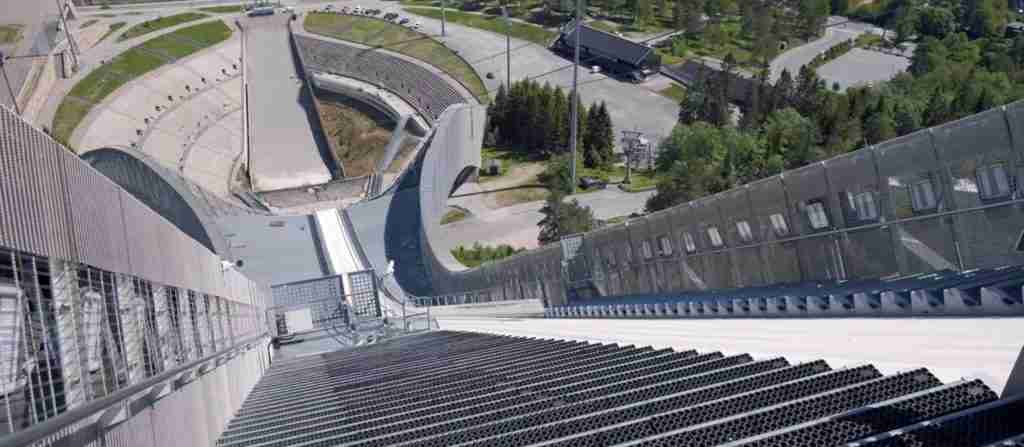
Visitors can ascend to the observation platform at the top of Holmenkollen’s ski jump tower, reaching the same elevation where Olympic athletes stand before launching their jumps. The climb involves either an elevator ride or ascending approximately 114 steps, with the viewing platform offering 360-degree panoramas at 64 meters above the landing slope. From this vantage point, you gain perspective on the extreme angles ski jumpers navigate—the in-run descends at 37.5 degrees, creating the intense speeds that propel athletes into flight.
The experience provides visceral understanding of the courage required for competitive ski jumping. Standing at the take-off point, you look down a vertiginous drop to the landing area 140 meters distant, with Oslo’s cityscape, Oslofjord, and Swedish hills visible beyond. Information panels explain the physics of ski jumping, wind conditions’ impact on performance, and the split-second decisions athletes make during flight. The tower remains open year-round, though access may be restricted during major competitions for safety and security reasons.
What events and competitions take place at Holmenkollen?
Holmenkollen serves as Norway’s premier venue for international ski jumping and Nordic combined competitions. The site hosts FIS World Cup events annually, typically in early March, drawing the world’s top athletes and tens of thousands of spectators. The Holmenkollen Ski Festival, established in 1892, represents one of winter sports’ oldest traditions and largest annual events, featuring ski jumping, cross-country skiing, and Nordic combined competitions alongside concerts, exhibitions, and cultural activities.
Beyond World Cup events, Holmenkollen hosts national championships, youth competitions, and training camps throughout the winter season. The facility includes cross-country trails that wind through Nordmarka forest, providing courses for distance races and biathlon events. Summer brings non-traditional uses: the zip-line “Kollensvevet” allows visitors to soar from the top of the jump tower down toward the stadium, while trail running races and cycling events utilize the scenic routes surrounding the complex.
Extended multi-day tours – 5+ days
Featured Oslo Multi-Day Tour Packages
3 days
Oslo 3-Day Discovery Tour
- ✓ Comprehensive Oslo experience
- ✓ Expert local guides included
- ✓ All accommodation included
- ✓ Transportation provided

5 days
Oslo 5-Day Highlights Experience
- ✓ Comprehensive Oslo experience
- ✓ Expert local guides included
- ✓ All accommodation included
- ✓ Transportation provided
7 days
Oslo 7-Day Cultural Journey
- ✓ Comprehensive Oslo experience
- ✓ Expert local guides included
- ✓ All accommodation included
- ✓ Transportation provided

10 days
Oslo 10-Day Complete Adventure
- ✓ Comprehensive Oslo experience
- ✓ Expert local guides included
- ✓ All accommodation included
- ✓ Transportation provided
Multi-day tour packages powered by TourRadar. Prices and availability subject to change.
Introduction: Norway’s Iconic Ski Jump Experience
Holmenkollen represents far more than a sporting venue—it embodies Norway’s soul as a winter sports nation and serves as a pilgrimage site for skiing enthusiasts worldwide. Since 1892, this hillside overlooking Oslo has witnessed skiing’s transformation from practical Nordic transportation to Olympic spectacle, hosting competitions that have become embedded in Norwegian national identity. The current structure, opened in 2010, stands as the fourth major reconstruction of the original wooden jump, each iteration pushing architectural and athletic boundaries while maintaining reverence for the site’s storied past.
Visiting Holmenkollen provides layered experiences that appeal to diverse interests. Sports enthusiasts study the museum’s comprehensive collection documenting skiing’s 4,000-year evolution and examine championship equipment from Norwegian legends like Bjørn Dæhlie and Ole Einar Bjørndalen. Architecture admirers analyze the modernist design that earned international acclaim for its bold integration of function and form. Nature lovers appreciate the setting within Nordmarka forest preserve, where trails extend for hundreds of kilometers through pristine Norwegian wilderness. Even casual tourists find themselves captivated by the vertiginous views from the jump tower and the palpable energy during World Cup competitions.
The site’s accessibility enhances its appeal. Located just 13 kilometers from Oslo’s city center and connected by frequent metro service, Holmenkollen fits naturally into itineraries for both short visits and extended stays. The complex welcomes visitors year-round, with each season offering distinct advantages: winter brings competitive events and snow-covered landscapes, spring and autumn provide comfortable temperatures and colorful foliage, while summer allows exploration without crowds and includes unique activities like zip-lining down the jump’s trajectory.
Understanding Holmenkollen requires grasping its cultural significance beyond sports statistics and architectural awards. For Norwegians, the site represents national pride in outdoor culture and winter competence—values deeply rooted in the nation’s identity. The Holmenkollen Ski Festival each March functions as unofficial national holiday, when the king joins tens of thousands of spectators to celebrate Nordic skiing traditions. This combination of elite competition, popular participation, and cultural celebration creates an atmosphere unlike any other sporting venue, making Holmenkollen essential for understanding modern Norway.
Historical Background: From Wooden Jump to Modern Marvel
The Original 1892 Structure and Early Competitions
Holmenkollen’s history begins in 1892 when members of the Christiania Ski Club (later renamed Oslo) constructed the first ski jump on this hillside northwest of Norway’s capital. The original wooden structure stood modest by today’s standards—just 21 meters high with jumps rarely exceeding 20 meters. Yet it represented revolutionary thinking: creating a dedicated facility for ski jumping as competitive sport rather than incidental display of practical skill. The inaugural competition attracted several thousand spectators, remarkable for an event in what was then a secondary Norwegian city.
Those early years established traditions that continue today. The Holmenkollen Ski Festival, launched alongside the jump’s opening, combined ski jumping with cross-country races through surrounding forests. Competitors included both elite athletes and recreational skiers, reflecting Norwegian “allemannsrett” principles that outdoor activities should be accessible to all regardless of class or skill level. This democratic approach helped skiing transition from rural farming technique to national pastime, with Holmenkollen serving as the movement’s symbolic heart.
Reconstructions and Technological Evolution
The jump underwent major reconstructions in 1914, 1940, and 2010, each reflecting advancing understanding of aerodynamics, materials science, and safety requirements. The 1914 version increased height to 41 meters, enabling jumps approaching 50 meters as athletes developed more aggressive techniques. Norwegian engineer Hjalmar Welhaven designed this iteration using Norway spruce timber, demonstrating that careful engineering could create structures supporting far greater forces than the original builders envisioned.
The 1940 reconstruction came despite—or perhaps because of—German occupation during World War II. The occupying administration approved the project as part of efforts to maintain Norwegian morale through “acceptable” cultural activities, though resistance members working on construction used the cover to move messages and supplies. This renovation increased height to 60 meters and introduced steel reinforcement alongside traditional timber, creating a hybrid structure that lasted four decades.
The 2010 complete rebuilding represented the most dramatic transformation. Architect Julien De Smedt’s firm designed a structure entirely of steel and concrete, abandoning timber for the first time in Holmenkollen’s history. The new jump featured computer-optimized curves ensuring ideal aerodynamic flow, adjustable gates allowing customization for wind conditions and athlete skill levels, and the 60-meter observation tower giving visitors unprecedented access. Critics initially questioned whether modernist design respected the site’s heritage, but public reception proved overwhelmingly positive, recognizing how the structure honored traditions while embracing Norway’s contemporary architectural identity.
Olympic Games and World Championships
Holmenkollen’s role in international competition cemented its status as winter sports cathedral. The 1952 Winter Olympics brought the world to Oslo, with ski jumping at Holmenkollen among the Games’ marquee events. Norwegian jumper Arnfinn Bergmann won gold on home snow, a victory celebrated as national triumph. Television coverage, though limited by 1950s standards, introduced global audiences to Holmenkollen’s dramatic setting and Norway’s skiing prowess.
The site hosted FIS Nordic World Ski Championships four times: 1930, 1966, 1982, and 2011. Each championship drove improvements to facilities and infrastructure. The 1982 event introduced computerized timing and electronic scoreboards, modernizing what had been largely analog operations. The 2011 championships, held on the newly reconstructed jump, showcased Norway’s ability to blend tradition with innovation, attracting record crowds and earning praise from FIS officials for the venue’s world-class standards.
Cultural Significance Beyond Competition
Holmenkollen transcends sports to serve as cultural touchstone in Norwegian society. The annual Ski Festival draws the royal family, government officials, and celebrities alongside ordinary citizens, creating rare moments of national unity. The event has survived wars, economic depressions, and societal changes, its continuity representing Norwegian resilience and commitment to outdoor traditions.
The site has witnessed historic moments extending beyond athletics. In 1896, Norwegian polar explorer Fridtjof Nansen lectured at Holmenkollen about his Arctic expeditions, connecting skiing’s practical origins to its sporting evolution. During the 1940 German occupation, small acts of resistance occurred at competitions—spectators wearing subtle symbols of Norwegian identity, athletes incorporating prohibited colors into their equipment. These moments wove Holmenkollen into Norway’s liberation narrative.
The Modern Ski Jump: Architecture & Design
Julien De Smedt’s Vision and Design Philosophy
Belgian-Norwegian architect Julien De Smedt approached the 2010 Holmenkollen redesign with awareness that he was reimagining Norway’s most iconic sporting structure. His firm, JDS Architects, won the international competition by proposing a design that respected the site’s history while making a bold contemporary statement. De Smedt described the concept as creating a “steel sculpture in the landscape”—a structure that would read as both functional sports facility and architectural artwork visible across Oslo.
The design philosophy emphasized integration with topography. Rather than appearing imposed on the hillside, the jump emerges from it, with the tower’s base embedded in the slope and the structure following natural contours. This approach minimized visual impact from certain angles while maximizing dramatic presence from others, particularly when viewed from Oslo city center where the illuminated jump dominates the northwestern skyline at night.
De Smedt’s team studied historical photographs and interviewed Norwegian ski jumping legends to understand what made Holmenkollen meaningful beyond its functional role. They identified key sightlines that had defined the venue for decades and ensured the new design preserved or enhanced these views. The result balances respect for tradition with unmistakable 21st-century identity—a structure that honors its predecessors while clearly belonging to its own time.
Structural Engineering and Materials
The engineering challenges in constructing a modern ski jump are formidable: the structure must support dynamic loads as athletes accelerate down the in-run at speeds exceeding 90 kilometers per hour, withstand Norwegian winter weather including heavy snow loads and extreme cold, and maintain precise geometric tolerances ensuring consistent performance across varied conditions. The 2010 Holmenkollen meets these requirements through advanced steel construction and foundation engineering.
The jump’s primary structure consists of welded steel beams forming a space frame that distributes loads efficiently while minimizing material use. This creates the distinctive open lattice visible along the in-run and tower. The take-off ramp and initial landing area feature reinforced concrete for durability, while the outlanding slope uses earth berms supported by steel retaining walls. This combination provides the strength required for elite competition while allowing the graceful lines crucial to the design’s aesthetic success.
Foundation work required drilling deep into the hillside’s granite bedrock to anchor the structure against lateral and uplift forces generated during use. The tower’s base includes tension cables extending 30 meters underground, creating a foundation capable of resisting extraordinary forces. This hidden infrastructure allows the visible structure to appear lighter and more elegant than traditional engineering would permit.
The Observation Tower and Visitor Experience
The 60-meter observation tower stands as Holmenkollen’s most distinctive feature, both architecturally and experientially. Its cantilevered design projects outward from the jump’s axis, creating an enclosed elevator shaft and viewing platform with floor-to-ceiling windows. The elevator ascends in approximately 30 seconds, though many visitors choose the adjacent staircase to better appreciate the structure’s engineering and enjoy intermediate viewing points.
The observation deck occupies the same level as the ski jumping take-off point, allowing visitors to stand where Olympic athletes have launched themselves into history. The platform extends 360 degrees around the tower, with different orientations offering distinct perspectives: north toward Nordmarka forest and its extensive trail network, east across Oslo to the Swedish hills beyond, south over Oslofjord toward Denmark, and west to the jump’s out-run and stadium.
Information panels integrated into the viewing platform explain what visitors see: distant landmarks, the physics of ski jumping, records set at Holmenkollen, and how weather conditions affect competition. Interactive displays allow visitors to “time” their own jumps and compare results to world records. The experience combines education with visceral appreciation for the courage required to compete in ski jumping—standing at the take-off point makes the sport’s danger and difficulty undeniable.
Sustainable Design and Environmental Integration
The 2010 reconstruction incorporated sustainability principles uncommon in major sports facilities at that time. The design minimized excavation by working with existing topography rather than extensively reshaping it. Materials selection emphasized durability and recyclability, with the steel structure designed for eventual disassembly and reuse rather than demolition. Energy-efficient systems include LED lighting throughout the complex and heating systems that use waste heat from the museum’s climate control to warm the tower and public areas.
The facility’s integration into Nordmarka forest preserve required careful environmental management. Construction disturbed minimal old-growth forest, with displaced vegetation transplanted rather than destroyed. Stormwater management systems prevent runoff from affecting streams feeding Oslo’s water supply. The ski jump’s illumination uses directed lighting that minimizes light pollution, important for the forest’s nocturnal wildlife and Oslo residents’ enjoyment of dark skies.
Museum Collections & Exhibits
Ancient Skiing: 4,000 Years of History
The museum’s chronological journey begins with skiing’s origins as practical necessity in Scandinavia’s harsh climate. The oldest artifacts date to approximately 2,000 BCE, including fragments of skis excavated from Scandinavian peat bogs where anaerobic conditions preserved wood for millennia. These primitive skis were broad and short compared to modern equipment, designed for stability in deep snow rather than speed or maneuverability.
Rock carvings from Norway’s Alta region, dating to 4,000-5,000 years ago, depict figures on skis hunting reindeer and elk. The museum displays photographic reproductions of these carvings alongside interpretive materials explaining how they document skiing’s early role in human survival in Arctic conditions. Visitors learn that skiing developed independently in multiple regions—Scandinavia, Russia, and China—wherever deep snow necessitated efficient winter transportation.
The Viking Age section features skis and poles from approximately 800-1000 CE, demonstrating how warfare and trade expanded skiing’s geographical reach. Norse sagas reference skiing extensively, with deities like Ullr and Skaði associated with the skill. The museum displays reconstructions of Viking-era skis based on archaeological finds, showing how design had evolved to include some differentiation between left and right skis and primitive binding systems that secured the foot while allowing the heel to lift.
Norwegian Polar Exploration and Skiing
Norwegian polar explorers’ achievements represent a pinnacle of skiing’s practical application, and Holmenkollen dedicates substantial exhibition space to this heritage. Fridtjof Nansen’s 1888 crossing of Greenland on skis demonstrated that Arctic travel need not follow established routes—mobility on snow opened vast territories to exploration. The museum displays skis, clothing, and equipment from Nansen’s expeditions, including items from his 1893-1896 attempt to reach the North Pole.
Roald Amundsen’s successful 1911 South Pole expedition relied fundamentally on skiing expertise honed in Norwegian mountains. His team’s ability to travel efficiently on skis allowed them to outpace Robert Scott’s British expedition, reaching the pole first and returning safely while Scott’s party perished. Original equipment from Amundsen’s expedition occupies a place of honor in the museum: skis, bindings, and waxes that performed in Earth’s most extreme conditions.
The polar exploration galleries explore how Norwegian skiing culture influenced these achievements. Unlike British Antarctic explorers who viewed skiing with suspicion and relied on manhauling sledges, Norwegians approached polar travel as an extension of familiar winter activities. This cultural difference proved decisive—Amundsen and his men were comfortable on skis, traveling with the rhythm and efficiency developed through thousands of hours in Nordmarka and other Norwegian forests.
The Evolution of Ski Equipment
A chronological display of skis from the 1800s through the present illustrates dramatic technological evolution. Mid-19th century skis were heavy wooden planks, often hand-carved by the user, with minimal shape differentiation and primitive toe-strap bindings. The Telemark region’s influence appears in skis from the 1870s-1880s showing increased side-cut—narrower waist relative to tip and tail—allowing carved turns rather than just straight running or stemming.
The early 20th century brought standardization as skiing transitioned from folk practice to organized sport. Manufacturers like Huitfeldt and Bergendal in Norway began producing skis with consistent dimensions and quality, making equipment accessible to urban populations joining the skiing movement. Bindings evolved from simple toe straps to cable systems securing the entire boot, a crucial safety improvement that reduced ankle injuries while enabling more aggressive technique.
Post-World War II materials science revolutionized ski construction. The museum displays examples of each generation: laminated wood with plastic bases (1950s-60s), fiberglass and aluminum composites (1970s-80s), and modern carbon fiber constructions (1990s-present). Visitors can compare a 1950s wooden ski weighing several kilograms to a contemporary World Cup model under one kilogram, understanding how equipment changes have transformed the sport’s demands and possibilities.
Olympic and World Championship Heritage
Dedicated galleries celebrate Norwegian skiing achievements at Olympic Games and World Championships. Medal displays begin with the first Winter Olympics at Chamonix 1924, where Norwegian athletes dominated Nordic events. Each subsequent Olympics receives attention through medals, photographs, video footage, and personal stories of athletes who became national heroes.
The 1952 Oslo Olympics occupy special prominence as Norway’s opportunity to showcase skiing culture to the world. Artifacts include the torch used in the opening ceremony at Bislett Stadium, uniforms worn by Norwegian team members, and newspapers from around the globe reporting on events. Video displays show historic race footage, allowing visitors to watch legends like Stein Eriksen’s alpine victories and Hjalmar Andersen’s speed skating dominance.
Individual athlete spotlights focus on Norwegian skiing icons: Bjørn Dæhlie, whose 12 Olympic medals (8 gold) represent the most successful Winter Olympic career in any sport; Marit Bjørgen, who surpassed Dæhlie’s total with 15 medals (8 gold) across five Olympics; and Ole Einar Bjørndalen, the “King of Biathlon,” with 13 Olympic medals and 20 World Championship golds. Their equipment, medals, and personal memorabilia help visitors understand the dedication required to achieve such excellence.
Ski Jumping and Nordic Combined Exhibits
Given Holmenkollen’s identity as a jumping venue, the museum provides comprehensive coverage of ski jumping’s technical and competitive evolution. Early jumping technique emphasized style over distance, with judges scoring based on form during flight and landing. The museum displays jump measurements and scoring criteria from different eras, showing how the sport’s emphasis shifted toward distance while maintaining style components.
Equipment evolution in ski jumping appears particularly dramatic. Early jumpers used standard cross-country skis with minimal adaptation. As the sport specialized, skis became longer, wider, and lighter, with each generation pushing boundaries until international regulations established limits. The V-style technique, revolutionizing jumping in the 1990s, required wider skis with specific geometric properties. The museum displays championship-winning skis from each era, allowing direct comparison of equipment that produced 60-meter jumps versus modern skis enabling jumps beyond 250 meters on the largest hills.
Nordic combined—the discipline combining ski jumping and cross-country skiing—receives dedicated exhibition space highlighting how Norway has dominated this sport even more than jumping or cross-country individually. The unusual demand for athletes to excel at two very different skiing disciplines makes Nordic combined particularly challenging, and Norwegian training methods and cultural emphasis on all-around outdoor competence provide distinct advantages.
Interactive Displays and Ski Simulators
Modern museum practice emphasizes visitor engagement, and Holmenkollen incorporates multiple interactive elements. A ski jumping simulator allows visitors to experience the sport virtually: standing at a mock take-off point, users watch a first-person video of a jump’s in-run, take-off, flight, and landing. The system tracks body position and provides feedback on technique, helping visitors appreciate the precise timing and body control required for successful jumping.
A cross-country skiing simulator uses a stationary ski ergometer with video display showing various trail conditions and competitors. Users experience the cardiovascular demands of elite cross-country racing, with the system measuring heart rate and comparing performance to world-class athletes. This exhibit reliably humbles visitors, demonstrating that what appears graceful and effortless on television requires extraordinary fitness.
Wax testing stations allow hands-on experimentation with different ski waxes under various temperature and snow conditions. This seemingly mundane aspect of skiing proves fascinating—choosing appropriate wax can mean the difference between winning and mid-pack finishes in elite competition. The exhibit explains waxing science and includes examples of historic waxes alongside modern fluorocarbon formulations.
Visitor Experience: Climbing the Tower
Access Options: Elevator vs. Stairs
Reaching the observation platform atop Holmenkollen’s tower involves choosing between elevator and stairs, each offering distinct experiences. The elevator ascends 60 meters in approximately 30 seconds, providing a smooth ride while large windows reveal the structure’s interior lattice work and glimpses of Oslo below. The elevator accommodates wheelchairs and strollers, ensuring accessibility for all visitors regardless of mobility.
The staircase alternative appeals to those wanting more active engagement with the structure. The climb involves approximately 114 steps with intermediate landings offering rest points and changing perspectives on the surrounding landscape. Information panels at landing points explain engineering details and provide historical context about Holmenkollen’s evolution. The stairs pass through the tower’s steel framework, allowing closer examination of the construction techniques and material choices that make the structure possible.
Most visitors find the stairs manageable—the climb takes 5-10 minutes at a leisurely pace. The physical effort enhances appreciation for the final view, creating a sense of accomplishment absent when stepping directly from elevator to platform. During peak summer months, lines for the elevator can extend to 15-20 minute waits, making stairs both faster and more engaging.
The Observation Deck: Views and Orientation
The observation deck occupies the tower’s uppermost level at 64 meters above the jump’s landing area and 371 meters above sea level, providing panoramic views across Oslo and beyond. Floor-to-ceiling windows allow unobstructed sight lines in all directions, while outdoor sections permit unfiltered photography and the sensation of standing at the ski jump’s actual take-off point.
Northern views extend into Nordmarka, the vast forest preserve surrounding Oslo. On clear days, visitors can trace cross-country ski trails winding through the forest and spot the characteristic red-painted cabins dotting the wilderness. The forest’s scale impresses those unfamiliar with Scandinavian landscapes—Nordmarka covers over 430 square kilometers of protected woodland and mountains, all accessible from Oslo city center.
Eastern and southern perspectives encompass downtown Oslo, the fjord, and Swedish hills. Key landmarks become identifiable: the Royal Palace with its park, the Opera House’s white angular form at the waterfront, Akershus Fortress guarding the harbor, and the distinctive Barcode Project towers along Bjørvika. The fjord often features cruise ships, cargo vessels, and sailboats, illustrating Oslo’s maritime character.
Western views look along the jump’s out-run toward the landing area and stadium. This vantage point allows you to understand ski jumping’s trajectory and appreciate the distances athletes achieve. Information panels provide perspective: the world record at Holmenkollen stands at 144 meters, set by Anders Fannemel in 2015. Standing at the take-off point and imagining flight over that distance makes the achievement seem impossible, yet dozens of competitors accomplish it regularly during World Cup events.
Understanding the Take-Off Point: Athlete Perspective
The observation deck includes the actual take-off point where ski jumpers launch, protected by railings but allowing visitors to stand precisely where Olympic champions have stood. This location provides unique appreciation for the sport’s psychological demands. The in-run descends steeply below—37.5 degrees from horizontal—creating speeds that approach 95 kilometers per hour by take-off. The landing area lies far below and distant, with only air between.
Information panels explain the split-second decisions jumpers make during the in-run. Gate position determines starting height and therefore speed at take-off; officials adjust gates based on wind conditions and jumper skill level to maintain fair competition and safety. Jumpers must maintain precise crouch position during the in-run to minimize air resistance, then execute a powerful explosive jump at take-off while maintaining balance and direction.
The flight phase lasts approximately 5-6 seconds for jumps approaching 140 meters. During this time, athletes must assume and maintain optimal body position: skis in a V-shape, body leaning far forward over the skis, arms positioned to stabilize flight. Small adjustments in body angle can add or subtract meters from the jump distance. Wind shifts during flight require instant reactions to maintain stability and maximize distance.
Landing at speeds exceeding 90 kilometers per hour demands perfect timing and technique. Jumpers must absorb enormous impact forces while maintaining balance and executing the Telemark landing—one ski forward, the other back, arms extended—that judges consider ideal style. The forces involved can exceed 10 times body weight momentarily, requiring exceptional lower body strength and neuromuscular control.
Seasonal Variations in the Viewing Experience
Holmenkollen’s observation deck offers dramatically different experiences across seasons. Winter provides the classic Norwegian mountain landscape: snow-covered forests, frozen sections of Oslofjord, and the city dusted white. Cold temperatures keep crowds smaller on typical winter days, allowing unhurried appreciation of views and photographic opportunities. The sun remains low even at midday during December and January, creating long shadows and golden light that photographers particularly prize.
Spring brings rapid transformation as snow melts and vegetation greens. March and early April often coincide with major competitions including the Holmenkollen Ski Festival, when the venue buzzes with energy and crowds reach annual peaks. Views combine lingering snow at higher elevations with green valleys below, illustrating Norway’s dramatic seasonal transitions.
Summer, while lacking competitive events, offers its own advantages: comfortable temperatures, long daylight hours (the sun barely sets during June and July), and lush forest colors. The observation deck stays open until evening, allowing sunset viewing across the fjord. Clear summer days provide visibility extending to distant mountains and across Oslofjord to Denmark’s coast, sometimes exceeding 100 kilometers.
Autumn brings spectacular color as birch forests turn golden and Norway’s brief fall season peaks. September and early October provide comfortable temperatures and fewer crowds than summer. The changing light as days shorten creates dramatic sky colors, particularly during late afternoon when low-angle sun illuminates the city and fjord while mountains cast long shadows.
The Viewing Platform & Panoramic Views
Oslo Cityscape and Landmarks
From Holmenkollen’s elevation, Oslo’s urban layout becomes clearly legible. The city center occupies the fjord’s inner reach, with neighborhoods spreading in a fan pattern northward into surrounding valleys. The Royal Palace anchors the western edge of downtown, its yellow neoclassical facade and extensive park visible from Holmenkollen. The palace’s 173 acres of public gardens create a green lung in the dense urban core.
The Opera House, completed in 2008, appears as a brilliant white angular form jutting into the fjord near the central station. Its sloped marble roof, designed for public walking and viewing, makes the building immediately distinctive from Holmenkollen’s vantage point. Nearby, the Barcode Project—a series of high-rise towers with varying heights and designs—creates a contemporary skyline element that contrasts with Oslo’s traditionally low-rise character.
Akershus Fortress occupies a strategic point on a small peninsula protecting Oslo’s medieval harbor. The fortress walls and towers, dating to the 1290s with later additions, mark Norway’s longest continuously maintained military installation. From Holmenkollen, the fortress’s strategic importance becomes obvious—it commands approaches from the fjord and overlooks what was historically Oslo’s commercial heart.
Oslofjord and Maritime Activity
The fjord extends south from Oslo for approximately 100 kilometers before opening to the Skagerrak strait between Norway and Denmark. From Holmenkollen, the inner fjord appears as a broad waterway dotted with islands and busy with marine traffic. Cruise ships bound for Norwegian fjords or Baltic destinations often dock near the Opera House, their massive forms providing scale reference against surrounding buildings.
Smaller vessels create constant movement: ferries connecting Oslo to Danish ports, passenger boats serving fjord islands, cargo ships heading to container terminals, and recreational sailboats and motorboats during summer months. This maritime activity illustrates Oslo’s historical role as Norway’s primary port and contemporary importance as gateway to Scandinavia.
The fjord’s islands appear as green patches, many with visible buildings and boats. Hovedøya, closest to the city center, hosts ruins of a medieval Cistercian monastery and beaches popular with Oslo residents. Other islands like Langøyene and Gressholmen feature recreational facilities and summer cottages. The island-dotted landscape helps explain Oslo’s appeal—a major capital city with wilderness and seaside recreation minutes from downtown.
Nordmarka Forest and Recreation Areas
Nordmarka’s vast expanse stretches north from Holmenkollen into the distance, covering over 430 square kilometers of protected forest and mountains. This wilderness preserve, owned largely by Oslo municipality, provides recreation opportunities that most cities cannot match: hundreds of kilometers of marked hiking and skiing trails, lakes for swimming and fishing, and traditional Norwegian cabins available for overnight stays.
From the observation deck, you can trace major trails winding through the forest. The forested slopes appear uniformly green in summer, transforming to white in winter as snow covers the landscape. Small lakes glint in clearings, particularly visible during low-angle morning or evening light. The characteristic red-painted cabins owned by Oslo families appear as occasional spots of color among the trees.
The forest’s accessibility from Holmenkollen makes it ideal for extending your visit. Numerous trails start near the metro station, ranging from easy family walks to challenging mountain routes. Sognsvann lake, visible to the northeast, marks a popular recreation area with a 3-kilometer walking path around its shore. More ambitious hikers tackle routes to Frognerseteren, Tryvannstårnet tower, or even multi-day expeditions deeper into Nordmarka.
Distant Mountains and Regional Geography
On exceptionally clear days, visibility from Holmenkollen extends to distant mountains marking geographical boundaries. Swedish hills appear as blue ridges to the east, approximately 80-100 kilometers distant. These views remind visitors that Scandinavia’s capital cities lie surprisingly close—Oslo to Stockholm measures just 400 kilometers, with much of that distance covered by the relatively flat Swedish interior rather than dramatic mountains.
Northern views can reach mountains in the Hadeland and Valdres regions, skiing destinations popular with Oslo residents for weekend trips. These areas feature higher elevations and more reliable snow than Oslo’s immediate surroundings, making them crucial for Norway’s ski culture. The visible mountains serve as reminders that even from a major capital, true wilderness lies within easy reach.
Weather permitting, western views extend across the Oslofjord to its western shore, where smaller cities like Drøbak and coastal communities dot the landscape. The fjord’s width at Oslo measures several kilometers, creating a genuine sense of coastal setting despite the city’s location at the waterway’s head. These expansive water views contribute to Oslo’s distinctive character—a capital that feels simultaneously urban and intimately connected to natural surroundings.
Events & Competitions at Holmenkollen
World Cup Ski Jumping
Holmenkollen hosts FIS Ski Jumping World Cup events annually, typically in early March as part of the Raw Air tournament series that includes multiple Norwegian venues. These competitions attract the world’s elite jumpers competing in both individual and team events. The World Cup circuit determines annual discipline champions and contributes to qualification for Olympic Games and World Championships.
Competition format includes qualification rounds where jumpers must achieve minimum distances to advance to the final. Finals typically feature two rounds with cumulative scoring determining winners. Judges evaluate both distance and style, with style scores based on flight position, landing technique, and overall execution. The combination of measured distance and subjective style scores creates tension and debate, particularly when close margins separate medals.
Holmenkollen’s challenging conditions make it among the circuit’s most difficult venues. The jump’s exposure to winds creates unpredictable conditions that can change dramatically during competition. Gate adjustments partially compensate for wind effects, but jumpers must still adapt to rapidly shifting conditions. Successfully reading wind and adjusting technique accordingly separates champions from mid-pack finishers at Holmenkollen.
The Holmenkollen Ski Festival
The Holmenkollen Ski Festival, established in 1892 alongside the jump itself, represents one of winter sports’ oldest and most significant annual events. Held each March, the festival combines elite international competition with mass participation events, concerts, exhibitions, and cultural activities that attract hundreds of thousands of participants and spectators over multiple days.
The festival’s centerpiece remains World Cup ski jumping, but the event encompasses much broader scope. Cross-country races from sprint distances to 50-kilometer marathons utilize Nordmarka’s trail network. Mass participation events allow recreational skiers to race the same courses as elite athletes, creating unusual opportunities for ordinary participants to directly compare their performance to world champions.
Evening concerts and entertainment transform Holmenkollen into festival grounds. Norwegian and international musicians perform for crowds that can exceed 50,000 on prime competition days. The atmosphere combines serious athletic competition with celebration of Norwegian outdoor culture, creating an event unlike typical international sports competitions. The Norwegian royal family typically attends, joining crowds and lending official recognition to skiing’s cultural importance.
Nordic Combined Events
Nordic combined competitions at Holmenkollen demonstrate sport at its most demanding: athletes must excel at both ski jumping and cross-country skiing, disciplines requiring very different physiological capabilities and technical skills. Jumpers need explosive power and body control; cross-country skiers require elite endurance and sustained power output. Mastering both simultaneously creates a unique athletic challenge.
Competition format features ski jumping first, with results converted to time advantages for the subsequent cross-country race using the Gundersen method. Better jumpers start the race ahead, with pursuit-style racing allowing spectators to see the leader at race conclusion cross the line first. The format creates dramatic competition as strong cross-country skiers chase early leaders, with races often decided in final kilometers.
Norwegian athletes have dominated Nordic combined historically, winning more Olympic and World Championship medals than any other nation. This success reflects cultural emphasis on all-around outdoor competence rather than specialization. Young Norwegian skiers typically train in multiple disciplines through teenage years before specializing, creating strong fundamental skills across Nordic skiing’s spectrum.
Summer Events and Alternative Activities
While winter remains Holmenkollen’s primary season, summer brings creative uses of the facility. The zip-line “Kollensvevet” allows visitors to soar from the tower’s top down toward the stadium, experiencing something approximating a jumper’s flight trajectory. The ride reaches speeds approaching 100 kilometers per hour over a 361-meter course, providing genuine adrenaline rush while appreciating the venue’s dramatic topography.
Trail running races utilize routes through Nordmarka forest, with Holmenkollen serving as start and finish points. These events attract both elite athletes and recreational runners, ranging from 10-kilometer introductory distances to ultramarathon formats exceeding 100 kilometers. The forest’s varied terrain and dramatic elevation changes create challenging courses that test different capabilities than winter skiing.
Cycling events have discovered Holmenkollen’s potential, with hill climb races ascending from Oslo city center to the jump complex. The approximately 10-kilometer route gains 250 meters of elevation, creating a test of climbing ability and pain tolerance. Professional cyclists use the climb for training and testing, while mass participation events allow amateur riders to challenge the same course.
Photography Guide: Capturing Holmenkollen
Exterior Architecture: Best Angles and Times
Photographing Holmenkollen’s exterior requires considering how light interacts with the white steel structure against varying backgrounds. Morning light from the east illuminates the jump’s front face, creating strong shadows that emphasize the structure’s geometric complexity. This lighting particularly suits architectural photography focused on form and engineering detail.
Late afternoon provides warmer light that softens the structure’s industrial character. Shooting from lower elevations looking up toward the tower creates dramatic perspectives emphasizing height and the cantilevered observation deck’s projection. Including foreground elements—trees, paths, or visitors—provides scale reference that helps viewers understand the jump’s massive dimensions.
Winter offers unique opportunities with snow covering surrounding landscape and potentially frosting the jump structure. Overcast days create soft even lighting that minimizes harsh shadows while emphasizing the structure’s white coloring against darker forests. Clear winter days with low sun angles generate long shadows and dramatic sidelighting that reveals texture in both structure and snow.
Interior Perspectives: Museum and Tower
Museum interior photography balances available light with exhibit lighting designed to protect sensitive artifacts. Many galleries permit photography without flash, allowing documentation of favorite exhibits and architectural details. The modern museum sections feature dramatic ceiling heights and large windows, creating naturally lit spaces that photograph well even with smartphone cameras.
The observation tower’s glass walls and elevator provide unique interior perspectives. Shooting through the tower’s steel framework creates geometric compositions contrasting organic landscapes with engineered structure. The elevator ascent allows shooting directly up or down through the tower’s core, emphasizing height and the interesting negative spaces within the lattice structure.
The viewing platform offers 360-degree photographic opportunities. Wide-angle lenses capture expansive panoramas combining foreground structure with distant views. Longer focal lengths compress perspective, bringing distant mountains or city landmarks into more prominent relationship with the jump itself. Vertical compositions emphasizing the jump’s height work well, particularly when including jumpers during competition or the dramatic drop to the landing area.
Competition Photography: Capturing Action
Ski jumping competition presents significant photographic challenges: extreme speed, distant subjects, and rapidly changing light conditions. Successful action photography requires fast shutter speeds—minimum 1/1000 second, preferably faster—to freeze jumpers during flight or landing. This demands telephoto lenses (typically 200mm or longer) to frame distant athletes adequately.
In-run shots capturing jumpers accelerating toward take-off require anticipating motion and pre-focusing on the zone where athletes will pass. Continuous autofocus helps track moving subjects, though challenging conditions may require manual focus on a predetermined point. Panning techniques—moving the camera to track the athlete’s motion—can create dynamic images with sharp subjects against blurred backgrounds suggesting speed.
Flight photography works best from positions allowing clear sightlines of jumpers against uncluttered backgrounds—ideally sky or distant mountains rather than forests or buildings. The brief 5-6 second flight requires rapid shooting and quick reactions. Modern cameras’ burst modes help, though reviewing and selecting best images from hundreds of shots demands considerable post-event time.
Seasonal Variations: Year-Round Photography
Each season offers distinct photographic opportunities at Holmenkollen. Winter’s snow-covered landscape creates high-contrast scenes with white structures and white ground separated by dark forests. The low angle of winter sun produces long shadows and dramatic lighting even during midday hours. Falling snow adds atmosphere, though it challenges cameras and requires careful exposure to prevent blown highlights in bright snow.
Spring’s transitional character appears in mixed snow coverage—white at higher elevations, green valleys below—and dramatic sky conditions as weather systems shift. The extended “blue hour” after sunset in late spring provides exceptional light for architectural photography, with structures silhouetted against colorful skies while artificial lighting creates interesting color contrasts.
Summer’s green forests and long daylight hours permit photography from early morning through late evening. The vegetation’s uniform green coloring provides neutral backgrounds that don’t distract from architectural subjects. Summer also brings the midnight sun phenomenon—during June and July, true darkness never arrives, creating unique twilight conditions that last hours and permit photography normally possible only briefly after sunset.
Autumn’s brief but spectacular color season transforms forests into golden displays. Birch trees dominate Nordmarka’s composition, and their yellow foliage creates warm backgrounds contrasting beautifully with Holmenkollen’s cool white structure. Early morning fog during autumn creates atmospheric conditions that can produce memorable images, though it may obscure distant views from the observation platform.
Practical Information for Visitors
Getting to Holmenkollen: Transportation Options
Reaching Holmenkollen from Oslo city center proves remarkably straightforward thanks to the T-bane metro system. Line 1 (marked Frognerseteren) departs from downtown stations including Nationaltheatret and Majorstuen, reaching Holmenkollen station in approximately 25 minutes. Trains run every 15 minutes during daytime hours, with reduced frequency evenings and weekends. The journey provides scenic views as the train climbs from sea level to 371 meters elevation.
From Holmenkollen station, the ski jump complex lies approximately 650 meters uphill via a clearly marked path. The walk takes 10-15 minutes for most visitors and includes moderate incline. During major events, shuttle buses operate between the station and venue, though most visitors find the walk manageable and enjoyable for its forest setting and anticipation building.
Driving to Holmenkollen is possible, with parking available near the ski jump complex. However, parking proves limited—approximately 200 spaces—and fills quickly during competitions and peak summer weekends. Parking fees apply, and navigating narrow roads around the venue can challenge those unfamiliar with the area. The metro remains the recommended option for most visitors, combining convenience with environmental responsibility.
Opening Hours and Admission
Holmenkollen Ski Jump and Museum maintains year-round operations with seasonal hour variations. During peak season (May through September), facilities typically open 9:00 AM and close 8:00 PM, allowing evening visits that include spectacular sunset views. Winter hours (October through April) generally run 10:00 AM to 5:00 PM, with extended hours during major competitions.
Admission fees support facility maintenance and museum operations. Adult tickets typically cost 180 NOK (approximately $17-20 USD depending on exchange rates), with reduced rates for students, seniors, and children under 16. Family tickets covering two adults and up to three children provide savings for groups. The Oslo Pass, which offers free public transportation and admission to many Oslo attractions, includes Holmenkollen entry—an economical option for visitors planning multiple museum visits.
Annual memberships appeal to Oslo residents and frequent visitors, providing unlimited access throughout the year. Membership levels range from individual to family options, with premium tiers including access to special events and lectures. The museum occasionally offers free admission days, typically during Norwegian holidays or special occasions—checking the official website before visiting can identify these opportunities.
Facilities and Accessibility
Holmenkollen provides comprehensive visitor facilities including restrooms, a café serving Norwegian specialties and international options, and a gift shop stocking ski-themed merchandise, books, and souvenirs. The café offers indoor seating with views and outdoor terrace space during warm weather, making it popular for post-visit refreshments or lunch.
Accessibility for wheelchair users and visitors with limited mobility receives significant attention. The elevator to the observation platform accommodates wheelchairs, and museum galleries feature level floors with ramped transitions where necessary. Audio guides available in multiple languages include descriptive content for vision-impaired visitors. Service dogs are welcome throughout the facility.
Locker facilities allow visitors to store bags and coats while touring the complex, though valuables should remain with visitors as no security guarantees apply. Baby changing facilities are available in restrooms, and the museum welcomes families with young children—though supervision is required, particularly near the observation platform’s open sections.
Guided Tours and Educational Programs
Guided tours in Norwegian and English operate regularly during peak season, typically departing several times daily. Tours last approximately 90 minutes and include museum highlights, tower access, and historical context provided by knowledgeable guides. Special interest tours focusing on specific topics—ski jumping technique, polar exploration, or architectural engineering—can be arranged for groups with advance notice.
Educational programs serve school groups and youth organizations, offering age-appropriate content that aligns with Norwegian curriculum standards for history, science, and physical education. These programs typically combine museum exhibits with hands-on activities and outdoor experiences in Nordmarka forest, creating comprehensive learning days that extend beyond passive museum viewing.
Booking requirements for guided tours vary by season and group size. Individual visitors can typically join scheduled tours without advance reservation, though arriving 15 minutes before tour departure ensures participation. Groups larger than 10 people should book in advance, particularly during winter and summer peak periods when the facility experiences highest visitation.
Combining Holmenkollen with Other Activities
Holmenkollen’s location makes it ideal starting point for exploring Nordmarka forest. Numerous marked trails begin near the metro station, ranging from easy family walks to challenging mountain routes. Frognerseteren, located one metro stop beyond Holmenkollen, offers another historic lodge, restaurants, and additional trail access. A circular route connecting Holmenkollen, Frognerseteren, and intermediate points provides excellent half-day hiking covering approximately 8-10 kilometers.
Winter visitors interested in experiencing cross-country skiing can rent equipment from shops near Holmenkollen metro station. Nordmarka’s trail network includes hundreds of kilometers of groomed tracks suitable for skiers of all abilities. Combining a morning ski session with afternoon museum visit and observation platform access creates full-day outdoor experience showcasing Norwegian winter culture.
Summer offers different combinations: mountain biking on Nordmarka’s extensive trail network, swimming at Sognsvann lake (accessible via metro), or visiting Oslo’s other major attractions. The comprehensive public transportation system allows easy movement between Holmenkollen and downtown museums, the Vigeland Sculpture Park, or the Opera House, enabling diverse itineraries that balance outdoor and cultural experiences.
Frequently Asked Questions About Holmenkollen
How long should I plan to spend at Holmenkollen?
Most visitors spend 2-3 hours exploring Holmenkollen’s museum, observation tower, and surrounding area. A focused visit concentrating on the tower views and key museum exhibits can be accomplished in 90 minutes, while those interested in comprehensive museum exploration and lingering at viewpoints may prefer 3-4 hours. Combining Holmenkollen with hiking in Nordmarka extends the visit to a half-day or full-day excursion.
Is Holmenkollen worth visiting if I’m not interested in skiing?
Absolutely. While skiing enthusiasts gain maximum appreciation from Holmenkollen’s specialized exhibits, the venue offers value for diverse interests. The observation tower provides Oslo’s best panoramic views, making it worthwhile for anyone wanting to understand the city’s geography and natural setting. The modernist architecture appeals to design enthusiasts regardless of skiing knowledge. The polar exploration exhibits fascinate history buffs even without skiing interest. Most visitors report enjoying Holmenkollen more than anticipated, finding aspects that engage them beyond initial expectations.
Can I visit during competitions, and should I?
Holmenkollen welcomes visitors during most competitions, though access to certain areas may be restricted for safety and security. Competition days create electric atmosphere with crowds, music, and palpable energy absent during regular operations. Tickets for World Cup events and the Holmenkollen Ski Festival should be purchased in advance as popular sessions sell out. Be prepared for crowds, particularly during finals and team events. Visiting the museum before or after competition hours allows enjoying both the venue’s normal offerings and the special event atmosphere.
What are the best weather conditions for visiting?
Clear days obviously provide best viewing conditions from the observation platform, with visibility potentially extending 100+ kilometers. However, Holmenkollen offers value even during less-than-perfect weather. Light cloud cover can create dramatic atmospheric effects, particularly when clouds move rapidly across the landscape. Fresh snowfall transforms winter views into pristine Nordic scenery. Foggy conditions, while limiting distance viewing, create moody atmosphere and interesting photographic opportunities. The museum remains fully engaging regardless of weather, making Holmenkollen a solid choice even on days unsuitable for purely outdoor activities.
Are there dining options at Holmenkollen?
The on-site café serves Norwegian specialties including waffles with brown cheese and jam, open-faced sandwiches, soups, and hot drinks alongside international café standards. Prices reflect tourist destination positioning—expect to pay 80-120 NOK for light meals, 40-60 NOK for beverages. Frognerseteren restaurant, one metro stop beyond Holmenkollen, offers more formal dining with traditional Norwegian cuisine and equally spectacular views, though at higher prices. Budget-conscious visitors might pack snacks and drinks, though the café provides welcome warmth during cold weather visits.
Can children enjoy Holmenkollen?
Children generally find Holmenkollen exciting, particularly the observation tower and views. The ski jumping simulator appeals to kids wanting to “try” jumping virtually. Younger children may find museum exhibits less engaging than older kids and teenagers, though the polar exploration sections with expedition equipment tend to capture imagination across ages. The walk from metro station to venue and potential climbing the tower stairs require moderate physical capability—most children over 6-7 handle this easily, though very young children may need carrying for portions. Family-oriented activities in adjacent Nordmarka forest—hiking, berry picking in season, exploring nature—complement the museum visit for families with energetic children.
Is photography permitted throughout the facility?
Photography without flash is permitted throughout most of Holmenkollen, including the museum galleries, observation tower, and exterior areas. Some temporary exhibitions may restrict photography to protect artist copyrights or lending agreements—signage indicates any restrictions. Commercial photography or professional equipment requiring tripods, lighting, or models requires advance permission from facility management. During competitions, spectator photography is permitted from designated areas, though professional media credentials are required for optimal positions.
Does Holmenkollen close during bad weather?
The facility remains open during most weather conditions, though extreme situations may cause temporary closures of the observation tower for safety. High winds that create dangerous conditions on the exposed platform, severe thunderstorms, or rare extreme cold might prompt closure of outdoor areas while the museum remains accessible. Such closures are typically temporary—few hours rather than full days. Checking the official website or calling ahead during questionable weather provides current status information.
What should I wear when visiting Holmenkollen?
Dress according to season and planned activities. The observation tower is partially outdoor with significant wind exposure—layers and wind protection prove essential even during summer. Winter visits require proper cold-weather clothing including insulated jacket, gloves, and hat as temperatures can drop well below freezing with wind chill making it feel colder. Comfortable walking shoes are necessary for the uphill approach from the metro station and potential tower stairs. If planning to hike in Nordmarka after visiting Holmenkollen, bring appropriate footwear and outdoor gear for Norwegian mountain conditions.
Are there storage facilities for luggage or large bags?
Lockers are available for storing bags, backpacks, and light coats while touring the facility. Size limitations apply—large suitcases or oversized items may not fit standard lockers. Visitors arriving directly from airports or hotels with substantial luggage might consider using Oslo city center storage facilities before traveling to Holmenkollen. The metro journey and uphill walk from station make managing large bags awkward.