Hill of Crosses Day Trip from Riga 2026: Lithuania Border Crossing Guide
The Hill of Crosses stands as one of the most powerful pilgrimage sites in the Baltic region, located just 123 kilometers from Riga across the Lithuanian border. This sacred hill covered with over 200,000 crosses offers a profound cultural experience that combines history, spirituality, and the remarkable story of Lithuanian resistance, making it an unforgettable day trip from Latvia’s capital.
Key Takeaways
- Seamless Border Crossing 2026: Latvia and Lithuania share an internal Schengen border with no passport controls or checkpoints, allowing unrestricted movement between countries since December 2007
- Multiple Transport Options: Direct buses from Riga to Šiauliai cost €21 and take 2.5 hours, with local connections to the Hill of Crosses, while organized tours range €65-85 per person including guided commentary
- Free Access Site: The Hill of Crosses remains open 24/7 with no entrance fee, though parking costs approximately €1 and crosses for leaving on the hill are available at the visitor center gift shop
- Šiauliai City Bonus: Lithuania’s fourth-largest city offers additional attractions including Photography Museum, St. Peter and Paul’s Cathedral, Sundial Square, and the famous Rūta Chocolate Museum for extended itineraries
- Budget-Friendly Day Trip: Independent travelers can complete this cross-border excursion for €35-50 per person including transport, meals, and local expenses, while organized tours provide hassle-free alternatives at €65-85
- Year-Round Destination: The site can be visited in any season, with snow-covered crosses creating particularly striking winter photography opportunities, though summer offers comfortable walking conditions and extended daylight hours
People Also Ask About Hill of Crosses Day Trip 2026
Do I need a passport to visit the Hill of Crosses from Riga in 2026?
You need a valid passport or national ID card for travel between Latvia and Lithuania, though border guards won’t conduct systematic checks at the internal Schengen border. Both countries joined the Schengen Area in December 2007, eliminating physical border controls between them. Travelers can cross freely by car or bus without stopping at checkpoints, though carrying valid identification remains mandatory as random immigration patrols operate within both countries. Non-EU citizens should ensure their Schengen visa covers both Latvia and Lithuania.
How much does a day trip to the Hill of Crosses cost in 2026?
Independent travelers spend €35-50 per person for a complete day trip, including bus transport from Riga to Šiauliai (€21 each way), local bus to the Hill of Crosses (€1), lunch in Šiauliai (€10-15), and minor expenses. Organized group tours cost €65-85 per person and include round-trip transportation, English-speaking guide, photo stops at the Latvia-Lithuania border, and sometimes additional attractions like Jelgava or Rundale Palace. Private tours start from €140 total (€75 base plus per-person rates) and offer flexible timing and unlimited site access.
What is the best time to visit the Hill of Crosses in 2026?
Early morning visits between 7:00-9:00 AM offer the most peaceful experience with fewer tourists and optimal photography light, especially during May through September when weather conditions are most favorable. Winter months (December-February) create dramatic snow-covered landscapes that photograph beautifully but require warm clothing for comfortable exploration. The site is open 24/7 year-round, allowing sunset visits that create atmospheric lighting conditions. Weekdays see fewer visitors than weekends, while avoiding major religious holidays ensures a more contemplative experience at this sacred pilgrimage site.
Can I leave my own cross at the Hill of Crosses in 2026?
Visitors are actively encouraged to leave crosses at the site, continuing a tradition that dates back to 1831. The visitor center gift shop sells crosses ranging from small wooden crosses at €5-10 to larger decorative pieces at €20-30, or you can bring a handmade cross from home. Many travelers personalize crosses with names, dates, or prayers before placing them on the hillside. The site now contains over 200,000 crosses, with new additions made daily by pilgrims and tourists from around the world, and there are no restrictions on where you can place your cross within the hillside areas.
Extended multi-day tours – 5+ days
Featured Riga Multi-Day Tour Packages
3 days
Riga 3-Day Discovery Tour
- ✓ Comprehensive Riga experience
- ✓ Expert local guides included
- ✓ All accommodation included
- ✓ Transportation provided
5 days
Riga 5-Day Highlights Experience
- ✓ Comprehensive Riga experience
- ✓ Expert local guides included
- ✓ All accommodation included
- ✓ Transportation provided
7 days
Riga 7-Day Cultural Journey
- ✓ Comprehensive Riga experience
- ✓ Expert local guides included
- ✓ All accommodation included
- ✓ Transportation provided
10 days
Riga 10-Day Complete Adventure
- ✓ Comprehensive Riga experience
- ✓ Expert local guides included
- ✓ All accommodation included
- ✓ Transportation provided
Multi-day tour packages powered by TourRadar. Prices and availability subject to change.
Introduction
The Hill of Crosses represents one of the most extraordinary and moving pilgrimage sites in Europe, where faith, resilience, and artistic expression converge on a modest hillside 12 kilometers north of Šiauliai, Lithuania. For travelers based in Riga, this Lithuanian national treasure sits remarkably close—just 123 kilometers away across an invisible border that hasn’t required passport checks since Latvia and Lithuania joined the Schengen Area in 2007. What began as acts of resistance following the 1831 Uprising has evolved into a powerful symbol of Lithuanian identity, drawing over 200,000 crosses, crucifixes, statues, rosaries, and effigies left by Catholic pilgrims and curious visitors from around the globe.
Planning a day trip from Riga to the Hill of Crosses in 2026 offers multiple advantages over visiting from other Baltic capitals. The proximity of just 90 minutes by car or 3-4 hours by public transport makes it feasible to visit the site and return to Riga the same day, while still allowing time to explore Šiauliai’s cultural attractions. The journey crosses from Latvia into Lithuania seamlessly, providing a taste of two Baltic nations in a single excursion. Unlike the more crowded and commercialized routes from Vilnius, the Riga approach often sees fewer tour groups, particularly on weekday mornings when the site retains its contemplative atmosphere.
The Hill of Crosses stands on what historians believe was once the Jurgaičiai or Domantai hill fort, though its exact origins remain uncertain. The tradition of placing crosses began in earnest after the 1831 November Uprising against Russian rule, when families unable to locate the graves of fallen rebels began leaving crosses on this hill as memorials. The practice intensified following the 1863 Uprising, and by the late 19th century, the hill had become an established pilgrimage site. During Soviet occupation, authorities bulldozed the crosses multiple times between 1961 and 1973, but Lithuanians secretly returned each night to replace them. This defiant act of religious and national resistance transformed the Hill of Crosses into a powerful symbol of Lithuanian resilience. Pope John Paul II visited in 1993, declaring it a place of hope, peace, and sacrifice, and left his own cross at the site.
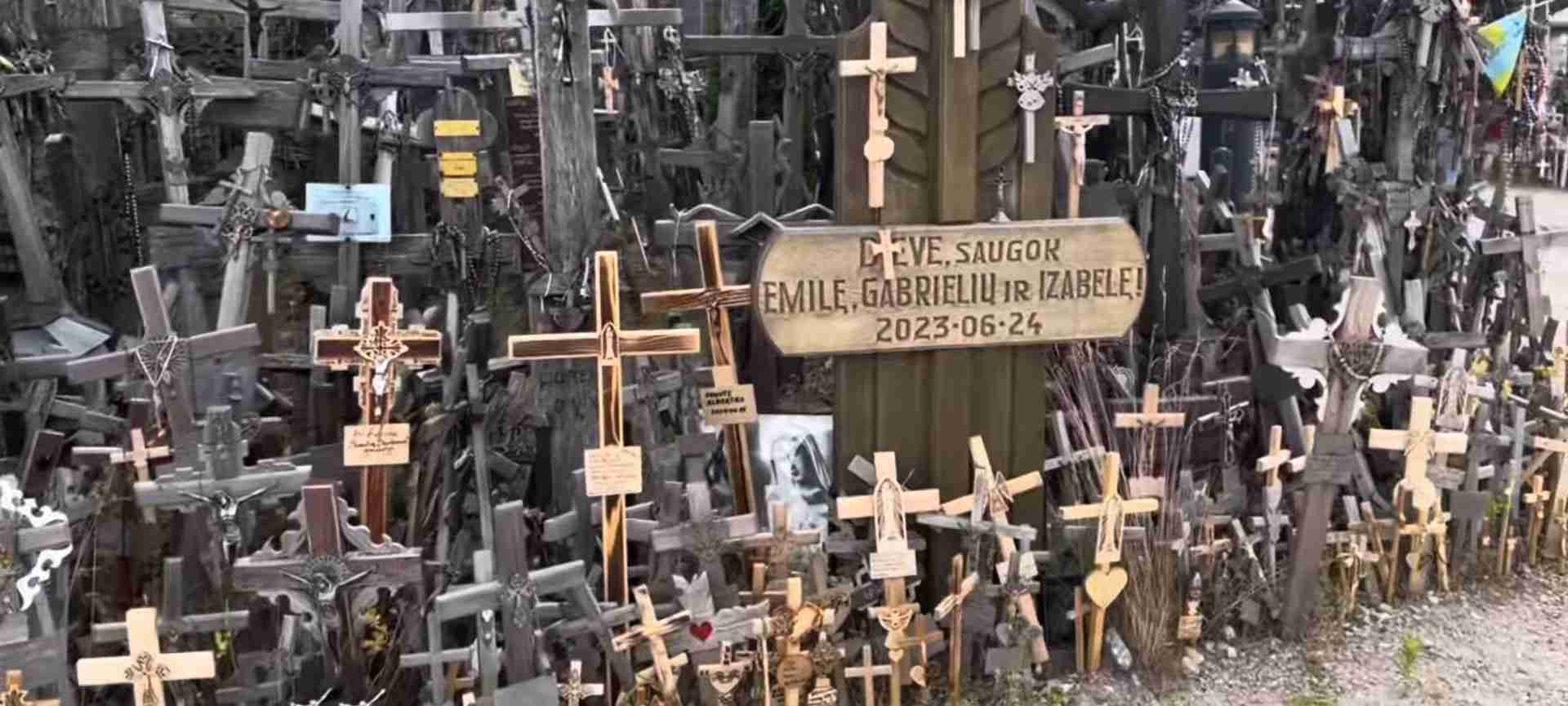
Today’s Hill of Crosses landscape defies simple description. As you approach down the gravel walkway from the parking area, you first see the hillside as a dark mass against the sky. Drawing closer, individual crosses emerge from the collective whole—massive wooden crucifixes tower 10-15 feet high, intricate metal crosses display sophisticated craftsmanship, tiny crosses dangle from larger structures, and thousands of rosaries wrap around every available surface. The crosses represent every conceivable style and material: carved wood, forged iron, polished brass, simple sticks tied with string, professional metalwork, and painted sculptures. Lithuanian patriots are depicted in carvings, Virgin Mary statues stand sentinel, and personal messages in dozens of languages cover cross surfaces. The visual density overwhelms, while the quiet atmosphere—broken only by wind chimes made from hanging rosaries—creates a profound sense of peace and reflection.
Essential Planning Information for 2026
Organizing your Hill of Crosses day trip from Riga requires understanding several key logistical elements that differ significantly between independent travel and organized tours. Latvia and Lithuania maintain an internal Schengen border with no physical checkpoints, passport stamps, or systematic immigration controls. Since both countries joined the Schengen Area on December 21, 2007, travelers can cross freely by car, bus, or train without stopping for border formalities. The former border crossing points between the two nations are now abandoned, though you may notice signs indicating you’re entering Lithuania. Immigration mobile patrols do operate randomly within both countries, making it mandatory to carry valid identification (passport or EU national ID card) at all times, even though border guards won’t check it when crossing.
Non-EU citizens should verify that their Schengen visa allows multiple-country access rather than limited territorial validity for Latvia only. Standard Schengen visas permit free movement within all Schengen member states, so tourists from the United States, Canada, Australia, and other visa-exempt countries can travel between Latvia and Lithuania without any special permissions. The 90-day stay limit within any 180-day period applies to the entire Schengen Area collectively, not to individual countries. Russian citizens and other nationals requiring visas should confirm their documentation covers both Latvia and Lithuania before attempting the journey.
Weather considerations significantly impact your Hill of Crosses experience in 2026. Summer months (June-August) offer the most comfortable conditions with temperatures between 15-25°C, extended daylight hours until 10:00 PM, and minimal rainfall. These advantages come with peak tourist crowds, particularly on weekends and during school holidays when bus tours from Vilnius and Riga arrive regularly. Spring (April-May) and autumn (September-October) provide cooler but pleasant weather, fewer visitors, and dramatic lighting for photography. Winter visits (November-March) create the most striking visual impact when snow covers the crosses, transforming the hillside into a monochromatic landscape punctuated by dark wood and metal. Temperatures can drop to -5°C to -15°C, requiring warm clothing, waterproof boots, and hand warmers for comfortable exploration. The parking area and walkways are cleared of snow, but pathways between crosses can become slippery with ice.
Timing your visit strategically enhances the experience regardless of season. Early morning arrivals between 7:00-9:00 AM offer the most peaceful atmosphere before tour buses arrive around 10:00 AM. Photography enthusiasts prize the golden hour light just after sunrise and before sunset, when low-angle sunlight creates dramatic shadows between the crosses. Midday visits during summer can be crowded with 50-100+ visitors simultaneously on the hillside, though the site is large enough that you can still find quiet corners for reflection. Late afternoon visits between 4:00-6:00 PM see crowds diminish as day-trippers return to Vilnius or Riga. The site remains open 24/7 with no gates or fences, allowing for nighttime visits, though limited lighting and safety considerations make this impractical for most visitors.
Latvia-Lithuania Border Crossing 2026
The Latvia-Lithuania border represents one of the oldest continuously recognized state boundaries in the Baltic region, first solidified after the Battle of Saule in 1236 and Battle of Durbe in 1260. The modern international border was established following both nations’ independence in 1918, formally delimited by the Treaty of Latvia-Lithuania in 1921, and demarcated on the ground between 1929-1930. Following Soviet occupation, it became an internal administrative boundary within the USSR. The border was restored as an international frontier when Latvia and Lithuania regained independence in 1991, with formal border checkpoints operating between 1991 and 2007. The 588.1-kilometer land border (plus 22.2 kilometers of sea border) runs from the triple junction with Belarus near Lake Drūkšiai to the Baltic Sea coast between Palanga and Rucava, following the Šventoji River for approximately 30 kilometers.
When Latvia and Lithuania joined the Schengen Area on December 21, 2007, all border controls between them were eliminated overnight. The former border crossing buildings, guard posts, and vehicle inspection lanes now stand abandoned along major highways, serving only as photo opportunities for tourists. Travelers notice they’ve entered Lithuania primarily through road signs that change from Latvian to Lithuanian text and the appearance of Lithuanian flags on buildings. The Via Baltica highway (European route E67) connecting Riga to the Hill of Crosses crosses the border near Meitene/Žagarė without any checkpoints, barriers, or traffic interruptions. Buses, cars, and trucks continue at highway speeds through what was once heavily fortified and strictly controlled.
Understanding Schengen Area regulations helps travelers navigate the border crossing confidently in 2026. All European Union citizens can enter and move freely within both Latvia and Lithuania using only their national identity cards—passports are not legally required, though many travelers carry them as preferred identification. Citizens of visa-exempt countries including the United States, Canada, Australia, Japan, and others can stay in the Schengen Area for up to 90 days within any 180-day period, with this calculation applying to all Schengen countries collectively. Your visit to Lithuania counts toward the same 90-day limit as your time in Latvia, not as a separate allowance. While border guards don’t conduct systematic checks when crossing internal Schengen borders, they maintain the right to verify identification anywhere within each country’s territory.
Latvia operates immigration mobile patrols that perform random checks on travelers after they’ve crossed from Lithuania, though these checks are infrequent and typically focused on suspected illegal immigration or cross-border crime rather than casual tourists. If stopped, you must present valid identification (passport or EU national ID card) and may be asked about your travel plans, accommodation, and financial means. Non-EU citizens should carry their passport with valid Schengen visa or residence permit. The border guard may verify your entry date to confirm you haven’t exceeded the 90-day limit, and in rare cases, they may contact immigration databases to check for any alerts or security concerns.
Temporary border controls can be reintroduced under exceptional circumstances, as happened in 2025 when Poland temporarily reinstated checks at its border with Lithuania due to irregular migration concerns. These temporary measures are permitted under Schengen regulations when member states face serious threats to public policy or internal security. Any reintroduction of controls between Latvia and Lithuania would be announced publicly in advance, and such measures typically target specific border crossing points rather than the entire border. As of early 2026, no temporary border controls are in effect between Latvia and Lithuania, and none are anticipated given the stable security situation in both countries.
Transportation Options from Riga 2026
Public Transport (Budget Option)
Independent travel by public transport offers the most economical route to the Hill of Crosses, with total costs of €35-50 per person for a complete day trip. The journey requires two bus segments—Riga to Šiauliai, then Šiauliai to the Domantai stop near the Hill of Crosses—plus careful timing to ensure connections work within a day-trip timeframe.
Buses from Riga Central Bus Station (Prāgas iela 1) to Šiauliai operate approximately every 4 hours on the Ollex and FlixBus services. Ollex provides the primary connection with departures at 6:00 AM, 9:00 AM, 1:00 PM, and 5:00 PM daily, taking 2 hours 30 minutes and costing €21 per person one-way. Book tickets online at ollex.eu or autobusubilietai.lt 2-7 days in advance to guarantee seats, or purchase at the bus station ticket counter on the day of travel if space remains available. FlixBus operates one daily departure at 8:30 AM with similar pricing and duration. The buses are modern, air-conditioned coaches with comfortable seats, WiFi, and onboard toilets, making the journey pleasant rather than merely functional.
Arriving at Šiauliai Central Bus Station (Tilžės g. 109), you need to navigate to the local bus platforms to reach the Hill of Crosses. If arriving by train at Šiauliai Railway Station, walk 10 minutes southeast along Dubijos Street, turn right on Tilžės Street, and you’ll see the bus station—a large modern building integrated with the Saulės miestas shopping center. This integration allows for convenient bathroom breaks, food purchases, and lunch options while waiting for connections.
Local buses from Šiauliai to the Hill of Crosses depart from Platform 8 at the bus station, following the Šiauliai-Joniškis route. Buses depart at 8:25 AM, 10:25 AM, 11:00 AM, 12:15 PM, 1:10 PM, 2:15 PM, 3:40 PM, 5:05 PM, and 8:30 PM (Monday, Friday, Sunday schedules may vary slightly). The journey takes approximately 15 minutes, and tickets cost €1 cash only, paid directly to the driver. Request the “Domantai” stop (pronounced “doh-mahn-tai”)—most drivers are accustomed to foreign tourists visiting the Hill of Crosses and will announce the stop or signal when to disembark. The bus drops you at a small bus shelter directly across from the Hill of Crosses entrance road.
Practical timing for a day trip using public transport requires catching the 6:00 AM or 9:00 AM bus from Riga. The 6:00 AM departure arrives in Šiauliai at 8:30 AM, allowing you to catch the 10:25 AM local bus to the Hill of Crosses, spend 2-3 hours at the site, return on the 2:15 PM local bus to Šiauliai, have lunch, and catch the 5:00 PM or later bus back to Riga. The 9:00 AM departure from Riga arrives at 11:30 AM in Šiauliai, connects to the 12:15 PM local bus, provides 2 hours at the Hill of Crosses, and returns via the 3:40 PM local bus and 5:00 PM Riga bus. This tighter schedule leaves minimal time for Šiauliai exploration but completes the day trip successfully.
Return bus schedules from the Hill of Crosses to Šiauliai require careful attention, as buses are less frequent than in major cities. Wait at the same bus shelter where you were dropped off, on the opposite side of the road heading back toward Šiauliai. Return buses pass at 10:40 AM, 12:30 PM, 2:15 PM, 3:55 PM, 5:20 PM, and 9:00 PM, though checking the current schedule at autobusubilietai.lt before your trip is essential as seasonal variations occur. Many independent travelers choose to use a taxi for the return journey to Šiauliai, as the cost is only €10-15 via the Bolt app, eliminating schedule concerns and providing flexibility in how long you spend at the site.
Organized Group Tours (Hassle-Free Option)
Small group tours from Riga to the Hill of Crosses eliminate transportation logistics while adding cultural commentary and additional attractions. Tours typically accommodate 6-8 passengers in comfortable vans or minibuses, departing from central Riga hotels or designated meeting points between 8:00-9:00 AM and returning by 3:00-4:00 PM.
The basic Hill of Crosses tour from Riga costs €65-75 per person and includes round-trip transportation, English-speaking driver-guide, photo stop at the Latvia-Lithuania border marker, 1-1.5 hours at the Hill of Crosses, and sometimes a brief photo stop in Jelgava. Tours operated by companies like Latvian Gem, Allure Tours Riga, and Red Fox Tours have established strong reputations with 5-star reviews from hundreds of travelers. The guides provide historical context about Lithuanian resistance, the site’s spiritual significance, and practical information about what you’re seeing, transforming the visit from simple sightseeing into an educational experience.
Combined tours that include the Hill of Crosses with Rundale Palace cost €85-110 per person and extend to 7-8 hours total duration. These tours typically visit Rundale Palace first, spending 1.5-2 hours exploring the baroque palace and French gardens (entrance tickets €12-14 included), then continue to the Hill of Crosses for 1 hour, with a lunch stop in between at a local Lithuanian restaurant. This combination maximizes a day trip from Riga by visiting two of the region’s most significant attractions, though the pace is necessarily faster than single-destination tours.
Private tours offer maximum flexibility at €140-200 total cost (not per person), making them economical for groups of 3-4 travelers. Private tours allow you to set your own schedule, spend as much time as desired at each location, make unscheduled photo stops, and customize the itinerary to include or exclude specific attractions. Many travelers use private tours to visit the Hill of Crosses at sunrise (departing Riga at 5:00 AM), which is impossible with public transport or group tours but creates extraordinary photography opportunities and a deeply contemplative experience.
Self-Drive (Maximum Flexibility)
Driving from Riga to the Hill of Crosses provides complete independence and allows you to explore Šiauliai and surrounding areas at your own pace. The journey covers 123 kilometers each way, taking approximately 1 hour 40 minutes under normal traffic conditions via the A12/E77 highway through Bauska, then A7/E77 into Lithuania.
Rental cars in Riga cost €35-50 per day for a compact vehicle through international companies like Sixt, Europcar, or Budget, with pickup locations at Riga Airport and downtown offices. Verify that your rental agreement permits cross-border travel to Lithuania—most companies allow this without additional fees, but some budget operators restrict vehicles to Latvia only. You’ll need your driver’s license, passport, and credit card for the rental deposit. GPS navigation or a downloaded offline map (Google Maps works well offline if you download the Latvia and Lithuania regions in advance) is essential, as rural areas have limited road signage in English.
The driving route from Riga follows the A12 highway southeast toward Bauska, continuing on the E77 toward Jelgava, then crossing into Lithuania where the highway becomes A12 in Lithuania. The road quality is excellent throughout—smooth asphalt, two lanes in each direction for most of the route, and clear signage. The border crossing point is unmarked, noticeable only through the change in road surface texture and directional signs switching from Latvian to Lithuanian language. Traffic is generally light except during rush hours near Riga (7:00-9:00 AM outbound, 4:00-7:00 PM inbound).
Fuel costs add €10-15 to your total expenses, as the round trip of 246 kilometers consumes approximately 15-20 liters depending on your vehicle. Lithuania’s fuel prices are typically €0.05-0.10 per liter cheaper than Latvia’s, making it worthwhile to fill up before returning to Riga. Major fuel station chains (Circle K, Neste, Virši) accept credit cards and have attendants who speak basic English at most locations.
Parking at the Hill of Crosses costs approximately €1 (exact amount varies) for the day, paid at an automated machine near the entrance to the parking area. The lot accommodates 100+ vehicles and fills completely only on major religious holidays or peak summer weekends. Overflow parking along the roadside is tolerated if the main lot is full. From the parking area, a 300-meter gravel pathway leads to the hillside—completely flat and suitable for strollers or wheelchairs until you reach the hill itself, where paths become uneven and stairs appear.
Hill of Crosses Visitor Experience 2026
The Hill of Crosses site consists of two main hills—the larger, original hillside covered densely with crosses, and a smaller adjacent hill with somewhat sparser coverage. A modern visitor center complex opened in the early 2000s includes clean public toilets, a gift shop selling crosses and religious souvenirs, informational displays about the site’s history, and covered areas for rest. The facility is simple but functional, designed to serve pilgrims and tourists without commercializing the sacred atmosphere of the hillside itself.
Approaching the Hill of Crosses from the parking area takes approximately 5 minutes along a wide gravel path suitable for wheelchairs and strollers. The path is lined with informational panels describing the site’s history in Lithuanian, English, and other languages. As you walk, the hillside comes into view gradually—first as a dark mass against the horizon, then individual large crosses emerge, and finally the overwhelming density of smaller crosses, rosaries, and religious items becomes apparent. The visual impact builds dramatically rather than appearing suddenly, creating a sense of anticipation and reverence.
The hillside itself offers multiple pathways winding between the crosses, allowing visitors to explore at different levels and angles. Wooden staircases provide access to higher sections of the hill, though the narrow paths and uneven ground make wheelchair access impossible once you leave the main walkway. Most visitors spend 1-2 hours on the site—30 minutes for a quick walk through the main areas, or 2-3 hours for photography enthusiasts and those seeking quiet reflection. The site is never entirely empty (barring early morning weekday visits in winter), but the size of the hillside allows you to find relatively isolated spots even when 50+ other visitors are present.
Photography at the Hill of Crosses presents both challenges and opportunities. The density of crosses makes it difficult to isolate individual subjects without other elements intruding into the frame. Wide-angle lenses (16-35mm) work well for capturing the overall scene and the overwhelming quantity of crosses. Telephoto lenses (70-200mm) allow you to compress perspective and isolate interesting details—intricate metalwork, weathered carvings, specific religious imagery. Morning light creates long shadows and warm tones, while overcast days provide soft, even lighting that works well for detail shots. Many photographers return multiple times to capture the site in different light conditions and seasons.
Leaving your own cross at the Hill of Crosses creates a personal connection to the site and participates in the centuries-old tradition. The visitor center gift shop sells crosses in various sizes and materials—small wooden crosses start at €5, medium decorative crosses cost €10-15, and larger ornate pieces reach €20-30. You can also bring a handmade cross from home, which many visitors find more meaningful. Write a prayer, message, or names on the cross before placing it. There are no restrictions on where you can place your cross—some visitors attach them to larger existing structures, others plant them in the ground, and some find special spots that hold personal significance.
The site maintains a contemplative atmosphere despite tourist crowds. Many visitors walk in silence, and loud conversation feels inappropriate. You’ll see pilgrims praying on their knees, couples quietly reflecting together, and individuals lighting candles at the larger crucifixes. The wind creates a gentle, almost musical sound as it moves through thousands of hanging rosaries and small metal crosses. This ambient soundscape, combined with the visual density of religious imagery, creates an environment that feels genuinely sacred regardless of your personal religious beliefs.
Šiauliai City Attractions 2026
Šiauliai offers substantial cultural attractions that justify extending your Hill of Crosses day trip into a 6-8 hour itinerary including the city itself. Lithuania’s fourth-largest city (population 110,000) often gets overlooked by tourists focusing exclusively on Vilnius and Kaunas, but its collection of specialized museums, impressive cathedral, and unique public art make it a worthwhile destination rather than merely a transit point to the Hill of Crosses.
St. Peter and Paul’s Cathedral dominates Šiauliai’s skyline with Lithuania’s tallest church tower at 70 meters. This Renaissance masterpiece was constructed between 1595-1625, though the tower was added in 1871. Pope John Paul II visited in 1993 following his pilgrimage to the Hill of Crosses, elevating the cathedral’s significance within Lithuanian Catholicism. The interior features baroque altars, 17th-century frescoes, and an impressive organ. The tower can be climbed (tickets €3) for panoramic views across Šiauliai and the surrounding countryside, though the 200+ stairs require reasonable fitness. Free entry to the cathedral itself makes this an easy addition to any itinerary.
Photography Museum (Vilniaus g. 140) houses the only dedicated photography museum in Lithuania, with extensive collections of historic cameras, photographic equipment, and exhibitions of Lithuanian photographers’ work. The museum occupies a renovated early 20th-century building and includes a modern gallery space, educational studio, photo laboratory, reading room, and museum shop. Admission costs €3, and the roof terrace provides views over Šiauliai Boulevard. Photography enthusiasts should budget 1.5-2 hours to explore the collections thoroughly, while casual visitors can see the highlights in 45 minutes.
Sundial Square (Saulės laikrodžio aikštė) represents Šiauliai’s main public gathering space, anchored by Lithuania’s tallest sundial at 18 meters. The golden sundial functions accurately on sunny days, and the surrounding amphitheater hosts summer concerts and events. The square underwent major renovation in 2015, adding modern paving, benches, and lighting that create an attractive space for relaxation. Nearby Šiauliai Boulevard features street art, sculpture, and cafe terraces where locals gather for coffee and conversation.
The Iron Fox sculpture stands as Šiauliai’s most iconic landmark and selfie spot. This massive metal fox sculpture, recorded in Lithuania’s Book of Records as the country’s largest metal animal sculpture, represents the legendary founding of Šiauliai. According to local legend, a fox’s howling led to the discovery of treasure that funded the city’s establishment. The sculpture sits at Vilniaus g. 74, easily accessible from the city center.
Rūta Chocolate Museum (Vilniaus g. 142) celebrates Lithuania’s oldest chocolate company, Rūta, founded in 1913. The museum traces chocolate history from ancient Aztecs to modern manufacturing, includes interactive exhibits, and concludes with chocolate tasting. Entrance costs €5 including samples of Rūta chocolates. The attached shop sells full product lines at factory-direct prices, making it popular with locals stocking up on gifts and treats.
Cat Museum (Žurgių g. 80) houses an extensive collection of cat-related art, figurines, and memorabilia in a charming historic building. The museum’s director—a cat—officially oversees several resident cats who wander through the galleries greeting visitors. This quirky attraction costs €3 to enter and takes 30-45 minutes to explore, appealing primarily to cat enthusiasts and those seeking unique photo opportunities.
Bicycle Museum (Vilniaus g. 137A) displays vintage and historic bicycles from the late 19th century through Soviet era, showing the evolution of bicycle design and Lithuania’s cycling culture. The museum is small but well-curated, with informative English audio guides available. Admission costs €2.50, and most visitors spend 30-45 minutes viewing the collection.
Chaim Frenkel Villa-Museum (Ežero g. 64) stands as the only Art Nouveau villa-museum in the Baltic States, built in 1908 for Jewish leather industrialist Chaim Frenkel. The beautifully restored building hosts rotating exhibitions, concerts, and workshops. The surrounding rose garden blooms magnificently in June-July. Admission costs €3, with guided tours available in English on weekends for €5 additional.
Restaurant and Food Options 2026
Šiauliai’s dining scene caters primarily to Lithuanian tastes, with traditional dishes dominating menus alongside international options. Most restaurants cluster near the city center and within the two major shopping centers—Saulės miestas (at the bus station) and Akropolis. Prices are notably lower than Riga, with substantial meals costing €8-15 rather than €12-20.
Black Bar (Vasario 16-osios g. 48) ranks among Šiauliai’s finest restaurants, offering upscale Eastern European cuisine without chemical additives. The menu features Lithuanian classics alongside international dishes, extensive beer selection (local and imported), and quality wines. The atmosphere balances elegance with comfort—suitable for both casual lunches and business dinners. Main courses cost €12-18, daily lunch specials €6-8. Service is professional, with English-speaking staff who can explain traditional dishes. The restaurant fills quickly on weekend evenings, making reservations advisable.
TRYS (Vilniaus g. 138) has established itself as a local favorite for family dining, offering global cuisines in a warm, inviting atmosphere. Located slightly away from the busy city center, TRYS provides peaceful ambiance for business lunches or relaxed weekend breakfasts. The Saturday morning breakfast menu features dishes inspired by international cuisines. Main courses range €10-15, with generous portions that often satisfy two people. Reviews consistently praise the friendly English-speaking staff and diverse menu accommodating various dietary needs.
Žemaitis Restoranas (P. Višinskio g. 41b) specializes in traditional Lithuanian cuisine at very affordable prices. The self-service cafeteria-style layout allows you to see dishes before ordering, helpful when navigating unfamiliar Lithuanian foods. Cepelinai (potato dumplings filled with meat), šaltibarščiai (cold beet soup), and bulviniai blynai (potato pancakes) represent authentic regional cooking. Complete meals including soup, main course, side dish, and drink cost €3-5. The restaurant fills with Lithuanian office workers at lunchtime (12:00-2:00 PM), indicating the food quality and value. Service can be impersonal due to the cafeteria format, and limited English is spoken.
Charlie Pizza (Tilžės g. 109, inside Saulės miestas shopping center) provides convenient dining when arriving or departing via the bus station. The restaurant occupies the upper floor with panoramic windows overlooking the city. Weekday lunch specials (11:00 AM-3:00 PM) offer soup, pizza or pasta, and water for €6-7. Regular menu pizzas cost €8-12, with fresh ingredients and generous toppings. The location makes it ideal for a quick meal while waiting for your bus back to Riga.
Grill London (also in Saulės miestas shopping center) serves international grill cuisine—steaks, burgers, ribs—in a modern setting. The restaurant targets shoppers and travelers seeking familiar food, with an English-language menu and photos of dishes. Burgers cost €8-10, steaks €12-18, with large portions that often require takeaway containers. Reviews note variable service quality, sometimes slow when busy, though food quality remains consistently good.
For budget travelers or those wanting quick meals, Saulės miestas shopping center includes supermarket Maxima and various fast-food outlets—local chains and international brands. You can assemble picnic supplies for eating at Lake Talša park or pack snacks for the Hill of Crosses visit. The shopping center also has clean public toilets (free for customers) and comfortable seating areas.
Sample Itineraries 2026
Budget Independent Day Trip (€35-50 per person)
6:00 AM – Depart Riga Central Bus Station on Ollex bus to Šiauliai (€21, pre-booked online)
8:30 AM – Arrive Šiauliai bus station, purchase coffee and pastry at Maxima supermarket (€3)
9:00 AM – Explore Šiauliai center: St. Peter and Paul’s Cathedral, Sundial Square, Iron Fox sculpture
10:25 AM – Board local bus from Platform 8 to Hill of Crosses (€1 cash to driver)
10:40 AM – Arrive at Hill of Crosses, explore the hillside
11:00 AM – Leave your cross at the site, purchased from visitor center (€5-10)
12:30 PM – Continue exploring, photography, quiet reflection
1:45 PM – Return to bus stop for 2:15 PM local bus to Šiauliai (€1)
2:30 PM – Arrive Šiauliai, lunch at Žemaitis restaurant (€5-7 for soup and main course)
3:30 PM – Quick visit to Photography Museum or Chocolate Museum (€3-5)
4:30 PM – Return to bus station
5:00 PM – Board return bus to Riga (€21)
7:30 PM – Arrive Riga
Total cost: €35-42 per person (excluding accommodation, breakfast, or dinner in Riga). This tightly-timed itinerary requires everything to run on schedule, so build in flexibility by catching the 9:00 AM bus from Riga if you prefer a more relaxed pace.
Comfortable Group Tour Day Trip (€65-75 per person)
8:30 AM – Hotel pickup in central Riga or meet at designated departure point
9:00 AM – Depart Riga in comfortable minivan (6-8 passengers)
10:00 AM – Photo stop at Latvia-Lithuania border marker (10 minutes)
10:30 AM – Brief stop in Jelgava for photos of Orthodox Cathedral exterior (15 minutes)
11:15 AM – Arrive at Hill of Crosses
11:30 AM – Guided introduction to the site’s history and significance (20 minutes)
11:50 AM – Free time to explore, photograph, leave crosses (1 hour 10 minutes)
1:00 PM – Depart Hill of Crosses
2:00 PM – Arrive back in Riga, hotel drop-off
Total cost: €65-75 per person including transportation and English-speaking guide. Tours typically don’t include lunch, but many travelers eat before departure or pack snacks. This represents the most hassle-free option, ideal for first-time visitors or those uncomfortable navigating public transport in foreign countries.
Self-Drive Extended Exploration (€80-100 per person for 2 people sharing)
7:00 AM – Pick up rental car in Riga (€45 for the day, split between 2 people)
7:30 AM – Depart Riga via A12/E77 highway
9:00 AM – Arrive Hill of Crosses, enjoy quiet morning atmosphere before tour groups
9:15 AM – Explore hillside, photograph in morning light (1 hour 45 minutes)
11:00 AM – Depart for Šiauliai city center (15 minutes drive)
11:15 AM – Visit St. Peter and Paul’s Cathedral, climb tower for views (€3)
12:00 PM – Walk through Šiauliai Boulevard, see Iron Fox sculpture
12:30 PM – Lunch at Black Bar restaurant (€12-15 per person)
1:45 PM – Visit Photography Museum or Chocolate Museum (€3-5)
2:45 PM – Drive to optional Rundale Palace (45 minutes via A12) OR return directly to Riga
Option A with Rundale: 3:30 PM arrive Rundale, explore palace and gardens (€12 admission, 1.5 hours)
Option B direct return: 4:15 PM arrive Riga
6:00 PM – Return to Riga if visiting Rundale, return rental car
Total cost: €40-50 per person (rental car, fuel, parking) plus €20-30 for meals and admissions. This option provides maximum flexibility for photographers wanting to capture sunrise/sunset light or families needing to accommodate children’s schedules.
Practical Tips and Essential Information 2026
Navigating the Latvian-Lithuanian border crossing requires no special procedures beyond carrying valid identification. Keep your passport or EU national ID card readily accessible, though border guards are extremely unlikely to check it when crossing by bus or car on major highways. If you’re stopped by immigration mobile patrols (rare), simply show your passport and explain you’re a tourist visiting the Hill of Crosses. Non-EU citizens should have their Schengen visa documentation available if requested. The entire border crossing process is invisible to travelers—you’ll notice only the change in road signs and perhaps slight differences in road surface texture.
Currency considerations matter when visiting Lithuania from Latvia. Latvia uses the Euro (€), and Lithuania also uses the Euro (€), having adopted it in 2015. This shared currency eliminates any need for money exchange, though you should carry cash for the local bus to the Hill of Crosses (€1 cash only, drivers don’t accept cards) and potentially for small purchases at the visitor center. Credit cards are widely accepted in Šiauliai restaurants and shops, with Visa and Mastercard most common. ATMs are plentiful in Šiauliai if you need to withdraw cash.
Mobile phone connectivity works seamlessly between Latvia and Lithuania for all EU mobile operators, which don’t charge roaming fees within EU countries. Non-EU visitors should verify their mobile plan covers Lithuania or purchase a local Baltic SIM card with cross-border data. Both Latvian and Lithuanian mobile networks provide good 4G/5G coverage along major highways and in cities, though rural areas near the Hill of Crosses may have reduced signal strength.
Language barriers are minimal for English speakers in 2026. Šiauliai’s tourist industry has developed significantly, and most restaurant servers, museum staff, and transport workers speak functional English. Younger Lithuanians typically speak better English than older generations. In Šiauliai, looking for restaurants near the city center or in shopping centers increases the likelihood of English-speaking staff. The Hill of Crosses visitor center has English-speaking staff during normal hours. All informational signage at the Hill of Crosses includes English translations alongside Lithuanian text.
Safety and security in both Latvia and Lithuania rank among the highest in Europe. Šiauliai is a safe city for tourists, with minimal crime targeting visitors. Standard precautions apply—don’t leave valuables visible in parked cars, keep your wallet secure in crowded areas, and be aware of your surroundings at night. The Hill of Crosses is completely safe even for solo travelers, and many people visit alone without any concerns. The only safety consideration is watching your footing on the hillside, where uneven paths and wooden stairs can be slippery when wet.
Weather preparation significantly impacts your Hill of Crosses experience. Summer visitors need sun protection—strong UV rays at this northern latitude, hat, sunglasses, and sunscreen—plus insect repellent for mosquitoes in surrounding wetlands. Light rain jacket or umbrella covers sudden summer showers. Winter visitors require warm layered clothing (temperature can be -10°C to -15°C), waterproof boots with good traction for potentially icy paths, hand warmers, and hat covering ears. Spring and autumn visitors should dress in layers, as morning temperatures may be 5-10°C cooler than afternoon highs.
Accessibility considerations limit full participation for wheelchair users and people with significant mobility challenges. The pathway from parking to the base of the hillside is completely wheelchair accessible—wide, flat, gravel surface suitable for both manual and electric wheelchairs. The visitor center, toilets, and gift shop are all accessible. However, once you reach the hillside itself, wheelchair access becomes impossible due to narrow paths, stairs, uneven ground, and steep slopes. Companions can explore the hillside while wheelchair users remain at the base viewing area, which still provides good views of the lower sections. People with moderate mobility limitations can explore the lower hillside areas using walking sticks or canes for stability.
Respect and etiquette at this sacred site require consideration despite its dual nature as pilgrimage destination and tourist attraction. Many Lithuanian Catholics consider the Hill of Crosses their most important pilgrimage site, and you should respect their devotions. Maintain reasonable quiet—conversation is fine, but loud voices, music, or disruptive behavior is inappropriate. Dress modestly, particularly if visiting during religious festivals—covered shoulders and knees show respect, though formal religious dress is not required. Photography is permitted throughout the site, including close-ups of individual crosses, but avoid photographing people praying without permission. Some larger crosses have containers for candles—you may light candles as a gesture of respect or remembrance, but ensure they’re placed safely in provided holders.
Best Time to Visit Hill of Crosses 2026
Seasonal considerations dramatically affect your Hill of Crosses experience, with each season offering distinct advantages and challenges. Summer (June-August) provides the most comfortable weather for exploration, with temperatures between 15-25°C, minimal rainfall, and extended daylight until 10:00 PM allowing for sunset photography. These comfortable conditions attract the largest crowds—weekends in July can see 100-200+ visitors on the hillside simultaneously, with tour buses from Vilnius, Riga, and other Baltic cities arriving continuously from 10:00 AM to 4:00 PM. The surrounding countryside is lush and green, creating a pleasant drive from Riga.
Spring (April-May) and autumn (September-October) represent the sweet spot for many visitors—cooler but pleasant weather, dramatically fewer crowds, and special visual characteristics. Spring brings wildflowers to the surrounding fields and brighter green tones throughout the landscape. Autumn creates golden-toned photographs with warm light, though days are shorter than summer (sunset around 6:00 PM by October). Temperatures range 5-15°C, requiring layered clothing but remaining comfortable for extended outdoor exploration. Rain becomes more frequent, particularly in October, making waterproof jackets essential. These shoulder seasons see perhaps 30-50 visitors on average weekday afternoons, allowing for more contemplative experiences.
Winter (November-March) transforms the Hill of Crosses into a stark, monochromatic landscape that many photographers consider the most visually dramatic. Snow covers the crosses, creating white-on-black contrasts when viewed against dark wood and metal. The visual density that can feel overwhelming in summer becomes almost ethereal under snow. However, winter visits require serious cold-weather preparation—temperatures drop to -5°C to -15°C regularly, with occasional cold snaps reaching -20°C. Wind chill makes these temperatures feel even colder. The parking area and main pathway are cleared of snow, but paths between crosses can be icy and slippery. Winter crowds are minimal—you might encounter only 5-10 other visitors on a weekday, creating a profoundly peaceful atmosphere.
Time of day dramatically impacts your experience regardless of season. Early morning visits between 7:00-9:00 AM offer the most peaceful conditions before tour buses arrive. The site is accessible 24/7, so arriving at sunrise provides photographers with golden hour light and virtually guaranteed solitude. Weekday mornings see fewer visitors than weekends. Midday visits (11:00 AM-3:00 PM) during summer coincide with peak tour bus arrivals, creating the most crowded conditions. Late afternoon visits between 4:00-6:00 PM find a middle ground—tour groups have departed, but enough daylight remains for comfortable exploration and photography.
Lithuanian religious holidays and festivals create special circumstances worth either seeking or avoiding. The Hill of Crosses sees its largest crowds during major Catholic feast days—particularly September 14 (Feast of the Cross), when thousands of pilgrims attend outdoor mass at the site. Easter Sunday also draws large religious crowds. These occasions offer unique cultural experiences and the opportunity to witness the site’s active pilgrimage role, but parking becomes extremely difficult and the contemplative atmosphere disappears amid crowds. Christmas and New Year periods are relatively quiet, as most Lithuanians celebrate with family at home rather than making pilgrimages.
Combining with Other Attractions
Maximizing your day trip from Riga can include additional attractions along the route between Riga and the Hill of Crosses, creating more comprehensive itineraries for travelers with extra time or those making a multi-day journey through the Baltics.
Rundale Palace (Pilsrundāle) stands as the most significant attraction between Riga and the Hill of Crosses, located 12 kilometers off the main highway approximately 40 minutes from Riga. This baroque and rococo masterpiece, designed by Italian architect Francesco Bartolomeo Rastrelli (who also designed St. Petersburg’s Winter Palace), features 138 rooms including spectacular state apartments, the White Hall, Great Gallery, and Duke’s private chambers. The French gardens extend over 10 hectares with geometrically arranged parterres, sculptures, and fountains. Palace admission costs €12 for adults (including gardens), with audio guides available in English. Visitors typically spend 1.5-2 hours exploring the palace interior and gardens. Combined tours from Riga visiting both Rundale Palace and the Hill of Crosses cost €85-110 per person and last 7-8 hours total.
Jelgava, Latvia’s third-largest city (population 60,000), sits directly on the route between Riga and Lithuania. Most organized tours include a brief photo stop at the Orthodox Cathedral (Liela iela 49), an impressive blue-and-gold-domed structure built in 1897, destroyed during WWII, and reconstructed between 1993-2003. The interior features beautiful frescoes and icon paintings. Jelgava Palace, while not open for tourist visits (it houses Latvia University of Agriculture), presents an impressive baroque facade worth photographing. Both stops take 15-20 minutes combined, adding minimal time to your journey.
Pakruojis Manor, located 45 kilometers northeast of Šiauliai, recreates 19th-century Lithuanian noble life as a living museum. The restored manor complex includes the main palace, servants’ quarters, stables, watermill, and brewery, all functioning as they did 150 years ago. Visitors can observe traditional crafts, sample manor-brewed beer, and explore the extensive park grounds. Admission costs €8 for adults. This requires a significant detour from the Riga-Hill of Crosses route, adding 1.5 hours to your journey each way, making it realistic only for multi-day itineraries or those with rental cars and flexible schedules.
Budget Breakdown 2026
Understanding total costs helps plan your Hill of Crosses day trip effectively, with expenses varying significantly between independent travel and organized tours.
Independent Public Transport Day Trip costs €35-50 per person for a complete experience. Bus from Riga to Šiauliai costs €21 one-way, so €42 round-trip represents your largest expense. Local bus from Šiauliai to Hill of Crosses costs €1 each way, totaling €2. Lunch in Šiauliai at budget-friendly Žemaitis restaurant costs €5-7 for soup and main course, or €12-15 at mid-range Black Bar. Cross to leave at the Hill of Crosses from visitor center gift shop costs €5-10 depending on size and design. Museum admission (Photography or Chocolate) adds €3-5 if you choose to visit. Coffee and snacks at Šiauliai bus station cost €3-5. Total budget: €60-85 including all transport, meals, cross, and one museum.
Group Tour Day Trip costs €65-75 per person for basic Hill of Crosses tours, or €85-110 for combined tours including Rundale Palace. Tours include all transportation, English-speaking guide, and photo stops, but not meals or museum admissions. Budget an additional €10-15 for lunch if the tour doesn’t include it, and €5-10 for a cross from the visitor center. Total tour budget: €80-95 for basic tours, €100-130 for combined tours including meals and cross.
Self-Drive Day Trip costs vary depending on group size. Rental car costs €45-50 per day, split between passengers (€22-25 per person for 2 people, €11-13 per person for 4 people). Fuel costs approximately €15 for the 246-kilometer round trip, again split between passengers. Parking at Hill of Crosses costs €1 total. Meals in Šiauliai cost €12-15 per person for lunch at mid-range restaurant. Cross and museum admissions add €8-15. Total self-drive budget for 2 people: €65-80 per person; for 4 people: €45-60 per person.
Money-saving strategies can reduce costs further. Book Ollex buses at least one week in advance for occasional promotional fares (sometimes €15-18 rather than €21). Pack lunch from Riga supermarkets rather than eating in restaurants, saving €8-12 per person. Bring a handmade cross from home instead of purchasing at the visitor center, saving €5-10. Skip museum visits if time or budget is tight—the Hill of Crosses itself is free and represents the primary attraction. Consider self-driving with a group of 3-4 people to split rental car costs efficiently.
Frequently Asked Questions
Is the Hill of Crosses worth visiting from Riga?
The Hill of Crosses ranks among the most unique and moving sites in the Baltic region, justifying the 3-4 hour round trip from Riga for most travelers. The site offers experiences unavailable elsewhere—the visual density of 200,000+ crosses creates an overwhelming impression, while the history of Lithuanian resistance during Soviet occupation adds profound meaning. Photography enthusiasts find endless subjects, spiritual travelers experience genuine sacred atmosphere, and history buffs appreciate the tangible connection to Lithuanian national identity. The journey crosses from Latvia to Lithuania seamlessly, adding international travel interest. Travelers who enjoyed sites like Auschwitz, Soviet memorials, or other places of historical resistance typically find the Hill of Crosses equally compelling, though in a more hopeful context.
How long should I spend at the Hill of Crosses?
Most visitors spend 1-2 hours at the Hill of Crosses, with wide variation based on interest level. Quick tours allowing 45 minutes provide enough time to walk through the main areas, take basic photos, and get a sense of the site’s scale and significance. Standard visits of 1-1.5 hours allow for thorough exploration of both main hills, time to purchase and leave your own cross, and basic photography. Photography enthusiasts and those seeking quiet contemplation often spend 2-3 hours, particularly during early morning or late afternoon when light conditions are optimal and crowds are minimal. The site never feels rushed—you can leave when you feel complete with the experience.
Can I visit the Hill of Crosses in winter?
Winter visits to the Hill of Crosses create the most dramatically beautiful photographs and the most peaceful experiences, though they require serious cold-weather preparation. Snow transforms the hillside into a stark monochromatic landscape, while freezing temperatures keep crowds minimal. Dress in multiple warm layers, wear insulated waterproof boots, bring hand warmers and face protection, as temperatures of -10°C to -20°C are common December through February. The parking area and main pathway remain cleared of snow, but paths between crosses can be icy. Visit during midday hours (11:00 AM-2:00 PM) when temperatures peak and daylight is strongest. Winter also offers the advantage of low-season pricing on Riga accommodations and potentially cheaper bus fares.
Do I need to book buses from Riga to Šiauliai in advance?
Advance booking is strongly recommended but not always mandatory, depending on season and day of week. Summer weekends (June-August) and major holidays see buses fill completely, particularly the convenient morning departures that allow full-day trips. Book 3-7 days in advance through ollex.eu or autobusubilietai.lt to guarantee seats and often secure slightly cheaper fares (€18-19 rather than €21). Weekday departures outside summer usually have available seats for same-day purchase at Riga bus station, though you risk missing your preferred departure time if the bus is full. The return journey from Šiauliai to Riga also benefits from advance booking, as you’ll know your exact return schedule.
Are there restrooms at the Hill of Crosses?
The modern visitor center complex includes clean public toilets near the parking area, open daily during visitor center hours (approximately 9:00 AM-6:00 PM). These facilities are free to use and include both standard toilets and accessible facilities. Outside these hours, the toilets are locked. No facilities exist on the hillside itself, so use the visitor center toilets before walking to the crosses. Šiauliai bus station (Saulės miestas shopping center) has public toilets available 24/7 for a small fee (€0.20-0.30) or free for customers of the shopping center restaurants and shops.
Can I take photos at the Hill of Crosses?
Photography is completely permitted and actively encouraged at the Hill of Crosses. No restrictions apply to what you can photograph or how—wide landscape shots, close details of individual crosses, creative compositions, or documentary photography all work. Professional photographers with tripods and extensive equipment are common sights. Drone photography operates in a legal gray area—no explicit permission is required, but flying drones near crowds raises safety concerns and potential complaints. The only photography etiquette consideration is avoiding photographing people praying without their permission, out of respect for the site’s active religious use. The best light occurs during golden hours—30 minutes after sunrise and 30 minutes before sunset—when low-angle light creates dramatic shadows and warm tones.
What should I bring to the Hill of Crosses?
Essential items for a Hill of Crosses visit include comfortable walking shoes (paths are gravel and can be muddy after rain), weather-appropriate clothing (layers for changeable Baltic weather), water bottle (no drinking water available on-site), and valid identification (passport or EU national ID card for border crossing). Optional but recommended items include sunscreen and hat for summer visits, insect repellent for surrounding wetlands, rain jacket or umbrella, snacks if visiting during meal times, cash for local bus fare (€1 exact change helpful), camera or smartphone with charged battery, and a cross if you want to leave one (can purchase on-site for €5-30 or bring handmade). Winter visitors should add hand warmers, insulated boots, and face protection.
Is the Hill of Crosses suitable for children?
Families with children age 8+ typically find the Hill of Crosses engaging, particularly if you explain the historical significance beforehand. Children enjoy the treasure-hunt aspect of finding interesting crosses, and leaving their own cross creates personal investment in the visit. The hillside paths are safe for children, with no dangerous drops or hazards, though the wooden stairs require supervision for younger children. Very young children (under 5) may find the site boring and the 1+ hour visit length too long for their attention spans. The contemplative atmosphere means children need to maintain reasonable quiet, which can be challenging for active youngsters. Consider combining with Šiauliai’s Chocolate Museum or Cats Museum to balance the serious pilgrimage site with child-friendly attractions.
Can I visit the Hill of Crosses on Sunday?
Sunday visits are completely possible, with the Hill of Crosses open 24/7 every day of the year including Sundays. Bus schedules from Riga to Šiauliai operate on Sundays with slightly reduced frequency—check ollex.eu for exact Sunday departure times, which may differ from weekday schedules. The local bus from Šiauliai to Hill of Crosses also runs on Sundays, though again with somewhat different timing than weekdays. Sunday visits encounter slightly larger crowds, particularly during summer months when weekend tourists from Vilnius and Kaunas make day trips. Sunday mornings at 8:00-10:00 AM remain peaceful before most visitors arrive, while Sunday afternoons see peak crowds. The visitor center and gift shop operate normal hours on Sundays.
What is the difference between the Hill of Crosses and regular tourist sites?
The Hill of Crosses differs fundamentally from typical tourist attractions in its dual nature as active pilgrimage site and historical monument. Unlike castles, museums, or scenic viewpoints designed primarily for tourism, the Hill of Crosses serves ongoing spiritual functions for Lithuanian Catholics who leave crosses, pray, light candles, and seek blessings. This active religious use creates a sacred atmosphere that persists despite tourist crowds, requiring visitors to balance their natural touristic behaviors (photography, conversation, exploration) with respect for others’ devotions. The lack of conventional tourism infrastructure—no gift shop on the hillside, minimal signage, no guided path—reflects its organic growth rather than planned development. The site’s meaning to Lithuanian national identity runs deeper than historical or architectural interest, representing resistance, faith, and cultural survival.