Heidelberg Castle: Germany’s Romantic Ruin Guide
Key Takeaways
- Heidelberg Castle represents Germany’s most significant romantic ruin, destroyed by French forces in 1689 and 1693 during the War of the Grand Alliance
- The fortress combines 500 years of architectural evolution from medieval fortifications through Renaissance palaces to baroque additions
- The Great Barrel (Großes Fass) holds 220,000 liters, built in 1751 as the world’s largest wine cask celebrating Palatinate viticulture
- Romantic poets and artists transformed the ruins into European cultural icon during the 19th century, establishing the aesthetic category of romantic decay
- The castle overlooks Heidelberg from Königstuhl mountain slopes at 80 meters above the Neckar River, dominating Germany’s most photographed urban landscape
- UNESCO World Heritage nomination remains under consideration, recognizing cultural significance to European romanticism and architectural heritage value
Introduction to Heidelberg Castle
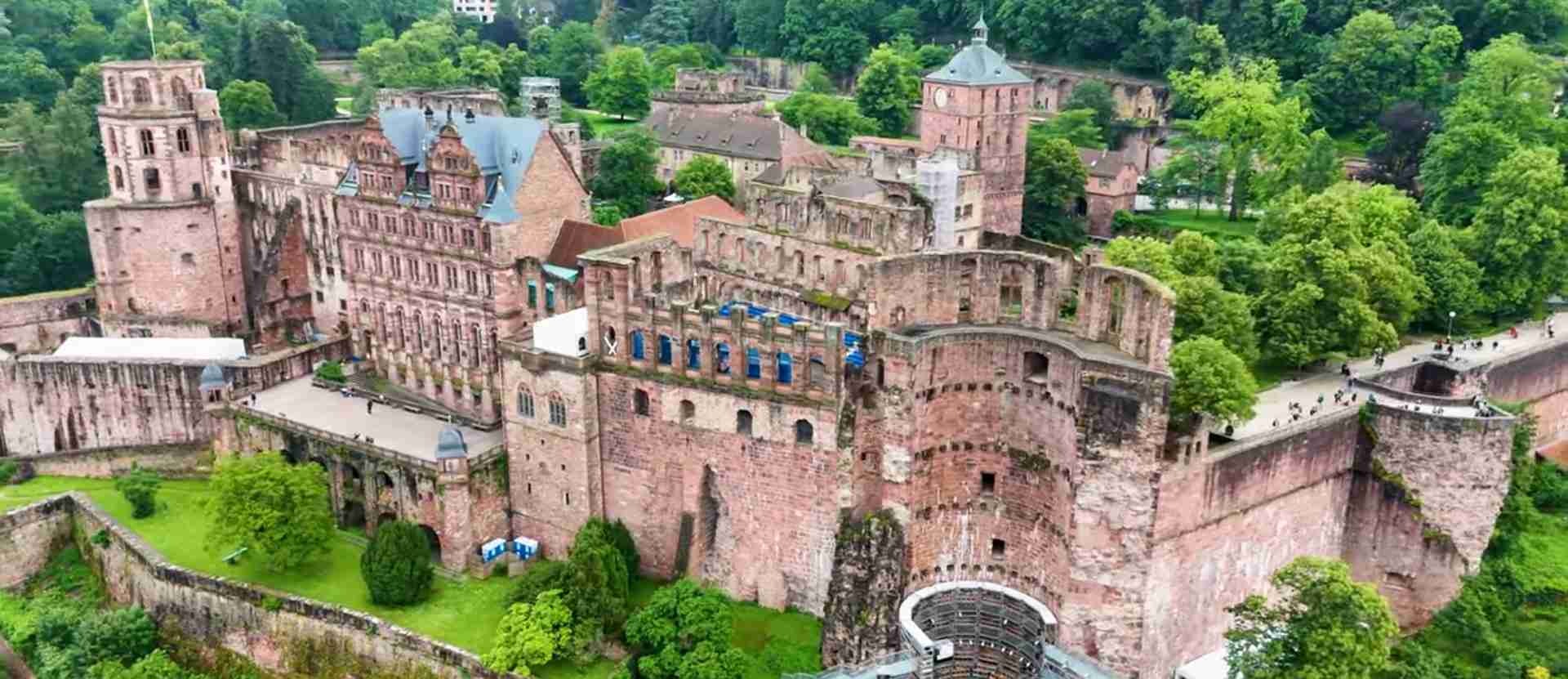
Heidelberg Castle stands as the physical embodiment of German romanticism, where Renaissance splendor meets picturesque destruction across a hillside complex overlooking the Neckar River. The fortress began as medieval fortification around 1214, evolved through five centuries of construction and expansion, suffered catastrophic destruction by French forces in the late 17th century, and achieved immortalization as cultural icon through 19th-century romantic movement artists and poets. The ruins reveal architectural evolution from Gothic defensive structures through Renaissance palace wings to baroque garden designs, creating a textbook of German architectural history compressed into a single site.
The castle’s cultural significance transcends its architectural merits or historical events. Romantic period writers including Johann Wolfgang von Goethe visited the ruins, finding inspiration in the contrast between former glory and present decay. British artist William Turner painted the castle multiple times, establishing its visual identity for European audiences. American writer Mark Twain devoted chapters of “A Tramp Abroad” to describing the ruins and their aesthetic power. This cultural attention transformed Heidelberg Castle from regional fortress into international symbol of romantic sensibility, influencing European aesthetic philosophy and establishing ruins as subjects worthy of artistic celebration rather than mere historical curiosity.
Today the castle serves dual purposes as active archaeological and architectural study site while functioning as major tourist destination attracting over one million visitors annually. The tension between preservation and presentation creates ongoing debates about restoration philosophy. Some ruins remain deliberately stabilized in ruined state per romantic aesthetic traditions, while other wings underwent reconstruction to house museums and event spaces. This balance between maintaining romantic decay and enabling practical use reflects broader questions about heritage site management, tourist expectations, and cultural memory’s role in shaping physical monuments.
People Also Ask About Heidelberg Castle
Why was Heidelberg Castle destroyed?
French forces under King Louis XIV destroyed Heidelberg Castle during two separate campaigns in the War of the Grand Alliance. The first destruction occurred in 1689 when French general Joseph de Montclar’s troops demolished fortifications and burned palace wings as part of scorched-earth policy during their Rhine Valley withdrawal. The Palatinate Elector’s decision to rebuild provoked a second French attack in 1693, when General Ezéchiel du Mas ordered complete destruction including intentional blowing up of towers using explosives. These deliberate demolitions aimed to eliminate the castle’s strategic military value and punish the Palatinate for opposing French territorial ambitions.
The destruction reflected broader European power politics during the late 17th century when Louis XIV sought to expand French territory eastward. The Palatinate’s strategic location along the Rhine made it a buffer zone between French and German territories. The castle’s prominence as Palatinate Elector residence made its destruction symbolically important beyond military considerations. French forces specifically targeted architectural features including the magnificent Renaissance facades and defensive towers, ensuring the fortress could never serve military purposes again while punishing the Palatinate population for resisting French occupation.
What architectural styles appear in Heidelberg Castle?
Heidelberg Castle demonstrates five centuries of architectural evolution from medieval Gothic through Renaissance to early baroque styles. The oldest sections include the Ruprecht Building from around 1400 showing late Gothic defensive architecture with thick walls and small windows. The Ottheinrich Building represents German Renaissance architecture’s pinnacle, constructed 1556-1559 with elaborate sculptural facades featuring mythological and allegorical figures in tiered classical orders. The Friedrich Building from 1601-1607 displays transitional Renaissance-baroque characteristics with its ancestor gallery and ornate window frames.
The English Building, completed 1615, shows early baroque influences particularly in its planned symmetrical design and garden integration, though French destruction interrupted its completion. The castle gates demonstrate military architecture evolution with the Elizabeth Gate from 1615 displaying triumphal arch Renaissance styling while earlier gates show pure defensive Gothic designs. The Powder Tower exhibits massive medieval construction using rounded form for deflecting artillery, contrasting sharply with the decorative Renaissance palace wings. This architectural diversity creates living textbook showing German architectural development across transitional medieval-to-modern period.
Who built the Great Barrel and why?
Electoral Prince Karl Theodor commissioned the Great Barrel’s construction in 1751, built by cooper Johann Andreas Bauer over several months using oak from the Palatinate forests. The barrel holds 220,000 liters (approximately 58,100 gallons), measuring 7 meters wide and 8.5 meters long with walls 30 centimeters thick. Karl Theodor intended the massive cask as both functional wine storage for annual tithes collected from Palatinate vineyards and as symbolic celebration of the region’s viticulture importance to its economy and culture.
The barrel represented more than practical storage needs. Its construction during the castle’s ruined state demonstrated the Electors’ continued commitment to Palatinate identity and economic prosperity despite the fortress’s destruction decades earlier. The adjacent cellar held elaborate tasting ceremonies where court officials sampled wines from across the Palatinate’s extensive vineyard regions. The barrel’s fame spread throughout Europe during the 18th century, appearing in travel accounts and artistic representations as symbol of German wine culture and engineering ambition. The barrel never filled completely due to concerns about wood stress, though it did hold substantial volumes during active use before becoming pure tourist attraction in the 19th century.
What is the Heidelberg Tun Guardian legend?
The legend centers on Perkeo, an Italian dwarf named Clemens Perkeo who served as court jester and cellar master under Electoral Prince Karl Theodor during the mid-18th century. According to popular tales, Perkeo earned his nickname from his standard response “perché no?” (“why not?”) when offered wine. The legend claims he drank enormous quantities daily, guarding the Great Barrel and sampling wines with legendary capacity. A wooden statue of Perkeo stands beside the Great Barrel today, portraying him holding a wine glass in characteristic pose.
Historical records confirm Perkeo’s actual existence as court entertainer from 1720 until his death in 1728. His dwarf stature (reportedly under 1.5 meters tall) combined with jovial personality made him beloved figure at court. The legend of his drinking capacity grew after his death, with tales claiming he consumed dozens of liters daily without intoxication. The ironic punch line to Perkeo legends states he died shortly after drinking water for the first time when wine supplies ran short during illness. While exaggerated, the Perkeo legend represents castle’s cultural atmosphere during its 18th-century partial rehabilitation when Electors maintained reduced court presence while the larger fortress remained ruined.
Extended multi-day tours – 5+ days
Featured Heidelberg Multi-Day Tour Packages
7 days
Frankfurt, Freiburg and Basel in a Week
- ✓ Comprehensive Heidelberg tour
- ✓ Expert local guides included
- ✓ All accommodation arranged
- ✓ Transportation provided
7 days
Cote d Azur, Burgundy, Alsace and Black Forest (including Gengenbach)
- ✓ Comprehensive Heidelberg tour
- ✓ Expert local guides included
- ✓ All accommodation arranged
- ✓ Transportation provided
7 days
GERMAN CHRISTMAS MARKETS 2026
- ✓ Comprehensive Heidelberg tour
- ✓ Expert local guides included
- ✓ All accommodation arranged
- ✓ Transportation provided
![Germany 4-Day Tour [Fairytale Route & Romantic Road Canals, Castles & Thermal Spa]](https://cdn.tourradar.com/s3/tour/360x210/361337_6a6c4f3825528.jpg)
4 days
Germany 4-Day Tour [Fairytale Route & Romantic Road Canals, Castles & Thermal Spa]
- ✓ Booking needs min. 2 travelers
Multi-day tour packages powered by TourRadar. Prices and availability subject to change.
Historical Background and Construction
Medieval Origins and Early Fortress Development
The first documented mention of a castle at Heidelberg appears in 1214, though archaeological evidence suggests earlier fortification existed on the site by the 12th century. The fortress initially served purely military functions, protecting the Neckar Valley trade route and providing refuge for the Lower Neckar region’s ruling family. The strategic location 80 meters above the river on Königstuhl mountain’s lower slopes offered commanding viewpoint while remaining accessible to the town developing below. Early construction used local sandstone quarried from the hillside itself, establishing the reddish stone characteristic of all subsequent building phases.
The castle’s importance increased dramatically when Ludwig I of Bavaria received the Palatinate territories in 1214, making the fortress a residence for Palatinate Electors who ranked among the Holy Roman Empire’s most powerful princes. This elevation from mere border fortress to electoral residence triggered first major expansion phases. The Ruprecht Building, constructed during the early 15th century under Ruprecht I and III, established the castle’s residential character with improved living quarters, larger windows, and decorative elements beyond pure military functionality.
Medieval castle layout followed topographical constraints, spreading across irregular hillside levels rather than achieving geometric symmetry. Defensive walls encompassed approximately three hectares including courtyard spaces, storage buildings, and fortified towers. The Fat Tower (Dicker Turm), erected around 1490, demonstrates late medieval artillery fortification with walls reaching seven meters thick designed to withstand cannon fire. This massive construction represented cutting-edge military engineering for its era, though French artillery in 1693 destroyed even these formidable defenses.
Renaissance Transformation Under the Palatinate Electors
The castle’s transformation from medieval fortress into Renaissance palace complex began under Ottheinrich, Elector Palatine from 1556 to 1559. Influenced by Italian Renaissance architecture encountered during travels, Ottheinrich commissioned the building bearing his name as Germany’s finest Renaissance palace facade. The Ottheinrich Building demonstrates sophisticated understanding of classical architectural orders with Ionic columns on the ground floor, Corinthian on the second, and composite capitals on the third level. Elaborate sculptural programs featuring pagan gods, Old Testament figures, and allegorical virtues fill spaces between windows, creating an architectural textbook of Renaissance humanist education.
Friedrich IV (ruled 1583-1610) continued Renaissance expansion with the Friedrich Building constructed 1601-1607. This wing introduced the Ancestor Gallery concept, displaying life-size statues of Palatinate rulers in chronological sequence along the facade. The sculptural program celebrated dynastic continuity and electoral legitimacy while demonstrating sophisticated Renaissance portraiture. The building’s position closing off the main courtyard created defined spatial organization replacing the medieval complex’s irregular layout. Interior spaces included elaborate throne room, portrait gallery, and residential apartments demonstrating the Electors’ increasing emphasis on representational magnificence over military functionality.
Friedrich V’s brief reign (1610-1623) saw construction of the English Building named for his wife Elizabeth Stuart, daughter of England’s King James I. This structure demonstrated early baroque influences with its planned symmetrical design and integration with extensive palace gardens being developed simultaneously. The marriage between Friedrich and Elizabeth represented a major Protestant alliance, and the castle’s expansion reflected the Palatinate’s growing political importance. Friedrich’s acceptance of the Bohemian crown in 1619 triggered the Thirty Years’ War, ultimately leading to his exile and the castle’s first serious damage during the conflict’s early phases.
Destruction, Abandonment, and Romantic Rediscovery
The catastrophic destruction of Heidelberg Castle occurred in two phases during French military campaigns. In 1689, French forces under Louis XIV’s command devastated the Palatinate region including Heidelberg, burning the castle’s wooden structures and demolishing defensive works. The Elector Karl III Philip initiated rebuilding efforts, restoring portions of the palace wings and planning complete reconstruction. This recovery ended abruptly in 1693 when French General Ezéchiel du Mas returned with explicit orders to render the fortress permanently unusable. French engineers systematically destroyed towers using explosive charges, including the spectacular collapse of the western powder tower which split into massive fragments still visible today.
Following the second destruction, the Electors abandoned Heidelberg Castle as primary residence, moving their court to Mannheim in 1720. This abandonment lasted over a century, during which local population quarried the ruins for building stone, dismantling walls and architectural elements for reuse in town construction. The castle degenerated into romantic ruin, with trees growing from walls and vegetation overtaking courtyards. Lightning struck the remnant structures in 1764, igniting fires that destroyed additional sections including roofing on partially restored wings. By 1800, the castle existed as thoroughly ruined complex with only fragments suggesting former magnificence.
The romantic movement’s 19th-century aesthetic revolution transformed the castle from embarrassing ruin into celebrated cultural monument. Goethe’s visits and poetic descriptions from the 1770s onward established the ruins as pilgrimage site for romantic sensibility. British and German artists including William Turner created paintings and engravings circulating throughout Europe, establishing Heidelberg Castle’s visual iconography. The first organized preservation efforts began in the 1830s when architect Johann Ludwig Metzger stabilized collapsing structures and prevented further deterioration. This marked philosophical shift from viewing ruins as awaiting demolition to recognizing their cultural value in ruined state.
Architectural Significance and Palace Wings
The Ottheinrich Building: Renaissance Masterpiece
The Ottheinrich Building represents the German Renaissance’s architectural and sculptural zenith, constructed 1556-1559 by unknown architect incorporating Italian Renaissance principles into Northern European context. The facade’s three-story elevation demonstrates sophisticated classical order application with each level employing different column styles: ground floor Ionic, second floor Corinthian, third floor composite capitals. This vertical progression follows Renaissance architectural theory from Vitruvius through Alberti, establishing hierarchical importance ascending toward piano nobile (main floor).
The sculptural program filling the facade displays encyclopedic ambition characteristic of Renaissance humanism. Over 50 individual statues and reliefs occupy niches and panels, including Old Testament figures (Samson, Joshua, David), pagan deities (Jupiter, Mars, Apollo), allegorical virtues (Fortitude, Justice, Temperance), and classical heroes (Hercules performing his labors). This integration of Christian, classical, and ethical subjects reflects Renaissance education’s comprehensive worldview. The sculptural quality demonstrates master craftsmen’s work with detailed anatomical accuracy, flowing drapery, and emotional expressiveness exceeding typical Northern European stone carving.
The building’s structural innovation appears in its stone portal leading to magnificent spiral staircase within. The portal displays elaborate decorative carving featuring grotesque figures, floral patterns, and Ottheinrich’s personal emblems. The interior staircase demonstrates Renaissance spatial drama with stone helical form creating visual spectacle while efficiently connecting floor levels. Though fire destroyed interior floors and rooms, the staircase survives showing original Renaissance construction techniques. The Ottheinrich Building’s influence on subsequent German Renaissance architecture cannot be overstated, with numerous buildings throughout German territories copying its facade organization and sculptural programs.
The Friedrich Building and Ancestor Gallery
Constructed 1601-1607 under Friedrich IV, this palace wing introduces the ancestor gallery concept featuring life-size statues of Palatinate rulers arranged chronologically across the facade. The gallery begins with Charlemagne (representing the Palatinate’s claimed Carolingian heritage) and continues through successive Electors to Friedrich IV himself. Each figure stands in individual architectural frame with identifying inscription below, creating visual dynastic narrative proclaiming the Palatinate’s political legitimacy and historical importance.
The building demonstrates transitional Renaissance-baroque characteristics particularly evident in its increased verticality and ornamental elaboration compared to earlier Renaissance wings. Window frames feature elaborate carved surrounds with scrollwork, grotesque masks, and floral patterns exceeding the Ottheinrich Building’s relative restraint. The roofline displays characteristic German gables and dormers creating irregular skyline rather than Italian Renaissance’s horizontal emphasis. This blend of Italian classical proportions with Northern European decorative traditions defines German late Renaissance architectural identity.
The interior arrangement included throne room, state apartments, and private residential quarters demonstrating functional differentiation between public ceremonial spaces and private family areas. The throne room occupied the piano nobile (second floor) with elaborate ceiling decoration and wall paintings (destroyed in 1693 fires). Contemporary accounts describe extensive tapestry collections, painted wood ceilings, and carved furniture filling the rooms. The building’s positioning completed the main courtyard’s enclosure, transforming the space from irregular medieval yard into formal Renaissance court suitable for ceremonial gatherings and representative display.
The English Building and Palace Gardens
The English Building, named for Friedrich V’s wife Elizabeth Stuart, represents early baroque architectural ambitions though French destruction prevented its completion. Construction began 1612 with plans calling for symmetrical four-wing palace organized around interior courtyard, following baroque design principles emphasizing geometric regularity and classical proportions. The completed eastern wing shows early baroque characteristics including rusticated ground floor, paired columns framing windows, and intended sculptural decoration in triangular pediments. The building’s integration with extensive terraced gardens demonstrated baroque landscape architecture’s emergence in German territories.
The palace gardens represented equally ambitious baroque project, though only fragmentary evidence survives their original extent and design. Contemporary descriptions and archaeological excavation reveal formal parterres, water features, sculpture gardens, and architectural follies spreading across multiple hillside terraces. The gardens incorporated Renaissance humanist symbolism with mythological statuary, allegorical groupings, and geometric plant arrangements spelling words or creating patterns visible from palace windows above. The garden integration with architecture demonstrated baroque unified design thinking treating building and landscape as interconnected aesthetic totality.
The Elizabeth Gate, constructed 1615 as garden entrance, survives as testament to the garden complex’s ambition and the couple’s romantic relationship mythology. Friedrich allegedly ordered the gate built overnight as birthday surprise for Elizabeth, creating enduring legend about their devotion. The gate’s triumphal arch form with coupled columns and triangular pediment demonstrates Renaissance architectural vocabulary applied to garden architecture. The gate’s preservation while larger structures fell to French demolition enabled its incorporation into 19th-century romantic castle mythology as symbol of lost love and vanished splendor.
Cultural Impact and Romantic Movement
Literary Representations and Poetic Significance
Heidelberg Castle’s transformation into cultural icon occurred primarily through literary representation during the romantic period. Johann Wolfgang von Goethe visited multiple times beginning in the 1770s, incorporating the ruins into his understanding of German cultural heritage and natural beauty’s philosophical meaning. His descriptions emphasized the ruins’ integration with landscape, noting how destroyed towers and crumbling walls merged with surrounding forest creating organic unity between human construction and natural process. This aesthetic appreciation of ruins as subjects worthy of contemplation rather than embarrassment marked fundamental shift in European cultural attitudes.
British and American writers contributed substantially to the castle’s international fame. Lord Byron mentioned Heidelberg in “Childe Harold’s Pilgrimage,” establishing the ruins within romantic poetry’s geographical canon alongside Rhine castles and Swiss Alps. Mark Twain devoted entire chapters of “A Tramp Abroad” (1880) to describing the castle, Old Town, and surrounding landscape with characteristic humor while acknowledging the site’s genuine aesthetic power. Twain’s accessible prose introduced Heidelberg to American audiences, contributing to its status as essential stop on Grand Tour itineraries throughout the late 19th century.
German romantic poets including Joseph von Eichendorff and Friedrich Hölderlin incorporated the castle into their works exploring German identity, historical consciousness, and landscape’s spiritual significance. The ruins symbolized German cultural continuity despite political fragmentation, providing tangible connection to medieval and Renaissance past when Germany existed as patchwork of principalities rather than unified nation-state. This symbolic importance intensified during 19th-century German unification movements when cultural monuments gained political significance as markers of shared heritage transcending territorial divisions.
Visual Arts and Picturesque Tradition
British artist J.M.W. Turner created multiple watercolors and oil paintings of Heidelberg Castle during 1840s visits, establishing visual representation that influenced subsequent artistic depictions. Turner’s characteristic atmospheric effects, misty lighting, and sublime landscape integration transformed the castle from architectural subject into romantic vision. His paintings circulated through exhibitions and engravings, creating visual template for how European and American audiences imagined romantic German landscapes. Turner’s influence extended to German artists who adopted similar compositional strategies emphasizing emotional atmosphere over documentary accuracy.
The castle became central subject for German romantic painters including Carl Blechen, Ernst Fries, and Carl Philipp Fohr. These artists developed picturesque tradition finding aesthetic value in decay, overgrown vegetation, and architectural fragmentation. Their paintings emphasized contrasts between ruined grandeur and humble town below, between human construction’s impermanence and natural landscape’s endurance. This visual program reinforced romantic philosophy privileging nature over artifice, organic over mechanical, and authentic emotion over rational calculation. Heidelberg Castle embodied these contrasts becoming visual shorthand for romantic sensibility itself.
Photography’s emergence in mid-19th century provided new medium for castle representation. Early photographers created albumen prints and stereoscopic views distributed throughout Europe and America, democratizing access to castle images beyond wealthy art collectors. These photographs emphasized architectural detail and picturesque ruin qualities, though technical limitations prevented capturing Turner’s atmospheric effects. Photographic documentation also served preservation purposes, recording structural conditions and guiding early restoration efforts. The combination of romantic paintings and documentary photography established dual visual tradition continuing in contemporary tourist photography and artistic representation.
Musical Inspiration and Cultural Performances
Composers found inspiration in Heidelberg Castle’s romantic atmosphere and cultural associations. Robert Schumann incorporated the castle into his piano compositions, while Johannes Brahms reportedly composed portions of his German Requiem while residing in Heidelberg during the 1860s. The castle’s acoustic properties in surviving vaulted spaces made it venue for musical performances throughout the 19th century as romantic movement emphasized atmospheric setting’s contribution to aesthetic experience. These concerts established tradition continuing today with summer castle festival performances utilizing courtyard and interior spaces for classical music, theater, and opera.
Student songs and drinking songs celebrating Heidelberg and its university incorporated castle references, contributing to popular culture representations distinct from high romantic literature and art. These volkstümlich traditions emphasized jovial student life, wine consumption, and youthful romance rather than philosophical ruin contemplation. The Student Prince operetta (1924) epitomized this lighter tradition, though set in Heidelberg with castle prominently featured. This dual cultural representation—serious romantic symbol and cheerful student town—continues shaping the castle’s cultural meanings and tourist expectations.
Legends and Stories
The Perkeo Legend and Wine Culture
The Perkeo legend represents Heidelberg Castle’s most beloved historical-mythological figure, blending documented court jester Clemens Perkeo (active 1720-1728) with elaborated tales about supernatural drinking capacity and comic wisdom. Historical records confirm Perkeo’s employment as court entertainer and cellar master under Electoral Prince Karl Theodor, where his diminutive stature (reportedly 1.3 meters) and jovial personality made him memorable court presence. The legend emerged after his death, transforming historical jester into mythological guardian of the Great Barrel and symbol of Palatinate wine culture.
Popular tales credit Perkeo with consuming up to 15 liters of wine daily without intoxication, tasting wines from throughout the Palatinate vineyards as official cellar master duty. The stories describe his characteristic response “perché no?” (“why not?”) when offered wine regardless of quantity or time of day. This phrase allegedly became his nickname. The legend’s ironic conclusion states that Perkeo died shortly after drinking water for the first time when illness prevented wine consumption, suggesting wine constituted his life force. While medically implausible, the tale reflects broader cultural associations between wine, vitality, and Palatinate regional identity.
Modern wooden statue of Perkeo stands beside the Great Barrel, carved in 1728 shortly after his death and repeatedly restored following fire damage. The statue shows him holding wine glass in characteristic pose, becoming obligatory photograph subject for castle visitors. The Perkeo legend represents broader tradition of castle guardian figures in European folklore, though unusually grounded in documented historical personage. The legend’s persistence demonstrates how historical sites acquire layered meanings combining verified events with mythological elaborations meeting cultural needs for memorable narratives and symbolic figures.
The Witches’ Sabbath and Supernatural Associations
Local folklore associated the castle ruins with witches’ meetings and supernatural phenomena, particularly during the 18th and early 19th centuries when the abandoned structures stood dark and overgrown. Tales described mysterious lights appearing in ruined towers on specific nights, attributed to witches gathering for sabbaths or ghosts of French soldiers cursed for their destruction. These supernatural associations reflected broader European folklore traditions surrounding ruins while serving practical purpose of deterring stone quarrying and vandalism through fear.
The castle’s dramatic setting with forests above and views across the Neckar Valley contributed to supernatural atmosphere in pre-electric lighting era. The ruined powder tower’s split fragments were attributed to devil’s interference rather than French explosives in popular stories. Tales of hidden treasure guarded by spirits circulated among local population, occasionally motivating amateur excavations in cellars and underground passages. These legends diminished as romantic movement reframed the ruins as aesthetic rather than supernatural subjects, though ghost stories persist in tourist literature and Halloween events.
The Curse of French Destruction
Local tradition maintains that French General Ezéchiel du Mas who ordered the 1693 destruction died under mysterious circumstances shortly afterward, representing divine punishment for cultural vandalism. While historical records show du Mas survived many years after Heidelberg’s destruction, the legend reflects popular memory’s need to assign moral meaning to catastrophic events. The curse narrative positions the destruction as sacrilege against cultural heritage rather than routine military strategy, elevating the castle’s significance beyond mere territorial fortress.
Variations of the curse legend claim that attempts to fully restore the castle result in disasters—lightning strikes, fires, or structural collapses—protecting the ruins’ romantic character against modernization. This narrative emerged during 19th-century debates about restoration philosophy, providing supernatural justification for preservation in ruined state. The 1764 lightning strike and subsequent fire that damaged partially restored sections reinforced the curse interpretation, though natural causes provide adequate explanation. The curse legend demonstrates how cultural monuments accumulate narratives serving contemporary preservation debates and heritage management philosophies.
Photography Guide and Visual Documentation
Classic Viewpoints and Compositional Strategies
The Philosophers’ Walk (Philosophenweg) hillside path across the Neckar River provides the most celebrated panoramic viewpoint combining castle, Old Bridge, and Old Town in single frame. The elevation approximately 200 meters above river level creates ideal perspective for capturing the castle’s hillside setting with town and valley context. Golden hour light (first hour after sunrise or last hour before sunset) illuminates the castle’s red sandstone facades while creating atmospheric haze over the river. Mid-distance focus (50-70mm equivalent) captures complete scene, while telephoto lenses (100-200mm) isolate castle details and compress spatial relationships.
The castle terrace itself provides reverse perspective looking down into Old Town’s baroque rooftops and across Neckar Valley. This elevated viewpoint works particularly well for urban landscape photography emphasizing tile roofs, church spires, and valley geography. Sunrise shooting on the terrace captures eastern light illuminating the town while keeping castle in shadow, creating dramatic foreground-background contrast. The terrace includes Renaissance garden elements and ruined walls providing foreground interest and framing options. Wide-angle lenses (16-35mm equivalent) capture spatial expansiveness while maintaining architectural detail.
The Old Bridge offers ground-level perspectives framing castle between baroque bridge towers and gate structures. This compositional strategy emphasizes the castle’s dominance over the town while including the Neckar River and bridge architecture as contextual elements. Blue hour (twilight after sunset before full darkness) enables balanced exposure between illuminated castle and sky, creating dramatic silhouettes and city lights reflection in river water. Long exposures (2-30 seconds) smooth water flow and capture light trails if boat traffic exists. The bridge viewpoint works year-round though spring flowering trees and autumn foliage add seasonal interest.
Architectural Detail and Interior Documentation
The Ottheinrich Building facade demands systematic documentation starting with overall elevation before moving to individual sculptural details. Morning light from the east provides excellent illumination for facade photography emphasizing relief depth and architectural order. Telephoto lenses (100-200mm) isolate individual statues and decorative panels, revealing sculptural quality and iconographic programs. The sculptural details reward macro photography (100mm or longer with close focusing) capturing stone carving texture, weathering patterns, and artistic technique. Systematic documentation of complete facade requires multiple visits under varying light conditions to capture all sculptural elements optimally.
Interior spaces including the Great Barrel cellar, castle chapel ruins, and palace room remnants present challenging lighting conditions requiring tripod support for long exposures or high ISO sensitivity. Available light photography preserves atmospheric qualities but demands exposure bracketing to manage contrast between bright windows and dark stone walls. The Great Barrel benefits from wide-angle perspective emphasizing its massive scale relative to human visitors. Detail shots of barrel construction show coopering technique and oak texture. The Pharmacy Museum within the castle provides historic apothecary equipment requiring careful composition balancing glass vessels, wooden cabinets, and ceramic containers.
Ruined sections including destroyed towers and roofless palace wings offer opportunities for ruin photography emphasizing vegetation growth, weathered stone, and sky framing through empty window openings. These compositions require attention to foreground-background relationships, using ruined architectural elements to frame views of intact structures or landscape beyond. Black and white photography enhances ruin aesthetics by emphasizing texture, form, and tonal contrast over color distraction. The split powder tower fragments provide dramatic subjects showing explosive destruction’s force and subsequent vegetation colonization.
Seasonal and Weather Considerations
Spring blooming in castle gardens and surrounding hillsides creates colorful foregrounds for April-May photography. Wisteria, tulips, and flowering fruit trees provide seasonal interest unavailable during other months. Spring light quality tends toward softer atmosphere due to increased humidity and pollen in air, creating subtle haze beneficial for landscape mood. However, spring weather variability requires schedule flexibility to capture optimal conditions. Cherry and apple blossom periods last only 7-10 days, demanding precise timing for peak flowering photography.
Summer brings maximum daylight hours enabling early morning and late evening shooting within convenient schedules. However, summer midday sun creates harsh lighting with excessive contrast and minimal shadow detail. Tourist crowds during summer require early morning or late evening sessions to photograph without excessive human presence in frames. Summer evening shoots can continue until 9-10 PM in June-July, providing extended blue hour and twilight opportunities. Storm clouds and dramatic weather occasionally occur during summer, offering moody atmospheric conditions enhancing romantic ruin aesthetics.
Autumn foliage transforms the castle’s hillside setting with red, orange, and yellow leaves creating warm color palettes. October typically provides peak autumn color though exact timing varies by weather patterns. Autumn light angles become lower as season progresses, providing directional illumination throughout midday hours unlike summer’s overhead sun. Morning fog in Neckar Valley creates atmospheric conditions when photographing from Philosophers’ Walk or castle terrace looking down into mist-filled valley. Autumn weather proves more stable than spring, making photography planning more reliable.
Winter snow occasionally covers the castle creating dramatic contrast between white snow and red sandstone. Snow photography requires visiting during or immediately after snowfall as melting occurs quickly. Winter light quality provides warm color temperature during midday hours due to low sun angle. Christmas market period (late November-December) illuminates castle courtyard and surrounding structures with decorative lighting, enabling nighttime photography distinct from normal evening lighting. Winter’s shorter daylight hours compress shooting schedule but create extended golden hour periods with directional low-angle light.
Conservation Efforts and UNESCO Recognition
19th-Century Preservation Debates
The fundamental question facing 19th-century preservationists involved whether to restore Heidelberg Castle to its pre-destruction condition or maintain the ruins in romantic deteriorated state. Johann Ludwig Metzger, appointed building inspector in 1822, advocated for stabilization without reconstruction, arguing that the ruins possessed aesthetic and cultural value exceeding any restored version. His approach involved consolidating dangerous structural elements, installing drainage to prevent water damage, and removing vegetation damaging stonework while preserving the overall ruined character. This preservation philosophy won broad support from romantic movement intellectuals who valued the ruins’ aesthetic and emotional impact.
Opposition came from those viewing the ruins as national embarrassment requiring restoration to former glory. French architect Charles Gourlier proposed complete reconstruction in 1840 using salvaged elements and new construction to recreate pre-destruction appearance. The plan gained support from those emphasizing historical accuracy over romantic aesthetics, arguing that Germany deserved proud monuments rather than melancholic ruins. Extensive public debate ensued with poets, artists, and philosophers defending ruin preservation while architects and engineers advocated reconstruction. The preservation faction ultimately prevailed, though limited reconstruction occurred in the Friedrich Building to create usable spaces for cultural events and museum functions.
This preservation debate established important precedents for heritage conservation philosophy. The decision to value ruins as ruins rather than as incomplete buildings requiring restoration represented novel thinking in European heritage management. The Heidelberg case influenced subsequent conservation approaches at other historic sites, contributing to development of principles distinguishing restoration, reconstruction, and conservation. Modern heritage professionals recognize the 19th-century Heidelberg debate as pivotal moment when aesthetic and cultural values gained recognition alongside purely historical or functional considerations in monument preservation.
Modern Conservation Challenges
Contemporary conservation faces ongoing challenges balancing preservation, tourist access, and structural safety. The castle’s sandstone construction proves particularly vulnerable to weathering, with acid rain and atmospheric pollution accelerating deterioration beyond natural aging. Conservation teams employ various techniques including stone consolidation using chemical treatments, replacement of severely damaged blocks with compatible new stone, and protective barriers reducing direct weather exposure. These interventions require careful documentation and reversibility to meet modern conservation standards requiring future generations’ ability to modify or remove current treatments.
Tourist pressure creates wear patterns on floors, stairs, and architectural surfaces while generating revenue necessary for conservation funding. This classic heritage management tension demands strategies limiting damage while maintaining access. Protective barriers around vulnerable sculptures, controlled flow patterns directing visitors away from fragile areas, and regular maintenance addressing wear damage represent current approaches. The challenge intensifies during special events including castle festival performances when thousands gather in courtyard spaces designed for much smaller populations. Balancing cultural vitality with physical preservation remains ongoing negotiation.
Climate change introduces new conservation variables including increased precipitation intensity causing erosion, temperature fluctuations expanding and contracting stonework, and altered biological growth patterns affecting vegetation management. Conservation plans now incorporate climate modeling to anticipate future conditions and develop adaptive strategies. Drainage systems require enhancement to handle increased storm water. Vegetation management shifts to address invasive species favored by warming temperatures. These climate-related challenges require long-term thinking extending beyond traditional five-year conservation plans to multi-decade strategic approaches.
UNESCO World Heritage Consideration
Heidelberg Castle and Old Town appear on Germany’s UNESCO World Heritage tentative list, recognizing their potential Outstanding Universal Value. The nomination emphasizes several significance criteria including the castle’s role in establishing romantic aesthetics as cultural movement, its architectural representation of German Renaissance and baroque development, and the cultural landscape’s exceptional preservation showing town-castle historical relationship. The nomination argues that Heidelberg influenced European cultural development beyond its immediate geographical context, spreading romantic ideals through literature, art, and tourism that reshaped how Europeans understood cultural heritage and historical monuments.
The UNESCO evaluation process requires demonstrating integrity and authenticity—that the site retains sufficient original fabric and spatial relationships to convey its significance. Heidelberg’s ruined state poses interesting questions for authenticity assessment. The ruins authentically represent 19th-century romantic preservation philosophy and the site’s destruction history, though they lack authenticity regarding original 16th-17th century completed condition. This tension highlights how UNESCO criteria must adapt to sites where destruction and ruination constitute part of the cultural significance rather than detracting from it.
Potential UNESCO inscription would bring international recognition while imposing obligations for conservation planning, tourist management, and development control in buffer zones surrounding the castle. German heritage authorities continue refining the nomination dossier, though timing for formal submission remains uncertain. Similar sites including Germany’s Wartburg Castle and Quedlinburg already hold World Heritage status, providing comparative examples for Heidelberg’s evaluation. Whether UNESCO inscription occurs or not, the castle’s cultural significance and conservation challenges remain important independent of official designation, though World Heritage status would strengthen international support for preservation efforts.
Frequently Asked Questions About Heidelberg Castle
How old is Heidelberg Castle?
The first documented mention dates to 1214, though archaeological evidence suggests earlier fortification on the site during the 12th century. The visible structures represent construction spanning from approximately 1400 (Ruprecht Building) through 1615 (English Building), creating an architectural record covering over 200 years. The castle’s different wings and towers date to specific construction periods under various Palatinate Electors, with the Ottheinrich Building (1556-1559) representing the Renaissance peak and the Friedrich Building (1601-1607) showing late Renaissance characteristics. The Great Barrel dates to 1751, constructed after the castle’s destruction and partial abandonment.
Can you see inside Heidelberg Castle?
Yes, interior access includes the castle courtyard (always accessible), the Great Barrel cellar and Pharmacy Museum (with standard admission ticket), and periodic access to palace room reconstructions in the Friedrich Building. The Ottheinrich Building interior remains largely destroyed with only the magnificent portal and staircase surviving. Guided tours provide access to additional areas not available to independent visitors including the castle chapel ruins and certain basement passages. The palace rooms show a mix of restored sections with furniture and decoration recreating historical interiors alongside ruined sections maintained in deteriorated state preserving romantic aesthetics.
Why didn’t they rebuild Heidelberg Castle?
Multiple factors prevented reconstruction. Financial constraints during the early 18th century made complete rebuilding impractical for the Palatinate Electors, who prioritized establishing their new residence in Mannheim. By the time resources existed for potential reconstruction, romantic movement aesthetic philosophy had transformed the ruins into celebrated cultural monuments whose value derived from their ruined state. The 19th-century preservation debate explicitly rejected reconstruction proposals, arguing that restored castle could never achieve the emotional and aesthetic impact of the romantic ruins. This decision reflected broader philosophical shift valuing authentic historical fabric and aesthetic experience over complete architectural reconstruction.
What does the castle look like from inside?
The interior courtyard provides the most complete experience of the castle’s architectural ensemble. The Ottheinrich Building’s Renaissance facade dominates one side with its elaborate sculptural program and classical orders. The Friedrich Building’s ancestor gallery faces it across the courtyard. Ruined walls and empty window openings frame views toward surrounding forest and valley. The courtyard combines intact Renaissance facades with obviously ruined sections creating the characteristic mixture of splendor and decay defining the romantic aesthetic. The courtyard serves as venue for summer festival performances, transforming historical space into active cultural site.
How did the castle influence German culture?
Heidelberg Castle became central symbol in German romantic movement during the 19th century, representing connection to medieval and Renaissance past during period when Germany lacked political unity. Romantic poets, artists, and philosophers used the ruins to explore themes of transience, historical consciousness, and national identity. The castle influenced aesthetic philosophy establishing ruins as subjects worthy of preservation and contemplation rather than embarrassment requiring reconstruction. This cultural role extended internationally, introducing European and American audiences to German romantic sensibility through literature, painting, and eventually tourism. The castle essentially defined romantic German aesthetic creating template applied to other historic sites throughout German territories.
What happened to the castle after the French destroyed it?
Following the 1689 and 1693 destructions, the Palatinate Electors made limited attempts at rebuilding but abandoned the site as primary residence by 1720, relocating to Mannheim. The castle deteriorated further through local stone quarrying and the 1764 lightning strike and fire. Throughout the late 18th and 19th centuries, the ruins transformed from abandoned fortress into cultural monument through romantic movement celebration. Organized preservation began in the 1820s under Johann Ludwig Metzger, stabilizing structures and preventing further collapse. The castle gradually transitioned from ruin to protected monument to active tourist destination and cultural venue, achieving its current status as museum, event space, and iconic German landmark.
Are there any original furnishings in the castle?
Very few original furnishings survive the French destruction and subsequent abandonment. The Pharmacy Museum within the castle displays historic apothecary equipment, though much comes from other locations rather than original castle contents. The palace rooms in the Friedrich Building show period furnishings and decorations recreating historical interiors based on documentary evidence, but these represent museum installations rather than surviving original pieces. Some architectural elements including carved doorways, window frames, and decorative stone work survive in situ, representing the most authentic material connection to the castle’s inhabited period. Most portable objects including furniture, tapestries, artwork, and domestic goods were either destroyed in fires, looted, or removed when the Electors relocated to Mannheim.
What is the castle made of?
The castle uses local Neckar Valley sandstone quarried from the hillside itself, giving structures their characteristic reddish-brown color. This sedimentary stone carves easily when freshly quarried but hardens upon exposure to air, making it ideal for elaborate sculptural decoration like the Ottheinrich Building’s facade. However, sandstone proves vulnerable to weathering, erosion, and atmospheric pollution, requiring ongoing conservation attention. Different construction periods used varying stone qualities and techniques, visible in color and texture variations across different wings and towers. Some structures incorporated brick for interior walls and vaulting, though external facades consistently employ sandstone maintaining visual unity across different construction periods.
How does Heidelberg Castle compare to other German castles?
Heidelberg represents a unique combination of Renaissance palace architecture, romantic ruined state, and cultural-historical significance distinct from other German castle types. Unlike medieval hilltop fortresses such as Rhine Valley castles, Heidelberg developed as electoral residence emphasizing Renaissance magnificence over purely military functions. Unlike fairy-tale castles like Neuschwanstein representing 19th-century romanticism, Heidelberg’s ruins authentically derive from French destruction rather than romantic recreation. The combination of architectural quality (particularly the Ottheinrich Building), dramatic destruction history, romantic cultural significance, and urban setting overlooking preserved baroque town creates characteristics without precise parallel among German castles.
What role did the castle play in German history?
As residence of Palatinate Electors who ranked among the Holy Roman Empire’s most powerful princes, the castle served as political and administrative center for territories covering much of southwestern Germany. The Electors participated in selecting Holy Roman Emperors, making the castle a site of imperial politics. Friedrich V’s acceptance of the Bohemian crown in 1619 while residing at Heidelberg triggered the Thirty Years’ War, demonstrating the castle’s role in events reshaping European political geography. The castle’s destruction by French forces represented broader Franco-German conflicts during Louis XIV’s expansionist period. In the 19th century, the ruins became symbol of German cultural identity during the romantic movement and unification period. This political-cultural history makes the castle significant beyond its architectural and aesthetic values.