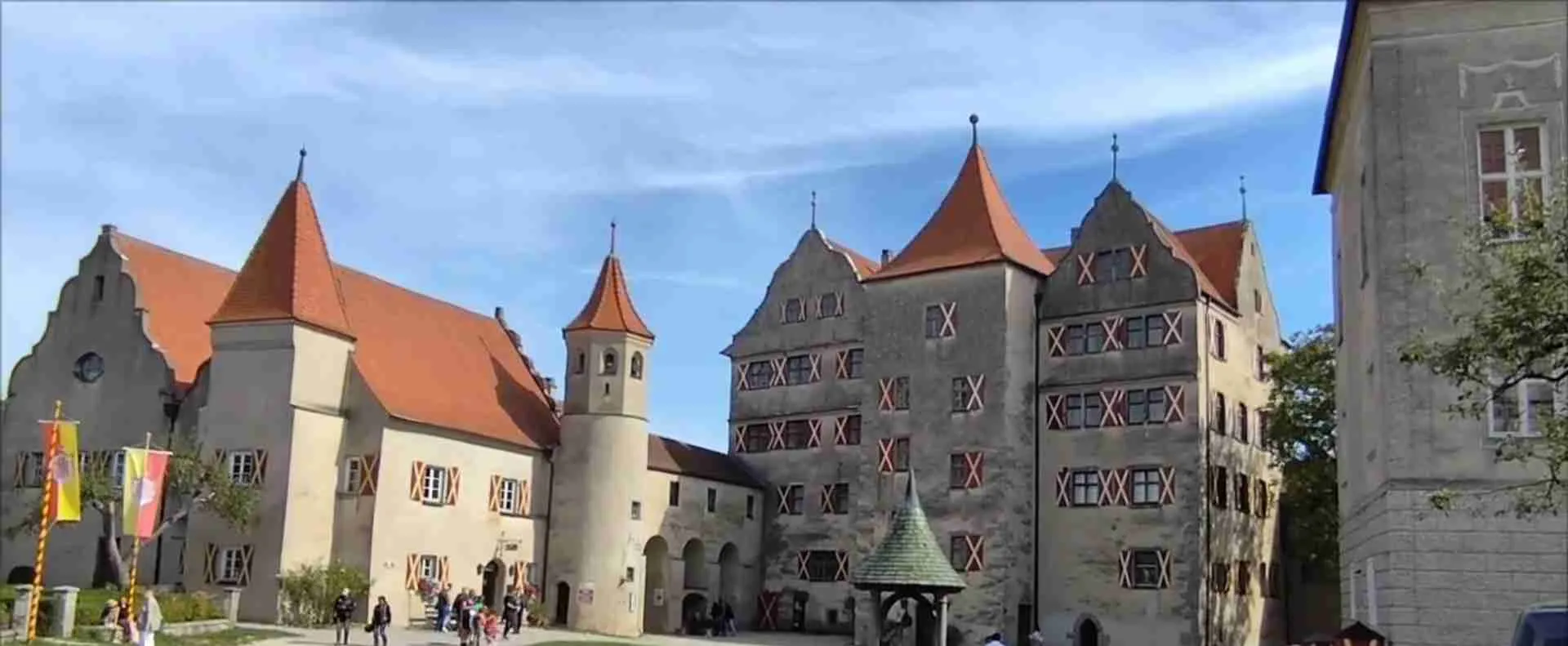
Harburg Castle: Medieval Fortress on Romantic Road
Key Takeaways
- Medieval Preservation: Harburg Castle stands as one of Germany’s best-preserved medieval fortresses, maintaining its original defensive architecture, residential quarters, and courtyard configuration across nearly 900 years of continuous occupation.
- Strategic Location: Built atop a limestone cliff above the Wörnitz River, the castle commanded crucial trade routes through Franconia, serving both military defense and customs collection for the powerful Hohenstaufen dynasty and subsequent rulers.
- Princely Heritage: The Oettingen-Wallerstein princely family has owned Harburg since 1295, creating an unbroken 700-year lineage that preserved the castle through careful stewardship rather than abandonment or destructive renovation.
- Architectural Evolution: The fortress demonstrates medieval castle development from 11th-century stone keep through 16th-century artillery fortifications, with each building phase responding to changing military technology while maintaining defensive coherence.
- Cultural Collections: The castle houses exceptional collections of medieval and Renaissance art, weapons, furniture, and manuscripts assembled by the Oettingen-Wallerstein family, offering insights into aristocratic life spanning seven centuries.
- Romantic Road Landmark: As a major attraction on Germany’s famous Romantic Road tourist route, Harburg Castle represents the medieval heritage that draws travelers seeking authentic experiences of Germany’s fortress architecture and historical landscapes.
Understanding Harburg Castle’s Historical Significance
Harburg Castle emerges from the Bavarian landscape as a testament to medieval military architecture and aristocratic continuity. Perched dramatically atop a 60-meter limestone outcrop above the Wörnitz River valley, the fortress has dominated the surrounding countryside for nearly nine centuries. Unlike many German castles that fell into romantic ruins or underwent destructive baroque renovations, Harburg maintained its medieval character through careful preservation by successive generations of the Oettingen-Wallerstein family, creating one of Germany’s most authentic medieval castle experiences.
The castle’s foundation in the 11th century responded to the Hohenstaufen dynasty’s need to control trade routes crossing Franconia. Emperor Frederick Barbarossa recognized Harburg’s strategic value, strengthening the fortress and using it as a base for military campaigns. The castle’s position allowed monitoring of merchants traveling between Nuremberg and Augsburg, generating customs revenues that funded further fortification while deterring potential attackers. This strategic importance ensured continuous investment in defensive capabilities, creating the complex fortification system visible today.
Harburg exemplifies the medieval castle’s dual function as military stronghold and aristocratic residence. The fortress combines massive defensive walls, towers, and gates with comfortable living quarters, administrative spaces, and ceremonial halls. This integration reveals how medieval nobility balanced security concerns with desires for refined living environments. The castle’s architecture demonstrates that medieval life, while certainly more austere than later periods, achieved sophisticated comfort and cultural refinement within defensible structures designed to withstand siege warfare.
The castle’s remarkable preservation owes much to the Oettingen-Wallerstein family’s continuous ownership since 1295. Rather than viewing the medieval fortress as outdated, successive princes maintained and adapted the complex, respecting its historical character while making necessary modifications for changing needs. This stewardship philosophy preserved architectural elements and interior spaces that disappeared from other castles during baroque and romantic-era renovations. Modern visitors encounter a medieval fortress that, while inevitably altered over centuries, maintains extraordinary architectural and atmospheric authenticity.
People Also Ask About Harburg Castle
What makes Harburg Castle architecturally significant?
Harburg Castle demonstrates exceptional preservation of medieval fortress architecture, maintaining original defensive systems, residential quarters, and spatial organization across nearly 900 years. The castle showcases the evolution of military architecture from early medieval stone keeps through late medieval artillery fortifications, with each building phase visible in the existing structure. The outer fortifications, featuring massive stone walls, corner bastions, and artillery positions, represent 16th-century responses to gunpowder warfare while preserving earlier defensive elements.
The residential complex illustrates medieval aristocratic architecture, featuring the great hall, private chambers, chapel, and administrative spaces arranged around central courtyards. These buildings demonstrate construction techniques, spatial planning, and decorative approaches characteristic of different medieval periods. Timber-framed structures from the 15th and 16th centuries display sophisticated carpentry, with exposed beams forming decorative patterns while supporting upper floors. Stone buildings exhibit masonry techniques ranging from rough-hewn blocks in the oldest sections to precisely cut ashlar in later additions.
The castle’s defensive architecture reveals sophisticated military engineering adapted to topography and evolving siege tactics. The approach road zigzags up the cliff face, exposing attackers to defensive fire from multiple positions. Gate complexes feature successive barriers forcing enemies to navigate confined passages under constant threat. The positioning of towers, wall walks, and firing positions creates overlapping fields of fire covering all approaches. This defensive sophistication demonstrates that medieval military engineers possessed advanced understanding of siege warfare and defensive geometry.
Who were the Hohenstaufen and why did they build Harburg?
The Hohenstaufen dynasty ruled the Holy Roman Empire during the 12th and 13th centuries, producing several powerful emperors including Frederick Barbarossa and Frederick II. The family originated in Swabia but controlled territories throughout southern Germany, requiring fortified strongpoints to maintain authority over trade routes, collect revenues, and project military power. Harburg Castle served these strategic purposes, positioned to dominate an important crossing of the Wörnitz River on routes connecting major imperial cities.
Emperor Frederick Barbarossa personally strengthened Harburg during his reign (1155-1190), recognizing the site’s military and economic importance. The emperor used the castle as a base during conflicts with rival German princes and as a secure repository for treasure and documents. Imperial visits brought the castle into direct contact with the highest levels of medieval government, exposing local nobles to imperial court culture and administrative practices. The Hohenstaufen connection elevated Harburg beyond merely regional significance, making it a participant in empire-wide political and military events.
The Hohenstaufen period established Harburg’s architectural foundations and defensive philosophy. The massive stone keep dates to this era, built with walls several meters thick capable of resisting contemporary siege weapons. The positioning of gates, approaches, and outer defenses reflects imperial military engineering expertise. When the Hohenstaufen dynasty ended in 1254, Harburg passed through several owners before the Oettingen-Wallerstein family acquired it in 1295, beginning their 700-year stewardship that preserved the Hohenstaufen heritage while adapting the fortress for changing needs.
What can visitors see inside Harburg Castle?
The castle interiors preserve exceptional collections of medieval and Renaissance art, furniture, weapons, and manuscripts assembled by the Oettingen-Wallerstein family over seven centuries. The Great Hall features medieval and Renaissance furniture, tapestries, and decorative objects that create an atmosphere of aristocratic life spanning multiple centuries. Original timber ceiling beams, wall paneling, and stone fireplaces maintain the hall’s medieval character while accommodating later decorative enhancements. The space demonstrates how noble families balanced respect for ancestral heritage with desires for contemporary comfort and style.
The armory displays extensive collections of medieval and Renaissance weapons, armor, and military equipment. Suits of plate armor from the 15th and 16th centuries demonstrate the evolution of personal protection as military technology advanced. Swords, polearms, crossbows, and early firearms illustrate changing combat techniques and weapon design. Heraldic shields and banners display the Oettingen-Wallerstein coat of arms and allied families, documenting political alliances and territorial claims. These collections provide exceptional resources for understanding medieval and Renaissance warfare beyond romantic idealizations.
The chapel preserves medieval sacred architecture and devotional objects, featuring original altar, religious sculptures, and painted decorations. The space served the spiritual needs of castle residents while demonstrating the family’s piety and wealth through artistic patronage. Medieval and Renaissance religious artworks include carved wooden altarpieces, painted panels, and liturgical objects that represent regional artistic traditions. The chapel’s preservation allows visitors to experience the role of religion in daily castle life and observe medieval sacred art in its original architectural context.
Private chambers and administrative spaces offer insights into aristocratic daily life and castle management. Furnished bedrooms display period furniture, textiles, and personal objects that reveal living conditions and aesthetic preferences across different centuries. Administrative rooms contain archives, account books, and correspondence documenting estate management, legal proceedings, and political affairs. These materials demonstrate the extensive bureaucratic apparatus required to manage aristocratic territories and maintain castle operations. The combination of public ceremonial spaces and private functional areas creates a comprehensive picture of castle life beyond romantic stereotypes.
How did medieval castles defend against sieges?
Harburg Castle demonstrates the sophisticated defensive systems medieval castles employed to resist siege warfare. The cliff-top position provided natural protection, making direct assault extremely difficult and forcing attackers to establish siege lines on unfavorable terrain. The approach road’s zigzag configuration exposed attacking forces to defensive fire from multiple angles while preventing deployment of siege engines close to walls. Gate complexes featured successive barriers—outer gate, passage through wall thickness, inner gate—that created deadly confined spaces where attackers faced concentrated defensive fire without room for maneuver.
Wall thickness and construction techniques resisted contemporary siege weapons. Outer walls measure several meters thick, built from massive stone blocks that could absorb impacts from catapults, trebuchets, and early cannon. Wall walks along the top allowed defenders to patrol perimeters, observe approaches, and direct fire at attackers. Towers projecting from wall lines enabled flanking fire along wall faces, preventing attackers from working under cover against wall bases. Murder holes above gates allowed defenders to drop projectiles, boiling liquids, or other materials on enemies attempting to breach entrances.
The castle maintained substantial food storage, water sources, and living quarters enabling prolonged resistance to siege. Deep wells provided water independent of external sources, preventing enemies from cutting off supplies. Extensive cellars stored grain, preserved meats, wine, and other provisions allowing garrisons to endure months-long sieges. The residential complex provided shelter for castle garrison, aristocratic family, and refugees from surrounding territories seeking protection during conflicts. This self-sufficiency transformed sieges into tests of endurance where defenders’ survival capacity determined outcomes more than direct military confrontation.
Extended multi-day tours – 5+ days
Featured Bavaria Multi-Day Tour Packages

3 days
Bavaria 3-Day Discovery Tour
- ✓ Comprehensive Bavaria experience
- ✓ Expert local guides included
- ✓ All accommodation included
- ✓ Transportation provided

5 days
Bavaria 5-Day Highlights Experience
- ✓ Comprehensive Bavaria experience
- ✓ Expert local guides included
- ✓ All accommodation included
- ✓ Transportation provided
7 days
Bavaria 7-Day Cultural Journey
- ✓ Comprehensive Bavaria experience
- ✓ Expert local guides included
- ✓ All accommodation included
- ✓ Transportation provided
10 days
Bavaria 10-Day Complete Adventure
- ✓ Comprehensive Bavaria experience
- ✓ Expert local guides included
- ✓ All accommodation included
- ✓ Transportation provided
Multi-day tour packages powered by TourRadar. Prices and availability subject to change.
Historical Development and Strategic Importance
Harburg Castle’s foundation in the early 11th century responded to the Holy Roman Empire’s need for fortified administrative centers controlling strategic territories and trade routes. The initial fortress occupied the cliff’s summit, featuring a stone keep surrounded by wooden palisades. These early structures provided security for imperial administrators collecting customs duties, dispensing justice, and maintaining order in surrounding regions. The castle’s position above the Wörnitz crossing made it a natural checkpoint for merchants traveling between Nuremberg, Augsburg, and points south, generating revenues that funded gradual expansion and improvement.
The Hohenstaufen period (1138-1254) marked the castle’s emergence as a major imperial stronghold. Emperor Frederick Barbarossa invested heavily in Harburg’s fortifications, recognizing its value for controlling Franconia during conflicts with rival princes and Italian campaigns requiring secure bases in German territories. Imperial visits brought courtly culture, administrative sophistication, and architectural patronage to Harburg, elevating it from provincial fortress to imperial residence. The massive stone construction from this period established the castle’s fundamental defensive capability and prestigious status that persisted through subsequent centuries.
The Oettingen-Wallerstein acquisition in 1295 began the family association that continues today. Count Ludwig von Oettingen received Harburg as an imperial fief, accepting responsibility for maintaining the fortress and providing military service to the emperor. The family’s rise to princely status in 1674 enhanced their political importance while their consistent stewardship preserved the castle through periods when other medieval fortresses faced abandonment or destruction. The family’s archival records, maintained at Harburg, document seven centuries of estate management, political negotiations, artistic patronage, and daily life, creating exceptional historical resources.
The castle witnessed numerous military conflicts reflecting broader German historical developments. During the Thirty Years’ War (1618-1648), Harburg changed hands multiple times as Catholic and Protestant forces fought for control of southern Germany. The fortress endured several sieges, demonstrating its defensive strength while suffering damage that required extensive repairs. Later conflicts, including Napoleonic Wars campaigns, involved the castle in military operations while its strategic importance gradually diminished as warfare evolved toward mobile field armies rather than fortress sieges.
The 19th century brought romantic interest in medieval heritage, transforming Harburg from military installation to cultural monument. The Romantic movement idealized medieval culture, inspiring preservation efforts and tourist interest in castles as symbols of German national identity. The Oettingen-Wallerstein family embraced this role, maintaining the castle as both family residence and historical attraction. This dual function continues today, with the family occupying private apartments while opening most of the complex to visitors, demonstrating that historic preservation and practical use can successfully coexist.
Architectural Elements and Defensive Systems
Harburg Castle’s architecture represents medieval fortress construction’s evolution from early stone keeps through late medieval artillery fortifications. The oldest surviving structures date to the 12th century, featuring massive stone walls built from locally quarried limestone. These walls employed construction techniques typical of Hohenstaufen-era imperial fortifications, with rough-hewn blocks in interior portions and better-finished stone on exterior faces. Wall thickness reaches several meters at the base, tapering slightly as height increases to reduce weight while maintaining defensive capability. The masonry demonstrates medieval builders’ sophisticated understanding of structural engineering and material properties.
The central keep functions as the castle’s architectural and defensive core. Built during the Hohenstaufen period, the tower rises approximately 30 meters above the courtyard, dominating the castle complex and surrounding landscape. The keep’s ground floor features thick walls with minimal openings, creating a secure refuge during sieges. Upper floors contained residential chambers for the castle’s lord and family, with larger windows providing light and views while maintaining defensive capability through strategic positioning. The keep’s height enabled observation of distant approaches, early warning of threats, and communication with allied fortresses through signal fires or flags.
The residential complex surrounding the keep developed over several centuries as comfort and ceremony gained importance relative to pure military function. The great hall, built in the 15th century, provided space for banquets, court proceedings, and other ceremonial functions. Timber-framed construction employing massive oak beams created large interior spaces while maintaining flexibility to accommodate changing needs. Upper floors contained private chambers for family members and guests, with carved woodwork, painted decorations, and glazed windows demonstrating increased sophistication in aristocratic living standards. These buildings illustrate the medieval castle’s transformation from purely military installation to multifunctional complex balancing security and domestic comfort.
The outer fortifications represent 16th-century responses to gunpowder artillery. Massive stone walls incorporating thick earthwork backing absorbed cannon impacts that would shatter thinner medieval walls. Corner bastions with rounded profiles deflected shot while providing platforms for defending artillery. Lower, thicker walls presented smaller targets to attacking cannon while maintaining defensive effectiveness through improved firing positions for defenders’ guns. These modifications demonstrate military architecture’s constant evolution as offensive and defensive technologies competed for advantage.
Gate complexes exemplify medieval defensive architecture’s sophistication. Visitors enter through successive barriers designed to channel attackers into confined killing zones. The outer gate, protected by a tower, opens onto a passage through the wall’s thickness before reaching an inner gate. Murder holes in passage ceilings allowed defenders to attack enemies trapped between gates. Heavy timber doors reinforced with iron bands could resist battering rams, while portcullises provided additional barriers that could be dropped to seal passages. The gate’s defensive design forced attackers to overcome multiple obstacles while exposed to concentrated defensive fire, making forced entry extremely costly and time-consuming.
The castle’s water supply system demonstrates medieval engineering solving critical siege survival challenges. Deep wells penetrate the limestone bedrock, reaching groundwater sources independent of external supply. Stone-lined well shafts prevented collapse and contamination, ensuring water quality during extended sieges. The positioning of wells in protected courtyards prevented enemies from poisoning water supplies, a common siege tactic. Backup cisterns collected rainwater, providing additional reserves. This sophisticated water management enabled the garrison to endure prolonged sieges without capitulation forced by thirst, significantly enhancing defensive capabilities.
Cultural Collections and Artistic Heritage
The Oettingen-Wallerstein family collections assembled at Harburg Castle represent seven centuries of artistic patronage, military achievement, and cultural refinement. The collections demonstrate how aristocratic families accumulated objects reflecting political alliances, military service, religious devotion, and aesthetic preferences. Unlike museum collections assembled for educational purposes, the Harburg collections grew organically through family history, creating a unique cultural ensemble that documents aristocratic life while preserving exceptional artworks and historical objects.
The medieval and Renaissance furniture collection includes exceptional examples of German and Southern European cabinetmaking. Carved oak chests from the 15th and 16th centuries feature intricate decoration incorporating Gothic tracery, heraldic devices, and figurative scenes. These pieces served both practical storage functions and decorative purposes, with quality indicating owners’ social status. Chairs, tables, and cabinets demonstrate evolving furniture forms and construction techniques, from medieval joined construction to Renaissance veneering and marquetry. The collection provides valuable resources for furniture historians while creating atmospheric period room settings that enhance visitors’ historical experience.
The weapons and armor collection represents one of Germany’s finest private assemblies of medieval and Renaissance military equipment. Complete suits of plate armor from the 15th and 16th centuries demonstrate armor-making’s technical sophistication and artistic achievement. Milanese, Augsburg, and Nuremberg armors display regional stylistic characteristics and varying approaches to balancing protection with mobility. Weapons include swords, polearms, crossbows, and early firearms illustrating combat technique evolution as military technology advanced. Tournament armor with elaborate decoration reveals martial sports’ ceremonial aspects and aristocratic culture’s emphasis on chivalric display.
The manuscript and book collection contains medieval and Renaissance texts documenting religious, legal, and literary culture. Illuminated manuscripts feature decorated initials, marginalia, and miniature paintings demonstrating medieval book production’s artistic quality. Early printed books from the 15th and 16th centuries represent the revolution printing brought to knowledge dissemination and cultural life. The collection includes religious texts, legal codes, chronicles, and literary works in Latin, German, and other languages, providing resources for scholars studying medieval and Renaissance intellectual culture while demonstrating aristocratic libraries’ contents and functions.
Religious art comprises painted altarpieces, carved wooden sculptures, liturgical objects, and devotional artworks. Gothic and Renaissance paintings display regional artistic styles, iconographic traditions, and technical developments in panel painting. Carved wooden sculptures of saints and religious scenes demonstrate exceptional craftsmanship while revealing popular devotional practices. Liturgical vessels, vestments, and ecclesiastical furnishings indicate the family’s role as church patrons and the importance of religious observance in aristocratic life. These objects transform the castle chapel and other spaces into environments where sacred art can be appreciated in appropriate historical and devotional contexts.
Decorative arts throughout the castle include tapestries, ceramics, glass, and metalwork representing European production centers from the medieval period through the 19th century. Flemish and French tapestries featuring mythological and historical scenes provided insulation, decoration, and status display in aristocratic residences. Ceramics from Italian, German, and Netherlands manufactories demonstrate evolving tastes and international trade in luxury goods. Venetian glass, German silver, and other metalwork reveal aristocratic dining customs and decorative preferences. These objects collectively recreate the material culture of aristocratic life, helping visitors understand castle residents’ daily experiences and aesthetic values.
Life in a Medieval Castle
Daily life at Harburg Castle reflected the medieval aristocracy’s dual roles as military defenders and territorial administrators. The castle housed the noble family, their household staff, military garrison, and administrative personnel, creating a self-contained community numbering dozens or hundreds of people depending on political circumstances and military threats. This population required complex organizational systems coordinating domestic service, military readiness, agricultural production, and administrative functions. Understanding this operational complexity reveals that medieval castles functioned as sophisticated enterprises requiring management skills comparable to modern organizations.
The noble family occupied the castle’s finest quarters, maintaining standards of comfort and display appropriate to their rank. Private chambers featured furniture, textiles, and decorative objects demonstrating wealth and taste. Heating came from fireplaces and portable braziers, making winter comfort dependent on abundant firewood supplies. Glazed windows, a luxury in medieval times, provided light while reducing drafts. Family members’ daily routines combined administrative responsibilities, religious observances, meals, recreation, and social interaction with household members and visitors. The castle served as both home and workplace, with family life intertwined with estate management and political activity.
The household staff included numerous specialized servants maintaining the aristocratic lifestyle. Cooks, bakers, and brewers prepared meals and beverages for the entire castle population. Chamberlains and stewards managed domestic operations and supervised junior servants. Ladies-in-waiting attended female family members, providing companionship and assistance with daily tasks. Grooms cared for horses essential for transportation, military service, and hunting. Artisans including blacksmiths, carpenters, and masons maintained buildings and equipment. This elaborate service structure enabled aristocratic leisure while generating employment for surrounding communities.
The military garrison maintained the castle’s defensive readiness and provided security for the surrounding territory. Soldiers performed guard duties, patrolled the region, and trained for potential conflicts. During peacetime, garrison requirements remained modest, but military threats brought rapid increases in personnel. The garrison commander coordinated with the castle’s lord on defensive preparations, intelligence gathering, and responses to security challenges. Military discipline coexisted with civilian castle operations, sometimes creating tensions but generally functioning through established hierarchies and clear role definitions.
Religious observances structured daily life at Harburg as at all medieval castles. The castle chapel served as the spiritual center, with daily masses, canonical hours, and special services marking the liturgical calendar. The chaplain provided spiritual guidance to the noble family and administered sacraments to castle residents. Religious festivals brought celebration and feasting, breaking the routine of daily life. The integration of religious and secular activities reflected medieval culture’s fundamental unity, where spiritual and temporal concerns intertwined rather than existing as separate spheres.
Economic activities centered on agricultural production from estates controlled by the castle. Administrators collected rents, taxes, and labor services from peasants farming castle lands. Account books meticulously recorded income and expenses, demonstrating the sophisticated financial management required for aristocratic enterprises. Markets and customs duties provided additional revenue, with the castle’s strategic position on trade routes generating income from merchant traffic. This economic foundation supported the castle’s military function, aristocratic lifestyle, and political influence, making estate management central to the noble family’s power and prestige.
Harburg on the Romantic Road
Harburg Castle serves as a major attraction on the Romantic Road (Romantische Straße), Germany’s most famous scenic tourist route connecting Würzburg to Füssen through picturesque medieval towns, baroque churches, and Alpine landscapes. Established in 1950 to promote tourism in Bavaria and Baden-Württemberg, the route capitalized on international fascination with German medieval and baroque heritage. Harburg’s authentic medieval architecture and dramatic cliff-top setting exemplify the romantic imagery that attracts millions of visitors annually, making the castle an essential stop for travelers seeking Germany’s historical and cultural treasures.
The Romantic Road’s development reflected post-World War II efforts to rebuild German tourism by emphasizing cultural heritage over military history. The route’s name referenced the 19th-century Romantic movement’s idealization of medieval culture rather than modern romantic tourism. Marketing emphasized picturesque landscapes, well-preserved medieval towns, and accessible cultural attractions appealing to international visitors. Harburg’s inclusion recognized the castle’s exceptional preservation, historical significance, and visual appeal, contributing to the route’s success in attracting tourists while supporting regional economic development.
Harburg represents the medieval castle type that dominates tourist imagination of German fortress architecture. Unlike reconstructed or heavily restored castles, Harburg maintains authenticity through minimal modern intervention and continuous use preserving original functions. The cliff-top position creates dramatic visual impact, with castle walls and towers rising directly from rock formations. This picturesque quality made Harburg popular with 19th-century romantic painters and writers, establishing its iconic status before modern tourism development. Contemporary visitors experience similar aesthetic responses, finding in Harburg the medieval atmosphere and architectural authenticity that romantic tourism seeks.
The castle’s position at the Romantic Road’s northern section makes it accessible for travelers beginning routes at Würzburg or approaching from central Germany. The nearby town of Harburg preserves medieval character through half-timbered houses, town walls, and the parish church’s Gothic architecture. This medieval townscape complements the castle, creating a comprehensive historical environment rather than an isolated monument. Visitors can explore both castle and town, experiencing the interconnected relationship between fortress and settlement that characterized medieval German territorial organization.
Tourism development at Harburg balances accessibility with preservation of historical character and family privacy. Guided tours provide structured visitor experiences while protecting sensitive areas and private family quarters. The visitor center offers interpretive materials, educational programs, and amenities supporting tourist needs without compromising architectural integrity. This approach demonstrates sustainable heritage tourism that generates economic benefits while maintaining the cultural authenticity that attracts visitors. The Oettingen-Wallerstein family’s continued residence ensures personal commitment to preservation, distinguishing Harburg from purely commercial tourist attractions.
Harburg’s inclusion on the Romantic Road connects the castle to broader narratives about German cultural identity, historical preservation, and heritage tourism. The castle represents continuity with medieval past, aristocratic traditions, and regional character that distinguish Bavaria within modern Germany. International visitors find in Harburg tangible connection to European medieval civilization, romantic imagery, and architectural heritage that transcends national boundaries while expressing distinctive German cultural characteristics. This multifaceted significance makes Harburg valuable both as individual monument and as component of larger cultural landscape embodied in the Romantic Road experience.
Photography and Visual Experience
Photographing Harburg Castle requires understanding its dramatic topographical setting, architectural complexity, and atmospheric medieval character. The fortress’s cliff-top position creates exceptional compositional opportunities from multiple viewpoints, each revealing different aspects of the architectural ensemble and relationship to landscape. Success demands technical proficiency with exposure, composition, and lighting while developing visual sensitivity to the castle’s historical and aesthetic qualities. Photographers who invest time exploring various perspectives and lighting conditions create compelling images that communicate the castle’s medieval power and romantic appeal.
Approach views from the valley reveal the castle’s dominant position and defensive strength. The limestone cliff creates natural drama, with castle walls appearing as extensions of living rock. Wide-angle lenses (14-24mm on full-frame cameras) capture the full vertical relationship between valley floor and castle summit, emphasizing the fortress’s commanding presence. Early morning or late afternoon light rakes across the cliff face, revealing geological textures and creating shadows that enhance three-dimensional modeling. Spring and autumn foliage provides color contrast against gray stone, while winter snow transforms the scene into monochromatic study of form and texture.
The town of Harburg provides excellent elevated viewpoints for architectural photography emphasizing the castle’s complex massing and defensive systems. These positions reveal the relationship between outer fortifications, residential complex, and central keep, illustrating the castle’s architectural development across multiple building periods. Mid-range focal lengths (35-70mm) isolate significant architectural elements while maintaining contextual relationships. Cloudy conditions provide even lighting that reveals architectural details without harsh shadows, though dramatic weather—storm clouds, morning mist, evening light—creates atmospheric effects enhancing medieval character.
Detail photography within the castle complex captures architectural elements, decorative features, and atmospheric qualities invisible from distance. Gate complexes, defensive features, timber-framed buildings, and courtyard spaces offer rich photographic subjects revealing construction techniques and medieval design principles. Available light photography preserves authentic atmosphere, though tripods or high ISO capabilities enable adequate exposure in darker passages and interior spaces. Close-up photography of masonry details, carved woodwork, and architectural elements documents construction methods while creating abstract compositions emphasizing texture, pattern, and material qualities.
Interior photography presents challenges from limited light, mixed color temperatures, and visitor traffic. The armory’s weapon displays, great hall’s furnishings, and chapel’s religious art require careful exposure balancing ambient light with necessary supplemental illumination. Modern cameras’ high ISO performance enables available light photography that preserves interior atmosphere without intrusive flash. Wide-angle lenses capture room volumes and architectural context, while standard focal lengths isolate individual artworks and decorative elements. Photographers should respect restrictions on tripod use and flash photography designed to protect delicate historical surfaces and maintain visitor experience quality.
Seasonal variation creates diverse photographic opportunities reflecting the castle’s changing appearance through the year. Spring brings fresh foliage and blooming vegetation softening the fortress’s martial character. Summer’s long days and warm light create accessible conditions for extended photography sessions. Autumn color provides vibrant contrast against stone architecture, while morning fog in the valley adds atmospheric mystery. Winter snow transforms the castle into fairy-tale subject, though challenging lighting conditions and limited hours require technical adaptability. Each season offers distinctive aesthetic qualities that communicate different aspects of the castle’s character and historical presence.
Conservation and Modern Stewardship
Maintaining Harburg Castle presents ongoing conservation challenges requiring expertise, financial resources, and philosophical commitment to preservation. The Oettingen-Wallerstein family’s ownership ensures personal investment in the castle’s future while creating responsibilities for maintaining a complex historical structure under constant threat from weathering, structural stresses, and visitor use. Modern conservation practice balances respect for historical fabric with necessary interventions ensuring structural stability and public safety. This delicate equilibrium between preservation and pragmatic maintenance distinguishes successful heritage stewardship from either excessive intervention or neglectful decay.
Stone conservation addresses weathering damage, structural movements, and biological growth threatening masonry integrity. The limestone used in construction, while durable, remains susceptible to freeze-thaw cycling, water infiltration, and atmospheric pollution. Conservation specialists monitor crack development, surface erosion, and structural deformations, intervening when deterioration threatens stability or accelerates damage. Cleaning removes biological growth and pollution deposits without damaging stone surfaces, employing gentle methods that avoid harsh abrasives or chemicals. Repointing replaces deteriorated mortar using traditional lime-based materials compatible with original construction, maintaining structural integrity while allowing walls to breathe and accommodate minor movements.
Timber conservation focuses on the extensive wooden structures including roof systems, timber-framed buildings, and interior woodwork. Medieval timber construction remains vulnerable to insect infestation, fungal decay, and structural overload from accumulated roof loads. Regular inspections identify emerging problems before serious damage occurs, enabling preventive treatments that preserve original material. Roof maintenance prevents water infiltration that accelerates timber decay, making weatherproofing a conservation priority. When replacement becomes necessary, conservators salvage and document original members, using traditional joinery techniques and compatible wood species to maintain structural authenticity and construction integrity.
Climate control balances conservation requirements with visitor comfort and energy efficiency. Excessive humidity promotes fungal growth and material degradation, while excessive dryness causes wood shrinkage and paint flaking. Heating systems warm selected spaces without creating temperature extremes damaging to historic materials. Ventilation systems remove excess moisture while avoiding drafts that stress building fabric. This environmental management protects collections and architectural elements while maintaining reasonably comfortable conditions for visitors and staff. The challenge intensifies in historic buildings lacking modern infrastructure, requiring creative solutions that achieve conservation goals without destructive interventions.
Visitor management protects vulnerable surfaces and spaces from wear while maintaining public access. Traffic routing directs visitors through the castle following paths minimizing stress on fragile floors, stairs, and architectural features. Barrier systems protect particularly vulnerable objects and surfaces without creating fortress-like atmosphere that diminishes visitor experience. Capacity limits prevent overcrowding that damages surfaces through accumulated wear and creates safety hazards. Education programs encourage visitors to respect historical environment, fostering appreciation that supports conservation while enabling meaningful engagement with cultural heritage.
Financial sustainability remains constant challenge for historic properties. Tourism revenue supports conservation costs, staff salaries, and operational expenses while funding interpretive programs that enhance visitor experience. The family’s private resources supplement tourism income, demonstrating personal commitment essential for long-term preservation. Grant programs from government agencies and private foundations support major conservation projects requiring capital investment beyond normal operational budgets. This mixed funding model distributes financial burden while maintaining family stewardship that ensures continuity and personal investment in the castle’s preservation and interpretation.
Frequently Asked Questions
How old is Harburg Castle?
Harburg Castle dates to the early 11th century, with foundation attributed to the years around 1150 under the Hohenstaufen dynasty. The oldest surviving structures, including portions of the central keep and inner fortification walls, come from this period. The castle underwent continuous development and expansion over subsequent centuries, with major building campaigns in the 13th, 15th, and 16th centuries adding defensive systems, residential quarters, and fortification improvements. This layered construction creates exceptional architectural complexity, with each building period visible in the existing structure and revealing nearly 900 years of military and domestic architectural evolution.
Who owns Harburg Castle today?
The Oettingen-Wallerstein princely family has owned Harburg Castle since 1295, creating an unbroken seven-century lineage of stewardship. The family maintains private apartments within the castle while opening most of the complex to visitors through guided tours. This continued family ownership ensures personal commitment to preservation and creates living connection between medieval past and contemporary heritage management. The family archives, maintained at the castle, document seven centuries of estate administration, artistic patronage, and daily life, providing exceptional resources for historical research while demonstrating aristocratic stewardship traditions.
What is the Romantic Road and why is Harburg on it?
The Romantic Road (Romantische Straße) is Germany’s most famous scenic tourist route, connecting Würzburg to Füssen through approximately 350 kilometers of picturesque medieval towns, baroque churches, and Alpine landscapes. Established in 1950 to promote tourism in Bavaria and Baden-Württemberg, the route capitalizes on international fascination with German medieval and baroque heritage. Harburg’s inclusion recognizes the castle’s exceptional preservation, historical significance, dramatic cliff-top setting, and visual appeal that exemplify the romantic medieval imagery attracting millions of visitors annually to experience Germany’s cultural treasures.
Can visitors tour Harburg Castle?
Harburg Castle offers guided tours providing access to the fortress’s main architectural features, historical rooms, and cultural collections. Tours explore the courtyard, residential quarters, great hall, chapel, armory, and defensive installations while explaining the castle’s history, architecture, and aristocratic heritage. Knowledgeable guides provide commentary on medieval life, military architecture, artistic collections, and the Oettingen-Wallerstein family’s stewardship. Tour schedules vary seasonally, with more frequent tours during peak tourism periods. The castle balances public access with preservation needs and family privacy, maintaining restrictions on certain areas while ensuring visitors experience the fortress’s essential character and historical significance.
What makes Harburg different from other German castles?
Harburg distinguishes itself through exceptional preservation of medieval architectural fabric and continuous family ownership spanning seven centuries. Unlike many German castles that became romantic ruins, underwent destructive baroque renovations, or experienced abandonment and later reconstruction, Harburg maintained its medieval character through careful stewardship respecting historical integrity while accommodating changing needs. The castle preserves original defensive systems, residential quarters, and spatial organization with minimal modern intrusion. This authenticity, combined with exceptional cultural collections assembled across family history, creates experiences of medieval fortress architecture and aristocratic life unavailable at heavily restored or reconstructed sites.
How did the castle defend against medieval attacks?
Harburg employed multiple defensive systems creating layered protection against medieval siege tactics. The cliff-top position provided natural barrier making direct assault extremely difficult. The zigzag approach road exposed attackers to defensive fire from multiple positions while preventing siege engine deployment near walls. Gate complexes featured successive barriers with murder holes allowing defenders to attack enemies trapped in confined passages. Massive stone walls several meters thick resisted contemporary siege weapons. Deep wells provided water during sieges, while extensive storage enabled prolonged resistance. These integrated defensive measures made Harburg nearly impregnable to medieval assault, with successful siege requiring prolonged investment of time, resources, and lives that few enemies could sustain.
What are the castle’s most important historical collections?
Harburg houses exceptional collections of medieval and Renaissance weapons, armor, furniture, manuscripts, and religious art assembled by the Oettingen-Wallerstein family across seven centuries. The armory displays complete suits of plate armor from leading European centers and weapons illustrating combat evolution. Medieval and Renaissance furniture demonstrates German cabinetmaking traditions. Illuminated manuscripts and early printed books document intellectual culture. Religious artworks include carved wooden sculptures, painted altarpieces, and liturgical objects. These collections represent aristocratic patronage, military heritage, and cultural refinement, providing resources for scholarly research while creating authentic period environments that enhance historical understanding and visitor experience.
Is Harburg Castle a UNESCO World Heritage Site?
Harburg Castle is not designated as a UNESCO World Heritage Site, though it represents exceptional medieval fortress architecture and cultural heritage. The castle contributes to Germany’s rich heritage landscape as a privately-owned monument maintained through family stewardship rather than state ownership. The fortress demonstrates outstanding preservation, historical significance, and architectural quality qualifying it for heritage protection under German law and international conservation standards. Its inclusion on the Romantic Road tourist route acknowledges cultural importance, while continued scholarly interest and visitor attention confirm its status as a major monument of German medieval civilization.
What role did the castle play in German history?
Harburg served strategic military and administrative functions throughout German medieval and early modern history. Under Hohenstaufen emperors, particularly Frederick Barbarossa, the castle controlled important trade routes and projected imperial authority in Franconia. It functioned as customs collection point, military stronghold, administrative center, and imperial residence during royal visits. During the Thirty Years’ War, Harburg endured sieges as Catholic and Protestant forces fought for regional control. The castle witnessed German political evolution from Holy Roman Empire through Napoleonic period, reflecting broader historical developments while maintaining continuity through Oettingen-Wallerstein family stewardship that preserved regional aristocratic traditions and cultural heritage.
How has the castle been preserved over the centuries?
Harburg’s preservation resulted from the Oettingen-Wallerstein family’s continuous ownership and commitment to maintaining the medieval fortress rather than undertaking destructive renovations fashionable in later periods. Successive generations valued the castle’s historical character, making necessary repairs and modifications while respecting original architectural fabric. This stewardship philosophy preserved defensive systems, residential quarters, and decorative elements that disappeared from other castles during baroque and romantic-era reconstructions. Modern conservation employs professional expertise, traditional materials, and careful intervention balancing preservation with practical use. The combination of family commitment, professional conservation practice, and sustainable tourism funding ensures the castle’s preservation for future generations while maintaining public access and educational programming.