Grand Place Brussels: UNESCO World Heritage Walking Guide
Brussels’ Grand Place stands as one of Europe’s most magnificent urban squares, where Gothic spires rise above Baroque guildhalls in a harmonious architectural ensemble recognized by UNESCO for its outstanding universal value. This walking guide reveals the square’s layered history from medieval marketplace to symbol of civic pride, decoding the gilded facades, sculptural programs, and urban legends that make every visit an immersion in European cultural heritage.
Key Takeaways
- UNESCO Recognition Since 1998: The Grand Place earned World Heritage status for its exceptional preservation of late 17th-century urban architecture blending Gothic and Baroque styles in remarkable coherence
- Phoenix Rising from Ashes: The 1695 French bombardment destroyed nearly everything except the Town Hall’s stone shell, yet guilds rebuilt the entire square within five years in even greater splendor
- Compact But Monumental: The 68 by 110 meter rectangular square packs extraordinary architectural density—every facade tells stories through sculpture, gilding, and symbolic imagery
- Seven Street Entrances: Bronze UNESCO plaques mark where seven narrow medieval streets penetrate the square through archways, maintaining the enclosed theatrical space
- Gothic Masterpiece Tower: The Town Hall’s 96-meter Brabantine Gothic spire crowned with Saint Michael slaying the dragon dominates the skyline and serves as Brussels’ defining landmark
- Living Heritage Square: Beyond museums and monuments, the Grand Place hosts the biennial Flower Carpet, Ommegang pageant, Christmas market, and daily café life animating the historic stones
People Also Ask About Grand Place Brussels
Why is Brussels Grand Place so famous?
The Grand Place achieved fame through its extraordinary architectural unity combining public and private buildings from the late 1600s in a small rectangular space. UNESCO recognized it as “an outstanding example of the eclectic and highly successful blending of architectural and artistic styles” that illustrates European culture at a pivotal moment. The square’s fame also stems from its dramatic history—the 1695 bombardment that leveled medieval Brussels, followed by the guilds’ astonishing five-year reconstruction creating the Baroque ensemble visible today. Victor Hugo called it “the most beautiful square in the world,” a judgment echoed by countless visitors encountering the gilded facades, Gothic Town Hall spire, and theatrical urban space for the first time. The square functions simultaneously as architectural masterpiece, historical document, and living urban plaza where Brusselers and tourists gather for markets, festivals, and café terraces beneath facades that have witnessed five centuries of European history.
What buildings surround the Grand Place?
The Grand Place is enclosed by approximately 40 buildings forming a continuous architectural wall on all four sides. The Town Hall (Hôtel de Ville) anchors the south side with its 96-meter Gothic tower and elaborate facade. Opposite on the north side stands the Maison du Roi (King’s House), also called the Breadhouse, housing Brussels City Museum. The remaining buildings are primarily guildhalls—headquarters of medieval trade corporations including brewers, bakers, boatmen, archers, haberdashers, and painters. Each guildhall bears a distinct name like Le Renard (The Fox), Le Cornet (The Horn), La Louve (The She-Wolf), Le Roy d’Espagne (King of Spain), and Le Cygne (The Swan). While called guildhalls collectively, some were always private residences of wealthy merchants. The continuous facades create an enclosed rectangular space accessible only through seven narrow street entrances, producing the square’s theatrical character where architecture forms both backdrop and main performer.
How long does it take to walk around Grand Place?
A simple circuit around the Grand Place’s perimeter takes 5-10 minutes at a normal pace, covering approximately 350 meters of cobblestoned square. However, a meaningful visit requires 45 minutes to 2 hours to properly appreciate architectural details, photograph facades from multiple angles, and absorb the square’s atmosphere. Dedicated visitors spend even longer examining individual building sculptures, reading historical plaques, visiting the Town Hall interior on guided tours, exploring the Brussels City Museum in the Maison du Roi, or simply sitting at café terraces observing the perpetual theater of tourist groups, street performers, and local life. The Grand Place rewards slow observation—notice how light changes the gilding’s appearance throughout the day, how different facades respond to morning versus evening illumination, how crowds ebb and flow creating alternating moments of congestion and surprising emptiness. Return visits at different times reveal new details previously overlooked in the visual richness.
When was the Grand Place built?
The Grand Place evolved over eight centuries rather than being “built” at a single moment. The first written mention dates to 1174 when the square functioned as the “Nedermerckt” (Lower Market) on drained marshland beside the Senne River. Wooden market structures and patrician houses lined the square through the 13th-14th centuries. The Gothic Town Hall rose in stages from 1402-1455, establishing the square’s architectural anchor. Guildhalls gradually replaced earlier structures throughout the 15th-16th centuries. The catastrophic bombardment of August 13-15, 1695, destroyed virtually everything except the Town Hall’s stone walls and tower. The current appearance dates primarily from 1695-1700 when guilds rebuilt their headquarters in coordinated Baroque style under city supervision. The Maison du Roi underwent major reconstruction in 1873-1896 in neo-Gothic style. This layered chronology—medieval origins, 15th-century Gothic monuments, late 17th-century Baroque reconstruction, 19th-century restoration—creates the palimpsest character that UNESCO recognized as exceptional cultural heritage.
Extended multi-day tours – 5+ days
Featured Belgium Multi-Day Tour Packages
7 days
7 Day Brussels including Antwerp, Battle of the Bulge, Flanders Fields, Ghent, Bruges, Luxemburg & Dinant
- ✓ Comprehensive Belgium tour
- ✓ Expert local guides included
- ✓ All accommodation arranged
- ✓ Transportation provided
7 days
7 Days Across Paris & Brussels: From Eiffel Tower to Grand Place
- ✓ Comprehensive Belgium tour
- ✓ Expert local guides included
- ✓ All accommodation arranged
- ✓ Transportation provided
6 days
6 Days of Belgian Charm: Bruges, Ghent, Antwerp, Dinant & Luxembourg
- ✓ Comprehensive Belgium tour
- ✓ Expert local guides included
- ✓ All accommodation arranged
- ✓ Transportation provided

9 days
9 Days in Brussels and Luxembourg by Train: Fairytale Cities, Castles & Culture
- ✓ Comprehensive Belgium tour
- ✓ Expert local guides included
- ✓ All accommodation arranged
- ✓ Transportation provided
Multi-day tour packages powered by TourRadar. Prices and availability subject to change.
Understanding the Grand Place’s Historical Layers
The Grand Place occupies land that was marshy floodplain in the 11th century, lying between the Senne River and higher ground where Brussels’ original settlement clustered around the ducal castle. As merchants drained the wetlands to create a marketplace, the “Nedermerckt” (Lower Market) emerged around 1174 as Brussels’ commercial heart. Its position at the navigable head of the Senne made it the natural transshipment point where river cargo met overland trade routes connecting the prosperous Low Countries.
By the 13th century, Brussels had become one of Northern Europe’s major cloth-producing cities, and the Grand Place evolved from simple market to the stage where economic and political power confronted each other. Wealthy merchant families built stone houses (“steenen”) replacing earlier wooden structures. The dukes of Brabant erected the Bread Hall (predecessor to the Maison du Roi) on the north side as a symbol of their authority. In response, the increasingly autonomous city government began constructing the Town Hall on the south side in 1402, making architectural assertion of civic independence from ducal control.
The square’s medieval peak coincided with Burgundian rule in the 15th century when Brussels served as one of several ducal capitals. Guilds—the trade corporations controlling craft production and merchant activity—gained formal representation in city government and built elaborate headquarters around the square. These medieval guildhalls demonstrated corporate wealth and political power through size, decoration, and prominent location facing the centers of ducal and civic authority.
On August 13, 1695, the Grand Place’s medieval character ended abruptly. French King Louis XIV, fighting the War of the League of Augsburg, ordered Marshal de Villeroy to bombard Brussels to draw enemy forces away from French territory. Over 36 hours, French artillery launched 3,000-4,000 cannonballs and incendiary bombs into the city center. The Town Hall was the primary target, but flaming projectiles ignited the surrounding wooden houses and market structures. By August 15, the Grand Place lay in ruins—only the Town Hall’s stone facade and tower survived, along with fragments of a few guildhall walls.
The reconstruction that followed proved more remarkable than the destruction. Rather than abandoning the devastated center, Brussels’ guilds committed to rebuilding on the same foundations within strict aesthetic guidelines. City authorities required submitted plans show architectural harmony while allowing individual guild expression. Within five years, the entire square stood complete in its current form—a Baroque ensemble replacing medieval Gothic with coordinated facades in stone rather than wood, but preserving the medieval street plan and square proportions. This phoenix-like rebirth from ashes became Brussels’ defining civic myth, embedded in every guildhall facade.
Town Hall: Gothic Pinnacle of Civic Pride
The Hôtel de Ville (Town Hall) represents Brussels’ most important Gothic monument and the Grand Place’s architectural anchor. Construction began in 1402 with the left wing, designed by Jacob van Thienen as an extension to an earlier 14th-century belfry. When guilds gained representation in city government, the existing structure proved inadequate. The right wing was added by 1448, creating asymmetry that makes the Town Hall’s composition more dynamic than perfectly balanced Renaissance palaces.
Jan van Ruysbroeck designed the spectacular tower begun in 1449 and completed around 1455. Rising 96 meters, the tower exemplifies Brabantine Gothic—the regional variant characterized by extreme vertical emphasis, tracery patterns, and delicate stone lacework that appears to defy gravity. The tower’s summit supports a gilded copper statue of Saint Michael, Brussels’ patron saint, shown slaying a dragon or demon. The 5-meter statue serves as weathervane, rotating with wind direction while overlooking the city Michael protects.
The Town Hall facade survived the 1695 bombardment structurally intact though blackened and damaged. The current sculptural program dates primarily from 19th-century restorations when 137 statues were carved to replace destroyed originals or fill niches left empty in earlier centuries. The figures represent dukes, duchesses, saints, prophets, and allegorical virtues—a stone encyclopedia of Christian and secular authority legitimizing civic government. The original 15th-century statues, severely weathered, reside in Brussels City Museum for preservation.
Public tours reveal the Town Hall’s interior splendors: the Gothic Hall with its timber vaulted ceiling and 19th-century murals depicting Brussels history, the Council Chamber where city government meets, the Wedding Hall used for civil ceremonies, and the Maximilian Hall featuring Brabantine Romanesque columns from an earlier structure. The grand staircase’s balustrade showcases Brussels’ trademark ornamental ironwork. Tours operate in Dutch, French, and English on specific days—verify current schedules as access is restricted when official functions occupy rooms.
The tower’s off-center position relative to the facade has generated numerous legends. One claims the architect, devastated to discover his error after completion, threw himself from the tower. Historical reality is less dramatic—the asymmetry resulted from incorporating the earlier belfry into the expanded structure. The “mistake” actually enhances the composition, creating visual tension that symmetry would eliminate. The tower’s slight lean eastward adds to its dynamic character, suggesting upward movement rather than static monumentality.
Maison du Roi: Symbol of Ducal Authority
The Maison du Roi (King’s House), called Broodhuis (Bread House) in Dutch, occupies the entire northern side of the Grand Place directly opposite the Town Hall. This nominal confusion reflects the building’s complex history as symbol of contested authority between dukes and city. The original 13th-century wooden structure served as the city bread market. In the late 15th century, the Duke of Brabant rebuilt it in stone as the Bread Hall, asserting ducal control over crucial grain supplies.
When Charles V became King of Spain and Holy Roman Emperor while retaining his title as Duke of Brabant, the building acquired the French name “Maison du Roi” despite no king ever residing there. The name asserted royal authority in the face of Brussels’ republican traditions. After the 1695 bombardment, the structure was rebuilt in simplified form. The current neo-Gothic facade dates from 1873-1896 reconstruction by architect Victor Jamaer, who attempted to recreate what he believed was the building’s 16th-century appearance based on old engravings and surviving fragments.
The reconstruction sparked heated debates about historical authenticity versus contemporary interpretation. Critics argued Jamaer invented a “neo-medieval” fantasy rather than accurately reproducing what stood before 1695. Defenders countered that the Gothic style harmonized with the Town Hall while distinguishing the Maison du Roi from surrounding Baroque guildhalls. The controversy anticipated 20th-century debates about heritage conservation—should reconstruction recreate lost buildings exactly, or interpret historical styles for contemporary sensibilities?
Since 1887, the building has housed the Brussels City Museum (Musée de la Ville de Bruxelles), displaying paintings, tapestries, ceramics, and historical objects documenting Brussels’ evolution from medieval trade center to European capital. The museum’s star attraction is the wardrobe of Manneken Pis—the city’s famous urinating boy statue possesses over 1,000 costumes donated by visiting dignitaries and organizations. These range from Elvis Presley outfits to samurai armor, creating an absurdist fashion museum within the serious historical collection.
The museum also preserves the original statues from the Town Hall facade, architectural fragments from demolished medieval buildings, and the 1628 altarpiece from the Sainte-Gudule chapel showing Brussels’ mythological foundation. Visitors interested in understanding the Grand Place’s evolution beyond its current appearance should allocate 60-90 minutes for the museum, which provides archaeological and documentary context invisible in the square’s surfaces.
Guildhalls: Corporate Palaces of Baroque Brussels
The Grand Place’s unique character derives from the guildhalls lining its eastern and western sides—buildings that are neither purely public nor private, but corporate headquarters of medieval trade organizations. Guilds controlled craft production and merchant activity in medieval cities, regulating quality, training apprentices, setting prices, and maintaining monopolies. Brussels’ major guilds included brewers, bakers, boatmen, archers, haberdashers, butchers, painters, cabinetmakers, and tallow chandlers.
After the 1695 bombardment, guilds competed to rebuild the most impressive facades as demonstrations of corporate prestige and economic power. City authorities imposed coordination requirements—all buildings must align at cornice heights, use similar materials (Gobertange sandstone or Euville stone), and harmonize stylistically. Within these constraints, individual guild architects created distinctive facades through sculptural programs, gable designs, and gilded ornamentation that identified each corporation.
The resulting Baroque style blended Italian influences (strong horizontal divisions, classical orders, sculptural richness) with Flemish traditions (stepped gables, vertical emphasis, playful ornamentation). Architects included Jan Cosijn, Pieter Herbosch, Antoine Pastorana, Cornelis van Nerven, and Willem de Bruyn—names less famous than their Renaissance Italian counterparts but equally skilled in creating unified diversity within shared architectural vocabulary.
Notable Guildhalls and Their Symbolism
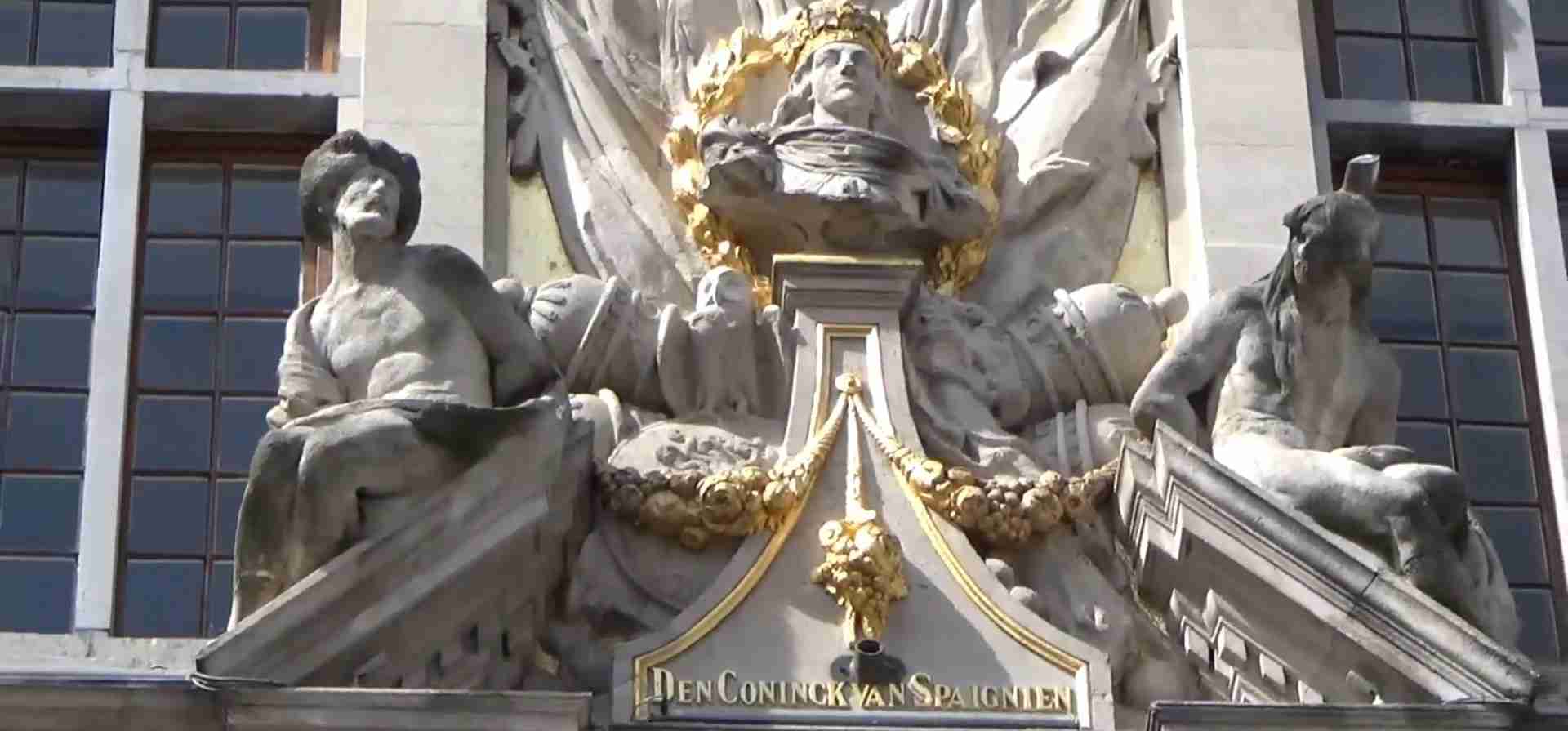
Le Roy d’Espagne (The King of Spain) – Houses 1-2: Originally the Bakers’ Guild headquarters, rebuilt 1696-1697. The facade displays a bust of Charles II of Spain, the last Habsburg king to rule the Spanish Netherlands. The building now houses Brussels’ most popular café with terrace seating offering ideal Grand Place views. The interior preserves period details including carved wooden ceilings and historical brewing equipment, as the building briefly served as a brewery before conversion to café.
La Brouette (The Wheelbarrow) – House 3: The Tallow Chandlers’ Guild chose a wheelbarrow as their symbol—the tool for transporting their products. The facade’s sculptural program shows Saint Giles, patron saint of chandlers, alongside allegorical figures of Faith and Hope. The top balustrade features gilded urns and the guild’s coat of arms. The building’s name inspired a Brussels saying: “lazy as a wheelbarrow” (referring to a tool that only works when pushed).
Le Sac (The Sack) – House 4: Built for the Cabinetmakers and Coopers’ Guild, its name refers to grain sacks (coopers made barrels for grain storage). The facade shows Saints protector of the crafts alongside tools of the trades. The attic features a distinctive curved gable typical of Flemish Baroque, contrasting with the more severe Italian palazzo influences elsewhere on the square.
La Louve (The She-Wolf) – House 5: The Archers’ Guild selected Romulus and Remus nursed by a she-wolf as their emblem, claiming ancient Roman martial traditions. The central sculpture group depicts this foundation myth, while surrounding reliefs show archery scenes and military saints. The building served as the archers’ shooting gallery and meeting hall until the guild dissolved in the 19th century. Apollo and the Muses appear in the pediment, linking military discipline to artistic harmony.
Le Cornet (The Horn) – House 6: The Boatmen’s Guild rebuilt this corner building in 1697 with a spectacular gable resembling a ship’s stern. The facade includes nautical imagery: anchors, ships’ wheels, dolphins, and sea gods. The top features a gilded copper ship weathervane. This corner position made the building particularly visible from multiple approach streets, allowing the boatmen to advertise their wealth and importance to Brussels’ river trade.
Le Renard (The Fox) – House 7: Headquarters of the Haberdashers’ Guild, featuring a gilded fox atop the gable. The facade depicts Saint Nicholas, patron of merchants, and includes sculptures of the Four Continents representing global trade. The haberdashers dealt in luxury textiles and notions, positioning themselves as sophisticated international traders rather than simple craftsmen. The interior staircase with elaborate ironwork survives as one of the Grand Place’s best-preserved 17th-century interiors.
Maison des Ducs de Brabant (House of the Dukes of Brabant) – Houses 13-19: This unified facade actually comprises seven separate buildings rebuilt as an ensemble in 1698. The design creates a single palace-like composition with 19 busts of Dukes and Duchesses of Brabant along the cornice. The monumental facade provides counterpoint to the individuality of other guildhalls, demonstrating that Baroque coherence could be achieved through coordination. The ground floor houses luxury chocolatiers and restaurants, while upper floors serve as offices and private residences.
Le Cygne (The Swan) – House 9: Originally the Butchers’ Guild, now famous as the location where Karl Marx and Friedrich Engels wrote portions of the Communist Manifesto during their 1845-1848 Brussels exile. A plaque commemorates this ironic historical accident—radical socialist theory composed in the heart of capitalist merchant headquarters. The facade features a graceful swan in white stone above the entrance, with elaborate sculptural decoration showing butchers’ tools and patron saints.
Architectural Details and Symbolic Programs
The Grand Place functions as an outdoor museum of late 17th-century sculptural decoration where every facade communicates meaning through imagery. Understanding these programs transforms casual observation into iconographic reading. The sculptures operate on multiple levels: identifying the building’s function and patron guild, demonstrating wealth and artistic patronage, asserting religious devotion, and claiming connection to mythological and historical precedents legitimizing trade corporations.
Guild symbols appear prominently—bakers display wheat sheaves and loaves, brewers show barrels and hops, boatmen feature ships and nautical equipment. These literal identifications are embellished with heraldic devices, family crests (when buildings had private owners), and city arms asserting Brussels’ jurisdictional authority. Patron saints occupy positions of honor: Saint Nicholas for merchants, Saint Giles for chandlers, Saint Aubert for bakers. These religious figures sanctified commercial activity and offered divine protection to guild members.
Classical mythology provided another legitimizing vocabulary. Hercules symbolized strength (appropriate for manual trades), Mercury represented commerce, Mars stood for military discipline (archers’ guild), and Apollo embodied artistic achievement. The Four Continents appeared frequently, representing global trade networks that enriched Brussels. Allegorical virtues—Justice, Fortitude, Prudence, Temperance—decorated upper facades, claiming moral authority for guild operations while acknowledging Christian oversight of earthly activities.
Gilding, applied to sculptural elements, weathervanes, and ornamental details, serves both aesthetic and symbolic functions. Gold reflects divine light in Christian iconography while simultaneously displaying wealth. The Grand Place’s golden highlights—visible from great distances—advertised Brussels’ prosperity to approaching travelers. Modern lighting installed in the late 20th century illuminates the gilding at night, creating a spectacular luminous ensemble that functions as urban theater.
Gables deserve special attention as the guildhalls’ crowning statements. Flemish stepped gables (trapgevel) rise in stair-step fashion, a regional form deriving from medieval brick construction. Baroque architects elaborated this northern tradition with curved scrolls, broken pediments, urns, statues, and obelisks creating silhouettes of extraordinary variety. The Le Cornet ship-stern gable represents the extreme of playful invention, while others show more restrained classical influence. Viewed as a collective skyline, the gables create visual rhythm—repetition with variation—that gives the Grand Place its distinctive profile.
Walking the Square: A Guided Circuit
Begin your walk at the southwestern corner where Rue de l’Etuve meets the square. Bronze UNESCO World Heritage plaques installed in 2018 mark all seven street entrances. The archway frames your first view of the square—note how the narrow entrance creates dramatic revelation when the enclosed space suddenly opens. This theatrical approach was intentional; medieval urban design manipulated views to create surprise and emphasis.
Walk counterclockwise around the square, allowing your eyes to adjust to the architectural density. Initial impressions emphasize the Town Hall’s Gothic tower dominating the skyline and the unified Baroque facades creating a continuous architectural wall. Resist the urge to photograph everything immediately; first circuit should focus on spatial experience—the human scale of the square despite monumental facades, the interplay of vertical (tower, gables) and horizontal (cornice lines, facade divisions) rhythms, the quality of light reflecting off stone and gilding.
Pause at the square’s center, approximately where the flower carpet is installed during August events. From this vantage point, appreciate the rectangular proportions (68 by 110 meters) that art historians identify as nearly ideal for creating enclosed yet not oppressive urban space. Notice how the facades curve slightly—the square isn’t perfectly rectangular, having adapted to medieval property lines and the irregular topography of the drained marsh.
Focus on individual buildings during your second circuit, starting with Le Roy d’Espagne at the northwestern corner. Move clockwise this time, studying each facade’s unique character while noting how neighboring buildings maintain harmony through shared materials, cornice heights, and architectural vocabulary. Bring binoculars or telephoto lens to examine upper-level details invisible from ground level—many of the finest sculptures occupy niches and gables 15-20 meters above the pavement.
The eastern side (Rue de la Tête d’Or entrance) offers the best vantage point for photographing the Town Hall in afternoon light. Morning light favors the western side and Maison du Roi. Photographers seeking the iconic Grand Place view should position themselves at the southeastern corner (near Rue Charles Buls) where the Town Hall tower rises above the guildhalls in balanced composition. This viewpoint appears in countless postcards and promotional images.
Don’t neglect the square’s pavement—17th-century cobblestones in geometric patterns visible when crowds thin. The foundations beneath are protected archaeological sites containing layers of earlier construction back to medieval timber structures. Seven bronze UNESCO plaques mark street entrances; finding all seven makes an excellent scavenger hunt for children and provides excuse for thorough exploration of the square’s perimeter.
The Grand Place Through the Seasons
The Grand Place reveals different characters across the calendar year, making repeat visits at different seasons worthwhile for serious admirers. Winter transforms the square through the Brussels Christmas Market (late November through early January), when wooden chalets fill the pavement selling seasonal foods, crafts, and mulled wine. The Christmas tree and lighting displays create festive atmosphere, though crowds reach maximum density and the architectural ensemble becomes partially obscured by temporary structures.
Spring brings relief as the square empties after New Year tourism peaks. April-May weather allows comfortable outdoor café seating when terraces extend into the square. This is ideal time for leisurely observation over Belgian beers, watching the perpetual parade of tour groups, school classes, and individual wanderers discovering the square for the first time. The warmer light enhances gilding and stone colors after winter’s grey tones.
The biennial Flower Carpet transforms the Grand Place into living artwork for four days every August in even-numbered years. Volunteers create massive designs covering 1,800 square meters using 500,000-800,000 fresh begonias in coordinated colors and patterns. Viewing platforms on the Town Hall balcony (ticketed) provide aerial perspective showing the complete design impossible to appreciate from ground level. The tradition began in 1971 and continues due to overwhelming popularity despite the event’s ephemeral nature and massive labor requirements.
Summer generally sees the heaviest tourist traffic when cruise ships and European holiday makers flood Brussels. July brings the Ommegang pageant (first Thursday of July), a historical recreation of Charles V’s 1549 entry into Brussels with 1,400 participants in period costume performing choreographed processions. This spectacular event temporarily converts the Grand Place into a Renaissance stage set, though tickets must be purchased months in advance for good viewing positions.
Autumn provides arguably the finest experience for architecture enthusiasts. September-October crowds diminish while weather remains pleasant. The lower-angled sunlight creates longer shadows enhancing sculptural depth on facades. This is optimal season for photography and for sitting in cafés observing without excessive heat or cold. The Grand Place returns to being a lived urban space rather than pure tourist attraction, with Brussels residents crossing for errands and meetings rather than sightseeing.
Museums and Interior Access
The Brussels City Museum (Musée de la Ville de Bruxelles) in the Maison du Roi provides essential context for understanding the Grand Place’s evolution. The ground floor displays the original Town Hall statues, showing medieval sculptural mastery and the weathering that necessitated 19th-century replacements. Architectural fragments from demolished buildings illustrate Brussels’ lost medieval and Renaissance architecture. Models show the city’s evolution from 11th-century settlement to modern capital.
Upper floors house paintings depicting the Grand Place before 1695, allowing comparison with the post-bombardment reconstruction. Tapestries illustrate the textile industry that created Brussels’ medieval wealth. The Manneken Pis costume collection occupies an entire wing—this seemingly frivolous display actually documents diplomatic history through the gifts of visiting heads of state and organizations. The museum opens Tuesday-Sunday 10 AM-5 PM; allow 60-90 minutes for a thorough visit.
The Town Hall interior is accessible only on guided tours operating in Dutch, French, and English on specific days. Tours include the Gothic Hall, Council Chamber where city government meets, Wedding Hall used for civil ceremonies, and grand staircase. The ceiling paintings in the Gothic Hall depict Brussels history with particular emphasis on the city’s resistance to foreign domination. Tours last 45 minutes and require advance booking, especially in summer when demand exceeds capacity.
Several guildhalls maintain historic interiors though most are closed to casual visitors. Le Roy d’Espagne café preserves period details including wooden ceilings and architectural fragments. Some buildings function as restaurants allowing diners to experience 17th-century spaces adapted for modern hospitality. The Brewers Museum on the Grand Place (separate from the City Museum) explores Belgian beer culture in the former Brewers’ Guild headquarters, offering tastings alongside historical exhibits.
Cafés, Restaurants, and Commercial Life
The Grand Place’s ground floors house chocolate shops, restaurants, cafés, and souvenir stores occupying spaces that have served commercial functions for eight centuries. This continuity of mercantile use gives the square living character beyond museum preservation. Balancing tourism commerce with authentic urban function represents ongoing management challenge for UNESCO World Heritage oversight.
Café terraces extend into the square weather permitting, creating outdoor rooms where visitors can observe the architecture while participating in Brussels’ café culture. Prices at Grand Place establishments exceed neighborhood averages—expect €6-9 for Belgian beer, €4-5 for coffee, €15-25 for light meals. The premium buys location and views rather than superior quality. For better value, walk 3-5 minutes to surrounding streets where locals patronize less tourist-oriented establishments.
Le Roy d’Espagne occupies the northwestern corner, claiming the square’s best terrace position for Town Hall views. The interior preserves historical atmosphere with period details and brewing artifacts. Expect waits for terrace seating during peak afternoon hours. The cellar level contains medieval vaulting from earlier structures predating the 1695 bombardment.
Chocolate shops compete aggressively for tourist attention through free samples and elaborate window displays. Brussels’ reputation for quality chocolate is deserved, though Grand Place shops charge premium prices. Neuhaus, Godiva, Leonidas, and smaller artisan chocolatiers offer range from mass-market to exclusive handmade pralines. Purchase from shops on side streets for identical quality at 20-30% lower cost, or view Grand Place shops as showrooms where you sample before buying elsewhere.
Restaurants range from quick-service waffle stands to formal dining. Traditional Belgian cuisine includes carbonnade flamande (beef beer stew), moules-frites (mussels and fries), waterzooi (cream-based fish or chicken stew), and various preparations of Belgian endive. Many restaurants display menus in four languages with photos—generally indicating tourist orientation rather than culinary excellence. Serious diners should reserve at restaurants 2-3 blocks from the square where locals eat.
Photography Guide: Capturing the Grand Place
The Grand Place presents both opportunities and challenges for photographers. The enclosed square creates controlled lighting conditions throughout the day, while architectural density offers infinite compositional possibilities. However, crowds, commercial signage, and varying facade conditions require careful timing and framing.
Early morning (7-8 AM) provides the cleanest light and emptiest square. The low sun illuminates the eastern facades (particularly the Town Hall) in warm side-light emphasizing sculptural depth. Cafe chairs are stacked, streets are quiet, and you can photograph without tourist groups in frame. This is prime time for architectural purists seeking to capture the square as architectural ensemble rather than tourist attraction.
Late afternoon (4-6 PM) brings golden light to the western facades and Maison du Roi. The sun angle enhances gilding and creates long shadows. Crowds have often thinned slightly after midday peak but before dinner service begins. The light quality is excellent for both color and black-and-white photography, though season affects exact timing—summer light lasts much later than winter.
Blue hour (30 minutes after sunset) transforms the Grand Place through artificial illumination. The facades are lit dramatically with uplighting emphasizing sculptural detail and gilding. The sky retains deep blue color providing perfect background contrast. This is optimal time for tripod-mounted long exposures capturing both architectural detail and ambient light. Arrive early to set up as the square attracts evening crowds.
Nighttime photography requires tripod and longer exposures to balance facade lighting against dark sky. The buildings glow theatrically, almost unrealistically golden. Weekend evenings feature projection mapping shows that transform facades into animated canvases—spectacular but departing from architectural documentation into entertainment spectacle.
Compositional approaches include: wide-angle views capturing the full square from corners, telephoto isolations of individual facades or architectural details, upward perspectives emphasizing vertical elements and gables, human-scale shots incorporating cafe tables and pedestrians to show scale, and aerial views from the Town Hall balcony or nearby buildings (during special events with elevated access).
Avoid common mistakes: excessive wide-angle distortion making buildings appear to lean dramatically, midday harsh overhead light flattening sculptural detail, cluttered compositions including too many competing elements, and over-processed HDR creating unnatural appearance. The Grand Place’s architecture is spectacular enough to require minimal digital enhancement—faithful reproduction often produces the most powerful images.
Beyond the Square: The Sacred Island
UNESCO’s Grand Place World Heritage designation includes a buffer zone called the “Îlot Sacré” (Sacred Island)—the network of medieval streets immediately surrounding the square. These narrow lanes preserve the street pattern established in the 12th-13th centuries, creating an urban fabric that contextualizes the Grand Place within Brussels’ historical core.
The Galeries Royales Saint-Hubert, located 100 meters north of the Grand Place, represents Europe’s oldest covered shopping arcade (completed 1847). Architect Jean-Pierre Cluysenaar designed the glass-roofed passages in Italian Renaissance style, creating elegant commercial space for luxury shops, cafés, and theaters. The arcades influenced later passages in Paris, Milan, and London. Walking from the Grand Place through the Galeries provides transition from medieval to 19th-century Brussels, illustrating the city’s layered development.
The Manneken Pis statue stands two blocks south at the corner of Rue de l’Étuve and Rue du Chêne. This small bronze fountain figure (61 centimeters tall) dates from 1619, though folklore claims much earlier origins. Despite diminutive size and crude subject, Manneken Pis has become Brussels’ unofficial mascot. The statue wears costumes donated by visiting dignitaries on special occasions—the wardrobe displayed in the Brussels City Museum numbers over 1,000 outfits. The statue’s fame vastly exceeds its artistic merit, making it an interesting study in how minor artworks acquire outsized cultural significance.
Rue des Bouchers (Butchers Street) running northeast from the Grand Place epitomizes Brussels’ tourist district, lined with restaurants aggressively competing for customers through sidewalk barkers, elaborate seafood displays, and multilingual menus. The street provides cautionary example of heritage tourism overwhelming authentic local character—few Brussels residents eat here, though the 17th-century building stock preserves historical streetscape. Walk through for architectural interest but dine elsewhere for better value and quality.
The Bourse (Stock Exchange), designed by Léon Suys in 1873, stands 200 meters west of the Grand Place. The monumental Second Empire building features elaborate sculptural decoration by Rodin and other 19th-century masters. The interior has been closed for renovation but the exterior provides excellent example of Brussels’ 19th-century architectural ambitions when the city transformed from regional capital to European metropolis.
Conservation Challenges and UNESCO Management
Maintaining the Grand Place as both lived urban space and protected World Heritage site creates ongoing tensions between preservation, commercial use, and public access. The Brussels-Capital Region government oversees conservation through the Directorate of Monuments and Sites, which reviews all interventions on protected buildings. Changes to facades, interiors, building functions, and even paint colors require approval ensuring compatibility with World Heritage values.
The foundations and subsurface archaeology face particular vulnerability. The Grand Place rests on reclaimed marshland requiring continuous monitoring for settlement and water infiltration. The medieval street level lies 1.2 meters below current paving, representing centuries of accumulated urban layers. Any excavation for utilities or construction exposes archaeological strata documenting Brussels’ evolution—requiring expensive salvage archaeology before modern work can proceed.
Tourism pressure tests the square’s capacity. Annual visitors exceed 5 million, concentrating on limited space throughout the year. Summer midday sees density approaching uncomfortable levels when multiple tour groups simultaneously explain the architecture to their clients. The Christmas market, while generating significant revenue and maintaining traditional use, obscures architecture and stresses infrastructure through temporary construction, crowds, and commercial activity.
Climate change introduces new conservation concerns. Increased rainfall and humidity cycles accelerate stone deterioration and encourage biological growth (algae, lichens) on facades. Extreme weather events—flooding, storms—threaten buildings already weakened by age. Ironically, the stone and gilding survive Brussels’ industrial pollution better than anticipated, though regular cleaning and restoration remain necessary at 15-25 year intervals.
Balancing preservation with accessibility presents philosophical dilemmas. Should the Grand Place be maintained as museum space prioritizing architectural conservation, or as living plaza emphasizing social and commercial functions? Can mass tourism and World Heritage protection coexist, or does one inevitably compromise the other? These questions have no simple answers—Brussels continues negotiating compromises attempting to preserve exceptional architecture while allowing the square to function as working urban center rather than frozen monument.
Frequently Asked Questions About Grand Place Brussels
Can you climb the Town Hall tower at Grand Place?
The Town Hall tower is not open for independent climbing—access is restricted to protect the medieval structure and for safety reasons. The only way to reach the tower’s upper levels is through special guided tours that operate infrequently and require advance booking through Brussels City tourism office. These rare tours include the tower’s historic carillon chamber and provide elevated views over the Grand Place, though they don’t reach the very top where Saint Michael’s statue stands. Alternatively, the Flower Carpet event in August offers ticketed access to the Town Hall balcony (not the tower itself) providing aerial perspective on the begonia designs. For panoramic city views, visitors should instead climb the Atomium, the Cathedral of St. Michael and St. Gudula, or visit the view platforms at the Brussels City Museum.
Is Grand Place free to visit?
Yes, the Grand Place square itself is completely free to visit at any time—it functions as public urban space accessible 24 hours daily. You can walk around the perimeter, photograph the facades, sit on benches, and enjoy the architecture without paying admission. However, entering specific buildings requires tickets: the Town Hall guided tours cost approximately €8-10, the Brussels City Museum in the Maison du Roi charges €8-10 for adults (check current official rates), and the Brewers Museum has its own admission fee. Café terraces are free to view but require purchases to sit. The Christmas market and special events like the Flower Carpet are free to walk through though premium viewing positions or special access may require tickets. The economic accessibility makes the Grand Place democratic—everyone can experience this World Heritage masterpiece regardless of budget.
What is the best time to see Grand Place without crowds?
Early morning between 7-9 AM offers the emptiest Grand Place, particularly on weekdays when tour groups haven’t yet arrived and cruise ship excursions haven’t deposited passengers. The square is quietest in winter months (January-February) excluding the Christmas market period, and during rainy weather when casual tourists stay in hotels. Late evening after 10 PM sees crowds thin dramatically, leaving mainly residents crossing the square and a few tourists enjoying the nighttime illumination. For photography, sunrise provides both beautiful light and minimal human interference. Monday-Thursday mornings are consistently less crowded than Friday-Sunday. Avoid midday (11 AM-3 PM) when crowds peak, especially in summer and during major events. Shoulder season months (April-May, September-October) balance decent weather with reduced tourist numbers compared to peak summer chaos.
How far is Grand Place from Brussels Central Station?
Brussels Central Station (Gare Centrale/Centraal Station) is located approximately 300 meters from the Grand Place, making it an easy 3-5 minute walk. Exit the station following signs for “Grand-Place/Grote Markt” which lead you through the Galeries Royales Saint-Hubert covered shopping arcade—an architectural gem worth seeing in its own right. The walk is flat, paved, and accessible, making it manageable even with luggage. This proximity makes the Grand Place extremely convenient for travelers arriving by train, whether from Brussels Airport, other Belgian cities, or international connections via Eurostar. The station also connects to the metro system (lines 1 and 5) though walking is easier than navigating underground transfers for this short distance. The route passes shops, cafés, and other historic buildings, creating a pleasant introduction to Brussels’ historic core.
What language is spoken at Grand Place?
The Grand Place sits in Brussels’ bilingual zone where both French and Dutch (Flemish) enjoy official status. You’ll hear both languages throughout the square, though French predominates in tourist interactions as Belgium’s lingua franca. Virtually all signage appears in both French and Dutch—”Grand-Place” (French) and “Grote Markt” (Dutch) refer to the same square. English is widely spoken and understood by restaurant staff, museum employees, and shopkeepers catering to international tourism. Many Brussels residents speak three or more languages (Dutch, French, English, and often German or Spanish). Visitors can manage entirely in English without learning French or Dutch, though locals appreciate attempts at basic French greetings. The linguistic situation reflects Belgium’s complex federalism and Brussels’ role as both national capital and European Union headquarters attracting international populations.
What are the UNESCO criteria for Grand Place?
UNESCO inscribed the Grand Place in 1998 under criteria (ii) and (iv) of the World Heritage Convention. Criterion (ii) recognizes the Grand Place as exhibiting “an important interchange of human values” through its architectural synthesis—the square demonstrates how Italian Baroque influences were absorbed and transformed by Flemish architectural traditions, creating a distinctive Northern European interpretation of 17th-century urbanism. Criterion (iv) identifies the Grand Place as “an outstanding example of a type of building, architectural or technological ensemble” that illustrates significant stages in human history. Specifically, UNESCO cited the square’s demonstration of a late medieval city’s commercial and political power, the traumatic 1695 bombardment, and the remarkable reconstruction coordinating civic pride with architectural excellence. The inscription recognizes not just individual buildings but the ensemble—the coherent urban space created through collective effort under regulated aesthetic guidelines.
Where is the Grand Place located in Brussels?
The Grand Place occupies the historic heart of Brussels’ Lower Town (Ville Basse/Benedenstad), approximately 1 kilometer southwest of the Royal Palace and Brussels Park. It stands at the center of Brussels’ medieval street network, accessible via seven converging lanes: Rue de la Tête d’Or, Rue au Beurre, Rue de la Colline, Rue des Chapeliers, Rue Chair et Pain, Rue d’Arenberg, and Rue Charles Buls. The square is walkable from most central Brussels hotels within 10-20 minutes. Metro stations Bourse/Beurs (lines 3 and 4) and De Brouckère (lines 1 and 5) are both 5 minutes’ walk away, though Brussels Central Station provides the easiest access. The Grand Place forms the geographical and symbolic center of Brussels—distances throughout the city center are commonly described in relation to the square. GPS coordinates are approximately 50.8467°N, 4.3525°E for digital navigation.
Can you drive to Grand Place?
No, the Grand Place and surrounding Îlot Sacré (Sacred Island) are closed to private vehicle traffic—the area functions as a pedestrian zone. Delivery vehicles have restricted access during early morning hours under tight regulation. The nearest parking is the Parking Grand Place underground garage (entrance on Rue du Marché aux Poulets), approximately 200 meters from the square with direct pedestrian access. Other nearby options include Parking Interparking Grand Sablon and several smaller commercial garages within 5-10 minutes’ walk. Parking costs approximately €3-4 per hour or €25-35 per day. Most visitors arrive by public transport (train, metro, tram, bus) which drops passengers closer than parking garages. Taxis can reach drop-off points on streets bordering the pedestrian zone but cannot enter the Grand Place itself. The car-free status enhances the square’s character while protecting historic paving and facades from vehicle damage.
What happened at Grand Place in 1695?
On August 13-15, 1695, French forces under Marshal François de Neufville, Duke of Villeroy, subjected Brussels to a devastating artillery bombardment during the Nine Years’ War (also called the War of the League of Augsburg). King Louis XIV ordered the attack to force the League of Augsburg to withdraw troops besieging French territories. French artillery positioned on hills surrounding Brussels launched approximately 3,000-4,000 cannonballs and incendiary bombs into the defenseless city center over 36 hours. The Grand Place, intentionally targeted as the seat of civic government, suffered near-total destruction—the bombardment destroyed approximately 4,000 buildings including virtually all the medieval guildhalls, market structures, and private houses surrounding the square. Only the Town Hall’s stone facade and tower survived, blackened and damaged but structurally intact. This catastrophic event paradoxically created the Grand Place we see today, as the subsequent 1695-1700 reconstruction replaced medieval Gothic architecture with the coordinated Baroque ensemble that UNESCO now protects as World Heritage.
Is the Grand Place the same as Grote Markt?
Yes, “Grand-Place” (French) and “Grote Markt” (Dutch) are simply different language names for the identical square. Belgium’s bilingual status in Brussels means all official locations carry both French and Dutch names, appearing on street signs, maps, and tourist information. The French “Grand-Place” translates as “Great Square,” while the Dutch “Grote Markt” means “Great Market,” both referencing the square’s size and function. Tourists may encounter confusion when different guidebooks, maps, or locals use different names for the same place. English speakers typically use the French “Grand Place” (sometimes without the hyphen as “Grand Place”), though “Grote Markt” appears in Flemish contexts and some historical references. When asking directions, you can use either name—Brussels residents understand both and won’t correct your choice. Some sources use “Grand-Place de Bruxelles” or “Grote Markt van Brussel” to distinguish it from other grand places or markets in Belgium and the Netherlands.