
Ghent Altarpiece: Van Eyck’s Adoration of the Mystic Lamb
The Ghent Altarpiece stands as one of the most important masterpieces in Western art history, representing the pinnacle of early Netherlandish painting and Northern Renaissance achievement. Created by the Van Eyck brothers in the early 15th century for St. Bavo’s Cathedral in Ghent, this monumental polyptych tells complex theological stories through unprecedented technical innovation and breathtaking artistic vision that continues to captivate scholars and visitors nearly six centuries later.
Key Takeaways
- The Ghent Altarpiece, completed in 1432, represents the collaborative masterwork of brothers Jan and Hubert van Eyck, establishing new standards for oil painting technique and realistic representation
- Comprising 12 panels when opened and 12 when closed, the altarpiece presents complex theological narratives centered on the Adoration of the Mystic Lamb from the Book of Revelation
- The work survived multiple threats including Reformation iconoclasm, Napoleon’s looting, Nazi theft, and a 1934 panel theft that remains partially unsolved, making it one of the most stolen artworks in history
- Recent restoration completed in 2020 revealed stunning original colors and details hidden for centuries, including the controversial original face of the Mystic Lamb
- The altarpiece holds UNESCO World Heritage status as part of the Belfries of Belgium and France, and remains in its original location at St. Bavo’s Cathedral in Ghent
- Art historians consider it a pivotal work bridging medieval and Renaissance traditions, influencing European painting for generations through its revolutionary approach to light, space, and naturalistic detail
People Also Ask About the Ghent Altarpiece
Why is the Ghent Altarpiece considered so important?
The Ghent Altarpiece revolutionized European painting through Jan van Eyck’s mastery of oil painting techniques, creating unprecedented levels of realistic detail, luminous color, and spatial depth. The work represents a pivotal moment when Northern European art moved beyond medieval symbolic representation toward naturalistic observation, influencing generations of artists. Its complex iconography synthesizes theology, philosophy, and artistic innovation in ways that established new standards for religious art. The altarpiece’s technical achievements—from its treatment of light and texture to its atmospheric perspective—fundamentally changed what painters believed possible, making it a cornerstone of Western art history.
What happened to the stolen panel from 1934?
The “Just Judges” panel, depicting righteous judges on horseback, was stolen from St. Bavo’s Cathedral on the night of April 10-11, 1934, and has never been recovered despite extensive investigation. The thief left ransom notes and returned one panel (the “John the Baptist” panel) as proof of possession, but died before revealing the location of the “Just Judges.” Numerous theories emerged over decades, including potential burial locations and deathbed confessions, but none led to recovery. The empty space now displays a 1945 reproduction by Jef Van der Veken. The theft remains one of art history’s most enduring mysteries, inspiring books, documentaries, and ongoing investigation.
How did the Van Eyck brothers create such realistic detail?
Jan van Eyck perfected oil painting techniques that allowed unprecedented control over color, transparency, and detail, building up multiple translucent layers of pigment mixed with linseed oil to create luminous, jewel-like effects. This approach enabled him to depict intricate textures—from the weave of fabrics to individual pearls and gemstones—with astonishing accuracy. He used fine brushes, sometimes containing just a few hairs, to render minute details invisible to previous tempera techniques. The brothers’ innovation included sophisticated understanding of optical effects, atmospheric perspective, and light behavior. Their technical mastery combined with acute observation of nature, allowing them to capture everything from the play of light on armor to the botanical accuracy of individual plant species in the foreground.
What does the symbolism in the altarpiece mean?
The altarpiece presents multilayered Christian symbolism centered on salvation history and the Book of Revelation’s vision of heaven. The central Mystic Lamb represents Christ’s sacrifice, with blood flowing into the Fountain of Life while saints, prophets, and the faithful gather in worship. Upper panels show God the Father enthroned, the Virgin Mary, and John the Baptist, while singing angels and music-making angels flank them. Adam and Eve appear nude in outer panels, representing humanity’s fall and need for redemption. The Just Judges and Warriors of Christ (outer panels) represent earthly and spiritual power defending the faith. Every element—from specific flowers representing virtues to the cityscape suggesting the Heavenly Jerusalem—carries theological meaning, creating a comprehensive visual theology that rewarded extended contemplation and study.
Extended multi-day tours – 5+ days
Featured Belgium Multi-Day Tour Packages
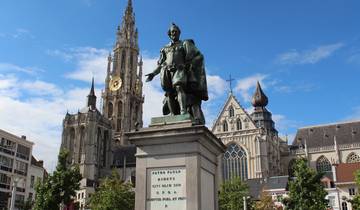
7 days
7 Day Brussels including Antwerp, Battle of the Bulge, Flanders Fields, Ghent, Bruges, Luxemburg & Dinant
- ✓ Comprehensive Belgium tour
- ✓ Expert local guides included
- ✓ All accommodation arranged
- ✓ Transportation provided
7 days
7 Days Across Paris & Brussels: From Eiffel Tower to Grand Place
- ✓ Comprehensive Belgium tour
- ✓ Expert local guides included
- ✓ All accommodation arranged
- ✓ Transportation provided
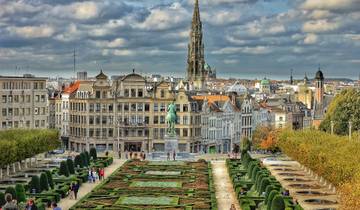
6 days
6 Days of Belgian Charm: Bruges, Ghent, Antwerp, Dinant & Luxembourg
- ✓ Comprehensive Belgium tour
- ✓ Expert local guides included
- ✓ All accommodation arranged
- ✓ Transportation provided

9 days
9 Days in Brussels and Luxembourg by Train: Fairytale Cities, Castles & Culture
- ✓ Comprehensive Belgium tour
- ✓ Expert local guides included
- ✓ All accommodation arranged
- ✓ Transportation provided
Multi-day tour packages powered by TourRadar. Prices and availability subject to change.
Introduction: The Supreme Achievement of Northern Renaissance Art
Standing before the Ghent Altarpiece at St. Bavo’s Cathedral, visitors encounter an artistic achievement so monumental that it fundamentally altered the course of Western art. This massive polyptych, measuring over 11 feet high and nearly 15 feet wide when opened, represents the culmination of medieval artistic traditions and the dawn of a new realistic approach that would define Renaissance painting. The work’s extraordinary journey through six centuries—surviving wars, theft, iconoclasm, and Nazi looting—mirrors European history itself, while its recent restoration revealed colors and details that continue to astonish scholars and challenge our understanding of 15th-century artistic capabilities.
The altarpiece’s creation story intertwines mystery with documented fact. An inscription credits both Hubert van Eyck, who began the work, and his younger brother Jan, who completed it in 1432. The exact division of labor between the brothers remains debated, with some scholars questioning Hubert’s role entirely, though most accept the inscription’s testimony that Hubert initiated the project before his death around 1426, leaving Jan to complete the masterwork. What remains indisputable is the revolutionary nature of the finished altarpiece, which established Jan van Eyck as one of history’s supreme artistic innovators.
Located in its original home for nearly six centuries, the Ghent Altarpiece anchors St. Bavo’s Cathedral as one of Europe’s essential artistic pilgrimages. The work’s UNESCO World Heritage status recognizes not just its artistic merit but its cultural significance as a defining achievement of European civilization. Recent restoration work, completed between 2012 and 2020, revealed the altarpiece’s original appearance with such striking vividness that it sparked renewed debate about medieval aesthetics and artistic intention. The controversial restoration of the Mystic Lamb’s face, returning it to Van Eyck’s original humanoid expression after centuries hidden beneath later overpaint, demonstrated how much we still have to learn from this inexhaustible masterwork.
Historical Background: Commission and Creation
The Ghent Altarpiece emerged from the convergence of artistic genius, wealthy patronage, and religious devotion in early 15th-century Flanders. Jodocus Vijd, a wealthy Ghent city official and alderman, and his wife Elisabeth Borluut commissioned the work for their private chapel in St. John’s Church (later renamed St. Bavo’s Cathedral after secularization). The inscription on the frame’s exterior provides crucial information: “The painter Hubert van Eyck, greater than whom no one was found, began this work; Jan, his brother, second in art, having carried through the task at the expense of Jodocus Vijd, invites you by this verse, on the sixth of May, to look at what has been done.”
This 1432 completion date places the altarpiece at a pivotal moment in European history. Bruges and Ghent flourished as centers of the Burgundian Netherlands, among Europe’s wealthiest regions thanks to the textile trade. The Burgundian court’s sophisticated artistic patronage created an environment where artists could experiment with new techniques and ambitious projects. Jan van Eyck served as court painter to Philip the Good, Duke of Burgundy, a position that provided financial security and access to expensive materials while allowing him to undertake major private commissions like the Ghent Altarpiece.
The question of Hubert van Eyck’s role remains one of art history’s enduring debates. Documentary evidence for Hubert is scarce beyond the inscription and a few archival references. Some scholars argue the entire work represents Jan’s achievement, suggesting the inscription honored a deceased brother or fulfilled contractual obligations. Others identify stylistic variations suggesting two hands at work. Analysis of underdrawing and painting techniques reveals some inconsistencies that could support multiple artists, though Jan’s own working methods evolved over his career, complicating attribution. The most widely accepted view credits Hubert with initial design and perhaps execution of certain panels, with Jan completing, revising, and unifying the whole into its final form.
Technical examination reveals the panels underwent various changes during creation. Infrared reflectography shows underdrawing that differs from final painted surfaces, indicating Jan modified compositions as work progressed. Some figures appear painted over earlier versions, and architectural elements show adjustments suggesting evolving design concepts. These revisions demonstrate the altarpiece as a living project rather than simple execution of predetermined plans, with artistic decisions continuing throughout the creative process.
The Van Eyck Brothers: Revolutionary Innovators
Jan van Eyck (c. 1390-1441) emerges from documentary records as one of the 15th century’s most accomplished and versatile artists. Born in Maaseik in the Prince-Bishopric of Liège, he entered the service of John of Bavaria, Count of Holland, by 1422, working in The Hague. After John’s death in 1425, Jan entered the employ of Philip the Good, Duke of Burgundy, serving not just as court painter but also diplomat, undertaking secret missions to Iberia and elsewhere. This elevated position provided financial security—Philip awarded him a generous annual salary and even intervened when city officials tried to withhold payment—that allowed sustained work on major projects.
Jan’s dated and signed works reveal an artist of extraordinary range and technical mastery. The 1434 Arnolfini Portrait demonstrates his ability to capture psychological presence and material reality with equal conviction. His religious works, from small devotional panels to ambitious altarpieces, show profound theological understanding combined with naturalistic observation. Portraits reveal individual character through subtle details of expression, costume, and setting. In every genre, Jan’s treatment of light and texture established new standards for realistic representation.
The innovation most associated with Jan van Eyck involves oil painting technique, though the extent of his invention versus perfection of existing methods remains debated. Earlier artists used oil as a medium, but Jan refined the technique to unprecedented levels. By mixing pigments with linseed and other oils and applying multiple translucent layers (glazes) over opaque underlayers, he achieved luminous color and subtle tonal transitions impossible with tempera. This layered approach allowed him to build up complex optical effects, making jewels appear to glow from within and creating atmospheric depth that suggested vast distances.
His technical mastery extended to preparation and materials. Jan used finely prepared oak panels, applied gesso grounds with meticulous care, and employed the finest available pigments including expensive ultramarine (ground lapis lazuli) and vermilion. He possessed deep understanding of how different pigments behaved in oil medium, which allowed thin transparent glazes and which required opaque application. His brushwork varied from broad underlayers to finishing touches applied with brushes of just a few hairs, enabling the microscopic detail that characterizes his work.
Hubert van Eyck remains a more shadowy figure. The few documentary references place him in Ghent by 1424-1425, where he maintained an independent workshop and received various commissions. An entry in Ghent city accounts from September 1426 records payment for his funeral, establishing that he predeceased completion of the altarpiece. No works survive that are unquestionably attributed to Hubert alone, making assessment of his individual style problematic. The inscription identifies him as “maior quo nemo repertus” (greater than whom no one was found), suggesting high contemporary regard, yet his role in the altarpiece and his overall achievement remain frustratingly unclear given the surviving evidence.
Artistic Significance: Technical and Aesthetic Innovation
The Ghent Altarpiece represents a watershed moment when Northern European painting achieved levels of naturalistic representation that rivaled and in some ways surpassed contemporary Italian Renaissance achievements. Where Italian painters pursued classical idealism and mathematical perspective, Jan van Eyck developed an approach rooted in minute observation of the natural world and mastery of optical effects. His technique created convincing three-dimensional space and atmospheric depth without relying on the systematic linear perspective being formulated in Florence, instead using empirical observation of how light and atmosphere affect appearance at different distances.
The altarpiece’s treatment of light demonstrates Van Eyck’s revolutionary approach. Rather than using conventional symbolic gold backgrounds, he depicted realistic sky and landscape, with light behaving as it does in nature—reflecting from surfaces, creating shadows with subtle color variations, and diminishing in intensity with distance. He understood and rendered different types of reflection: the diffuse reflection of matte fabrics, the directional reflection of silk, the mirror-like reflection of polished armor, and the complex internal reflection of gemstones. This optical sophistication allowed him to create material presence that seemed to exist in the viewer’s own space.
The naturalistic detail extends to extraordinary levels. In the lower central panel’s foreground, dozens of plant species appear rendered with botanical accuracy, allowing modern identification. Individual flowers, from roses to irises to violets, show specific characteristics of their species. The singing angels in the upper panels wear brocade robes with textile patterns shown in such detail that specialists can identify specific weaving techniques. The panel depicting Adam shows individual strands of hair on his legs and subtle variations in skin tone that suggest bone structure beneath flesh. Such detail went far beyond what viewing distance required, suggesting Van Eyck’s desire to capture divine creation’s infinite complexity.
The altarpiece’s color achieves luminosity that still startles viewers, particularly after recent restoration removed darkened varnish. Van Eyck’s layered oil technique created colors that seem to glow from within. Red robes show variations from deep crimson shadows to brilliant scarlet highlights, all achieved through careful glazing over white and colored underlayers. Blue sky gradates convincingly from deep ultramarine at the zenith to pale blue-white at the horizon, creating atmospheric depth. Green landscape passages show dozens of distinct hues, suggesting the complexity of natural vegetation rather than formulaic convention.
The compositional sophistication matches the technical achievement. The altarpiece functions as unified whole while each panel maintains individual completeness. The central lower panel establishes a vanishing point that organizes the entire lower register, yet each of the four surrounding panels creates its own convincing space. The upper register panels, though separated by the frame structure, relate through gesture and glance, suggesting communication across the physical divisions. When closed, the exterior panels present a coherent scene spanning eight panels, demonstrating Van Eyck’s ability to conceive and execute compositions at multiple scales.
The Panels and Their Iconography
The altarpiece’s structure allows multiple viewing experiences through its twenty-four painted surfaces—twelve when opened, twelve when closed. This architectural complexity reflects medieval religious sensibility, where revelation occurred in stages and deeper meanings remained hidden from casual observation, requiring devotion and contemplation to fully comprehend.
When closed, the altarpiece presents the Annunciation scene across four central panels, with the Angel Gabriel and the Virgin Mary in an upper chamber rendered with meticulous architectural detail. Above them, prophets and sibyls appear in simulated stone sculpture, their grisaille painting creating illusion of statuary in niches. Below, the donors Jodocus Vijd and Elisabeth Borluut kneel in prayer, painted to simulate sculpture like the prophets above them. On the outer wings, Saints John the Baptist and John the Evangelist stand in similar grisaille simulation. This closed state presented theological narrative from prophecy (prophets and sibyls) through Annunciation (beginning of Christ’s earthly life) to witness (the two Johns), while the simulated sculpture honored medieval artistic tradition and demonstrated Van Eyck’s technical versatility.
Opening the altarpiece reveals the full glory of Van Eyck’s vision, centered on the Adoration of the Mystic Lamb from Revelation 7. The central lower panel shows the Lamb of God standing on an altar, its blood flowing into the Fountain of Life, while groups of saints, martyrs, confessors, and the faithful gather in worship. The landscape setting presents an idealized vision combining recognizable elements—detailed plants, distant city architecture, hills and forests—into a paradise garden. Four surrounding panels expand this scene: the Just Judges and Warriors of Christ (defenders of the faith on horseback) approach from the left, while Hermit Saints and Pilgrims (contemplative and active religious life) approach from the right.
The upper register presents the heavenly court in five panels. God the Father (or Christ in Glory—interpretations differ) sits enthroned in the center, wearing papal tiara and magnificent brocade vestments, right hand raised in blessing. To his right, the Virgin Mary sits crowned and reading, while John the Baptist appears on his left. Both turn slightly toward the central figure, creating subtle interaction across panel divisions. The outer panels show angels singing from a music manuscript (left) and angels playing instruments including a pipe organ (right). These musical angels flank the composition with sound of heavenly praise.
The outermost upper panels depict Adam and Eve in striking nudity, among the earliest examples of realistic nude figures in Northern European art. Adam stands in contrapposto, his body showing understanding of anatomy that matches Italian Renaissance achievements. Eve’s posture and proportions follow Northern Gothic conventions more than classical ideals, yet Van Eyck renders her flesh with same attention to light and texture shown throughout the altarpiece. Above each figure, scenes from their story appear in simulated sculpture: Cain murdering Abel above Adam, Cain’s offering above Eve. These outer panels complete the theological narrative from Fall (Adam and Eve) through Redemption (Mystic Lamb) to Glory (heavenly court).
Symbolism and Theological Meaning
Every element in the Ghent Altarpiece carries symbolic weight, creating layers of meaning that reward extended contemplation. The central Mystic Lamb represents Christ’s sacrificial death, with its blood flowing into the chalice-like Fountain of Life. Around the fountain, groups represent the church triumphant: martyrs with palm branches, prophets with scrolls, apostles and clergy, virgin martyrs with roses and lilies. The gathering suggests Revelation’s vision of “a great multitude that no one could number, from every nation, from all tribes and peoples and languages, standing before the throne and before the Lamb.”
The landscape setting combines naturalistic observation with symbolic geography. The distant city on the horizon suggests the Heavenly Jerusalem described in Revelation, with identifiable buildings that may reference actual structures in Utrecht, Jerusalem, or other cities. The foreground flora includes plants with specific symbolic associations: roses for love and martyrdom, lilies for purity, iris for Mary’s sorrow, oranges for paradise. Trees in the middle distance include oak (strength, endurance) and palm (victory, martyrdom), while the fountain at center functions as Fountain of Life from Revelation 22: “the river of the water of life, bright as crystal, flowing from the throne of God and of the Lamb.”
The upper register presents the Trinity through complex iconography. The central figure wears triple crown and combines attributes of God the Father and Christ, creating ambiguity that reflects theological mysteries about Trinity’s nature. The Holy Spirit, represented by the dove descending in the Annunciation scene (on exterior panels) and hovering over the Lamb (on interior central panel), completes the Trinity. The Virgin Mary and John the Baptist function as intercessors, their presence beside the throne suggesting their roles in salvation history and continuing advocacy for humanity.
Color carries symbolic meaning throughout. Red signifies both divine love and martyrdom, appearing in the robes of singing angels, God’s vestments, and the martyrs’ clothing. Blue represents heavenly realm and truth, dominating Mary’s robes and the sky itself. Green suggests new life and paradise, spreading across the landscape. Gold, used sparingly compared to medieval convention, appears primarily in the Fountain and divine attributes, its luminosity suggesting divine presence rather than serving as generic background.
The musical angels demonstrate Van Eyck’s attention to symbolic detail. The singers on the left read from actual music notation, and specialists have identified the piece as a 15th-century motet. The instrumentalists on the right play organ, harp, and other instruments, their arrangement suggesting both earthly and heavenly music. This emphasis on music reflects theology about angelic worship and the harmony of creation, where music ordered by mathematical relationships mirrors cosmic order.
Conservation and Restoration History
The Ghent Altarpiece’s survival through nearly six centuries required numerous interventions, each reflecting changing understanding about conservation and sometimes causing as much harm as help. The panels underwent various treatments even in the 16th and 17th centuries, when conservators added protective varnish layers that eventually darkened and obscured the original colors. By the 19th century, the accumulated varnish layers and damage from previous cleanings created significant concern about the work’s condition.
Major restoration campaigns occurred in 1823-1825, 1859-1862, and 1920-1921, each using methods considered appropriate at the time but problematic by later standards. The 1823-1825 restoration transferred the paint layer from the original oak panels to new supports, a risky procedure that caused some paint loss. Later restorations added overpaint to damaged areas and applied new varnish layers. These interventions created a palimpsest where Van Eyck’s original work existed beneath centuries of additions and alterations.
The most comprehensive restoration to date began in 2012 and concluded in 2020, conducted by the Royal Institute for Cultural Heritage in Brussels. This painstaking project treated the panels in sequence, allowing public viewing of partially restored work while conservation continued. The team used advanced imaging technology including infrared reflectography, X-radiography, and macro-X-ray fluorescence scanning to understand the original painting techniques and identify later additions.
The restoration revealed colors of startling brightness and intensity, with reds more vivid, greens more luminous, and blues more saturated than anyone had seen in centuries. The removal of darkened varnish and overpaint exposed details hidden since shortly after completion. Individual pearls on divine vestments showed internal structure. Landscape elements emerged with clarity that demonstrated Van Eyck’s observational precision. Text on scrolls and books became legible again.
The most controversial discovery involved the Mystic Lamb’s face. Beneath 16th-century overpaint that gave the Lamb conventionally sweet features, conservators found Van Eyck’s original: a frontal-facing, almost humanoid expression with prominent ears and intense gaze. This startling face sparked debate about whether to preserve the familiar 16th-century version or restore Van Eyck’s original intention. The restoration team chose authenticity, revealing the original despite its confrontational strangeness. The decision reflects modern conservation ethics prioritizing original artistic intent over later alterations, however familiar those alterations may have become.
The Altarpiece’s Tumultuous History
Few artworks have survived such sustained threats as the Ghent Altarpiece. Its history of theft, looting, and narrow escapes from destruction reads like adventure fiction, yet each episode demonstrates the work’s perceived value across changing cultural contexts.
The first major threat came during the Reformation, when Calvinist iconoclasts controlled Ghent in 1566 and again 1578-1584. Church officials hid the panels in the cathedral tower to protect them from destruction. When Catholic authorities regained control, the altarpiece returned to its chapel, but Protestant challenges to religious images had marked it as target requiring vigilance. This pattern of preemptive protection would repeat throughout its history.
The French Revolutionary and Napoleonic period brought new dangers. In 1794, French forces occupying the Austrian Netherlands seized the central panels showing the Adoration of the Mystic Lamb and the surrounding scenes as war booty. Napoleon’s agents transported them to Paris for the Louvre, then the Musée Napoléon. After Napoleon’s defeat in 1815, most looted artworks returned to original locations under provisions of the Congress of Vienna, and the central panels came back to Ghent. However, Austrian authorities had sold the wing panels to an art dealer in 1816, and these ended up in Berlin museums, creating the altarpiece’s first significant separation.
The Treaty of Versailles after World War I required Germany to return the wing panels to Belgium as part of war reparations, reuniting the altarpiece in 1920. This reunion lasted only two decades. As World War II approached, Belgian authorities recognized the threat Nazi Germany posed to cultural heritage. In 1940, they secretly moved the altarpiece to southern France for safekeeping. When Germany occupied France in 1942, the panels were moved again, eventually hidden in a castle in Pau. Nevertheless, German forces discovered and seized them in 1942, transporting them to Germany.
Adolf Hitler wanted the altarpiece for his planned Führermuseum in Linz, but it ended up stored in the Austrian salt mine at Altaussee along with thousands of looted artworks. As Allied forces advanced in 1945, Hitler ordered the destruction of artworks rather than allow their capture. Local Austrian resistance and quick-thinking mine officials prevented this disaster. American Monuments Men discovered the altarpiece in the mine in May 1945, and it returned to Ghent in triumph, having survived the Nazi regime’s cultural warfare.
Yet the altarpiece’s most famous theft remains unsolved. On the night of April 10-11, 1934, someone entered St. Bavo’s Cathedral through a small door and removed the lower left panel showing the Just Judges. The thief left a note reading “Taken from Germany by the Treaty of Versailles,” suggesting political motive. Over following months, additional ransom notes arrived demanding money and the return of panels given to Belgium after World War I. The thief returned one panel (the John the Baptist wing) as proof of possession, but negotiations failed.
Investigators focused on Arsène Goedertier, a stockbroker and church official who made a deathbed statement suggesting he knew the panel’s location, but he died before revealing details. Subsequent investigations explored numerous theories, from burial in specific locations to secret societies, but the Just Judges has never been recovered. The current panel is a 1945 copy by Belgian artist Jef Van der Veken, identifiable upon close inspection but serving to complete the visual composition.
UNESCO Recognition and Cultural Heritage Status
The Ghent Altarpiece holds UNESCO World Heritage status as part of the “Belfries of Belgium and France” inscription, recognizing its exceptional cultural significance. This designation acknowledges the altarpiece as a defining achievement of European art history and ensures its protection under international heritage law. The UNESCO recognition extends beyond the panels themselves to encompass St. Bavo’s Cathedral as the altarpiece’s historic setting, acknowledging that the work’s significance includes its context and original purpose.
The altarpiece’s influence on European art extends far beyond its immediate context. Artists traveling to Flanders to study the work included Albrecht Dürer, who made pilgrimage to Ghent specifically to view it. The altarpiece established standards for oil painting technique that spread throughout Europe, contributing to the Northern Renaissance’s technical achievements. Its influence appears in works by Rogier van der Weyden, Hans Memling, Hugo van der Goes, and countless other painters who absorbed Van Eyck’s lessons about naturalistic representation, optical effects, and complex iconography.
The work’s cultural impact reaches beyond art history into broader European identity. Its survival through wars, revolutions, and theft attempts makes it symbol of cultural resilience. The dramatic recovery stories, particularly rescue from the Altaussee salt mine in 1945, feature prominently in narratives about protecting civilization’s achievements from destruction. The ongoing mystery of the stolen panel maintains public interest and demonstrates enduring fascination with the work beyond specialist scholarship.
Modern conservation science uses the Ghent Altarpiece as case study for advanced techniques. The recent restoration employed cutting-edge imaging technology, establishing protocols that inform treatment of other historic paintings. Research generated by this project contributes to understanding 15th-century artistic materials and techniques, knowledge applicable to works throughout European museums. In this sense, the altarpiece continues to influence art beyond its original role as devotional object, serving as laboratory for conservation methodology and technical art history.
Viewing the Altarpiece Today
The Ghent Altarpiece remains in its original location at St. Bavo’s Cathedral, displayed in a climate-controlled chapel that protects the panels while allowing public viewing. Visitors enter through a dedicated entrance that manages crowd flow and maintains conservation standards. The display presents the altarpiece in its opened state, allowing full view of the interior panels’ glory, though periodic exhibitions show the closed exterior view.
Advanced glass enclosure protects the panels while maintaining visual clarity. The climate control system regulates temperature and humidity to conservation standards, preventing the fluctuations that cause wood panels to expand and contract. Lighting replicates natural daylight spectrum without ultraviolet radiation that could damage pigments, allowing viewers to appreciate the colors’ subtlety and luminosity while protecting the artwork from light damage.
The viewing experience benefits from interpretive materials that explain the iconography and historical context. Audio guides provide detailed information about individual panels and elements, while printed materials offer overviews for those seeking quick understanding. The cathedral maintains staff who answer questions and provide context about both the altarpiece and its setting within the broader cathedral complex.
Photography policies balance visitor desires to document their experience with conservation concerns. Flash photography is prohibited, as repeated flash exposure could damage pigments over time. Professional photography requires special permission and occurs under controlled conditions. These restrictions reflect broader heritage management balancing access with preservation, ensuring future generations can experience the altarpiece in condition approaching what visitors see today.
The surrounding cathedral context enhances the viewing experience. St. Bavo’s contains numerous other artworks and architectural features spanning centuries, allowing visitors to appreciate the altarpiece within the religious and cultural context it was created to serve. The cathedral’s crypt houses archaeological remains revealing Ghent’s medieval history, while the main structure demonstrates Gothic architectural achievements parallel to Van Eyck’s artistic innovations.
Influence on Art History and Scholarship
The Ghent Altarpiece occupies a central position in art historical scholarship, generating endless analysis and interpretation. Its technical achievements make it cornerstone for understanding early Netherlandish painting technique. Art historians study its innovative approach to space, light, and naturalistic detail as foundation for Northern Renaissance development. The work’s iconographic complexity provides endless material for theological and symbolic interpretation, with scholars continuing to identify new elements and decode meanings nearly six centuries after completion.
Technical studies using modern imaging reveal information unavailable to previous generations. Infrared reflectography shows underdrawing that clarifies working methods and compositional development. X-radiography reveals paint layer structure and modifications made during creation. Macro-X-ray fluorescence scanning creates elemental maps showing pigment distribution, identifying specific materials and application techniques. These scientific approaches complement traditional connoisseurship and archival research, creating comprehensive understanding of how the altarpiece was made and what it meant to original audiences.
The attribution debate surrounding Hubert van Eyck’s role demonstrates how a single artwork can generate scholarly controversy lasting centuries. Arguments about the inscription’s reliability, stylistic analysis identifying different hands, and documentary evidence about the brothers’ lives continue to produce new interpretations. This ongoing debate shows how even well-studied artworks retain mysteries that resist definitive resolution, keeping them vital to scholarly discourse.
The altarpiece influences contemporary artists who engage with its themes and techniques. Modern painters study Van Eyck’s approach to light and detail, finding inspiration in his technical mastery. Installation artists reference the altarpiece’s panel structure and transformation between closed and open states. Photographers and digital artists explore the work’s relationship between surface appearance and underlying meaning. This continued engagement demonstrates the altarpiece’s relevance beyond historical artifact, functioning as living inspiration for creative practice.
The Restored Lamb: Contemporary Reactions
The 2020 revelation of the Mystic Lamb’s original face sparked unprecedented public discussion about restoration ethics and artistic intention. The strange, almost human-like expression with frontal gaze and prominent ears challenged centuries of familiarity with the overpainted version’s conventionally sweet features. Social media responses ranged from shock to humor, with memes and commentary spreading the image worldwide. The “new” (actually original) face became cultural phenomenon, demonstrating how restoration can transform relationship between artwork and contemporary audiences.
The controversy highlighted fundamental questions about conservation philosophy. Should restoration preserve familiar appearance developed over centuries, even if that appearance differs from original intent? Or should it reveal original artistic conception, however startling or unfamiliar? The restoration team’s choice to uncover Van Eyck’s original reflects modern conservation ethics prioritizing authenticity over comfort, but the decision generated debate among specialists and public alike.
Art historians defended the restoration, noting that Van Eyck’s original lamb face, while unusual, demonstrates his revolutionary naturalism. Rather than depicting conventionally beautiful symbolic lamb, he observed actual sheep and painted what he saw, including the forward-facing gaze sheep actually employ. This naturalistic approach parallels his treatment of every other element in the altarpiece, from botanical details to human anatomy. Viewing the “new” lamb in this context reveals it as consistent with Van Eyck’s entire artistic project, making nature itself the subject worthy of minute observation.
The public response demonstrated how deeply artworks integrate into cultural consciousness. Generations familiar with the overpainted lamb face experienced the restoration as loss of the “real” altarpiece, even though the uncovered version is literally more authentic. This paradox reveals how familiarity shapes perception, with copies and alterations sometimes becoming “truer” to cultural memory than originals. The incident parallels other controversial restorations, from the Sistine Chapel ceiling to various Old Master paintings, where dramatic cleaning revealed colors shocking to eyes accustomed to darkened varnish.
Frequently Asked Questions
Where can I see the Ghent Altarpiece?
The Ghent Altarpiece remains in its original location at St. Bavo’s Cathedral in Ghent, Belgium, where it has resided since 1432 (with interruptions for wartime protection and restoration). The cathedral displays it in a specially designed chapel with climate control and security measures, allowing public viewing during cathedral visiting hours. The viewing experience includes interpretive materials, audio guides, and staff assistance to help visitors understand the work’s complex iconography and historical significance.
How large is the Ghent Altarpiece?
When fully opened, the Ghent Altarpiece measures approximately 3.4 meters (11.2 feet) high and 4.6 meters (15.1 feet) wide. The polyptych consists of 12 panels when opened (showing the interior scenes) and 12 panels when closed (showing the exterior Annunciation and grisaille figures). The central panels measuring larger than the wing panels, creating the characteristic altarpiece shape with prominent center section. The sheer physical scale contributes to the work’s overwhelming visual impact and allows the minute details to remain visible despite the monumental composition.
What happened to the missing panel?
The “Just Judges” panel was stolen from St. Bavo’s Cathedral on April 10-11, 1934, and has never been recovered. The thief left ransom notes and returned one panel as proof of possession but died (allegedly stockbroker Arsène Goedertier) before revealing the location. Despite numerous investigations, deathbed confessions, and theories about burial locations, the original panel remains lost. The current panel displayed in the altarpiece is a 1945 copy painted by Jef Van der Veken that replicates the stolen panel’s composition while being identifiable as a replacement upon close inspection.
Why did the restoration change the lamb’s face?
The restoration didn’t change the lamb’s face—it revealed Jan van Eyck’s original painting hidden beneath 16th-century overpaint for approximately 400 years. Someone in the 1500s painted over Van Eyck’s unusual humanoid lamb face with a more conventionally sweet expression, and this overpaint became familiar through centuries of viewing. Modern conservation ethics prioritize revealing original artistic intention rather than preserving later alterations, so the restoration team removed the overpaint to show Van Eyck’s actual work, despite its startling appearance to modern viewers accustomed to the altered version.
What makes Van Eyck’s technique so revolutionary?
Jan van Eyck revolutionized painting through his mastery of oil painting techniques, building up multiple translucent layers (glazes) over opaque underlayers to create unprecedented luminosity, subtle color transitions, and realistic detail. His approach allowed him to depict light behavior with optical accuracy, from the reflection of silk to the internal glow of gemstones. Combined with minute observational detail—individual plant species, textile weaves, anatomical precision—his technique established new standards for naturalistic representation that influenced European painting for generations and made the Northern Renaissance technically equivalent to Italian achievements.
What does the central panel symbolize?
The central panel depicts the Adoration of the Mystic Lamb from the Book of Revelation, representing Christ’s sacrifice and the worship of heaven. The Lamb stands on an altar with its blood flowing into the Fountain of Life, while saints, prophets, martyrs, and the faithful gather in worship around it. The scene represents salvation history’s culmination, where Christ’s sacrifice redeems humanity and creates the possibility of eternal life. Every element carries symbolic meaning: specific flowers represent virtues, the distant city suggests Heavenly Jerusalem, and the gathering crowds represent the universal church across all time and space.
How did the altarpiece survive World War II?
Belgian authorities moved the altarpiece to southern France in 1940 for protection from Nazi occupation. Despite this precaution, German forces discovered and seized the panels in 1942, transporting them to Germany for Hitler’s planned Führermuseum. The panels ended up hidden in the Altaussee salt mine in Austria along with thousands of looted artworks. When Hitler ordered the mine’s artworks destroyed as Allied forces approached, local Austrian resistance and mine officials prevented this catastrophe. American Monuments Men discovered the altarpiece intact in May 1945 and returned it to Ghent, where it survived as testament to cultural heritage’s resilience against wartime destruction.
Can I photograph the altarpiece?
Personal photography without flash is generally permitted at St. Bavo’s Cathedral, allowing visitors to document their experience. Flash photography is strictly prohibited because repeated flash exposure can damage historic pigments over time through cumulative light exposure and heat generation. Professional photography and filming require special permission from cathedral authorities and occur under controlled conditions with conservation protocols. These policies balance visitor desires to share their experience with preservation responsibilities, ensuring the altarpiece remains in good condition for future generations while allowing contemporary audiences reasonable access.
What happened to Hubert van Eyck?
Hubert van Eyck died in Ghent in September 1426, before completion of the altarpiece that would secure his fame. Ghent city accounts record payment for his funeral, establishing the death date, but little else is known about his life or independent work. The altarpiece inscription credits him as beginning the work (“maior quo nemo repertus”—greater than whom no one was found), with brother Jan completing it, but the exact division of labor remains debated. No works survive that can be attributed to Hubert with certainty independent of the altarpiece, making him one of art history’s most mysterious figures despite the inscription’s high praise.
Why is it called a polyptych?
A polyptych is a painting consisting of multiple panels hinged together, allowing it to open and close like a book. The term derives from Greek “poly” (many) and “ptyche” (fold). The Ghent Altarpiece’s polyptych structure allows it to function in two modes: closed (showing the Annunciation and grisaille figures) and opened (revealing the full glory of the Adoration of the Mystic Lamb and heavenly court). This format was common for medieval and Renaissance altarpieces because it protected precious interior paintings when not in use for important liturgical occasions while providing simpler exterior imagery for everyday viewing. The multiple panels also allowed practical considerations like transportation and complex iconographic programs spanning numerous scenes.