Free Things to Do in Lucerne 2026: Complete Guide to No-Cost Experiences
Lucerne stands as Switzerland’s most accessible city for budget travelers, offering dozens of spectacular experiences requiring no entrance fees. Between the medieval Musegg Wall’s panoramic views, the iconic Chapel Bridge spanning the Reuss River, and miles of lakeside promenades beneath alpine peaks, visitors discover that Lucerne’s greatest treasures cost nothing at all. This guide reveals how to experience the city’s historic landmarks, cultural heritage, and natural beauty in 2026 without spending a single franc.
Key Takeaways: Free Lucerne Experiences 2026
- Medieval Fortifications Access: The 870-meter Musegg Wall and four of its nine towers open free to the public from April 1 through November 1, 2026, offering the city’s finest panoramic views from 8 AM to 7 PM daily
- Iconic Bridges: Both Chapel Bridge and Spreuer Bridge provide free access year-round, featuring original medieval paintings and serving as Lucerne’s most photographed landmarks
- Lakeside Recreation: Lake Lucerne’s extensive promenade system delivers miles of free lakefront walking, cycling, and picnicking with continuous alpine and water views
- Old Town Exploration: The car-free historic center reveals frescoed Renaissance buildings, medieval squares, baroque churches, and Gothic fountains accessible entirely on foot at no cost
- Guest Card Benefits: Overnight visitors automatically receive the Lucerne Guest Card from their accommodation, providing free public transportation throughout Zone 10 including buses reaching all major free attractions
- Year-Round vs Seasonal Access: While most free attractions operate year-round, the Musegg Wall towers close from November through March, making April-October optimal for complete free access to all city highlights
People Also Ask About Free Things to Do in Lucerne 2026
What are the completely free attractions in Lucerne in 2026?
Lucerne’s major free attractions in 2026 include the Chapel Bridge and Spreuer Bridge spanning the Reuss River, the Lion Monument carved into natural rock, the entire Old Town historic district with its painted facades and medieval squares, the Jesuit Church and St. Leodegar Church, and the Musegg Wall with four accessible towers. The lakeside promenade stretching along Lake Lucerne provides miles of free walking and cycling paths with mountain views. All Old Town squares including Weinmarkt, Kornmarkt, and Sternenplatz remain accessible without fees. These attractions represent Lucerne’s most iconic landmarks and together offer several days of comprehensive sightseeing at zero cost.
When can I visit the Musegg Wall towers for free in 2026?
The Musegg Wall and its four publicly accessible towers (Männliturm, Zytturm, Wachtturm, and Schirmerturm) open free from April 1 through November 1, 2026, operating daily from 8 AM to 7 PM. The wall closes entirely from November through March during winter months. Four of the nine towers along the 870-meter medieval fortification remain open to climbers during the April-November season, while the remaining five towers house guild halls and private associations. The Zytturm features Lucerne’s oldest clock from 1535, which famously chimes one minute before all other city clocks. Visitors should wear proper footwear as tower stairs are steep and narrow, with the climb to viewing platforms requiring moderate fitness levels.
Is the Chapel Bridge free to cross in 2026?
The Chapel Bridge remains completely free to cross at all times in 2026, operating as both a pedestrian thoroughfare and tourist landmark accessible 24 hours daily. Built in 1333, this covered wooden bridge spans 204 meters across the Reuss River and features 17th-century paintings under its roof depicting scenes from Lucerne’s history and Swiss patron saints. The adjacent Water Tower, part of the city’s original fortifications, appears in virtually every Lucerne photograph but serves as a private function space not open for interior tours. Visiting early morning before 8 AM or evening after 6 PM provides the most peaceful bridge crossing experience with minimal crowds and excellent photography lighting conditions.
How can I get free public transportation in Lucerne 2026?
Overnight guests staying at any Lucerne accommodation automatically receive the Lucerne Guest Card upon check-in, providing free public transportation throughout Zone 10 covering the entire city and immediate surroundings in 2026. The Guest Card includes unlimited bus travel on all VBL (Verkehrsbetriebe Luzern) routes reaching every major attraction including the Old Town, lakefront, Musegg Wall, and Lion Monument. Hotels, hostels, and vacation rentals all participate in the Guest Card program as a standard municipal benefit. The card activates upon checking in and remains valid through checkout, eliminating all local transportation costs for visitors with paid accommodation. Day visitors without overnight stays can walk to most central attractions within 30 minutes from Lucerne train station, as the compact Old Town concentrates the majority of free sights within a walkable area.
Extended multi-day tours – 5+ days
Featured Lucerne Multi-Day Tour Packages
3 days
Lucerne 3-Day Discovery Tour
- ✓ Comprehensive Lucerne experience
- ✓ Expert local guides included
- ✓ All accommodation included
- ✓ Transportation provided
5 days
Lucerne 5-Day Highlights Experience
- ✓ Comprehensive Lucerne experience
- ✓ Expert local guides included
- ✓ All accommodation included
- ✓ Transportation provided
7 days
Lucerne 7-Day Cultural Journey
- ✓ Comprehensive Lucerne experience
- ✓ Expert local guides included
- ✓ All accommodation included
- ✓ Transportation provided
10 days
Lucerne 10-Day Complete Adventure
- ✓ Comprehensive Lucerne experience
- ✓ Expert local guides included
- ✓ All accommodation included
- ✓ Transportation provided
Multi-day tour packages powered by TourRadar. Prices and availability subject to change.
Introduction: Experiencing Lucerne Without Spending Money
Switzerland’s reputation as Europe’s most expensive destination creates the misconception that visiting cities like Lucerne requires substantial budgets for basic sightseeing. This assumption collapses upon arrival in Lucerne, where the city’s greatest treasures systematically avoid charging entrance fees. The medieval Chapel Bridge spanning the Reuss River, the Musegg Wall towering above the Old Town, the lakeside promenades stretching for miles beneath Mount Pilatus, and the entire historic center with its painted Renaissance facades all welcome visitors without ticket booths or admission gates.
Lucerne’s free accessibility stems from Swiss cultural values prioritizing public access to heritage landmarks and natural spaces. The city maintains its medieval fortifications, bridges, churches, and public squares as open commons rather than commercialized attractions. This approach creates an unusual European capital where the primary tourist circuit costs nothing beyond transportation to reach it. The Lucerne Guest Card, provided free to all overnight visitors, eliminates even local transportation costs by including unlimited bus access throughout the city.
The 2026 season brings no significant changes to Lucerne’s free attraction access policies, maintaining the established April-through-November opening period for the Musegg Wall towers and year-round access to all other major landmarks. Understanding which experiences cost nothing, when seasonal attractions open, and how to maximize the Guest Card benefits allows travelers to design comprehensive Lucerne itineraries with minimal expenses beyond accommodation and meals. Many visitors spend entire days exploring the city while spending only on food purchases, proving that authentic Swiss experiences need not require substantial budgets.
The following sections detail each free attraction category, providing specific access information, optimal visiting times, and strategic combinations for efficient sightseeing. From dawn walks across the Chapel Bridge to sunset views from the Musegg Wall, Lucerne’s free offerings span from early morning through evening, accommodating various travel styles and time constraints. Budget travelers, families managing expenses, and anyone seeking authentic experiences over commercialized attractions find Lucerne remarkably welcoming and accessible.
Medieval Fortifications: Musegg Wall and Towers 2026
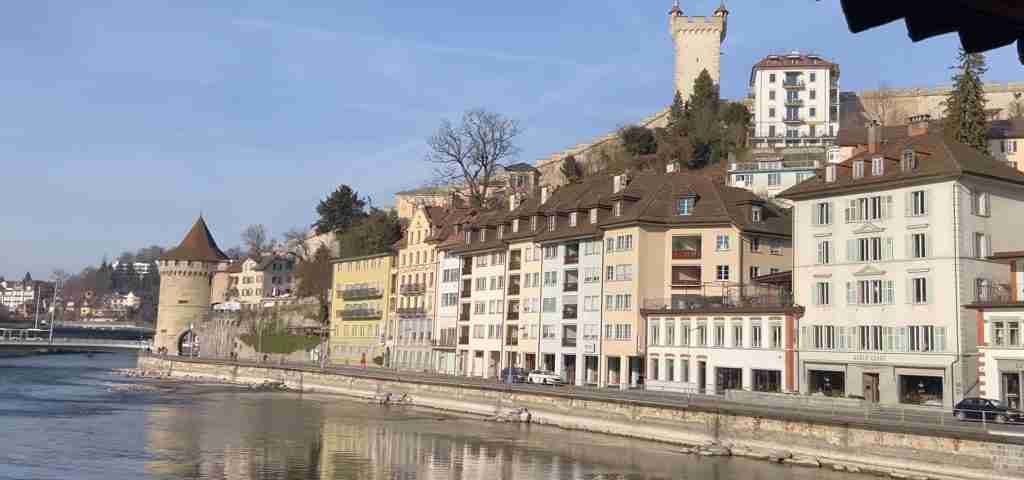
The Musegg Wall represents Switzerland’s best-preserved medieval defensive fortification and Lucerne’s premiere free attraction. Constructed between 1350 and 1408 along a sandstone ridge overlooking the Old Town, this 870-meter stone rampart stretches from the Nölli Tower above the Reuss River to the Dächli Tower at the eastern boundary of the historic center. Nine watchtowers punctuate the wall at strategic intervals, each displaying distinct architectural features reflecting different construction periods and defensive functions. Four towers—Männliturm, Zytturm, Wachtturm, and Schirmerturm—open to public climbing during the April-November season, while the remaining five serve as guild halls and cultural association headquarters.
The wall opens free to all visitors from April 1 through November 1, 2026, operating daily from 8 AM to 7 PM. Access closes entirely from November through March as winter conditions make the narrow rampart walkways and steep tower stairs hazardous. The battlement path connecting the towers measures roughly 40 centimeters wide in sections, requiring single-file passage and creating occasional bottlenecks during peak tourist hours between 10 AM and 4 PM. Multiple entry points along Museggstrasse allow visitors to access specific tower sections rather than walking the entire 870-meter length, though completing the full wall circuit from west to east requires approximately 90 minutes including tower climbs.
Männliturm: The Iron Sentinel Tower 2026
The Männliturm, second tower from the western end, takes its name from the small iron figure crowning its peak—a medieval knight in full armor holding sword and flag. Built in the 15th century, this 33-meter tower provides the wall’s most dramatic city views, overlooking the entire Old Town, the Reuss River with both covered bridges, and Lake Lucerne extending toward Mount Pilatus. The climb involves 87 steep stone steps spiraling upward through progressively narrower passages, with the final ascent requiring ducking through a low ceiling opening onto the viewing platform.
The Männliturm viewing platform accommodates roughly six people comfortably, creating wait times during midday peak hours when tour groups visit. Early morning visitors between 8 AM and 9 AM typically find the tower empty, allowing extended photography time capturing Lucerne’s red rooftops against the alpine backdrop. The platform features four-direction views through original arrow slits, with the western exposure framing the Chapel Bridge and Water Tower, the northern vista revealing residential Lucerne spreading toward suburbs, the eastern perspective showing the remaining wall towers marching up the ridge, and the southern outlook capturing Lake Lucerne’s entire western shore.
Zytturm: The Clock Tower and Its Privilege 2026
The Zytturm stands as Lucerne’s most historically significant tower, housing Central Switzerland’s oldest functioning clock mechanism. Constructed by clockmaker Hans Luter in 1535, this mechanical marvel maintains a unique privilege granted by medieval city authorities: striking the full hour one minute before all other clocks in Lucerne. This temporal advantage originally allowed city gatekeepers and night watchmen to begin their hourly routines before the general population, maintaining orderly transitions between civic functions. The privilege continues in 2026 purely as historical tradition, with the Zytturm’s bells ringing at 11:59 while all other Lucerne clocks chime at noon.
Visitors climbing the Zytturm access the clock mechanism chamber during the final ascent, observing the gears, weights, and pendulum systems through protective glass barriers. The massive iron weights descend through the tower’s interior, requiring weekly rewinding by city maintenance staff who access the mechanism via a separate entrance. The viewing platform, positioned one level above the clock mechanism, delivers slightly lower elevation than Männliturm but superior southern exposure toward Lake Lucerne and Mount Rigi. The platform’s eastern vista captures the upper Musegg Wall climbing toward Luegislandturm, the wall’s oldest and tallest section at 52.6 meters, which remains closed to public access.
Wachtturm: The Rebuilt Watchtower 2026
The Wachtturm occupies the site of the medieval Heuturm, which exploded in 1701 when lightning struck its gunpowder magazine. The blast destroyed half the tower and scattered debris across the Old Town below, killing three citizens and damaging multiple buildings. City authorities rebuilt the tower in 1707 as a dedicated watchtower without gunpowder storage, renaming it Wachtturm and implementing strict separation of ammunition storage among remaining towers. The rebuilt structure stands 44 meters tall, featuring wider stairs than original medieval towers thanks to 18th-century construction standards prioritizing safety over defensive compactness.
The Wachtturm provides the most family-friendly climb among accessible towers, with stairs allowing two people to pass comfortably and handrails installed throughout the ascent. The viewing platform features the wall’s most comprehensive interpretive panels, explaining each visible landmark in German, French, Italian, and English. Information boards identify Mount Pilatus’s individual peaks, trace the Chapel Bridge’s route across the Reuss, and highlight notable Old Town buildings by their painted facades. The platform’s northern exposure reveals Lucerne’s residential expansion toward suburbs and surrounding villages, demonstrating the city’s evolution from a compact medieval settlement to a modern regional center.
Schirmerturm: The Gateway Tower 2026
The Schirmerturm, easternmost accessible tower, originally served as Lucerne’s primary gateway between the fortified city and surrounding agricultural lands. Constructed in 1420, this tower features a ground-level passage allowing carts and livestock to enter the city during daylight hours while closing at night with heavy timber doors and iron-reinforced gates. The passage remains visible at ground level, though modern pedestrian traffic uses adjacent sidewalks rather than passing through the medieval opening. The tower’s defensive function emphasized controlling countryside access rather than repelling organized military assaults, as Lucerne’s eastern approach featured gentler terrain compared to the river-protected western and southern boundaries.
Climbing the Schirmerturm requires ascending 76 steps through chambers displaying increasing sophistication in defensive architecture. Lower levels feature narrow arrow slits positioned for crossbow fire, middle chambers include storage areas for weapons and supplies, and upper levels reveal machicolations—floor openings allowing defenders to drop stones or pour boiling liquids on attackers attempting to breach the gate below. The viewing platform provides unique perspectives absent from western towers: eastern vistas reveal the surrounding Lucerne countryside extending toward Kriens and the Pilatus cable car base station, while southern views capture Lake Lucerne’s narrower eastern sections where the water splits toward multiple arms reaching into Central Switzerland’s interior valleys.
Strategic Wall Walking Tips 2026
Walking the entire Musegg Wall circuit requires navigating steep stone stairs connecting different rampart elevations, narrow battlement paths with occasional missing handrails, and uneven medieval stonework that becomes slippery after rain. Proper footwear makes substantial difference in both safety and comfort—athletic shoes, hiking boots, or walking shoes with good grip handle the varied surfaces better than fashion footwear, sandals, or heels. The wall features minimal shade, making sun protection essential during summer visits, while April and October provide cooler temperatures for comfortable climbing without overheating during the tower ascents.
The recommended walking direction proceeds west to east, starting at the Nölli Tower above Geissmattbrücke and climbing gradually upward toward the Schirmerturm. This route follows the natural ridge ascent, requiring less cardiovascular effort than the reverse direction’s steep initial climb from Museggstrasse. Budget 20-25 minutes between tower climbs to allow for walking the connecting rampart sections and recovering from the previous ascent. Carrying water proves essential as no facilities exist along the wall, and the nearest public restrooms locate at ground level near the Nölli Tower entrance and along Museggstrasse near the Schirmerturm descent.
Photography opportunities multiply throughout the walk, with each tower angle revealing different Old Town perspectives and alpine compositions. Morning light between 8 AM and 10 AM illuminates Lucerne’s eastern facades while backlighting Mount Pilatus for dramatic silhouettes. Afternoon light from 3 PM through sunset casts warm tones across the Old Town’s painted buildings and creates ideal exposure for Chapel Bridge photographs from elevated angles. Evening visits near the 7 PM closing time provide solitude and softer light, though visitors must complete their wall walk before staff close the tower doors promptly at closing time.
Iconic Covered Bridges: Chapel Bridge and Spreuer Bridge 2026
Lucerne’s two covered wooden bridges rank among Europe’s most significant medieval structures, serving simultaneously as functional river crossings, defensive fortifications, and open-air art galleries. Both bridges span the Reuss River connecting the Old Town on the northern bank with the New Town on the southern shore, creating pedestrian corridors that have operated continuously since the 14th century. Unlike typical tourist landmarks requiring paid entry, both bridges function as active public thoroughfares used daily by local residents commuting between neighborhoods, ensuring perpetual free access regardless of time or season.
Chapel Bridge: Europe’s Oldest Wooden Bridge 2026
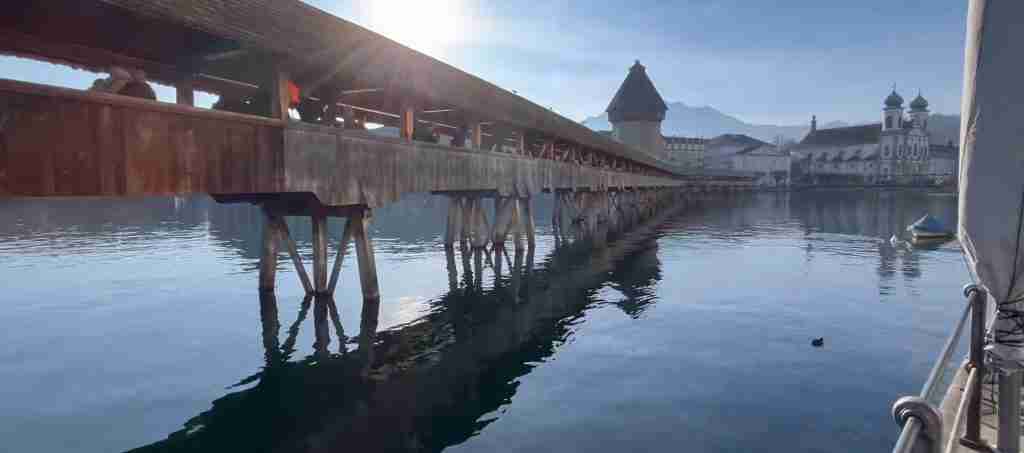
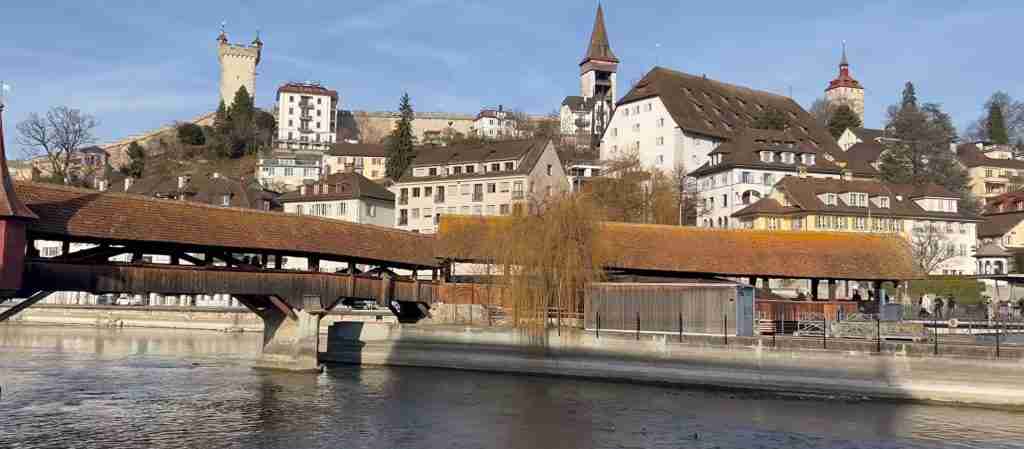
The Chapel Bridge (Kapellbrücke) extends 204 meters across the Reuss River in a diagonal alignment from the Old Town’s Rathaussteg near the Town Hall to the southern bank adjacent to St. Peter’s Chapel. Constructed in 1333 as part of Lucerne’s medieval fortification system, the bridge originally connected to defensive walls encircling the city, allowing residents to cross the river under protective cover during sieges. The distinctive Water Tower (Wasserturm) rises from the river approximately one-third along the bridge’s length, predating the bridge itself with construction beginning around 1300 as a standalone defensive tower and lighthouse guiding river traffic.
The bridge’s roof shelters 17th-century triangular paintings created by local artist Hans Heinrich Wägmann, depicting scenes from Lucerne’s history, Swiss patron saints’ lives, and significant events in Swiss Confederation history. Originally numbering 158 paintings, the collection suffered devastating loss during a 1993 fire that destroyed the bridge’s central section and 78 paintings. Reconstruction completed in 1994 restored the bridge structure while salvaging and restoring 30 paintings damaged by fire and water, and creating reproductions of several destroyed panels based on historical photographs. The surviving and restored paintings hang in their original triangular frames beneath the peaked roof, creating a continuous narrative as pedestrians cross the river.
Walking the Chapel Bridge requires no fee and operates 24 hours daily without restrictions. The bridge serves as Lucerne’s most photographed landmark, with optimal exterior photography locations including the southern bank near Jesuitenplatz for classic compositions framing the Water Tower with the bridge extending toward the Old Town backdrop, the northern bank near Rathaussteg for afternoon light illuminating the bridge’s length, and the Spreuer Bridge for elevated perspective capturing the Chapel Bridge’s diagonal river crossing. Interior photography while walking the bridge captures the painted panels, though achieving quality images requires visiting during off-peak hours when pedestrian traffic allows stopping without blocking other walkers.
The Water Tower, while visually central to Chapel Bridge photographs, functions as a private event venue operated by Lucerne’s artillery society and remains closed to tourist access. The octagonal stone tower stands 34.5 meters tall including its pointed roof, having served variously as defensive position, archive storage, treasury, prison, and torture chamber during its 700-year history. Modern renovations converted the interior spaces into upscale function rooms available for private rental, with public access limited to exterior viewing only. The tower’s strategic position mid-river allows pedestrians to walk around its base where the bridge route bends slightly, creating multiple photography angles of the tower against the Old Town skyline.
Spreuer Bridge: The Dance of Death Gallery 2026
The Spreuer Bridge (Spreuerbrücke) crosses the Reuss River 200 meters west of the Chapel Bridge, connecting the Old Town near Mühlenplatz with the southern bank at Pfistergasse. Constructed between 1406 and 1408 as part of expanded city fortifications, this 80-meter covered bridge originally served as the city’s mill bridge, positioning water mills beneath its structure where river flow powered grinding stones processing grain from surrounding agricultural regions. Small openings in the bridge floor allowed millers to dispose of chaff (Spreu in German) into the river current, giving the bridge its name.
The Spreuer Bridge houses a complete Dance of Death (Totentanz) painting cycle created by Kaspar Meglinger between 1626 and 1635. This series of 67 triangular paintings depicts allegorical scenes of Death leading individuals from all social stations—popes, emperors, nobles, merchants, peasants—toward their inevitable end, emphasizing mortality’s universality across class boundaries. The paintings rank as the most extensive known Dance of Death cycle in existence, with many individual panels showing Death as a skeleton musician or dancer accompanying specific social archetypes. The somber theme reflected post-plague European society’s preoccupation with mortality following the Black Death’s recurring outbreaks.
Unlike the Chapel Bridge’s historical narrative paintings, the Spreuer Bridge’s philosophical and allegorical cycle creates a distinctly different viewing experience requiring slower passage to appreciate individual panel details. Reading the German inscriptions beneath each painting provides additional context for the depicted scenes, though the visual imagery communicates effectively without language comprehension. The bridge receives substantially fewer visitors than the Chapel Bridge despite equal historical significance, often allowing solitary viewing during early morning and late afternoon hours. Photography inside the bridge benefits from natural light entering through side windows, though achieving even exposure across the paintings’ dark backgrounds requires manual camera settings or HDR processing.
The bridge’s southern exit leads directly to Pfistergasse, a medieval street lined with painted facades and guild houses demonstrating Lucerne’s Renaissance prosperity. Combining a Spreuer Bridge crossing with Pfistergasse exploration creates a natural walking route through less-trafficked Old Town sections rarely included in rushed tourist circuits. The adjacent Nölli Tower marks the Musegg Wall’s starting point, allowing visitors to connect bridge viewing with wall climbing in a single morning or afternoon excursion covering multiple free attractions within a compact geographic area.
Optimal Bridge Photography Strategy 2026
Photographing both covered bridges requires managing challenging lighting conditions created by dark wooden structures against bright sky and water reflections. Sunrise between 6 AM and 7 AM provides soft directional light illuminating the bridges from the east while avoiding harsh midday contrast. The golden hour before sunset creates warm tones across the wooden structures and generates attractive reflections on the Reuss River’s surface, with timing varying by season from 4:30 PM in winter to 7:30 PM in summer.
The most successful bridge compositions utilize foreground elements framing the structures—flowering planters along the riverbanks in spring and summer, fallen autumn leaves in October and November, or swan families common throughout the year. Elevated perspectives from the Musegg Wall towers or the Rathaus Bridge capture the Chapel Bridge’s diagonal river crossing more effectively than ground-level shots, creating depth through overlapping architectural elements. The Spreuer Bridge photographs particularly well from the western riverbank near Reusssteg, where the bridge’s length extends toward the Old Town skyline backdrop without competing foreground distractions.
Interior bridge photography succeeds best during early morning hours before 8 AM when minimal pedestrian traffic allows positioning tripods or taking multiple exposures without blocking passage. The triangular paintings require careful exposure metering as their dark backgrounds and light-colored figures span significant dynamic range. Using exposure compensation or HDR techniques prevents either blown highlights on painted figures or lost detail in dark background sections. Respectful photography avoids flash, which disturbs other visitors and creates unnatural lighting unsuitable for the 17th-century artwork’s subtle tones and details.
Lake Lucerne Waterfront: Free Promenades and Parks 2026
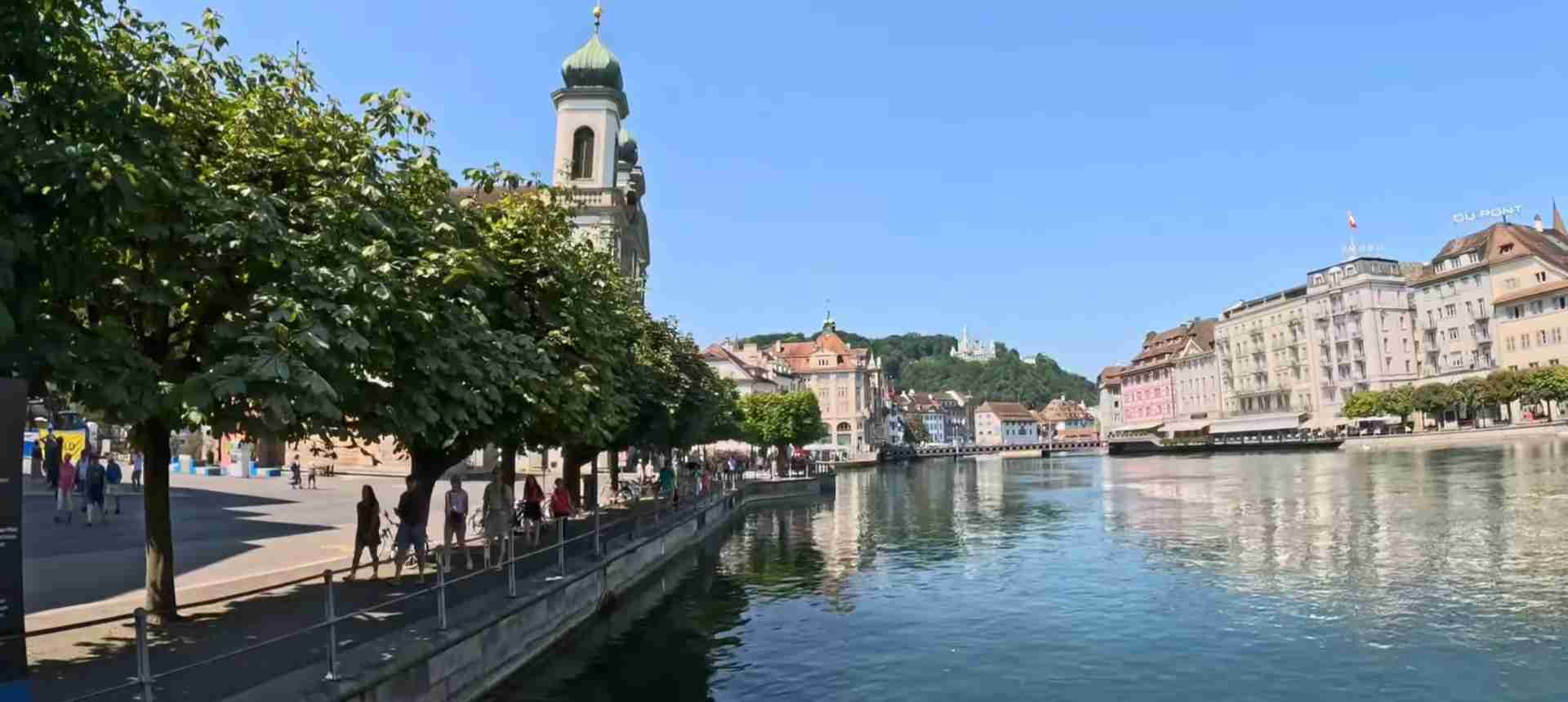
Lake Lucerne’s urban waterfront stretches approximately five kilometers along the city’s southern boundary, creating an extensive public promenade system accessible without fees throughout the year. The lakefront path extends from the Swiss Transport Museum grounds in the east through the city center to the Tribschen neighborhood in the west, connecting parks, swimming areas, sculpture installations, and viewing platforms overlooking the lake’s dramatic mountain backdrop. Unlike many European waterfront developments commercializing lake access, Lucerne maintains its shoreline as public commons with minimal development restricting pedestrian movement or sightline views.
National Quay and City Center Waterfront 2026
The National Quay (Nationalquai) forms Lucerne’s ceremonial waterfront, stretching from the train station eastward past the KKL Luzern concert hall to the Hotel National. This manicured promenade features wide pedestrian paths, mature plane trees providing summer shade, meticulously maintained lawns, and stone balustrades framing unobstructed lake and mountain views. The quay’s length accommodates simultaneous activities without crowding—joggers following the waterfront path, families spreading picnic blankets on grass sections, photographers positioning tripods for sunset compositions, and couples occupying benches facing the water.
Multiple entry points connect the National Quay to the Old Town across the adjacent main road, with zebra crossings at regular intervals allowing easy movement between waterfront and historic center. The quay’s eastern terminus reaches the boat landing stages where Lake Lucerne Navigation Company ferries depart for destinations around the lake’s perimeter, creating continuous activity throughout the day as passengers embark and disembark. While boat cruises require paid tickets, observing the historic paddle steamers and modern motor vessels from quayside costs nothing and provides entertainment particularly for families with children fascinated by watercraft operations.
The KKL Luzern (Culture and Convention Center Lucerne) occupies a prominent National Quay position, designed by architect Jean Nouvel with a distinctive roof canopy extending toward the lake. The building’s public plaza beneath the canopy remains accessible as public space, offering covered area during rain and framing composed views across the water toward Mount Pilatus. Summer months bring occasional free outdoor concerts and cultural events to the plaza, with performance schedules posted on the building’s exterior information boards and the Lucerne tourism website.
Inseli Park: Peninsula Gardens and Swimming 2026
The Inseli (Little Island) peninsula extends into Lake Lucerne east of the city center, creating a compact park popular with local residents during summer months. The park features mature trees, grass lawns, gravel paths, and a designated swimming area with wooden docks extending into the lake. Swimming costs nothing but requires personal swimming ability as no lifeguards supervise the area, and lake water temperatures range from frigid 8-12°C in spring to refreshing 20-23°C in July and August. The swimming docks attract local families, teenagers, and young adults treating the space as casual social gathering place rather than formal recreation facility.
Benches positioned throughout Inseli Park face east toward the Bürgenstock ridge and Mount Rigi, creating optimal spots for sunrise viewing or afternoon relaxation while watching sailboats tack across the lake surface. The park’s compact size concentrates activity into a small area, creating vibrant atmosphere on warm summer days when usage peaks between 2 PM and 6 PM. Conversely, spring and autumn visits find the park relatively empty, allowing peaceful lake contemplation without competing for bench space or waterfront positions.
The park’s eastern edge borders the Lido Lucerne public swimming complex, which charges admission for pool and facility access. However, the lakefront promenade continues past the Lido boundary, maintaining free access to waterside walking despite the adjacent paid facility. This section receives less foot traffic than central waterfront areas, appealing to visitors seeking quieter walking environments away from crowded tourist circuits while maintaining quality lake and mountain views.
Western Waterfront: Tribschen and Richard Wagner Museum Area 2026
Lucerne’s western waterfront extends past residential neighborhoods toward Tribschen, where lakeside paths transition from urban promenades to parkland trails beneath mature deciduous forests. This section attracts fewer tourists while remaining popular with local residents walking dogs, jogging, or cycling along the continuous lakeside path. The landscape shifts from manicured lawns to natural shoreline with reeds and wildflowers, creating different aesthetic character compared to the formal National Quay environment.
The Richard Wagner Museum occupies a historic villa where the composer lived from 1866 to 1872, set within lakeside gardens that remain open to public walking despite the museum building requiring paid admission. The surrounding park features specimen trees, flower gardens during spring and summer, and multiple benches positioned for lake views framed by vegetation. Visitors can explore the museum grounds without entering the building, experiencing the peaceful setting that inspired Wagner’s creative period without spending the CHF 12 ($13) museum entrance fee.
Continuing west beyond Tribschen, the lakefront path eventually connects to hiking trails leading toward Horw and the Pilatus cable car valley station approximately five kilometers from city center. This extended route exceeds casual walking distance for most visitors but offers option for energetic hikers seeking longer free activities. The path quality remains excellent throughout with clear signage, making navigation straightforward even without detailed maps. Cyclists commonly use this route as car-free connection between Lucerne and surrounding lake communities.
Seasonal Waterfront Considerations 2026
Lake Lucerne’s waterfront experiences dramatic seasonal transformation affecting visitor experience and activity options. Summer months from June through August bring consistently warm weather enabling swimming, extended evening promenade walks lasting until 9 PM sunset, and peak usage making popular sections crowded between noon and 6 PM. Spring and autumn deliver comfortable walking temperatures between 12-18°C, fewer crowds, and dramatic mountain visibility as autumn air clarity reveals distant peaks invisible during summer haze.
Winter waterfront visits from December through February offer solitude and stark beauty as snow blankets surrounding mountains creating stark contrast against dark lake water, but require warm clothing as temperatures hover near 0°C and wind across open water amplifies cold sensation. The National Quay receives municipal snow clearing maintaining walking path accessibility even after snowfall, unlike less-trafficked western sections where accumulation may impede passage. Year-round waterfront access never requires fees regardless of season, making lakeside walks consistently available free activities throughout 2026.
Old Town Historic District: Free Architecture and Squares 2026
Lucerne’s Old Town (Altstadt) occupies the Reuss River’s northern bank, preserving Switzerland’s finest concentration of medieval and Renaissance urban architecture within a compact pedestrian district. Cobblestone streets connect painted guild houses, baroque churches, Gothic fountains, and frescoed merchant buildings, creating an outdoor museum of Central European civic architecture accessible entirely on foot without entrance fees. The district spans roughly 400 by 600 meters, small enough to explore thoroughly in a single day while offering sufficient detail to reward multiple visits discovering previously overlooked facades, courtyards, and architectural elements.
Major Old Town Squares 2026
Weinmarkt (Wine Market) ranks as Lucerne’s most beautiful historic square, surrounded by painted Renaissance buildings displaying elaborate facade frescoes. The square served as the city’s wine trading center from medieval times through the 19th century, with wealthy merchant families constructing increasingly ornate buildings demonstrating their prosperity through artistic decoration. Today’s facades date primarily from the 16th and 17th centuries, featuring biblical scenes, mythological figures, geometric patterns, and allegories representing virtues and trades. The central fountain, dating to 1557, depicts standing figures in Renaissance costume, restored multiple times while maintaining original design elements.
Kornmarkt (Grain Market) lies two blocks east of Weinmarkt, fronted by the Old Town Hall (Altes Rathaus) with its distinctive Italian Renaissance architecture featuring open arcades at ground level. The Town Hall’s construction between 1602 and 1606 introduced Lombardic architectural elements to Central Switzerland, creating civic building style that influenced subsequent regional development. The building houses municipal offices rather than museums, meaning visitors cannot tour interiors but can freely photograph the exterior and pass beneath the ground-floor arcades. The adjacent tower features historical astronomical clock mechanism visible from Kornmarktgasse, though viewing requires looking upward from street level rather than accessing tower interior.
Hirschenplatz (Deer Square) creates intimate plaza surrounded by painted guild houses including the spectacular Zunfthaus zu Pfistern (Guild House of the Bakers). This building’s facade depicts a Renaissance family scene with children representing various civic activities—one plays musical instruments, another holds the Lucerne and Swiss flags, others demonstrate trades and crafts. The square’s compact size creates enclosed feeling compared to the broader Weinmarkt, making it popular lunch spot where benches fill with office workers during midday hours. Evening visits find the square nearly empty, allowing unobstructed facade photography and quiet contemplation of architectural details.
Notable Painted Facades and Guild Houses 2026
The Old Town’s painted facades represent Switzerland’s most significant collection of exterior fresco work, with over 70 historic buildings displaying figurative and decorative painting. Unlike interior frescoes requiring museum entry fees, these exterior artworks remain visible from public streets throughout the year. The paintings employ fresco techniques applying pigments to wet plaster, creating durable surfaces withstanding centuries of weather exposure, though modern conservation efforts include periodic restoration maintaining color vibrancy and preventing deterioration.
The Hotel des Balances on Reuss River frontage displays classical architectural trompe l’oeil painting creating illusion of three-dimensional columns, balustrades, and niches despite the completely flat facade surface. This 17th-century painting technique demonstrated wealth and artistic sophistication, transforming modest building facades into apparent palazzos rivaling Italian Renaissance architecture. The hotel operates commercially requiring paid accommodation for interior access, but the facade remains photographable from the riverfront promenade opposite the building.
Zunfthaus zu Pfistern (mentioned above) and Zunfthaus zur Rebleuten (Vintners Guild House) on Kapellgasse showcase contrasting fresco styles—the former featuring narrative scenes with multiple figures and complex compositions, the latter displaying geometric and heraldic designs emphasizing symbolic representation over storytelling. Walking the connecting streets between major squares reveals additional painted facades on nearly every block, with many buildings featuring details requiring close examination to appreciate—small figures in window surrounds, decorative bands between floors, heraldic shields identifying original owners, and inscriptions dating construction or renovation periods.
Churches and Religious Architecture 2026
The Jesuit Church (Jesuitenkirche) stands on the Reuss River southern bank between the two covered bridges, representing Switzerland’s first large-scale baroque religious building. Constructed between 1666 and 1677 by Jesuit architects, the church’s interior features elaborate stucco work, ceiling frescoes, and ornate altars contrasting sharply with Protestant Reformed churches’ austere simplicity. Entry remains free during daytime hours approximately 6:30 AM to 6 PM daily, allowing visitors to experience baroque religious architecture without admission fees. The church hosts regular services but welcomes respectful tourist visits outside worship times, requesting silence and appropriate attire from visitors exploring the interior.
St. Leodegar Church (Hofkirche) occupies elevated ground north of the Old Town center, featuring twin Gothic spires visible across much of Lucerne. The current structure dates from 1633-39, rebuilt after fire destroyed the original medieval church, combining Gothic towers from earlier construction with Renaissance nave and baroque decorative elements. The church houses significant pipe organs including a 1640 instrument still used for concerts, though organ performance schedules vary and concerts may require tickets. Daily free access allows viewing the interior architecture, carved choir stalls, and grave markers of notable Lucerne families, with visiting hours typically 8 AM to 6 PM depending on service schedules.
Multiple smaller chapels and religious buildings scatter throughout the Old Town and surrounding neighborhoods, generally maintaining open access during daylight hours. St. Peter’s Chapel near the Chapel Bridge’s southern terminus dates to medieval foundations though current structure reflects multiple renovation periods. The unadorned Protestant interior contrasts with Catholic churches’ elaborate decoration, reflecting theological differences manifest through architectural choices. All religious buildings request appropriate visitor behavior—quiet voices, modest clothing, no eating or drinking, and exiting during services unless participating in worship.
Old Town Walking Routes and Photography 2026
Optimal Old Town exploration follows natural routes connecting major squares while incorporating side streets revealing additional painted facades and architectural details. A recommended circuit starts at Chapel Bridge northern terminus, proceeds through Weinmarkt to examine painted guild houses, continues to Kornmarkt for Town Hall photographs, detours along Kramgasse to view additional facades, crosses through Hirschenplatz, and returns via Kapellgasse past more painted buildings to complete the loop at Spreuer Bridge. This circuit covers approximately 1.5 kilometers requiring 90-120 minutes depending on photography stops and facade examination detail.
Morning light between 8 AM and 11 AM illuminates eastern and southern building facades, creating ideal conditions photographing Weinmarkt’s painted houses and Kornmarkt’s Town Hall. Afternoon light shifts to western facades, favoring Hirschenplatz buildings and Kapellgasse guild houses. Overcast conditions eliminate harsh shadows and provide even lighting across facades, often producing superior photography compared to bright sun creating excessive contrast between building faces and deep street shadows.
The car-free Old Town environment allows unrestricted pedestrian movement without traffic concerns, though delivery vehicles access some streets before 10 AM for commercial supply. Cobblestone surfaces create charming medieval atmosphere but require appropriate footwear—athletic shoes, walking shoes, or boots handle uneven stones better than fashion footwear or heels. The district concentrates restaurants and cafes serving lunch crowds between noon and 2 PM, creating peak pedestrian density making photography challenging during midday hours. Early morning and late afternoon provide quieter conditions for unobstructed facade photography and peaceful street exploration.
Lion Monument and Surrounding Gardens 2026
The Lion of Lucerne (Löwendenkmal) represents Switzerland’s most emotionally powerful monument, carved into natural sandstone cliff face overlooking a small pond. Danish sculptor Bertel Thorvaldsen designed the monument commemorating Swiss Guards who died defending French King Louis XVI during the French Revolution’s 1792 Tuileries Palace assault. The carving depicts a dying lion pierced by a spear, lying upon a shield bearing the French royal fleur-de-lis, expressing grief and nobility through the animal’s posture and facial expression. Mark Twain famously called it “the most mournful and moving piece of stone in the world” during his 1880 visit, a quote repeated in virtually every subsequent tourist description.
Access to the Lion Monument and surrounding Löwenplatz gardens remains completely free throughout the year, with the carving visible from a small plaza allowing multiple viewing angles. The monument measures approximately 10 by 6 meters, carved during 1820-21 directly into the cliff face rather than constructed as freestanding sculpture. Above the lion carving, Latin inscriptions identify the monument’s purpose and list officer names from the Swiss Guards’ ranks who fell during the 1792 incident. The reflecting pond at the cliff base mirrors the carving in still conditions, creating photographic opportunities capturing both the original sculpture and its reflection in single compositions.
The gardens surrounding Löwenplatz feature mature deciduous trees, manicured lawns, gravel paths, and benches positioned for monument viewing. The compact space accommodates tourist groups particularly during summer peak season between 10 AM and 4 PM when multiple tour buses deposit visitors simultaneously, creating crowded conditions lasting 20-30 minutes before groups depart for subsequent stops. Independent travelers visiting before 9 AM or after 5 PM find substantially quieter conditions allowing extended contemplation and unobstructed photography. The monument’s north-facing orientation means direct sunlight never reaches the carving surface, maintaining consistent soft lighting throughout the day regardless of season.
Adjacent Attractions Near Lion Monument 2026
The Glacier Garden (Gletschergarten) museum occupies land immediately adjacent to the Lion Monument, charging CHF 15 ($16) admission for access to geological exhibits including preserved glacial potholes from Ice Age, mirror maze, and viewing tower. However, the Lion Monument itself lies outside the museum boundary, requiring no ticket for viewing despite the adjacent paid attraction. Visitors seeking only the free monument can access it directly from Löwenplatz without approaching the Glacier Garden entrance, while those interested in both attractions can combine viewing in single visit.
Löwenstrasse, the street leading from the monument toward the Old Town, features tourist shops selling Swiss souvenirs, watches, and chocolates. Window shopping costs nothing though store interiors actively encourage purchases, with aggressive sales tactics common in watch shops targeting Asian tour groups. Continuing down Löwenstrasse reaches the Old Town edge in approximately 400 meters, connecting the Lion Monument to historic center via straightforward route requiring 5-7 minutes’ walk. This convenient proximity allows combining monument visits with Old Town exploration in single walking circuit covering both areas.
Lion Monument Historical Context 2026
Understanding the Lion Monument’s significance requires basic French Revolution history context. Swiss Guards served as royal bodyguards protecting French monarchs since 1616 based on Switzerland’s reputation for military reliability and political neutrality. During the 1792 Tuileries Palace assault by revolutionary forces, approximately 760 Swiss Guards defended King Louis XVI despite the king ordering them to stand down. Roughly 400 guards died in combat, with survivors imprisoned and eventually released after the revolutionary government concluded they had simply followed orders. The monument, commissioned by a Swiss Guard officer who survived the incident, honors this sacrifice emphasizing military duty and loyalty transcending political circumstances.
Modern Swiss neutrality partly stems from this incident, as the Swiss Confederation subsequently prohibited its citizens from serving foreign military forces except the Vatican’s ceremonial Swiss Guard unit continuing today. The Lion Monument represents national trauma transforming military policy, not merely commemorating tragic incident but marking constitutional transition toward neutrality doctrine defining Switzerland’s international position through present day. This context elevates the monument beyond simple memorial sculpture to symbol representing fundamental Swiss political identity.
Churches and Religious Sites 2026
Beyond the Old Town’s major churches already mentioned, Lucerne maintains numerous additional religious buildings accessible to visitors without entrance fees. Swiss religious architecture reflects the Catholic-Protestant divide following the Reformation, with Lucerne remaining staunchly Catholic throughout religious conflicts, resulting in baroque and rococo church decoration contrasting with simpler Protestant traditions. All religious buildings request appropriate visitor conduct—respectful silence, modest clothing covering shoulders and knees, no food or beverages, and avoiding tourism during active worship services.
Franciscan Church: Gothic Simplicity 2026
The Franciscan Church (Franziskanerkirche) sits on the Old Town’s eastern edge, representing Lucerne’s oldest surviving religious building with foundations dating to 1270. Unlike the elaborate Jesuit Church’s baroque decoration, the Franciscan Church maintains medieval Gothic austerity reflecting the Franciscan order’s poverty emphasis. The narrow nave, simple wooden pews, minimal decoration, and subdued lighting create contemplative atmosphere favoring quiet meditation over visual spectacle. The church displays some Renaissance additions including carved choir stalls and painted altar panels, but overall character remains Gothic.
Free access continues during daylight hours typically 8 AM to 6 PM, with Mass schedules posted at the entrance and inside the narthex. The church attracts fewer tourists than larger St. Leodegar or the Jesuit Church, creating peaceful environment even during summer peak season. Small side chapel dedicated to St. Anthony of Padua features votive offerings and prayer candles lit by devotees, providing glimpse into ongoing religious practice beyond historical architecture appreciation. Visitors purchasing candles (typically CHF 2-5 donation) can light them as part of traditional Catholic devotional practice regardless of personal religious affiliation.
Parish Church of St. Mary: Hillside Views 2026
The Parish Church of St. Mary (Pfarrkirche St. Maria) occupies hillside position near the Musegg Wall eastern end, constructed 1925-30 in neo-Romanesque style with prominent tower visible across eastern Lucerne. While relatively modern compared to medieval churches, the building’s elevated position delivers excellent city views from the surrounding churchyard terrace. Free access to the terrace and church exterior operates continuously, with interior access during service times or when church staff unlock the building for cleaning and maintenance.
The churchyard terrace functions as quasi-public viewing platform despite religious site designation, with benches positioned for city and lake views appealing to both worshippers and tourists. The terrace location approximately 50 meters elevation above the Old Town provides different perspective compared to Musegg Wall towers, creating foreground compositions framing red rooftops against lake backdrop. The position remains significantly less crowded than Musegg Wall towers, occasionally completely deserted during weekday afternoons, offering peaceful alternative for visitors seeking elevated city views without tower climbing.
Roadside Chapels and Wayside Shrines 2026
Smaller devotional structures scatter throughout Lucerne’s older residential neighborhoods, including roadside chapels, wayside shrines, and Marian grottos maintained by local parishes and neighborhood associations. These minor religious sites rarely appear in tourist guides but contribute to Lucerne’s Catholic cultural landscape. Most measure only 2-3 meters in size, featuring religious statuary, prayer benches, and votive candles under protective roofs or within small buildings.
Examples include the Mariahilf Chapel near the Musegg Wall lower section, the stations of the cross installations on various hillside paths, and numerous small shrines along residential streets throughout older neighborhoods. None charge access fees and most remain perpetually open, reflecting their function as neighborhood devotional spaces rather than tourist attractions. Visitors interested in religious folk art and traditional Catholic practices find these minor sites revealing authentic local spirituality beyond major churches’ architectural grandeur and tourism infrastructure.
Free Viewpoints and Natural Landscapes 2026
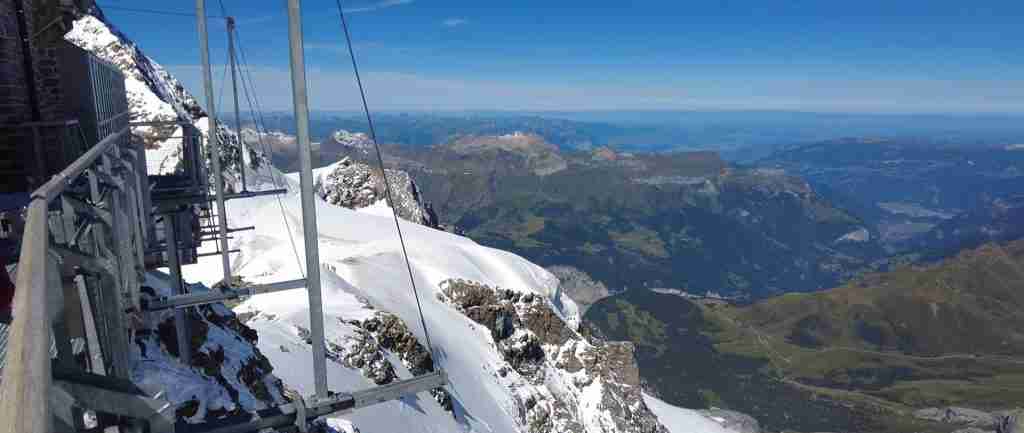
Lucerne’s position between lake and mountains creates numerous free viewpoints accessible through short walks or hillside climbs. While the city’s famous mountain summits—Pilatus, Rigi, Stanserhorn—require expensive cable car or cogwheel train tickets (CHF 72-108 / $80-120), closer viewpoints reachable on foot provide excellent vistas without mechanical transportation costs. Understanding which viewpoints offer sufficient scenic rewards without mountain summit expenses helps budget travelers prioritize free options over paid excursions.
Gütsch Hillside Walk and Castle Views 2026
The Gütsch neighborhood rises steeply behind the train station’s southern side, accessible via steep pedestrian streets and stairs climbing approximately 100 meters elevation. The neighborhood’s upper reaches deliver panoramic views across central Lucerne, the train station, and Lake Lucerne extending toward distant mountains. Château Gütsch, a neo-Gothic castle-style hotel constructed 1888, crowns the hillside summit though interior access requires hotel guest status. However, the surrounding streets and garden areas remain public, allowing viewpoint photography from multiple positions around the hotel grounds.
The climb from the station to Gütsch takes 15-20 minutes via Gütschstrasse, following steep but well-maintained sidewalks passing through residential areas. Alternatively, a funicular railway operates between the station and Gütsch (CHF 4.20 / $4.50 one-way), though walking costs nothing beyond modest physical effort. The optimal photography position locates near the castle’s western side where street layout allows unobstructed views toward the Old Town, lake, and mountains without hotel building blocking sightlines. Sunset visits provide excellent light though the climb in darkness requires caution on steep return descent.
Dietschiberg Forest Trails 2026
The Dietschiberg hillside north of the Old Town features forest trails climbing through beech and oak woodland toward residential neighborhoods at approximately 600 meters elevation. Multiple trail entry points connect from streets near the Musegg Wall’s northern side, marked with standard Swiss hiking trail signs (yellow diamonds and directional arrows). The trails gain 150-200 meters elevation through switchbacks and steady climbs, requiring 45-60 minutes to reach upper trail sections delivering city and lake views through forest gaps.
These trails attract primarily local hikers and trail runners rather than tourists, creating peaceful forest walking environment contrasting sharply with crowded Old Town streets. The forest composition shifts with elevation from deciduous hardwoods at lower sections to mixed forest including conifers at higher elevations. Spring brings wildflowers including wood anemones, while autumn delivers dramatic foliage colors throughout October. The trails require proper footwear as forest paths include roots, rocks, and muddy sections after rainfall, making them unsuitable for casual street shoes.
Lidostrasse Lakefront Path Eastern Extension 2026
The lakefront path extending east from the Lido swimming complex follows the shoreline through progressively less developed areas, eventually reaching suburban neighborhoods and continuing toward Meggen approximately four kilometers from city center. This extended path delivers continuous lake and mountain views while avoiding urban traffic and commercial development, creating environment approaching rural character despite remaining within Greater Lucerne boundaries.
The path accommodates pedestrians and cyclists on separate lanes marked by painted lines, with joggers using either section depending on speed. The relatively flat terrain makes this route accessible for visitors with limited fitness compared to hillside climbs required for elevated viewpoints. Multiple benches positioned at scenic intervals allow rest stops and extended lake viewing without time pressure or crowd competition. The path connects to public bus routes at several points, allowing one-way walks returning via bus using the Lucerne Guest Card for free transportation.
Seasonal Events and Free Cultural Activities 2026
Lucerne hosts numerous annual events incorporating free public components despite some festivals charging admission for specific venues or performances. Understanding which events offer complimentary participation and when they occur allows timing visits to coincide with enhanced cultural programming. The city’s festival calendar concentrates outdoor events during summer months when weather permits open-air activities, while winter brings indoor-focused cultural programming with more limited free access.
Lilu Light Festival 2026
The Lilu Light Festival transforms Lucerne into an outdoor art gallery each January, installing light art installations throughout the Old Town, along the lakefront, and at various landmarks. The festival typically runs for 7-10 days in mid-January, featuring approximately 15-20 light installations created by international artists addressing themes ranging from abstract patterns to interactive sound-reactive displays. All outdoor installations remain accessible without tickets, with visitors walking self-guided routes connecting installations scattered across the city center.
The festival’s free nature attracts substantial crowds during evening hours when darkness allows optimal viewing, with peak attendance occurring on Friday and Saturday evenings between 6 PM and 9 PM. Weekday evenings and late night hours after 9 PM offer quieter viewing conditions allowing more time examining individual installations without navigating around other visitors. The installations operate nightly throughout the festival period regardless of weather, though rain and snow reduce attendance dramatically, creating excellent viewing opportunities for weather-resistant visitors.
Specific 2026 dates and installation locations will be announced on the Lilu Festival website (www.luzern.com/lilu) approximately two months before the event, allowing advance planning for visitors timing Lucerne trips to coincide with the festival. Previous editions typically scheduled festivals between January 10-20, though exact dates shift annually. The festival incorporates some indoor venues requiring paid tickets, but the majority of installations occupy public outdoor spaces accessible freely.
Outdoor Concerts and Cultural Events Summer 2026
Various organizations sponsor free outdoor concerts on the National Quay and in Old Town squares during summer months, particularly July and August. These events typically occur Thursday through Saturday evenings, featuring local musicians, brass bands, folk music ensembles, and occasional classical performances. Events rarely advertise extensively to avoid overwhelming available space, instead relying on word-of-mouth and posters displayed around the Old Town announcing upcoming performances 1-2 weeks in advance.
The Lucerne Festival, Switzerland’s premiere classical music event running late August through mid-September, charges substantial ticket prices (CHF 60-200 / $65-220) for concert hall performances but occasionally includes free open-air concerts and public events. The festival schedule (www.lucernefestival.ch) identifies complimentary events several months before the festival, allowing interested visitors to plan attendance. Previous editions included free midday concerts at the KKL Luzern plaza and outdoor performance previews on the National Quay, though specific 2026 free events remain subject to festival programming decisions announced in spring.
Christmas Market 2026
Lucerne’s Christmas Market transforms Franziskanerplatz and adjacent Old Town areas into festive markets from late November through December 23, featuring decorated wooden chalets selling handicrafts, seasonal foods, and gift items. While purchasing items costs money, walking through the market, viewing decorated stalls, experiencing the festive atmosphere, and observing vendor demonstrations remains free. The market attracts substantial evening crowds when lighting and decoration reach maximum effect, creating lively atmosphere from 4 PM through 9 PM closing.
The 2026 market typically operates from approximately November 26 through December 23 based on historical patterns, though exact dates will be confirmed on the Lucerne tourism website (www.luzern.com/christmas) by September 2026. The market occupies multiple Old Town locations including Franziskanerplatz as the primary market area, Weinmarkt hosting additional stalls, and the Jesuit Church plaza featuring a nativity scene and small performance stage. All market areas remain accessible to pedestrians without entrance fees, allowing budget travelers to experience Christmas market atmosphere without purchase obligations.
Fasnacht Carnival 2026
Lucerne’s Fasnacht carnival ranks among Switzerland’s largest pre-Lenten celebrations, featuring costume parades, street performances, brass bands, and general revelry Thursday through Tuesday before Ash Wednesday. The 2026 Fasnacht dates fall February 26 through March 3 based on Easter calculations, with major parades occurring Thursday morning (Schmutziger Donnerstag), Saturday afternoon, and Monday afternoon (Güdismontag Parade). All street festivities, parades, and open-air performances cost nothing to observe as spectator, though participants purchasing costumes and attending private balls incur significant expenses.
The Thursday morning parade called Urknall (Big Bang) begins at 5 AM with brass bands and costumed groups assembling in the Old Town creating cacophonous atmosphere through coordinated noise-making. This bizarre ritual marks the carnival’s official opening and attracts substantial crowds despite the predawn hour. The Saturday and Monday parades follow more conventional routes through the city center, featuring elaborate floats, costume groups, and satirical commentary on current events through visual displays and performances. Prime parade viewing positions along the route fill early, requiring spectators to claim spots 30-60 minutes before parade start times.
Practical Strategies for Maximizing Free Experiences 2026
Successful budget travel in expensive Switzerland requires strategic planning maximizing free activities while minimizing unavoidable costs. Lucerne’s combination of free attractions, complimentary guest card transportation, and abundant public spaces allows constructing multi-day itineraries with minimal daily expenses beyond accommodation and meals. Understanding optimal timing, strategic activity sequencing, and available resources transforms a potentially expensive visit into surprisingly affordable experience without sacrificing quality or authentic engagement with the destination.
Free Public Transportation via Guest Card 2026
The Lucerne Guest Card represents the city’s single most valuable budget travel tool, providing unlimited free public transportation throughout Zone 10 covering the entire urban area and immediate suburbs. Every overnight accommodation provider—from five-star hotels to budget hostels—automatically issues Guest Cards to registered guests upon check-in, with the card remaining valid from arrival through departure day. This policy applies universally regardless of accommodation category or price point, meaning even hostel dormitory guests receive identical transportation benefits as luxury hotel visitors.
Zone 10 encompasses all city bus routes reaching major attractions including the Old Town, lakefront, Musegg Wall, Lion Monument, Verkehrshaus (Swiss Transport Museum), and residential neighborhoods. Buses operate approximately 5:30 AM through midnight on weekdays, with reduced schedules on Sundays and holidays. The Guest Card also provides discounts up to 50% on various mountain railways, museum admissions, and boat cruises, though these discounted experiences still require purchasing tickets. The free transportation benefit alone saves CHF 3.70 ($4) per trip or CHF 15.20 ($17) for a day pass when purchased without the Guest Card.
Maximizing Guest Card value requires staying at least one night in Lucerne rather than day-tripping from Zurich or other cities. Even budget hostels charging CHF 35-45 ($40-50) for dormitory beds provide Guest Cards worth CHF 15-30 in avoided transportation costs for typical visitor daily bus usage. This mathematics favors booking Lucerne accommodation over commuting from cheaper neighboring cities, as transportation costs and time lost commuting exceed the accommodation price differential. Multi-night stays increase Guest Card value proportionally, with three-night visits potentially saving CHF 45-90 ($50-100) in avoided transportation expenses.
Strategic Activity Sequencing for Weather and Crowds 2026
Lucerne’s weather variability requires flexible planning accommodating rain, which occurs roughly 40-50 days between April and October based on regional climate patterns. Ranking activities by weather dependency allows constructing backup plans utilizing indoor options when outdoor activities become less appealing. The Musegg Wall towers and open-air walking circuits represent weather-dependent activities best completed during clear conditions, while Old Town exploration, covered bridge walks, and church visits proceed effectively regardless of weather with appropriate rain gear.
Crowd management favors early morning activity scheduling before tour bus arrivals around 10 AM and cruise ship groups disembarking for day visits around 11 AM. The Chapel Bridge, Lion Monument, and central Old Town squares experience heaviest crowding between 10:30 AM and 4 PM during summer season, while visiting these locations before 9 AM or after 5 PM reduces pedestrian density by 60-80%. The Musegg Wall opens at 8 AM allowing first-hour access before crowds arrive, with similarly quiet conditions during the final hour before 7 PM closing.
Seasonal timing affects experience quality beyond simple weather considerations. April and May bring spring flowers and relatively quiet conditions before June-August peak season crowds, though museums walls remain closed until April 1 potentially affecting itinerary options. September and October deliver autumn colors, comfortable temperatures, continued Musegg Wall access through November 1, and reduced tourist density compared to summer peak. November through March restricts access to certain attractions including Musegg Wall towers but provides genuine solitude at remaining free sites and dramatic winter mountain scenery when clouds clear.
Picnic Strategies and Supermarket Options 2026
Swiss restaurant meals rank among Europe’s most expensive regardless of category or cuisine, making self-catered meals essential for strict budget management. Lucerne maintains several supermarkets near the Old Town where travelers can purchase picnic supplies at substantially lower cost than restaurant dining. The Migros on Hertensteinstrasse near the train station offers comprehensive selection including fresh bakery sections, prepared salads, sandwiches, fruits, and beverages at prices approximately 60-70% lower than comparable items at cafes and restaurants.
Optimal picnic locations include the National Quay grass sections offering lake and mountain views, Inseli Park providing shaded areas and swimming access, the Musegg Wall lower gardens near the Nölli Tower featuring benches and small lawns, and any lakeside bench along the extended waterfront promenade system. All these locations welcome picnickers without restrictions, though visitors should pack out trash using available public waste bins rather than leaving debris on grass or benches.
Water fountains dispensing potable water locate throughout the Old Town and along major streets, allowing free bottle refills rather than purchasing CHF 4-6 ($4.50-7) bottled water at kiosks and cafes. These fountains connect to Lucerne’s municipal water system delivering high-quality drinking water identical to tap water quality. Reusable water bottles carried from home or purchased at supermarkets for CHF 2-3 eliminate beverage expenses entirely when used with fountain refills throughout the day.
Multi-Day Budget Itinerary Framework 2026
A sample three-day Lucerne itinerary maximizing free activities while minimizing costs might follow this framework: Day one explores the Old Town core including both covered bridges, the major painted facades and squares, St. Leodegar Church, and the Jesuit Church, requiring approximately 5-6 hours with photography stops and lunch break using supermarket picnic on the riverbank. Day two combines the Musegg Wall complete circuit including all four tower climbs with Lion Monument visit and Gütsch hillside walk for sunset views, totaling roughly 5 hours of activity plus breaks. Day three focuses on lakefront walking from the Lido east to Tribschen west, potentially adding the Richard Wagner Museum gardens (free grounds access), totaling 3-4 hours at relaxed pace with waterfront relaxation time.
This framework fills three full days with quality activities costing zero beyond accommodation, meals, and transportation to/from Lucerne. Adding paid activities like museums, mountain excursions, or boat cruises can supplement this free activity base depending on available budget, but the free framework alone provides satisfying destination experience without requiring expensive commercial attractions. Extending the stay to four or five days allows revisiting favorite locations during optimal conditions (weather, lighting, crowds), exploring additional free trails and viewpoints, or simply adopting slower pace reducing daily activity pressure.
Accessibility and Mobility Considerations 2026
Lucerne’s medieval Old Town and hillside attractions present significant accessibility challenges for visitors with mobility limitations, though some free attractions remain accessible with proper planning. Understanding which sites accommodate wheelchairs, which require substantial walking or climbing, and which alternative options exist helps visitors with varying mobility levels construct realistic itineraries matching their physical capabilities.
Wheelchair and Mobility Aid Access 2026
The lakefront promenade system, including the National Quay and extended waterfront paths, maintains excellent wheelchair accessibility with smooth paved surfaces, minimal gradients, and curb cuts at all street crossings. This extensive path network delivers quality scenic experiences without mobility barriers, making waterfront walks the most accessible free activity category in Lucerne. The Old Town’s cobblestone streets create more challenging conditions with uneven surfaces, though main pedestrian routes through Weinmarkt, Kornmarkt, and connecting streets remain generally navigable with standard wheelchairs requiring modest effort pushing over cobblestones.
Both covered bridges accommodate wheelchairs despite wooden plank flooring creating slightly rough surfaces requiring careful steering. The Chapel Bridge’s length presents endurance requirements as the 204-meter crossing allows no intermediate exits or rest positions. The Spreuer Bridge’s shorter 80-meter span creates less demanding crossing. Both bridges feature level approaches without stairs or significant ramps, allowing independent wheelchair access without assistance.
The Musegg Wall remains completely inaccessible to wheelchairs or anyone unable to climb steep stairs, as the battlement paths and tower ascents require navigating medieval stone stairs without elevators or ramps. Similarly, the Gütsch hillside, Dietschiberg forest trails, and other elevated viewpoints involve significant climbing inappropriate for visitors with mobility limitations. The Lion Monument features level ground approaching the viewing plaza, making it accessible to wheelchairs and mobility aids, though the reflecting pond area includes some uneven stone paving requiring careful navigation.
Alternative Options for Limited Mobility Visitors 2026
Visitors unable to access the Musegg Wall can obtain elevated city views via alternative means including the Gütsch funicular railway (CHF 4.20 one-way / $4.50), which ascends to the hilltop hotel area where surrounding streets provide viewpoints accessible with wheelchairs. While this option costs money unlike the free Musegg Wall, it delivers comparable views without requiring climbing ability. The public buses included with the Guest Card all feature low-floor designs with wheelchair-accessible entrances, allowing mobility-limited visitors to reach various city areas and viewpoints accessible from bus stops.
The Old Town churches including St. Leodegar and the Jesuit Church feature accessible entrances though some interior areas may involve steps to elevated sections. Both churches provide sufficient accessible viewing allowing appreciation of architectural and artistic features without accessing every interior space. Many Old Town facades remain photographable from accessible street positions, though some narrow side streets with optimal viewing angles may present cobblestone challenges requiring modest determination to navigate.
Safety and Practical Visitor Information 2026
Lucerne ranks among Europe’s safest cities for travelers, with violent crime virtually nonexistent and property crime remaining rare outside typical tourist-area pickpocketing risks. Standard urban precautions apply regarding valuables, though visitors can explore the city throughout the day and evening without significant safety concerns. The following practical information addresses common visitor questions and logistical considerations.
Public Restroom Access and Locations 2026
Public restrooms in Lucerne typically require CHF 1-2 payment via coin-operated turnstiles, making them technically not free though the minimal cost barely impacts budgets. Major restroom locations include the train station (CHF 2), near the National Quay boat landing stages (CHF 1), at the Inseli Park (CHF 1), and near the Lion Monument parking area (CHF 2). Restaurants and cafes restrict restroom access to paying customers, though the Old Town concentration of cafes makes finding accessible facilities straightforward when purchasing even a coffee (CHF 4-5).
Museum and cultural venue restrooms typically require venue admission, making them unavailable to budget travelers avoiding paid attractions. Church restrooms rarely exist except at major facilities like St. Leodegar where limited public restroom access may be available outside service times. Planning restroom access requires carrying CHF 1-2 coins rather than relying on credit cards, as older automated facilities accept only Swiss franc coins without card payment options.
Weather Preparation and Clothing 2026
Lucerne’s climate features significant daily temperature variation requiring layered clothing even during summer months. Morning temperatures often start 10-15°C cooler than afternoon peaks, making light jackets or sweaters essential even in July and August. Rain occurs unpredictably with brief showers common throughout warmer months, making packable rain jackets essential carry items. The Musegg Wall and lakefront provide minimal shelter during precipitation, while the Old Town’s narrow streets and building overhangs offer some rain protection allowing continued exploration during light showers.
Proper footwear proves essential for enjoyable experience as Lucerne involves substantial walking on varied surfaces including cobblestones, uneven medieval stairs, forest trails, and paved promenades. Athletic shoes, walking shoes, or hiking boots handle all terrain types encountered during typical sightseeing activities. Fashion footwear, sandals, and heels create discomfort and safety issues on cobblestones and Musegg Wall stairs. Summer sun exposure along the exposed lakefront and on the Musegg Wall ramparts requires sun protection including hats, sunglasses, and sunscreen, as the higher elevation (436 meters above sea level) increases UV intensity compared to lower-lying European cities.
Emergency Services and Medical Access 2026
Emergency services in Switzerland respond to 112 (European emergency number) or 117 (police), 118 (fire), 144 (ambulance). English-speaking operators typically available though responses vary by time and specific situation. The Cantonal Hospital Lucerne (Luzerner Kantonsspital) on Spitalstrasse operates 24-hour emergency department treating both residents and tourists, though Swiss medical costs rank among the world’s highest for uninsured patients. Travel insurance providing medical coverage proves essential for non-European visitors, as a simple emergency department visit without procedures costs CHF 500-1000 ($550-1100) before treatment expenses.
Pharmacies (Apotheke in German) provide over-the-counter medications and basic medical advice, with several locations operating in the Old Town and near the train station. Sunday and holiday pharmacy rotation ensures at least one pharmacy remains open during closed periods, with the on-duty pharmacy’s location posted at closed pharmacy doors and available through the tourism information website. Minor ailments often resolve through pharmacy consultation without requiring more expensive physician visits.
Frequently Asked Questions: Free Things to Do in Lucerne 2026
Can I see everything in Lucerne for free?
Lucerne’s major landmarks including the Chapel Bridge, Spreuer Bridge, Lion Monument, Musegg Wall towers, Old Town historic district, lakefront promenades, and principal churches all provide free access requiring no entrance fees. These attractions represent the city’s most iconic sights and together deliver comprehensive Lucerne experience without paid admissions. However, major museums (Swiss Transport Museum, Rosengart Collection, Richard Wagner Museum), mountain excursions (Pilatus, Rigi, Titlis), and lake cruises charge substantial fees ranging CHF 12-108 ($13-120). Visitors focusing exclusively on free attractions miss certain experiences but still encounter Lucerne’s essential character and most photographed landmarks while spending nothing on entrance tickets.
How many days do I need for free activities in Lucerne?
A comprehensive exploration of Lucerne’s free attractions requires 2-3 full days allowing thorough rather than rushed visits. Day one typically covers the Old Town including both covered bridges, painted facades, major squares, and principal churches requiring 5-6 hours. Day two focuses on the Musegg Wall complete circuit with all tower climbs plus the Lion Monument and surrounding gardens totaling approximately 5 hours. Day three explores the lakefront promenade system from the Lido to Tribschen with extended waterfront relaxation requiring 3-4 hours. Additional days allow revisiting favorite locations during optimal conditions, discovering additional painted facades and minor churches missed during initial exploration, or exploring free hiking trails and viewpoints beyond the central tourism circuit.
What free activities work best for families with children?
The lakefront promenades and parks, particularly Inseli Park with swimming access and grass areas for running, engage children effectively while costing nothing. The Chapel Bridge and Water Tower fascinate young children through the combination of water views, swans, and passing boats creating continuous activity to observe. The Musegg Wall towers appeal to older children and teenagers capable of climbing steep stairs, with the medieval atmosphere and panoramic views providing educational context beyond simple sightseeing. The Old Town’s painted facades create outdoor art gallery where families can examine different building decorations and discuss historical stories depicted in the frescoes. Picnics allow children to burn energy in parks rather than requiring restaurant behavior, while the Guest Card’s free transportation eliminates concerns about multiple trips returning to accommodation for breaks or naps.
When is the best time to visit for free activities in 2026?
April through October provides optimal free activity access in Lucerne, with the Musegg Wall towers opening April 1 and remaining accessible through November 1. Late April through May brings spring flowers, relatively quiet conditions before peak summer crowds, and comfortable temperatures for walking and tower climbing. September and early October deliver autumn colors, reduced tourist density compared to summer, continued Musegg Wall access, and generally stable weather before November’s increasing rain frequency. July and August offer warmest temperatures and longest daylight hours but bring peak crowding at major attractions and highest accommodation costs. Winter months December through March restrict access to Musegg Wall towers but provide genuine solitude at remaining free sites and dramatic snow-covered mountain scenery, appealing to visitors prioritizing peaceful atmosphere over comprehensive attraction access.
Can I do free activities if I only have a few hours in Lucerne?
Short Lucerne visits of 3-4 hours allow experiencing several major free attractions through focused itinerary prioritizing proximity and efficiency. A recommended rapid circuit starts at the train station, walks to the Chapel Bridge crossing the river toward the Old Town, explores Weinmarkt and Kornmarkt squares observing painted facades, continues to the Lion Monument via Löwenstrasse, and returns to the station via the lakefront National Quay. This route covers approximately three kilometers requiring 90-120 minutes at tourist walking pace with brief stops for photographs and facade examination. Adding Musegg Wall tower climbs extends the visit to 3-4 hours but dramatically increases walking distance and required physical effort. Day-trippers should accept they cannot experience all free attractions in limited time, focusing instead on the most iconic landmarks while potentially returning for longer future visits exploring previously missed attractions.
Are there free guided tours in Lucerne?
Lucerne lacks comprehensive free guided walking tours comparable to “free tour” models operating in many European cities where guides work for tips. However, the tourism information office near the train station provides free maps and self-guided walking route descriptions allowing independent exploration with basic navigational guidance. Some hotels organize complimentary guest walking tours during summer months, worth inquiring about upon check-in for guests staying at participating properties. The Lucerne tourism website (www.luzern.com) offers downloadable audio guides and PDF walking tour descriptions covering various themes including architecture, history, and art, providing structured self-guided tours at no cost beyond internet data for downloading materials.
What about free Wi-Fi access in Lucerne?
Lucerne provides limited free public Wi-Fi through the “Lucerne Free WiFi” network operating in certain public spaces including the National Quay, train station area, and some Old Town locations. Connection quality varies significantly by location and time of day, with network speeds sufficient for messaging and basic browsing but often inadequate for video streaming or large file transfers. Many cafes and restaurants provide free Wi-Fi to customers, typically requiring one-time registration or password access printed on receipts after purchase. The public library near the train station offers free Wi-Fi and computer access to visitors, though limited opening hours (closed Sundays and Monday mornings) restrict availability. Visitors requiring reliable data access should consider purchasing Swiss SIM cards (CHF 10-20 / $11-22 for prepaid options with data) from Swisscom, Salt, or Sunrise mobile carriers, providing superior coverage and speeds compared to sporadic public Wi-Fi networks.
Can I swim in Lake Lucerne for free?
Lake Lucerne allows free swimming at various public access points including Inseli Park, though water quality, safety considerations, and cold temperatures require careful evaluation before entering. The lake reaches comfortable swimming temperatures (20-23°C) only during July and August peak summer, with spring and autumn water remaining quite cold (12-16°C) suitable only for hardy swimmers accustomed to cold water. No lifeguards supervise public swimming areas, making personal swimming ability and safety judgment essential. The designated Lido swimming facility charges admission (CHF 8 / $9) providing supervised pools, changing facilities, and amenities unavailable at free public access points. Most Lucerne residents preferring lake swimming visit the Lido rather than free public areas, particularly families with children requiring shallow supervised water and changing facilities.
What free activities work during rain or bad weather?
Rainy weather limits optimal free activity options but doesn’t eliminate possibilities entirely. Both covered bridges provide sheltered walking allowing continued sightseeing during light rain, with the Chapel Bridge’s longer span delivering extended covered route. Church interiors including the Jesuit Church and St. Leodegar offer substantial dry shelter while providing architectural and artistic interest requiring 30-60 minutes per church for thorough visits. The Old Town’s narrow streets provide some weather protection through building overhangs and arcades, allowing continued exploration during intermittent showers with waterproof jacket. The KKL Lucerne plaza beneath the concert hall canopy creates covered public space suitable for rain shelter. Persistent heavy rain fundamentally limits enjoyable free activities, as Lucerne’s major free attractions emphasize outdoor walking and viewpoint appreciation requiring dry conditions for comfortable extended visits. Rainy days may justify visiting paid indoor museums typically avoided for budget reasons, as attempting to force free outdoor activities during poor weather conditions creates frustrating experiences diminishing destination enjoyment.
Are winter visits worthwhile focusing on free activities?
Winter visits to Lucerne (December-March) reduce free activity options through Musegg Wall closure but maintain access to most other major attractions including both covered bridges, the Old Town, churches, the Lion Monument, and lakefront promenades. Winter brings dramatic scenic beauty as snow blankets surrounding mountains creating stark contrast against dark lake water, though obtaining clear mountain views requires fortunate weather timing as winter clouds frequently obscure peaks. The reduced tourist density during winter creates peaceful sightseeing conditions rarely experienced during summer peak season, with major landmarks often nearly deserted during weekday visits. Winter visits suit travelers prioritizing peaceful atmosphere and authentic local culture over comprehensive attraction access, particularly those visiting Lucerne as part of Swiss ski holidays adding city sightseeing to primarily mountain-focused trips. January’s Lilu Light Festival provides unique winter-specific free attraction justifying visits specifically during that period.