
Faro Best Tours & Walking Routes 2026: Ria Formosa, Caves & Coastline
Faro’s position at the gateway to the Ria Formosa Natural Park creates exceptional opportunities for exploring coastal lagoons, dramatic sea caves, and pristine barrier islands through guided boat tours and self-guided walking routes. This comprehensive guide details the region’s most rewarding tours and trails for 2026, from sunset cruises through the protected wetlands to challenging coastal hikes along clifftop paths, complete with current pricing, booking strategies, and route-specific planning advice for maximizing your Algarve coastal experience.
Key Takeaways About Faro Tours and Walking Routes 2026
- Ria Formosa Boat Tours Essential: Standard boat tours exploring the lagoon islands cost €25-48 ($30-53) for 2-4 hour excursions with stops at Ilha Deserta, Culatra, and Farol. Sunset tours command €30-42 ($33-46), while dolphin-watching expeditions reach €60-66 ($66-73). Private charters start at €478 ($525) for groups up to 10 passengers.
- Benagil Cave Access Requires Full-Day Commitment: Reaching the famous Benagil Cave from Faro requires full-day tours costing €60-90 ($66-99) including transport, as the cave lies 70 kilometers west. Tours include stops at Marinha Beach and Algar Seco, with viewing from above rather than interior access due to current safety regulations. Direct boat tours from closer bases in Portimão or Albufeira offer better value for cave-focused visits.
- Seven Hanging Valleys Trail Best Coastal Hike: The 12-kilometer Seven Hanging Valleys Trail between Praia da Marinha and Vale de Centeanes represents the Algarve’s most spectacular clifftop walk, requiring 3-4 hours with moderate fitness. The route passes dramatic rock formations, natural arches, and secluded beaches, with minimal shade requiring early morning starts in summer. Free parking available at both trailheads.
- Ria Formosa Nature Walks Accessible Year-Round: The flat, well-maintained trails through Ria Formosa Natural Park suit all fitness levels, with the São Lourenço Walking Trail and Ludo Trail offering exceptional birdwatching for flamingos, spoonbills, and herons. Boardwalk sections accommodate wheelchairs and strollers, with spring and autumn providing optimal wildlife viewing and comfortable temperatures.
- Food Tours Combine Culinary and Cultural Discovery: Faro’s walking food tours cost €95-120 ($104-132) for 3-hour experiences visiting 4 restaurants with 10 traditional tastings and wine pairings. Tours concentrate in the Old Town, combining historical commentary with authentic taverna stops frequented by locals rather than tourists. Free walking tours operate daily at 11:00 and 15:00, tip-based with suggested €10-20 ($11-22) contributions.
- Booking Timing Matters for Summer 2026: Ria Formosa tours fill rapidly June through September, with sunset departures and small-group tours requiring 3-5 days advance booking. Benagil Cave tours from all bases sell out weeks ahead for July-August morning slots. Free walking tours require no reservation except for groups over 6 people, while food tours need 24-48 hours notice for dietary accommodations.
People Also Ask About Faro Tours and Walking Routes 2026
What Is the Best Boat Tour in Faro 2026?
The best boat tour in Faro for 2026 depends on your priorities. For comprehensive Ria Formosa exploration, 4-hour island-hopping tours visiting Ilha Deserta, Culatra, and Farol cost €42-48 ($46-53) and provide swimming stops, village visits, and birdwatching opportunities. Sunset tours lasting 2-3 hours cost €30-42 ($33-46) and emphasize photography in golden-hour light across the lagoon channels. Dolphin-watching expeditions extend 2.5 hours at €60-66 ($66-73) with Atlantic coastal cruising beyond the barrier islands. Private charters at €478 ($525) for groups up to 10 allow customized itineraries and flexible timing.
Tours departing from Faro Marina access the Ria Formosa directly, avoiding the 60-90 minute drives required for western Algarve destinations like Benagil Cave. Most operators offer morning (09:00-10:00) and afternoon (14:00-15:00) departures, with morning trips providing calmer waters and better wildlife sightings. The Lands eco-friendly solar boat tours emphasize environmental education and operate with minimal noise disturbance to bird populations, particularly valuable for photographers and nature enthusiasts. Operators provide free cancellation up to 24 hours before departure, essential given weather dependencies in this exposed coastal environment.
How Difficult Is the Seven Hanging Valleys Trail?
The Seven Hanging Valleys Trail rates as moderate difficulty, requiring reasonable fitness but no technical hiking skills. The 12-kilometer route takes 3-4 hours at steady pace, with elevation changes totaling approximately 300 meters accumulated through numerous short climbs and descents rather than sustained uphill sections. The trail surface alternates between packed dirt paths, rocky sections requiring careful foot placement, and occasional sandy stretches that slow progress.
The most challenging aspects involve navigating uneven limestone surfaces near cliff edges, with some sections lacking barriers where caution prevents accidents. The trail offers virtually no shade coverage, making summer midday temperatures (often exceeding 32°C/90°F) the primary difficulty factor rather than the physical demands. Strong footwear with ankle support and grippy soles prevents twisted ankles on rocky sections. Hikers should carry 2 liters of water per person, as no facilities exist between the trailheads. The route permits bailout options at Praia do Vale de Centeanes (midpoint) and Praia do Carvalho (kilometer 8), where beach access paths descend to road level for those finding the full distance excessive.
Can You Visit Benagil Cave from Faro in 2026?
Visiting Benagil Cave from Faro requires full-day tours costing €60-90 ($66-99), as the cave sits 70 kilometers west requiring 90 minutes driving each direction. Tours typically depart 09:00-10:00, spending 5-6 hours total including 90 minutes at the cave area, 60 minutes at Marinha Beach, and 30 minutes at Algar Seco viewpoint. Current 2026 regulations prohibit entering the cave interior for safety reasons following rockfall incidents, with viewing restricted to the entrance opening and the famous roof oculus from above via clifftop paths.
Travelers prioritizing Benagil Cave access achieve better value taking direct boat tours from Portimão (30 kilometers from cave) or Albufeira (35 kilometers) rather than the Faro-based full-day excursions. Boat tours from these closer bases cost €35-60 ($38-66) for 2-hour cave-focused trips without the extended road transfers. The Faro full-day tours suit visitors without rental cars who want packaged transportation covering multiple coastal highlights beyond just the cave. Independent travelers with vehicles can drive to Benagil parking area and book 90-minute boat tours directly at the beach for €25-35 ($28-38), though summer parking requires early arrival before 09:00.
What Are the Best Free Walking Routes in Faro?
The best free walking routes in Faro concentrate in three distinct areas: the walled Old Town, the Ria Formosa nature trails, and the Ilha de Faro beach peninsula. The Old Town circuit covers 2-3 kilometers in 60-90 minutes, following cobblestone streets through the Arco da Vila gateway to the Cathedral, Bishop’s Palace, and Municipal Museum before circling back via the harbor front. This route provides complete shade from whitewashed buildings, making afternoon walks comfortable even in summer.
The Ludo Trail represents the premier nature walk, extending 5 kilometers through salt marshes and lagoon channels south of the airport. The route features wooden boardwalk sections ensuring wheelchair and stroller accessibility, with bird observation hides positioned for viewing flamingos, spoonbills, and herons. The flat terrain suits all fitness levels, requiring 90-120 minutes at leisurely pace. The Ilha de Faro Coastal Trail follows the 6-kilometer beach peninsula connecting Faro to the barrier island, offering Atlantic views on one side and lagoon vistas on the other. This route lacks shade but benefits from coastal breezes reducing heat impact. All three routes require no permits or fees, with free parking available at starting points.
Extended multi-day tours – 5+ days
Featured Algarve Multi-Day Tour Packages
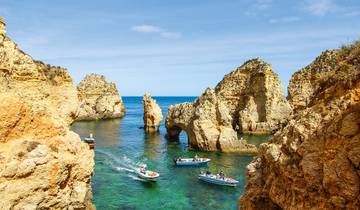
4 days
Algarve Discovery Tour
- ✓ Booking needs min. 2 travelers

8 days
Walking in Portugal – Remote Coastal Trails
- ✓ Comprehensive Algarve tour
- ✓ Expert local guides included
- ✓ All accommodation arranged
- ✓ Transportation provided
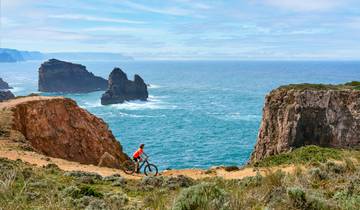
7 days
Costa Vicentina: Natural Park self-guided bike tour
- ✓ Comprehensive Algarve tour
- ✓ Expert local guides included
- ✓ All accommodation arranged
- ✓ Transportation provided
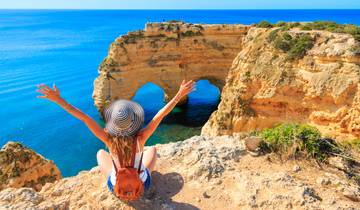
7 days
Algarve – a holiday full of wine
- ✓ Comprehensive Algarve tour
- ✓ Expert local guides included
- ✓ All accommodation arranged
- ✓ Transportation provided
Multi-day tour packages powered by TourRadar. Prices and availability subject to change.
Introduction to Faro’s Tours and Walking Routes in 2026
Faro occupies a unique position among Algarve destinations, serving simultaneously as the region’s administrative capital and the primary gateway to Portugal’s most biodiverse coastal ecosystem. Where other Algarve towns prioritize beach resort development, Faro maintains authentic Portuguese character while providing unparalleled access to the Ria Formosa Natural Park, a 60-kilometer labyrinth of tidal lagoons, salt marshes, and barrier islands designated as one of Portugal’s Seven Natural Wonders. This geographic advantage creates the foundation for the region’s most rewarding tours and walking routes, from intimate boat explorations of channels navigable only at high tide to challenging clifftop hikes revealing the full drama of the Algarve’s golden limestone coast.
The 2026 tourism landscape in Faro reflects evolving priorities toward sustainable small-group experiences rather than mass-market bus tours. Operators increasingly emphasize environmental education, with solar-powered boats, expert naturalist guides, and deliberate limitations on group sizes protecting the fragile ecosystems that attract visitors in the first place. This shift benefits independent travelers seeking authentic encounters with local culture and nature, as the explosion of specialized tour options creates opportunities for precisely targeted experiences — whether that involves kayaking through mangrove channels at sunrise, walking ancient Roman roads through cork oak forests, or sampling cataplana in family-run tascas unknown to guidebook readers.
Understanding Faro’s tour and trail options requires recognizing the fundamental distinction between the immediate Ria Formosa environment and the western Algarve destinations popularized on social media. The Ria Formosa tours departing from Faro Marina access flat-water lagoon systems ideal for families, birdwatchers, and photographers prioritizing wildlife over adrenaline. These trips operate year-round with high success rates even in winter’s occasional weather disruptions. By contrast, reaching the western Algarve’s headline attractions — Benagil Cave, Ponta da Piedade, the Seven Hanging Valleys Trail — requires significant time investments through full-day tours or rental car commitments, with Atlantic swell conditions regularly forcing cancellations October through March.
The walking route network radiating from Faro encompasses everything from flat accessible boardwalks through wetlands to challenging 12-kilometer clifftop treks requiring navigation skills and heat tolerance. Many visitors underestimate the physical demands imposed by the Algarve’s summer climate, where even moderate trails become grueling under 35°C afternoon sun with no shade coverage. Successful trail planning for 2026 requires matching route difficulty not just to fitness levels but to temperature tolerance, hydration capacity, and sun protection discipline. The reward for proper preparation reveals itself in those extraordinary moments unique to Algarve hiking: watching the Atlantic breakers crash into golden cliffs while flamingos feed in the lagoon 30 meters below, or discovering a Roman fish-salting facility on a deserted beach accessible only by foot.
This guide organizes Faro’s tours and walking routes into logical categories based on activity type, difficulty level, and time requirements, providing the specific practical information needed for confident booking and preparation. Each section addresses common planning questions from real travelers — from understanding which boat tour format best suits your priorities to determining whether you possess the fitness level required for specific trails. The emphasis throughout remains on actionable intelligence rather than generic encouragement, acknowledging that successful outdoor experiences in Faro’s demanding climate require honest self-assessment and deliberate preparation rather than spontaneous optimism.
Ria Formosa Boat Tours from Faro 2026
Boat tours through the Ria Formosa Natural Park represent the definitive Faro experience, providing access to pristine barrier islands, traditional fishing villages, and wildlife-rich channels impossible to reach by foot or car. The protected lagoon system stretches 60 kilometers along the Algarve coast, with Faro Marina serving as the primary departure point for explorations ranging from quick 1-hour sunset cruises to comprehensive full-day expeditions visiting multiple islands. Understanding the distinctions between tour formats, operators, and seasonal considerations determines whether your Ria Formosa experience delivers memorable wildlife encounters or disappointing crowds and rushed schedules.
Standard Island-Hopping Tours in Ria Formosa 2026
The classic Ria Formosa boat tour format visits three barrier islands over 3-4 hours, providing structured stops rather than continuous cruising. Tours typically depart at 09:30 or 14:00, costing €42-48 ($46-53) per adult with children under 12 receiving 50% discounts. The standard itinerary includes Ilha Deserta (30-40 minute beach stop), Culatra village (20-30 minute exploration), and Farol lighthouse area (20 minutes), with the remaining time allocated to navigation through the lagoon channels and wildlife observation opportunities.
Ilha Deserta, officially named Barreta Island, provides the tour’s centerpiece experience. The island contains no permanent residents and restricts development to a single restaurant, creating the Algarve’s most isolated accessible beach. The white sand beach extends uninterrupted for kilometers in both directions, backed by dunes reaching 10 meters high where specialized vegetation survives in the salt-blasted environment. Most tours allocate insufficient time for proper beach appreciation — the 30-minute stop barely allows walking to the water, photographing the lighthouse, and returning to the boat before departure. Travelers prioritizing beach time should request the longer stops offered by specific operators, though this reduces time at other islands.
Culatra Island reveals a working fishing community little changed from a century ago, where colorful houses line sandy paths too narrow for vehicles. The village population of approximately 800 residents depends almost entirely on fishing and shellfish harvesting, with women still hand-sorting clams on doorsteps and men mending nets in afternoon shade. The brief tour stop permits walking the main village path, photographing the cube-style Moorish-influenced architecture, and perhaps purchasing fresh oysters from fishermen selling directly at the dock. The time constraint prevents reaching the island’s Atlantic-facing beach, a 15-minute walk through the village and over the dunes.
Farol (lighthouse) represents the smallest stop, focusing on the 47-meter-tall lighthouse built in 1851 that still guides ships through the channels. The settlement consists primarily of vacation homes and a few year-round fishing families, with limited interest for most tour participants beyond photographing the lighthouse structure. Operators increasingly shorten or eliminate this stop, redirecting time toward Ilha Deserta or wildlife observation opportunities.
Tour quality varies significantly between operators despite similar pricing. Lands operates solar-powered boats accommodating maximum 10 passengers, emphasizing environmental education and birdwatching with expert naturalist guides. Their tours move more slowly through the channels, stopping for extended wildlife observation when flamingos, spoonbills, or ospreys appear. Islands 4 You Ria Formosa runs slightly larger boats (12-15 passengers) with faster transit between islands, maximizing beach time at Ilha Deserta at the expense of wildlife focus. Traditional operators use converted fishing boats holding 20-30 passengers, creating noisier environments less conducive to bird viewing but offering more sociable atmospheres for families and groups.
The flat calm waters within the Ria Formosa lagoon eliminate seasickness concerns even for highly susceptible travelers. The barrier islands protect the channels from Atlantic swell, creating glassy conditions except during rare strong wind events. Tours operate year-round, though winter departures (November-February) reduce to one daily due to shorter daylight and lower demand. Summer bookings (June-September) require 3-5 days advance reservation for preferred departure times, while shoulder seasons offer same-day or next-day availability. All operators provide free cancellation up to 24 hours before departure, essential protection given occasional weather disruptions.
Sunset and Photography Tours in Ria Formosa 2026
Sunset boat tours condense the island-hopping experience into 2-2.5 hours, eliminating beach stops to focus on golden-hour photography and the evening light transformation across the lagoon. These tours cost €30-42 ($33-46), departing approximately 90 minutes before sunset (timing varies May through September as sunset moves from 20:00 to 21:15). The emphasis shifts from wildlife observation to landscape photography, with boats positioning strategically for shots of the setting sun behind Faro’s Old Town skyline, the lighthouse silhouettes, and the dramatic color progression across the vast tidal flats.
The sunset timing creates fundamentally different wildlife encounters compared to morning or afternoon tours. As the sun lowers, flamingos congregate in large feeding flocks along the shallow channels, creating the iconic pink-tinted scenes associated with the Ria Formosa. Egrets, herons, and spoonbills become more active in the cooler evening air, while the diminished human activity in the channels reduces disturbance factors. The trade-off involves missing the dolphin sightings occasionally encountered on tours extending into Atlantic waters beyond the barrier islands, as sunset cruises remain within the protected lagoon boundaries.
Photographers appreciate the deliberate slower pace compared to island-hopping tours, with captains willing to hold position for several minutes when optimal light conditions develop. The low sun angle creates long shadows highlighting the texture of salt marsh vegetation and the three-dimensional modeling of sand patterns in the tidal flats. The most spectacular moments occur in the 20 minutes following sunset, when the western sky transitions through orange, pink, and purple while the eastern sky darkens to deep blue, creating a color gradient spanning the entire visible spectrum.
Sunset tours attract disproportionately more couples and adult-only groups compared to the family-heavy midday departures, creating quieter atmospheres more conducive to contemplation and photography. The evening timing eliminates heat concerns, though passengers should bring light jackets as temperatures drop quickly after sunset, particularly in spring and autumn shoulder seasons. The reduced light levels make bird identification more challenging for casual observers, limiting appeal for serious birdwatchers who prefer morning departures when lighting aids species distinction.
Dolphin-Watching Expeditions from Faro Marina 2026
Dolphin-watching tours extend beyond the protected Ria Formosa lagoon into Atlantic waters offshore from the barrier islands, searching for common dolphins, bottlenose dolphins, and occasionally pilot whales frequenting the continental shelf edge. These tours cost €60-66 ($66-73) for 2.5-hour excursions, representing the region’s premium boat tour option. Departure times concentrate in morning (09:00-10:00) for optimal sighting conditions when dolphins feed most actively.
Success rates vary seasonally and weather-dependent, with operators reporting 60-75% dolphin encounter rates across full seasons but approaching 90% during peak summer months when calm conditions permit thorough searching. Common dolphins travel in pods of 20-200 individuals, creating dramatic spectacles when they bow-ride the boat or perform aerial acrobatics. Bottlenose dolphins appear individually or in small family groups, exhibiting more cautious behavior but tolerating closer approach. The tours include marine biologist guides explaining cetacean behavior, conservation challenges, and identification techniques for distinguishing species at distance.
The Atlantic exposure creates notably different boat conditions compared to lagoon cruises. Even moderate swells of 1-2 meters create rolling motion affecting passengers prone to seasickness. The faster rigid inflatable boats used for these tours amplify motion through pounding action when crossing wave trains, making anti-seasickness medication advisable for susceptible individuals. The trade-off compensates through the authentic offshore experience, with the boat’s speed and maneuverability enabling pursuing dolphin pods and positioning for optimal viewing angles.
Tour structure divides time between active searching (moving at cruising speed between known dolphin hotspots) and stationary observation periods when pods are located. The captain’s experience dramatically affects success rates, as skilled operators recognize the subtle surface patterns indicating feeding activity several kilometers away. When dolphins are sighted, boats typically observe from 50-100 meters distance for 10-15 minutes before departing to allow undisturbed feeding, then potentially returning later in the tour if the pod remains in the area.
These tours appeal primarily to wildlife enthusiasts and active adults comfortable with offshore conditions. Families with young children generally achieve better value from the calmer lagoon tours, as the faster speeds, longer periods without guaranteed wildlife sightings, and rougher conditions challenge child attention spans and comfort levels. The premium pricing reflects the specialized boats, smaller group sizes (typically 10-12 passengers maximum), and expert guide qualifications rather than longer duration or luxury amenities.
Private Boat Charters in Ria Formosa 2026
Private boat charters provide complete itinerary control, custom timing, and intimate family or group experiences without the compromises inherent in shared tours. Charter pricing starts at €478 ($525) for boats accommodating up to 10 passengers for 3-hour tours, scaling to €750-900 ($825-990) for 6-hour full-day charters with beach stops, swimming breaks, and extended exploration. Per-person costs become competitive with standard tours when groups reach 6-8 passengers, while delivering substantially enhanced flexibility and privacy.
The charter format permits adapting the route in real-time based on wildlife sightings, weather conditions, and group interests. Families with young children can request shorter transit times and longer beach stops, while birdwatchers can spend extended periods in the channels known for rare species sightings. Photography groups can hold position during optimal light conditions rather than adhering to fixed schedules. The captain’s local knowledge enables accessing lesser-known channels and beaches impossible to reach on standard tours due to timing or tidal restrictions.
Charter boats range from traditional converted fishing vessels providing authentic atmosphere to modern cabin cruisers offering shaded seating, onboard bathrooms, and music systems. The choice between boat types depends primarily on group priorities: converted fishing boats suit adventurous groups comfortable with basic amenities in exchange for character and closer water-level viewing; modern cruisers appeal to families with young children, elderly passengers, or those prioritizing comfort over atmosphere. All charter boats include safety equipment, life jackets, and basic refreshments, though passengers should clarify what’s provided and bring supplementary food and drinks for longer charters.
Booking private charters requires 2-3 weeks advance notice during summer peak season (July-August), as the limited fleet and high demand create scheduling constraints. Shoulder seasons (April-May, September-October) offer better availability and sometimes negotiable pricing. Operators require 50% deposits at booking with balance due 48 hours before departure. Weather cancellations apply the same free rescheduling or refund policies as standard tours, though the captain’s judgment prevails regarding safety conditions and many groups underestimate how windy conditions affect comfort in smaller boats.
Benagil Cave Tours from Faro 2026
Benagil Cave’s social media fame as one of the world’s most photogenic sea caves creates intense demand for access from Faro-based visitors, despite the cave’s location 70 kilometers west requiring significant time and expense to reach. Understanding the logistics, current access restrictions, and alternative approaches helps travelers make informed decisions about whether Benagil Cave warrants the full-day commitment required from Faro or whether reallocating that time to closer coastal attractions delivers greater overall value.
Full-Day Benagil Cave Tours from Faro 2026: Format and Costs
Full-day tours from Faro to Benagil Cave cost €60-90 ($66-99) for 5-6 hour excursions including round-trip transportation, with pricing variations reflecting group sizes and additional stops included. Tours typically depart 09:00-09:30 from pickup points in Faro’s city center or marina area, requiring 75-90 minutes driving time each direction through the coastal highway (N125) and secondary roads. The tour structure divides time between three primary locations: Benagil Cave viewing (60-75 minutes total), Marinha Beach (60 minutes), and Algar Seco rock formations (30-45 minutes), with brief photo stops at additional viewpoints when time permits.
The critical factor travelers must understand before booking involves the current prohibition on entering Benagil Cave’s interior. Following several serious rockfall incidents in 2023-2024, Portuguese maritime authorities restricted boat access to the cave’s outer entrance only, prohibiting tourists from entering the cavern and prohibiting beach landing inside. The famous interior views showing the circular oculus in the roof with beach below now require either photographing from the entrance opening (disappointing perspective) or accessing the clifftop viewing platform above the cave via a short but steep trail from Benagil Beach parking area. Most 2026 tours emphasize this viewing-from-above experience rather than boat entry, fundamentally changing the experience from what social media images suggest.
Tour pricing correlates primarily with group size rather than service quality differences. Small-group tours limited to 6-8 passengers cost €85-90 ($93-99) using minivan transport and often including local guide commentary throughout the journey. Standard group tours accommodating 12-15 passengers drop pricing to €60-70 ($66-77) but sacrifice individual attention and flexibility. The comfort level in the transport vehicles during 90-minute drives significantly affects overall experience, with cramped seating and inadequate air conditioning creating unpleasant conditions in July-August heat. Higher-priced tours typically include bottled water, light snacks, and beach towel provision, while budget operators require passengers to bring all supplies.
The Marinha Beach stop provides the tour’s most valuable component for many participants, as this beach consistently ranks among Europe’s most beautiful. The golden limestone cliffs create dramatic backdrops for swimming and photography, with crystal-clear water perfect for snorkeling when conditions permit. The 60-minute allocation barely suffices for descending the wooden staircase (150+ steps), finding beach space during summer crowds, swimming, and returning to the vehicle, creating rushed experiences when tours adhere strictly to schedules. The beach lacks facilities beyond basic toilets and a seasonal restaurant, requiring tours to provide or allow purchasing food and drinks.
Algar Seco represents the tour’s final significant stop, featuring naturally eroded limestone grottos and rock formations accessed via clifftop pathways and wooden staircases. The 30-45 minute visit permits walking the main viewing circuit and photographing the formations but insufficient time for the more extensive coastal paths extending in both directions. The site includes a small cafe and public toilets, providing the tour’s only significant amenity stop before the return drive to Faro.
Comparing Benagil Cave Access Options for Faro-Based Travelers 2026
Travelers based in Faro face three primary approaches for accessing Benagil Cave, each involving distinct trade-offs between cost, time investment, convenience, and overall experience quality. The full-day tours from Faro described above represent the most expensive option but eliminate navigation and parking challenges while bundling multiple coastal highlights. Independent travelers with rental cars can drive directly to Benagil Beach parking (75-minute drive from Faro), then book boat tours directly at the beach for €25-35 ($28-38) lasting 60-90 minutes. This approach costs significantly less but requires arriving before 09:00 during summer to secure parking and boat availability, with the parking lot filling completely by 10:00 peak season.
The third option involves basing boat tours from Portimão (30 kilometers from Benagil Cave) or Albufeira (35 kilometers), accessed via 35-45 minute drives from Faro. These intermediate bases offer numerous boat tour operators running 2-hour cave-focused excursions costing €35-60 ($38-66) without the extended land transport component. Tours depart frequently (hourly during summer) allowing flexible timing, with the shorter distances enabling cramming Benagil cave tours into morning or afternoon slots while preserving the rest of the day for Faro-area activities. This approach suits travelers comfortable driving on Portuguese highways and navigating parking in busy resort towns.
The cost-benefit analysis heavily favors the independent driving options when travel groups reach 3-4 people sharing rental car expenses. A rental car costs approximately €45-65 ($50-72) daily including insurance, splitting among four passengers to €11-16 ($12-18) per person. Adding direct beach boat tour costs of €25-35 ($28-38) produces total per-person costs of €36-51 ($39-56), substantially below the €60-90 ($66-99) full-day tour pricing. Solo travelers or couples reverse this equation, as the packaged tours deliver better value than car rental expenses for just 1-2 people.
The time investment comparison becomes more nuanced. Full-day tours consume 5-6 hours total but require zero planning, navigation, or parking stress, allowing passengers to relax throughout. Independent approaches theoretically save 1-2 hours through eliminating other stops and group coordination, but this assumes perfect execution without parking delays, boat tour waits, or traffic complications. First-time visitors to the Algarve often underestimate the summer traffic density on coastal roads and the parking chaos at major attractions, sometimes creating frustrating experiences that structured tours avoid.
A critical consideration involves realistic expectations about the Benagil Cave experience itself. The cave, while genuinely spectacular in photographs, occupies a small area viewable in 10-15 minutes from boats or the clifftop overlook. The prohibition on interior access fundamentally limits the experience compared to visitor expectations formed by social media images showing people on the interior beach beneath the oculus. Many travelers report disappointment that the long journey produced a brief viewing experience rather than the immersive exploration anticipated. This reality particularly affects those booking the full-day tours from Faro, where the cave represents just one component of a 6-hour excursion rather than the sole focus.
Alternative Cave Experiences Closer to Faro 2026
Travelers seeking impressive sea cave experiences without the Benagil Cave journey can explore several alternatives within 30 kilometers of Faro offering comparable geological drama with significantly reduced time and expense investments. The Ponta da Piedade headland near Lagos (85 kilometers from Faro, 65 kilometers from Benagil) features dozens of dramatic grottos, arches, and rock formations accessible via boat tours costing €20-40 ($22-44) for 60-90 minute excursions. The tours navigate through narrow channels between towering rock pillars, entering multiple cave systems rather than focusing on a single famous formation, creating more varied experiences than Benagil’s single-cave emphasis.
The eastern Algarve’s cave formations receive far less promotion but provide rewarding explorations. The coastal stretches near Albufeira (35 kilometers west of Faro) contain numerous accessible grottos including several large enough for small boats to enter at high tide. Local operators run 2-hour coastal tours costing €35-45 ($38-50) visiting 8-12 distinct formations, with significantly fewer crowds compared to the Benagil area. The geological processes creating these formations mirror those responsible for Benagil Cave, producing similarly dramatic oculus openings, though typically on smaller scales.
The Ria Formosa Natural Park itself contains overlooked cave systems within the barrier islands’ limestone base. These formations lack the dramatic roof openings characterizing Atlantic coast caves but offer intimate grotto explorations accessible only at specific tidal stages. Specialized kayak tours operated by local guides explore these hidden channels, combining cave viewing with navigation instruction and wildlife observation impossible from larger tour boats. The 3-4 hour tours cost €55-70 ($60-77) per person and suit adventurous travelers comfortable with active participation rather than passive observation.
Walking Routes in and Around Faro 2026
Faro’s walking route network encompasses everything from gentle urban strolls through the historic Old Town to challenging multi-hour clifftop treks requiring navigation skills and serious fitness levels. Understanding the distinctions between route categories, difficulty ratings, and seasonal considerations enables matching trail selection to realistic capabilities while avoiding the common pitfalls that transform pleasant walks into miserable ordeals under the Algarve’s demanding summer climate.
Faro Old Town Walking Circuit 2026: Free Self-Guided Route
The Faro Old Town walking circuit provides an essential orientation to the city’s historical core, suitable for all mobility levels and requiring 60-90 minutes at leisurely pace. The route begins at the Arco da Vila, the monumental gateway with bell tower marking the entrance to Vila Adentro (the walled Old Town), constructed in 1812 on the site of a medieval castle gate. The archway’s neoclassical architecture incorporates a niche housing a statue of St. Thomas Aquinas, the city’s patron saint, blessed by bishops departing for overseas missions during Portugal’s Age of Discovery.
Entering through the arch reveals the Largo da Sé, a picturesque square dominated by the Cathedral of Faro on the north side and the 18th-century Bishop’s Palace on the east. The cathedral merits interior exploration (€3 entry fee) for its gilt baroque chapel and the bell tower offering panoramic views across the city and Ria Formosa lagoon beyond. The original Gothic structure dates to 1251, though subsequent earthquakes necessitated extensive Renaissance and Baroque renovations visible in the mixed architectural elements. The climb up the tower requires negotiating narrow spiral stairs but rewards effort with the city’s best elevated vantage point, particularly valuable for photographers planning later shoots in the lagoon.
Proceeding clockwise around the square’s perimeter leads past the Municipal Museum, housed in a 16th-century convent building displaying Roman mosaics discovered during local construction projects. The museum’s modest €2 entry fee barely covers operating costs, making it excellent value for those interested in the region’s archaeological heritage spanning Phoenician through Moorish periods. The route continues along Rua do Castelo past restored townhouses now converted to boutique accommodations and galleries, with the narrow lanes providing complete shade valuable during midday heat.
The circuit’s southern boundary follows the medieval city walls, largely reconstructed but incorporating original 9th-century Moorish foundations. The wall-top walkway remains closed to public access, but the external path provides viewing of the fortification structure and harbor areas beyond. This section passes the Arco do Repouso (Arch of Rest), legend claiming the arch’s niche once held bones of Afonso III, the king who finally expelled the Moors from Faro in 1249, though historical evidence for this claim remains inconclusive.
Completing the circuit returns to the Arco da Vila via either the direct route along the walls or the longer path through the harbor front development. The waterfront extension adds 20-30 minutes but provides context for Faro’s contemporary role as a working port city rather than purely historical monument. The entire route covers approximately 2 kilometers, with all surfaces paved or cobbled and accessible for wheelchairs with assistance over occasional step obstacles. Free printed maps are available at the tourist office just inside the Arco da Vila, though the compact area makes navigation essentially foolproof even without mapping aids.
Ria Formosa Nature Trails: Ludo Trail and São Lourenço Trail 2026
The Ria Formosa Natural Park’s extensive trail system provides exceptional birdwatching opportunities while remaining accessible to casual walkers intimidated by the region’s more challenging coastal cliff routes. The two premier trails, Ludo Trail and São Lourenço Trail, offer contrasting environments and wildlife focuses while sharing the flat terrain characteristic of wetland habitats.
The Ludo Trail, officially named Trilho dos Animais (Animals Trail), extends 3 kilometers through the Ludo-Quinta do Lago wetlands immediately south of Faro Airport. The route features primarily wooden boardwalk construction elevated above the salt marsh, ensuring dry footing even after rain and accommodating wheelchairs and strollers throughout the circuit. The trail requires 60-90 minutes at naturalist pace allowing frequent stops for bird observation, with the numerous benches and bird-viewing hides positioned at optimal sighting locations.
The Ludo Trail’s exceptional bird diversity stems from the habitat variety compressed into small areas — salt pans, reed beds, mud flats, and shallow channels create feeding and nesting opportunities for species ranging from tiny warblers to massive greater flamingos. The resident flamingo flock, numbering 200-600 individuals depending on season, feeds in the salt pans just 30-50 meters from viewing platforms, creating photography opportunities impossible at most flamingo locations where birds maintain greater distances. The brilliant pink coloration peaks in breeding season (March-May) when birds consume maximum crustaceans producing the carotenoid pigments responsible for their distinctive hue.
Beyond flamingos, the trail regularly delivers sightings of purple gallinules, spoonbills (whose spatulate bills sweep side-to-side through shallow water filtering tiny crustaceans), grey herons, little egrets, and various duck species. The reed beds conceal numerous smaller species detected primarily by sound — Cetti’s warblers produce explosively loud songs despite remaining invisible in dense vegetation. Spring and autumn migrations (March-May and September-November) bring the greatest diversity as dozens of passage species stop in the Ria Formosa’s food-rich environments before continuing longer journeys to or from African wintering grounds.
The São Lourenço Trail represents a more extensive exploration, extending 5 kilometers through the Quinta do Lago estate area and adjacent nature reserve. This trail combines boardwalk sections with natural paths and requires 2-2.5 hours completing the full circuit. The route passes through more varied habitats than Ludo Trail, including pine forest sections providing shade (rare commodity in Algarve trails) and ancient stone walls marking Roman-era property boundaries. Archaeological sites dot the route, including visible remains of fish-salting facilities where Romans processed tuna and other Atlantic catches for preservation and export throughout their empire.
The São Lourenço Trail attracts more serious birdwatchers than the Ludo Trail due to the greater habitat diversity supporting specialized species. The pine forest sections host woodpeckers, nuthatches, and various songbirds uncommon in pure wetland environments. The coastal dune sections provide nesting sites for Kentish plovers, small shorebirds increasingly threatened by human disturbance elsewhere. The trail includes several elevated viewing platforms offering sweeping vistas across the Ria Formosa channels and barrier islands, valuable for understanding the ecosystem’s vast scale and complexity.
Both trails operate year-round without fees or permits. Optimal visiting occurs in early morning (7:00-9:00) when birds feed most actively and summer heat remains tolerable, or late afternoon (17:00-19:00) when activity resumes after midday’s heat-induced lull. The flat terrain suits all fitness levels, though the São Lourenço Trail’s greater length and natural surface sections require reasonable mobility. Neither trail offers facilities beyond the basic toilets at trailheads, requiring visitors to bring water and snacks for longer explorations. Mosquitoes present significant nuisance factors May through September, making insect repellent essential for comfortable visits.
Seven Hanging Valleys Trail 2026: The Algarve’s Signature Coastal Hike
The Seven Hanging Valleys Trail, officially designated Percurso dos Sete Vales Suspensos, represents Portugal’s most spectacular coastal cliff walk, extending 12 kilometers between Praia da Marinha near Carvoeiro and Vale de Centeanes beach. The trail traverses the golden limestone cliffs characterizing the central Algarve coast, passing dramatic rock formations, natural arches, hidden coves, and those “hanging valleys” referencing collapsed cave systems creating narrow inlets cutting perpendicular to the coastline. The route requires 3-4 hours at steady hiking pace, with moderate fitness sufficient for completion though the combination of elevation changes, exposed cliff edges, and minimal shade creates challenges exceeding what distance and elevation statistics suggest.
Trail access from Faro requires rental car or tour participation, as public transport serves neither trailhead adequately. The 75-kilometer drive from Faro to the western trailhead at Vale de Centeanes takes 60-75 minutes via A22 motorway and coastal roads. Most hikers start from the eastern trailhead at Praia da Marinha parking area (70 kilometers from Faro, 55 minutes driving), walking westward with the sun behind them in morning or approaching sunset in late afternoon, avoiding direct sun in eyes throughout. Free parking exists at both trailheads, though Praia da Marinha fills completely by 09:30 during July-August, necessitating 08:00 or earlier arrival for guaranteed spaces.
The trail surface alternates between packed dirt paths, limestone bedrock sections requiring careful foot placement on uneven footing, and occasional sandy stretches slowing progress. The marked route mostly remains 5-15 meters from cliff edges, though the best viewpoints require approaching closer where informal paths branch toward promontories. These unmaintained side paths sometimes deteriorate to the point where inexperienced hikers misjudge safe approach distances, creating genuine fall hazards where 30-50 meter drops meet unforgiving rocks or breaking waves below. Conservative navigation treats all cliff approaches seriously, recognizing that the limestone’s golden color conceals how friable the rock becomes near edges where erosion continuously works.
The route’s most photographed features include the Arco de Marinha, a massive natural arch visible from the eastern trailhead; the Benagil Cave oculus (viewable from clifftop, requiring 1-kilometer detour from main trail); and the succession of collapsed cave formations creating the “hanging valleys” that inspired the trail’s name. The valleys themselves represent former underground river channels draining the limestone plateau, their roofs eventually collapsing to create steep-sided inlets where resident birds nest on ledges inaccessible to terrestrial predators. The geological processes remain active, with occasional rockfalls closing specific trail sections pending rerouting or stabilization work.
Water requirements exceed casual hikers’ expectations. The complete lack of shade combined with reflective limestone surfaces and sea-level humidity creates oppressive conditions even at modest 28-30°C temperatures. Experienced trail runners consume 1 liter per hour walking pace, suggesting the full 3-4 hour route requires 3-4 liters per person minimum. Underestimating hydration needs commonly forces premature exits at intermediate beach access points where stairs descend to road level, as continuing with insufficient water reserves risks dangerous dehydration. The nearest water sources exist at the beach restaurants at Vale de Centeanes (midpoint) and Praia do Carvalho (kilometer 8), though summer demand sometimes exhausts bottled water supplies before afternoon.
The trail permits several bailout options for those finding full distance excessive. Praia do Vale de Centeanes divides the route almost exactly in half, with stairs descending to beach level where cafes and road access provide easy exit. Praia do Carvalho at kilometer 8 offers similar access, allowing completion of the trail’s most spectacular eastern two-thirds while skipping the final western section where dramatic formations become less frequent. Independent hikers using rental cars must arrange return transport between trailheads if not walking the full out-and-back distance (24 kilometers total), typically via taxi services costing €30-40 ($33-44) for the 15-kilometer road transfer.
Trail marking follows the Portuguese standard white and red painted stripes on rocks and occasional posts, generally adequate for navigation though sections where paths cross bare limestone can require careful observation to locate the next marking. GPS navigation apps show the official route reliably, with AllTrails and Komoot providing the most accurate track files. Mobile phone coverage remains strong throughout due to multiple cell towers on the coastal plateau, enabling emergency calls if required though serious injuries necessitate helicopter evacuation given road access limitations.
Optimal hiking seasons span March-May and September-October when temperatures moderate to 20-25°C ranges and summer crowds thin dramatically. Summer hiking (June-August) demands 7:00-8:00 starts completing before midday heat peaks, or late afternoon starts (17:00-18:00) finishing near sunset. Winter hiking (November-February) trades heat concerns for wind exposure and occasional rain, though the trail’s firm surface drains quickly. The exposed cliff-top position makes wind a year-round consideration, with sustained winds above 30 km/h creating uncomfortable buffeting and occasional concerns about balance near edges. Weather forecasts warrant checking before committing to the drive from Faro, as clouds visible from the city frequently dissipate along the western coast or vice versa.
Ilha de Faro and Ilha da Culatra Walking Routes 2026
The barrier islands protecting Faro’s lagoon from Atlantic storms offer distinct walking experiences combining beach ambulation, village exploration, and channel observation from the calm lagoon side. These routes require ferry or private boat access, creating costs and logistical considerations absent from mainland trails, but reward with the islands’ car-free tranquility and authentic fishing village atmospheres.
Ilha de Faro represents the most accessible option, connected to the mainland via causeway and bridge allowing vehicle access. The 6-kilometer peninsula extends southwestward from Faro Airport, with a single road connecting the few restaurants and beach clubs to the more developed residential areas near the bridge. The walking route follows the beach for the peninsula’s full length, requiring 90-120 minutes one direction at steady pace. The Atlantic-facing beach provides typical Algarve golden sand backed by low dunes and occasional beach bar development concentrated near the bridge access point.
The peninsula’s lagoon side offers more interesting exploration than the exposed beach, with paths threading between vacation houses to reach channels where flamingos and other wading birds feed. The residential areas display the cube architecture characteristic of Algarve fishing communities, though increasing gentrification gradually replaces working-class cottages with upscale vacation properties. The northernmost section near the airport runway creates unique plane-watching opportunities as commercial flights pass just 100 meters overhead during final approach, close enough to read airline liveries but far enough that noise remains tolerable.
Ilha da Culatra provides more authentic island experiences, accessible only via ferry services departing Faro Marina. The ferry costs €5 ($6) round-trip for foot passengers, operating hourly 08:00-19:00 June through September with reduced frequency (every 2-3 hours) October through May. The 20-minute crossing delivers passengers to the small harbor where the fishing village occupies a narrow strip between lagoon and Atlantic beach.
The village walking circuit requires 60-90 minutes covering approximately 3 kilometers through sandy lanes too narrow for vehicles. The colorful cube houses pack tightly together, their flat roofs designed for collecting rainwater in cisterns before piped water systems arrived. Fishing remains the dominant economic activity, with women sorting clams and cockles outside doorways while men repair nets or tend to the small boats moored in the harbor. The atmosphere differs completely from tourist-oriented mainland towns, with residents outnumbering visitors even during summer peak season.
The Atlantic beach extends the full island length, requiring 90 minutes walking from the village to the lighthouse at Farol, though most visitors content themselves with the easily accessed sections near the village. The beach quality rivals the mainland’s best, with pristine white sand and crystal-clear water, but lacks facilities beyond the few seasonal beach bars near the ferry landing. The absence of road access eliminates the crowds plaguing mainland beaches, creating the Algarve’s most uncrowded swimming opportunities during July-August when mainland beaches become shoulder-to-shoulder humanity.
Walking explorations on Culatra require advance planning regarding ferry schedules, as missing the last departure necessitates expensive water taxi returns (€50-80 / $55-88 for the boat) or overnight stays in the limited island accommodations. The island offers no ATMs and limited credit card acceptance in the small shops and restaurants, requiring carrying sufficient cash for purchases and meals. The sandy paths become challenging when strong winds blow loose sand, and the lack of shade creates similar sun exposure concerns as mainland cliff trails despite the modest distances and flat terrain.
Guided Walking Tours in Faro 2026
Guided walking tours transform Faro’s streets from pleasant backdrops into narratives revealing centuries of conquest, trade, and cultural exchange that shaped the Algarve’s capital. The guide quality varies enormously between operators, from university-trained historians providing deep analysis to enthusiastic amateurs repeating guidebook summaries, making operator selection crucial for satisfactory experiences. Tour formats divide between free walking tours operating on tips, food-focused walking tours combining historical commentary with culinary tastings, and private guided experiences customized to specific interests.
Free Walking Tours in Faro Old Town 2026
Free walking tours operate daily from the Arco da Vila at fixed departure times, typically 11:00 and 15:00, requiring no advance reservation except for groups exceeding 6 participants. The term “free” indicates no fixed price, with guides working exclusively for tips provided at tour conclusion. The suggested tip ranges €10-20 ($11-22) per person depending on group size, tour quality, and individual satisfaction, though participants technically may provide any amount including zero without obligation. The business model creates strong incentives for guide quality, as poor tours generate minimal tips while exceptional guides earn substantially more than fixed-wage equivalents.
The standard tour format covers 2-2.5 kilometers over 90-120 minutes, focusing on the Old Town’s major monuments with brief excursions to the municipal market, Carmo Church (housing the famous bone chapel), and harbor front areas. Guide quality proves highly variable between individuals working for the same company, as most operators hire freelancers rather than maintaining permanent staff. Reading recent reviews identifying specific guides by name helps secure better experiences, as the companies assign tours first-come-first-served from available guides each departure time.
The bone chapel at Igreja do Carmo represents the tour’s most dramatic stop, where the Chapel of Bones displays walls and ceiling decorated with skulls and long bones from approximately 1,200 monks exhumed from the church cemetery when space exhausted. The macabre artistry dates to 1816, when the Carmelite order created the chapel as meditation on mortality, with a Latin inscription translating “We bones that are here, for yours we await.” The €2 entry fee covers both the baroque church and bone chapel, with most free walking tours pausing outside while explaining the chapel’s history and significance rather than including entry in the tour.
Free tours operate year-round regardless of weather, though extreme heat July-August sometimes forces afternoon tour cancellations or shortened routes. Rain rarely affects operations, as the Old Town’s covered arcades and narrow streets provide substantial weather protection. Group sizes vary wildly from 4-5 participants on quiet winter weekdays to 25-30 during summer peak season, with larger groups inevitably reducing interaction opportunities and making guide audibility challenging in noisy street environments. Travelers prioritizing intimate experiences should target morning departures in shoulder seasons when average group sizes drop to 8-12 participants.
Faro Food Walking Tours 2026: Combining Cuisine and Culture
Food walking tours represent Faro’s premium guided experience, combining historical commentary with tastings at 3-4 traditional restaurants over 3-hour itineraries costing €95-120 ($104-132) per person. These tours target adults interested in Portuguese culinary traditions rather than families with children, evidenced by the alcohol pairings accompanying most tastings and the 18:00-19:00 typical start times accommodating dinner schedules. The format delivers 10-12 tastings spanning appetizers, mains, and desserts, with accompanying wines, beers, or cocktails creating substantial food volume approaching full meal equivalents.
Tour routes concentrate in the Old Town and immediately adjacent neighborhoods where traditional tascas (taverns) and restaurants serve local clientele rather than tourist crowds. The stops represent establishments locals frequent regularly, distinguished from tourist traps through factors like Portuguese-language menus, regular customer greetings by staff, and pricing reflecting local purchasing power rather than tourist willingness to pay. Guides negotiate advance arrangements with restaurants ensuring expedited service and pre-plated tastings, minimizing wait times between stops while introducing participants to specialties they might otherwise overlook when ordering independently.
Typical tastings include cataplana (seafood stew cooked in distinctive copper pot resembling clamshell), grilled sardines or mackerel reflecting the region’s fishing heritage, percebes (goose barnacles, expensive delicacy harvested from wave-battered rocks), conquilhas (tiny clams served in garlic and olive oil), presunto (dry-cured ham similar to Spanish jamón), queijo de Azeitão (soft sheep’s milk cheese from nearby Setúbal region), and pastéis de nata (custard tarts, Portugal’s iconic dessert). Wine pairings emphasize Algarve regional producers largely unknown outside Portugal, including white wines from the Lagos and Lagoa appellations and reds from the interior Monchique hills.
Guide expertise varies between companies, with the best operators hiring individuals possessing culinary training or restaurant industry experience rather than general tour guides reading from scripts. The difference becomes apparent in the depth of explanation regarding ingredient sourcing, preparation techniques, and regional variations. Superior guides explain how the cataplana cooking vessel’s sealed design creates a self-basting environment intensifying flavors, detail the months-long curing process for presunto, and articulate the terroir factors distinguishing Algarve wines from those produced in Portugal’s more famous Douro and Alentejo regions. Lesser guides simply recite dish names and basic preparation steps without substantive culinary context.
Tours accommodate most dietary restrictions with advance notice (48 hours minimum), substituting appropriate dishes for those with shellfish allergies, gluten sensitivities, or lactose intolerance. Vegetarian and vegan requirements prove more challenging given Portuguese culinary traditions’ heavy reliance on seafood and meat, though operators manage by expanding cheese, olive, and vegetable components. The advanced planning necessity reflects the need to coordinate substitutions with multiple restaurants rather than limitations of Portuguese cuisine, which actually offers substantial plant-based options when restaurants prepare specifically.
The substantial price premium over free walking tours reflects not just the food and beverage costs but also the restricted group sizes (typically 6-10 participants maximum) ensuring all participants receive adequate guide attention and restaurant tables accommodate the group comfortably. Summer demand requires 3-5 days advance booking for weekend evening tours, while weekday availability remains stronger. Shoulder seasons offer occasional same-day or next-day availability particularly for couples or solo travelers who slot easily into partially filled tours.
Private Guided Walking Tours in Faro and Surroundings 2026
Private guided walking tours provide complete itinerary customization, allowing deep dives into specific interests impossible within the time constraints and broad appeal requirements of group tours. Private guides charge €150-250 ($165-275) for half-day (3-4 hour) tours accommodating up to 6 participants, with pricing typically fixed regardless of group size making the per-person cost attractive for families or friend groups. The format suits travelers with specialized interests — architecture enthusiasts focusing on Manueline, Baroque, and Neoclassical elements; history buffs exploring the Moorish period’s archaeological evidence; or photography groups seeking guidance to optimal shooting locations at specific times of day.
Private tour itineraries extend beyond the standard Old Town circuit to incorporate neighborhoods, monuments, and lesser-known sites rarely visited by group tours. Examples include the Jewish quarter’s remnants (largely destroyed in the 1755 earthquake but identifiable through street names and architectural fragments), the fishing district’s morning auction where boats unload catches and wholesalers bid on quality specimens, the municipal cemetery where 19th and 20th century mausoleums display evocative Art Nouveau and Modernist design, and the inland villages within 30 kilometers offering insights into rural Algarve life contrasting sharply with the coastal tourism economy.
The guide selection process proves critical to satisfaction with private tours, as capabilities vary enormously and the higher price point creates corresponding expectations. The most qualified guides typically work independently or through small boutique agencies, maintaining professional websites with detailed biographies, sample itineraries, and client testimonials. Their backgrounds often include advanced degrees in history, archaeology, or architecture; multilingual capabilities beyond just English; and extensive Algarve residence providing the local knowledge distinguishing exceptional guides from competent generalists. These specialists command premium pricing but deliver proportionally enhanced value through depth of expertise and ability to access restricted sites or facilitate interactions with local artisans, archaeologists, or community leaders enriching the experience beyond standard commentary.
Private guides accommodate mobility limitations more flexibly than group tours, modifying routes to minimize stair climbing, arranging vehicle transfers between sites too distant for comfortable walking, and adjusting pacing to match group stamina. Families with young children benefit from the flexibility to incorporate parks, playgrounds, or beach breaks maintaining child engagement over longer explorations. The private format also permits starting at times optimizing light conditions for photography, avoiding the fixed departures characterizing group tours.
Booking private guides requires 1-2 weeks advance notice during peak season, as the most sought-after individuals maintain limited availability due to the intensive personal attention each tour demands. Email communication clarifying specific interests, mobility considerations, and desired emphasis areas helps guides design appropriate itineraries. Many guides provide pre-tour reading lists or website links helping participants build context before the tour, maximizing the value derived from the guide’s in-person commentary by eliminating the need to cover basic background information during the limited hours available.
Seasonal Considerations for Faro Tours and Walking Routes 2026
Seasonal timing dramatically affects both the quality and feasibility of tours and walking routes in Faro, with the differences between summer peak season and winter extending far beyond simple temperature variations. Understanding these seasonal factors enables aligning visit timing with specific priorities — wildlife observation, comfortable hiking temperatures, crowd avoidance, or budget considerations — while avoiding the common mistake of assuming that “good weather” automatically translates to optimal conditions for outdoor activities.
Peak Summer Season in Faro: June Through August 2026
Peak summer (June-August) delivers the reliable sunshine and warm temperatures tourists associate with the Algarve while simultaneously creating the year’s most challenging conditions for tours and walking activities. Daily high temperatures consistently reach 30-35°C (86-95°F) with overnight lows rarely dropping below 20°C (68°F), creating oppressive heat loads particularly during the afternoon hours when exposed cliff trails become genuinely dangerous for inadequately prepared hikers. The intense sun combines with high humidity from the Atlantic proximity and reflective limestone surfaces to create heat index values exceeding actual air temperatures by several degrees.
Boat tours operate at maximum frequency during peak summer, with multiple daily departures from Faro Marina accommodating demand. The increased competition creates occasional price discounting, particularly for morning departures that tourists frequently skip in favor of sleeping late or spending morning hours at beaches. The flat calm water conditions characteristic of July-August make these months optimal for susceptible seasickness sufferers, as the stable high-pressure weather systems minimize both ocean swell and lagoon chop. The downside involves crowding on boats, beaches, and islands, with the premium intimate experiences becoming difficult to secure without weeks-advance booking.
Wildlife observation quality declines during peak summer months. The combination of heat stress and breeding season completion reduces bird activity, with many species departing for northern European breeding grounds while others simply limit daytime activity to early morning and late evening hours. The flamingo flocks maintain smaller populations during summer as birds disperse to Mediterranean breeding colonies. The reduced wildlife activity particularly affects the Ria Formosa nature walks, where summer midday excursions may deliver frustratingly few sightings despite the habitat remaining populated by resident species simply inactive in the heat.
Walking routes require aggressive timing strategies to remain comfortable during peak summer. The Seven Hanging Valleys Trail becomes a pre-dawn affair, with experienced hikers starting 6:30-7:00 AM to complete before 11:00 when temperatures and sun intensity reach oppressive levels. The lack of shade transforms afternoon hikes into endurance tests, with multiple reports annually of hikers requiring rescue due to dehydration, heat exhaustion, or heat stroke. The Old Town walks benefit from the architecture’s shade, though the cobblestone streets radiate stored heat making even shaded areas uncomfortable 13:00-17:00. Sunset timing enables pleasant evening walks 19:00-21:00 when temperatures moderate and the low sun angle creates dramatic lighting for photography.
Shoulder Seasons in Faro: Spring and Autumn 2026
The shoulder seasons of spring (March-May) and autumn (September-October) deliver Faro’s optimal conditions for tours and walking activities, balancing comfortable temperatures, reduced crowds, and enhanced wildlife activity. Spring particularly stands out for nature-focused activities, as the bird migrations bring maximum species diversity and the wildflowers transform the limestone plateaus into colorful displays impossible during the dry summer months. Autumn trades some wildlife advantages for the harvest season’s culinary benefits and the golden afternoon light beloved by photographers.
Spring temperatures range 18-26°C (64-79°F), creating genuinely pleasant hiking conditions throughout the day rather than requiring dawn departures. The morning and late afternoon periods still offer advantages for wildlife observation and optimal light, but midday hiking remains comfortable rather than dangerous. The increased cloud cover compared to summer provides welcome shade during otherwise exposed trail sections, though the variable weather requires checking forecasts and carrying light rain shells for sudden showers that summer visitors rarely encounter.
Bird migration peaks in April-May when species returning from African wintering grounds pause in the Ria Formosa to refuel before continuing to northern European breeding territories. The diversity during this brief window surpasses any other period, with birdwatchers recording 100+ species in single days when conditions align favorably. The flamingo flocks reach maximum size as northbound birds from Mediterranean regions join the year-round residents, creating spectacular concentrations in the salt pans. The reduced tourist activity in the nature reserve creates more intimate wildlife encounters, as birds tolerate closer approach in the absence of the constant disturbance characterizing summer crowds.
Autumn (September-October) reverses the migration patterns while maintaining the comfortable temperatures and reduced crowds. The September weather often surpasses spring conditions through the lingering summer warmth without the oppressive heat, though October occasionally brings the autumn’s first Atlantic storm systems creating dramatic but photogenic cloudy conditions. The harvest season brings food tours to their peak, as the seafood catches reflect summer abundance while the first autumn vegetables appear in markets. The grape harvest occurs primarily in inland regions, though some Algarve wineries offer harvest participation experiences for those interested in viticulture beyond simple tastings.
Tour operators reduce boat departure frequency during shoulder seasons while maintaining service quality, as the smaller tourist populations enable filling boats without requiring multiple daily departures. The reduction sometimes creates scheduling challenges for travelers with fixed itineraries, as morning departures may occur only 3-4 days weekly rather than daily. Advance booking importance increases during shoulder seasons despite overall reduced demand, as the fewer departures mean the available slots fill completely while alternative days show minimal bookings. Food tours maintain consistent schedules through shoulder seasons given strong appeal to adult travelers less constrained by school holiday schedules than family tours.
Winter Season in Faro: November Through February 2026
Winter in Faro delivers the year’s most variable conditions, ranging from pleasant 15-18°C (59-64°F) sunny days rivaling northern European summer weather to wet windy storms where outdoor activities become genuinely unpleasant or dangerous. The unpredictability extends even to weekly forecasts, as the Atlantic storm tracks shift rapidly and Mediterranean high-pressure systems alternate with Atlantic low-pressure intrusions in patterns defying reliable prediction. This variability creates both frustration for rigid itineraries and opportunity for flexible travelers who can adapt plans to actual conditions.
The winter months deliver Faro’s wettest weather, with November-January accounting for 60% of annual rainfall. The precipitation typically arrives in multi-day storm systems bringing sustained rain, strong winds, and occasionally dramatic thunderstorms rather than the brief showers characterizing summer’s rare wet days. The storms create genuine hazards for clifftop walking routes where wet limestone becomes slippery and strong winds buffet hikers near exposed edges. The Ria Formosa boat tours continue operating most days, as the lagoon’s protection from Atlantic swell maintains calm conditions even when offshore waters run heavy seas, though the reduced daylight hours (sunset by 17:30 December-January) limit departure scheduling.
Wildlife observation reaches seasonal peaks during winter as northern European breeding birds arrive in the Ria Formosa for warm-weather wintering. Species rarely or never seen during summer — wigeons, pintails, teal, and various other ducks and waders — populate the channels in large numbers, creating exceptional birdwatching for those tolerating the weather variability. The reduced human activity in the nature reserve creates the year’s most intimate wildlife encounters, with birds feeding closer to trails and exhibiting natural behaviors less disrupted by disturbance.
Tour pricing drops substantially during winter, with boat tours discounting 20-30% compared to summer rates and food tours occasionally offering special promotions filling capacity during the quietest weeks. The reduced demand creates opportunities for last-minute bookings and spontaneous tour participation impossible during summer when advance reservations prove essential. The free walking tours maintain schedules throughout winter, though group sizes often shrink to 2-4 participants creating essentially private tour experiences for the tip-based price.
Walking routes demonstrate dramatically different characters in winter weather. The Old Town walks benefit from reduced tourist congestion and cooler temperatures making afternoon explorations comfortable, though the shorter days compress optimal timing into narrower windows. The coastal cliff trails transform during winter storms, with the crashing waves creating dramatic photography opportunities contrasting with summer’s placid seas, though the increased objective hazards from slippery surfaces and buffeting winds require conservative judgment. The Ria Formosa nature walks maintain accessibility through winter’s wet periods, as the boardwalk construction ensures dry footing and the flat terrain eliminates the mud accumulation plaguing hillside trails after rain.
Booking Strategies and Practical Planning for Faro Tours 2026
Successful tour booking in Faro’s evolving tourism landscape requires understanding both the general principles applicable across all seasons and the specific tactics appropriate to particular tour types, seasons, and group compositions. The explosive growth in online booking platforms over recent years creates both advantages — unprecedented transparency regarding pricing, availability, and reviews — and complications through commission structures incentivizing specific operators while potentially excluding better alternatives lacking sophisticated digital marketing.
Advance Booking Requirements by Tour Type and Season 2026
The advance booking timeline necessary for securing preferred tours varies dramatically between activity types and seasons, requiring strategic approaches matching specific circumstances rather than blanket recommendations. Ria Formosa boat tours during peak summer (July-August) fill 3-5 days ahead for sunset departures and small-group ecological tours, while midday standard tours sometimes offer next-day availability even during peak weeks. The sunset tours’ limited capacity (single daily departure versus multiple midday options) creates tighter booking windows, with the final seats often claiming premium pricing as operators recognize the limited alternatives available to procrastinating travelers.
Benagil Cave tours from all bases demonstrate the tourism industry’s most aggressive booking patterns, with the premier morning departures from Portimão and Albufeira selling out 2-3 weeks ahead during July-August peak. The full-day tours from Faro show slightly longer availability due to higher pricing reducing demand, though the best-reviewed operators still require 1-2 weeks notice during summer. Independent travelers planning to drive directly to Benagil Beach and book boats on arrival should understand the parking lot fills by 09:30 peak season, with the boat operators sometimes exhausting capacity by 10:00-10:30, requiring 08:00 or earlier arrival for reliable access.
Food walking tours require 24-48 hours minimum notice regardless of season, reflecting the need to coordinate with multiple restaurants for table reservations and special preparation requirements. Summer weekend evening tours (Friday-Saturday departures) command 3-5 days advance booking during June-August, while midweek tours maintain stronger availability. The shoulder seasons (April-May, September-October) relax these requirements to same-day or next-day booking for most departures. Dietary restriction accommodation requires communicating needs at booking time rather than on arrival, as the multiple restaurant coordination prevents last-minute adjustments.
Free walking tours require zero advance booking except for groups exceeding 6 participants, as the variable guide capacity and flexible group sizes accommodate walk-up participation. This spontaneity advantage makes free tours ideal fallback options when weather disrupts planned activities or when arriving in Faro without fixed itineraries. Private guided tours demand 1-2 weeks notice during peak season given guide availability constraints, though shoulder and winter seasons sometimes permit 2-3 days notice for basic Old Town tours.
Direct Booking Versus Online Platforms: Price and Service Trade-offs
The choice between booking directly with tour operators versus using aggregation platforms like Viator, GetYourGuide, or TripAdvisor involves nuanced trade-offs between convenience, pricing, customer protection, and operator quality. Platform bookings typically add 15-25% commission margins above the operator’s direct pricing, though the competitive marketplace sometimes forces operators to absorb these commissions through discounted platform pricing matching or approaching direct rates. The platforms provide substantial value through consolidated reviews, standardized cancellation policies, and centralized customer service managing disputes, benefits particularly valuable for first-time visitors lacking knowledge about local operator reputations.
Direct booking with established operators often delivers better pricing, particularly for multi-person groups or multi-activity packages where operators exercise pricing flexibility impossible within platform commission structures. The direct communication enables clarifying specific questions about boat types, group size limits, or dietary accommodations before commitment, reducing the risk of booking tours that ultimately fail to meet expectations. The relationship building through direct contact sometimes yields spontaneous upgrades or additions — a boat captain extending the tour by 20 minutes to reach a dolphin pod sighting, a food tour guide adding an extra tasting stop when timing permits — gestures less likely when operators view customers as anonymous platform transactions.
The platforms excel in aggregating customer reviews creating transparency about operator quality difficult to assess through direct channels. A boat tour company claiming “excellent service” on its website gains credibility only when hundreds of independent TripAdvisor or GetYourGuide reviews confirm those claims. The review filtering by recency reveals whether quality maintained consistency or degraded after the operator sold to new owners or expanded too rapidly. The review detail identifying specific guides by name helps securing tours with exceptional individuals rather than risking assignment to the weakest performers in an operator’s roster.
The intermediate approach combines platform research with direct booking, using the review aggregation and comparison tools to identify quality operators then contacting them directly for booking when direct pricing advantages materialize. Many operators match or beat platform pricing for direct bookings when customers explain they’re comparison shopping, as the saved commission creates room for mutual benefit through price reduction splitting the savings between operator profit margin and customer discount. This hybrid approach requires more effort than pure platform booking but can deliver 10-20% savings for identical tours while maintaining the quality assurance derived from platform reviews.
Group Size Implications and Private Tour Economics 2026
Understanding group size dynamics proves essential for optimizing value in Faro’s tour market, as the per-person costs and quality trade-offs shift dramatically between solo travelers, couples, families, and larger groups. Standard shared tours operate most efficiently with 10-15 participants, creating sociable atmospheres where conversations between travelers enhance experiences while maintaining sufficient intimacy for questions and guide interaction. Tours pushing 20-25+ participants cross quality thresholds where guide audibility becomes challenging, individual attention effectively disappears, and coordination delays between stops consume increasing proportions of limited tour time.
Private tour economics become compelling when groups reach 4-6 participants, as the per-person cost of private options drops below or approaches shared tour pricing while delivering dramatically enhanced flexibility, privacy, and guide attention. A private 3-hour Ria Formosa boat charter costing €478 ($525) splits among 6 participants to €80 ($88) per person, competing favorably with €48 ($53) standard tours when accounting for the superior experience quality. The private format permits complete itinerary control, adjusting timing and route based on real-time wildlife sightings or weather conditions rather than adhering to fixed schedules prioritizing operational efficiency over customer experience.
Solo travelers face inherent disadvantages in tour economics, as per-person pricing structures force them to absorb full costs while groups share expenses. The budget-conscious solo traveler should prioritize free walking tours and standard shared boat tours where per-person pricing applies equally, reserving private tours for unique circumstances where the premium delivers irreplaceable value. Some operators offer “join-in” private tours where solo travelers or couples book onto partially filled private charters at reduced per-person rates, creating hybrid experiences combining private tour quality with shared tour economics. These arrangements require flexibility regarding specific dates and times, as operators construct these tours opportunistically when multiple small bookings coincide rather than offering scheduled departures.
Families with children face distinct economic considerations. The children’s discounts offered by most boat tour operators (typically 50% for ages 4-12, free under 4) reduce family costs substantially, though the standard tour format sometimes fails to engage children’s shorter attention spans. Private family tours permit incorporating beach breaks, shorter routes, and interactive elements maintaining children’s engagement, justifying the premium pricing through delivered value rather than pure economic comparison. Food tours generally exclude children under 12 or 14 given the adult-oriented format, prolonged standing/walking requirements, and alcohol components, forcing families to seek alternative evening activities when parents wish to participate in food tours.
Safety Considerations and Risk Management for Faro Tours and Trails 2026
Outdoor activities in Faro’s coastal and marine environments involve inherent risks ranging from minor discomfort to potentially serious injuries or medical emergencies, particularly for travelers underestimating the genuine hazards posed by clifftop trails, open ocean conditions, or the Algarve’s intense summer heat. Understanding these risk factors and implementing appropriate management strategies enables enjoying rewarding experiences while maintaining safety margins protecting against the preventable accidents that occasionally transform vacations into medical crises.
Boat Tour Safety and Medical Considerations
Ria Formosa boat tours operate in fundamentally different risk environments than Atlantic coastal excursions, requiring separate safety assessments. The lagoon’s protected waters eliminate the primary hazards associated with ocean boating — large swells creating violent motion, breaking waves potentially swamping smaller craft, and the rapid weather deterioration possible when storms approach from open water. The lagoon tours suit passengers with seasickness susceptibility, balance issues, or mobility limitations that would render ocean boating uncomfortable or dangerous. The maximum water depths of 3-5 meters within the channels and consistently calm conditions mean even worst-case scenarios like engine failure rarely escalate beyond inconvenience while awaiting tow assistance.
Atlantic dolphin-watching tours and Benagil Cave coastal excursions operate in exposed offshore conditions where swell, wind, and current create genuine motion challenges. The rigid inflatable boats commonly used for these tours transmit every wave impact directly to passengers, creating violent pounding sensations when crossing wave trains at speed. Passengers with back problems, neck issues, or pregnancy should avoid these tours entirely, as the repetitive impact loading exceeds medical safety thresholds. The motion intensity frequently surprises first-time passengers expecting gentle cruising, instead experiencing jarring impacts every few seconds for sustained periods.
Seasickness affects approximately 30% of the general population to varying degrees, with susceptibility increasing in rougher conditions and on smaller boats transmitting more motion. The over-the-counter antihistamines like Dramamine or Bonine provide effective prevention when taken 30-60 minutes before boarding, though the drowsiness side effects sometimes prove unacceptable for travelers wanting to remain alert. The prescription scopolamine patches offer superior efficacy without drowsiness but require obtaining prescriptions several days before travel. The ginger supplements and acupressure wristbands marketed for seasickness show minimal clinical efficacy beyond placebo effects. Passengers feeling nauseated should focus on the horizon (not the boat interior), remain in open air rather than enclosed cabins, and stay hydrated while avoiding heavy meals immediately before tours.
Sun exposure on boats frequently exceeds what passengers anticipate, as the wind chill from boat motion masks the intense UV radiation at sea level. The reflective water surface increases total UV exposure by 25-40% compared to land environments, accelerating sunburn development. The combination of inadequate sun protection and 2-4 hours exposure results in severe burns requiring medical attention several times weekly during peak summer season. Comprehensive sun protection requires SPF 50+ sunscreen applied 30 minutes before boarding and reapplied every 60-90 minutes, wide-brimmed hats secured against wind, UV-protective sunglasses, and covering clothing on arms and legs. The subtropical latitude (37°N) creates intense UV radiation even on cloudy days, eliminating the false security that overcast conditions provide safe exposure.
Trail Safety and Heat-Related Illness Prevention
The clifftop trails along the Algarve coast combine multiple risk factors creating hazardous conditions for inadequately prepared or inexperienced hikers. The primary objective hazard involves the cliff edges themselves, where the golden limestone’s visual appeal conceals its mechanical weakness. The rock near edges frequently overhangs undercut bases, creating unstable platforms that can collapse under human weight without warning. The informal side paths branching toward viewpoints receive no maintenance and sometimes lead to dead-end positions where reversing becomes difficult or dangerous. Conservative trail navigation treats all cliff approaches as potentially unstable, maintaining several meters safety margin from edges and never trusting the apparent solidity of any specific position.
Heat-related illnesses represent the most common serious medical emergencies on Algarve trails, with cases ranging from heat exhaustion (uncomfortable but manageable) to life-threatening heat stroke requiring immediate evacuation. The progression from comfortable hiking to dangerous heat stress occurs rapidly in the combination of direct sun exposure, radiating heat from limestone surfaces, high humidity from ocean proximity, and physical exertion. The initial symptoms include excessive sweating, weakness, nausea, and headache, progressing to confusion, absence of sweating, and dangerously elevated core temperature requiring emergency medical intervention.
Heat illness prevention requires aggressive hydration strategies exceeding casual hikers’ typical consumption. The minimum water requirement for the Seven Hanging Valleys Trail’s 3-4 hour duration reaches 3-4 liters per person under July-August conditions, with requirements scaling upward for faster pacing, heavier loads, or afternoon timing. The hydration begins before trail access, consuming 500ml in the 30 minutes before starting, maintaining steady consumption throughout the hike rather than drinking only when thirsty (thirst indicates already-existing dehydration), and consuming additional fluids immediately after finishing. The electrolyte replacement through sports drinks or salt-supplemented snacks prevents the hyponatremia sometimes developing when hikers over-compensate heat conditions through excessive pure water consumption diluting blood sodium levels.
The timing strategies mitigating heat risks involve starting Seven Hanging Valleys Trail hikes at 7:00-8:00 AM in summer, completing before the 12:00-15:00 period when temperatures and sun intensity peak. The early start requires arriving at Praia da Marinha parking by 7:30 AM or earlier to secure spaces before the lot fills. Late afternoon starts (17:00-18:00) provide alternative heat avoidance, finishing near sunset when temperatures moderate and the low sun angle creates optimal photography conditions. The midday hiking that tourists frequently attempt transforms a moderate trail into a grueling ordeal where the primary challenge shifts from physical fitness to heat tolerance.
The emergency response capabilities on remote coastal trails prove limited by access constraints and communication challenges. The Portuguese emergency number 112 connects to dispatch centers capable of coordinating rescue responses, though accurate location description becomes critical given the absence of address markers on trails. The GPS coordinates from smartphone mapping apps provide precise positions enabling helicopter deployment when serious injuries necessitate evacuation. The cell coverage remains strong throughout most Algarve coastal areas due to multiple towers on the inland plateau, though occasional dead zones exist in valley sections or where cliffs block signals. Travelers should test coverage before departing into remote sections and consider carrying personal locator beacons when hiking solo.
Weather Monitoring and Activity Cancellation Decision-Making
Weather assessment proves more nuanced than checking basic forecasts, as the microclimates along the Algarve coast create substantial variations between locations and the conditions affecting activity safety versus mere comfort require understanding beyond temperature and precipitation predictions. The Portuguese meteorological service IPMA provides detailed coastal weather including marine forecasts, wind predictions, and UV indices through its website and mobile app, offering more location-specific information than international weather services. The marine forecasts prove essential for boat tour planning, as wave height, swell period, and wind speed predictions indicate whether offshore conditions will prove rough enough to affect seasickness susceptibility or potentially force tour modifications.
The wind speed threshold for comfortable boat tours sits around 20-25 kilometers per hour, with higher speeds creating increasingly choppy conditions particularly in the exposed Atlantic offshore environments. The lagoon tours tolerate winds to 30 km/h before experiencing significant disruption, as the barrier islands provide substantial wind protection. The wind direction matters equally to speed, with westerly winds creating confused sea states along the southern coast while easterly winds of equal speed may leave the same areas relatively calm. The boat captains make final decisions regarding departure on each specific day, sometimes canceling tours when forecasts predict borderline conditions or modifying routes to avoid exposed areas while maintaining departures.
Trail conditions after rain require 24-48 hours drying time before the coastal paths return to normal traction characteristics, as the limestone surfaces retain water in micropores creating slippery conditions lasting well beyond visible wetness disappearance. Hikers accustomed to granite or sandstone trails where surfaces dry quickly sometimes misjudge the slipping hazards on wet limestone, leading to falls on what appear to be dry surfaces. The risk becomes acute on trail sections crossing bare rock slabs angled toward cliff edges, where a slip can initiate sliding with insufficient friction to stop before reaching the edge. Conservative trail planning postpones hikes for 24-36 hours after substantial rainfall, particularly when planning the Seven Hanging Valleys Trail where numerous exposed limestone sections concentrate the risk.
The UV index in the Algarve regularly reaches 9-11 (“very high” to “extreme” categories) during April-September, creating sunburn risk within 15-20 minutes of unprotected exposure for fair-skinned individuals. The UV forecasts provided in weather apps help calibrating sun protection strategies, with values above 8 requiring maximum protection measures regardless of temperature or cloud cover. The combination of subtropical latitude, summer sun angle, and high altitude (even the modest elevations of coastal plateaus increase UV exposure 8-10% versus sea level) creates radiation intensities exceeding what northern European and North American tourists experience in their home environments. Underestimating UV risks based on home-climate conditioning results in painful burns disrupting subsequent vacation days and occasionally requiring medical treatment for second-degree burns.
Combining Tours and Walking Routes: Multi-Day Itinerary Strategies 2026
Visitors spending 3-5 days in Faro can combine boat tours, walking routes, and guided experiences into coherent itineraries balancing variety with realistic physical demands and weather contingencies. The successful multi-day planning requires understanding the time commitments each activity demands, the recovery periods needed between strenuous activities, and the flexibility necessary when weather disrupts original plans.
Three-Day Faro Active Itinerary Example
A three-day itinerary might structure as follows: Day 1 focuses on Ria Formosa boat exploration through a morning island-hopping tour (09:30-13:00), allowing afternoon beach time on Ilha Deserta or returning to Faro for Old Town walking tour. The boat tour’s moderate physical demands and seated time create manageable first-day activity while providing orientation to the region’s defining ecosystem. The afternoon Old Town walk adds cultural context without excessive physical demands, finishing with sunset viewing from the harbor front.
Day 2 allocates to the Seven Hanging Valleys Trail, requiring early 7:00 AM departure from Faro to reach Praia da Marinha parking by 8:00, complete the 12-kilometer hike by noon, and return to Faro early afternoon. The substantial physical demands exhaust most participants, making the afternoon appropriately dedicated to recovery, perhaps visiting the bone chapel, exploring the municipal market, or relaxing at Praia de Faro beach. An evening food tour (18:30-21:30) provides cultural immersion and excellent dining without physical demands beyond walking between restaurants.
Day 3 offers weather contingency options: if conditions permit, a morning dolphin-watching tour (09:00-11:30) adds Atlantic experience contrasting with Day 1’s lagoon environment. If weather disrupts ocean tours, the alternative involves the Ludo Trail nature walk (accessible in light rain given boardwalk construction) or driving to Estoi village for countryside walking exploring rural Algarve. The afternoon remains flexible for shopping in Faro’s pedestrian streets, visiting the Faro Municipal Museum, or additional beach time depending on energy levels and weather.
Five-Day Comprehensive Faro and Western Algarve Itinerary
Extended five-day visits permit incorporating the western Algarve’s signature attractions while maintaining reasonable pacing. Day 1 mirrors the three-day itinerary with Ria Formosa boat tour and Old Town exploration. Day 2 dedicates to Benagil Cave full-day tour from Faro, accepting the long transport requirements and multiple stops as worthwhile investments for experiencing the famous cave and Marinha Beach. This tour’s substantial demands (5-6 hours) preclude additional significant activities, making evening hotel relaxation appropriate.
Day 3 tackles the Seven Hanging Valleys Trail with early start, finishing by noon and spending afternoon recovering at Faro or Ilha de Faro beaches. Day 4 provides the flexibility essential in longer itineraries, accommodating weather delays for previously canceled ocean tours, pursuing specific interests (serious birdwatching at São Lourenço Trail, photography-focused sunset boat tour, winery visits in nearby Lagoa region), or simply inserting rest day recovering from accumulated exertion. Day 5 concludes with morning activity (sunrise Ria Formosa photography cruise, final Old Town walking exploration, last beach session) before departure preparations.
The five-day format allows booking the more specialized tours requiring advance reservation without forcing daily activity. The inserted rest/flex day prevents the burnout developing when ambitious itineraries schedule significant activities every single day without recovery periods. The longer stay also permits weather rescheduling when storms disrupt specific plans without sacrificing the overall experience quality.
Budget Planning for Faro Tours and Walking Activities 2026
Daily tour and activity costs in Faro vary dramatically based on selected experiences, group sizes, and seasonal timing, requiring realistic budgeting matching specific activity preferences rather than relying on generic daily averages.
Budget-Conscious Approach: €30-60 ($33-66) Per Person Daily
Budget-focused travelers can experience Faro’s tours and walking routes spending €30-60 ($33-66) daily per person through strategic choices emphasizing free and low-cost options. The foundation involves the free walking tours (tip €10-15 / $11-17), free Old Town self-guided walking, and the free Ludo Trail and Ilha de Faro walks requiring no guides or entry fees. A single Ria Formosa standard boat tour costs €42-48 ($46-53) consuming most of one day’s activity budget but delivering the essential lagoon experience justifying the expense. The budget approach limits tours to 1-2 paid activities across a 3-4 day visit, filling remaining days with free walking exploration and beach time.
The budget constraints exclude the premium experiences: dolphin-watching tours, Benagil Cave full-day excursions, private boat charters, and food walking tours all exceed budget thresholds through their €60-120 ($66-132) pricing. The seven-day visit on strict budget allocates perhaps €150-200 ($165-220) total for tours across the week, purchasing two boat tours and several tipped walking tours while completing remaining activities independently. The strategy works well for active travelers comfortable with extensive walking and self-guided exploration, less successfully for those preferring structured experiences with expert guides.
Mid-Range Touring Approach: €80-150 ($88-165) Per Person Daily
Mid-range budgets permit combining the signature experiences without excessive constraint. A typical five-day visit might include: standard Ria Formosa boat tour (€45 / $50), sunset Ria Formosa tour (€35 / $38), dolphin-watching tour (€65 / $72), Seven Hanging Valleys Trail (free, but including €45 / $50 rental car allocation for access), food walking tour (€110 / $121), and private guide for half-day customized walking tour (€50 / $55 per person for group of four). The total tours and activities cost reaches approximately €350-400 ($385-440) across five days, averaging €70-80 ($77-88) daily.
The mid-range approach enables experiencing Faro’s full diversity without the intensive advance planning budget approaches require. The flexibility to book moderately-priced tours spontaneously when weather conditions optimize or when encountering recommendations from other travelers enhances overall satisfaction compared to the rigid adherence to free activities characterizing budget strategies.
Premium Experience Approach: €200-400+ ($220-440+) Per Person Daily
Premium budgets unlock the exclusive experiences through private tours, small-group specializations, and multi-activity combinations. A five-day premium visit might structure as: private Ria Formosa half-day charter (€80 / $88 per person for group of six), private dolphin-watching (€150 / $165 per person for couple), Benagil Cave full-day small group tour (€90 / $99), private full-day guide covering Seven Hanging Valleys Trail with transport (€200 / $220 per person for couple), and premium food tour with wine estate visit (€180 / $198). The five-day total reaches €700-900 ($770-990) per person, with daily averages €140-180 ($154-198) though the premium experiences concentrate costs unevenly across days.
The premium approach delivers transformative differences in experience quality through the guide expertise, flexibility, and intimate group sizes impossible in standard tours. The per-person costs decrease substantially when premium experiences split among 4-6 travelers sharing private tours and charters, making the premium tier achievable for families or friend groups without proportionally premium budgets.
Frequently Asked Questions About Faro Tours and Walking Routes 2026
Do I Need to Book Boat Tours in Advance or Can I Show Up at the Marina?
Advance booking requirements depend primarily on season and tour type. During peak summer (July-August), sunset boat tours and small-group ecological tours in Ria Formosa typically require 3-5 days advance booking, while standard midday island-hopping tours sometimes accommodate walk-up bookings same-day or next-day. The dolphin-watching tours in Atlantic waters maintain stricter advance requirements given limited daily capacity, usually needing 2-4 days notice during peak season. Shoulder seasons (April-May, September-October) relax these requirements significantly, with most tours accepting next-day or even same-day bookings except on weekends. Winter months (November-February) offer the greatest spontaneity, frequently accepting walk-up bookings at the marina 30-60 minutes before departure, though the reduced departure frequency means missing one boat may require waiting several days for the next scheduled tour rather than just shifting to an afternoon departure as summer’s multiple daily options permit.
Walk-up booking at Faro Marina does technically remain possible even during peak season, as tour operators maintain sales kiosks and last-minute availability sometimes opens when booked passengers cancel. The approach carries substantial risk during summer, as the premium departure times (early morning for wildlife, sunset for photography) fill completely while the less-desirable midday slots during maximum heat remain available. Travelers prioritizing specific experiences or operating on fixed schedules should book 3-7 days ahead during peak season, while those with flexible itineraries and willingness to accept alternative times or dates can attempt walk-up booking accepting the risk of full tours forcing delays or substitutions.
Are the Coastal Cliff Trails Safe for Families with Young Children?
The safety of coastal cliff trails for families depends entirely on specific trail selection, as the difficulty spectrum ranges from completely child-appropriate flat boardwalks to genuinely hazardous clifftop paths inappropriate even for some adults. The Ria Formosa nature trails including Ludo Trail and portions of São Lourenço Trail suit children of all ages, featuring flat terrain, boardwalk construction, and zero cliff exposure creating safe environments for even toddlers in strollers. The Ilha de Faro beach walk similarly provides family-appropriate routing with minimal hazards beyond sun exposure common to any beach environment.
The Seven Hanging Valleys Trail and similar coastal cliff routes require careful assessment of children’s capabilities, maturity, and supervision requirements. The combination of significant distance (12 kilometers), sustained elevation changes, complete shade absence creating heat risks, and most critically the exposed cliff edges create an environment where momentary inattention or child impulsiveness near edges could produce catastrophic consequences. Children under 8-10 years old generally lack the sustained attention and risk perception necessary for safe navigation of exposed cliff sections, regardless of athletic ability or hiking experience. Older children and teenagers with demonstrated trail discipline and adult supervision throughout can complete these routes successfully, though families should honestly assess whether the supervision intensity required permits adults to enjoy the experience rather than spending the entire hike in anxious edge-monitoring.
The safest family approach involves selecting age-appropriate routes rather than attempting to adapt challenging trails through excessive caution and constant supervision. Faro offers sufficient family-friendly alternatives that forcing children onto advanced trails becomes unnecessary. The Old Town walking circuit, Ria Formosa nature boardwalks, and beach walks deliver rewarding experiences for all ages without the stress and safety concerns inherent in clifftop routes. Families with older children seeking more adventurous experiences might consider guided tours where professional leaders manage safety considerations and provide age-appropriate information maintaining engagement throughout.
Can I Do the Seven Hanging Valleys Trail Without a Car?
Completing the Seven Hanging Valleys Trail without private vehicle access presents substantial logistical challenges, as public transport serves neither trailhead adequately and the distance from Faro (70+ kilometers) eliminates practical walking or cycling approaches. The most feasible carless option involves booking organized hiking tours departing from Faro or nearby coastal towns, which handle all transportation logistics while providing guides, support, and group safety. These tours cost €60-90 ($66-99) per person for full-day experiences including transportation, guide services, and sometimes meals, comparable to rental car costs when accounting for insurance and fuel.
Independent carless travelers can reach the trail using elaborate public transport and taxi combinations, though the complexity and expense often exceed rental car costs. The approach requires taking a bus from Faro to Lagoa or Carvoeiro (multiple daily departures, €5-8 / $6-9, 45-60 minutes), then arranging taxi service to Praia da Marinha trailhead (€20-30 / $22-33, 15 minutes). Completing the hike necessitates either backtracking the full 12 kilometers to the starting point for taxi retrieval or arranging pickup at the western trailhead requiring coordination with taxi services and accepting the €30-40 ($33-44) fare for the taxi’s deadhead return to populated areas. The coordination complexity, expense comparable to or exceeding rental car costs, and inflexibility regarding timing make this approach inefficient for most travelers.
Rental cars in Portugal start at €30-50 ($33-55) daily including basic insurance, dropping to €20-30 ($22-33) daily for week-long rentals. The cost splits among 3-4 passengers become genuinely economical compared to tour alternatives while providing complete flexibility regarding departure timing, intermediate stops, and return schedules. Solo travelers or couples may find the organized tours deliver better value than car rental, while groups of three or more almost always achieve savings through independent vehicle access. The additional consideration involves confidence with Portuguese driving including highway toll systems, roadside parking, and navigating traffic in resort towns during peak season.
What Happens If Weather Forces Boat Tour Cancellation?
Weather cancellation procedures vary between operators but typically follow standardized patterns providing customer protection while maintaining operational flexibility. Most operators provide free rescheduling to alternative dates when they initiate cancellations due to weather, as distinguished from customer-initiated changes which may incur penalties. The cancellation decision rests entirely with the boat captain or operations manager based on forecast conditions and real-time assessment at departure time, with customers lacking input into whether marginal conditions warrant cancellation or attempting departure. This captain’s discretion occasionally creates disappointment when customers believe conditions appear acceptable while operators cancel for safety or comfort considerations not immediately apparent to non-mariners.
The notification timing for weather cancellations attempts to provide maximum advance warning, though the Algarve’s weather variability sometimes forces last-minute decisions. Operators typically commit to go/no-go decisions 2-4 hours before scheduled departure, sending cancellation notices via email or SMS to provided contact information. Travelers should monitor weather forecasts independently when borderline conditions develop, as occasional communication failures result in customers arriving at marinas unaware of cancellations announced hours earlier. The safest approach involves contacting operators directly on the morning of scheduled tours when forecasts show concerning conditions, confirming departure status rather than assuming tours proceed until receiving explicit cancellation notices.
The rescheduling process usually offers flexibility rebooking any available departure during the remainder of the customer’s stay without penalties. Travelers whose visits end before alternative tour dates become possible typically receive full refunds, processed through original payment methods within 5-10 business days. Platform bookings (Viator, GetYourGuide) route refunds through platform procedures which sometimes extend processing times but provide additional consumer protection through platform guarantee policies. The cancellation situations occasionally reveal operators’ true customer service commitment, as the best companies proactively suggest alternatives, coordinate with partner operators for immediate replacement tours on different routes, or offer partial tour modifications (lagoon-only routes when Atlantic conditions prevent offshore excursions) rather than simply canceling and refunding.
Are Food Tours Suitable for Travelers with Dietary Restrictions?
Food tours can accommodate most dietary restrictions given adequate advance notice (minimum 48 hours, preferably 3-5 days), though the accommodation quality and appropriateness varies significantly by restriction type. Shellfish allergies represent the most straightforward accommodation, as Portuguese cuisine offers abundant meat, cheese, and vegetable-based dishes substituting naturally for seafood tastings without requiring special preparation. The tour operators coordinate with restaurants before arrival, ensuring appropriate alternatives appear alongside the standard seafood tastings presented to other group members. Gluten sensitivities receive reasonable accommodation through Portugal’s increasing awareness of celiac disease and growing availability of gluten-free products, though complete cross-contamination avoidance proves difficult in traditional tavernas using shared preparation surfaces and fryers.
Vegetarian requirements present moderate challenges given Portuguese culinary traditions’ heavy emphasis on seafood and meat, though the cuisine’s foundation in olive oil, vegetables, cheeses, and breads provides building blocks for satisfying meat-free meals. Tour operators handle vegetarian accommodations by expanding cheese tastings, adding vegetable-based dishes like açorda (bread soup), and incorporating egg-based preparations. The vegetarian experience differs qualitatively from omnivorous tours, missing some of Portugal’s signature dishes, but still delivers worthwhile culinary and cultural immersion. Vegan requirements prove substantially more challenging, as Portuguese cuisine relies heavily on dairy products and the concept of completely animal-free eating remains foreign in traditional contexts. Some operators decline vegan bookings entirely, while others attempt accommodation through vegetable dishes and imported specialty products that ultimately deliver disappointing experiences disconnected from authentic Portuguese cuisine.
Nut allergies require clear communication at booking time, as Portuguese desserts frequently incorporate almonds and other nuts without explicit menu labeling. The operators can substitute nut-free desserts but require advance warning enabling coordination with pastry suppliers. Religious dietary restrictions including halal and kosher prove essentially impossible to accommodate within the traditional taverna context of most food tours, as the establishments lack certification and the traditional preparation methods inherently fail to meet these requirements. Travelers maintaining strict halal or kosher observance should skip food tours entirely, exploring Faro’s cuisine through research-identified compliant restaurants rather than attempting to force-fit religious dietary requirements into an inherently incompatible tour format.
Can I Visit Multiple Algarve Coastal Highlights in One Day from Faro?
Visiting multiple dispersed Algarve coastal highlights in a single day proves theoretically possible but practically inadvisable, as the distances involved and time demands of worthy experiences create rushed itineraries sacrificing quality for quantity. The classic mistake involves attempting to combine Benagil Cave (70 kilometers west), Ponta da Piedade in Lagos (95 kilometers west), and the Seven Hanging Valleys Trail (75 kilometers west) into a single exhausting circuit. The driving alone consumes 3+ hours, leaving insufficient time for meaningful experiences at any location while creating stress levels transforming vacation into endurance test.
More realistic single-day combinations confine themselves to geographically proximate attractions, such as pairing the Seven Hanging Valleys Trail (morning 4-hour hike) with Benagil Cave viewing (afternoon, locations 15 kilometers apart via coastal roads). This combination remains ambitious, requiring 7:00 AM departure from Faro, 8:00-12:00 trail completion, 1:00 PM arrival at Benagil for afternoon viewing, and 4:00-5:00 PM return drive to Faro. The schedule allows no meal breaks beyond trail snacks and permits zero flexibility for delays, potentially creating frustrating experiences when reality fails to conform to optimistic planning.
The alternative involves dedicating separate days to distinct geographic zones: one day exploring the immediate Faro area (Ria Formosa, Old Town, nearby beaches), another day for the central western coast (Benagil, Marinha Beach, Algar Seco cluster around Carvoeiro), and a third day for Lagos area attractions if visiting. This geographic clustering reduces driving while allowing proper time experiencing each location, ultimately delivering superior value through quality over rushed quantity. The false economy of cramming multiple distant highlights into single days frequently backfires, with travelers spending more time in cars than at destinations while experiencing nothing thoroughly enough to create lasting positive memories.
Do I Need Special Hiking Boots for Algarve Coastal Trails?
Full hiking boots prove unnecessary overkill for most Algarve coastal trails, which feature surfaces more similar to mountain trails than technical alpine routes requiring specialized footwear. The Seven Hanging Valleys Trail and similar cliff routes manage perfectly well with quality trail running shoes or approach shoes providing adequate traction, ankle support, and toe protection without the bulk and heat retention problematic in full leather hiking boots. The trail surfaces—packed dirt, smooth limestone bedrock, occasional sandy sections—lack the loose scree, boulder fields, or sustained steep descents where full boot support proves valuable.
The footwear choice depends primarily on individual ankle stability and hiking experience. Hikers with strong ankles and experience on varied terrain typically prefer lighter trail running shoes, which reduce fatigue during longer distances and breathe better in hot conditions. Those with weak ankles, previous injuries, or limited trail experience benefit from the mid-height ankle support provided by approach shoes or light hiking boots, accepting the modest weight penalty for improved stability on uneven surfaces. The most critical footwear characteristics involve grippy Vibram or equivalent rubber soles providing traction on smooth limestone, adequate toe protection (the limestone’s hard surface makes stubbed toes genuinely painful), and secure heel retention preventing blisters during downhill sections.
New footwear should never debut on significant trails like the Seven Hanging Valleys route, as the blister risk from un-broken-in shoes transforms potentially enjoyable hikes into painful ordeals. Footwear requires 30-50 kilometers of use before the materials conform to individual foot shapes and hotspot locations reveal themselves through minor irritations correctable with different lacing or adhesive padding. The flat Ria Formosa nature boardwalks accommodate any closed-toe shoe including walking sneakers, though true sandals create hazards on the occasional uneven sections and provide inadequate sun protection for feet receiving surprisingly intense UV exposure in exposed environments.
Are There Age or Fitness Requirements for Boat Tours?
Boat tour age and fitness requirements vary dramatically between tour types, with the spectrum ranging from accessible-to-all Ria Formosa lagoon cruises to physically demanding dolphin-watching expeditions inappropriate for elderly passengers or those with mobility limitations. The standard Ria Formosa island-hopping tours welcome participants of all ages and fitness levels, as the calm flat-water conditions eliminate balance concerns and the seated touring format requires only the modest mobility needed for boarding and disembarking at floating docks. Most operators formally permit children of all ages though recommend minimum ages of 3-4 years recognizing that toddlers derive minimal benefit from boat tours and potentially disrupt other passengers’ experiences through boredom-induced fussing.
The dolphin-watching tours in Atlantic offshore waters impose informal but significant fitness requirements through the boat motion’s physical demands. The rigid inflatable boats transmit every wave impact directly to passengers’ spines, creating repetitive compression loading inappropriate for those with back problems, neck injuries, recent surgeries, or pregnancy. The operators typically include generic disclaimaries noting tours are “not recommended for” these conditions without enforcing strict prohibitions, placing responsibility on passengers for honest self-assessment. The reality involves many passengers with marginal fitness levels suffering significantly during 2.5-hour tours, wishing they had heeded the warnings they previously dismissed as excessive caution.
The boat boarding and disembarking procedures pose the primary accessibility challenges, as most tours utilize floating docks that rise and fall with tides creating variable height differences between dock and boat. The gangway angles and stability change throughout the day as tides rise and fall, sometimes creating steep approaches or unstable footing. Passengers with significant mobility limitations should communicate these constraints during booking, as operators can sometimes arrange boarding at low-float positions or provide additional assistance. Wheelchair users face essential impossibility accessing most boats given the dock configurations and narrow boat entrances, though some operators offer accessible alternatives through specially designed vessels with boarding ramps warranting inquiry during booking processes.
What Photography Equipment Works Best for Boat Tours and Coastal Trails?
Photography equipment selection for Algarve tours and trails involves balancing image quality aspirations against the practical constraints of weight, weather protection, and security concerns. The enthusiast photographers carrying full-frame DSLRs with multiple lenses capture superior image quality but accept significant disadvantages through 3-5 kilogram equipment weights, constant worry about theft or damage in public environments, and the attention-dividing burden of equipment management interfering with fully experiencing tours themselves. The smartphone photographers at the opposite extreme prioritize experience over image quality, accepting the computational photography limitations in challenging lighting and the restricted creative control over depth of field and composition.
The optimal middle-ground approach for most travelers involves premium compact cameras or mirrorless systems with versatile zoom lenses covering wide-angle through moderate telephoto ranges (24-200mm full-frame equivalent). The 1-inch sensor compacts like Sony RX100 series deliver surprisingly strong image quality in a pocket-sized package weighing 300 grams, eliminating security concerns while providing manual controls unavailable in smartphones. The micro four-thirds and APS-C mirrorless systems with 18-200mm or similar all-in-one zooms scale to 600-800 grams with lens, managing the complete range from wide landscape shots to wildlife portraits without lens changes risking dust infiltration or missed moments during swaps.
Boat photography requires faster shutter speeds than landscapes due to constant motion, with minimum 1/500 second speeds preventing blur from boat movement and wave impacts. The requirement favors cameras with effective image stabilization enabling lower ISO settings maintaining image quality despite fast shutter speeds. The salt spray presents genuine corrosion risks to electronics, making waterproof cameras or protective covers valuable for Atlantic tours where wave impacts occasionally drench passengers. The Ria Formosa’s calmer conditions rarely produce significant spray, though the humid salt air still corrodes electronics over time when cameras lack weather sealing.
Trail photography equipment must balance image quality against the weight carried for 3-4 hours, as even modest camera systems become burdensome during the Seven Hanging Valleys Trail’s full distance. The decisive factor involves whether photography represents the hike’s primary purpose or a supplemental activity. Photographers specifically planning elaborate compositions may accept carrying 2-3 kilograms of equipment recognizing the slower pace and frequent stops this approach necessitates. Hikers prioritizing the physical experience over photography achieve better results carrying only smartphones or minimal compact cameras, accepting compositional limitations rather than transforming a hike into a burdened photo trek. The middle ground involves ultra-light mirrorless systems with single compact zoom lenses, providing creative control without the bulk of full photography kits.
Should I Book Tours Directly or Through My Hotel/Accommodation?
Hotel and accommodation booking services typically function as commission-based intermediaries rather than adding genuine value beyond convenience, charging 15-30% premiums above direct operator pricing in exchange for coordinating reservations. The arrangement benefits the accommodations through commission revenue and benefits travelers seeking maximum convenience through eliminating research and booking effort, but rarely delivers optimal value or tour quality compared to independent direct booking following proper research. The specific calculation depends on individual priorities regarding convenience, research tolerance, and price sensitivity.
The accommodations typically partner with mid-tier operators paying highest commission rates rather than the best-quality operators, as the partnership economics favor volume over excellence. The result commonly involves steering guests toward adequate but unexceptional tours when superior alternatives exist at comparable or lower direct-booking prices. The particularly concerning variant involves accommodations operating captive tour services where they don’t just recommend operators but actually run tours themselves or maintain exclusive relationships with single operators, eliminating competitive pressure maintaining quality and pricing discipline. These captive arrangements almost invariably deliver poor value, though guests discover this reality only after experiencing mediocre tours and learning from other travelers about superior alternatives.
The appropriate use of accommodation booking assistance involves leveraging their local knowledge for recommendations while maintaining control over actual booking. Requesting accommodation staff to identify 2-3 operators for specific tour types, then independently researching those operators through online reviews and direct contact for pricing, produces better results than blindly accepting accommodation bookings. The research investment of 30-60 minutes per activity type pays substantial dividends through securing superior experiences at better prices, while the accommodation recommendations still provide valuable starting points reducing research from overwhelming to manageable. Solo elderly travelers or those with language barriers might reasonably accept the convenience premium for accommodation-managed bookings, while most travelers benefit from independent research and direct booking approaches.