
Epidaurus UNESCO Guide: Ancient Theatre & Asklepion
Tucked into a quiet valley of the northeastern Peloponnese, Epidaurus stands as one of the ancient world’s most extraordinary sacred landscapes — a place where architecture, medicine, and religion converged into a civilization-defining achievement. Home to the best-preserved ancient theatre on Earth and the most celebrated healing sanctuary of antiquity, the site rewards every visitor with insights into the Greek genius that still resonates across Western culture. This guide covers every aspect of the Sanctuary of Asklepios and the Ancient Theatre of Epidaurus: their history, monuments, UNESCO significance, and everything you need to know before you visit.
Key Takeaways
- The Sanctuary of Asklepios at Epidaurus was inscribed as a UNESCO World Heritage Site in 1988, recognised for its exceptional architecture and its foundational role in the development of healing sanctuaries across the ancient Mediterranean world.
- The Ancient Theatre of Epidaurus, built circa 340–300 BCE by Polykleitos the Younger, is universally regarded as the most acoustically perfect ancient theatre ever constructed — visitors today can hear a whisper from the stage in the highest rows.
- The Asklepion was not merely a religious site but the ancient world’s most sophisticated medical complex, blending spiritual ritual, herbal treatment, and proto-scientific practice into a system of care that influenced medicine for centuries.
- The site encompasses multiple distinct monuments — the Temple of Asklepios, the Tholos, the Abaton (dormitory), the Stadium, and the Gymnasium — each revealing a different dimension of ancient Greek sacred and civic life.
- The Epidaurus Festival, established in 1955, continues to stage ancient drama performances in the original theatre each summer, making Epidaurus one of the few UNESCO sites in the world where the ancient purpose of a monument remains actively fulfilled.
- The on-site Archaeological Museum houses remarkable finds from excavations spanning 1881 to the present, including the famous miracle-inscription stelai that document ancient healing cures in the patients’ own words.
People Also Ask About Epidaurus and the Sanctuary of Asklepios
Why is Epidaurus a UNESCO World Heritage Site?
Epidaurus was inscribed on the UNESCO World Heritage List in 1988 on the basis of two distinct criteria. Under Criterion I, the Theatre of Epidaurus is recognised as one of the purest masterpieces of Greek architecture — a monument of such exceptional design and preservation that it stands as the definitive example of ancient Greek theatrical construction. Under Criterion VI, the sanctuary as a whole directly and tangibly illustrates the emergence of modern medicine from a context of faith-based healing: the functional evolution of the site — from purely miraculous cures to systematised medical practice — is documented not only through the monuments themselves but through the surviving inscribed stelai that record patient treatments in explicit detail. Together, these two criteria position Epidaurus as a site of outstanding universal value for both architectural achievement and the history of human civilisation.
What are the acoustics of the Epidaurus Theatre like?
The acoustics of the Theatre of Epidaurus are considered the finest of any ancient structure. From the uppermost rows — more than 60 metres from the orchestra floor — an audience member can clearly hear a coin dropped, a page turned, or a sentence spoken at normal conversational volume on stage. Modern acoustic research has established that the theatre’s remarkable performance results from a combination of low-frequency noise filtering by the limestone seating, careful geometric proportioning of the cavea, and precise orientation on the hillside. A performer speaking unamplified at the centre of the circular orchestra projects sound equally and clearly to all 14,000 seats. No ancient theatre studied since has replicated all these properties simultaneously.
What was the healing practice of enkoimesis at Epidaurus?
Enkoimesis — literally “sleeping within” — was the central ritual of the Asklepion healing cult. After purification rituals that could include bathing, fasting, sacrifice, and prayer, a patient was led to the Abaton (the sacred dormitory), where they spent the night in a state of induced semi-sleep on the floor or on simple cots. During this liminal state between waking and sleep, Asklepios himself was believed to visit the patient in a dream, prescribing treatment or, in some accounts, effecting an immediate miraculous cure. The priests of the sanctuary, trained in interpreting these dream encounters, then advised the patient on the course of action required. Over centuries, the treatments moved from purely divine intervention toward concrete herbal, dietary, and physical prescriptions — a transition that makes Epidaurus a foundational moment in the history of clinical medicine.
How does the Epidaurus Festival work today?
The Athens and Epidaurus Festival, established in 1955 and formalised as an annual event for ancient drama, stages performances in the ancient theatre each summer — the programme runs from late June through August. Performances take place on Friday and Saturday evenings, using the original orchestra circle as the stage. The programme includes works by Aeschylus, Sophocles, Euripides, and Aristophanes, alongside occasional modern classics and experimental productions. Tickets are sold through the official festival website and at the box office in Athens and Nafplion. The theatre accommodates up to 14,000 spectators per performance, and the experience of watching a 2,400-year-old play in the theatre for which it was written, under an open sky with perfect natural sound, is routinely described by audiences as among the most powerful cultural experiences in the world.
Extended multi-day tours – 5+ days
Featured Peloponnese Islands Multi-Day Tour Packages

3 days
Peloponnese Islands 3-Day Discovery Tour
- ✓ Comprehensive Peloponnese Islands experience
- ✓ Expert local guides included
- ✓ All accommodation included
- ✓ Transportation provided
5 days
Peloponnese Islands 5-Day Highlights Experience
- ✓ Comprehensive Peloponnese Islands experience
- ✓ Expert local guides included
- ✓ All accommodation included
- ✓ Transportation provided
7 days
Peloponnese Islands 7-Day Cultural Journey
- ✓ Comprehensive Peloponnese Islands experience
- ✓ Expert local guides included
- ✓ All accommodation included
- ✓ Transportation provided
10 days
Peloponnese Islands 10-Day Complete Adventure
- ✓ Comprehensive Peloponnese Islands experience
- ✓ Expert local guides included
- ✓ All accommodation included
- ✓ Transportation provided
Multi-day tour packages powered by TourRadar. Prices and availability subject to change.
Introduction: Epidaurus and the Ancient World’s Most Complete Sacred Landscape
There are ancient sites that impress through sheer scale, and others that command attention through beauty alone. Epidaurus does both — and then goes further, presenting something rarer: a site where you can trace the entire arc of an ancient civilisation’s ambitions in a single valley. The Sanctuary of Asklepios at Epidaurus is not a ruin but a landscape. Spread across two hillside terraces in the Argolid region of the northeastern Peloponnese, the site preserves temples, a theatre, a stadium, thermal bathing facilities, patient dormitories, and a gymnasium — an integrated sacred complex that served simultaneously as religious shrine, medical centre, athletic venue, and cultural gathering point.
The sanctuary grew from a much earlier sacred presence on the site. Worship of Apollo Maleatas on the upper terrace (the Kynortion Hill subsidiary sanctuary) preceded the Asklepios cult by centuries, with evidence of cult activity stretching back to the Bronze Age. By the Classical period, the lower valley sanctuary had grown into the most celebrated healing centre in the Greek world — not merely the most famous, but the institutional model from which more than 200 other Asklepeia (healing sanctuaries) across the ancient Mediterranean derived their practices and prestige.
The principal monuments visible at the site today date from the exceptional building programme of the 4th and 3rd centuries BCE, when Epidaurus was at the height of its religious and political power. This era produced the Temple of Asklepios, the enigmatic Tholos, the Abaton dormitory, the Stadium, the theatre, and the great Gymnasium complex. Each monument was designed with an architectural ambition that announced Epidaurus’s status as a peer of Olympia and Delphi — the most sacred Greek sites of their age.
The site was declared a UNESCO World Heritage property in 1988, and the inscription language captures precisely what makes Epidaurus irreplaceable: it is simultaneously a masterpiece of architectural achievement and a tangible record of one of Western civilisation’s most consequential intellectual transitions — the movement from divine healing to scientific medicine. In the words of the UNESCO citation, no other site so directly illustrates “the emergence of modern medicine” from its origins in ritual and belief.
The Sanctuary of Asklepios: Sacred Geography and Historical Origins
The physical setting of the Epidaurus sanctuary is not accidental. Ancient Greeks chose healing sites with deliberate attention to natural qualities: clear running water, mild climate, sheltered topography, and the kind of profound natural quiet that encouraged the altered states of consciousness associated with dream-healing. The valley at Epidaurus delivers all of these. Surrounded by the mountain heights of Arachnaio, Koryfaio, and Tithio, the site is protected from coastal winds. Springs fed the bathing facilities and ritual purification pools. The climate is consistently mild, and the isolation from the city of Epidaurus (whose port was several kilometres distant at the Saronic Gulf) created an atmosphere of deliberate separation from ordinary life.
According to myth, Asklepios was born at Epidaurus — the son of Apollo and the mortal Coronis, raised by the centaur Chiron who taught him the arts of healing. This divine pedigree gave the sanctuary an authority above any purely human institution: those who came to Epidaurus sought the god’s direct intervention, not merely mortal physicians. The earliest physical evidence of organised cult activity at the lower sanctuary dates to the 6th century BCE, when the worship of Asklepios became the official cult of the city-state of Epidaurus. The sanctuary grew steadily in prestige throughout the 5th century, drawing pilgrims from across the Greek world and accumulating the wealth that funded the extraordinary building campaign of the 4th century.
By the Hellenistic period, Epidaurus had become the undisputed centre of the Asklepios cult — the source from which daughter sanctuaries in Athens, Corinth, Pergamon, Cos, and Rome all derived their founding traditions. When Rome established its own Asklepion on the Tiber Island in 291 BCE, it sent a delegation specifically to Epidaurus to bring a sacred serpent from the sanctuary — a direct mythological transfer of the healing power originating in this Peloponnesian valley. More than 200 Asklepeia across the ancient Mediterranean acknowledged Epidaurus as their institutional parent.
The sanctuary’s influence continued into Imperial Roman times. The Roman consul Antoninus financed a major building programme in the mid-2nd century CE, restoring older structures and constructing new ones. The traveller and geographer Pausanias visited the sanctuary during this same period and left detailed written descriptions of its monuments, providing scholars today with an invaluable textual guide to the site’s layout and contents. The sanctuary continued operating until the late Roman Empire, when imperial edicts prohibiting pagan worship forced the closure of what had been, for nearly a thousand years, the most celebrated medical institution in the known world.
The Healing Cult of Asklepios: Medicine, Myth, and the Path to Science
The healing system practiced at Epidaurus represents one of the most fascinating intersections of religion and proto-medicine in human history. Patients who arrived at the sanctuary underwent a carefully structured sequence of preparatory rituals before reaching the central healing experience. Purification came first: bathing in sacred springs, dietary fasting, animal sacrifice to Asklepios, and prayer. This preparation could last days or weeks. The ancient sources suggest that the psychological dimensions of this process — the building anticipation, the removal from ordinary life, the heightened state of ritual attention — were themselves therapeutically significant.
The central healing event was enkoimesis, the sacred sleep described in detail in the People Also Ask section above. The Abaton (also called the Enkoimeterion), a long colonnaded hall, served as the dormitory for this ritual. Patients slept on the floor or on simple wooden structures, accompanied by sacred serpents — the animal symbol of Asklepios — that moved freely through the hall. The serpents were non-venomous and served as tangible embodiments of the divine presence. In the dream state, Asklepios might appear directly and administer treatment, or might simply prescribe a course of action that the patient then reported to the sanctuary priests.
What makes the Epidaurus healing tradition genuinely extraordinary is the documentary evidence that survives it. In 1883, excavators discovered 70 inscribed stone stelai in and around the sanctuary — the famous iamata, or cure-records. These inscriptions, dating to the late 4th or early 3rd century BCE, record the names of patients, their conditions, and the treatments or cures they reportedly received. The range of ailments documented is remarkable: blindness, paralysis, infertility, tumours, wounds, and parasitic infections are all listed. Some cures are clearly miraculous and mythological in character. Others describe treatments — herbal preparations, dietary recommendations, bathing regimens — that anticipate later Hippocratic medicine in their clinical specificity.
This coexistence of divine and empirical within the same institution points to a crucial historical process. The priests of Asklepios were not simply performing religious theatre. They were, over generations, accumulating a body of observed medical knowledge. The treatments that worked were repeated and refined. The knowledge developed at Epidaurus and the other great Asklepeia contributed directly to the emergence of Greek rational medicine — the tradition associated with Hippocrates of Cos, whose island sanctuary of Asklepios was one of Epidaurus’s most prestigious daughter sites. The famous Hippocratic oath, still the symbolic foundation of medical ethics today, invokes Asklepios by name.
Physical healing was embedded within a broader programme of restoration: exercise in the gymnasium and stadium, performances in the theatre, bathing and hydrotherapy. The sanctuary treated the whole person — body, mind, and spirit — in ways that anticipate modern integrative medicine’s emphasis on environment, psychology, and lifestyle alongside direct physical treatment. That this approach was developed here, in this valley, more than 2,400 years ago, is what the UNESCO inscription recognises as the sanctuary’s most profound contribution to human civilisation.
The Ancient Theatre of Epidaurus: Architecture and Acoustics
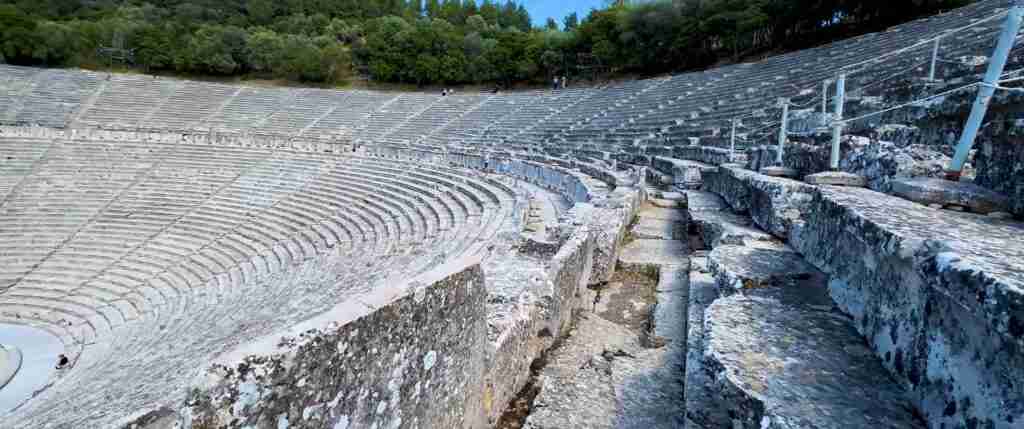
The Ancient Theatre of Epidaurus, constructed circa 340–300 BCE by the architect Polykleitos the Younger, is universally acknowledged as the greatest surviving example of ancient Greek theatre architecture — and the most acoustically sophisticated performance space ever built. The theatre seats 13,000 to 14,000 spectators in 55 rows of limestone benches arranged in a precise geometric arc on the natural slope of Kynortion Hill, immediately adjacent to but architecturally distinct from the main sanctuary complex.
Polykleitos the Younger, son of the sculptor Polykleitos who created the Doryphoros (the canonical male figure of Classical Greek art), brought the same rigorous geometric intelligence to theatrical design that his father applied to sculpture. The theatre’s cavea is divided into two unequal sections by a horizontal walkway (the diazoma): the lower section contains 34 rows and the upper section 21 rows. The seating arc subtends slightly more than a semicircle, a proportion that maximises sightlines while maintaining intimate proximity between audience and performers. The ancient travel writer Pausanias, visiting in the 2nd century CE, praised the theatre specifically for its symmetry and beauty — singling it out among Greek theatres as exceptional even by the standards of that monument-rich age.
The acoustic performance of the theatre has been extensively studied by modern engineers and acoustic physicists. The limestone seating blocks, it has been demonstrated, function as natural high-pass filters: they absorb the low-frequency ambient noise of wind and crowd sounds while allowing the higher-frequency sounds of the human voice to propagate clearly to every seat in the house. The theatre’s precise geometry — the radius of curvature, the angles of the seating tiers, the shape of the orchestra — appears to have been designed with acoustic performance in mind, though whether Polykleitos the Younger possessed the mathematical theory of acoustics or worked from empirical observation remains debated.
The orchestra — the circular performance space at the centre of the theatre — retains its original circular form, a rarity among surviving ancient theatres that is particularly significant for modern understanding of how ancient drama was staged. The orchestra circle is 20 metres in diameter, and its central stone altar to Dionysus provided both a symbolic focal point for the performances (which were religious as well as artistic events) and a geometric centre for the acoustic calculations of the theatre’s design. Standing at the centre of the orchestra today and speaking at normal volume, a visitor can be clearly heard at every point in the house — an experience that invariably produces a profound sense of connection with the performers who stood in exactly this position 2,400 years ago.
The skene — the stage building directly behind the orchestra — does not survive above foundation level, but archaeological evidence establishes its position and basic structure. This is consistent with other ancient theatres: the stone seating and orchestra were built to last; the wooden stage structures were not. The theatre remained in use through the Roman period without any significant modifications to its structure — an unusual circumstance that preserves the Classical-period design intact, without the Roman adaptations (arena walls, modified orchestra shapes) that complicate the reading of most other Greek theatres.
The monument was rediscovered during systematic excavations beginning in 1881 under archaeologist Panagiotis Kavvadias, who found it in a remarkable state of preservation beneath centuries of accumulated earth and vegetation. Restoration work by Alexandros Orlandos between 1954 and 1963 stabilised and repaired the seating while maintaining the ancient material. Further conservation work by the Preservation Committee for Epidaurus Monuments from 1988 to 2016 has ensured the structure’s continued integrity. The theatre performs today in essentially the same form it held when it opened in the 4th century BCE.
Key Monuments of the Asklepion: Tholos, Abaton, Temple, and Stadium
The lower sanctuary at Epidaurus encompasses a constellation of monuments that together constituted the most fully equipped sacred and medical complex of the ancient world. Each structure served a distinct function within the sanctuary’s integrated programme of healing, worship, and communal life.
The Temple of Asklepios
The Temple of Asklepios, constructed in the early 4th century BCE under the architect Theodotus, formed the religious centrepiece of the sanctuary. A Doric peristyle temple of six columns by eleven — measuring approximately 24 metres in length — the temple housed the gold and ivory cult statue of Asklepios described in detail by Pausanias. The god was depicted seated on a throne, his hand resting on the head of a serpent, with a dog lying at his feet — both animals symbolic of healing and regeneration. The pedimental sculptures, fragments of which survive in the on-site museum, depicted scenes from the mythology of Asklepios and were executed by master sculptors of the period. The temple’s construction accounts survive in inscriptional form, providing unusually detailed information about costs, materials, and the timeline of a major 4th-century BCE building project.
The Tholos (Rotunda of Polykleitos)
The Tholos is the most architecturally enigmatic monument at Epidaurus and one of the most debated structures in Greek architectural history. A circular building designed by Polykleitos the Younger (the same architect responsible for the theatre), the Tholos consisted of three concentric rings: an outer Doric colonnade of 26 columns, an inner Corinthian colonnade of 14 columns, and a central cella. The floor of the cella was paved with black and white marble in an alternating pattern. Beneath the floor was a complex subterranean labyrinthine structure of concentric stone walls, the function of which remains contested. Ancient and modern scholars have proposed that this underground space housed the sacred serpents of Asklepios, served as a ritual purification space, or functioned as a symbolic representation of the underworld (through which the healing power of the god was accessed). The Tholos was considered in antiquity one of the most beautiful buildings in all of Greece. Though now largely reduced to its foundations, the precision of its stonework — visible in the museum’s display of the reconstructed coffered ceiling decorations — confirms its status as a masterpiece of Classical design.
The Abaton (Enkoimeterion)
The Abaton, or Enkoimeterion, was a long stoa (colonnaded hall) running along the north side of the Temple of Asklepios. It is the building that most directly embodied the sanctuary’s healing function: this is where patients underwent the ritual of enkoimesis, sleeping in the presence of the god in the hope of receiving a healing dream. The building was designed for maximum atmospheric effect — deep porticos that shaded the sleeping areas from direct sunlight, a deliberate separation from the more public areas of the sanctuary, and access to the sacred spring waters that fed the purification pools below. The structure visible today dates primarily from two building phases: an initial construction in the late 5th or early 4th century BCE, and a significant enlargement in the 4th century that more than doubled its capacity. The physical design of the Abaton — functional, spare, oriented entirely toward the patient’s experience — stands in revealing contrast to the elaborate ornamental architecture of the temple and Tholos nearby.
The Stadium
Epidaurus maintained its own Stadium, reflecting the sanctuary’s role as a venue for the Asklepieia — the sacred games held in honour of Asklepios every four years (in the year following the Olympic Games). The Epidaurus stadium, constructed in the 5th century BCE and later expanded, held approximately 12,000 spectators in earthen embankments. The starting line for foot races and a section of the track surface survive in situ. Athletic competition was integral to the healing programme at Epidaurus, reflecting the Greek understanding that physical fitness and bodily discipline contributed directly to health — an idea that modern sports medicine would readily endorse. The stadium hosted foot races, wrestling, chariot racing, and the full range of Greek athletic events during the Asklepieia festivals.
The Gymnasium and Katagogion (Guest House)
The Gymnasium at Epidaurus, one of the largest on the Greek mainland, served both the training needs of athletes competing in the Asklepieia and the exercise programme of patients undergoing healing treatment at the sanctuary. The complex included a large central courtyard, covered running tracks (xystoi), bathing facilities, and rooms for athletic instruction. Adjacent to the gymnasium was the Katagogion — a substantial guesthouse with 160 individual rooms arranged around four internal courtyards, designed to accommodate the stream of pilgrims and patients who arrived at the sanctuary from across the Greek world. The sheer scale of these accommodation and athletic facilities confirms that Epidaurus was not simply a temple precinct but a fully functioning residential and therapeutic campus.
The Archaeological Museum of Epidaurus
The Archaeological Museum of Epidaurus, located within the sanctuary grounds immediately adjacent to the entrance, is among the oldest dedicated museums of ancient Greek architecture in existence. Founded in the context of Kavvadias’s excavations in the late 19th century, the museum has been continuously expanded and reorganised to accommodate the volume of extraordinary finds recovered from the site.
The collections are organised around three primary categories: architectural elements and sculptures from the sanctuary buildings; small finds including votives, medical instruments, and personal objects left by pilgrims; and the extraordinary inscribed stelai that document the healing cures. The architectural sculptures — pediment figures and acroteria from the Temple of Asklepios, coffered ceiling sections from the Tholos, column drums and capital fragments from multiple structures — provide a rare opportunity to see the decorative programme of the sanctuary’s principal buildings in close detail. The quality of carving is consistently exceptional: the pedimental figures from the Temple of Asklepios rank among the masterworks of early 4th-century BCE Greek sculpture.
The iamata stelai — the inscription slabs recording patient cures — occupy a special place in the museum’s display. These four large marble slabs, inscribed in the late 4th or early 3rd century BCE, contain over 70 individual case histories in the patients’ own words (or the sanctuary’s stylised version thereof). Reading through them — even in translation — is to experience a direct connection with the patients who sought healing here: a blind man whose sight is restored; a woman who sleeps in the Abaton and wakes to find a tumour dissolved; a man with a spear-point lodged in his jaw who dreams that Asklepios removes it and wakes to find himself healed. Whether one interprets these accounts as miraculous, psychosomatic, or the result of actual medical intervention, they stand as irreplaceable primary documents of ancient religious and medical experience.
The votive offerings displayed in the museum provide a complementary window onto the sanctuary’s human reality. Terracotta body parts — eyes, ears, limbs, internal organs — deposited by grateful patients as thank-offerings to the god form a remarkable catalogue of the ailments that brought people to Epidaurus from across the ancient world. Medical instruments found in and around the sanctuary further attest to the empirical dimension of the healing practice, including probes, forceps, and surgical tools that could have belonged to any equipped physician’s kit. The museum’s admission is included in the standard site ticket.
The Epidaurus Festival: Ancient Drama in the Original Setting
The Athens and Epidaurus Festival represents one of the most culturally significant annual events in Greece and, arguably, in the world. The first modern performance in the ancient theatre took place in 1938, when Electra by Sophocles was staged with Katina Paxinou and Eleni Papadaki — two of the defining actresses of 20th-century Greek theatre. After a wartime interruption, performances resumed in 1954, and the festival was formally established in 1955 as an annual programme for ancient drama. It has continued without interruption since, growing from a local cultural initiative to an internationally recognised event that attracts companies and audiences from across Europe and beyond.
The festival programme runs from late June through August, with performances on Friday and Saturday evenings. Ancient tragedy and comedy form the core of the programme, but the festival has expanded over the decades to include contemporary interpretations of classical themes, experimental productions, opera, dance, and music. International companies — from major European theatres to experimental performance groups — compete for the prestige of staging work in what is widely considered the most important theatrical venue in the Western tradition. The Greek soprano Maria Callas performed at Epidaurus in 1960, appearing in Norma and Médée in productions that became legendary in operatic history. The list of major artists who have worked in this theatre since 1955 reads as a roll-call of 20th-century performance excellence.
Attending a performance at the festival is a genuinely distinct experience from any other theatrical event. The open-air theatre under the stars of a Greek summer night, the perfect natural acoustic system that requires no amplification whatsoever, the physical setting on a Peloponnesian hillside surrounded by olive groves and cypress trees, and the awareness that one is sitting in the same stone seats occupied by audiences watching the original premieres of plays that remain central to world literature — these factors combine to produce an evening of cultural intensity that is difficult to replicate anywhere else on Earth. Festival tickets are available through the Athens and Epidaurus Festival website and sell out well in advance for popular productions; booking several months ahead is necessary for July and August performances.
The Subsidiary Sanctuary of Apollo Maleatas
Less visited but historically significant, the subsidiary sanctuary of Apollo Maleatas occupies the summit of Kynortion Hill above the main Asklepion complex. Archaeological evidence confirms that this upper sanctuary predates the Asklepios cult by several centuries, with organized cult activity reaching back to at least the late Bronze Age (15th–12th centuries BCE). The sanctuary remained in active use through the Classical and Hellenistic periods and into late antiquity, its dedication to Apollo reflecting the mythological parentage of Asklepios and the historical progression of the site’s religious associations.
Excavation of the Apollo Maleatas sanctuary has recovered remarkable Bronze Age terracotta figures, animal bones from sacrificial feasts, and architectural remains spanning nearly two millennia of continuous religious use. The site offers exceptional views over the entire valley of the main sanctuary and across the Argolid plain toward the Saronic Gulf — a perspective that makes clear the deliberate landscape planning of the ancient Epidaurians, who situated their sacred buildings in calculated relationship to the natural topography. The steep path to the summit requires approximately 45 minutes of walking and is suitable for fit visitors.
Visiting the Sanctuary of Asklepios: Practical Information
The archaeological site and museum at Epidaurus charge a standard admission fee of €20 per adult (current rate, introduced as part of Greece’s revised archaeological site pricing structure effective April 2025). This ticket includes both the outdoor archaeological site and the on-site museum. EU citizens under 25 years of age and non-EU citizens under 18 enter free upon presentation of valid identification at the ticket office. A 50% discount applies for visitors over 65 years of age. Students in secondary education and vocational training from EU and European Economic Area countries also enter free.
Timed entry tickets have been in operation at Epidaurus since April 1, 2024. Visitors must select a specific entry time slot when purchasing tickets. Once inside the site, there is no time limit on the visit — only the entry time is controlled. During peak summer season (July–August), advance online purchase through the official booking system (hhticket.gr) is strongly recommended, as popular time slots sell out, particularly in morning hours when cruise ship and tour group arrivals concentrate. Walk-up tickets at the site entrance remain available for less popular time slots.
Opening hours vary by season. The site opens at 8:00 daily throughout the year. Closing times are seasonal: November through February the site closes at 17:00; March closes at 18:00; April closes at 19:00; May through August closes at 20:00; September 1–15 closes at 19:30; September 16–30 closes at 19:00; October 1–15 closes at 18:30; October 16–31 closes at 18:00. The site is closed on national public holidays including January 1, March 25, Easter Sunday, May 1, and December 25–26. Good Friday admission is limited (12:00–17:00) and Holy Saturday hours are reduced (08:30–15:30).
Allow a minimum of three hours for a thorough visit to the main sanctuary and museum. Visitors who wish to walk up to the Apollo Maleatas sanctuary should allow an additional 90 minutes. The site covers significant ground — comfortable, closed-toe walking shoes are essential. Sun protection (hat, sunscreen) is critical from April through October, as the site provides minimal shade. The museum café and gift shop operate during summer months; bring water regardless of season. Disabled access facilities exist at the main site areas and in the Abaton area, though the terrain of the wider sanctuary is uneven.
Getting to Epidaurus: Transportation and Practical Access
Epidaurus is located in the Argolid Peninsula of the northeastern Peloponnese, approximately 150 kilometres southwest of Athens by road. The site sits near the modern village of Lygourio, approximately 30 kilometres from the city of Nafplion and 2 hours by car from central Athens via the Corinth–Nafplion motorway route (A7 toward Corinth, then south on the E65 toward Nafplion, then local roads toward Lygourio and the sanctuary).
Driving is the most practical independent transport option. The drive from Athens takes approximately 2 hours in normal traffic. From Nafplion — the region’s main base for travellers exploring the Argolid — the drive is approximately 30 minutes. Parking is available at the site entrance at no charge.
Public bus service connects Athens’s Kifissos KTEL bus terminal with Nafplion, with journey time of approximately 2.5 hours. From Nafplion, local KTEL buses serve Lygourio and the Epidaurus sanctuary on a limited schedule (check current timetables at the Nafplion KTEL office, as schedules change seasonally). The bus service is not frequent; if using public transport, plan around return departures carefully, particularly on weekdays.
Organised day tours from Athens to Epidaurus are widely available and represent a practical option for visitors without a car. Most tours combine Epidaurus with Mycenae and/or Nafplion, making efficient use of the day’s travel time across three of the Argolid’s principal sites. Tour operators typically depart from Athens in the morning, arriving at Epidaurus mid-morning before the worst of the midday heat. The tour format also handles the timed entry booking logistics on visitors’ behalf.
Epidaurus is a natural pairing with Mycenae (approximately 50 kilometres north, a 45-minute drive), the Bronze Age citadel of the Mycenaean civilisation and itself a UNESCO World Heritage Site. Nafplion, the elegant neoclassical city on the Argolic Gulf, serves as the ideal overnight base for exploring the region: it offers a wide selection of hotels, restaurants, and the Palamidi Fortress, and is well-positioned for morning departure to either site before the crowds build.
Epidaurus in Context: The Greek UNESCO World Heritage Legacy
The Sanctuary of Asklepios at Epidaurus represents one of eighteen UNESCO World Heritage Sites in Greece — a density of inscribed heritage reflecting the country’s extraordinary position at the foundation of Western civilisation. Greece’s World Heritage properties span the full arc of human cultural achievement, from prehistoric cave art to Classical architecture, Byzantine religious monuments to early modern urban landscapes.
Within this constellation, Epidaurus occupies a distinctive position. Unlike the Acropolis of Athens — which represents the pinnacle of civic and political expression — or Ancient Olympia — which embodies the athletic and competitive ideals of Greek culture — Epidaurus expresses the healing and restorative dimensions of ancient Greek civilisation. Its inscription recognises not only architectural achievement but an intellectual and medical legacy that traces directly into the Western medical tradition. The Hippocratic oath that physicians still recite today, the principle that medicine should treat the whole person rather than isolated symptoms, the idea that environment and lifestyle are medical variables — these concepts have deep roots in the practices developed and refined in this valley over nearly a thousand years of continuous operation.
For the traveller, Epidaurus offers something that few ancient sites can match: legibility. The theatre still works as a theatre. The museum still tells the stories of the patients who came here seeking healing. The landscape still creates the sense of deliberate, healing calm that the sanctuary’s architects intended. Standing in the orchestra of the ancient theatre and hearing your voice return to you from the hillside, or reading the iamata and encountering the words of a patient who slept in the Abaton 2,400 years ago hoping for a cure, are experiences that collapse the distance between the ancient world and the present in a way that academic knowledge alone cannot achieve.
Best Time to Visit Epidaurus
Spring (April–June) is the optimal period for visiting Epidaurus. Temperatures are mild (18–26°C), the surrounding Argolid countryside is green and flowered, and visitor numbers have not yet reached summer peaks. The site opens late (closing at 19:00–20:00 from April), allowing comfortable morning exploration without midday heat stress. Pre-booking timed entry tickets is advisable but generally not difficult in spring outside Greek Easter week.
Summer (July–August) is when the Epidaurus Festival makes the site unmissable for those interested in attending a performance. The heat (30–38°C) is significant and afternoon visits are uncomfortable; aim for the first available morning slot (8:00–9:00 AM) to complete the site visit before midday. Festival performance evenings are cooler and genuinely magical — a summer performance night at Epidaurus is worth building an itinerary around.
Autumn (September–October) offers an excellent balance: heat diminishes from September, crowds thin substantially after the festival season, and the landscape takes on the warm ochre tones of the Mediterranean autumn. The site remains open until 18:00–19:30 in early autumn, providing ample visiting time. October brings the fewest crowds of the accessible season and is considered by many regular visitors to be the finest time of year for unhurried exploration.
Winter (November–March) sees the site open with reduced hours (closing at 17:00–18:00) and smaller crowds. The Peloponnese winter is mild compared to northern Europe (daytime temperatures of 10–16°C) and rarely impedes outdoor site visits. The experience of a quiet morning in the ancient theatre, with mist still lifting from the valley and no other visitors in the orchestra, has its own powerful atmosphere — and the museum is as rewarding in winter as in any season.
Frequently Asked Questions About the Sanctuary of Asklepios at Epidaurus
What is the entrance fee for the Epidaurus archaeological site?
The standard entrance fee for the Epidaurus archaeological site and museum is €20 per adult, the current rate established under Greece’s revised archaeological site pricing structure from April 2025. This single ticket covers both the outdoor sanctuary complex and the on-site Archaeological Museum. EU citizens under 25 and non-EU citizens under 18 enter free with valid ID. Visitors over 65 receive a 50% discount (€10), applicable at the ticket office or through the official booking website. Secondary and vocational students from EU and European Economic Area countries enter free with valid accreditation. Check the official hhticket.gr website for any updates before visiting.
Do I need to book tickets in advance for Epidaurus?
Since April 1, 2024, timed entry tickets are mandatory for all visitors to Epidaurus. You select a specific entry time slot when purchasing your ticket; the ticket is valid from one hour before to one hour after your selected slot. Once inside, you may stay as long as you wish. During July and August and on Greek public holidays, advance online booking through hhticket.gr is strongly recommended — popular morning slots frequently sell out. Walk-up tickets remain available for off-peak slots, but to guarantee your preferred visit time, book online at least a few days ahead in summer.
How long does it take to visit the Epidaurus archaeological site?
A thorough visit to the main Epidaurus sanctuary and museum takes approximately 3 hours for most visitors. This allows time for the theatre (30–45 minutes), the main sanctuary area including the Tholos, Abaton, and Temple foundations (60–75 minutes), the Stadium (20 minutes), and the museum (45–60 minutes). Visitors who want to walk up to the subsidiary sanctuary of Apollo Maleatas on Kynortion Hill should add 90 minutes for the return walk. Those attending an evening festival performance typically arrive in the afternoon and spend 3–4 hours at the site before the show. Half a day is the minimum comfortable allocation; a full day allows exploration of the wider area including Lygourio village and the surrounding Argolid landscape.
Can I see a performance at the Ancient Theatre of Epidaurus?
Performances take place at the Ancient Theatre of Epidaurus annually as part of the Athens and Epidaurus Festival, running from late June through August on Friday and Saturday evenings. The programme includes ancient Greek tragedy and comedy, contemporary theatre, opera, and dance. Tickets are sold through the official Athens and Epidaurus Festival website (aefestival.gr) and at ticket offices in Athens and Nafplion. Popular productions — particularly ancient tragedy by major Greek theatre companies — sell out weeks in advance. Attending a performance is one of the most extraordinary cultural experiences Greece offers, and planning around a festival date is strongly recommended for summer visitors.
What is the Tholos at Epidaurus and why is it significant?
The Tholos is a circular building at the heart of the Epidaurus sanctuary, designed by Polykleitos the Younger in the late 4th century BCE. Considered in antiquity one of the most beautiful buildings in all of Greece, it consisted of three concentric rings: an outer Doric colonnade of 26 columns, an inner Corinthian colonnade of 14 columns, and a central cella with a striking black-and-white marble floor. Beneath the floor lies a complex subterranean labyrinthine structure whose function remains debated — it may have housed the sacred serpents of Asklepios, served as a purification space, or represented the underworld symbolically. The Tholos is architecturally significant for its early use of the Corinthian order in an interior colonnade, a formal innovation that influenced subsequent Greek and Roman architecture. Though largely preserved at foundation level, reconstructed coffered ceiling fragments in the museum document the exceptional quality of its decorative programme.
What is the Epidaurus Archaeological Museum and what does it contain?
The Archaeological Museum of Epidaurus is one of Greece’s oldest dedicated architectural museums, founded in the context of the Kavvadias excavations of 1881–1928 and continuously expanded since. Its collections encompass architectural sculptures and elements from the sanctuary’s principal buildings (including pediment figures from the Temple of Asklepios and coffered ceiling sections from the Tholos), small finds including bronze medical instruments and terracotta votive body parts left by patients, and the exceptional iamata stelai — four large marble slabs inscribed with over 70 case histories of healings at the sanctuary. The museum’s admission is included with the standard site ticket and typically requires 45–60 minutes for a full visit. It is housed in the original late 19th-century building constructed during the first systematic excavations.
How far is Epidaurus from Athens and Nafplion?
Epidaurus is approximately 150 kilometres from central Athens by road, a drive of approximately 2 hours under normal traffic conditions via the Athens–Corinth motorway (A7) and the E65 south toward Nafplion. From Nafplion — the most practical overnight base for exploring the Argolid region — Epidaurus is approximately 30 kilometres and 30 minutes by car. From Corinth, the drive takes approximately 1 hour. The site is accessible by KTEL bus from Athens via Nafplion, though schedules are limited and driving or an organised tour is the more convenient option. Many visitors combine Epidaurus with Mycenae (45 minutes north by car) and Nafplion in a single day trip from Athens, though an overnight stay in the region allows a more relaxed pace.
What is the historical connection between Epidaurus and modern medicine?
Epidaurus occupies a unique position in the history of medicine as the institution where the transition from divine healing to empirical medical practice is most clearly documented and traceable. The sanctuary’s healing system — combining ritual purification, the enkoimesis dream-healing practice, herbal treatments, exercise, and dietary prescription — accumulated over centuries into a body of practical medical knowledge. The iamata inscriptions document this evolution in real time, recording treatments that range from clearly miraculous accounts to detailed empirical protocols. The great Asklepeia, of which Epidaurus was the acknowledged parent, provided the institutional context in which Greek rational medicine developed. Hippocrates of Cos, whose island Asklepion was among Epidaurus’s most prestigious daughter sanctuaries, formalized the transition to evidence-based medicine. The Hippocratic tradition — including the ethical framework of the Hippocratic oath, which explicitly invokes Asklepios — is the direct intellectual descendant of the healing culture that Epidaurus pioneered, making this Peloponnesian sanctuary a genuine origin point of the Western medical tradition.
Are there free entry days at Epidaurus?
The Greek Ministry of Culture designates specific national free entry days at archaeological sites and museums throughout the year. These include March 6 (Memory of Melina Mercouri), April 18 (International Monuments Day), May 18 (International Museums Day), the last weekend of September (European Heritage Days), and October 28 (Ochi Day national holiday). Additionally, the first Sunday of each month from November through March offers free admission. On free entry days, timed entry slots still apply and must be reserved in advance through the standard booking system — free entry does not mean unrestricted walk-up access, and popular free entry days (especially May 18) fill all available slots quickly. Check the Ministry of Culture website for the current annual list of free entry dates before planning your visit.
What other ancient sites can be combined with Epidaurus in the Argolid region?
The Argolid is the most densely concentrated region of major ancient sites in Greece after Athens itself. Mycenae, a UNESCO World Heritage Site approximately 50 kilometres north of Epidaurus (45-minute drive), is the defining monument of Mycenaean civilisation and houses the Lion Gate, the Treasury of Atreus, and the royal grave circles that revealed to 19th-century excavators the full wealth of the Bronze Age Greek world. Nafplion, 30 kilometres from Epidaurus, offers the neoclassical harbour town, the Palamidi Fortress, and the Bourtzi island castle, along with excellent hotels and restaurants for an overnight stay. Tiryns, a Mycenaean citadel also listed as a UNESCO World Heritage Site (inscribed jointly with Mycenae in 1999), lies just outside Nafplion. Ancient Corinth, with its Temple of Apollo and associated Roman remains, is approximately 1 hour north of Epidaurus and can be added to a two-day Argolid itinerary. The underwater ruins of Ancient Epidaurus (the city as distinct from the sanctuary) are accessible by kayak and snorkelling tour from the coastal village of Archaia Epidauros.