
Driving the Ironstone Ridge: The Alternative Vale of Belvoir Route 2026 from Leicester
The Vale of Belvoir cuts a quiet seam through the East Midlands where Leicestershire, Nottinghamshire, and Lincolnshire meet — a glacially carved corridor of ironstone villages and castle silhouettes that most drivers bypass on faster A roads heading north. This 48-hour self-drive circuit threads the alternative byways, from Mercian friezes at Breedon on the Hill to canal engineering at Foxton Locks, with Rutland’s Norman great hall at Oakham marking the midpoint. Updated for 2026 road conditions and EV infrastructure, this guide equips drivers to take the slower road.
Key Takeaways
- The circuit covers approximately 130–140 miles from Leicester and back across two days, threading secondary roads through the Vale of Belvoir and Rutland without touching a motorway once the city boundary is cleared — the Vale of Belvoir Byways are among the most coherently under-trafficked heritage roads in the East Midlands.
- Three of the route’s four major stops — the Priory Church at Breedon on the Hill, Oakham Castle Great Hall, and Foxton Locks — are completely free to enter; full admission to Belvoir Castle runs approximately £26 per adult as of January 2026 (check belvoircastle.com for the current rate, as pricing adjusts seasonally and tickets can be booked online for discounts).
- Budget travelers complete the 48-hour Ironstone Heritage Route for approximately £105–150 per person (two sharing a B&B and choosing gardens-only entry at Belvoir); mid-range visitors who take the full castle tour and stay in a country inn budget approximately £185–265 per person for the circuit.
- Belvoir Castle is closed on Tuesdays and Wednesdays throughout the year — this is a hard closure, not a seasonal restriction. Plan Day 1 on a Thursday, Friday, Saturday, Sunday, or Monday to guarantee access to the castle interior.
- EV drivers find confirmed rapid charging at Morrisons in Melton Mowbray (50kW DC, LE13 1QR) and slow 7kW chargers at Oakham’s Church Street Car Park (LE15 6AA); no public charger is currently documented at Belvoir Castle itself, so arrive with adequate range for the Belvoir-to-Melton leg.
- The warm orange-ferruginous ironstone of the vale’s village vernacular — the same iron-oxide geology that gives Rutland’s towns their characteristic amber warmth — represents a building logic that appears independently in the laterite fortification traditions of the Deccan Plateau six thousand miles away: two unconnected traditions, one geological principle.
People Also Ask About the Vale of Belvoir Ironstone Route 2026
What is the best time of year to drive the Ironstone Ridge route through the Vale of Belvoir in 2026?
May through September is the optimal window for the Vale of Belvoir Ironstone route in 2026. Belvoir Castle’s gardens reach their fullest flowering from late spring, narrowboat traffic through Foxton Locks is at its peak (more boats mean more hydraulic activity to watch), and the ironstone villages settle into their warmest coloration under long summer light. Late-afternoon sun in May or early June is particularly effective on the stone facades of Long Clawson and Harby: the goethite in the Jurassic ironstone glows a deep amber that midday overhead light completely flattens. April and early October also work well — substantially thinner crowds at every site, Belvoir’s woodland in dramatic autumnal color, and accommodation rates typically lower on midweek stays. Winter driving on the circuit is possible on the principal A roads but carries risks on the lower vale lanes, which are built on Lias clay and prone to ponding after extended wet periods. Belvoir Castle also operates a reduced and event-specific calendar from November through March; check the official website before planning a winter visit, as the castle interior may be closed for private events on short notice even when the gardens are open.
How much does the 48-hour Leicestershire and Rutland heritage circuit cost in 2026?
Total cost depends sharply on travel style. Budget travelers — two sharing a village B&B, choosing gardens-only entry at Belvoir rather than the full castle tour, and eating at pub cafes — complete the circuit for approximately £105–150 per person, or about £55–75 per person per day. Mid-range visitors who take the full Belvoir Castle tour and stay in a country inn such as one of Melton Mowbray’s coaching hotels budget approximately £185–265 per person for the full circuit, or roughly £95–135 per person per day. Luxury visitors — Hambleton Hall for the night, a Michelin-level dinner, and the full Belvoir guided tour with afternoon tea in the Aviary Tearoom — should expect approximately £325–520 per person for the 48 hours, around £165–260 per day. All three tiers benefit from the three completely free anchor attractions (Breedon on the Hill church, Oakham Castle Great Hall, and Foxton Locks), which substantially reduce what would otherwise be a heavier admission-cost circuit.
Where can EV drivers charge their vehicles along the Vale of Belvoir and Rutland in 2026?
EV infrastructure on this circuit is adequate at the two transit towns but essentially absent on the rural B roads between them — all confirmed charging is in Melton Mowbray or Oakham. Melton Mowbray’s Morrisons supermarket (LE13 1QR) is the most practical stop: an Equans 50kW DC rapid charger alongside a 22kW AC unit, ideal for an overnight top-up on Day 1. Oakham offers 7kW Type 2 slow chargers at Church Street Car Park (LE15 6AA), well-calibrated to a two-hour dwell while visiting the castle. Rutland Hall Hotel and Spa at Barnsdale (LE15 8AB) carries Project EV fast chargers for guests and customers; Hambleton Hall nearby (LE15 8TH) has a Tesla Destination point (verify adapter compatibility before arrival). No public EV charger is currently documented at Belvoir Castle itself — plan to arrive at the castle with enough range to cover the return leg to Melton Mowbray (approximately 12 miles). Verify live charger status on Zapmap or Zap-Map before departure, as Rutland’s network has expanded significantly since the county’s early EV adoption program launched in 2011.
Can the Ironstone Heritage Route through the Vale of Belvoir 2026 be completed without a car?
The circuit is designed for a self-drive vehicle and is genuinely difficult to complete car-free. The B roads connecting Breedon on the Hill, the Vale of Belvoir villages, Belvoir Castle, and the Rutland section carry no regular scheduled bus service linking these sites. That said, the two transit-anchor towns are well connected by rail. East Midlands Railway runs roughly hourly services from Leicester to Melton Mowbray (approximately 25–30 minutes), and very frequent services from Leicester to Market Harborough on the Midland Main Line (approximately 20–25 minutes). From Melton Mowbray, a taxi reaches Belvoir Castle in about 20 minutes (approximately 12 miles, fare approximately £12–18 each way). From Market Harborough, a taxi or Uber reaches Foxton Locks in under 10 minutes. Oakham station sits a five-minute walk from the castle. The weakest link is Breedon on the Hill, which has no practical public transport from Leicester: a direct taxi costs approximately £18–25 each way. Cyclists can cover the Rutland section on Day 2 using the county’s well-signed cycle route network, but Breedon’s steep hilltop climb and the overall circuit distances make a full car-free completion genuinely challenging.
Extended multi-day tours – 5+ days
Featured Coventry Multi-Day Tour Packages
3 days
Coventry 3-Day Discovery Tour
- ✓ Comprehensive Coventry experience
- ✓ Expert local guides included
- ✓ All accommodation included
- ✓ Transportation provided
5 days
Coventry 5-Day Highlights Experience
- ✓ Comprehensive Coventry experience
- ✓ Expert local guides included
- ✓ All accommodation included
- ✓ Transportation provided
7 days
Coventry 7-Day Cultural Journey
- ✓ Comprehensive Coventry experience
- ✓ Expert local guides included
- ✓ All accommodation included
- ✓ Transportation provided

10 days
Coventry 10-Day Complete Adventure
- ✓ Comprehensive Coventry experience
- ✓ Expert local guides included
- ✓ All accommodation included
- ✓ Transportation provided
Multi-day tour packages powered by TourRadar. Prices and availability subject to change.
Why the Vale of Belvoir Remains One of England’s Most Underexplored Drives in 2026
The Vale of Belvoir occupies an awkward position in the East Midlands tourism map: it falls across three county boundaries — Leicestershire, Nottinghamshire, and Lincolnshire — and belongs to no single regional authority’s promotional priority. It has no National Trail threading through it, no National Park designation lending organizational energy to its promotion, and no motorway exit specifically signed for its villages. Drivers heading north from the Midlands predominantly use the A1 or the A46, skirting the vale’s western ridge while looking for signs to Lincoln or the Peak District. That invisibility is, for the driver willing to leave the trunk road, an almost undiluted advantage: a landscape of genuine agricultural England, not heritage England performing itself.
The circuit described in this guide takes the descriptive name Ironstone Heritage Route for the belt of secondary roads that arcs northwest from Leicester to Breedon on the Hill before sweeping east and northeast through the ironstone villages of the vale, cresting at Belvoir Castle, and looping back south via Oakham and the Grand Union Canal at Foxton Locks. This is not an officially designated route — no brown tourist signs mark it, no heritage body sponsors it — but the sequence of sites it connects forms a coherent arc: one geological story in the building stone, four separate institutional architectures spanning fourteen centuries, and two of the East Midlands’ most useful transit towns as bookends.
Belvoir Castle is the circuit’s single most recognizable draw and the one site that has benefited from recent visibility. Its use as Windsor Castle’s double in the Netflix series The Crown generated considerable visitor interest, and as of 2026 it sustains a steady mid-sized attendance. What has not followed the castle’s rise in recognition is any corresponding interest in the surrounding vale. Long Clawson, Hose, Harby, and Barkestone-le-Vale remain quiet working settlements: no cafes, no boutique shops, effectively no tourist infrastructure beyond an occasional village notice board. Their appeal is the non-performance of it — domestic vernacular in functioning agricultural England, unimproved and uninterpreted.
Breedon on the Hill represents a different kind of unrealized potential. It holds what multiple heritage organizations describe as one of the largest and finest collections of Anglo-Saxon stone sculpture in England, yet it sits on almost no mainstream heritage itinerary. The approach from the village — up a narrow lane past the quarry’s advancing edge, the church visible above on the limestone stub — is dramatically unmediated. There are no arrival sequences, no entry procedures, no visitor management. The church simply opens at 9:30am and is there.
Foxton Locks, at the circuit’s southern end, is the exception to the obscurity pattern. The Canal and River Trust records over 400,000 annual visitors to the site, and it functions as a day-trip destination for Leicester and Market Harborough locals. But it sits outside the heritage itinerary that might connect it with the castle and cathedral circuits to its north. The remains of the Foxton Inclined Plane — a listed Scheduled Ancient Monument and one of the most significant surviving pieces of Victorian hydraulic engineering in the Midlands — typically receive a fraction of the attention given to the still-operational lock flight beside them.
For a driver with two days, the Vale of Belvoir Byways offer something increasingly difficult to find in England’s crowded heritage landscape: a coherent sequence of genuinely important sites — Mercian ecclesiastical, Norman domestic, Regency aristocratic, and Victorian industrial — separated by slow, beautiful secondary roads, low traffic, warm building stone, and no visible queue at any of them.
The Ironstone Vernacular: East Midlands Geology and a Global Stone Parallel
The warm orange-amber coloration that defines the Vale of Belvoir’s villages and gives this route its name has a precise geological explanation. The building stone throughout the vale and across much of Rutland belongs to the Jurassic Marlstone Rock Formation — a ferruginous oolitic limestone and calcareous sandstone laid down in a shallow subtropical sea approximately 175 million years ago and now exposed across a broad belt running from Dorset and Somerset northeast through Northamptonshire, into Rutland, and across south Leicestershire. The iron content is carried primarily as goethite (an iron oxyhydroxide), with contributions from limonite; both are iron-bearing minerals that weather to a characteristic spectrum of warm tones — light honey on freshly exposed faces, deep amber on weathered facades, and rich burnt sienna where iron-rich seams oxidize most fully. The color is structural, not surface: it runs through the stone and intensifies when freshly cut, then settles to a mellower warmth as the building ages.
The geological transition along the circuit route is abrupt enough to track by the building fabric alone. Breedon on the Hill sits on Carboniferous limestone — an entirely different rock, grey-white, vastly older, deposited in a different sea at a different period. The quarry that has consumed most of the hill’s east flank reveals this pale stone clearly: it is the same stone that produces the slightly austere character of the Charnwood Forest villages to the south. Within a few miles of driving east and south from Breedon toward the vale, the building stock shifts register. Field walls, barn gables, and cottage facades progressively warm from grey-white to amber, and by the time the circuit reaches Long Clawson, the ironstone vernacular is fully established: the stone appears not as a material choice but as a geological inevitability, quarried very locally throughout the vale’s long agricultural history.
This pattern of practical vernacular responding to local geology — producing a characteristic color palette that ties settlements visually to their landscape — finds a parallel in an entirely independent tradition on the other side of the world. The Deccan Plateau of peninsular India has its own iron-rich building-stone tradition rooted in a different geological process. Laterite, formed by millions of years of intense tropical chemical weathering of basalt and related parent rocks under hot, seasonal rainfall conditions, is iron-oxide rich (primarily hematite, with goethite content depending on the specific formation) and produces a warm reddish-brown to ochre color range. From Karnataka to Maharashtra and Goa, laterite has been quarried and used for fortification and vernacular construction since at least the medieval period: easily workable when freshly extracted, hardening on exposure to air, and coloring the surrounding soils and road cuttings in the same warm tones as the buildings.
The visual parallel with the East Midlands ironstone is striking. Bidar Fort in Karnataka, built by the Bahmanid Sultanate in the 15th century and elaborated by successive dynasties, uses local dark laterite alongside basalt; the vernacular settlements associated with the broader Deccan hill-fort tradition similarly drew on whatever local stone the terrain offered, producing settlements and fortifications whose warm reddish-brown color merges naturally with the ferruginous soils of the plateau surface. Maratha hill-fort architecture in Maharashtra — Torna, Rajmachi, Pratapgad — presents a comparable phenomenon: buildings that read as geological feature rather than human imposition, because the stone from which they are built is indistinguishable in color from the rock on which they stand.
The convergence is independent and must be understood as such. No documented transmission chain connects Mercian builders quarrying the Jurassic outcrop of the Charnwood rim in the 7th century with the architects and masons of Bahmanid Karnataka in the 15th. The parent rocks are different (marine sedimentary versus tropical weathering residue), the geological ages are different (Jurassic versus Cretaceous to Precambrian), the cultural and institutional contexts are separated by the full width of Asia. The parallel is purely chemical: iron oxide in a building stone, wherever and however it forms, produces warmth. When vernacular builders work with what geology provides locally — as they invariably do in traditions without access to long-distance stone transport — they arrive at solutions shaped by the stone rather than by any shared inheritance. The East Midlands ironstone villages and the laterite settlements of the Deccan are connected only by the periodic table and the landscape logic of building from what is nearest.
For the driver on this circuit, the geology is legible without technical knowledge. The most effective vantage point is the elevated road running south of Belvoir Castle, looking back northwest across the vale on a clear afternoon in May or September: the ironstone villages on the valley floor appear as patches of warm amber embedded in a green and ochre landscape, their color continuous with the exposed plowed soil on surrounding fields. It is, in visual terms, almost exactly what the geological texts describe — ferruginous stone placed by human hands into the landscape that generated it, doing what iron-rich stone always does in afternoon light.
Hidden Leicestershire and Rutland: A 48-Hour Off-the-Beaten-Track Circuit (2026 Edition)
The two-day circuit below is structured as a northwest-to-northeast arc on Day 1 (Leicester to Breedon on the Hill, east through the vale villages, north to Belvoir Castle, overnight in Melton Mowbray) followed by a southwestern sweep on Day 2 (Melton Mowbray to Oakham, south through Rutland to Foxton Locks, return to Leicester). Total driving across both days is approximately 130–140 miles. The circuit works best Thursday through Monday, ensuring Belvoir Castle is open on Day 1. Confirm Day 2 Oakham Castle hours at oakhamcastle.org before departure — the Great Hall is closed on Tuesdays and operates reduced Sunday hours (noon to 4pm).
Day 1: Mercian Carvings and Ironstone Villages
Depart Leicester by 9:00am. Take the A511 northwest from the city, picking up the A453 toward Castle Donington. The road climbs steadily out of the Soar Valley onto the Charnwood fringe, and within twenty minutes the horizon opens: Breedon on the Hill becomes visible ahead — a pale limestone promontory rising above agricultural flatlands, the church tower just distinguishable at the summit. Total distance from Leicester center: approximately 22 miles, about 40 minutes in ordinary traffic.
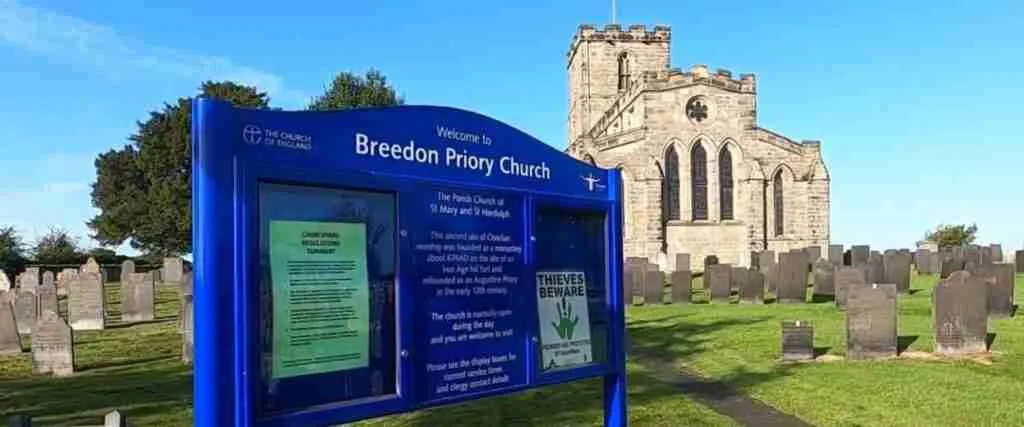
Breedon on the Hill — allow 1.5 hours. Park in the village (free) and drive up the narrow lane — there are passing places at intervals — to the hilltop car park. Alternatively, the footpath from the village base takes about 10 minutes. The Priory Church of St Mary and St Hardulph opens daily from 9:30am and admission is free.
The hill itself rewards attention before entering the church. The Bulwarks — the earthwork ramparts of an Iron Age hillfort dating to approximately 800–450 BC — are still traceable as banks running along the surviving hilltop rim. The quarry has consumed most of the hill’s eastern and southern faces, leaving the church perched on a dramatically reduced plateau with clear views north across the Trent valley and, on clear days, west toward Derbyshire. The Carboniferous limestone that makes up the hill is visible in the quarry face: pale grey, quite different from the warm Jurassic stone that will characterize the rest of Day 1.
Inside, the Anglo-Saxon sculpture collection is the principal reason for the visit. A monastic community was founded on this hilltop in approximately 675 AD with consent from King Æthelred of Mercia, as recorded in the Anglo-Saxon Chronicle, and for roughly two centuries it functioned as a centre of Mercian religious culture and craft. The carved stonework that survives — much of it salvaged from the original monastic buildings and incorporated into the later structure — dates principally to the 8th and 9th centuries and represents the Mercian kingdom’s sculptural tradition at considerable sophistication. Vine scrolls, interlaced knotwork, zoomorphic beasts with elaborately intertwined limbs, seated figures, and mounted warriors appear across the frieze fragments incorporated into the church walls. The quality is consistently high and the iconographic range is wide.
The most celebrated individual piece is the Breedon Angel — a relief carving of a standing winged figure that the National Churches Trust describes as thought to be among the earliest representations of an angel surviving anywhere in Europe, though as with all such superlatives in early medieval sculpture the exact ranking depends on the selection criteria applied. The carving is well-preserved, directly observable, and justifies the designation alone. There is also a Mercian cross shaft inside the nave, a curious carved figural block whose iconographic reading remains contested, and a series of later monuments including 16th and 17th century alabaster effigies for the Shirley family, lords of the neighboring manor.
Historical sources note that the monastic community was attacked and dispersed by Danish forces around 874 AD — the same decade that saw the Great Heathen Army’s operations in Mercia more broadly — and the monastery never fully recovered its former character. The later church that emerged from this disruption eventually became an Augustinian priory, which accounts for the site’s full historical name. The churchyard’s widespread use of slate headstones is an unusual Leicestershire tradition: the black slate retains legible inscriptions for centuries, long after limestone equivalents have weathered to illegibility.
East through the ironstone villages — allow 45–60 minutes of driving, with stops. From Breedon, take B roads east via Kegworth and then toward Wymeswold. The geological transition announces itself in the building fabric: within a few miles of leaving Breedon’s Carboniferous country, field walls and farmsteads begin to shift from pale grey to warm orange-amber as the Jurassic Marlstone takes over. The route passes through or skirts Long Clawson, Hose, and Harby — a sequence of agricultural settlements whose domestic vernacular constitutes one of the most intact examples of the ironstone building tradition in Leicestershire. Long Clawson hosts Long Clawson Dairy, one of the most noted producers of Stilton cheese under its Protected Designation of Origin, though the working dairy does not offer public tours. The village store and farm shops in the vicinity carry the output.
These are working villages without tourist infrastructure: no cafes, no car parks signed for visitors, no interpretation boards. The appeal is precisely the absence of all that — domestic England in its agricultural form, where the ironstone appears in field boundaries, barn gables, and cottage facades without annotation. The lane through Hose is single-track in places (passing places at intervals); Harby is similarly constrained. Barkestone-le-Vale, if the route takes in the full arc, adds another ironstone settlement to the sequence. Drivers with a particular interest in vernacular church architecture may note St Mary the Virgin in Harby — another ironstone building, though without the sculptural significance of Breedon.
Belvoir Castle — allow 2.5–3 hours. The approach from the vale side is among the circuit’s finest sequences. The road rises gradually from the flat vale floor toward the wooded ridge, and the castle appears in stages — first a crenellated tower above the treeline, then the full Gothic Revival profile against the sky. The current structure dates from the early 19th century, designed in a Gothic Revival idiom after earlier versions of the castle were destroyed or substantially rebuilt from the 11th century original. It has been the ancestral seat of the Manners family, Dukes of Rutland, since the 16th century.
Full admission — castle interior, gardens, and playground — runs approximately £26 per adult as of January 2026; check belvoircastle.com for the current rate, as pricing adjusts seasonally and online booking can offer savings. Gardens and playground without the castle interior cost approximately £10. The castle opens Thursday through Monday, 10am to 5pm (last entry 4:30pm); it is closed on Tuesdays and Wednesdays throughout the year. Parking costs £3 per vehicle, payable on exit via ANPR. Historic Houses membership provides free admission for card holders.
Guided castle tours depart daily at 11:00am and 2:00pm and last approximately 90 minutes. The state rooms — Guardroom, Ballroom, and Elizabeth Saloon among them — contain portraits, tapestries, and furniture assembled over centuries of ducal patronage. The castle’s exterior was used as Windsor Castle’s double in The Crown, and its Gothic Revival towers hold that resemblance to a degree that is worth appreciating from the south terrace. The gardens, partly redesigned in work attributed to Capability Brown and subsequently restored, include formal terraced beds and woodland walks with panoramic views across the vale. The Engine Yard, a restored Victorian estate complex near the entrance, carries cafes, a farm shop stocking estate and local produce, and artisan retailers — a useful stop for evening provisions if heading to Melton Mowbray after the visit.
Overnight in Melton Mowbray — approximately 15 miles south of Belvoir, allow 25–30 minutes. Aim to leave the castle by 4:30pm. The market town offers a range of accommodation from budget B&Bs and Premier Inn through to mid-range coaching inns. Evening dining focuses appropriately on the town’s food heritage: pork pies and Stilton both carry Protected Geographical Indication status here, and the better pub kitchens take both seriously. Ye Olde Pork Pie Shoppe on Church Street (Dickinson and Morris, one of the oldest established pie producers in the country) is worth a visit before it closes. EV drivers should charge overnight at Morrisons (LE13 1QR), which carries an Equans 50kW DC rapid charger alongside a 22kW AC unit — a full overnight or early-morning rapid charge will replenish most batteries well within the Day 2 circuit’s range requirements.
Day 2: Norman Great Halls and Canal Hydraulics
Depart Melton Mowbray by 9:00–9:30am. Take the A606 west and southwest toward Oakham, Rutland’s county town and the administrative capital of England’s smallest historic county. The 12-mile drive takes approximately 20 minutes and passes through pleasant Eye Valley countryside; there are glimpsed views of Rutland Water to the south, one of England’s largest reservoirs by surface area, as the road descends from the Melton uplands.
Oakham — allow 1.5–2 hours. Park in the town center (pay and display) or at Church Street Car Park (LE15 6AA), which carries two 7kW Type 2 Mennekes slow chargers — a practical two-hour top-up while visiting the castle, adding approximately 14kWh to a standard EV battery. The Great Hall is a five-minute walk from most central car parks.
Oakham Castle’s Great Hall was built between approximately 1180 and 1190 by Walkelin de Ferrers, the then-Lord of the Manor of Oakham. The official castle site describes it as “the finest surviving example of Norman domestic architecture in Europe,” a superlative that other heritage sources state more cautiously as one of the finest in England; either way, the interior is exceptional. A magnificent oak-timbered roof sits above stone-arcaded walls hung with over 240 ceremonial horseshoes presented by royalty and peers of the realm on their first visit to Oakham — a custom extending back centuries whose origin the castle’s own history acknowledges as unclear. The oldest surviving horseshoe in the collection is attributed to Edward IV’s visit in 1470, following his victory at the Battle of Losecoat Field in nearby Lincolnshire. More recent additions include a horseshoe presented by the then Duchess of Cornwall, now Queen Camilla, in 2014.
Above the arcaded columns, six carved musician figures each play a different instrument, cut from local Clipsham stone. The Discover Rutland heritage listing notes that they are believed to have been carved by masons who also worked at Canterbury Cathedral — a plausible inference from stylistic parallels rather than a documented attribution. The hall is still used as a Crown Court, with judicial proceedings held approximately every two years, lending the interior a layered institutional history that stretches from Norman banqueting to 21st-century justice.
Admission to the Great Hall is free; donations go to the Friends of Rutland County Museum and Oakham Castle. Opening hours are Monday, Wednesday, Thursday, Friday, and Saturday 10am to 4pm; closed Tuesdays; Sunday hours are noon to 4pm. Guided group tours can be pre-booked at £3.50 per visitor. Verify hours at oakhamcastle.org before visiting, as the hall is occasionally closed for private events and civil weddings. The castle grounds — covering the motte-and-bailey earthworks, which function as a public park — are always accessible.
Oakham’s market square, two minutes’ walk from the castle, operates on Wednesdays and Saturdays. The Rutland County Museum nearby (free entry; check opening times) covers local archaeology, agricultural history, and the county’s Roman-period inheritance. Several cafes and pubs on the High Street provide lunch options before the road continues south toward Foxton.
Drive south to Foxton Locks — approximately 28–30 miles, allow 50–60 minutes. From Oakham, take the A47 west and then B roads south toward the Leicestershire border. The route passes through Rutland’s compact countryside — Braunston-in-Rutland, Tilton-on-the-Hill — before descending toward the Market Harborough area. Foxton Locks sits approximately 3 miles west of Market Harborough town center, signed from the A6 on the northern approach.
Foxton Locks — allow 1.5–2 hours. Pedestrian access to the site is free at all times. Two ANPR car parks serve the site, both payable on exit: the top long-stay car park gives pedestrian access to the lock flight’s upper end and the Lock Keepers Cottage Café; the bottom short-stay car park (four-hour maximum) gives access to both pubs, the BoilerHouse Museum, and the canal-level paths. The site’s 34 acres include extensive towpath walking in both directions from the locks.
The lock flight consists of ten staircase locks arranged in two staircases of five, lifting and lowering boats approximately 75 feet through the hill on the Leicester Line of the Grand Union Canal. The hydraulic engineering of a staircase is worth understanding before watching: in a true staircase, the top gate of one lock serves as the bottom gate of the lock above it, meaning that ascending and descending boats cannot pass each other within the flight without one waiting at a landing. A single boat working through a full staircase takes 20–30 minutes to observe, and on busy summer days multiple boats queue at each end, creating a sustained display of canal-lock mechanics that few other sites in England can match for scale or complexity.
To the right of the lock flight, looking uphill, the remains of the Foxton Inclined Plane are listed as a Scheduled Ancient Monument. The incline was opened in 1900 as an alternative to the lock flight — a counterbalanced system of two water-filled boat caissons running on rails, designed to allow a boat to ascend the hill in about 12 minutes rather than the 70–90 minutes required to work through ten locks. After just 11 years of operation, competition from railways and insufficient narrowboat traffic to justify the running costs led to its closure in 1911; it was dismantled for scrap in 1928. The earthwork ramp, the mechanical pit, and the boiler house shell survive as some of the most significant remains of Victorian hydraulic canal engineering in England. The BoilerHouse Museum (formerly Foxton Canal Museum) interprets the incline’s history through exhibits and a viewing platform over the incline site.
On the water: approximately 5,000 narrowboats pass through Foxton annually according to the Canal and River Trust, with summer weekends the busiest periods. Herons, swans, kingfishers, and swallows are regular presences on the canal and bank margins. Short 30-minute canal cruises on the vessel Vagabond II are available at summer weekends from the bottom lock. Lock Keepers Cottage Café at the top lock serves hot and cold drinks, snacks, and locally made ice cream. Foxton Locks Inn and Bridge 61 pub at the bottom lock both carry full menus, beer gardens, and canal views; Foxton Locks Inn opens daily 9am to 6pm with food served until 5pm in summer (winter hours reduced — check the restaurant website).
Return to Leicester — approximately 15 miles north, allow 30 minutes. The A6 northward from the Market Harborough area carries the circuit cleanly back to Leicester. The final stretch across the East Midlands flatlands between Market Harborough and the city suburbs brings the ironstone, the castle, and the canal into retrospect before the urban fringe begins.
EV Charging and Sustainable Driving Along the Vale of Belvoir 2026
The Ironstone Heritage Route is manageable for most modern long-range EVs without significant range anxiety if overnight charging is planned. The total circuit covers approximately 130–140 miles, which falls well within the range of any EV sold since 2022. The constraint is not range but charging location: infrastructure is concentrated in the two transit towns and at accommodation venues, and is essentially absent on the rural B roads between them. Plan your charging around Melton Mowbray and Oakham rather than hoping for an en-route fast charger in the vale itself.
Melton Mowbray — primary overnight charge point. Morrisons supermarket (LE13 1QR) carries an Equans network 50kW DC rapid charger and a 22kW AC unit. This is the most practical charging stop on the full circuit. A 30- to 45-minute rapid charge while shopping for provisions or having breakfast restores most batteries from a partial depletion, and the supermarket location makes the stop efficient. Melton Mowbray town center may carry additional points from other networks; verify current availability on Zapmap before arriving, as the market-town charging network has been growing since 2023.
Oakham — daytime slow charge. Church Street Car Park (LE15 6AA) carries two 7kW Type 2 Mennekes slow chargers, historically part of the POLAR network (now operating under various brand names following sector consolidation — confirm the current access method before arrival). At 7kW, a two-hour dwell adds approximately 14kWh, equating to 50–70 miles of additional range under mixed rural driving conditions. This is well-sized for the Oakham-to-Foxton-to-Leicester leg of approximately 45 miles.
Accommodation venue charging. Hambleton Hall (LE15 8TH) on the Rutland Water peninsula has a Tesla Destination charger; non-Tesla drivers should confirm adapter compatibility with the hotel before arrival. Rutland Hall Hotel and Spa at Barnsdale (LE15 8AB) carries Project EV dual fast chargers available to hotel guests and customers. Both are relevant for drivers staying in the area for Day 1 rather than in Melton Mowbray.
Belvoir Castle. No public EV charger is currently documented at the castle’s car park or Engine Yard. Drivers arriving via the Day 1 route from Leicester through Breedon and the vale villages will have covered approximately 55–65 miles by the castle. Modern long-range vehicles (250-plus miles per charge) face no issue. Drivers with shorter-range older vehicles should consider charging at the Morrisons Melton Mowbray before the castle visit, then returning to Melton for a top-up before the Day 2 departure.
EV versus petrol costs on this circuit. A petrol car averaging 35 miles per gallon over 130 miles consumes roughly 3.7 gallons. At 2026 forecourt prices — approximately £1.55–1.65 per litre — the total fuel cost is approximately £22–25, or £11–13 per person for two sharing. An EV covering the same distance from a home charger starting point draws approximately 26kWh (at a representative 5 miles per kWh on mixed rural A and B roads), costing approximately £5–8 at domestic electricity rates. If relying predominantly on public rapid charging at 75–90p per kWh (typical for a 50kW rapid point in 2026), the total rises to approximately £18–23 — narrowing the margin against petrol significantly. The EV advantage is maximized when overnight charging happens at home or at a destination hotel charger and the on-route stops are supplementary rather than primary. Use Zapmap (zapmap.com) or PlugShare for live charger status verification before and during the circuit; both apps show real-time availability and support filtering by speed and connector type.
Seasonal Road Conditions and the Best Windows to Drive in 2026
The Vale of Belvoir has a seasonal road character distinct from the surrounding Midlands uplands. The vale floor sits on Jurassic Lias clay — a formation that swells with moisture content in a way that limestone and ironstone upland roads do not. Two practical consequences follow: the lowest lanes in the vale (particularly the network serving Hose, Harby, and Barkestone-le-Vale) can become partially flooded after sustained wet periods from November to March, and verge surfaces adjacent to single-track lanes soften significantly after prolonged rain, making inadvertent wheel drops harder to recover. The principal A roads connecting Melton Mowbray, Oakham, Market Harborough, and Leicester are well-maintained all-weather routes unaffected by these conditions; the challenge is specific to the vale-floor B roads and byways.
May through September is the optimal driving season. Crowd levels at Belvoir Castle, Breedon, and the vale villages are highest on summer weekends but remain moderate on weekdays; Foxton Locks is busiest at summer weekends and bank holidays but the added boat traffic makes it more visually rewarding. The ironstone villages look their most distinctive under late-afternoon summer light, when the low sun angle produces raking illumination that deepens the stone color. May and early June offer the best balance of light quality, crowd levels, garden condition at Belvoir, and road surface reliability.
April and October are strong alternatives. Shoulder-season accommodation is typically 10–20% cheaper than peak summer on weekday stays; Foxton Locks in early April, before the main boating season begins, has an almost contemplative atmosphere; and Breedon on the Hill in October morning mist is one of the finer visual experiences available for the price of fuel from Leicester. Belvoir Castle’s estate woodland in late October produces autumn color against the Gothic Revival towers that the summer calendar does not match.
Day-of-week planning is as important as season. Belvoir Castle closes on Tuesdays and Wednesdays throughout the year — this is a standing closure rather than a seasonal or staffing exception. No Day 1 visit is possible on either of those days regardless of season, weather, or advance booking. Plan Day 1 on a Thursday, Friday, Saturday, Sunday, or Monday. Oakham Castle Great Hall closes on Tuesdays and has reduced Sunday hours (noon to 4pm rather than 10am). For a Day 2 visit that begins at Oakham, Wednesday through Saturday morning is the most reliable window. The recommended circuit structure — Day 1 Thursday or Friday, Day 2 Friday or Saturday — balances open-access requirements with the quieter midweek atmosphere that makes the vale villages, Breedon, and Foxton most enjoyable.
Winter (November–March). The circuit remains driveable on its A-road framework throughout the year. Breedon on the Hill church opens daily year-round from 9:30am. Foxton Locks is always accessible on foot and is genuinely atmospheric in winter: frost on the lock gates, mist on the canal surface, and crowd levels negligible. The BoilerHouse Museum maintains its standard hours in winter. Belvoir Castle operates a restricted calendar between November and March — the castle interior may be closed except for specific themed events (Christmas market, New Year events) while the gardens remain open. Always check the official website before a winter visit. EV drivers in winter should account for reduced range in cold temperatures: add approximately 20–25% to the estimated energy consumption when temperatures fall below 5°C, and plan a charging stop accordingly.
Specific road notes. The lane ascending Breedon Hill is passable for standard saloon cars, conventional SUVs, and small vans; it is not suitable for motorhomes, campervans, or any vehicle significantly larger than a transit van. The B676 east of Harby toward the Belvoir ridge narrows on the approach to the castle; it is fine for standard family vehicles and standard-wheelbase SUVs. The lanes between Long Clawson, Hose, and Harby are single-track with adequate passing places in normal conditions; exercise standard rural caution and reduce speed significantly when approaching blind bends.
Budget Guide for the Ironstone Ridge Drive 2026
The Ironstone Heritage Route has an unusually favorable budget profile for a two-day heritage circuit: three of its four principal attractions are completely free to enter. Breedon on the Hill church charges nothing and requires no booking. Oakham Castle Great Hall is free, operated by Rutland County Council with donations welcomed. Foxton Locks is free pedestrian access at all times. The single paid attraction — Belvoir Castle — offers admission tiering (castle-plus-gardens or gardens only) that allows visitors to calibrate their spend within the site itself. All figures below are per person for the full 48-hour circuit, assuming two people sharing both a car and overnight accommodation. Room rates are divided by two before being added to individual costs. Petrol is calculated at approximately £12 per person for two sharing a mid-range petrol car over the full circuit distance.
Budget tier: approximately £105–150 per person for the 48-hour circuit
- Accommodation (1 night in a village B&B or guesthouse, room £60–85 for two sharing): £30–43 per person
- Meals across both days (pub lunch and dinner on Day 1, café lunch on Day 2): £41–68 per person
- Petrol, two sharing: £12 per person
- Attractions (Belvoir Castle gardens-only entry): £10 per person
- Parking and incidentals: £10–18 per person
This averages approximately £55–75 per person per day. Budget travelers still see the three most architecturally significant free sites on the circuit — Breedon, Oakham, and Foxton — and access Belvoir’s grounds without the interior. The main trade-off is the Belvoir state rooms and guided tour; for those whose interest is primarily landscape, gardens, and the Engine Yard, the gardens-only ticket is an entirely adequate choice.
Mid-range tier: approximately £185–265 per person for the circuit
- Accommodation (1 night in a country inn or coaching hotel, room £100–150 for two sharing): £50–75 per person
- Meals across both days (gastropub lunch, sit-down dinner Day 1, hotel breakfast, cafe lunch Day 2): £77–115 per person
- Petrol, two sharing: £12 per person
- Attractions (full Belvoir Castle entry): £26 per person
- Parking and incidentals: £20–37 per person
This averages approximately £95–135 per person per day. The mid-range experience includes the Belvoir state rooms and guided tour, a comfortable overnight with a proper dinner, and budget headroom for Lock Keepers Cottage Café at Foxton and a coffee in Oakham.
Luxury tier: approximately £325–520 per person for the circuit
- Accommodation (1 night in a country house hotel or luxury inn, room £200–350 for two sharing): £100–175 per person
- Meals across both days (hotel dinner, fine dining or equivalent, plus daytime meals): £120–190 per person
- Petrol or EV charging: £15 per person
- Attractions and experiences (full Belvoir entry and optional afternoon tea in the Aviary Tearoom): £56–80 per person
- Shopping at Engine Yard and incidentals: £30–60 per person
This averages approximately £165–260 per person per day. At the upper end of this range, Hambleton Hall on Rutland Water provides a standard of accommodation and cuisine that makes the circuit genuinely competitive with internationally prominent destinations.
Money-saving strategies. Historic Houses membership (an annual subscription covering over 1,500 properties) provides free admission to Belvoir Castle and pays for itself in one to two visits for regular heritage property visitors. The gardens-only Belvoir ticket saves £16 per adult versus full entry — a meaningful saving for a party of four. Midweek travel (Thursday or Friday for Day 1 on this circuit) typically reduces country-inn accommodation by 10–20% relative to Friday-Saturday rates. Packing a picnic lunch in Melton Mowbray from the market or farm shop — the town’s food heritage makes provisioning easy and enjoyable — removes the main daytime dining cost on Day 2. The three free anchor attractions mean that even the mid-range circuit has lower admission costs than most comparable heritage two-day circuits in England.
Hidden costs to plan for. Belvoir Castle parking costs £3 per vehicle, paid on exit via ANPR — have a payment method ready as there may not be a staffed booth. Foxton Locks car parking is similarly ANPR-based, with rates varying by car park (top long-stay and bottom short-stay have different pricing structures; check the Canal and River Trust website before visiting). An annual Canal and River Trust parking pass — from £125 plus VAT per 28 May 2026 — is worthwhile for frequent visitors. Oakham town center pay-and-display allows approximately 2–3 hours for £2–4. Optional extras at Belvoir Castle (afternoon tea in the Aviary Tearoom, specialist guided tours, seasonal events) can add meaningfully to the castle spend; check the Belvoir Castle website when booking to see current add-on pricing.
Leicester Transit Anchors and Route Entry Points 2026
The circuit is built around Leicester as its primary hub, using the city’s rail and road connections as the Leicester Outbound Transit foundation for a two-county heritage circuit. Leicester station sits on the Midland Main Line with regular direct services to London St Pancras (approximately 70 minutes), Birmingham New Street (approximately 50 minutes), Sheffield, and Nottingham. The city’s road position at the intersection of the M1, M69, A46, and A6 makes it accessible from most Midlands and northern cities within two hours.
Rail entry and onward car hire. Drivers collecting a hire car from Leicester for the circuit will find city-center hire desks (Enterprise, Hertz, Budget) approximately 5–10 minutes from the station. EV hire availability varies by fleet; check ZipCar and specialist EV hire providers in Leicester if an electric vehicle is the priority, as standard rental fleets carry varying proportions of EVs and booking in advance is advisable.
Rail connections to individual circuit points. For those combining rail travel with shorter car-free sections:
- Leicester to Melton Mowbray: East Midlands Railway on the Peterborough branch, roughly hourly service, approximately 25–30 minutes. From Melton Mowbray station, taxis reach Belvoir Castle in approximately 20 minutes (about 12 miles; approximately £12–18 each way).
- Leicester to Market Harborough: Midland Main Line, multiple services per hour at peak times, approximately 20–25 minutes. From Market Harborough, Foxton Locks is approximately 3 miles by taxi (£6–8 each way) or accessible on foot via the Grand Union Canal towpath in about 45–50 minutes.
- Oakham: East Midlands Railway on the Leicester–Peterborough line, approximately 40–50 minutes from Leicester and approximately 25 minutes from Melton Mowbray. Oakham station is a five-minute walk from the castle.
Practical car-free limitation. The segment connecting Breedon on the Hill to the vale villages has no viable public transport alternative. A taxi from Leicester to Breedon costs approximately £18–25 each way; shared across a party of three or four, this becomes more reasonable. Cyclists reaching Breedon from Leicester via the National Forest Way or Charnwood byways face a steep final climb to the church; the wider circuit distances across two days require significant fitness and planning. The honest advice is that Breedon on the Hill is genuinely most practical as a car visit from Leicester.
Entry from other East Midlands cities. Nottingham is approximately 22 miles from Belvoir Castle via the A52 and A607, making the circuit easily reachable as a two-day circuit from Nottingham with a modified starting sequence (Belvoir Castle on Day 1 morning before the Leicester-starting arc). Derby is approximately 30 miles from Breedon on the Hill via the A514. Visitors based in either city can join the circuit at its most convenient point and adjust the two-day sequence accordingly.
Where to Stay Along the Ironstone Ridge Route 2026
The standard overnight anchor for this 48-hour circuit is Melton Mowbray, combining the widest accommodation choice, the town’s food heritage, and the Morrisons rapid EV charger. Alternative bases — Oakham for Day 1 night if the Rutland countryside is the priority, Market Harborough for maximum Day 2 proximity to Foxton — are viable variants at the cost of slightly longer Day 1 and Day 2 drives respectively.
Budget accommodation (approximately £60–85 per room). Melton Mowbray has a practical stock of B&Bs, guesthouses, and budget chain hotels (Premier Inn and Travelodge both have town-center presences). These are working-town accommodations rather than destination properties but are well-priced and close to the evening dining that makes Melton’s food heritage accessible. The Rutland Arms and several independent guesthouses on the main approach roads offer the character of older market-town buildings at budget rates; check current availability and reviews on Booking.com and Airbnb, as the smaller independent stock changes regularly.
Mid-range accommodation (approximately £100–150 per room). Several country inns in and around Melton Mowbray fall into this range, with the Oakham area offering a slightly better concentration of characterful mid-range properties. The Manners Arms at Knipton (LE14 4HF) deserves specific mention: a boutique inn managed by the Belvoir estate, sitting within the estate grounds approximately 2 miles from the castle entrance, it provides both convenience for a Day 1 Belvoir visit and a genuine connection to the estate character. Rooms typically range from approximately £100–180; book well ahead for spring and summer weekend stays. Country inns in Langham, Barleythorpe, and Manton near Oakham provide a Rutland alternative at comparable prices.
Luxury accommodation (approximately £200–350 per room). Two properties stand out on the circuit:
- Hambleton Hall (LE15 8TH, Hambleton peninsula, Rutland Water): consistently recognized as one of England’s finest country house hotels, with a Michelin-starred restaurant, walled garden, and spa. Rooms typically from approximately £250 upward; dinner, bed, and breakfast packages are the standard booking format. Tesla Destination charging on site. Book weeks or months in advance for weekend stays, particularly in spring and summer.
- Barnsdale Hall Hotel and Spa (LE15 8AB, near Oakham): a substantial spa and leisure hotel on the southern Rutland Water shore, offering a wider range of room types and a more accessible luxury price point (approximately £130–200). Project EV fast charging available on site. The spa facilities make this a natural choice for travelers wanting a relaxing circuit rather than a purely heritage-focused one.
Camping and glamping. Rutland Water’s reservoir margins support seasonal glamping options; check the Rutland Water parks for current availability. This suits circuit travelers arriving in late spring to early autumn with appropriate equipment, though it naturally shifts the EV charging strategy since campsite hook-ups provide only slow charging.
Hidden Costs, Practical Tips, and Route Variations for 2026
Non-negotiable timing check. Before booking any accommodation, map both attraction closures against your intended circuit days: Belvoir Castle closed Tuesday and Wednesday; Oakham Castle Great Hall closed Tuesday, reduced Sunday hours (noon to 4pm). The most reliable circuit runs Day 1 on Thursday or Friday, Day 2 on Friday or Saturday. A midweek Thursday–Friday circuit in May, September, or October hits the optimal intersection of open-access days, quieter crowds, lower accommodation rates, and good light quality.
Photography. Breedon on the Hill’s carved relief panels read best with raking light from the south and southeast, which means pre-11am on a sunny morning; arrive at the church opening (9:30am) for optimal conditions. Belvoir Castle’s most dramatic photographic angle is from the vale approach north of Long Clawson or Harby, where a telephoto lens captures the castle tower above the treeline against open sky — not achievable from within the car park. Foxton Locks is most photogenic when boats are transiting the staircase, which happens most frequently on summer weekend mornings. The ironstone village facades are best in late-afternoon light from May through September, when the low angle deepens the goethite color to near-amber.
Narrow lane protocol. The lane ascending Breedon Hill is suitable for standard cars and conventional SUVs; reduce speed through the single-track section and allow full clearance before passing. The lanes through central Harby and between Hose and Long Clawson are single-track with adequate passing places; treat blind bends with standard rural caution. Motorhomes and car-plus-caravan combinations should approach Belvoir Castle via the B676 from the Grantham direction or from Melton Mowbray via the A607 — both routes are wider than the vale-floor lanes and avoid the Hose–Harby corridor. The Foxton Locks bottom car park has height barriers; check current dimensions on the Canal and River Trust website before arriving in a tall vehicle.
Route variation: the condensed day-trip circuit. Drivers who cannot manage an overnight can complete a long day from Leicester: Leicester departure by 9:00am → Breedon on the Hill (9:30am opening, allow 90 minutes) → Oakham Castle (allow 2 hours, 20-minute drive from Breedon via the A46/A607) → Foxton Locks (allow 2 hours, 30–35 minute drive from Oakham) → Leicester (30 minutes north on the A6). This skips Belvoir Castle and the vale village section — the Oakham–Foxton–Leicester segment substitutes the Rutland canal loop for the vale ironstone arc. Total driving approximately 90 miles; earliest return approximately 5:30–6:00pm.
Route variation: the three-day extended circuit. Drivers with three days can add a Nottinghamshire extension on Day 2: from Melton Mowbray, drive northeast to Bottesford (St Mary the Virgin church, which holds an exceptional series of Manners family alabaster tomb monuments spanning the 16th and 17th centuries), then east to Grantham and Woolsthorpe Manor — Isaac Newton’s birthplace, managed by the National Trust (adult admission approximately £12; verify at nationaltrust.org.uk). Return south to Oakham and proceed to Foxton on Day 3 as described. This adds approximately 50–60 miles and a full day to the circuit and extends the aristocratic heritage theme from the Mercian monastery through the Norman hall and Regency castle into the 17th-century country-house tradition.
Wildlife. The Vale of Belvoir’s agricultural landscape supports a barn owl population that is most reliably seen hunting at dusk on the vale-floor lanes in spring and early summer. Drivers covering the Hose–Harby–Barkestone corridor in the hour before dark between April and October have a reasonable chance of a sighting from a roadside hedge or fence post. Reduce speed after dark on all vale lanes; the combination of single-track roads and low-level hunting owls is precisely the condition under which wildlife collision incidents occur.
Frequently Asked Questions About the Ironstone Heritage Route 2026
Is the full Belvoir Castle admission worth paying over the gardens-only ticket in 2026?
For most visitors, yes — the state rooms provide interpretive context that the gardens and Engine Yard alone cannot. The Guardroom, Ballroom, and Elizabeth Saloon contain portraits, tapestries, and fine art assembled over centuries of ducal patronage, and the guided castle tour (departing daily at 11:00am and 2:00pm, approximately 90 minutes) adds narrative depth that a self-guided gardens walk does not attempt. The approximately £16 premium over the gardens-only ticket represents reasonable value for the interior access. If the visit is primarily about outdoor space, the Engine Yard artisan retail village, and the landscape views from the Capability Brown-influenced terraces, the gardens-only ticket at approximately £10 is perfectly adequate for that purpose. Historic Houses members gain full castle access free of charge; the membership is worth calculating if Belvoir is one of two or more such properties planned in the same year.
Can I visit Breedon on the Hill church without a car in 2026?
Without a car, Breedon on the Hill is difficult but not impossible to reach. No direct bus service runs from Leicester to the village; the nearest regular bus route connects Castle Donington (approximately 2.5 miles from Breedon) with Loughborough and East Midlands Airport, but the Castle Donington-to-Breedon leg requires either a taxi or a walk. A direct taxi from Leicester to Breedon costs approximately £18–25 each way; shared across a group of three or four, this becomes considerably more accessible. Cyclists can reach the village from Leicester via the National Forest Way or Charnwood byway network, though the final ascent to the hilltop car park is a steep climb that will challenge loaded touring bikes. The church’s remote hilltop position — the very quality that makes it so atmospherically distinctive — is the specific obstacle for car-free visitors. The village base is a more ordinary journey; the church requires the final ascent by vehicle, foot, or bicycle.
What are the best places to eat along the Ironstone Heritage Route in 2026?
Dining options cluster in the two transit towns rather than along the rural B roads between them. Melton Mowbray offers the most distinctive food experience: the town’s Protected Geographical Indication status for both its pork pies and Stilton cheese means that the best pub kitchens and producers use local ingredients as a direct selling point. Ye Olde Pork Pie Shoppe on Church Street, run by Dickinson and Morris and one of the oldest established pie producers in the country, is the obvious starting point. The town market (Tuesday and Saturday) carries local cheese, charcuterie, and produce. In Oakham, several High Street cafes and pubs serve solid lunches, and the town’s compact market square makes midday stops efficient. Along the circuit itself, Lock Keepers Cottage Café at the top of Foxton Locks is the most reliable rural food stop (hot and cold drinks, snacks, locally produced ice cream). The Foxton Locks Inn and Bridge 61 at the bottom lock carry full menus. Belvoir Castle’s Engine Yard has a tearoom. There is no sit-down dining option in the vale villages themselves — plan to carry provisions from Melton Mowbray.
Is the Vale of Belvoir circuit suitable for motorhomes and campervans in 2026?
The circuit is suitable for motorhomes on its principal roads but requires route modification on the vale-floor B-road section. The A607, A606, A6, and A46 connecting Leicester, Melton Mowbray, Oakham, and Market Harborough are all unrestricted and comfortable for standard motorhomes. The specific B roads recommended for the ironstone village section — through Long Clawson, Hose, and Harby — are single-track with limited passing options and are not recommended for vehicles larger than a standard van. Motorhome drivers should approach Belvoir Castle from the east via the B676 from Grantham or from Melton Mowbray via the A607, bypassing the narrowest vale lanes; both are adequate for motorhomes. Belvoir’s car park accommodates larger vehicles in its extended area. The Foxton Locks bottom car park has height barriers on some access lanes; check current clearance measurements on the Canal and River Trust website before driving a tall vehicle to the site.
How busy are Foxton Locks during the 2026 school holidays?
Foxton Locks attracts over 400,000 annual visitors and is at its most congested during the main school summer holidays — particularly late July through the August bank holiday weekend. Both car parks can fill by late morning on peak summer Saturdays, and the towpath around the upper staircase becomes crowded enough to slow walking between the lock gates. The visit is still highly worthwhile at these times — more boats transiting means more hydraulic action to observe — but arriving before 10:30am significantly improves the parking situation. Midweek visits in July and August are noticeably quieter. The BoilerHouse Museum, which focuses on the Inclined Plane history rather than the working lock flight, is consistently less crowded than the lock-side paths at all times of year and is worth prioritizing if the incline’s engineering history is the primary interest.
Can this circuit be driven in winter 2026?
The circuit’s principal roads are driveable year-round. Breedon on the Hill church is open daily from 9:30am throughout the year. Foxton Locks is pedestrian-accessible at all times. The specific winter challenges are: the vale-floor B roads through Hose and Harby may flood or become soft-verged after sustained heavy rain from November through March; Belvoir Castle operates a reduced and event-specific winter calendar that may mean the castle interior is closed except for specific dates — always check the official website before a winter visit; and daylight is short enough from November through January to compress the Day 1 schedule significantly. A frost-free, dry-road January weekday visit to the circuit offers all three free sites at their most uncrowded and atmospheric — frost on the Breedon stone, mist at Foxton, and the Oakham horseshoe collection entirely without competition for viewing space — at the cost of a compressed schedule and the possible loss of the Belvoir interior.
Are there cycle hire options on the Rutland section of the circuit in 2026?
Rutland Water offers cycle hire through Rutland Cycling, with hire centers at Whitwell (LE15 8BL) on the northern shore and Normanton (LE15 8RP) on the southern shore. Both centers hire standard bikes, e-bikes, and family configurations by the hour or day, and the 23-mile perimeter circuit of the reservoir is well-signed, largely flat, and suitable for most fitness levels on an e-bike. This circuit is a natural Day 2 extension for drivers who have overnighted at Hambleton Hall or Barnsdale and prefer to swap the Foxton road drive for a Rutland Water cycle. The direct Oakham-to-Foxton route by bike (approximately 20 miles through rural Leicestershire) is not routed on dedicated cycling infrastructure; cycling-confident adults using Komoot or the Sustrans cycle network can identify quieter lanes, but it requires planning and is not a casual addition to the circuit.
What is the recommended day-by-day order for the 2026 circuit?
The northwest-to-northeast-to-south arc described in this guide — Breedon on Day 1 morning, vale villages through the afternoon, Belvoir Castle on Day 1 afternoon, overnight in Melton Mowbray; Oakham on Day 2 morning, Foxton Locks on Day 2 afternoon, return to Leicester — is the recommended sequence for several practical reasons. It places the paid attraction (Belvoir, open Thursday through Monday) on Day 1 where full afternoon dwell time is available. It orients the driving as a coherent geographic arc rather than a crosshatch of return journeys. It ends at Foxton, which is the circuit’s most sociable stop, putting the canal-side pub and café experience at the natural close of the circuit. Reversing the sequence (Foxton first, Belvoir last) works logistically but requires an awkward northward return from the south on Day 2 that adds mileage and crosses the circuit path.
Does Belvoir Castle have good disabled access in 2026?
Belvoir Castle has partial disabled access. The Engine Yard, adjacent car park, and the main garden terrace areas are largely navigable for wheelchair users, though some garden paths include gravel and grass sections that may be challenging in wet conditions. The castle interior involves uneven historic stone floors and some unavoidable staircases on the standard guided tour route. Disabled parking bays are positioned near the visitor entrance. The castle’s accessibility guide and front-of-house staff can advise on specific visiting options and which rooms are step-free; contact Belvoir Castle directly at [email protected] or by telephone on 01476 871001 before visiting to establish what is accessible for specific mobility requirements. Oakham Castle Great Hall is ground-level accessible for wheelchair users, and the castle grounds function as an accessible public park on a flat motte-and-bailey terrain. Foxton Locks’ towpath involves gradient on both sides of the lock flight; accessible toilets are located near both car parks per the Canal and River Trust site documentation.
What other East Midlands heritage sites extend this circuit for a longer itinerary?
The circuit connects naturally to several longer East Midlands heritage drives. To the northeast, Bottesford church (St Mary the Virgin, Nottinghamshire) holds an extraordinary series of alabaster Manners family tomb monuments spanning the 16th and 17th centuries — a direct extension of the Belvoir estate heritage. Woolsthorpe Manor (National Trust, approximately 18 miles east of Belvoir near Grantham) is Isaac Newton’s birthplace, where he reportedly developed early ideas on gravity during the 1665–66 plague closure of Cambridge; adult admission approximately £12. To the north, Southwell Minster in Nottinghamshire — one of England’s most undervisited Norman cathedrals, notable for the Chapter House naturalistic leaf carvings — is approximately 30 miles from Belvoir. To the west, Kirby Muxloe Castle (English Heritage, approximately 8 miles west of Leicester) is an unfinished 15th-century brick-moated fortification that bridges the medieval and Tudor periods and pairs naturally as a Leicester-area bookend for the circuit. Drivers connecting this route to earlier articles in a broader East Midlands itinerary will find it links smoothly with Bradgate Park in Charnwood Forest to the northwest and with the Coventry and Birmingham heritage circuit to the southwest, though those combinations require four to five days minimum.