Crown Jewels at Tower of London: Ultimate Guide to Britain’s Most Precious Treasures
Deep within the fortress walls of the Tower of London lies one of the world’s most extraordinary treasure collections – the **Crown Jewels, a working repository of royal regalia valued at over £3 billion**. These aren’t merely historical artifacts gathering dust in display cases; they represent the living heart of British constitutional monarchy, used in contemporary ceremonies from coronations to the annual State Opening of Parliament.
Key Takeaways
- Active Royal Collection: The Crown Jewels are working regalia still used in modern ceremonies, not museum pieces
- 23,578 Gemstones: The collection features over 100 objects with more than 23,000 precious stones worth billions
- Morning Strategy: Visit the Jewel House immediately upon arrival for shortest queues and best viewing conditions
- Photography Forbidden: Strict no-photography policy enforced throughout the Crown Jewels exhibition
- Historical Significance: Most pieces date to 1661 after Parliament destroyed original medieval regalia in 1649
- Controversial Diamonds: The Koh-i-Noor and other diamonds represent complex colonial history and ongoing cultural disputes
For nearly four centuries, the Crown Jewels have resided at the Tower, surviving Civil War destruction, World War bombings, and audacious theft attempts while maintaining their role as symbols of royal authority and national identity. From the sacred St. Edward’s Crown worn only at coronations to the controversial Koh-i-Noor diamond that sparked international disputes, each piece tells stories that illuminate British history, craftsmanship, and the complex legacy of empire.
The Crown Jewels Collection: A Treasury of Living History
The current Crown Jewels collection represents one of the most comprehensive royal regalia assemblages in the world, comprising **over 100 objects adorned with more than 23,578 precious stones**. Unlike many royal treasures relegated to purely ceremonial or museum status, Britain’s Crown Jewels maintain their active role in constitutional monarchy, bridging centuries-old traditions with contemporary royal ceremonies.
The collection’s foundation dates to 1661, when Charles II commissioned new regalia following the Restoration of the monarchy. Parliament had systematically destroyed the original medieval Crown Jewels in 1649, melting down gold frames and selling precious stones to eliminate symbols of royal authority. Only the ancient Coronation Spoon survived this destructive period, making it the collection’s oldest item and a tangible link to medieval royal ceremonies.
Today’s visitors encounter a collection that spans **over 350 years of continuous development**, with pieces added, modified, and enhanced to reflect changing royal needs, artistic styles, and political circumstances. The Crown Jewels tell the story not just of individual monarchs, but of Britain’s evolving relationship with monarchy, empire, and national identity.
The Jewel House: Fortress Within a Fortress
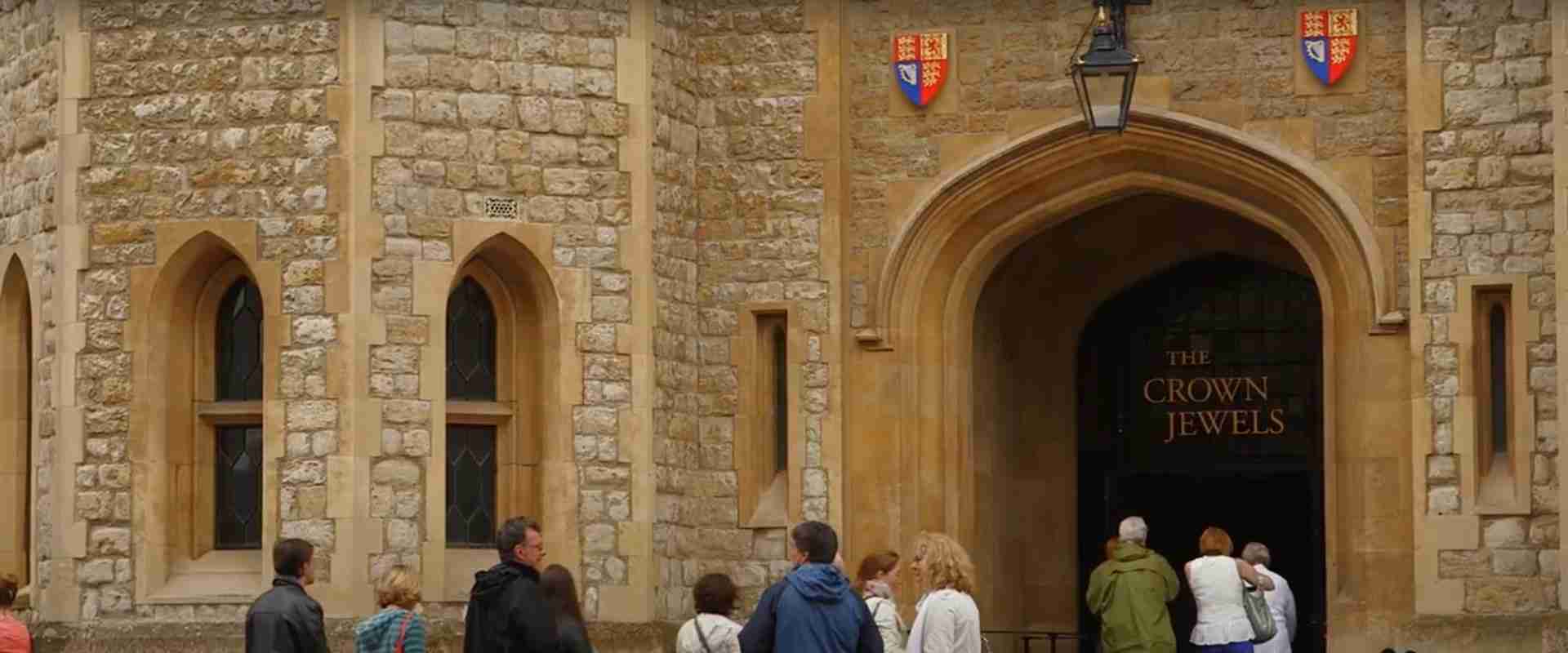
The Crown Jewels reside within the **specially constructed Jewel House, a modern high-security facility** that opened in 1994 within the Tower’s ancient walls. This climate-controlled environment provides optimal preservation conditions while accommodating millions of annual visitors seeking to witness these legendary treasures.
Security measures remain largely invisible but comprehensive, with armed guards, advanced surveillance systems, and protocols developed through centuries of protecting royal treasures. The current display system balances accessibility with protection, using innovative lighting and presentation techniques that allow detailed viewing while ensuring the jewels’ long-term preservation.
St. Edward’s Crown: The Sacred Crown of Coronations
**St. Edward’s Crown represents the most sacred and symbolically important piece** in the entire Crown Jewels collection. Used exclusively for the moment of coronation itself, this magnificent crown embodies the divine authority that transforms an individual into a monarch, making it the centerpiece of British constitutional ceremony.
Crafted from solid gold and weighing 2.23 kilograms (nearly 5 pounds), St. Edward’s Crown features **four crosses pattée alternating with four fleur-de-lis**, creating the distinctive silhouette recognized worldwide as the symbol of British monarchy. The crown’s purple velvet cap and ermine band add regal splendor while providing comfort during the lengthy coronation ceremony.
The crown’s semi-precious stones include amethysts, sapphires, garnets, topazes, and tourmalines, chosen for their symbolic significance rather than maximum monetary value. This deliberate selection reflects the crown’s spiritual rather than material purpose – it serves as a sacred vessel for the ancient ritual that has crowned British monarchs for over a millennium.
Coronation History and Symbolism
St. Edward’s Crown derives its name from **Edward the Confessor, the 11th-century king whose crown reportedly served as the template** for coronation regalia before its destruction in 1649. The current crown, created for Charles II’s coronation in 1661, has since crowned every British monarch from William III through King Charles III in 2023.
The coronation ceremony itself represents one of Europe’s oldest continuous constitutional traditions, with elements dating back over 1,000 years. The crown serves as the physical manifestation of this ancient ritual, transforming legal succession into sacred ceremony and connecting contemporary monarchs with their medieval predecessors.
**During coronations, St. Edward’s Crown is placed upon the monarch’s head at the moment of greatest solemnity**, accompanied by the ancient words “Be thy head anointed with holy oil: as kings, priests, and prophets were anointed.” This moment transforms the crown from beautiful artifact into active constitutional instrument.
The Imperial State Crown: Symbol of Reigning Majesty
If St. Edward’s Crown represents sacred transformation, the **Imperial State Crown embodies the working reality of modern monarchy**. Worn by the sovereign at the conclusion of coronation ceremonies and annually for the State Opening of Parliament, this crown serves as the visible symbol of royal authority in contemporary Britain.
The current Imperial State Crown, crafted for George VI’s coronation in 1937 and subsequently worn by Elizabeth II throughout her 70-year reign, features **over 2,800 diamonds alongside numerous other precious stones**. Its relatively lighter weight (900 grams compared to St. Edward’s Crown’s 2.23 kilograms) reflects its frequent ceremonial use and the practical needs of a working monarch.
Famous Stones and Their Stories
The **Black Prince’s Ruby**, actually a red spinel weighing 170 carats, holds the place of honor at the crown’s front center. This stone carries legendary significance as the gem worn by Henry V at the Battle of Agincourt in 1415, where English forces achieved their famous victory against overwhelming French odds. The stone’s dark red color and irregular shape make it instantly recognizable among the crown’s sparkling diamonds.
**St. Edward’s Sapphire**, set at the crown’s top center, provides direct connection to medieval royal traditions. This oval blue sapphire allegedly came from Edward the Confessor’s coronation ring, removed from his tomb when his body was found to be incorrupt. The stone thus represents both spiritual authority and historical continuity spanning nearly a thousand years.
The **317.4-carat Cullinan II diamond** dominates the crown’s front band, its brilliant cut maximizing light reflection and symbolic impact. Cut from the largest diamond ever found (the 3,106-carat Cullinan Diamond discovered in South Africa), this stone represents both the technical achievement of early 20th-century gem cutting and the complex legacy of Britain’s imperial relationships.
The Stuart Sapphire and Royal Intrigue
Set at the crown’s back, the **Stuart Sapphire tells one of the collection’s most dramatic stories** of royal exile, revolution, and restoration. This oval blue sapphire possibly belonged to Charles I, whose son James II allegedly smuggled it out of England during the Glorious Revolution of 1688 when Protestant forces deposed the Catholic king.
The sapphire’s journey through European courts during decades of royal exile demonstrates how precious stones served as portable wealth and symbols of legitimacy for dispossessed monarchs. Its eventual return to the British Crown Jewels symbolizes the ultimate triumph of constitutional monarchy over absolute royal authority.
The Sovereign’s Orb and Sceptre: Instruments of Royal Authority
The **Sovereign’s Orb represents the Earth under Christ’s dominion**, its hollow gold sphere topped with a jeweled cross emphasizing the divine basis of royal authority. Weighing 1.32 kilograms and measuring 16.5 centimeters in diameter, the orb features over 600 precious stones including diamonds, emeralds, rubies, and sapphires arranged in symbolic patterns.
During coronation ceremonies, **the orb is placed in the monarch’s left hand** while the Sovereign’s Sceptre with Cross occupies the right hand, symbolizing the balance between temporal and spiritual authority that defines constitutional monarchy. This ceremonial positioning dates back centuries and connects modern coronations with medieval concepts of divinely appointed kingship.
The Sovereign’s Sceptre with Cross
The **Sovereign’s Sceptre with Cross, enhanced in 1910 with the magnificent 530.4-carat Cullinan I diamond** (also known as the Great Star of Africa), represents the largest cut diamond in the world. This pear-shaped brilliant cut diamond was added to celebrate the coronation of George V, creating one of the most spectacular royal artifacts ever crafted.
The sceptre’s design balances the massive diamond with elegant proportions, ensuring that this ultimate symbol of royal authority remains practical for ceremonial use. The Cullinan I’s exceptional clarity and size make it visible throughout Westminster Abbey during coronation ceremonies, serving as a brilliant focal point for the ancient ritual.
The Controversial Koh-i-Noor: Empire, Ethics, and Cultural Heritage
No discussion of the Crown Jewels can ignore the **Koh-i-Noor diamond, one of the world’s most famous and controversial gemstones**. Currently set in Queen Mary’s Crown and weighing 105.6 carats, this legendary diamond has become a focal point for debates about cultural heritage, colonial history, and the ethics of museum collections.
The Koh-i-Noor’s history spans centuries and continents, passing through the hands of **Mughal emperors, Persian shahs, Afghan rulers, and Sikh maharajas** before reaching the British Crown through the 1849 Treaty of Lahore. Each transfer of ownership tells stories of conquest, diplomacy, and the complex relationships between imperial powers and regional rulers.
Cultural Significance and Modern Debates
The diamond’s name means **”Mountain of Light” in Persian**, reflecting its legendary status throughout South Asian and Middle Eastern cultures. Historical accounts describe the stone’s supposed curse upon male owners and its role in determining the fate of empires, though these stories blend fact with folklore accumulated over centuries.
**Contemporary debates about the Koh-i-Noor’s ownership** reflect broader discussions about cultural heritage and colonial legacies. India, Pakistan, Iran, and Afghanistan have all claimed rightful ownership, arguing that the diamond was taken through colonial pressure rather than legitimate acquisition. These discussions highlight evolving attitudes toward museum collections and cultural repatriation.
The British position maintains that the diamond was legally acquired through treaty arrangements and has been held continuously for over 170 years, during which time it has become integral to British royal regalia. This debate continues to evolve, reflecting changing international perspectives on cultural heritage and historical justice.
The Coronation Spoon: Medieval Survivor and Sacred Instrument
Among all the Crown Jewels’ spectacular treasures, the **humble Coronation Spoon holds unique significance as the only item to survive Parliament’s 1649 destruction** of the royal regalia. Dating to the 12th century, this silver-gilt spoon provides an unbroken link to medieval coronation traditions spanning nearly nine centuries.
The spoon’s sacred function involves **anointing the monarch with holy oil during coronation**, the ceremony’s most solemn and private moment when cameras turn away and the sovereign is spiritually transformed from individual to monarch. This ancient ritual connects British coronations with biblical traditions of anointing kings and priests.
**The spoon’s survival through the Commonwealth period** occurred because it was sold as secular silverware rather than destroyed as a symbol of monarchy. Its eventual recovery and restoration for Charles II’s coronation demonstrates the powerful pull of tradition and the practical challenges of eliminating deeply rooted cultural practices.
Visiting the Crown Jewels: Practical Strategies for Maximum Experience
Timing Your Visit for Optimal Viewing
**Successful Crown Jewels viewing requires strategic timing** to avoid the crowds that can make the experience rushed and frustrating. The optimal strategy involves heading directly to the Jewel House upon entering the Tower, ideally arriving at opening time (9:00 AM Tuesday-Saturday, 10:00 AM Sunday-Monday) for the shortest queues.
During peak periods, **moving walkways manage visitor flow** past the most popular displays, particularly the coronation regalia. However, these walkways stop operating during quieter periods, allowing unlimited viewing time for detailed observation and appreciation of individual pieces’ craftsmanship.
**Mid-week visits during school term time** provide the best balance of accessibility and viewing quality, while summer weekends and school holidays create the most challenging viewing conditions. Early morning slots offer superior lighting conditions and opportunities for more contemplative engagement with these remarkable treasures.
Understanding the Photography Policy
**Photography is strictly prohibited throughout the Crown Jewels exhibition** for security, conservation, and crowd management reasons. This policy is rigorously enforced, with security personnel monitoring visitors continuously and requiring deletion of any unauthorized images taken within the Jewel House.
Instead of photographs, **focus on detailed observation** that creates lasting mental images of these extraordinary artifacts. Notice the subtle color variations in different diamonds, the intricate metalwork supporting precious stones, and the way professional lighting reveals details invisible in typical photography.
**Professional photography and detailed images** are available through official Historic Royal Palaces publications, online resources, and high-quality books that provide close-up views impossible to achieve during typical visits. These resources complement rather than replace the personal experience of encountering these treasures in person.
Audio Guide Enhancement
The **official audio guide provides exceptional value** for Crown Jewels visitors, offering detailed commentary about individual pieces, their historical significance, and the ceremonies in which they’re used. Available in multiple languages for £4, the audio guide includes content unavailable during standard visits.
**Audio guide highlights include** detailed explanations of cutting techniques used for famous diamonds, historical accounts of coronation ceremonies, and insights into the practical challenges of wearing heavy ceremonial regalia during lengthy state occasions.
The Crown Jewels in Contemporary Royal Ceremonies
Coronation 2023: Living Tradition in Action
**King Charles III’s coronation in May 2023** demonstrated the Crown Jewels’ continued relevance as working royal regalia rather than museum pieces. The ceremony showcased how these ancient treasures adapt to contemporary needs while maintaining their essential symbolic functions.
**St. Edward’s Crown was modified specifically for Charles III**, with adjustments to ensure proper fit and comfort during the lengthy ceremony. These modifications, invisible to viewers but essential for practical use, demonstrate how the Crown Jewels continue evolving to serve each new monarch’s needs.
**The ceremony’s global broadcast** exposed billions of viewers worldwide to the Crown Jewels’ beauty and significance, creating renewed interest in visiting these treasures and understanding their role in modern constitutional monarchy.
State Opening of Parliament: Annual Tradition
**The annual State Opening of Parliament** provides the Crown Jewels’ most regular public appearance, when the Imperial State Crown travels from the Tower to Westminster for the sovereign’s ceremonial reading of the government’s legislative agenda. This journey requires extensive security arrangements and demonstrates the practical challenges of maintaining working royal regalia.
**Television coverage of these ceremonies** allows millions to see the Crown Jewels in active use, reinforcing their status as living symbols of constitutional monarchy rather than historical curiosities. These regular appearances maintain public engagement with royal traditions and justify the resources devoted to their preservation.
Conservation and Security: Protecting Priceless Heritage
Modern Conservation Techniques
**Preserving the Crown Jewels requires constant vigilance** and cutting-edge conservation science to protect materials ranging from medieval silver to 20th-century platinum settings. Environmental control, specialized lighting, and regular condition monitoring ensure these treasures remain stable for future generations.
**Professional conservators work continuously** to address the natural aging of organic materials like pearls and the stress placed on metal settings by the weight of large gemstones. This work occurs largely behind the scenes but ensures the Crown Jewels retain their structural integrity and visual impact.
Security Measures and Historical Theft Attempts
The **1671 attempt by Colonel Thomas Blood** to steal the Crown Jewels represents the most famous security breach in the collection’s history. Blood and his accomplices nearly succeeded in escaping with St. Edward’s Crown and other regalia before being captured within the Tower grounds. This incident led to enhanced security measures that continue evolving today.
**Contemporary security arrangements** remain classified but clearly involve multiple layers of protection including armed guards, advanced surveillance technology, and rapid response protocols. The visible security presence reassures visitors while deterring potential threats to these irreplaceable treasures.
Educational Value and Cultural Significance
Understanding British Constitutional Monarchy
**The Crown Jewels provide unique insights** into how constitutional monarchy balances tradition with modern democratic governance. Unlike republics where power transfers through purely political processes, Britain’s system maintains ceremonial elements that connect contemporary governance with centuries of historical precedent.
**Studying the Crown Jewels reveals** how symbols and rituals serve essential functions in political systems, creating shared cultural references that transcend partisan politics and provide stability during periods of change. These treasures demonstrate the power of material culture to embody abstract concepts like authority, legitimacy, and national identity.
Craftsmanship and Artistic Achievement
**The Crown Jewels showcase centuries of exceptional craftsmanship** from Britain’s finest goldsmiths, jewelers, and artists. Each piece represents the pinnacle of contemporary artistic achievement, from medieval metalworking techniques to modern precision gem cutting and setting.
**Detailed examination reveals** the evolution of decorative arts, changing aesthetic preferences, and advances in technical capability spanning over 350 years of continuous development. These artistic elements make the Crown Jewels valuable not only as historical artifacts but as supreme examples of decorative arts.
Planning Your Crown Jewels Experience
Pre-Visit Preparation
**Successful Crown Jewels visits benefit from advance preparation** to maximize understanding and appreciation of these complex historical artifacts. Reading about individual pieces, their historical significance, and ceremonial use creates context that enhances the viewing experience.
**Online resources including virtual tours** allow visitors to familiarize themselves with the collection’s layout and major highlights before arrival. This preparation proves particularly valuable given photography restrictions that prevent on-site reference materials.
Combining with Broader Tower Exploration
**The Crown Jewels represent just one element** of the Tower of London’s comprehensive historical experience. Combining Crown Jewels viewing with exploration of the White Tower, Medieval Palace, and Yeoman Warder tours creates a complete understanding of royal history and the Tower’s multifaceted significance.
**Allow sufficient time** for thorough exploration rather than rushing through multiple attractions. The Crown Jewels deserve careful attention and contemplation, while the broader Tower context helps explain their historical development and continued significance.
Conclusion: Treasures That Define a Nation
The Crown Jewels at the Tower of London represent far more than an extraordinary collection of precious objects – they embody the living heart of British constitutional tradition and provide tangible connection to nearly a millennium of royal history. **From the sacred symbolism of St. Edward’s Crown to the controversial heritage of the Koh-i-Noor diamond**, each piece tells stories that illuminate not just British history but the complex relationships between power, tradition, and cultural identity.
**For visitors to this UNESCO World Heritage Site**, the Crown Jewels offer an unparalleled opportunity to encounter working royal regalia that continues shaping contemporary ceremonies and constitutional functions. These aren’t museum pieces preserved in historical amber – they remain active instruments of monarchy that bridge ancient traditions with modern governance.
**The experience of viewing these treasures** provides insights impossible to gain through photographs or descriptions alone. The scale, craftsmanship, and symbolic power of the Crown Jewels create lasting impressions that enhance understanding of British culture, constitutional monarchy, and the role of material heritage in defining national identity.
Whether you’re drawn by the spectacular gemstones, fascinated by the complex history, or seeking to understand contemporary monarchy’s role, the Crown Jewels reward careful attention and thoughtful engagement. **Plan your visit strategically, arrive early, and prepare to encounter some of the world’s most significant royal treasures** in the ancient fortress where they’ve resided for over three centuries.
Frequently Asked Questions
Are the Crown Jewels real or replicas?
The Crown Jewels displayed at the Tower of London are completely authentic – these are the actual working royal regalia used in contemporary ceremonies including coronations and the State Opening of Parliament. They’re not replicas or copies, but the genuine treasures of the British monarchy.
Why can’t I take photos of the Crown Jewels?
Photography is prohibited for multiple reasons: security concerns, conservation protection (camera flashes can damage delicate materials), and crowd management (stopping for photos would create bottlenecks). The policy is strictly enforced by security personnel throughout the Jewel House.
What’s the most valuable item in the Crown Jewels?
While exact valuations aren’t published, the Imperial State Crown with the Cullinan II diamond and other precious stones is considered among the most valuable single pieces. However, the entire collection’s value is essentially incalculable due to its historical significance and irreplaceable nature.
How often are the Crown Jewels used in ceremonies?
The Imperial State Crown is used annually for the State Opening of Parliament, while St. Edward’s Crown is reserved exclusively for coronations. Other pieces may be used for royal baptisms, state visits, and special ceremonial occasions throughout the year.
Can I see the Crown Jewels being transported to ceremonies?
The Crown Jewels travel under heavy security for state occasions, but these movements aren’t publicly announced for security reasons. The annual State Opening of Parliament provides the most regular opportunity to see the Imperial State Crown in ceremonial use via television coverage.
What happened to the original medieval Crown Jewels?
Parliament ordered the destruction of most medieval Crown Jewels in 1649 after executing Charles I. The gold was melted down and turned into coins, while precious stones were sold. Only the 12th-century Coronation Spoon survived, making it the collection’s oldest piece.
Is the Koh-i-Noor diamond ever displayed separately?
The Koh-i-Noor remains permanently set in Queen Mary’s Crown (made for the 1911 coronation) and is displayed as part of that crown within the Crown Jewels exhibition. It’s not shown separately from its setting.
How long should I plan to spend viewing the Crown Jewels?
Allow 30-45 minutes minimum for the Crown Jewels exhibition, though this varies based on crowd levels and your level of interest. During busy periods, moving walkways may limit viewing time for the most popular pieces, while quieter times allow unlimited observation.
Are there different Crown Jewels for different occasions?
Yes, different pieces serve specific ceremonial functions. St. Edward’s Crown is used only for coronations, the Imperial State Crown for regular state occasions, and various other crowns, tiaras, and regalia are used for different royal ceremonies and family occasions.
What security measures protect the Crown Jewels?
While specific security details aren’t disclosed, the Crown Jewels are protected by armed guards, advanced surveillance systems, bulletproof glass, and multiple security protocols. The Tower’s centuries of experience protecting royal treasures informs modern security arrangements.