Coventry Best Tours & Walking Routes 2026: Secret Spots & Lesser-Known Treasures
Coventry has reinvented itself from an industrial powerhouse into one of England’s most rewarding walking cities, carrying the lasting energy of its City of Culture 2021 designation into 2026. Within a compact, walkable city centre you will find medieval guildhalls, cathedral ruins, world-class car collections, and a grassroots music scene that sparked one of the most significant movements in British pop history. This guide covers the best guided tours, self-guided walking routes, and genuinely lesser-known spots that most visitors entirely overlook.
Key Takeaways
- Coventry’s city centre is compact enough to explore on foot, with the Cathedral Quarter, medieval Spon Street, and Broadgate all within a fifteen-minute walk of each other — plan at least a full day for the highlights and a second day for the hidden gems.
- Guided walking tours start from approximately £13–15 ($17–19) per person, covering 140–165 minutes; the Cathedral Quarter route and the Jigsaw of History tour approach the city from very different angles, so experienced visitors benefit from booking both.
- The majority of Coventry’s headline attractions — Coventry Cathedral ruins, the Lady Godiva Statue, Holy Trinity Church, and Spon Street’s medieval streetscape — are free to enter, making the city exceptional value for history walkers.
- Coventry Charterhouse, a Grade I listed 14th-century former monastery now managed by the National Trust, opened to the public in spring 2023 and remains the city’s single most underrated attraction; adult admission is £10 ($13), with free entry for National Trust members and Go CV+ cardholders.
- The Transport Museum, housing the world’s two fastest cars and the largest publicly-owned collection of British road vehicles, charges £15.50 ($20) for advance adult tickets valid for a full year of repeat visits — outstanding value for a half-day experience.
- The 2-Tone Village on Walsgrave Road — birthplace of ska and Two-Tone Records, home to the Coventry Music Museum — lies a short bus or taxi ride from the city centre and completes a full picture of Coventry’s cultural identity beyond the WWII narrative.
People Also Ask About Coventry Tours 2026
What are the best walking tours in Coventry in 2026?
Coventry’s two strongest guided walking tours in 2026 are the Godiva’s Cathedral Quarter Guided Walking Tour and the Jigsaw of History Guided Walking Tour, both bookable through platforms such as GetYourGuide and Viator from approximately £13–15 ($17–19) per person. The Cathedral Quarter tour runs approximately 140 minutes and follows the iconic corridor from the Lady Godiva Statue through St Mary’s Guildhall, Holy Trinity Church, and both cathedrals, concluding at the often-overlooked St Osburg’s Church. The Jigsaw of History tour takes a deliberately different path, zig-zagging through city-centre streets away from the headline sites to reveal the architectural layers — Victorian civic buildings, post-Blitz reconstruction, and surviving medieval fragments — that most visitors miss entirely. Private walking tours are also readily available for groups wanting a tailored itinerary at their own pace; these depart from the Lady Godiva Statue in Broadgate and typically run 2.5 hours.
How much do Coventry tours and attractions cost in 2026?
The core Coventry experience is largely free. The Cathedral ruins, the New Cathedral interior, Holy Trinity Church, the Lady Godiva Statue, Spon Street, and FarGo Village all carry no admission charge. The Cathedral Tower Climb costs £5 ($6) for adults and £2.50 ($3) for visitors aged 8–18; it opens Saturdays 11am–3pm (and selected Sundays), weather permitting, and is closed throughout January. The Herbert Art Gallery & Museum introduced a £5.40 ($7) adult day pass from April 2025. Coventry Charterhouse costs £10 ($13) for adults. The Transport Museum charges £15.50 ($20) advance (or £17/$22 on the day) for a ticket valid for unlimited return visits for one year. Guided walking tours from operators run approximately £13–15 ($17–19) per person. Check current rates at official websites before visiting, as prices are subject to seasonal revision.
What hidden gems are most worth visiting in Coventry?
The single most underrated experience in Coventry is Coventry Charterhouse — a 14th-century Carthusian monastery with some of the finest surviving medieval and Renaissance wall paintings in England, set in a wildlife-rich heritage park just over a mile from the city centre. In the city itself, Ford’s Hospital on Greyfriars Lane is one of the best-preserved examples of early Tudor timber-frame architecture in the country, yet receives a fraction of the footfall of better-publicised sites. The Tin Music & Arts venue, built into Victorian coal vaults beneath the canal on Coal Vaults Lane, is Coventry’s most atmospheric secret — a functioning gig space and arts bar literally underground. London Road Cemetery, adjacent to Charterhouse, is a magnificently preserved Victorian garden cemetery with Gothic chapels, tree-lined avenues, and graves of the city’s industrial dynasty families, yet almost no tourist presence. Finally, St Osburg’s Church on Upper Well Street — Coventry’s oldest surviving Catholic church, founded in 1845 — is a quiet and beautiful surprise tucked behind the ring road.
How long does it take to walk around Coventry’s main sights in 2026?
The Cathedral Quarter’s core circuit — from Broadgate through the cathedrals, St Mary’s Guildhall, and Holy Trinity Church — covers roughly 1.5 miles and takes 90 minutes at a relaxed pace without stepping inside any of the buildings. Add time for a proper visit to each site and a half-day disappears quickly. The extended hidden-city route, adding Spon Street, the Priory gardens, Ford’s Hospital, and the canal basin, covers approximately 2.5–3 miles and fills a full day. Coventry Charterhouse and the Sherbourne Valley walk add a further 2–3 hours and require a short bus journey or a 25-minute walk from the city centre. The 2-Tone Village and Coventry Music Museum sit further east on Walsgrave Road, making a logical afternoon trip by bus or taxi rather than on foot from the centre. A thorough two-day itinerary covers both the headline and hidden-gem circuits without rushing.
Extended multi-day tours – 5+ days
Featured Coventry Multi-Day Tour Packages
2 days
Essential England (7 destinations)
- ✓ Comprehensive Coventry tour
- ✓ Expert local guides included
- ✓ All accommodation arranged
- ✓ Transportation provided
2 days
Essential England (7 destinations)
- ✓ Comprehensive Coventry tour
- ✓ Expert local guides included
- ✓ All accommodation arranged
- ✓ Transportation provided
7 days
Touring Southern England with London (14 destinations)
- ✓ Comprehensive Coventry tour
- ✓ Expert local guides included
- ✓ All accommodation arranged
- ✓ Transportation provided

4 days
Touring Southern England (14 destinations)
- ✓ Comprehensive Coventry tour
- ✓ Expert local guides included
- ✓ All accommodation arranged
- ✓ Transportation provided
Multi-day tour packages powered by TourRadar. Prices and availability subject to change.
Why Coventry Rewards Curious Visitors in 2026
Coventry occupies an unusual position among English cities. Globally it is associated with two things that could not be more different: the Coventry Blitz of November 1940, which destroyed much of the medieval city in a single night of German bombing, and the Two-Tone Records movement of 1979, which produced The Specials and The Selecter and became the most influential multi-racial British musical movement of the twentieth century. Between those two extremes lies a city of extraordinary depth — one that survived the Dissolution of the Monasteries, the English Civil War, the Blitz, and post-war concrete redevelopment to emerge in 2026 with one of the most eclectic and rewarding visitor itineraries in the English Midlands.
The City of Culture year in 2021 left behind a changed conversation about Coventry. Investment in heritage sites accelerated, new venues opened, and residents grew demonstrably more proud of what the city had to offer. Coventry Charterhouse, locked away from the public for decades and at serious risk of demolition in living memory, opened in spring 2023 and welcomed more than 50,000 visitors in its first year alone — triple the National Trust’s original target. The Herbert Art Gallery & Museum completed a major expansion of its interpretation. St Mary’s Guildhall, one of the finest surviving medieval guildhalls in England, underwent a £6 million restoration and reopened with cutting-edge digital tours and augmented reality that bring its seven centuries of power and ceremony to vivid life.
None of this means Coventry has solved every challenge — city centre regeneration in the post-Covid era remains ongoing, and some corners of the built environment still show the scars of hasty post-Blitz reconstruction. But that patchwork of medieval survival, Brutalist ambition, and contemporary reinvention is precisely what makes Coventry so interesting to walk. Few cities in England tell as many stories per square mile, and fewer still do so with such accessible walking distances between them. With a compact inner ring road that defines the walkable centre and good local bus connections to the wider heritage sites, Coventry in 2026 is unusually well-suited to visitors who want to explore on foot, at their own pace, with a curiosity for what lies behind the main drag.
This guide is structured to serve every kind of walker — those joining an expert-led guided tour for their first visit, those returning to discover the city they skimmed last time, and those with a specific obsession, whether medieval architecture, automotive history, ska music, or Victorian landscape design. Each section works independently: read what applies to your interests and build your own itinerary from it.
Coventry’s Best Guided Tours 2026: Cathedral Quarter, History Walks & Private Experiences
Coventry has a small but focused offering of guided walking tours in 2026, concentrated on the Cathedral Quarter and the broader city-centre historical layer. Two tours stand out as reliably well-reviewed and accessible to independent visitors without private-group bookings.
The Godiva’s Cathedral Quarter Guided Walking Tour is the most popular and most immediately logical starting point for any first visit. Running approximately 140 minutes, the tour departs from the Lady Godiva Statue in Broadgate and moves through the Cathedral Quarter, pausing at the sites that anchored Coventry’s civic and spiritual life for six centuries before the Blitz remade the city. Highlights include St Mary’s Guildhall — whose Coventry Tapestry, Great Hall, and Mary Queen of Scots connection most visitors pass without entering — the atmospheric ruins of the old cathedral, the New Cathedral’s celebrated interior, and Holy Trinity Church, whose Doom Painting is one of the most significant surviving medieval wall paintings in England. The tour concludes at St Osburg’s Church on Upper Well Street, a discovery that surprises almost every participant. Prices start from approximately £13–15 ($17–19) per person; book through GetYourGuide or Viator and check for current availability, as this tour runs small-group departures (check official site for current rates).
The Jigsaw of History Guided Walking Tour takes the opposite approach. Rather than anchoring on the headline sights, this 165-minute tour zig-zags through the city centre on a route deliberately designed to avoid the cathedrals — revealing the architectural detective story of Coventry’s layers. Walking it, you discover how the post-war planners worked around the medieval survivals they chose not to demolish, how the Brutalist precinct of the 1950s and 1960s has aged, and how the city’s streetscape carries evidence of guild halls, monasteries, watch-making workshops, and ribbon-weaving sheds even where the buildings themselves are long gone. This is the tour for visitors who already know the cathedral ruins and want to understand the city around them. Prices are comparable to the Cathedral Quarter tour, starting from approximately £13–15 ($17–19) per person; book through the same platforms.
Private and bespoke walking tours are also available in Coventry in 2026 for groups of two or more, typically departing from the Lady Godiva Statue and lasting 2–2.5 hours. Private tours allow a completely customised itinerary — the guide shapes the route around your specific interests, whether that means spending more time in the cathedral ruins and Basil Spence’s New Cathedral, exploring the surviving medieval almshouses, or digging into the automotive heritage of the city that invented the Safety Bicycle and arguably the modern motor industry. Private tour prices vary by operator and group size; check Tripadvisor and Viator for current listings and reviews.
For visitors who prefer walking entirely at their own pace, the Coventry Cathedral itself offers a free audio guide through its website and the Smartify app, covering fifteen key objects in the collection and works of art that define the building’s significance. The guidebook available from the Cathedral gift shop (a few pounds) offers the most comprehensive printed introduction to both the New Cathedral and the ruins. The Herbert Art Gallery & Museum offers a free Smartify-powered highlights tour covering fifteen key objects in the collection, available to any visitor with a smartphone.
The Operation City Quest digital scavenger hunt is worth noting for families and groups who prefer self-directed exploration with a game element. Using a smartphone app, participants solve puzzles and find objects across the city centre — an engaging way to cover the main sights without feeling lectured. Separate zombie-survival and mystery-solving variants operate on the same platform. These cost a modest fee and are bookable through Tripadvisor; check current pricing at booking.
The Cathedral Quarter Walking Route 2026: Coventry’s Essential Self-Guided Loop
The Cathedral Quarter walking route is Coventry’s most naturally compelling self-guided circuit. It covers approximately 1.5 miles in a loose figure of eight centred on the old and new cathedrals, and it passes through seven centuries of English urban history in under two hours at a relaxed walking pace. The route works at any time of year, though the ruins of the old cathedral are most atmospheric in late afternoon light, and the New Cathedral’s interior is most striking on bright mornings when John Piper’s stained glass baptistery window floods the nave with colour.
Begin at Broadgate, the pedestrianised heart of the city centre, where the bronze Lady Godiva Statue stands as Coventry’s most photographed landmark. The legend of Lady Godiva — a noblewoman who, by tradition, rode naked through the city to win relief from taxes for its citizens — is one of the most enduring in England. Historians note that Godiva, wife of Leofric, Earl of Mercia, was a documented historical figure who made substantial charitable gifts to religious institutions, though the famous naked ride belongs to the realm of later tradition rather than contemporary medieval record. The statue by William Reid Dick, unveiled in 1949, is the most visible version of a story that has been told in Coventry for centuries. The small figure of Peeping Tom watching from a window above is a later addition to the legend.
From Broadgate, walk east along Priory Street towards the Cathedral Quarter. The Holy Trinity Church on Trinity Lane is the first stop that many visitors miss entirely, attracted straight to the cathedrals a hundred metres further on. This is a significant omission. Holy Trinity is one of the largest medieval parish churches in England, with a nave and tower that survived the 1940 Blitz when much of the surrounding city did not. Inside, the Doom Painting above the chancel arch is a substantial medieval survival, depicting the Last Judgement in faded but still legible colours. The church is free to enter and open daily; no booking is required.
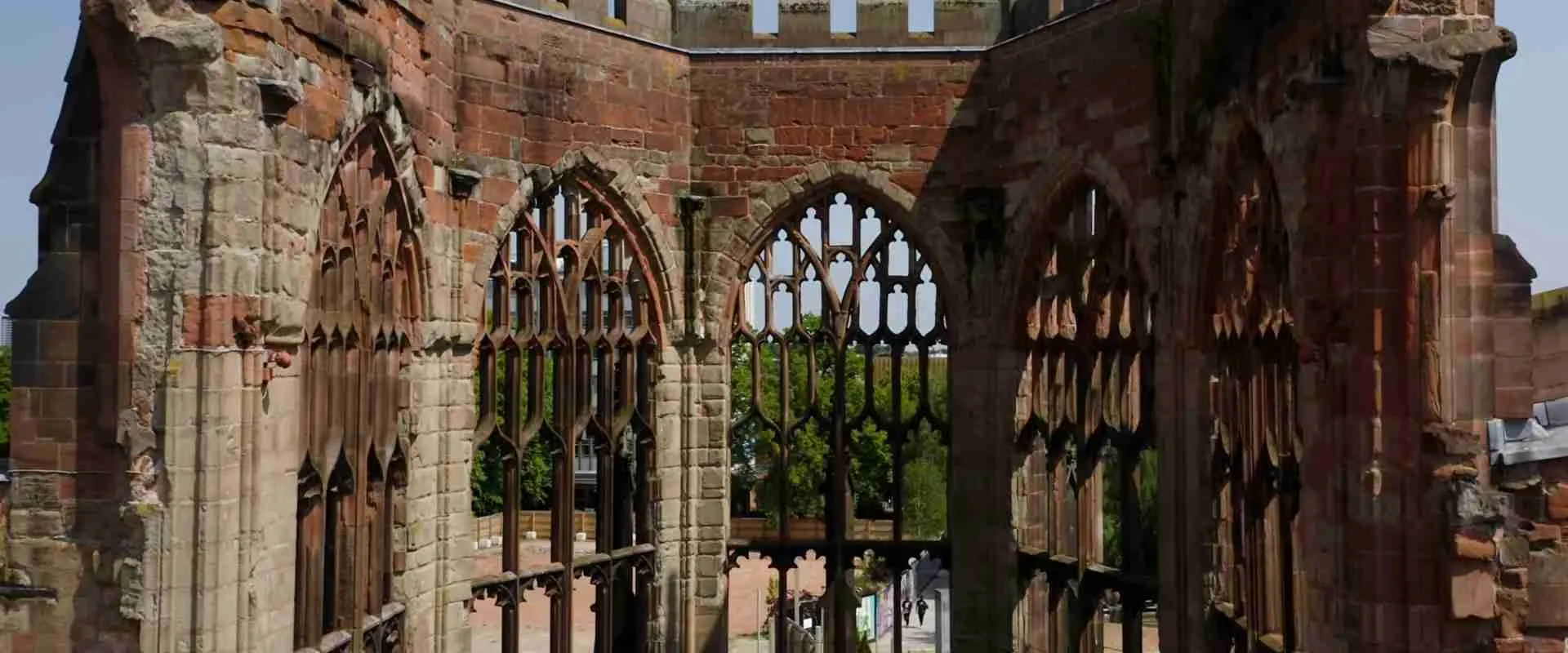
Continue to Coventry Cathedral — which is not one building but two, and one set of ruins, all occupying a single intensely atmospheric site on Priory Street. The outdoor ruins of the old St Michael’s Cathedral, destroyed on the night of 14–15 November 1940 during the Coventry Blitz, are an open-air space requiring no ticket. Walking through them, visitors encounter the surviving tower and spire — one of the three tallest in the UK, rising over 100 metres — the outline of the medieval nave marked in the stone floor, and the famous Charred Cross made from timbers found in the rubble after the bombing. The ruins are free to visit and open at all times.
Entry to the New Cathedral, designed by Sir Basil Spence and consecrated in 1962, is also free, with a voluntary donation encouraged to support ongoing maintenance. Inside, the building is a landmark of mid-century British architecture: the massive tapestry of Christ in Glory in the Tetramorph by Graham Sutherland dominates the east end, John Piper’s celebrated stained glass baptistery window transforms the nave’s light, and Jacob Epstein’s bronze sculpture of St Michael’s Victory over the Devil stands on the exterior wall. The Blitz Museum within the cathedral complex offers additional context on the 1940 bombing and its aftermath; enquire at the cathedral for current access and any charges that may apply.
The Cathedral Tower Climb is available on Saturdays 11am–3pm (and selected Sundays), costing £5 ($6) for adults and £2.50 ($3) for visitors aged 8–18; under-8s are not permitted. The 180-step spiral staircase leads to a viewing platform with 360-degree panoramic views across the city. The tower closes throughout January, and opening may be affected by weather or events in the ruins below. No booking is required; tickets are bought on the day at the tower base, which is accessed from within the ruins (check for current rates at coventrycathedral.org.uk).
Directly across Bayley Lane from the cathedral ruins stands St Mary’s Guildhall, one of the most beautiful medieval civic buildings in England. Founded in the 14th century, it served as the seat of the Coventry merchant guilds, hosted English monarchs during the Wars of the Roses period, and held Mary Queen of Scots as a prisoner on behalf of Queen Elizabeth I in 1569–1570. The Coventry Tapestry — a 15th-century embroidered textile still hanging in its original location in the Great Hall after more than five centuries — is alone worth the entrance fee. The restored medieval kitchen, augmented-reality digital tours, and costumed guides bring the layers of history to life across its floors. St Mary’s Guildhall opens Thursday to Sunday, 11am–4pm (last entry 3pm), and charges standard entry; check current admission prices at stmarysguildhall.co.uk, as these are subject to seasonal revision. Note that the Guildhall closes periodically for private events, so checking availability before travelling is advisable.
Complete the Cathedral Quarter loop by walking north from the Guildhall back towards the Priory Gardens, where the remains of St Mary’s Priory — the Benedictine monastery dissolved by Henry VIII in the 1530s, whose ruins lay buried beneath the city until archaeological excavations in the late 1990s — are preserved beneath street level and visible in the sunken gardens. The Priory Visitor Centre on Priory Row tells the story of these excavations and the finds they produced; enquire locally for current opening arrangements, as the centre was operating under a new lease agreement from 2025. The surrounding Priory Gardens are free and open at all times, and provide a peaceful conclusion to the Cathedral Quarter loop before returning to Broadgate.
The Hidden City Walking Route 2026: Spon Street, Medieval Almshouses, and the Canal Basin
The Cathedral Quarter is only half of Coventry’s walkable heritage. A second, longer route — running west and south from the city centre — introduces the medieval street that survived the Blitz, two extraordinary Tudor almshouses, the canal basin that opened the city to industrial trade, and several architectural discoveries that most visitors to Coventry never reach. This route covers approximately 2.5 miles and fills 3–4 hours, including time inside each building. It connects naturally to the Cathedral Quarter route, making a full-day programme if combined.
Begin at the western edge of the city centre at Spon Street, Coventry’s most evocative medieval streetscape. A row of timber-framed buildings lines this short street, their jettied upper storeys overhanging a cobbled lane in a scene that could belong to the 15th century. What makes Spon Street particularly interesting — and slightly unexpected — is that several of its buildings were not originally here at all. After the 1940 Blitz, a number of medieval timber-framed structures from other parts of the city were carefully dismantled, stored, and re-erected on Spon Street to preserve them rather than lose them permanently to demolition. The result is a curated concentration of medieval domestic architecture from across the city, including the Weaver’s House — a preserved example of a mid-15th-century weaver’s cottage, said by local historians to be among the oldest domestic buildings in Coventry still standing in substantially original condition. Entry to the street itself is free; individual building access varies seasonally.
Walking south from Spon Street along Greyfriars Lane, you reach Ford’s Hospital, an early 16th-century almshouse that is one of the finest surviving examples of Tudor timber-frame architecture in England. The courtyard arrangement of carved oak framing — with its elaborate decorative bargeboarding and jettied upper floors on all four sides — is striking enough to stop most walkers in their tracks. Founded as a charitable establishment for elderly Coventry residents, Ford’s Hospital has served continuous residential use for more than five centuries. The courtyard is generally accessible to visitors and is free to enter; enquire with Historic Coventry Trust for any current access restrictions or guided tour opportunities. A short distance away, Bond’s Hospital on Hill Street is a companion almshouse of comparable antiquity and comparable beauty, less visited than Ford’s but equally worth the short detour.
Continue east from the almshouses towards the city centre’s southern edge, where the Coventry Canal Basin sits at the terminus of the Coventry Canal, opened in 1769 to connect the city to the national canal network. The basin and its immediate surroundings have been sympathetically restored, retaining original warehouse structures alongside independent cafés and a craft brewery. The Tin Music & Arts Centre occupies the Victorian coal vaults beneath the canal on Coal Vaults Lane — a low-ceilinged, atmospheric underground space running intimate gig nights, open-mic sessions, and arts events in a setting unlike anything else in the city. The bar is open to non-event visitors; check the Tin’s website or social media for current event listings. Entry to the coal vaults bar is generally free on non-event evenings; ticketed events carry their own pricing.
Returning north through the city centre, pass through the Drapers’ Hall area on Bayley Lane — a 16th-century guild hall now operating as an intimate music venue and community space. The building’s exterior with its timber framing and carved details is accessible at all times; check current programming at Historic Coventry Trust for interior access. The Whitefriars monastery remnants on Much Park Street — a surviving gatehouse and fragment of wall from the medieval Carmelite friary suppressed in 1538 — are a further discovery tucked into the streetscape that even many long-term Coventry residents have not noticed.
End this route at the Herbert Art Gallery & Museum on Jordan Well, entering via the new main entrance on Bayley Lane. From April 2025, the Herbert charges a day pass of £5.40 ($7) for adults (£3.60/$5 with a Go CV card), £2.50 ($3) for children 5–15, and £3.60 ($5) for concessions, with an annual pass available at £10.80 ($14) for adults. Children under 4 and National Art Pass holders enter free. The Herbert opens Tuesday to Saturday 10am–4pm and Sunday 12pm–4pm, and is closed on Mondays (except bank holiday Mondays). The collection ranges from the Discover Godiva gallery and the city’s Peace and Reconciliation collection to natural history, archaeology, and a fine art gallery including Graham Sutherland’s tapestry studies for the New Cathedral. Coventry Archives within the building, accessible by appointment and free of charge, holds city records stretching back to the medieval period.
Charterhouse and the Sherbourne Valley Walk 2026
The single experience that most transforms a visitor’s understanding of Coventry — and the one most reliably described as a revelation by those who make the journey — is Coventry Charterhouse, a Grade I listed medieval monastery just over a mile from the city centre in the Charterhouse Heritage Park. The building opened to the public in spring 2023 after a major restoration supported by the National Lottery Heritage Fund, and is now managed by the National Trust. In its first year it welcomed more than 50,000 visitors, far exceeding projections, yet it remains almost entirely unknown to visitors who arrive in Coventry without doing specific research.
Coventry Charterhouse was founded in 1381 as a house of the Carthusian order — a silent monastic community whose members lived in individual cells and met communally only for church services. The building retains extraordinary medieval fabric, including what the National Trust describes as some of the finest surviving examples of medieval and Renaissance wall paintings in England, preserved across its upper floors. The painted rooms, the chapter house, the walled garden, and the wider heritage park encompassing sections of the River Sherbourne provide a complete afternoon visit that places medieval Coventry in vivid context.
Admission to the house and gardens costs £10 ($13) for adults and £5 ($7) for children aged 5–17, with a family ticket (two adults, up to three children) at £25 ($32). National Trust members and Go CV+ cardholders enter free. Note that from 25 June to 1 September 2026, a temporary government reduction in VAT applies, meaning the price at the till may be lower than the advertised rate — confirm current pricing at the National Trust desk on arrival. The café, run by Farmers Fayre and open from 9am Wednesday to Sunday, is free to enter without a museum ticket; the children’s playground in the wider park is also free access. Check nationaltrust.org.uk/coventry-charterhouse for current opening days and times, as the house operates on volunteer availability and may close on specific days.
Getting to Charterhouse: the X18 Stagecoach bus to Stratford departs from Stop TS2 near Sainsbury’s in the city centre and arrives at London Road by the Charterhouse entrance in approximately 10 minutes. The number 3 National Express Coventry bus towards Warwickshire Shopping Park from Cross Cheaping (Stop BS6) reaches Humber Avenue, near the back entrance, in approximately 7 minutes and runs every 15 minutes on weekdays. On foot, the walk from the city centre takes approximately 25 minutes, or a pleasant 35-minute walk through London Road Cemetery offers a compelling route in its own right.
London Road Cemetery, adjacent to Charterhouse, deserves specific mention as one of Coventry’s most beautiful and most overlooked public spaces. Laid out in the Victorian era with the deliberate character of a landscaped park — sometimes described as an arboretum in the Paxton tradition — it features Gothic chapels, tree-lined avenues, wildflower meadows in spring, and the graves of Coventry’s industrial dynasties, including figures associated with the city’s watchmaking, ribbon-weaving, bicycle, and motor manufacturing eras. It is entirely free to enter, open daily, and constitutes a genuine destination in its own right rather than merely a route to Charterhouse.
The Sherbourne Valley Way connects Charterhouse to the surrounding countryside through restored river sections developed by Warwickshire Wildlife Trust, with a pond-dipping platform and wildlife trail forming part of the wider heritage park. Walking the river path from Charterhouse into the landscape beyond the ring road reveals a side of Coventry — birdsong, wildflower banks, and open meadow — that the city’s industrial identity entirely obscures. This walk suits a morning start, with the café at Charterhouse providing refreshments before or after, and a return to the city centre by bus in the early afternoon.
Coventry’s Best-Kept Secret Spots You Will Almost Certainly Miss
Even visitors who complete both the Cathedral Quarter and the hidden-city walking routes tend to leave Coventry without encountering several of its most distinctive and atmospherically singular places. These are the discoveries that local residents who know the city well consistently cite as underappreciated, and that informed guides return visitors to on repeat trips.
Holy Trinity Church undercroft: The main body of Holy Trinity receives reasonable visitor attention, but the medieval undercroft beneath the church — accessible on specific guided tour dates — offers a very different atmosphere. Check directly with the church for current tour availability; this is not always publicised widely.
St Osburg’s Church on Upper Well Street: Coventry’s oldest surviving Catholic church, founded in 1845 in the years following Catholic Emancipation. The building stands quietly behind the inner ring road on the western fringe of the city centre, almost invisible from main walking routes. Its interior, with Victorian decorative details in a modest Gothic Revival style, provides a moment of contemplative quiet that contrasts sharply with the scale of Coventry Cathedral 600 metres away. Entry is free and the church is generally open for quiet visits during daytime hours.
Ford’s Hospital courtyard: Described in the previous walking-route section, but worth reiterating specifically as a secret spot. Standing in the courtyard of this early Tudor almshouse, surrounded on four sides by carved oak framing that predates the Blitz, the English Reformation, and the Industrial Revolution, it is genuinely difficult to believe you are less than five minutes’ walk from the city’s main shopping precinct. The experience of sudden, complete historical immersion is rare in any English city; Ford’s Hospital delivers it without fuss.
The Tin Music & Arts coal vaults: Already mentioned in the walking route, but deserving emphasis as a secret spot. This is a functioning cultural venue built into Victorian canal infrastructure beneath street level — a raw, brick-vaulted, underground bar and performance space that hosts intimate gigs and open-mic nights with an atmosphere that no purpose-built venue can manufacture. It is genuinely unknown to most visitors and not promoted by conventional tourist materials.
The Old Grammar School: Associated with the Herbert Art Gallery & Museum on Jordan Well, the Old Grammar School is a medieval building offering occasional guided tours that combine the story of Coventry’s educational history with outstanding examples of medieval timber and masonry construction. Ask at the Herbert box office for current tour schedules.
Broadgate’s hidden layer: The modern pedestrianised space of Broadgate sits on top of centuries of civic history, and the ring of statues and architectural fragments embedded in the surrounding buildings repays slow, observant walking rather than a quick glance towards the Lady Godiva Statue. The bronze relief panels depicting Coventry’s history on the old Council House on Earl Street narrate the city’s past in compressed civic imagery; the Council House itself, an Edwardian baroque building of 1917, is one of the finer examples of that style in the West Midlands.
War Memorial Park’s hidden aviary: Coventry’s main park, south of the city centre, is popular with locals for its open space and war memorial, but almost no visitors discover the old enclosed aviary area at the park’s quieter corners — a peaceful spot that serves as one of the city’s best lunchtime retreats. The park is free to enter and open at all times.
Drapers’ Hall: The restored 16th-century merchant hall on Bayley Lane, now operated as an intimate music and events venue by Historic Coventry Trust, offers one of the most handsome medieval interiors in the city for those who happen to catch it during an open event or scheduled visit. Check historiccoventrytrust.org.uk for current programming and access.
FarGo Village and the Creative Quarter 2026
FarGo Village, located on Far Gosford Street approximately 15 minutes’ walk east of the city centre, is Coventry’s most concentrated hub of independent creative businesses and the clearest legacy of the City of Culture investment that reshaped how the city thinks about itself. Built around a repurposed industrial space with shipping-container architecture and a distinctively improvisational aesthetic, FarGo houses more than 45 independent traders in 2026 — a mix of vintage clothing and vinyl, ceramic studios, letterpress printers, artisan food producers, a craft brewery, cafés, and galleries that change their exhibitions regularly.
Entry to FarGo Village itself is free. The experience of wandering through it — particularly on a weekend afternoon when more units are open and street food traders are operating — costs nothing beyond whatever you choose to spend. The Twisted Barrel Ale brewery and taproom at the far end of the complex is a destination in its own right, with a rotating selection of house-brewed ales and craft beers in a setting that makes the most of the exposed industrial architecture. The brewery’s commitment to Coventry provenance — naming beers after local landmarks and history — makes it a fitting conclusion to a day that has immersed you in the city’s layers.
The deeper FarGo discovery, as local insiders note, is at the back of the complex and in its quieter corners: a violin workshop operating in a unit barely larger than a garage, letterpress print studios where type is still set by hand, and ceramic artists whose work reflects a consistent visual dialogue with the city around them. Walking to the far end of FarGo, past the immediate shopfronts, reveals a working creative ecosystem that is not performing for tourists but simply getting on with making things. This quality — the sense of genuine activity rather than heritage-kitsch retail — is what distinguishes FarGo from comparable creative-quarter developments in other English cities.
FarGo Village is most reliably open Thursday to Sunday, though individual unit hours vary by trader. The core café and bar offer is available most of the week. Check fargovillage.co.uk for current operating hours and event listings, particularly for the Summer Makers Market and other periodic festivals that draw significantly larger crowds and give the space its most energetic atmosphere.
Getting to FarGo from the city centre: a 15-minute walk east along Far Gosford Street is the most direct route on foot, or multiple bus services on the ring road serve the surrounding area. The walk itself takes you through a part of Coventry that the guided tours rarely reach — a long street of independent businesses, takeaways, and community spaces that represents the lived city rather than its heritage showcase.
The 2-Tone Village & Music Heritage Trail 2026
Any serious account of Coventry’s cultural identity must reckon with the fact that the city produced one of the most significant moments in British music history. In 1979, against a backdrop of youth unemployment, racial tension, and post-industrial decline in the West Midlands, a small group of Coventry musicians and a record label founded by Jerry Dammers launched the Two-Tone movement. The Specials, The Selecter, and their affiliated acts created a deliberately multi-racial fusion of Jamaican ska and punk that simultaneously topped the charts and articulated a social critique. The movement’s visual identity — the black-and-white checkerboard motif, the Two-Tone Records iconography — became a shorthand for a particular moment in British culture, still immediately recognisable more than four decades later.
The 2-Tone Village on Walsgrave Road in the Ball Hill area of east Coventry, approximately 2 miles from the city centre, is the physical home of this legacy. The complex includes the Coventry Music Museum, a Caribbean restaurant and café, a vintage Two-Tone shop, a modern merchandise outlet, the Coventry Wall of Fame, and the Knights Bar — a live music venue where local bands perform regularly. The museum itself was founded in 2013 by local music historian Pete Chambers and his wife Julie, and operates on a volunteer model supported by donations, with very modest admission prices reflecting its community character. It houses the world’s largest collection of Two-Tone Records vinyl (on loan from a private collector), original master tapes from The Specials’ first recording sessions, a platinum disc from The Moody Blues, and rotating exhibitions covering Coventry’s music history from the 1960s to the present. The museum opens Thursday to Sunday 10am–4pm; confirm current admission and any special exhibition charges at 2tonevillage.com.
The broader music heritage trail extends beyond the 2-Tone Village itself. Walking the streets around Walsgrave Road and the surrounding Ball Hill neighbourhood reveals a community that continues to take its musical history seriously — pubs with live music, record shops, and occasional live events that maintain the area’s character. The Coventry Wall of Fame outside the museum lists the names of musicians who have called the city home, from Two-Tone acts through to artists across multiple genres and decades. It is an unusually generous monument, including names that most cities would not think to celebrate.
Getting to the 2-Tone Village from the city centre: several bus routes serve Walsgrave Road from the city centre; the journey takes approximately 10–15 minutes. A taxi or rideshare is the most direct option and costs a few pounds each way. The 2-Tone Village visit combines naturally with a walking exploration of the surrounding neighbourhood — a part of Coventry that gives a very different picture of the city from the Cathedral Quarter circuit. Plan an afternoon here rather than a quick 45-minute stop.
Admission Costs and Tour Prices in Coventry 2026: Complete Breakdown
Coventry is unusual among English cities of comparable heritage richness in that its core walking itinerary is largely free of charge. The Cathedral ruins, the New Cathedral interior, Holy Trinity Church, the Lady Godiva Statue, Spon Street, the Priory Gardens, FarGo Village, and the canal basin all carry no admission fee. This makes the city unusually accessible for visitors working with a limited daily budget, and allows a full day’s exploration of the Cathedral Quarter without spending a pound on entry.
The following paid experiences represent Coventry’s principal admission charges in 2026. Check each venue’s official website before visiting, as prices are subject to revision.
Cathedral Tower Climb (coventrycathedral.org.uk): £5 ($6) for adults, £2.50 ($3) for visitors aged 8–18. Under-8s are not permitted on the climb. Open Saturdays 11am–3pm and selected Sundays, weather permitting; closed throughout January. No booking required — tickets bought on the day at the tower base within the ruins.
Herbert Art Gallery & Museum (theherbert.org): Day pass £5.40 ($7) for adults, £2.50 ($3) for children aged 5–15, £3.60 ($5) for concessions (seniors 60+, students with TOTUM card, Museums Association members). Children under 4 free. National Art Pass holders free. Annual pass £10.80 ($14) adult. Open Tuesday–Saturday 10am–4pm, Sunday 12pm–4pm, closed Monday. The gift shop and café (via courtyard on Jordan Well) remain free to access without a museum ticket.
Coventry Transport Museum (transport-museum.com): Advance online ticket £15.50 ($20) for adults, £12 ($15) for concessions, £8.50 ($11) for children aged 5–16, under-4s free; family of four £38.50 ($49). On-the-day prices slightly higher. Critically, all tickets are valid for unlimited return visits for 365 days from date of purchase — effectively an annual pass. Open Tuesday–Sunday 10am–5pm (last admission 4:30pm), closed Monday. Located on Millennium Place, Hales Street, CV1 1JD.
Coventry Charterhouse (nationaltrust.org.uk/coventry-charterhouse): Adult £10 ($13), child aged 5–17 £5 ($6), family (two adults, up to three children) £25 ($32). National Trust members and Go CV+ cardholders free. Note: the government’s temporary VAT reduction (25 June to 1 September 2026) may reduce the till price below advertised rates. Open most Wednesdays–Sundays; check opening calendar at the National Trust website before visiting as hours are subject to volunteer availability. Café free to enter, parking free for first hour with charges after.
St Mary’s Guildhall (stmarysguildhall.co.uk): Standard daytime entry tickets are available to book online; check current pricing directly at the official website as specific rates were not confirmed at time of research. Open Thursday–Sunday 11am–4pm (last entry 3pm). Note that the Guildhall occasionally closes for private events; check availability before travelling.
Guided walking tours: The Godiva’s Cathedral Quarter Guided Walking Tour and the Jigsaw of History Guided Walking Tour both start from approximately £13–15 ($17–19) per person; book through GetYourGuide, Viator, or Tripadvisor for current pricing, availability, and departure times. Private tours for two or more are available from multiple operators and priced by negotiation; check individual operator listings on Tripadvisor.
Coventry Music Museum (2tonevillage.com): Admission by donation; very modest. Open Thursday–Sunday 10am–4pm.
The Coventry Attractions Pass — available through the Transport Museum — bundles access to participating attractions at a combined rate that offers savings for visitors intending to cover several sites in a single stay. Check transport-museum.com/visiting/attractions-pass for current participating venues and combined pricing.
Planning Your Coventry Tour Visit 2026: Practical Logistics
Coventry train station sits approximately 20 minutes’ walk from the city centre on foot, or a short taxi ride from the Cathedral Quarter. Direct services connect the city to London Euston in approximately one hour, Birmingham New Street in approximately 30 minutes, and Leicester in 40 minutes, making Coventry an effective day trip from any of those cities. The station sits at the southern edge of the ring road, and the signposted pedestrian route into the Cathedral Quarter is straightforward.
By car, the city’s inner ring road is a distinctive feature — a multi-junction elevated highway that encircles the city centre and which, while effective for vehicular navigation, can confuse first-time pedestrian visitors who find themselves trapped between junctions. Familiarise yourself with the pedestrian underpasses and crossing points before arriving on foot from a car park. The closest large car parks to the Cathedral Quarter are in the city centre off Fairfax Street and on the ring road itself; check coventry.gov.uk/parking for current charges. Salt Lane multi-storey is among the most convenient for St Mary’s Guildhall.
Bus services within Coventry connect the city centre to outlying attractions including Charterhouse (X18 or number 3 bus), the 2-Tone Village on Walsgrave Road, and War Memorial Park. National Express Coventry and Stagecoach operate the main routes; fares are typical single-bus pricing. Pool Meadow bus station in the city centre is the hub for most routes. A single bus journey in 2026 costs approximately £2–3 ($3–4); day rider tickets offer savings for visitors making multiple journeys.
The best single-day strategy for a first visit to Coventry combines the Cathedral Quarter self-guided walking route (morning, 3–4 hours including time inside the New Cathedral, St Mary’s Guildhall, and Holy Trinity Church) with the Transport Museum (afternoon, allow 2–3 hours) and FarGo Village (early evening, 1–2 hours for a drink and a browse). This covers Coventry’s three strongest assets without backtracking. Charterhouse and the Sherbourne Valley walk, the 2-Tone Village, the hidden almshouses, and the Tin Music & Arts venue are each strong enough to anchor a second day independently.
Seasonal considerations: the Cathedral Tower Climb is closed throughout January. Charterhouse is most rewarding in spring and summer when the walled garden is in bloom and the café terrace is open. FarGo Village’s markets and outdoor events concentrate in warmer months. Heritage Open Days in September (typically over a weekend in mid-to-late September) open many of Coventry’s normally closed or rarely-accessible buildings for free — if your visit coincides with this annual event, the opportunities expand significantly. Check heritageopendays.org.uk and coventry.gov.uk for dates.
Accessibility: the city centre’s main walking routes are largely flat and manageable for most visitors, though the Cathedral Quarter’s cobbled lanes (notably Bayley Lane and Cuckoo Lane) can present difficulty for mobility-impaired visitors. St Mary’s Guildhall has a lift to the first floor. Charterhouse has step-free access to the walled garden and a lift within the house, with wheelchairs and a mobility scooter available to borrow. The Transport Museum on Millennium Place is fully accessible. Check individual venues for detailed accessibility guides.
Frequently Asked Questions About Coventry Tours and Walking Routes 2026
Is Coventry worth visiting for a full day in 2026?
Coventry is worth visiting for at least two full days in 2026. A single day can cover the Cathedral Quarter circuit, the Transport Museum, and an evening at FarGo Village — which is a strong introduction — but the city’s most distinctive experiences (Charterhouse, the hidden almshouses, the 2-Tone Village, the Tin Music & Arts) each require separate time that a single-day visit cannot accommodate without rushing. Visitors who have written Coventry off as a brief detour on the way somewhere else consistently leave surprised by both the depth of what is there and the fact that almost none of it was crowded.
Which guided walking tour is better — the Cathedral Quarter tour or the Jigsaw of History?
They serve different purposes and ideally complement each other. The Godiva’s Cathedral Quarter Guided Walking Tour is the right starting point for any first visit: it establishes the historical framework of Coventry’s medieval golden age, the Blitz, and the postwar reconstruction through the sites most central to the city’s identity. The Jigsaw of History tour is better suited to return visitors or those with a specific interest in urban morphology and architectural history — it fills in the analytical context around the headline sights, explaining why the city looks the way it does rather than simply narrating what each landmark represents. Both run from approximately £13–15 ($17–19) per person. Booking both across a two-day visit is the strongest option for anyone wanting genuine depth.
Do I need to book walking tours in Coventry in advance?
Booking in advance is strongly recommended for small-group guided tours, particularly on weekends and during school holiday periods when availability is limited. Both the Cathedral Quarter and the Jigsaw of History tours operate with capped group sizes that fill up on popular dates. Book through GetYourGuide, Viator, or Tripadvisor — confirmation arrives by email and refund policies typically allow cancellation up to 24 hours before departure. Private walking tours require advance booking in virtually all cases; contact operators through Tripadvisor or their own websites to arrange a date and itinerary.
Is the Cathedral Tower Climb worth the price in 2026?
The Cathedral Tower Climb is worth £5 ($6) for any visitor who is physically able to manage 180 uneven steps on a spiral staircase, is visiting on a Saturday (or a Sunday when open), and arrives within the 11am–3pm window. The panoramic view from the top of the third-highest cathedral spire in England is genuinely spectacular on a clear day, placing the Cathedral Quarter, the ring road, and the wider city in spatial context that transforms your subsequent ground-level exploration. The limitation is its narrow availability window — Saturdays and selected Sundays only, closed January — which means a midweek visitor cannot access it at all. Check coventrycathedral.org.uk for current opening days before planning around it.
Can I visit Coventry Charterhouse without being a National Trust member?
Yes. Admission for non-members costs £10 ($13) for adults and £5 ($7) for children aged 5–17, with a family ticket at £25 ($32). The Charterhouse café (open 9am, Wednesday to Sunday) and the wider Heritage Park and children’s playground are accessible without any admission ticket. Parking is free for the first hour. National Trust members and Go CV+ cardholders enter the house and gardens free. If you plan to visit other National Trust properties during your Midlands trip — Baddesley Clinton, Packwood House, and Charlecote Park are all within an hour — a National Trust membership begins to pay for itself quickly. Note the temporary VAT reduction on admission charges in summer 2026 may reduce the price at the till below advertised rates.
What makes FarGo Village different from other creative markets?
FarGo Village’s distinguishing quality is that it functions as a working creative ecosystem rather than a curated heritage-retail experience. The units include functioning studios — violin makers, letterpress printers, ceramic artists — where production is genuinely happening, not simulated for visitors. The mix of independent traders (vintage clothing and vinyl alongside artisan food, craft beer, and independent galleries) generates a specificity of character that reflects Coventry’s particular culture rather than a generic post-industrial rebranding template. The Twisted Barrel Ale brewery and taproom occupies the far end of the complex, and evening events bring a different crowd to the venue that daytime browsing. Entry is free; plan 1–2 hours for a relaxed visit or longer on event days.
How do I get to the 2-Tone Village and Coventry Music Museum?
The 2-Tone Village on Walsgrave Road, CV2 4ED, is approximately 2 miles east of the city centre and most easily reached by bus or taxi. Multiple bus routes serve Walsgrave Road from the city centre, with a journey time of approximately 10–15 minutes; a taxi costs a few pounds each way. The 2-Tone Village opens Thursday to Sunday 10am–4pm (occasionally with extended hours during special events; check 2tonevillage.com before travelling). There is on-street parking in the surrounding area for those arriving by car, but no dedicated car park. The visit pairs naturally with FarGo Village as part of an east-Coventry creative quarter afternoon.
What is the most efficient way to see both Charterhouse and the city centre in one day?
The most efficient single-day approach is to begin at Charterhouse in the morning (taking the X18 or number 3 bus from the city centre) and spend 2–3 hours there, including the café and a walk through the Heritage Park and London Road Cemetery, before returning to the city centre by bus for an afternoon in the Cathedral Quarter. Arriving at Charterhouse when it opens (typically 10am or 11am Wednesday to Sunday, depending on season) allows the full morning for the Heritage Park experience before the café serves lunch. The return bus journey takes 10 minutes, and the Cathedral Quarter fills the afternoon comfortably. This itinerary does mean the Transport Museum falls on a separate visit — it is large enough to merit its own half-day rather than being squeezed in as an afterthought.
Are there free walking resources available for self-guided exploration in Coventry?
Yes, several. The Coventry Cathedral offers a free Smartify-powered audio tour for the New Cathedral accessible via smartphone. The Herbert Art Gallery & Museum offers a comparable Smartify highlights tour for its collection. Visit Coventry (visitcoventry.co.uk) publishes self-guided trail maps and itineraries for the city centre, including themed routes focused on medieval heritage, City of Culture legacy, and Two-Tone music history. The National Trust provides comprehensive visitor information and accessibility guides for Charterhouse. The Historic Coventry Trust website (historiccoventrytrust.org.uk) covers the restored buildings it manages, including Ford’s Hospital and Drapers’ Hall, and publishes details of occasional free open days and community events that provide access to buildings not otherwise accessible to the public.
What should I prioritise if I only have a morning in Coventry?
A single morning in Coventry calls for the Cathedral Quarter’s essential triangle: the Cathedral ruins and New Cathedral (free, allow 45–60 minutes), St Mary’s Guildhall (check for opening — Thursday to Sunday only, 11am–4pm — and budget 45–60 minutes inside), and Holy Trinity Church (free, 20–30 minutes for a proper look including the Doom Painting). This covers three of Coventry’s four strongest heritage experiences in a focused 2.5-hour circuit without backtracking. If the Guildhall is closed on your morning (it opens Thursday to Sunday only), substitute the Herbert Art Gallery & Museum, which is open Tuesday to Saturday from 10am. The Cathedral Tower Climb is only possible on Saturdays between 11am and 3pm — if you are there on a Saturday morning, factor it in as a 30-minute detour at the start.