Cordoba Architectural Road Trip 2027: Exploring the Mezquita, Madinat al-Zahra & Almodóvar Castle Without the Crowds
Three architectural epochs, one river valley, and thirty kilometres of road: Córdoba’s most compelling monuments form a westward corridor along the Guadalquivir that no other city in Spain can match for historical density. The Mosque-Cathedral anchors the visit in the pedestrianized historic center; Medina Azahara — the tenth-century Umayyad palace-city, UNESCO-inscribed in 2018 — sits 8 km west on the lower slopes of the Sierra Morena; and Almodóvar Castle stands another 17 km downstream. This guide covers every logistical detail for 2027: transport options, entry costs, crowd-free timing windows, and what to examine architecturally at each stop.
Key Takeaways
- The Mezquita offers free entry Monday through Saturday from 8:30 to 9:30 AM, saving €15 per adult and providing the quietest conditions in the hypostyle hall — the single best crowd-avoidance window in Córdoba.
- Medina Azahara uses time-slotted entry booked through museosdeandalucia.es; EU and EEA citizens enter free, all others pay €1.50. The mandatory internal shuttle from the visitor center to the ruins adds approximately 15–20 minutes of staging time to every visit plan.
- Almodóvar Castle (€10 adults) operates on a schedule that includes a midday break in some periods — verify current hours on the official castle website before routing your day, especially if driving in from Medina Azahara.
- Driving the complete circuit takes roughly 45 minutes of road time across the day; by public transport, combining all three sites in a single day is very difficult — plan two days or prioritize one outbound site per day.
- Medina Azahara runs a split summer schedule (June 21 through September 20): morning visits close at 14:00 and the site reopens in the evening from 19:00 to midnight, which restructures the entire circuit for summer visitors.
- The tourist bus to Medina Azahara from Paseo de la Victoria (Córdoba) departs at 10:00 AM and 10:45 AM Tuesday through Sunday and is the cheapest round-trip option at €10 per person including the internal shuttle — book in advance during high season.
People Also Ask About Córdoba Architectural Road Trip 2027
Can I visit the Mezquita, Medina Azahara, and Almodóvar Castle all in one day in 2027?
By car, combining all three is achievable but requires disciplined timing. The Mezquita’s free 8:30–9:30 AM morning slot is the optimal starting point; you exit before paid queues form, drive west on the A-431 to Medina Azahara, arriving for a 9:30 AM shuttle departure and spending two hours on site, then continue west to Almodóvar Castle, which opens at 11:00 AM. The three visits fit inside a 9-hour day with minimal queuing. By public transport, realistically plan two separate days: one for the Mezquita combined with a Medina Azahara morning bus, another dedicated entirely to Almodóvar Castle, because the bus from Córdoba bus station runs only every four hours and return connections from the castle are limited.
How do I book tickets for Medina Azahara in 2027?
Book directly through the Junta de Andalucía’s platform at museosdeandalucia.es, where entry is organized in 30-minute timed arrival windows. EU and EEA citizens enter free but still require a reservation to secure a time slot — free is not the same as walk-in. Non-EU visitors pay €1.50 at the monument’s ticket office on arrival after presenting their online booking. The official tourist bus from Córdoba (departing from Paseo de la Victoria) can be booked through Turismo de Córdoba or Civitatis; the €10 ticket includes the round-trip Córdoba–visitor center journey and the mandatory internal shuttle from the visitor center to the ruins. During high season (April–June and September–October), book both your site slot and your bus at least two weeks ahead — free-entry Tuesdays fill seven days in advance.
What is the cheapest way to cover this Córdoba circuit in 2027?
EU and EEA citizens visiting Medina Azahara free, combined with the Mezquita’s 8:30 AM free morning slot, can reduce entry costs to €10 adults for Almodóvar Castle plus any transport. The tourist bus to Medina Azahara adds €10 per person round-trip. A return bus from Córdoba bus station to Almodóvar del Río costs approximately €3–5 each way. In total, EU citizens using public transport and the free entry windows spend roughly €20–25 per person covering all three sites. Non-EU visitors add €1.50 for Medina Azahara and €15 for the Mezquita outside the free window, bringing the total to approximately €35–40 per person with public transport.
What is the best time of year to visit Córdoba’s architectural circuit without crowds in 2027?
October through early December and February through March offer the best balance of manageable visitor numbers, mild temperatures (14°C–20°C), and full site access without summer scheduling complications. April and May are Córdoba’s peak season — the Patio Festival in May draws enormous crowds and accommodation prices spike — but morning slots at the Mezquita still clear by 10:30 AM. July and August are the hottest months (routinely above 38°C) and Medina Azahara’s split schedule shifts daytime access to morning only (9:00–14:00), with evening openings providing a partial substitute. January and early February bring near-empty sites but shorter opening windows. For photographers targeting the hypostyle hall’s column-filtered morning light, March and September offer the optimal angle of early sunlight through the eastern windows.
Extended multi-day tours – 5+ days
Featured Cordoba Spain Multi-Day Tour Packages

3 days
Cordoba Spain 3-Day Discovery Tour
- ✓ Comprehensive Cordoba Spain experience
- ✓ Expert local guides included
- ✓ All accommodation included
- ✓ Transportation provided

5 days
Cordoba Spain 5-Day Highlights Experience
- ✓ Comprehensive Cordoba Spain experience
- ✓ Expert local guides included
- ✓ All accommodation included
- ✓ Transportation provided

7 days
Cordoba Spain 7-Day Cultural Journey
- ✓ Comprehensive Cordoba Spain experience
- ✓ Expert local guides included
- ✓ All accommodation included
- ✓ Transportation provided

10 days
Cordoba Spain 10-Day Complete Adventure
- ✓ Comprehensive Cordoba Spain experience
- ✓ Expert local guides included
- ✓ All accommodation included
- ✓ Transportation provided
Multi-day tour packages powered by TourRadar. Prices and availability subject to change.
Córdoba’s Western Corridor 2027: Why This Circuit Works as a Single Journey
Understanding why these three monuments cluster so effectively along a single axis requires a brief look at the Guadalquivir valley’s role in Iberian history. The river was both the city’s economic spine and its strategic corridor: whoever controlled the Guadalquivir from Córdoba westward commanded the route between the Andalusian interior and the Atlantic. The Umayyad Caliphate of Córdoba, which administered much of the Iberian peninsula from the late eighth through the early eleventh century, invested extraordinarily in this corridor — first with the monumental mosque in the city center, then with the astonishing palace-city of Medina Azahara on the escarpment above the river, and finally with a chain of defensive fortifications of which Almodóvar is the best-preserved example. The Christian Reconquista absorbed each structure in turn, adapting the mosque into a cathedral, using the ruins of Medina Azahara as a stone quarry for centuries, and reinforcing Almodóvar into a frontier garrison. The result is a landscape where three very different buildings — an Islamic hypostyle mosque-cathedral hybrid, a fragmentary but legible palace-city, and a Gothic hilltop fortress — share the same river valley and repay a single westward drive with an unusually complete reading of eleven centuries of Andalusian history.
The circuit is also practical for a reason that is rarely discussed in promotional material: the three sites are staggered in their opening times in a way that almost perfectly sequences a driving day. Medina Azahara opens earliest (from 9:00 AM in standard season), the Mezquita’s paid hours begin at 10:00 AM (with the free window from 8:30), and Almodóvar Castle opens at 11:00 AM. A driver starting at the Mezquita at 8:30 AM can be at Medina Azahara by 9:30 AM after the free morning slot ends, spend two hours on site including the shuttle, and be at Almodóvar Castle at 12:00–12:30, completing all three before early afternoon. Reversing the order — starting at Almodóvar, then Medina Azahara, then the Mezquita — also works well and avoids the midday Mezquita crowd peak, though it sacrifices the free morning entry.
For non-drivers, the circuit splits more naturally across two days. Day one: walk to the Mezquita at 8:30 AM for the free slot, walk back to the hotel by 9:30, take the tourist bus to Medina Azahara at 10:00 AM from Paseo de la Victoria, return to Córdoba by 1:30 PM. Day two: take the M-250 San Sebastián bus from Córdoba bus station to Almodóvar del Río in the morning, spend 1.5–2 hours at the castle, and return by midday or afternoon. This two-day structure gives each site proper attention without the time pressure of the driving circuit.
One consistent challenge for visitors attempting this route is Córdoba’s summer heat. From late June through September, midday temperatures in the Guadalquivir valley regularly exceed 38°C and can approach 45°C during heat waves. Almodóvar Castle is completely exposed — no shade to speak of within the grounds — and Medina Azahara’s ruins are similarly unprotected. The Mezquita, by contrast, is cool and dim inside, which is one reason it attracts the largest visitor volumes in summer. Any summer circuit plan should front-load outdoor sites before 11:00 AM and reserve the Mezquita for 10:00–11:30 AM when it offers genuine relief. Carry at least 1.5 litres of water per person for the outdoor sites; the kiosk at the Medina Azahara visitor center sells cold drinks but the archaeological zone itself has no facilities.
The interactive route map accompanying this guide shows the complete driving circuit, departure bus stops, and key parking zones for each site. Distances and approximate driving times are marked on each segment.
Route Logistics & Transit Map: Daily Connections Between Cordoba Hub, Medina Azahara, and Almodóvar del Río
The three sites lie along an almost straight westward axis from central Córdoba, which makes the routing unusually simple. From the Mezquita in the historic center, the A-431 provincial road runs west through Córdoba’s suburban fringe into the agricultural plain of the Guadalquivir, passing the Medina Azahara access road at kilometre 5.5 and continuing downriver to Almodóvar del Río town at kilometre 25. Driving the full one-way circuit from the Mezquita to Almodóvar Castle takes approximately 35–40 minutes in normal traffic; the return to Córdoba adds another 30 minutes. There are no tolls on this route. Traffic on the A-431 is light outside commuting hours and essentially non-existent between Medina Azahara and Almodóvar del Río on weekday mornings.
Córdoba’s historic center presents the only routing complication for drivers. The city operates a restricted vehicle access zone throughout the walled Judería and the streets immediately surrounding the Mezquita. Tourist rental cars and private vehicles are not permitted to drive within this perimeter; the zone is enforced by automatic number-plate recognition cameras at entry points. Travelers arriving in Córdoba by car should park at one of the municipal garages on the periphery of the historic center — Parking Jardines de la Victoria on Calle Cairuán (approximately 400 metres from the Mezquita) or Parking Campo Santo de los Mártires slightly to the south are the two closest options, each costing approximately €1.50–2.00 per hour — and walk to the Mezquita. From those garages, it is a straightforward 5–10 minute walk through the Judería to the mosque-cathedral entrance.
Drivers planning to complete the full circuit in one day should park in the city center for the Mezquita morning visit, collect the car before 10:00 AM, and drive directly to Medina Azahara. The Medina Azahara visitor center has a free car park — which is the main parking area for both independent drivers and the tourist bus from Córdoba. Proceed from there to Almodóvar Castle by continuing west on the A-431 and then the A-3052 into the town of Almodóvar del Río, from which the castle is clearly visible above the valley.
Car vs. Public Shuttle: Optimizing Departure Times for Early-Access Photographers
For photographers — particularly those targeting the Mezquita’s hypostyle hall columns during the angled morning light — the car option offers a decisive advantage: you can leave the Mezquita at 9:30 AM and be at Medina Azahara’s visitor center before the 10:00 AM tourist bus from Córdoba arrives, entering the first shuttle of the day to the ruins with a smaller group. The tourist bus and independent arrivals converge at the visitor center around 10:15–10:30 AM, which is also when organized guided tours make up the bulk of the shuttle queue. Arriving before this window — only possible by private car or taxi, since the bus does not depart until 10:00 AM — gives photographers 20–30 minutes on the upper terrace before the main morning influx.
The public tourist bus from Córdoba, operated from Paseo de la Victoria (two stops: the Red Cross Hospital roundabout and opposite the Mercado Victoria), departs at 10:00 AM and 10:45 AM Tuesday through Sunday. The 10:00 AM departure returns from Medina Azahara at 1:30 PM; the 10:45 AM departure returns at 2:15 PM. The 20-minute drive delivers passengers directly to the visitor center, where the €10 ticket price already includes the internal shuttle up to the ruins — a significant cost saving versus paying €3 each way for the shuttle separately. The bus does not run on Mondays, matching Medina Azahara’s Monday closure.
For the Mezquita, the free 8:30–9:30 AM morning slot has no organized guided tours and no audio guides — which is precisely what makes it optimal for photography. The forest of columns in the hypostyle hall can be photographed with essentially no other visitors in frame if you arrive at 8:30 AM rather than 8:45 AM. Tripods are not permitted at any time, but a camera or smartphone on a monopod has not historically been challenged. The light entering through the southern arcade windows is strongest and most angled between 9:00 and 9:30 AM in spring and autumn (March–May and September–November), making those months the highest-reward pairing with the free morning slot. Summer mornings (June–August) see the light come in flat from a higher sun angle, reducing the column-shadow drama that characterizes the best-known interior photographs.
At Almodóvar Castle, the best photographic light for the exterior is late afternoon, when the setting sun illuminates the castle’s western walls and the Guadalquivir plain glows below. Arriving after 16:00 (assuming the midday closure has ended) and before 18:30 gives approximately 1.5 hours in optimal late-afternoon light. The drive from Medina Azahara to Almodóvar takes 20–25 minutes, meaning a photographer leaving Medina Azahara at 13:00 could have lunch in Almodóvar del Río town and reach the castle at 16:15 — well-timed for afternoon shooting. For motorized visitors, this scheduling — Mezquita at 8:30 AM, Medina Azahara at 9:30 AM, light lunch, Almodóvar Castle at 16:00 — is the closest thing to an ideal photography day circuit.
Taxis offer a middle option between car and public bus: metered cabs from central Córdoba to Medina Azahara cost approximately €15–18 one way (the return is the same, since there is no fixed-price tourism taxi), while a taxi from Medina Azahara to Almodóvar Castle costs approximately €25–35 depending on the meter at the time. A full-day taxi booking covering all three sites from Córdoba and returning can be arranged through local companies for approximately €90–130 for the vehicle, making it cost-competitive with car rental for two or more people while eliminating parking and navigation concerns. Radio Taxi Córdoba (+34 957 764 444) accepts advance bookings.
Parking & Drop-Off Zones Near Medina Azahara Visitor Center
The Medina Azahara visitor center has a dedicated free car park at the end of the access road off the A-431 at kilometre 5.5. The car park is large enough to accommodate tourist coaches and typically does not fill on weekday mornings outside the April–June peak. On busy spring weekends — particularly during the Córdoba Patio Festival in May — the car park can reach capacity by 10:30 AM, and parking on the access road verge becomes the overflow option. If you arrive by private car before 10:00 AM on a weekend in April or May, the car park will generally have spaces.
The drop-off zone for the tourist bus from Córdoba is the same car park; the bus pulls in beside the visitor center building, offloads passengers, and waits for its return journey. Independent visitors arriving by car park in the same area. There is no separate “tourist bus” lane or zone — all vehicles use the same facility. Cyclists also use this car park as the staging point, having ridden the A-431 from Córdoba (a flat 8 km ride in approximately 25 minutes) and chained their bikes to the racks near the visitor center entrance before taking the mandatory shuttle up to the ruins.
Private vehicles cannot proceed beyond the visitor center under any circumstances. The access road to the ruins beyond the visitor center is reserved exclusively for the internal shuttle bus operated by the Junta de Andalucía site management. This is an environmental and conservation measure — the unpaved approach road to the archaeological zone is sensitive, and the shuttle limits the vibration and exhaust exposure to the partially excavated structures. The shuttle bus runs every 20–30 minutes from the visitor center to the entrance of the archaeological zone, a journey of approximately 5 minutes covering roughly 2.5 km. Return shuttles operate on the same schedule. The shuttle is mandatory regardless of mobility level — there is no pedestrian path to the ruins along the shuttle route. The cost of the shuttle is €3 each way for visitors who did not arrive on the Córdoba tourist bus (which includes the shuttle in its €10 ticket).
There is no designated parking within Almodóvar del Río town specifically labeled for castle visitors. On weekdays, visitors arriving by car can generally drive up the road that winds from the town to the castle gate and park in the small lot at the top — approximately 15 vehicles’ worth of space beside the entrance. On weekends and public holidays, this summit parking is reserved for accessibility vehicles only; all other cars must use the large free car park at the foot of the hill near the town entrance, from which it is a 10–15 minute uphill walk to the castle gate. A minibus shuttle operates between the bottom parking area and the castle entrance on weekends and public holidays at a cost of €1 per person each way — note that this service does not operate during June and July, even on weekends, when visitors must walk up regardless of mobility preference.
Avoiding the Crowds in 2027: Seasonal Patterns and Optimal Visit Windows
Córdoba is one of Andalusia’s most visited cities, and the Mezquita is among the five most-visited monuments in Spain. During high season (April through June and September through October), the number of daily visitors to the mosque-cathedral exceeds 10,000. The visual impact of this at 11:00 AM on a Saturday in May is a hypostyle hall so dense with visitor groups that the famous column perspectives are obstructed from any direction. The same hall at 8:45 AM on a Monday in November holds perhaps fifty people. Understanding this range is the foundation of crowd avoidance at this site.
The Mezquita’s single most effective crowd-avoidance strategy is the 8:30–9:30 AM free entry slot, available Monday through Saturday. The hall during this hour is quiet not merely by comparison but in absolute terms — you will frequently be able to photograph or simply stand between columns without another person in the frame. The free-entry period was introduced as a gesture toward local residents and mass tourism de-escalation; it has the additional effect of distributing the most committed visitors (who bother to arrive that early) into the quietest window. The central cathedral nave inside the mosque — a Renaissance choir inserted in the sixteenth century over Caliph Hisham II’s portion of the prayer hall — is technically closed during this slot (it serves as a place of active Catholic worship), but the hypostyle hall itself, the mihrab, and the orange-tree courtyard (Patio de los Naranjos) are fully accessible.
If you cannot use the 8:30 AM slot, the second-best window is after 5:00 PM (Monday through Saturday) when many tour groups have concluded their visit. The closing time of 6:00 PM means this late-afternoon window is short — roughly 45–50 minutes — but it provides clearer column lines than the 11:00 AM–4:00 PM peak. Sunday crowds are managed differently: paid entry begins at 8:30 AM (no free slot on Sundays) and closes at 11:30 AM before a break until 3:00 PM. The 8:30–10:00 AM Sunday window is relatively quiet by Sunday standards but is never as empty as the Monday–Saturday free slot.
At Medina Azahara, crowds are a different problem. The site has limited daily visitor capacity enforced through the time-slotting system, so it is never overwhelmed in the way the Mezquita can be. The larger risk is not crowds but slot availability: the 10:00 AM and 11:00 AM slots on Tuesdays (free entry for EU citizens) fill seven days in advance during March through June, and weekend slots in any month from March through October should be booked at least five days ahead. The quietest windows are Tuesday through Thursday mornings outside the April–June and September–October peaks; winter slots (November through February) are typically available same-week or even same-day.
Almodóvar Castle is the easiest of the three to visit without crowds. Even in high season, weekday mornings before 12:30 PM see modest numbers — the castle draws a different visitor profile (families, Game of Thrones enthusiasts, road trippers) rather than the organized heritage tour groups that fill the other two sites. Weekends in spring are busier, particularly on public holidays when excursionists from Seville and Córdoba fill the bottom car park. A Tuesday through Friday morning visit in any month is virtually never crowded.
Stop 1: The Mezquita’s Hypostyle Hall & Caliphal Extensions
The Mosque-Cathedral of Córdoba — universally known as the Mezquita — stands at the southwestern corner of the walled Judería, set within the UNESCO-inscribed Historic Centre of Córdoba (inscribed 1984, extended 1994). The building is, by any reckoning, one of the most complex architectural documents in the Mediterranean world: a single structure that embeds within its walls the complete history of Córdoba’s role as capital of the Western Umayyad Caliphate and then as a Christian cathedral, with each era’s construction visible, distinct, and reading simultaneously. No restoration has erased the seams between phases — the Mezquita is a palimpsest you walk through rather than read about.
The building’s history begins in 785 CE. Historical sources record that Abd al-Rahman I, the Umayyad prince who had survived the Abbasid massacre of his family and established an independent emirate on the Iberian peninsula, purchased from the Christian community of Córdoba the southern half of the Visigothic basilica of San Vicente that stood on this site. He demolished that half and built the first mosque in its place; the northern half continued as a church for some years before being absorbed into subsequent expansions. His mosque was a longitudinal hypostyle hall of eleven aisles with a characteristic double-tiered arch system: a lower horseshoe arch in stone and brick alternating red and white, and an upper semicircular arch carrying the clerestory above. The double-tier allowed the aisles to reach unusual height — approximately 10 metres to the ceiling — without the material demands of very tall single columns, and the visual rhythm of the arches created the famous “forest of columns” that characterizes the mosque’s interior to this day.
Three successive expansions enlarged the mosque’s prayer hall southward and laterally. Abd al-Rahman II added eight more bays to the southern end around 833–848. Al-Hakam II undertook the most famous expansion between 961 and 976, extending the prayer hall by twelve bays and adding the elaborately decorated mihrab — the prayer niche indicating the direction of Mecca — that remains the visual and devotional centerpiece of the Mezquita. Historical accounts hold that al-Hakam II sought craftsmen and materials from the Byzantine court for the mihrab’s decoration, including glass tesserae for the mosaic work surrounding the arch; the Byzantine Emperor reportedly sent artisans along with the materials. This correspondence is documented in Islamic chronicles, though the original texts are not universally agreed upon by scholars, and the mosaic technique may reflect local craftsmen trained in Byzantine methods rather than Constantinople-sent masters — a distinction the scholarly literature treats with appropriate caution. What is not in doubt is the result: the mihrab’s horseshoe arch is framed by a dense geometric and vegetal mosaic of gold, red, and turquoise that stands as one of the finest surviving examples of Umayyad decorative arts in the western Mediterranean.
Al-Mansur, the de facto ruler of Córdoba under the child Caliph Hisham II, added a final expansion to the east in 987–990 — eight more aisles that nearly doubled the prayer hall’s width while deliberately not extending toward the mihrab, which remained the devotional center. This eastward expansion is the portion nearest the orange-tree courtyard entrance used by most visitors today, and it is where the column density is highest and most disorienting in the most rewarding sense.
What to Look for in the Hypostyle Hall
The hypostyle hall’s 856 columns are frequently cited as a single uniform element, but a careful circuit of the building reveals considerable variation. The columns are reused Roman and Visigothic material — shafts of varying stone types (granite, marble, jasper) and varying diameters, the inconsistencies managed by the double-arch system above, which could accommodate columns of different heights. Spotting these variations — a gray granite shaft beside a veined marble one, a Corinthian capital beside a simpler base — rewards a slow walk rather than a linear progression. The al-Hakam II zone, which is the southernmost section reached by following the main aisle toward the mihrab, shifts to a more deliberate and expensive material palette, with marble columns and elaborately carved capitals suggesting a higher material investment as you approach the devotional center.
The Renaissance cathedral nave — the Capilla Mayor — was inserted on the orders of Bishop Alonso Manrique in the 1520s with the authorization of Emperor Charles V. It was built through the center of the hypostyle hall, requiring the destruction of approximately 63 columns and several bays of al-Mansur’s extension to create a vaulted choir space. When Charles V visited Córdoba in 1526 and saw the result, he is widely said to have told the canons: “You have destroyed something unique to build something ordinary.” Whether these were his exact words is historically uncertain — the remark appears in later accounts rather than contemporary documents — but the general record of his dissatisfaction with the insertion is well established in the historiography. The cathedral itself is an accomplished piece of late Gothic and early Renaissance Spanish architecture, but it sits in an awkward relationship with the surrounding mosque: visible through gaps in the hypostyle hall from almost every direction, it establishes the Mezquita’s central tension — that of two great architectural traditions occupying the same building.
Practical Notes: Mezquita Entry 2027
The standard adult entry price is €15. Reduced price (€12) applies to visitors over 65 and students aged 15–26 with valid documentation; children aged 10–14 pay €8; under-10s enter free. The free morning window (Monday–Saturday, 8:30–9:30 AM) applies to everyone with no ticket required. Entry during this window is for individual visitors — organized group visits are not permitted during the free slot, which is one reason the hall is comparatively uncrowded. Book paid tickets through the official website (mezquita-catedraldecordoba.es) during high season; same-day tickets sell out before 11:00 AM on busy spring and autumn days. The bell tower, accessible from the Patio de los Naranjos, requires a separate additional payment of €3 and is not included in the standard ticket. The night visit — El Alma de Córdoba — runs daily at a separate ticket of €20 with a maximum of 100 participants per show; it consistently sells out and must be booked days or weeks in advance. Photography inside the mosque is permitted; tripods and monopods are not.
Allow a minimum of 90 minutes for a productive visit to the Mezquita. Two hours is more comfortable if you intend to circuit all four historical zones (the original Abd al-Rahman I prayer hall, the Abd al-Rahman II extension, the al-Hakam II extension and mihrab, and the al-Mansur zone), climb to the bell tower, and spend time in the orange-tree courtyard. The courtyard — Patio de los Naranjos — is an often-overlooked element: a large ablution court with orange, lemon, and cypress trees along the original Islamic axial plan, with a nineteenth-century fountain occupying the center and a Visigothic column incorporated into one of the gates. It is the first large open space you enter on the north side and one of the last you leave, and its proportions — a rectangle whose dimensions mirror those of the prayer hall beyond — reward attention.
Stop 2: Madinat al-Zahra Palace Complex — Navigating the Upper Terrace & Reception Halls
Medina Azahara (Madinat al-Zahra in its Arabic form) was, for about seventy years, one of the most extraordinary cities in the medieval world — a complete palace-city built on the lower slopes of the Sierra Morena, 8 km west of Córdoba, that housed the Umayyad court, its administrative apparatus, and a resident population historical sources suggest reached tens of thousands. It was built from the late 930s on the order of Abd al-Rahman III, the caliph who consolidated Umayyad authority over most of the Iberian peninsula and declared himself Caliph — Commander of the Faithful — in 929, asserting a rivalry with the Abbasid Caliph in Baghdad and the Fatimid Caliph in North Africa. Medina Azahara was both the administrative center of this claim and its physical declaration: a city built from scratch, entirely from the caliph’s resources, whose very existence announced the wealth and organizational capacity of the Cordoban state.
Historical accounts, preserved in later Arabic chronicles, associate the city’s name — Madinat al-Zahra, “the city of al-Zahra” — with a favorite of Abd al-Rahman III whose name this was, though the origin of the name is a matter of tradition rather than contemporary documentation, and some scholars read “al-Zahra” as an honorific meaning “the resplendent” or “the radiant” applied to the city itself. By local tradition, building began around 936–940 CE. The city was laid out on three terraces descending the hillside: the upper terrace housed the palace and reception halls, the middle terrace the administrative and residential quarters, and the lower terrace the city’s infrastructure including workshops, a mosque, and what appears from archaeological evidence to have been an extensive garden and water system fed by an aqueduct from the Sierra Morena.
By around 1010 CE, the city was systematically sacked and stripped during the civil war (fitna) that ended Umayyad rule in Córdoba. Berber mercenaries loyal to rival claimants looted and burned the palace complex; the ruins were subsequently used as a stone quarry for several centuries, with columns, capitals, and carved marble panels from Medina Azahara appearing in buildings across southern Spain and North Africa. Excavations began in the early twentieth century and have been ongoing since, with the site now estimated to be only partially excavated — current projections suggest the visible ruins represent perhaps 10–15 percent of the full city’s extent. UNESCO’s inscription of Medina Azahara in 2018 recognized both the site’s outstanding universal value and the complexity of its management as an active archaeological project.
The Visitor Center and Museum: 45 Minutes Well Spent Before the Ruins
The purpose-built Visitor Center (also called the Reception Center or Museo de Madinat al-Zahra) won the European Museum of the Year Award in 2010 for a design that integrates a modern museum building into the hillside approach to the ruins without competing visually with the site itself. Spending 45 minutes here before taking the shuttle to the ruins is strongly recommended — not merely as an orientation exercise but because the museum houses the most important reconstructed and preserved elements of the site: carved marble panels with intricate vegetal and geometric relief work in a density and quality that the ruins themselves, exposed to two centuries of weather since excavation, no longer display. Comparisons between the museum’s pieced-together decorative fragments and their in-situ contexts on the ruins become much richer if you have seen the museum display first.
The museum’s introductory video (running 15 minutes, available in English and Spanish) provides an overview of the site’s history, construction sequence, and political context that significantly improves the experience at the ruins. First-time visitors who skip the museum and go directly to the shuttle typically spend the ruins visit largely confused about what they are seeing; visitors who watch the video and walk the museum’s reconstruction gallery arrive at the upper terrace with a working mental model of the city’s original function.
The Upper Terrace: Reception Halls and the Rich Hall
The shuttle deposits visitors at the entrance to the upper terrace, which is the most extensively excavated and the most architecturally readable section of the site. The upper terrace was dominated by the palace’s reception halls — the formal spaces where the caliph received embassies, adjudicated legal matters, and performed the ceremonial functions of Umayyad court life. Of these, the most significant is the Salon Rico, known in English as the “Rich Hall” or “Ornate Hall” (the Spanish name translates literally as “the rich room”), which served as the principal audience hall of Abd al-Rahman III and his successor al-Hakam II.
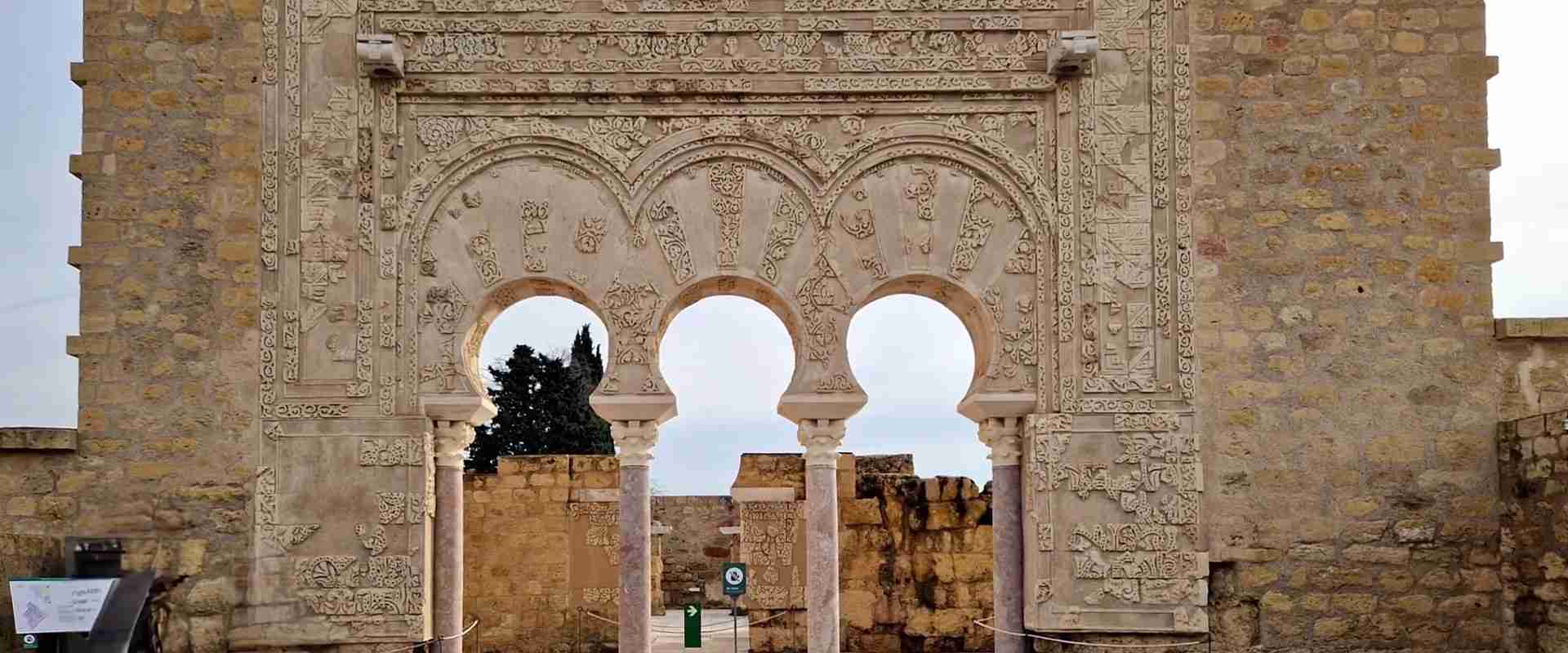
The Rich Hall is the best-preserved architectural space on the upper terrace, and the carved marble decoration that survives in partial reconstruction along its interior walls is among the finest examples of Umayyad architectural ornament in existence. The carved marble panels — in a style that uses dense, symmetrical vegetal scrollwork within geometric panels — are closely related to, but distinct from, the decorative vocabulary of the Mezquita’s mihrab chamber, and comparing the two during a single day’s circuit provides a remarkably specific visual lesson in tenth-century Umayyad aesthetics. The hall was tripartite in plan — a central nave flanked by two lateral aisles, each opening through horseshoe arches to a transverse hallway and then, beyond, to the garden terrace — and this structure is legible in the ruins even though the hall’s roof and upper walls are gone.
Beyond the Rich Hall, the upper terrace contains the remains of an oratory (small mosque for the caliph’s personal use), several residential suites, and portions of the garden terrace that separated the palace from the administrative middle terrace. The garden, which from historical accounts included reflecting pools and a sophisticated irrigation system fed by gravity through ceramic pipes from a cistern above, survives only in its stone beds and channel lines, though the Archaeological Park is progressively restoring sections of the planting layout based on botanical analysis of seeds recovered from excavation.
Practical Notes: Medina Azahara Entry 2027
Entry is free for EU and EEA citizens; non-EU visitors pay €1.50 at the visitor center ticket desk on arrival, after presenting the online booking confirmation. All visitors require a time-slot booking through museosdeandalucia.es. The site closes on Mondays and on the following public holidays: January 1 and 6, May 1, December 24, 25, and 31. Opening hours vary by season — the standard season runs Tuesday through Sunday approximately 9:00 AM to 6:00 PM, but the summer band from approximately June 21 through September 20 operates a split schedule: morning visits Tuesday through Saturday from 9:00 AM to 2:00 PM (last admission) and evening visits from 7:00 PM to midnight, with the evening slot restricted to the archaeological zone. Sundays and public holidays have their own schedule — check the Junta de Andalucía’s current seasonal calendar at museosdeandalucia.es before booking, as summer hours significantly restructure the available visit windows. Guided tours in English and Spanish range from approximately €8–12 for 90-minute group tours. Allow a minimum of two hours for the visitor center, shuttle, and ruins; 2.5–3 hours is comfortable if you intend to explore the terraces thoroughly.
Stop 3: Castillo de Almodóvar del Río — Military Gothic Fortification Overlooking the Guadalquivir
Almodóvar Castle occupies the summit of the hill of El Redondo above the town of Almodóvar del Río, 25 km southwest of Córdoba on the north bank of the Guadalquivir. Its visual impact is immediate: approaching along the A-431 from Medina Azahara, the castle appears above the plain as a compact cluster of eight towers connected by crenellated curtain walls, the whole structure rising to approximately 50 metres above the surrounding fields. It is the most photographically satisfying of the three circuit sites for exterior views, partly because its silhouette is simple and dramatic and partly because the Guadalquivir valley below it provides a foreground of genuine agricultural beauty — whitewashed farmhouses, olive groves, and the steel-gray river bend that defined the strategic value of this position for over a millennium.
The castle’s origins are Moorish. A fortress occupied this site from the early period of Muslim rule in the peninsula — historical sources and archaeological evidence suggest an 8th-century construction, though precise dating is uncertain and the site likely had a defensive use in Roman and pre-Roman periods as well. The Islamic fortification served as one of a chain of Guadalquivir valley strongpoints defending Córdoba’s western approaches. After the Christian conquest of the region in the thirteenth century, the castle passed through several noble families and underwent substantial modifications to accommodate changing military technology, including the addition of Gothic-style towers in the late medieval period as the Reconquista’s frontier moved further south and the castle’s garrison role diminished.
The building’s current appearance owes much to an extensive restoration undertaken in the early twentieth century by its private owners, the Counts of Torralba — aristocratic descendants of the castle’s medieval lords — who rebuilt and stabilized the towers and curtain walls in a style that reflects a Romantic Gothic interpretation of medieval military architecture. This restoration, completed largely between 1901 and 1936, is what most visitors see today: a visually coherent castle whose exterior reads as authentically medieval but whose details in many areas reflect early twentieth-century taste and structural judgment rather than original materials. Understanding this restoration context is not a reason to discount a visit — the castle’s position, scale, and basic plan are entirely historical — but it helps set appropriate expectations for visitors who have seen more fragmentary or less-interpreted medieval monuments elsewhere in Spain.
The Towers, Battlements, and Interior Rooms
The circuit of eight towers — connected by curtain walls averaging 10–12 metres in height — can be walked in its entirety, with access to the battlements giving panoramic views of the Guadalquivir valley in both directions. On a clear day in winter or spring, the Sierra Morena to the north and the olive-covered plains of the Guadalquivir basin to the south create a landscape that is visually unchanged from the castle’s operational period. The views alone justify the 10–15 minute uphill walk from the lower parking area.
The interior spaces include a series of vaulted rooms interpreted with period furniture, suits of armor, period weapons, and display cases providing historical context for the castle’s various periods of use. The largest interior space, the Hall of the King (Sala del Rey), occupies the upper story of the main residential block and provides the most direct view from the castle’s interior down to the river. A torture chamber — a dark, low-vaulted room in the basement of one tower, historically associated with Peter I of Castile’s use of the castle as a detention facility in the fourteenth century — is one of the castle’s more theatrically presented spaces, though the historical connection to Peter I is based on chronicle records rather than physical evidence within the room itself.
The castle gained considerable international profile as a filming location for the television series Game of Thrones, which used its exterior as the seat of House Tyrell (Highgarden) in several scenes. On-site displays and the audio guide reference this filming history, and it accounts for a significant portion of the visitor demographic — particularly younger visitors who might not otherwise include a medieval castle on a Córdoba itinerary. The Game of Thrones association is presented clearly and without architectural inflation: the castle is not themed around the series, but the association is acknowledged and makes the site accessible to visitors whose primary interest is the television context rather than the military Gothic architecture.
What Makes Almodóvar’s Architecture Significant
Within the context of this three-site circuit, Almodóvar Castle provides a specific architectural counterpoint: where the Mezquita demonstrates Umayyad Islamic building at its most sophisticated, and Medina Azahara illustrates the planning and decorative ambitions of the caliphal state, Almodóvar represents the military architecture tradition of the Christian Reconquista and its late medieval successors. The castle’s plan — mural towers at regular intervals along a defensive perimeter, a central courtyard providing interior organization — is a standard formulation of Castilian military Gothic that appears across dozens of Andalusian hilltop fortresses. What distinguishes Almodóvar is less the typological innovation and more the specific site: the hill of El Redondo is unusually isolated from the surrounding terrain, giving the castle’s profile a clarity and drama that more geographically embedded fortresses lack.
The corbelling below several of the tower battlements — overhanging stone brackets that would have supported wooden defensive platforms (hourdes) in the medieval period — is a specific detail worth examining in the context of the 20th century restoration: some of the corbelling visible today is original medieval stonework, while other sections were added or reconstructed during the early 20th-century campaign. Distinguishing original from restored material requires attentive examination of the stone coursing and the regularity of the masonry joints. This is, admittedly, a specialist interest — but the castle’s audio guide (included in the entry ticket) addresses it briefly, and for architecture-focused visitors it provides a productive exercise in reading building history from surface evidence.
Practical Notes: Almodóvar Castle Entry 2027
The standard adult entry fee is €10. Reduced entry (€8.50) is available for visitors over 65 and other qualifying categories. Children’s entry is €6. The audio guide is included in the ticket price. The castle is privately owned and operated; check the official website (castillodealmodovar.com) for current opening hours and any special event schedules before visiting, as these have varied seasonally and the midday break documented in visitor accounts (approximately 14:30–16:00) may or may not apply during your visit period. General operating hours have typically run 11:00 AM to 7:00 PM, with the last admission one hour before closing. The castle operates year-round except December 25 and January 1.
Ticket Costs & Advance Booking 2027: What to Budget for All Three Stops
The three sites in this circuit present three entirely different ownership and access models. The Mezquita is managed by the Diocese of Córdoba as an active Catholic cathedral — ticketing is handled directly through the cathedral’s official website and a small counter at the Patio de San Eulogio information center. Medina Azahara is managed by the Junta de Andalucía through the Red de Espacios Culturales de Andalucía — booking is online-only through museosdeandalucia.es. Almodóvar Castle is privately owned and operated — tickets are available at the castle entrance and through several third-party booking platforms including the official castle website. No single combined ticket exists for the three sites; each requires individual booking through its own channel.
The following cost summary reflects verified 2026 prices (check official sites for any 2027 adjustments before visiting):
Mezquita-Catedral de Córdoba: Adults €15; reduced rate (65+, students 15–26, European Youth Card holders) €12; children 10–14 €8; under-10 free. Free entry Monday–Saturday 8:30–9:30 AM (no booking required, no guided tours, approximately 60% of the space accessible). Bell tower: additional €3. Night visit (El Alma de Córdoba): €20, maximum 100 participants — must be booked in advance.
Medina Azahara: EU and EEA citizens: free. All other visitors: €1.50 (paid at the site ticket desk on arrival). Mandatory internal shuttle bus: €3 each way, or included in the €10 tourist bus package from Córdoba. Time-slot booking required for all visitors regardless of entry cost — book at museosdeandalucia.es. Group guided tours in English or Spanish: approximately €8–12 per person for a 90-minute tour (includes shuttle in the group ticket).
Almodóvar Castle: Adults €10; reduced (65+) €8.50; children €6. Audio guide included. Weekend shuttle from lower parking: €1 each way (not available June–July).
For a couple (two adults) using the free Mezquita morning slot, taking the tourist bus to Medina Azahara, and driving to Almodóvar Castle: the full three-site circuit totals approximately €40 per couple — Mezquita free in the morning slot, Medina Azahara tourist bus €10 each, Almodóvar Castle €10 each. EU citizens who self-drive to Medina Azahara (free entry plus €6 shuttle round-trip) bring the couple total down to approximately €26. Non-EU visitors paying the Mezquita standard entry of €15 each can expect a full-day couple cost of approximately €70 using the tourist bus option to Medina Azahara.
Advance booking is most critical for Medina Azahara, especially on Tuesdays (free EU entry day, first to fill) and during the April–June and September–October peak windows. The Mezquita’s paid-entry tickets should be booked at least one to two weeks ahead for spring and autumn weekends. Almodóvar Castle rarely sells out advance slots but booking online avoids a small queue at the ticket desk on weekends.
The Córdoba Bono Turístico — the city’s tourism pass — does not include the Mezquita or Medina Azahara. It covers the Alcázar de los Reyes Cristianos, the Caliphal Baths (Baños Califales), and a handful of smaller municipal attractions. For visitors focusing exclusively on this three-site western corridor circuit, the Bono Turístico is not cost-effective unless you are also dedicating separate time to the Alcázar and Roman sites in the city center.
Photography Guide 2027: What to Shoot and When at Each Site
Each of the three sites on this circuit rewards a specific photographic approach. Understanding the light conditions and best positions before arriving allows you to prioritize within the available time, particularly at the Mezquita where the most productive photography window (8:30–9:30 AM) is also the free entry window and lasts only 60 minutes.
Mezquita — Hypostyle Hall: The prayer hall’s most characteristic image — a long perspective of doubled arches receding into depth, the alternating red and white voussoirs producing horizontal rhythm — is best captured from the center of the prayer hall looking south toward the mihrab. The light quality varies significantly by season and time of day. In spring (March–May) and autumn (September–November), the low morning sun enters through the hall’s eastern arcades and produces angled shafts of light that cross the column perspectives at roughly 45 degrees, creating the depth-emphasizing contrast that characterizes the best-known interior photographs. Summer mornings produce flat overhead light earlier in the day, reducing this effect. Winter light is lower but the sun angle from the east is more oblique and may not reach the central aisles clearly before 9:30 AM. A wide-angle equivalent of approximately 16–24mm on a full-frame camera (or its equivalent) captures the full arch span; a medium telephoto of 50–85mm compresses the column depth into a tighter, more graphic image of receding arches. Tripods are prohibited at all times; use a camera or phone with image stabilization, or brace against a column for long exposures in the free morning slot’s lower light. The mihrab niche itself is a single highly decorative space best photographed straight-on; flash is not necessary given its gold mosaic interior, which reflects available light effectively.
Medina Azahara — Upper Terrace: The ruins photograph best in overcast or partly cloudy conditions, when the flat diffused light reduces the harsh shadow patterns that strong Andalusian sun creates across the rough-textured stone. On a clear winter or spring morning, the golden hour light from the east illuminates the carved marble panels in the Rich Hall with a warmth and depth that midday sun cannot replicate. The shuttle arrives at the upper terrace from the east; turning left (north) and climbing to the terrace edge before proceeding to the Rich Hall allows a reverse approach that catches the morning light on the carved surfaces from the optimal angle. The garden terrace below the reception hall complex — visible from the terrace edge — provides foreground depth for photographs that show the site’s three-terrace structure descending to the valley. A focal length of 28–50mm covers most productive compositions on the upper terrace; close-up detail work on the carved marble panels rewards a macro or portrait lens at 90–105mm.
Almodóvar Castle — Exterior and Views: The most immediately rewarding photographs are exterior: the castle’s silhouette against the sky, approached from the A-431 as you arrive from Medina Azahara, with the Guadalquivir visible as a silver line below the hill. Stop on the roadside before the town for this approach shot; once you are in the town and climbing to the castle, the view changes to upward angles that are less compositionally resolved. Within the castle, the views from the battlements looking south over the Guadalquivir bend reward a wide field of view — 24mm equivalent or wider — to capture the foreground crenellation against the valley. Late afternoon (post-16:00) produces warm directional light on the west-facing towers for exterior texture photography. The castle’s interior rooms are mostly lit by artificial light and require longer exposures or higher ISO settings; a steady hand and the “Live View” stabilization of a modern phone camera manage most of these interiors adequately.
Practical Tips 2027: Getting the Most from Your Córdoba Circuit
What to wear: The Mezquita dress code is enforced by staff at the entrance — shoulders and knees must be covered. This applies to all genders; scarves and wraps are available to borrow at the entry, but bringing your own is faster. Comfortable walking shoes are essential at Medina Azahara (extensive uneven terrain over rough rubble paths) and Almodóvar Castle (steep slope and stairs throughout). Hats are practically mandatory from April through October at both outdoor sites; the ruins of Medina Azahara have almost no shade and the castle grounds are similarly exposed.
Water and food: Carry a minimum of 1 litre per person for any outdoor visit from April through September; 1.5 litres for summer visits. The Medina Azahara visitor center has a small café. Almodóvar del Río town below the castle has several bars serving standard Andalusian plates — the walk down from the castle after your visit to find lunch is straightforward. The Mezquita’s surrounding Judería neighborhood has no shortage of cafés and restaurants; the narrow streets of Calleja de las Flores, a few minutes’ walk from the mosque’s northern entrance, concentrate Córdoba’s most atmospheric options. Prices in the Judería run somewhat higher than the rest of the city because of tourist density; walking two blocks away generally halves the price per dish.
Córdoba base logistics: Córdoba is served by the AVE high-speed train from Madrid (approximately 1 hour 40 minutes from Atocha, trains every 30–60 minutes), Seville (approximately 45 minutes), and Granada (approximately 1 hour 20 minutes with a change at Antequera). The train station (Córdoba Central) is approximately 1.5 km from the Mezquita — walkable in 20 minutes or accessible by city bus and taxi. Car rental desks are located at the train station and airport. For this westward circuit, collecting a rental car at the station on the morning of your circuit day and returning it that evening is the most efficient structure — no need to have a car for the Mezquita, which is better reached on foot from a central hotel.
Combined circuits: Several operators offer guided full-day circuits covering the Mezquita, Medina Azahara, and occasionally Almodóvar Castle in a single minibus tour from Córdoba. These are convenient for visitors who do not want to manage transport logistics independently, though they provide less flexibility on timing (particularly the free Mezquita morning window, which organized tours typically cannot use since group visits are not permitted during the 8:30–9:30 AM slot). For independent visitors, the self-drive circuit described in this guide consistently produces more productive visits at each site than organized group tours.
Frequently Asked Questions About Córdoba Architectural Road Trip 2027
Can I do the Mezquita, Medina Azahara, and Almodóvar Castle circuit in one day in 2027?
By car, yes — the three-site circuit fits into approximately 9 hours with disciplined timing: Mezquita at 8:30 AM (free slot, exit by 9:30), drive to Medina Azahara, arrive 10:00 AM for the first shuttle, spend 2 hours including museum time, drive to Almodóvar Castle, arrive approximately 12:15 for the castle’s 11:00 AM opening. By public transport, the combination is very challenging in one day because the tourist bus to Medina Azahara and the M-250 bus to Almodóvar del Río depart from different Córdoba stops on incompatible schedules. Most public-transport visitors split the circuit across two days.
Is the Mezquita free to visit in 2027?
Yes — the Mezquita is free for everyone, Monday through Saturday, from 8:30 to 9:30 AM. This slot corresponds to morning prayer hours. Approximately 60% of the monument is accessible during this window (the central Renaissance choir is closed, as it serves active religious functions). No booking is required; arrive before 8:30 AM to be among the first, as entry queues form from about 8:15 AM during high season. Outside this window, the standard adult entry price is €15, with reduced prices for seniors, students, and children. On Sundays and holidays there is no free slot — paid entry begins at 8:30 AM.
How much does it cost to visit Medina Azahara in 2027?
EU and EEA citizens enter Medina Azahara free of charge; visitors from all other countries pay €1.50 at the site ticket desk on arrival. However, all visitors need a time-slot booking through museosdeandalucia.es — the free entry is not walk-in. The mandatory internal shuttle bus from the visitor center to the archaeological ruins costs €3 each way for independent visitors. Visitors arriving on the Córdoba tourist bus (€10 per person from Paseo de la Victoria) have the shuttle included in their ticket. During spring and summer, English-language guided tours of approximately 90 minutes are available for approximately €8–12 per person in addition to entry costs.
What are the Medina Azahara opening hours in summer 2027?
Medina Azahara operates a split summer schedule from approximately June 21 through September 20: morning visits run Tuesday through Saturday from 9:00 AM to 2:00 PM (last admissions approximately 30–45 minutes before closing), and evening visits from 7:00 PM to midnight cover only the archaeological zone (the visitor center museum is closed in the evening). Sundays during summer have their own schedule; Mondays remain closed year-round. This split schedule eliminates the option of combining a late Medina Azahara visit with an afternoon Almodóvar Castle trip during summer months, unless you are willing to use the evening Medina Azahara window separately. Verify the exact current seasonal schedule at museosdeandalucia.es or through the official Junta de Andalucía tourism portal before planning your circuit in July or August.
Are there night visits at Medina Azahara in 2027?
Yes — the site has run night archaeological visits on Friday and Saturday evenings during the summer period (approximately late May through September) and occasionally at other times. The evening visits from 7:00 PM are part of the summer split schedule and cover the archaeological zone by nightfall, giving a dramatically different atmospheric experience from the daytime visit. Capacity is limited and these sessions book out quickly — sometimes within hours of becoming available in the spring booking window. Night tour bookings go through museosdeandalucia.es. The visitor center museum is not open during evening visits. Check the official Junta de Andalucía events calendar for the 2027 night visit schedule, as dates and times can shift from year to year.
Is Almodóvar Castle worth visiting in 2027?
Yes — particularly for visitors who have seen the Mezquita and Medina Azahara and want the architectural comparison of a Christian military structure from a later period, or for visitors interested in medieval military architecture generally. The castle’s restored state means it lacks the scholarly authenticity of a fragmentary ruin, but this also makes it more legible to non-specialist visitors. The exterior views from the battlements over the Guadalquivir valley are among the most visually satisfying panoramas in the province, the audio guide is genuinely informative, and the uphill approach walk through olive-and-cypress countryside adds an unprogrammed sensory dimension that the other two sites (indoors or by shuttle) do not provide. Allow 1.5 hours for a comfortable visit including the battlements circuit and the main interior rooms.
Can I drive through Córdoba’s historic center to reach the Mezquita in 2027?
No — Córdoba’s historic walled center operates a restricted vehicle access zone enforced by automatic number-plate cameras at all entry points. Tourist rental cars and private vehicles cannot drive within the perimeter, which includes all streets immediately surrounding the Mezquita, the Judería, and the Roman Bridge area. Designated parking garages on the perimeter of the historic center — including Parking Jardines de la Victoria on Calle Cairuán and Parking Campo Santo de los Mártires — offer the closest legal parking, approximately 400–500 metres from the Mezquita entrance. From these garages, the walk through the Judería to the mosque-cathedral takes 5–10 minutes. Taxis and licensed tourism vehicles can enter designated drop-off points within the zone, which some visitors use for the Mezquita portion of the circuit before collecting a rental car from an external parking garage for the westward drive.
What should I prioritize inside the Mezquita if I only have the 8:30–9:30 AM free hour?
Spend the first 20 minutes in the hypostyle hall moving from the northern entrance south toward the mihrab, following the central aisle to experience the column depth perspective in both directions. At the 20-minute mark, turn east into the al-Mansur expansion, where the column density is highest, for another 10 minutes. From there, proceed south to the al-Hakam II extension and the mihrab chamber — allocated 15–20 minutes here, as the mihrab’s decorative vocabulary is the most concentrated example of Umayyad arts on the site. Return north through the Abd al-Rahman I and II zones and exit through the Patio de los Naranjos, spending your final 5–10 minutes in the orange-tree courtyard. The central Renaissance cathedral nave is visible through the hypostyle hall during the free period but is technically closed — don’t attempt to enter it during this window.
Are there luggage storage options near Córdoba bus station and train station for day-trip circuit visitors?
Yes — Córdoba train station (Córdoba Central) has coin-operated lockers in the main concourse, available in small, medium, and large sizes at approximately €3–6 per day. The bus station (Estación de Autobuses de Córdoba) on Calle Diego Serrano also has lockers. Both facilities allow visitors arriving in Córdoba on the day of the circuit to store large luggage and proceed to the sites with day packs only. For this circuit, light-packing for the day is advisable in any case — the Medina Azahara ruins involve considerable walking over uneven terrain, and Almodóvar Castle has no bag storage at the entrance.
Which site should I prioritize if I only have time for one of the three in 2027?
The Mezquita, without question. It is one of the three or four most significant standing buildings of the medieval Islamic world, and the experience of walking its hypostyle hall — particularly during the free morning window — is the single most architecturally rewarding 60 minutes in Córdoba. Medina Azahara is the better choice for visitors who have already seen the Mezquita or who are particularly interested in caliphal palace architecture, urban archaeology, or the history of the Umayyad state. Almodóvar Castle is best positioned as a supplementary stop rather than a primary destination — it rewards visitors who have time after the other two and who want the physical experience of a medieval military fortification alongside the panoramic valley views.