Colmar Architectural Itinerary Alsace 2027: Exploring Petite Venise, Maison des Têtes & Eguisheim Without the Crowds
Colmar packs five centuries of Alsatian building into a few walkable streets, and the best of it sits beside villages most visitors never reach. This itinerary links Little Venice, the House of Heads and the Unterlinden Museum with Turckheim, Eguisheim and Pfaffenheim on the Alsace Wine Route, using early starts, quiet weekdays and short rail and bus hops. You will leave with timed routes, current costs and a clear plan for avoiding the midday crush.
Key Takeaways
- Colmar’s historic core is compact enough to cover on foot: the railway station sits roughly a 15-minute walk from Little Venice, and a first architectural loop through the Tanners’ Quarter, Pfister House, House of Heads and Saint Martin’s Collegiate Church fits comfortably into one morning.
- Crowds peak around early afternoon on Saturdays and fall away on weekday mornings; arriving at Little Venice before 9 AM gives canal reflections and empty bridges, while the Unterlinden Museum is closed every Tuesday and costs €14 for a full-price adult ticket.
- Turckheim is the easiest day-trip village: the regional train from Colmar takes about 10 minutes, and its three medieval gates, Guardhouse and half-timbered streets can be walked in under two hours.
- Eguisheim, built in concentric rings around its castle, is reached by a short bus ride or a cycle ride of roughly 6 km from Colmar; Pfaffenheim, farther south on the Alsace Wine Route, suits cyclists and drivers who want a quieter vineyard village.
- Mid-range travelers spend approximately €145-230 per person daily (two sharing a mid-range hotel), budget travelers €85-135, and luxury travelers €300-535; a three-day mid-range stay totals approximately €435-690 per person.
People Also Ask About Colmar Architectural Itinerary 2027
How many days do you need for Colmar’s architecture in 2027?
Two full days cover Colmar’s main architecture and one village excursion; three days add a second village and a slower pace. Day one handles the old town: Little Venice, the Tanners’ Quarter, Pfister House, House of Heads, the Koïfhus and Saint Martin’s Collegiate Church. Day two fits Turckheim and Eguisheim by train, bus or bicycle, with Unterlinden Museum fitted into a spare morning or afternoon. A third day allows Pfaffenheim and the vineyard paths between villages. Travelers with only one day should prioritize the old town before 11 AM and finish with an evening in Turckheim or Eguisheim, where the crowds thin after the tour buses leave.
How much does a Colmar architectural itinerary cost per day in 2027?
Mid-range travelers spend approximately €145-230 per person daily, assuming two people share a mid-range hotel room. Budget travelers need about €85-135 per person daily with two sharing a budget hotel, and luxury travelers invest roughly €300-535 per person daily. These ranges include the hotel share, meals, local transport and attractions such as the Unterlinden Museum at €14 and a Little Venice boat ride at around €9. Regional trains and buses to Turckheim and Eguisheim cost only a few euros each way, so the village excursions add little to the daily total. Rates are indicative; check booking platforms and official sites for current prices.
When is the quietest time to visit Colmar in 2027?
Weekday mornings in late spring and September are the quietest windows, with Wednesdays reported as the calmest day at Little Venice and Saturday around 2 PM the busiest. Late May and September combine mild weather with thinner crowds and lower hotel rates than July and August. Avoid the Advent weekends in late November and December if your priority is architecture rather than markets, because the old town closes to cars and visitor numbers surge. Within any day, the hour before 9 AM and the late afternoon after the tour groups leave give the best light and the emptiest lanes in Colmar and Eguisheim.
How do you reach Turckheim and Eguisheim from Colmar in 2027?
Turckheim is a 10-minute train ride from Colmar on the TER line toward Munster, with a typical one-way fare of around €4. Eguisheim is served by a regional bus from Colmar station and an urban bus from the Château d’Eau stop, about 10 minutes door to door at roughly €3; the urban service is listed Monday to Saturday, so Sunday travelers should plan a taxi (€18-22), a bicycle or a walk of around 6 km. There is no direct bus between Turckheim and Eguisheim, so the usual route returns via Colmar. Check the TER Grand Est, Fluo 68 and TRACE timetables each September, when schedules change.
Extended multi-day tours – 5+ days
Featured Alsace Lorraine Multi-Day Tour Packages
7 days
Catalonia, south of France, Burgundy and Alsace
- ✓ Comprehensive Alsace Lorraine tour
- ✓ Expert local guides included
- ✓ All accommodation arranged
- ✓ Transportation provided
4 days
Enchanting Christmas Markets along Alsatian Canals (port-to-port cruise)
- ✓ Comprehensive Alsace Lorraine tour
- ✓ Expert local guides included
- ✓ All accommodation arranged
- ✓ Transportation provided
7 days
Alsace Lorraine Discovery Tour
- ✓ Comprehensive Alsace Lorraine tour
- ✓ Expert local guides included
- ✓ All accommodation arranged
- ✓ Transportation provided

7 days
Alsace Lorraine Discovery Tour
- ✓ Comprehensive Alsace Lorraine tour
- ✓ Expert local guides included
- ✓ All accommodation arranged
- ✓ Transportation provided
Multi-day tour packages powered by TourRadar. Prices and availability subject to change.
Colmar Architecture Itinerary 2027: Why a Planned Route Beats Wandering
A planned route matters in Colmar because the town’s best architecture clusters inside a small area where the same few streets carry most of the foot traffic. The historic center spreads across a modest footprint, the key facades face narrow lanes, and the postcard views of Little Venice are crowded by late morning in season. Planning the order of stops, the hour of arrival and the transport for each village turns a busy day into a quiet one, and it lets you spend your time reading buildings rather than queuing.
Colmar sits in Haut-Rhin on the Alsace Wine Route, with the Vosges foothills to the west and the Rhine plain to the east. It is reached from Paris by high-speed train in about 2 hours 20 minutes, and regional TER trains link it with Strasbourg and Mulhouse. That position explains much of its architecture. The town grew rich on wine and trade, and the merchants and guilds who built its Renaissance houses wanted the facades to show it. The result is a streetscape where Gothic church masonry, Renaissance oriels, painted timber-framing and canal-side gables stand within a few minutes’ walk of one another.
The three villages in this guide extend that story into the vineyards. Turckheim keeps its medieval gates and a night watchman who still walks his rounds on summer evenings. Eguisheim wraps its houses in concentric rings around a castle. Pfaffenheim, farther south, offers a vineyard village with a Romanesque church tower and far fewer visitors. Together they let you compare how the same building tradition looks in a wealthy town and in working wine villages.
This guide is built for the 2027 travel year. Prices, hours and timetables quoted here come from official and operator sources published in 2026, the most recent available at the time of writing; hotel and boat rates are shown as ranges because they move with the season. Where a source is a tradition or a single account rather than a documented record, the text says so. Use the walking routes as templates, then adjust the timing to the day of the week you arrive.
The guide follows the order you will actually travel. It begins with how to read Colmar’s footprint and move around it, continues through the individual landmarks, then takes the train and bicycle routes out to Turckheim, Eguisheim and Pfaffenheim. It closes with crowd-timing data, sample two-day and three-day itineraries, a full cost breakdown, accommodation guidance and ten frequently asked questions.
Navigating Colmar’s Medieval Footprint: Efficient Walking Routes & Public Transport Links
Colmar’s old town is walkable end to end, and the most efficient route runs in a loop from the Unterlinden Museum through the pedestrian streets to Little Venice and back along the Tanners’ Quarter. A signposted walking circuit connecting Little Venice, the old town and the Tanners’ Quarter is described in French-language sources as a loop of about 3 km, with a map available from the tourist office near Place Unterlinden. At a relaxed pace, with stops at the main facades, the loop takes a half day.
The medieval footprint is still legible in the street plan. Fortifications dating from around 1220 are recorded for the town, and traces survive, while the later Gothic and Renaissance building campaigns filled the interior with guild houses, merchants’ mansions and market buildings. Colmar was heavily fought over in the winter of 1944-1945, yet the old town is generally described as having come through largely intact, which is why so many 15th- to 17th-century facades remain.
Colmar Distances and Walking Times at a Glance
- Railway station to Little Venice: about 1 km in a straight line, roughly 15 minutes on foot.
- Railway station to Unterlinden Museum: about 1.1 km, roughly 15 to 20 minutes on foot.
- Unterlinden Museum to House of Heads: a few minutes through the old town streets.
- Pfister House to the Koïfhus: a short stroll along the main pedestrian axis.
- Saint Martin’s Collegiate Church to Little Venice: roughly 10 minutes via the Tanners’ Quarter.
- Full old-town loop with stops: about 3 km and 3 to 4 hours including interiors.
How Do You Get Around Colmar by Public Transport in 2027?
Colmar’s urban buses are operated by the TRACE network, with stops at the railway station and next to the municipal theatre, and the old town is compact enough that most visitors use a bus only to reach the station or a car park. Since June 2025 TRACE has used a contactless system: you pay and validate with a bank card on board, or use the M-Ticket mobile app, which generates a QR code to scan on boarding. Paper tickets and the old sticker cards were exchangeable until 30 June 2026, so do not rely on a paper ticket bought elsewhere. A single urban ride costs roughly €2-3.
Regional buses on the Fluo 68 network serve the surrounding area from the same bus station, including a line from Colmar through Eguisheim to Rouffach that tourist offices list as line R030 and a line through Riquewihr to Ribeauvillé. A cross-border bus runs several times a day to Breisach in Germany. TER trains leave Colmar for Strasbourg, Mulhouse, Munster and Sainte-Marie-aux-Mines. Timetables change each autumn, so check the TER Grand Est, Fluo and TRACE sites a week before travel.
If you drive, the old town is largely pedestrian, and during the Advent season the center closes to cars; the tourist authority points drivers to the Parc Expo and station-side Bleyle car parks with free shuttle buses at Christmas. Outside December, paid car parks ring the old town. For an architecture-focused visit, staying near the station and using public transport removes the parking problem entirely.
From Colmar Station to Petite Venise: Strategic Micro-Itineraries for Peak Season Avoidance
The fastest way from Colmar station to Little Venice is on foot, a walk of roughly 15 minutes along the main axis toward the old town, and the smartest use of that walk is to time it for before 9 AM. Travel guides consistently advise visiting the canal district in the early morning, when the light is soft and tour groups have not yet arrived. The micro-itineraries below are built around that rule and around the day of the week.
Micro-itinerary one: the 90-minute dawn loop (weekday, before 10 AM). Walk from the station to Little Venice and stand on the bridge near Rue de Turenne for the canal view while the street is empty. Continue along Quai de la Poissonnerie, cross into the Tanners’ Quarter and read the timber galleries where the tanners dried hides, then finish at Saint Martin’s Collegiate Church as its doors open at 8:00 AM Monday to Saturday or 10:00 AM on Sunday. You have covered the three most photographed districts before the main crowds exist.
Micro-itinerary two: the museum-first morning (Wednesday to Monday). Open with the Unterlinden Museum at 9 AM, when it opens, spend one to two and a half hours with the Isenheim Altarpiece and the building’s convent architecture, then walk through the old town to Pfister House and House of Heads at midday while visitors queue for lunch. Take the Little Venice boat late in the afternoon, when the slanting light makes the facades glow and morning crowds have gone.
Micro-itinerary three: the Saturday workaround. Saturday is the day to leave the old town to others between roughly noon and 4 PM. Use the morning for the dawn loop, take the train to Turckheim or the bus to Eguisheim for the middle of the day, and return for a late-afternoon boat ride and dinner. Footfall data for Colmar suggests Little Venice peaks around 2 PM on Saturdays and is quietest on Wednesdays, so a Wednesday arrival is the easiest to plan.
Micro-itinerary four: the evening reversal. In summer, flip the day. Visit the villages in the morning, return to Colmar after the museums have thinned, walk Little Venice at golden hour and eat early. Because the old town empties after the day trippers leave, this reversal often gives better photographs than the dawn loop and a calmer dinner.
Boarding points for the flat-bottomed boats sit near the bridge area by Rue de Turenne, with a second embarkation point reported near the Covered Market. Rides last about 25 to 30 minutes and cost around €8-9 per adult, with a discount for children and free travel for the youngest; the operators are reported not to take individual reservations, and July and August morning slots fill quickly. Winter service is limited. Confirm the current fare at the kiosk.
Colmar Landmark Architecture 2027: Pfister House, House of Heads & the Koïfhus
Pfister House, the House of Heads and the Koïfhus are the three buildings that define Colmar’s Renaissance and late-medieval civic skyline, and they stand within a few minutes’ walk of one another. Visiting them together on the pedestrian axis takes about an hour of looking and photographing, and none requires a ticket to appreciate from the street.
Pfister House: Renaissance Facade and Painted Timber
Pfister House dates from 1537 and is widely cited as one of the finest Renaissance buildings in Colmar and perhaps the most photographed. French sources record it as built for a hatter named Louis Scherer; the name Pfister comes from a later owning family, who held the house in the 19th century. Its character lies in the stacked composition: arcades at ground level, two upper floors with mullioned windows, a polygonal corner turret, wooden galleries and facades painted with scenes that guides describe as biblical. The house was restored in the 20th century and has been a listed historic monument since 1927.
The best viewing position is across the street on Rue des Marchands, where the full height of the facade fits in one frame. Photographers favor the first hour of daylight, before pedestrians fill the street. The house is occupied rather than a museum, so plan to admire the exterior rather than enter.
House of Heads: 106 Carved Faces on a Merchant’s Facade
The House of Heads (Maison des Têtes) was built in 1609 for the merchant Anton Burger, who became Colmar’s chief magistrate in 1626. It takes its name from the 106 small carved heads, grimacing human faces, masks and grotesques that decorate the facade, and it has been a listed historic monument since 1898. One French guide credits the architect Albert Schmidt, but this attribution rests on a single source and should be treated as probable rather than settled.
The building later housed the town’s wine exchange, established in 1898, and a statue of an Alsatian cooper stands on the roof. It is described as made of tin and as the work of Colmar-born sculptor Frédéric Auguste Bartholdi, installed in 1902. Today the house shelters a five-star hotel of 21 rooms and a high-end brasserie in the historic hall at 19 Rue des Têtes. You can admire the facade freely from the street, and the brasserie is an option for lunch if you want to see the interior.
The Koïfhus: Colmar’s Old Customs House
The Koïfhus, the Old Customs House, was built in 1480 and is described as the oldest surviving public building in Colmar. It served as customs and administrative center, and at various points between the 15th and 19th centuries it also acted as the town hall. Its position reflects Colmar’s role on trade routes between Italy and Flanders and between the Danube and Champagne, according to local heritage writing.
The ground floor arches frame an open covered space, and the building takes center stage during the Christmas markets when artisans sell inside. Outside the festive season it is quiet, and its position makes it a natural resting point between Pfister House and the Tanners’ Quarter.
Adolph House, Kragen House and the Other Half-Timbered Facades on Rue des Marchands
Rue des Marchands and its side streets hold a dense run of houses that reward slow looking. Adolph House likely dates to the 14th century according to a heritage guide, which would make it one of the oldest in the town, though a precise date is uncertain. Kragen House on Rue des Marchands is listed as a fine example of half-timbering with protected facades and roofs. Kern House is another named stop on the old-town trail, and the sculptor Bartholdi’s birthplace, now the Bartholdi Museum opened in 1922, is not far from Pfister House.
When reading a half-timbered facade, look for four things: the framing pattern of vertical posts and diagonal braces, the jettied upper floors that project over the street, the oriels and carved corbels that signal a wealthy owner, and the painted infill panels between the timbers. Colmar’s houses show these features across a span of several centuries, so the street works as an open-air lesson in how the style evolved.
Little Venice and the Tanners’ Quarter in 2027: Canal Architecture, Boat Rides & Quiet Hours
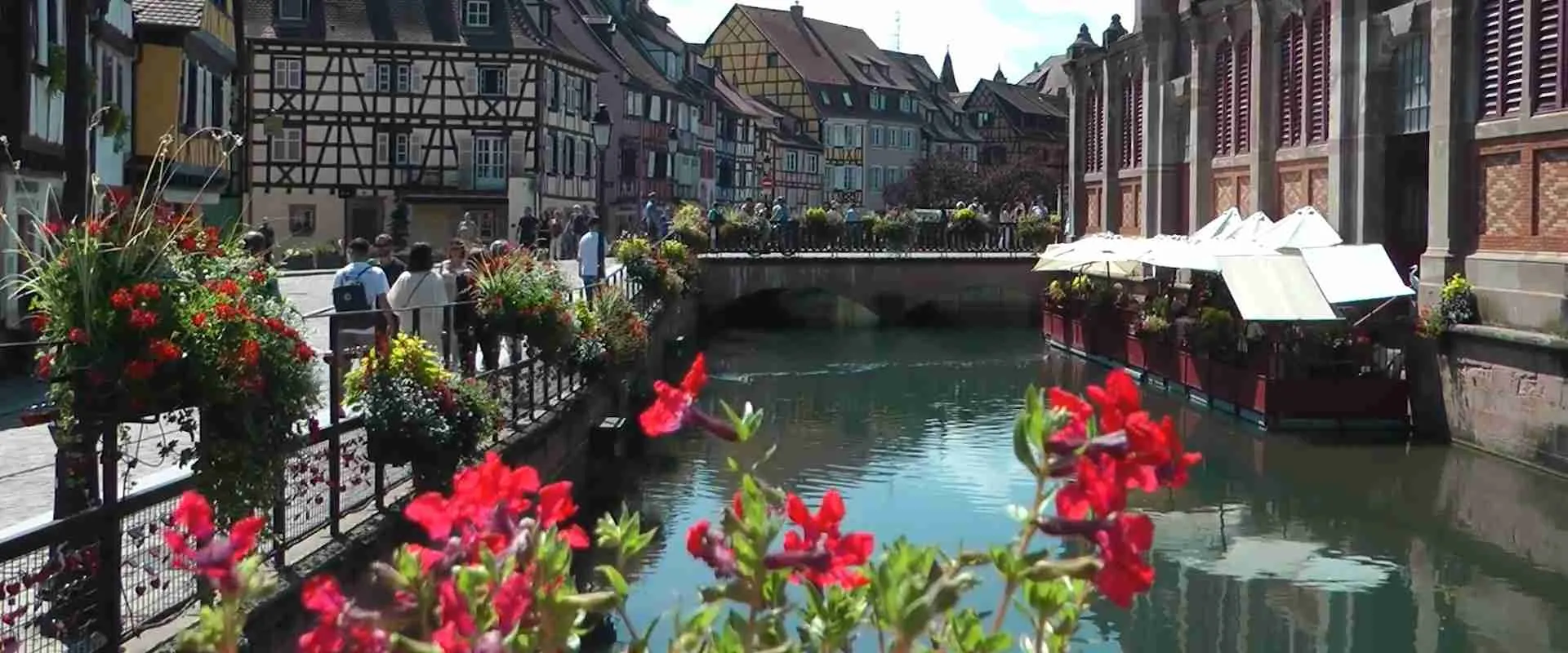
Little Venice is the stretch of the Lauch river and its canals between the Tanners’ Quarter and Quai de la Poissonnerie, lined with houses painted pink, yellow and pale blue, and it is best visited at dawn or in the late afternoon. The district takes its popular name from a comparison with the Italian lagoon city, which one French guide attributes to a journalist writing in the early 20th century; treat that origin as a local account rather than a documented record. Most of the houses were homes and workplaces of fishermen, market gardeners and tanners, who used the water to move goods toward the Covered Market.
What to Look For in Little Venice’s Waterfront Houses
The architecture here is vernacular rather than grand. Timber frames sit on stone ground floors that handled the damp, while upper floors project outward to gain space and shelter the street below. Wooden balconies and galleries overlook the water, steep roofs shed rain, and window boxes of geraniums bloom from May to September. The pastel plaster between the dark timbers is part of the picture, though paint schemes change over time, so do not expect any specific color to match old photographs.
Walk the quays on both banks. The north side gives the classic canal view with the facades reflected in the water, while the narrow lanes behind show how the district worked: workshops on the ground floor, living space above, drying lofts under the roof. Bridges link the banks every few dozen meters, and each offers a slightly different frame. The bridge near Rue de Turenne is the vantage most guides recommend for the early-morning view.
Boat Rides in Little Venice: Fares, Timing and Booking
A flat-bottomed boat ride through Little Venice lasts 25 to 30 minutes and costs about €8-9 per adult, with children discounted and under-threes free. The boats are poled by a guide who provides commentary on the district, and the route reaches rear gardens and courtyards that you cannot see from the pedestrian paths. Departures run frequently from April to October, and service is limited in winter. Guides advise arriving early in July and August, because morning slots fill quickly and individual reservations are not taken.
Book a late-afternoon slot if you want the best light. Between 5 and 6 PM the sun slants across the facades and the daytrippers are leaving. If the weather is poor or a queue forms, skip the boat and walk the quays, since the architecture reads well from the bank. Check the kiosk for the current fare before boarding.
The Tanners’ Quarter: Drying Galleries and Guild Streets
The Tanners’ Quarter is described in guide writing as a village within the village, a cluster of narrow streets around Rue des Tanneurs where the tanners’ guild worked. The upper floors of the houses served as drying lofts for hides, which explains the tall, open timber galleries and steep roofs. From Little Venice, the quarter takes about ten minutes to cross, so it is easy to fold into any route. A short distance away lies Rue des Vignerons, named for another medieval guild.
The quarter is most atmospheric early in the day. By midday the lanes carry the same crowds as the canals, so schedule it either side of 10 AM or after 5 PM. Look up rather than ahead: the timber details, carved corbels and drying shutters sit above shop-window height.
The Covered Market: An 1865 Iron Hall Beside the Canals
The Covered Market is an iron-framed hall dating from 1865 beside the Lauch, and one guide reports that it opens at 8 AM. Late morning is the better time for shopping, when producers from the Munster valley bring cheeses to add to the stalls. For an architectural visit the point is the contrast: a 19th-century industrial building sits next to medieval and Renaissance canal houses, showing how the town modernized without losing its older fabric. A boat embarkation point is reported beside the market, which makes it a convenient meeting place for groups.
Gothic Colmar in 2027: Saint Martin’s Collegiate Church, the Dominican Church & Unterlinden Museum
Colmar’s Gothic landmarks are Saint Martin’s Collegiate Church, the Dominican Church and the Unterlinden Museum, which occupies a former 13th-century Dominican convent. Between them they show how the town’s religious institutions built in stone while its merchants built in timber and plaster. Plan about an hour for the church, 30 minutes for the Dominican Church and one to two and a half hours for the museum.
Saint Martin’s Collegiate Church: Pink Sandstone and a Tiled Roof
Saint Martin’s Collegiate Church was built between 1235 and 1365 and is an important example of Gothic architecture in Alsace. It is constructed of pink Vosges sandstone, and a French heritage guide records its classification as a historic monument in 1840. A fire in the south tower in 1572 destroyed the framework and roofs, and the tower was crowned three years later with the lantern-shaped cap that gives the church its recognizable silhouette. The roof carries colored glazed tiles in a style reminiscent of the collegiate church in Thann.
Despite its common local name of Cathedral and its large dimensions, the church served as a cathedral for only about a decade, from the Civil Constitution of the Clergy in 1790 to the Concordat of 1801. Inside, look for the ambulatory, described as unusual in Alsatian churches, the Baroque organ case of 1755, and a 13th-century head of a beardless Christ in the stained glass. Archaeological work in the 20th century found foundations of an earlier church from around the year 1000. The south portal, dedicated to Saint Nicholas, dates from the second half of the 13th century and marks the transition between Romanesque and Gothic styles.
Visiting hours listed by the tourist office are Monday to Saturday 8:00 AM to 6:45 PM and Sunday 10:00 AM to 7:00 PM, except during services. Entry is generally free. Hours may shift during the year, so check the tourist office page before a Sunday morning visit.
The Dominican Church: A Quiet Gothic Interior
The Dominican Church is a 13th- and 14th-century Gothic monument in the heart of the old town, a short walk from Saint Martin’s Collegiate Church. It is austere and elegant in form, which makes it a good place to pause between the canals and the museum. Opening hours vary by season and event, so confirm them locally.
Unterlinden Museum: Convent Architecture and the Isenheim Altarpiece
The Unterlinden Museum opened in 1853 and occupies a former 13th-century Dominican convent, with a modern wing added in the 21st century. It is best known for the Isenheim Altarpiece, one of the most important Renaissance works in Europe. For an architecture itinerary the building matters as much as the collection: the cloister and convent spaces show Gothic monastic planning, and the modern extension shows how a historic fabric can be joined to new volumes.
- Opening hours: Wednesday to Monday, 9 AM to 6 PM, with last entry at 5:30 PM.
- Closed: every Tuesday and on 1 January, 1 May, 1 November and 25 December; shorter hours on 24 and 31 December.
- Full-price adult ticket: €14 at the latest published rate; check the museum’s official site for current 2027 pricing.
- Reduced rates: €9 for ages 12 to 17 and students under 30, free for children under 12.
- Bags: large bags and suitcases are not allowed; the permitted size is 40 by 30 by 20 centimeters, and everyone passes a security check at the entrance.
- Quiet times: footfall data suggests Fridays are the quietest, with Saturday around 3 PM the busiest.
Book online during Christmas and high summer to avoid queues. The museum reports pickpockets operate in crowded places, so keep bags closed and carried in front of you.
Halftimbered Gems Beyond the Center: Connectingpfaffheim, Turckheim & Eguisheim
Turckheim, Eguisheim and Pfaffenheim are the three villages that carry Colmar’s half-timbered tradition into the vineyards, and they can be linked in a single day by train, bus and bicycle. The place-name in this section’s title is Pfaffenheim, the wine village south of Eguisheim; the title joins the three villages in one connected route. Turckheim lies about 6 km west of Colmar, Eguisheim about 5 to 7 km to the south depending on the route, and Pfaffenheim roughly 13 to 15 km south by road.
The villages differ in character. Turckheim is a fortified former Decapolis town with civic buildings. Eguisheim is an intensively planned circular village that draws large crowds. Pfaffenheim is a working wine village on a hillside. Seeing all three shows the range of Alsatian vernacular building, from the formal to the farmyard.
Turckheim: Three Gates, a Guardhouse and the Night Watchman
Turckheim is a small medieval town in the heart of the vineyards, a former member of the Decapolis league of ten imperial towns, and its three imposing medieval gates are the remains of its fortifications. Inside the walls you will find the Guardhouse on Rue Wickram, the Town Hall, 17th- and 18th-century civic buildings, half-timbered houses typical of Alsace, and the Sainte-Anne church with a Romanesque bell tower. The whole circuit takes 90 minutes to two hours on foot.
The town’s best-known tradition is its night watchman, who sings his rounds in costume with halberd, lantern and horn. The tourist office states that his authentic song still sounds from May to October during rounds at 10 PM, and that in December he walks at 9 PM except on 24 and 25 December. Confirm the current schedule and any ticketing with the Turckheim tourist office before building a day around it. A guided daytime tour of the town is also offered in French with limited places.
Turckheim is the easiest village to reach from Colmar because it has its own railway station on the Colmar to Munster line. The ride takes roughly 10 minutes. From the station it is a short walk to the first gate.
Eguisheim: Concentric Streets Around an Octagonal Castle
Eguisheim is built in concentric rings of streets around a central castle, and its circular plan is the reason the village is among the most photographed in Alsace. It was voted Favourite Village of the French in 2013 and is classified among the Most Beautiful Villages of France. Narrow cobbled lanes lined with half-timbered houses, balconies, bay windows, pointed gables and winegrowers’ courtyards wind around the castle at the center, with Rue du Rempart following the circuit and Grand’Rue crossing it.
Local tradition holds that the castle goes back to the 8th century and was founded by Duke Eberhard; the surviving octagonal enclosure is a 13th-century stone structure, and the village was fortified from 1257. Tradition also holds that Bruno of Eguisheim-Dagsbourg, later Pope Leo IX, was born in the castle in 1002; he served as pope from 1049 until his death in 1054. Treat these as traditions rather than documented facts; they are widely repeated but depend on medieval accounts.
At the heart of the village stands the Saint Leo IX Chapel, built on the site of the castle and consecrated in the 1890s, which holds relics associated with the pope. A Renaissance-style fountain topped by a statue of Leo IX, placed there in 1842, stands on the castle square. The castle itself is described as accessible only on guided tours offered by the tourist office, and one visitor found it closed, so book through the tourist office if entry matters to you. A parish church dedicated to Saint Peter and Saint Paul was remodeled in Gothic style around 1220 according to a local tourism listing, and a small train and guided walks run by the local historical society tour the center.
The village rewards wandering the outer ring first, since the walls and inner courtyards are quieter there than on the main square, and then spiraling toward the castle. A marked trail with explanatory plaques follows the circular streets. Arrive before 10 AM or after 5 PM to avoid tour groups.
Pfaffenheim: A Quiet Vineyard Village on the Wine Route
Pfaffenheim lies roughly 13 to 15 km south of Colmar along the Alsace Wine Route, between Eguisheim and Rouffach, at the foot of the Schauenberg hill and its pilgrimage site. It is a working wine village, known for the Steinert grand cru terroir and for a village cooperative that offers tastings. A summer wine festival has run since 1987, held in July; the 2026 edition was set for 10 and 11 July, so look for a similar early-July weekend in 2027 and confirm the dates locally.
For architecture, the village offers Renaissance houses, fountains and half-timbered wine-growers’ houses, with a church, Saint Pantaleon, whose Romanesque three-story bell tower, reported by a hiking guide at about 36 meters, is said to be the last remnant of an early 12th-century church. Visitor accounts describe the stone of the apse as bearing notches that tradition links to winegrowers sharpening their knives. These details come from visitor guides, so treat the dimensions as approximate.
Pfaffenheim has no railway station, and public bus coverage is thinner than for Eguisheim, so it suits cyclists, drivers and walkers on the vineyard path between Eguisheim and the village. The route is described as a pleasant track through the vines and is much less crowded than the better-known villages.
Transport Logistics: Timing Regional Trains and Bicycles along the Alsatian Wine Route
Rail serves Turckheim directly, while Eguisheim relies on buses and Pfaffenheim on bicycles or cars, so the best day plan combines a train out, a bicycle between villages and a bus or train back. The trains on the Colmar to Munster line stop at Turckheim after about 10 minutes, and published timetables show departures roughly every one to two hours through the day; times change each season, so use the current TER Grand Est timetable. A standard one-way fare is about €4.
Eguisheim is reached by two bus options. A regional Fluo 68 service runs from the railway station toward Rouffach, and an urban bus runs from the Château d’Eau stop, listed hourly Monday to Saturday, with a journey of about 10 minutes and a fare near €3. A taxi costs about €18-22. Between Turckheim and Eguisheim there is no direct bus; the route goes through Colmar and takes 56 minutes to a little over an hour, so a taxi (about €19-23 for roughly 6.6 km) or a ride or walk of around 6 km is faster.
- Colmar to Turckheim: TER train, about 10 minutes, roughly €4.
- Colmar to Eguisheim: bus, about 10 minutes, roughly €3; taxi €18-22.
- Turckheim to Eguisheim: no direct bus; taxi €19-23, walk about 6 km, or via Colmar in about an hour.
- Eguisheim to Pfaffenheim: about 6 km along the vineyard path; no confirmed regular bus.
- Colmar to Pfaffenheim: about 13 to 15 km by road; 15 minutes by car.
A loop by bicycle from Colmar through Eguisheim and Turckheim covers roughly 20 to 25 km by this guide’s planning estimate, while tour operators describe a 29 km circuit from Eguisheim and a 40 km loop through Turckheim for slower pacing. The Alsace vineyard route follows quiet lanes and dedicated paths, and one stretch near Eguisheim runs on dirt for a few kilometers, so a hybrid or e-bike is more comfortable than a thin-tired road bike.
Rental rates vary by operator. One self-service operator with a location on Rue de Turenne in Colmar has been reported at roughly €35 for an e-bike day, and a gravel-bike specialist in Hattstatt lists €30 for a half day and €50 for a full day. Check the TER Grand Est rules for bicycles before relying on a train for the return leg, and download an offline map, because the route often skirts around the villages rather than through them.
How to Beat the Crowds in Colmar and Eguisheim in 2027: Timing by Day, Hour and Season
The simplest rule for avoiding crowds in Colmar is to arrive before 9 AM on a weekday and avoid Saturday afternoon. Footfall estimates put Little Venice’s busiest moment at about 2 PM on a Saturday, with visitors typically staying around an hour and a half, and Wednesday as its quietest day. The Unterlinden Museum is estimated busiest around 3 PM on Saturday and quietest on Fridays. Combine those patterns and a weekday morning schedule becomes the default plan.
- Best days: Wednesday and Friday for the old town and museum; Monday for Eguisheim and Turckheim.
- Best hours: before 9 AM and after 5 PM; the middle of the day is when tour buses arrive.
- Best months: late May, June and September for weather, flowers and lighter crowds.
- Busiest periods: July and August afternoons, Saturdays, and the Advent weekends from late November to late December.
- Quiet alternatives: Pfaffenheim and the vineyard paths between villages, and Turckheim in the early evening.
Seasonal character shifts too. Mid-May through September is the warmest period for canal-side dining and vineyard excursions, while the Advent markets run from late November to the end of December and bring illuminations to the half-timbered facades along with the largest crowds of the year. Winter and early spring are cheapest but quieter on the water, with limited boat service. Daylight in December is short, around eight hours.
The unlisted trick is direction. Most visitors enter Colmar through the station and move toward Little Venice and Pfister House in the late morning. Walk in the opposite order, beginning in the Tanners’ Quarter and ending at the House of Heads, and you meet fewer people at each stop. In Eguisheim, begin on the outer ring and finish at the castle square.
Alsatian Half-Timbered Architecture in Colmar and the Wine Villages: A Reading Guide for 2027
Alsatian half-timbered buildings follow a recognizable grammar that you can learn in a day and use in every village. The structural frame is oak or other timber, filled with plaster or masonry, and the frame’s pattern changes from the town to the countryside and from the 15th to the 17th century. Knowing the vocabulary turns a stroll into an informed survey and helps you date what you see by the details, within reason.
- Jettied floors: upper levels that project over the street, adding space and shelter.
- Oriels and bay windows: projecting windows, common on wealthy merchants’ houses such as Pfister House.
- Corbels and carved brackets: decorative supports, sometimes carved with faces or figures, as on the House of Heads.
- Painted facades: fresco or paint schemes, such as the scenes on Pfister House.
- Winegrowers’ courtyards: stone-arched gateways leading into working courtyards, common in Eguisheim and Pfaffenheim.
- Steep gables and drying lofts: tall roofs sheltering open galleries, typical of the Tanners’ Quarter.
Comparing the town and village examples is the best exercise. Colmar’s merchants’ houses show ornament as a statement of wealth. The village houses, such as those in Eguisheim, are narrower and tuck into rings of streets, with courtyards for pressing and storing wine. Turckheim sits between the two, with civic buildings and gates that show planned town architecture. Treat the dates quoted in plaques and guides with some care, since many houses were altered over centuries.
Colmar Itinerary 2027: Sample Two-Day and Three-Day Architectural Routes
The best two-day plan spends day one on Colmar’s old town and day two on Turckheim and Eguisheim, and a third day adds Pfaffenheim and the vineyard paths. The routes below assume a weekday start, use public transport for the villages and keep the busiest landmarks outside the Saturday afternoon peak. Prices are single line items per person at the latest published rates.
Day One: Colmar Old Town, Little Venice and Gothic Landmarks
- 7:45 AM: Walk from the station to Little Venice and cross the bridge near Rue de Turenne while the lanes are empty. Free.
- 8:30 AM: Follow Quai de la Poissonnerie into the Tanners’ Quarter and read the drying galleries. Free.
- 9:00 AM: Unterlinden Museum opens; allow two hours for the Isenheim Altarpiece and the convent architecture. Ticket €14.
- 11:30 AM: Walk to Pfister House, House of Heads and the Koïfhus along the pedestrian axis. Free from the street.
- 12:30 PM: Lunch at the Covered Market or a traditional Alsatian wine tavern (Winstub); a main course and a drink typically fall in the €15-25 range.
- 2:30 PM: Saint Martin’s Collegiate Church and the Dominican Church. Free entry.
- 5:00 PM: Little Venice boat ride in slanting light. Ticket about €9.
- 6:30 PM: Early dinner, then a stroll along the canals as the day trippers leave.
Attractions for day one come to about €25 per person, which sits at the low end of the mid-range attractions figure in the budget section below. The full mid-range daily cost with hotel share, meals and transport is approximately €145-230 per person.
Day Two: Turckheim and Eguisheim by Train, Bus and Foot
- 8:30 AM: TER train from Colmar to Turckheim, about 10 minutes, roughly €4.
- 9:00 AM: Walk Turckheim’s three gates, the Guardhouse and the Town Hall; allow 90 minutes to two hours. Free.
- 11:30 AM: Return to Colmar by train, about €4, and eat lunch near the station.
- 1:30 PM: Bus from Colmar to Eguisheim, about 10 minutes, roughly €3. If it is a Sunday, take a taxi (€18-22) or cycle.
- 2:00 PM: Walk the outer ring along Rue du Rempart, then spiral toward the castle square and Saint Leo IX Chapel. Free.
- 4:30 PM: Wine tasting at a winegrower’s courtyard; tastings often come with a small fee, so ask on arrival.
- 6:00 PM: Bus back to Colmar for dinner, or stay for the quieter evening in Eguisheim.
Day two is the cheapest day because most sights are free and local fares are only a few euros. The only fixed costs are the train and bus tickets and any tasting. If you prefer the night watchman, check the Turckheim tourist office for the current May to October schedule and plan to be in Turckheim at 10 PM, which means a taxi (€19-23 to Eguisheim) or a hotel stay in the village for the return.
Day Three: Pfaffenheim, the Vineyard Path and a Slow Return
- 9:00 AM: Pick up a bicycle in Colmar (about €35 for an e-bike day from one reported operator) or take a taxi to Eguisheim.
- 10:00 AM: Ride the vineyard path from Eguisheim toward Pfaffenheim, about 6 km, stopping for views over the Alsace plain.
- 11:30 AM: Walk Pfaffenheim’s Renaissance houses, fountains and Saint Pantaleon church with its Romanesque tower. Free.
- 12:30 PM: Lunch in the village or at the winegrowers’ cooperative if it is open for tastings.
- 2:30 PM: Return by bicycle through the vineyards to Colmar, roughly 13 to 15 km by road.
- 5:00 PM: Final golden-hour walk through Little Venice and an early dinner.
A third day is worth adding if you want quiet, because Pfaffenheim and the paths between villages see far fewer visitors. It also gives a buffer for weather: if rain makes the bicycle ride unattractive, swap in a second visit to the Unterlinden Museum or the Bartholdi Museum.
Colmar Budget 2027: Daily Costs for Budget, Mid-Range and Luxury Travelers
Mid-range travelers spend approximately €145-230 per person daily in Colmar, assuming two people share a mid-range hotel room. Budget travelers need approximately €85-135 per person daily, and luxury travelers approximately €300-535. Every figure below is per person, per day, with the hotel rate divided between two sharing; all rates are indicative, so check booking platforms and official sites for current prices.
Budget Travelers: Approximately €85-135 Per Person Daily
- Hotel share: €35-55 per person (a budget room at €70-110 for two).
- Meals: €30-45, with a bakery breakfast, a market or wine tavern lunch and a simple dinner.
- Local transport: €6-10, covering a few bus rides or one return train trip.
- Attractions: €15-25, such as one museum visit or a boat ride, with many sights free.
- Total: approximately €85-135 per person daily (two sharing a budget hotel).
Mid-Range Travelers: Approximately €145-230 Per Person Daily
- Hotel share: €60-100 per person (a mid-range room at €120-200 for two).
- Meals: €55-80, with a café breakfast, a sit-down lunch and a wine tavern dinner with a glass of local wine.
- Local transport: €6-12, including the Turckheim train and the Eguisheim bus.
- Attractions: €25-40, covering the Unterlinden Museum at €14 and a Little Venice boat ride at about €9, plus a tasting.
- Total: approximately €145-230 per person daily (two sharing a mid-range hotel).
Luxury Travelers: Approximately €300-535 Per Person Daily
- Hotel share: €125-225 per person (a luxury room at €250-450 for two).
- Meals: €110-170, including a gastronomic dinner and a wine-pairing lunch.
- Local transport: €25-60, with taxis between villages at €18-23 per hop.
- Attractions: €40-80, covering guided tours, private tastings and museum entries.
- Total: approximately €300-535 per person daily (two sharing a luxury hotel).
Solo Travelers and Trip Totals
Solo travelers pay the full room rate, so a mid-range solo day costs approximately €205-330, a budget solo day approximately €120-190, and a luxury solo day approximately €425-760.
For trip totals, apply the daily range for your tier to each day. A two-day mid-range visit totals approximately €290-460 per person, and a three-day mid-range visit approximately €435-690. Budget visitors spend approximately €170-270 over two days and €255-405 over three, while luxury visitors spend approximately €600-1,070 over two days and €900-1,605 over three. All trip totals assume two sharing a room.
Seasonal Price Variations in Colmar
Hotel prices in Colmar rise sharply in high season and during Advent. One price aggregator reports mid-range peak-season rates running roughly 85% above the average rate for the year. Late May, early June and September deliver the best balance of weather, flowers and lower rates. Boat rides and some seasonal services run on limited schedules from November to March, so winter visitors save on accommodation but give up some experiences.
Hidden Costs and Money-Saving Strategies
- Tourist tax: French communes charge a small per-person, per-night tourist tax that varies with hotel category; check the final price at booking.
- Parking: central car parks are paid, and the old town is largely closed to cars in Advent; staying near the station and using public transport avoids the issue.
- Museum discounts: young people aged 12 to 17 and students under 30 pay €9 at the Unterlinden Museum, and under-12s enter free.
- Free architecture: Pfister House, the House of Heads, the Koïfhus, Little Venice from the quays, both major churches and all three villages cost nothing to see from the street.
- Picnics: the Covered Market supplies regional cheeses and bread for a low-cost lunch.
- Weekday travel: midweek rates run lower and the crowds thin out.
- Bank card payments: TRACE buses accept contactless cards on board, so no ticket machine is needed.
Where to Stay in Colmar in 2027: Neighborhoods and Hotel Price Ranges
The best base for an architectural itinerary is the old town or the area between the station and Unterlinden Museum, and hotel prices run from about €70 to €450 per room per night depending on tier. Staying near Little Venice puts the canals at your door but costs noticeably more; aggregator data suggests hotels near the canals and the Tanners’ Quarter run well above the town average, by roughly 13% to 50% depending on the source. The station area is the budget zone, with guesthouses, aparthotels and bed-and-breakfasts, and many include breakfast.
- Budget (about €70-110 per room): chain hotels and aparthotels near the railway station, such as ibis budget Colmar Centre Ville, Hotel Primo Colmar Centre and B&B Hotel Colmar Lumière.
- Mid-range (about €120-200 per room): central hotels near Unterlinden Museum and the old town, including Mercure Colmar Centre Unterlinden and aparthotels such as Odalys City Colmar.
- Luxury (about €250-450 per room): boutique and five-star properties, including the House of Heads hotel (21 rooms) and L’Esquisse Hotel & Spa Colmar.
- Village stays: Eguisheim and Pfaffenheim offer rooms in half-timbered houses and vacation rentals, which let you see the villages after the day visitors leave.
Book early for May to September and for the Advent weekends; the cheapest rooms go first. A stay of two to three nights is the norm for visitors. If you plan the village excursions by public transport, choose a hotel within a 10-minute walk of the station to save time with luggage and early departures.
Practical Tips for Visiting Colmar’s Architecture in 2027: Hours, Tickets and Etiquette
The most useful practical advice is to check each opening time and ticketing rule before travel, because small sites change hours by season. This section collects the facts that affect planning most.
- Unterlinden Museum: open Wednesday to Monday, 9 AM to 6 PM; closed Tuesdays and four holidays; €14 full price at the latest published rate.
- Saint Martin’s Collegiate Church: Monday to Saturday 8:00 AM to 6:45 PM, Sunday 10:00 AM to 7:00 PM, except during services; check the tourist office listing.
- Covered Market: reported to open at 8 AM; late morning for cheese stalls.
- Little Venice boats: about €8-9 per adult, 25 to 30 minutes, no individual reservations reported; limited winter service.
- Turckheim night watchman: May to October at 10 PM, December at 9 PM except 24 and 25 December; confirm locally.
- Transport payment: contactless card or M-Ticket on TRACE; paper tickets are no longer the standard and were exchangeable only until 30 June 2026.
- Etiquette: many half-timbered houses are private homes and winegrowers’ courtyards are working spaces; photograph from the street and ask before entering a courtyard.
- Drones: check local rules before flying; the old town is a protected area.
- Weather: carry a light rain layer, since the Vosges foothills can bring showers, and wear shoes with grip for cobbles.
The most common mistake is arriving at Little Venice at midday on a Saturday, then leaving disappointed. The second most common is forgetting that the Unterlinden Museum is closed on Tuesdays. Fix both by planning around the day of the week.
Frequently Asked Questions About Colmar Architecture 2027
Is Colmar worth visiting for architecture in 2027?
Yes, Colmar is worth visiting for architecture because it concentrates Gothic churches, Renaissance merchants’ houses and canal-side half-timbered homes in a few walkable streets. Pfister House dates from 1537, the House of Heads from 1609, the Koïfhus from 1480 and Saint Martin’s Collegiate Church from the 13th and 14th centuries. Add the Unterlinden Museum, set in a 13th-century convent, and you have eight centuries of building in one day. The excursions to Turckheim, Eguisheim and Pfaffenheim show the same tradition in smaller settings. Plan around crowd peaks and Tuesday museum closures.
What is the best order for Colmar’s architectural landmarks in 2027?
The best order is Little Venice and the Tanners’ Quarter before 9 AM, then the Unterlinden Museum at opening, Pfister House, the House of Heads and the Koïfhus around midday, and Saint Martin’s Collegiate Church in the afternoon. This sequence moves against the main flow of visitors, who typically enter from the station and head straight to the canals. End with a late-afternoon boat ride in Little Venice, when the light is softest and the daytrippers are leaving. The whole route covers about 3 km and takes a full day with interior visits.
Is the Unterlinden Museum worth the €14 ticket in 2027?
The Unterlinden Museum is worth the €14 full-price ticket if you care about medieval and Renaissance art or monastic architecture, because it holds the Isenheim Altarpiece and occupies a former 13th-century Dominican convent. Young people aged 12 to 17 and students under 30 pay €9, and children under 12 enter free. The museum is open Wednesday to Monday from 9 AM to 6 PM, with last entry at 5:30 PM, and closed on Tuesdays. Allow one to two and a half hours, and visit on a Friday or at opening to avoid the Saturday afternoon peak.
How much does a Little Venice boat ride cost in 2027?
A Little Venice boat ride costs about €8-9 per adult at the latest published rates, with children discounted and under-threes free. Rides last 25 to 30 minutes, run frequently from April to October and operate on a limited schedule in winter. The boats are poled by a guide who gives commentary. Operators are reported not to take individual reservations, and July and August morning slots fill quickly, so arrive early or choose a late-afternoon slot. Check the fare at the kiosk before boarding, because operators set their own prices.
Can you visit Turckheim and Eguisheim in one day from Colmar in 2027?
Yes, you can visit Turckheim and Eguisheim in one day from Colmar by combining a 10-minute train ride to Turckheim with a 10-minute bus ride to Eguisheim. Spend the morning in Turckheim, where the three medieval gates, the Guardhouse and the town center take about two hours, then return to Colmar and continue to Eguisheim for the afternoon. There is no direct bus between the two villages, so a taxi (about €19-23) is faster if you want to link them directly. The train fare is around €4 each way and the bus around €3.
Is there a train to Eguisheim in 2027?
There is no train station in Eguisheim in 2027; the village is reached by bus or taxi from Colmar. A regional Fluo 68 service runs from Colmar station toward Rouffach, and an urban bus runs from the Château d’Eau stop, listed hourly Monday to Saturday, with a journey of about 10 minutes and a fare near €3. A taxi costs about €18-22. On Sundays, when the urban service is not listed, plan a taxi, a bicycle ride of roughly 6 km or a walk. Check the current Fluo and TRACE timetables each September.
Can you cycle from Colmar to Eguisheim and Pfaffenheim in 2027?
Yes, you can cycle from Colmar to Eguisheim and onward to Pfaffenheim on the Alsace vineyard route, which uses quiet lanes and dedicated paths. Eguisheim lies about 5 to 7 km from Colmar and Pfaffenheim about 6 km farther south; a loop through Eguisheim and Turckheim covers roughly 20 to 25 km by this guide’s planning estimate. Rental rates vary: a self-service operator on Rue de Turenne has been reported at about €35 for an e-bike day, and a gravel-bike specialist in Hattstatt lists €50 for a full day. Download an offline map, since the route skirts the villages.
What is the cheapest way to visit Colmar in 2027?
The cheapest way to visit Colmar is to travel midweek, stay near the station and rely on free architecture, public transport and market picnics, which brings the daily cost to approximately €85-135 per person with two sharing a budget hotel. Most major sights, including Pfister House, the House of Heads, the Koïfhus, both churches and all three villages, cost nothing from the street. Pay for one museum (€14, or €9 for students under 30) and skip the boat in favor of walking the quays. Avoid July, August and the Advent weekends, when rooms cost the most.
Where should you stay in Colmar in 2027?
Stay in the old town or between the station and the Unterlinden Museum for the shortest walks to the landmarks, with budget rooms near the station costing about €70-110 for two and mid-range central rooms about €120-200. Properties near Little Venice cost more, and luxury options such as the five-star House of Heads hotel run about €250-450 per room. If you prefer quiet evenings, a half-timbered guesthouse in Eguisheim or Pfaffenheim puts the villages at your door after the day visitors leave. Book early for May to September and Advent.
Is Colmar still crowded outside the Christmas season in 2027?
Yes, Colmar remains busy outside Christmas, especially on Saturday afternoons and in July and August, but the crowds are predictable and easy to avoid. Footfall estimates put Little Venice’s peak around 2 PM on Saturdays and its quietest day on Wednesdays, while the Unterlinden Museum peaks around 3 PM on Saturdays and is quietest on Fridays. Arrive before 9 AM or after 5 PM, travel midweek, and visit in late May, June or September. The villages are quieter in the early evening, after the tour buses depart.