
Coastal Liguria On-The-Road: The High-Altitude Ridge Route and Hidden Maritime Fortresses Road Trip Guide 2026
The ridge roads of coastal Liguria — the crinale network climbing above the five UNESCO villages of the Cinque Terre — carry almost none of the gridlock that chokes the SP370 coastal corridor every summer. A road trip along the SP51 and the connecting SP38 delivers unobstructed views across terraced vineyards, medieval maritime fortresses, and Romanesque sanctuaries that coastal-bound visitors never see. This guide provides the technical preparation, stage-by-stage routing, and 2026 cost framework to navigate the passes confidently.
Key Takeaways
- The SP51 — the Road of the Sanctuaries — climbs from 139 to 550 metres above the Cinque Terre coastline along 14.6 kilometres of well-paved asphalt well clear of coastal traffic. The SP370 coastal road from La Spezia serves as the entry corridor, with the SP51 junction beginning at a roundabout after the third tunnel. Together the two routes form the complete 2026 ridge circuit.
- All five Cinque Terre village historic centres operate as 24-hour ZTL (limited traffic zones) restricted to residents. Driving into the ZTL without a permit carries fines of €80–300. Park outside the ZTL boundary: Monterosso’s main Fegina parking area (approximately 300 spaces, €2–2.50 per hour) fills by 9 AM in July and August. Levanto offers easier parking at €1 per hour.
- Monterosso al Mare has zero EV charging points. La Spezia has more than 100 publicly accessible EV chargers including Be Charge network stations near Piazza Matteotti. EV drivers should charge fully in La Spezia before starting and plan a return stop before the charge falls below 30 percent.
- Budget road trippers spend €80–130 per person daily (two sharing a room); mid-range travellers spend €160–255; and luxury visitors invest €295–465. A 3-day ridge road trip costs approximately €240–390 (budget), €480–765 (mid-range), or €885–1,395 (luxury) per person.
- The Soviore Sanctuary — Liguria’s oldest Marian shrine, first documented in 1225 and the natural high point of the stage-by-stage itinerary — sits at 464 metres on the SP38, 78 metres below the Termine Pass. Its Romanesque bell tower, on-site restaurant, and guesthouse make it the ideal halfway rest point on the ascent from Monterosso harbour.
- Standard cars and small SUVs handle the SP51 and SP38 well in dry conditions. Campervans, large motorhomes, and vehicles with trailers are not suitable for the narrowest ridge road sections. Begin the ascent from Monterosso before 9 AM or after 4 PM to avoid peak-hour pressure on the approach roads and parking areas.
People Also Ask About Coastal Liguria Road Trip 2026
What is the best time in 2026 to drive the SP51 ridge road above the Cinque Terre?
April through early June and mid-September through October are the strongest windows for the ridge road trip. Temperatures at the 500-metre crinale level remain pleasant — typically 10–18 °C in spring and 14–22 °C in autumn — while coastal towns below are significantly warmer and more crowded. Parking in Monterosso is more manageable in shoulder season, and the Cinque Terre Trekking Card stays at its standard rate of €7.50 per adult per day rather than the doubled red-day pricing that applies on approximately 17 designated peak days per year in high summer. The SP51 road surface is well-maintained and driveable year-round, though mountain fog can reduce visibility above 400 metres on November and December mornings. Winter visitors benefit from free access to all national park trails and near-deserted passes, but should carry snow chains and confirm that the Soviore Sanctuary restaurant is open before planning a lunch stop at altitude.
Can I drive a large SUV or campervan on the SP51 and SP38 mountain passes in 2026?
A standard car, compact SUV, or crossover handles the SP51 ridge road and SP38 approaches without difficulty in dry conditions. The SP51 surface rates highly for quality and two standard vehicles can pass each other in most sections. The situation changes markedly on the descending spur roads toward each village, where the carriageway narrows to single-track width with passing places. Campervans, large motorhomes, and vehicles with trailers should not attempt these village-approach spurs and should restrict themselves to the main ridge road and the Levanto approach. A standard 4×4 SUV under approximately 2.0 metres in width encounters no practical difficulty on the SP51 itself. Vehicle width is the binding constraint, not ground clearance or four-wheel drive capability.
Are there ZTL restrictions affecting the SP51 ridge road or the SP370 approach in 2026?
The SP51 ridge road and the SP370 coastal approach lie entirely outside the Cinque Terre ZTL zones. The ZTL applies only to the historic centres of the five villages themselves — Monterosso, Vernazza, Corniglia, Manarola, and Riomaggiore — and is in force 24 hours per day, restricted to residents with authorisation. Driving into the ZTL without a valid permit triggers camera-recorded fines of €80–300 depending on the commune. The ridge road system — SP51 and SP38 — accesses the sanctuary areas and inter-village passes without entering any restricted zone, making it the correct route for drivers who want to experience the national park without risking a fine. If staying at accommodation inside a ZTL, the property must register your vehicle number plate before your arrival.
How much does a complete 3-day Ligurian ridge road trip cost per person in 2026?
Budget travellers spending two to a room in an agriturismo or the Soviore Sanctuary guesthouse pay approximately €80–130 per person daily, making the 3-day road trip cost €240–390 per person in total. Mid-range travellers staying in a 3-star hotel in Levanto or Monterosso spend €160–255 per person daily, bringing the 3-day total to €480–765. Luxury visitors at a 4-star Monterosso seafront hotel pay €295–465 daily, or €885–1,395 for the full 3-day itinerary. All figures assume two sharing a room, with the room rate halved before adding to individual daily costs, and include fuel and parking split between two people. Hotel prices in Monterosso peak sharply in July and August; shoulder-season stays deliver the same driving experience at considerably lower accommodation cost.
Extended multi-day tours – 5+ days
Featured Liguria Multi-Day Tour Packages

3 days
Liguria 3-Day Discovery Tour
- ✓ Comprehensive Liguria experience
- ✓ Expert local guides included
- ✓ All accommodation included
- ✓ Transportation provided

5 days
Liguria 5-Day Highlights Experience
- ✓ Comprehensive Liguria experience
- ✓ Expert local guides included
- ✓ All accommodation included
- ✓ Transportation provided

7 days
Liguria 7-Day Cultural Journey
- ✓ Comprehensive Liguria experience
- ✓ Expert local guides included
- ✓ All accommodation included
- ✓ Transportation provided
10 days
Liguria 10-Day Complete Adventure
- ✓ Comprehensive Liguria experience
- ✓ Expert local guides included
- ✓ All accommodation included
- ✓ Transportation provided
Multi-day tour packages powered by TourRadar. Prices and availability subject to change.
Understanding the Ligurian Ridge Network in 2026: Why SP51 Beats the Coastal Crowd
The Cinque Terre sits within one of Italy’s most topographically dramatic coastal zones, where the Ligurian Apennines drop to the Riviera di Levante in a near-vertical sequence of cliffs, terraced slopes, and narrow valley mouths. Five villages — Monterosso al Mare, Vernazza, Corniglia, Manarola, and Riomaggiore — occupy the handful of natural harbour inlets along this twelve-kilometre stretch, and the UNESCO World Heritage inscription of 1997 formalised what the communities had demonstrated over centuries: this landscape is extraordinary, intricate, and overwhelmingly vertical.
The road infrastructure that serves it reflects that verticality. Two provincial road systems run parallel to the coast at dramatically different elevations. The SP370 — the Cinque Terre Coast provincial road — runs at low altitude through a series of tunnels blasted through the headlands, connecting La Spezia to the south with Riomaggiore, Manarola, Corniglia, and eventually feeding the junction where the SP51 begins its ascent. It is the road that appears on tourist navigation systems, and it carries the predictable consequences: summer weekend traffic queues stretching back from the tunnel mouths, frustrated engines idling in the heat, and the particular irony of a scenic region where the car becomes a liability at precisely the most popular moment to use it.
The SP51 operates at a different register entirely. Known in full as the Strada Provinciale dei Santuari — the Road of the Sanctuaries — it climbs from the SP370 junction through the terraced interior landscape, reaching altitudes between 139 and 550 metres across its 14.6 kilometres of asphalt. The road takes its name from the series of Marian hilltop sanctuaries visible or accessible from its course, and it has served as the primary inland connection for ridge communities long before the coastal road existed. In 2026, it continues to function as the least-known route above one of Italy’s most visited coastlines — and for drivers who prepare correctly, it delivers an exceptional experience.
The third road in the system is the SP38, which descends from the Val di Vara inland valley and connects to the ridge near the Termine Pass (Passo del Termine) at 542 metres. The SP38 provides the most direct road ascent from Monterosso to the Soviore Sanctuary at 464 metres and continues to the Termine Pass intersection with SP51. For the stage-by-stage itinerary beginning at Monterosso harbour, the SP38 serves as the ascending route and the return descent, while the SP51 provides the panoramic ridge traverse between the two.
The practical case for choosing the ridge road in 2026 is straightforward. The Cinque Terre’s tourist season runs from April through October, and the SP370 and the rail corridor carry the overwhelming majority of it. The ridge road avoids that pressure while unlocking a landscape that coastal visitors almost never see: the interior of the national park’s terraced wine country, the crinale sightlines that let you observe all five villages simultaneously from above, and the maritime defensive network of towers and castles that becomes readable only at elevation. An understanding of how SP51 and SP370 work together — one as the gateway approach, one as the elevated traverse — is the foundation of this road trip.
The Cinque Terre’s rail hubs serve an important function for hikers and day visitors, but they offer nothing to a driver seeking to understand the ridge landscape. The train travels through the hillside in tunnels, surfacing briefly at each village station before disappearing underground again. It gives passengers no view of the terraced vineyards, no sight of the ridge-top sanctuaries, and no perspective on the defensive geography that the Genoese Republic imposed on this coastline over several centuries. The road trip designed around SP51 provides exactly what the train cannot: an elevated, mobile viewpoint that reads the landscape from the crinale down to the harbour.
Bypassing the Rail Hubs: Navigating SP51 and SP370 Mountain Passes Safely
The SP370 and SP51 operate as the two-phase structure of any well-planned Cinque Terre road trip: the SP370 is the access corridor, following the coast from La Spezia through the tunnel sequence that connects each village to the main provincial network; the SP51 is the elevation route, climbing above the coast to traverse the ridge in views that the SP370 never provides. Drivers approaching from the motorway join the A12 Genoa–Livorno at either the La Spezia–Santo Stefano Magra exit for the southern approach via the SP370, or the Carrodano exit for the northern approach toward Levanto and Monterosso via SP38. The choice of entry point determines the direction of the ridge traverse.
From La Spezia, the SP370 runs northward along the coast. The road follows the promontory toward Portovenere before turning to trace the Cinque Terre coastline through its tunnel sequence. After the first tunnel comes the turn for Riomaggiore; after the second comes Manarola; after the third tunnel, a roundabout marks the junction where the SP51 begins its ascent. Drivers taking the exit signed for Corniglia, Vernazza, and Monterosso join the SP51 here and begin climbing through Volastra and Groppo. The SP370 continues below at the coastal level, but once on SP51 the perspective shifts entirely: the road climbs steeply with continuous curves and narrowing carriageway as altitude builds.
From the Carrodano motorway exit, the recommended approach is southward toward Levanto, then along the coastal road toward Monterosso. From Monterosso, the SP38 provides the ascent to the Soviore Sanctuary and the Termine Pass, after which the junction with SP51 gives access to the full ridge traverse. This northern approach is often preferable for first-time ridge drivers because Levanto provides easier parking and a less pressured starting point than La Spezia in high season. It also places the itinerary in its natural uphill direction, from the harbour at sea level to the sanctuary at altitude.
Stage-by-Stage Itinerary 2026: From Monterosso Harbor to the Romanesque Sanctuary of Soviore without the Crowds
The Monterosso-to-Soviore stage covers approximately 4 to 5 kilometres of road and 464 metres of elevation gain, beginning at the Fegina beach parking area in Monterosso al Mare and ending at the Soviore Sanctuary’s stone forecourt. It is the defining ascent of the ridge road trip: a transition from sea-level coastal village to a hilltop pilgrimage centre that takes under 20 minutes by car but delivers an entirely different Cinque Terre than the one visible from the harbour below.
Start at the Fegina parking area — the largest parking facility in the Cinque Terre at approximately 300 spaces, charging €2–2.50 per hour. In peak season the lot fills by 9 AM on most summer weekend days; arriving before 8 AM is the reliable strategy. The parking area sits near the Monterosso train station and the Fegina beach promenade, with the new town’s restaurants and shops adjacent. From here, follow road signs uphill toward Soviore and the national park interior. The ascent begins immediately: the road climbs sharply out of the valley floor, winding through olive groves and the lower terraced vineyards that supply the Cinque Terre’s DOC wine production — the Sciacchetrà dessert wine and the Cinque Terre Bianco DOC both come from grapes grown across these same terraces.
At around 2 kilometres from Monterosso, the road breaks out of tree cover and the first ridge-top views appear to the south and east. The Ligurian Sea is visible as a broad horizontal behind the receding profile of the promontory, with the Monterosso harbour — so crowded at sea level — appearing as a compact inlet far below. Another kilometre of climbing, and the SP38 reaches the Soviore Sanctuary complex at 464 metres above sea level.
The Soviore Sanctuary is Liguria’s oldest Marian shrine, first mentioned in a document of 1225 and associated with a site of devotion likely older still — local tradition holds that the original discovery of the sacred image dates to the 8th century, though documentary evidence begins in the 13th. The main church body dates primarily to the 14th century, extensively renovated in the 18th century when the interior was reconfigured from three naves into a single hall. The defining architectural element is the bell tower, from the Romanesque period and the oldest surviving part of the complex: three storeys, topped by a spire, its face opened by characteristic Romanesque paired-arch windows. The main façade carries a Gothic ogival portal with a marble bas-relief of the Madonna Addolorata, surmounted by a Gothic rose window. Inside, the barrel-vaulted ceiling was frescoed with scenes from the sanctuary’s legendary founding; the interior also houses an Agati pipe organ from 1834 and canvas works from the Genoese school. The surrounding stone forecourt is shaded by centuries-old cypress and holm oak trees, recognised as monumental trees by the Italian forestry authority. The sanctuary celebrates its main feast on 15 August and the Festa del Ritrovamento on 7 July.
The sanctuary operates as a working pilgrimage centre with an on-site restaurant and a pilgrim guesthouse, making it a practical rest point and — for budget travellers willing to book well ahead — a genuinely memorable overnight option at altitude. After resting, continue up SP38 for a further 78 metres of elevation over roughly one kilometre to reach the Termine Pass at 542 metres. This is the high point of the route and the junction with the SP51 ridge road. The pass offers clear northward views into the Val di Vara and southward across the Cinque Terre coast; on clear mornings before summer haze builds, the full arc of the Ligurian coastline from Punta Mesco to the La Spezia gulf is visible.
From the Termine Pass junction, turning onto SP51 begins the ridge traverse. The road runs generally southwest along the crinale, maintaining altitude between 400 and 550 metres. The first kilometres follow a section of the Alta Via delle Cinque Terre long-distance trail that runs parallel; hikers and cyclists share this corridor and road speeds should be adjusted accordingly. The SP51 passes the junction for Vernazza roughly 3 to 4 kilometres from the Termine Pass — descending right brings you toward the Vernazza parking area on a road that becomes steep and single-track in its final section. Continuing on SP51, the Corniglia junction follows, and the road eventually descends toward the SP370 roundabout junction, completing a circuit if starting from La Spezia.
The complete loop from Monterosso — ascending via SP38 through the Soviore Sanctuary, crossing SP51 along the ridge, descending to the SP370 junction, and returning along the coastal road to Monterosso — covers roughly 35 to 50 kilometres depending on diversions to village approach roads. Allow three to four hours for the full loop including a 45-minute rest at the sanctuary and at least two viewpoint stops on the ridge. A more leisurely approach across a full day allows time to park near Vernazza and visit the Doria Castle on foot, adding the maritime fortress dimension to the ridge perspective.
Vehicle Width and Road Characteristics on SP51 and SP370 in 2026
The SP370 coastal road handles two-way traffic through most of its length without difficulty, though the tunnel sections reduce the effective carriageway and approaching headlights are the signal to slow and allow the oncoming vehicle to complete its passage first. Headlights should be on at all times through the tunnel sequence. The SP370 tarmac condition is adequate to good, with periodic resurfacing by the provincial authority.
The SP51 presents a different character. From the SP370 roundabout junction, the road is initially adequate for two cars side by side and in generally good condition. As it climbs toward Volastra and Groppo the carriageway narrows progressively. In the sections between the main village junctions and the Termine Pass, road width varies: two small cars or hatchbacks can pass with mutual care, but two SUVs in the narrowest sections require one vehicle to use a passing place or the outer edge of the road. Passing places exist at irregular intervals. On most Italian single-track mountain roads the descending vehicle seeks the first available widening point when encountering an ascending vehicle — this convention operates on SP51 and SP38 and should be expected rather than resisted. Reversing in a controlled manner on a gradient is a standard skill for ridge road users.
The spur roads descending from SP51 toward individual village parking areas — particularly toward Vernazza — become genuinely single-track, steep (gradients can exceed 15 percent in the final sections), and unguarded at the outer edge in places. These roads are not suitable for campervans, minibuses, large motorhomes, or vehicles towing a trailer. A standard passenger car or small SUV under approximately 1.95 metres in width handles these descents without difficulty in low gear with appropriate caution. Drivers who prefer not to navigate the village approach roads can restrict themselves to the SP51 ridge traverse, return via SP38 and the Soviore Sanctuary to Monterosso, and use the Cinque Terre Express train or the seasonal ferry service to visit the other villages. This combination of ridge drive and rail access is, practically speaking, the most comfortable approach for drivers unfamiliar with narrow mountain roads.
The SP38 between Monterosso and the Soviore Sanctuary is narrower than the main SP51 in most of its length, winding through terraced land where the carriageway is typically sufficient for one car at a time with passing places at intervals. The standard Italian mountain road convention applies: sound the horn briefly before blind curves, keep to the uphill side where possible, and move into the nearest widening point when oncoming traffic appears.
Embankment Engineering and Load Awareness on Ligurian Coastal Ridge Roads
The road embankments supporting SP51, SP38, and the descending village approach roads are built over and through the Cinque Terre’s celebrated dry-stone terrace system — the ciappi, a network of retaining walls constructed over centuries to reclaim agricultural land from the near-vertical hillside. In several sections, road embankments rest on or are integrated with terrace wall structures that were not originally designed as road foundations. The provincial authority carries out regular maintenance, but sections showing vegetation growth on vertical embankment faces, surface discoloration at the road edge, or visible crack patterns in the outer wall face should be treated as advisory indicators: move to the inner lane, avoid parking adjacent to suspect embankment sections, and do not linger at the outer edge.
For practical weight considerations: signs at the approaches to the narrowest sections of the SP51 and SP38 network indicate the tonnage limit applicable to that passage. These signs are mandatory limits, not advisory guidelines. The Regione Liguria roads portal publishes current restrictions, but conditions can change after winter rainfall events, and checking in-season is worthwhile for any vehicle over 3.5 tonnes. Standard passenger cars and standard SUVs generate no meaningful load concern on the asphalted sections. For heavier vehicles — larger campervans, light trucks with full water tanks, in the 3.5–7.5 tonne range — verifying the current posted limits at the road entrance before beginning the ascent is the responsible practice. The outer edge of the ridge road in several sections presents a significant drop onto terraced slopes below; guardrails exist on the most exposed sections but there are stretches without continuous barrier protection. Keep to the centre of the carriageway and use only designated lay-bys for photography stops.
ZTL Zones and Access Restrictions 2026: What Drivers Must Know Before Entering the Cinque Terre
The Cinque Terre is governed by three separate municipal authorities: the Comune di Monterosso al Mare, the Comune di Vernazza (which also covers Corniglia and neighbouring settlements), and the Comune di Riomaggiore (which covers Riomaggiore, Manarola, Volastra, and Groppo). Each administers its own ZTL with its own camera positions, sign language, and fine schedule. A driver who has navigated one zone cannot assume the rules of the next are identical.
The common element across all three comuni is that historic village centres are ZTL 0-24: restricted to authorised vehicles 24 hours per day, seven days per week, every day of the year. There is no off-peak window in which tourist vehicles can legally enter without a permit. Camera enforcement is automated: number plates are photographed at the zone boundary, cross-checked against the permit database, and fines are issued by post to the registered owner. For rental car drivers, the rental company forwards fines to the renter, typically with an additional administration charge on top of the original penalty. Fines in the Comune di Riomaggiore have been documented at approximately €122; the general range across Italian ZTL zones runs €80–300 depending on the severity classification. A repeat entry captured by multiple cameras on the same day can generate multiple fines for a single visit.
In practice, the ZTL boundary typically begins at a gate or barrier at the last road-accessible point before each village pedestrian core. At Monterosso, the ZTL starts at the old-town barrier by the tunnel. At Vernazza, the lower parking area boundary marks the limit — below the Cooperativa parking area the road becomes residents-only. At Corniglia and the other villages, the approach roads effectively terminate at small parking areas above the pedestrian zones. The rule of thumb is clear: when you see a gate or barrier across the road, that is the ZTL threshold. Park before it, not through it.
Monterosso is the only village of the five with significant visitor parking. The Fegina parking area near the train station offers roughly 300 spaces at €2–2.50 per hour and is the recommended base for the ridge road itinerary. The Loreto covered car park in the historic centre is the alternative, immediately adjacent to the pedestrian zone. Both fill rapidly on summer weekends and public holidays; arriving before 9 AM gives a strong probability of finding a space. After 10 AM in July and August, availability is unreliable. If both Monterosso lots are full, the practical alternatives are Levanto — main municipal lot near the train station at €1 per hour, with a 3-minute train connection to Monterosso — or La Spezia, which has larger city parking near the main station at approximately €1.50 per hour and frequent train connections to all five Cinque Terre villages.
If you are staying at accommodation inside a Cinque Terre ZTL, the property is responsible for registering your vehicle number plate with the relevant commune before your arrival, granting temporary access for check-in and check-out. This is the property’s obligation, not the guest’s, but confirming that it has occurred before you arrive is the guest’s insurance against a fine during the approach manoeuvre.
The SP51 ridge road and the Soviore Sanctuary approach via SP38 are entirely outside all Cinque Terre ZTL zones. Driving this route, parking at the Termine Pass area, stopping at the sanctuary, and traversing the full SP51 ridge requires no ZTL permit and carries no fine risk. The ridge road trip is the cleanest way to navigate the national park area by car in 2026.
Hidden Maritime Fortresses Along the Ridge Route 2026: A Driver’s Architecture Guide
The Cinque Terre’s reputation for pastel harbours and coastal trail vistas obscures an older, more defensive reading of the landscape. From the 12th century onward, the Republic of Genoa consolidated military and administrative control over the Riviera di Levante, building or reinforcing coastal defensive structures at each strategic harbour point. The ridge roads, being the primary pre-modern overland connection, passed directly above or adjacent to these structures; in 2026 the SP51 and SP38 offer the same elevated perspective, allowing a driver to read the defensive geography of the coast in the way that the Genoese commanders who planned it would have understood it — from the high ground above the sea.
The Cinque Terre’s maritime defence problem became acute during the 16th and 17th centuries, when North African corsair fleets and Ottoman Turkish naval expeditions raided the Ligurian coastline with increasing frequency and devastation. A signal network of coastal towers — watchtowers placed on promontories, headlands, and village perimeters — provided early warning of approaching threats. The visual signalling system linked these structures across sightlines that remain readable from the ridge road today: from the SP51 or the Soviore Sanctuary approach, the relationship between the Aurora Tower in Monterosso below, the Doria Castle promontory at Vernazza further south, and the high ground of Monte Castellana above forms exactly the chain of observed and observing positions that the Genoese defensive architecture intended.
Aurora Tower, Monterosso al Mare. The most accessible of the Cinque Terre’s surviving watchtowers stands on the seafront of Monterosso’s historic district, at the foot of the San Cristoforo headland between the old town and the Fegina shore. Built in the 16th century as part of the village’s defensive perimeter, the tower takes its name from Aurora, the goddess of dawn — a reference to its eastward orientation and the sunrise sea views available from its upper level. The tower is open to visitors, with a restaurant on the lower floor and the upper section accessible on tours. Its rooftop provides one of the clearest views of the Cinque Terre bay available from any man-made structure at sea level. From the SP38 during the descent toward Monterosso, the Aurora Tower is visible as a cylindrical silhouette against the Fegina seafront below.
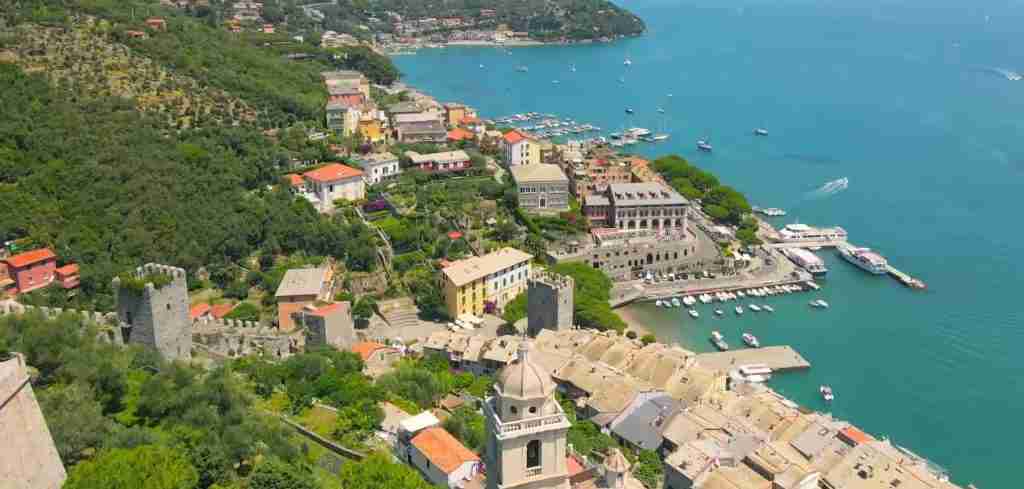
Doria Castle and Belforte Tower, Vernazza. The oldest surviving fortification in the Cinque Terre stands on a rocky promontory above Vernazza’s harbour. A document from 1080 records this site as the “castrum Vernatio,” associated with the Obertenghi, a Frankish noble family with feudal authority over the Cinque Terre in the early medieval period. The cylindrical tower that survives today is the original core of the structure; subsequent modifications were made under a succession of Genoese noble families including the Fieschi, until the Genoese Republic consolidated control over the coastline and the castle passed under the Doria, whose name it now carries. The Belforte Tower, integrated into the fort as its watchtower element, extended sightlines along the coast in both directions, enabling effective visual signalling to other coastal stations. Today the castle is largely a ruin except for the cylindrical tower, with tickets purchased at the site. From the SP51 ridge road, Vernazza’s harbour and the castle promontory are visible as a single composition roughly 500 metres below — one of the defining views of the ridge traverse, and one that makes the defensive logic of the coastal network immediately legible from above.
Monterosso Castle Ruins. The Obertenghi family who fortified Vernazza also established a castle above Monterosso to defend the northern village from maritime raids. The structure was subsequently modified under the Doria, Fieschi, and Saporiti families over several centuries. Today the castle survives only in its outer wall foundations and the tombs of noble families built into the old bastions; the walled enclosure now functions as the village’s historic cemetery, with the Church of San Cristoforo serving as the cemetery chapel. This is an unconventional but genuinely atmospheric heritage site — the convergence of medieval defensive architecture, noble family sepulchre, and Ligurian hilltop setting makes it a distinctive stop during a Monterosso morning before beginning the ascent.
Capuchin Monastery and Church of San Francesco, Monterosso. Though not a military structure, the Capuchin Monastery on the San Cristoforo hill occupies one of the most strategically sited positions in Monterosso — above the old town, commanding views over the Fegina shore and the Vernazza direction simultaneously. Established in 1618, the complex includes the Church of San Francesco, which contains significant 17th-century artworks. Its elevated hill position adjacent to the old castle ruins reflects the typical Ligurian medieval pattern of religious and military structures sharing commanding ground — the monks, like the garrison before them, occupied the position precisely because of what could be seen and controlled from it.
Monte Castellana Military Fortification. Visible from sections of the SP51 and from the Alta Via delle Cinque Terre ridge trail, the large military structure on Monte Castellana occupies high ground above the village sequence with clear sightlines in multiple directions. The site is not accessible to visitors. Its mass is clearly legible from the ridge road as a form distinctly different from the agricultural and pilgrimage architecture surrounding it, and its elevated position serves as the clearest reminder on the crinale that the ridge was not only a route of spiritual pilgrimage but also a defensive corridor whose heights the Genoese Republic sought to control and observe.
Punta Mesco Semaphore. On the western headland above Monterosso — accessible only by the hiking trail from the Fegina parking area, not by the road trip itself — stands a 1917 Italian Navy signal station built to monitor maritime traffic on the Genoa–La Spezia shipping route. It operated as a visual signalling post, using flag signals by day and light signals by night, until 1976 when electronic navigation rendered it redundant. The structure represents a later phase of the same coastal surveillance logic as the medieval watchtowers: the Ligurian maritime corridor demanded observation posts at its geometric control points, in every era. From sections of the SP38 ascent toward the Soviore Sanctuary, the Punta Mesco headland is visible to the northwest as a promontory above the Ligurian Sea.
San Giorgio Castle, La Spezia. For drivers beginning or ending the road trip in La Spezia, the San Giorgio Castle on the hill above the city harbour provides the broadest strategic overview of the entire driving route. A medieval fortification with a complex modification history, it occupies the dominant high point above the La Spezia gulf. From its upper platform the full arc of the gulf is visible, with the Cinque Terre coastline extending to the northwest and the Portovenere peninsula closing the southern jaw of the bay. San Giorgio Castle now houses the civic archaeological collection. Check current opening hours and admission costs at the La Spezia comune cultural services website, as schedules and pricing change seasonally.
EV Charging Infrastructure 2026: Electric Vehicle Planning for the Ligurian Ridge
Monterosso al Mare has no EV charging infrastructure within the village. Chargemap’s publicly accessible database records zero charging points for Monterosso al Mare. This gap is not likely to close significantly in the near term: the historic centre’s ZTL restrictions limit vehicle access, there is no large public car park suitable for charging installation, and the grid infrastructure in the Cinque Terre villages is sized for residential demand rather than high-power vehicle charging.
The ridge roads — SP38 and SP51 — have no EV charging points. The rural sections of the route, including the climb to the Soviore Sanctuary, the Termine Pass, and the SP51 crinale traverse, pass through national park territory where no charging infrastructure is installed or foreseen.
La Spezia is the primary EV charging hub for the entire Cinque Terre approach corridor. The city has more than 100 publicly accessible charging points, including Be Charge network stations on Via Dalmazia near Piazza Matteotti and additional points near the main train station. These include both AC slow chargers suitable for overnight charging at a hotel and DC fast chargers capable of significant top-up within 30 to 40 minutes. La Spezia is the logical start point for EV-equipped road trippers: charge to 90–100 percent before departing, execute the full ridge circuit (approximately 50–70 kilometres round trip from La Spezia to the Soviore Sanctuary and back with typical village diversions), and return to La Spezia for a top-up before any further driving. A modern long-range EV can execute this circuit without range concern; a shorter-range vehicle should plan one complete circuit per charge cycle.
Levanto has limited but real EV charging. At least one charging point is available in the town centre piazza area, and Agriturismo Villanova, approximately 2 kilometres outside Levanto toward the Cinque Terre interior, offers EV charging for guests. The town’s smaller size relative to La Spezia means fewer backup options if the primary point is occupied; EV drivers using Levanto as a base should verify availability before relying on it as the sole charging source.
For range planning, the key calculation is straightforward. The La Spezia to Termine Pass circuit via SP370 and SP38 covers approximately 60–70 kilometres; a typical long-range EV (real-world range 300 kilometres or more) completes this circuit with comfortable reserve. Regenerative braking on the descents from 542 metres to sea level provides meaningful energy recovery. A practical note on connectivity: mobile signal coverage on the SP51 and SP38 corridor is inconsistent. Download offline maps before departure, note the address of the nearest La Spezia charging station, and avoid relying on real-time navigation apps to locate chargers in areas where signal is intermittent.
Seasonal Timing and Peak-Hour Avoidance 2026: When and How to Drive the Mountain Passes
The SP370 coastal road experiences its most severe traffic pressure from mid-July through the last weekend of August. During this period, queues can extend several kilometres from the SP370 tunnel approaches on Friday evenings, Saturday mornings, and Sunday afternoons — the classic Italian summer movement pattern. For road trippers whose travel dates fall in this window, the SP51 ridge traverse is significantly less affected: the crinale route carries a fraction of the coastal volume, and the Soviore Sanctuary area at 464 metres is rarely congested even when the village car parks below are at capacity. The ridge road is not immune to summer pressure — it carries increased motorcycle and cycling traffic from May through September — but the pressure is of a qualitatively different and more manageable kind than the stop-start coastal queue.
The ideal months for the ridge road trip in 2026 are April, May, early June, and September through October. April delivers the terraced vineyards in spring growth, with wildflowers on the high sections of SP51, temperatures of 14–20 °C on the ridge, and accommodation at shoulder-season rates 25–40 percent below August peaks. May remains excellent through its first three weeks before the pre-summer surge begins; the Pentecost weekend typically brings the first major crowd spike on the coast, though the ridge road is less affected. September returns pleasant temperatures alongside harvest activity in the vineyards: grapes for the Cinque Terre Bianco DOC and the Sciacchetrà are typically picked from mid-September through early October, and the terrace landscape is at its most characterful during this period.
Winter — November through March — offers the quietest ridge roads and a genuinely unusual experience. The Cinque Terre Trekking Card is not required for any trail during this period, which makes ridge hiking free as well as uncrowded. Road conditions require specific preparation: fog is possible above 400 metres on November and December mornings (typically burning off by 10 AM), and frost occurs on the SP51 overnight from December through February. Snow chains are legally required in Italy for mountain passes when precipitation is occurring or forecast; carry them from November through March even if conditions appear clear at departure. Check the Regione Liguria weather portal (allertameteo.regione.liguria.it) for road closure updates before any winter ridge drive.
Peak-hour avoidance follows predictable patterns. The SP370 and the Monterosso parking areas experience the highest pressure between 9 AM and 6 PM on all weekend days and public holidays from mid-June through August. The effective strategy is to begin the ridge drive before 8 AM — when parking is available, the SP38 ascent is quiet, and the early light at altitude is exceptional for photography — or to arrive in the late afternoon after 4 PM when the day-tripper wave begins to depart and parking availability recovers. Weekday visits, Monday through Thursday, during peak season see markedly less vehicle volume on the ridge roads compared to weekends, with a corresponding improvement in parking availability and a less pressured sanctuary stop.
Cinque Terre Card pricing also reflects seasonal timing in a way that rewards early or late visitors. Standard (green zone) Trekking Card rates are €7.50 per adult per day for the majority of the season. On approximately 17 designated high-demand days per year — typically falling in late July, August, and specific bank holiday dates — red-zone pricing doubles the cost to €15 per adult per day. Timed for April, May, or September, standard rates apply throughout the itinerary.
Budget Planning 2026: Complete Cost Breakdown for the Ligurian Ridge Road Trip
The Cinque Terre is among the more expensive domestic destinations in Italy, and a road trip that adds vehicle costs to an already premium coastal price structure requires honest pre-trip budgeting. All figures below assume two people sharing a car and one room. The room rate is divided by two before being added to individual daily costs; this division occurs first, before any other addition. Figures are expressed per person per day and as a complete 3-day itinerary total.
Accommodation Costs 2026
Budget accommodation at an agriturismo in the Levanto hinterland, a basic B&B on the Monterosso approach road, or a room in the Soviore Sanctuary guesthouse typically runs €70–120 per room per night in shoulder season, rising to €100–140 in peak summer. Per person with two sharing: €35–60 per night. The Soviore Sanctuary guesthouse is the most distinctive budget option on the route itself — staying at 464 metres, directly on the itinerary, in a working pilgrimage centre — and should be booked well in advance as capacity is limited. A 3-star hotel in Levanto or Monterosso costs €150–220 per room in mid-season, or €75–110 per person sharing. Four-star hotels in Monterosso directly on the seafront reach €250–380 per room in peak season, or €125–190 per person sharing. Platform data indicates Monterosso rooms from approximately €96 per night in off-season to peak average rates around €200–370 in May and summer months; booking at least 44 days in advance is strongly recommended to access the most competitive available rates.
Food and Dining Costs 2026
Monterosso and the Cinque Terre villages carry premium restaurant pricing by Italian standards, reflecting their tourist draw and the logistical cost of supplying isolated harbour communities. A budget approach — market bread and local cheese for lunch, a trattoria dinner sharing a carafe of house wine — keeps daily food costs to approximately €35–50 per person. A mid-range day with a sit-down seafood lunch (€18–28) and a full restaurant dinner with wine (€38–55 per person) represents a realistic Cinque Terre experience at current pricing. Fine dining focused on cacciucco fish stew and the Sciacchetrà dessert wine paired with local pastries reaches €65–100 per person for dinner alone. The Soviore Sanctuary restaurant offers mid-range Ligurian dishes at altitude — an accessible and atmospheric lunch option during the ridge drive without descending to the coastal village price premium.
Fuel and Transport Costs 2026
Fuel for a standard petrol car executing the Monterosso–Soviore–SP51 circuit (approximately 50–70 kilometres of mountain driving per day) runs approximately €8–14 per car per day at Italian petrol prices, or €4–7 per person with two sharing. An A12 motorway toll for the La Spezia–Carrodano section adds approximately €4–6 per journey depending on vehicle class. The Cinque Terre Train Card, which includes unlimited second-class train travel between La Spezia and Levanto stopping at all five villages, costs €16 per adult per day at standard rates — relevant if the road trip base is La Spezia or Levanto and rail access complements the ridge drive for village visits.
Parking Costs 2026
Parking is the most variable cost in the Cinque Terre road trip and the item most likely to create budget stress if unplanned. Monterosso Fegina: €2–2.50 per hour; a typical visit of 4–6 hours costs €8–15 per car, or €4–7.50 per person with two sharing. Levanto municipal lot near the train station: €1 per hour; a full day’s parking costs €4–8 per car. La Spezia parking garages near the main station: approximately €1.50 per hour or flat-rate daily options. The Soviore Sanctuary and Termine Pass have informal stopping areas with no charge, suitable for the ascent rest stop. Free roadside parking exists on the SP51 in straight sections with adequate road verge, away from blind bends and road-edge drop-offs — look for white line markings indicating permitted zones.
Cinque Terre Card and Attraction Costs 2026
The Cinque Terre Trekking Card costs €7.50 per adult per day at standard rates (€15 on red-day pricing) and is required only for the paid sections of the Blue Trail (Sentiero Azzurro) between Monterosso and Vernazza, and between Vernazza and Corniglia. The ridge trails, including the Alta Via delle Cinque Terre that runs parallel to SP51, are free without a card. The Soviore Sanctuary path from Monterosso (path 509, 2.5 kilometres, approximately 1.5 hours) is also free. The 2-day Trekking Card at €14.50 per adult covers both days if combining one day of ridge driving with one day of Blue Trail hiking. Doria Castle in Vernazza charges a small admission fee; check current pricing at the Vernazza comune or at the site on arrival. The Soviore Sanctuary itself is free to visit, with donations accepted. San Giorgio Castle in La Spezia charges for entry; verify current pricing at the La Spezia comune cultural services page before visiting.
Daily Budget Summaries 2026
Budget travellers spending two to a room pay €80–130 per person per day on the ridge road trip. At the lower end — an agriturismo room split between two people, picnic lunch at the Soviore Sanctuary, a trattoria dinner in Levanto, conservative fuel and parking — the day comfortably reaches €80–95. At the top of the budget tier — a basic Monterosso B&B, a trattoria dinner with a carafe of Cinque Terre DOC, and full-day Monterosso parking — the per-person total approaches €125–130. For a 3-day road trip at budget pace, total spending runs approximately €240–390 per person.
Mid-range travellers sharing a 3-star hotel pay €160–255 per person per day. The hotel share at €75–110, sit-down meals at €56–93, parking and fuel at €10–18, Cinque Terre Card at €7.50–15, and incidentals at €10–18 produce the range. The 3-day mid-range total runs approximately €480–765 per person. This tier delivers the most satisfying balance of comfort and authentic experience: a hotel with sea views, a serious dinner including local fish, and unhurried time on the ridge road.
Luxury travellers at a 4-star Monterosso seafront hotel pay €295–465 per person per day. The hotel share (€125–190 per person) is the largest single line item; fine dining dinner (€65–100) and a private boat excursion or guided tour (€40–70) bring the daily total to the upper range. The 3-day luxury total runs approximately €885–1,395 per person, and may include a private guide for the Soviore and SP51 traverse, afternoon wine tasting at a Sciacchetrà producer by advance booking, and a private speedboat tour of the Cinque Terre coastline as a complement to the ridge perspective.
Accommodation Strategy 2026: Where to Base Along the High-Altitude Route
The ridge road trip works best from one of five base types, each with different cost, access, and parking implications. The choice of base also determines the direction of the ridge traverse and the level of morning flexibility available before coastal crowds build below.
Levanto is the most practical base for first-time Ligurian ridge road trippers. The town lies just beyond the western boundary of the Cinque Terre National Park, with municipal parking near the train station at €1 per hour and markedly more relaxed access than Monterosso. From Levanto, the drive toward Monterosso via the SP370 and the SP38 ascent to the Soviore Sanctuary takes under 30 minutes. The Levanto train station is 3 minutes from Monterosso by train, providing a seamless secondary option for village visits when the car is parked. Accommodation ranges from budget pensioni (from approximately €70–100 per room in shoulder season) to comfortable 3-star hotels (€130–200 per room). Limited EV charging is available in the town centre.
La Spezia suits road trippers approaching from Tuscany, Rome, or the A12 from Livorno, and those who want the largest EV charging infrastructure plus access to the Portovenere peninsula as a day-trip extension. La Spezia’s urban accommodation is cheaper than Cinque Terre prices: 3-star hotels near the train station run €90–150 per room. The 17-minute train journey from La Spezia Centrale to Monterosso connects the city base to the ridge road start. The San Giorgio Castle and the city’s own seafront promenade offer independent content for arrival and departure days.
Monterosso al Mare is the most expensive base but offers the shortest distance to the ridge road ascent and direct access to the Fegina beach. Hotel options range from small B&Bs (€100–180 per room depending on season) to seafront 3- and 4-star hotels (€200–380 per room at peak). Parking is the constraint: Fegina parking must be secured before 9 AM in summer. For drivers who want to begin the SP38 ascent at first light without any transit involved, Monterosso is the natural choice despite its cost premium.
Soviore Sanctuary Guesthouse is the most atmospheric accommodation on the ridge road itself. The sanctuary’s foresteria provides pilgrim-style rooms within the 464-metre complex, with the on-site restaurant, centuries-old gardens, and dawn views that no coastal hotel can match. Booking directly with the sanctuary community well in advance is essential — particularly for August, when pilgrimage groups, scout retreats, and hiking parties fill the available rooms. The combination of an overnight stay at altitude and early-morning access to the SP51 ridge before any day-trippers arrive represents the most complete version of the ridge road experience available in 2026.
Agriturismo in the Cinque Terre hinterland provides a further option for travellers who want rural Liguria without coastal hotel pricing. Working farms around Volastra, Groppo, and the Val di Vara offer rooms with parking included — a critical consideration in this region — and typically serve dinners using estate-grown produce: local olive oil, pesto made from Ligurian basil, rabbit prepared in the regional style, and the area’s DOC wines. Rates at quality agriturismo properties run approximately €90–140 per room per night, competitive with basic Monterosso B&Bs while delivering a substantially different experience and direct proximity to the SP51 corridor.
Emergency Protocols and Safety 2026: Mountain Pass Driving Essentials
The SP51 and SP38 pass through national park territory with inconsistent mobile signal coverage. Several sections between Monterosso and the Termine Pass, and along the SP51 above the main village junctions, have weak or absent coverage on major Italian networks. Download offline maps (Maps.me, Google Maps offline) before departure and note the Soviore Sanctuary and the Vernazza junction as navigational anchor points with saved coordinates. Do not rely exclusively on real-time navigation in the ridge sections.
Emergency contacts for the ridge road area: Italian emergency services, 112 (police, ambulance, fire — single European emergency number, functions with minimal credit on most phones even with weak signal in many areas); Italian roadside assistance via ACI (Automobile Club d’Italia), 803.116; mountain and medical emergencies, 118. The Cinque Terre National Park ranger service and visitor centres are reachable through parconazionale5terre.it.
Fuel: there are no petrol stations on the SP51 or SP38 ridge sections. The nearest fuel is available in Monterosso at a station near the town entrance, in Levanto near the train station area, and throughout La Spezia. Begin the ridge drive with a minimum of half a tank; mountain climbing at sustained gradient consumes fuel faster than flat-road driving and the return descent offers no mid-route refuelling option.
Italian road law requires all vehicles to carry a high-visibility vest accessible from the driver’s seat without entering the luggage area, and a warning triangle for breakdown situations. Rental cars are required to include both; verify before departing. Speed limits on the SP51 and SP38 are 50 km/h in built-up sections near the sanctuaries and Volastra, and 70–90 km/h on the open mountain sections — but the practical safe speed in narrow ridge road curves is often considerably below any posted maximum, and should be governed by road width and visibility rather than the sign. Italian blood alcohol limits are 0.05 percent for standard licence holders and 0.00 percent for drivers under 21 or with a licence held for under three years; carabinieri and polizia stradale conduct regular checks on the SP370 approach from La Spezia during summer season.
Weather awareness is significant for the ridge roads. Summer thunderstorms build rapidly over the Ligurian Apennines in July and August, typically in the afternoon from 2 to 5 PM; morning drives are safer than afternoon on high-summer days. Rain on the SP38 and SP51 makes the road surface slippery at bend sections where braking rubber accumulates. Check the Liguria Meteo service (limet.eu) before each morning’s drive. If Regione Liguria issues a red weather alert, do not drive the ridge roads: the same alerts that close the hiking trails reflect genuine slope instability risk, which can affect road embankments as well as footpaths. The national park suspends Trekking Card sales during red-alert conditions, which serves as an indirect but reliable indicator that the ridge environment is genuinely hazardous on those days.
Frequently Asked Questions
What is the easiest approach to the SP51 ridge road for drivers arriving from Tuscany in 2026?
The most direct approach from Tuscany is via the A12 Genoa–Livorno motorway, exiting at La Spezia–Santo Stefano Magra. From the tollbooth, follow signs for the La Spezia waterfront, then the Cinque Terre direction northward, and pick up the SP370 coastal road. The SP51 junction is signed after the third tunnel, at a roundabout indicating the turn toward Corniglia, Vernazza, and Monterosso. The A12 Carrodano exit — used to approach from the north through Levanto — is often less congested in peak season because the La Spezia approach is the more heavily used entry corridor. Allow 30 minutes from the La Spezia tollbooth to the SP51 junction in shoulder season, or up to 60 minutes in July and August peak traffic. From the Carrodano exit, Levanto is 10–15 minutes by road, and from Levanto the coast road to Monterosso takes a further 10 minutes.
Can I visit the Soviore Sanctuary without a Cinque Terre Card in 2026?
Yes. The Soviore Sanctuary is reached by road via SP38, which is not subject to any Cinque Terre Card requirement. The card is required only for the paid sections of the Blue Trail — the coastal path between Monterosso and Vernazza and between Vernazza and Corniglia. The hiking path from Monterosso to the sanctuary (path 509, 2.5 kilometres, approximately 1.5 hours on foot) is free. All ridge trails including the Alta Via delle Cinque Terre that runs parallel to SP51 are free without a card. The sanctuary itself does not charge admission. If you plan to combine a ridge road drive and sanctuary visit with a day’s hiking on the paid Blue Trail sections, the 1-day Trekking Card at €7.50 covers the hiking access without requiring a train card.
How does the SP51 ridge road differ from the SP370 coastal road in terms of driving experience in 2026?
The SP370 is the coastal provincial road connecting La Spezia to the Cinque Terre villages through a series of tunnels, running mostly at low altitude near sea level. It carries the majority of tourist car traffic and experiences significant congestion on summer weekends. The SP51 — Road of the Sanctuaries — runs at 139–550 metres altitude along the ridge above the villages, offering continuous panoramic views of the Ligurian coast and terraced vineyards across 14.6 kilometres of well-maintained asphalt. The SP51 is far less trafficked than the SP370 and provides a mountain road driving experience: curves, altitude changes, occasional narrow sections, and exceptional sustained scenery. The two roads complement each other in a circuit rather than competing: the SP370 provides the coastal gateway and return, while the SP51 provides the elevated traverse that makes the ridge road trip distinctive. Most drivers who attempt the circuit find they want to repeat the SP51 direction on a second day.
What is the complete daily driving distance for the Monterosso ridge circuit in 2026?
The core circuit from Monterosso’s Fegina parking area — ascending SP38 to the Soviore Sanctuary and Termine Pass, joining SP51, traversing the full 14.6-kilometre ridge road, descending to the SP370 junction, and returning along the coastal road to Monterosso — covers approximately 35–50 kilometres depending on how much of the SP51 is traversed before turning back or descending. A full loop including a diversion to the Vernazza parking area and a walk into the village adds approximately 6 kilometres. An extended day that also includes driving to the SP370 junction near La Spezia and returning covers approximately 60–75 kilometres total, well within comfortable daily mountain driving range for any standard vehicle.
Are the ridge roads safe to drive in rainy conditions in 2026?
Light rain does not close the SP51 or SP38, but it materially changes the risk profile. The outer tarmac on curves where braking rubber accumulates becomes slippery when wet; lower tyre pressures, extended braking distances, and speeds well below posted maximums are the practical response. Heavy rain raises a more serious concern: the Cinque Terre national park terrain is subject to slope instability, and heavy precipitation events have caused SP51 and SP38 road closures in previous seasons. Check the Regione Liguria weather alert system at allertameteo.regione.liguria.it before any rainy-season ridge drive. An orange or red weather alert is the signal to postpone the traverse entirely. The national park suspends Trekking Card sales during red-alert conditions, which serves as an indirect indicator that conditions at that level carry genuine risk across the whole ridge environment.
Can I charge an electric vehicle in the Cinque Terre national park in 2026?
No public EV charging stations exist within the Cinque Terre National Park boundaries or in Monterosso al Mare. The ridge roads — SP38 and SP51 — have no charging infrastructure. La Spezia provides the nearest reliable hub, with more than 100 publicly accessible chargers including Be Charge network fast chargers near Piazza Matteotti; these can top up a long-range EV within 30–40 minutes. Levanto has limited charging in the town centre piazza and at Agriturismo Villanova approximately 2 kilometres from the centre. For EV drivers, the practical approach is to charge fully in La Spezia, complete the ridge circuit (approximately 60–70 kilometres round trip), and return to La Spezia for a top-up before any further driving. Modern long-range EVs handle this without range concern; shorter-range vehicles should plan one circuit per charge cycle and avoid extended diversions to multiple village approach roads.
Is Doria Castle in Vernazza accessible by car from the SP51 ridge road in 2026?
Doria Castle is not directly accessible by car; the final approach is on foot through Vernazza’s pedestrian harbour lanes. From the SP51, the descent road toward Vernazza arrives at a parking area approximately 1 kilometre above the village, and from there the walk to the castle takes 15–20 minutes through the village lanes and a short steep staircase. The descent road to the parking area is narrow and steep — gradients exceed 15 percent in the final section — and is not suitable for campervans or vehicles over approximately 2.0 metres in width. Doria Castle is largely a ruin except for the original cylindrical 11th-century tower; tickets are purchased at the site. From the castle’s elevated position, the view of Vernazza harbour and the surrounding coastline is exceptional, and the perspective makes the same defensive sightlines visible from the ridge road above suddenly comprehensible from the castle level below.
What are the parking arrangements for overnight stays at the Soviore Sanctuary in 2026?
Overnight guests at the Soviore Sanctuary may use the parking areas adjacent to the sanctuary complex on SP38. The approach road is freely accessible from Monterosso; there is no barrier or restricted zone on the ascent. The sanctuary forecourt area provides adequate space for a modest number of vehicles. The guesthouse should be booked directly with the sanctuary community well in advance, particularly for August when pilgrimage groups, scout organisations, and hiking parties fill available rooms. Contact details and availability are maintained through the Cinque Terre National Park sanctuary network and the Monterosso al Mare comune website. The on-site restaurant is available to both overnight guests and day visitors arriving by road or trail without reservation.
What are the key practical differences between starting the ridge circuit from La Spezia versus from Levanto in 2026?
Starting from La Spezia takes advantage of the largest EV charging infrastructure and motorway proximity but adds distance to the Soviore Sanctuary — approximately 30–35 kilometres one way via SP370 and SP38. Parking in La Spezia is available at covered city garages near the train station at approximately €1.50 per hour. A La Spezia–based circuit is logical for travellers wanting to combine the ridge drive with a visit to the southern Cinque Terre villages (Riomaggiore, Manarola), as the SP370 passes their approach roads before reaching the SP51 junction. Starting from Levanto places the driver on the northern side of the ridge, reaching Monterosso in 10–15 minutes and beginning the SP38 ascent after a shorter transfer. Levanto parking is cheaper (€1 per hour) and more reliably available in peak season. Levanto also provides direct train access to all five villages, which makes it a natural base when combining road and rail.
What should I carry in the vehicle for a safe day on the Ligurian ridge road in 2026?
Italian law requires a high-visibility vest accessible from the driver’s seat and a warning triangle for breakdown situations; verify that the rental car includes both before departing. Additional practical items for the ridge road: offline maps downloaded before entering areas of weak signal coverage; a fully charged phone with the emergency number 112 and ACI roadside assistance number 803.116 saved; at least 2 litres of water per person (the ridge road has no water sources between the Soviore Sanctuary restaurant and Levanto); snacks for altitude delays; and a basic tyre gauge. EV drivers should note the nearest La Spezia charging location and start each ridge drive with range calculated conservatively — sustained mountain climbing at gradient reduces real-world range relative to flat-road estimates. For travel between November and March, snow chains or winter tyres are legally required at altitudes above 400 metres when precipitation is occurring or forecast; carry and fit them before the ascent rather than at the point of need on a narrow mountain road.