
Central Portugal Without the Crowds: A 2026 Curated Guide to the Kingdom’s Best-Kept Secrets
Central Portugal holds the bones of a kingdom — fortified hilltowns, medieval abbeys, forgotten river valleys, and a landscape that moves between schist and granite without ever asking for your attention. While Lisbon and Porto absorb the tour buses, the Beiras, the Ribatejo, and the Alentejo fringe remain genuinely unhurried: places where the bread is still baked in stone ovens, the wine costs less than the glass feels it should, and the monasteries see more swallows than selfie sticks. This guide maps the region’s most rewarding and least-visited destinations for 2026, with honest costs, practical logistics, and the kind of insider sequencing that turns a good trip into an exceptional one.
Key Takeaways: Central Portugal Without the Crowds 2026
- Budget travelers spend €45-80 per person daily (two sharing a guesthouse or hostel), making central Portugal one of Western Europe’s most accessible destinations in 2026 — a full week runs approximately €315-560 per person.
- Mid-range comfort costs €90-150 per person daily (two sharing a mid-range hotel or charming pousada), with a week coming to roughly €630-1,050 per person — exceptional value for the quality delivered.
- Luxury travelers invest €200-355 per person daily (two sharing a five-star pousada or historic manor), with a seven-night stay running approximately €1,400-2,485 per person including guides, private transfers, and upscale dining.
- Coimbra, Tomar, Viseu, and Castelo Branco are the anchor cities of the region and all reward at least one overnight stay — none requires more than two nights to see the highlights, making circuit itineraries highly efficient in 2026.
- Spring (April-June) and autumn (September-October) are the optimal windows: wildflower-covered hillsides, harvest festivals, mild temperatures, and accommodation prices 20-35% below August peaks.
- A rental car transforms the experience — public transport serves the main towns adequately, but the schist villages of the Aldeias Históricas, the Serra da Estrela high plateau, and the vineyard lanes of the Beira Interior are inaccessible without wheels.
People Also Ask About Central Portugal Without the Crowds 2026
How much does a trip to central Portugal cost per day in 2026?
Daily costs in central Portugal in 2026 vary significantly by travel style, but the region consistently undercuts comparable destinations in Spain, France, and Italy. Budget travelers sharing guesthouse accommodation spend approximately €45-80 per person daily, covering a private or dorm room, local meals at tascas and mercados, and regional bus or train transport. Mid-range travelers — two people sharing a three-star hotel or boutique pousada — spend €90-150 per person daily, adding sit-down restaurant dinners, entrance fees at major monuments, and occasional rideshare or taxi. Luxury travelers at historic pousadas and quintas spend €200-355 per person daily, incorporating fine dining, private guides, and wine-estate experiences. These figures include accommodation divided between two people — solo travelers should add the full room supplement, typically €30-80 extra per night depending on tier.
Which towns in central Portugal are the least crowded in 2026?
The least-visited yet most rewarding towns in central Portugal in 2026 include Viseu (an elegant city virtually unknown outside Portugal), Trancoso (a walled medieval town with almost no tourist infrastructure), Penamacor (a border castle village in the deepest Beira Baixa), Castelo Branco (a quiet regional capital with a spectacular episcopal garden), and the Aldeias Históricas circuit — twelve schist villages including Piódão, Sortelha, and Monsanto. Even Tomar and Coimbra, the two most-visited cities in the region, remain manageable: neither experiences the congestion of Sintra or Óbidos, and both can be visited comfortably without advance reservation for most of the year.
Do I need a car to explore central Portugal in 2026?
A car is strongly recommended for any itinerary that goes beyond the main urban centres in 2026. Coimbra, Tomar, Santarém, and Guarda connect reasonably well by Comboios de Portugal regional trains and Rede Expressos coaches. However, the Aldeias Históricas schist villages, the Serra da Estrela mountain plateau, the Beira Interior wine country, and the interior castle towns of the Raia border zone are either poorly served or entirely without public transport. Rental cars in central Portugal cost €30-60 per day for a compact vehicle (including insurance), with fuel economical on the IC and EN highway network. Driving standards are good, roads are well-maintained, and parking in smaller towns is almost always free.
What is the best time to visit central Portugal without crowds in 2026?
April through June and September through October are the optimal periods for visiting central Portugal without crowds in 2026. Spring brings the Serra da Estrela wildflowers, the almond and cherry blossoms of the Beira Baixa valley, and the Queima das Fitas student festival in Coimbra (first week of May). Autumn delivers the grape harvest in the Dão and Beira Interior wine regions, lower accommodation prices, and the warm amber light that defines Portuguese hill towns at their most photogenic. July and August are entirely manageable in terms of crowds — central Portugal never approaches Algarve saturation — but temperatures exceed 35°C in the interior and accommodation prices rise 25-40% above spring and autumn levels. Winter (November-February) offers the lowest prices, dramatic Serra da Estrela snowfall, and a genuinely local atmosphere but closes some smaller museums and rural tourism properties.
Extended multi-day tours – 5+ days
Featured Portugal Multi-Day Tour Packages

3 days
Portugal 3-Day Discovery Tour
- ✓ Comprehensive Portugal experience
- ✓ Expert local guides included
- ✓ All accommodation included
- ✓ Transportation provided

5 days
Portugal 5-Day Highlights Experience
- ✓ Comprehensive Portugal experience
- ✓ Expert local guides included
- ✓ All accommodation included
- ✓ Transportation provided

7 days
Portugal 7-Day Cultural Journey
- ✓ Comprehensive Portugal experience
- ✓ Expert local guides included
- ✓ All accommodation included
- ✓ Transportation provided
10 days
Portugal 10-Day Complete Adventure
- ✓ Comprehensive Portugal experience
- ✓ Expert local guides included
- ✓ All accommodation included
- ✓ Transportation provided
Multi-day tour packages powered by TourRadar. Prices and availability subject to change.
Introduction: The Portugal That History Forgot to Advertise
The story of Portugal is in many ways the story of its centre. It was in Guimarães, just north of the Douro, that Afonso Henriques declared the kingdom in 1139. It was in Coimbra — once the Moorish city of Qulumriyya — that the first university was founded in 1290 and where Inês de Castro was buried in one of the most heartbreaking tombs in Europe. It was in Tomar that the Knights Templar built their Convent of Christ, a building so layered with Romanesque, Gothic, Manueline, and Renaissance additions that a single visit can barely contain it. And it was across the boulder-strewn highland of the Beiras that a thin line of medieval fortresses — Trancoso, Pinhel, Almeida, Castelo Rodrigo — held the frontier against Castile for three centuries.
None of this is obscure in the historical record. All of it is obscure on the tourist map.
Central Portugal — roughly the triangle between Coimbra, Castelo Branco, and the Spanish border — absorbs perhaps eight to ten percent of the country’s international visitors despite containing some of its most significant monuments, most dramatic landscapes, and most authentic food and wine culture. The reasons are structural rather than qualitative: no beach, no airport hub, no single iconic image that circulates on social media. What the region has instead is coherence — a landscape, a cuisine, a pace of life, and an architectural heritage that feel genuinely continuous rather than curated.
This guide treats central Portugal as a destination in its own right rather than a day-trip appendage to Lisbon. It covers the major anchor cities with practical depth, maps the lesser-known villages and landscapes that reward independent exploration, and provides honest 2026 cost guidance calibrated to real prices rather than optimistic approximations.
The Anchor Cities: What Warrants Your Nights in 2026
Coimbra: The University City That Earns Two Nights
Coimbra is the most visited city in central Portugal and the only one that appears on a significant number of international itineraries. It earns that attention. The Joanine Library — built between 1717 and 1728 under João V and considered one of the most beautiful baroque interiors in the world — justifies the journey alone. The old university on the hilltop, still fully operational with 20,000 students, creates an atmosphere entirely unlike the preserved-in-amber quality of most Portuguese historic centres: this one breathes, argues, sings fado at two in the morning, and sells used textbooks alongside azulejo tiles.
The Joanine Library tickets cost €13 for adults in 2026, with timed entry slots that book out weeks in advance in summer — reserve at uc.pt as early as possible. The wider university complex ticket covering the Royal Palace, Examination Room, and chapel costs €12.50. The Machado de Castro National Museum, occupying the former bishop’s palace above a Roman cryptoporticus that visitors walk through, charges €6 and is among the most underrated museum experiences in Portugal. The Santa Cruz Monastery on Praça 8 de Maio is free to enter and contains the tombs of the first two Portuguese kings.
Coimbra fado — distinct from Lisbon fado, more austere, sung exclusively by students and alumni — performs at venues including Diligência Bar and À Capella, a converted twelfth-century chapel on Rua Quebra Costas. Cover charges at dedicated fado venues run €10-15 and typically include one drink.
Two nights in Coimbra is the correct allocation: the first for the university hill and Santa Cruz, the second for Machado de Castro, the lower town’s market, and an evening of fado. Hotels in the historic centre run €65-95 per room for a solid three-star; boutique options on the Baixa cost €90-140. Budget travellers find guesthouses and hostel beds for €15-30 per person.
Tomar: The Templar City That Demands More Than a Day Trip
Tomar is positioned on every Lisbon day-trip list and deserves better. The Convent of Christ — UNESCO World Heritage since 1983 — is architecturally the most complex building in Portugal, a layered accumulation of Templar round church, Gothic chapter house, eight Manueline cloisters, and Renaissance additions spanning four centuries. Three hours is the minimum to absorb it meaningfully; four is better. The extraordinary Manueline chapter house window, a tangle of nautical rope, coral, armillary spheres, and Templar crosses, is the single most photographed architectural detail in Portugal outside Sintra.
Convent of Christ entry costs €10 for adults in 2026. The town below the convent hill rewards a leisurely walk: the Mata Nacional dos Sete Montes park surrounding the convent is free and dramatically beautiful, the Nabão river runs through a quiet centre of whitewashed houses, and the synagogue on Rua Dr. Joaquim Jacinto — one of the best-preserved medieval synagogues in Iberia — charges €3. The Friday market beside the Templars’ bridge is one of the most genuine in the Ribatejo and worth timing an overnight to catch.
Staying overnight in Tomar rather than day-tripping from Lisbon changes the experience entirely. The town empties after five o’clock; the convent glows differently in late evening light; the restaurants on Praça da República serve honest Ribatejo food — bacalhau com grão, caldeirada de enguias — at prices that feel like a different economic reality from the capital. Mid-range hotels run €55-85 per room; the charming Hotel dos Templários beside the river costs €75-110.
Viseu: The Elegant City Almost Nobody Visits
Viseu is, by a reasonable measure, the most underrated city in Portugal. Positioned in the heart of the Dão wine country, it combines a genuinely beautiful historic centre — granite cathedral, bishop’s palace, arcaded praça — with a quality of local life (restaurants, markets, wine bars) that punches well above its modest international profile. The Museu Grão Vasco, housing the masterworks of Vasco Fernandes, the greatest painter of the Portuguese Renaissance, charges €4 and is magnificent in a way that art collections three times its size rarely are.
The Cathedral of Viseu is free to enter and contains a Renaissance interior of quiet power. The Adro da Sé — the terrace in front of the cathedral — looks out over rooftops and vine-covered hills in a panorama that requires no filter. The surrounding Dão wine region produces some of Portugal’s most food-friendly red wines from Touriga Nacional and Tinta Roriz; a tasting at a local quinta costs €10-20 and almost always includes cheese and presunto. Viseu’s Tuesday and Saturday market at the Feira de São Mateus grounds is the best general market in the Beiras.
Hotels in Viseu run €50-80 per room for mid-range options; the Montebelo Viseu Congress Hotel and the Hotel Palácio dos Melos represent the upper tier at €90-140. Budget accommodation in guesthouses runs €20-35 per person. One night is workable; two nights with a morning drive into the Dão vineyard lanes is the better choice.
Castelo Branco: The Garden City of the Beira Baixa
Castelo Branco sits in the lower Beiras, closer to Spain than to Lisbon, and is visited almost exclusively by Portuguese travellers from other regions. Its extraordinary Jardim do Paço Episcopal — the Episcopal Palace Garden — is one of the finest baroque gardens in the Iberian Peninsula: a formal composition of granite stairways, azulejo-lined water channels, clipped box hedges, and monumental statuary including the Apostles, the Kings of Portugal, and the Evangelists, arranged along a central axis that builds to a theatrical reflecting pool. Entry costs €2.50 — one of the best-value cultural experiences in Portugal.
The Museu Francisco Tavares Proença Júnior, next door to the garden, houses an important collection of Flemish tapestries alongside the colchas bordadas — the elaborate embroidered bedspreads that are Castelo Branco’s most distinctive craft tradition. Museum entry costs €3. The Ruínas do Castelo Templário above the town offer panoramic views over the Tejo valley toward Spain for free. The local market on Tuesday and Friday mornings beside the jardim is excellent for regional produce: smoked presunto from the Cova da Beira, migas à transmontana, and the local honey.
Castelo Branco works well as an overnight base for exploring the Aldeias Históricas circuit to the north and the Tejo Natural Park to the south. Hotels run €45-70 per room; guesthouses €20-30 per person.
The Aldeias Históricas: Twelve Villages Worth the Detour in 2026
The Aldeias Históricas de Portugal programme designated twelve historic schist and granite villages in the Beira Baixa and Beira Interior for conservation and sustainable tourism development. The result is a circuit of villages ranging from entirely tourist-free to mildly visited, all architecturally extraordinary, and none remotely resembling the commercialised “medieval villages” found elsewhere in Europe. A car is essential; the villages are 20-60 kilometres apart on mostly good secondary roads through pine forest and boulder fields.
Piódão: The Schist Village Hidden in a Gorge
Piódão is the most photogenic and most visited of the twelve — which in absolute terms means perhaps thirty visitors on a summer weekday afternoon rather than three hundred. Built entirely of blue-grey schist against a near-vertical hillside above the Ribeira de Paul river, it creates an image of such concentrated beauty — the blue-painted window frames against dark stone, the narrow stepped lanes, the white chapel — that photographs of it circulate in travel media as proxies for the entire Beira Interior. The village has a handful of guesthouses and two restaurants; arriving after four in the afternoon means almost certainly having it to yourself. No entry fee; parking €2 at the lower lot.
Sortelha: The Walled Village Inside a Castle
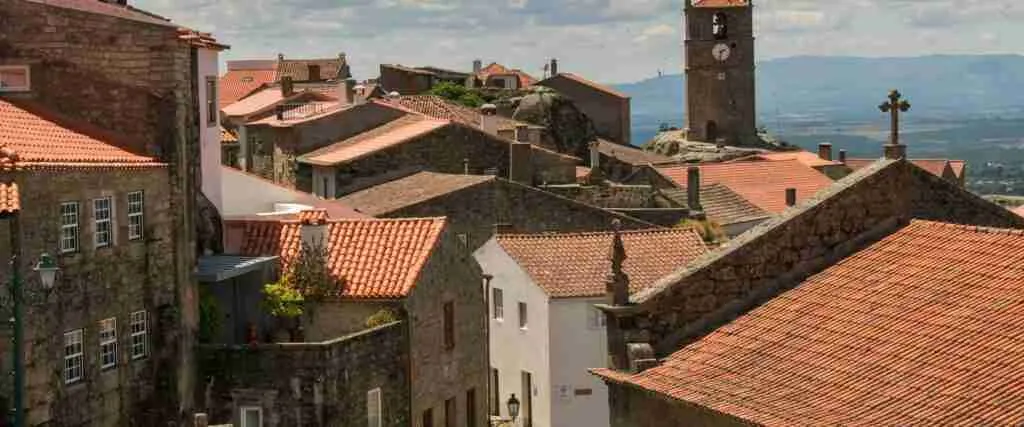
Sortelha is arguably the most dramatically sited village in Portugal. The entire settlement — church, well, communal oven, houses — sits inside a ring of medieval walls on a granite outcrop, surrounded by a lower village of more recent houses and olive groves. The castle walls are free to walk; the views over the boulder-strewn Serra da Malcata extend toward Spain in a landscape of absolute solitude. The village has one excellent restaurant, Dom Sancho, which serves slow-roasted kid and regional wine at moderate prices (€15-25 per person for a full meal). One guesthouse inside the walls, Casa da Villa, operates at €70-90 per room.
Monsanto: The Village Among the Boulders
Monsanto was once voted “the most Portuguese village in Portugal” in a 1930s competition, and the designation stuck — a golden amphora hangs from the castle keep to this day. The village grows between and under enormous granite boulders, with houses built against and beneath them in a relationship between architecture and geology unlike anything else in the country. The castle ruin at the top is free and offers views across the Cova da Beira plain. A single road winds up through the village; parking at the base is free. Like Piódão and Sortelha, Monsanto absorbs visitors with dignity rather than infrastructure — there are two restaurants and a handful of rooms, and none of them tries to be more than it is.
Trancoso: The Medieval Walled Town Worth an Overnight
Trancoso is the largest and most historically significant of the Aldeias Históricas and the one most deserving of an overnight rather than a passing visit. Enclosed within intact medieval walls with four gates and a central castle keep, it contains a Judaica quarter (one of the best-preserved in Portugal), the house of Bandarra the Cobbler-Prophet (whose sixteenth-century verses were later interpreted as predicting Sebastian’s disappearance at Alcácer Quibir), and a main square, Praça República, that functions as a genuine social centre rather than a heritage exhibit. The walls are free to walk; the castle charges €1.50. Guesthouses inside the walls run €40-65 per room; the Turismo de Habitação properties are consistently good value.
Almeida: The Star Fortress Town on the Spanish Border
Almeida is not a schist village but a fully intact eighteenth-century star-shaped fortress — a twelve-pointed bastion design built by Portuguese and later modified by French military engineers during the Peninsular War. The entire town of Almeida sits within the walls, which are free to walk and extraordinary in scale: the glacis, ravelins, and moat describe a geometry that only makes complete sense from above. The village inside is quiet, slightly melancholy, and entirely authentic. The Museu Histórico Militar de Almeida charges €2. One pousada and several guesthouses operate within the walls (€55-90 per room); the Pousada de Almeida in the old governor’s house is the obvious choice for a special night.
Serra da Estrela: Portugal’s High Mountain in 2026
The Serra da Estrela is the highest mountain range in mainland Portugal, reaching 1,993 metres at Torre, and the only place in the country where snow falls reliably in winter. In 2026 the Serra da Estrela Natural Park — recently elevated to UNESCO Geopark status — covers 101,000 hectares of glaciated valley, high plateau, pine and oak forest, and traditional shepherd villages. It is also the origin of Portugal’s only protected designation cheese: Queijo Serra da Estrela DOP, the soft, runny, intensely flavoured sheep’s milk cheese that is consumed by cutting off the top rind and scooping the interior with bread.
Gouveia, Seia, and Manteigas: The Gateway Towns in 2026
The three main gateway towns to the Serra da Estrela in 2026 are Gouveia (west), Seia (southwest), and Manteigas (east). Of the three, Manteigas is the most rewarding base: a narrow town in the glacial valley of the Zêzere river, flanked by sheer schist walls, with thermal baths, the best starting points for mountain hiking, and a selection of small hotels and mountain guesthouses at €45-80 per room. Seia houses the Museu do Pão (Museum of Bread) — an unlikely but genuinely fascinating institution devoted to the history of bread in Portuguese culture, charging €5 — and serves as the main access point for the plateau road to Torre.
Torre and the High Plateau in 2026
The EN339 road from Seia climbs to Torre, passing through an increasingly lunar landscape of granite boulders, ski infrastructure (minimal, largely abandoned outside January-February), and high moorland that supports a unique flora in spring. Torre itself is an anticlimactic concrete platform with a telecommunications tower, but the plateau around it — the Planalto da Torre — rewards slow walking in April and May when the nardus grassland and Cytisus oromediterraneus bloom. No entry fee to the plateau; the road is open year-round except during heavy snowfall. In winter, snow chains are mandatory and available for rental in Seia (€15-20 per day).
The Zêzere Glacial Valley and Covão d’Ametade
The Zêzere Glacial Valley — one of the clearest glacial trough formations in Iberia — runs south from Torre toward Manteigas in a near-perfect U-shape. The walk from Manteigas through the valley floor, past the Poço do Inferno waterfall and up to the Covão d’Ametade glacial cirque lake, covers approximately 18 kilometres and 600 metres of elevation gain. It is the finest day walk in central Portugal and sees perhaps a few dozen walkers on a typical spring day. No entry fee; trail maps available from the Natural Park office in Manteigas (free).
The Beira Interior Wine Country: Dão, Bairrada, and Cova da Beira 2026
Central Portugal’s wine regions are among the country’s most exciting and least internationally known. The Dão DO, surrounding Viseu, produces structured, mineral-driven reds from Touriga Nacional, Tinta Roriz, and Alfrocheiro that age beautifully and retail for €8-20 per bottle at the producer. The Bairrada DO, closer to the coast between Coimbra and Aveiro, specialises in Baga — an austere, tannic grape variety that makes the region’s most age-worthy reds and a growing portfolio of méthode traditionnelle sparkling wines. The Beira Interior DO, centred around Guarda and extending toward the Spanish border, produces both red and white wines from Touriga Nacional, Marufo, and Síria at prices that remain startlingly low for the quality achieved.
Quinta Visits and Wine Tourism Costs in 2026
Wine tourism in central Portugal in 2026 is relatively undeveloped compared to the Douro or Alentejo, which is part of its charm. Most quintas welcome visitors by appointment without charging for the visit itself; a structured tasting with a tour of the winery and vineyard typically costs €10-20 per person and almost always includes food. Quinta de Lemos in the Dão charges €15 for a tasting of six wines with presunto and sheep’s milk cheese. Quinta das Maias, also in the Dão, offers a vineyard walk and tasting for €12. In Bairrada, the Caves São João winery outside Anadia offers cellar tours and tastings of aged Baga reserves for €10. Purchasing wine at the quinta rather than through retail adds meaningfully to the experience and rarely costs more than retail prices.
The Dão Wine Route in 2026
The Rota dos Vinhos do Dão connects eleven producer quintas across the sub-regions of Silgueiros, Santar, Carregal do Sal, and Santa Comba Dão. A self-drive circuit from Viseu visiting three to four quintas covers approximately 80 kilometres and a full day. The village of Santar — a perfectly preserved granite hamlet in the heart of the Dão — warrants a stop regardless of wine interest: the seventeenth-century Solar dos Albuquerques and the surrounding vineyard landscape constitute one of the most beautiful rural scenes in the Beiras. No entry fee to the village; Solar dos Albuquerques exterior viewing only.
Conímbriga: The Roman City South of Coimbra
Conímbriga is the best-preserved Roman settlement in Portugal and one of the most significant in the Iberian Peninsula. Located 16 kilometres south of Coimbra near the village of Condeixa-a-Nova, it encompasses excavated townhouses with extraordinary in-situ mosaic floors, the remains of a forum, baths, aqueduct, and the defensive wall hastily built across the centre of the city in the third century CE when Barbarian raids began. The Museu Monográfico de Conímbriga, adjacent to the site, houses statuary, ceramics, glass, and coins recovered from the excavations in a well-designed collection.
Combined site and museum entry costs €5 for adults in 2026. The site is open daily; the mosaics in the House of the Fountains and the House of Cantaber are among the finest Roman floor mosaics surviving in the western empire. A visit requires two to three hours and is easily combined with a morning or afternoon in Coimbra. The site has a good on-site restaurant serving regional lunch dishes at moderate prices (€10-15 for a full meal).
Santarém: The Gothic Capital Nobody Visits
Santarém sits on a bluff above the Tejo river, 78 kilometres north of Lisbon by motorway, and contains more Gothic architecture per square kilometre than almost any other city in Portugal. It was the royal capital between Coimbra and Lisbon during the thirteenth and fourteenth centuries, and its churches — Igreja de Santa Maria de Graça, Igreja de São João de Alporão, Igreja do Seminário — contain some of the finest Gothic stonework in the country. The tomb of Pedro Álvares Cabral, the navigator who claimed Brazil for Portugal in 1500, is in Santa Maria de Graça. The miradouro of Portas do Sol, a public garden on the old Moorish alcáçova, offers a panorama of the Tejo floodplain that inspired Turner during his 1832 Portuguese journey.
Santarém’s churches are mostly free to enter or charge symbolic fees of €1-2. The city is underserved by tourist infrastructure despite its patrimony: hotels are functional rather than atmospheric (€45-70 per room), restaurants focus on Ribatejo cuisine (bull-raising country means excellent beef; the grilled entrecosto is the order to make), and the pace is entirely local. The National Gastronomy Festival held each November is one of Portugal’s most serious food events and draws chefs and producers from across the country. The weekly Saturday market beside the Jardim da República is the best in the Ribatejo for fresh produce, Serra da Estrela cheese, and Ribatejo wines.
The Raia Border Zone: Castle Towns on the Edge of the Kingdom 2026
The Raia — the Portuguese term for the frontier with Spain — was the most militarised landscape in medieval Iberia. A chain of hilltop castles extending from the Douro to the Tejo held the border of the kingdom against Castilian incursion for three centuries, and many of these fortresses survive in remarkable condition. The border zone in 2026 is among the least-visited landscapes in Western Europe: economically depressed, demographically thinned by decades of emigration, and entirely beautiful in the way that landscapes are when they are left mostly to themselves.
Guarda: The Highest City in Portugal
At 1,056 metres above sea level, Guarda is the highest city in Portugal and the one most likely to test the claim that central Portugal has a mild climate. In winter it is genuinely cold; in July it is genuinely pleasant when the Alentejo bakes. The Cathedral of Guarda — begun in 1390 and completed in 1540, spanning late Gothic and early Manueline styles — is massive, stern, and magnificent, its interior containing a retable attributed (at least in part) to João de Ruão and Hodart. Entry is free. The city’s compact historic centre rewards an afternoon’s walking; the tower at the Praça Velha offers views across the Beira Alta plateau toward the Serra da Estrela. Hotels run €45-75 per room; guesthouses €20-35 per person.
Pinhel and the Beira Interior Frontier
Pinhel is a small town on the granite plateau between Guarda and the Spanish border, surrounded by vineyards producing Beira Interior DO wines and fortified by a two-tower castle that appears in almost every account of the Portuguese reconquest. The town sees almost no international visitors and has exactly one hotel (adequate, €40-55 per room) and three restaurants serving honest regional food. The castle is free to access; the adjacent Museu Municipal houses a small but well-presented collection of Roman epigraphy, medieval artefacts, and Peninsular War relics for €1.50. Pinhel is best visited as part of a Beira Interior circuit rather than as a standalone destination.
Castelo Rodrigo: The Abandoned Village Inside a Castle
Castelo Rodrigo is one of the most atmospheric places in central Portugal. The original village inside the medieval castle walls was burned by its own residents in 1640 as an act of defiance against the treachery of the local lord, who had sided with Spain during the Restoration War. The ruins of the burned village — roofless houses, narrow lanes, the shell of a palace — were never rebuilt and stand today as a kind of open-air monument to collective revenge. The views from the walls across the Côa valley and toward the Serra da Marofa are extraordinary. Entry to the castle village costs €2; a lower village of inhabited houses surrounds the fortified hill with basic café facilities. The Côa Valley Archaeological Park — home to the greatest concentration of Palaeolithic open-air rock art in the world — lies 30 kilometres to the north at Vila Nova de Foz Côa.
Complete Daily Budget Breakdowns for Central Portugal 2026
Budget Travel in Central Portugal 2026: €45-80 Per Person Daily
Budget travel in central Portugal in 2026 is genuinely comfortable rather than merely austere. The region’s hostel and guesthouse network is well-developed in the main towns, local restaurants (tascas) serve two-course lunch menus (prato do dia plus soup, bread, and wine or water) for €8-12, and most of the major monuments charge €2-6. A typical budget day breaks down as follows: accommodation €15-25 per person (hostel dorm or budget guesthouse, two sharing), breakfast at a local café €3-5, lunch prato do dia €8-12, dinner at a tasca €10-15, regional bus or train transport €5-10, attractions €0-8. The low end of this range — €43, rounded to €45 — is achievable by staying in hostel dorms, eating the lunch menu rather than ordering à la carte, and prioritising free monuments. The high end of €80 per person daily covers a private guesthouse room for two, sit-down meals at both lunch and dinner, and paid attractions without particular economy. A week at the budget tier runs approximately €315-560 per person.
Mid-Range Travel in Central Portugal 2026: €90-150 Per Person Daily
Mid-range travel in central Portugal in 2026 delivers a quality of experience — boutique guesthouses in historic buildings, regional restaurants with serious wine lists, private quinta visits — that would cost substantially more in comparable Spanish or Italian destinations. A typical mid-range day: accommodation €35-55 per person (mid-range hotel or pousada, two sharing a €70-110 room), breakfast included or café €5-8, lunch at a proper restaurant €15-25, dinner at a regional restaurant with wine €30-45, transport €8-15 (combination of driving and parking), attractions and guided experiences €8-18. Total low end: €35 + €5 + €15 + €30 + €8 + €8 = €101, rounded to €90 after accounting for days with minimal attractions. Total high end: €55 + €8 + €25 + €45 + €15 + €18 = €166, rounded to €150 for a realistic ceiling on typical days. A week at mid-range runs approximately €630-1,050 per person.
Luxury Travel in Central Portugal 2026: €200-355 Per Person Daily
Luxury travel in central Portugal in 2026 is defined by historic pousadas (converted monasteries, castles, and manor houses in the Pousadas de Portugal network), private quinta stays, guided day programmes, and the region’s best restaurant tables. Daily costs at this tier: accommodation €90-160 per person (luxury pousada at €180-320 per room, two sharing), breakfast included or hotel restaurant €10-15, lunch at a regional fine dining restaurant €35-50, dinner with full wine pairing €60-90, private driver or rental car with guide €25-45, private guided visits and premium experiences €25-50. Low end: €90 + €10 + €35 + €60 + €25 + €25 = €245, rounded to €200 on lighter days. High end: €160 + €15 + €50 + €90 + €45 + €50 = €410, rounded to €355 as a realistic ceiling excluding exceptional splurges. A week at luxury tier runs approximately €1,400-2,485 per person. The Pousada Convento de Tomar (€150-220 per room) and Pousada Mosteiro de Guimarães (€160-240 per room, technically just north of the region) represent the category’s most significant properties.
Accommodation Costs and Options in Central Portugal 2026
Pousadas de Portugal: Historic Hotels in the Region
The Pousadas de Portugal network operates several properties in central Portugal that represent the most atmospheric and best-value luxury accommodation in the region. The Pousada Convento de Tomar occupies part of the Convent of Christ complex and offers rooms in a genuine Renaissance monastery with cloisters and a swimming pool in what was once a vegetable garden. Rates run €150-220 per room in 2026. The Pousada de Almeida, in the eighteenth-century governor’s house inside the star fortress, costs €110-160 per room. The Pousada de Condeixa-a-Nova, convenient for Conímbriga, runs €100-150 per room. All pousadas include breakfast and operate with the particular combination of historic atmosphere and reliable service standards that defines the network.
Rural Tourism and Quintas
The Turismo Rural and Turismo de Habitação categories cover the broad range of manor houses, farmhouses, and wine estates that offer accommodation in central Portugal. Quality varies significantly — from genuinely beautiful eighteenth-century solares with antique furniture and garden breakfasts to underfunded properties that have not updated their mattresses since the 1990s. Booking through the TURIHAB association (turihab.pt) filters toward quality. Rates run €60-130 per room depending on the property and season. The Dão wine region around Viseu has several well-run quinta accommodations combining wine tourism with comfortable rural lodging.
Urban Hotels and Guesthouses
Urban hotel pricing in the main cities of central Portugal in 2026 remains significantly below equivalent Portuguese coastal destinations. In Coimbra, three-star hotels in the historic centre run €65-95 per room; four-star options €90-140. In Viseu, €50-80 covers a solid three-star; €90-140 for boutique options. In Castelo Branco and Guarda, two- and three-star hotels run €40-70. Budget travellers find guesthouses (residenciais) in every significant town at €20-40 per room; hostel beds in Coimbra at €15-25. Booking direct with properties rather than through platforms frequently yields discounts of 10-15%, particularly for stays of three or more nights.
Food and Dining Costs in Central Portugal 2026
What the Beiras Eat: The Cuisine of the Region
Central Portuguese cuisine is one of the most honest and least-known in Western Europe. The Beira Alta and Beira Baixa share a highland tradition built on cured pork (presunto da Guarda, chouriço de Vinhais), sheep and goat meat (cabrito assado, chanfana — goat slow-braised in red wine), freshwater fish from the Mondego and Zêzere rivers (trout, lamprey in season), and the bread-thickened dishes (migas, açordas) that extend modest ingredients into substantial meals. The Ribatejo, centred on Santarém, is bull-raising and horse-breeding country that expresses itself culinarily in excellent beef and the distinctive soups and stews of the riverside communities. The Dão and Bairrada wine regions produce the natural accompaniment to all of it.
Restaurant Price Tiers in Central Portugal 2026
Dining costs in central Portugal in 2026 remain among the lowest in Western Europe for the quality delivered. Tascas and local restaurants serving the prato do dia lunch menu charge €8-12 for a full meal including soup, main course, bread, and house wine or water — the single best-value eating experience in Portugal. A la carte lunch at a mid-range restaurant runs €15-25 per person with wine. Dinner at a serious regional restaurant, with a full menu and a decent bottle of Dão or Bairrada, costs €30-45 per person. High-end restaurants — there are very few in the region, with the most notable being DOM Restaurant in Viseu and several pousada dining rooms — charge €55-80 per person for a tasting menu with wine pairing. Self-catering from weekly markets and local bakeries reduces food costs to €15-25 per day with genuine quality.
Market Shopping and Picnic Culture
Central Portugal’s weekly markets are among the best reasons to plan an itinerary around days of the week. The main markets worth building around: Coimbra’s Mercado Municipal (daily), Viseu’s Tuesday and Saturday market, Tomar’s Friday market by the Templar bridge, Santarém’s Saturday market beside the Jardim da República, and Castelo Branco’s Tuesday and Friday market beside the Episcopal Garden. Regional specialities worth purchasing: Serra da Estrela cheese (€8-15 per wheel depending on size and curing), smoked presunto from the Cova da Beira (€12-20 per piece), local honeys (€4-8 per jar), and Dão or Beira Interior wines directly from producers at the market stalls (€4-8 per bottle for wines that retail at €12-18 in Lisbon).
Transportation Costs and Strategies in Central Portugal 2026
Getting to Central Portugal in 2026
No international airport serves central Portugal directly. The three practical entry points are Lisbon (120-200 kilometres from most destinations in the region, served by all major European carriers), Porto (100-180 kilometres from the northern Beiras, well-served from northern Europe and the UK), and Madrid Barajas (230-280 kilometres by motorway from Guarda and the border zone, useful for travellers from Spain or North America via Iberia/American). Car rental from Lisbon or Porto airport and driving directly into the region is the most efficient approach for most international visitors in 2026; rental cars average €30-60 per day for a compact with insurance, fuel costs approximately €0.12-0.15 per kilometre on the IC motorway network (tolls add €5-15 depending on route).
Public Transport Within the Region in 2026
Public transport connects the main urban centres of central Portugal adequately if not brilliantly. Comboios de Portugal Alfa Pendular and InterCity trains connect Coimbra with Lisbon (€16-22, 1 hour 40 minutes) and Porto (€14-19, 1 hour) with good frequency. Regional trains connect Coimbra with Guarda (€11-14, 2 hours 20 minutes) via Covilhã and the Cova da Beira. Rede Expressos coaches serve Tomar (€11-14 from Lisbon, 1 hour 40 minutes), Castelo Branco (€15-18 from Lisbon, 2 hours 30 minutes), Santarém (€8-10 from Lisbon, 1 hour), and Viseu (€14-17 from Porto, 2 hours). Local buses within the Beiras are sparse and infrequent; the STUB network in the Beira Interior covers some inter-village routes but with schedules designed for residents rather than visitors.
Car Rental and Driving in Central Portugal 2026
A rental car is the definitive transportation choice for exploring central Portugal beyond the main cities in 2026. The EN2 — Portugal’s Route 66, running the full length of the country on minor roads — passes through the heart of the Beiras and provides a spectacular alternative to the IC motorway network. The roads of the Aldeias Históricas circuit are well-paved and clearly signed. Mountain roads in the Serra da Estrela are passable in summer in any car; in winter, AWD or snow chains are mandatory above 1,200 metres. Fuel prices in 2026 run approximately €1.65-1.80 per litre for unleaded; diesel €1.55-1.70. A full circuit of central Portugal covering Coimbra, the Dão, Viseu, Serra da Estrela, Guarda, the Aldeias Históricas, Castelo Branco, and Tomar covers approximately 700-900 kilometres depending on routing, making fuel costs for the entire circuit €80-130 in a typical compact car.
Seasonal Price Variations in Central Portugal 2026
Central Portugal shows meaningful seasonal price variation even if it lacks the extreme peaks of coastal Portuguese destinations. Understanding the variation allows for significant savings without sacrificing experience quality.
High season (July-August) brings accommodation prices 25-40% above spring and autumn levels. Hotels that run €65-85 in May charge €85-120 in August. The roads in the Serra da Estrela and on the Aldeias Históricas circuit carry more traffic (primarily Portuguese domestic tourists), and the most popular monuments — Coimbra’s Joanine Library, Tomar’s Convent of Christ — require advance booking. Temperatures in the interior exceed 35°C in July and August; the Serra da Estrela plateau and the Dão valley are meaningfully cooler than the Beira Baixa plain.
Shoulder season (April-June and September-October) offers the best combination of price, weather, and atmosphere. Accommodation prices drop to their base levels; the landscape is at its most photogenic; and the weekly markets are at peak agricultural richness (spring asparagus and strawberries, autumn quince and chestnuts). The Queima das Fitas in Coimbra (first week of May) brings festival crowds to the city but is worth experiencing; booking accommodation two to three months in advance for that week is advisable.
Low season (November-March) delivers accommodation discounts of 15-30% below shoulder prices and an atmosphere of genuine local life undisturbed by visitor presence. Some rural tourism properties close for January and February; museum hours reduce in smaller towns. The Serra da Estrela in winter, when snow covers the plateau and the valley mists fill the Zêzere gorge, is spectacular for those equipped for cold weather.
Hidden Costs and Practical Budget Considerations in Central Portugal 2026
Tolls on Portuguese Motorways
Portugal’s motorway network operates on an electronic tolling system (Via Verde) that charges are billed via the rental car’s toll transponder. Tolls accumulate quickly on the A1 Lisbon-Porto motorway and its branches; a Lisbon airport to Coimbra journey costs €9-12 in tolls. The full A1/A25 circuit through the Beiras adds €20-35 in tolls for a week’s driving. Budget for €25-45 in total motorway tolls for a one-week circuit of the region. The EN national road network avoids tolls entirely at the cost of longer journey times — often a worthwhile trade on scenic routes.
Parking Costs in Central Portugal
Parking in central Portugal is almost universally free or very low-cost outside Coimbra’s historic centre. Coimbra charges €0.80-1.20 per hour in its blue-zone street parking zones; underground car parks in the lower city charge €1-1.50 per hour with daily maximums of €8-12. Tomar, Viseu, Castelo Branco, and Guarda all have free municipal car parks within walking distance of their historic centres. In the Aldeias Históricas villages, parking is free or charges a nominal €1-2 at designated lots below the village entrance. Budget approximately €15-25 for the total week’s parking across the circuit.
Service Charges and Tipping
Service charges are not added to restaurant bills in Portugal. Tipping is appreciated but not structurally expected: rounding up to the nearest euro on small bills, or leaving 5-10% at sit-down restaurants, is the customary range. Taxi drivers appreciate rounding up to the nearest euro. Tour guide gratuities of €5-10 per person for a half-day guided walk are appropriate. Budget approximately €5-10 per day for tips across all service interactions.
The Couvert: Understanding Portuguese Restaurant Extras
Portuguese restaurants routinely place bread, olives, cheese, butter, and cured meats on the table without being asked and charge for these items — the couvert or entrada — at €2-5 per person. This is not a scam; it is a custom. Items can be refused (ask the waiter to remove them before touching anything), but they are almost always good and worth keeping at a tasca. Budget €3-5 per person per sit-down dinner meal for the couvert.
Sample Itineraries for Central Portugal 2026
Five-Day Budget Circuit 2026: Coimbra to Castelo Branco
Day 1 — Coimbra: Arrive Coimbra by train from Lisbon or Porto. Afternoon: Santa Cruz Monastery (free), Baixa walk. Evening: Conímbriga option if arriving early. Accommodation guesthouse €15-25 per person. Dinner tasca €10-12.
Day 2 — Coimbra and Conímbriga: Morning: Joanine Library (€13, book ahead), university complex (€12.50). Afternoon: bus to Conímbriga (€3 return), site entry (€5). Return Coimbra. Evening fado at À Capella (€10 cover). Total attractions and transport approximately €43-50 per person.
Day 3 — Tomar: Coimbra to Tomar by bus (€8-10). Morning: Convent of Christ (€10). Afternoon: Synagogue (€3), Mata Nacional walk (free), Friday market if applicable. Accommodation guesthouse €20-30 per person. Dinner €10-14. Day cost approximately €55-75 per person.
Day 4 — Santarém and Castelo Branco: Bus Tomar to Santarém (€6-8). Morning: Gothic churches (free-€2). Bus or taxi Santarém to Castelo Branco (€15-20 by bus). Afternoon: Episcopal Garden (€2.50), Museu Proença Júnior (€3). Accommodation guesthouse €20-30 per person. Dinner €10-14. Day cost approximately €60-80 per person.
Day 5 — Castelo Branco and return: Morning market visit, castle ruins (free). Bus return to Lisbon (€15-18). Total five-day budget circuit approximately €225-385 per person excluding intercity transport to/from Portugal.
Seven-Day Mid-Range Circuit 2026: The Full Beiras Experience
Day 1 — Coimbra (arrive, settle, evening): Hotel €35-55 per person. Dinner with wine €30-40. Day cost approximately €85-125 per person.
Day 2 — Coimbra: Joanine Library, university, Machado de Castro, Conímbriga afternoon. Hotel €35-55. Meals and attractions €55-75. Day cost approximately €90-130 per person.
Day 3 — Tomar: Drive (rental car from Day 3 onward). Convent of Christ, town. Pousada Convento de Tomar €75-110 per person. Meals and attractions €50-65. Day cost approximately €125-175 per person.
Day 4 — Viseu and Dão: Drive Tomar to Viseu via Dão wine country. Cathedral, Museu Grão Vasco, quinta visit. Hotel Viseu €35-55. Meals and attractions €55-70. Day cost approximately €90-125 per person.
Day 5 — Serra da Estrela: Drive Viseu to Manteigas via Torre. Zêzere valley walk. Manteigas guesthouse €25-40. Meals €35-45. Day cost approximately €80-110 per person.
Day 6 — Aldeias Históricas: Drive Manteigas to Sortelha, Monsanto, Castelo Rodrigo circuit. Castelo Rodrigo guesthouse €25-40. Meals €30-40. Day cost approximately €75-100 per person.
Day 7 — Castelo Branco and return: Drive to Castelo Branco. Episcopal Garden, market, drive to Lisbon or train. Hotel day use or guesthouse €20-35. Meals €30-40. Day cost approximately €65-95 per person.
Total seven-day mid-range circuit approximately €610-860 per person including rental car (€30-50 per day for 5 days = €150-250 split between two people = €75-125 total car cost per person) and fuel (approximately €40-50 per person for the circuit). Accommodation and meals total approximately €530-790 before transport. Full circuit total: approximately €605-860 per person.
Practical Planning Tips for Central Portugal 2026
Booking the Joanine Library in Advance
The Joanine Library in Coimbra operates timed entry slots of 30 minutes with a maximum of 60 visitors per slot. Slots at 9 AM, 9:30 AM, 10 AM, 10:30 AM, and 11 AM fill weeks in advance in July and August and two to three weeks ahead in May, June, and September. Booking via the University of Coimbra’s official portal (uc.pt/visit) is the only way to secure a slot; tickets cost €13. Walk-in availability exists for the 3 PM and 3:30 PM slots on weekdays outside peak season, but this is unreliable. Book as early as possible — the library is worth the advance planning.
Language and Communication
English is spoken with confidence at pousadas, tourist offices, and most mid-range hotels. In tascas, local markets, and guesthouses in smaller towns, Portuguese is the working language. A basic repertoire of Portuguese phrases — bom dia (good morning), obrigado/a (thank you), queria (I would like), quanto custa (how much does this cost), pode trazer a conta (may I have the bill) — is both practical and genuinely appreciated. Google Translate’s camera function handles menus written only in Portuguese. Menus in English exist in tourist-facing restaurants in Coimbra and Tomar; they are absent in most of the region’s best tascas, which is not a problem with the camera function active.
Mobile Connectivity and Navigation
4G coverage is reliable in all cities and towns in central Portugal. Mountain areas in the Serra da Estrela and the Aldeias Históricas circuit have variable coverage: signal is present on main roads but drops in valley bottoms and some village interiors. Download offline maps (Google Maps or Maps.me) for the full circuit before departure; the EN road network in the border zone and interior highlands is not always correctly rendered in real-time navigation. A Portuguese SIM card or European data roaming plan costs €15-25 for a week’s data.
What to Pack for the Region
Spring and autumn visits require layers: mornings in the Serra da Estrela and border highlands are cool (10-15°C) even in May and October; afternoons in the Beira Baixa plain reach 25-30°C. Good walking shoes are essential — the Aldeias Históricas villages are paved in schist cobblestones that are slippery when wet and irregular throughout. A light rain jacket is necessary from October to April. In summer, sun protection and a water bottle are critical in the interior: shade is limited in castle ruins and plateau walks, and temperatures above 35°C are common in July and August.
Frequently Asked Questions: Central Portugal Without the Crowds 2026
How many days do I need for central Portugal in 2026?
A minimum of five days allows a focused circuit covering Coimbra, Tomar, and one or two Aldeias Históricas villages by public transport, or Coimbra, Viseu, and the Serra da Estrela by rental car. Seven days is the optimal length for a self-drive circuit that covers all the major areas — Coimbra, the Dão, Viseu, Serra da Estrela, the Aldeias Históricas, and Castelo Branco — without feeling rushed. Ten days allows adding the Raia border zone (Guarda, Almeida, Castelo Rodrigo) and the Côa Valley rock art park, plus one or two days of leisure at a quinta or pousada without a fixed programme.
Is central Portugal safe for solo travellers in 2026?
Central Portugal is among the safest regions in Western Europe for solo travellers in 2026. Portugal consistently ranks in the top five of the Global Peace Index; the central region has lower tourist density than the coast, which further reduces the petty crime risks that accompany concentrated tourism. Solo female travellers report the region as comfortable and harassment-free. Standard precautions apply in Coimbra’s university quarter late at night (student nightlife area). Hiking alone in the Serra da Estrela is advisable only with a downloaded offline map, sufficient water, and someone informed of your route; the plateau above 1,500 metres can generate fog and weather changes quickly. The greatest practical challenge for solo travellers is the car rental cost premium — all car rental pricing is per vehicle, so solo drivers bear the full €30-60 daily cost rather than splitting it.
Can I visit central Portugal without speaking Portuguese?
Yes, comfortably. English is spoken at all tourist-facing businesses, pousadas, and most mid-range hotels. In local tascas and village guesthouses, Portuguese is the only language; the Google Translate camera function handles menus and signage effectively. The genuine benefit of learning a few basic phrases — bom dia, obrigado/a, queria — is not linguistic necessity but social warmth: in the interior towns, a foreign visitor making an effort in Portuguese is met with disproportionate generosity and often unexpected hospitality. A phrasebook or language app used for ten minutes before arrival pays dividends throughout the trip.
What are the best day trips from Coimbra in 2026?
The best day trips from Coimbra in 2026 include Conímbriga (16 kilometres south, bus or car, Roman mosaics), Tomar (80 kilometres, bus, Knights Templar Convent of Christ), Luso and Buçaco (30 kilometres north, bus, thermal spa town and palace hotel in a national forest), Figueira da Foz (45 kilometres west, train, Atlantic beach town at the mouth of the Mondego), and Conimbricenses (minor Roman sites in the Mondego valley). Of these, Conímbriga and Tomar are the most rewarding historically; both can be done comfortably as single days but reward an overnight stay for those with the schedule. The Buçaco National Forest — a Victorian-era royal hunting forest with 700 labelled tree species and a Manueline-Gothic palace hotel — is the most unusual day trip and the one least likely to appear on itinerary lists generated by AI or travel algorithms.
Are the Aldeias Históricas accessible by public transport in 2026?
The Aldeias Históricas circuit is not realistically accessible by public transport in 2026. Local buses serve some of the gateway towns (Sabugal, Fundão, Idanha-a-Nova) on infrequent schedules designed for residents. No regular bus service connects the villages themselves on a tourist-friendly schedule. The two practical solutions are renting a car or joining an organised tour — several Coimbra and Guarda-based operators run Aldeias Históricas day tours at €45-65 per person including transport and a guide. A self-drive rental car remains the more flexible and only marginally more expensive option for two people travelling together.
What is Queijo Serra da Estrela and where do I buy it?
Queijo Serra da Estrela DOP is a soft, creamy sheep’s milk cheese produced in a defined zone around the Serra da Estrela mountain range. It is made exclusively from raw milk of the Bordaleira or Churra Mondegueira sheep breeds, coagulated with thistle flower (Cynara cardunculus) rather than animal rennet — this vegetable rennet gives the cheese its distinctive soft, slightly bitter, almost mineral character. A mature Serra da Estrela (60+ days aged) is served at room temperature with its top rind cut off; the interior is scooped with bread and has the consistency of thick double cream. The freshest and most authentic Serra da Estrela is purchased directly from producers in the villages of Manteigas, Gouveia, and Seia, or from specialist cheese shops in Coimbra’s Mercado Municipal. Prices run €8-15 per wheel (250-500 grams) at source; the same cheese in Lisbon specialty shops costs €15-25. It does not travel well in luggage for more than two to three days unless purchased vacuum-sealed.
What are the opening hours of the Convent of Christ in Tomar in 2026?
The Convent of Christ in Tomar opens daily from 9 AM to 6:30 PM in summer (June-September) and from 9 AM to 5:30 PM in winter (October-May). The site is closed on 1 January, Easter Sunday, 1 May, and 25 December. Entry costs €10 for adults; the ticket includes access to all areas of the convent including the round Templar church, all eight cloisters, the chapter house, and the Manueline window terrace. Audio guides are available for €3. Allow a minimum of two and a half hours for a thorough visit; the complexity of the architectural accumulation rewards slow movement. The site becomes busy between 10 AM and 1 PM in July and August; arriving at opening time or after 3 PM reduces wait times at the main entrance.
How does central Portugal compare to the Alentejo for wine tourism in 2026?
Central Portugal’s wine regions (Dão, Bairrada, Beira Interior) offer a fundamentally different wine tourism experience from the Alentejo in 2026. The Alentejo has developed a sophisticated wine tourism infrastructure — purpose-built visitor centres, designer tasting rooms, agrotourism hotels — that central Portugal largely lacks. What central Portugal offers instead is lower prices (Dão and Beirão tastings at €10-20 versus €20-35 at comparable Alentejo estates), less structured and more personal quinta visits where the winemaker frequently conducts the tasting personally, and wines of a more restrained, food-oriented character that many serious wine travellers find more interesting than the robust, extracted style the Alentejo has become known for. The Dão Touriga Nacional and aged Bairrada Baga are among Portugal’s finest wines; their lack of international profile is the traveller’s advantage.
Are there hiking trails in central Portugal for 2026?
Central Portugal has extensive hiking infrastructure in 2026, concentrated in the Serra da Estrela Natural Park and the Aldeias do Xisto (Schist Villages) network in the Beira Interior. The Serra da Estrela offers routes ranging from the two-hour Covão d’Ametade lake circuit (6 kilometres, easy) to the full Zêzere Glacial Valley traverse (18 kilometres, moderate) and the Cântaro Magro via ferrata (expert, equipped with steel cables and pegs). The Aldeias do Xisto network — distinct from but overlapping with the Aldeias Históricas — maintains 25 marked walking routes between schist villages in the Góis, Arganil, and Lousã municipalities, ranging from 5 to 25 kilometres. Trail maps for the Serra da Estrela routes are available free from the Natural Park offices in Manteigas, Seia, and Gouveia. The Aldeias do Xisto walking routes are downloadable from aldeiasxisto.pt.
What is the Queima das Fitas and should I plan my visit around it?
The Queima das Fitas (Burning of the Ribbons) is the annual academic festival of the University of Coimbra, held during the first full week of May. Students burn the coloured ribbons representing their faculty at the end of their final year; the week includes the traditional serenata on the steps of the old university, faculty balls, concerts, and a parade of academic faculty costumes through the city. It is one of the oldest continuous academic traditions in Europe, dating to the nineteenth century, and creates an atmosphere in Coimbra unlike anything else in Portugal — part graduation, part carnival, part genuine farewell by a student body that has lived in the city for five years. Hotels in Coimbra during Queima week cost 40-60% above standard rates and book out months in advance. The festival is worth building a visit around for travellers interested in Portuguese cultural traditions; it requires advance hotel booking of at least two to three months.