Imagine discovering a massive ancient city older than Egypt’s Great Pyramids, predating Stonehenge by millennia, and rewriting everything we thought we knew about the origins of civilization in the Americas. This isn’t science fiction—it’s the remarkable story of Caral-Supe, a 5,000-year-old metropolis hidden in Peru’s desert that has fundamentally changed our understanding of human history.
When Peruvian archaeologist Dr. Ruth Shady first began excavating what appeared to be unremarkable mounds in Peru’s Supe Valley in 1994, she had no idea she was about to uncover one of the most significant archaeological discoveries of the modern era. What emerged from those dusty hills was nothing less than the oldest known urban center in the Americas—a sophisticated civilization that thrived when most of the world was still living in small tribal communities.
Caral-Supe doesn’t just predate the Inca Empire; it predates it by four millennia. This ancient city challenges every assumption about when and how complex societies developed in the New World, forcing archaeologists to completely rewrite the timeline of human civilization in the Americas.
Key Takeaways
🏛️ Historic Significance:
- Caral-Supe is the oldest known urban center in the Americas at 5,000 years old
- Predates Egyptian pyramids and Stonehenge by centuries
- One of only six places on Earth where civilization arose independently
🔬 Revolutionary Discovery:
- Discovered by Dr. Ruth Shady in 1994, confirmed by radiocarbon dating in 2001
- Rewrite of American prehistory – pushed back timeline by over 1,000 years
- Published in prestigious Science journal, shocking archaeological community
🕊️ Peaceful Civilization:
- No evidence of warfare – no weapons, defensive walls, or violence found
- Based on trade and cooperation rather than conquest
- Extensive commercial networks from Pacific coast to Amazon rainforest
🏗️ Architectural Marvels:
- 626 hectares of sophisticated urban planning
- Six massive pyramids with the largest reaching 28 meters high
- Advanced engineering including earthquake-resistant design and drainage systems
🎵 Cultural Sophistication:
- 32 bone flutes and 37 cornets showing importance of music
- Early quipu system – ancient method of recording information
- Evidence of complex social organization and specialized crafts
🌍 Global Impact:
- UNESCO World Heritage Site since 2009
- Influenced Andean architecture for millennia
- Challenges assumptions about how civilizations develop
- Contact us for a comfortable and personalized itinerary (Free Service)
The Discovery That Shook the Archaeological World
A Visionary Archaeologist’s Groundbreaking Work
Dr. Ruth Shady Solís, a determined Peruvian archaeologist, began investigating the mysterious mounds of the Supe Valley in October 1994. Unlike many of her colleagues who dismissed the site due to the absence of pottery—traditionally considered a hallmark of advanced civilizations—Shady suspected these barren hills held secrets far older than anyone imagined.
Her instincts proved revolutionary. What appeared to be natural formations were actually the remains of massive pyramids, intricate urban complexes, and sophisticated architectural marvels that had been buried under centuries of desert sand. The site’s lack of ceramics, rather than indicating primitiveness, actually suggested it predated the invention of pottery altogether.
The Eureka Moment:
The breakthrough came when Shady’s team discovered reed-woven bags called “shicras” filled with stones, used in the construction of pyramid walls. These organic materials were perfect candidates for radiocarbon dating. In 1999, she sent samples to renowned archaeologists Jonathan Haas at Chicago’s Field Museum and Winifred Creamer at Northern Illinois University.
The results, published in the prestigious journal Science in April 2001, sent shockwaves through the archaeological community: the reeds dated to 2627 BC, making Caral nearly 5,000 years old. This wasn’t just another ancient site—it was the oldest urban center ever discovered in the Americas, pushing back the timeline of New World civilization by over 1,000 years.
The Immediate Impact on Archaeological Understanding
The announcement created an immediate sensation in academic circles. Betty Meggers, an archaeologist at the Smithsonian Institution, called the discovery “almost unbelievable,” noting that “this data pushed back the oldest known dates for an urban center in the Americas by more than 1,000 years.”
Suddenly, the accepted narrative of American prehistory crumbled. The Chavín culture, previously considered the first civilization of the region around 900 BCE, was now revealed to be a relatively recent development. Caral had been thriving when the Egyptian pyramids were just being built, when Stonehenge was still centuries in the future, and when most of Europe was populated by scattered hunter-gatherer tribes.
Caral-Supe: A Civilization Beyond Its Time
The Sacred City’s Impressive Scale
Caral-Supe encompasses an astounding 626 hectares (1,547 acres) of carefully planned urban development. The city is strategically positioned on a dry desert terrace overlooking the fertile Supe River valley, demonstrating sophisticated understanding of geography and resource management.
The Upper Sector (Caral Alto):
- Six massive pyramidal complexes with associated plazas and residential areas
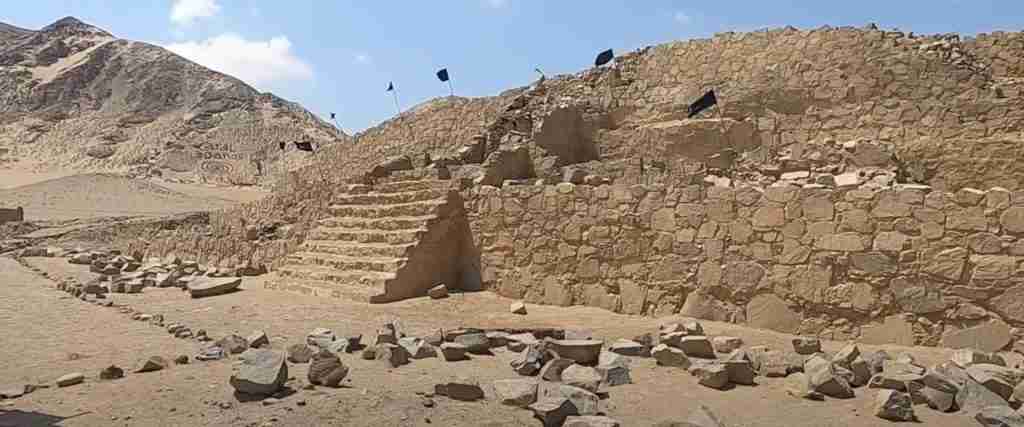
- The Great Temple (Templo Mayor): The largest pyramid measuring 150 meters long, 110 meters wide, and 28 meters high
- Elite residential quarters with evidence of luxury goods and imported materials
- Sophisticated urban planning with designated areas for different social classes
The Lower Sector (Caral Bajo):
- The Amphitheater Pyramid with its remarkable sunken circular court
- Residential complexes for artisans and workers
- Administrative buildings showing evidence of complex bureaucracy
- Specialized workshop areas for craft production
The Peripheral Zone:
- Multiple residential clusters following the natural contours of the valley
- Evidence of mixed-use buildings serving as both homes and workshops
- Agricultural terraces demonstrating advanced farming techniques
Revolutionary Archaeological Evidence
Musical Sophistication:
One of Caral’s most remarkable discoveries came from the amphitheater, where archaeologists uncovered 32 flutes crafted from pelican and condor bones, plus 37 cornets made from deer and llama bones. This evidence points to a society where music played a central role in religious and social ceremonies.
Early Recording Systems:
Perhaps most significantly, archaeologists discovered what appears to be one of the earliest quipus—the intricate knotted-string recording system later perfected by the Incas. This find suggests that Caral’s inhabitants had developed sophisticated methods of information storage and communication millennia before previously thought possible.
Advanced Craftsmanship:
Excavations have revealed exquisite artifacts including:
- Intricate jewelry made from shells sourced from Ecuador’s coast
- Sophisticated textiles woven from cotton and other fibers
- Carved bone implements showing remarkable artistic skill
- Stone tools demonstrating advanced manufacturing techniques
The Norte Chico Civilization: A Peaceful Ancient Society
A Network of Cities Without Warfare
What makes Caral-Supe truly unique among ancient civilizations is the complete absence of weapons, defensive fortifications, or evidence of warfare. Unlike contemporary civilizations in Mesopotamia and Egypt, which were defined by conflict and military might, the Norte Chico civilization appears to have been entirely peaceful.
Evidence of Peace:
- No defensive walls or military fortifications
- No weapons discovered in extensive excavations
- No signs of violence on human remains
- No artistic depictions of warfare or conflict
- Cooperative architecture suggesting collaborative rather than coercive social organization
This peaceful nature challenges fundamental assumptions about how complex societies develop, suggesting that cooperation and trade, rather than conquest and control, drove Caral’s remarkable success.
A Trade-Based Economy
Dr. Ruth Shady’s research reveals that Caral was the center of an extensive trade network that stretched from the Pacific coast to the Amazon rainforest. This commercial system, rather than military conquest, appears to have been the foundation of the civilization’s power and influence.
Trade Network Evidence:
- Cotton fishing nets found at coastal sites, produced in Caral’s inland location
- Spondylus shells from Ecuador’s warm northern waters
- Amazon products including tropical fruits and exotic materials
- Highland goods from Andean communities
- Specialized production of textiles, tools, and luxury items
Economic Sophistication:
The trade network required:
- Complex logistics for transporting goods across difficult terrain
- Standardized measurements for fair exchange
- Quality control systems for manufactured goods
- Administrative oversight to manage commercial relationships
- Diplomatic relations with diverse cultural groups


Architectural Marvels That Influenced Millennia
Engineering Ahead of Its Time
Caral’s architects demonstrated remarkable engineering skills that influenced Andean construction techniques for thousands of years. Their innovations include:
Pyramid Construction:
- Stone-filled bag technique using shicras for structural stability
- Terraced platforms maximizing limited flat space
- Earthquake-resistant design crucial in seismically active Peru
- Sophisticated drainage systems preventing flood damage
- Modular construction allowing for expansions and modifications
Urban Planning:
- Zoned development separating residential, ceremonial, and administrative areas
- Traffic flow management with wide ceremonial avenues and narrow residential streets
- Water management systems channeling river water for irrigation and domestic use
- Waste disposal planning maintaining urban sanitation
- Green space integration preserving areas for agriculture within the city
Architectural Legacy
Caral’s architectural innovations became templates for later Andean civilizations:
Sunken Circular Courts:
These distinctive ceremonial spaces, first developed at Caral, became standard features in Andean architecture for millennia, appearing in sites throughout Peru and influencing cultures as late as the Inca.
Stepped Pyramids:
The terraced pyramid design pioneered at Caral influenced monumental architecture across the Americas, from the Chavín culture to the great pyramid complexes of later civilizations.
U-Shaped Ceremonial Complexes:
Caral’s distinctive U-shaped building layout, with arms extending from a central platform, became a defining characteristic of Andean ceremonial architecture.
Scientific Dating: The Evidence That Changed Everything
Radiocarbon Dating Revolution
The precise dating of Caral relied on cutting-edge radiocarbon analysis of organic materials found throughout the site. Twenty-nine separate radiocarbon dates from different locations within Caral all confirmed the site’s extraordinary antiquity.
Key Dating Evidence:
- Reed bags (shicras): Dated to 2627 BC ± 32 years
- Textile fragments: Multiple samples dating 2600-2000 BC
- Wooden structural elements: Confirming construction phases
- Organic deposits: Providing dates for different occupation periods
- Agricultural remains: Dating farming activities
Comparative Timeline: Caral in World Context
To truly appreciate Caral’s significance, consider what was happening elsewhere in the world around 2600 BC:
Egypt (2600 BC):
- The Great Pyramid of Khufu was just being completed
- Egyptian civilization was in its early dynastic period
- Hieroglyphic writing was still developing
Mesopotamia (2600 BC):
- Sumerian city-states were flourishing
- Cuneiform writing was becoming standardized
- The first known legal codes were being developed
Europe (2600 BC):
- Stonehenge was still 500 years in the future
- Most populations were still hunter-gatherers
- Agriculture was just spreading into northern regions
North America (2600 BC):
- Native populations were primarily nomadic hunter-gatherers
- No permanent settlements existed north of Mexico
- Complex societies wouldn’t emerge for another 2,000 years
This comparison makes Caral’s achievement even more remarkable—while the rest of the Americas remained in the Stone Age, the Supe Valley was developing one of the world’s first urban civilizations.
The Mysterious Decline and Lasting Legacy
The End of an Era
Around 1800 BC, after flourishing for over 1,000 years, Caral and the other Norte Chico settlements went into decline. The reasons remain mysterious, but several factors likely contributed:
Environmental Changes:
- Climate shifts affecting the region’s delicate ecological balance
- River course changes disrupting irrigation systems
- Drought periods making agriculture more difficult
- El Niño events causing flooding and destruction
Social Evolution:
- Population growth straining resources
- Internal conflicts as society became more complex
- Trade disruption affecting economic foundations
- Religious changes altering social priorities
Migration Patterns:
Archaeological evidence suggests that as Caral declined, its inhabitants migrated to more fertile regions, taking their knowledge and cultural practices with them. This diaspora helped spread Caral’s innovations throughout the Andean region.
Influence on Later Civilizations
Caral’s impact on subsequent Andean cultures was profound and lasting:
The Chavín Culture (900-200 BC):
- Adopted Caral’s U-shaped ceremonial complexes
- Incorporated sunken court designs
- Continued the tradition of monumental architecture
- Maintained peaceful trading relationships
The Moche Civilization (100-700 AD):
- Built upon Caral’s urban planning principles
- Continued advanced irrigation techniques
- Maintained complex trade networks
- Developed Caral’s artistic traditions
The Inca Empire (1438-1532 AD):
- Used quipu recording systems pioneered at Caral
- Adopted terraced agriculture techniques
- Incorporated architectural design elements
- Maintained Caral’s tradition of skilled craftsmanship
Modern Research and Ongoing Discoveries
Dr. Ruth Shady’s Continuing Work
Despite being in her late 70s, Dr. Ruth Shady continues to lead research at Caral through the Caral-Supe Special Archaeological Project. Her work has expanded far beyond the original site to encompass the entire Norte Chico region.
Recent Discoveries:
- Additional pyramid complexes throughout the Supe Valley
- Sophisticated water management systems demonstrating advanced engineering
- Elite burial sites revealing social organization
- Astronomical alignments in building orientations
- Evidence of long-distance trade reaching as far as Colombia
Ongoing Research Projects:
- Complete site mapping using advanced surveying techniques
- Environmental reconstruction to understand ancient climate
- Population studies estimating Caral’s inhabitants
- Cultural analysis of artifacts and architectural features
- Conservation efforts to preserve the site for future generations
The Peñico Discovery: Expanding the Timeline
In 2024, Dr. Shady’s team announced the discovery of Peñico, a 3,500-year-old city that provides new insights into the continuation of Caral culture. This “City of Social Integration” demonstrates that the Norte Chico civilization’s influence persisted long after Caral’s decline.
Peñico’s Significance:
- Strategic location connecting coast, highlands, and jungle regions
- Evidence of continued trade maintaining commercial networks
- Architectural evolution showing cultural development
- 18 identified structures including ceremonial complexes
- Public opening allowing visitors to explore this newest discovery
Challenges and Controversies
Academic Disputes
The discovery of Caral has not been without controversy. Academic disputes have emerged over credit for the discovery, with some North American researchers claiming a larger role in the site’s investigation and interpretation.
The Plagiarism Controversy:
In the mid-2000s, Dr. Shady accused American archaeologists Jonathan Haas and Winifred Creamer of plagiarism and insufficient attribution for their collaborative work on Caral research. While formal plagiarism charges were dismissed, the controversy highlighted issues of academic credit and international collaboration in archaeology.
Recognition and Justice:
Despite these disputes, Dr. Shady has received increasing international recognition:
- UNESCO recognition for her groundbreaking work
- L’Oreal-UNESCO Prize for Women in Science (2018)
- BBC’s 100 Most Influential Women (2020)
- Peru’s Order of Merit for Distinguished Services (2021)
Modern Threats to the Site
Caral faces ongoing challenges from both natural and human threats:
Land Invasions:
Despite its UNESCO World Heritage status, Caral has faced invasion attempts from agricultural interests and land speculators. Dr. Shady has personally confronted these threats, even surviving a shooting in 2002 while defending the site.
Environmental Pressures:
- Climate change affecting the desert environment
- Urban expansion from nearby communities
- Agricultural encroachment threatening archaeological areas
- Tourism pressure requiring careful management
Funding Challenges:
Limited resources for archaeology in Peru have hampered research efforts, though international recognition has helped secure additional funding for site preservation and research.
Visiting Caral-Supe: A Journey Through Time
Planning Your Visit
Caral is open to visitors year-round and offers a unique opportunity to walk through one of humanity’s earliest cities. The site is managed by trained local guides, many of whom are archaeologists or archaeology students.
Getting There:
- Distance from Lima: 200 kilometers (124 miles) north
- Travel time: Approximately 3.5 hours by car
- Public transport: Buses to Supe town, then taxi to site
- Tours: Day trips available from Lima ($80-120 USD)
- Private transport: Recommended for flexibility
What to Expect:
- Site tours: 2-3 hours with knowledgeable guides
- Multiple pyramids: Climb ancient structures for panoramic views
- Visitor center: Exhibits explaining Caral’s significance
- Active excavations: Witness ongoing archaeological work
- Desert setting: Bring sun protection and water
The Visitor Experience
Walking through Caral is like stepping back 5,000 years into humanity’s distant past. The experience offers:
Educational Value:
- Expert guides providing archaeological insights
- Historical context explaining Caral’s global significance
- Cultural education about ancient Peruvian civilizations
- Archaeological methodology understanding how sites are studied
- Conservation awareness learning about site preservation
Spiritual Connection:
- Ancient ceremonial spaces where rituals occurred millennia ago
- Pyramid climbing offering panoramic valley views
- Desert solitude providing contemplative experiences
- Historical perspective connecting with humanity’s shared heritage
- Cultural continuity understanding Peru’s deep historical roots
Supporting Responsible Tourism
The Caral Archaeological Zone (ZAC) is committed to responsible tourism that benefits local communities while protecting the archaeological site:
Community Benefits:
- Local guide training providing employment opportunities
- Agricultural support for traditional farming methods
- Educational programs for area schools
- Cultural preservation maintaining local traditions
- Economic development through sustainable tourism
Visitor Responsibilities:
- Respect site rules protecting archaeological integrity
- Support local guides ensuring fair compensation
- Environmental awareness minimizing impact on desert ecosystem
- Cultural sensitivity respecting indigenous heritage
- Educational engagement learning about Caral’s significance
The Global Significance of Caral-Supe
One of Civilization’s Six Cradles
Caral-Supe holds the distinction of being one of only six places on Earth where complex civilization arose independently. This exclusive group includes:
- Mesopotamia (modern-day Iraq) – 3500 BC
- Ancient Egypt (Nile Valley) – 3100 BC
- Indus Valley (Pakistan/India) – 2600 BC
- Ancient China (Yellow River) – 2000 BC
- Mesoamerica (Mexico/Guatemala) – 1500 BC
- Caral-Supe (Peru) – 2600 BC
Being among this select group demonstrates that the inhabitants of the Supe Valley achieved something extraordinary—they independently developed the complex social, economic, and political systems that define human civilization.
Redefining American Prehistory
Caral’s discovery has fundamentally altered our understanding of pre-Columbian America:
Previous Assumptions:
- Complex societies developed much later in the Americas
- Civilization spread from north to south
- Pottery was essential for advanced cultures
- Warfare drove social complexity
New Understanding:
- Advanced civilizations emerged simultaneously with Old World counterparts
- South America was a center of innovation
- Complex societies could develop without ceramics
- Trade and cooperation could drive civilization
Lessons for Modern Society
Caral offers valuable insights for contemporary challenges:
Peaceful Coexistence:
Caral demonstrates that complex societies can thrive without warfare, offering hope for peaceful conflict resolution in our modern world.
Environmental Sustainability:
The civilization’s 1,000-year success in a challenging desert environment provides lessons for sustainable development in arid regions.
Social Organization:
Evidence of relatively egalitarian social structures suggests alternatives to highly stratified societies.
Cultural Preservation:
Caral’s influence on subsequent cultures shows the importance of preserving and transmitting cultural knowledge.
The Future of Caral Research
Technological Advances in Archaeology
Modern technology is revolutionizing Caral research:
Remote Sensing:
- Satellite imagery revealing hidden structures
- Ground-penetrating radar mapping subsurface features
- LIDAR scanning creating detailed 3D site models
- Drone surveys documenting large-scale site patterns
Laboratory Analysis:
- Advanced dating techniques refining chronologies
- DNA analysis of human remains providing population data
- Chemical analysis of artifacts revealing trade patterns
- Environmental reconstruction understanding ancient climate
Digital Preservation:
- 3D modeling preserving site details for future study
- Virtual reality creating immersive educational experiences
- Database development organizing research data
- Online access sharing discoveries with global audiences
Expanding Research Horizons
Future research at Caral will focus on:
Regional Studies:
- Complete Norte Chico survey mapping all related sites
- Comparative analysis with other early civilizations
- Environmental impact studies understanding human-environment interaction
- Cultural transmission tracking how Caral influenced later cultures
Interdisciplinary Approaches:
- Anthropological studies understanding social organization
- Economic analysis mapping trade networks
- Religious studies interpreting ceremonial practices
- Astronomical research understanding calendar systems
Conclusion: Caral’s Enduring Legacy
The discovery of Caral-Supe represents one of archaeology’s greatest achievements, fundamentally altering our understanding of human civilization’s origins in the Americas. This remarkable 5,000-year-old city challenges every assumption about when and how complex societies developed in the New World, proving that the inhabitants of ancient Peru achieved something truly extraordinary.
Dr. Ruth Shady’s groundbreaking work has revealed a civilization that was not only contemporaneous with the great ancient cultures of Egypt and Mesopotamia but was in many ways more advanced in its social organization. Caral’s peaceful nature, sophisticated trade networks, and remarkable architectural achievements offer a different model of how human societies can develop and thrive.
The implications of Caral extend far beyond archaeology. This ancient city demonstrates that:
- Complex civilization can develop through cooperation rather than conflict
- Environmental challenges can be overcome through innovation and collaboration
- Cultural achievements can persist and influence societies for millennia
- Peaceful societies can be as successful as militaristic ones
- Trade and cultural exchange drive human progress
As we face modern challenges of environmental sustainability, social inequality, and global cooperation, Caral offers valuable lessons from humanity’s distant past. The civilization that thrived in Peru’s Supe Valley 5,000 years ago achieved something remarkable—they created a complex, sophisticated society based on peace, trade, and mutual benefit.
Today, as visitors walk through Caral’s ancient plazas and climb its weathered pyramids, they are not just exploring archaeological ruins—they are connecting with one of humanity’s greatest achievements. In this desert city that rewrote history, we find proof that human ingenuity, cooperation, and vision can create something enduring and beautiful.
Caral-Supe stands as a testament to human potential, reminding us that our ancestors achieved the seemingly impossible by working together toward common goals. In our modern world, perhaps we can learn from their example and create our own lasting legacy of peace, prosperity, and cultural achievement.
The story of Caral is far from over. As researchers continue to uncover its secrets and as new sites are discovered throughout the Norte Chico region, we can expect even more revelations about this remarkable civilization. Each discovery adds another piece to the puzzle of human history, helping us understand not just where we came from, but where we might be going.
In the end, Caral-Supe is more than just the oldest city in the Americas—it’s a reminder of what human beings can accomplish when they work together with vision, determination, and hope for the future. It truly is the city that rewrote history, and its lessons remain as relevant today as they were 5,000 years ago.

Frequently Asked Questions (FAQ)
How old is Caral-Supe exactly?
Caral-Supe dates to approximately 2600-2000 BC, making it nearly 5,000 years old. This age was confirmed through radiocarbon dating of organic materials, particularly reed bags (shicras) found in pyramid construction that dated to 2627 BC ± 32 years.
Who discovered Caral-Supe?
Dr. Ruth Shady Solís, a Peruvian archaeologist, began systematic excavations at Caral in October 1994. While the site was known since 1948 when American archaeologist Paul Kosok first documented it, Dr. Shady was the first to recognize its true age and significance.
How does Caral compare to other ancient civilizations?
Caral is contemporaneous with ancient Egypt’s pyramid-building era and predates most other American civilizations by millennia. It’s one of only six places on Earth where complex civilization arose independently, alongside Mesopotamia, Egypt, Indus Valley, China, and Mesoamerica.
Why is Caral called a “peaceful civilization”?
Unlike other ancient civilizations, Caral shows no evidence of warfare – no weapons, defensive fortifications, or signs of violence on human remains. The society appears to have been based on trade and cooperation rather than military conquest.
Can tourists visit Caral today?
Yes! Caral is open to visitors year-round and became a UNESCO World Heritage Site in 2009. It’s located about 200 kilometers north of Lima (3.5-hour drive) and offers guided tours with trained archaeologists. Day trips from Lima cost approximately $80-120 USD.
What makes Caral’s architecture special?
Caral features sophisticated urban planning with six major pyramids, the largest measuring 150m x 110m x 28m high. The architecture includes earthquake-resistant design, advanced drainage systems, and innovative construction using stone-filled reed bags (shicras).
How big was Caral-Supe?
The main city covers 626 hectares (1,547 acres) and housed approximately 3,000 inhabitants. However, 19 other related sites in the Supe Valley suggest the entire Norte Chico civilization may have supported up to 20,000 people.
What artifacts have been found at Caral?
Notable discoveries include 32 bone flutes and 37 cornets (showing musical sophistication), an early quipu recording system, intricate jewelry made from Ecuadorian shells, sophisticated textiles, and carved bone implements demonstrating advanced craftsmanship.
Why did Caral decline?
Around 1800 BC, Caral went into decline for reasons that remain mysterious. Factors likely included climate changes, drought periods, El Niño events, population growth straining resources, and possible internal social changes.
How did Caral influence later civilizations?
Caral’s architectural innovations—including sunken circular courts, stepped pyramids, and U-shaped ceremonial complexes—became standard features in Andean architecture for millennia. The quipu recording system continued through to the Inca Empire, and urban planning principles influenced cultures throughout Peru.
Is Caral still being excavated?
Yes, Dr. Ruth Shady continues to lead active research through the Caral-Supe Special Archaeological Project. Recent discoveries include the 2024 opening of Peñico, a 3,500-year-old city that provides new insights into the Norte Chico civilization’s continuation.
How was Caral’s age proven?
The site’s age was confirmed through 29 separate radiocarbon dates from organic materials found throughout the site, including reed bags, textile fragments, wooden structural elements, and agricultural remains. This scientific dating revolutionized understanding of American prehistory.
What can we learn from Caral today?
Caral demonstrates that complex societies can thrive through cooperation rather than conflict, offers lessons for sustainable development in challenging environments, and shows the importance of trade networks and cultural exchange in driving human progress.