Calabria Day Trips 2026: Best Excursions & Planning
Calabria rewards exploration: within a single day from almost any base you can stand before fifth-century BC bronze warriors in a climate-controlled gallery, swim through sea caves below a clifftop village, walk Byzantine frescoes painted onto the walls of a thousand-year-old monastery, or feel cool highland air among primeval pine trees rarely visited by international travelers. This guide covers the best day excursions available in 2026, organized by departure base, with verified transport options, admission costs, and practical planning advice for every trip type.
Key Takeaways
- Tropea is the most popular base for Tyrrhenian coastal excursions, while Reggio Calabria gives fastest access to Scilla, the Aspromonte interior, and the Ionian coast; Cosenza serves the Sila plateau.
- The Reggio Calabria to Scilla train runs approximately 20–25 minutes and costs around €3 one-way — the cheapest and most scenic quick excursion in the region, with up to 33 services daily.
- The National Archaeological Museum of Magna Graecia in Reggio Calabria charges €10 for adult admission (Tuesday–Sunday, 9:00–20:00, last entry 19:30); under-18s from EU countries enter free, and the first Sunday of the month is free for all at state museums.
- The Cattolica di Stilo, Calabria’s defining Byzantine monument, was under restoration throughout much of 2025–2026; as of early June 2026 the municipality announced imminent reopening — verify current status directly before building an itinerary around it.
- Most inland highlights — Gerace, Pentedattilo, Aspromonte National Park, and the Sila plateau — are impractical or impossible without a car; compact rentals at Lamezia Terme Airport start from around €25 per day when booked in advance (check current rates, as summer pricing is higher).
- The Aeolian Islands full-day boat trip from Vibo Marina is one of Italy’s great summer excursions, visiting a UNESCO World Heritage archipelago; book at least a week ahead for July and August departures, as tours sell out quickly.
People Also Ask About Calabria Day Trips 2026
What are the best day trips from Tropea in 2026?
The strongest day trips from Tropea in 2026 include Scilla (about 90 minutes south by regional train), Pizzo (around 30 minutes north by car or train, famous for tartufo di Pizzo ice cream and the Murat Castle), and the Aeolian Islands by boat from Vibo Marina in summer. Capo Vaticano, just 15 kilometers from Tropea, makes an easy half-day coastal escape by car or taxi for those seeking sea caves and spectacular views along the Coast of the Gods. For cultural depth, Reggio Calabria is reachable in roughly 90 minutes to two hours by regional train and combines the Riace Bronzes at the National Archaeological Museum of Magna Graecia with the Falcomatà Promenade. Travelers with a car can extend into the Sila mountains or head south toward Gerace and Locri Epizephyrii for a full archaeological day on the Ionian coast. The Aeolian Islands trip lasts a full 10–12 hours and covers at least three islands, making it a demanding but unforgettable full day.
How much do day trips in Calabria cost in 2026?
A budget day trip — covering a regional train ticket and entrance to a free village but skipping a sit-down lunch — typically costs €15–35 per person. A mid-range day with a train or organized transport, one paid attraction, and a seafront lunch comfortably runs €35–65 per person. Organized full-day guided tours from Tropea — such as the Reggio Calabria and Scilla circuit — generally cost €65–75 per person and include transport and a guide; they typically exclude lunch and museum admission. Private tours are priced considerably higher, starting around €250 for a group. Individual attraction costs are modest: adult admission to the National Archaeological Museum of Magna Graecia is €10 (check the official booking page for current rates), the Cattolica di Stilo when open charges around €4, and most medieval villages such as Gerace and Pentedattilo are free to enter. The Aeolian Islands boat trip adds approximately €50–70 per person for the shared ferry and guide, making it the day’s most significant single expense.
How can I get around Calabria for day trips without a car in 2026?
The Trenitalia regional network connects the Tyrrhenian coast reliably: Reggio Calabria, Villa San Giovanni, Scilla, Bagnara Calabra, Palmi, Pizzo, and Tropea are all linked. Services run frequently — as many as 33 trains daily between Reggio Calabria and Scilla — and tickets are inexpensive, typically €3–10 depending on distance. Regional trains from Reggio Calabria to Tropea take between 90 minutes and two hours; buy tickets online at trenitalia.com or at station machines. Organized day tours from Tropea, bookable through local operators and platforms such as GetYourGuide, cover the most popular coastal circuits and include hotel pickup. The limitation of public transport is inland: Gerace, Pentedattilo, Aspromonte National Park, and Sila National Park are difficult or impossible to reach without a car, and local bus connections are timetabled for residents rather than tourists. For those destinations a car rental from Lamezia Terme Airport — typically around €25–40 per day for a compact vehicle booked in advance — is the practical solution.
Which day trips from Reggio Calabria are easiest by public transport in 2026?
Scilla is by far the simplest: the regional train takes approximately 20–25 minutes and costs around €3 one-way, with up to 33 services a day. It is practically an extension of the city by rail. The Gambarie d’Aspromonte ski and hiking resort is reachable by Ferrovie della Calabria buses from Piazza Garibaldi in Reggio Calabria in about 45–60 minutes, making it an accessible mountain alternative. Tropea is the furthest coastal destination accessible by train, taking between 90 minutes and two hours on regional services, with tickets from approximately €8–10. Gerace, Pentedattilo, Locri Epizephyrii, and most Ionian inland villages require a rental car or an organized excursion: road infrastructure is good but public bus timetables are designed for local commuters and do not synchronize usefully with tourist visiting hours. Day tour operators in Reggio Calabria offer guided circuits that include some of these sites.
Extended multi-day tours – 5+ days
Featured South Italy Multi-Day Tour Packages
8 days
8 days Small Group Sicily Food & Wine Tour (max 8 Guests)
- ✓ Comprehensive South Italy tour
- ✓ Expert local guides included
- ✓ All accommodation arranged
- ✓ Transportation provided
10 days
New Tour of Sicily from Palermo 10 Days
- ✓ Comprehensive South Italy tour
- ✓ Expert local guides included
- ✓ All accommodation arranged
- ✓ Transportation provided
4 days
Amalfi Coast Experience – Budget Friendly Small Group Tour
- ✓ Comprehensive South Italy tour
- ✓ Expert local guides included
- ✓ All accommodation arranged
- ✓ Transportation provided
7 days
Historic Rome To Sorrento Coastal Bliss
- ✓ Comprehensive South Italy tour
- ✓ Expert local guides included
- ✓ All accommodation arranged
- ✓ Transportation provided
Multi-day tour packages powered by TourRadar. Prices and availability subject to change.
Calabria as a Day Trip Destination
Calabria occupies the southernmost tip of the Italian peninsula, a narrow mountain spine barely 50 kilometers wide at its broadest point that ends in the rounded toe of the boot. This geography makes it surprisingly productive for day trippers: the Tyrrhenian and Ionian coasts are rarely more than an hour apart, and the towering massifs of Aspromonte and the Sila plateau rise sharply enough from the shoreline that the temperature can drop ten degrees between the coast and the mountain rim on a single short drive. The combination of coast and highland, ancient and medieval, Greek and Byzantine and Norman, compressed into this slender region means that almost no day trip here delivers only one mood.
The region’s history as a cross-cultural frontier is the source of much of its interest. Settled by Greek colonists from the eighth century BC — who founded the city-states that Romans later called Magna Graecia — it passed through Byzantine rule for centuries after the fall of the Western Empire, was invaded by Saracens and eventually conquered by the Normans in the eleventh century, then passed through Swabian, Angevin, and Aragonese hands before Italian unification. Each wave left monuments. The Riace Bronzes in Reggio Calabria represent the Greek layer at its most transcendent. The Cattolica di Stilo is the Byzantine layer in its most concentrated form. The Norman Cathedral of Gerace grafts Romanesque mass onto a Byzantine foundation. Traveling these day trip circuits is a way of reading the layers of an extraordinarily complex heritage in landscape scale.
Planning day trips in Calabria in 2026 requires a different mindset from trips in better-documented Italian regions. Public transport exists and is genuinely useful on the Tyrrhenian coast; inland, a car is close to essential. Many sites keep hours that shrink in low season or are closed on Mondays, and a handful — most notably the Cattolica di Stilo — have been closed for restoration work and may or may not have recently reopened. The practical advice in each section below flags these conditions and directs travelers to verify current status before making an attraction the anchor of a day’s itinerary.
Understanding Calabria’s Day Trip Geography in 2026
Three bases account for most day trip planning in Calabria, and choosing among them reshapes which excursions are realistic. Tropea, perched on a sea cliff on the Tyrrhenian coast midway down the region, is the most popular tourist base in Calabria and the most convenient departure point for Tyrrhenian day trips. It sits on the branch railway known informally as the Tropea Line, which also serves Pizzo to the north, making those two of the easiest train-based excursions in the region. From Tropea, Reggio Calabria is reachable by regional train in roughly 90 minutes to two hours, depending on the service; Scilla, between Tropea and Reggio, takes about 60–90 minutes.
Reggio Calabria, at the toe tip of the peninsula, functions as the gateway to three distinct day trip circuits. Scilla is 18 kilometers north by rail, a near-suburb in transport terms. The Aspromonte mountain massif rises sharply behind the city and its highest resort, Gambarie d’Aspromonte, is accessible by bus. Eastward, toward the Ionian coast, a car opens up Gerace, Locri Epizephyrii, and the ghost village of Pentedattilo — all within an hour to 90-minute drive. For travellers without a car, organized tours from Reggio cover most of these circuits.
Cosenza, in the north of the region, is the natural base for Sila National Park, with key entry points including Camigliatello Silano and Lorica reachable within 45–60 minutes by car on the SS107 mountain highway. Cosenza itself has a well-preserved medieval old town worth at least a morning. Lamezia Terme, the region’s main airport, sits midway along the Tyrrhenian coast and is an effective hub for those renting a car: Tropea is about 45 minutes south, Cosenza 30 minutes north.
Road distances in Calabria are deceptive: the A3 Salerno–Reggio Calabria motorway (now branded the Autostrada del Mediterraneo) is fast and well-maintained, but the secondary and mountain roads that connect most cultural sites are often narrow, winding, and in varying condition. Budget generously for driving time on inland routes, and note that some approaches to hilltop villages involve single-track sections better tackled in a compact car than an SUV.
Day Trips from Tropea in 2026
Scilla: The Tyrrhenian’s Most Picturesque Fishing Village
Scilla sits on a dramatic promontory above the Strait of Messina, roughly 90 minutes south of Tropea by regional train. It divides into two distinct characters: the clifftop old town around Ruffo Castle, and the Chianalea district, a narrow ribbon of fishermen’s houses built directly over the sea on wooden stilts, their foundations washed by the Tyrrhenian. Walking the alleys of Chianalea — where fishing nets dry on windowsills and the smell of salt and charcoal hangs in the air — is one of the most atmospheric experiences available anywhere on Calabria’s coast.
The castle itself occupies the highest point of the promontory. It offers views south across the Strait of Messina to Sicily and, on clear days, the outline of Mount Etna rising above the Sicilian shore. Note that the castle is generally open only in the morning: afternoon-only day trippers from Tropea should plan to arrive no later than mid-morning to visit the interior. The castle charges a modest entry fee; check opening hours locally before visiting, as they vary seasonally.
Scilla’s other strong draw is seafood, particularly swordfish. The Chianalea restaurants are well-regarded and reasonably priced by Italian tourist-coast standards; a two-course lunch with local wine at a waterfront table typically costs €20–35 per person. The village beach below the castle — Marina Grande — is a well-kept sandy strand with calm water suitable for swimming. Trains between Reggio Calabria and Scilla run very frequently (around 33 services a day in each direction). The regional train from Tropea stops at Scilla in roughly 60–90 minutes. Tickets start from around €5 from Tropea (check current Trenitalia fares; prices vary by service type and booking time).
Pizzo: Tartufo Gelato and the Murat Castle
Pizzo sits on a rocky promontory above the Gulf of Saint Euphemia, about 30 minutes north of Tropea by car or a similar time by regional train. Its fame rests on two things: a chocolate-hazelnut ice cream and a castle that served as the final prison of a Napoleonic general. Both are worth the trip, and neither takes long, making Pizzo an ideal half-day excursion that leaves time for a beach stop.
The tartufo di Pizzo is a hand-formed sphere of hazelnut and chocolate gelato, filled with molten chocolate and dusted with cocoa, with Italian IGP (Protected Geographical Indication) status requiring that it be made in Pizzo to bear the name. According to local tradition, it was created in the early 1950s by a gelato maker named Giuseppe De Maria — known as Don Pippo — who improvised when he ran out of moulds at a feast and shaped the ice cream by hand. Whether or not the anecdote is strictly accurate, the dessert is genuinely distinct from what you find elsewhere in Italy, and the gelaterie along Piazza della Repubblica — including the longstanding Bar Gelateria Ercole — do it well. Plan to try at least one, ideally on a bench overlooking the sea.
The Murat Castle at the edge of the piazza was built in the fifteenth century and is best known as the prison where Joachim Murat, former King of Naples and Napoleon’s brother-in-law, spent his last days before his execution for treason in 1815. The castle houses a small museum documenting Murat’s imprisonment, and the rooftop terrace offers striking views of the coastline. Admission is modest; check locally for current hours. The Piedigrotta Church — a cave chapel carved into a cliff face on the coast north of the town centre — is another distinctive stop, though it has been closed periodically for maintenance; verify before making it the reason for the trip.
Capo Vaticano: Sea Caves and the Coast of the Gods
Capo Vaticano is the southwestern headland of the Tropea promontory, 15 kilometers from the town by road. It is not served by public transport — a car, taxi, or organized boat trip is required — but the reward is access to some of the clearest water and most dramatic sea-cliff scenery on the Tyrrhenian coast. The series of coves and grottos cut into the white tuff below the cape — locally named Grotticelle, Riaci, and Isola Bella — are the targets of most boat tours departing from Tropea harbour.
The most popular way to experience Capo Vaticano in 2026 is a shared boat tour, which typically departs from the Tropea harbour in the morning and runs three to four hours, stopping for swimming at grottos and sandy coves inaccessible by road. These tours typically cost €35–55 per person for a shared boat with a small group; private charter is available at higher prices. Book the day before in summer, as popular departure times fill quickly. Those with a car can drive to the cape viewpoint — the lighthouse at the tip offers a panorama that on very clear days extends to the Aeolian Islands and the Sicilian coast — and then descend to the beach below. The drive back into Tropea for lunch takes under 30 minutes.
The Aeolian Islands: A Full-Day UNESCO Voyage
The Aeolian Islands, inscribed on the UNESCO World Heritage List as a natural site in 2000, lie between 30 and 75 kilometers off the Calabrian coast and are reachable by ferry from Vibo Marina (the port for Vibo Valentia, about 20 minutes north of Tropea by road). Full-day group boat tours typically visit three or four islands — most commonly Lipari, the largest and most serviced; Vulcano, with its sulphurous hot springs and volcanic crater; and Stromboli, whose active volcano launches lava fragments into the night sky at regular intervals — and return to Vibo Marina in the evening after 10–12 hours at sea.
Shared day trips to the Aeolians from Vibo Marina typically cost €50–70 per person for the ferry and group guide, not including meals or island admission fees. A night excursion to watch Stromboli’s eruptions — departing in the late afternoon and returning after midnight — is also widely offered in summer and is unforgettable for those not deterred by the late return. Some tours depart directly from Tropea’s own harbour, though Vibo Marina offers more frequent departures. Booking one week in advance is advisable throughout July and August; departures in June and September can typically be booked two to three days ahead. Check the official schedule with departure operators directly, as weather can cause last-minute cancellations.
Reggio Calabria and the Riace Bronzes as a Day Trip from Tropea
The National Archaeological Museum of Magna Graecia in Reggio Calabria is, for many visitors to the region, the most important single institution in the entire south of Italy outside Naples. Its two celebrity exhibits — the Riace Bronzes — are fifth-century BC Greek bronze warriors discovered in 1972 by a diver near the Ionian village of Riace, and they represent the finest surviving examples of classical bronze sculpture anywhere in the world. Each statue stands two metres tall, weighs approximately 190 kilograms, and is displayed in a climate-controlled room at the museum’s ground level (Level D), with entry regulated to a maximum of 20 visitors at a time to preserve the microclimate.
The museum is open Tuesday to Sunday from 9:00 to 20:00 (last entry 19:30), closed Monday. Adult admission is €10; EU citizens aged 18–25 pay €2; under-18s enter free. The first Sunday of each month offers free admission for all at state museums. Beyond the Bronzes, the collections span Calabria’s long history from Neolithic settlements through the Greek colonies of Magna Graecia to the Roman era, with exceptional holdings from Locri, Crotone, Sibari, and Reggio itself. Allow at least 90 minutes, ideally two hours. After the museum, the Falcomatà Promenade — described by the poet Gabriele D’Annunzio as Italy’s most beautiful kilometre — provides a cooling waterfront walk lined with tropical plants, contemporary sculpture, and views across the Strait of Messina to Sicily. Reggio Calabria is reachable from Tropea by regional train in 90 minutes to two hours; tickets from approximately €8–10 (check current Trenitalia fares).
Day Trips from Reggio Calabria in 2026
Scilla: The Twenty-Minute Wonder
Viewed from Reggio Calabria, Scilla is less a day trip than a neighbourhood: the regional train covers the 18 kilometres in approximately 20–25 minutes and costs around €3 one-way, with departures up to 33 times a day. The ease of travel means you can arrive mid-morning, walk the Chianalea district at leisure, have lunch at a waterfront restaurant, visit Ruffo Castle in the morning hours when it is open, and be back in Reggio Calabria in time for an early aperitivo. It is the ideal excursion for a half-day when the weather is too hot for extended sightseeing but too fine to stay indoors.
The Chianalea quarter is the draw. The houses that appear to grow directly from the sea — reached through alleyways so narrow that two people cannot pass comfortably — are among the most distinctive architectural tableaux in southern Italy. The swordfish tradition of Scilla is the culinary highlight: local restaurants serve it grilled, in pasta, and in a local preparation with capers and tomatoes that is essentially the area’s emblematic dish. A seafood lunch in Chianalea typically costs €20–35 per person. Allow time to walk up to the castle viewpoint before lunch; the castle closes in the early afternoon, and those who eat first often miss it.
Gerace and Locri Epizephyrii: Medieval Village and Greek Ruins
Combining Gerace and Locri Epizephyrii makes the most demanding and richest full-day excursion available from Reggio Calabria, and it essentially requires a car. Gerace is approximately 100 kilometres from Reggio Calabria, roughly 90 minutes along the A3 motorway and then inland via the provincial roads toward the Aspromonte foothills. It is one of Italy’s designated Most Beautiful Villages (Borghi più belli d’Italia), and the designation understates the case: the medieval stone streets, towers, and noble palaces are extraordinarily well-preserved, and the views from the Norman castle ruins across the Ionian coast are among the finest in Calabria.
The Cathedral of Santa Maria Assunta dominates the hilltop. Dating from the early eleventh century — with later rebuilding following earthquakes — it is the largest church in Calabria and reads from outside more like a fortress than a place of worship, its limestone mass unornamented and severe. Inside, tradition holds that several of the columns supporting the nave were salvaged from ancient Locri, which explains their variety of stone types, sizes, and capitals. A modest admission is charged; consult locally for current pricing. The Church of San Francesco below the cathedral was associated with the Angevin court in the thirteenth century and displays fine Gothic stonework.
Locri Epizephyrii, ten kilometres from Gerace on the coastal plain, was one of the earliest and most significant Greek colonies in Calabria, founded in the seventh century BC. The archaeological park contains the remains of temples, city walls, a theatre, and the Sanctuary of Persephone — whose votive deposits included thousands of terracotta pinakes (tablets) now partly on display in the National Archaeological Museum of Magna Graecia in Reggio Calabria. The open-air site allows free wandering through ruins that feel genuinely remote and undisturbed. Combined with Gerace, the two sites form a journey from Greek antiquity through Byzantine survival to medieval Norman overlay, all within a 15-kilometre radius. Aim to arrive at Gerace by 10:00 and allow three to four hours; then descend to Locri for two hours before returning to Reggio by early evening.
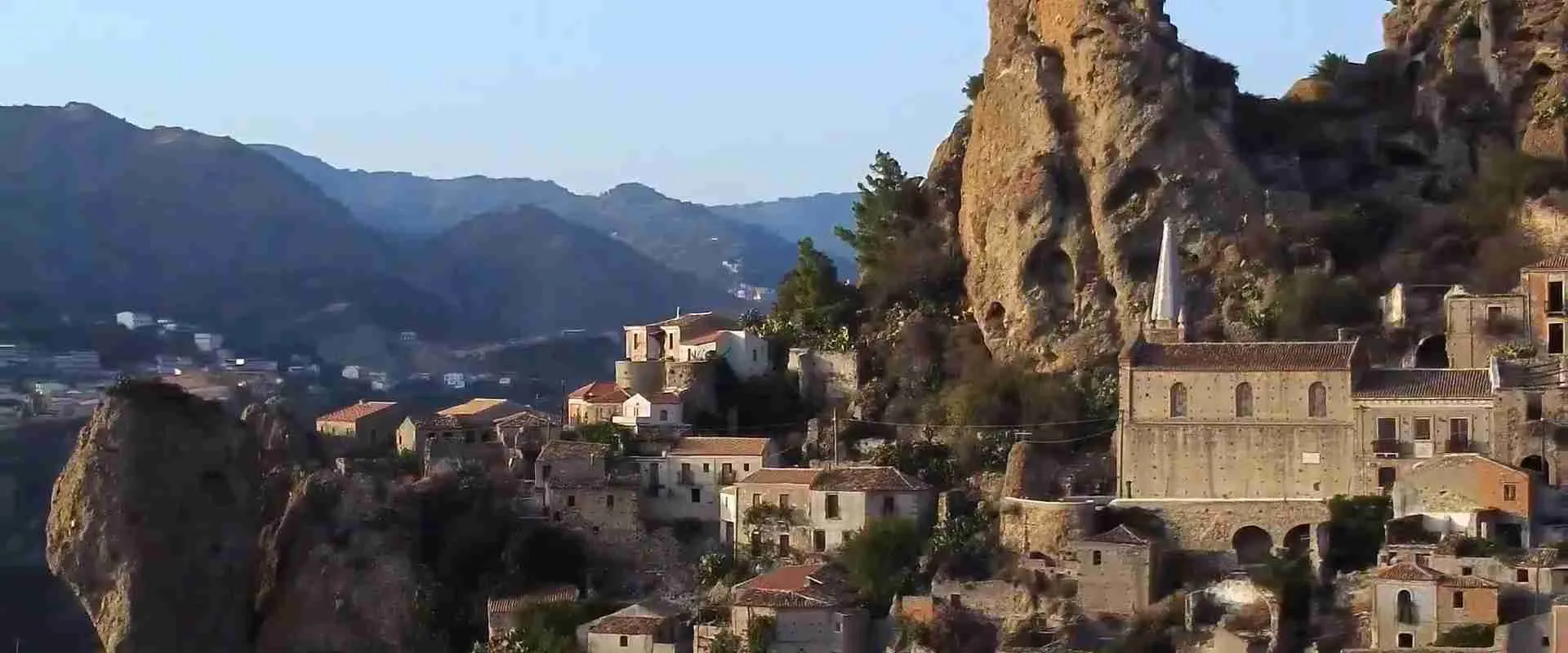
Pentedattilo: The Ghost Village on the Rock
Pentedattilo is one of the most dramatic abandoned settlements in all of Italy, and it sits close enough to Reggio Calabria — roughly 40 kilometres by road, about 40–50 minutes — to make a half-day excursion realistic even in combination with another stop. The village clings to the five-fingered crest of a rocky outcrop (the name derives from the Greek for five fingers) above the Fiumara Amendolea valley. Earthquake damage — particularly in the seventeenth and eighteenth centuries — prompted the gradual abandonment of the medieval core, and the ruins that remain are now a protected heritage site being carefully consolidated for visitor access.
A small residential community persists at the base of the rock, and some parts of the old village have been given over to artistic residencies and seasonal exhibitions. The overall effect — crumbling medieval masonry fused organically to the grey limestone cliff, with the Ionian coast visible in the distance through gaps in the mountains — is extraordinary, particularly in the low light of late afternoon. No public transport serves Pentedattilo: a rental car or taxi from Reggio Calabria is required. The drive is straightforward on the state road, though the approach to the car park above the valley involves some narrow switchbacks. Entry to the site is free; a small visitor contribution may be collected during staffed periods.
Aspromonte National Park and Gambarie
The Aspromonte massif rises directly behind Reggio Calabria to a summit plateau at over 1,900 metres, and its national park — Aspromonte National Park — encompasses a wild interior of deep river gorges, beech forests, and mountain villages that feel genuinely separate from the coast below. The most accessible entry point from Reggio Calabria is Gambarie d’Aspromonte, a mountain resort at around 1,300 metres elevation that functions as a ski destination in winter and a hiking base in summer. The Ferrovie della Calabria operates a regular bus service from Piazza Garibaldi in Reggio Calabria to Gambarie, taking approximately 45–60 minutes; check current schedules at the Ferrovie della Calabria website.
In summer, Gambarie is primarily a hiking and cooler-temperature alternative to the coastal heat: the ridge trails above the village open views over both the Tyrrhenian and Ionian Seas simultaneously on clear days. The Maesano Waterfalls, accessible from several points in the Aspromonte interior by car, are the park’s most visited natural spectacle in summer, but they require a car and a short hike to reach. For those with a rental vehicle, the drive from Reggio Calabria to the more remote parts of the park — crossing the massif to emerge on the Ionian side near Bova or Brancaleone — is a genuine mountain adventure on roads that wind through terrain unchanged for centuries.
Bova: The Last Hellenic Village
Bova, perched on a high inland hill about 70 kilometres east of Reggio Calabria, is one of the last remaining strongholds of Greko, the Italo-Greek dialect still spoken — if only by older residents and in ceremonial contexts — as a legacy of Byzantine-era Greek settlement. The village is a striking assembly of medieval stone buildings around a hilltop castle, with views south to the Ionian and north to the mountains. A dedicated Greko Language and Culture Museum offers context on the linguistic minority community, known as the Greci di Calabria or Calabrian Greeks. Bova is reached by car — roughly 70 minutes from Reggio Calabria — and its road connections to the coast and to Pentedattilo make it natural to pair with a morning at the ghost village. The village itself is free to explore; allow two to three hours for the streets and museum.
Heritage Day Trips 2026: Byzantine Monuments, Greek Ruins and Medieval Villages
Calabria’s heritage day trips fall into three broad historical layers: the Greek colonial period (eighth to third century BC), the Byzantine period (sixth to eleventh centuries AD), and the Norman medieval period (from the late eleventh century onward). Understanding these layers helps in planning: some sites are strongest for one period, and the most rewarding full days mix two layers within a single circuit.
Stilo and the Cattolica di Stilo
The Cattolica di Stilo is the monument most likely to appear in any photographic survey of southern Italian Byzantine heritage. It sits on a rocky spur at the foot of Monte Consolino, a few hundred metres above the hilltop village of Stilo on the Ionian coast, and its silhouette — a cubic mass topped by five cylindrical drums capped with terracotta domes — has appeared on postage stamps, on the cover of cultural brochures, and on travel articles about Calabria for decades. The church dates from the end of the tenth or the beginning of the eleventh century, built during the final phase of Byzantine rule in Calabria. Its name derives from the Greek word Katholikon, which in Byzantine monastic tradition designated the principal church of a monastic complex; scholars consider it most likely to have belonged to a monastery, probably dedicated to the Assumption, as suggested by a 1094 document that refers to a property “to the right of the Catholicon” in the Stilo area.
Inside, four slender columns — almost certainly salvaged from earlier sites — support the central drum. The original fresco cycle covering the interior walls was largely lost over the centuries; the paintings visible today, studied and documented by the archaeologist Paolo Orsi beginning in 1927, include a Dormition of the Virgin, an Ascension with Christ in a mandorla carried by angels, and the figures of Saints Nicolas, Basil, and John Chrysostom on the south wall. The Arabic inscription visible on one column adds a further layer of historical uncertainty, with scholars proposing multiple explanations ranging from reused spolia to the presence of Muslim craftsmen.
Critically for 2026 planning: the Cattolica di Stilo has been closed for restoration and enhancement works funded under the National Recovery and Resilience Plan (PNRR). The official closure was extended to 31 May 2026 to allow work to proceed; as of early June 2026, the municipality of Stilo announced that reopening was imminent. As of the date of this guide’s publication the site had most likely reopened, but travelers should verify the current situation directly with the Direzione Regionale Musei Nazionali Calabria (email: [email protected]) before making it the centrepiece of a day trip. Normal admission when open is €4 (full), €2 (reduced). Stilo itself is a designated Most Beautiful Village, with a Norman castle, a cathedral under restoration after earthquake damage, and steep medieval streets worth exploring for an hour regardless of whether the Cattolica is accessible. Stilo is best reached by car — roughly 1 hour 40 minutes from Reggio Calabria via the A3 and SS106.
Locri Epizephyrii and the Magna Graecia Archaeological Circuit
The coastal plain below Gerace, near the modern town of Locri, preserves the remains of Locri Epizephyrii, one of the most significant Greek colonies in Calabria. Founded in the seventh century BC — making it among the earliest Greek settlements in the region — it was known in the ancient world for its legal code, attributed by tradition to the lawgiver Zaleucus, and for the manufacture of fine terracotta votive objects destined for the Sanctuary of Persephone. The sanctuary is the best-preserved element of the site, and the surrounding landscape of excavated city blocks, fragments of walls, and ruined temple platforms gives a strong sense of scale. The park is substantially free to visit and walk; confirm any ticketing at the entrance. A small associated museum in modern Locri holds additional finds alongside the major holdings now in Reggio Calabria’s national museum.
Locri forms a natural pairing with Gerace in a full Ionian day trip, as described in the Reggio Calabria section above. It also connects conveniently with Stilo: the SS106 coastal highway links the two archaeological areas, making a combined Locri–Stilo circuit feasible in a single long day if the Cattolica is open. Allow two hours at Locri Epizephyrii for a proper visit including the museum; the site rewards those who slow down and look closely at the surviving temple foundations and ancient paved streets.
Serra San Bruno Charterhouse
The Serra San Bruno Charterhouse — a Carthusian monastery founded in the eleventh century by Saint Bruno of Cologne, who chose the forests of the Serre mountains in central Calabria for the site of the second Carthusian house after La Grande Chartreuse in France — remains an active monastery with a small portion open to visitors. The main church and some of the conventual spaces can be visited; the cloister of the monks themselves is restricted, as Carthusian life is strictly contemplative. A monastic museum adjacent to the complex holds archives, liturgical objects, and materials documenting the history of the Carthusian presence in Calabria. The surrounding forests of the Serre massif are themselves a significant natural heritage landscape, largely undeveloped and excellent for walking. Serra San Bruno is about two hours from Reggio Calabria and one hour 20 minutes from Catanzaro; a car is required.
Mountain and Nature Day Trips in 2026: Sila National Park and Aspromonte
Sila National Park: Europe’s Most Southerly Highland Plateau
The Sila plateau stretches across the central spine of Calabria at elevations between 1,200 and nearly 2,000 metres, forming the largest upland plateau in Mediterranean Italy. Recognized as a UNESCO Biosphere Reserve and managed as a national park, it covers approximately 74,000 hectares across the provinces of Cosenza, Catanzaro, and Crotone. The landscape reads as Scandinavian rather than Italian: rolling forested hills, wide glacial lakes filled by hydroelectric dams in the early twentieth century, ancient laricio pine forests, and mountain villages built in timber and stone. On very clear days the summit ridge of Monte Botte Donato (1,928 metres) offers simultaneous views from the Tyrrhenian to the Ionian, with the outline of the Sicilian coast and Etna visible to the south.
The park’s most popular visitor hub for day trippers from Cosenza is the arc formed by Camigliatello Silano, Lake Cecita, and Lorica on Lake Arvo. Camigliatello is roughly 45 minutes from Cosenza on the SS107 mountain road and is the starting point for most organized excursions into the park. Lake Arvo, the largest of the Sila lakes, is encircled by beech and fir forest and offers hiking, cycling, canoeing, and fishing from its shores. The Cupone visitor centre on Lake Cecita, operated by the park authority, provides maps, trail information, wildlife observation points, and an enclosure where deer, roe deer, and wolves can be observed — making it the ideal first stop for a day trip with children or first-time visitors.
The park contains no general entry fee: access to the natural landscape, trails, and most picnic areas is free. Some specific activities — boat rental, guided excursions, the visitor centre programme — carry modest charges. The trail network covers over 600 kilometres with 66 signed routes across all difficulty levels. For a manageable half-day introduction, the Sentiero delle Fate loop trail near Camigliatello (approximately 6.7 kilometres, under two hours) winds through beech forest along the Simmerino stream and is suitable for most fitness levels. The Colli Perilli ring circuit is a more demanding full-day option at around 10 kilometres, requiring boots and alpine fitness.
The Treno della Sila: A Historic Mountain Railway
The Treno della Sila is a narrow-gauge heritage railway operating a seasonal service on a section of the historic Cosenza–San Giovanni in Fiore line. The journey from the Cosenza area climbs to the San Nicola station at over 1,400 metres elevation — the highest narrow-gauge station in Europe — on tracks that wind through Sila’s valleys and forests at a pace slow enough to appreciate the landscape through the windows. The train runs on weekends and selected public holidays from spring through autumn; check the current schedule and book ahead, particularly for popular weekend departures in summer. The experience is appreciated equally by families, railway enthusiasts, and those who simply prefer to see the mountain without driving its roads. Reservations are strongly recommended.
Aspromonte National Park: The Toe’s Wild Interior
Aspromonte National Park, covering approximately 64,000 hectares in the province of Reggio Calabria, is the wilder, less-developed counterpart to the Sila. The park’s character is shaped by the steep river gorges (fiumare) that cut from the central ridgeline to the coasts, creating a highly fragmented landscape of forest, maquis, and near-vertical cliff faces. The summit area around Montalto (1,956 metres, the highest point) is reached by a winding mountain road from Gambarie d’Aspromonte and offers panoramic views over both coastlines. The park interior contains a number of small villages that see almost no tourist traffic — Bova is the most visited, but Brancaleone, Africo Nuovo, and Ferruzzano Nuovo each have their own character. Wildlife includes golden eagles, Sicilian fir trees at their most northerly habitat, and, in the deepest valleys, a wild Aspromonte pine endemic to the massif.
Visitors with a car who are comfortable on mountain roads will find Aspromonte one of the genuinely undiscovered landscapes of southern Italy. The Fiumara d’Arte project — a series of large-scale outdoor sculptures installed in the Fiumara di Tusa gorge on the Tyrrhenian side — adds a cultural layer to what is otherwise a pure nature destination. Entry to the park itself is free; specific visitor centres may charge for guided services.
Coastal Day Trips 2026: The Coast of the Gods and Beyond
The Tyrrhenian coast between Tropea and Pizzo, known as the Coast of the Gods, is the most intensely photographed stretch of Calabrian shoreline and the one most day trippers from within Italy already know. The defining feature is a series of sea stacks and headlands of pale limestone and calcarenite, undercut by turquoise coves that shift colour from aquamarine to deep blue depending on depth and time of day. The beaches at Tropea itself — particularly the town beach below the clifftop old town and the Grotticelle beach at Capo Vaticano — are among the most scenic in Italy and justify a day devoted to doing nothing more strenuous than moving from swimming spot to gelato shop and back.
Boat tours represent the best way to experience the Coast of the Gods that road access cannot provide. Shared half-day tours from Tropea harbour typically visit Capo Vaticano, the cave known as the Grotta dello Scheletro, the Roman harbour ruins at Riaci, and the Grotticelle lagoon, with stops for swimming at each. These tours cost approximately €35–55 per person on a shared boat of up to twelve passengers; private charter is significantly more expensive. The morning departure avoids the midday heat and catches the best light on the limestone cliffs; most operators depart between 9:00 and 10:00 and return by 13:00–14:00, leaving the afternoon free for the beach or lunch in Tropea.
The Purple Coast (Costa Viola) south of Bagnara Calabra — named for the violet-purple light that falls on the water in the evening — is another rewarding coastal circuit that can be explored by car from both Reggio Calabria and Tropea. The drive follows a scenic corniche between sea cliffs and the water with views to Sicily. Bagnara Calabra is famous for its swordfish tradition and holds a swordfish festival in summer; the fish is still hunted using a lookout tower and small traditional boats known as passerella, a practice maintained for centuries on this stretch of coast. The town’s seafront cafes make an excellent lunch stop on a Purple Coast circuit.
For longer coastal ambitions, the boat connection from Vibo Marina to the Aeolian Islands (covered in the Tropea section) remains the most spectacular full-day option on the Tyrrhenian side. On the Ionian side, the waters off the Locride coast near Monasterace Marina have produced several important underwater archaeological finds, and seasonal dive tours explore ancient Greek harbour ruins that still lie on the seabed. Enquire with local dive operators in Monasterace for current programmes.
Getting Around Calabria for Day Trips in 2026
Transport planning is the single most important logistical element of Calabrian day tripping, because the region’s infrastructure divides sharply between the coastal rail corridor and the interior road network. Getting these two systems right in advance saves the frustration of arriving at a village bus stop only to discover the next bus back comes six hours later.
By Train: The Trenitalia regional network links Reggio Calabria northward along the Tyrrhenian coast through Villa San Giovanni, Scilla, Bagnara Calabra, Palmi, Rosarno, Vibo Marina, Pizzo, and on to Lamezia Terme and the Tropea branch line. This is the backbone of day trip transport on the western side of the region. Services run frequently between Reggio Calabria and Scilla (up to 33 a day), with less frequency further north. Regional tickets are inexpensive — €3 to €10 for the distances covered — and can be purchased at station machines, at ticket offices, or via the Trenitalia app and website. Tickets are not seat-reserved on regional services: validate your ticket at the yellow machines on the platform before boarding. On the Ionian coast, the Jonica railway links Reggio Calabria eastward through Melito di Porto Salvo toward Locri and Crotone, but services are infrequent and the connections to inland villages are essentially nonexistent for tourist purposes.
By Car: A car is essential for access to inland Calabria and transforms the range of available excursions. The A3 motorway (Autostrada del Mediterraneo) runs the full length of the Tyrrhenian coast at speed; exits are well-signed and the road is modern throughout. The SS106 Jonica coastal road on the Ionian side is slower but scenic, and provides access to Locri, Stilo, and the Ionian coastal circuit. Mountain roads — particularly into the Sila and Aspromonte — are well-maintained on the major routes but should not be underestimated: the combination of altitude, narrow lanes, and livestock on the road requires concentration. Car hire desks operate at Lamezia Terme Airport (the regional hub), Reggio Calabria Airport, and Reggio Calabria Centrale station. Compact cars at Lamezia Terme Airport start from approximately €25 per day when booked well in advance; summer peak rates (July–August) average €30–45 per day for a small vehicle. Booking directly with a major international agency reduces the risk of contract ambiguities.
By Organized Tour: Organized day tours from Tropea and Reggio Calabria cover the most popular circuits and are particularly valuable for travelers without a car or those who prefer local expertise on heritage sites. Operators in Tropea include CST Tropea and smaller local agencies bookable through GetYourGuide, Musement, and Viator. A typical full-day circuit (for example, Reggio Calabria and Scilla from Tropea) costs €65–75 per person, includes hotel pickup, and lasts about 11 hours. The tour typically does not include museum admission or lunch. The advantage of a tour for the Reggio Calabria circuit is that the guide explains the Riace Bronzes in context — an experience that adds significantly to what the museum’s own labeling provides.
By Bus: Regional buses operated by Ferrovie della Calabria connect Reggio Calabria with Gambarie d’Aspromonte and some other interior destinations. For most tourist purposes beyond Gambarie, however, the bus network is too infrequent and the connections too time-consuming to compete with car hire for day trips. Urban buses in Reggio Calabria connect the main railway stations with the National Archaeological Museum of Magna Graecia.
Day Trip Cost Planning for Calabria in 2026
Calabria is one of the most affordable day trip regions in Italy, with most of the cost coming from transport rather than admission fees. Planning a realistic daily budget requires accounting for three main categories: getting there, getting in, and eating.
Transport is the largest variable. A return train from Reggio Calabria to Scilla costs around €6 total — essentially the cheapest day excursion in the whole of Italy for the scenic return offered. A day trip from Tropea to Reggio Calabria and back on regional trains costs approximately €16–20 return. If renting a car for a day’s inland touring, add €25–45 for the vehicle plus petrol — typically €15–25 for a day’s driving in this compact region. Organized tours from Tropea run €65–75 per person for a full day. The Aeolian Islands boat trip adds €50–70 per person to whatever you spend on transport to reach Vibo Marina.
Admission fees in Calabria are low by Italian standards. The National Archaeological Museum of Magna Graecia in Reggio Calabria charges €10 for adults (the single highest entry cost you are likely to encounter). The Cattolica di Stilo when open charges around €4. Most medieval villages — Gerace, Pentedattilo, Bova — are free to walk. The Sila National Park and most of Aspromonte National Park have no general entry fee. Cathedral admissions where charged typically run €2–4.
Food costs reflect Calabria’s position as one of Italy’s less expensive regions for dining. A two-course lunch with local wine at a waterfront trattoria in Scilla or Tropea typically costs €20–35 per person. A seafood lunch in Reggio Calabria’s centre is similar. Inland at a village restaurant the same lunch comes to €15–25. A street snack — a slice of pizza, a piece of roasted swordfish sandwich, or a tartufo in Pizzo — runs €3–8. Budget travelers who eat simply, travel by train, and visit free sites can experience a full and varied day in Calabria for €15–35 per person. A comfortable mid-range day with lunch, one paid attraction, and public transport typically runs €35–65 per person. A fully organized guided tour day, including the tour fee and a restaurant lunch, falls in the €85–120 per person range.
Best Season for Day Trips in Calabria 2026
The right season shapes day trip planning dramatically in Calabria, where summer heat and winter rain can close off entire categories of experience.
April to June is the strongest window for heritage and inland day trips. Temperatures are comfortable — typically 18–26°C on the coast, 10–18°C in the mountains — wildflowers bloom in the Aspromonte and Sila, the light is excellent for photographs, and the tourist infrastructure is fully operational without the crowds of July and August. The Sila’s forest trails are accessible from May onward without snowshoes. The Aeolian Islands boat trips begin operating regularly from early June.
July and August are high summer: coastal Calabria bakes at 30–38°C, Tropea’s beaches are packed, and the Aeolian Islands excursion reaches peak popularity. The sea is warm and clear — ideal for boat-based coastal trips and swimming at Capo Vaticano — and beach day trips from Tropea are straightforwardly excellent. The disadvantage is crowds at the most popular sites, higher accommodation prices, and a heat that makes afternoon sightseeing in historic towns uncomfortable. Mountain trips to Sila or Aspromonte are especially valuable in July and August as a temperature escape: the plateau can be 15 degrees cooler than the coast and is at its greenest.
September and October are the consensus best months for combining heritage, mountain, and coastal excursions. Temperatures moderate to 22–28°C on the coast, the Sila’s forests turn gold with beech foliage, the sea remains warm enough for swimming well into October, and tourist crowds thin sharply after the first week of September. The Aeolian Islands trips run into mid-September. This is the period when Gerace, Pentedattilo, and the Ionian heritage circuit can be visited in full comfort.
November through March is the low season, when coastal tourism contracts significantly. Most heritage sites remain open — the National Archaeological Museum of Magna Graecia operates year-round — but some seasonal restaurants, boat tour operators, and smaller village visitor services close or reduce hours. The Sila transforms into a ski destination from December; Camigliatello and Lorica have slope facilities that attract domestic visitors. Winter visits to medieval villages like Gerace or Stilo offer an atmosphere of genuine quietude that summer visitors never see, with fog in the valleys and fires burning in village cafes. Heritage travelers who can tolerate cool weather often find November and February the most intimate time to visit.
Frequently Asked Questions
Is it better to base myself in Tropea or Reggio Calabria for day trips in 2026?
The two bases serve different priorities. Tropea gives the best access to the Tyrrhenian coastal circuit — Pizzo, Capo Vaticano, Scilla, and the Aeolian Islands boat trip — in a beach-resort setting with a lively tourist infrastructure. Reggio Calabria is the better choice for those prioritizing the Riace Bronzes, Scilla by the most convenient train connection, the Ionian coast including Gerace and Locri Epizephyrii, and the Aspromonte interior. Travelers with two weeks might spend the first week based in Tropea for the coast and the second in Reggio Calabria for the south and the Ionian. Those with a car and one week might prefer Reggio Calabria as the quieter, more centrally useful base.
Can I visit the Riace Bronzes without a reservation in 2026?
Walk-in admission to the National Archaeological Museum of Magna Graecia is possible during standard hours (Tuesday–Sunday, 9:00–20:00), but access to the Riace Bronzes room is regulated: only 20 visitors are admitted at a time to protect the climate-controlled environment. In peak summer (July–August), queues for the bronzes room can develop, particularly on weekend mornings and after large tour groups arrive. Booking a timed entry slot through the CoopCulture online ticketing system (ticketing.coopculture.it) avoids waiting and is strongly recommended for July and August visits. Online booking also locks in the current €10 admission rate; check the official page for any pricing changes before purchasing.
How many of Calabria’s best day trips actually require a car in 2026?
The coastal excursions — Scilla, Pizzo, Tropea to Reggio Calabria — are well served by regional trains and organized tours and do not require a car. In contrast, most inland day trips are effectively inaccessible without one: Gerace, Locri Epizephyrii, Pentedattilo, Bova, Stilo, Serra San Bruno Charterhouse, Aspromonte National Park beyond Gambarie, and the deeper parts of the Sila plateau all require a rental vehicle or an organized private tour. The rough division is that the best cultural and natural experiences in Calabria sit inland, and that the coastal train network serves the coast exclusively. Travelers planning to see more than beach towns and the Riace Bronzes will get significantly more from their time with a car for at least two or three days.
How do I find out if the Cattolica di Stilo is open before I visit in 2026?
The site’s current status is managed by the Direzione Regionale Musei Nazionali Calabria, which publishes official notices on the Italian Ministry of Culture website (cultura.gov.it) under the site listing for “La Cattolica.” The most reliable method is to email the site directly at [email protected] or to call the contact number listed on the official page. The municipality of Stilo’s tourist office and the Stilo Pro Loco (“T. Campanella” association) can also provide current information. Given the long history of deadline extensions during the current restoration project, confirm no earlier than two or three days before your planned visit. The village of Stilo itself and the cathedral below it are fully accessible regardless of the Cattolica’s status.
Is Sila National Park worth visiting for just one day from Cosenza in 2026?
A single day in Sila National Park is entirely worthwhile and gives a clear sense of the plateau’s character even if it barely scratches the surface of the hiking network. The most effective single-day itinerary from Cosenza starts at the Cupone visitor centre on Lake Cecita for the wildlife enclosures and a short trail, then continues to the Giants of Sila reserve to walk among the ancient laricio pines, and ends at Lake Arvo near Lorica for a late lunch at a lakeside restaurant and a sunset walk on the shore. On weekends when the Treno della Sila is running, adding a train ride from the Cosenza area to the San Nicola mountain station and back adds two hours but provides a perspective on the landscape that the road cannot. The full loop by car takes around five to six hours of driving and visiting, leaving a comfortable margin for stops.
What should I know about driving in Calabria in 2026?
The A3 motorway and the SS106 coastal highway on the Ionian side are modern, wide, and fast. Mountain secondary roads are typically well-maintained but often narrow and winding, with gradients that require careful descent technique on longer sections. Some approaches to hilltop villages — particularly Gerace and Pentedattilo — involve passages where two cars cannot pass easily; pull-outs exist but require care. GPS navigation is reliable throughout the region. Speed limits are strictly enforced on motorways (130 km/h) and at Autovelox fixed cameras on secondary roads (90 km/h). ZTL (Limited Traffic Zone) restrictions apply in the historic centres of Reggio Calabria and in some smaller hilltop villages: do not drive into an old town without confirming public vehicle access. Most historic centres have car parks at the village entrance with a short walk to the main sights.
Are Calabria’s day trip sites family-friendly in 2026?
Several of the region’s best day trips work well for families with children. Scilla has an accessible beach at Marina Grande and a straightforward village to walk; the train journey from Reggio is short enough for young children to handle. The Sila National Park’s Cupone visitor centre wildlife enclosures are designed with children in mind and require minimal hiking. Capo Vaticano boat tours are generally suitable for children over six who are comfortable on water. The Riace Bronzes in the National Archaeological Museum of Magna Graecia work well for children who can tolerate a museum visit — the bronzes themselves are large, dramatic, and visually striking enough to hold young attention. Pizzo’s tartufo gelato is, obviously, an immediate success with children of any age. The ghost village of Pentedattilo requires a short walk on rough terrain and works better for families with children aged ten and up.
What local food and drink should I look for on Calabria day trips in 2026?
Calabrian cuisine is one of the most assertively spiced in Italy, and the key ingredients appear in different forms at almost every day trip destination. ‘Nduja — a soft, spicy, spreadable sausage made with pork and Calabrian chili peppers — is the region’s most famous export and appears in pasta, on bread, and as a topping for pizza. Swordfish (pesce spada) is the coastal highlight, particularly in Scilla and Bagnara Calabra, where traditional fishing methods persist. The tartufo di Pizzo is essential in Pizzo itself. On the Ionian coast around Gerace and the Locride area, the wines are exceptional: the Greco di Bianco, a late-harvest dessert wine made from Greco Bianco grapes, has been documented since antiquity and pairs magnificently with local cheeses. In the Sila, fresh porcini mushrooms in autumn, provola silana cheese, and roasted chestnuts from the mountain forests define the mountain table. Licorice (liquirizia) from the Crotone area and bergamot citrus from the Reggio Calabria coast round out the regional specialties worth seeking on any day trip itinerary.
Are there organized guided tours of the Riace Bronzes in English in 2026?
English-language guided tours of the National Archaeological Museum of Magna Graecia are available; visits can be booked in Italian and in English through the museum’s call centre and online ticketing at the CoopCulture portal. The museum itself offers audio guides. Local tour operators in Reggio Calabria — accessible through booking platforms — offer private guided museum visits in English, typically lasting two hours and focusing specifically on the Riace Bronzes, the Philosopher’s Head, and the broader Magna Graecia collection. Day tours from Tropea that include the museum typically incorporate an English-speaking guide for the city and promenade portions, though museum commentary may be briefer in that format. Independent visitors without a guide benefit from reading about the Bronzes’ 1972 discovery before arriving: the context significantly enhances the experience of standing in front of them.
What are the most common planning mistakes on Calabria day trips in 2026?
The most frequent errors in Calabrian day trip planning are: underestimating inland driving times on mountain roads (always add 30 percent to GPS estimates on secondary routes); arriving at hilltop sites in the early afternoon when heat and post-lunch closures reduce access; failing to check the opening status of restoration-affected sites like the Cattolica di Stilo before making them the centrepiece of a day; attempting Gerace and Locri Epizephyrii from Tropea in a single day without a car (the distances and public transport connections make this impractical); and booking Aeolian Islands tours without advance reservation in July and August, when the most popular departures are sold out days ahead. For first-time visitors, the Scilla train excursion from Reggio Calabria is almost impossible to do wrong and sets a useful tone for the pace and character of the region before attempting more complex itineraries.