
Brescia & Franciacorta Travel Guide 2026: Ultimate Planning Resource
Brescia rarely appears on first-time Italy itineraries, yet this Lombard city pairs UNESCO World Heritage monuments with one of Italy’s finest sparkling wine regions and sits just 36 minutes by high-speed train from Milan. This guide covers every practical aspect of a 2026 visit — from transport options and verified ticket prices to Franciacorta estate recommendations, neighbourhood-by-neighbourhood hotel choices, and pre-verified daily budgets for every travel style.
Key Takeaways
- Fast Milan connection: High-speed Frecciarossa and Italo trains reach Brescia in 36–50 minutes from €8 advance; regional trains take around 1 hour 15 minutes from €8. Around 80–135 services run daily in each direction.
- UNESCO heritage: Brescia holds two components of the serial “Longobards in Italy. Places of Power (568–774 A.D.)” inscription (reference 1318, criteria ii, iii, vi, inscribed 25 June 2011): the Santa Giulia–San Salvatore monastery complex and the adjacent Roman Forum archaeological area. The Integrated Ticket covering both plus four additional civic museums costs €19 per adult in 2026.
- Verified 2026 daily costs: Budget travelers spend €65–100 per person daily (two sharing a budget hotel); mid-range travelers €135–205; luxury travelers €270–410. All figures include accommodation, meals, transport, and admissions.
- Franciacorta DOCG: Italy’s leading sparkling wine region lies 15 km south-west of Brescia city centre. Standard winery tours with tastings cost €25–55 per person; premium full-day experiences with food pairings reach €75–135. A car or organised tour is required to visit the estates.
- Brescia Card advantage: The 48-hour Brescia Card (€23) covers unlimited city public transport plus entry to all main civic museums — better value than buying a transport day pass and museum ticket separately for any two-day visit.
- Best seasons in 2026: Late April through early June offers mild temperatures and vineyards in blossom. Mid-September through late October brings the Franciacorta harvest and the annual Festival Franciacorta, when over 120 estates open their cellars to the public.
People Also Ask About Brescia & Franciacorta 2026
How much does a trip to Brescia cost in 2026?
A three-day mid-range trip to Brescia costs approximately €405–615 per person (two sharing a 3-star hotel). Budget travelers managing costs carefully spend €65–100 per person daily — two sharing a budget hotel at €55–75 per room, eating at local bars and osterias, and using city transport. Mid-range travelers covering accommodation, restaurant dining, the Integrated Museum Ticket, and at least one Franciacorta wine tour spend €135–205 per person daily. Luxury travelers staying at 4-star hotels and dining at Brescia’s best restaurants spend €270–410 per person daily. All figures assume two people sharing accommodation; solo travelers add the full room cost. See the Budget Breakdown section for full per-component itemisation.
How do I get from Milan to Brescia in 2026?
The fastest option from Milan Centrale is a Frecciarossa or Italo high-speed train, which covers the 85 km in 36 minutes with advance fares from €8. Regional Trenord trains from Milan Centrale or Milano Porta Garibaldi take around 1 hour 15 minutes and start at €8. Around 80–135 trains run daily in each direction, so same-day travel requires no advance planning beyond buying a ticket at the machine. Brescia station stands in the city centre, five minutes’ walk from the metro and 15–20 minutes’ walk from the historic core. Drivers take the A4 autostrada (Milan–Venice) and exit at Brescia Centro; the journey takes 55–80 minutes depending on traffic.
Is Brescia worth visiting in 2026?
Yes — Brescia is one of Lombardy’s most rewarding and undervisited cities. The UNESCO Longobards complex alone justifies a full day: the Santa Giulia Museum covers 14,000 square metres across six centuries of architectural layering, and the adjacent Brixia Roman archaeological park houses the finest Roman bronze in northern Italy, the Winged Victory. The Franciacorta wine region on the city’s doorstep adds a dimension that no comparable UNESCO city in Italy can match. Tourist crowds at Brescia run far below those in Verona, Venice, and the Lakes, and restaurant prices reflect local rather than tourist economics. A three-day visit combining the UNESCO sites, Piazza della Loggia, the castle, and two Franciacorta estates gives a full and satisfying itinerary at well below the cost of an equivalent Milan stay.
What are the best Franciacorta wineries to visit in 2026?
Ca’ del Bosco in Erbusco is the region’s flagship estate — tours wind through underground barrel rooms filled with contemporary sculpture before ending at a tasting of the estate’s benchmark Cuvée Prestige and Vintage bottlings. Bellavista, also in Erbusco, offers panoramic hilltop views across vineyards toward Lake Iseo and produces some of the region’s most refined Satèn and Brut. Berlucchi at Borgonato di Cortefranca is the estate that effectively invented modern Franciacorta in 1961 and provides strong historical context alongside the cellar tour. For smaller, family-owned alternatives, Il Mosnel in Camignone di Passirano uses 16th-century cellars and Ferghettina in Adro is recognised for distinctive winemaking and memorable Rosé. All major estates require advance booking in the 2026 season; weekend slots at Ca’ del Bosco and Bellavista fill several weeks ahead.
Extended multi-day tours – 5+ days
Featured Brescia Multi-Day Tour Packages

3 days
Brescia 3-Day Discovery Tour
- ✓ Comprehensive Brescia experience
- ✓ Expert local guides included
- ✓ All accommodation included
- ✓ Transportation provided
5 days
Brescia 5-Day Highlights Experience
- ✓ Comprehensive Brescia experience
- ✓ Expert local guides included
- ✓ All accommodation included
- ✓ Transportation provided

7 days
Brescia 7-Day Cultural Journey
- ✓ Comprehensive Brescia experience
- ✓ Expert local guides included
- ✓ All accommodation included
- ✓ Transportation provided

10 days
Brescia 10-Day Complete Adventure
- ✓ Comprehensive Brescia experience
- ✓ Expert local guides included
- ✓ All accommodation included
- ✓ Transportation provided
Multi-day tour packages powered by TourRadar. Prices and availability subject to change.
Introduction: Brescia & Franciacorta in 2026
Brescia is the second city of Lombardy and one of the most historically layered urban centres in the Italian Alps foothills. The Romans called it Brixia and built a Capitoline temple complex whose pediment still stands in the heart of the city. The Lombards arrived in 569 A.D. and built the monastery of San Salvatore — later expanded into the Santa Giulia complex — whose carved stones, painted chapels, and Gothic cloisters now form the centrepiece of a UNESCO World Heritage inscription shared with six other Italian sites. Venice ruled Brescia for nearly four centuries, leaving behind the Renaissance loggias and clock tower of Piazza della Loggia and a cycle of Romanino altarpieces in the city’s oratories. The industrial revolution gave Brescia its engineering legacy and the iron-working tradition that still runs through its commercial DNA, but none of that visibly interrupts the medieval and Renaissance architecture of the centro storico.
The Franciacorta wine region begins where the city ends. The term refers to both a geographic zone — roughly 30 km of moraine hills and lake-fed clay soils between Brescia and Lake Iseo — and a DOCG appellation for sparkling wines made by the traditional method (the same process used in Champagne). Franciacorta earned DOC status in 1967 and full DOCG for its sparkling wines in 1995, making it Italy’s first DOCG specifically designating the traditional method for sparkling production. Today around 120 producers farm the zone, ranging from giants like Ca’ del Bosco and Bellavista producing millions of bottles annually, to family estates releasing a few thousand cases of meticulously crafted non-vintage and vintage cuvées. The wines are not cheap — a quality non-vintage Franciacorta Brut retails between €15 and €30 at the cellar door — but they are among the most consistent and food-friendly sparkling wines produced anywhere in the world.
Together, Brescia and Franciacorta make a destination that rewards every traveller type: the history-minded visitor who wants depth of UNESCO heritage without Colosseum-scale queues; the wine traveller seeking an alternative to Champagne and Prosecco; the day-tripper from Milan or Venice needing a solid full day of sightseeing; and the slow-travel enthusiast who wants a Lombard base from which to reach Lake Iseo, Lake Garda, Bergamo, and Verona. This guide provides all the practical detail needed for each of those visits.
Getting to Brescia in 2026: Trains, Roads & Airport Connections
High-speed train is the definitive way to reach Brescia in 2026, and the connection from Milan is one of the best short-haul rail links in northern Italy. Frecciarossa services from Milano Centrale reach Brescia in 36 minutes with standard 2nd-class fares starting at €9 when booked in advance; Italo trains on the same route take 36–40 minutes from €8. Regional Trenord services from Milano Centrale or Milano Porta Garibaldi take around 1 hour 15 minutes and cost €8 regardless of booking timing. The frequency is exceptional — over 80 trains daily in each direction means no meaningful planning is required: buy a ticket, get on the next train.
From Verona Porta Nuova, Frecciarossa and Intercity trains reach Brescia in 28–35 minutes from €8–12; this makes Brescia a natural first or last stop on a Verona–Milan corridor itinerary. From Venice Santa Lucia, the journey takes approximately 1 hour 45 minutes to 2 hours by Frecciarossa from around €15–25 advance. From Rome Termini, direct Frecciarossa services take around 2 hours 40 minutes with fares from €25 advance; all long-distance trains stop at Brescia station in the city centre without any transfer.
Brescia from Airports in 2026
Bergamo Orio al Serio airport (BGY) — the Ryanair hub closest to Brescia — connects to Brescia by a combination of ATB bus to Bergamo station (30 minutes, €2) and Trenord train to Brescia (30–40 minutes, €5–7). Total journey time from the terminal is 70–90 minutes; total cost around €7–9. Malpensa airport (MXP) requires a rail transfer in Milan: Malpensa Express to Milano Centrale (52 minutes, €13), then Frecciarossa or regional train to Brescia. Total journey around 1 hour 45 minutes from terminal. Linate (LIN), the urban Milan airport, connects by tram (Line 5 or the Linate Metro shuttle) to Milan’s metro network, then train to Brescia in around 1 hour 30 minutes total. Verona Catullo (VRN) is 45 minutes by car and connects by shuttle bus to Verona station.
Driving to Brescia in 2026
The A4 autostrada (Torino–Venezia) passes directly through the Brescia agglomeration with two relevant exits: Brescia Centro (for the historic district and Santa Giulia Museum) and Brescia Est (for the A21 connection toward Lake Garda). Journey time from Milan by car is 55–80 minutes depending on the A4 congestion that plagues the Bergamo–Brescia stretch on Friday evenings and Sunday afternoons. Fuel prices on the autostrada average €1.85–1.95/litre for unleaded in 2026; the A4 toll from Milan to Brescia runs around €4.00. Parking in the historic centre: the Parcheggio Arnaldo near Via dei Musei costs €1.50–2 per hour; street parking on blue lines in surrounding streets runs €1–1.50 per hour and is free after 20:00 and on Sundays in most zones.
Getting Around Brescia & Franciacorta 2026
Brescia’s historic centre is compact and walkable. The main UNESCO sites, the Roman theatre, Piazza della Loggia, Piazza Paolo VI, and the castle hill are all within a 20-minute walk of each other. For visiting outlying neighbourhoods or reaching the station quickly, Brescia operates a modern single-line metro and an extensive bus network through Gruppo Brescia Mobilità.
Metro, Bus & the Brescia Card 2026
The Brescia Metro (Linea 1) runs 17 stations from Prealpino (north-west) to Sant’Eufemia–Buffalora (south-east), with the most useful central stops being Vittoria (for Piazza della Vittoria and Santa Giulia), Brescia (for the main station), and Repubblica (for Piazza della Repubblica). A single metro or bus ticket costs €1.80 and is valid for 75 minutes. Day passes are available at €5. The 48-hour Brescia Card (€23) covers unlimited metro, bus, and the Bicimia bike-share, plus free entry to the Santa Giulia Museum, Brixia Roman Archaeological Park, Tosio Martinengo Art Gallery, Mille Miglia Museum, Diocesan Museum, and Luigi Marzoli Arms Museum. For any visitor spending two or more days in Brescia, the 48-hour card is demonstrably better value than buying transport and museum tickets separately — the museum entries alone are worth €19 at standard rates, and two days of unlimited transit add further value. The 24-hour Brescia Card costs €18 and covers the same benefits.
Getting Around the Franciacorta Wine Region 2026
A car is the most practical way to explore the Franciacorta estates: the vineyards spread across roughly 300 km² of rolling hills and no single bus route connects the major wineries. Renting a car in Brescia for a single day costs €35–55 for a compact class through Hertz, Avis, or Europcar at the main station; fuel for a one-day winery circuit adds approximately €10–15. If the itinerary involves wine tasting at multiple estates, a designated driver is essential — Italian road rules apply strictly, and wineries do not offer a drive-around alternative.
Organised tours from Brescia solve the driving problem. Multiple operators run half-day (from €75/person, including transport and tasting at one estate) and full-day Franciacorta tours (from €110–135/person, two estates plus lunch). These run daily in season from March through November and include hotel pick-up in Brescia. Book at least a week in advance during spring and autumn weekends. E-bike rentals at around €30–40 per day from shops in Erbusco and Adro work well for a leisurely one-estate visit on flat terrain; the marked Strada del Franciacorta cycling route covers the zone. Taxis from Brescia to Erbusco (where Ca’ del Bosco and Bellavista are located) run approximately €25–35 one-way.
Brescia’s UNESCO World Heritage Sites 2026: Longobards, Santa Giulia & Brixia Romana
Brescia holds two interconnected components of the serial UNESCO inscription “Longobards in Italy. Places of Power (568–774 A.D.)” — reference 1318, criteria (ii), (iii), and (vi), inscribed at the 35th session of the World Heritage Committee on 25 June 2011. The inscription covers seven site groups across Italy (Cividale del Friuli, Brescia, Castelseprio-Torba, Spoleto, Campello sul Clitunno, Benevento, and Monte Sant’Angelo); Brescia’s contribution is the most layered of the seven because it superimposes Lombard monastic architecture directly on a pre-existing Roman urban core, making the two chronological strata inseparable. Both components are included in the Integrated Ticket (€19 full price; €16 for affiliates and over-65s; €12 for under-26s), valid until 31 August 2026 and providing one admission to each of the five venues covered.
Santa Giulia Museum & the San Salvatore Monastery Complex
The Santa Giulia Museum is the finest civic museum in Lombardy outside Milan and one of the most architecturally extraordinary museum settings in Italy. It occupies the monastic complex of San Salvatore–Santa Giulia — founded in 753 A.D. by Desiderius, Duke of Brescia and future last king of the Lombards, with his wife Ansa — and covers approximately 14,000 square metres of exhibition space spread across buildings from the 8th century through the 16th. The museum address is Via dei Musei 81/b; it opens Tuesday through Sunday 10:00–19:00 in summer (1 June–30 September) and 10:00–18:00 in winter (1 October–31 May), and closes on Mondays except public holidays.
The three-hour minimum visit moves through the Roman residential quarter — two domus with intact mosaic floors and frescoed walls — before entering the Lombard church of San Salvatore, whose three naves display an extraordinary fusion of Roman column capitals, Byzantine carved reliefs, and Lombard interlace patterns. Above the nave sits the oratory of Santa Maria in Solario, home to the Cross of Desiderius: a 9th-century bejewelled processional cross encrusted with 212 cameos and gemstones, arguably the most important surviving example of Lombard goldsmith work. The Nuns’ Choir (Coro delle Monache), completed in 1599, fills an entire barrel-vaulted space with frescoes by Floriano Ferramola. The museum’s final rooms trace Brescia from the Venetian period through the 19th century. The Winged Victory, Brescia’s iconic Roman bronze goddess excavated in 1826, is displayed at the adjacent Brixia site rather than in the museum itself.
Brixia Roman Archaeological Park & the Winged Victory
The Brixia Roman Archaeological Park (Parco Archeologico di Brescia Romana) sits directly behind the Santa Giulia Museum on Via dei Musei and covers the remains of the ancient Roman forum of Brixia: the Republican sanctuary, the Capitolium temple of the Flavian era, the Roman theatre, and the municipal basilica. The park opens Tuesday through Sunday on the same seasonal hours as the museum and is included in both the Integrated Ticket and the Brescia Card.
The Capitolium, built under Emperor Vespasian around 73 A.D. and partially restored in the 19th century, presents three surviving cells of what was originally a three-cella temple dedicated to Jupiter, Juno, and Minerva. The podium stands at nearly original height with four Corinthian columns still in position along the front — the only intact Republican-era temple front surviving in northern Italy. Inside the central cell, multimedia displays reconstruct the forum as it appeared at its peak. The Winged Victory stands in the reconstructed cella: a 1st-century A.D. bronze originally displayed here in the late Roman period, re-discovered under the floor in 1826. The figure is technically a Nike (or Victoria) in the act of stepping forward with her right foot while writing on a shield — the pose and workmanship make it one of the most graceful bronzes from the Roman world, and it is rarely reproduced in guidebooks at the scale its quality deserves.
Beyond UNESCO: Essential Sights in Brescia 2026
Brescia’s non-UNESCO attractions form a full secondary day of sightseeing that most visitors underestimate. The castle, the Renaissance piazzas, and the art gallery each stand independently as worthwhile destinations.
Brescia Castle (Castello di Brescia) 2026
The Castello di Brescia occupies the summit of the Cidneo hill above the historic centre, visible from virtually every point in the city. Entry to the castle grounds and terraces is free; the Luigi Marzoli Arms Museum inside the castle walls costs €5 separately or is included in the Integrated Ticket and Brescia Card. The museum holds one of Europe’s finest collections of medieval and Renaissance arms and armour — over 700 pieces including 15th-century Milanese armour, Brescian sword production from the 16th through 18th centuries, and a remarkable series of 17th-century firearms. The castle grounds are worth the 15-minute climb even without the museum entry: the panoramic terraces give the best views of the city’s roofscape and the Franciacorta hills to the south.
Piazza della Loggia & the Renaissance Centre
Piazza della Loggia is one of the most elegant Renaissance squares in the Veneto–Lombard tradition. The Loggia (town hall), begun in 1492 under Venetian supervision and completed in 1574, shows the influence of Jacopo Sansovino and Palladio in its upper storey; the lower arcade in Istrian stone gives onto the square with quiet confidence. The clock tower at the eastern end of the piazza dates to 1545 and contains an astronomical clock with Moorish automaton figures. The square is pedestrianised and free to enter at all hours; the Loggia houses municipal offices rather than a visitor museum.
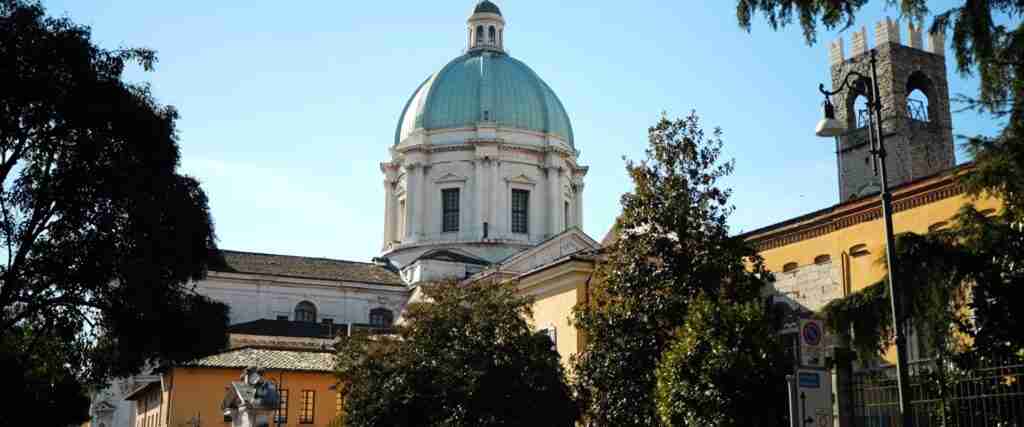
Three minutes north of Piazza della Loggia, Piazza Paolo VI holds Brescia’s twin cathedrals: the Duomo Vecchio (Rotonda), a circular Romanesque basilica of the 11th century built directly over a 6th-century episcopal church, and the Duomo Nuovo, a 17th-century Baroque cathedral whose dome was not completed until 1825. Both are open daily without charge. The Duomo Vecchio interior reveals the archaeological layers of the Episcopal complex beneath its floor — visible Roman and early-Christian remains including the 6th-century church of San Filastrio — and contains Moretto da Brescia’s Assumption of the Virgin (1526), one of the artist’s finest works.
Tosio Martinengo Art Gallery 2026
The Pinacoteca Tosio Martinengo, housed in Palazzo Martinengo on Via dei Musei (five minutes from Santa Giulia), reopened after a major restoration in 2021 and now presents one of the best-displayed provincial art galleries in northern Italy. The collection specialises in the Brescian Cinquecento — Moretto da Brescia, Romanino, Savoldo, and the Campi brothers — alongside works by Lorenzo Lotto, Raphael (a small panel), and Vincenzo Foppa. Entry is included in the Integrated Ticket and Brescia Card; opening hours match the other civic museums (Tuesday–Sunday, 10:00–18:00 or 19:00 seasonally).
Mille Miglia Museum 2026
The Museo Mille Miglia at Viale della Bornata 123, housed in the monastery of Sant’Eufemia, dedicated to the legendary open-road race that ran from Brescia to Rome and back between 1927 and 1957, and whose revival edition still starts from Brescia each May. The permanent collection includes over 200 historic vehicles, original trophies, and an extensive photographic archive. Entry costs €15 (adults) and €7 (children 6–14); it is included in the Brescia Card. Opening hours are Tuesday–Sunday 10:00–18:00.
Franciacorta Wine Region 2026: Estates, Tastings & Touring Routes
Franciacorta is Italy’s answer to Champagne: a moraine-based wine region where sparkling wines produced by the traditional method (tirage in bottle, minimum 18 months on lees for non-vintage) command serious prices and international critical respect. The DOCG zone covers roughly 3,000 hectares of vineyards across 19 municipalities between Brescia and Lake Iseo. Around 120 producers bottle wine under the Franciacorta DOCG designation; Chardonnay forms the backbone of most blends, with Pinot Nero adding structure and Pinot Bianco contributing freshness. An indigenous white variety, Erbamat, gained approval in 2017 for use in Vintage and Satèn cuvées as a tool for managing acidity in a warming climate.
The Four Main Franciacorta Wine Styles
Non-vintage Franciacorta Brut spends a minimum of 18 months on lees before disgorgement and represents the entry point into the appellation — wines at this level from the best producers rival good Champagne at lower prices. Vintage Franciacorta requires a minimum of 30 months on lees and carries a harvest year on the label; the best examples are age-worthy for a decade or more. Satèn is a Blanc de Blancs style exclusive to Franciacorta, produced at slightly lower atmospheric pressure than standard sparkling wines, giving a notably creamy mousse; it must contain at least 85% Chardonnay. Franciacorta Rosé, blended with Pinot Nero to varying degrees, runs from pale salmon to deep copper and pairs particularly well with the rich grilled meats of the Brescian kitchen. Prestige cuvées — the best bottles from the top estates — age for 60 months or more and release at €30–80 per bottle at the cellar door.
Top Franciacorta Estates to Visit in 2026
Ca’ del Bosco (Via Case Sparse 20, Erbusco) is the estate that defines Franciacorta’s international image. Founded by Maurizio Zanella in the 1960s, it now produces around 1.6 million bottles annually while maintaining an insistence on quality that has earned consistent 90+ Parker and Gambero Rosso scores. Tours weave through underground barrel rooms populated with contemporary sculpture — the winery doubles as an outdoor art gallery — before ending at a tasting of three to five wines. Cellar tours run Tuesday through Sunday with advance booking required; standard tasting with tour costs €40–55 per person. The flagship Cuvée Prestige Brut is the best single introduction to the Franciacorta style.
Bellavista (Via Bellavista 5, Erbusco) stands on a hill that genuinely earns its name (beautiful view): the estate looks south over vineyards to Lake Iseo and north to the Alpine foothills. Owned by the Moretti family (Terra Moretti group), it produces around 1.2 million bottles annually across a wide range of styles. The visitor experience emphasises the relationship between landscape and wine; tasting rooms open directly onto vineyard terraces. Standard tours with tasting cost €35–50 per person; the restaurant Alberta serves lunch with wine pairings at €60–90 per person. Advance booking is essential, particularly for weekend visits.
Berlucchi (Borgonato di Cortefranca) is where Franciacorta began. In 1961, the Franco Ziliani–Guido Berlucchi partnership produced the first bottle of sparkling wine by the traditional method in the region; the estate thus carries the weight of the entire denomination’s history. Cellar tours here are particularly informative on the historical development of Franciacorta as an appellation, alongside the technical production details common to all estate visits. Standard tasting with tour costs €25–40 per person. The approachable pricing and historical context make Berlucchi the best introductory stop for first-time Franciacorta visitors.
Il Mosnel (Via Barboglio 14, Camignone di Passirano) belongs to the Barzanò Barboglio family, now in its fifth generation of continuous ownership. The 16th-century cellars are among the most atmospheric in the region. The estate produces around 350,000 bottles annually with a reputation for particularly precise, mineral-driven wines. Guided vineyard and cellar tours with tasting cost €32–45 per person; the estate also offers a 4 km and a 7 km marked walking route through its 40 hectares.
Ferghettina (Via Saline 11, Adro) is instantly recognisable by its square bottles — an intentional design statement by owner Roberto Gatti. The estate produces around 600,000 bottles with a focus on single-variety and single-vineyard expressions. Tastings with cellar tours start at €30 per person. The Rosé and the Brut Milledi (a multi-vintage cuvée) are consistently among the region’s best bottles at their price point.
The Strada del Franciacorta & Self-Guided Routes
The Consorzio Franciacorta has marked a 100 km cycling and driving route — the Strada del Franciacorta — linking the main wine villages and estates through the hills between Erbusco, Adro, Cortefranca, and Provaglio d’Iseo. The route is signposted and downloadable as a GPS track from the Consorzio website. By car, a loop from Brescia through Erbusco, Adro, Passirano, and back takes 2–3 hours excluding estate visits; by e-bike the same route takes 4–5 hours. Accommodation within the wine region — agritourist farmhouses, small spa hotels, and the boutique Ophelia Hotel in Erbusco (from €125/room per night including breakfast) — allows multi-day immersion without driving back to Brescia at the end of each session.
Festival Franciacorta 2026
The Festival Franciacorta, held over the third weekend of September (19–20 September 2026; verify exact dates at festivalfranciacorta.it), opens the doors of over 100 estates simultaneously for public tastings, vineyard walks with oenologists, disgorging demonstrations, and aperitivi in the vines. Entry to individual events ranges from €10 to €40 per person; full weekend access packages sold by the Consorzio run around €80–120. The festival consistently draws visitors from across northern Italy and represents the best single opportunity to taste across the full range of producers in one weekend.
Where to Stay in Brescia & Franciacorta 2026
Brescia’s accommodation offer concentrates in two zones: the historic centre (walking distance to all UNESCO sites) and the station district (immediate transport access to Milan and the Franciacorta estates). Staying within the centro storico adds 15–20 minutes’ walk to station access but eliminates the need for any transit to reach the museums. The Franciacorta wine zone offers agritourist accommodation for visitors focusing on wine region stays.
Budget Accommodation in Brescia 2026 (€44–80/Room)
The budget sector in Brescia is competitive compared to Milan or the Lakes. Hotel della Volta near Piazza della Loggia starts from €44 per night for a double room and offers simple, clean accommodation in the most central location possible. B&B Hotel Brescia near the station starts from €59 per night and provides reliable chain-standard rooms with free parking — a strong choice for car-based travellers. Albergo Orologio, a family-run hotel five minutes from the Duomo, runs from €67–76 per night and consistently earns high cleanliness scores. For the full budget category, expect to spend €55–75 per room per night for a double in a clean 2–3 star property; the per-person cost for two sharing is €28–38 daily.
Mid-Range Hotels in Brescia 2026 (€95–140/Room)
The mid-range sector — 3-star hotels and boutique properties — is where Brescia offers best value relative to other northern Italian cities. Hotel Cristallo at Viale Stazione 12/a is 50 metres from the station, recently renovated, and prices double rooms at €90–120 per night with WiFi and air conditioning. AC Hotel Brescia (Marriott) near Via Cassala combines modern facilities with good transport links to the station and the Franciacorta estates, pricing doubles at €95–130 per night. The mid-range average across the city runs €95–140 per room per night; dividing by two for two sharing gives €48–70 per person. Room rates in the station district run 10–15% lower than equivalent properties in the historic centre.
Luxury Accommodation in Brescia 2026 (€160–250/Room)
Hotel Vittoria (Via delle X Giornate 20) is Brescia’s sole 5-star property, housed in a restored 1930s palazzo steps from Piazza della Loggia. Standard doubles run €180–250 per night; suites reach €350–450. The hotel’s position, restaurant, and historic fabric justify the premium for a special occasion stay. The Doubletree by Hilton Brescia, two km from the centre near the university district, offers 4-star facilities and doubles from €160–200 per night — better value for work-style stays that prioritise facilities over location. In the Franciacorta zone, L’Albereta in Erbusco (Relais & Châteaux, associated with Bellavista winery and the Marchesi cuisine legacy) is the prestige option with rooms from €200–350 per night. The divided-by-two per-person accommodation cost for luxury tier is €80–125 daily.
Food & Dining in Brescia & Franciacorta 2026
Brescian cuisine sits at the intersection of Lombard peasant cooking and Venetian-era refinement. The city eats better than its low tourist profile suggests: ingredient quality is high, regional specialities are taken seriously in local restaurants, and the proximity of Franciacorta means every decent restaurant carries a serious cellar of local sparkling wines for pairing.
Essential Brescian Dishes
Casoncelli alla bresciana are Brescia’s answer to ravioli — large crescent-shaped pasta filled with a mixture of beef, sausage, bread, egg, and Parmigiano, dressed with butter, sage, and pancetta. Every osteria in the city serves its own version, and the dish varies subtly between households and restaurant kitchens. Spiedo bresciano is the city’s landmark meat dish: game birds, chicken pieces, and pork ribs are threaded onto long spits and slow-roasted for six to eight hours over sage-scented fat. Polenta taragna — polenta made from a mix of corn and buckwheat flours, stirred with Bagoss cheese — is the defining primo of the Alpine foothills tradition. Nervetti (boiled veal cartilage, dressed with onion, oil, and vinegar) is the quintessential cicchetto served at wine bars along Via dei Musei. Manzo all’olio (beef braised slowly in olive oil, local tradition of Rovato in Franciacorta) appears on menus throughout the wine zone.
Dining Costs by Budget Tier in Brescia 2026
Budget dining in Brescia relies on the bar-and-osteria culture. A standing breakfast at a bar (cornetto and cappuccino) costs €3–4. Local osterias and trattorias in the Carmine and Borgo Trento neighbourhoods serve a full lunch with primo, secondo, wine, and water for €12–18 per person. A pizza at one of the city’s decent pizzerias runs €8–14. Budget dinner at a neighbourhood trattoria or pizzeria: €18–25 including house wine. Total daily food spend for a careful budget traveller: €31–45.
Mid-range dining means sit-down meals with regional specialities. A café breakfast with pastry, coffee, and juice runs €5–8. A restaurant lunch with casoncelli, a glass of Franciacorta, and dessert: €20–30. Dinner at a mid-range trattoria with two courses, wine, and cover charge: €35–50. Total daily food spend: €60–88.
Luxury dining in Brescia peaks at a handful of ambitious restaurants. La Sosta (Via San Martino della Battaglia 20) is Brescia’s best-known fine dining address, serving updated regional dishes at €70–95 per head (excluding wine). In Franciacorta, the restaurant at L’Albereta in Erbusco serves cuisine in the Gualtiero Marchesi tradition at €90–130 for a full menu. Hotel Vittoria’s restaurant sits between these poles at €60–85 per person for dinner. Total daily food spend at luxury level: €120–178.
Wine Bars & Aperitivo Culture
Brescia has a strong aperitivo culture concentrated along Via dei Musei, Piazza del Mercato, and the streets around Piazza della Loggia. Wine bars in the UNESCO quarter stock Franciacorta by the glass from €8–15 per flute (the DOCG premium is real) alongside local Lugana whites and Garda reds. The aperitivo hour (18:00–20:00) includes a glass and buffet cicchetti for €10–15 — comparable to Milan’s aperitivo offer but with consistently better sparkling wine. A glass of Franciacorta at a restaurant table costs €12–18 for entry-level cuvées and €18–28 for prestige bottlings.
Brescia & Franciacorta Budget Breakdown 2026
The following daily cost summaries assume two people sharing accommodation; all hotel rates are divided by two before calculating per-person totals. Currency is Euro only — Italy uses the Euro throughout.
Budget Travelers in Brescia 2026 (€65–100 Per Person Daily)
Budget travelers sharing a €55–75/night double room pay €28–38 per person for accommodation. Meals at bars and neighbourhood trattorias cost €31–45 daily — breakfast at a local bar costs €3–5, a set lunch at an osteria €10–15, and an affordable trattoria dinner €18–25. City bus and metro rides add €3–6 for a day’s transport. Attractions at this level mix free sites (castle grounds, all piazzas, churches, the medieval streets) with selective paid entries at €5–10 when visiting one civic museum separately. The daily total for this tier — accommodation per person at €28–38 plus meals at €31–45, transport €3–6, and attractions €5–10 — comes to €65–100 per person daily. A three-day budget trip costs approximately €195–300 per person; a full week costs €455–700.
Mid-Range Travelers in Brescia 2026 (€135–205 Per Person Daily)
Mid-range travelers sharing a 3-star hotel at €95–140 per night pay €48–70 per person for accommodation. A café breakfast, restaurant lunch, and trattoria dinner run €60–88. City transit with occasional rideshares adds €7–12. The Integrated Museum Ticket (€19) spread across two days plus a standard Franciacorta winery tasting (€30–35) averages €20–35 per day for attractions. Adding accommodation per person (€48–70) to meals (€60–88), transport (€7–12), and attractions (€20–35) gives €135–205 per person daily. A three-day mid-range trip costs €405–615 per person; a week costs €945–1,435.
Luxury Travelers in Brescia 2026 (€270–410 Per Person Daily)
Luxury travelers sharing a 4-star hotel at €160–250 per night pay €80–125 per person for accommodation. Upscale café breakfast, a formal restaurant lunch, and fine dining dinner total €120–178. Car hire with fuel or private rideshares add €15–25. Private guided tours, a premium Franciacorta tasting with food pairing, and full museum access together cost €55–80. Adding accommodation per person (€80–125), meals (€120–178), transport (€15–25), and attractions (€55–80) gives €270–410 per person daily. A three-day luxury visit costs €810–1,230 per person; a week costs €1,890–2,870.
Hidden Costs & Essential Fees in Brescia 2026
Brescia levies a tourist tax (tassa di soggiorno) of €1.50–3.00 per person per night, charged at check-out and not included in booking platform prices. Budget hotels charge €1.50/night; 4-star properties charge €2.50–3.00. For a three-night stay this adds €4.50–9 per person. Most Brescia restaurants add a coperto (cover charge) of €1.50–3.00 per person; this is legal and standard practice — it is not a service charge. Tipping is not customary at Italian osterias and trattorias; in upscale restaurants, rounding up by 5–10% for good service is appropriate. Parking in Brescia’s controlled zones costs €1–2 per hour and is rarely free near the historic centre; the Parcheggio Arnaldo near Santa Giulia is the most convenient paid garage at €1.50–2/hour. Cash is useful for smaller bars and market stalls; card payments are accepted at all hotels, museums, and mid-range restaurants.
The Brescia Card Value Analysis 2026
The 48-hour Brescia Card at €23 provides unlimited city public transit plus entry to all six main civic museums. Buying equivalents separately costs: Integrated Museum Ticket €19, plus two days of transit day passes at €5 each = €29. The direct cash saving is approximately €6; the more significant benefit is the operational convenience of a single card for both transport and museums without purchasing separate tickets at each entry point. The 24-hour card (€18) makes sense for a single full day of intensive museum visiting combined with transit use; the 48-hour card is always the better choice for an overnight stay.
Best Time to Visit Brescia & Franciacorta 2026
Brescia’s climate is continental Lombard — hot summers (July averages 28–32°C, with heat spikes to 37°C), cold winters (January averages 2–5°C, with occasional snow), and the most reliable conditions in spring and autumn.
Spring 2026: April & May
Late April through May is the premium season for Brescia. Temperatures run 16–24°C; vineyards in Franciacorta show new growth from mid-April and reach blossom by early May. Museum crowds are modest relative to summer peaks. Hotel rates in May average €95–130 for mid-range doubles — around 15–20% below August highs. The Mille Miglia historic race (third week of May in 2026; check millemiglia.it for the confirmed start date) passes through Brescia with the start and finish in Piazza della Vittoria; this weekend raises hotel prices by 30–50% and requires booking months ahead. Avoid that specific weekend unless the race itself is the attraction.
Summer 2026: June, July & August
June is the warmest acceptable month — temperatures average 22–28°C, tourist numbers grow but stay well below those at Lake Garda or Venice, and the Franciacorta estates are in full growing season. July and August bring heat, reduced hours at some smaller wineries as harvest preparation begins, and the only meaningful tourist pressure on Brescia’s accommodation. Lake Iseo and Lake Garda day trips become the dominant activity supplement; Sirmione, Desenzano, and Monte Isola draw visitors looking for water. Mid-range hotel rates in August peak at €120–160 for doubles.
Autumn 2026: September & October
September is arguably the best month of the year. The Franciacorta harvest runs from late August through late September depending on vintage conditions; wineries are at maximum activity and the air carries the smell of fermenting must. The Festival Franciacorta — scheduled for the weekend of 19–20 September 2026 (verify at festivalfranciacorta.it) — fills the estates and books accommodation across the region; plan and book at least two months in advance for that weekend. October brings cooler temperatures (14–20°C), lower accommodation rates, changing foliage on the Franciacorta hills, and the deepest peace at the UNESCO sites. The Tosio Martinengo Art Gallery runs its major temporary exhibitions in autumn.
Winter 2026: November through March
Winter tourism in Brescia is thin but not absent. Museums stay open Tuesday through Sunday on their standard hours; the historic centre operates at full Brescian normality without tourist pressure. January and February bring the lowest hotel rates of the year — budget doubles fall to €44–60, mid-range to €75–100. Fog is endemic to the Po Plain in winter and affects the Franciacorta views; winery visits are possible year-round but the landscape experience is diminished. The Brescia Christmas markets run through most of December in Piazza della Loggia.
Day Trips from Brescia 2026: Lake Iseo, Lake Garda & Beyond
Brescia’s rail and road connections make it one of the strongest day-trip hubs in northern Italy. Four major destinations lie within 45 minutes; five more within 90 minutes.
Lake Iseo & Monte Isola 2026
Lake Iseo (Lago d’Iseo) lies 30–40 minutes from Brescia city centre by car or by Trenord regional train to Paratico-Sarnico station (€5–7 one-way, 25–35 min). The lake is the smallest and least crowded of the major Italian lakes; its key attraction is Monte Isola, the largest lake island in Italy by area and the largest in Western Europe — a traffic-free island of olive groves, fishing villages, and panoramic trails. Ferries from Sulzano to Monte Isola run every 15–20 minutes and cost €6 round-trip. The island circuit on foot takes 3–4 hours; the fishing village of Peschiera Maraglio and the sanctuary of Madonna della Ceriola at the summit are the two main stops. Restaurant meals on Monte Isola average €20–35 for a full fish lunch.
Lake Garda 2026
Lake Garda’s southern shore is 40–55 minutes from Brescia by car (A4 to Desenzano) or by Trenitalia regional train to Desenzano del Garda-Sirmione station (25 min, €5–8 one-way). Desenzano is the best base for a day trip: the historic centre and the Roman villa (Villa Romana, €5 entry) are compact and walkable. Sirmione, five km east along the lakefront, occupies a narrow peninsula with the Scaligero castle (€10 entry) and the Grotte di Catullo Roman ruins (€8 entry) at its tip. Buses connect Desenzano station to Sirmione in 15 minutes (€2.50). The North Garda towns (Gargnano, Limone, Malcesine) require a car or the slow ferry and are better as an overnight destination than a day trip from Brescia.
Bergamo 2026
Bergamo Upper Town (Città Alta) is a UNESCO-inscribed Venetian walled city with one of the best-preserved Renaissance fortifications in Lombardy. Frequent Trenord trains from Brescia to Bergamo take 40–50 minutes and cost €5–8; the journey follows the same route as the Milan connection. From Bergamo station, the funicular to the Upper Town (€1.40 each way) deposits visitors within the walls. The Piazza Vecchia, the Colleoni Chapel, the Civic Museum, and the funicolare to the higher district of San Vigilio are the primary attractions. Bergamo is comfortably combined with a Brescia stay as a one-day excursion.
Verona 2026
Verona is 28–35 minutes from Brescia by Frecciarossa (from €8) and Regional trains (from €8, 40 min). The Arena di Verona — the best-preserved Roman amphitheatre in Italy and host of the summer opera season — is the defining attraction (€12 general admission, €5 reduced; opera tickets range from €30 to €200+ in season). The historic centre (UNESCO inscribed in 2000 as “Verona City”) includes the Roman theatre, Piazza delle Erbe, the Castelvecchio, and the Romanesque churches of Sant’Anastasia and San Zeno Maggiore. Verona deserves a full day rather than half-day treatment; it pairs naturally with Brescia for a two-centre Lombard-Veneto itinerary.
Mantua 2026
Mantua (Mantova), a UNESCO city inscribed in 2008 (criteria ii, iii, iv), lies 55–65 minutes from Brescia by car (A21 or SP343) or around 1 hour by regional train (€7–9). The Gonzaga Ducal Palace (€13 entry) with its Camera degli Sposi frescos by Andrea Mantegna is the principal attraction; the Palazzo Te (€11 entry) on the city’s edge offers Giulio Romano’s playfully erotic mythological cycles. Mantua’s three-sided lake setting and compressed historic centre make it one of the most rewarding single-day UNESCO excursions in northern Italy from any base along the A4 corridor.
Sample Itineraries for Brescia & Franciacorta 2026
The following itineraries are designed around verified 2026 opening hours, ticket prices, and transport connections. Day costs use mid-range assumptions (two sharing a 3-star hotel at €115/night) unless otherwise noted.
One Day in Brescia 2026 (Day-Trip from Milan)
Depart Milan Centrale at 9:00 on the first convenient Frecciarossa or Italo (€9 advance); arrive Brescia 9:36. Walk 15 minutes to Via dei Musei and purchase the Integrated Ticket (€19). Spend 9:50–13:00 at the Santa Giulia Museum and San Salvatore (three hours minimum; book timed entry online in advance for morning weekends). Cross the courtyard to the Brixia Roman Archaeological Park for the Capitolium and Winged Victory: 13:10–14:00. Lunch at Pizzeria Igea or an osteria on Via dei Musei (€15–22). Walk to Piazza della Loggia and Piazza Paolo VI (30 minutes). At 15:30, walk up to the Castello di Brescia for the panorama and optional Luigi Marzoli Museum (included in Integrated Ticket). Descend at 17:00 for an aperitivo at a wine bar on Via dei Musei — a glass of Franciacorta Brut, €10–15. Train back to Milan Centrale at 18:30 or 19:30 (€9). Total spend for the day-trip: approximately €75–100 per person.
Three-Day Brescia & Franciacorta Itinerary 2026
Day 1 — UNESCO Brescia: Arrive morning, check into mid-range hotel (€115/room), purchase 48-hour Brescia Card (€23). Full morning and early afternoon at Santa Giulia Museum and Brixia Romana (Integrated Ticket included in Card). Afternoon: Tosio Martinengo Art Gallery (included) and Piazza della Loggia. Evening aperitivo and dinner at an osteria with casoncelli (€35–45). Day 1 total per person including hotel share: approximately €150.
Day 2 — Franciacorta Wine Region: Hire a car from Brescia station at 9:00 (€40/day; split two ways = €20/person). Drive to Berlucchi for a 10:30 cellar tour and tasting (€30/person). Lunch at a local agriturismo in Cortefranca (€25–30). Drive to Ca’ del Bosco for a 15:00 afternoon tasting (€45/person). Return to Brescia by 18:30. Dinner at a mid-range trattoria (€40). Day 2 total per person: approximately €175.
Day 3 — Lake Iseo & Monte Isola: Train from Brescia to Paratico (€6 return). Ferry to Monte Isola (€6 return). Morning walk around the island, lunch at a lakeside restaurant (€28). Return to Brescia by mid-afternoon. Final gelato and coffee circuit through the historic centre before the evening train back to Milan (€9). Day 3 total per person: approximately €65.
Three-day trip total: approximately €390 per person (accommodation for 2 nights at €115/room = €58/person/night = €116 total; activities, meals, transport = €274). This sits within the mid-range calculated range of €405–615 for 3 days; the below-range result reflects Day 3’s budget-level day-trip spending.
Money-Saving Tips for Brescia & Franciacorta 2026
The 48-hour Brescia Card (€23) is the single most effective cost-reduction tool for any two-day visit. It eliminates separate transport ticketing and covers all six main civic museums including the Integrated Ticket value of €19 — saving transport costs over two days against buying a transport day pass and the museum ticket separately.
Book Santa Giulia Museum tickets online in advance at bresciamusei.com. Walk-up queues on weekend mornings during spring and autumn can run 20–40 minutes; online booking with a timed entry window eliminates this entirely, and the ticket price is identical to the walk-up price.
Visit the Brixia Roman Archaeological Park on the same day as Santa Giulia — both are covered by the same Integrated Ticket entry. Many visitors arrive specifically for Santa Giulia and miss the Capitolium entirely; the Winged Victory alone justifies crossing the courtyard. Allow two additional hours for the Roman site after the museum visit.
Train travel between Brescia and Milan is dramatically cheaper when booked even a week in advance through trenitalia.com or italotreno.it. Last-minute walk-up fares on the Frecciarossa can reach €15–20 for the 36-minute run that advance buyers pay €8–9. For a couple travelling both directions, buying advance tickets saves €10–20 per person over the trip.
For Franciacorta wine touring, combining a self-driven itinerary with one premium guided tour and one independent estate visit cuts costs relative to two guided tours while maintaining the logistical convenience of driver support for the main cellar visit. The self-guided estate visit (book directly with the winery; most estates accept direct bookings via their websites) costs €25–35 versus €45–55 for tour-operator packages to the same estate.
Eating lunch rather than dinner at a mid-range Brescia restaurant cuts costs by 30–40% for the same food quality: many trattorias serve a full set lunch (primo, secondo, water, wine) for €15–22 at midday versus €35–50 in the evening for equivalent dishes à la carte. Reversing the day’s meal emphasis — substantial midday meal, lighter evening snack with wine — is both local practice and the most economical approach.
Every Thursday afternoon from 14:00, all students from Brescia universities and academies enter civic museums free with a student card — this does not apply to most international tourists but is worth noting for those with valid Italian university credentials. On International Museum Day (18 May), entry to all civic museums in the Brescia Musei network is free for all visitors without any card requirement.
Practical Tips & Essential Planning for Brescia 2026
Museum opening hours: All main civic museums (Santa Giulia, Brixia Romana, Tosio Martinengo, Luigi Marzoli, Museo del Risorgimento) open Tuesday through Sunday. They close on Mondays except public holidays. Summer hours (1 June–30 September) run 10:00–19:00; winter hours (1 October–31 May) run 10:00–18:00. Ticket offices close 45 minutes before the museum. The Mille Miglia Museum keeps the same Tuesday–Sunday schedule at 10:00–18:00 year-round.
Language: Brescia is an Italian city functioning in Italian. English is spoken at all hotel front desks, museum ticket offices, and most mid-range restaurants; basic Italian phrases help significantly at neighbourhood bars and market stalls. The Santa Giulia Museum provides a free QR-code multimedia guide in English, German, French, and Spanish accessible via smartphone — download it before entering to avoid relying on WiFi inside the museum.
Transport card purchasing: Brescia Cards are purchased at the Brescia Mobilità Infopoints on Via Trieste, Viale della Stazione, and Via San Bartolomeo, at all participating museum ticket offices, and online at bresciacard.it. Validate the card on first use — on a bus validator or at a museum entrance validator — which starts the 24-hour or 48-hour clock.
Franciacorta winery bookings: All major estates — Ca’ del Bosco, Bellavista, Berlucchi, Il Mosnel, Ferghettina — require advance booking for cellar tours and tastings. Ca’ del Bosco and Bellavista fill weekend slots 2–4 weeks ahead during September and October peak season. Bookings are accepted via each estate’s website; most offer an English-language booking form. Smaller estates (Muratori, Cavalleri, Contadi Castaldi) accept walk-in visits during opening hours and are the better choice for spontaneous wine region exploration.
Parking at Santa Giulia: Via dei Musei is a Limited Traffic Zone (ZTL); standard hire cars and private vehicles are not permitted to drive or park directly on the street. Use Parcheggio Arnaldo (400 metres south-east, €1.50–2/hour) or arrive by metro (Vittoria station, eight minutes’ walk from the museum). The Brescia Card includes unlimited bus and metro but not parking.
Tipping and service culture: Service charges are not legally mandated in Italy and are rarely added automatically. The coperto (cover charge) of €1.50–3 per person covers bread, table linen, and service within the standard restaurant experience; it is not a tip. Rounding up the bill at a mid-range restaurant by 5–8% is appreciated and increasingly common, particularly at tourist-facing venues; at neighbourhood osterias and bars the convention remains change-left-in-the-saucer at most.
Connectivity: Free WiFi is available at all civic museums, most mid-range and luxury hotels, and many bars in the historic centre. Mobile coverage across the Franciacorta wine zone is reliable for TIM, Vodafone, and Wind-Tre networks; remote vineyard tracks between estates drop to 3G. The Brixia archaeological park has limited WiFi coverage; download the museum guide before entering.
Frequently Asked Questions About Brescia & Franciacorta 2026
How long does the Santa Giulia Museum take to visit in 2026?
A thorough visit to the Santa Giulia Museum takes 2.5–3 hours for first-time visitors. The 14,000 square metres of exhibition space across six centuries of architectural layers — Roman domus, Lombard church, Romanesque oratory, Renaissance cloisters — cannot be meaningfully compressed below 2 hours. Factor an additional 45–60 minutes for the adjacent Brixia Roman Archaeological Park if using the Integrated Ticket. Allow a full morning (arrival at 10:00, departure by 13:30) for both sites together.
Is the Brescia Card worth buying in 2026?
The 48-hour Brescia Card (€23) is worth buying for any visitor spending two or more days in Brescia. It covers the Integrated Museum Ticket value of €19 plus unlimited public transport that would otherwise cost €5/day in transit passes. Any visitor who uses the metro or bus even twice per day across two days extracts full value from the card. The 24-hour card (€18) makes sense for a single intensive day of museum visiting combined with transit. For a day-tripper arriving and leaving the same day by train, the Integrated Museum Ticket alone (€19) is sufficient.
Can I visit Franciacorta without a car in 2026?
Yes, though it requires either organised tours or strategic planning. Organised half-day and full-day Franciacorta tours run from Brescia from €75–135 per person including transport, guide, and tastings at one or two estates. These are the most practical option for visitors without a rental car who want to visit major estates. Alternatively, some estates near Erbusco and Adro are reachable by Trenord train to the local stations followed by a taxi or e-bike hire; this works for a single-estate visit but does not allow the multi-estate circuit that defines the standard Franciacorta day. Uber is not active in the Brescia–Franciacorta corridor; local taxis (Radio Taxi Brixia: +39 030 35111) cover Brescia to Erbusco for €25–35 one-way.
What is Franciacorta DOCG and how does it compare to Champagne?
Franciacorta DOCG is Italy’s designation for sparkling wines produced in the Franciacorta zone of Brescia province using the traditional method — secondary fermentation in the bottle, followed by a minimum of 18 months ageing on lees for non-vintage and 30 months for vintage. The grapes are Chardonnay, Pinot Nero, Pinot Bianco, and a small percentage of Erbamat. The production rules match Champagne in rigor; quality from the top estates is comparable. Differences from Champagne: Franciacorta is warmer-climate, giving riper fruit character and rounder acidity; the price at the cellar door is lower (€15–30 for quality non-vintage versus €30–50+ for equivalent Champagne); the prestige cuvées reach €50–80 and stand up to most non-prestige Champagne comparisons. Franciacorta is less widely exported, making the region a genuine discovery for wine-literate visitors.
Are there free attractions in Brescia in 2026?
Brescia has a substantial offer of free attractions. The castle grounds and perimeter walls are free to enter at all times; the castle terraces give the best panoramic view in the city at zero cost. Both cathedrals on Piazza Paolo VI (Duomo Vecchio and Duomo Nuovo) are free. Piazza della Loggia and the entire historic street network are free. The Roman theatre ruins, visible from Via dei Musei, can be viewed from the street perimeter. The Sant’Angela Merici oratory, the Duomo Vecchio crypt, and most of Brescia’s Romanesque and Baroque churches operate with free entry. On International Museum Day (18 May), all civic museums are free for all visitors. Every Thursday afternoon from 14:00, university students with valid credentials enter all civic museums free.
What is the best neighbourhood to stay in Brescia in 2026?
The historic centre (centro storico) is the best neighbourhood for first-time visitors: all UNESCO sites, the castle, Piazza della Loggia, and the main restaurants are within a 15-minute walk. The drawback is limited parking and restricted traffic access — arrive by train and navigate on foot or metro. The station district (around Viale della Stazione) offers competitive hotel prices, immediate metro and train access, and 15–20 minutes’ walk from the historic core; this is the practical choice for car-based visitors or those making day trips to Franciacorta and back. The Carmine neighbourhood, just north-west of Piazza della Loggia, is a bohemian residential area with the best independent restaurants and lowest accommodation prices of any central zone.
How far is Franciacorta from Brescia in 2026?
The Franciacorta DOCG zone begins approximately 12–15 km south-west of Brescia city centre. The town of Erbusco — home to Ca’ del Bosco and Bellavista — is 18 km from central Brescia and takes 20–25 minutes by car on the SP510 or Via Brognolo. Adro (Ferghettina) is 16 km away; Borgonato di Cortefranca (Berlucchi) is 17 km away. All three are reachable within 25 minutes by car without autostrada use. The outermost estates near Paratico on Lake Iseo’s south shore are 30–35 km and 35–40 minutes from central Brescia.
What is the Mille Miglia and does it affect my 2026 visit?
The Mille Miglia is a historic car race re-enactment that runs annually from Brescia to Rome and back, covering roughly 1,700 km over four days in vehicles produced before 1957. The race starts and finishes in Viale Venezia, Brescia, and passes through Piazza della Vittoria in spectacular procession. The 2026 edition is scheduled for the third week of May (check millemiglia.it for the exact dates). During Mille Miglia week, hotel prices in Brescia increase by 30–60% and rooms sell out months ahead; restaurant terrace tables along the race route are reserved by the event. For most travellers, avoiding Mille Miglia week unless specifically attending the race is the most practical choice. For car enthusiasts, arriving on the start or finish Thursday evening provides the best spectacle without full race-week hotel costs.
Is Brescia a good base for Lake Garda in 2026?
Yes — Brescia is one of the most practical bases for exploring Lake Garda’s eastern shore. Desenzano del Garda station is 28–35 minutes from Brescia by regional train (€5–8 one-way) with around 30 daily services. Sirmione is 15 minutes by bus from Desenzano, making a combined Desenzano-Sirmione day trip easy from Brescia. The West Garda towns (Salò, Gardone, Gargnano) are 45–80 minutes by car and less practical as day trips without a vehicle. Brescia hotel prices run 20–40% lower than equivalent accommodation in Sirmione or Desenzano, making it a financially rational base for a Garda-focused trip that incorporates Brescia’s UNESCO heritage as a bonus activity.
When does the Festival Franciacorta take place in 2026?
The Festival Franciacorta takes place annually over the third weekend of September — in 2026, this falls on the weekend of 19–20 September (check festivalfranciacorta.it for official confirmation as the date is announced in early 2026). Over 100 estates open simultaneously for public tastings, vineyard walks, disgorging demonstrations, and themed dinners. Entry to individual winery events at the Festival costs €10–40 per session; weekend access packages sold by the Consorzio run €80–120 per person. The festival weekend books out accommodation across the entire Franciacorta zone and in Brescia city for a radius of 30 km; reservations made in July–August are advisable. The September harvest period (which begins 2–3 weeks before the festival) gives the best possible sensory context for winery visits — grapes being picked, fermentation tanks active, the estate fully operational.