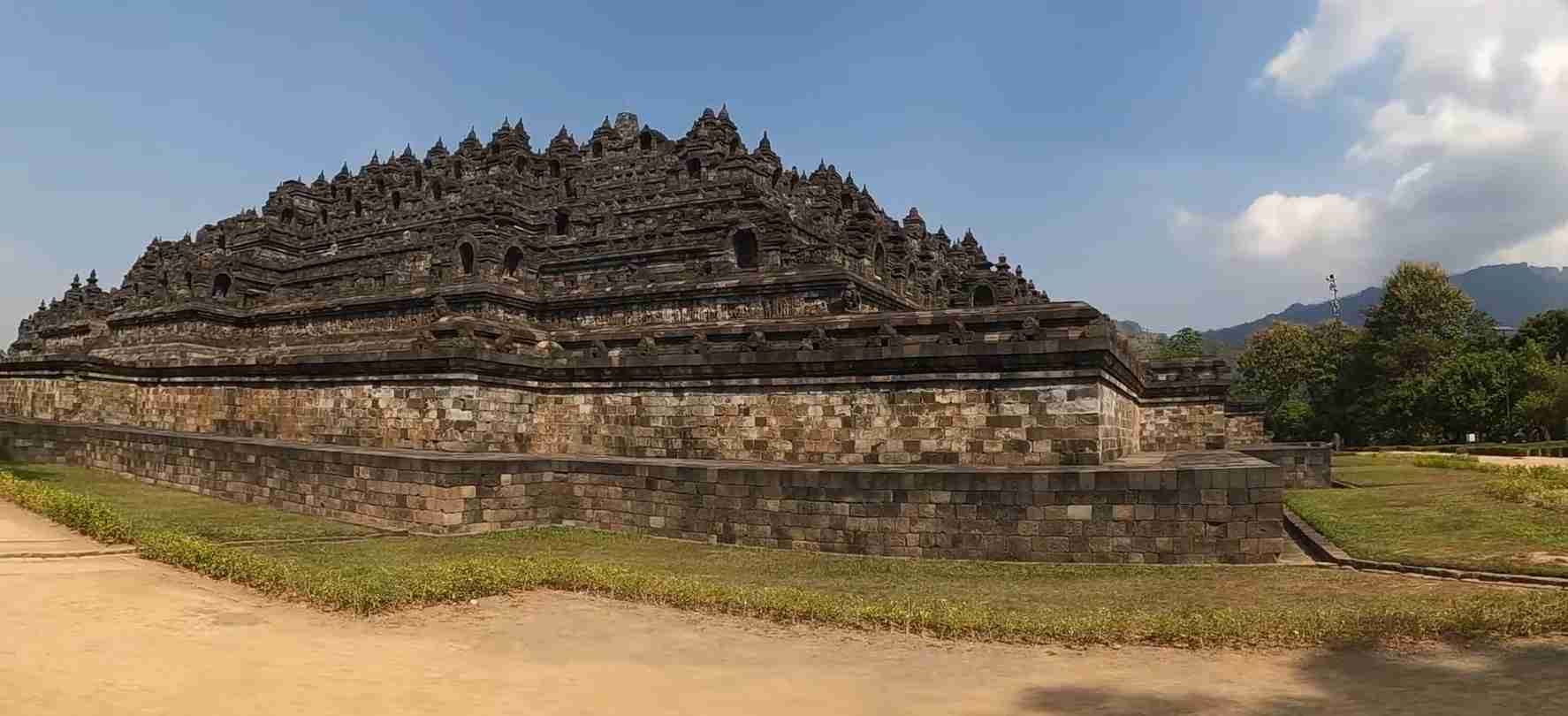
Borobudur Temple: World’s Largest Buddhist Monument
Rising from Central Java’s volcanic plains like a stone mountain crowned with stupas, Borobudur stands as humanity’s most ambitious attempt to render Buddhist cosmology in architectural form—a ninth-century masterpiece where over 2,600 relief panels and 500 Buddha statues guide pilgrims through a three-dimensional mandala representing the soul’s journey from earthly desire through higher consciousness toward ultimate enlightenment. This colossal monument transforms abstract spiritual concepts into walkable sacred geometry, inviting each visitor to physically ascend through the realms of existence while contemplating the path to nirvana.
Key Takeaways About Borobudur Temple
- Borobudur comprises nine stacked platforms—six square terraces representing the realm of forms and three circular platforms symbolizing the formless realm—constructed from approximately 1.6 million blocks of volcanic andesite stone assembled without mortar using precise interlocking techniques that have withstood centuries of earthquakes and volcanic eruptions
- The monument functions as a three-dimensional mandala measuring 118 meters square at its base and rising 35 meters high, designed for ritual circumambulation where pilgrims walk clockwise through nearly five kilometers of corridors ascending from the lowest platform to the central stupa at the summit
- A total of 2,672 relief panels carved into the temple walls depict Buddhist teachings including Jataka tales (stories of Buddha’s previous lives), the life of Gautama Buddha, and the Gandavyuha sutra, forming the world’s most extensive and complete collection of Buddhist stone reliefs
- The three-realm structure embodies Buddhist cosmology: Kamadhatu (world of desire) at the hidden base, Rupadhatu (world of forms) on the square terraces, and Arupadhatu (formless world) on the circular platforms where 72 perforated stupas each contain a seated Buddha statue visible through diamond-shaped openings
- Constructed during the Sailendra Dynasty’s reign between approximately 750-842 CE, Borobudur remained active as a Buddhist pilgrimage site until the 14th-15th centuries when the monument was abandoned as Islam spread through Java, remaining buried under volcanic ash and jungle vegetation for centuries until rediscovery in 1814
- UNESCO designated Borobudur as a World Heritage Site in 1991 following major restoration efforts during the 1970s-1980s that dismantled and reconstructed upper levels while installing modern drainage systems and stabilization measures to protect the monument from tropical weathering and structural deterioration
People Also Ask About Borobudur Temple
Why is Borobudur considered the world’s largest Buddhist monument?
Borobudur holds the title of world’s largest Buddhist monument based on its total volume of stone construction and the sheer scale of its integrated architectural and sculptural program, with approximately 1.6 million cubic feet of volcanic andesite blocks forming a massive stepped pyramid covering an area of nearly 14,000 square meters at its base. While other Buddhist structures may reach greater heights (certain pagodas in Myanmar and Thailand tower higher vertically), Borobudur’s combination of immense footprint, nine-level terraced structure rising 35 meters, and comprehensive decorative program featuring 2,672 relief panels plus 504 Buddha statues creates an unmatched monumentality in Buddhist architecture. The temple’s significance lies not merely in physical dimensions but in its complete realization of Buddhist cosmological concepts in stone—functioning simultaneously as stupa, mandala, and sacred mountain—representing the most ambitious architectural expression of Mahayana Buddhist philosophy ever constructed. Angkor Wat in Cambodia, though larger in total temple complex area, serves primarily Hindu purposes despite later Buddhist use, while Borobudur remains purpose-built as a purely Buddhist monument from its ninth-century origins.
What is the meaning of the three levels at Borobudur?
The three architectural levels at Borobudur represent the three realms of existence in Buddhist cosmology, creating a physical manifestation of the spiritual journey toward enlightenment that pilgrims experience by ascending through the monument. The lowest level, Kamadhatu (realm of desire), originally featured 160 relief panels depicting the law of karma—showing both sinful acts leading to suffering and virtuous deeds resulting in rewards—though these panels now remain largely hidden beneath an encasing platform added during construction to prevent structural collapse. The middle level comprising six square terraces constitutes Rupadhatu (realm of forms), where spiritual practice begins refining consciousness but physical forms still exist, represented through 1,300+ relief panels depicting Buddha’s life and Jataka tales plus 432 Buddha statues in niches along the terrace walls. The highest level consisting of three circular platforms embodies Arupadhatu (formless realm), where form dissolves into pure spiritual essence, manifested architecturally through the transition from square to circular geometry and the presence of 72 perforated stupas containing seated Buddhas visible yet enclosed, symbolizing the attainment of enlightenment while still perceiving the world. This vertical progression mirrors the Bodhisattva’s path through ten stages of spiritual development, with each ascending terrace representing deeper levels of wisdom and detachment from worldly existence.
How long did it take to build Borobudur Temple?
Borobudur’s construction spanned approximately 75 years based on architectural analysis and comparison with dated inscriptions from the period, beginning around 750 CE during the early Sailendra Dynasty reign and reaching completion near 825 CE under King Samaratungga or possibly his daughter Queen Pramudawardhani. The extended construction timeline reflects the monument’s extraordinary scale and complexity, requiring quarrying, transporting, and precisely shaping roughly 1.6 million blocks of volcanic andesite stone from nearby riverbeds, then assembling these blocks using sophisticated interlocking joinery without any mortar binding—a technique demanding exceptional engineering skill and geometric precision. Historical evidence suggests the temple architect Gunadharma designed the overall structure, though no contemporary inscriptions explicitly documenting Borobudur’s construction have survived, leaving scholars to estimate dates through artistic style analysis comparing relief carving techniques and Buddhist iconography with other dated monuments across Java and Southeast Asia. The labor force likely numbered in the thousands, including skilled stonemasons for carving the intricate reliefs depicting Buddhist narratives, sculptors for creating the Buddha statues, engineers for planning the terraced structure and drainage systems, and countless workers for quarrying and moving the massive stone blocks—all sustained through the Sailendra kingdom’s wealth derived from agricultural productivity in Java’s fertile volcanic plains and maritime trade connections throughout the Indonesian archipelago.
What happened to Borobudur after it was abandoned?
Following abandonment sometime during the 14th-15th centuries as Javanese society converted to Islam and political power shifted eastward from Central Java, Borobudur gradually disappeared beneath layers of volcanic ash from repeated Mount Merapi eruptions combined with encroaching tropical jungle vegetation that obscured the monument from view and memory for approximately four centuries. The temple remained present in local Javanese oral traditions and folklore as a place of misfortune or cursed ruins, with villagers avoiding the site and occasionally using exposed stones as building materials for nearby structures, though the complete extent of the monument stayed unknown as thick forest and ash deposits buried the lower terraces and relief panels. British Lieutenant-Governor Sir Thomas Stamford Raffles, an enthusiastic amateur archaeologist governing Java during brief British occupation from 1811-1816, learned of the monument’s existence through local reports and commissioned Dutch engineer H.C. Cornelius to investigate, leading to Cornelius organizing 200 workers to clear vegetation and excavate during 1814, revealing Borobudur’s extraordinary sculptural program to modern scholarship for the first time since medieval abandonment. Subsequent centuries witnessed gradual deterioration through stone theft by collectors and villagers, damage from tropical weathering and biological growth, and the 1985 terrorist bombing that destroyed nine stupas, ultimately necessitating the comprehensive UNESCO restoration program during the 1970s-1980s that dismantled, cleaned, and reconstructed the upper terraces while installing modern engineering solutions preventing further decay—transforming Borobudur from endangered ruin into protected world heritage monument visited by millions annually.
Extended multi-day tours – 5+ days
Featured Java Multi-Day Tour Packages

11 days
Indonesia: Highlights of Java
- ✓ Comprehensive Java tour
- ✓ Expert local guides included
- ✓ All accommodation arranged
- ✓ Transportation provided
5 days
Amazing Yogyakarta Tour With Local People
- ✓ Booking needs min. 2 travelers
9 days
From Jakarta : Best Highlight Java Trip : Private Tour
- ✓ Comprehensive Java tour
- ✓ Expert local guides included
- ✓ All accommodation arranged
- ✓ Transportation provided
8 days
Classic Java: Borobudur & Mt Bromo
- ✓ Comprehensive Java tour
- ✓ Expert local guides included
- ✓ All accommodation arranged
- ✓ Transportation provided
Multi-day tour packages powered by TourRadar. Prices and availability subject to change.
Introduction: Borobudur’s Significance in Buddhist Architecture
Among the world’s religious monuments, few achieve Borobudur’s synthesis of architectural ambition, spiritual symbolism, and artistic accomplishment. This massive stone structure rising from Java’s Kedu Valley represents the culmination of eighth-century Buddhist civilization in maritime Southeast Asia—a period when Indian Ocean trade networks carried not only spices and textiles but also religious ideas, architectural knowledge, and artistic traditions from the Indian subcontinent to the Indonesian archipelago, where they merged with indigenous Javanese culture creating distinctive hybrid forms.
Borobudur’s uniqueness stems from its integration of multiple Buddhist architectural traditions into a coherent whole. The monument simultaneously functions as stupa (reliquary mound), temple (sacred structure), mandala (cosmic diagram), and symbolic representation of Mount Meru (the cosmic mountain at the universe’s center in Hindu-Buddhist cosmology). This multivalent character distinguishes Borobudur from other great Buddhist monuments: unlike the relic stupas of India built primarily as devotional shrines, or the monastery complexes of Tibet designed for monastic community, or the pagodas of East Asia emphasizing vertical aspiration, Borobudur creates an experiential pilgrimage journey where architecture, sculpture, and sacred text combine guiding practitioners through visual meditation on the path to enlightenment.
The monument’s location in Central Java reflects the island’s historical importance as a cultural crossroads. During the eighth and ninth centuries, Java’s Sailendra Dynasty rulers patronized both Buddhist and Hindu monuments—Borobudur representing Buddhist achievement while the nearby Prambanan complex embodied Hindu architectural expression. This religious plurality demonstrates the sophisticated cosmopolitan culture characterizing early medieval Java, where ruling elites drew legitimacy and cultural prestige from multiple Indian religious traditions while maintaining distinctively Javanese artistic sensibilities visible in the naturalistic carving styles and narrative compositions adorning Borobudur’s walls.
Understanding Borobudur requires approaching the monument from multiple perspectives. As architecture, it demonstrates extraordinary engineering accomplishment—stacking nearly two million stone blocks without mortar into a stable structure surviving twelve centuries of earthquakes and volcanic activity. As religious art, the relief panels represent Buddhist narrative sculpture’s highest achievement, depicting complex theological concepts through imagery accessible to both learned monks and lay pilgrims. As sacred space, the monument creates a pilgrimage path transforming physical climbing into spiritual ascent, where each clockwise circumambulation around successive terraces marks progress through stages of consciousness toward enlightenment.
This guide explores Borobudur’s historical origins, architectural design, symbolic meanings, decorative programs, abandonment and rediscovery, modern conservation, and continuing spiritual significance, providing comprehensive understanding of why this monument stands as Buddhism’s greatest architectural legacy and one of humanity’s supreme creative achievements.
Historical Origins and Construction of Borobudur
Borobudur’s origins lie in the prosperous Sailendra Dynasty that ruled Central Java during the eighth and ninth centuries, a period of remarkable artistic and architectural flowering when wealthy kingdoms funded monumental temple construction throughout the fertile volcanic plains surrounding present-day Yogyakarta. The Sailendras (“Lords of the Mountain”) established their power through control of Java’s productive rice agriculture and participation in maritime trade networks connecting the Indonesian archipelago with India, China, and mainland Southeast Asia, accumulating wealth and cultural sophistication enabling patronage of ambitious religious projects.
The precise circumstances of Borobudur’s commissioning remain mysterious due to the absence of foundation inscriptions explicitly documenting the monument’s construction—a frustrating gap in the historical record considering the temple’s extraordinary scale. Scholars estimate construction began around 750 CE based on stylistic analysis of relief carvings and comparison with dated inscriptions from other Javanese monuments, with the project reaching completion near 825 CE during King Samaratungga’s reign or possibly under his daughter Queen Pramudawardhani. The approximately 75-year construction timeline reflects not only the monument’s immense size but also the meticulous craftsmanship required for carving thousands of relief panels and hundreds of Buddha statues while maintaining precise geometric proportions throughout the nine-level structure.
The temple’s architect, according to Javanese tradition named Gunadharma, designed Borobudur as a synthesis of Indian Buddhist architectural concepts adapted to Javanese conditions and aesthetic preferences. Indian influence appears clearly in the stupa form, mandala layout, and iconographic programs depicting scenes from Sanskrit Buddhist texts, while distinctively Javanese characteristics emerge in the naturalistic relief carving styles, the integration with the natural hilltop landscape, and certain architectural details unknown in Indian prototypes. This creative adaptation demonstrates how Javanese craftsmen and religious thinkers absorbed foreign traditions while developing original solutions to architectural and symbolic challenges.
Construction required mobilizing enormous resources across decades. Workers quarried volcanic andesite stone from nearby riverbeds, where natural erosion and geological processes provided ready access to building materials. The stones were shaped using iron tools, with evidence suggesting that relief carving occurred after blocks were positioned in the monument rather than pre-carving stones before assembly—allowing sculptors to create continuous narrative sequences spanning multiple blocks. The interlocking joinery system joining stones without mortar demanded sophisticated geometric planning, with each block cut to precise dimensions ensuring structural stability through compression and friction rather than adhesive bonding.
The labor force organization remains speculative, though parallels with other great monuments suggest a combination of corvée labor (peasants fulfilling tax obligations through construction work), skilled craftsmen employed by the court, and possibly enslaved workers. Supporting this workforce required vast logistical systems providing food, tools, and materials across the 75-year construction period—representing a massive economic investment by successive Sailendra rulers who valued religious merit-making through architectural patronage as central to kingship’s spiritual and political dimensions.
Architectural Structure and Design Principles
Borobudur’s architectural form consists of nine stacked platforms creating a stepped pyramid structure: a square base platform (often called the tenth level when counting from bottom to top), five square terraces of progressively decreasing size, and three circular platforms crowned by a massive central stupa. The monument rises 35 meters from ground level to the summit, with the base platform measuring 118 meters on each side—covering an area of approximately 14,000 square meters and requiring roughly 1.6 million cubic feet of stone for construction.
The transition from square to circular geometry marks Borobudur’s most symbolically significant architectural feature. The six square levels correspond to the Buddhist realm of forms (Rupadhatu), where physical reality and spiritual practice coexist. The three circular levels represent the formless realm (Arupadhatu), where physical constraints dissolve into pure consciousness. This geometric progression from square to circle mirrors the spiritual journey from worldly existence through progressive stages of detachment culminating in enlightenment’s formless perfection—making the very shape of the temple a three-dimensional diagram of Buddhist cosmology.
The monument features 2,672 relief panels carved into the walls and balustrades of the terraces, creating the world’s most extensive Buddhist relief sculpture collection. These panels average approximately one square meter each, totaling over 2,500 square meters of carved surface depicting scenes from Buddhist texts. The relief sequences are designed for clockwise circumambulation (pradakshina), with pilgrims walking around each terrace level viewing the narrative panels in order while gradually ascending toward the summit—a ritual journey spanning nearly five kilometers if walking every gallery at each level.
The 504 Buddha statues distributed throughout Borobudur occupy niches in the terrace walls and perforated stupas on the circular platforms. The square terrace Buddhas display four different mudras (hand gestures) corresponding to the cardinal directions: Akshobhya mudra (touching the earth) facing east, Ratnasambhava mudra (giving) facing south, Amitabha mudra (meditating) facing west, and Amoghasiddhi mudra (fearlessness) facing north. The circular terrace Buddhas within the 72 perforated stupas all display the Dharmachakra mudra (turning the wheel of dharma), symbolizing the teaching of Buddhist doctrine to all directions.
The central stupa crowning Borobudur’s summit measures 15 meters in diameter, rising above the surrounding perforated stupas as the monument’s culminating architectural element. Unlike the perforated stupas containing visible Buddha statues, the central stupa remains solid and sealed, with scholarly debate continuing regarding whether it originally contained a Buddha statue, sacred relics, or remained intentionally empty—the void itself symbolizing ultimate reality’s formless nature beyond representation.
Borobudur’s drainage system demonstrates sophisticated engineering understanding of tropical weathering challenges. Hidden channels carved into the stone blocks and concealed within the structure direct rainwater away from the monument, preventing water accumulation that would cause structural damage through erosion, freeze-thaw cycles, and biological growth. The modern UNESCO restoration enhanced this system with additional drainage layers, though the original eighth-century engineers already recognized and addressed water management as critical for the monument’s long-term survival.
The Three-Dimensional Mandala: Sacred Geometry in Stone
Borobudur functions as a three-dimensional mandala, transforming the two-dimensional sacred diagrams used in Buddhist meditation practice into walkable architectural space where pilgrims physically inhabit the geometric patterns representing cosmic order and enlightened consciousness. This architectural innovation represents one of Borobudur’s most profound achievements—creating a structure that simultaneously serves as monument, meditation tool, and symbolic universe.
The mandala concept originates in Indian religious traditions, where circular geometric diagrams represent the cosmos, divine realms, and the enlightened mind’s structure. In Buddhist practice, meditators visualize mandalas mentally while contemplating the paths to enlightenment, using the diagrams as focal points for concentration and visualization exercises. Borobudur expands this mental practice into physical form, allowing practitioners to walk through the mandala’s sacred geometry while viewing relief panels depicting the spiritual journey—combining bodily movement, visual contemplation, and doctrinal instruction into integrated pilgrimage experience.
The monument’s square base and circular top create the fundamental mandala pattern of squared circle or circled square—geometric forms symbolizing the union of earth (square) and heaven (circle), matter and spirit, temporal and eternal. The progression from square terraces through transitional zones to circular platforms mirrors the spiritual transformation from earthly existence bound by physical forms through intermediate states of refinement toward the formless perfection of enlightened consciousness.
The cardinal orientation structures Borobudur’s mandala organization, with stairways positioned at each of the four directions (east, south, west, north) allowing pilgrims to enter the monument from any side. This four-directional symmetry reflects Buddhist cosmology positioning Mount Meru at the universe’s center with continents arranged in the four cardinal directions, while also enabling ritual circumambulation to begin from any gateway—democratic access contrasting with some Hindu temple complexes restricting entry to specific castes or ritual specialists.
The concentric arrangement of terraces creates nested mandalas diminishing in scale as they ascend, producing visual rhythm and symbolic hierarchy where outer levels correspond to preliminary spiritual stages and inner levels represent advanced consciousness states. This concentric design appears most clearly when viewing Borobudur from above, where the monument’s layout resembles traditional mandala diagrams with outer walls, intermediate courts, and inner sanctum arranged in perfect symmetry around the central axis marked by the summit stupa.
The number symbolism embedded in Borobudur’s structure demonstrates sophisticated mathematical and cosmological knowledge. The nine levels represent the nine stages of Bodhisattva development leading to Buddhahood. The 72 perforated stupas on the circular terraces relate to numerological significance in Buddhist tantric texts. The carefully calculated proportions maintaining harmonic ratios between base width, terrace heights, and summit elevation create aesthetic unity while encoding sacred geometric principles believed to embody cosmic order’s mathematical perfection.
Buddhist Cosmology in Stone: The Three Realms
Borobudur’s three-level structure embodies the three realms (triloka or tridhatu) of Buddhist cosmology, creating architectural representation of the entire universe as conceived in Mahayana Buddhist philosophy. This cosmological mapping transforms abstract theology into concrete spatial experience, allowing pilgrims to literally ascend through the realms of existence while contemplating their spiritual significance.
Kamadhatu: The Realm of Desire
The lowest level, Kamadhatu (realm of desire), corresponds to ordinary worldly existence dominated by sensory pleasures, material attachments, and karmic consequences of moral actions. At Borobudur, this realm originally appeared in 160 relief panels carved on the monument’s true base, depicting the Karmavibhangga (explanation of karmic law) showing both sinful acts leading to hellish punishments and virtuous deeds resulting in heavenly rewards. These explicit, sometimes shocking scenes illustrated cause-and-effect relationships governing worldly existence—graphically demonstrating how actions produce consequences across lifetimes through the mechanism of karma and rebirth.
Shortly after construction began, builders encased the original base with an additional stone platform, hiding the Kamadhatu reliefs beneath this covering layer. Theories explaining this architectural modification include structural concerns about the original foundation’s stability on the natural hill, or possibly religious considerations that the explicit Kamadhatu imagery proved too disturbing for public display. Archaeological excavations during the 1890s exposed a section of the hidden base, revealing these remarkable reliefs to modern scholarship, though most remain concealed beneath the encasing platform preserving the monument’s structural integrity.
Rupadhatu: The Realm of Forms
The middle level comprising five square terraces represents Rupadhatu (realm of forms), where spiritual practice and ethical discipline refine consciousness but physical forms and mental concepts still exist. This transitional realm corresponds to meditative states where practitioners develop concentration, wisdom, and compassion while not yet achieving complete liberation from conceptual thinking and phenomenal perception.
The Rupadhatu terraces feature approximately 1,300 relief panels depicting Buddhist narratives from multiple textual sources: the life of Gautama Buddha from birth through enlightenment to teaching and final nirvana, Jataka tales recounting Buddha’s previous lives as Bodhisattva demonstrating perfection of virtues across countless rebirths, Avadana stories illustrating karmic consequences and spiritual lessons, and most prominently the Gandavyuha sutra describing the pilgrim Sudhana’s quest for enlightenment through visiting 53 spiritual teachers. These narrative sequences guide pilgrims through Buddhist teachings while providing visual meditation subjects for contemplating the path to awakening.
The 432 Buddha statues occupying niches in the Rupadhatu terrace walls display four different mudras corresponding to cardinal directions and associated Buddha aspects, creating mandala-like arrangement where each direction contains specific Buddhas embodying particular wisdom qualities. Pilgrims circumambulating the terraces encounter these directional Buddhas in sequence, experiencing symbolic progression through different facets of enlightened consciousness.
Arupadhatu: The Formless Realm
The highest level consisting of three circular platforms embodies Arupadhatu (formless realm), representing consciousness states transcending physical forms, mental concepts, and dualistic thinking—approaching enlightenment’s non-dual awareness beyond subject-object distinctions. The architectural transition from square to circular geometry, from wall-enclosed terraces to open circular platforms, and from narrative reliefs to undecorated surfaces visually manifests the formless realm’s ineffable character.
The 72 perforated stupas arranged in concentric circles on the Arupadhatu platforms each contain a seated Buddha statue visible through diamond-shaped openings in the latticed stone walls. This architectural device creates paradoxical condition where Buddhas remain simultaneously visible yet enclosed, present yet withdrawn—symbolizing enlightened beings’ relationship to phenomenal reality as engaged yet detached, perceiving yet free from attachment to perception. The perforations allow partial visibility from different angles, with the Buddha statues appearing and disappearing depending on the viewer’s position during circumambulation—suggesting enlightenment’s elusive quality that cannot be grasped through ordinary perception.
The solid central stupa crowning the summit represents the ultimate goal—complete enlightenment beyond all forms, concepts, and representations. Whether this stupa originally contained a Buddha image, sacred relics, or remained intentionally empty continues debated among scholars, though the sealed, unadorned exterior suggests symbolic significance as the formless absolute transcending all manifestation.
The Relief Narratives: Buddhist Teachings in Stone
Borobudur’s 2,672 relief panels constitute the world’s most extensive and sophisticated Buddhist sculptural program, depicting narratives from multiple textual sources while demonstrating extraordinary artistic skill in translating religious literature into visual form. These relief sequences served didactic purposes, teaching Buddhist doctrine to both literate monks familiar with the Sanskrit and Pali source texts and illiterate pilgrims who could comprehend religious stories through the carved imagery.
Jataka Tales: Buddha’s Previous Lives
Jataka tales recounting Buddha’s previous births form major component of Borobudur’s relief program, with 120+ stories depicted across multiple terrace levels. These narratives demonstrate the Bodhisattva’s gradual perfection of virtues (paramitas) through countless lifetimes—showing how the future Buddha developed generosity, morality, patience, energy, concentration, and wisdom through dramatic encounters where he sacrificed personal welfare for others’ benefit. Famous Jataka stories appearing at Borobudur include the Vessantara Jataka (ultimate generosity), the Shama Jataka (filial devotion), and the Mahakapi Jataka (self-sacrifice as monkey king).
The relief carvers demonstrated remarkable creativity adapting literary narratives to visual medium, using architectural and natural elements to indicate settings, employing scale variations showing important characters larger than minor figures, and creating continuous narrative composition where single panels depict multiple sequential moments from the same story—techniques allowing complex tales to unfold across limited carved space.
The Life of Buddha Gautama
Approximately 120 panels on the first gallery terrace depict the historical Buddha’s life from miraculous conception and birth through renunciation, ascetic practices, enlightenment under the Bodhi tree, first sermon at Sarnath, forty-five years of teaching, and final passing into nirvana at Kushinagar. These biographical reliefs follow the Lalitavistara, a Mahayana text elaborating Buddha’s life story with supernatural elements emphasizing his cosmic significance beyond ordinary human biography.
The Buddha life panels showcase Javanese sculptors’ naturalistic style, depicting palace scenes, forest hermitages, village settings, and celestial realms with careful attention to architectural details, costume, flora and fauna—creating visual encyclopedia of eighth-century Javanese material culture alongside religious narrative. The carving quality ranges from deeply undercut three-dimensional figures projecting dramatically from background surfaces to delicate low-relief details, demonstrating technical mastery across the relief program’s vast extent.
The Gandavyuha: Sudhana’s Pilgrimage
The Gandavyuha sutra, occupying 460 panels across the upper terrace levels, recounts the spiritual journey of Sudhana, a young seeker who visits 53 teachers including kings, merchants, ascetics, goddesses, and Bodhisattvas, learning different aspects of enlightenment from each encounter before finally achieving supreme realization through meeting Samantabhadra Bodhisattva. This text held special significance for Mahayana Buddhism, illustrating the principle that enlightenment emerges through encountering diverse teachers and experiences rather than single authoritative instruction.
The Gandavyuha reliefs at Borobudur create meta-pilgrimage narrative, where carved depictions of Sudhana’s journey mirror the actual pilgrims’ circumambulation through the temple—both seeking enlightenment through progressive encounters with sacred teachings. This parallel between depicted narrative and pilgrim experience makes Borobudur itself function as one of Sudhana’s teachers, offering visual instruction guiding consciousness toward awakening.
The Buddha Statues and Symbolic Mudras
The 504 Buddha statues distributed throughout Borobudur embody the Dhyani Buddha system central to Mahayana and Vajrayana Buddhist iconography, where five transcendent Buddhas represent different aspects of enlightened consciousness and cosmic directions. The statues’ hand gestures (mudras) communicate specific meanings, creating symbolic program coordinating with the mandala structure and cosmological organization.
The square terrace Buddhas display four directional mudras: Akshobhya mudra (bhumisparsha or earth-touching gesture) facing east, symbolizing Buddha’s enlightenment when calling the earth goddess to witness his spiritual attainment; Ratnasambhava mudra (varada or gift-giving gesture) facing south, representing generosity and fulfillment of wishes; Amitabha mudra (dhyana or meditation gesture) facing west, embodying meditative concentration and inner peace; and Amoghasiddhi mudra (abhaya or fearlessness gesture) facing north, symbolizing protection and fearless compassion. These directional Buddhas transform each terrace circumambulation into encounter with different enlightened qualities, with pilgrims mentally absorbing these spiritual characteristics through contemplating the Buddha images.
The 72 perforated stupa Buddhas on the circular platforms all display the Dharmachakra mudra (wheel-turning gesture), symbolizing the Buddha’s first sermon at Sarnath when he “set the wheel of dharma in motion” by teaching the Four Noble Truths and Eightfold Path. This unified mudra across the formless realm platforms suggests the ultimate teaching transcending directional divisions—enlightenment’s universal truth applicable to all beings regardless of orientation or circumstance.
Many Buddha statues have suffered damage over centuries through weathering, vandalism, and theft, with heads particularly vulnerable to collectors seeking portable antiquities. The 1973-1983 UNESCO restoration addressed statue conservation, though numerous niches remain empty where statues disappeared during the monument’s abandoned period or were removed by colonial-era collectors before protective legislation.
Decline and Abandonment: The Lost Centuries
Borobudur functioned as active pilgrimage center for approximately 400-500 years following completion, serving Buddhist communities throughout Java and possibly attracting pilgrims from other parts of maritime Southeast Asia connected through trade networks. Evidence of continuing religious use appears in the eighth through thirteenth centuries, though specific details of ritual practices remain largely unknown due to limited written documentation from this period.
The gradual abandonment of Borobudur during the 14th-15th centuries resulted from multiple converging factors. The spread of Islam through Java beginning in the 13th century gradually reduced Buddhist communities as Javanese society converted to the new religion, eliminating the population base supporting temple maintenance and pilgrimage activity. Political changes saw power shifting from Central Java eastward to kingdoms based in East Java, reducing royal patronage for monuments in the Kedu Valley region. Volcanic eruptions from Mount Merapi deposited layers of ash covering portions of the monument, while earthquakes possibly damaged structural elements, making access difficult and discouraging continued use.
Local Javanese retained awareness of Borobudur’s existence through oral traditions, though the monument’s specific history and Buddhist identity faded from collective memory. Some traditions described the ruins as cursed or haunted, discouraging close approach, while others viewed exposed stones as convenient building materials for village construction. The monument gradually disappeared beneath accumulating volcanic deposits and encroaching tropical vegetation, with trees and vines growing across the terraces and galleries, obscuring the relief panels and Buddha statues from view.
This abandonment period paradoxically contributed to Borobudur’s preservation. While lack of maintenance allowed weathering and biological damage, the concealing vegetation and ash deposits protected many reliefs from vandalism and stone theft that might have occurred had the monument remained fully accessible and visible. The tropical climate’s rapid plant growth created natural protective covering preventing more severe erosion, effectively placing Borobudur in dormant state awaiting eventual rediscovery.
Rediscovery and Modern History
British Lieutenant-Governor Sir Thomas Stamford Raffles rediscovered Borobudur for Western scholarship in 1814 during the brief period of British rule over Java (1811-1816) following Napoleon’s conquest of the Netherlands. Raffles, an enthusiastic amateur scholar interested in Javanese history and archaeology, heard local reports about ancient ruins buried in jungle near Magelang and commissioned Dutch engineer H.C. Cornelius to investigate the site.
Cornelius organized 200 workers for two months cutting down trees, removing vegetation, and excavating volcanic ash deposits, revealing the monument’s extraordinary extent for the first time in modern era. His preliminary survey documented Borobudur’s basic structure and reported the existence of relief panels and Buddha statues, though complete clearing required decades of additional work. Raffles’ published account in his 1817 book “History of Java” introduced Borobudur to European scholarly attention, stimulating subsequent archaeological investigation throughout the nineteenth century.
The Dutch colonial government initiated systematic clearing and documentation from the 1840s onward, with major campaigns in 1873 and 1907-1911 led by engineer Theodoor van Erp removing all vegetation, photographing and cataloging reliefs, and attempting first structural repairs. Van Erp’s work revealed the monument’s deteriorated condition, with many stones displaced, drainage systems clogged, and structural integrity compromised by centuries of weathering and plant growth. His restoration efforts stabilized certain areas but lacked modern engineering techniques and materials needed for comprehensive conservation.
Post-independence Indonesia recognized Borobudur as supreme national heritage monument symbolizing the country’s pre-Islamic cultural greatness. The temple appeared on currency, postage stamps, and tourism promotional materials, while successive governments struggled with conservation challenges as tropical weathering, biological growth, and increasing visitor traffic accelerated deterioration threatening the monument’s survival.
The 1985 terrorist bombing by Islamic extremists damaged nine stupas on the upper terraces, shocking Indonesia and highlighting religious tensions regarding pre-Islamic heritage. The attack galvanized public support for stronger protection and accelerated conservation efforts, while demonstrating Borobudur’s continuing significance as contested symbol in Indonesian cultural politics.
UNESCO Restoration and Conservation Efforts
The Indonesian government requested UNESCO assistance in 1968 for comprehensive Borobudur restoration, leading to the largest and most expensive monument conservation project ever undertaken in the Southern Hemisphere. UNESCO coordinated international funding and technical expertise, with work proceeding from 1973 through 1983 at a cost exceeding $25 million (equivalent to over $150 million today).
The restoration employed radical approach dismantling the upper three circular terraces and the top three square terraces, cleaning and treating each stone individually, then rebuilding the entire upper monument section with modern engineering enhancements. Workers removed over 300,000 stones, each cleaned, photographed, catalogued, and treated with protective coatings before reassembly. This massive undertaking allowed installing new drainage systems, waterproofing layers, and structural reinforcements impossible to implement without complete dismantling.
Modern concrete foundation was poured beneath the reconstructed terraces, distributing weight more evenly and preventing structural settlement that had caused tilting and displacement in the original construction. New drainage channels were carved and water-resistant membranes installed directing rainwater away from vulnerable areas, addressing the primary cause of structural deterioration in tropical climates. Chemical treatments applied to stone surfaces inhibited biological growth (mosses, lichens, algae) and protected against acid rain and pollution damage.
The lower terraces, base platform, and hidden Kamadhatu reliefs received conservation treatment without dismantling, involving cleaning, biological growth removal, and stabilization of loose stones. Archaeological excavations exposed sections of the hidden base reliefs for study and limited public viewing while maintaining the encasing platform’s structural function.
UNESCO designated Borobudur as World Heritage Site in 1991, recognizing both the monument’s outstanding universal value and the successful restoration demonstrating international cooperation in cultural heritage preservation. This designation brought enhanced legal protection, ongoing monitoring, and continued funding for maintenance and conservation addressing ongoing challenges from weathering, pollution, volcanic activity, and tourism pressure.
Contemporary conservation focuses on preventive maintenance rather than major interventions, with regular monitoring of structural stability, drainage system function, biological growth, and stone deterioration. Visitor management strategies limit daily numbers accessing the terraces, designate specific pathways preventing excessive foot traffic damage, and restrict climbing on certain fragile sections. Research continues investigating advanced treatments protecting stone surfaces while allowing the monument to breathe and release moisture, preventing trapped humidity causing internal deterioration.
Spiritual and Cultural Significance Today
Borobudur maintains active spiritual significance despite Indonesia’s Muslim-majority population, serving as pilgrimage site for Indonesia’s Buddhist minority and international Buddhist visitors while functioning as powerful symbol of Indonesia’s diverse cultural heritage transcending religious boundaries. The monument represents pre-Islamic civilization’s achievements, demonstrating sophisticated artistic and architectural traditions that contemporary Indonesians regard as shared national heritage regardless of personal religious affiliation.
Annual Vesak Day celebrations commemorating Buddha’s birth, enlightenment, and death attract thousands of Buddhist pilgrims from Indonesia and abroad, with the Indonesian government designating Vesak as official national holiday acknowledging religious diversity. The ceremony begins at Mendut Temple before processing to Pawon and culminating at Borobudur, recreating the traditional three-temple pilgrimage route while demonstrating Buddhism’s continuing vitality in modern Indonesia despite representing small percentage of the population.
The monument attracts scholarly interest from Buddhist studies researchers, archaeologists, art historians, and religious specialists investigating questions regarding construction techniques, iconographic programs, textual sources for relief narratives, and relationships with broader Buddhist architectural traditions across Asia. International conferences and academic publications regularly examine new interpretations of Borobudur’s symbolism, ongoing conservation challenges, and the monument’s role in cultural identity formation.
Tourism brings millions of annual visitors experiencing Borobudur as aesthetic wonder, historical monument, and spiritual site regardless of religious background. The sunrise viewing experience particularly popular with tourists creates secular pilgrimage parallel to religious functions, where natural beauty and architectural grandeur combine producing contemplative atmosphere transcending specific doctrinal frameworks. This democratization of access allows Borobudur to function as shared human heritage inspiring diverse audiences through its artistic excellence and spiritual depth.
The tension between conservation and accessibility continues challenging management authorities, who must balance protecting fragile stone reliefs against visitor desires for close access and tactile experience. Current regulations restrict climbing to certain areas, prohibit touching reliefs and Buddha statues, and require visitors wear provided sandals on upper terraces protecting stone surfaces from modern shoe abrasion. These measures frustrate some visitors seeking unrestricted exploration but prove essential preventing irreversible damage to the ninth-century monument.
The Temple Complex: Mendut and Pawon
Borobudur forms part of three-temple complex aligned along a perfectly straight line, with Mendut Temple located 3 kilometers east and Pawon Temple positioned midway between Mendut and Borobudur. This spatial arrangement suggests intentional planning creating ritual pilgrimage route where ancient Buddhist practitioners began at Mendut, stopped at Pawon, and concluded at Borobudur—the three temples representing progressive stages in spiritual development.
Mendut Temple, though much smaller than Borobudur, contains remarkable sculptural treasures including a massive stone Buddha statue measuring 3 meters high seated in teaching posture, flanked by Bodhisattva Avalokiteshvara (embodying compassion) and Bodhisattva Vajrapani (embodying power). The Buddha’s serene expression and graceful proportions demonstrate Javanese sculptors’ mastery, while relief panels depicting Jataka tales on exterior walls connect thematically with Borobudur’s extensive narrative program. Mendut’s active function as contemporary Buddhist temple, with monks in residence and regular religious services, contrasts with Borobudur’s status as protected archaeological monument, though both share origins in Sailendra Dynasty patronage.
Pawon Temple occupies intermediate position both geographically and symbolically, its smaller scale and simpler decoration suggesting transitional purpose between the elaborate Mendut interior sculptures and Borobudur’s monumental exterior reliefs. Scholars debate Pawon’s specific ritual function, with theories suggesting use as purification site where pilgrims performed ablutions or ceremonies preparing for Borobudur’s sacred ascent. The temple’s architectural details mirror both Mendut and Borobudur, creating stylistic continuity across the three-temple complex.
The precise alignment of these three temples along a straight line running west-east suggests astronomical or cosmological significance, possibly referencing sacred geography concepts positioning temples according to cardinal directions, mountain locations, or celestial phenomena. This spatial relationship demonstrates sophisticated planning coordinating multiple monument constructions across considerable distances, requiring surveying skills and geometric knowledge ensuring proper alignment visible from Borobudur’s summit where pilgrims could view Mendut and Pawon along the sacred axis.
Experiencing Borobudur: Practical and Philosophical Dimensions
Visiting Borobudur offers multiple experience levels depending on preparation, knowledge, and openness to the monument’s spiritual dimensions. Casual tourists appreciate the architectural grandeur, photographic opportunities, and exotic cultural encounter, while serious students engage deeply with iconographic meanings, relief narratives, and Buddhist philosophy embodied in stone. The monument rewards both approaches, functioning simultaneously as spectacular visual experience and profound meditation on consciousness, existence, and liberation.
The traditional pilgrimage path follows clockwise circumambulation beginning at the eastern stairway (though modern tourist access allows any entry point), ascending gradually through the terraces while viewing relief panels in narrative sequence. Completing all gallery levels involves walking nearly five kilometers through covered corridors and open terraces, requiring 2-3 hours minimum depending on pace and attention to relief details. This extended walking meditation mirrors the Buddhist path’s gradual nature, where enlightenment emerges through patient accumulation of wisdom rather than sudden transformation.
Early morning visits, particularly around sunrise, provide optimal lighting conditions for photography while avoiding midday heat and afternoon crowds. The atmospheric effects when morning mist shrouds the Kedu Valley while the rising sun illuminates Borobudur’s upper terraces create ethereal beauty explaining the monument’s enduring aesthetic appeal. The relative quiet of dawn hours allows contemplative experience more conducive to understanding Borobudur’s spiritual intentions than crowded midday visits dominated by tour groups.
Understanding the relief narratives enhances appreciation significantly, though requires either advance study of Buddhist literature, hiring knowledgeable guides, or using detailed guidebooks identifying specific scenes and explaining their significance. Many relief sequences remain opaque to viewers lacking familiarity with Jataka tales, Buddha’s biography, or the Gandavyuha sutra, making the carved stones decorative art rather than legible text. Investing time learning the stories transforms the reliefs from attractive but mysterious carvings into coherent narratives communicating Buddhist teachings.
The monument’s scale and complexity reward multiple visits, as comprehending the entire iconographic program, architectural symbolism, and aesthetic subtleties exceeds single-visit capacity. Returning visitors notice details overlooked initially, understand relationships between different relief sequences, and appreciate how architectural form reinforces symbolic meanings—experiencing the cumulative effect Borobudur’s designers intended for pilgrims who might visit annually throughout their lives.
Photography restrictions on the upper circular terraces and central stupa protect these most sacred areas from commercial exploitation, though enforcement varies. Respecting these limitations acknowledges Borobudur’s continuing spiritual significance beyond tourist attraction, recognizing that some spaces deserve protection from complete documentation allowing mystery and sanctity to remain.
Frequently Asked Questions About Borobudur Temple
What makes Borobudur different from other Buddhist monuments?
Borobudur differs from other major Buddhist monuments through its unique combination of stupa, temple, and mandala functions integrated into single structure, whereas most Buddhist monuments emphasize one architectural type. Indian stupas like Sanchi serve primarily as reliquary mounds for circumambulation but lack extensive relief narratives or interior spaces, while Southeast Asian pagodas in Myanmar and Thailand prioritize vertical aspiration through spire architecture reaching toward heaven without Borobudur’s horizontal terraced progression through cosmological realms. The monument’s synthesis of architectural traditions created unprecedented form: stupa-shaped profile, temple-like platform construction, mandala geometric organization, and sacred mountain symbolism representing Mount Meru, all integrated into coherent whole expressing Mahayana Buddhist philosophy through spatial experience. Additionally, Borobudur’s extensive relief program featuring 2,672 narrative panels exceeds any comparable Buddhist monument, creating visual encyclopedia of Buddhist teachings unmatched in scope or artistic quality elsewhere in the Buddhist world.
Can visitors climb to the top of Borobudur?
Visitors can access most of Borobudur’s terraces including the upper circular platforms, though regulations implemented for conservation purposes restrict certain areas and require special footwear protecting the ninth-century stone from modern shoe abrasion. Current visitor management policies provide special sandals worn on the upper terraces, prohibit touching relief panels and Buddha statues to prevent cumulative damage from millions of hands, and designate specific pathways preventing excessive foot traffic on vulnerable areas. The central stupa remains closed to climbing, both for conservation and spiritual respect, with the sealed summit representing the ineffable ultimate reality beyond human reach. During peak visiting periods, authorities may implement crowd control measures limiting numbers ascending to upper levels simultaneously, preventing structural stress and allowing safer movement through narrow passages. These restrictions, while frustrating to some tourists seeking unrestricted exploration, prove essential for preserving the monument allowing future generations to experience Borobudur’s wonders, balancing access against conservation imperatives.
What is the meaning of the name Borobudur?
The name “Borobudur” remains etymologically uncertain despite extensive scholarly investigation, with multiple competing theories proposing different derivations from Sanskrit, Old Javanese, or hybrid linguistic sources. The most widely accepted theory derives “boro” from the Sanskrit word “vihara” meaning Buddhist monastery or temple, combined with “budur” possibly from “buduhur” or “beduhur” in Old Javanese meaning “high” or “mountain,” yielding interpretation “temple on the hill” or “high monastery” referencing the monument’s hilltop location and mountainous profile. Alternative theories suggest “boro” relates to “bara” meaning flame or light, or derives from “bhumi sambhara” (virtuous land), while “budur” might connect to Buddha himself or “ancient Buddha” interpretations. The earliest written reference appears in Sir Thomas Stamford Raffles’ 1817 “History of Java” using the spelling “Borobudur,” though no inscriptions from the monument’s construction period mention this name, leaving original ninth-century designation unknown—possibly lost during the abandonment centuries when oral traditions gradually forgot specific details. The mystery surrounding the name parallels other uncertainties about Borobudur’s origins, adding to the monument’s enigmatic character.
How did Borobudur survive volcanic eruptions and earthquakes?
Borobudur survived twelve centuries of volcanic eruptions and seismic activity through combination of sophisticated original engineering, favorable geological conditions, and fortunate circumstances protecting the monument during vulnerable periods. The interlocking stone construction without mortar creates flexible structure where individual blocks can shift slightly during earthquakes then resettle without catastrophic collapse, unlike rigid mortar-bound masonry that cracks catastrophically under seismic stress—demonstrating ancient engineers’ empirical understanding of earthquake-resistant design principles. The monument’s massive weight and low center of gravity provide inherent stability, while the stepped pyramid form distributes stresses efficiently through compression, allowing the structure to absorb vibrations without structural failure. Volcanic eruptions from Mount Merapi deposited ash layers that, while contributing to abandonment by obscuring the monument, simultaneously protected relief surfaces from weathering and created cushioning deposits absorbing seismic shocks. The natural hill foundation underlying Borobudur provides solid bedrock support superior to unconsolidated alluvial plains where other monuments sink or tilt over time. Additionally, the monument experienced centuries buried under vegetation and ash when earthquakes occurred, with concealing growth stabilizing loose stones and preventing displacement that might have happened had terraces remained fully exposed and accessible. The modern UNESCO restoration addressed accumulated damage from centuries of weathering and minor earthquake effects, installing additional structural reinforcements and drainage systems ensuring Borobudur’s continued survival against future natural disasters threatening Central Java’s active volcanic landscape.
What role did Borobudur play in ancient Javanese society?
Borobudur functioned as premier pilgrimage destination and Buddhist educational center for ancient Javanese society during the eighth through fourteenth centuries, serving religious, political, and economic purposes that extended beyond purely spiritual functions. The monument provided site for ritual circumambulation and meditation practices where Buddhist monks and lay devotees performed ceremonies seeking merit, spiritual advancement, and karmic benefits believed to improve current life circumstances and future rebirth conditions—making pilgrimage to Borobudur significant life event for pious Buddhists throughout Java and possibly maritime Southeast Asia. For Sailendra Dynasty rulers who commissioned construction, Borobudur demonstrated royal power, accumulated religious merit enhancing legitimacy, and created tangible symbol of the kingdom’s Buddhist commitment competing with Hindu kingdoms’ architectural achievements like nearby Prambanan—temple patronage serving political purposes asserting sovereign authority through spectacular monument visible across the Kedu Valley. The extensive relief program functioned as teaching tool for monks studying Buddhist texts, providing visual aids for memorizing narratives and doctrines in pre-printing era when written manuscripts remained scarce and expensive, making Borobudur essentially vast stone library preserving religious knowledge accessible through images rather than words. Economically, pilgrimage traffic generated income for surrounding villages providing accommodations, food, guide services, and ritual offerings, creating economic ecosystem supporting local populations—similar to how major pilgrimage sites worldwide generate regional prosperity beyond purely religious impacts. The monument’s scale required mobilizing enormous resources across generations, demonstrating state organizational capacity managing complex construction projects while suggesting that temple building served developmental purposes training artisans, organizing labor systems, and creating infrastructure supporting Sailendra political authority throughout Central Java.
Why are some Buddha statues missing their heads?
Missing Buddha statue heads at Borobudur result primarily from theft by collectors and art dealers during the nineteenth and early twentieth centuries when colonial authorities inadequately protected the abandoned monument, allowing systematic looting of portable antiquities that could be sold to European museums and private collectors. The heads, being relatively small and detachable compared to full statues, proved particularly vulnerable to removal, with looters using tools to sever heads from bodies then smuggling them off-site for sale—creating lucrative black market trade in Borobudur artifacts that depleted the monument’s sculptural program before effective legal protections were established. Additional damage occurred from vandalism by locals who feared or resented the pre-Islamic monument, natural weathering processes that weakened stone at the neck juncture making heads vulnerable to accidental detachment and falling, and deliberate iconoclasm during periods when religious extremists opposed preserving Buddhist heritage. Some missing heads appear in museum collections worldwide, particularly European institutions that acquired Javanese antiquities during colonial periods, creating ongoing repatriation debates as Indonesia seeks return of looted artifacts to their original contexts. The modern conservation regime protects remaining intact statues through surveillance, visitor management preventing touching, and security measures deterring theft, though restoration philosophy generally opposes creating modern replacement heads for decapitated statues—preserving the damaged condition as historical testimony to the monument’s tumultuous past rather than fabricating inauthentic completeness.
How does Borobudur compare to Angkor Wat?
Borobudur and Angkor Wat represent the two greatest religious monuments in Southeast Asia, though they differ significantly in scale, purpose, architectural tradition, and temporal development despite both employing mandala concepts and cosmic mountain symbolism. Angkor Wat, constructed in the twelfth century (approximately 300 years after Borobudur), covers far larger total area as part of extensive temple complex serving as state temple for Khmer Empire, combining Hindu temple functions with royal mortuary monument purposes, while Borobudur stands as independent Buddhist pilgrimage site focused on individual spiritual development rather than royal glorification. Architecturally, Angkor Wat features enclosed galleries, towers, bas-reliefs depicting Hindu epics especially the Ramayana and Mahabharata, and elaborate decorative programs celebrating Khmer kingship, whereas Borobudur emphasizes open terraces, stupa forms, and exclusively Buddhist narrative content teaching spiritual liberation—reflecting different religious priorities and architectural vocabularies. Angkor Wat remained continuously occupied and maintained transitioning from Hindu to Buddhist use as Cambodian society converted, while Borobudur experienced complete abandonment and centuries of neglect before modern rediscovery, creating different conservation challenges and heritage contexts. Both monuments employ mandala layouts, cardinal orientation, and cosmic mountain symbolism representing Mount Meru, demonstrating shared Southeast Asian architectural traditions adapting Indian religious concepts through local innovations. In terms of artistic achievement, Borobudur’s relief carving generally exhibits more naturalistic, graceful style compared to Angkor Wat’s more rigid, formalized approach, though both represent supreme examples of stone sculpture serving religious instruction. Ultimately, comparing the monuments proves less valuable than recognizing each as unique masterpiece reflecting different moments in Southeast Asian religious and artistic history—Borobudur embodying Buddhist Java’s cultural flowering, Angkor Wat representing Khmer Cambodia’s imperial zenith.
What happened to the Buddhist community that built Borobudur?
The Buddhist community that built and maintained Borobudur gradually diminished from the tenth century onward as Islam spread through Java, with complete disappearance occurring by the fifteenth century when the monument’s abandonment coincided with Java’s near-total conversion to Islam becoming the dominant religion throughout the Indonesian archipelago. The process occurred gradually over several centuries rather than sudden conquest, with Muslim traders and missionaries arriving from India, Arabia, and China establishing commercial settlements along Java’s coasts beginning around the thirteenth century, gradually spreading inland through trade relationships, intermarriage, and political alliances with local rulers seeking connections to expanding Islamic trade networks. As Javanese kings converted to Islam for political and economic advantages, royal patronage supporting Buddhist and Hindu temples ceased, removing the financial and institutional support maintaining monumental architecture while encouraging population conversion following elite example—typical pattern where religious change flows from ruling class downward through society. Additionally, volcanic eruptions and political instability during the fourteenth-fifteenth centuries prompted migration from Central Java’s Kedu Valley region toward eastern Java and coastal areas, reducing the local population supporting Borobudur’s maintenance and pilgrimage activities. Some Buddhist communities may have persisted in isolated pockets or relocated to other Indonesian islands like Bali where Hinduism-Buddhism survived Islamization, though Java’s Buddhist tradition essentially disappeared as distinct religious identity, with Buddhist practices either abandoned or absorbed into syncretic Javanese Islam incorporating pre-Islamic elements. Modern Indonesia’s small Buddhist minority primarily consists of Chinese Indonesians maintaining Chinese Buddhist traditions rather than descendants of ancient Javanese Buddhist communities, representing discontinuity rather than survival of the civilization that created Borobudur—making the monument orphaned masterpiece whose original religious context vanished centuries ago.
How long does it take to properly explore Borobudur?
Properly exploring Borobudur requires minimum 2-3 hours for basic circumambulation of all terrace levels while viewing major relief sequences, though comprehensive study of the entire iconographic program, architectural details, and Buddhist symbolism could occupy days or even weeks for scholars and serious students seeking deep engagement with the monument’s complexities. The standard tourist visit typically allocates 90 minutes to two hours, allowing ascent through the terraces, viewing representative relief panels, photographing Buddha statues and architectural features, and reaching the summit for panoramic views—sufficient for general appreciation but necessarily superficial given the monument’s vast scale and iconographic density. More thorough exploration dedicating 3-4 hours enables walking every gallery level reading relief narratives in sequence, studying different Buddha statue mudras, observing architectural transition from square to circular geometry, and allowing contemplative pauses experiencing the monument’s spiritual atmosphere beyond rushed sightseeing. Ideal approach involves multiple visits at different times (sunrise, midday, late afternoon) and seasons, as changing light conditions dramatically alter the monument’s appearance revealing details invisible under different illumination, while repeated exposure allows noticing subtleties and relationships between elements that single visits necessarily miss. Hiring knowledgeable guides adds significant value, as understanding relief narratives, Buddhist symbolism, and historical context transforms the carved stones from decorative art into legible teaching texts—though finding truly expert guides rather than superficial tour leaders requires careful selection and potentially additional expense. For visitors seriously interested in Buddhist art and architecture, preliminary study of relevant literature, iconographic conventions, and textual sources for relief narratives before arrival maximizes on-site comprehension, allowing limited visiting time to focus on observing details and nuances rather than struggling to understand basic concepts that could have been learned in advance through reading.
What conservation challenges does Borobudur face today?
Borobudur faces ongoing conservation challenges from biological growth (mosses, lichens, algae colonizing stone surfaces), atmospheric pollution causing acid rain damage, groundwater and drainage issues creating structural instability, tourism pressure from millions of annual visitors, and potential volcanic activity from Mount Merapi threatening catastrophic ash deposits or seismic damage. The tropical climate’s constant heat and humidity, combined with frequent rainfall, creates ideal conditions for biological organisms that break down stone surfaces through chemical and physical processes, requiring regular cleaning and treatment with biocides—though overly aggressive chemical treatments themselves risk damaging the ninth-century stone patina. Air pollution from nearby cities and volcanic emissions creates acidic atmospheric conditions accelerating stone weathering, particularly affecting the intricate relief carvings where fine details erode under chemical attack, necessitating ongoing research into protective coatings allowing stone to breathe while shielding from pollutants. Visitor foot traffic wearing down stone surfaces, touching reliefs and statues despite prohibitions, and generating waste requiring management creates cumulative impact degrading the monument, leading to controversial proposals limiting daily visitor numbers to sustainable levels balanced against economic dependence on tourism revenue. The natural hill foundation underneath Borobudur contains subsurface water flows potentially undermining stability if drainage systems fail, requiring constant monitoring and maintenance ensuring water diverts away from the structure rather than pooling beneath foundations causing settlement and displacement. Future volcanic eruptions from Mount Merapi, active throughout history with major events in 2010, pose existential threat through pyroclastic flows, earthquake damage, or thick ash deposits, though monitoring systems and emergency response planning aim to protect the monument during volcanic crises. These interconnected challenges require sustained conservation funding, ongoing scientific research developing improved protection methods, and careful management balancing preservation against access—ensuring Borobudur survives for future generations while remaining accessible to contemporary visitors and Buddhist communities maintaining spiritual connections to this supreme architectural achievement.